WO2024150784A1 - 粘着剤組成物、粘着剤層、粘着剤層付光学フィルムおよび表示装置 - Google Patents
粘着剤組成物、粘着剤層、粘着剤層付光学フィルムおよび表示装置 Download PDFInfo
- Publication number
- WO2024150784A1 WO2024150784A1 PCT/JP2024/000363 JP2024000363W WO2024150784A1 WO 2024150784 A1 WO2024150784 A1 WO 2024150784A1 JP 2024000363 W JP2024000363 W JP 2024000363W WO 2024150784 A1 WO2024150784 A1 WO 2024150784A1
- Authority
- WO
- WIPO (PCT)
- Prior art keywords
- meth
- acrylate
- group
- adhesive layer
- molecular weight
- Prior art date
- Legal status (The legal status is an assumption and is not a legal conclusion. Google has not performed a legal analysis and makes no representation as to the accuracy of the status listed.)
- Ceased
Links
Images

Classifications
-
- C—CHEMISTRY; METALLURGY
- C09—DYES; PAINTS; POLISHES; NATURAL RESINS; ADHESIVES; COMPOSITIONS NOT OTHERWISE PROVIDED FOR; APPLICATIONS OF MATERIALS NOT OTHERWISE PROVIDED FOR
- C09J—ADHESIVES; NON-MECHANICAL ASPECTS OF ADHESIVE PROCESSES IN GENERAL; ADHESIVE PROCESSES NOT PROVIDED FOR ELSEWHERE; USE OF MATERIALS AS ADHESIVES
- C09J133/00—Adhesives based on homopolymers or copolymers of compounds having one or more unsaturated aliphatic radicals, each having only one carbon-to-carbon double bond, and at least one being terminated by only one carboxyl radical, or of salts, anhydrides, esters, amides, imides, or nitriles thereof; Adhesives based on derivatives of such polymers
- C09J133/04—Homopolymers or copolymers of esters
- C09J133/06—Homopolymers or copolymers of esters of esters containing only carbon, hydrogen and oxygen, the oxygen atom being present only as part of the carboxyl radical
- C09J133/062—Copolymers with monomers not covered by C09J133/06
- C09J133/066—Copolymers with monomers not covered by C09J133/06 containing -OH groups
-
- C—CHEMISTRY; METALLURGY
- C08—ORGANIC MACROMOLECULAR COMPOUNDS; THEIR PREPARATION OR CHEMICAL WORKING-UP; COMPOSITIONS BASED THEREON
- C08K—Use of inorganic or non-macromolecular organic substances as compounding ingredients
- C08K5/00—Use of organic ingredients
- C08K5/54—Silicon-containing compounds
- C08K5/541—Silicon-containing compounds containing oxygen
- C08K5/5415—Silicon-containing compounds containing oxygen containing at least one Si—O bond
-
- C—CHEMISTRY; METALLURGY
- C09—DYES; PAINTS; POLISHES; NATURAL RESINS; ADHESIVES; COMPOSITIONS NOT OTHERWISE PROVIDED FOR; APPLICATIONS OF MATERIALS NOT OTHERWISE PROVIDED FOR
- C09J—ADHESIVES; NON-MECHANICAL ASPECTS OF ADHESIVE PROCESSES IN GENERAL; ADHESIVE PROCESSES NOT PROVIDED FOR ELSEWHERE; USE OF MATERIALS AS ADHESIVES
- C09J11/00—Features of adhesives not provided for in group C09J9/00, e.g. additives
- C09J11/02—Non-macromolecular additives
- C09J11/06—Non-macromolecular additives organic
-
- C—CHEMISTRY; METALLURGY
- C09—DYES; PAINTS; POLISHES; NATURAL RESINS; ADHESIVES; COMPOSITIONS NOT OTHERWISE PROVIDED FOR; APPLICATIONS OF MATERIALS NOT OTHERWISE PROVIDED FOR
- C09J—ADHESIVES; NON-MECHANICAL ASPECTS OF ADHESIVE PROCESSES IN GENERAL; ADHESIVE PROCESSES NOT PROVIDED FOR ELSEWHERE; USE OF MATERIALS AS ADHESIVES
- C09J133/00—Adhesives based on homopolymers or copolymers of compounds having one or more unsaturated aliphatic radicals, each having only one carbon-to-carbon double bond, and at least one being terminated by only one carboxyl radical, or of salts, anhydrides, esters, amides, imides, or nitriles thereof; Adhesives based on derivatives of such polymers
- C09J133/04—Homopolymers or copolymers of esters
- C09J133/06—Homopolymers or copolymers of esters of esters containing only carbon, hydrogen and oxygen, the oxygen atom being present only as part of the carboxyl radical
-
- C—CHEMISTRY; METALLURGY
- C09—DYES; PAINTS; POLISHES; NATURAL RESINS; ADHESIVES; COMPOSITIONS NOT OTHERWISE PROVIDED FOR; APPLICATIONS OF MATERIALS NOT OTHERWISE PROVIDED FOR
- C09J—ADHESIVES; NON-MECHANICAL ASPECTS OF ADHESIVE PROCESSES IN GENERAL; ADHESIVE PROCESSES NOT PROVIDED FOR ELSEWHERE; USE OF MATERIALS AS ADHESIVES
- C09J133/00—Adhesives based on homopolymers or copolymers of compounds having one or more unsaturated aliphatic radicals, each having only one carbon-to-carbon double bond, and at least one being terminated by only one carboxyl radical, or of salts, anhydrides, esters, amides, imides, or nitriles thereof; Adhesives based on derivatives of such polymers
- C09J133/04—Homopolymers or copolymers of esters
- C09J133/14—Homopolymers or copolymers of esters of esters containing halogen, nitrogen, sulfur or oxygen atoms in addition to the carboxy oxygen
-
- C—CHEMISTRY; METALLURGY
- C09—DYES; PAINTS; POLISHES; NATURAL RESINS; ADHESIVES; COMPOSITIONS NOT OTHERWISE PROVIDED FOR; APPLICATIONS OF MATERIALS NOT OTHERWISE PROVIDED FOR
- C09J—ADHESIVES; NON-MECHANICAL ASPECTS OF ADHESIVE PROCESSES IN GENERAL; ADHESIVE PROCESSES NOT PROVIDED FOR ELSEWHERE; USE OF MATERIALS AS ADHESIVES
- C09J175/00—Adhesives based on polyureas or polyurethanes; Adhesives based on derivatives of such polymers
- C09J175/04—Polyurethanes
-
- C—CHEMISTRY; METALLURGY
- C09—DYES; PAINTS; POLISHES; NATURAL RESINS; ADHESIVES; COMPOSITIONS NOT OTHERWISE PROVIDED FOR; APPLICATIONS OF MATERIALS NOT OTHERWISE PROVIDED FOR
- C09J—ADHESIVES; NON-MECHANICAL ASPECTS OF ADHESIVE PROCESSES IN GENERAL; ADHESIVE PROCESSES NOT PROVIDED FOR ELSEWHERE; USE OF MATERIALS AS ADHESIVES
- C09J7/00—Adhesives in the form of films or foils
- C09J7/30—Adhesives in the form of films or foils characterised by the adhesive composition
- C09J7/38—Pressure-sensitive adhesives [PSA]
-
- G—PHYSICS
- G02—OPTICS
- G02B—OPTICAL ELEMENTS, SYSTEMS OR APPARATUS
- G02B5/00—Optical elements other than lenses
- G02B5/30—Polarising elements
Definitions
- the present invention relates to a pressure-sensitive adhesive composition, and further to a pressure-sensitive adhesive layer containing the pressure-sensitive adhesive composition, and an optical film with a pressure-sensitive adhesive layer.
- Patent Document 1 proposes a composition that forms an adhesive for polarizing plates that has durability in high-temperature environments.
- the object of the present invention is to provide an adhesive that exhibits excellent heat resistance and mechanical strength.
- the present invention provides the following pressure-sensitive adhesive composition, pressure-sensitive adhesive layer, pressure-sensitive adhesive layer-attached optical film, and display device.
- a composition comprising a (meth)acrylic resin (A), a crosslinking agent (B), and a silane compound (C),
- the (meth)acrylic resin (A) is A structural unit derived from an alkyl (meth)acrylate (a) having a homopolymer glass transition temperature of less than 0° C.
- the polymer contains a structural unit derived from an alkyl (meth)acrylate (b) having a homopolymer glass transition temperature of 0° C.
- the (meth)acrylic resin (A) contains a high molecular weight region component and a low molecular weight region component, A pressure-sensitive adhesive composition, wherein the high molecular weight region component has a higher glass transition temperature than the low molecular weight region component.
- a pressure-sensitive adhesive composition wherein the high molecular weight region component has a higher glass transition temperature than the low molecular weight region component.
- Mw mass average molecular weight
- the pressure-sensitive adhesive composition according to any one of [1] to [4], wherein the alkyl (meth)acrylate (b) having a homopolymer glass transition temperature of 0° C. or higher includes at least one selected from the group consisting of methyl acrylate, methyl methacrylate, tert-butyl methacrylate, isobornyl methacrylate, and cyclohexyl methacrylate.
- a pressure-sensitive adhesive composition according to any one of [1] to [5], wherein the crosslinking agent (B) contains an aromatic isocyanate compound and contains 0.2 parts by mass or more and 5.0 parts by mass or less of the crosslinking agent (B) per 100 parts by mass of the (meth)acrylic resin.
- a pressure-sensitive adhesive layer comprising the pressure-sensitive adhesive composition according to any one of [1] to [6].
- a pressure-sensitive adhesive layer-attached optical film comprising an optical film and the pressure-sensitive adhesive layer according to [7] laminated on the optical film.
- the pressure-sensitive adhesive layer-attached optical film according to [8] wherein the optical film includes a polarizer.
- a display device comprising the pressure-sensitive adhesive layer-attached optical film according to [8] or [9].
- the present invention provides an adhesive that exhibits excellent heat resistance and mechanical strength.
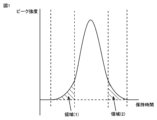
- FIG. 2 is a schematic diagram illustrating a high molecular weight region component and a low molecular weight region component contained in the (meth)acrylic resin (A).
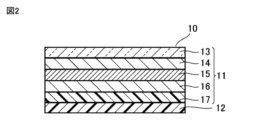
- 1 is a schematic cross-sectional view showing an example of a pressure-sensitive adhesive layer-attached optical film according to the present invention.
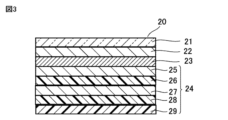
- FIG. 2 is a schematic cross-sectional view showing another example of a pressure-sensitive adhesive layer-attached optical film according to the present invention.
- 1 is a schematic cross-sectional view showing an example of an image display device according to the present invention.
- the (meth)acrylic resin (A) contained in the pressure-sensitive adhesive composition according to the present invention includes a structural unit derived from an alkyl (meth)acrylate (a) [hereinafter also referred to as alkyl (meth)acrylate (a)] having a homopolymer glass transition temperature (hereinafter also referred to as Tg) of less than 0° C., a structural unit derived from an alkyl (meth)acrylate (b) [hereinafter also referred to as alkyl (meth)acrylate (b)] having a homopolymer glass transition temperature of 0° C.
- Tg homopolymer glass transition temperature
- (meth)acrylic means that it may be either acrylic or methacrylic.
- (Meth)acrylate means that it may be either acrylate or methacrylate.
- the Tg of the homopolymer of alkyl (meth)acrylate (a) and (b) can be taken from literature values such as those in the POLYMER HANDBOOK (Wiley-Interscience).
- alkyl (meth)acrylates include alkyl groups such as ethyl acrylate, n- and i-propyl acrylate, n- and i-butyl acrylate, n-pentyl acrylate, n- and i-hexyl acrylate, n-heptyl acrylate, n- and i-octyl acrylate, 2-ethylhexyl acrylate, n- and i-nonyl acrylate, n- and i-decyl acrylate, and n-dodecyl acrylate.
- alkyl groups such as ethyl acrylate, n- and i-propyl acrylate, n- and i-butyl acrylate, n-pentyl acrylate, n- and i-hexyl acrylate, n-heptyl acrylate, n- and i-oc
- alkyl methacrylates having an alkyl group with a carbon number of 4 to 12, such as n-pentyl methacrylate, n- and i-hexyl methacrylate, n-heptyl methacrylate, n- and i-octyl methacrylate, 2-ethylhexyl methacrylate, n- and i-nonyl methacrylate, n-decyl methacrylate, and n-dodecyl methacrylate.
- the alkyl(meth)acrylate (a) may be an alkyl(meth)acrylate (cycloalkyl(meth)acrylate) having an alicyclic structure, but from the viewpoint of conformability (or flexibility or adhesion) to the optical film, an alkyl acrylate having a carbon number of 2 to 10, preferably an alkyl acrylate having a carbon number of 3 to 8, and more preferably an alkyl acrylate having a carbon number of 4 to 6 is preferred.
- the alkyl (meth)acrylate (a) may be used alone or in combination of two or more types.
- the content of the structural units derived from the alkyl (meth)acrylate (a) is preferably 40 parts by mass or more and 90 parts by mass or less, more preferably 45 parts by mass or more and 80 parts by mass or less, and even more preferably 50 parts by mass or more and 75 parts by mass or less, relative to 100 parts by mass of all the structural units constituting the (meth)acrylic resin (A).
- alkyl (meth)acrylates (b) include methyl acrylate, methyl methacrylate, stearyl acrylate, tert-butyl acrylate, ethyl methacrylate, isobutyl methacrylate, n-butyl methacrylate, sec-butyl methacrylate, tert-butyl methacrylate, propyl methacrylate, isopropyl methacrylate, etc.
- the alkyl (meth)acrylate (b) may be an alkyl (meth)acrylate having an alicyclic structure (cycloalkyl (meth)acrylate).
- the alicyclic structure may be a cycloparaffin structure having a carbon number of usually 5 or more, preferably about 5 to 7.
- alkyl (meth)acrylates having an alicyclic structure include isobornyl methacrylate, cyclohexyl methacrylate, dicyclopentanyl methacrylate, trimethylcyclohexyl methacrylate, tert-butylcyclohexyl methacrylate, 1-adamantyl methacrylate, isobornyl acrylate, cyclohexyl acrylate, dicyclopentanyl acrylate, cyclododecyl acrylate, methylcyclohexyl acrylate, trimethylcyclohexyl acrylate, tert-butylcyclohexyl acrylate, and ⁇ -ethoxycyclohexyl acrylate.
- the alkyl (meth)acrylate (b) may be used alone or in combination of two or more. From the viewpoint of adjusting the glass transition temperature of the low molecular weight region component and the high molecular weight region component, it is preferable to use an alkyl methacrylate and an alkyl acrylate in combination as the alkyl (meth)acrylate (b).
- the content of the structural units derived from the alkyl (meth)acrylate (b) is preferably from 1 to 40 parts by mass, more preferably from 3 to 30 parts by mass, and even more preferably from 5 to 20 parts by mass, per 100 parts by mass of all structural units constituting the (meth)acrylic resin (A).
- Alkyl (meth)acrylate (a) and alkyl (meth)acrylate (b) may be alkyl (meth)acrylates in which a substituent has been introduced into the alkyl group in the alkyl (meth)acrylate (the hydrogen atom of the alkyl group has been replaced with a substituent).
- the substituent may be, for example, an aryl group (such as a phenyl group), an aryloxy group (such as a phenoxy group), or an alkoxy group (such as a methoxy group or an ethoxy group).
- the polar group-containing monomer (c) can be an ethylenically unsaturated monomer having one or more polar groups in the molecular chain.
- Examples of the polar group include a hydroxyl group, a carboxyl group, and a nitrogen atom.
- the polar group-containing monomer (c) may be used alone or in combination of two or more types.
- the content of the constituent units derived from the polar group-containing monomer (c) is preferably from 0.1 to 10 parts by mass, more preferably from 0.3 to 5 parts by mass, and even more preferably from 0.5 to 3 parts by mass, per 100 parts by mass of all the constituent units constituting the (meth)acrylic resin (A), from the viewpoint of mechanical strength and heat resistance and durability.
- Examples of monomers having a hydroxyl group include those of the following formula (1):
- n represents an integer of 1 to 5;
- a 1 represents a hydrogen atom or an alkyl group;
- X1 represents a methylene group which may have a substituent;
- n is 2 or more, the X 1 may be the same or different.
- Examples of the hydroxyl group-containing (meth)acrylate include those represented by the following formula:
- examples of the alkyl group that can constitute A1 include alkyl groups having 1 to 10 carbon atoms, such as a methyl group, an ethyl group, a propyl group, an isopropyl group, a butyl group, a s-butyl group, a tert-butyl group, a pentyl group, and a hexyl group.
- alkyl groups having 1 to 10 carbon atoms such as a methyl group, an ethyl group, a propyl group, an isopropyl group, a butyl group, a s-butyl group, a tert-butyl group, a pentyl group, and a hexyl group.
- a methyl group is preferable.
- examples of the substituent that the methylene group that can constitute X1 may have include, for example, a halogen atom (a fluorine atom, a chlorine atom, a bromine atom, an iodine atom), an alkyl group (for example, an alkyl group having 1 to 10 carbon atoms, such as a methyl group, an ethyl group, a propyl group, an isopropyl group, a butyl group, a s-butyl group, a tert-butyl group, a pentyl group, or a hexyl group, preferably an alkyl group having 1 to 6 carbon atoms, and more preferably an alkyl group having 1 to 3 carbon atoms), a cycloalkyl group (a cyclopentyl group, a cyclohexyl group, etc.), an aryl group (a phenyl group, an alkylphenyl group (a fluorine
- halogen atom an alkyl group, an alkoxy group, an aryloxy group, etc. are preferred, and an alkyl group (e.g., a methyl group, an ethyl group, etc.) is particularly preferred.
- n may be, for example, an integer of 1 to 4, preferably an integer of 1 to 3, and more preferably 2.
- X 1 may be the same or different. That is, when n is 2 or more, X 1 may be composed of an unsubstituted methylene group, may be composed of an unsubstituted methylene group and a methylene group having a substituent, or may be composed of a methylene group having a substituent.
- the substituents may be the same or different.
- hydroxy group-containing (meth)acrylates include 1-hydroxy C1 to C8 alkyl (meth)acrylates such as 1-hydroxymethyl (meth)acrylate, 1-hydroxyethyl (meth)acrylate, 1-hydroxyheptyl (meth)acrylate, 1-hydroxybutyl (meth)acrylate, and 1-hydroxypentyl (meth)acrylate; 2-hydroxy C2 to C9 alkyl (meth)acrylates such as 2-hydroxyethyl (meth)acrylate, 2-hydroxypropyl (meth)acrylate, 2-hydroxybutyl (meth)acrylate, 2-hydroxypentyl (meth)acrylate, and 2-hydroxyhexyl (meth)acrylate; 3-hydroxypropyl (meth)acrylate, 3-hydroxybutyl (meth)acrylate, and 3-hydroxybutyl (meth)acrylate; ) acrylate, 3-hydroxypentyl (meth)acrylate, 3-hydroxyhexyl (meth)acrylate, 3-hydroxyheptyl (meth)acryl
- the hydroxyl group-containing (meth)acrylate may be used alone or in combination of two or more kinds.
- the content of the structural units derived from a hydroxyl group-containing (meth)acrylate is preferably from 0.3 to 5.5 parts by mass, more preferably from 0.3 to 4 parts by mass, even more preferably from 0.4 to 3 parts by mass, and particularly preferably from 0.5 to 2.5 parts by mass, per 100 parts by mass of all structural units constituting the (meth)acrylic resin (A), from the viewpoint of mechanical strength and heat resistance durability.
- monomers having a carboxy group include (meth)acrylic acid, maleic acid, maleic anhydride, fumaric acid, crotonic acid, and carboxyalkyl (meth)acrylates (e.g., carboxyethyl (meth)acrylate, carboxypentyl (meth)acrylate). Of these, acrylic acid is preferred.
- the monomers having a carboxy group may be used alone or in combination of two or more types.
- the content of the constituent unit derived from the carboxy group-containing monomer may be 0.05 parts by mass or more and 5.5 parts by mass or less relative to 100 parts by mass of all constituent units constituting the (meth)acrylic resin (A), and from the viewpoint of mechanical strength and heat resistance durability, it is preferably 0.05 parts by mass or more and 3 parts by mass or less, and more preferably 0.1 parts by mass or more and 2 parts by mass or less.
- the mass ratio of the constituent units derived from the monomer having a carboxy group to the constituent units derived from the hydroxyl group-containing (meth)acrylate is preferably 0.06 or more and 1.0 or less, more preferably 0.06 or more and 0.9 or less, even more preferably 0.08 or more and 0.8 or less, and particularly preferably 0.1 or more and 0.7 or less, from the viewpoint of mechanical strength and heat resistance and durability.
- Examples of the monomer having a nitrogen atom include an amino group-containing monomer, an amide group-containing monomer, and other nitrogen atom-containing monomers.
- the monomer having a nitrogen atom may be used alone or in combination of two or more kinds.
- Amino group-containing monomers include, for example, primary amino group-containing monomers such as aminomethyl (meth)acrylate and aminoethyl (meth)acrylate; secondary amino group-containing monomers such as t-butylaminoethyl (meth)acrylate; and tertiary amino group-containing monomers such as ethylaminoethyl (meth)acrylate, dimethylaminoethyl (meth)acrylate, and diethylaminoethyl (meth)acrylate. From the viewpoint of preventing a decrease in the releasability of the separate film that can be laminated to the adhesive layer, it is preferable that the composition does not substantially contain structural units derived from monomers having amino groups. Note that "substantially does not contain” means that the amount is less than 1.0 part by mass per 100 parts by mass of all structural units that constitute the (meth)acrylic resin (A).
- amide group-containing monomers examples include (meth)acrylamide; alkoxyalkyl (meth)acrylamide monomers such as methoxymethyl (meth)acrylamide, ethoxymethyl (meth)acrylamide, propoxymethyl (meth)acrylamide, isopropoxymethyl (meth)acrylamide, n-butoxymethyl (meth)acrylamide, and isobutoxymethyl (meth)acrylamide; hydroxyl group-containing amide monomers such as N-(hydroxymethyl)acrylamide; dialkyl (meth)acrylamide monomers such as dimethyl (meth)acrylamide and diethyl (meth)acrylamide; and heterocyclic amide monomers such as (meth)acryloylmorpholine.
- the (meth)acrylic resin (A) may further contain structural units derived from styrene monomers, structural units derived from vinyl monomers, structural units derived from monomers having multiple (meth)acryloyl groups in the molecule, etc.
- styrene monomers include styrene; alkyl styrenes such as methylstyrene, dimethylstyrene, trimethylstyrene, ethylstyrene, diethylstyrene, triethylstyrene, propylstyrene, butylstyrene, hexylstyrene, heptylstyrene, and octylstyrene; halogenated styrenes such as fluorostyrene, chlorostyrene, bromostyrene, dibromostyrene, and iodostyrene; nitrostyrene; acetylstyrene; methoxystyrene; and divinylbenzene.
- alkyl styrenes such as methylstyrene, dimethylstyrene, trimethylsty
- Vinyl monomers include, for example, fatty acid vinyl esters such as vinyl acetate, vinyl propionate, vinyl butyrate, vinyl 2-ethylhexanoate, and vinyl laurate; vinyl halides such as vinyl chloride and vinyl bromide; vinylidene halides such as vinylidene chloride; nitrogen-containing aromatic vinyls such as vinylpyridine, vinylpyrrolidone, and vinylcarbazole; and conjugated diene monomers such as butadiene, isoprene, and chloroprene.
- Examples of monomers having multiple (meth)acryloyl groups in the molecule include monomers having two (meth)acryloyl groups in the molecule, such as 1,4-butanediol di(meth)acrylate, 1,6-hexanediol di(meth)acrylate, 1,9-nonanediol di(meth)acrylate, ethylene glycol di(meth)acrylate, diethylene glycol di(meth)acrylate, tetraethylene glycol di(meth)acrylate, and tripropylene glycol di(meth)acrylate; and monomers having three (meth)acryloyl groups in the molecule, such as trimethylolpropane tri(meth)acrylate.
- the weight average molecular weight (Mw) of the (meth)acrylic resin (A) is preferably 1 million to 3.2 million in terms of mechanical strength and heat resistance and durability, more preferably 1.1 million to 3.1 million, more preferably 1.2 million to 3 million, and particularly preferably 1.3 million to 2.9 million.
- the molecular weight distribution (Mw/Mn) expressed as the ratio of the weight average molecular weight (Mw) to the number average molecular weight (Mn) of the (meth)acrylic resin (A) may be, for example, 1.5 to 10, and is preferably 2 to 8, more preferably 2.5 to 7 in terms of mechanical strength and heat resistance and durability.
- the weight average molecular weight can be analyzed by gel permeation chromatography (GPC) and is a value converted into standard polystyrene.
- the (meth)acrylic resin (A) contains a resin component contained in a high molecular weight region (hereinafter referred to as a high molecular weight region component) and a resin component contained in a low molecular weight region (hereinafter referred to as a low molecular weight region component).
- the high molecular weight region component is a resin component that is contained in a 10% area region (region (1) in FIG. 1) on the high molecular weight side of the peak area derived from the (meth)acrylic resin (A) in the chromatogram obtained when GPC measurement is performed.
- the low molecular weight region component is a component that is contained in a 10% area region (region (2) in FIG. 1) on the low molecular weight side of the peak area derived from the (meth)acrylic resin (A) in the chromatogram obtained when GPC measurement is performed.
- the GPC measurement is performed according to the method described in the Examples section below.
- the glass transition temperature of the high molecular weight region component is higher than that of the low molecular weight region component. Since the glass transition temperature of the high molecular weight region component is higher than that of the low molecular weight region component, the mechanical strength and heat resistance durability tend to be improved.
- the glass transition temperatures of the high molecular weight region component and the low molecular weight region component can be adjusted, for example, by selecting the raw materials used in the production of the (meth)acrylic resin (A), adjusting the charging amounts, charging order, and production conditions (for example, temperature, time, nitrogen concentration in the system, etc.).
- the glass transition temperature of the high molecular weight region component is preferably -37°C or higher, more preferably -30°C or higher, and even more preferably -26°C or higher, from the viewpoint of mechanical strength and heat resistance and durability.
- the glass transition temperature of the low molecular weight region component may be, for example, less than -38°C, and from the viewpoint of mechanical strength and heat resistance durability, is preferably -40°C or less, and more preferably -42°C or less.
- the difference (absolute value) between the glass transition temperature of the high molecular weight region component and the glass transition temperature of the low molecular weight region component is preferably 3°C or more, more preferably 10°C or more, and even more preferably 11°C or more, from the viewpoint of mechanical strength and heat resistance durability.
- the glass transition temperature (Tg) of the (meth)acrylic resin (A) is preferably -50°C or higher and -10°C or lower, more preferably -45°C or higher and -15°C or lower, and even more preferably -40°C or higher and -20°C or lower, from the viewpoints of mechanical strength and heat resistance and durability.
- the (meth)acrylic resin (A) (or a mixture of two or more types) is preferably dissolved in ethyl acetate to a concentration of 20% by mass, and the solution preferably exhibits a viscosity of 20 Pa ⁇ s or less at 25°C, and more preferably 0.1 Pa ⁇ s or more and 7 Pa ⁇ s or less.
- the viscosity can be measured using a Brookfield viscometer.
- the (meth)acrylic resin (A) can be produced by known methods such as solution polymerization, bulk polymerization, suspension polymerization, and emulsion polymerization.
- a polymerization initiator is usually used in the production of the (meth)acrylic resin (A).
- the polymerization initiator is used in an amount of about 0.001 to 5 parts by mass per 100 parts by mass of the total of all monomers used in the production of the (meth)acrylic resin (A).
- the (meth)acrylic resin (A) may also be produced by a method in which polymerization is advanced by active energy rays such as ultraviolet rays.
- the polymerization initiator a thermal polymerization initiator or a photopolymerization initiator is used.
- a photopolymerization initiator for example, 4-(2-hydroxyethoxy)phenyl(2-hydroxy-2-propyl)ketone can be mentioned.
- thermal polymerization initiator for example, azo compounds such as 2,2'-azobisisobutyronitrile, 2,2'-azobis(2-methylbutyronitrile), 1,1'-azobis(cyclohexane-1-carbonitrile), 2,2'-azobis(2,4-dimethylvaleronitrile), 2,2'-azobis(2,4-dimethyl-4-methoxyvaleronitrile), dimethyl-2,2'-azobis(2-methylpropionate), and 2,2'-azobis(2-hydroxymethylpropionitrile); lauryl peroxide;
- the peroxide include organic peroxides such as tert-butyl hydroperoxide, benzoyl peroxide, tert-butyl peroxybenzoate, cumene hydroperoxide, diisopropyl peroxydicarbonate, dipropyl peroxydicarbonate, tert-butyl peroxyneodecanoate, tert-butyl peroxypivalate
- the solution polymerization method is preferred as a method for producing the (meth)acrylic resin (A).
- One example of the solution polymerization method is to mix the monomer and an organic solvent, add a thermal polymerization initiator under a nitrogen atmosphere, and stir for about 3 to 48 hours at about 40 to 90°C, preferably about 50 to 80°C.
- the monomer and the thermal polymerization initiator may be added continuously or intermittently during polymerization, or may be added in a dissolved state in an organic solvent.
- organic solvents examples include aromatic hydrocarbons such as toluene and xylene; esters such as ethyl acetate and butyl acetate; aliphatic alcohols such as propyl alcohol and isopropyl alcohol; and ketones such as acetone, methyl ethyl ketone, and methyl isobutyl ketone.
- the (meth)acrylic resin (A) can be produced by methods such as bulk polymerization and drop polymerization.
- the components to be used in polymerization such as the monomer and organic solvent
- the drop polymerization method some of the components to be used in polymerization are added dropwise to a reaction vessel and polymerization is performed.
- the components to be used in polymerization such as the monomer and organic solvent
- the components to be used in polymerization are charged into a reaction vessel, and then the components to be used in polymerization, such as the monomer and organic solvent, are added dropwise to the reaction vessel continuously or intermittently to perform polymerization.
- the polymerization reaction can be controlled by adjusting the composition of the monomer to be dropped, and the glass transition temperature of the low molecular weight region component and the high molecular weight region component can be adjusted.
- the pressure-sensitive adhesive composition further contains a crosslinking agent (B).
- the crosslinking agent (B) can be a compound that reacts with a structural unit derived from a polar functional group-containing monomer in the (meth)acrylic resin (A) and crosslinks the (meth)acrylic resin (A).
- Specific examples include isocyanate-based compounds, epoxy-based compounds, aziridine-based compounds, and metal chelate-based compounds. Of these, isocyanate-based compounds, epoxy-based compounds, and aziridine-based compounds have at least two functional groups in the molecule that can react with the polar functional group in the (meth)acrylic resin.
- the crosslinking agent (B) may be used alone or in combination of two or more.
- isocyanate compound a compound having at least two isocyanato groups (-NCO) in the molecule is preferred, and examples thereof include aliphatic isocyanate compounds (e.g., hexamethylene diisocyanate, etc.), alicyclic isocyanate compounds (e.g., isophorone diisocyanate), aromatic isocyanate compounds (e.g., tolylene diisocyanate, xylylene diisocyanate, hydrogenated xylylene diisocyanate, diphenylmethane diisocyanate, hydrogenated diphenylmethane diisocyanate, naphthalene diisocyanate, triphenylmethane triisocyanate, etc.).
- aliphatic isocyanate compounds e.g., hexamethylene diisocyanate, etc.
- alicyclic isocyanate compounds e.g., isophorone diisocyanate
- aromatic isocyanate compounds
- the crosslinking agent (B) may be an adduct of an isocyanate compound with a polyhydric alcohol compound (e.g., an adduct with glycerol, trimethylolpropane, etc.), an isocyanurate, a biuret-type compound, a urethane prepolymer-type isocyanate compound obtained by addition reaction with a polyether polyol, a polyester polyol, an acrylic polyol, a polybutadiene polyol, a polyisoprene polyol, etc., or a derivative thereof.
- the crosslinking agent (B) may be used alone or in combination of two or more.
- representative examples include aromatic isocyanate compounds (e.g., tolylene diisocyanate, xylylene diisocyanate), aliphatic isocyanate compounds (e.g., hexamethylene diisocyanate), or adducts of these with polyhydric alcohol compounds (glycerol, trimethylolpropane).
- aromatic isocyanate compounds e.g., tolylene diisocyanate, xylylene diisocyanate
- aliphatic isocyanate compounds e.g., hexamethylene diisocyanate
- adducts of these with polyhydric alcohol compounds glycerol, trimethylolpropane
- Epoxy compounds are compounds that have at least two epoxy groups in the molecule.
- Specific compounds include, for example, bisphenol A type epoxy resins, ethylene glycol diglycidyl ether, polyethylene glycol diglycidyl ether, glycerin diglycidyl ether, glycerin triglycidyl ether, 1,6-hexanediol diglycidyl ether, trimethylolpropane triglycidyl ether, N,N-diglycidylaniline, N,N,N',N'-tetraglycidyl-m-xylylenediamine, 1,3-bis(N,N'-diglycidylaminomethyl)cyclohexane, etc.
- Two or more types of epoxy compounds can also be mixed and used.
- Aziridine compounds are compounds that have at least two three-membered ring structures, also known as ethyleneimines, each consisting of one nitrogen atom and two carbon atoms. Specific examples of compounds include diphenylmethane-4,4'-bis(1-aziridinecarboxamide), toluene-2,4-bis(1-aziridinecarboxamide), triethylenemelamine, isophthaloylbis-1-(2-methylaziridine), tris-1-aziridinylphosphine oxide, hexamethylene-1,6-bis(1-aziridinecarboxamide), trimethylolpropane-tris- ⁇ -aziridinylpropionate, and tetramethylolmethane-tris- ⁇ -aziridinylpropionate.
- metal chelate compounds include compounds in which acetylacetone or ethyl acetoacetate is coordinated with polyvalent metals such as aluminum, iron, copper, zinc, tin, titanium, nickel, antimony, magnesium, vanadium, chromium, and zirconium.
- isocyanate compounds are preferred, and aromatic isocyanate compounds such as tolylene diisocyanate, xylylene diisocyanate, hydrogenated xylylene diisocyanate, diphenylmethane diisocyanate, hydrogenated diphenylmethane diisocyanate, naphthalene diisocyanate, triphenylmethane triisocyanate, and their adducts with polyhydric alcohol compounds (e.g., glycerol, trimethylolpropane, etc.) are more preferred.
- polyhydric alcohol compounds e.g., glycerol, trimethylolpropane, etc.
- the content of the crosslinking agent (B) is preferably 0.2 parts by mass or more and 5.0 parts by mass or less, more preferably 0.5 parts by mass or more and 2.0 parts by mass or less, based on 100 parts by mass of the solid content of the (meth)acrylic resin (A) (when two or more types are used, the total amount of the (meth)acrylic resin (A)).
- the content is preferably 0.2 parts by mass or more and 5.0 parts by mass or less, more preferably 0.5 parts by mass or more and 2.0 parts by mass or less.
- the adhesive composition contains a silane compound (C).
- a silane compound (C) By containing the silane compound (C), it is possible to improve the adhesion (or adhesion) between the adhesive layer and a metal layer, a transparent electrode, a glass substrate, etc.
- the silane compound (C) include vinyltrimethoxysilane, vinyltriethoxysilane, vinyltris(2-methoxyethoxy)silane, 3-glycidoxypropyltrimethoxysilane, 3-glycidoxypropyltriethoxysilane, 3-glycidoxypropylmethyldimethoxysilane, 3-glycidoxypropylethoxydimethylsilane, 2-(3,4-epoxycyclohexyl)ethyltrimethoxysilane, 3-chloropropylmethyldimethoxysilane, 3-chloropropyltrimethoxysilane, 3-methacryloyloxypropyltrimethoxysi
- the silane compound may be a silicone oligomer.
- Specific examples of the silicone oligomer are shown below. In the following specific examples, the silicone oligomer is expressed in the form of a combination of monomers. mercaptopropyl group-containing oligomers such as 3-mercaptopropyltrimethoxysilane-tetramethoxysilane oligomer, 3-mercaptopropyltrimethoxysilane-tetraethoxysilane oligomer, 3-mercaptopropyltriethoxysilane-tetramethoxysilane oligomer, and 3-mercaptopropyltriethoxysilane-tetraethoxysilane oligomer;
- mercaptomethyl group-containing oligomers such as mercaptomethyltrimethoxysilane-tetramethoxysilane oligomer, mercaptomethyltrimethoxysilane-tetraethoxysilane oligomer, mercaptomethyltriethoxysilane-tetramethoxysilane oligomer, and mercaptomethyltriethoxysilane-tetraethoxysilane oligomer; methacryloyloxypropyl group-containing oligomers such as 3-methacryloyloxypropyl trimethoxysilane-tetramethoxysilane oligomer, 3-methacryloyloxypropyl trimethoxysilane-tetraethoxysilane oligomer, 3-methacryloyloxypropyl triethoxysilane-tetramethoxysilane oligomer, 3-methacryloyloxypropyl tri
- Acryloyloxypropyl group-containing oligomers such as 3-acryloyloxypropyl trimethoxysilane-tetramethoxysilane oligomer, 3-acryloyloxypropyl trimethoxysilane-tetraethoxysilane oligomer, 3-acryloyloxypropyl triethoxysilane-tetramethoxysilane oligomer, 3-acryloyloxypropyl triethoxysilane-tetraethoxysilane oligomer, 3-acryloyloxypropyl methyl dimethoxysilane-tetramethoxysilane oligomer, 3-acryloyloxypropyl methyl dimethoxysilane-tetraethoxysilane oligomer, 3-acryloyloxypropyl methyl diethoxysilane-tetramethoxysilane oligomer, 3-acryloyloxypropyl methyl diethoxy
- Vinyl group-containing oligomers such as vinyltrimethoxysilane-tetramethoxysilane oligomer, vinyltrimethoxysilane-tetraethoxysilane oligomer, vinyltriethoxysilane-tetramethoxysilane oligomer, vinyltriethoxysilane-tetraethoxysilane oligomer, vinylmethyldimethoxysilane-tetramethoxysilane oligomer, vinylmethyldimethoxysilane-tetraethoxysilane oligomer, vinylmethyldiethoxysilane-tetramethoxysilane oligomer, and vinylmethyldiethoxysilane-tetraethoxysilane oligomer.
- silane Compound (C) has the formula (C):
- the silane compound (C) is preferably a silane compound represented by the formula: Inclusion of the silane compound (C) improves adhesion to metals, transparent electrodes, glass substrates, etc. in high temperature environments, and tends to provide excellent heat resistance and durability.
- a 1 , A 2 and A 3 each independently represent an alkyl group having 1 to 3 carbon atoms or an alkoxy group having 1 to 3 carbon atoms.
- Examples of the alkyl group having 1 to 3 carbon atoms include a methyl group, an ethyl group, an n-propyl group and an i-propyl group, and examples of the alkoxy group having 1 to 3 carbon atoms include a methoxy group, an ethoxy group, an n-propoxy group and an i-propoxy group.
- L represents an alkylene group having 8 to 12 carbon atoms, or a group in which at least one methylene group constituting the alkylene group is substituted with a group selected from the group consisting of -NH- and -O-.
- alkylene groups having 8 to 12 carbon atoms include -( CH2 ) 8- , -( CH2 ) 9- , -( CH2 ) 10- , -( CH2 ) 11- and -( CH2 ) 12- .
- L is a group in which at least one methylene group constituting an alkylene group having 8 to 12 carbon atoms is substituted with a group selected from the group consisting of -NH- and -O-, only one methylene group may be substituted with -NH- or -O-, or two or more methylene groups may each be substituted with -NH- or -O-.
- two or more methylene groups are substituted, typically the two or more substituted -NH- and/or -O- are bonded to an alkylene group having two or more carbon atoms.
- X is a thiol group (-SH), as shown in the following formula:
- Alicyclic epoxy groups include the following formula:
- n an integer of 1 to 5.
- An example of the aryl group is a monovalent group in which one hydrogen atom has been removed from the structure represented by the following formula:
- the silane compound (C) is preferably one in which A 1 , A 2 and A 3 are each independently a methoxy group or an ethoxy group, and X is a thiol group, an epoxy group or an amino group, and is represented by the formula (C-1):
- the silane compound (C-1) contains or consists of a silane compound (C-1) represented by the following formula (C-1): In the above formula (C-1), m represents an integer of 6 to 10.
- silane compound (C-1) examples include: 6-glycidoxyhexyltrimethoxysilane, 7-glycidoxyheptyltrimethoxysilane, 8-glycidoxyoctyltrimethoxysilane, 9-glycidoxynonyltrimethoxysilane,
- the silane compound (C-1) is 10-glycidoxydecyltrimethoxysilane. Most of the silane compounds (C-1) are liquid.
- the silane compound (C-1) may be a commercially available product or may be produced by a known method.
- the content of the silane compound (C) in the adhesive composition is usually 0.01 to 5 parts by mass relative to 100 parts by mass of the solid content of the (meth)acrylic resin (A) (when two or more types are used, the total of the (meth)acrylic resins (A)), and from the viewpoint of mechanical strength and heat resistance durability, it is preferably 0.1 to 4 parts by mass, and more preferably 0.2 to 3 parts by mass.
- the pressure-sensitive adhesive composition may further contain an ionic compound.
- the ionic compound may function as an antistatic agent for imparting antistatic properties to the pressure-sensitive adhesive layer.
- the ionic compound is a compound having an inorganic cation or an organic cation and an inorganic anion or an organic anion.
- inorganic cations include lithium cation [Li + ], sodium cation [
- suitable cations include alkali metal ions such as Na + , potassium cation [K + ], and alkaline earth metal ions such as beryllium cation [Be 2+ ], magnesium cation [Mg 2+ ], and calcium cation [Ca 2+ ].
- organic cations examples include imidazolium cations, pyridinium cations, pyrrolidinium cations, ammonium cations, sulfonium cations, and phosphonium cations.
- organic cationic components are preferably used because they have excellent compatibility with the adhesive composition.
- organic cationic components pyridinium cations and imidazolium cations are particularly preferably used because they are less likely to become charged when the release film provided on the adhesive layer is peeled off.
- inorganic anions examples include chloride anion [Cl- ] , bromide anion [ Br- ], iodide anion [ I- ], tetrachloroaluminate anion [ AlCl4- ], heptachlorodialuminate anion [ Al2Cl7- ] , tetrafluoroborate anion [BF4-], hexafluorophosphate anion [PF6-], perchlorate anion [ClO4- ] , nitrate anion [ NO3- ] , hexafluoroarsenate anion [ AsF6- ] , hexafluoroantimonate anion [ SbF6- ] , hexafluoroniobate anion [ NbF6- ] , hexafluorotantalate anion [ TaF6- ] , and dicyanamide anion [(CN) 2N- ] .
- organic anions examples include acetate anion [CH 3 COO - ], trifluoroacetate anion [CF 3 COO - ], methanesulfonate anion [CH 3 SO 3 - ], trifluoromethanesulfonate anion [CF 3 SO 3 - ], p-toluenesulfonate anion [p-CH 3 C 6 H 4 SO 3 - ], bis(fluorosulfonyl)imide anion [(FSO 2 ) 2 N - ], bis(trifluoromethanesulfonyl)imide anion [(CF 3 SO 2 ) 2 N - ], tris(trifluoromethanesulfonyl)methanide anion [(CF 3 SO 2 ) 3 C - ], dimethylphosphinate anion [(CH 3 ) 2 POO - ], (poly)hydrofluorofluoride anion [F(HF) n - ] (n is about 1
- anion components containing fluorine atoms are particularly preferred because they provide ionic compounds with excellent antistatic properties.
- anion components containing fluorine atoms include bis(fluorosulfonyl)imide anion, hexafluorophosphate anion, and bis(trifluoromethanesulfonyl)imide anion.
- ionic compounds can be appropriately selected from the combinations of the above-mentioned cationic and anionic components.
- ionic compounds having organic cations, classified according to the structure of the organic cation include the following:
- Pyridinium salts N-hexylpyridinium hexafluorophosphate, N-octylpyridinium hexafluorophosphate, N-octyl-4-methylpyridinium hexafluorophosphate, N-butyl-4-methylpyridinium hexafluorophosphate, tetrabutylammonium hexafluorophosphate, N-decylpyridinium bis(fluorosulfonyl)imide, N-dodecylpyridinium bis(fluorosulfonyl)imide, N-tetradecylpyridinium bis(fluorosulfonyl)imide, N-hexadecylpyridinium bis(fluorosulfonyl)imide, N-dodecyl-4-methylpyridinium bis(fluorosulfonyl)imide, N-tetradecyl-4
- Imidazolium salts 1-ethyl-3-methylimidazolium hexafluorophosphate, 1-ethyl-3-methylimidazolium p-toluenesulfonate, 1-ethyl-3-methylimidazolium bis(fluorosulfonyl)imide, 1-ethyl-3-methylimidazolium bis(trifluoromethanesulfonyl)imide, 1-butyl-3-methylimidazolium methanesulfonate, 1-Butyl-3-methylimidazolium bis(fluorosulfonyl)imide.
- Pyrrolidinium salts N-butyl-N-methylpyrrolidinium hexafluorophosphate, N-butyl-N-methylpyrrolidinium bis(fluorosulfonyl)imide, N-butyl-N-methylpyrrolidinium bis(trifluoromethanesulfonyl)imide.
- Quaternary ammonium salts tetrabutylammonium p-toluenesulfonate, (2-hydroxyethyl)trimethylammonium bis(trifluoromethanesulfonyl)imide, (2-hydroxyethyl)trimethylammonium dimethylphosphinate.
- examples of ionic compounds that have inorganic cations include the following:
- the ionic compound is a solid at room temperature. This allows the antistatic performance to be maintained for a longer period of time than when an ionic compound that is liquid at room temperature is used. From the viewpoint of long-term stability of the antistatic properties, it is preferable that the ionic compound has a melting point of 25°C or higher. On the other hand, if the melting point is too high, the compatibility with the (meth)acrylic resin (A) becomes poor, so the melting point is preferably 90°C or lower, more preferably 70°C or lower, and even more preferably less than 50°C.
- the content of the ionic compound in the adhesive composition is usually 0.2 parts by mass or more and 8 parts by mass or less per 100 parts by mass of the solid content of the (meth)acrylic resin (A) (when two or more types are used, the total of the (meth)acrylic resins) and, from the viewpoint of mechanical strength and heat resistance and durability, is preferably 0.2 parts by mass or more and 5 parts by mass or less, and more preferably 0.5 parts by mass or more and 4 parts by mass or less.
- the adhesive composition may contain additives such as a crosslinking catalyst, a weathering stabilizer, a tackifier, a plasticizer, a softener, a dye, a pigment, an inorganic filler, light-scattering fine particles, a resin other than the (meth)acrylic resin (A), etc.
- additives such as a crosslinking catalyst, a weathering stabilizer, a tackifier, a plasticizer, a softener, a dye, a pigment, an inorganic filler, light-scattering fine particles, a resin other than the (meth)acrylic resin (A), etc.
- it is also useful to blend an ultraviolet-curable compound into the adhesive composition form an adhesive layer, and then irradiate ultraviolet light to cure the compound to form a harder adhesive layer.
- the adhesive layer can be prepared by aging for a short period of time. Furthermore, when a crosslinking catalyst is contained, lifting or peeling at the interface between the adhesive layer and the adjacent member, and foaming of the adhesive layer can be more effectively suppressed, and mechanical strength can also be improved.
- crosslinking catalysts include amine-based compounds such as hexamethylenediamine, ethylenediamine, polyethyleneimine, hexamethylenetetramine, diethylenetriamine, triethylenetetramine, isophoronediamine, trimethylenediamine, polyamino resins, and melamine resins.
- an isocyanate-based compound is preferable as the crosslinking agent (B).
- the adhesive composition can be prepared by mixing the above components.
- the adhesive composition may have a gel fraction of, for example, 50% or more and 98% or less, and preferably 60% or more and 95% or less.
- the gel fraction can be measured according to the measurement method described in the Examples section below.
- the adhesive composition may have, for example, three or less pits on the metal layer surface in a mechanical strength test.
- the mechanical strength test may be carried out according to the method described in the Examples section below.
- the adhesive composition may show little or no change in appearance, such as lifting, peeling, cracking, or foaming, in a heat resistance durability test, and preferably shows no change at all.
- the heat resistance durability test can be carried out according to the method described in the Examples section below.
- the pressure-sensitive adhesive layer of the present invention includes the pressure-sensitive adhesive composition of the present invention described above, and typically consists of the pressure-sensitive adhesive composition of the present invention.
- the pressure-sensitive adhesive layer can be obtained by dissolving or dispersing each component constituting the pressure-sensitive adhesive composition in a solvent to obtain a solvent-containing pressure-sensitive adhesive composition, which is then applied onto a substrate film and dried.
- the pressure-sensitive adhesive layer has excellent mechanical strength and heat resistance.
- the base film is generally a plastic film, and a typical example is a release film (separator) that has been subjected to a release treatment.
- the release film can be, for example, a film made of various resins such as polyethylene terephthalate, polybutylene terephthalate, polycarbonate, polyarene, etc., with a release treatment such as silicone treatment applied to the surface on which the adhesive layer is to be formed.
- the adhesive composition may be directly applied to the surface of the optical film to form an adhesive layer, and if necessary, a release film may be laminated on the outer surface of the adhesive layer to form an optical film with an adhesive layer.
- a surface activation treatment such as plasma treatment, corona treatment, etc. may be applied to the bonding surface of the optical film and/or the bonding surface of the adhesive layer.
- the thickness of the adhesive layer may be, for example, 10 ⁇ m or more and 50 ⁇ m or less, and from the viewpoint of mechanical strength and heat resistance durability, is preferably 15 ⁇ m or more and 40 ⁇ m or less, and more preferably 18 ⁇ m or more and 35 ⁇ m or less.
- the pressure-sensitive adhesive layer-attached optical film according to the present invention can include, for example, an optical film and the above-mentioned pressure-sensitive adhesive layer laminated thereon.
- optical films examples include polarizers; protective films provided to protect the surface of polarizers and the like; polarizing plates in which protective films are laminated on one or both sides of a polarizer; retardation films; protective films (also called surface protective films); optical compensation films other than retardation films; anti-glare films with uneven surfaces, films with anti-reflection surfaces; reflective films with reflective surfaces; semi-transmissive films with both reflective and transmissive functions; light diffusion films; and hard coat films.
- the optical film with adhesive layer can include one or more optical films, or may include two or more of the same type. When two or more optical films are included, a bonding layer may be used to laminate the two or more optical films, and in this case, the bonding layer can also be part of the optical film.
- the thickness of the optical film is not particularly limited, but can be, for example, 5 ⁇ m or more and 300 ⁇ m or less.
- a polarizing plate in which a protective film is laminated on one or both sides of a polarizer is also called a linear polarizing plate.
- polarizers include those in which iodine is oriented in a polyvinyl alcohol resin layer, and those in which a liquid crystal compound and a dichroic dye are oriented.
- the protective film is not particularly limited, but is preferably a thermoplastic resin film having translucency (preferably optically transparent).
- the thermoplastic resin constituting such a film include polyolefin resins such as linear polyolefin resins (polyethylene resins, polypropylene resins, etc.) and cyclic polyolefin resins (norbornene resins, etc.); cellulose ester resins such as triacetyl cellulose, diacetyl cellulose, and cellulose acetate propionate; polyester resins such as polyethylene terephthalate and polyethylene naphthalate; polycarbonate resins; (meth)acrylic resins such as (meth)acrylic acid and polymethyl (meth)acrylate; vinyl alcohol resins such as polyvinyl alcohol and polyvinyl acetate; polystyrene resins; mixtures and copolymers thereof.
- (meth)acrylic means “at least one of acrylic and methacrylic”. These resins may contain one or more additives such as lubricants, plasticizers, dispersants, heat stabilizers, UV absorbers, infrared absorbers, antistatic agents, antioxidants, and light diffusing agents such as fine particles.
- additives such as lubricants, plasticizers, dispersants, heat stabilizers, UV absorbers, infrared absorbers, antistatic agents, antioxidants, and light diffusing agents such as fine particles.
- Linear polyolefin resins include homopolymers of linear olefins such as polyethylene resin and polypropylene resin, as well as copolymers made of two or more types of linear olefins.
- Cyclic polyolefin resin is a general term for resins polymerized using cyclic olefins as polymerization units.
- Specific examples of cyclic polyolefin resins include ring-opening (co)polymers of cyclic olefins, addition polymers of cyclic olefins, copolymers (typically random copolymers) of cyclic olefins with linear olefins such as ethylene and propylene, graft polymers modified with unsaturated carboxylic acids or their derivatives, and hydrogenated versions of these.
- norbornene resins using norbornene monomers such as norbornene or polycyclic norbornene monomers as the cyclic olefin are preferably used.
- Cellulosic resins are partial or complete esters of cellulose, such as cellulose acetate, propionate, butyrate, and mixed esters thereof.
- cellulose such as cellulose acetate, propionate, butyrate, and mixed esters thereof.
- triacetyl cellulose, diacetyl cellulose, cellulose acetate propionate, cellulose acetate butyrate, etc. are preferably used.
- Polyester resins are resins other than the above-mentioned cellulose resins that have ester bonds, and are generally made of polycondensates of polycarboxylic acids or their derivatives with polyhydric alcohols.
- polycarboxylic acids or their derivatives dicarboxylic acids or their derivatives can be used, such as terephthalic acid, isophthalic acid, dimethyl terephthalate, and dimethyl naphthalenedicarboxylate.
- diols can be used, such as ethylene glycol, propanediol, butanediol, neopentyl glycol, and cyclohexanedimethanol.
- polyester resins include polyethylene terephthalate, polybutylene terephthalate, polyethylene naphthalate, polybutylene naphthalate, polytrimethylene terephthalate, polytrimethylene naphthalate, polycyclohexane dimethyl terephthalate, and polycyclohexane dimethyl naphthalate.
- Polycarbonate-based resins consist of polymers in which monomer units are bonded via carbonate groups.
- Polycarbonate-based resins may be modified polycarbonates, which are resins in which the polymer backbone has been modified, or copolymer polycarbonates, etc.
- the (meth)acrylic resin can be a polymer containing a methacrylic acid ester as the main monomer, and is preferably a copolymer in which a small amount of other comonomer components are copolymerized.
- the (meth)acrylic resin is more preferably a copolymer of methyl methacrylate and methyl acrylate, and may further be copolymerized with a third monofunctional monomer.
- Examples of the third monofunctional monomer include methacrylic acid esters other than methyl methacrylate, such as ethyl methacrylate, butyl methacrylate, cyclohexyl methacrylate, phenyl methacrylate, benzyl methacrylate, 2-ethylhexyl methacrylate, and 2-hydroxyethyl methacrylate; acrylic acid esters such as ethyl acrylate, butyl acrylate, cyclohexyl acrylate, phenyl acrylate, benzyl acrylate, 2-ethylhexyl acrylate, and 2-hydroxyethyl acrylate; 2-(hydroxymethyl)methyl acrylate, 2-(1-hydroxy
- Examples of the third monofunctional monomer include hydroxyalkyl acrylates such as methyl 2-(ethyl)acrylate, ethyl 2-(hydroxymethyl)acrylate, and butyl 2-(hydroxymethyl)acrylate; unsaturated acids such as me
- a polyfunctional monomer may be further copolymerized into the (meth)acrylic resin.
- polyfunctional monomers include ethylene glycol di(meth)acrylate, diethylene glycol di(meth)acrylate, triethylene glycol di(meth)acrylate, tetraethylene glycol di(meth)acrylate, nonaethylene glycol di(meth)acrylate, and tetradecaethylene glycol di(meth)acrylate, which are esterified at both terminal hydroxyl groups of ethylene glycol or its oligomers with acrylic acid or methacrylic acid; propylene glycol or its oligomers with acrylic acid or methacrylic acid, which are esterified at both terminal hydroxyl groups of propylene glycol or its oligomers with acrylic acid or methacrylic acid; and dihydric alcohols such as neopentyl glycol di(meth)acrylate, hexanediol di(meth)acrylate, and butanediol di(meth)
- the (meth)acrylic resin may be modified by further reacting the functional groups of the copolymer. Examples of such reactions include an intrapolymer chain demethanolization condensation reaction between the methyl ester group of methyl acrylate and the hydroxyl group of methyl 2-(hydroxymethyl)acrylate, and an intrapolymer chain dehydration condensation reaction between the carboxyl group of acrylic acid and the hydroxyl group of methyl 2-(hydroxymethyl)acrylate.
- the (meth)acrylic resin may also have any of the following structures: a glutarimide derivative, a glutaric anhydride derivative, or a lactone ring structure.
- the glass transition temperature of the (meth)acrylic resin is preferably 90 to 160°C, more preferably 110 to 160°C, and even more preferably 120 to 150°C.
- the (meth)acrylic resin may contain additives as necessary.
- additives include lubricants, antiblocking agents, heat stabilizers, antioxidants, antistatic agents, light resistance agents, impact resistance modifiers, surfactants, etc.
- (Meth)acrylic resin may contain acrylic rubber particles as an impact modifier from the viewpoint of film formability and impact resistance of the film.
- Acrylic rubber particles are particles whose essential component is an elastic polymer mainly composed of acrylic acid ester, and examples thereof include a single-layer structure consisting essentially of this elastic polymer, and a multi-layer structure having this elastic polymer as one layer.
- An example of this elastic polymer is a cross-linked elastic copolymer in which alkyl acrylate is the main component and other copolymerizable vinyl monomers and cross-linkable monomers are copolymerized with this.
- alkyl acrylates that are the main component of elastic polymers include those with an alkyl group having 1 to 8 carbon atoms, such as methyl acrylate, ethyl acrylate, butyl acrylate, and 2-ethylhexyl acrylate, and acrylic acid having an alkyl group having 4 or more carbon atoms is particularly preferred.
- alkyl acrylates include compounds having one polymerizable carbon-carbon double bond in the molecule, and more specifically, methacrylic acid esters such as methyl methacrylate, aromatic vinyl compounds such as styrene, and vinyl cyan compounds such as acrylonitrile.
- crosslinkable monomers include crosslinkable compounds having at least two polymerizable carbon-carbon double bonds in the molecule, and more specifically, examples include (meth)acrylates of polyhydric alcohols such as ethylene glycol di(meth)acrylate and butanediol di(meth)acrylate, alkenyl esters of (meth)acrylic acid such as allyl (meth)acrylate, and divinylbenzene.
- polyhydric alcohols such as ethylene glycol di(meth)acrylate and butanediol di(meth)acrylate
- alkenyl esters of (meth)acrylic acid such as allyl (meth)acrylate
- divinylbenzene divinylbenzene
- the protective film can also be a laminate of a film made of acrylic resin that does not contain rubber particles and a film made of acrylic resin that does contain rubber particles.
- the retardation film is an optical film that exhibits optical anisotropy.
- the resins that can be used for the protective film it can be a stretched film obtained by stretching a resin film made of, for example, polyvinyl alcohol resin, polyarylate resin, polyimide resin, polyethersulfone resin, polyvinylidene fluoride/polymethyl methacrylate resin, liquid crystal polyester resin, saponified ethylene-vinyl acetate copolymer, polyvinyl chloride resin, etc., by about 1.01 to 6 times.
- stretched films obtained by uniaxially or biaxially stretching a polycarbonate resin film, a cycloolefin resin film, a (meth)acrylic resin film, or a cellulose resin film are preferred.
- zero retardation films are also included in the retardation film (however, they can also be used as protective films).
- films called uniaxial retardation films, wide viewing angle retardation films, low photoelasticity retardation films, etc. can also be used as retardation films.
- the retardation film may be a film having an optically anisotropic layer made of a polymer formed by polymerizing a polymerizable liquid crystal compound in an oriented state on a substrate.
- the substrate may be the thermoplastic resin film used in the protective film.
- the retardation film can be, for example, a 1/4 wavelength retardation layer with reverse wavelength dispersion, a positive C plate, a 1/2 wavelength retardation layer with positive wavelength dispersion, a 1/4 wavelength retardation layer with positive wavelength dispersion, etc.
- the retardation film may be composed of two or more retardation layers, and may have, for example, a configuration in which a 1/4 wavelength retardation layer with reverse wavelength dispersion is combined with a positive C plate, or a configuration in which a 1/2 wavelength retardation layer with positive wavelength dispersion is combined with a 1/4 wavelength retardation layer with positive wavelength dispersion, etc.
- the retardation film and protective film have a moisture permeability of 500 g/( m2 ⁇ 24h) measured at a temperature of 40°C and a relative humidity of 90% by the cup method specified in JIS Z 0208. r) or less.
- a surface protective film is a film used for the purpose of protecting the surface of an object to be protected, such as an optical film, from scratches and dirt.
- various optical films such as polarizers, protective films, retardation films, light diffusion sheets, and reflective sheets, which are optical films for liquid crystal display devices, are usually distributed with a surface protective film attached to their surface (the surface opposite the adhesive layer, if the optical film has an adhesive layer on one side).
- the surface protective film is usually peeled off and removed after the optical film is attached to a liquid crystal cell, etc.
- substrates for surface protection films include polyolefin resins such as polyethylene, polypropylene, and polymethylpentene; fluorinated polyolefin resins such as polyvinyl fluoride, polyvinylidene fluoride, and polyethylene fluoride; polyester resins such as polyethylene naphthalate, polyethylene terephthalate, polybutylene terephthalate, and polyethylene terephthalate/isophthalate copolymers; polyamides such as nylon 6 and nylon 6,6; vinyl polymers such as polyvinyl chloride, vinyl chloride-vinyl acetate copolymer, ethylene-vinyl acetate copolymer, ethylene-vinyl alcohol copolymer, polyvinyl alcohol, and vinylon; cellulose resins such as triacetyl cellulose, diacetyl cellulose, and cellophane; (meth)acrylic resins such as polymethyl methacrylate, polyethyl methacrylate, polyethyl
- the lamination layer may be an adhesive layer or an adhesive layer.
- an adhesive layer other than the above-mentioned adhesive layer may be used for the lamination layer.
- the adhesive layer may be composed of an adhesive composition mainly composed of a resin such as a (meth)acrylic resin, a rubber resin, a urethane resin, an ester resin, a silicone resin, or a polyvinyl ether resin.
- an adhesive composition having a (meth)acrylic resin as a base polymer which is excellent in transparency, weather resistance, heat resistance, etc., is preferable.
- the adhesive composition may be an active energy ray curable type or a heat curable type.
- the (meth)acrylic resin (base polymer) used in the adhesive composition is preferably a polymer or copolymer having one or more monomers of (meth)acrylic acid esters such as butyl (meth)acrylate, ethyl (meth)acrylate, isooctyl (meth)acrylate, and 2-ethylhexyl (meth)acrylate. It is preferable to copolymerize a polar monomer into the base polymer.
- polar monomers include monomers having a carboxyl group, hydroxyl group, amide group, amino group, epoxy group, etc., such as (meth)acrylic acid, 2-hydroxypropyl (meth)acrylate, hydroxyethyl (meth)acrylate, (meth)acrylamide, N,N-dimethylaminoethyl (meth)acrylate, and glycidyl (meth)acrylate.
- the adhesive composition may contain only the base polymer, but usually also contains a crosslinking agent.
- crosslinking agents include divalent or higher metal ions that form metal carboxylates with carboxyl groups; polyamine compounds that form amide bonds with carboxyl groups; polyepoxy compounds or polyols that form ester bonds with carboxyl groups; and polyisocyanate compounds that form amide bonds with carboxyl groups. Of these, polyisocyanate compounds are preferred.
- the thickness of the attachment layer is preferably 1 ⁇ m or more and 200 ⁇ m or less, more preferably 2 ⁇ m or more and 100 ⁇ m or less, even more preferably 2 ⁇ m or more and 80 ⁇ m or less, and particularly preferably 3 ⁇ m or more and 50 ⁇ m or less.
- the lamination layer is an adhesive layer
- any suitable adhesive can be used.
- the adhesive can be a water-based adhesive, an active energy ray curing adhesive, or the like.
- the thickness of the adhesive when applied can be set to any appropriate value. For example, it is set so that an adhesive layer having the desired thickness is obtained after curing or heating (drying).
- the thickness of the adhesive layer is preferably 0.01 ⁇ m or more and 7 ⁇ m or less, more preferably 0.01 ⁇ m or more and 5 ⁇ m or less, even more preferably 0.01 ⁇ m or more and 2 ⁇ m or less, and most preferably 0.01 ⁇ m or more and 1 ⁇ m or less.
- water-based adhesives examples include aqueous polyvinyl alcohol resin solutions and water-based two-component urethane emulsion adhesives.
- the active energy ray-curable adhesive is an adhesive containing a curable compound that cures when exposed to active energy rays such as ultraviolet light, visible light, electron beams, and X-rays, and is preferably an ultraviolet ray-curable adhesive.
- the curable compound may be a cationic polymerizable curable compound or a radical polymerizable curable compound.
- the cationic polymerizable curable compound include an epoxy compound (a compound having one or more epoxy groups in the molecule), an oxetane compound (a compound having one or more oxetane rings in the molecule), or a combination of these.
- the radical polymerizable curable compound include a (meth)acrylic compound (a compound having one or more (meth)acryloyloxy groups in the molecule), other vinyl compounds having a radical polymerizable double bond, or a combination of these.
- a cationic polymerizable curable compound and a radical polymerizable curable compound may be used in combination.
- An active energy ray curable adhesive usually further includes at least one of a cationic polymerization initiator and a radical polymerization initiator for initiating the curing reaction of the curable compound.
- a surface activation treatment may be applied to at least one of the laminating surfaces of the laminating layer and the optical film.
- the surface activation treatment include dry treatments such as corona treatment, plasma treatment, discharge treatment (glow discharge treatment, etc.), ozone treatment, UV ozone treatment, and ionizing active ray treatment (ultraviolet ray treatment, electron beam treatment, etc.). These surface activation treatments may be performed alone or in combination of two or more. Among them, corona treatment is preferred. Corona treatment may be performed with an output of, for example, 1 kJ/m 2 or more and 50 kJ/m 2 or less. The time for performing corona treatment may be, for example, 1 second or more and 1 minute or less.
- optical film with an adhesive layer it is preferable to attach the above-mentioned release film to the surface of the adhesive layer and provide temporary protection until use.
- the optical film with an adhesive layer according to this embodiment with a release film attached can be manufactured by a method of applying an adhesive composition onto a release film to form an adhesive layer and further laminating a resin film onto the resulting adhesive layer, or a method of applying an adhesive composition onto a resin film to form an adhesive layer and laminating a release film onto the adhesive surface.
- the optical film with adhesive layer can be used in displays such as organic electroluminescence (organic EL) displays and liquid crystal displays, and can be attached to the viewing side of the image display element of these displays.
- organic EL organic electroluminescence
- the laminated structure of the optical film with adhesive layer is not particularly limited as long as it includes an optical film and an adhesive layer laminated on the optical film.
- the adhesive layer-attached optical film 10 shown in FIG. 2 includes a linear polarizer 11 and an adhesive layer 12.
- the linear polarizer 11 includes, in this order, a first protective film 13, an adhesive layer 14, a polarizer 15, an adhesive layer 16, and a second protective film 17.
- the adhesive layer 12 can be used to attach to a liquid crystal cell, which is an image display element of a liquid crystal display device.
- a separator peeleling film (not shown) may be provided on the surface of the adhesive layer 12 opposite the linear polarizer 11.
- the adhesive layer-attached optical film 20 shown in FIG. 3 includes, in this order, an adhesive layer 21, a retardation film 22, an attachment layer 23, and a linear polarizer 24.
- the linear polarizer 24 includes, in this order, a first protective film 25, an adhesive layer 26, a polarizer 27, an adhesive layer 28, and a second protective film 29.
- the adhesive layer 21 can be used to attach to a liquid crystal cell, which is an image display element of a liquid crystal display device.
- a separator peeleling film (not shown) may be provided on the surface of the adhesive layer 21 opposite the retardation film 22.
- optical films 10 and 20 with adhesive layers shown in Figures 2 and 3 are merely examples, and may have a laminate structure other than that described above.
- the protective film may have further layers such as a hard coat film, a film with anti-glare function, or a film with surface anti-reflection function.
- the display device includes the pressure-sensitive adhesive layer-attached optical film described above.
- the pressure-sensitive adhesive layer-attached optical film described above can be suitably used in displays such as organic EL displays, liquid crystal displays, inorganic electroluminescence (inorganic EL) displays, and electron emission displays.
- the display device 30 shown in FIG. 4 is a liquid crystal display device including the optical film 10 with adhesive layer shown in FIG. 2 and an image display element 31.
- the optical film 10 with adhesive layer can be disposed on the viewing side and/or the back side of the image display element 31 via the adhesive layer 12.
- Mw and Mn were measured in terms of standard polystyrene using a GPC apparatus with three columns in series, one "TSKgel guard column HHR-H(S)” manufactured by Tosoh Corporation and two “TSKgel GMHHR-H", and tetrahydrofuran as an eluent under the conditions of a sample concentration of 2 mg/mL, a sample introduction amount of 100 ⁇ L, a temperature of 40° C., and a flow rate of 1 mL/min.
- the obtained (meth)acrylic resin was subjected to molecular weight fractionation into a high molecular weight region component and a low molecular weight region component.
- a component in the region of 10% of the high molecular weight side of the peak derived from the (meth)acrylic resin in the chromatogram obtained by GPC measurement was fractionated
- the low molecular weight region component a component in the region of 10% of the low molecular weight side of the peak derived from the (meth)acrylic resin in the chromatogram obtained by GPC measurement was fractionated.
- the (meth)acrylic resin thus obtained was subjected to molecular weight fractionation, and the glass transition temperatures (Tg) of the high molecular weight region component and the low molecular weight region component were then measured.
- the Tg was measured using a differential scanning calorimeter (DSC) "EXSTAR DSC6000" manufactured by SII NanoTechnology Co., Ltd. under conditions of a nitrogen atmosphere, a measurement temperature range of -80 to 50°C, and a heating rate of 10°C/min.
- Table 1 shows the monomer composition of the monomer mixture used, as well as the Mw, molecular weight distribution (Mw/Mn), and Tg of the resulting (meth)acrylic resin.
- Adhesive layer The adhesive composition prepared in (1) above was applied to the release-treated surface of a separate film made of a release-treated polyethylene terephthalate film ["Diafoil MRV38 (V04)" manufactured by Mitsubishi Chemical Corporation] using an applicator so that the thickness after drying would be 25 ⁇ m, and the coating was dried at 100° C. for 1 minute to prepare an adhesive layer (adhesive sheet).
- the laminate is folded four times so as to encase the adhesive layer and stapled, and then weighed, and its mass is designated as Wb.
- the mesh stapled in [b] above is placed in a glass container, 60 mL of ethyl acetate is added to soak it, and the glass container is then stored at room temperature for 3 days.
- the mesh is removed from the glass container, dried at 120° C. for 4 hours, and then weighed. The mass is designated as Wa, and the weight is calculated by the following formula:
- the pressure-sensitive adhesive layer (pressure-sensitive adhesive sheet) prepared in (2) was stored for 7 days at 23°C and 60% humidity. After storage, the pressure-sensitive adhesive layer (pressure-sensitive adhesive sheet) was subjected to measurement of mechanical properties in a tensile test. First, the adhesive sheet was cut into a size of 3 cm x 12 cm, and rolled to prepare a cylindrical test piece with a length of 3 cm and a diameter of 2 mm.
- test piece was clamped at both ends in the long side direction with the upper and lower grips of a tensile tester (AUTOGRAPH AG-1S tester manufactured by Shimadzu Corporation) so that the distance between the grips was 1 cm, and a tensile test was performed at a tensile speed of 100 mm/min under an environment of a temperature of 23°C and a relative humidity of 55% until the test piece broke. From the obtained stress-strain curve, the breaking stress, breaking strain, and breaking energy per unit volume were calculated. The results are shown in Table 3.
- a tensile tester AUTOGRAPH AG-1S tester manufactured by Shimadzu Corporation
- Polarizing Plate A polarizing plate was prepared by laminating, via a water-based adhesive, 40 ⁇ m-thick protective films made of saponified triacetyl cellulose resin to both sides of a 12 ⁇ m-thick polarizer in which iodine was adsorbed and oriented on a uniaxially stretched polyvinyl alcohol film.
Landscapes
- Chemical & Material Sciences (AREA)
- Organic Chemistry (AREA)
- Physics & Mathematics (AREA)
- Medicinal Chemistry (AREA)
- Health & Medical Sciences (AREA)
- Chemical Kinetics & Catalysis (AREA)
- Optics & Photonics (AREA)
- Polymers & Plastics (AREA)
- General Physics & Mathematics (AREA)
- Adhesives Or Adhesive Processes (AREA)
- Adhesive Tapes (AREA)
- Liquid Crystal (AREA)
- Polarising Elements (AREA)
- Addition Polymer Or Copolymer, Post-Treatments, Or Chemical Modifications (AREA)
Abstract
Description
[1] (メタ)アクリル系樹脂(A)と、架橋剤(B)と、シラン化合物(C)とを含み、
前記(メタ)アクリル系樹脂(A)は、
ホモポリマーのガラス転移温度が0℃未満であるアルキル(メタ)アクリレート(a)由来の構成単位、
ホモポリマーのガラス転移温度が0℃以上であるアルキル(メタ)アクリレート(b)由来の構成単位、および
極性基を有するモノマー(c)由来の構成単位
を含み、
前記(メタ)アクリル系樹脂(A)は、高分子量領域成分と、低分子量領域成分とを含み、
前記高分子量領域成分のガラス転移温度は、前記低分子量領域成分のガラス転移温度より高い、粘着剤組成物。
[2] 前記高分子量領域成分のガラス転移温度は、-30℃以上である、[1]に記載の粘着剤組成物。
[3] 前記高分子量領域成分のガラス転移温度と前記低分子量領域成分のガラス転移温度の差は10℃以上である、[1]または[2]に記載の粘着剤組成物。
[4] 前記(メタ)アクリル系樹脂(A)の質量平均分子量(Mw)は100万以上320万以下である、[1]~[3]のいずれかに記載の粘着剤組成物。
[5] 前記ホモポリマーのガラス転移温度が0℃以上であるアルキル(メタ)アクリレート(b)は、メチルアクリレートおよびメチルメタクリレート、tert-ブチルメタクリレート、イソボルニルメタクリレートおよびシクロヘキシルメタクリレートからなる群から選択される少なくとも一種を含む、[1]~[4]のいずれかに記載の粘着剤組成物。
[6] 前記架橋剤(B)は芳香族系イソシアネート化合物を含み、前記(メタ)アクリル系樹脂100質量部に対して前記架橋剤(B)を0.2質量部以上5.0質量部以下含有する、[1]~[5]のいずれかに記載の粘着剤組成物。
[7] [1]~[6]のいずれかに記載の粘着剤組成物を含む粘着剤層。
[8] 光学フィルムと、前記光学フィルム上に積層された[7]に記載の粘着剤層とを含む、粘着剤層付光学フィルム。
[9] 前記光学フィルムは偏光子を含む、[8]に記載の粘着剤層付光学フィルム。
[10] [8]または[9]に記載の粘着剤層付光学フィルムを含む表示装置。
(1)(メタ)アクリル系樹脂(A)
本発明に係る粘着剤組成物が含む(メタ)アクリル系樹脂(A)は、ホモポリマーのガラス転移温度(以下、Tgともいう)が0℃未満であるアルキル(メタ)アクリレート(a)[以下、アルキル(メタ)アクリレート(a)ともいう]由来の構成単位、ホモポリマーのガラス転移温度が0℃以上であるアルキル(メタ)アクリレート(b)[以下、アルキル(メタ)アクリレート(b)ともいう]由来の構成単位、および極性基を有するモノマー(c)由来の構成単位を含む。なお本明細書において、(メタ)アクリルとは、アクリルまたはメタクリルのいずれでもよいことを意味する。(メタ)アクリレートとは、アクリレートまたはメタクリレートのいずれでもよいことを意味する。

nは1~5の整数を示し、
A1は水素原子またはアルキル基を示し、
X1は置換基を有していてもよいメチレン基を示し、
nが2以上のとき、前記X1は同一であってよく、または異なっていてもよい]
で表されるヒドロキシ基含有(メタ)アクリレートが挙げられる。
これらのうち、機械強度および耐熱耐久性の観点から、2-ヒドロキシエチル(メタ)アクリレート、2-ヒドロキシプロピル(メタ)アクリレート、2-ヒドロキシブチル(メタ)アクリレート等のnが2であるヒドロキシ含有(メタ)アクリレート;3-ヒドロキシプロピル(メタ)アクリレート、3-ヒドロキシブチル(メタ)アクリレート、3-ヒドロキシペンチル(メタ)アクリレート等のnが3であるヒドロキシ含有(メタ)アクリレートが好ましい。特に、nが2であるヒドロキシ含有(メタ)アクリレートが好ましく、これらの中でも2-ヒドロキシエチル(メタ)アクリレートが好ましい。
ヒドロキシ基含有(メタ)アクリレートは、1種のみを単独で用いてもよいし、2種以上を併用してもよい。
粘着剤組成物は、架橋剤(B)をさらに含有する。架橋剤(B)は、(メタ)アクリル系樹脂(A)中の特に極性官能基含有単量体に由来する構造単位と反応し、(メタ)アクリル系樹脂(A)を架橋させる化合物であることができる。具体的には、イソシアネート系化合物、エポキシ系化合物、アジリジン系化合物、金属キレート系化合物等が例示される。これらのうち、イソシアネート系化合物、エポキシ系化合物およびアジリジン系化合物は、(メタ)アクリル樹脂中の極性官能基と反応しうる官能基を分子内に少なくとも2個有する。架橋剤(B)は、1種のみを単独で使用してもよいし、2種以上を併用してもよい。
3-メルカプトプロピルトリメトキシシラン-テトラメトキシシランオリゴマー、3-メルカプトプロピルトリメトキシシラン-テトラエトキシシランオリゴマー、3-メルカプトプロピルトリエトキシシラン-テトラメトキシシランオリゴマー、3-メルカプトプロピルトリエトキシシラン-テトラエトキシシランオリゴマー等のメルカプトプロピル基含有オリゴマー;
3-メタクリロイルオキシプロピルトリメトキシシラン-テトラメトキシシランオリゴマー、3-メタクリロイルオキシプロピルトリメトキシシラン-テトラエトキシシランオリゴマー、3-メタクリロイルオキシプロピルトリエトキシシラン-テトラメトキシシランオリゴマー、3-メタクリロイルオキシプロピルトリエトキシシラン-テトラエトキシシランオリゴマー、3-メタクリロイルオキシプロピルメチルジメトキシシラン-テトラメトキシシランオリゴマー、3-メタクリロイルオキシプロピルメチルジメトキシシラン-テトラエトキシシランオリゴマー、3-メタクリロイルオキシプロピルメチルジエトキシシラン-テトラメトキシシランオリゴマー、3-メタクリロイルオキシプロピルメチルジエトキシシラン-テトラエトキシシランオリゴマー等のメタクリロイルオキシプロピル基含有オリゴマー;
シラン化合物(C)は、式(C):
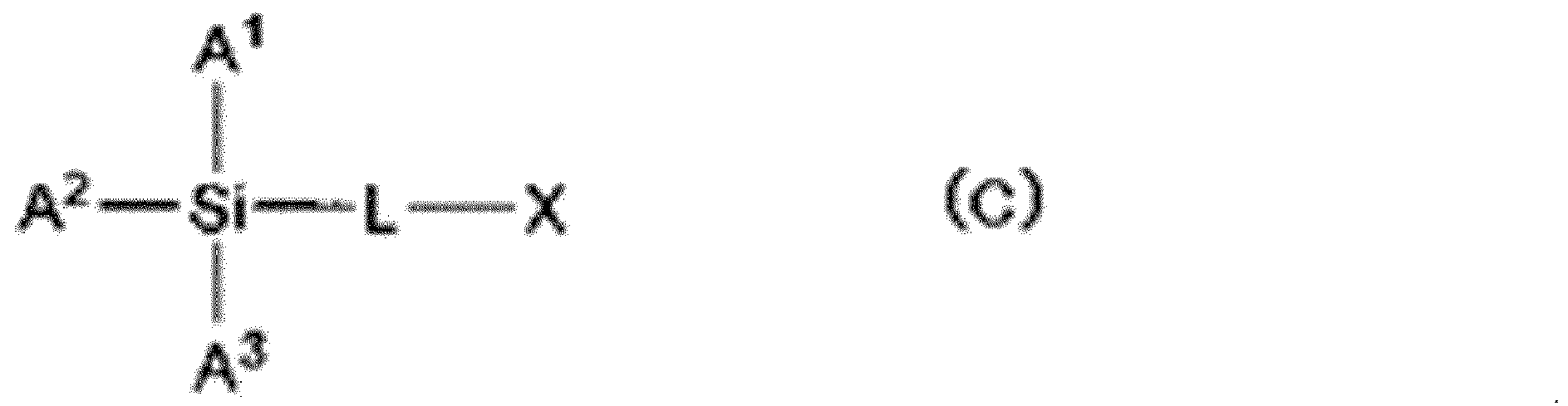

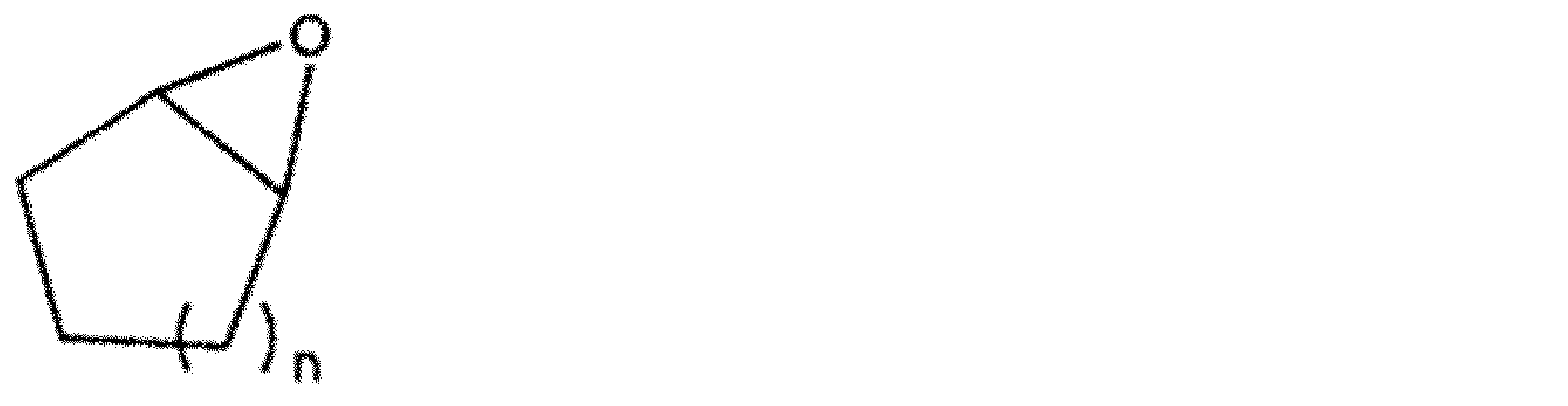
で表される構造から1つの水素原子が取り除かれた1価の基が例示される。
はエトキシ基であり、Xがチオール基、エポキシ基またはアミノ基であることが好ましく、式(C-1):

6-グリシドキシヘキシルトリメトキシシラン、
7-グリシドキシへプチルトリメトキシシラン、
8-グリシドキシオクチルトリメトキシシラン、
9-グリシドキシノニルトリメトキシシラン、
10-グリシドキシデシルトリメトキシシラン
である。シラン化合物(C-1)の多くは液体である。シラン化合物(C-1)は市販のものを用いてもよいし、公知の方法により製造したものを用いてもよい。
粘着剤組成物は、イオン性化合物をさらに含有することができる。イオン性化合物は、粘着剤層に帯電防止性を付与するための帯電防止剤として機能することができる。イオン性化合物は、無機カチオンまたは有機カチオンと、無機アニオンまたは有機アニオンとを有する化合物である。
Na+〕、カリウムカチオン〔K+〕のようなアルカリ金属イオンや、ベリリウムカチオン〔Be2+〕、マグネシウムカチオン〔Mg2+〕、カルシウムカチオン〔Ca2+〕のようなアルカリ土類金属イオン等が挙げられる。
N-ヘキシルピリジニウム ヘキサフルオロホスフェート、
N-オクチルピリジニウム ヘキサフルオロホスフェート、
N-オクチル-4-メチルピリジニウム ヘキサフルオロホスフェート、
N-ブチル-4-メチルルピリジニウム ヘキサフルオロホスフェート、
テトラブチルアンモニウム ヘキサフルオロホスフェート、
N-デシルピリジニウム ビス(フルオロスルホニル)イミド、
N-ドデシルピリジニウム ビス(フルオロスルホニル)イミド、
N-テトラデシルピリジニウム ビス(フルオロスルホニル)イミド、
N-ヘキサデシルピリジニウム ビス(フルオロスルホニル)イミド、
N-ドデシル-4-メチルピリジニウム ビス(フルオロスルホニル)イミド、
N-テトラデシル-4-メチルピリジニウム ビス(フルオロスルホニル)イミド、
N-ヘキサデシル-4-メチルピリジニウム ビス(フルオロスルホニル)イミド、
N-ベンジル-2-メチルピリジニウム ビス(フルオロスルホニル)イミド、
N-ベンジル-4-メチルピリジニウム ビス(フルオロスルホニル)イミド、
N-ヘキシルピリジニウム ビス(トリフルオロメタンスルホニル)イミド、
N-オクチルピリジニウム ビス(トリフルオロメタンスルホニル)イミド、
N-オクチル-4-メチルピリジニウム ビス(トリフルオロメタンスルホニル)イミド、
N-ブチル-4-メチルルピリジニウム ビス(トリフルオロメタンスルホニル)イミド。
1-エチル-3-メチルイミダゾリウム ヘキサフルオロホスフェート、
1-エチル-3-メチルイミダゾリウム p-トルエンスルホネート、
1-エチル-3-メチルイミダゾリウム ビス(フルオロスルホニル)イミド、
1-エチル-3-メチルイミダゾリウム ビス(トリフルオロメタンスルホニル)イミド、
1-ブチル-3-メチルイミダゾリウム メタンスルホネート、
1-ブチル-3-メチルイミダゾリウム ビス(フルオロスルホニル)イミド。
N-ブチル-N-メチルピロリジニウム ヘキサフルオロホスフェート、
N-ブチル-N-メチルピロリジニウム ビス(フルオロスルホニル)イミド、
N-ブチル-N-メチルピロリジニウム ビス(トリフルオロメタンスルホニル)イミド。
テトラブチルアンモニウム p-トルエンスルホネート、
(2-ヒドロキシエチル)トリメチルアンモニウム ビス(トリフルオロメタンスルホニル)イミド、
(2-ヒドロキシエチル)トリメチルアンモニウム ジメチルホスフィネート。
リチウム ヨーダイド、
リチウム テトラフルオロボレート、
リチウム ヘキサフルオロホスフェート、
リチウム チオシアネート、
リチウム パークロレート、
リチウム トリフルオロメタンスルホネート、
リチウム ビス(フルオロスルホニル)イミド、
リチウム ビス(トリフルオロメタンスルホニル)イミド、
リチウム ビス(ペンタフルオロエタンスルホニル)イミド、
リチウム トリス(トリフルオロメタンスルホニル)メタニド、
リチウム p-トルエンスルホネート、
ナトリウム ヘキサフルオロホスフェート、
ナトリウム ビス(フルオロスルホニル)イミド、
ナトリウム ビス(トリフルオロメタンスルホニル)イミド、
ナトリウム p-トルエンスルホネート、
カリウム ヘキサフルオロホスフェート、
カリウム ビス(フルオロスルホニル)イミド、
カリウム ビス(トリフルオロメタンスルホニル)イミド、
カリウム p-トルエンスルホネート。
粘着剤組成物は、架橋触媒、耐候安定剤、タッキファイヤー、可塑剤、軟化剤、染料、顔料、無機フィラー、光散乱性微粒子、(メタ)アクリル系樹脂(A)以外の樹脂等の添加剤を含有することができる。そのほか、粘着剤組成物に紫外線硬化性化合物を配合し、粘着剤層を形成した後に紫外線を照射して硬化させ、より硬い粘着剤層とすることも有用である。
本発明の粘着剤層は、上述の本発明に係る粘着剤組成物を含むものであり、典型的には本発明に係る粘着剤組成物からなる。粘着剤層は、上記粘着剤組成物を構成する各成分を溶剤に溶解または分散して溶剤含有の粘着剤組成物とし、次いで、基材フィルム上に塗布し、乾燥させることによって得ることができる。粘着剤層は、機械強度および耐熱耐久性に優れている。
本発明に係る粘着剤層付光学フィルムは、例えば光学フィルムと、その上に積層された上述の粘着剤層とを含むことができる。
r)以下であってよい。
本発明に係る表示装置は、上述の粘着剤層付光学フィルムを含む。上記した粘着剤層付光学フィルムは、有機EL表示装置、液晶表示装置、無機エレクトロルミネッセンス(無機EL)表示装置、電子放出表示装置等の表示装置に好適に用いることができる。
冷却管、窒素導入管、温度計および攪拌機を備えた反応容器に、酢酸エチル86.4部、ブチルアクリレート68.7部、メチルアクリレート20.0部、メチルメタクリレート10.0部、2-ヒドロキシエチルアクリレート1.0部、およびアクリル酸0.3部の混合溶液を仕込み、窒素ガスで装置内の空気を置換して酸素不含としながら内温を60℃に上げた。その後、アゾビスイソブチロニトリル(重合開始剤)0.10部を酢酸エチル13.7部に溶かした溶液を全量添加した。開始剤の添加後4時間この濃度で保持した。最後に酢酸エチルを加えて(メタ)アクリル系樹脂の濃度が20質量%となるように調節し、(メタ)アクリル系樹脂の酢酸エチル溶液を調製した。
MwおよびMnは、GPC装置にカラムとして、東ソー(株)製の「TSKgel guardcolumnHHR-H(S)」を1本、「TSKgel GMHHR-H」を2本の計3本を直列につないで配置し、溶出液としてテトラヒドロフランを用い、試料濃度2mg/mL、試料導入量100μL、温度40℃、流速1mL/分の条件で、標準ポリスチレン換算により測定した。
GPC装置(日本分析工業製のLaboACE LC-7080)にカラムとして、東ソー(株)製の「TSKgel guardcolumnHHR-H(S)」を1本、「TSKgel GMHHR-H」を2本の計3本を直列につないで配置し、溶出液としてテトラヒドロフランを用い、試料濃度2.5mg/mL、試料導入量2mL、室温、流速6mL/分の条件で、分子量分画を行った。
Tgは、エスアイアイ・ナノテクノロジー(株)製の示差走査熱量計(DSC)「EXSTAR DSC6000」を用い、窒素雰囲気下、測定温度範囲-80~50℃、昇温速度10℃/分の条件で測定した。
用いたモノマー混合物のモノマー組成、並びに得られた(メタ)アクリル系樹脂のMwおよび分子量分布(Mw/Mn)、Tgを表1にまとめた。
モノマー組成を表1の通りにした以外は、製造例1と同様に(メタ)アクリル系樹脂の酢酸エチル溶液を調整した。
<製造例3:粘着剤層用(メタ)アクリル系樹脂の製造(滴下重合)>
冷却管、窒素導入管、温度計、滴下漏斗および攪拌機を備えた反応容器に、酢酸エチル60.0部、ブチルアクリレート39.09部、メチルアクリレート30.0部、2-ヒドロキシエチルアクリレート0.7部、およびアクリル酸0.21部の混合溶液を仕込み、窒素ガスで装置内の空気を置換して酸素不含としながら内温を60℃に上げた。その後、アゾビスイソブチロニトリル(重合開始剤)0.11部を酢酸エチル10.0部に溶かした溶液を添加した。開始剤の添加後30分間この濃度で保持した。次いで、酢酸エチル30.0部、ブチルアクリレート29.61部、2-ヒドロキシエチルアクリレート0.30部、およびアクリル酸0.09部の混合溶液を滴下漏斗から30分間かけて反応容器に滴下した後、30分間攪拌した。最後に酢酸エチルを加えて(メタ)アクリル系樹脂の濃度が20質量%となるように調節し、(メタ)アクリル系樹脂の酢酸エチル溶液を調製した。

BA :ブチルアクリレート(ホモポリマーTg:-54℃)
MA :メチルアクリレート(ホモポリマーTg:10℃)
MMA :メチルメタクリレート(ホモポリマーTg:105℃)
HEA :2-ヒドロキシエチルアクリレート
AA :アクリル酸
(1)粘着剤組成物の調製
上記製造例で得られた(メタ)アクリル系樹脂の酢酸エチル溶液(樹脂濃度:20%)に、該溶液の固形分100質量部に対し、架橋剤、シラン化合物およびイオン性化合物を表2に示す量(質量部)混合し、さらに固形分濃度が14質量%となるように酢酸エチルを添加して粘着剤組成物の溶液を調製した。表2において、(メタ)アクリル系樹脂、架橋剤、シラン化合物および帯電防止剤の配合量(質量部)は固形分換算量である。

[架橋剤]
B:D-103(トリレンジイソシアネートのトリメチロールプロパンアダクト体の酢酸エチル溶液:固形分濃度75質量%、三井化学(株)製)
[シラン化合物]
C:8-グリシドキシオクチルトリメトキシシラン「KBM-4803」、信越化学工業(株)製
[イオン化合物]
D:メチルトリブチルアンモニウム=ビス(トリフルオロメチルスルホニル)イミド
上記(1)で調製した粘着剤組成物を、離型処理が施されたポリエチレンテレフタレートフィルムからなるセパレートフィルム〔三菱ケミカル(株)製の「ダイアホイルMRV38(V04)」〕の離型処理面に、アプリケーターを用いて乾燥後の厚みが25μmとなるように塗布し、100℃で1分間乾燥して粘着剤層(粘着剤シート)を作製した。
(2)で作製した粘着剤層(粘着剤シート)を23℃60%で7日間保管した。保管後の粘着剤層(粘着剤シート)について、ゲル分率〔23℃におけるゲル分率(G23)〕を測定した。ゲル分率は、以下の〔a〕~〔d〕に従って測定した。結果を表3に示す。
〔a〕約8cm×約8cmの面積の粘着剤層と、約10cm×約10cmのSUS304からなる金属メッシュ(その質量をWmとする)とを貼合する。
〔b〕上記〔a〕で得られた貼合物を秤量して、その質量をWsとし、次に粘着剤層を包み込むように4回折りたたんでホッチキス(ステープラー)で留めた後に秤量して、その質量をWbとする。
〔c〕上記〔b〕でホッチキス留めしたメッシュをガラス容器に入れ、酢酸エチル60mLを加えて浸漬した後、このガラス容器を室温で3日間保管する。
〔d〕ガラス容器からメッシュを取り出し、120℃で4時間乾燥した後に秤量して、その質量をWaとし、下記式:
ゲル分率(質量%)=〔{Wa-(Wb-Ws)-Wm}/(Ws-Wm)〕×100に基づいてゲル分率を計算する。
(2)で作製した粘着剤層(粘着剤シート)を23℃60%で7日間保管した。保管後の粘着剤層(粘着剤シート)について、引張試験における機械物性を測定した。
まず、粘着剤シートを3cm×12cmに切り出し、これを巻いて長さ3cm、直径2mmの円柱状の試験片を作製した。次いで、引張試験機〔(株)島津製作所製 AUTOGRAPH AG-1S試験機〕の上下つかみ具で、つかみ具の間隔が1cmとなるように、上記試験片の長辺方向の両端を挟み、温度23℃、相対湿度55%の環境下で引張速度100mm/分で試験片が破断するまで引張試験を行った。得られた応力-ひずみ曲線により、破断応力、破断歪み、および単位体積当たりの破断エネルギーを算出した。結果を表3に示す。
一軸延伸ポリビニルアルコールフィルムにヨウ素が吸着配向された厚み12μmの偏光子の両面にケン化処理を施したトリアセチルセルロース樹脂からなる厚み40μmの保護フィルムを、水系接着剤を介して貼合することにより偏光板を作製した。
上記(5)で作製した偏光板の一方の保護フィルムの外面に、上記(2)で作製した粘着剤層におけるセパレートフィルムとは反対側の面(粘着剤層面)をラミネーターにより貼り合わせた後、温度23℃、相対湿度60%の条件で7日間養生して、粘着剤層付偏光板を得た。
上記(6)で作製した粘着剤層付偏光板からセパレートフィルムを剥がした後、その粘着剤層面を無アルカリガラス基板〔コーニング社製の「Eagle XG」〕の両面にクロスニコルになるように貼着した。得られたガラス基板が貼り付けられた試験片(ガラス基板が貼り付けられた粘着剤層付偏光板)を、オートクレーブ中、温度50℃、圧力5kg/cm2(490.3kPa)で、20分間加圧し、評価用サンプルを作製した。このサンプルを用いて次の耐熱耐久性試験を実施した。
〔耐熱耐久性試験〕
・温度110℃の乾燥条件下で750時間保持する耐熱性試験を行った。
A:浮き、剥れ、割れ、発泡等の外観変化が少し認められる。
B:浮き、剥れ、割れ、発泡等の外観変化が非常に大きく認められる。

Claims (10)
- (メタ)アクリル系樹脂(A)と、架橋剤(B)と、シラン化合物(C)とを含み、
前記(メタ)アクリル系樹脂(A)は、
ホモポリマーのガラス転移温度が0℃未満であるアルキル(メタ)アクリレート(a)由来の構成単位、
ホモポリマーのガラス転移温度が0℃以上であるアルキル(メタ)アクリレート(b)由来の構成単位、および
極性基を有するモノマー(c)由来の構成単位
を含み、
前記(メタ)アクリル系樹脂(A)は、高分子量領域成分と、低分子量領域成分とを含み、
前記高分子量領域成分のガラス転移温度は、前記低分子量領域成分のガラス転移温度より高い、粘着剤組成物。 - 前記高分子量領域成分のガラス転移温度は、-30℃以上である、請求項1に記載の粘着剤組成物。
- 前記高分子量領域成分のガラス転移温度と前記低分子量領域成分のガラス転移温度の差は10℃以上である、請求項1に記載の粘着剤組成物。
- 前記(メタ)アクリル系樹脂(A)の質量平均分子量(Mw)は100万以上320万以下である、請求項1~3のいずれか一項に記載の粘着剤組成物。
- 前記ホモポリマーのガラス転移温度が0℃以上であるアルキル(メタ)アクリレート(b)は、メチルアクリレートおよびメチルメタクリレート、tert-ブチルメタクリレート、イソボルニルメタクリレートおよびシクロヘキシルメタクリレートからなる群から選択される少なくとも一種を含む、請求項1~3のいずれか一項に記載の粘着剤組成物。
- 前記架橋剤(B)は芳香族系イソシアネート化合物を含み、前記(メタ)アクリル系樹脂100質量部に対して前記架橋剤(B)を0.2質量部以上5.0質量部以下含有する、請求項1~3のいずれか一項に記載の粘着剤組成物。
- 請求項1~3のいずれか一項に記載の粘着剤組成物を含む粘着剤層。
- 光学フィルムと、前記光学フィルム上に積層された請求項7に記載の粘着剤層とを含む、粘着剤層付光学フィルム。
- 前記光学フィルムは偏光子を含む、請求項8に記載の粘着剤層付光学フィルム。
- 請求項8に記載の粘着剤層付光学フィルムを含む表示装置。
Priority Applications (2)
| Application Number | Priority Date | Filing Date | Title |
|---|---|---|---|
| CN202480007434.6A CN120457180A (zh) | 2023-01-13 | 2024-01-11 | 粘合剂组合物、粘合剂层、带有粘合剂层的光学膜及显示装置 |
| KR1020257022654A KR20250135193A (ko) | 2023-01-13 | 2024-01-11 | 점착제 조성물, 점착제층, 점착제층 부착 광학 필름 및 표시 장치 |
Applications Claiming Priority (2)
| Application Number | Priority Date | Filing Date | Title |
|---|---|---|---|
| JP2023004050 | 2023-01-13 | ||
| JP2023-004050 | 2023-01-13 |
Publications (1)
| Publication Number | Publication Date |
|---|---|
| WO2024150784A1 true WO2024150784A1 (ja) | 2024-07-18 |
Family
ID=91897022
Family Applications (1)
| Application Number | Title | Priority Date | Filing Date |
|---|---|---|---|
| PCT/JP2024/000363 Ceased WO2024150784A1 (ja) | 2023-01-13 | 2024-01-11 | 粘着剤組成物、粘着剤層、粘着剤層付光学フィルムおよび表示装置 |
Country Status (5)
| Country | Link |
|---|---|
| JP (1) | JP2024100730A (ja) |
| KR (1) | KR20250135193A (ja) |
| CN (1) | CN120457180A (ja) |
| TW (1) | TW202442834A (ja) |
| WO (1) | WO2024150784A1 (ja) |
Citations (11)
| Publication number | Priority date | Publication date | Assignee | Title |
|---|---|---|---|---|
| JP2004323543A (ja) * | 2003-04-21 | 2004-11-18 | Nitto Denko Corp | 光学部材用粘着剤組成物、光学部材用粘着剤層、粘着型光学部材および画像表示装置 |
| JP2008308621A (ja) * | 2007-06-15 | 2008-12-25 | Toyo Ink Mfg Co Ltd | 感圧式接着剤組成物及びその利用 |
| JP2012158632A (ja) * | 2011-01-31 | 2012-08-23 | Toyo Ink Sc Holdings Co Ltd | 感圧式接着剤、及びそれを用いた積層体 |
| JP2015203064A (ja) * | 2014-04-14 | 2015-11-16 | 綜研化学株式会社 | 偏光板用粘着剤組成物、粘着剤層、粘着シートおよび粘着剤層付き偏光板 |
| JP2015206858A (ja) * | 2014-04-18 | 2015-11-19 | 綜研化学株式会社 | 偏光板用粘着剤組成物、粘着剤層、粘着シートおよび粘着剤層付き偏光板 |
| JP2016180018A (ja) * | 2015-03-23 | 2016-10-13 | 東洋インキScホールディングス株式会社 | 粘着剤およびそれを用いた粘着シート |
| JP2017019960A (ja) * | 2015-07-14 | 2017-01-26 | 東洋インキScホールディングス株式会社 | 感圧式接着剤、感圧式接着フィルム、およびそれを用いた光学積層体 |
| WO2017122732A1 (ja) * | 2016-01-15 | 2017-07-20 | 日東電工株式会社 | 粘着剤層付片保護偏光フィルム、画像表示装置およびその連続製造方法 |
| JP2018169612A (ja) * | 2017-03-29 | 2018-11-01 | 日東電工株式会社 | 粘着剤層付片保護偏光フィルム、画像表示装置およびその連続製造方法 |
| JP2019179211A (ja) * | 2018-03-30 | 2019-10-17 | 日東電工株式会社 | 粘着剤層付偏光フィルム、及び画像表示装置 |
| JP2020003576A (ja) * | 2018-06-26 | 2020-01-09 | 日東電工株式会社 | 粘着剤層付片保護偏光フィルム、画像表示装置およびその連続製造方法 |
Family Cites Families (1)
| Publication number | Priority date | Publication date | Assignee | Title |
|---|---|---|---|---|
| JP7552121B2 (ja) | 2020-07-29 | 2024-09-18 | 三菱ケミカル株式会社 | 偏光板用粘着剤組成物、偏光板用粘着剤及び画像表示装置 |
-
2024
- 2024-01-11 WO PCT/JP2024/000363 patent/WO2024150784A1/ja not_active Ceased
- 2024-01-11 JP JP2024002698A patent/JP2024100730A/ja active Pending
- 2024-01-11 KR KR1020257022654A patent/KR20250135193A/ko active Pending
- 2024-01-11 TW TW113101236A patent/TW202442834A/zh unknown
- 2024-01-11 CN CN202480007434.6A patent/CN120457180A/zh active Pending
Patent Citations (11)
| Publication number | Priority date | Publication date | Assignee | Title |
|---|---|---|---|---|
| JP2004323543A (ja) * | 2003-04-21 | 2004-11-18 | Nitto Denko Corp | 光学部材用粘着剤組成物、光学部材用粘着剤層、粘着型光学部材および画像表示装置 |
| JP2008308621A (ja) * | 2007-06-15 | 2008-12-25 | Toyo Ink Mfg Co Ltd | 感圧式接着剤組成物及びその利用 |
| JP2012158632A (ja) * | 2011-01-31 | 2012-08-23 | Toyo Ink Sc Holdings Co Ltd | 感圧式接着剤、及びそれを用いた積層体 |
| JP2015203064A (ja) * | 2014-04-14 | 2015-11-16 | 綜研化学株式会社 | 偏光板用粘着剤組成物、粘着剤層、粘着シートおよび粘着剤層付き偏光板 |
| JP2015206858A (ja) * | 2014-04-18 | 2015-11-19 | 綜研化学株式会社 | 偏光板用粘着剤組成物、粘着剤層、粘着シートおよび粘着剤層付き偏光板 |
| JP2016180018A (ja) * | 2015-03-23 | 2016-10-13 | 東洋インキScホールディングス株式会社 | 粘着剤およびそれを用いた粘着シート |
| JP2017019960A (ja) * | 2015-07-14 | 2017-01-26 | 東洋インキScホールディングス株式会社 | 感圧式接着剤、感圧式接着フィルム、およびそれを用いた光学積層体 |
| WO2017122732A1 (ja) * | 2016-01-15 | 2017-07-20 | 日東電工株式会社 | 粘着剤層付片保護偏光フィルム、画像表示装置およびその連続製造方法 |
| JP2018169612A (ja) * | 2017-03-29 | 2018-11-01 | 日東電工株式会社 | 粘着剤層付片保護偏光フィルム、画像表示装置およびその連続製造方法 |
| JP2019179211A (ja) * | 2018-03-30 | 2019-10-17 | 日東電工株式会社 | 粘着剤層付偏光フィルム、及び画像表示装置 |
| JP2020003576A (ja) * | 2018-06-26 | 2020-01-09 | 日東電工株式会社 | 粘着剤層付片保護偏光フィルム、画像表示装置およびその連続製造方法 |
Also Published As
| Publication number | Publication date |
|---|---|
| KR20250135193A (ko) | 2025-09-12 |
| TW202442834A (zh) | 2024-11-01 |
| CN120457180A (zh) | 2025-08-08 |
| JP2024100730A (ja) | 2024-07-26 |
Similar Documents
| Publication | Publication Date | Title |
|---|---|---|
| TWI553085B (zh) | 黏著劑片材、附有黏著劑之光學膜及光學積層體 | |
| CN102119348B (zh) | 带粘合剂的光学膜和使用其的光学层叠体 | |
| CN101144868B (zh) | 涂布有粘合剂的光学膜 | |
| JP5023470B2 (ja) | アクリル樹脂組成物及び粘着剤 | |
| TWI837777B (zh) | 黏著劑組成物、黏著劑層及附黏著劑層之光學構件 | |
| JP2007126559A5 (ja) | ||
| JP2025172806A (ja) | 光学積層体および画像表示装置 | |
| JP2007119667A5 (ja) | ||
| US20040092689A1 (en) | Acrylic resin, adhesive comprising the resin, and optical laminate comprising the adhesive | |
| US20040152812A1 (en) | Acrylic resin composition, adhesive comprising the composition, and optical laminate comprising the adhesive | |
| WO2025205588A1 (ja) | 粘着剤組成物、及び粘着剤層付き光学フィルム | |
| WO2024150783A1 (ja) | 粘着剤組成物、粘着剤層、粘着剤層付光学フィルムおよび表示装置 | |
| CN107177319B (zh) | 带粘合剂层的光学构件 | |
| JP2004190012A (ja) | アクリル樹脂組成物 | |
| JP2006096776A (ja) | アクリル樹脂組成物 | |
| JP2024100730A (ja) | 粘着剤組成物、粘着剤層、粘着剤層付光学フィルムおよび表示装置 | |
| WO2024150781A1 (ja) | 粘着剤組成物、粘着剤層、粘着剤層付光学フィルムおよび表示装置 | |
| WO2024150782A1 (ja) | 粘着剤組成物、粘着剤層、粘着剤層付光学フィルムおよび表示装置 | |
| JP2025156021A (ja) | 粘着剤組成物、及び粘着剤層付き光学フィルム | |
| WO2025205589A1 (ja) | 粘着剤組成物、及び粘着剤層付き光学フィルム | |
| JP2025156022A (ja) | 粘着剤組成物、及び粘着剤層付き光学フィルム | |
| JP2025036152A (ja) | 光学積層体及び画像表示装置 | |
| WO2025205587A1 (ja) | 粘着剤組成物、及び粘着剤層付き光学フィルム | |
| JP2025156020A (ja) | 粘着剤組成物、及び粘着剤層付き光学フィルム |
Legal Events
| Date | Code | Title | Description |
|---|---|---|---|
| 121 | Ep: the epo has been informed by wipo that ep was designated in this application |
Ref document number: 24741556 Country of ref document: EP Kind code of ref document: A1 |
|
| ENP | Entry into the national phase |
Ref document number: 1020257022654 Country of ref document: KR Free format text: ST27 STATUS EVENT CODE: A-0-1-A10-A15-NAP-PA0105 (AS PROVIDED BY THE NATIONAL OFFICE) |
|
| WWE | Wipo information: entry into national phase |
Ref document number: 202480007434.6 Country of ref document: CN |
|
| WWP | Wipo information: published in national office |
Ref document number: 202480007434.6 Country of ref document: CN |
|
| NENP | Non-entry into the national phase |
Ref country code: DE |
|
| 122 | Ep: pct application non-entry in european phase |
Ref document number: 24741556 Country of ref document: EP Kind code of ref document: A1 |