WO2024150554A1 - 藻類又は微生物の増殖抑制方法、紫外線照射装置、及び照明装置 - Google Patents
藻類又は微生物の増殖抑制方法、紫外線照射装置、及び照明装置 Download PDFInfo
- Publication number
- WO2024150554A1 WO2024150554A1 PCT/JP2023/043101 JP2023043101W WO2024150554A1 WO 2024150554 A1 WO2024150554 A1 WO 2024150554A1 JP 2023043101 W JP2023043101 W JP 2023043101W WO 2024150554 A1 WO2024150554 A1 WO 2024150554A1
- Authority
- WO
- WIPO (PCT)
- Prior art keywords
- ultraviolet light
- ultraviolet
- algae
- irradiated
- light source
- Prior art date
- Legal status (The legal status is an assumption and is not a legal conclusion. Google has not performed a legal analysis and makes no representation as to the accuracy of the status listed.)
- Ceased
Links
Images

















Classifications
-
- A—HUMAN NECESSITIES
- A01—AGRICULTURE; FORESTRY; ANIMAL HUSBANDRY; HUNTING; TRAPPING; FISHING
- A01K—ANIMAL HUSBANDRY; AVICULTURE; APICULTURE; PISCICULTURE; FISHING; REARING OR BREEDING ANIMALS, NOT OTHERWISE PROVIDED FOR; NEW BREEDS OF ANIMALS
- A01K63/00—Receptacles for live fish, e.g. aquaria; Terraria
- A01K63/04—Arrangements for treating water specially adapted to receptacles for live fish
-
- A—HUMAN NECESSITIES
- A61—MEDICAL OR VETERINARY SCIENCE; HYGIENE
- A61L—METHODS OR APPARATUS FOR STERILISING MATERIALS OR OBJECTS IN GENERAL; DISINFECTION, STERILISATION OR DEODORISATION OF AIR; CHEMICAL ASPECTS OF BANDAGES, DRESSINGS, ABSORBENT PADS OR SURGICAL ARTICLES; MATERIALS FOR BANDAGES, DRESSINGS, ABSORBENT PADS OR SURGICAL ARTICLES
- A61L2/00—Disinfection or sterilisation of materials or objects, in general; Accessories therefor
- A61L2/02—Disinfection or sterilisation of materials or objects, in general; Accessories therefor using physical processes
- A61L2/08—Radiation
- A61L2/10—Ultraviolet [UV] radiation
-
- A—HUMAN NECESSITIES
- A61—MEDICAL OR VETERINARY SCIENCE; HYGIENE
- A61L—METHODS OR APPARATUS FOR STERILISING MATERIALS OR OBJECTS IN GENERAL; DISINFECTION, STERILISATION OR DEODORISATION OF AIR; CHEMICAL ASPECTS OF BANDAGES, DRESSINGS, ABSORBENT PADS OR SURGICAL ARTICLES; MATERIALS FOR BANDAGES, DRESSINGS, ABSORBENT PADS OR SURGICAL ARTICLES
- A61L2/00—Disinfection or sterilisation of materials or objects, in general; Accessories therefor
- A61L2/24—Apparatus using programmed or automatic operation
-
- C—CHEMISTRY; METALLURGY
- C02—TREATMENT OF WATER, WASTE WATER, SEWAGE, OR SLUDGE
- C02F—TREATMENT OF WATER, WASTE WATER, SEWAGE, OR SLUDGE
- C02F1/00—Treatment of water, waste water, or sewage
- C02F1/30—Treatment of water, waste water, or sewage by irradiation
- C02F1/32—Treatment of water, waste water, or sewage by irradiation with ultraviolet light
-
- F—MECHANICAL ENGINEERING; LIGHTING; HEATING; WEAPONS; BLASTING
- F21—LIGHTING
- F21S—NON-PORTABLE LIGHTING DEVICES; SYSTEMS THEREOF; VEHICLE LIGHTING DEVICES SPECIALLY ADAPTED FOR VEHICLE EXTERIORS
- F21S8/00—Lighting devices intended for fixed installation
- F21S8/08—Lighting devices intended for fixed installation with a standard
-
- H—ELECTRICITY
- H05—ELECTRIC TECHNIQUES NOT OTHERWISE PROVIDED FOR
- H05B—ELECTRIC HEATING; ELECTRIC LIGHT SOURCES NOT OTHERWISE PROVIDED FOR; CIRCUIT ARRANGEMENTS FOR ELECTRIC LIGHT SOURCES, IN GENERAL
- H05B45/00—Circuit arrangements for operating light-emitting diodes [LED]
- H05B45/30—Driver circuits
- H05B45/31—Phase-control circuits
-
- H—ELECTRICITY
- H05—ELECTRIC TECHNIQUES NOT OTHERWISE PROVIDED FOR
- H05B—ELECTRIC HEATING; ELECTRIC LIGHT SOURCES NOT OTHERWISE PROVIDED FOR; CIRCUIT ARRANGEMENTS FOR ELECTRIC LIGHT SOURCES, IN GENERAL
- H05B47/00—Circuit arrangements for operating light sources in general, i.e. where the type of light source is not relevant
- H05B47/10—Controlling the light source
- H05B47/105—Controlling the light source in response to determined parameters
-
- H—ELECTRICITY
- H05—ELECTRIC TECHNIQUES NOT OTHERWISE PROVIDED FOR
- H05B—ELECTRIC HEATING; ELECTRIC LIGHT SOURCES NOT OTHERWISE PROVIDED FOR; CIRCUIT ARRANGEMENTS FOR ELECTRIC LIGHT SOURCES, IN GENERAL
- H05B47/00—Circuit arrangements for operating light sources in general, i.e. where the type of light source is not relevant
- H05B47/10—Controlling the light source
- H05B47/155—Coordinated control of two or more light sources
Definitions
- the present invention relates to a growth inhibition method and ultraviolet irradiation device that inhibit the growth of algae or photosynthetic microorganisms. It also relates to a lighting device that illuminates the surroundings and inhibits the growth of algae or photosynthetic microorganisms.
- Algae refers to, for example, Euglena algae, green algae, or diatoms, as well as xanthophyte algae, dinoflagellates, red algae, and brown algae.
- Microorganisms refers to, for example, true bacteria or eukaryotes.
- algae or photosynthetic microorganisms may be collectively referred to as “algae, etc.”.
- Patent Document 1 proposes a method of applying a paint to an object to control algae or prevent the growth of algae.
- Patent Document 1 If the method described in Patent Document 1 above could be applied, it would be possible to suppress the proliferation of algae and other microorganisms on the target object.
- this method involves applying paint that suppresses the proliferation of algae and other microorganisms, it cannot be applied to suppress the proliferation of algae and other microorganisms on the surface of a pond or in the water.
- paint whenever new algae or other microorganisms are found, it is necessary to apply paint using a brush or nozzle.
- this method cannot be carried out efficiently in places that are difficult for workers to reach.
- the present invention aims to provide an easily implemented method for suppressing the proliferation of algae, etc.
- the present invention also aims to provide an ultraviolet irradiation device that can easily suppress the proliferation of algae, etc., and a lighting device that can illuminate the surroundings and easily suppress the proliferation of algae, etc.
- the proliferation inhibiting method according to the present invention comprises the steps of:
- the method is characterized in that an area inhabited by algae or photosynthetic microorganisms is irradiated with ultraviolet light having a dominant wavelength in the range of 200 nm to 230 nm.
- Algae and the like live on the water surface of a pond or the like, floating in the water, or rooted to the surface of an object. Visible light, water, and carbon dioxide are used for photosynthesis by algae and the like.
- the "habitat” of algae and the like refers to the water surface, underwater, or the surface of an object, an area where visible light, water, and carbon dioxide are present.
- “inhibiting growth” refers to the comprehensive concept of killing or causing the reproduction of algae and photosynthetic microorganisms.
- chlorophyll is a pigment necessary for photosynthesis
- the decomposition of chlorophyll reduces the activity of algae and the like.
- ultraviolet light in the above wavelength range can suppress the proliferation of algae and the like, and the proliferation of algae and the like can be suppressed by irradiating areas where algae and the like live with the above ultraviolet light. Note that the fact that discoloration caused by algae and the like is improved by irradiation with the above ultraviolet light is described in detail in the "Verification" section of the "Form for carrying out the invention” below.
- ultraviolet light in the 200-230 nm wavelength range has a much higher protein absorption coefficient than, for example, ultraviolet light with a wavelength of 254 nm, and most of it is absorbed by the surface of human skin (for example, the stratum corneum). For this reason, ultraviolet light in this wavelength range has the characteristic that it does not easily penetrate into the skin and has an extremely low impact on the human body. This characteristic is presumed to be the same for animals, fish, and other living organisms other than humans. Furthermore, since the wavelength range of light that insects can see is 250-600 nm, there is little concern that ultraviolet light in this wavelength range will attract insects. In other words, ultraviolet light in this wavelength range has the advantage of having little impact on the ecosystem surrounding the area where it is irradiated.
- ultraviolet light By irradiating with ultraviolet light, it is possible to suppress the proliferation of algae and other organisms without directly touching the target where the algae live. Also, ultraviolet light can be applied to places that are difficult for workers to reach.
- the surface turns green, damaging the aesthetic appearance of the object. Furthermore, the presence of algae on the surface of an object can cause problems such as making the surface slippery.
- Possible methods for removing algae from the surface of an object include directly cleaning the surface with a brush or applying a paint (chemical) to prevent algae (see also Patent Document 1 above). However, these methods have concerns that they may unnecessarily damage the surface of the object, or that some chemicals may have a negative effect on the surrounding ecosystem.
- the above-mentioned growth inhibition method has the characteristic that it can inhibit the growth of algae without directly contacting the surface of the object where the algae live, and further has little impact on the surrounding ecosystem, as mentioned above.
- the ultraviolet light may be irradiated onto the habitat area while the habitat area is being irradiated with visible light emitted by a lighting device.
- the above configuration suppresses the proliferation of algae and the like even in habitat areas irradiated with visible light from a lighting device.
- habitat areas irradiated with visible light from a lighting device proliferation of algae and the like progresses even at night. This is because the lighting device is turned on during times of day when there is little sunlight, such as at night, and visible light is irradiated onto the habitat area of algae and the like, lengthening the time period during which the algae and the like perform photosynthesis. Therefore, it is preferable to irradiate the above-mentioned ultraviolet light onto the habitat area irradiated with visible light emitted by the lighting device.
- the habitat area irradiated with visible light emitted by a lighting device may be irradiated with the ultraviolet light while the lighting device is turned off.
- TLV Threshold Limit Values
- the radiation intensity and lighting time of the ultraviolet light source be determined so that the cumulative amount of ultraviolet radiation irradiated within a specified time period is within the standard value of the TLV.
- the proliferation inhibition method be a method of irradiating ultraviolet rays while the lighting device is turned off.
- the ultraviolet light may be irradiated onto a region including a visible light irradiation range within which the visible light emitted by the lighting device is irradiated.
- the "visible light irradiation range” refers to the area irradiated with visible light emitted by the lighting device that has an illuminance of 50% or more of the area showing the maximum illuminance. Additionally, the “ultraviolet light irradiation range” described below refers to the area irradiated with ultraviolet light that has an illuminance of 50% or more of the maximum irradiance. This also applies when ultraviolet light or visible light is irradiated onto the surface of water or underwater.
- the proliferation suppression method is a method of irradiating the ultraviolet rays to an area that includes the range where the visible light is irradiated (visible light irradiation range).
- the ultraviolet light may be irradiated onto the habitat area in which the cyanobacteria live.
- photosynthetic microorganisms include, for example, the true bacteria cyanobacteria (sometimes called blue-green algae). Cyanobacteria are the cause of the outbreak of so-called “blue-green algae,” which not only mars the aesthetic appearance of ponds, but also cause problems by worsening the water quality. Therefore, the method of inhibiting proliferation involves irradiating the area in which the cyanobacteria live with ultraviolet light, which not only improves aesthetics, but also inhibits the deterioration of water quality.
- the ultraviolet rays may be irradiated toward the water surface.
- the above method decomposes algae floating on the water surface, thereby suppressing the proliferation of algae on the water surface.
- the algae include cyanobacteria
- microcystin which is toxic to living organisms, may be released.
- the above method is suitable for suppressing the proliferation of algae including cyanobacteria while minimizing the impact on the ecosystem.
- the ultraviolet light may be irradiated so that the integrated irradiance of the ultraviolet light on the water surface is 200 mJ/cm 2 or more.
- the proliferation inhibition method is preferably a method of irradiating the above-mentioned ultraviolet light so that the integrated irradiance on the water surface is 200 mJ/ cm2 or more. This makes the effect of decomposing microcystin more pronounced.
- the ultraviolet light may be irradiated so that the integrated irradiance of the ultraviolet light in the habitat area is 1 J/cm 2 or more.
- the method of inhibiting proliferation is preferably a method of irradiating the ultraviolet rays so that the integrated irradiance in the habitat is 1 J/ cm2 or more. This makes the effect of inhibiting proliferation of algae and the like more pronounced.
- the ultraviolet light may be irradiated onto the habitat on an exhibit or building.
- the growth inhibition method is a method of irradiating ultraviolet rays onto exhibits such as natural history specimens that are displayed indoors or outdoors, and buildings such as houses, shrines, temples, and castles.
- the method for inhibiting proliferation may involve irradiating the ultraviolet rays onto sculptures such as stones and lanterns in gardens, or onto stone walls that form moats in castles, etc.
- the ultraviolet irradiation device comprises: An apparatus for irradiating an area inhabited by algae or photosynthetic microorganisms with ultraviolet light, comprising: An ultraviolet light source that emits ultraviolet light having a dominant wavelength in the range of 200 nm to 230 nm; A housing that contains the ultraviolet light source; an ultraviolet ray exit window for extracting the ultraviolet ray emitted from the ultraviolet ray source to the outside of the housing;
- the present invention is characterized in that it comprises an attachment portion for fixing the housing in a state in which the ultraviolet light extracted from the ultraviolet light exit window is irradiated onto the habitat area.
- Ultraviolet light can be easily applied to areas where algae and other organisms live by using the ultraviolet light application device described above. Furthermore, when an ultraviolet light application device is installed around an area where algae and other organisms live, if ultraviolet light application is stopped after irradiation, it is possible to easily resume ultraviolet light application even if new algae and other organisms grow.
- the ultraviolet light irradiation device includes a mounting section for fixing the housing in a state in which the ultraviolet light is irradiated onto the habitat. Therefore, the ultraviolet light irradiation device can be fixed to the wall or rock surface of a building, or to a lighting device present in the vicinity, and ultraviolet light can be irradiated onto the habitat of algae as described above.
- the ultraviolet irradiation device is A control unit that controls the lighting state of the ultraviolet light source; A detection unit that directly or indirectly detects whether the illuminance in the habitat area is equal to or greater than a predetermined reference value, The reference value is set from an illuminance value of 1600 [lx] or more, When the detection unit detects that the illuminance in the habitat area is equal to or greater than a reference value, the control unit may turn off the ultraviolet ray source.
- the activity of algae and the like may decrease.
- some algae and the like grow slowly in areas where visible light is irradiated at an illuminance of 1600 [lx] or more, while others grow slowly in environments with an illuminance of 2000 [lx] or more.
- cyanobacteria tend to grow slower in environments where visible light with an illuminance of 5000 [lx] or more is irradiated, and this tendency is more pronounced at 10,000 [lx] or more.
- the illuminance in the habitat area is 1600 [lx] or more.
- the standard value may be set to 2000 [lx] or more, 5000 [lx] or more, or even 10000 [lx] or more.
- the illuminance of the habitat is 1600 [lx] or more
- irradiation of ultraviolet light may be stopped.
- the reference value in this case may be set to 2000 [lx] or more, 5000 [lx] or more, or even 10000 [lx] or more.
- the housing may be waterproofed to prevent moisture from entering the space in which the ultraviolet light source is housed.
- the ultraviolet light source mounted in the ultraviolet light irradiation device may be applied with a high voltage in order to emit ultraviolet light. For this reason, the intrusion of moisture into the housing may cause an electric leakage or short circuit in the ultraviolet light source or the circuit connected to the ultraviolet light source.
- the waterproofing treatment prevents moisture from intruding into the housing, thereby reducing malfunctions of the ultraviolet light irradiation device, which is preferable.
- the irradiation device comprises: A lighting device that illuminates the surroundings and irradiates ultraviolet light onto an area inhabited by algae or photosynthetic microorganisms, an illumination source that emits visible light; An ultraviolet light source that emits ultraviolet light having a dominant wavelength in the range of 200 nm to 230 nm; A housing that contains the ultraviolet light source; an ultraviolet ray exit window for extracting the ultraviolet ray emitted from the ultraviolet ray source to the outside of the housing;
- the present invention is characterized in that it comprises an attachment portion for fixing the housing in a state in which the ultraviolet light extracted from the ultraviolet light exit window is irradiated to the habitat area onto which the visible light is irradiated.
- the lighting device is equipped with an ultraviolet light source that emits ultraviolet light whose dominant wavelength is in the range of 200 nm to 230 nm.
- the lighting device can suppress the growth of algae and the like by the ultraviolet light emitted by the ultraviolet light source while illuminating the surroundings with the lighting light source.
- the lighting device includes: A control unit may be provided that turns on the ultraviolet light source while the illumination light source is turned off.
- the illumination light source is accommodated in the housing;
- the ultraviolet ray exit window may also function as a visible light exit window for extracting the visible light to the outside of the housing.
- the above configuration is advantageous because it reduces the space required to install the illumination light source for illuminating the surroundings and the ultraviolet light source for suppressing the growth of algae, etc.
- the present invention provides an easily implemented method for inhibiting the growth of algae, etc.
- the present invention also provides an ultraviolet irradiation device that can easily inhibit the growth of algae, etc., and a lighting device that can illuminate the surroundings and easily inhibit the growth of algae, etc.
- FIG. 1 is a conceptual diagram showing an example of an embodiment of a proliferation inhibition method.
- FIG. 1B is a conceptual diagram illustrating a different scene from that in FIG. 1A.
- FIG. 1B is a view of FIG. 1A from a different angle.
- 1B is an enlarged view of the periphery of the ultraviolet irradiation device in FIG. 1A.
- 1 is a schematic diagram showing a configuration of an ultraviolet irradiation device when viewed from the tube axis direction of a lamp constituting an ultraviolet source.
- 2 is a schematic diagram showing a configuration of an ultraviolet irradiation device when viewed from a direction perpendicular to a main surface of an ultraviolet exit window.
- FIG. 2 is a block diagram showing a schematic configuration of an ultraviolet irradiation device.
- 1 is a schematic diagram showing another example of the configuration of an ultraviolet irradiating device when viewed from the tube axis direction of a lamp constituting an ultraviolet ray source.
- FIG. 10 is a schematic diagram showing another example of the configuration of the ultraviolet irradiation device when viewed from a direction perpendicular to the main surface of the ultraviolet exit window.
- FIG. FIG. 13 is a schematic diagram showing how the ultraviolet irradiation device is attached to a pole.
- FIG. 2 is a schematic diagram of an ultraviolet irradiation device attached to a pole.
- FIG. 1 is a conceptual diagram showing a schematic diagram of an experimental system used in the verification.
- FIG. 1 is a graph showing the emission spectra of an excimer lamp and a low-pressure mercury lamp used in the verification.
- 13 is a graph showing the results of verification 1. This is the absorption spectrum of the sample liquid used in verification 2.
- 13 is a graph showing the results of verification 2.
- This is a microscopic image of cyanobacteria obtained in verification 3.
- This is a microscopic image of cyanobacteria obtained in verification 3.
- FIG. 1 is a conceptual diagram showing an example of an embodiment of a proliferation inhibition method.
- 2 is a schematic diagram showing a configuration of the lighting device when viewed in a direction parallel to a main surface of an ultraviolet exit window.
- FIG. 2 is a block diagram illustrating a schematic configuration of a lighting device.
- 14 is a conceptual diagram showing a schematic arrangement of an ultraviolet ray source and an illumination light source when the illumination device shown in FIG. 13 is viewed from a direction perpendicular to the ultraviolet ray exit window.
- FIG. 12 is a diagram showing the fossil as viewed from the lighting device.
- FIG. 1 is a conceptual diagram showing an example of an embodiment of a proliferation inhibition method.
- FIG. 17B is a view of FIG. 17A from a different angle.
- FIG. 13 is a perspective view showing a modified example of the ultraviolet irradiation device.
- 19 is a diagram showing the ultraviolet irradiation device as viewed from a different direction than that of FIG. 18.
- FIG. 19B is a diagram showing a state in which the emission direction of ultraviolet light is changed from the state of FIG. 19A.
- FIG. 19 is a block diagram showing a schematic configuration of the ultraviolet irradiation device 1 according to FIG. 18.
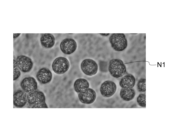
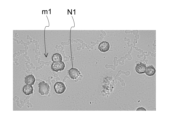
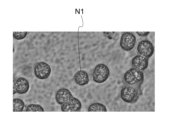
- FIG. 21 is a graph showing the results of verification 4. This is a phase contrast microscope image of cyanobacteria obtained in verification 5. This is a phase contrast microscope image of cyanobacteria obtained in verification 5. This is a phase contrast microscope image of cyanobacteria obtained in verification 5.
- FIG. 1 is a conceptual diagram showing a typical embodiment of a proliferation inhibition method.
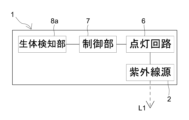
- FIG. 11 is a block diagram showing a schematic configuration of another ultraviolet irradiation device.
- FIG. 11 is a block diagram illustrating a schematic configuration of another lighting device.
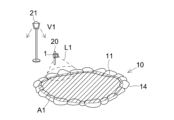
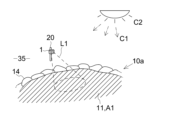
- Fig. 1A is a conceptual diagram showing an example of an embodiment of the growth inhibition method.
- Fig. 1A shows a scene in which ultraviolet light L1 emitted from an ultraviolet light irradiation device 1 is irradiated onto a pond 10 partitioned by stones 14 or the like.
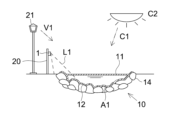
- FIG. 1B is a conceptual diagram that shows a different scene from FIG. 1A. As shown in FIG. 1B, in a scene where sunlight C1 is not irradiated, such as at night, visible light V1 is irradiated from the lighting devices 21 for the purpose of illuminating the surroundings, etc.
- FIG. 2 is a drawing of FIG. 1A viewed from a different angle. As mentioned above, it is assumed that the lighting device 21 is turned off during the time period when sunlight C1 is irradiated, but for convenience of illustration, FIG. 2 shows both the visible light V1 emitted by the lighting device 21 and the sunlight C1.
- FIG. 1A sunlight C1 is irradiated onto the pond 10.
- FIG. 1B visible light V1 is irradiated onto the pond 10.
- the pond 10 contains water, and carbon dioxide in the air and water. Therefore, algae and the like live and grow in the pond 10. More specifically, microorganisms such as cyanobacteria live and grow on the surfaces of the stones 14, on the water surface 11 of the pond 10, and in the water. Also, algae that have taken root on the stones 14 and the like live and grow on the bottom surface 12 of the pond 10.
- FIG. 1A, FIG. 1B, and FIG. 2 the habitat area A1 of the algae and the like in the pond 10 is shown diagrammatically, and the area corresponding to the habitat area A1 is hatched.
- ultraviolet light L1 is irradiated onto the stone 14 and the water surface 11 in the vicinity of the stone 14. If algae or the like grows on the surface of the stone 14, the surface of the stone 14 becomes slippery. Therefore, from the viewpoint of safety for people visiting the pond 10, it is preferable to irradiate the stone 14 with ultraviolet light L1.
- the habitat area A1 is not limited to the stones 14 and the water surface 11 of the pond 10, but also includes the surfaces of the stones 14 forming the bottom surface 12 of the pond 10, as well as the surfaces of sand and pebbles, etc., so ultraviolet light L1 may be irradiated onto these.
- the ultraviolet rays L1 emitted by the ultraviolet irradiation device 1 are in the wavelength range of 200 nm to 230 nm. As described below, by irradiating the habitat area A1 of algae with ultraviolet rays L1 in the above wavelength range, the proliferation of algae and the like is suppressed. Furthermore, sufficient irradiation of ultraviolet rays breaks down the chlorophyll of the algae and the like present in the pond 10, reducing the areas discolored green by the algae and the like, and restoring the beauty of the pond 10.
- the water in the pond 10 also convects due to naturally occurring wind and temperature gradients in the water. Therefore, as shown in FIG. 1A, even if the area irradiated with ultraviolet light L1 is only part of the water surface 11, it is expected that the convection of the water in the pond 10 will suppress the proliferation of algae and the like over a wide area of the water surface 11. Naturally, ultraviolet light L1 may also be irradiated onto the entire water surface 11.
- chlorophyll is broken down because irradiation with ultraviolet light L1 breaks down algae, etc., causing chlorophyll to flow out of the algae, etc., and then ultraviolet light L1 is irradiated onto the chlorophyll.
- ultraviolet light L1 breaks down algae, etc.
- the outflow of chlorophyll is promoted by water convection, making it easier for ultraviolet light L1 to be irradiated onto the chlorophyll.
- chlorophyll is diluted as it flows out over a wide area due to water convection. In this way, irradiating water storage areas with ultraviolet light L1 has a large aesthetic restoration effect and is therefore ideal.
- lighting devices 21 are installed around the pond 10, but algae and the like grow due to at least the visible light contained in sunlight C1. In other words, whether or not lighting devices 21 are installed around the pond 10 is optional.
- the configuration of the ultraviolet irradiation device 1 is explained below.
- FIG. 3 is an enlarged view of the periphery of the ultraviolet irradiation device 1 in FIG. 1A.
- FIG. 4A is a schematic diagram showing the configuration of the ultraviolet irradiation device 1 when viewed from the axial direction of a lamp constituting the ultraviolet source 2 described below.
- FIG. 4B is a schematic diagram showing the configuration of the ultraviolet irradiation device 1 when viewed from a direction perpendicular to the main surface of the ultraviolet exit window 4.
- the interior of the ultraviolet irradiation device 1 is shown in a transparent manner in FIGS. 4A and 4B.
- the ultraviolet irradiation device 1 comprises an ultraviolet source 2, a housing 3, an ultraviolet exit window 4, and an attachment portion 5.
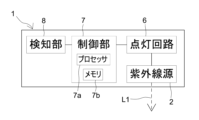
- FIG. 5 is a block diagram showing a schematic configuration of the ultraviolet irradiation device 1. As shown in FIG. 5, the ultraviolet irradiation device 1 includes a lighting circuit 6, a control unit 7, and a detection unit 8.
- the ultraviolet light source 2 is composed of a straight tube excimer lamp containing krypton gas and chlorine gas as the light emitting gas, and emits ultraviolet light L1 with a wavelength of 200 nm to 230 nm.
- the pond 10 is home to fish and other living organisms (not shown), and as mentioned above, by using ultraviolet light L1 in the above wavelength range, it is possible to irradiate the pond 10 with ultraviolet light while reducing the impact on the ecosystem.
- the ultraviolet light source 2 only needs to be capable of emitting ultraviolet light L1 of the above wavelength, and may be composed of a solid-state light source such as an LED or LD.
- the dominant wavelength of ultraviolet light L1 belongs to the above wavelength range.
- “dominant wavelength” refers to a wavelength range that shows a light intensity of 40% or more of the light intensity of the wavelength (peak wavelength) that shows the maximum intensity on the emission spectrum, and includes the peak wavelength.
- the housing 3 houses the ultraviolet light source 2 inside.
- the ultraviolet light L1 is extracted to the outside from an ultraviolet light exit window 4 of the housing 3 (see FIG. 4A).
- a diffusion filter that diffuses and transmits the incident ultraviolet light L1 may be mounted on the main surface of the ultraviolet light exit window 4.
- a fluororesin sheet such as PTFE can be used.
- an optical filter that suppresses the transmission of ultraviolet light on the wavelength side longer than 230 nm may be mounted on the main surface of the ultraviolet light exit window 4.
- an optical filter that suppresses the transmission of ultraviolet light with wavelengths between 240 nm and 300 nm is used.
- “suppressing transmission” refers to lowering the ratio of the light intensity of ultraviolet light with wavelengths longer than 230 nm to the light intensity of ultraviolet light within the wavelength range of 200 nm to 230 nm that has passed through the optical filter.
- the optical filter is, for example, a dielectric multilayer film in which a thin film layer of silica (SiO 2 ) and a thin film layer of hafnia (HfO 2 ) are laminated.
- the housing 3 in this embodiment is waterproofed. More specifically, the housing 3 has seams 3a around its periphery, and these seams 3a are sealed by seal parts 3b made of resin such as silicone (see FIG. 4B). As the seams 3a are sealed, the intrusion of moisture into the housing 3 is suppressed.
- FIG. 6A is a schematic diagram showing another example of the configuration of the ultraviolet irradiation device 1 when viewed from the axial direction of the lamp that constitutes the ultraviolet source 2.
- FIG. 6B is a schematic diagram showing another example of the configuration of the ultraviolet irradiation device 1 when viewed from a direction perpendicular to the main surface of the ultraviolet exit window 4.
- the ultraviolet irradiation device 1 may be configured to include a waterproof cover 3c that surrounds the periphery of the housing 3, as shown in FIGS. 6A and 6B.
- the waterproof cover 3c can be made mainly of, for example, a resin material or a metal material.
- main material refers to the material with the highest component ratio. More specifically, resin materials such as polyethylene, polypropylene, polyvinyl chloride, polystyrene, acrylonitrile-butadiene-styrene copolymer synthetic resin (ABS), acrylic, polyamide, polyacetal, polycarbonate, polyethylene terephthalate, polyphenylene sulfide, polysulfone, polyarylate, and fluororesin can be used as the resin material.
- Non-conductive fiber-reinforced resin materials such as FRP and carbon can also be used as the resin material.
- aluminum, iron, and stainless steel can be used as the metal material.
- FIG. 7A is a schematic diagram of the ultraviolet irradiation device 1 when it is attached to the pole 20.
- FIG. 7B is a schematic diagram of the ultraviolet irradiation device 1 attached to the pole 20 installed around the pond 10.
- the attachment portion 5 includes a clamping portion 5a, and the housing 3 is fixed to the pole 20 by the clamping portion 5a clamping the pole 20.
- the clamping portion 5a may be configured to include an elastic material on the surface that contacts the pole 20.
- elastic materials include rubber materials such as nitrile rubber, chloroprene rubber, ethylene propylene diene rubber (EPDM), and fluororubber.
- the mounting unit 5 may also be configured to be screwable to the pole 20. Furthermore, the mounting unit 5 may be configured to include an anchor that can be inserted into the ground, and to fix the housing 3 by inserting the anchor into the ground. In addition, the mounting unit 5 may include legs for adjusting the height of the ultraviolet light exit window 4.
- the lighting circuit 6 in this embodiment is an electric circuit configured to apply a voltage between a pair of electrodes (2a, 2b) of the excimer lamp, which is the ultraviolet light source 2 (see also FIG. 4B).
- the control unit 7 is a control means that transmits a control signal to the lighting circuit 6, and is configured to include a processor 7a, such as a CPU, and a memory 7b for storing information.
- the control unit 7 outputs a control signal to the lighting circuit 6 that controls the application of a voltage to light the ultraviolet light source 2 (see FIG. 5).
- the detection unit 8 is an illuminometer that measures the illuminance in the pond 10.
- the detection unit 8 issues a signal to the control unit 7 when it detects that the illuminance at the water surface 11 is equal to or greater than a predetermined reference value.
- the control unit 7 then controls the lighting circuit 6 based on the signal, thereby turning off the ultraviolet light source 2.
- the detection unit 8 may be, for example, an illuminance sensor made up of a semiconductor light-receiving element.
- the detection unit 8 measures the illuminance at the stone 14 or the water surface 11 by receiving visible light V1 reflected by the stone 14 or the water surface 11.
- the detection unit 8 may also be arranged independently outside the housing 3 and configured to transmit the measured illuminance data to the control unit 7 via wireless communication.
- the photosynthetic microorganisms that inhabit the pond 10 are, for example, cyanobacteria.
- Cyanobacteria tend to become less active in an environment where they are irradiated with visible light at an illuminance of 5000 [lx] or more.
- the reference value of illuminance is set to 5000 [lx]
- when visible light is irradiated with an illuminance of 5000 [lx] or more on the stone 14 the ultraviolet light source 2 is turned off and irradiation of ultraviolet light L1 is stopped.
- the activity of cyanobacteria becomes significantly less active in an environment where they are irradiated with visible light at an illuminance of 10000 [lx] or more.
- the reference value may be set to 10000 [lx].
- the ultraviolet light source 2 may be turned on.
- the detection unit 8 may also be configured to calculate the illuminance based on information stored in memory 7b included in the control unit 7. Information regarding the relationship between the illuminance around the ultraviolet irradiation device 1 and the illuminance at the stone 14 may be stored in advance in the memory 7b, and the detection unit 8 may measure the illuminance around the ultraviolet irradiation device 1 and calculate the illuminance at the stone 14 based on the information.
- the memory 7b may store in advance information regarding the relationship between the illuminance around the ultraviolet irradiation device 1 and the illuminance on the bottom surface 12 of the pond 10.
- the detection unit 8 measures the illuminance around the ultraviolet irradiation device 1 and calculates the illuminance on the bottom surface 12 based on the information.
- the irradiation range of the ultraviolet light L1 can be easily adjusted by changing the installation position of the ultraviolet light irradiation device 1 or by changing the emission direction of the ultraviolet light L1. In other words, by adjusting the irradiation range of the ultraviolet light L1, the proliferation of algae and the like over a wide area can be easily suppressed.
- the installation position of the ultraviolet light irradiation device 1 is arbitrary.
- the ultraviolet light irradiation device 1 may be attached to the support of the lighting device 21.
- FIG. 8 is a conceptual diagram showing a schematic diagram of the experimental system used in this verification.
- a sample liquid 41 to be verified was placed in a quartz cell 40 having an optical path length 43 of 10 mm.
- the sample liquid 41 in the cell 40 was irradiated with ultraviolet light L1 using an ultraviolet light irradiation device 44 described later.
- the ultraviolet light L1 was irradiated so that the irradiance at the end surface 42 of the cell 40 on the ultraviolet light irradiation device 44 side was 1 mW/ cm2 .
- the absorbance of the sample liquid 41 in the cell 40 was measured using an absorptiometer (Nanodrop, manufactured by Thermo Fisher Scientific). In this way, the effect of irradiation of the sample liquid 41 with ultraviolet light L1 on the sample liquid 41 was evaluated by checking the change in the absorbance of the sample liquid 41 relative to the integrated irradiance of the ultraviolet light L1.
- chlorophyll A manufactured by Fujifilm Wako Pure Chemical Industries, Ltd.: model number 034-21361 was used as the subject of verification.
- the sample solution 41 was prepared using acetonitrile (manufactured by Fujifilm Wako Pure Chemical Industries, Ltd.: model number 019-08631) as a solvent, with a chlorophyll A concentration of 10 ⁇ g/mL. 3 mL of sample solution 41 was placed in the cell 40.
- the ultraviolet irradiation device 44 that irradiates the ultraviolet light L1 was changed to vary the wavelength of the ultraviolet light L1, and the effect of irradiation with each ultraviolet light L1 on chlorophyll A was examined.
- this verification was carried out using an excimer lamp containing krypton gas and chlorine gas (UXFL70-222B4-UIA manufactured by Ushio Inc.) as the ultraviolet irradiation device 44, and a low-pressure mercury lamp (SUV-6 manufactured by AS ONE Corporation) as a comparative example.
- the excimer lamp used in this verification is equipped with an optical filter that limits the transmission of ultraviolet light in the range of 240 nm to 300 nm.
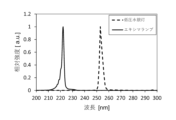
- Figure 9 is a graph showing the emission spectra of the excimer lamp and low-pressure mercury lamp used in this verification. Note that the emission spectra shown in Figure 9 are normalized based on the maximum emission intensity in each emission spectrum. As shown in Figure 9, for the excimer lamp used in this verification, the wavelength (peak wavelength) showing the maximum emission intensity is located near 222 nm. For the low-pressure mercury lamp, the peak wavelength is located near 254 nm. Note that "near” here is intended to include an error range of about 1 nm to 5 nm that can occur due to individual differences in the ultraviolet irradiation device 44.
- Verification 2 This verification differs from verification 1 in that cyanobacteria, which are microorganisms, were used as the subject of the verification. In addition, in consideration of the fact that cyanobacteria grow on the surface of stones 14 (see FIG. 1A, etc.), a cell 40 with an optical path length 43 of 2 mm was used in this verification. 0.3 mL of sample liquid 41 was poured into the cell 40.
- the cyanobacteria used in the verification were obtained through a distribution from the National Institute for Environmental Studies' Microbial Culture Collection (NIES Collection), which preserves a variety of microorganisms. More specifically, the strain number is NIES-44 and the scientific name is Microcystis aeruginosa.
- sample N1 The above-mentioned cyanobacteria (hereinafter, for convenience, referred to as "sample N1”) were cultured to prepare sample solution 41.
- Sample N1 was cultured in CB medium, also obtained from the NIES collection. The cultured sample was placed in an environment with an illumination of 1200 [lx] for 10 hours per day, and in an environment with an illumination of 100 [lx] or less for the remaining 14 hours. The temperature during culture was also set to 25 degrees. The solution cultured under these conditions for 20 days was used as sample solution 41.
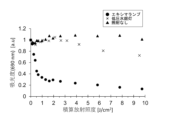
- FIG. 10A is a graph showing the integrated irradiance of ultraviolet light L1 on the horizontal axis and the absorbance of the sample liquid 41 on the vertical axis.
- the absorbance is a value normalized by the absorbance of the sample liquid 41 before the irradiation of ultraviolet light L1 is started.
- FIG. 10A shows the results when an excimer lamp and a low-pressure mercury lamp are used as the ultraviolet light irradiation device 44.
- FIG. 10A also shows the absorbance in a state where ultraviolet light L1 is not irradiated (no irradiation) as a reference example.
- FIG. 10A shows the absorbance for light of 670 nm.
- Chlorophyll A is one of the pigments found in microorganisms that perform photosynthesis, such as algae and cyanobacteria. Chlorophyll A also plays a role in photosynthesis, such as absorbing visible light V1 and converting the light energy. Therefore, it is believed that the activity of algae, etc. decreases due to the decrease in chlorophyll A. In other words, it can be said that the proliferation of algae, etc. is inhibited by irradiation with ultraviolet light L1.
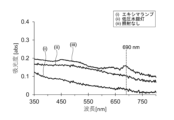
- FIG. 10B is an absorption spectrum of the sample solution 41 of the sample N1 used in this verification.
- FIG. 10B shows the absorption spectrum of the sample solution 41 before (without) irradiation with ultraviolet light L1 and when the integrated irradiance of ultraviolet light L1 is set to 16 J/cm 2.
- FIG. 10C is a graph showing the results of verification 2, following FIG. 10A.
- the sample N1 has a characteristic absorption peak of absorbance near 690 nm.
- the absorption peak is estimated to be an absorption band related to the chlorophyll contained in the sample N1, and the decrease due to irradiation with ultraviolet light L1 was significant. Therefore, FIG. 10C shows the absorbance for light of 690 nm.
- irradiation with ultraviolet light L1 reduced the absorbance of sample liquid 41 for visible light (350 nm to 800 nm). From this result, it is believed that the transmittance of sample N1 in sample liquid 41 for visible light has increased. In other words, irradiation with ultraviolet light L1 has the effect of diluting the color exhibited by sample N1. Furthermore, this decrease in absorbance was more significant when ultraviolet light L1 was irradiated using an excimer lamp than when ultraviolet light L1 was irradiated using a low-pressure mercury lamp.
- FIG. 10C The same discussion as in FIG. 10A is possible for FIG. 10C. That is, it was confirmed that, like chlorophyll A, sample N1 was reduced by irradiation with ultraviolet light L1. More specifically, from FIG. 10C, it can be seen that in the case of using an excimer lamp, the absorbance rapidly decreased from the start of irradiation with ultraviolet light L1 until the integrated irradiance reached 1 J/ cm2 , and the absorbance decreased more significantly than in the other cases. On the other hand, in the case of using a low-pressure mercury lamp, the absorbance decreased gradually, and even if the integrated irradiance reached 10 J/ cm2 , the absorbance decrease was small.
- the integrated irradiance at which the absorbance shows 0.1 compared to the state before irradiation with ultraviolet light L1 is 0.5 J/ cm2 in the case of an excimer lamp, while it is 12 J/ cm2 in the case of a low-pressure mercury lamp.
- the latter requires an integrated irradiance 20 times or more that of the former.
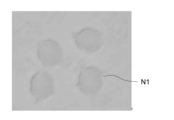
- Fig. 11A is a microscopic image of the cyanobacteria contained in the sample liquid 41 before irradiation with ultraviolet light L1
- Fig. 11B is a microscopic image of the cyanobacteria contained in the sample liquid 41 when the integrated irradiance was set to 56 mJ/ cm2
- Fig. 11C is a microscopic image when the integrated irradiance was set to 1.3 J/ cm2 .
- the ultraviolet rays emitted by the excimer lamp used in this verification have a peak wavelength near 222 nm, and fall within the range of 200 nm to 230 nm.
- the ultraviolet rays emitted by the low-pressure mercury lamp used in this verification have a peak wavelength near 254 nm, and fall within the range of 250 to 260 nm.
- ultraviolet rays in the range of 200 nm to 230 nm are more effective at decomposing chlorophyll A and sample N1 than ultraviolet rays in the range of 250 to 260 nm.
- example N1 a species of cyanobacteria identified by the strain number NIES-44 was used.
- example N1 a species of cyanobacteria identified by the strain number NIES-44 was used.
- ultraviolet light L1 in the range of 200 nm to 230 nm is effective in decomposing chlorophyll A.
- chlorophyll A is found in many algae, it is presumed that irradiation with the above ultraviolet light L1 inhibits the growth of not only sample N1 used in verification 2, but also algae such as euglena algae and green algae, and other microorganisms that perform photosynthesis.
- the excimer lamp used in this verification is a light source that emits ultraviolet light L1 with a dominant wavelength in the range of 200 nm to 230 nm, as shown in Figure 9.
- the ultraviolet light L1 contains ultraviolet light that falls within the above wavelength range
- the dominant wavelength is outside the above wavelength range
- the proliferation of algae, etc. can be suppressed, as in this verification, by adjusting the output of the ultraviolet light irradiation device that emits the ultraviolet light L1 and the irradiation time of the ultraviolet light L1, etc., so that the habitat of the algae, etc. is sufficiently irradiated with ultraviolet light in the above wavelength range.
- the end surface 42 of the cell 40 was irradiated with a radiant illuminance of 1 mW/ cm2 .
- the irradiant illuminance may be appropriately adjusted in consideration of the effect of the irradiation of the ultraviolet ray L1 on the irradiation target.
- the aesthetic appearance of the irradiation object does not change suddenly between the area irradiated with the ultraviolet ray L1 and the area not irradiated with the ultraviolet ray.
- the ultraviolet ray may be irradiated so that the integrated irradiance of the ultraviolet ray is 1 J/cm 2 or more at the time when one week has elapsed since the start of irradiation of the ultraviolet ray L1, or the integrated irradiance of the ultraviolet ray is 1 J/cm 2 or more at the time when 12 weeks have elapsed.
- the ultraviolet ray L1 may be irradiated so that the integrated irradiance at the time when a predetermined period set within a period of one week to 12 weeks has elapsed is 1 J/cm 2 or more.
- the ultraviolet ray L1 may be irradiated intermittently.
- ultraviolet light may be irradiated so that the integrated irradiance is 1 J/ cm2 or more within a period shorter than one week, for example, three days after the start of irradiation of ultraviolet light L1.
- a program such as the voltage to be supplied to the ultraviolet light source 2 and the supply time of the voltage may be stored in the memory 7b (see FIG. 5).
- the program is for driving the ultraviolet light source 2 so that a preset integrated irradiance of the ultraviolet light L1 is reached within a predetermined period of time from the start of irradiation of the ultraviolet light L1.
- the control unit 7 may be configured to output a control signal to the lighting circuit 6 based on the program.
- FIG. 12 is a conceptual diagram showing a typical embodiment of the growth inhibition method.
- a scene is shown in which visible light V1 and ultraviolet light L1 emitted from a lighting device 30 are irradiated onto a fossil 15 on a display stand 16 exhibited in a museum.
- the fossil 15 may have algae or microorganisms attached to its surface. It is also expected that algae etc. may attach to or grow on the surface of the fossil 15 during transportation after excavation or during the long-term display process. If algae etc. attach to or grow on the surface of the fossil 15 and grow, the surface will turn green, damaging the aesthetic appearance of the fossil 15. It is also preferable to suppress the growth of algae etc. from the perspective of maintaining a good preservation condition of the fossil 15.
- This embodiment differs from the first embodiment in that the lighting device 30 irradiates ultraviolet light L1 onto the habitat area A1 of the fossil 15.
- FIG. 13 is a schematic diagram showing the configuration of the lighting device 30.
- the lighting device 30 includes an ultraviolet light source 2, an illumination light source 9, a housing 3, an ultraviolet light exit window 4, and a connector 22.
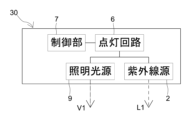
- FIG. 14 is a block diagram showing a schematic configuration of the lighting device 30. As shown in FIG. 14, the lighting device 30 includes a lighting circuit 6 and a control unit 7.
- the ultraviolet light source 2 and the illumination light source 9 are composed of solid-state light sources such as LED elements.
- the illumination device 30 is capable of emitting ultraviolet light L1 and visible light V1, and therefore illuminates the fossil 15 and irradiates the fossil 15 with ultraviolet light L1.
- the irradiation of ultraviolet light L1 inhibits the growth of algae and the like on the surface of the fossil 15, so there is no risk of damaging the surface of the fossil 15 compared to directly cleaning the surface with a brush or the like.
- the illumination device 30 with both the ultraviolet light source 2 and the illumination light source 9, the space required for installing both can be reduced.
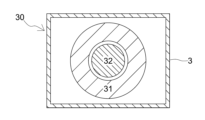
- FIG. 15 is a conceptual diagram showing the arrangement of the ultraviolet light source 2 and the illumination light source 9 when the illumination device 30 shown in FIG. 13 is viewed from a direction perpendicular to the main surface of the ultraviolet light exit window 4.
- the area where the ultraviolet light source 2 is arranged is referred to as the "ultraviolet light source arrangement area 31," and that of the illumination light source 9 is referred to as the "illumination light source arrangement area 32.”
- FIG. 16 corresponds to a drawing of the fossil 15 when viewed from the illumination device 30 in FIG. 12.
- a lighting device 30 is realized in which the range irradiated with ultraviolet light L1 (hereinafter, for convenience, referred to as the "ultraviolet light irradiation range L2") includes the visible light irradiation range V2 inside, as shown in FIG. 16.
- the irradiation ranges of ultraviolet light L1 and visible light V1 are shown diagrammatically. Note that in FIG. 16, the visible light irradiation range V2 and the ultraviolet light irradiation range L2 are illustrated overlapping, and ultraviolet light L1 is also irradiated onto the visible light irradiation range V2. This is because the ultraviolet light L1 emitted from the ultraviolet light source 2 travels while spreading out at a predetermined divergence angle.
- the ultraviolet light L1 is irradiated to an area that includes the visible light irradiation range V2.
- the housing 3 houses the ultraviolet light source 2 and the illumination light source 9 inside.
- the ultraviolet light L1 is extracted to the outside from the ultraviolet light exit window 4 of the housing 3.
- the ultraviolet light exit window 4 also functions as a visible light exit window for extracting the visible light V1 emitted by the illumination light source 9 to the outside of the housing 3.
- an optical filter and a diffusion filter may be mounted on the main surface of the ultraviolet light exit window 4, as described above in the first embodiment.
- the lighting device 30 is installed indoors, so there is a low possibility that moisture will infiltrate the inside of the housing 3. Therefore, there is no need to apply waterproofing treatment to the housing 3.
- the lighting circuit 6 shown in FIG. 14 is an electrical circuit that supplies the power required for lighting to the ultraviolet light source 2 and the illumination light source 9.
- the control unit 7 is a control means that transmits a control signal to the lighting circuit 6.
- the control unit 7 is configured to turn on the ultraviolet light source 2 while the illumination light source 9 is off.
- the control unit 7 is preferable to irradiate ultraviolet light L1 during the period when the illumination light source 9 is off.
- the period when the illumination light source 9 is off refers to, for example, the non-operating hours of the museum. In other words, during that time period, there is a low possibility that people will be present within the facility. Therefore, if ultraviolet light L1 is irradiated during that time period, the standard values of the ACGIH and other standards mentioned above can be easily complied with.
- the connector 22 is electrically connected to a power supply terminal provided on the ceiling 23. The necessary power is supplied to the lighting circuit 6 via the connector 22.
- the lighting device 30 may be attached to a ceiling 23, a wall surface, etc. by including the mounting portion 5 described above in the first embodiment.
- FIG. 13 shows an example in which the ultraviolet light exit window 4 also functions as a visible light exit window
- the ultraviolet light source 2 and the illumination light source 9 may be disposed in separate spaces within the housing 3, and the ultraviolet light L1 and the visible light V1 may be emitted to the outside from different locations.
- the arrangement of the ultraviolet light source 2 and the illumination light source 9 may also be designed arbitrarily.
- control unit 7 has been described as turning on the ultraviolet light source 2 while the illumination light source 9 is turned off (see FIG. 14).
- the control unit 7 and the lighting circuit 6 may be configured for each of the ultraviolet light source 2 and the illumination light source 9, and the ultraviolet light source 2 and the illumination light source 9 may be turned on or off individually.
- the lighting device 30 has been described as including an ultraviolet light source 2 and an illumination light source 9.
- an ultraviolet light irradiation device 1 including an ultraviolet light source 2 may be installed separately from the lighting device that illuminates the fossil 15.
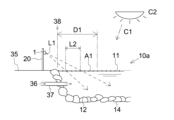
- FIG. 17A is a conceptual diagram showing a schematic example of one embodiment of the proliferation inhibition method.
- FIG. 17B is a drawing of FIG. 17A viewed from a different angle, following FIG. 2.
- FIGS. 17A and 17B show a scene in which ultraviolet light L1 emitted by the ultraviolet light irradiation device 1 is irradiated toward the water surface 11 of the lake 10a.
- FIG. 17A shows a habitat area A1 formed on the water surface 11 of the lake 10a.
- oxygen includes the oxygen in the water, so the occurrence of blue-green algae reduces the oxygen concentration in the water.
- cyanobacteria may produce microcystin, which is toxic to living organisms. Therefore, if blue-green algae occurs in lake 10a, the cyanobacteria that form the algae will produce a large amount of microcystin, greatly affecting the ecosystem of lake 10a.
- Lake 10a can be a target for people to view, but if the foul odor becomes too noticeable, it can discourage people from viewing it.
- the water surface 11 it is preferable to irradiate the water surface 11 with ultraviolet light L1 to reduce, i.e., decompose, the cyanobacteria and inhibit their proliferation.
- ultraviolet light L1 decomposes and reduces algae, etc., including cyanobacteria, and inhibits the proliferation of the algae, etc.
- the microcystin produced by the cyanobacteria may flow into lake 10a and remain there. However, as described below, it is possible to decompose the microcystin by irradiation with ultraviolet light L1.
- UV-L1 irradiation can decompose cyanobacteria while suppressing the consumption of oxygen in the water and the generation of foul odors.
- the integrated irradiance of the ultraviolet light L1 at the water surface 11 is 200 mJ/ cm2 or more.
- the integrated irradiance of the ultraviolet light L1 can be adjusted by varying the lighting time of the ultraviolet irradiation device 1 and the irradiance at the water surface 11.
- the irradiance at the water surface 11 can be calculated based on the distance between the ultraviolet light exit window 4 and the water surface 11, for example, using the irradiance at the ultraviolet light exit window 4 of the ultraviolet irradiation device 1 as a reference.
- FIG. 17B shows a schematic diagram of domestic wastewater 36 flowing into lake 10a from land 35.
- the nitrogen concentration or phosphorus concentration is likely to become locally high, particularly near the water's edge 38 of lake 10a, and that cyanobacteria are likely to proliferate and cause blue-green algae.
- the ultraviolet irradiation range L2 of ultraviolet light L1 on the water surface 11 be formed within a distance D1 of 20 m, more preferably 10 m, from the water's edge 38 of lake 10a.
- the configuration of the ultraviolet irradiation device 1 can be discussed in the same manner as described in the first embodiment.
- FIG. 18 is a perspective view showing a modified example of the ultraviolet irradiation device 1. As shown in FIG. 18, the ultraviolet irradiation device 1 may be equipped with a wind vane 50, which will be described later.
- FIG. 19 is a drawing of the ultraviolet irradiation device 1 viewed from a different direction than FIG. 18.
- the inside of the ultraviolet irradiation device 1 is shown in a transparent manner, and the anemometer 50 is omitted.
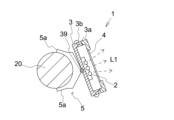
- the mounting part 5 of the ultraviolet irradiation device 1 includes a clamping part 5a and an angle adjustment mechanism 39, as shown in FIG. 19. This allows the mounting part 5 to be configured to change the direction of the ultraviolet light L1 emitted by the housing 3.
- the angle adjustment mechanism 39 is fixed to a portion of the housing 3 and is configured to be able to change the position of the housing 3 relative to the pole 20.
- FIG. 19B is a diagram showing a state in which the emission direction of ultraviolet light L1 has been changed from the state of FIG. 19A. As shown in FIG. 19B, the angle adjustment mechanism 39 changes the position of the housing 3 relative to the pole 20 by, for example, driving an electric motor (not shown), thereby changing the emission direction of ultraviolet light L1. Note that the emission direction of ultraviolet light L1 may be a direction perpendicular to the ultraviolet light exit window 4.
- the wind vane 50 comprises a fixed base 51, a body 52, and a support shaft 53 that supports the body 52.
- the body 52 has a shape that extends in one direction, and has wings (52a, 52b) and a tip 52c on the opposite side.
- the support shaft 53 is connected to the fixed base 51 and supports the body 52 in a rotatable state within a horizontal plane.
- the anemometer 50 detects the wind direction by detecting the orientation of the body 52 with a sensor (not shown) built into the fixed base 51.
- the emission direction of ultraviolet light L1 may be changed based on the wind direction detected by the anemometer 50.
- FIG. 20 is a block diagram that, following FIG. 5, shows a schematic configuration of the ultraviolet irradiation device 1 according to FIG. 18.
- the control unit 7 is configured to be able to transmit a signal d2 for driving the angle adjustment mechanism 39 to the angle adjustment mechanism 39 based on a signal d1 from the wind vane 50.
- the angle adjustment mechanism 39 changes the position of the housing 3 relative to the pole 20, for example as described with reference to FIG. 19B, to change the emission direction of the ultraviolet light L1.
- the emission direction of ultraviolet rays L1 set for each wind direction may be stored in advance in the memory 7b of the control unit 7.
- the control unit 7 reads out the emission direction of ultraviolet rays L1 corresponding to the wind direction measured by the anemometer 50, and transmits it as a signal d2 to the angle adjustment mechanism 39.
- the angle adjustment mechanism 39 changes the position of the housing 3 relative to the pole 20, and changes the emission direction of ultraviolet rays L1 to a predetermined direction.
- the configuration of the angle adjustment mechanism 39 is arbitrary as long as it can change the emission direction of the ultraviolet light L1, and is not limited to the configuration described with reference to Figures 19A and 19B.
- the wind vane 50 can have a conventionally known configuration as long as it can measure the wind direction.
- the control unit 7 that controls the lighting circuit 6 and the angle adjustment mechanism 39 does not have to be a common unit. Also, in the above description, the control unit 7 controls the angle adjustment mechanism 39, but the emission direction of the ultraviolet light L1 may be changed manually.
- the wind direction may be measured by any wind vane.
- information about the wind direction may be sent to any server.
- the control unit 7 may receive information about the wind direction from any server.
- the ultraviolet light irradiation device 1 when changing the emission direction of the ultraviolet light L1 according to the wind direction, the ultraviolet light irradiation device 1 is not limited to being equipped with the wind vane 50.
- control unit 7 may transmit information regarding the emission direction of ultraviolet light L1 from any server.
- the control unit 7 is not limited to a configuration including memory 7b.
- the ultraviolet irradiation device 1 is described as being attached to the poles 20 installed around the lake 10a. However, it is also possible to install the ultraviolet irradiation device 1 above the water of the lake 10a, for example, by driving the poles 20 into the bottom surface 12 of the lake 10a.
- multiple ultraviolet irradiation devices 1 may be placed around the lake 10a or on the water, and information regarding the emission direction of ultraviolet rays L1 may be transmitted from an arbitrary server to each ultraviolet irradiation device 1 based on the wind direction.
- the habitat area A1 has been described as the water surface 11 of the lake 10a.
- a water storage area such as a pond 10, for example.
- Verification 4 The effect of irradiating microcystin with ultraviolet light L1 was verified, and will be described below as Verification 4. In this verification, microcystin was irradiated with ultraviolet light L1 under two conditions, Case 1 and Case 2, and the residual rate of microcystin was evaluated.
- the procedure for preparing the sample subjected to irradiation with ultraviolet light L1 is as follows. First, microcystin (Fujifilm Wako Pure Chemical Industries, Ltd.: 136-12241 Microcystin LR) was dissolved in methanol (Fujifilm Wako Pure Chemical Industries, Ltd.: 131-01826) at a concentration of 250 ⁇ g/mL. Next, this solution was diluted and mixed with pure water to obtain a sample solution with a concentration of approximately 1600 pg/mL. Then, approximately 4 mL of this sample solution was dropped into a petri dish with a diameter of 35 mm to obtain a sample.
- the sample was irradiated with ultraviolet light L1.
- a plurality of samples were prepared, and the reactivity of the samples was evaluated by a known ELISA method with different integrated irradiances (mJ/cm 2 ) of ultraviolet light L1.
- the ELISA method is a method for evaluating the reactivity of microcystin by reacting microcystin with a specific antibody and measuring the absorbance of the reaction product.
- an "ELISA kit Tokiwa Chemical Industry Co., Ltd.: 300-05191 Microcystin ELISA Kit)" for evaluating microcystin was used as the kit for carrying out the ELISA method.
- the residual rate of microcystin was evaluated from the ratio of the absorbance of the sample after UV-L1 irradiation to the absorbance of the sample before UV-L1 irradiation.
- the ultraviolet light L1 was irradiated using an excimer lamp filled with krypton gas and chlorine gas.
- the sample was irradiated with ultraviolet light L1, whose peak wavelength is located near 222 nm.
- the excimer lamp used in this verification has the same specifications as the excimer lamp used in the aforementioned verification 1.
- Results of Verification 4 is a graph showing the results of verification 4.
- the residual rate of microcystin versus the integrated irradiance (mJ/cm 2 ) of ultraviolet light L1 in case 1 and case 2 is shown.
- the residual rate of microcystin decreases as the cumulative irradiance of ultraviolet light L1 increases.
- Fig. 21 clearly shows that irradiation with ultraviolet light L1 decomposes microcystin.
- the cumulative irradiance required for the residual rate to reach, for example, about 0.1 is 200 mJ/ cm2 .
- the residual rate remained at about 0.2 even when the cumulative irradiance reached 1000 mJ/ cm2 .
- irradiation with an excimer lamp is more effective at decomposing microcystin than irradiation with a low-pressure mercury lamp.
- the ultraviolet light emitted by the excimer lamp used in this verification has a peak wavelength near 222 nm, with a dominant wavelength in the range of 200 nm to 230 nm.
- the dominant wavelength of the ultraviolet light L1 it is preferable for the dominant wavelength of the ultraviolet light L1 to be in the range of 200 nm to 230 nm. This point will be reconsidered later, including the results of verification 5.
- microcystin can be decomposed favorably.
- the ultraviolet rays L1 are irradiated so that the integrated irradiance at the time of the lapse of a predetermined period set within 72 hours is 200 mJ/cm 2 or more. Note that the period required for the integrated irradiance to reach 200 mJ/cm 2 after the start of irradiation of the ultraviolet rays L1 can be appropriately adjusted.
- ultraviolet rays may be irradiated so that the integrated irradiance of the ultraviolet rays is 200 mJ/cm 2 or more after 48 hours have elapsed from the start of irradiation of the ultraviolet rays L1, or ultraviolet rays may be irradiated so that the integrated irradiance of the ultraviolet rays is 200 mJ/cm 2 or more after 24 hours have elapsed.
- phase contrast observation was performed. More specifically, the inverted microscope used in Verification 3 and this verification allows switching between phase contrast observation mode and bright field observation mode. In phase contrast observation, the contrast between light and dark allows for more detailed observation of the cell membrane of microorganisms, etc. It should be noted that, just to be clear, in the above Verification 3, sample N1 was observed in bright field observation mode in order to observe the color change exhibited by sample N1.
- cyanobacteria (sample N1) were observed under two different conditions: irradiating ultraviolet light from an excimer lamp, as in verification 3, and irradiating ultraviolet light from the low-pressure mercury lamp used in verification 1, etc.
- Fig. 22A is a phase contrast microscope image of sample N1 before irradiation with ultraviolet light L1.
- Fig. 22B is a phase contrast microscope image of sample N1 at the time when ultraviolet light was irradiated by an excimer lamp having the same specifications as in verification 3 and the integrated irradiance was set to 75 mJ/ cm2 .
- Fig. 22C is a phase contrast microscope image of sample N1 at the time when ultraviolet light was irradiated by a low-pressure mercury lamp and the integrated irradiance was set to 750 mJ/ cm2 .
- FIG. 22B when ultraviolet light emitted by the excimer lamp, i.e., ultraviolet light having a peak wavelength near 222 nm, was irradiated, the outer shape of sample N1 changed compared to the state before ultraviolet light irradiation (Fig. 22A). This is believed to be because the cell membrane of sample N1 was broken by ultraviolet light irradiation. Also, in Fig. 22A, component m1, which is presumed to have flowed out from sample N1, was observed. As described above, in Fig.
- the integrated irradiance of ultraviolet light was set to 75 mJ/ cm2 , and this result is consistent with the point that the color exhibited by sample N1 became lighter at an integrated irradiance of about 50 mJ/ cm2 (see Fig. 11B).
- Fig. 22B more clearly shows that the cell membrane of the cyanobacteria breaks and decomposition starts at an integrated irradiance of about 50 mJ/ cm2 .
- the decomposition of the cyanobacteria causes pigments such as chlorophyll and microcystin to leak out of the cyanobacteria.
- Fig. 22C when ultraviolet light emitted by a low pressure mercury lamp, i.e., ultraviolet light having a peak wavelength near 254 nm, was irradiated, no change was observed in sample N1 compared to the state before ultraviolet light irradiation (Fig. 22A).
- the integrated irradiance is about 10 times that of Fig. 22B.
- ultraviolet light having a peak wavelength near 254 nm was irradiated, it is considered that sample N1 was hardly decomposed even if the integrated irradiance was 750 mJ/ cm2 . This point is consistent with the result of Fig. 10C.
- proteins have a very high absorption coefficient for ultraviolet light in the wavelength range of 200 nm to 230 nm. More specifically, proteins are known to have a high absorption coefficient for ultraviolet light with wavelengths of approximately 240 nm or less. On the other hand, proteins have a relatively low absorption coefficient for ultraviolet light with a wavelength of, for example, 254 nm.
- the cell membrane of cyanobacteria is composed of proteins, it is believed to have a higher absorption coefficient for ultraviolet light with a peak wavelength around 222 nm than for ultraviolet light with a peak wavelength around 254 nm. This is believed to be the reason why irradiation with ultraviolet light from the excimer lamp was more effective at decomposing cyanobacteria.
- microcystin which is composed of proteins, also exhibits a high absorption coefficient for ultraviolet light in the above wavelength range.
- the dominant wavelength of ultraviolet light L1 be in the range of 200 nm to 230 nm.
- the cell membrane is composed of proteins not only in cyanobacteria but also in other algae. Also, since the chlorophyll contained in algae exists in a state bound to a certain protein, the reduction of chlorophyll is promoted by the decomposition of the protein. In other words, from the viewpoint of inhibiting the proliferation of algae and protecting or restoring the beauty of the plant, it is preferable that the dominant wavelength of ultraviolet light falls within the above wavelength range.
- FIG. 22 is a conceptual diagram showing a typical example of an embodiment of the proliferation inhibition method. As shown in Fig. 22, ultraviolet light L1 may be irradiated onto an exterior wall surface 25, such as under the eaves of a building 24.
- an ultraviolet irradiation device 1 may be attached to the exterior wall surface 25.
- FIG. 23A is a block diagram showing a schematic diagram of another configuration of the ultraviolet irradiation device 1.
- the ultraviolet irradiation device 1 may be equipped with a living organism detection unit 8a that detects the presence of a living organism such as a human in the vicinity.
- the living organism detection unit 8a is an infrared sensor that detects the surrounding heat.
- the living organism detection unit 8a issues a signal to the control unit 7 that it has detected the presence of a living organism in the vicinity.
- the control unit 7 then issues a signal to the lighting circuit 6 to turn off the ultraviolet ray source 2.
- the above-mentioned ACGIH and other regulations prescribe standard values for the amount of ultraviolet radiation irradiated to the human body.
- Ultraviolet radiation L1 which has a wavelength in the range of 200 nm to 230 nm, has an extremely low impact on the human body, but from the perspective of protecting the ecosystem, it is desirable to give some consideration to the amount of ultraviolet radiation irradiated to animals other than humans.
- the above-mentioned configuration makes it easy to irradiate ultraviolet radiation L1 in accordance with the above-mentioned ACGIH and other regulations.
- FIG. 23B is a block diagram showing a schematic diagram of another configuration of the lighting device 30.
- the control unit 7 receives the above signal from the biological detection unit 8a, it issues a signal to the lighting circuit 6 to turn off the ultraviolet light source 2 and turn on the illumination light source 9.
- the period during which the ultraviolet irradiation device 1 or the lighting device 30 irradiates the habitat area A1 with ultraviolet light L1 is not limited. Therefore, although the above description assumes that the ultraviolet irradiation device 1 or the lighting device 30 includes a control unit 7, it is optional whether or not the ultraviolet irradiation device 1 or the lighting device 30 includes a control unit 7.
- the detection unit 8 is not required.
- UV irradiation device 2 UV source 3: Housing 3a: Joint 3b: Sealing section 3c: Waterproof cover 4: UV exit window 5: Mounting section 6: Lighting circuit 7: Control section 7a: Processor 7b: Memory 8: Detection section 8a: Living organism detection section 9: Illumination light source 10: Pond 10a: Lake 11: Water surface 12: Bottom surface 14: Stone 15: Fossil 16: Display stand 20: Pole 21, 30: Illumination device 22: Connector 23: Ceiling 24: Building 25: Exterior wall surface 31: UV source placement area 32: Illumination light source placement area 35: Land 36: Domestic wastewater 37: Drain outlet 38: Water's edge 39: Angle adjustment mechanism 40: Cell 41: Sample liquid 42: End face 43: Optical path length 50: Wind vane 51: Fixed base 52: Body 52a, 52b: Wings 52c: Tip 53: Support axis A1: Habitat area C1: Sunlight C2: Sun L1: Ultraviolet light L2
Landscapes
- Life Sciences & Earth Sciences (AREA)
- Health & Medical Sciences (AREA)
- Epidemiology (AREA)
- Environmental Sciences (AREA)
- Veterinary Medicine (AREA)
- Engineering & Computer Science (AREA)
- Public Health (AREA)
- General Health & Medical Sciences (AREA)
- Animal Behavior & Ethology (AREA)
- Hydrology & Water Resources (AREA)
- Organic Chemistry (AREA)
- Chemical & Material Sciences (AREA)
- Water Supply & Treatment (AREA)
- Environmental & Geological Engineering (AREA)
- Toxicology (AREA)
- Marine Sciences & Fisheries (AREA)
- Animal Husbandry (AREA)
- Biodiversity & Conservation Biology (AREA)
- General Engineering & Computer Science (AREA)
- Apparatus Associated With Microorganisms And Enzymes (AREA)
- Micro-Organisms Or Cultivation Processes Thereof (AREA)
Priority Applications (1)
| Application Number | Priority Date | Filing Date | Title |
|---|---|---|---|
| JP2024570076A JPWO2024150554A1 (https=) | 2023-01-11 | 2023-12-01 |
Applications Claiming Priority (2)
| Application Number | Priority Date | Filing Date | Title |
|---|---|---|---|
| JP2023-002577 | 2023-01-11 | ||
| JP2023002577 | 2023-01-11 |
Publications (1)
| Publication Number | Publication Date |
|---|---|
| WO2024150554A1 true WO2024150554A1 (ja) | 2024-07-18 |
Family
ID=91896766
Family Applications (1)
| Application Number | Title | Priority Date | Filing Date |
|---|---|---|---|
| PCT/JP2023/043101 Ceased WO2024150554A1 (ja) | 2023-01-11 | 2023-12-01 | 藻類又は微生物の増殖抑制方法、紫外線照射装置、及び照明装置 |
Country Status (2)
| Country | Link |
|---|---|
| JP (1) | JPWO2024150554A1 (https=) |
| WO (1) | WO2024150554A1 (https=) |
Cited By (1)
| Publication number | Priority date | Publication date | Assignee | Title |
|---|---|---|---|---|
| WO2026042330A1 (ja) * | 2024-08-23 | 2026-02-26 | ウシオ電機株式会社 | 紫外光照射装置 |
Citations (8)
| Publication number | Priority date | Publication date | Assignee | Title |
|---|---|---|---|---|
| JPH0252086A (ja) * | 1988-05-09 | 1990-02-21 | Furuno Electric Co Ltd | 浄水装置 |
| JP2003519009A (ja) * | 2000-01-04 | 2003-06-17 | フォーリノーバ、アクティーゼルスカブ | 水生系中で大増殖する微生物の防止方法および手段 |
| JP2009000494A (ja) * | 2007-05-23 | 2009-01-08 | Noritsu Koki Co Ltd | ポルフィリン検出方法、ポルフィリンの表示方法、およびポルフィリン検出装置 |
| JP2020092968A (ja) * | 2018-12-14 | 2020-06-18 | ウシオ電機株式会社 | 紫外線照射装置 |
| JP2021185991A (ja) * | 2020-05-26 | 2021-12-13 | コイズミ照明株式会社 | 照明器具 |
| JP2022043880A (ja) * | 2020-09-04 | 2022-03-16 | ウシオライティング株式会社 | スポットライト型光源、及びスポットライト型照明用光源 |
| JP2022089195A (ja) * | 2020-12-03 | 2022-06-15 | ショット アクチエンゲゼルシャフト | 病原体の根絶方法 |
| JP2022125487A (ja) * | 2021-02-17 | 2022-08-29 | ウシオ電機株式会社 | 菌又はウイルスの不活化方法 |
-
2023
- 2023-12-01 JP JP2024570076A patent/JPWO2024150554A1/ja not_active Abandoned
- 2023-12-01 WO PCT/JP2023/043101 patent/WO2024150554A1/ja not_active Ceased
Patent Citations (8)
| Publication number | Priority date | Publication date | Assignee | Title |
|---|---|---|---|---|
| JPH0252086A (ja) * | 1988-05-09 | 1990-02-21 | Furuno Electric Co Ltd | 浄水装置 |
| JP2003519009A (ja) * | 2000-01-04 | 2003-06-17 | フォーリノーバ、アクティーゼルスカブ | 水生系中で大増殖する微生物の防止方法および手段 |
| JP2009000494A (ja) * | 2007-05-23 | 2009-01-08 | Noritsu Koki Co Ltd | ポルフィリン検出方法、ポルフィリンの表示方法、およびポルフィリン検出装置 |
| JP2020092968A (ja) * | 2018-12-14 | 2020-06-18 | ウシオ電機株式会社 | 紫外線照射装置 |
| JP2021185991A (ja) * | 2020-05-26 | 2021-12-13 | コイズミ照明株式会社 | 照明器具 |
| JP2022043880A (ja) * | 2020-09-04 | 2022-03-16 | ウシオライティング株式会社 | スポットライト型光源、及びスポットライト型照明用光源 |
| JP2022089195A (ja) * | 2020-12-03 | 2022-06-15 | ショット アクチエンゲゼルシャフト | 病原体の根絶方法 |
| JP2022125487A (ja) * | 2021-02-17 | 2022-08-29 | ウシオ電機株式会社 | 菌又はウイルスの不活化方法 |
Cited By (1)
| Publication number | Priority date | Publication date | Assignee | Title |
|---|---|---|---|---|
| WO2026042330A1 (ja) * | 2024-08-23 | 2026-02-26 | ウシオ電機株式会社 | 紫外光照射装置 |
Also Published As
| Publication number | Publication date |
|---|---|
| JPWO2024150554A1 (https=) | 2024-07-18 |
Similar Documents
| Publication | Publication Date | Title |
|---|---|---|
| CN104803445B (zh) | 水下紫外线杀菌器 | |
| KR101173348B1 (ko) | 식물병해 방제용 조명장치 | |
| KR101346053B1 (ko) | 해충 유인 조명 방법 및 해충 유인 조명 시스템 | |
| US20130102076A1 (en) | Systems and methods for growing photosynthetic organisms | |
| KR101051607B1 (ko) | 식물 재배를 위한 양액 순환 방식의 식물 공장 | |
| JP6761970B2 (ja) | 病害虫防除装置 | |
| US20130145688A1 (en) | Method for cultivating plant and plant cultivation device | |
| Borderie et al. | Heritage materials and biofouling mitigation through UV-C irradiation in show caves: state-of-the-art practices and future challenges | |
| WO2024150554A1 (ja) | 藻類又は微生物の増殖抑制方法、紫外線照射装置、及び照明装置 | |
| JP2012165727A (ja) | 環境配慮型養殖栽培システム | |
| CN117998983A (zh) | 植物枯杀方法以及植物枯杀系统 | |
| JP2011217732A (ja) | グリーン建築 | |
| US20220008572A1 (en) | Frequency Selective Viral Inactivation through Bond Breaking | |
| JP5424372B1 (ja) | 雑草や虫用の除去装置およびその方法 | |
| KR20110010470A (ko) | 엘이디 자외선 램프 및 오존을 이용한 살균기능을 구비한 어항 | |
| CN204625248U (zh) | 水下紫外线杀菌器 | |
| ITTV20100075A1 (it) | Apparato per l'incubazione di uova e/o embrioni di organismi acquatici | |
| EP3538637A1 (fr) | Système d'illumination d'un dispositif, notamment d'un élément décoratif, d'une façade d'un bâtiment ou d'un élément de mobilier urbain par bioluminescence | |
| KR20140017935A (ko) | 자연광을 이용하는 식물 공장 | |
| JP2016077264A (ja) | 植物栽培装置 | |
| JP2011101619A (ja) | 植物栽培装置 | |
| KR200401512Y1 (ko) | 발광다이오드를 이용한 어항 | |
| WO2006106363A3 (en) | Fluid disinfection apparatus and system | |
| Kieft et al. | Potential for mitigation of cave Lampenflora using Benzalkonium chloride or UV-C | |
| JP2903591B2 (ja) | 生物の付着防止方法 |
Legal Events
| Date | Code | Title | Description |
|---|---|---|---|
| 121 | Ep: the epo has been informed by wipo that ep was designated in this application |
Ref document number: 23916170 Country of ref document: EP Kind code of ref document: A1 |
|
| WWE | Wipo information: entry into national phase |
Ref document number: 2024570076 Country of ref document: JP |
|
| NENP | Non-entry into the national phase |
Ref country code: DE |
|
| 122 | Ep: pct application non-entry in european phase |
Ref document number: 23916170 Country of ref document: EP Kind code of ref document: A1 |