WO2024127732A1 - 自動二輪車用タイヤ - Google Patents
自動二輪車用タイヤ Download PDFInfo
- Publication number
- WO2024127732A1 WO2024127732A1 PCT/JP2023/031037 JP2023031037W WO2024127732A1 WO 2024127732 A1 WO2024127732 A1 WO 2024127732A1 JP 2023031037 W JP2023031037 W JP 2023031037W WO 2024127732 A1 WO2024127732 A1 WO 2024127732A1
- Authority
- WO
- WIPO (PCT)
- Prior art keywords
- elastic modulus
- tire
- belt cord
- inflection point
- belt
- Prior art date
- Legal status (The legal status is an assumption and is not a legal conclusion. Google has not performed a legal analysis and makes no representation as to the accuracy of the status listed.)
- Ceased
Links
Images
Classifications
-
- B—PERFORMING OPERATIONS; TRANSPORTING
- B60—VEHICLES IN GENERAL
- B60C—VEHICLE TYRES; TYRE INFLATION; TYRE CHANGING; CONNECTING VALVES TO INFLATABLE ELASTIC BODIES IN GENERAL; DEVICES OR ARRANGEMENTS RELATED TO TYRES
- B60C9/00—Reinforcements or ply arrangement of pneumatic tyres
- B60C9/18—Structure or arrangement of belts or breakers, crown-reinforcing or cushioning layers
- B60C9/20—Structure or arrangement of belts or breakers, crown-reinforcing or cushioning layers built-up from rubberised plies each having all cords arranged substantially parallel
- B60C9/22—Structure or arrangement of belts or breakers, crown-reinforcing or cushioning layers built-up from rubberised plies each having all cords arranged substantially parallel the plies being arranged with all cords disposed along the circumference of the tyre
- B60C9/2204—Structure or arrangement of belts or breakers, crown-reinforcing or cushioning layers built-up from rubberised plies each having all cords arranged substantially parallel the plies being arranged with all cords disposed along the circumference of the tyre obtained by circumferentially narrow strip winding
-
- B—PERFORMING OPERATIONS; TRANSPORTING
- B60—VEHICLES IN GENERAL
- B60C—VEHICLE TYRES; TYRE INFLATION; TYRE CHANGING; CONNECTING VALVES TO INFLATABLE ELASTIC BODIES IN GENERAL; DEVICES OR ARRANGEMENTS RELATED TO TYRES
- B60C9/00—Reinforcements or ply arrangement of pneumatic tyres
- B60C9/18—Structure or arrangement of belts or breakers, crown-reinforcing or cushioning layers
- B60C9/20—Structure or arrangement of belts or breakers, crown-reinforcing or cushioning layers built-up from rubberised plies each having all cords arranged substantially parallel
-
- B—PERFORMING OPERATIONS; TRANSPORTING
- B60—VEHICLES IN GENERAL
- B60C—VEHICLE TYRES; TYRE INFLATION; TYRE CHANGING; CONNECTING VALVES TO INFLATABLE ELASTIC BODIES IN GENERAL; DEVICES OR ARRANGEMENTS RELATED TO TYRES
- B60C9/00—Reinforcements or ply arrangement of pneumatic tyres
- B60C9/18—Structure or arrangement of belts or breakers, crown-reinforcing or cushioning layers
- B60C9/20—Structure or arrangement of belts or breakers, crown-reinforcing or cushioning layers built-up from rubberised plies each having all cords arranged substantially parallel
- B60C9/22—Structure or arrangement of belts or breakers, crown-reinforcing or cushioning layers built-up from rubberised plies each having all cords arranged substantially parallel the plies being arranged with all cords disposed along the circumference of the tyre
-
- D—TEXTILES; PAPER
- D07—ROPES; CABLES OTHER THAN ELECTRIC
- D07B—ROPES OR CABLES IN GENERAL
- D07B1/00—Constructional features of ropes or cables
- D07B1/06—Ropes or cables built-up from metal wires, e.g. of section wires around a hemp core
- D07B1/0606—Reinforcing cords for rubber or plastic articles
- D07B1/062—Reinforcing cords for rubber or plastic articles the reinforcing cords being characterised by the strand configuration
-
- B—PERFORMING OPERATIONS; TRANSPORTING
- B60—VEHICLES IN GENERAL
- B60C—VEHICLE TYRES; TYRE INFLATION; TYRE CHANGING; CONNECTING VALVES TO INFLATABLE ELASTIC BODIES IN GENERAL; DEVICES OR ARRANGEMENTS RELATED TO TYRES
- B60C9/00—Reinforcements or ply arrangement of pneumatic tyres
- B60C9/18—Structure or arrangement of belts or breakers, crown-reinforcing or cushioning layers
- B60C9/20—Structure or arrangement of belts or breakers, crown-reinforcing or cushioning layers built-up from rubberised plies each having all cords arranged substantially parallel
- B60C9/22—Structure or arrangement of belts or breakers, crown-reinforcing or cushioning layers built-up from rubberised plies each having all cords arranged substantially parallel the plies being arranged with all cords disposed along the circumference of the tyre
- B60C2009/2252—Physical properties or dimension of the zero degree ply cords
- B60C2009/2261—Modulus of the cords
-
- B—PERFORMING OPERATIONS; TRANSPORTING
- B60—VEHICLES IN GENERAL
- B60C—VEHICLE TYRES; TYRE INFLATION; TYRE CHANGING; CONNECTING VALVES TO INFLATABLE ELASTIC BODIES IN GENERAL; DEVICES OR ARRANGEMENTS RELATED TO TYRES
- B60C2200/00—Tyres specially adapted for particular applications
- B60C2200/10—Tyres specially adapted for particular applications for motorcycles, scooters or the like
-
- B—PERFORMING OPERATIONS; TRANSPORTING
- B60—VEHICLES IN GENERAL
- B60C—VEHICLE TYRES; TYRE INFLATION; TYRE CHANGING; CONNECTING VALVES TO INFLATABLE ELASTIC BODIES IN GENERAL; DEVICES OR ARRANGEMENTS RELATED TO TYRES
- B60C9/00—Reinforcements or ply arrangement of pneumatic tyres
- B60C9/02—Carcasses
- B60C9/04—Carcasses the reinforcing cords of each carcass ply arranged in a substantially parallel relationship
- B60C9/06—Carcasses the reinforcing cords of each carcass ply arranged in a substantially parallel relationship the cords extend diagonally from bead to bead and run in opposite directions in each successive carcass ply, i.e. bias angle ply
-
- D—TEXTILES; PAPER
- D07—ROPES; CABLES OTHER THAN ELECTRIC
- D07B—ROPES OR CABLES IN GENERAL
- D07B2501/00—Application field
- D07B2501/20—Application field related to ropes or cables
- D07B2501/2046—Tyre cords
Definitions
- the present invention relates to motorcycle tires (hereinafter also simply referred to as "tires”), more specifically to motorcycle tires relating to improvements in belt cords used in spiral belts, and in particular to motorcycle pneumatic tires.
- belts used to reinforce the tread surface of motorcycle tires have been two or more inclined belt layers arranged so that the cord directions intersect between the layers, or one or more spiral belts made of rubber-coated cords wound in a spiral shape around the tire circumference.
- Patent Document 1 discloses a pneumatic radial motorcycle tire that uses steel cord as a reinforcing material for the spiral belt layer, and in which the amount of elongation when the applied load is changed and the difference in the applied load when the amount of elongation is changed satisfy predetermined conditions.
- the technology described in Patent Document 1 aims to provide a pneumatic radial motorcycle tire that improves turning control performance (cornering performance) without compromising various tire performances such as straight-line driving performance, high-speed performance, ride comfort, and uniformity.
- the object of the present invention is to provide a motorcycle tire that suppresses the occurrence of buckling during driving and improves braking performance without compromising steering stability and ride comfort.
- a motorcycle tire having a carcass extending in a toroidal shape across a pair of bead portions as a skeleton, and a spiral belt formed by winding a belt cord spirally in the tire circumferential direction on the radially outer side of the carcass,
- a stress-strain curve of the belt cord taken out from a tire has an inflection point P V in a strain range of 0.20 to 0.90%
- a motorcycle tire characterized in that the ratio E VH /E VL of the elastic modulus E VL in the low elastic modulus region below the inflection point P V to the elastic modulus E VH in the high elastic modulus region above the inflection point P V of the belt cord taken out from the tire is 2.0 to 8.0.
- the elastic moduli E VL and E UL in the low elastic modulus region are defined as the minimum value of the slope of the stress-strain curve in the strain range of 0.05 to 1.0%.
- the elastic moduli E VH and E UH in the high elastic modulus region are defined as the maximum value of the slope of the stress-strain curve in the strain range exceeding 1.0%.
- the inflection points P V and P U are defined as points having intermediate elastic moduli between the elastic moduli E VL and E UL in the low elastic modulus region and the elastic moduli E VH and E UH in the high elastic modulus region, respectively.
- the present invention makes it possible to realize a motorcycle tire that suppresses the occurrence of buckling during driving and improves braking performance without compromising steering stability and ride comfort.
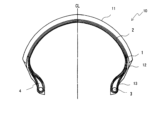
- FIG. 1 is a widthwise cross-sectional view showing an example of a motorcycle tire of the present invention.
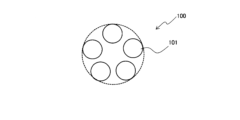
- FIG. 2 is a widthwise cross-sectional view showing an example of a configuration of a belt cord used in the spiral belt according to the present invention.
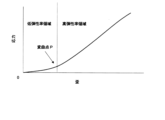
- 1 is a graph (schematic diagram) showing an example of a stress-strain curve of a belt cord.
- the compounds and materials described herein may be derived in whole or in part from fossil resources, from biological resources such as plant resources, from recycled resources such as used tires, or from a mixture of two or more of fossil resources, biological resources, and recycled resources.
- Fig. 1 is a widthwise cross-sectional view showing an example of a motorcycle tire of the present invention.
- the motorcycle tire 10 shown in the figure has a tread portion 11 formed in an annular shape, and a pair of sidewall portions 12 and bead portions 13 arranged in sequence on the radially inner side of the tread portion 11.
- the motorcycle tire 10 shown in the figure also has a carcass 1 that extends in a toroidal shape across the pair of bead portions 13 as a skeleton, and has a spiral belt 2 formed by winding a belt cord spirally around the tire circumferential direction on the radially outer side of the carcass 1.
- Figure 3 shows a graph (schematic diagram) of an example of a stress-strain curve for a belt cord.
- the illustrated stress-strain curve has an inflection point P, and shows a relatively low elastic modulus in the low elastic modulus region from the origin to the inflection point P, and a relatively high elastic modulus in the high elastic modulus region beyond the inflection point P.
- the elastic modulus here refers to the tensile elastic modulus.
- the stress-strain curve of the belt cord taken out of the tire has an inflection point P V in the range of 0.20 to 0.90% strain, and the ratio E VH /E VL of the elastic modulus E VL in the low elastic modulus region below the inflection point P V to the elastic modulus E VH in the high elastic modulus region above the inflection point P V of the belt cord taken out of the tire is 2.0 to 8.0.
- the position of the inflection point P V must be in the range of strain 0.20 to 0.90%, and from the viewpoint of obtaining the effects of the present invention better, it is preferable that the position is in the range of strain 0.35 to 0.45%. If the strain at the inflection point P V is small, less than 0.20%, the ground contact pressure at the ground contact surface becomes non-uniform, resulting in poor braking performance, whereas if it is large, more than 0.90%, the tire becomes prone to deflection, resulting in poor handling stability and ride comfort.
- the ratio E VH /E VL between the elastic modulus E VL in the low elastic modulus region and the elastic modulus E VH in the high elastic modulus region must be 2.0 to 8.0, and from the viewpoint of obtaining the effect of the present invention better, it is preferable that it is 2.0 to 4.0.
- the values of both the elastic modulus E VL and the elastic modulus E VH are relatively small, if the ratio of the elastic modulus E VH /E VL is small, less than 2.0, the rigidity of the spiral belt becomes too low, the tire becomes easily deflected during running, and the steering stability and ride comfort deteriorate.
- both the elastic modulus E VL and the elastic modulus E VH are relatively large, if the ratio of the elastic modulus E VH /E VL is small, less than 2.0, the braking performance deteriorates.
- the elastic modulus ratio E VH /E VL is large, exceeding 8.0, if the elastic modulus in the low elastic modulus region is too low, the tire is easily deflected, and the handling stability and ride comfort are deteriorated.
- the elastic modulus in the high elastic modulus region is too high, the rigidity of the spiral belt becomes too high, and the ride comfort is deteriorated.
- the belt cord taken out of the tire only needs to satisfy the above conditions for the strain at the inflection point P V and the ratio E VH /E VL of the elastic modulus E VL in the low elastic modulus region to the elastic modulus E VH in the high elastic modulus region, and there are no particular limitations on the specific values of the elastic modulus E VL and the elastic modulus E VH .
- the elastic modulus E VL in the low elastic modulus region of the belt cord taken out of the tire is preferably 30 to 65 GPa, and more preferably 35 to 45 GPa.
- the belt cord removed from the tire means a belt cord with rubber still attached that is cut from inside a vulcanized product tire.
- the stress-strain curve of the unrubber-coated belt cord before vulcanization has an inflection point P U , and more preferably has the inflection point P U in a strain range of 1.60 to 2.20%, particularly in a strain range of 1.80 to 2.00%.
- the strain at the inflection point P U within the above range, the ground contact pressure on the ground contact surface becomes uniform, improving braking performance, and ensuring steering stability and ride comfort without tire deflection.
- the ratio E UH /E UL of the elastic modulus E UL in the low elastic modulus region below the inflection point PU to the elastic modulus E UH in the high elastic modulus region above the inflection point PU of the unvulcanized rubber-coated belt cord is preferably 20 to 32, and more preferably 26 to 32.
- the specific structure of the belt cord according to the present invention is not particularly limited, but a twisted cord formed by twisting together multiple steel filaments, particularly shaped steel filaments, can be used.
- a steel cord 100 with a 1 ⁇ 5 structure formed by twisting together five shaped steel filaments 101, as shown in the cross-sectional structure of FIG. 2, can be preferably used.
- the belt cord according to the present invention preferably has a diameter of 0.59 to 0.71 mm, and more preferably 0.64 to 0.69 mm, before vulcanization and before being rubber-coated. If the diameter of the belt cord is small, the strain at the inflection point P V of the belt cord taken out of the tire may be too small, whereas if the diameter of the belt cord is large, the strain at the inflection point P V of the belt cord taken out of the tire may be too large.
- the twist pitch of the belt cord of the present invention before vulcanization and before it is rubber-coated is preferably 5.2 to 8.8 mm, and more preferably 5.5 to 7.5 mm.
- the shaping height of the steel filaments in a rubber-uncoated state before vulcanization is preferably 0.70 to 0.80 mm, more preferably 0.71 to 0.74 mm. If the shaping height of the steel filaments is small, the amount of shaping is small, and the strain at the inflection point P V of the belt cord taken out of the tire may be too small, whereas if the shaping height is large, the amount of shaping is large, and the strain at the inflection point P V of the belt cord taken out of the tire may be too large.
- a belt cord that satisfies the above conditions is used for the spiral belt 2.
- the spiral belt 2 is formed by winding the belt cord in a spiral shape in the tire circumferential direction, where the tire circumferential direction means substantially parallel to the tire equatorial plane CL.
- the belt cord of the spiral belt 2 only needs to satisfy the above conditions, and there are no particular limitations on the other tire structure or details of the materials used, but for example, it can be configured as follows.
- the carcass 1 is made of at least one carcass ply, and is formed by arranging relatively highly elastic textile cords in parallel to each other.
- the number of carcass plies may be one, two, or three or more. In the example shown, two carcass plies are arranged. Both ends of the carcass ply may be secured in the bead portion 13 by folding back from the inside to the outside of the tire around the bead core 3 embedded in the bead portion 13, or may be secured by being sandwiched between bead wires from both sides. Either securing method may be used.
- At least one spiral belt 2 can be arranged, but two or more are also acceptable. In the illustrated example, one spiral belt 2 is arranged.
- a bead filler 4 can be arranged on the radially outer side of the bead core 3, and an inner liner (not shown) can be arranged in the innermost layer of the tire.
- the tire 10 shown in the figure is a front tire, but the tire of the present invention can be applied to both front and rear tires of motorcycles, and can be applied to both radial and bias tires.
- Example 1 A front tire for motorcycles having a tire size of 120/600R17 and a structure as shown in Fig. 1 was manufactured.
- This tire had a carcass 1 consisting of two carcass plies as a skeleton, and was provided with one spiral belt 2 on the outer side in the tire radial direction, which was formed by winding a belt cord having the conditions shown in the table below in a spiral shape in the tire circumferential direction.
- the two carcass plies were reinforced with ply cords (material: polyamide) arranged to cross each other at a cord angle of ⁇ 69° relative to the tire equatorial plane CL.
- the belt cord count in the tire contact area of the spiral belt was 13 cords/25 mm.
- Example 2 Comparative Examples 1 to 5
- Sample tires of Example 2 and Comparative Examples 1 to 5 were produced in the same manner as in Example 1, except that the conditions of the belt cords used in the spiral belt were changed as shown in the table below.
- the cord of Comparative Example 5 has a structure in which three of the strands formed by twisting four steel filaments together with an S twist at a twist pitch of 2.0 mm are twisted together with an S twist at a twist pitch of 5.0 mm.
Landscapes
- Engineering & Computer Science (AREA)
- Mechanical Engineering (AREA)
- Tires In General (AREA)
Priority Applications (2)
| Application Number | Priority Date | Filing Date | Title |
|---|---|---|---|
| JP2024564162A JPWO2024127732A1 (https=) | 2022-12-14 | 2023-08-28 | |
| EP23903036.4A EP4635750A4 (en) | 2022-12-14 | 2023-08-28 | MOTORCYCLE TIRE |
Applications Claiming Priority (2)
| Application Number | Priority Date | Filing Date | Title |
|---|---|---|---|
| JP2022199193 | 2022-12-14 | ||
| JP2022-199193 | 2022-12-14 |
Publications (1)
| Publication Number | Publication Date |
|---|---|
| WO2024127732A1 true WO2024127732A1 (ja) | 2024-06-20 |
Family
ID=91484761
Family Applications (1)
| Application Number | Title | Priority Date | Filing Date |
|---|---|---|---|
| PCT/JP2023/031037 Ceased WO2024127732A1 (ja) | 2022-12-14 | 2023-08-28 | 自動二輪車用タイヤ |
Country Status (3)
| Country | Link |
|---|---|
| EP (1) | EP4635750A4 (https=) |
| JP (1) | JPWO2024127732A1 (https=) |
| WO (1) | WO2024127732A1 (https=) |
Citations (6)
| Publication number | Priority date | Publication date | Assignee | Title |
|---|---|---|---|---|
| JP2001130218A (ja) * | 1999-11-02 | 2001-05-15 | Sumitomo Rubber Ind Ltd | 自動二輪車用ラジアルタイヤ |
| JP2004009760A (ja) * | 2002-06-03 | 2004-01-15 | Yokohama Rubber Co Ltd:The | 空気入りラジアルタイヤ |
| JP2007191096A (ja) | 2006-01-20 | 2007-08-02 | Bridgestone Corp | 自動二輪車用空気入りラジアルタイヤ |
| JP2010188780A (ja) * | 2009-02-16 | 2010-09-02 | Sumitomo Rubber Ind Ltd | 自動二輪車用タイヤ、及びその製造方法 |
| WO2013098738A1 (en) * | 2011-12-27 | 2013-07-04 | Pirelli Tyre S.P.A. | Tyre for motorcycles |
| WO2013098735A1 (en) * | 2011-12-27 | 2013-07-04 | Pirelli Tyre S.P.A. | Tyre for motorcycles |
Family Cites Families (2)
| Publication number | Priority date | Publication date | Assignee | Title |
|---|---|---|---|---|
| JP4678958B2 (ja) * | 2000-12-08 | 2011-04-27 | 株式会社ブリヂストン | 二輪自動車用タイヤの製造方法及び二輪自動車用タイヤ |
| WO2021124138A1 (en) * | 2019-12-17 | 2021-06-24 | Pirelli Tyre S.P.A. | Metallic reinforcing cord for tyres for vehicle wheels |
-
2023
- 2023-08-28 JP JP2024564162A patent/JPWO2024127732A1/ja active Pending
- 2023-08-28 WO PCT/JP2023/031037 patent/WO2024127732A1/ja not_active Ceased
- 2023-08-28 EP EP23903036.4A patent/EP4635750A4/en active Pending
Patent Citations (6)
| Publication number | Priority date | Publication date | Assignee | Title |
|---|---|---|---|---|
| JP2001130218A (ja) * | 1999-11-02 | 2001-05-15 | Sumitomo Rubber Ind Ltd | 自動二輪車用ラジアルタイヤ |
| JP2004009760A (ja) * | 2002-06-03 | 2004-01-15 | Yokohama Rubber Co Ltd:The | 空気入りラジアルタイヤ |
| JP2007191096A (ja) | 2006-01-20 | 2007-08-02 | Bridgestone Corp | 自動二輪車用空気入りラジアルタイヤ |
| JP2010188780A (ja) * | 2009-02-16 | 2010-09-02 | Sumitomo Rubber Ind Ltd | 自動二輪車用タイヤ、及びその製造方法 |
| WO2013098738A1 (en) * | 2011-12-27 | 2013-07-04 | Pirelli Tyre S.P.A. | Tyre for motorcycles |
| WO2013098735A1 (en) * | 2011-12-27 | 2013-07-04 | Pirelli Tyre S.P.A. | Tyre for motorcycles |
Non-Patent Citations (1)
| Title |
|---|
| See also references of EP4635750A1 |
Also Published As
| Publication number | Publication date |
|---|---|
| EP4635750A1 (en) | 2025-10-22 |
| JPWO2024127732A1 (https=) | 2024-06-20 |
| EP4635750A4 (en) | 2026-04-22 |
Similar Documents
| Publication | Publication Date | Title |
|---|---|---|
| US8479792B2 (en) | Motorcycle tire and method for manufacturing the same | |
| CN103958218B (zh) | 用于摩托车的轮胎 | |
| JP4814979B2 (ja) | タイヤ用コード及びそれを用いた空気入りタイヤ | |
| US20100263781A1 (en) | Pneumatic tire | |
| US20180154695A1 (en) | Pneumatic Tire | |
| US20190329594A1 (en) | Pneumatic Tire | |
| US11535059B2 (en) | Motorcycle tyre | |
| US20190255886A1 (en) | Pneumatic tire | |
| JP7142555B2 (ja) | 空気入りタイヤ | |
| JP4349607B2 (ja) | 自動二輪車用空気入りタイヤ | |
| US20220274445A1 (en) | Pneumatic tire | |
| JP2013086667A (ja) | 空気入りタイヤ | |
| EP2777948B1 (en) | Radial tire for motorcycle | |
| WO2024127732A1 (ja) | 自動二輪車用タイヤ | |
| JP2009173150A (ja) | ラジアルタイヤ | |
| WO2020075466A1 (ja) | 複合コード及びそれを用いたタイヤ | |
| US6244315B1 (en) | Tyre with high transverse curvature coefficient in particular for a two-wheeled vehicle | |
| JP7572167B2 (ja) | 空気入りタイヤ | |
| JP2023068376A (ja) | 空気入りタイヤ | |
| US20220009287A1 (en) | Tyre for vehicle wheels | |
| JP5013522B2 (ja) | 空気入りラジアルタイヤ | |
| JP5727161B2 (ja) | 空気入りラジアルタイヤ | |
| JPH07276913A (ja) | 空気入りラジアルタイヤ | |
| WO2015098554A1 (ja) | 空気入りタイヤ | |
| US20250242636A1 (en) | Pneumatic tire |
Legal Events
| Date | Code | Title | Description |
|---|---|---|---|
| 121 | Ep: the epo has been informed by wipo that ep was designated in this application |
Ref document number: 23903036 Country of ref document: EP Kind code of ref document: A1 |
|
| WWE | Wipo information: entry into national phase |
Ref document number: 2024564162 Country of ref document: JP |
|
| WWE | Wipo information: entry into national phase |
Ref document number: 2023903036 Country of ref document: EP |
|
| NENP | Non-entry into the national phase |
Ref country code: DE |
|
| ENP | Entry into the national phase |
Ref document number: 2023903036 Country of ref document: EP Effective date: 20250714 |
|
| WWP | Wipo information: published in national office |
Ref document number: 2023903036 Country of ref document: EP |