WO2024127551A1 - エレベーターの利用者属性取得システム、及びエレベーターの利用者属性取得方法 - Google Patents
エレベーターの利用者属性取得システム、及びエレベーターの利用者属性取得方法 Download PDFInfo
- Publication number
- WO2024127551A1 WO2024127551A1 PCT/JP2022/046025 JP2022046025W WO2024127551A1 WO 2024127551 A1 WO2024127551 A1 WO 2024127551A1 JP 2022046025 W JP2022046025 W JP 2022046025W WO 2024127551 A1 WO2024127551 A1 WO 2024127551A1
- Authority
- WO
- WIPO (PCT)
- Prior art keywords
- beacon signal
- beacon
- user attribute
- elevator
- user
- Prior art date
- Legal status (The legal status is an assumption and is not a legal conclusion. Google has not performed a legal analysis and makes no representation as to the accuracy of the status listed.)
- Ceased
Links
Images




Classifications
-
- B—PERFORMING OPERATIONS; TRANSPORTING
- B66—HOISTING; LIFTING; HAULING
- B66B—ELEVATORS; ESCALATORS OR MOVING WALKWAYS
- B66B1/00—Control systems of elevators in general
- B66B1/02—Control systems without regulation, i.e. without retroactive action
- B66B1/06—Control systems without regulation, i.e. without retroactive action electric
- B66B1/14—Control systems without regulation, i.e. without retroactive action electric with devices, e.g. push-buttons, for indirect control of movements
-
- B—PERFORMING OPERATIONS; TRANSPORTING
- B66—HOISTING; LIFTING; HAULING
- B66B—ELEVATORS; ESCALATORS OR MOVING WALKWAYS
- B66B3/00—Applications of devices for indicating or signalling operating conditions of elevators
Definitions
- This disclosure relates to technology for acquiring elevator user attributes.
- Patent Document 1 discloses an elevator control device that allows stroller users or wheelchair users to use elevators on a priority basis.
- stroller users or wheelchair users receive a priority card from a priority card issuing device at the entrance to a building, wait near the arrival elevator number written on the priority card at the scheduled arrival time, and use the elevator on a priority basis when the elevator arrives.
- stroller users or wheelchair users are given priority for boarding and appropriate instructions for using the elevator, so that even if the elevator hall is crowded, stroller users or wheelchair users can use the elevator on a priority basis and comfortably without any trouble.
- the elevator control device grasps user attributes such as stroller users or wheelchair users in response to proactive operations by the user.
- Such manual input operations by the user are time-consuming for the user.
- This disclosure has been made to solve the problems described above, and aims to provide technology that can obtain user attributes of users who use mobile devices such as strollers, wheelchairs, and shopping carts within a facility without the users having to enter the information manually.
- the elevator user attribute acquisition system disclosed herein includes a first beacon device that is installed at an elevator landing of a facility and transmits a first beacon signal including landing beacon information corresponding to the landing, a second beacon device that is installed at a mobile object used by a user of the facility and transmits a second beacon signal including user attribute beacon information corresponding to a user attribute of the mobile object, and a mobile terminal.
- the mobile terminal includes a first beacon signal detection unit that determines whether the first beacon signal has been detected, a second beacon signal detection unit that determines whether the second beacon signal has been detected, and a user attribute information transmission unit that transmits user attribute information, which is information that associates the landing beacon information included in the first beacon signal with the user attribute beacon information included in the second beacon signal, to the elevator management device when detection of the first beacon signal has been determined.
- the elevator user attribute acquisition method disclosed herein is executed by a mobile terminal having an application program for receiving a facility service implemented therein, to acquire user attributes of a mobile body used by a user waiting at an elevator hall of the facility.
- the mobile terminal executes the application program to execute a first process of determining whether a first beacon signal including hall beacon information corresponding to the hall has been detected from a first beacon device installed at the elevator hall of the facility, a second process of determining whether a second beacon signal including user attribute beacon information corresponding to the user attribute of the mobile body has been detected, the second process being transmitted from a second beacon device installed at the mobile body when the detection of the first beacon signal has been determined, and a third process of transmitting user attribute information, which is information in which the hall beacon information included in the second beacon signal is associated with the user attribute beacon information included in the first beacon signal, to the elevator management device.
- a mobile terminal determines that a first beacon signal has been detected, it can be determined that the mobile terminal is located near a platform where a first beacon device is installed. Therefore, when a mobile terminal detecting a first beacon signal determines that a second beacon signal has been detected, it can be determined that a mobile body on which a second beacon device, which is the source of the second beacon signal, is installed, is located near the platform. This makes it possible to acquire the user attributes of a user who is presumed to be waiting at a platform without manual input by the user.
- FIG. 1 is a conceptual diagram for explaining an overview of an elevator user attribute acquisition system according to an embodiment.
- FIG. 1 is a block diagram showing an example of a configuration of a user attribute acquisition system.
- 10 is a functional block diagram showing functions related to a facility-specific application that are realized by the processor of the mobile terminal executing a program.
- FIG. 3 is a flowchart of a routine executed in the user attribute acquisition system.
- 13 is a flowchart showing a modified example of the second beacon signal detection process.
- FIG. 13 is a diagram illustrating a modified example of hardware resources of a mobile terminal.
- Embodiment 1-1 Overview of the overall configuration of the user attribute acquisition system
- Fig. 1 is a conceptual diagram for explaining an overview of an elevator user attribute acquisition system according to an embodiment.
- the elevator 10 is, for example, an elevator installed in a large commercial facility.
- the user attribute acquisition system 100 is a system for acquiring user attributes of facility users waiting at each landing 2 of the elevator 10.
- the user attributes here are attributes of a moving object that moves in association with the user, and examples include a dolly, a shopping cart, a stroller, a wheelchair, etc.
- the user attribute acquisition system 100 shown in FIG. 1 includes at least one second beacon device 20, at least one first beacon device 30, at least one mobile terminal 40, a management server 50, and a management device 8.
- the first beacon device 30 is installed at each hall 2 of the elevator 10 in the facility.
- the first beacon device 30 may be installed only at one or more halls 2 that have been set in advance.
- the first beacon device 30 functions as a transmitter that periodically transmits weak radio wave information including three types of identifiers: UUID, Major, and Minor. This radio wave information is hereinafter referred to as the "first beacon signal.”
- the first beacon signal includes hall beacon information corresponding to the hall 2 in which the first beacon device 30 is installed.
- the hall beacon information includes information on the elevator 10 and the floor of the hall 2, such as "3F of 12345670-001."
- the transmission interval and transmission radio wave strength of the first beacon signal transmitted by the first beacon device 30 can be set appropriately according to various standards.
- the second beacon device 20 is installed on each of the mobile bodies M.
- the second beacon device 20 functions as a transmitter that periodically transmits weak radio wave information including three types of identifiers: UUID, Major, and Minor. This radio wave information is hereinafter referred to as the "second beacon signal.”
- the second beacon signal includes user attribute beacon information corresponding to the user attributes of the mobile body M in which it is installed, and unique identification information of the mobile body M.
- the transmission interval and transmission radio wave strength of the second beacon signal transmitted by the second beacon device 20 can be set appropriately according to various standards.
- the mobile terminal 40 is a portable terminal device carried by a user of the facility. Examples of the mobile terminal 40 include a smartphone and a tablet. In the example shown in FIG. 1, user A carries the mobile terminal 40.
- the mobile terminal 40 is configured to be able to communicate with the management server 50 via the communication network 52.
- the mobile terminal 40 has an operating system and application program software implemented in its hardware.
- the application programs include, for example, dedicated application programs for receiving services within a commercial facility. These application programs are hereinafter referred to as "facility-specific apps.”
- the facility-specific apps are executed under the operating system to realize various functions, which will be described later.
- the management server 50 receives the information sent from the mobile terminal 40 and transmits the information to the management device 8 of the target elevator 10.
- the management server 50 is installed, for example, in the facility where the elevator 10 is installed or in a remote location away from the facility.
- the management device 8 is a device that controls the operation of the elevator 10 based on information received from the management server 50.
- the operation of the elevator 10 controlled by the management device 8 includes, for example, opening and closing of the doors, management of registered calls, and management of the dispatch and running of cars that respond to calls.
- the management server 50 transmits the received call registration information to the management device 8 of the corresponding elevator 10.
- the operation system of the mobile terminal 40 determines whether a first beacon signal is detected while the facility-specific app is running. This process is hereinafter referred to as the "first beacon signal detection process.”
- the first beacon signal detection process determines whether a first beacon signal with a radio wave strength greater than a preset first threshold is detected.
- the radio wave strength here can be, for example, an RSSI value.
- the first threshold can be set to a value that can be detected when user A carrying the mobile terminal 40 is waiting near the boarding area 2.
- the operation system of the mobile terminal 40 determines whether a second beacon signal is detected while the facility-specific app is running. This process is hereinafter referred to as the "second beacon signal detection process.”
- the second beacon signal detection process for example, the detection of a second beacon signal with a radio wave strength greater than a preset second threshold is determined.
- the radio wave strength here can be, for example, an RSSI value.
- the second threshold can be set to a value that allows detection of second beacon signals of other users who are waiting in the vicinity of user A who is waiting near the boarding area 2 in the same manner. Note that the second threshold here may be the same value as the second threshold in the first beacon signal detection process.
- the operation system of the mobile terminal 40 detects a first beacon signal in the first beacon signal detection process, it is considered that user A carrying the mobile terminal 40 is waiting near the platform 2 of the platform beacon information included in the first beacon signal.
- the operation system of the mobile terminal 40 detects one or more second beacon signals in the first beacon signal detection process, it is considered that a user corresponding to the user attribute beacon information included in the detected second beacon signal is waiting near the platform 2 like user A.
- the second beacon signals corresponding to users B and C waiting near the platform 2 are detected.
- the operation system of the mobile terminal 40 transmits user attribute information that associates the detected user attribute beacon information with the hall beacon information to the management server 50.
- This process is hereinafter referred to as the "user attribute information transmission process.”
- the management server 50 transmits the received user attribute information to the management device 8 of the corresponding elevator 10. This process allows the management device 8 to obtain the user attributes of users waiting at the hall 2. This allows the management device 8 to dispatch cars according to the user attributes, improving convenience for users using mobile objects M such as shopping carts.
- FIG. 2 is a block diagram showing an example of the configuration of the user attribute acquisition system 100.
- the user attribute acquisition system 100 includes at least one second beacon device 20, at least one first beacon device 30, a mobile terminal 40, a management server 50, and a management device 8.
- the mobile terminal 40 has a function of a processing device as a computer.
- the mobile terminal 40 includes at least one processor 400 and at least one memory 410 coupled to the processor 400.
- the memory 410 stores at least one program 420 executable by the processor 400 and various data 430 associated therewith.
- the at least one program 420 includes a program for an operation system and a program for a facility-specific application executed under the operation system.
- the facility-specific application is a dedicated application program used in the facility in which the elevator 10 is installed.
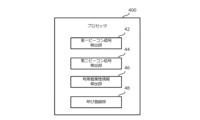
- FIG. 3 is a functional block diagram showing functions related to the facility-specific app that are realized by the processor 400 of the mobile terminal 40 executing the program 420.
- the processor 400 includes a first beacon signal detection unit 42, a second beacon signal detection unit 44, a user attribute information transmission unit 46, and a call registration unit 48.
- the first beacon signal detection unit 42 is a functional block for executing a first beacon signal detection process.
- the second beacon signal detection unit 44 is a functional block for executing a second beacon signal detection process.
- the user attribute information transmission unit 46 is a functional block for executing a user attribute information transmission process.
- the call registration unit 48 is a functional block for executing a call registration process.
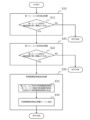
- Fig. 4 is a flowchart of a routine executed in the user attribute acquisition system 100.
- the routine shown in Fig. 4 is repeatedly executed at a predetermined control period by the processor 400 while the facility-specific app is running on the mobile terminal 40.
- the processing of the routine shown in Fig. 4 also represents a user attribute acquisition method for the elevator 10.
- the processor 400 executes a first beacon signal detection process in the first beacon signal detection unit 42.
- the first beacon signal detection process in step S12, it is determined whether the radio wave strength of the detected first beacon signal is greater than a first threshold.
- the radio wave strength is an RSSI value.
- the radio wave strength of the first beacon signal is equal to or less than the first threshold, it is determined that the user carrying the mobile terminal 40 is not in the vicinity of the first beacon device 30, i.e., near the boarding area 2, and this routine is terminated.
- the radio wave strength of the first beacon signal is greater than the first threshold, it is determined that the user carrying the mobile terminal 40 is in the vicinity of the boarding area 2, and the process proceeds to step S20.
- the processor 400 executes the second beacon signal detection process in the second beacon signal detection unit 44.
- the second beacon signal detection process in step S22, it is determined whether the radio wave strength of the detected second beacon signal is greater than a second threshold.
- the radio wave strength is an RSSI value.
- the radio wave strength of the second beacon signal is equal to or less than the second threshold, it is determined that there is no second beacon device 20 in the vicinity of the user carrying the mobile terminal 40, that is, there is no mobile body M around the user, and this routine is terminated.
- the processor 400 executes the second beacon signal detection process for each second beacon signal.
- step S30 the processor 400 executes a user attribute information transmission process in the user attribute information transmission unit 46.
- the user attribute information transmission process extracts the platform beacon information from the first beacon signal and extracts the user attribute beacon information from the second beacon signal.
- the processor 400 then generates user attribute information that associates the platform beacon information with the extracted user attribute information.
- step S34 the generated user attribute information is transmitted to the management server 50. Note that if the mobile terminal 40 detects multiple second beacon signals, the processor 400 executes a user attribute information transmission process for each second beacon signal.
- the user attribute acquisition system 100 described above can acquire the user attributes of users waiting near the hall 2 without the need for manual input by the user. This allows the management device 8 of the elevator 10 to dispatch cars according to the user attributes in response to the user's call registration through the call registration process. As a result, the convenience of users using the mobile object M within the facility is improved.
- the user attribute acquisition system 100 can acquire the user attributes of the user who is waiting near the boarding area 2.
- the user attribute acquisition system 100 according to the embodiment may be modified as follows.
- Management server 50 The management server 50 is not an essential component of the user attribute acquisition system 100.
- the processor 400 may be configured to directly transmit the user attributes to the management device 8 via the communication network 52.
- Second beacon signal detection process In the second beacon signal detection process, even if a passerby using the mobile body M passes near a user carrying a mobile terminal 40, the user attributes of the passerby may be transmitted as the user attributes of a user waiting at the hall 2. Therefore, in the second beacon signal detection process, the elapsed time of the radio wave strength of the second beacon signal may be further added to the determination.
- FIG. 5 is a flowchart showing a modified example of the second beacon signal detection process.
- the processor 400 determines in step S22 whether the radio wave strength of the detected second beacon signal is greater than the second threshold. As a result, if the radio wave strength of the second beacon signal is greater than the second threshold, it is determined that there is a user using a mobile object M around the user carrying the mobile terminal 40, and the process proceeds to step S24.
- step S24 the processor 400 judges whether the time elapsed since the second beacon signal detection process was started has exceeded the judgment time.
- the judgment time here is a preset value used as the time for judging whether the user corresponding to the second beacon device 20 is a waiting person or a passerby. As a result, if it is judged that the elapsed time has not exceeded the judgment time, the processor 400 executes the process of step S22 again. Then, in the process of step S22, if the radio wave intensity of the second beacon signal becomes equal to or less than the second threshold, it is judged that the second beacon device 20 has moved away from the vicinity of the user carrying the mobile terminal 40, that is, the user corresponding to the second beacon device 20 is a passerby, and this routine is terminated.
- step S24 if it is determined in the processing of step S24 that the elapsed time exceeds the judgment time, it is determined that the second beacon device 20 is staying near the user carrying the mobile terminal 40, that is, that the user corresponding to the second beacon device 20 is a waiting person, and the processing proceeds to the next user attribute information transmission processing.
- This modified second beacon signal detection process can exclude detection of second beacon signals from passersby passing near a user carrying a mobile terminal 40. This makes it possible to accurately acquire user attributes of users waiting at the boarding area 2.
- the second beacon signal detection process may further include a process for identifying the user attributes of the user who possesses the mobile terminal 40. That is, the second beacon signal that is constantly detected in the second beacon signal detection process is highly likely to be the second beacon signal transmitted from the second beacon device 20 corresponding to the user who possesses the mobile terminal 40. Therefore, in the second beacon signal detection process, the processor 400 may identify the user attribute information of the constantly detected second beacon signal as the user attribute corresponding to the user who possesses the mobile terminal 40. With such additional processing, when a call registration process is performed from the mobile terminal 40, the call registration can be associated with the user attributes, thereby further improving the convenience of the car dispatch performed by the management device 8.
- FIG. 6 is a diagram showing a modified example of the hardware resources of the mobile terminal 40.
- the mobile terminal 40 includes a processor 400, a memory 410, and a processing circuit 450 including dedicated hardware 440, for example.
- Fig. 6 shows an example in which some of the functions of the mobile terminal 40 are realized by the dedicated hardware 440. All of the functions of the mobile terminal 40 may be realized by the dedicated hardware 440.
- the dedicated hardware 440 a single circuit, a composite circuit, a programmed processor, a parallel programmed processor, an ASIC, an FPGA, or a combination of these may be adopted.
Landscapes
- Engineering & Computer Science (AREA)
- Automation & Control Theory (AREA)
- Indicating And Signalling Devices For Elevators (AREA)
- Elevator Control (AREA)
Priority Applications (3)
| Application Number | Priority Date | Filing Date | Title |
|---|---|---|---|
| CN202280102164.8A CN120303204A (zh) | 2022-12-14 | 2022-12-14 | 电梯的利用者属性取得系统和电梯的利用者属性取得方法 |
| PCT/JP2022/046025 WO2024127551A1 (ja) | 2022-12-14 | 2022-12-14 | エレベーターの利用者属性取得システム、及びエレベーターの利用者属性取得方法 |
| JP2024564037A JP7722603B2 (ja) | 2022-12-14 | 2022-12-14 | エレベーターの利用者属性取得システム、及びエレベーターの利用者属性取得方法 |
Applications Claiming Priority (1)
| Application Number | Priority Date | Filing Date | Title |
|---|---|---|---|
| PCT/JP2022/046025 WO2024127551A1 (ja) | 2022-12-14 | 2022-12-14 | エレベーターの利用者属性取得システム、及びエレベーターの利用者属性取得方法 |
Publications (1)
| Publication Number | Publication Date |
|---|---|
| WO2024127551A1 true WO2024127551A1 (ja) | 2024-06-20 |
Family
ID=91484694
Family Applications (1)
| Application Number | Title | Priority Date | Filing Date |
|---|---|---|---|
| PCT/JP2022/046025 Ceased WO2024127551A1 (ja) | 2022-12-14 | 2022-12-14 | エレベーターの利用者属性取得システム、及びエレベーターの利用者属性取得方法 |
Country Status (3)
| Country | Link |
|---|---|
| JP (1) | JP7722603B2 (https=) |
| CN (1) | CN120303204A (https=) |
| WO (1) | WO2024127551A1 (https=) |
Citations (6)
| Publication number | Priority date | Publication date | Assignee | Title |
|---|---|---|---|---|
| JP2010202363A (ja) * | 2009-03-04 | 2010-09-16 | Toshiba Elevator Co Ltd | エレベータおよびエレベータシステム |
| JP2017013975A (ja) * | 2015-07-02 | 2017-01-19 | 清水建設株式会社 | エレベータシステム、エレベータ制御方法およびプログラム |
| WO2019058655A1 (ja) * | 2017-09-22 | 2019-03-28 | パナソニックIpマネジメント株式会社 | 位置管理装置、位置管理システムおよび位置管理方法 |
| WO2019106801A1 (ja) * | 2017-11-30 | 2019-06-06 | 三菱電機ビルテクノサービス株式会社 | エレベーターの制御装置 |
| CN113753696A (zh) * | 2021-09-07 | 2021-12-07 | 北方工业大学 | 一种智能轮椅与电梯通信控制系统 |
| WO2022059098A1 (ja) * | 2020-09-16 | 2022-03-24 | 三菱電機ビルテクノサービス株式会社 | エレベーターの制御システム |
Family Cites Families (4)
| Publication number | Priority date | Publication date | Assignee | Title |
|---|---|---|---|---|
| JP5137699B2 (ja) * | 2008-06-11 | 2013-02-06 | 三菱電機ビルテクノサービス株式会社 | 車椅子使用者用エレベータ自動登録システム |
| JP6227271B2 (ja) * | 2013-04-10 | 2017-11-08 | 株式会社日立製作所 | エレベータ制御装置及びエレベータ制御方法 |
| JP6251638B2 (ja) * | 2014-06-03 | 2017-12-20 | 株式会社日立製作所 | エレベータシステム |
| JP6733847B2 (ja) * | 2018-07-03 | 2020-08-05 | 三菱電機株式会社 | エレベータの利用者認識システム |
-
2022
- 2022-12-14 JP JP2024564037A patent/JP7722603B2/ja active Active
- 2022-12-14 WO PCT/JP2022/046025 patent/WO2024127551A1/ja not_active Ceased
- 2022-12-14 CN CN202280102164.8A patent/CN120303204A/zh active Pending
Patent Citations (6)
| Publication number | Priority date | Publication date | Assignee | Title |
|---|---|---|---|---|
| JP2010202363A (ja) * | 2009-03-04 | 2010-09-16 | Toshiba Elevator Co Ltd | エレベータおよびエレベータシステム |
| JP2017013975A (ja) * | 2015-07-02 | 2017-01-19 | 清水建設株式会社 | エレベータシステム、エレベータ制御方法およびプログラム |
| WO2019058655A1 (ja) * | 2017-09-22 | 2019-03-28 | パナソニックIpマネジメント株式会社 | 位置管理装置、位置管理システムおよび位置管理方法 |
| WO2019106801A1 (ja) * | 2017-11-30 | 2019-06-06 | 三菱電機ビルテクノサービス株式会社 | エレベーターの制御装置 |
| WO2022059098A1 (ja) * | 2020-09-16 | 2022-03-24 | 三菱電機ビルテクノサービス株式会社 | エレベーターの制御システム |
| CN113753696A (zh) * | 2021-09-07 | 2021-12-07 | 北方工业大学 | 一种智能轮椅与电梯通信控制系统 |
Also Published As
| Publication number | Publication date |
|---|---|
| JPWO2024127551A1 (https=) | 2024-06-20 |
| JP7722603B2 (ja) | 2025-08-13 |
| CN120303204A (zh) | 2025-07-11 |
Similar Documents
| Publication | Publication Date | Title |
|---|---|---|
| KR102494560B1 (ko) | 방문자에게 건물로의 제어된 접근을 제공하기 위한 방법 | |
| US20230046391A1 (en) | Equipment server, device server, and communication system | |
| CN109928281B (zh) | 乘客运输系统的维护 | |
| US10118797B2 (en) | Mobile application based elevator dispatching using tenant identity | |
| KR102388495B1 (ko) | 엘리베이터의 자동 호출 등록 시스템 | |
| JP6829267B2 (ja) | モバイル装置の状態管理及び位置特定 | |
| US10494223B2 (en) | Group management control device of elevator, group management system of elevator, and elevator system | |
| EP3331795B1 (en) | System and method of initiating a hall and car call for an elevator system | |
| EP3418235B1 (en) | Determination for motion of passenger over elevator landing area | |
| CN109110601B (zh) | 乘客相对电梯轿厢的移动的确定 | |
| KR20190010481A (ko) | 엘리베이터 카에서의 승객 인파의 원활한 추적 | |
| US20190193989A1 (en) | Determination of non-normal elevator calling request in an automatic elevator calling request system | |
| JP6841379B2 (ja) | エレベーターの自動呼び登録システム | |
| US20190106290A1 (en) | System and method for dispatching an elevator | |
| JP7063405B1 (ja) | 移動体の管理システムおよびエレベーター | |
| JP7722603B2 (ja) | エレベーターの利用者属性取得システム、及びエレベーターの利用者属性取得方法 | |
| US11697572B2 (en) | Remote call and mobile access extension for controlling an elevator or a door key | |
| CN119389892A (zh) | 电梯访客授权管理方法、装置、系统和存储介质 | |
| CN111615070A (zh) | 一种业务处理方法及装置 | |
| CN114014114A (zh) | 一种电梯的授权方法、装置、计算机设备及存储介质 | |
| WO2026017410A1 (en) | Building system and method for user registration for content publishing | |
| CN121698180A (zh) | 便携终端、存储介质以及电梯系统 | |
| JP2024149413A (ja) | 認証対象特定方法、規制解除方法、および入退室管理セキュリティシステム | |
| JP2022165202A (ja) | 列車乗降支援システム、およびサービス提供方法 | |
| JP2023132409A (ja) | 入場管理システム及び入場管理方法 |
Legal Events
| Date | Code | Title | Description |
|---|---|---|---|
| 121 | Ep: the epo has been informed by wipo that ep was designated in this application |
Ref document number: 22968463 Country of ref document: EP Kind code of ref document: A1 |
|
| WWE | Wipo information: entry into national phase |
Ref document number: 2024564037 Country of ref document: JP |
|
| WWE | Wipo information: entry into national phase |
Ref document number: 202280102164.8 Country of ref document: CN |
|
| WWP | Wipo information: published in national office |
Ref document number: 202280102164.8 Country of ref document: CN |
|
| NENP | Non-entry into the national phase |
Ref country code: DE |
|
| 122 | Ep: pct application non-entry in european phase |
Ref document number: 22968463 Country of ref document: EP Kind code of ref document: A1 |