WO2024127460A1 - 撥水撥油性評価方法および撥水撥油性評価装置 - Google Patents
撥水撥油性評価方法および撥水撥油性評価装置 Download PDFInfo
- Publication number
- WO2024127460A1 WO2024127460A1 PCT/JP2022/045670 JP2022045670W WO2024127460A1 WO 2024127460 A1 WO2024127460 A1 WO 2024127460A1 JP 2022045670 W JP2022045670 W JP 2022045670W WO 2024127460 A1 WO2024127460 A1 WO 2024127460A1
- Authority
- WO
- WIPO (PCT)
- Prior art keywords
- water
- repellency
- oil
- droplet
- substrate
- Prior art date
- Legal status (The legal status is an assumption and is not a legal conclusion. Google has not performed a legal analysis and makes no representation as to the accuracy of the status listed.)
- Ceased
Links
Images




Classifications
-
- G—PHYSICS
- G01—MEASURING; TESTING
- G01N—INVESTIGATING OR ANALYSING MATERIALS BY DETERMINING THEIR CHEMICAL OR PHYSICAL PROPERTIES
- G01N13/00—Investigating surface or boundary effects, e.g. wetting power; Investigating diffusion effects; Analysing materials by determining surface, boundary, or diffusion effects
Definitions
- This disclosure relates to a method and device for evaluating water and oil repellency.
- Methods for evaluating water- or oil-repellency include a method in which a liquid is dropped onto a surface to be evaluated for water- or oil-repellency and the angle (contact angle) between the droplet and the evaluation surface is measured, a method in which the droplet is ejected or sucked in and the contact angle in each case is evaluated (prism/shrinkage method), and a method in which the evaluation surface onto which the liquid has been dropped is tilted and the contact angle of the droplet as it slides off and the angle of the evaluation surface as it begins to slide off are evaluated (slide method) (Non-Patent Documents 1, 2).
- This disclosure has been made in light of the above, and aims to provide a simpler and more practical method for evaluating water or oil repellency.
- a flat or curved surface or a slope between a flat and curved surface is used as the evaluation surface, and a droplet is dropped onto the surface of the evaluation surface, and the droplet is accelerated by gravity (potential energy) to measure the difference in motion behavior due to friction between the evaluation surface and the droplet, thereby evaluating the water/oil repellency of the evaluation surface.
- the water/oil repellency evaluation device of one embodiment of the present disclosure has an evaluation surface that is a flat or curved surface or a slope between a flat and curved surface that is water/oil repellent, and includes an input unit that inputs a video of the movement of a droplet on the evaluation surface as the droplet is dropped onto the evaluation surface and accelerates using gravity (potential energy), and an analysis unit that analyzes the video, measures the strength of friction between the droplet and the evaluation surface from the motion behavior of the droplet, and analyzes the water/oil repellency according to the strength of friction, and is equipped with an evaluation unit that evaluates the water/oil repellency using the evaluation method.
- the water- and oil-repellency evaluation device of one embodiment of the present disclosure drops a droplet onto a substrate that is curved downward with the water- and oil-repellent surface facing up, measures the horizontal and vertical distances from the point where the droplet was dropped to the first arrival point where the droplet stops moving after dropping, measures the number of times the droplet makes a round trip over the lowest part of the evaluation surface, and evaluates the water or oil repellency using at least one of the horizontal and vertical distances and the number of times.
- the water- and oil-repellency evaluation device of one embodiment of the present disclosure includes an input unit that inputs a video of the movement of a droplet on a downwardly curved substrate with an evaluation surface for evaluating water or oil repellency facing up; an analysis unit that analyzes the video to measure the horizontal and vertical distances from the point where the droplet was dropped to a first arrival point where the droplet stopped moving, and measures the number of times the droplet makes a round trip to the lowest part of the evaluation surface; and an evaluation unit that evaluates the water or oil repellency using at least one of the horizontal and vertical distances and the number of times the droplet makes a round trip.
- This disclosure makes it easier to evaluate practical water or oil repellency.
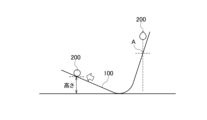
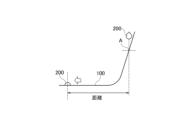
- FIG. 1 is a diagram for explaining an example of a method for evaluating water and oil repellency according to the present embodiment.
- FIG. 2 is a flow chart showing an example of a process flow for evaluating the water and oil repellency of a plurality of substrates.
- FIG. 3 is a diagram showing an example of the arrangement of the substrates according to the first embodiment.
- FIG. 4 is a plan view showing an example of a substrate to be evaluated.
- FIG. 5 is a diagram showing an example of how a substrate is photographed by a video camera.
- FIG. 6 is a diagram showing an example of a state before the substrate of the second embodiment is curved.
- FIG. 7 is a diagram showing an example of a substrate arrangement according to the second embodiment.
- FIG. 1 is a diagram for explaining an example of a method for evaluating water and oil repellency according to the present embodiment.
- FIG. 2 is a flow chart showing an example of a process flow for evaluating the water and oil repellency of a plurality of
- FIG. 8 is a diagram showing an example of the shape of a substrate.
- FIG. 9 is a diagram showing an example of the shape of a substrate.
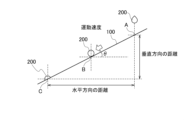
- FIG. 10 is a diagram for explaining another example of the method for evaluating water and oil repellency according to the present embodiment.
- FIG. 11 is a diagram showing an example of the arrangement of the substrates according to the third embodiment.
- FIG. 12 is a diagram showing an example of the configuration of a water/oil repellency evaluation device according to this embodiment.
- the surface of an inclined or curved surface consisting of a water- or oil-repellent (hereinafter also referred to as water- and oil-repellent) surface is used as the evaluation surface 100A, and a droplet 200 is dropped onto the inclined or curved surface (hereinafter also referred to as the substrate 100) that is curved downward with the evaluation surface 100A facing up, and at least one of the horizontal distance L and the vertical distance H (hereinafter referred to as the horizontal and vertical distances) from the drop point A of the droplet to the first arrival point B where the movement of the droplet 200 stops is measured, the number of times the droplet 200 goes back and forth through the part with the lowest height on the evaluation surface 100A is measured, and the water- or oil-repellency is evaluated using at least one of the horizontal and vertical distances and the number of times of going back and forth.
- the horizontal distance L and the vertical distance H hereinafter referred to as the horizontal and vertical distances
- the number of times of going back and forth is counted as the number of times the droplet 200 goes back and forth through the part with the lowest height on the evaluation surface 100A until it stops.
- the number of times the aircraft travels back and forth over the lowest altitude point C on the evaluation surface 100A within a specified time period may be counted.
- the higher the water- or oil-repellency, and the more times the surface is turned back and forth the higher the water- or oil-repellency.
- measurements can be taken on multiple substrates 100, and the water- or oil-repellency can be evaluated by comparing the measurement results.
- a standard value can be set, and if the measured value is higher than the standard value, the water- or oil-repellency can be evaluated as being high.
- This evaluation method is a practical technique for evaluating water repellency or oil repellency based on the frictional resistance of the droplet 200 generated by the substrate 100. Unlike methods in which the droplet is left stationary to measure the contact angle, this evaluation method is a method in which the droplet 200 is less likely to remain at the same point.
- the measured horizontal and vertical distances and number of reciprocating movements include the effects of changes over time in the droplet 200, so the changes over time can be averaged to evaluate the water and oil repellency.
- the substrate 100 to be evaluated is placed with the evaluation surface 100A facing up and the back surface 100B facing down, curved downward.
- the substrate 100 is curved in a U-shape, but this is not limited to this and any structure may be used as long as the droplet 200 travels back and forth around the lowest altitude point C.
- the substrate 100 From the perspective of the significance of the evaluation, it is preferable for the substrate 100 to have a shape with a curvature equivalent to the curved surface of the structure applied in each application.
- the substrate 100 From the perspective of the accuracy of the evaluation, it is preferable for the substrate 100 to have a shape in which the difference in horizontal and vertical distances and the difference in the number of times of travel differ greatly in each measurement.
- a part of the substrate 100 may be flat. For example, both ends of the substrate 100 or the vicinity of the lowest altitude point C of the substrate 100 may be flat.
- the substrate 100 may be made by processing a water- and oil-repellent material, or the substrate 100 may be subjected to a water- and oil-repellent treatment. After the substrate 100 is curved, the evaluation surface 100A may be subjected to a water- and oil-repellent treatment.
- the volume of the droplets used in each measurement does not matter as long as the volume is constant. From the perspective of the significance of the evaluation, it is best to set the volume of the droplets that you want to repel for each application. From the perspective of the accuracy of the evaluation, it is best to set the volume of the droplets so that the difference in horizontal and vertical distances and the difference in the number of round trips in each measurement are significantly different.
- the type of droplets can be any type as long as the type of droplets used in each measurement is consistent. For example, if the objective is to evaluate water repellency, water droplets can be used as the droplets. If the objective is to evaluate oil repellency, commercially available salad oil can be used as the droplets.
- the droplet drop point A is constant for each measurement, and the position of the drop point A is not important as long as the droplet slides down and travels back and forth to the lowest altitude point C of the substrate 100. Note that dropping the droplet on the lowest altitude point C or near the lowest altitude point C is not preferable because the droplet will not move.
- step S11 a droplet is dropped onto each of the substrates 100, and the horizontal and vertical distances from the drop point A to the first arrival point B are measured, as well as the number of times the droplet makes a round trip to the lowest altitude point C.
- step S12 the number of reciprocations measured for each substrate 100 is compared.
- step S13 the substrate 100 with a greater number of reciprocations is evaluated as having higher water and oil repellency.
- step S14 the substrate 100 with a longer horizontal and vertical distance is evaluated as having higher water and oil repellency.
- substrates 100 to be evaluated When there are three or more substrates 100 to be evaluated, they are grouped according to the number of reciprocations, and the group with the greater number of reciprocations is evaluated as having higher water and oil repellency. Within each group, substrates 100 with longer horizontal and vertical distances are evaluated as having higher water and oil repellency. When there is only one substrate 100 to be evaluated, a standard number of reciprocations and horizontal and vertical distances may be determined and compared with the standard value.
- water or oil repellency is evaluated solely based on the number of reciprocating strokes, it is not possible to evaluate the difference in water or oil repellency between a substrate on which the droplets slide slowly over time and a substrate on which the droplets slide quickly ("Difficulties in evaluating differences in water or oil repellency").
- the horizontal and vertical distances include the resistance between the substrate and the droplet, making it easier to evaluate this difference.
- it is necessary to measure the horizontal and vertical distances from the drop point to the first arrival point while the droplet changes direction instantly at the first arrival point, and the measurement accuracy depends on the measurement method ("Difficulties in accurate measurement due to high dependence of measurement accuracy on measurement method").
- Example 1 By bending and measuring a flexible substrate, it is easy to determine the curvature at which the droplet slides down and travels back and forth to its lowest point, reducing the effort required to recreate samples for evaluation.
- Example 1 the substrate was curved to fit the inside of a tube (beaker).
- a polyethylene terephthalate (PET) film as the substrate, and evaluating the water repellency of Sample 1, which was treated with a water repellent treatment, and Sample 2, which was not treated with a water repellent treatment.
- Two PET film substrates 100 measuring 8 mm x 50 mm and 50 ⁇ m thick are prepared as substrates 100 for samples 1 and 2.
- the 8 mm side is referred to as the short side
- the 50 mm side is referred to as the long side.
- One side of the substrate 100 used as sample 1 is designated as the evaluation surface 100A, and the other side is designated as the back surface 100B.
- a solution obtained by dissolving a water-repellent material in a solvent is applied to the evaluation surface 100A, and the solution is left to stand for three days or more to allow the solvent to evaporate.
- the substrate 100 used as sample 2 is not treated with a water-repellent treatment.
- one surface of the substrate 100 is designated as the evaluation surface 100A, and the other surface is designated as the back surface 100B.
- the substrate 100 of sample 1 is placed along the inner wall of a 50 mL beaker 110.
- the substrate 100 is placed so that the evaluation surface 100A faces the center of the beaker 110 and the long side of the substrate 100 curves along the inner wall of the beaker 110.
- a cylinder other than the beaker 110 may be used as long as the substrate 100 can be curved along the inner wall.
- the beaker 110 In order to determine the drop position in advance and drop the droplets, the beaker 110 is placed on a stand with marks P1 and P2, and the droplets are dropped toward the mark P1.
- the line connecting the marks P1 and P2 should be parallel to the mouth line of the beaker 110 when viewed from above, and the lowest part C should be in the middle of the marks P1 and P2.
- Both short sides of the substrate 100 should be of equal height. In the example of Figure 4, the distance from the installation surface to the short sides of the substrate 100 is 20 mm. Because the substrate 100 (PET film) and the beaker 110 are transparent, the marks P1 and P2 on the stand can be seen when the beaker 110 is viewed from above.
- the intended location for droplet application may be marked with an oil-based pen before or after applying a water-repellent treatment to the rear surface 100B of the substrate, and the droplet may then be applied toward the mark.
- mark A was marked 15 mm away from one of the short sides of the substrate 100 and 4 mm away from the long side. As the PET film is transparent, the mark made on the rear surface 100B can be seen from the evaluation surface 100A.
- a video camera 120 is installed at a fixed point so that the entire substrate 100 can be seen.
- filming begins with the video camera 120, and 2 ⁇ L of water droplet 200 is dispensed with a micropipette toward the mark made on the back surface 100B of the substrate 100. After the droplet stops moving, filming with the video camera 120 is stopped. The filmed video is analyzed to measure the horizontal and vertical distances and the number of times it goes back and forth.
- sample 2 is placed in beaker 110 and measurement begins.
- Example 2 In Example 2, the short sides of the substrate are pressed from both sides to bend the substrate.
- a PET film substrate is used as in Example 1, and the water repellency is evaluated for Sample 3, which is subjected to a water repellent treatment, and for Sample 4, which is not subjected to a water repellent treatment.
- the water-repellent treatment is performed while the substrate 100 is curved. If the substrate is curved after the water-repellent treatment, the deformation of the substrate may cause deformation of the fine structure of the water-repellent film on the evaluation surface. If deformation of the water-repellent surface is not anticipated in the situation that is to be evaluated, the water-repellent treatment is performed after the substrate is deformed, and then the water repellency is evaluated, allowing an evaluation that takes practical aspects into account.
- Example 2 the short sides of the substrate 100 are attached to the opposing movable walls 130 with the evaluation surface 100A facing up.
- the short sides of the substrate 100 are attached at a height of 20 mm from the installation surface of the wall 130 with the evaluation surface 100A facing up and the back surface 100B facing down.
- the substrate 100 may be fixed to the wall 130 with tape, or a groove about the thickness of the substrate 100 may be provided in the wall 130 and the substrate 100 may be fitted into the groove.
- the walls 130 are moved closer to each other to curve the long sides of the substrate 100 downward. As shown in FIG. 7, the walls 130 are moved closer to each other until the rear surface 100B of the substrate 100 comes into contact with the mounting surface. Only one of the walls 130 may be moved. The walls 130 may be moved manually or automatically. The side walls of the box may be used as the walls 130. The droplet placement position should be the same for each sample. As in Example 1, a mark may be placed on the mounting surface or on the rear surface of the substrate 100.
- the substrate 100 was curved and a solution obtained by dissolving a water-repellent material in a solvent was applied to the evaluation surface 100A, and the solution was left to stand for three days or more to allow the solvent to evaporate.
- Example 2 similar to Example 1, as shown in FIG. 5, the video camera 120 is placed at a fixed point so that the entire substrate 100 is captured, and measurement is started. Specifically, filming with the video camera 120 is started, and 2 ⁇ L of water droplet 200 is dropped with a micropipette toward the mark made on the back surface 100B of the substrate 100. After the movement of the droplet stops, filming with the video camera 120 is stopped. The filmed video is analyzed to measure the horizontal and vertical distances and the number of reciprocations.
- a symmetrically curved substrate is used, but the present invention is not limited to this.
- the substrate 100 may be curved, or the curved substrate 100 may be disposed asymmetrically.
- the curved part of the substrate 100 is brought into contact with the installation surface, and the end of the slope opposite to the drop point A is slightly raised. After the droplet 200 is dropped, the maximum height to which the droplet 200 climbs up the slope on the opposite side is measured. A substrate 100 to which the droplet 200 can climb to a higher point can be evaluated as having high water and oil repellency.
- the substrate 100 is placed with the inclined surface opposite to the drop point A in contact with the installation surface. After the droplet 200 is dropped, the horizontal and vertical distances traveled by the droplet 200 are measured. The substrate 100 from which the droplet 200 travels further can be evaluated as having high water and oil repellency.
- a substrate 100 is placed with the evaluation surface for evaluating water- and oil-repellency facing up, tilted at a certain angle, a droplet 200 is dropped, and the water- or oil-repellency is evaluated by measuring the motion speed v of the droplet over a certain distance from the drop point A of the droplet to an arbitrary point B.
- the horizontal and vertical distances from the drop point A of the droplet to the point C where the droplet stops sliding down are measured, and the larger the value, the higher the water- or oil-repellency is evaluated to be.
- measurements can be taken on the substrate 100 in FIG. 10, and the water- and oil-repellency can be evaluated by comparing the measurement results.
- a standard value can be set, and if the measured value is higher than the standard value, the water- or oil-repellency can be evaluated as being high.
- the contact angle of the surface to be evaluated for water or oil repellency is low and the long side of the substrate is short, and the above evaluation does not reveal any relative differences. In such cases, it is expected that the relative differences will be revealed and the water and oil repellency will be easily evaluated by placing multiple substrates to be evaluated at the same inclination angle, dropping a droplet from a fixed height, and measuring the distance traveled by the droplet.
- Example 3 the substrate is not curved, but is positioned to have the same inclination angle.
- a PET film substrate is used, as in Example 1, and sample 5 is treated with a water-repellent coating, while sample 6 is not treated with a water-repellent coating to evaluate water repellency.
- the substrate 100 of sample 5 is placed in a screw tube 140, and the substrate 100 is arranged in the screw tube 140 at a constant angle.
- a structure other than the screw tube 140 may be used as long as the substrate 100 can be arranged at a constant angle against the inner wall.
- the diameter of the screw tube 140 is approximately 34 mm.
- the screw tube 140 is transparent, so the inside can be visually observed. Note that the screw tube 140 does not need to be used as long as the substrate 100 can be arranged at a constant angle. For example, the substrate 100 may be leaned between opposing walls.
- the screw tube 140 In order to determine the drop position in advance and drop the droplets, the screw tube 140 is placed on a stand with marks P1 and P2, and the droplets are dropped toward mark P1.
- the marks P1 and P2 on the stand are aligned along the diameter of the circular base of the screw tube 140, and mark P2 is directly below the side wall of the screw tube 140.
- the substrate 100 in the screw tube 140 at an angle, check the marks P1 and P2 on the stand from above the substrate 100 and make sure that the long side of the substrate 100 is parallel to the line connecting marks P1 and P2.
- the intended locations for droplet application can be marked with an oil-based pen before or after applying a water-repellent treatment to the back surface of the substrate, and the droplets can be applied toward the marks.
- a fixed volume of water droplet is dropped at drop point A, and the horizontal and vertical distances from drop point A to stop position D where the droplet stops sliding are measured.
- a pipette is prepared by marking a position 2.5 cm from the tip with an oil-based pen, and after sucking up water into the pipette, the water is pushed out to the position of the mark. After the water is pushed out, the pressure is relaxed and the water is continued to be held in the pipette, while any water droplets remaining on the outside of the tip of the pipette are removed. Stop position D of the droplet is taken as the center of the droplet's shape.
- the experiment is conducted with 8 trials and the median value is calculated.
- sample 6 is placed in screw tube 140 and measured in the same manner as sample 5.
- sample 5 which was treated to be water repellent
- sample 6 which was not treated to be water repellent
- the water- and oil-repellency evaluation device 10 of this embodiment will be described with reference to FIG. 12.
- the water- and oil-repellency evaluation device 10 shown in the figure is a device for automating the water- and oil-repellency evaluation method described above.
- the water- and oil-repellency evaluation device 10 includes an evaluation surface 100 (prepared by placing a substrate with the water- and oil-repellent surface 100A to be evaluated on the top and the surface 100B not to be evaluated on the bottom) that is the water- and oil-repellency surface to be evaluated, a control unit 11, a video capture unit 12, an information processing unit 13, a display unit 14, and a droplet supply unit 15.
- Each unit included in the water- and oil-repellency evaluation device 10 may be configured by a computer including an arithmetic processing device, a storage device, etc., and the processing of each unit may be executed by a program.
- This program is stored in a storage device included in the water- and oil-repellency evaluation device 10, and can be recorded on a non-transient recording medium that can be read by a computer, such as a magnetic disk, an optical disk, or a semiconductor memory, or can be provided through a network.
- the control unit 11 controls the video capture unit 12 and the droplet supply unit 15.
- the video capture unit 12 captures the movement of the droplet 200 dropped onto the substrate 100.
- the information processing unit 13 analyzes the video captured by the video capture unit 12 and measures the horizontal and vertical distances and the number of round trips.
- the display unit 14 outputs the results of the video analysis performed by the information processing unit 13.
- the droplet supply unit 15 always drops a constant amount of droplets 200 onto the substrate 100.
- the operator When evaluating water and oil repellency, the operator places the substrate 100 under the droplet supply unit 15 and starts the operation of the water and oil repellency evaluation device 10.
- control unit 11 controls the video capture unit 12 to instruct it to start capturing a video, and controls the droplet supply unit 15 to dispense droplets 200 onto the substrate 100.
- the video capture unit 12 stops capturing the video and transmits the captured video to the information processing unit 13.
- the information processing unit 13 detects the droplet 200 from the video and measures the horizontal and vertical distances and the number of round trips based on the movement of the droplet 200. For example, the information processing unit 13 extracts frames in which the position of the droplet 200 does not change on the video after the droplet 200 is dropped. The extracted frames can be considered to be frames in which the droplet 200 reaches the first arrival point. The information processing unit 13 calculates the horizontal and vertical distances from the drop point to the first arrival point based on the extracted frames. The information processing unit 13 also extracts frames in which the droplet 200 passes the lowest altitude point, and counts the number of round trips based on the number of extracted frames.
- the display unit 14 displays the horizontal and vertical distances and the number of reciprocations measured by the information processing unit 13.
- the display unit 14 may hold the measurement results of the substrate 100 to be compared, evaluate the water and oil repellency according to the flowchart of FIG. 2, and display the evaluation of the water and oil repellency.
- the water/oil repellency evaluation device 10 may include only the information processing unit 13 and the display unit 14. In this case, the operator drops the droplets 200 while taking a video with the video camera 120, and inputs the video into the water/oil repellency evaluation device 10. The water/oil repellency evaluation device 10 analyzes the input video and displays the analysis results.
- the droplet 200 is dropped on the downwardly curved substrate 100 with the evaluation surface 100A for evaluating water- or oil-repellency facing up.
- the horizontal and vertical distance L from the point where the droplet 200 is dropped to the first arrival point where the movement of the droplet 200 stops, and the number of times the droplet 200 moves back and forth on the evaluation surface 100A are measured.
- the water- or oil-repellency is evaluated using at least one of the horizontal and vertical distances and the number of times of movement.
- the water- and oil-repellency evaluation method of this embodiment can evaluate the water- and oil-repellency more easily because it is sufficient to observe the movement of the droplet dropped by bending the substrate 100.
- the horizontal and vertical distances and the number of times of movement measured include the effect of the change over time of the droplet 200, the water- and oil-repellency can be evaluated by averaging the change over time.
- the substrate 100 with a greater number of reciprocations is evaluated as having higher water-repellency or oil-repellency, and if the number of reciprocations is the same, the substrate 100 with a greater horizontal and vertical distance to the first arrival point is evaluated as having higher water-repellency or oil-repellency.
Landscapes
- Physics & Mathematics (AREA)
- Health & Medical Sciences (AREA)
- Life Sciences & Earth Sciences (AREA)
- Chemical & Material Sciences (AREA)
- Analytical Chemistry (AREA)
- Biochemistry (AREA)
- General Health & Medical Sciences (AREA)
- General Physics & Mathematics (AREA)
- Immunology (AREA)
- Pathology (AREA)
- Application Of Or Painting With Fluid Materials (AREA)
Priority Applications (2)
| Application Number | Priority Date | Filing Date | Title |
|---|---|---|---|
| PCT/JP2022/045670 WO2024127460A1 (ja) | 2022-12-12 | 2022-12-12 | 撥水撥油性評価方法および撥水撥油性評価装置 |
| JP2024563780A JPWO2024127460A1 (https=) | 2022-12-12 | 2022-12-12 |
Applications Claiming Priority (1)
| Application Number | Priority Date | Filing Date | Title |
|---|---|---|---|
| PCT/JP2022/045670 WO2024127460A1 (ja) | 2022-12-12 | 2022-12-12 | 撥水撥油性評価方法および撥水撥油性評価装置 |
Publications (1)
| Publication Number | Publication Date |
|---|---|
| WO2024127460A1 true WO2024127460A1 (ja) | 2024-06-20 |
Family
ID=91484511
Family Applications (1)
| Application Number | Title | Priority Date | Filing Date |
|---|---|---|---|
| PCT/JP2022/045670 Ceased WO2024127460A1 (ja) | 2022-12-12 | 2022-12-12 | 撥水撥油性評価方法および撥水撥油性評価装置 |
Country Status (2)
| Country | Link |
|---|---|
| JP (1) | JPWO2024127460A1 (https=) |
| WO (1) | WO2024127460A1 (https=) |
Citations (9)
| Publication number | Priority date | Publication date | Assignee | Title |
|---|---|---|---|---|
| JPS6162839A (ja) * | 1984-09-03 | 1986-03-31 | Unitika Ltd | 撥水性の測定方法及び装置 |
| JP2006078477A (ja) * | 2004-08-10 | 2006-03-23 | Kanagawa Acad Of Sci & Technol | 液滴移動挙動の測定方法および装置 |
| JP2006226835A (ja) * | 2005-02-17 | 2006-08-31 | Kanagawa Acad Of Sci & Technol | 液滴除去性能の評価方法および評価装置 |
| JP2007040730A (ja) * | 2005-08-01 | 2007-02-15 | Toyota Motor Corp | 撥液特性評価装置 |
| JP2007147545A (ja) * | 2005-11-30 | 2007-06-14 | Asahi Glass Co Ltd | 撥水性透明基体の撥水性能評価方法 |
| JP2014092536A (ja) * | 2012-11-07 | 2014-05-19 | Kayaba Ind Co Ltd | 流動性試料観察装置及び流動性試料観察方法 |
| JP2014202578A (ja) * | 2013-04-04 | 2014-10-27 | 協和界面科学株式会社 | 自動接触角計および接触角の自動測定方法 |
| CN111089822A (zh) * | 2018-10-23 | 2020-05-01 | 宁波方太厨具有限公司 | 玻璃表面疏水涂层防雾效果测试装置及测试方法 |
| CN111487165A (zh) * | 2020-06-03 | 2020-08-04 | 中国计量大学 | 一种织物拒油性能测试装置及方法 |
-
2022
- 2022-12-12 JP JP2024563780A patent/JPWO2024127460A1/ja active Pending
- 2022-12-12 WO PCT/JP2022/045670 patent/WO2024127460A1/ja not_active Ceased
Patent Citations (9)
| Publication number | Priority date | Publication date | Assignee | Title |
|---|---|---|---|---|
| JPS6162839A (ja) * | 1984-09-03 | 1986-03-31 | Unitika Ltd | 撥水性の測定方法及び装置 |
| JP2006078477A (ja) * | 2004-08-10 | 2006-03-23 | Kanagawa Acad Of Sci & Technol | 液滴移動挙動の測定方法および装置 |
| JP2006226835A (ja) * | 2005-02-17 | 2006-08-31 | Kanagawa Acad Of Sci & Technol | 液滴除去性能の評価方法および評価装置 |
| JP2007040730A (ja) * | 2005-08-01 | 2007-02-15 | Toyota Motor Corp | 撥液特性評価装置 |
| JP2007147545A (ja) * | 2005-11-30 | 2007-06-14 | Asahi Glass Co Ltd | 撥水性透明基体の撥水性能評価方法 |
| JP2014092536A (ja) * | 2012-11-07 | 2014-05-19 | Kayaba Ind Co Ltd | 流動性試料観察装置及び流動性試料観察方法 |
| JP2014202578A (ja) * | 2013-04-04 | 2014-10-27 | 協和界面科学株式会社 | 自動接触角計および接触角の自動測定方法 |
| CN111089822A (zh) * | 2018-10-23 | 2020-05-01 | 宁波方太厨具有限公司 | 玻璃表面疏水涂层防雾效果测试装置及测试方法 |
| CN111487165A (zh) * | 2020-06-03 | 2020-08-04 | 中国计量大学 | 一种织物拒油性能测试装置及方法 |
Also Published As
| Publication number | Publication date |
|---|---|
| JPWO2024127460A1 (https=) | 2024-06-20 |
Similar Documents
| Publication | Publication Date | Title |
|---|---|---|
| JP6830406B2 (ja) | 分注装置 | |
| JP4646009B1 (ja) | ぬれ性の評価装置 | |
| CN110573855B (zh) | 粒子测量装置和粒子测量方法 | |
| EP3210004B1 (en) | Method for measuring surface properties | |
| KR100670235B1 (ko) | 폴리머 소재의 점착 및 마찰 특성 측정 장치 | |
| US8270668B2 (en) | Method and apparatus for analyzing objects contained in a flow or product sample where both individual and common data for the objects are calculated and monitored | |
| US11602751B2 (en) | Liquid evaluation | |
| JPH11230886A (ja) | 接触角測定装置および接触角測定方法 | |
| CN110376208A (zh) | 点胶装置与其点胶尺寸的检测方法及点胶设备 | |
| CN104613844A (zh) | 靶材厚度测量装置 | |
| CN107683401A (zh) | 形状测定装置和形状测定方法 | |
| Pak et al. | Static and dynamic contact angle measurements using a custom-made contact angle goniometer | |
| JP5109738B2 (ja) | 表面状態の評価方法 | |
| WO2024127460A1 (ja) | 撥水撥油性評価方法および撥水撥油性評価装置 | |
| Tanaka et al. | Effective shear displacement on lateral adhesion force of a liquid bridge between separated plates | |
| CN101089680A (zh) | 测量接触角装置 | |
| JP2010060379A (ja) | 接触角測定システム及び接触角測定方法 | |
| CN107002861B (zh) | 变速器换挡装置、其用途和获知其中的选挡杆位置的方法 | |
| US10948335B2 (en) | Liquid volumetric measurement device | |
| JP2003232712A (ja) | 接触角・表面形状複合測定装置及び測定方法 | |
| CN210604280U (zh) | 一种液体滚动角测量装置 | |
| CN107703053A (zh) | 一种滑动摩擦系数的测量方法 | |
| KR20120115812A (ko) | 휴대용 습도막 두께 측정장치 | |
| EP4394389A1 (en) | Method for accurately positioning a robotic arm at a target position in an automated sample handling device and such a device | |
| JPS5991336A (ja) | 生物流体試料の単分子膜作製装置 |
Legal Events
| Date | Code | Title | Description |
|---|---|---|---|
| 121 | Ep: the epo has been informed by wipo that ep was designated in this application |
Ref document number: 22968372 Country of ref document: EP Kind code of ref document: A1 |
|
| WWE | Wipo information: entry into national phase |
Ref document number: 2024563780 Country of ref document: JP |
|
| NENP | Non-entry into the national phase |
Ref country code: DE |
|
| 122 | Ep: pct application non-entry in european phase |
Ref document number: 22968372 Country of ref document: EP Kind code of ref document: A1 |