WO2024122406A1 - 磁性体コア、回転電気機械及びブラシレスモータ - Google Patents
磁性体コア、回転電気機械及びブラシレスモータ Download PDFInfo
- Publication number
- WO2024122406A1 WO2024122406A1 PCT/JP2023/042584 JP2023042584W WO2024122406A1 WO 2024122406 A1 WO2024122406 A1 WO 2024122406A1 JP 2023042584 W JP2023042584 W JP 2023042584W WO 2024122406 A1 WO2024122406 A1 WO 2024122406A1
- Authority
- WO
- WIPO (PCT)
- Prior art keywords
- magnetic core
- main body
- geometric center
- line
- teeth
- Prior art date
- Legal status (The legal status is an assumption and is not a legal conclusion. Google has not performed a legal analysis and makes no representation as to the accuracy of the status listed.)
- Ceased
Links
Images






Classifications
-
- H—ELECTRICITY
- H02—GENERATION; CONVERSION OR DISTRIBUTION OF ELECTRIC POWER
- H02K—DYNAMO-ELECTRIC MACHINES
- H02K1/00—Details of the magnetic circuit
- H02K1/06—Details of the magnetic circuit characterised by the shape, form or construction
- H02K1/12—Stationary parts of the magnetic circuit
- H02K1/14—Stator cores with salient poles
- H02K1/146—Stator cores with salient poles consisting of a generally annular yoke with salient poles
- H02K1/148—Sectional cores
-
- H—ELECTRICITY
- H02—GENERATION; CONVERSION OR DISTRIBUTION OF ELECTRIC POWER
- H02K—DYNAMO-ELECTRIC MACHINES
- H02K1/00—Details of the magnetic circuit
- H02K1/06—Details of the magnetic circuit characterised by the shape, form or construction
- H02K1/12—Stationary parts of the magnetic circuit
- H02K1/14—Stator cores with salient poles
-
- H—ELECTRICITY
- H02—GENERATION; CONVERSION OR DISTRIBUTION OF ELECTRIC POWER
- H02K—DYNAMO-ELECTRIC MACHINES
- H02K1/00—Details of the magnetic circuit
- H02K1/02—Details of the magnetic circuit characterised by the magnetic material
-
- H—ELECTRICITY
- H02—GENERATION; CONVERSION OR DISTRIBUTION OF ELECTRIC POWER
- H02K—DYNAMO-ELECTRIC MACHINES
- H02K2213/00—Specific aspects, not otherwise provided for and not covered by codes H02K2201/00 - H02K2211/00
- H02K2213/03—Machines characterised by numerical values, ranges, mathematical expressions or similar information
Definitions
- the present invention relates to a magnetic core for use in a rotating electric machine, a rotating electric machine equipped with a magnetic core, and a brushless motor equipped with a magnetic core.
- the magnetic core described in Patent Document 1 includes teeth extending from the inner peripheral surface of a cylindrical yoke extending in a direction along the rotation axis in the opposite radial direction of the yoke, or teeth extending from the outer peripheral surface of a cylindrical yoke extending in a direction along the rotation axis in the radial direction of the yoke.
- the rotation axis is the rotation axis of a rotating electric machine when the magnetic core is incorporated in the rotating electric machine.
- the teeth have a teeth main body portion around which a coil is wound, and teeth tips that protrude from the teeth main body portion in the direction along the rotation axis and in the circumferential direction of the yoke.
- Patent Document 1 there is a demand for the magnetic core described in Patent Document 1 to generate a thrust force in a direction along the rotation axis.
- the object of the present invention is to provide a magnetic core, a rotating electric machine, and a brushless motor that can generate a thrust force in a direction along the rotation axis.
- a magnetic core includes: A magnetic core for use in a rotating electrical machine, comprising: A core back portion; a teeth portion including a teeth main body portion extending in a first direction from the core back portion and a teeth tip portion provided at a tip of the teeth main body portion in the first direction; Equipped with In a second direction that is a direction along the rotation axis of the rotating electric machine when the magnetic core is incorporated into the rotating electric machine, the position of the geometric center of the teeth portion is different from the position of the geometric center of the core back portion.
- the present invention provides a magnetic core, a rotating electric machine, and a brushless motor that can generate a thrust force in a direction along the rotation axis.
- FIG. 1 is a perspective view of a magnetic core 1.
- FIG. FIG. 2 is a cross-sectional view of the magnetic core 1 viewed in a fourth direction DIR4.
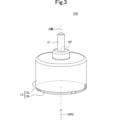
- FIG. 3 is a perspective view showing the appearance of a brushless motor 100 in which the magnetic core 1 is used.
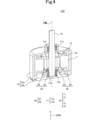
- FIG. 4 is an exploded perspective schematic view of a brushless motor 100 in which the magnetic core 1 is used.
- FIG. 5 is a cross-sectional view of a magnetic core 6 according to a comparative example viewed in a fourth direction DIR4.
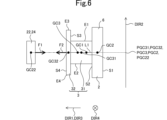
- FIG. 6 is a cross-sectional view of an example of magnetic forces F1, F2 generated between a magnetic core 6 and a rotor member 22 according to a comparative example when the rotor 20 is rotating, viewed in a fourth direction DIR4.
- FIG. 7 is a cross-sectional view, viewed in a fourth direction DIR4, showing an example of magnetic forces F1, F2 generated between the magnetic core 1 and the rotor member 22 when the rotor 20 is rotating.
- FIG. 8 is a cross-sectional view of the magnetic core 1a viewed in the fourth direction DIR4.
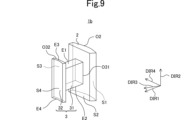
- FIG. 9 is a perspective view of the magnetic core 1b.
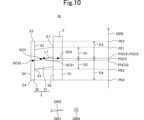
- FIG. 10 is a cross-sectional view of magnetic core 1b viewed in a fourth direction DIR4.
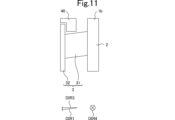
- FIG. 11 is a cross-sectional view of the magnetic core 1b and the bus bar 40 viewed in the fourth direction DIR4.
- FIG. 12 is a perspective view of the magnetic core 1c.
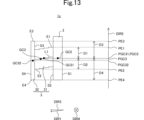
- FIG. 13 is a cross-sectional view of magnetic core 1c viewed in a fourth direction DIR4.
- Fig. 1 is a perspective view of the magnetic core 1.
- Fig. 2 is a cross-sectional view of the magnetic core 1 as viewed in a fourth direction DIR4.
- the directions are defined as follows.
- the direction in which the teeth main body portion 31 extends is defined as the first direction DIR1.
- the direction along the rotation axis of the brushless motor 100 when the magnetic core 1 is assembled in the brushless motor 100 is defined as the second direction DIR2.
- the orthogonal projection of the first direction DIR1 onto a plane perpendicular to the second direction DIR2 is defined as the third direction DIR3.
- the third direction DIR3 is equal to the first direction DIR1.
- the direction perpendicular to the second direction DIR2 and the third direction DIR3 is defined as the fourth direction DIR4.
- the fourth direction DIR4 is also perpendicular to the first direction DIR1 because the third direction DIR3 is equal to the first direction DIR1.
- the first direction DIR1, the second direction DIR2, the third direction DIR3, and the fourth direction DIR4 are directions defined for the purpose of explanation. Therefore, the first direction DIR1, the second direction DIR2, the third direction DIR3, and the fourth direction DIR4 during actual use of the magnetic core 1 do not necessarily have to coincide with the first direction DIR1, the second direction DIR2, the third direction DIR3, and the fourth direction DIR4 in this embodiment.
- the magnetic core 1 is used in a brushless motor 100.
- the brushless motor 100 is an example of a "rotating electric machine" according to the present invention.
- the magnetic core 1 has a core back portion 2 and teeth portion 3.
- the magnetic core 1 is a soft magnetic material. When a magnetic field is applied from the outside, the soft magnetic material is magnetized. When the application of the magnetic field is then stopped, the soft magnetic material loses its magnetization.
- An example of the material of such a soft magnetic material is iron.
- the magnetic core 1 is a molded body formed from soft magnetic powder. That is, each of the core back portion 2 and the teeth portion 3 is a molded body formed from soft magnetic powder.
- the material of the soft magnetic powder includes, for example, iron and a binder.
- the binder is, for example, a resin.
- the soft magnetic powder is, for example, a mixture of iron powder and epoxy resin, which is an example of a binder.
- Such a magnetic core 1 is produced, for example, by press molding. Furthermore, the outer surface of the magnetic core 1 is subjected to an insulating treatment.
- the core back portion 2 has a first main surface S1 and a second main surface S2 aligned in the third direction DIR3.
- the second main surface S2 is located in the third direction DIR3 further than the first main surface S1.
- each of the first main surface S1 and the second main surface S2 has a rectangular shape when viewed in the third direction DIR3.
- the core back portion 2 has a geometric center GC2.
- the geometric center GC2 is the position of the arithmetic mean taken over all points belonging to the core back portion 2.
- the core back portion 2 has a shape that is plane-symmetrical with respect to a plane perpendicular to the second direction DIR2.
- the teeth portion 3 includes a teeth main body portion 31 and a teeth tip portion 32.
- the teeth portion 3 has a geometric center GC3.
- the geometric center GC3 is the position of the arithmetic mean taken over all points belonging to the teeth portion 3.
- the teeth main body portion 31 extends from the core back portion 2 in the first direction DIR1. More specifically, the teeth main body portion 31 extends from the second main surface S2 in the first direction DIR1. In this embodiment, the first direction DIR1 is perpendicular to the second direction DIR2. Therefore, the third direction DIR3 is equal to the first direction DIR1.
- the teeth main body portion 31 is rectangular.
- the teeth main body portion 31 has a geometric center GC31.
- the geometric center GC31 is the position of the arithmetic mean taken over all points belonging to the teeth main body portion 31.
- the tooth body portion 31 has a shape that is plane-symmetrical with respect to a plane perpendicular to the second direction DIR2.
- the teeth main body portion 31 has a first end E1 and a second end E2, which are opposite ends in the second direction DIR2.
- the first end E1 is located further in the second direction DIR2 than the second end E2.
- the second direction DIR2 is a direction along the rotation axis of the brushless motor 100 when the magnetic core 1 is assembled in the brushless motor 100.
- the tooth tip portion 32 has a third principal surface S3 and a fourth principal surface S4 aligned in the third direction DIR3.
- the fourth principal surface S4 is located in the third direction DIR3 from the third principal surface S3.
- the third principal surface S3 and the fourth principal surface S4 each have a rectangular shape when viewed in the third direction DIR3.
- the tooth tip portion 32 has a geometric center GC32.
- the geometric center GC32 is the position of the arithmetic mean taken over all points belonging to the tooth tip portion 32.
- the tooth tip portion 32 has a shape that is plane-symmetrical with respect to a plane perpendicular to the second direction DIR2.
- the tooth tip portion 32 has a third end E3 and a fourth end E4, which are both ends in the second direction DIR2.
- the third end E3 is located further in the second direction DIR2 than the fourth end E4.
- Such a tooth tip portion 32 is provided at the tip of the tooth main body portion 31 in the first direction DIR1, as shown in FIG. 1.
- the outer edge O2 of the core back portion 2 as viewed in the third direction DIR3 surrounds the outer edge O31 of the tooth main body portion 31 as viewed in the third direction DIR3, as shown in FIG. 1.
- the outer edge O32 of the tooth tip portion 32 as viewed in the third direction DIR3 surrounds the outer edge O31 of the tooth main body portion 31 as viewed in the third direction DIR3.
- the length of the tooth main body portion 31 in the second direction DIR2 is uniform in the third direction DIR3, as shown in FIG. 2.
- the distance D1 in the second direction DIR2 between the first end E1 of the teeth main body portion 31 and the geometric center GC2 of the core back portion 2 is equal to the distance D2 in the second direction DIR2 between the second end E2 of the teeth main body portion 31 and the geometric center GC2 of the core back portion 2, as shown in FIG. 2. Accordingly, the position PGC31 in the second direction DIR2 of the geometric center GC31 of the teeth main body portion 31 is equal to the position PGC2 in the second direction DIR2 of the geometric center GC2 of the core back portion 2.
- the distance D3 in the second direction DIR2 between the third end E3 of the tooth tip portion 32 and the geometric center GC2 of the core back portion 2 is smaller than the distance D4 in the second direction DIR2 between the fourth end E4 of the tooth tip portion 32 and the geometric center GC2 of the core back portion 2, as shown in FIG. 2.
- the geometric center GC2 of the core back portion 2 is located further in the second direction DIR2 than the geometric center GC32 of the tooth tip portion 32.
- the position PGC32 in the second direction DIR2 of the geometric center GC32 of the tooth tip portion 32 is different from the position PGC2 in the second direction DIR2 of the geometric center GC2 of the core back portion 2.
- the geometric center GC2 of the core back portion 2 is located further in the second direction DIR2 than the geometric center GC3 of the tooth portion 3. That is, in the second direction DIR2, the position PGC3 of the geometric center GC3 of the teeth portion 3 is different from the position PGC2 of the geometric center GC2 of the core back portion 2. More specifically, the geometric center GC2 of the core back portion 2 is located in the second direction DIR2 further than the geometric center GC3 of the teeth portion 3. Therefore, the magnetic core 1 does not have a plane-symmetric shape with respect to a plane perpendicular to the second direction DIR2. Note that the magnetic core 1 has a plane-symmetric shape with respect to a plane perpendicular to the fourth direction DIR4.
- the line connecting the geometric centers of the cross sections of the teeth main body portion 31 perpendicular to the third direction DIR3 is defined as the first line L1.
- the geometric center of the cross section of the teeth main body portion 31 perpendicular to the third direction DIR3 is the position of the arithmetic mean taken over all points belonging to the cross section of the teeth main body portion 31 perpendicular to the third direction DIR3.
- the first line L1 is a straight line as shown in FIG. 2.
- the direction in which the first line L1 extends is parallel to the third direction DIR3 and perpendicular to the second direction DIR2. That is, the position of the first line L1 at the tip of the teeth main body portion 31 in the first direction DIR1 and the position of the first line L1 at the end of the teeth main body portion 31 opposite to the tip are equal in the second direction DIR2.
- Fig. 3 is an external perspective view of the brushless motor 100 using a magnetic core 1.
- Fig. 4 is an exploded perspective schematic view of the brushless motor 100 using a magnetic core 1. Note that in Fig. 4, reference symbols are given only to representative magnetic cores 1, coils 13, and insulating members 14 among the multiple magnetic cores 1, multiple coils 13, and multiple insulating members 14.
- the brushless motor 100 includes a rotor 20 and a stator assembly 10. As shown in FIG. 4, the stator assembly 10 is disposed around the rotor 20 when viewed in the second direction DIR2. In other words, the brushless motor 100 is an inner rotor type.
- the rotor 20 includes a shaft 21 and a rotor member 22.
- the shaft 21 has a shape that extends in the second direction DIR2. More specifically, the shaft 21 is cylindrical.
- the rotor member 22 is cylindrical.
- the central axes of the shaft 21 and the rotor member 22 are the Z-axis. In other words, the rotation axis of the brushless motor 100 is the Z-axis. Therefore, the second direction DIR2 is a direction along the Z-axis.
- the rotor member 22 includes a soft magnetic body 23 and a hard magnetic body 24.
- the rotor member 22 is attached to the outer peripheral surface of the shaft 21 in the radial direction centered on the Z axis. More specifically, the soft magnetic body 23 is attached to the outer peripheral surface of the shaft 21 in the radial direction centered on the Z axis.
- the hard magnetic body 24 is attached to the outer peripheral surface of the soft magnetic body 23 in the radial direction centered on the Z axis.
- the rotor member 22 is arranged so that the position PGC22 in the second direction DIR2 of the geometric center GC22 of the rotor member 22 is equal to the position PGC2 in the second direction DIR2 of the geometric center GC2 of the core back portion 2.
- the geometric center GC22 is the position of the arithmetic mean taken over all points belonging to the rotor member 22.
- the soft magnetic body 23 is a soft magnetic body.
- the hard magnetic body 24 is a hard magnetic body. When a magnetic field is applied from the outside, the hard magnetic body is magnetized. Even if the application of the magnetic field is then stopped, the hard magnetic body does not lose its magnetization. Such hard magnetic material is a magnet.
- the stator assembly 10 includes a bearing 11, a housing 12, a plurality of magnetic cores 1, a plurality of coils 13, and a plurality of insulating members 14.
- the brushless motor 100 includes a magnetic core 1.
- the bearing 11 supports the shaft 21 so that it can rotate in the circumferential direction around the Z-axis. More specifically, as shown in FIG. 4, the bearing 11 has a first bearing 11a and a second bearing 11b. Each of the first bearing 11a and the second bearing 11b is, for example, a ball bearing. Each of the first bearing 11a and the second bearing 11b is cylindrical. The central axis of each of the first bearing 11a and the second bearing 11b is the Z-axis. In other words, the central axis of each of the first bearing 11a and the second bearing 11b coincides with the central axis of the shaft 21.
- the first bearing 11a is positioned further in the second direction DIR2 than the second bearing 11b.
- the first bearing 11a is also positioned further in the second direction DIR2 than the rotor member 22.
- the second bearing 11b is positioned in the opposite direction of the second direction DIR2 than the rotor member 22.
- the second bearing 11b supports the end of the shaft 21 that is positioned opposite the second direction DIR2.
- the housing 12 has a first housing 12a and a second housing 12b.
- the first housing 12a is cylindrical.
- the central axis of the first housing 12a is the Z axis.
- the first housing 12a is positioned further in the second direction DIR2 than the second housing 12b.
- the first housing 12a also has an opening OP.
- the end of the shaft 21 in the second direction DIR2 protrudes from the opening OP in the second direction DIR2.
- the brushless motor 100 is a single-shaft type.
- the first housing 12a supports the first bearing 11a, the multiple magnetic cores 1, the multiple coils 13, and the multiple insulating members 14.
- the second housing 12b supports the second bearing 11b.
- the materials of the first housing 12a and the second housing 12b are, for example, a highly rigid material such as SUS.
- the number of magnetic cores 1, the number of coils 13, and the number of insulating members 14 is nine. Each of the nine coils 13 and each of the nine insulating members 14 is provided corresponding to each of the nine magnetic cores 1. More specifically, if a set including one magnetic core 1, one coil 13, and one insulating member 14 is considered to be one set, the nine sets are lined up in the circumferential direction centered on the Z axis. Each set is arranged around the hard magnetic material 24 with a gap therebetween. Note that each set has the same structure. Therefore, one set including one magnetic core 1, one coil 13, and one insulating member 14 will be described.
- the magnetic core 1 is magnetized by both the magnetic field generated by the hard magnetic material 24 and the magnetic field generated by the coil 13. As a result, the magnetic core 1 generates a magnetic force that rotates the rotor. Note that, as shown in FIG. 4, there is an air gap between the magnetic core 1 and the rotor member 22.
- the first direction DIR1 is the direction toward the rotation axis of the brushless motor 100 when the magnetic core 1 is incorporated into the brushless motor 100.
- the coil 13 is wound around the teeth main body 31 so as to be positioned around the magnetic core 1 when viewed in the radial direction centered on the Z-axis.
- the coil 13 is made of a conductive material such as copper.
- the coil 13 has a structure in which the surface of the copper wire is covered with an insulating film. The coil 13 generates a magnetic field when a current flows through the coil 13.
- the insulating member 14 is an insulator. As shown in FIG. 4, the insulating member 14 is disposed between the magnetic core 1 and the coil 13. This electrically insulates the magnetic core 1 and the coil 13. In this embodiment, the insulating member 14 is in the form of a film, but it may also be in the form of a plate. The insulating member 14 may also be disposed so that a portion of the insulating member 14 is disposed between the magnetic core 1 and the coil 13. Thus, the insulating member 14 may be disposed over the entire surface of the coil 13.
- a current is supplied to the coil 13 from a power source (not shown).
- the rotation of the rotor 20 is controlled by controlling this current.
- FIG. 5 is a cross-sectional view of the magnetic core 6 according to the comparative example viewed in the fourth direction DIR4.
- FIG. 6 is a cross-sectional view of an example of magnetic forces F1, F2 generated between the magnetic core 6 according to the comparative example and the rotor member 22 when the rotor 20 is rotating viewed in the fourth direction DIR4.
- FIG. 7 is a cross-sectional view of an example of magnetic forces F1, F2 generated between the magnetic core 1 and the rotor member 22 when the rotor 20 is rotating viewed in the fourth direction DIR4.
- the magnetic core 6 according to the comparative example will be described. Note that, for the magnetic core 6 according to the comparative example, only the parts that are different from the magnetic core 1 will be described, and the rest will be omitted.
- the distance D3 in the second direction DIR2 between the third end E3 of the tooth tip portion 32 and the geometric center GC2 of the core back portion 2 is equal to the distance D4 in the second direction DIR2 between the fourth end E4 of the tooth tip portion 32 and the geometric center GC2 of the core back portion 2, as shown in FIG. 5.
- the position PGC32 in the second direction DIR2 of the geometric center GC32 of the tooth tip portion 32 is equal to the position PGC2 in the second direction DIR2 of the geometric center GC2 of the core back portion 2. Since the position PGC31 in the second direction DIR2 of the geometric center GC31 of the tooth body 31 and the position PGC32 in the second direction DIR2 of the geometric center GC32 of the tooth tip 32 are equal to the position PGC2 in the second direction DIR2 of the geometric center GC2 of the core back portion 2, the position PGC3 in the second direction DIR2 of the geometric center GC3 of the tooth portion 3 is equal to the position PGC2 in the second direction DIR2 of the geometric center GC2 of the core back portion 2.
- the position PGC6 in the second direction DIR2 of the geometric center GC6 of the magnetic core 6 of the comparative example is equal to the position PGC2 in the second direction DIR2 of the geometric center GC2 of the core back portion 2.
- the magnetic core 6 of the comparative example has a shape that is plane-symmetrical with respect to a plane perpendicular to the second direction DIR2.
- magnetic forces F1 and F2 are generated between the magnetic core 6 according to the comparative example and the rotor member 22, as shown in FIG. 6.
- the magnetic forces F1 and F2 are Coulomb forces acting between two magnetic charges.
- the direction of the magnetic force F1 is the third direction DIR3.
- the direction of the magnetic force F1 is the opposite direction to the third direction DIR3.
- the direction of the magnetic force F1 is parallel to the third direction DIR3. That is, the direction of the magnetic force F1 is perpendicular to the second direction DIR2. Therefore, in the magnetic core 6 according to the comparative example, no thrust force is generated in the direction along the rotation axis.
- the position PGC3 of the geometric center GC3 of the teeth portion 3 is different from the position PGC2 of the geometric center GC2 of the core back portion 2. Therefore, the position PGC22 of the geometric center GC22 of the rotor member 22 in the second direction DIR2 is different from the position PGC1 of the geometric center GC1 of the magnetic core 1 in the second direction DIR2.
- the directions of the magnetic forces F1 and F2 are not parallel to the third direction DIR3. More specifically, the direction of the magnetic force F1 is parallel to the straight line connecting the geometric center GC22 of the rotor member 22 and the geometric center GC1 of the magnetic core 1, as shown in FIG. 7.
- the geometric center GC22 of the rotor member 22 is located in the second direction DIR2 further than the geometric center GC1 of the magnetic core 1.
- the magnetic force F1 includes a component in the second direction DIR2.
- the magnetic force F1 includes a component in the opposite direction of the second direction DIR2.
- the magnetic force F1 includes a component in the direction along the rotation axis (the second direction DIR2 or the direction opposite to the second direction DIR2). Therefore, the magnetic core 1 can generate a thrust force in the direction along the rotation axis.
- the magnetic core 1 can increase the thrust force in the direction along the rotation axis. More specifically, the Coulomb force is inversely proportional to the square of the distance between the two magnetic charges.
- Each of the magnetic forces F1 and F2 is a composite of the Coulomb force acting between the rotor member 22 and the teeth tip 32, the Coulomb force acting between the rotor member 22 and the teeth main body 31, and the Coulomb force acting between the rotor member 22 and the core back portion 2.
- the teeth tip 32 is disposed closest to the rotor member 22 among the core back portion 2, the teeth main body 31, and the teeth tip 32.
- the magnetic core 1 makes the position PGC32 of the geometric center GC32 of the teeth tip 32 in the second direction DIR2 different from the position PGC2 of the geometric center GC2 of the core back portion 2 in the second direction DIR2. As a result, the magnetic core 1 can increase the thrust force in the direction along the rotation axis.
- the magnetic core 1 can ensure an area that overlaps with the tooth tip portion 32 when viewed in the second direction DIR2 and is located further in the second direction DIR2 than the tooth tip portion 32. More specifically, the distance D3 in the second direction DIR2 between the third end E3 of the tooth tip portion 32 and the geometric center GC2 of the core back portion 2 is smaller than the distance D4 in the second direction DIR2 between the fourth end E4 of the tooth tip portion 32 and the geometric center GC2 of the core back portion 2.
- the area that overlaps with the tooth tip portion 32 when viewed in the second direction DIR2 and is located further in the second direction DIR2 than the tooth tip portion 32 can be made larger than the area that overlaps with the tooth tip portion 32 when viewed in the second direction DIR2 and is located in the opposite direction to the second direction DIR2 than the tooth tip portion 32.
- the magnetic core 1 can secure an area that overlaps with the tooth tip 32 when viewed in the second direction DIR2, and is located further in the second direction DIR2 than the tooth tip 32.
- the magnetic core 1 makes it easier to wind the coil 13 around the tooth main body 31. More specifically, the position of the first line L1 at the tip of the tooth main body 31 in the first direction DIR1 is equal to the position of the first line L1 at the end of the tooth main body 31 opposite the tip in the second direction DIR2. In other words, the direction in which the first line L1 extends is perpendicular to the second direction DIR2, which is the direction along the rotation axis of the brushless motor 100. Therefore, the magnetic core 1 makes it easier to wind the coil 13 around the tooth main body 31.
- the magnetic core 1 makes it easier to form the magnetic core 1. More specifically, the core back portion 2, the teeth main body portion 31, and the teeth tip portion 32 each have a shape that is plane-symmetrical with respect to a plane perpendicular to the second direction DIR2. Therefore, for example, when the magnetic core 1 is manufactured by press molding, the magnetic core 1 can be manufactured using a die and a punch each having a shape that is plane-symmetrical with respect to a plane perpendicular to the second direction DIR2. As a result, the magnetic core 1 makes it easier to form the magnetic core 1.
- a magnetic core 1a according to a second embodiment of the present invention will be described with reference to the drawings.
- Fig. 8 is a cross-sectional view of the magnetic core 1a in the fourth direction DIR4. Note that, for the magnetic core 1a according to the second embodiment, only the parts different from the magnetic core 1 according to the first embodiment will be described, and the rest will be omitted.
- the magnetic core 1a differs from the magnetic core 1 in that the position PGC32 in the second direction DIR2 of the geometric center GC32 of the tooth tip portion 32 is equal to the position PGC2 in the second direction DIR2 of the geometric center GC2 of the core back portion 2, and the position PGC31 in the second direction DIR2 of the geometric center GC31 of the tooth main body portion 31 differs from the position PGC2 in the second direction DIR2 of the geometric center GC2 of the core back portion 2.
- the distance D3 in the second direction DIR2 between the third end E3 of the tooth tip portion 32 and the geometric center GC2 of the core back portion 2 is equal to the distance D4 in the second direction DIR2 between the fourth end E4 of the tooth tip portion 32 and the geometric center GC2 of the core back portion 2, as shown in FIG. 8. Accordingly, the position PGC32 in the second direction DIR2 of the geometric center GC32 of the tooth tip portion 32 is equal to the position PGC2 in the second direction DIR2 of the geometric center GC2 of the core back portion 2.
- the distance D1 in the second direction DIR2 between the first end E1 of the teeth main body 31 and the geometric center GC2 of the core back portion 2 is smaller than the distance D2 in the second direction DIR2 between the second end E2 of the teeth main body 31 and the geometric center GC2 of the core back portion 2. Accordingly, the geometric center GC2 of the core back portion 2 is located further in the second direction DIR2 than the geometric center GC31 of the teeth main body 31. As a result, the geometric center GC2 of the core back portion 2 is located further in the second direction DIR2 than the geometric center GC3 of the teeth portion 3. In other words, in the second direction DIR2, the position PGC3 of the geometric center GC3 of the teeth portion 3 is different from the position PGC2 of the geometric center GC2 of the core back portion 2.
- the magnetic core 1a as described above also has the same effect as the magnetic core 1. Moreover, according to the magnetic core 1a, it is possible to secure a region that overlaps with the tooth main body portion 31 when viewed in the second direction DIR2 and is located further in the second direction DIR2 than the tooth main body portion 31. More specifically, the distance D1 in the second direction DIR2 between the first end E1 of the tooth main body portion 31 and the geometric center GC2 of the core back portion 2 is smaller than the distance D2 in the second direction DIR2 between the second end E2 of the tooth main body portion 31 and the geometric center GC2 of the core back portion 2.
- the region that overlaps with the tooth main body portion 31 when viewed in the second direction DIR2 and is located further in the second direction DIR2 than the tooth main body portion 31 can be made larger than the region that overlaps with the tooth main body portion 31 when viewed in the second direction DIR2 and is located in the opposite direction to the second direction DIR2 than the tooth main body portion 31.
- the magnetic core 1a can secure an area that overlaps with the tooth main body 31 when viewed in the second direction DIR2, and is located further in the second direction DIR2 than the tooth main body 31.
- FIG. 9 is a perspective view of the magnetic core 1b.
- Fig. 10 is a cross-sectional view of the magnetic core 1b in the fourth direction DIR4.
- Fig. 11 is a cross-sectional view of the magnetic core 1b and the bus bar 40 in the fourth direction DIR4. Note that, for the magnetic core 1b according to the third embodiment, only the parts different from the magnetic core 1 according to the first embodiment will be described, and the rest will be omitted.
- magnetic core 1b differs from magnetic core 1 in that the first direction DIR1 is not perpendicular to the second direction DIR2. That is, in this embodiment, the third direction DIR3 is different from the first direction DIR1.
- the tooth main body portion 31 has a rectangular prism shape. More specifically, in this embodiment, the first line L1 at the tip of the tooth main body portion 31 in the first direction DIR1 is located in the opposite direction of the second direction DIR2 from the first line L1 at the end of the tooth main body portion 31 opposite the tip of the tooth main body portion 31 in the first direction DIR1. Therefore, in this embodiment, the tooth main body portion 31 does not have a shape that is plane-symmetrical with respect to a plane perpendicular to the second direction DIR2.
- the magnetic core 1b as described above also has the same effect as the magnetic core 1.
- the first line L1 at the tip of the tooth main body 31 in the first direction DIR1 is located in the opposite direction to the second direction DIR2 from the first line L1 at the end of the tooth main body 31 opposite to the tip of the tooth main body 31 in the first direction DIR1.
- the magnetic core 1b it is possible to secure an area that overlaps with the tip of the tooth main body 31 in the first direction DIR1 as viewed in the second direction DIR2, and is located in the second direction DIR2 further than the tooth main body 31 in the first direction DIR1.
- Fig. 12 is a perspective view of the magnetic core 1c.
- Fig. 13 is a cross-sectional view of the magnetic core 1c viewed in the fourth direction DIR4. Note that, for the magnetic core 1c according to the first modified example, only the parts different from the magnetic core 1b according to the third embodiment will be described, and the rest will be omitted.
- magnetic core 1c differs from magnetic core 1b in that first line L1 is a broken line.
- the magnetic core 1c described above has the same effect as the magnetic core 1b.
- the magnetic core according to the present invention is not limited to the magnetic cores 1, 1a to 1c, and may be modified within the scope of the present invention.
- the structures of the magnetic cores 1, 1a to 1c may be combined in any manner.
- the first direction DIR1 may be perpendicular to the second direction DIR2, or may not be perpendicular to the second direction DIR2.
- the rotating electric machine may have a structure in which the rotor is rotated by electricity, or a structure in which electricity is generated by the rotation of the rotor.
- the rotating electric machine may have at least one of the magnetic cores 1, 1a to 1c, and may also have brushes.
- the magnetic cores 1, 1a to 1c may be made by laminating electromagnetic steel sheets.
- the magnetic cores 1, 1a to 1c may be made of any soft magnetic material.
- the outer surfaces of the magnetic cores 1, 1a to 1c do not need to be insulated.
- each of the first main surface S1 and the second main surface S2 of the core back portion 2 does not have to have a rectangular shape when viewed in the third direction DIR3.
- the core back portion 2 does not have to have a shape that is plane-symmetrical with respect to a plane perpendicular to the second direction DIR2.
- the tooth body portion 31 does not have to be rectangular or rectangular prism shaped.
- each of the third principal surface S3 and the fourth principal surface S4 of the tooth tip portion 32 does not have to have a rectangular shape when viewed in the third direction DIR3.
- the tooth tip portion 32 does not have to have a shape that is plane-symmetrical with respect to a plane perpendicular to the second direction DIR2.
- the outer edge O2 of the core back portion 2 as viewed in the third direction DIR3 does not have to surround the outer edge O31 of the tooth main body portion 31 as viewed in the third direction DIR3. Furthermore, the outer edge O32 of the tooth tip portion 32 as viewed in the third direction DIR3 does not have to surround the outer edge O31 of the tooth main body portion 31 as viewed in the third direction DIR3.
- the length of the tooth main body portion 31 in the second direction DIR2 as viewed in the fourth direction DIR4 does not have to be uniform in the third direction DIR3.
- the distance D1 in the second direction DIR2 between the first end E1 of the tooth main body portion 31 and the geometric center GC2 of the core back portion 2 may be different from the distance D2 in the second direction DIR2 between the second end E2 of the tooth main body portion 31 and the geometric center GC2 of the core back portion 2.
- the position PGC31 in the second direction DIR2 of the geometric center GC31 of the tooth main body portion 31 may be different from the position PGC2 in the second direction DIR2 of the geometric center GC2 of the core back portion 2.
- the distance D3 in the second direction DIR2 between the third end E3 of the tooth tip portion 32 and the geometric center GC2 of the core back portion 2 may be different from the distance D4 in the second direction DIR2 between the fourth end E4 of the tooth tip portion 32 and the geometric center GC2 of the core back portion 2.
- the position PGC32 in the second direction DIR2 of the geometric center GC32 of the tooth tip portion 32 may be different from the position PGC2 in the second direction DIR2 of the geometric center GC2 of the core back portion 2.
- the magnetic core 1 does not have to have a shape that is plane-symmetric with respect to a plane perpendicular to the fourth direction DIR4.
- first line L1 is not limited to being a straight line or a broken line, and may be a curved line. Furthermore, the first line L1 may include a straight line or a curved line.
- the first line L1 at the tip of the tooth main body portion 31 in the first direction DIR1 may be located in the second direction DIR2 further than the first line L1 at the end of the tooth main body portion 31 opposite the tip of the tooth main body portion 31 in the first direction DIR1.
- the brushless motor 100 may be an outer rotor type.
- the first direction DIR1 is the opposite direction to the direction toward the rotation shaft of the brushless motor 100 when the magnetic core 1 is assembled in the brushless motor 100.
- the brushless motor 100 is not limited to a single-shaft type.
- the brushless motor 100 may be, for example, a double-shaft type.
- the first bearing 11a and the second bearing 11b may each be pressurized by a thrust force generated in a direction along the rotation axis.
- first bearing 11a and the second bearing 11b are not limited to ball bearings.
- the materials for the first housing 12a and the second housing 12b may be any material that has high rigidity.
- each of the magnetic cores 1, the coils 13, and the insulating members 14 is not limited to nine. Each of the coils 13 and each of the insulating members 14 may be provided in correspondence with each of the magnetic cores 1.
- the present invention has the following configuration.
- a magnetic core for use in a rotating electrical machine comprising: A core back portion; a teeth portion including a teeth main body portion extending in a first direction from the core back portion and a teeth tip portion provided at a tip of the teeth main body portion in the first direction; Equipped with a position of a geometric center of the teeth portion is different from a position of a geometric center of the core back portion in a second direction that is a direction along a rotation axis of the rotating electric machine when the magnetic core is assembled in the rotating electric machine; Magnetic core.
- a position of a geometric center of the tooth main body portion in the second direction is different from a position of a geometric center of the core back portion in the second direction.
- a position of a geometric center of the tooth tip portion in the second direction is different from a position of a geometric center of the core back portion in the second direction.
- the teeth main body portion has a first end and a second end which are opposite ends in the second direction, a distance in the second direction between the first end and the geometric center of the core back portion is smaller than a distance in the second direction between the second end and the geometric center of the core back portion;
- a magnetic core according to any one of (1) to (3).
- the tooth tip portion has a third end and a fourth end which are opposite ends in the second direction, a distance in the second direction between the third end and a geometric center of the core back portion is smaller than a distance in the second direction between the fourth end and a geometric center of the core back portion;
- a magnetic core according to any one of (1) to (4).
- An orthogonal projection of the first direction onto a plane perpendicular to the second direction is defined as a third direction;
- a line connecting geometric centers of cross sections of the teeth main body portions perpendicular to the third direction is defined as a first line, the first line is a straight line, a position of the first line at the tip of the tooth main body portion and a position of the first line at an end of the tooth main body portion opposite to the tip are equal in the second direction;
- a magnetic core according to any one of (1) to (5).
- An orthogonal projection of the first direction onto a plane perpendicular to the second direction is defined as a third direction;
- a line connecting geometric centers of cross sections of the teeth main body portions perpendicular to the third direction is defined as a first line, the first line is a straight line, a position of the first line at the tip of the tooth main body portion and a position of the first line at an end of the tooth main body portion opposite to the tip are shifted in the second direction.
- a magnetic core according to any one of (1) to (5).
- An orthogonal projection of the first direction onto a plane perpendicular to the second direction is defined as a third direction;
- a line connecting geometric centers of cross sections of the teeth main body portions perpendicular to the third direction is defined as a first line, the first line is a broken line, a position of the first line at the tip of the tooth main body portion and a position of the first line at an end of the tooth main body portion opposite to the tip are shifted in the second direction.
- a magnetic core according to any one of (1) to (5).
- An orthogonal projection of the first direction onto a plane perpendicular to the second direction is defined as a third direction;
- the core back portion has a shape that is plane-symmetrical with respect to a plane perpendicular to the second direction,
- the tooth main body portion has a shape that is plane-symmetric with respect to a plane perpendicular to the second direction,
- the tip end portion of the teeth has a shape that is plane-symmetrical with respect to a plane perpendicular to the second direction.
- a magnetic core according to any one of (1) to (6).
- An orthogonal projection of the first direction onto a plane perpendicular to the second direction is defined as a third direction;
- the length of the tooth main body portion in the second direction is uniform in the third direction.
- a magnetic core according to any one of (1) to (9).
- Each of the core back portion and the teeth portion is a molded body formed from soft magnetic powder.
- the material of the soft magnetic powder includes iron and resin; A magnetic core according to (11).
- a magnetic core according to any one of (1) to (12) is provided. Rotating electrical machines.
- a magnetic core according to any one of (1) to (12) is provided. Brushless motor.
Landscapes
- Engineering & Computer Science (AREA)
- Power Engineering (AREA)
- Iron Core Of Rotating Electric Machines (AREA)
Priority Applications (4)
| Application Number | Priority Date | Filing Date | Title |
|---|---|---|---|
| CN202380062049.7A CN119768997A (zh) | 2022-12-05 | 2023-11-28 | 磁芯、旋转电气机械和无刷马达 |
| DE112023002731.5T DE112023002731T5 (de) | 2022-12-05 | 2023-11-28 | Magnetkern, drehende elektrische maschine und bürstenloser motor |
| JP2024562706A JP7845505B2 (ja) | 2022-12-05 | 2023-11-28 | 磁性体コア、回転電気機械及びブラシレスモータ |
| US19/081,390 US20250219473A1 (en) | 2022-12-05 | 2025-03-17 | Magnetic core, rotating electrical machine, and brushless motor |
Applications Claiming Priority (2)
| Application Number | Priority Date | Filing Date | Title |
|---|---|---|---|
| JP2022-194080 | 2022-12-05 | ||
| JP2022194080 | 2022-12-05 |
Related Child Applications (1)
| Application Number | Title | Priority Date | Filing Date |
|---|---|---|---|
| US19/081,390 Continuation US20250219473A1 (en) | 2022-12-05 | 2025-03-17 | Magnetic core, rotating electrical machine, and brushless motor |
Publications (1)
| Publication Number | Publication Date |
|---|---|
| WO2024122406A1 true WO2024122406A1 (ja) | 2024-06-13 |
Family
ID=91379306
Family Applications (1)
| Application Number | Title | Priority Date | Filing Date |
|---|---|---|---|
| PCT/JP2023/042584 Ceased WO2024122406A1 (ja) | 2022-12-05 | 2023-11-28 | 磁性体コア、回転電気機械及びブラシレスモータ |
Country Status (5)
| Country | Link |
|---|---|
| US (1) | US20250219473A1 (https=) |
| JP (1) | JP7845505B2 (https=) |
| CN (1) | CN119768997A (https=) |
| DE (1) | DE112023002731T5 (https=) |
| WO (1) | WO2024122406A1 (https=) |
Citations (4)
| Publication number | Priority date | Publication date | Assignee | Title |
|---|---|---|---|---|
| JP2000201458A (ja) * | 1998-06-30 | 2000-07-18 | Mitsubishi Electric Corp | 鉄心装置及びその製造方法 |
| JP2008061407A (ja) * | 2006-08-31 | 2008-03-13 | Jtekt Corp | 電動モータ |
| JP2010166810A (ja) * | 2010-03-26 | 2010-07-29 | Mitsubishi Electric Corp | 回転電機の固定子 |
| JP2017060395A (ja) * | 2015-09-16 | 2017-03-23 | ヤマハ発動機株式会社 | 回転電機及びステータ |
-
2023
- 2023-11-28 WO PCT/JP2023/042584 patent/WO2024122406A1/ja not_active Ceased
- 2023-11-28 DE DE112023002731.5T patent/DE112023002731T5/de active Pending
- 2023-11-28 CN CN202380062049.7A patent/CN119768997A/zh active Pending
- 2023-11-28 JP JP2024562706A patent/JP7845505B2/ja active Active
-
2025
- 2025-03-17 US US19/081,390 patent/US20250219473A1/en active Pending
Patent Citations (4)
| Publication number | Priority date | Publication date | Assignee | Title |
|---|---|---|---|---|
| JP2000201458A (ja) * | 1998-06-30 | 2000-07-18 | Mitsubishi Electric Corp | 鉄心装置及びその製造方法 |
| JP2008061407A (ja) * | 2006-08-31 | 2008-03-13 | Jtekt Corp | 電動モータ |
| JP2010166810A (ja) * | 2010-03-26 | 2010-07-29 | Mitsubishi Electric Corp | 回転電機の固定子 |
| JP2017060395A (ja) * | 2015-09-16 | 2017-03-23 | ヤマハ発動機株式会社 | 回転電機及びステータ |
Also Published As
| Publication number | Publication date |
|---|---|
| JP7845505B2 (ja) | 2026-04-14 |
| JPWO2024122406A1 (https=) | 2024-06-13 |
| CN119768997A (zh) | 2025-04-04 |
| US20250219473A1 (en) | 2025-07-03 |
| DE112023002731T5 (de) | 2025-04-03 |
Similar Documents
| Publication | Publication Date | Title |
|---|---|---|
| CN100477446C (zh) | 旋转电机 | |
| US20020093260A1 (en) | Axial directional gap type eccentric rotor having stop position maintaining unit and flat coreless vibration motor using the rotor | |
| EP1628380A1 (en) | Stator slot openings of a permanent magnet motor | |
| US20250219477A1 (en) | Magnetic core, coil-equipped magnetic core, and rotary electric machine | |
| WO2024122406A1 (ja) | 磁性体コア、回転電気機械及びブラシレスモータ | |
| JP7852742B2 (ja) | 磁性体コア、ステータアッシー、回転電気機械及びブラシレスモータ | |
| JP2018160956A (ja) | ブラシレスモータ | |
| JP2023005548A (ja) | 回転電機 | |
| JPWO2024122405A5 (https=) | ||
| WO2023189285A1 (ja) | 回転子及び電動機 | |
| WO2024181096A1 (ja) | ステータ及び回転電気機械 | |
| WO2024157740A1 (ja) | 回転電気機械 | |
| JP2024121489A (ja) | ステータ及び回転電気機械 | |
| WO2023167290A1 (ja) | ロータおよび回転電機 | |
| CN118020232A (zh) | 转子及旋转电机 | |
| EP4156460A1 (en) | Rotary electric machine | |
| WO2023053604A1 (ja) | ロータおよび回転電機 | |
| WO2024122407A1 (ja) | 磁性体コア及び回転電気機械 | |
| JP7848933B2 (ja) | ステータ部材、回転電気機械及びステータ部材の製造方法 | |
| US20240186844A1 (en) | Magnetic core, winding with magnetic core, rotary electric machine, and brushless motor | |
| WO2024122408A1 (ja) | 磁性体コア、コイル付き磁性体コア、回転電気機械及びブラシレスモータ | |
| JP3591660B2 (ja) | 3相クローポール式永久磁石型回転電機 | |
| EP4535615A1 (en) | Electric motor, core block, and stator core | |
| JP2025153941A (ja) | ロータおよび回転電機 | |
| JP2024131471A (ja) | ステータ、モータ、および送風機 |
Legal Events
| Date | Code | Title | Description |
|---|---|---|---|
| 121 | Ep: the epo has been informed by wipo that ep was designated in this application |
Ref document number: 23900522 Country of ref document: EP Kind code of ref document: A1 |
|
| WWE | Wipo information: entry into national phase |
Ref document number: 112023002731 Country of ref document: DE |
|
| WWE | Wipo information: entry into national phase |
Ref document number: 2024562706 Country of ref document: JP |
|
| WWE | Wipo information: entry into national phase |
Ref document number: 202380062049.7 Country of ref document: CN |
|
| WWP | Wipo information: published in national office |
Ref document number: 112023002731 Country of ref document: DE |
|
| WWP | Wipo information: published in national office |
Ref document number: 202380062049.7 Country of ref document: CN |
|
| 122 | Ep: pct application non-entry in european phase |
Ref document number: 23900522 Country of ref document: EP Kind code of ref document: A1 |