WO2024122046A1 - 面状ヒータ - Google Patents
面状ヒータ Download PDFInfo
- Publication number
- WO2024122046A1 WO2024122046A1 PCT/JP2022/045420 JP2022045420W WO2024122046A1 WO 2024122046 A1 WO2024122046 A1 WO 2024122046A1 JP 2022045420 W JP2022045420 W JP 2022045420W WO 2024122046 A1 WO2024122046 A1 WO 2024122046A1
- Authority
- WO
- WIPO (PCT)
- Prior art keywords
- heat
- sealing layer
- heating element
- cord
- shaped heating
- Prior art date
- Legal status (The legal status is an assumption and is not a legal conclusion. Google has not performed a legal analysis and makes no representation as to the accuracy of the status listed.)
- Ceased
Links
Images



Classifications
-
- H—ELECTRICITY
- H05—ELECTRIC TECHNIQUES NOT OTHERWISE PROVIDED FOR
- H05B—ELECTRIC HEATING; ELECTRIC LIGHT SOURCES NOT OTHERWISE PROVIDED FOR; CIRCUIT ARRANGEMENTS FOR ELECTRIC LIGHT SOURCES, IN GENERAL
- H05B3/00—Ohmic-resistance heating
- H05B3/20—Heating elements having extended surface area substantially in a two-dimensional [2D] plane, e.g. plate-heater
- H05B3/34—Heating elements having extended surface area substantially in a two-dimensional [2D] plane, e.g. plate-heater flexible, e.g. heating nets or webs
-
- H—ELECTRICITY
- H05—ELECTRIC TECHNIQUES NOT OTHERWISE PROVIDED FOR
- H05B—ELECTRIC HEATING; ELECTRIC LIGHT SOURCES NOT OTHERWISE PROVIDED FOR; CIRCUIT ARRANGEMENTS FOR ELECTRIC LIGHT SOURCES, IN GENERAL
- H05B3/00—Ohmic-resistance heating
- H05B3/20—Heating elements having extended surface area substantially in a two-dimensional [2D] plane, e.g. plate-heater
- H05B3/22—Heating elements having extended surface area substantially in a two-dimensional [2D] plane, e.g. plate-heater non-flexible
- H05B3/26—Heating elements having extended surface area substantially in a two-dimensional [2D] plane, e.g. plate-heater non-flexible heating conductor mounted on insulating base
- H05B3/267—Heating elements having extended surface area substantially in a two-dimensional [2D] plane, e.g. plate-heater non-flexible heating conductor mounted on insulating base the insulating base being an organic material, e.g. plastic
-
- B—PERFORMING OPERATIONS; TRANSPORTING
- B32—LAYERED PRODUCTS
- B32B—LAYERED PRODUCTS, i.e. PRODUCTS BUILT-UP OF STRATA OF FLAT OR NON-FLAT, e.g. CELLULAR OR HONEYCOMB, FORM
- B32B27/00—Layered products comprising a layer of synthetic resin
- B32B27/12—Layered products comprising a layer of synthetic resin next to a fibrous or filamentary layer
-
- B—PERFORMING OPERATIONS; TRANSPORTING
- B32—LAYERED PRODUCTS
- B32B—LAYERED PRODUCTS, i.e. PRODUCTS BUILT-UP OF STRATA OF FLAT OR NON-FLAT, e.g. CELLULAR OR HONEYCOMB, FORM
- B32B27/00—Layered products comprising a layer of synthetic resin
- B32B27/18—Layered products comprising a layer of synthetic resin characterised by the use of special additives
- B32B27/20—Layered products comprising a layer of synthetic resin characterised by the use of special additives using fillers, pigments, thixotroping agents
-
- B—PERFORMING OPERATIONS; TRANSPORTING
- B32—LAYERED PRODUCTS
- B32B—LAYERED PRODUCTS, i.e. PRODUCTS BUILT-UP OF STRATA OF FLAT OR NON-FLAT, e.g. CELLULAR OR HONEYCOMB, FORM
- B32B27/00—Layered products comprising a layer of synthetic resin
- B32B27/32—Layered products comprising a layer of synthetic resin comprising polyolefins
-
- B—PERFORMING OPERATIONS; TRANSPORTING
- B32—LAYERED PRODUCTS
- B32B—LAYERED PRODUCTS, i.e. PRODUCTS BUILT-UP OF STRATA OF FLAT OR NON-FLAT, e.g. CELLULAR OR HONEYCOMB, FORM
- B32B5/00—Layered products characterised by the non- homogeneity or physical structure, i.e. comprising a fibrous, filamentary, particulate or foam layer; Layered products characterised by having a layer differing constitutionally or physically in different parts
- B32B5/02—Layered products characterised by the non- homogeneity or physical structure, i.e. comprising a fibrous, filamentary, particulate or foam layer; Layered products characterised by having a layer differing constitutionally or physically in different parts characterised by structural features of a fibrous or filamentary layer
- B32B5/022—Non-woven fabric
-
- B—PERFORMING OPERATIONS; TRANSPORTING
- B32—LAYERED PRODUCTS
- B32B—LAYERED PRODUCTS, i.e. PRODUCTS BUILT-UP OF STRATA OF FLAT OR NON-FLAT, e.g. CELLULAR OR HONEYCOMB, FORM
- B32B5/00—Layered products characterised by the non- homogeneity or physical structure, i.e. comprising a fibrous, filamentary, particulate or foam layer; Layered products characterised by having a layer differing constitutionally or physically in different parts
- B32B5/02—Layered products characterised by the non- homogeneity or physical structure, i.e. comprising a fibrous, filamentary, particulate or foam layer; Layered products characterised by having a layer differing constitutionally or physically in different parts characterised by structural features of a fibrous or filamentary layer
- B32B5/024—Woven fabric
-
- H—ELECTRICITY
- H05—ELECTRIC TECHNIQUES NOT OTHERWISE PROVIDED FOR
- H05B—ELECTRIC HEATING; ELECTRIC LIGHT SOURCES NOT OTHERWISE PROVIDED FOR; CIRCUIT ARRANGEMENTS FOR ELECTRIC LIGHT SOURCES, IN GENERAL
- H05B3/00—Ohmic-resistance heating
- H05B3/10—Heating elements characterised by the composition or nature of the materials or by the arrangement of the conductor
- H05B3/12—Heating elements characterised by the composition or nature of the materials or by the arrangement of the conductor characterised by the composition or nature of the conductive material
- H05B3/14—Heating elements characterised by the composition or nature of the materials or by the arrangement of the conductor characterised by the composition or nature of the conductive material the material being non-metallic
-
- H—ELECTRICITY
- H05—ELECTRIC TECHNIQUES NOT OTHERWISE PROVIDED FOR
- H05B—ELECTRIC HEATING; ELECTRIC LIGHT SOURCES NOT OTHERWISE PROVIDED FOR; CIRCUIT ARRANGEMENTS FOR ELECTRIC LIGHT SOURCES, IN GENERAL
- H05B3/00—Ohmic-resistance heating
- H05B3/20—Heating elements having extended surface area substantially in a two-dimensional [2D] plane, e.g. plate-heater
-
- H—ELECTRICITY
- H05—ELECTRIC TECHNIQUES NOT OTHERWISE PROVIDED FOR
- H05B—ELECTRIC HEATING; ELECTRIC LIGHT SOURCES NOT OTHERWISE PROVIDED FOR; CIRCUIT ARRANGEMENTS FOR ELECTRIC LIGHT SOURCES, IN GENERAL
- H05B3/00—Ohmic-resistance heating
- H05B3/40—Heating elements having the shape of rods or tubes
- H05B3/54—Heating elements having the shape of rods or tubes flexible
- H05B3/56—Heating cables
-
- B—PERFORMING OPERATIONS; TRANSPORTING
- B32—LAYERED PRODUCTS
- B32B—LAYERED PRODUCTS, i.e. PRODUCTS BUILT-UP OF STRATA OF FLAT OR NON-FLAT, e.g. CELLULAR OR HONEYCOMB, FORM
- B32B2255/00—Coating on the layer surface
- B32B2255/02—Coating on the layer surface on fibrous or filamentary layer
-
- B—PERFORMING OPERATIONS; TRANSPORTING
- B32—LAYERED PRODUCTS
- B32B—LAYERED PRODUCTS, i.e. PRODUCTS BUILT-UP OF STRATA OF FLAT OR NON-FLAT, e.g. CELLULAR OR HONEYCOMB, FORM
- B32B2255/00—Coating on the layer surface
- B32B2255/20—Inorganic coating
- B32B2255/205—Metallic coating
-
- B—PERFORMING OPERATIONS; TRANSPORTING
- B32—LAYERED PRODUCTS
- B32B—LAYERED PRODUCTS, i.e. PRODUCTS BUILT-UP OF STRATA OF FLAT OR NON-FLAT, e.g. CELLULAR OR HONEYCOMB, FORM
- B32B2264/00—Composition or properties of particles which form a particulate layer or are present as additives
- B32B2264/10—Inorganic particles
- B32B2264/107—Ceramic
- B32B2264/108—Carbon, e.g. graphite particles
-
- B—PERFORMING OPERATIONS; TRANSPORTING
- B32—LAYERED PRODUCTS
- B32B—LAYERED PRODUCTS, i.e. PRODUCTS BUILT-UP OF STRATA OF FLAT OR NON-FLAT, e.g. CELLULAR OR HONEYCOMB, FORM
- B32B2307/00—Properties of the layers or laminate
- B32B2307/20—Properties of the layers or laminate having particular electrical or magnetic properties, e.g. piezoelectric
- B32B2307/21—Anti-static
-
- B—PERFORMING OPERATIONS; TRANSPORTING
- B32—LAYERED PRODUCTS
- B32B—LAYERED PRODUCTS, i.e. PRODUCTS BUILT-UP OF STRATA OF FLAT OR NON-FLAT, e.g. CELLULAR OR HONEYCOMB, FORM
- B32B2307/00—Properties of the layers or laminate
- B32B2307/30—Properties of the layers or laminate having particular thermal properties
- B32B2307/304—Insulating
-
- H—ELECTRICITY
- H05—ELECTRIC TECHNIQUES NOT OTHERWISE PROVIDED FOR
- H05B—ELECTRIC HEATING; ELECTRIC LIGHT SOURCES NOT OTHERWISE PROVIDED FOR; CIRCUIT ARRANGEMENTS FOR ELECTRIC LIGHT SOURCES, IN GENERAL
- H05B2203/00—Aspects relating to Ohmic resistive heating covered by group H05B3/00
- H05B2203/013—Heaters using resistive films or coatings
-
- H—ELECTRICITY
- H05—ELECTRIC TECHNIQUES NOT OTHERWISE PROVIDED FOR
- H05B—ELECTRIC HEATING; ELECTRIC LIGHT SOURCES NOT OTHERWISE PROVIDED FOR; CIRCUIT ARRANGEMENTS FOR ELECTRIC LIGHT SOURCES, IN GENERAL
- H05B2203/00—Aspects relating to Ohmic resistive heating covered by group H05B3/00
- H05B2203/029—Heaters specially adapted for seat warmers
Definitions
- the present invention relates to a surface heater.
- sheet heaters in which a cord-shaped heating element is fixed to various substrates. Such sheet heaters are also used, for example, as seat heaters in automobiles.
- a cord-shaped heating element is arranged in a serpentine manner on an insulating substrate such as nonwoven fabric or urethane foam and sewn to the substrate.
- a cord-shaped heating element having a heat-sealing layer on its surface is arranged in a serpentine manner on a substrate having a heat-sealing layer on its surface and fused and fixed to the substrate by thermocompression.
- An example of such a sheet heater is disclosed, for example, in Japanese Patent Publication No. 2014-127230.
- the sheet heater When these sheet heaters are used as seat heaters, the sheet heater is arranged, for example, between an insulating seat cushion and a skin cover. Such sheet heaters are required to have various performance properties, such as bending durability, quick heating, uniform heating, energy saving, and contact sensation, depending on the application.
- the objective of the present invention is to provide an excellent planar heater.
- the planar heater comprises an insulating substrate, a metal-coated substrate provided on the insulating substrate, a cord-shaped heating element provided on the metal-coated substrate side of the insulating substrate, and a black heat-sealing layer provided adjacent to the cord-shaped heating element.
- the present invention provides an excellent planar heater.
- FIG. 1A is a schematic plan view showing an outline of a configuration example of a stitched-type sheet heater according to a first embodiment.
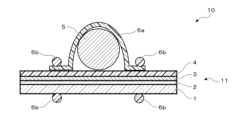
- FIG. 1B is a schematic diagram showing an outline of a cross section of the stitching type planar heater taken along line IB-IB shown in FIG. 1A.
- FIG. 1C is a diagram showing a schematic structure of an example of a cord-shaped heating element according to one embodiment, in which a part of the insulating coating layer has been removed and a part of the stranded wires has been unraveled.
- FIG. 1D is a schematic diagram illustrating a cross section of an example of a stranded wire according to one embodiment.
- FIG. 2A is a schematic plan view showing an outline of a configuration example of an adhesive-type sheet heater according to a second embodiment.
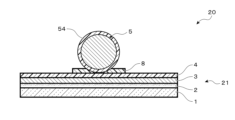
- FIG. 2B is a schematic diagram showing an outline of a cross section of the bonded type sheet heater taken along line IIB-IIB shown in FIG. 2A.
- FIG. 3A is a schematic plan view showing an outline of a configuration example of a covered type sheet heater according to a third embodiment.
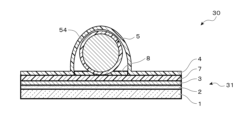
- FIG. 3B is a schematic diagram showing an outline of a cross section of the coated type planar heater taken along line IIIB-IIIB shown in FIG. 3A.
- This embodiment relates to a planar heater that can be used, for example, as a seat heater.
- the planar heater of this embodiment uses a cord-shaped heating element that has been reliable and cost-effective for many years as a seat heater, while retaining the advantages of various planar heating elements.
- the planar heater of this embodiment has excellent energy-saving characteristics.
- FIG. 1A is a schematic plan view showing an outline of a configuration example of a sheet heater 10 according to this embodiment.
- Fig. 1B is a schematic cross-sectional view showing an outline of a cross section of the sheet heater 10 taken along line IB-IB shown in Fig. 1A.
- the planar heater 10 has a structure in which a cord-shaped heating element 5 is fixed onto a heater wire holding substrate 11.
- the heater wire holding substrate 11 has a structure in which an insulating substrate 1, an adhesive layer 2, an aluminum-coated substrate 3, and a black heat-sealing layer 4 are laminated in this order.
- the heater wire holding substrate 11 is formed by integrating the insulating substrate 1 and the aluminum-coated substrate 3 with an adhesive, then disposing the black heat-sealing layer 4 on the surface of the aluminum-coated substrate 3, and heat-sealing the black heat-sealing layer 4 to the surface of the aluminum-coated substrate 3 by hot pressing or the like.
- the insulating substrate 1, adhesive, aluminum-coated substrate 3, and black heat-sealing layer 4 may be disposed at the same time and heat-sealed.
- the aluminum-coated substrate 3 is provided on the insulating substrate 1.
- the black heat-sealing layer 4 is a black heat-sealing layer that contains carbon.
- the cord-shaped heating element 5 is fixed on the black heat-sealing layer 4 of the heater wire holding substrate 11.
- the cord-shaped heating element 5 is fixed to the heater wire holding substrate 11 by sewing with an upper thread 6a and a lower thread 6b.
- the cord-shaped heating element 5 is laid on the surface of the black heat-sealing layer 4 of the heater wire holding substrate 11 according to a pattern program of an automatic sewing machine, and is staggered stitched with, for example, the upper thread 6a and the lower thread 6b, so that the cord-shaped heating element 5 is sewn and fixed to the heater wire holding substrate 11. In this way, the black heat-sealing layer 4 is provided adjacent to the cord-shaped heating element 5.
- the strength and looseness of the cord-shaped heating element 5 can be adjusted by appropriately adjusting the sewing speed, stitch width, thread tension, etc.
- the sheet heater 10 is used as a seat heater, the downward deformation stress caused by the user sitting down can be alleviated by the slippage of the cord-shaped heating element 5. This structure provides high durability.
- Thermal insulation base material and adhesive Various materials can be used for the heat insulating substrate 1, such as urethane foam, nonwoven fabric, felt, etc. Regarding the adhesion between the heat insulating substrate 1 and the aluminum-coated substrate 3, the higher the flatness, the less wrinkles will be formed after adhesion. Therefore, it is preferable to select the material for the heat insulating substrate 1 with an emphasis on the smoothness of the surface of each material.
- the adhesive that bonds the insulating substrate 1 and the aluminum-coated substrate 3 is required to be heat-resistant and flame-retardant. Furthermore, when the sheet heater 10 is used as a seat heater, a soft adhesive is preferable. If an adhesive that hardens after curing is used, the user will feel uncomfortable when sitting down as it will be stiff.
- the aluminum-coated substrate 3 is a flexible and durable fabric to which an aluminum thin film has been applied.
- the fabric may be a woven fabric, a nonwoven fabric, a polymer film, or the like.
- the aluminum thin film is applied by, for example, vacuum deposition, sputtering, plasma spraying, or the like. With vacuum deposition, aluminum is deposited at the atomic level, so the aluminum thin film formed is dense, which is preferable from the viewpoint of thermal conduction. Sputtering and plasma spraying have a high deposition speed, so the aluminum thin film formed is fine but granular deposition. Vacuum deposition is preferable from the viewpoint of thermal conduction.
- the thickness of the aluminum thin film is 5 ⁇ m to 50 ⁇ m, preferably 10 ⁇ m to 15 ⁇ m. If it is less than 5 ⁇ m, the thermal conductivity will decrease. If it is more than 50 ⁇ m, the aluminum thin film will peel off easily, and the production volume per hour will be relatively low, resulting in high costs.
- a woven fabric with excellent flatness is preferred.
- the plant fibers are the preferred woven fabric material.
- versatile and inexpensive cotton woven fabric is preferred.
- cotton fabrics plain weave fabrics that are supple and glossy, like those found in dress shirts, are preferred for obtaining thin aluminum-deposited films.
- Petrochemical fibers are subject to a strong stretching force during spinning, so they shrink in the longitudinal direction when heated by the heater, easily causing deformation of the fabric.
- Aluminum-coated cotton fabric is commercially available, for example, as a quick-heat, heat-equalizing cover for ironing boards. Such aluminum-coated cotton fabric does not shrink at high temperatures and has excellent thermal conductivity.
- Nonwoven fabrics with smooth surfaces are also preferred as fabrics.
- Nonwoven fabrics are made of petrochemical fibers, but because they are short fibers and are randomly arranged, the shrinkage of each short fiber has little effect on the overall fabric, and deformation of the fabric is unlikely to occur.
- the insulating substrate 1 may be a nonwoven fabric. Therefore, the insulating substrate 1 may be a typical thick and inexpensive nonwoven fabric, and the aluminum-coated substrate 3 may be bonded to the aluminum-vapor-deposited nonwoven fabric, which is expensive but has a smooth surface. If thick nonwoven fabric with a smooth surface is available at low cost, the thick nonwoven fabric with a smooth surface may be vacuum-vapor-deposited with aluminum, and the resulting product may be used in place of the insulating substrate 1, adhesive layer 2, and aluminum-coated substrate 3. In other words, the insulating substrate and the aluminum-coated substrate provided on the insulating substrate may be integrally formed as a nonwoven fabric with an aluminum-coated surface.
- the aluminum-coated substrate 3 is not limited to a fabric with a thin aluminum film applied.
- the aluminum-coated substrate 3 may be, for example, a woven fabric made of aluminum-coated long fibers.
- the aluminum-coated substrate 3 may be a metal-coated substrate containing another suitable metal instead of aluminum.
- silver or copper may be used instead of aluminum.
- the black heat-sealing layer 4 of this embodiment is a mixture of polyolefin resin, carbon particles, and a small amount of additives, which is then formed into a film by a biaxial stretching device. Ceramic powder may be used instead of or in addition to the carbon particles.
- the black heat-sealing layer 4 has a heat-sealing function.
- the black heat-sealing layer 4 prevents peeling of the aluminum thin film of the aluminum-coated substrate 3, providing safety to the planar heater 10.
- the black heat-sealing layer 4 also provides the planar heater 10 with a far-infrared radiation function.
- This far-infrared radiation function allows the planar heater 10 to heat the object to be heated by heat conduction, as well as by heat rays known as far-infrared radiation. As a result, the thermal efficiency of the planar heater 10 is improved, resulting in an energy-saving effect.
- polyolefin resin polyolefin resin or olefin copolymer may be used alone or in combination of two or more.
- polyolefin resin for example, polyethylene, polypropylene, polybutene, etc. may be used.
- Polyethylene includes high density polyethylene, low density polyethylene, linear low density polyethylene, etc.
- olefin copolymer a copolymer of ethylene and any of propylene, vinyl acetate, acrylic acid, ethyl acrylate, vinyl chloride, etc., a copolymer of propylene and vinyl chloride, etc., or modified products thereof may be used.
- low-density polyethylene linear low-density polyethylene, etc. are particularly preferred, taking into consideration the melting point, heat fusion property, price, etc.
- carbon particles can be used.
- carbon black particles oil furnace black, thermal black, acetylene black, graphite particles, etc. can be used alone or in combination as a mixture.
- the average particle size of the carbon particles is preferably 10 nm to 100 nm. Usually, a stable resistance value can be obtained when the average particle size is 10 nm to 100 nm. It is more preferable that the average particle size of the carbon particles is 20 nm to 50 nm. If the average particle size is less than 10 nm, dispersion in the resin is poor, and uneven resistance value and color are likely to occur. On the other hand, if the average particle size exceeds 100 nm, the surface resistivity tends to be high, the variation in surface resistivity increases, and uneven surface gloss is likely to occur.
- the carbon particles may be a mixture of two or more types of carbon particles with different average particle sizes.
- the blending ratio of the polyolefin resin and the carbon particles is preferably adjusted so that the surface resistivity is 10 5 ⁇ /cm 2 to 10 10 ⁇ /cm 2.
- the ratio of the polyethylene resin to the total weight of the black heat-sealing layer 4 is, for example, 60 to 95% by weight and 40 to 5% by weight of the carbon particles.
- the polyethylene resin is 80 to 90% by weight and the carbon particles are 20 to 10% by weight.
- a resin composition with such a blending ratio can be easily obtained by appropriately kneading a commercially available carbon color compound with a polyethylene resin. If the ratio of the carbon particles is high, the total amount of far-infrared radiation increases.
- the ratio of the carbon particles is high, the strength of heat fusion to the aluminum-coated substrate 3 is weakened and the insulating properties are deteriorated. Also, if the ratio of the carbon particles is low, the amount of far-infrared radiation is low and the antistatic effect described later is weakened, which is not preferable.
- the thickness of the black heat-sealing layer 4 is preferably 0.05 mm to 0.35 mm, and more preferably 0.08 mm to 0.15 mm, in order to achieve the two objectives of preventing peeling of fine aluminum flakes from the aluminum-coated substrate 3 and radiating far-infrared rays. If the thickness of the black heat-sealing layer 4 is 0.05 mm or less, the surface will become rough when heat-sealed to the aluminum-coated substrate 3, which is undesirable in terms of preventing peeling of fine aluminum flakes. If the thickness of the black heat-sealing layer 4 is thicker than 0.35 mm, the rise time during heating will be longer, the overshoot will be larger, and power consumption will also increase, which is undesirable.
- the black heat-sealing layer 4 is formed, for example, by kneading a commercially available carbon color compound with polyethylene resin as described above and forming it into a film using a biaxial stretching device.
- the black heat-sealing layer 4 is placed on the aluminum-coated substrate 3 and heat-sealed to the surface of the aluminum-coated substrate 3 using a hot press device or the like. Heat-sealing may also be performed using a continuous heating roll device or the like.
- a carbon-free polyolefin resin film of the same quality may be layered on top of the black heat-sealing layer 4 and heat-sealed to provide reinforcement against mechanical stress.
- Fig. 1C is a schematic diagram showing the structure of an example of the cord-like heating element 5, showing a state in which part of the insulating coating layer 53 has been removed and part of the stranded wire 52 has been unwound.
- the cord-like heating element 5 has a structure in which three to six stranded wires 52 are aligned and wound helically transversely at an appropriate pitch around a winding core 51, with an electrically insulating coating layer 53 formed therearound.
- the core 51 may be made of polyester fiber, aromatic polyamide fiber, wholly aromatic polyester fiber, or the like.
- an aromatic polyamide fiber such as fiber known under the trade name "Kevlar” may be used, and a wholly aromatic polyester fiber such as fiber known under the trade name "Vectran” may be used.
- a bundle of polyester fiber has been used as the core for a general-purpose sheet heating element, which is advantageous in terms of cost.
- a core for a seat heater has been used that is made of wholly aromatic polyester fiber with a fineness of about 560 dtex, bundled together to have an outer diameter of 0.2 mm to 0.3 mm.
- wholly aromatic polyester fiber is thin, it is strong and has excellent heat resistance.
- FIG. 1D is a schematic diagram showing a cross section of an example of stranded wire 52.
- Stranded wire 52 has a structure in which two or three resistance strands 521, which are 0.3% copper-tin alloy wires with an outer diameter of 0.05 mm to 0.08 mm, are twisted together, and a coating layer 522 made of urethane resin is provided on the surface.
- the insulating coating layer 53 has a thickness of, for example, about 0.1 mm to 0.2 mm.
- the insulating coating layer 53 is formed of a resin such as, for example, tetrafluoroethylene-ethylene copolymer (ETFE) or tetrafluoroethylene-hexafluoropolypropylene copolymer (FEP).
- ETFE tetrafluoroethylene-ethylene copolymer
- FEP tetrafluoroethylene-hexafluoropolypropylene copolymer
- the cord-shaped heating element 5 having the above-mentioned configuration, for example, by using a wholly aromatic polyester fiber for the winding core 51, the winding core 51 is thin and heat resistant, and for example, by using a fluororesin for the insulating coating layer 53, the insulating coating layer 53 is thin and has excellent heat resistance and strength. Therefore, the cord-shaped heating element 5 can be made sufficiently thin. Even if the cord-shaped heating element 5 is thin, breakage of the resistance wire 521 due to mechanical stress when sitting down is prevented. In addition, because the cord-shaped heating element 5 is sufficiently thin, discomfort felt by the user due to unevenness of the cord-shaped heating element 5 is sufficiently suppressed.
- the cord-shaped heating element 5 may be, for example, a 3% silver-copper alloy wire with an outer diameter of about 0.06 mm, the surface of which is covered with an electrical insulating material such as urethane resin several ⁇ m thick, twisted together to have an outer diameter of about 20 pieces, and have an outer diameter of about 0.4 mm.
- the 3% silver-copper alloy wire is high in strength and can withstand mechanical stress when sitting without an intermediate material such as a winding core, and safety can be ensured with only a very thin individual insulating layer.
- a cord-shaped heating element with such a configuration is generally called an individually insulated cord-shaped heating element. With such a configuration, the outer diameter of the cord-shaped heating element 5 can be made thin, and discomfort when sitting can be suppressed.
- the 3% silver-copper alloy wire is expensive.
- the sheet heater 10 of this embodiment is excellent in safety, quick heating, uniform heating, and energy saving properties.
- a sheet heater has been known in which a cord-shaped heating element is sewn and fixed directly to an insulating substrate such as nonwoven fabric or polyurethane foam.
- an insulating substrate such as nonwoven fabric or polyurethane foam.
- the temperature of the cord-shaped heating element itself rises quickly, but the insulating substrate has a large porosity and low thermal conductivity, so the sheet heater as a whole is slow to heat up and cool down.
- the initial temperature rise immediately after power is turned on is gradual even when power is turned on at maximum output, and it takes time to reach the set temperature.
- the heater as a whole has a large heat retention effect, even if the power is turned on and the set temperature is reached and the input power is turned off by the temperature controller, the temperature continues to rise, and a temperature rise that exceeds the set temperature, known as overshoot, may occur. For these reasons, power consumption increases.
- the planar heater 10 of this embodiment has an aluminum-coated substrate 3 on the heater wire holding substrate 11. Because the thermal conductivity of the aluminum-coated substrate 3 is high, the temperature of the planar heater 10 rises quickly and power consumption is reduced. In addition, the temperature responsiveness of the planar heater 10 is improved, making temperature control easier and suppressing overshoot. For these reasons, the planar heater 10 with the aluminum-coated substrate 3 can achieve energy savings.
- the sheet heater 10 of this embodiment has a black heat-sealing layer 4 on a heater wire holding substrate 11.
- the black heat-sealing layer 4 has the following four features. (1)
- the black heat-sealing layer 4 included in the heater wire holding substrate 11 does not cause any hindrance when sewing the cord-shaped heating element 5, and also functions as a heat-sealing material when adhering the cord-shaped heating element 5 to the heater wire holding substrate 11. Therefore, the black heat-sealing layer 4 can increase the degree of freedom in designing the sheet heater 10.
- the black thermal seal layer 4 prevents the aluminum thin film of the aluminum-coated substrate 3 from tearing or peeling off.
- the black thermal seal layer 4 prevents the aluminum thin film of the aluminum-coated substrate 3 from tearing or peeling off due to repeated seating stress. Therefore, the black thermal seal layer 4 contributes to preventing, for example, health hazards and electrical hazards to humans.
- the far-infrared radiation from the black thermal adhesive layer 4 effectively utilizes heat energy, resulting in an energy saving effect.
- the operating temperature is generally set to 40 to 50°C, and when carbon is heated in this temperature range, far-infrared radiation is efficiently emitted.
- the black heat-sealing layer 4 can be used together with a cord-shaped heating element that has been in use for many years and has an established reputation for reliability, resulting in high cost performance.
- Aluminum foil heaters have been known in which a cord-shaped heating element is fixed to an aluminum foil substrate.
- Aluminum foil heaters are known for their quick heating and heat uniformity, and are used, for example, as heaters for defrosting refrigerators, heaters for melting snow, and heaters for cooking rice or keeping rice warm in electric rice cookers.
- an aluminum foil heater may crack, causing it to lose its ability to soak up heat. If the aluminum foil cracks, fine aluminum fragments may fly off from the cracks.
- the aluminum foil deforms and emits metallic noise. This noise can be problematic depending on the application. For example, if an aluminum foil heater is used as a seat heater, the load caused by repeated sitting on the seat may cause the aluminum foil to break or fly off as described above, or the noise made when sitting may be unpleasant for passengers.
- the black heat-sealing layer 4 is fused to the aluminum-coated substrate 3, preventing the aluminum thin film of the aluminum-coated substrate 3 from tearing or peeling off. Noise is also suppressed.
- the cord-shaped heating element 5 is disposed on the aluminum-coated substrate 3 and the black heat-sealing layer 4, and if the aforementioned resistance wire 521 breaks and the end of the wire comes into direct contact with the aluminum-coated substrate 3, electricity will leak to the aluminum-coated substrate 3.
- a carbon-free insulating heat-sealing film for example a polyolefin-based film, can be fused to the surface of the aluminum-coated substrate 3 instead of the black heat-sealing layer 4.
- a carbon-free polyolefin-based insulating heat-sealing film can ensure insulation when the resistance wire 521 breaks and prevent the aluminum thin film of the aluminum-coated substrate 3 from tearing or peeling.
- a carbon-free polyolefin-based insulating heat-sealing film cannot provide the energy-saving effect of far-infrared radiation.
- a black heat-sealed layer 4 that contains carbon and has high resistance but is not an insulator is heat-sealed to the surface of the aluminum-coated substrate 3. This is because the black heat-sealed layer 4 has the far-infrared radiation function to achieve an energy-saving effect.
- the value of the leakage current through the black heat-sealing layer 4 will be considered. Since the vertical resistance of the black heat-sealing layer 4 is high, when DC 12V contacts it, the leakage current is expected to be about 1 ⁇ A or less, although it depends on the location. An example of a bad case of leakage current will be considered. Assume that a break occurs near the positive terminal side of the cord-shaped heating element 5 connected to a DC 12V power source, one end of the broken resistance wire 521 abuts vertically against the black heat-sealing layer 4, and the aluminum-coated substrate 3 of the base contacts the negative side of the power source.
- the diameter of the resistance wire 521 is 0.075 mm
- the thickness of the black heat-sealing layer 4 is 0.15 mm
- the surface resistance is 3 ⁇ 10 8 ⁇ /cm 2. Since the surface resistance is high, the leakage current flows almost vertically without spreading horizontally.
- the resistance value of the black heat-sealing layer 4 with which one thin resistance wire 521 comes into contact is approximately 750 M ⁇ or more, and the leakage current is expected to be 0.02 ⁇ A or less. Even if three resistance wires 521 are broken, the leakage current will be less than 1 ⁇ A. This value is considered to be negligible compared to the leakage current of the entire vehicle.
- the commercially available carbon color compound that is the raw material for the black heat seal layer 4 is used for antistatic and electromagnetic interference prevention. Even if this compound is diluted with polyethylene resin, EVA resin, etc., its antistatic function is maintained, and the black heat seal layer 4 containing this compound can function as an antistatic body. Thus, unlike insulating heat seal films that do not contain carbon, the black heat seal layer 4 containing carbon has an antistatic function in addition to the far-infrared radiation function described above.
- the sheet heater according to this embodiment can be used, for example, as a seat heater in an automobile.
- the energy saving function described above is also important for seat heaters in electric vehicles, which have become increasingly popular in recent years. By reducing power consumption, it is possible to reduce battery consumption in electric vehicles and extend the driving distance per charge.
- electric vehicles are equipped with a greater number of electronic devices with low voltage power sources than ever before, due to the need for automatic driving using artificial intelligence.
- Automobile seats use synthetic resins such as polyurethane and polyester for the seat base, skin cover, and seat heater placed between them, and friction between these materials makes static electricity likely to occur.
- the high-voltage charged state associated with static electricity and noise caused by the discharge of this high voltage may affect electronic devices.
- the antistatic function of the black thermal adhesive layer 4 included in the planar heater 10 of this embodiment is also effective in reducing noise that affects electronic devices.
- the above-mentioned seat heaters can be used not only for automobile seats, but also for seats in other vehicles and various facilities.
- the above-mentioned planar heaters can also be used in various planar heating devices, such as electric carpets and medical health mats.
- Fig. 2A is a schematic plan view showing an outline of a configuration example of a sheet heater 20 according to this embodiment.
- Fig. 2B is a schematic cross-sectional view showing an outline of a cross section of the sheet heater 20 taken along line IIB-IIB shown in Fig. 2A.
- the planar heater 20 of the second embodiment includes a heater wire holding substrate 21 having a configuration similar to that of the heater wire holding substrate 11 of the planar heater 10 of the first embodiment.
- a cord-shaped heating element 5 is fixed onto the heater wire holding substrate 21 by adhesive.
- a heat-sealing layer 54 is provided by extrusion molding or the like to cover the outer periphery of the cord-shaped heating element 5 similar to that in the first embodiment.
- the material of the heat-sealing layer 54 is preferably a polyolefin resin used in the black heat-sealing layer 4, and does not contain carbon.
- polyethylene, polypropylene, polybutene, etc. may be used for the heat-sealing layer 54.
- low-density polyethylene and linear low-density polyethylene are particularly preferred in terms of melting point, heat-sealing properties, and price.
- the heat-sealing layer 54 needs to secure a gap while ensuring the adhesive strength between the black heat-sealing layer 4 and the cord-shaped heating element 5, its thickness is relatively thick, and it is preferable that it is about 0.15 mm to 0.25 mm, for example.
- a heat-sealing layer 8 similar to the heat-sealing layer 54 that covers the cord-shaped heating element 5 may be provided on the surface portion of the black heat-sealing layer 4 on which the cord-shaped heating element 5 covered with the heat-sealing layer 54 is disposed. Furthermore, this heat-sealing layer 8 may be formed by the heat-sealing layer 54 that covers the cord-shaped heating element 5 during heat fusion.
- the black heat-sealing layer 4 and the cord-like heating element 5 covered with the heat-sealing layer 54 are heat-sealed and fixed by a hot press or the like. At this time, the temperature, pressure, and time of the hot press are controlled to ensure a minute gap between the cord-like heating element 5 and the heat-sealing layer 54. This gap allows deformation of the sheet heater 20 and the cord-like heating element 5 caused by external loads to be absorbed by the sliding of the cord-like heating element 5 within the heat-sealing layer 54, achieving high durability.
- cord-shaped heating element 5 has a shape in which unevenness caused by twisting is exposed on the surface, such as the above-mentioned individually insulated cord-shaped heating element, it is difficult to ensure a uniform minute gap between the heat-sealing layer 54 as described above. Therefore, in this embodiment, it is preferable to use a cord-shaped heating element 5 covered with an insulating covering layer 53 as shown in Figure 1C.
- the adhesive type sheet heater 20 of the second embodiment is excellent in safety, quick heating, uniform heat distribution, energy saving, etc., and provides similar effects.
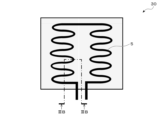
- FIG. 3A is a schematic plan view showing an outline of a configuration example of a sheet heater 30 according to this embodiment.
- Fig. 3B is a schematic cross-sectional view showing an outline of a cross section of the sheet heater 30 taken along line IIIB-IIIB shown in Fig. 3A.
- the material of the heat fusion layer 7 is the same as that of the heat fusion layer 54 covering the cord-shaped heating element 5 of the second embodiment.
- the heat fusion layer 7 has the function of preventing peeling of the aluminum thin film of the aluminum coated substrate 3, and heat-fusing the cord-shaped heating element 5 covered with the heat fusion layer 54 to the aluminum coated substrate 3.
- a heat-sealing layer 8 similar to the heat-sealing layer 54 may be provided on the surface portion of the heat-sealing layer 7 on which the cord-shaped heating element 5 covered with the heat-sealing layer 54 is disposed.
- the aluminum-coated substrate 3, the heat-sealing layer 7, and the cord-like heating element 5 covered with the heat-sealing layer 54 are heat-sealed and fixed by a hot press or the like.
- the temperature, pressure, and time of the hot press are controlled to ensure a minute gap between the cord-like heating element 5 and the heat-sealing layer 54. This gap allows deformation of the sheet heater 30 and the cord-like heating element 5 caused by external loads to be absorbed by the sliding of the cord-like heating element 5 within the heat-sealing layer 54, achieving high durability.
- the heater wire holding substrate 31 and the cord-shaped heating element 5 are heat-sealed and fixed, and then a black heat-sealed layer 4 similar to that of the first and second embodiments is provided to cover the entire surface of the planar heater 30, and the black heat-sealed layer 4 is heat-sealed and fixed by hot pressing or the like to form a covered planar heater 30.
- the heat insulating substrate 1 was made of semi-rigid polyurethane foam with a density of about 40 kg/ m2 and a hardness of 98 N or more, which conforms to the flame retardant standard of MVSS302.
- the thickness of the heat insulating substrate 1 was 3.5 mm.
- the aluminum-coated substrate 3 was made of plain woven cotton cloth with one side coated with aluminum vapor deposition, which is commercially available as an ironing board cover.
- the adhesive that bonds the heat insulating substrate 1 and the aluminum-coated substrate 3 to form the adhesive layer 2 was made of chloroprene rubber-based solvent-based adhesive GS1Z (manufactured by Konishi Co., Ltd.). This adhesive was spray-applied to the heat insulating substrate 1 and air-dried, and then the aluminum-coated substrate 3 was placed on top of it, and the adhesive was bonded and cured by hot pressing at 60°C for 5 minutes.
- the black heat-sealing layer 4 was as follows.
- the main material of the black heat-sealing layer 4 was a commercially available color compound, trade name "Papiostat PST5011" color compound (manufactured by Tokyo Ink Co., Ltd.).
- This color compound was a low-density polyethylene with carbon black dispersed therein.
- LDPE low-density polyethylene resin
- EVA ethylene vinyl acetate copolymer
- NUC3830 manufactured by Eneos NUC Co., Ltd.
- a general-purpose antioxidant and flame retardant were added so as to obtain the blend shown in Table 1.
- Blend 1 was approximately 10 8 ⁇ /cm 2
- Blend 2 was approximately 10 6 ⁇ /cm 2 .
- An insulating coating layer 53 was then formed on top of this by extrusion coating ETFE resin to a thickness of 0.2 mm, producing a cord-shaped heating element 5 with an outer diameter of 0.9 mm.
- the length of the cord-shaped heating element 5 was 5.75 ⁇ 0.06 m, and the resistance was 1.9 ⁇ 0.02 ⁇ .
- Example 1 As Example 1, the stitch-type sheet heater 10 according to the first embodiment shown in Fig. 1B was fabricated and an experiment was carried out.
- the stitch-type sheet heater 10 was fabricated as follows.
- a black heat-sealing layer 4 based on formulation 1 in Table 1 was placed on top of the insulating substrate 1 and aluminum-coated substrate 3 that had been previously bonded together. The whole was pressed and heated in a hot press to heat-seal the aluminum-coated substrate 3 and the black heat-sealing layer 4. The heating temperature was 180°C and the heating time was 20 seconds.
- This integrated sheet was used as a heater wire holding substrate 11.
- a cord-shaped heating element 5 was laid on the surface of the heater wire holding substrate 11 in a predetermined pattern using a program-controlled automatic wire-laying sewing machine, and at the same time, it was sewn in a zigzag pattern with upper thread 6a and lower thread 6b. In this manner, the sheet heater 10 of Example 1 was produced.
- a wiring stand with spring pins embedded in positions along the wiring pattern was used.
- the cord-shaped heating element 5 covered with the above-mentioned heat-sealing layer 54 was hooked onto the spring pins of the wiring stand and laid.
- a heater wire holding substrate 21 similar to the heater wire holding substrate 11 of Example 1 was placed with the black heat-sealing layer 4 facing down, and the whole was pressed and heated with a hot press to heat-seal the heat-sealing layer 54 of the cord-shaped heating element 5 and the black heat-sealing layer 4 of the heater wire holding substrate 21.
- the heating temperature was 180°C, and the heating time was 10 seconds. In this manner, the planar heater 20 of Example 3 was produced.
- Example 4 As Example 4, an adhesive type sheet heater 20 according to the second embodiment shown in Fig. 2B was fabricated and an experiment was carried out. Example 4 differs from Example 3 only in that the thickness of the black thermal adhesive layer 4 was set to 0.35 mm.
- Example 5 As Example 5, the covered sheet heater 30 according to the third embodiment shown in Fig. 3B was fabricated and an experiment was carried out.
- the covered sheet heater 30 was fabricated as follows.
- the black heat-sealing layer 4 was placed over the entire surface of this intermediate assembly, and the entire assembly was pressed and heated using a hot press to heat-seal the heat-sealing layer 7 and the cord-shaped heating element 5 to the black heat-sealing layer 4.
- the heating temperature was 180°C, and the heating time was 20 seconds. In this manner, the planar heater 30 of Example 5 was produced.
- Comparative Example 1 As Comparative Example 1, a sheet heater was produced in which a cord-shaped heating element 5 was laid on a heat insulating substrate 1 and simultaneously sewn with an upper thread 6a and a lower thread 6b. This sheet heater corresponds to the sewn-type sheet heater 10 according to the first embodiment, but without the adhesive layer 2, aluminum-coated substrate 3, and black heat-sealing layer 4. Comparative Example 1 has a conventionally known structure for a sheet heater used in a seat heater.
- Comparative Example 2 As Comparative Example 2, a sheet heater was produced by laying a cord-shaped heating element 5 on a heater wire holding substrate having a heat insulating substrate 1, an adhesive layer 2, and an aluminum-coated substrate 3, and simultaneously sewing the substrate with an upper thread 6a and a lower thread 6b. This sheet heater corresponds to the sewn-type sheet heater 10 according to the first embodiment, but without the black thermal adhesive layer 4. Comparative Example 2 has a structure in which an aluminum-coated substrate 3 is added to a conventionally known sheet heater.
- Table 2 shows the combinations of the elements and conditions constituting the above-mentioned Examples 1 to 5 and Comparative Examples 1 and 2.
- a temperature control thermocouple was also attached to the surface of the planar heater at a position corresponding to the position of the measurement thermocouple attached to the center of the copper heat collecting plate.
- the temperature control thermocouple was positioned so as not to come into contact with the cord-shaped heating element 5.
- the temperature control thermocouple was connected to a temperature controller. Since the resistance of the cord-shaped heating element 5 is temperature dependent, the applied voltage (approximately 12.5 V) was fine-tuned for each sample while watching the power meter in advance so that the power consumption at 40°C would be 82.1 W.
- ⁇ Start-up time> The sheet heater was directly connected to a DC power source without a temperature controller. The power source was turned on and the temperature rise was recorded by a temperature logger. Based on the record, the time until the surface temperature of the sheet heater reached 40°C and 50°C was measured.
- the planar heater was connected to a DC power source via a temperature controller.
- the temperature controller was set to turn off the power supply when the temperature measured by the temperature control thermocouple reached 40° C.
- the power switch was turned on and the temperature rise was recorded in a temperature logger. Based on the record, the maximum temperature of the first overshoot that exceeded 40° C. was measured, and the difference from 40° C. was determined as the overshoot temperature.
- the sheet heater was connected to a DC power source via an ON-OFF type temperature controller, and the switch was turned ON to set the temperature to automatic temperature control, and the power consumption was measured.
- the OFF point temperature of the temperature controller was set to 40°C
- the ON point temperature was set to 39.5°C
- a hysteresis width of 0.5°C was provided.
- the power consumption was measured using an integrated wattmeter. The measurement time was 30 minutes from the moment the power switch was turned ON. The average value of the integrated power was determined as the average power consumption.
- the sheet heater was hung in the air at 25°C in the absence of wind, and connected to a DC power source via a temperature controller.
- the temperature controller was set to 40°C and put into automatic temperature control mode.
- a black cloth large enough to hide the sheet heater was stretched in the air 15 cm away from the surface of the sheet heater.
- the surface temperature of the black cloth, which corresponds to the center of the sheet heater was measured using a far-infrared thermograph. Measurements were taken at 1-minute intervals for 10 minutes, and the average temperature was determined as the far-infrared heating.
- a planar heater was sandwiched between the heat insulating/elastic sheet and the skin cover of the automobile, and DC 13.5V was applied to the planar heater to prepare a test specimen.
- the seat was rotated and slid for boarding and sitting, a load of 40 kg was applied, and the vehicle was vibrated up and down 20 times, followed by the reverse movement for leaving and getting off the vehicle, which constituted one cycle.
- a life test was conducted by repeating this cycle 10,000 times. After this test, it was visually checked whether aluminum particles generated by the destruction of the aluminum-coated substrate 3 had protruded from the black heat-sealing layer 4 or the polyethylene heat-sealing layer 7. It was also visually checked whether carbon-containing particles had been scattered due to the destruction of the black heat-sealing layer 4.
- a sheet heater was placed between the heat insulating elastic sheet and the skin cover of the automobile, and a DC power source was connected to the sheet heater, but the switch was turned off to keep it in a non-energized state.
- the surface of the skin cover was rubbed strongly with a polyester cloth 10 times over an area of about 30 cm square, and then the charged voltage was immediately measured at a distance of 25 mm using a static electricity tester.
- Examples 1 to 5 have thermally similar structures having an aluminum-coated substrate 3, and there was only a slight difference in the warm-up time between them. Comparing the warm-up time at 40°C with Comparative Example 1, which does not have an aluminum-coated substrate 3 and has only an insulating substrate 1 as the heater wire holding substrate, it was clear that Examples 1 to 5 have more than twice the quick-warming ability. Also, Comparative Example 2, in which the heater wire holding substrate has an insulating substrate 1, an adhesive layer 2, and an aluminum-coated substrate 3, showed a remarkable quick-warming ability similar to that of Examples 1 to 5. In this way, it was confirmed that the presence of an aluminum-coated substrate 3 has a significant effect on quick-warming.
- Examples 1 to 5 showed nearly twice the instantaneous heating.
- Comparative Example 2 which does not have a black heat-sealing layer 4, with Examples 3 and 4, which have different thicknesses of the black heat-sealing layer 4,
- Example 4 which has a relatively thick black heat-sealing layer 4, showed slightly inferior instantaneous heating. It became clear that it is better not to make the black heat-sealing layer 4 too thick, for example, that the black heat-sealing layer 4 is preferably less than 0.35 mm.
- Example 5 ⁇ Evaluation of average power consumption>
- the average power consumption was kept low compared to Comparative Example 1.
- power saving of 15% or more was achieved compared to Comparative Example 1.
- the average power consumption of Example 5 is slightly higher than that of Examples 1 to 3, which is considered to indicate that the outermost layer of the sheet heater is covered with the black thermal fusion layer 4, and therefore the heat retention is good and the thermal response is somewhat slow. This can be understood from the fact that the average power consumption of Comparative Example 2, in which the aluminum-coated substrate 3 is exposed, is relatively low, which indicates the characteristics of good heat dissipation and fast thermal response.
- Example 3 Comparing Example 3 and Example 4, which have different thicknesses of the black thermal fusion layer 4, the average power consumption of Example 4, in which the black thermal fusion layer 4 is relatively thick, was slightly higher. It was revealed that the black thermal fusion layer 4 should not be too thick, for example, that the black thermal fusion layer 4 is preferably less than 0.35 mm. It was revealed that the sheet heater according to the embodiment can achieve power saving.
- Example 1 to 5 which are sheet heaters having a black thermal fusion layer 4
- a surface temperature rise of approximately 3.5°C to 5°C was observed in the black fabric used for measurement. This temperature rise includes a temperature rise due to far-infrared radiation.
- Comparative Examples 1 and 2 which are sheet heaters having no black thermal fusion layer 4, the surface temperature rise of the black fabric used for measurement was small.
- Example 4 in which the black thermal fusion layer 4 is relatively thick, and in which the black thermal fusion layer 4 is the outermost layer, the surface temperature of the black fabric used for measurement was slightly higher than in Examples 1 to 3.
- the temperature was measured at a position 15 cm away from the sheet heater.
- the sheet heater is used as a seat heater, the sheet heater and the human body are in close contact.
- the sensation of warmth felt by the human body due to far infrared rays is greater than in this example.
- the black heat-sealing layer 4 exhibits the characteristic that the heat energy contains less heat ray components that are unsuitable for heating the human body, and more far-infrared components that are effective for heating the human body. It has become clear that the planar heater according to the embodiment can achieve energy saving effects by emitting far-infrared rays.
- the planar heater according to the embodiment can provide high safety.
- Example 2 which had a relatively high carbon concentration, had a low electrostatic charge. This is thought to be because in the planar heater of Example 2, the charged static electricity was quickly consumed by the black heat-sealing layer 4, which had a moderate resistance value.
- the aluminum-coated substrate 3 in Comparative Example 2 has a low resistance value and is excellent as an electrical path.
- the sheet heater of Comparative Example 2 does not have the black thermal seal layer 4, it has become clear that in terms of power consumption due to static electricity resistance, it is inferior to the sheet heaters of Examples 1 to 5, which have the black thermal seal layer 4.
- the high resistance of the black thermal seal layer 4 functions as an antistatic material. It has become clear that a planar heater having a black thermal seal layer 4 can reduce various noises caused by static electricity compared to a planar heater not having a black thermal seal layer 4.
- the planar heater according to the embodiment has the following effects due to the combination structure of the aluminum-coated substrate 3 and the black heat-sealing layer 4. That is, in terms of structure, the planar heater according to the embodiment can use the cord-shaped heating element 5, which has a conventional guaranteed reliability. In terms of performance, the planar heater according to the embodiment has a fast heating rate, small overshoot, functions suitable for heating the human body by far-infrared radiation, low power consumption, resistance to seating stress, antistatic function, high design freedom, excellent cost performance, and energy saving.
Landscapes
- Engineering & Computer Science (AREA)
- Textile Engineering (AREA)
- Surface Heating Bodies (AREA)
Priority Applications (6)
| Application Number | Priority Date | Filing Date | Title |
|---|---|---|---|
| KR1020257007267A KR102820569B1 (ko) | 2022-12-09 | 2022-12-09 | 면상 히터 |
| US18/834,539 US12309889B2 (en) | 2022-12-09 | 2022-12-09 | Sheet heater |
| CN202280090686.0A CN118715870B (zh) | 2022-12-09 | 2022-12-09 | 面状加热器 |
| JP2023514505A JP7300236B1 (ja) | 2022-12-09 | 2022-12-09 | 面状ヒータ |
| PCT/JP2022/045420 WO2024122046A1 (ja) | 2022-12-09 | 2022-12-09 | 面状ヒータ |
| US19/094,227 US20250227816A1 (en) | 2022-12-09 | 2025-03-28 | Sheet heater |
Applications Claiming Priority (1)
| Application Number | Priority Date | Filing Date | Title |
|---|---|---|---|
| PCT/JP2022/045420 WO2024122046A1 (ja) | 2022-12-09 | 2022-12-09 | 面状ヒータ |
Related Child Applications (2)
| Application Number | Title | Priority Date | Filing Date |
|---|---|---|---|
| US18/834,539 A-371-Of-International US12309889B2 (en) | 2022-12-09 | 2022-12-09 | Sheet heater |
| US19/094,227 Continuation US20250227816A1 (en) | 2022-12-09 | 2025-03-28 | Sheet heater |
Publications (1)
| Publication Number | Publication Date |
|---|---|
| WO2024122046A1 true WO2024122046A1 (ja) | 2024-06-13 |
Family
ID=86900527
Family Applications (1)
| Application Number | Title | Priority Date | Filing Date |
|---|---|---|---|
| PCT/JP2022/045420 Ceased WO2024122046A1 (ja) | 2022-12-09 | 2022-12-09 | 面状ヒータ |
Country Status (5)
| Country | Link |
|---|---|
| US (2) | US12309889B2 (https=) |
| JP (1) | JP7300236B1 (https=) |
| KR (1) | KR102820569B1 (https=) |
| CN (1) | CN118715870B (https=) |
| WO (1) | WO2024122046A1 (https=) |
Citations (6)
| Publication number | Priority date | Publication date | Assignee | Title |
|---|---|---|---|---|
| JPH0261977A (ja) * | 1988-08-26 | 1990-03-01 | Matsushita Electric Ind Co Ltd | 電気カーペット |
| JPH03286854A (ja) * | 1990-04-02 | 1991-12-17 | Tookoo Eizai Kk | 複合温熱材料 |
| JPH1184927A (ja) * | 1997-09-04 | 1999-03-30 | Suzuka Fuji Xerox Kk | 加熱ロール、加圧ロールおよび定着装置 |
| JP2005520315A (ja) * | 2002-08-08 | 2005-07-07 | ヴィー・エー・テー・オートモーティヴ・システムス・アクチェンゲゼルシャフト | 被覆を有する加熱導体 |
| JP2007200866A (ja) * | 2005-12-27 | 2007-08-09 | Matsushita Electric Ind Co Ltd | 面状発熱体 |
| JP2008258129A (ja) * | 2007-03-13 | 2008-10-23 | Totoku Electric Co Ltd | 融着ヒータ線およびアルミ付ヒータ |
Family Cites Families (10)
| Publication number | Priority date | Publication date | Assignee | Title |
|---|---|---|---|---|
| JPS5649086U (https=) * | 1979-09-21 | 1981-05-01 | ||
| JP2592500B2 (ja) * | 1988-06-01 | 1997-03-19 | 三井石油化学工業株式会社 | 積層フィルム |
| US6180719B1 (en) * | 1996-11-22 | 2001-01-30 | Daicel Chemical Industries Ltd | Heat-fusion composition and multi-layer molded body containing layer comprising the same |
| US6664512B2 (en) * | 2001-09-11 | 2003-12-16 | Sunbeam Products, Inc. | Warming blanket with heat reflective strips |
| JP2010015691A (ja) * | 2008-06-30 | 2010-01-21 | Kurabe Ind Co Ltd | コード状ヒータ |
| CN103202093B (zh) * | 2010-11-08 | 2016-01-20 | 松下知识产权经营株式会社 | 面状发热体及其制造方法 |
| JP6101480B2 (ja) | 2012-12-25 | 2017-03-22 | 株式会社クラベ | ヒータユニット |
| ES2656097T3 (es) * | 2012-12-25 | 2018-02-23 | Kurabe Industrial Co., Ltd | Calentador con forma de cordón y calentador con forma de lámina |
| US10045401B2 (en) * | 2015-08-07 | 2018-08-07 | Kurabe Industrial Co., Ltd. | Heater unit and steering wheel |
| KR102356847B1 (ko) | 2021-01-11 | 2022-02-08 | 주식회사 교린 | 에너지 절감형 유연 면상 발열체 |
-
2022
- 2022-12-09 US US18/834,539 patent/US12309889B2/en active Active
- 2022-12-09 KR KR1020257007267A patent/KR102820569B1/ko active Active
- 2022-12-09 WO PCT/JP2022/045420 patent/WO2024122046A1/ja not_active Ceased
- 2022-12-09 CN CN202280090686.0A patent/CN118715870B/zh active Active
- 2022-12-09 JP JP2023514505A patent/JP7300236B1/ja active Active
-
2025
- 2025-03-28 US US19/094,227 patent/US20250227816A1/en active Pending
Patent Citations (6)
| Publication number | Priority date | Publication date | Assignee | Title |
|---|---|---|---|---|
| JPH0261977A (ja) * | 1988-08-26 | 1990-03-01 | Matsushita Electric Ind Co Ltd | 電気カーペット |
| JPH03286854A (ja) * | 1990-04-02 | 1991-12-17 | Tookoo Eizai Kk | 複合温熱材料 |
| JPH1184927A (ja) * | 1997-09-04 | 1999-03-30 | Suzuka Fuji Xerox Kk | 加熱ロール、加圧ロールおよび定着装置 |
| JP2005520315A (ja) * | 2002-08-08 | 2005-07-07 | ヴィー・エー・テー・オートモーティヴ・システムス・アクチェンゲゼルシャフト | 被覆を有する加熱導体 |
| JP2007200866A (ja) * | 2005-12-27 | 2007-08-09 | Matsushita Electric Ind Co Ltd | 面状発熱体 |
| JP2008258129A (ja) * | 2007-03-13 | 2008-10-23 | Totoku Electric Co Ltd | 融着ヒータ線およびアルミ付ヒータ |
Also Published As
| Publication number | Publication date |
|---|---|
| CN118715870B (zh) | 2026-03-31 |
| US20250113410A1 (en) | 2025-04-03 |
| US20250227816A1 (en) | 2025-07-10 |
| JPWO2024122046A1 (https=) | 2024-06-13 |
| KR102820569B1 (ko) | 2025-06-13 |
| CN118715870A (zh) | 2024-09-27 |
| US12309889B2 (en) | 2025-05-20 |
| KR20250041067A (ko) | 2025-03-25 |
| JP7300236B1 (ja) | 2023-06-29 |
Similar Documents
| Publication | Publication Date | Title |
|---|---|---|
| CA2675484C (en) | Ptc resistor | |
| US20100326976A1 (en) | Polymer heating element | |
| JP2013211276A (ja) | 平型ヒータ | |
| JP2010091185A (ja) | 加熱装置およびそれを用いた車両用暖房装置 | |
| RU2683952C1 (ru) | Нагревательный элемент, рулевое колесо и способ изготовления нагревательного элемента | |
| JP2004055219A (ja) | シートヒーター | |
| JP2009199794A (ja) | 面状発熱体 | |
| WO2024122046A1 (ja) | 面状ヒータ | |
| JP2011003330A (ja) | 面状発熱体およびそれを用いた座席 | |
| JP3823744B2 (ja) | 面状発熱体 | |
| JP7475756B1 (ja) | ヒータ線保持基材 | |
| WO2019225316A1 (ja) | 感圧発熱素子及び加熱装置 | |
| RU2401518C1 (ru) | Резистор с положительным температурным коэффициентом | |
| CN101578912B (zh) | Ptc电阻器 | |
| JP2010257685A (ja) | 面状発熱体 | |
| CN203859891U (zh) | 可挠式正温度系数发热结构 | |
| JP2024129711A (ja) | 表皮材 | |
| JP2003243135A (ja) | 面状発熱体およびこれを用いた暖房装置 | |
| JP2010257684A (ja) | 面状発熱体 | |
| JP2003264052A (ja) | 面状発熱体およびこれを用いた暖房装置 | |
| TWI407460B (zh) | 可撓式正溫度係數發熱元件以及其製造方法與運用 | |
| JPWO1999026456A1 (ja) | 面状ヒータおよび面状発熱体 | |
| JPH08330054A (ja) | 面状発熱体及びその製造方法 | |
| TWM481568U (zh) | 軟性加熱元件 |
Legal Events
| Date | Code | Title | Description |
|---|---|---|---|
| WWE | Wipo information: entry into national phase |
Ref document number: 2023514505 Country of ref document: JP |
|
| 121 | Ep: the epo has been informed by wipo that ep was designated in this application |
Ref document number: 22967892 Country of ref document: EP Kind code of ref document: A1 |
|
| WWE | Wipo information: entry into national phase |
Ref document number: 18834539 Country of ref document: US |
|
| WWE | Wipo information: entry into national phase |
Ref document number: 202280090686.0 Country of ref document: CN |
|
| ENP | Entry into the national phase |
Ref document number: 20257007267 Country of ref document: KR Kind code of ref document: A |
|
| WWE | Wipo information: entry into national phase |
Ref document number: 1020257007267 Country of ref document: KR |
|
| WWP | Wipo information: published in national office |
Ref document number: 1020257007267 Country of ref document: KR |
|
| WWP | Wipo information: published in national office |
Ref document number: 18834539 Country of ref document: US |
|
| WWG | Wipo information: grant in national office |
Ref document number: 18834539 Country of ref document: US |
|
| NENP | Non-entry into the national phase |
Ref country code: DE |
|
| 122 | Ep: pct application non-entry in european phase |
Ref document number: 22967892 Country of ref document: EP Kind code of ref document: A1 |