WO2024121887A1 - 車両制振方法及び車両制振装置 - Google Patents
車両制振方法及び車両制振装置 Download PDFInfo
- Publication number
- WO2024121887A1 WO2024121887A1 PCT/JP2022/044692 JP2022044692W WO2024121887A1 WO 2024121887 A1 WO2024121887 A1 WO 2024121887A1 JP 2022044692 W JP2022044692 W JP 2022044692W WO 2024121887 A1 WO2024121887 A1 WO 2024121887A1
- Authority
- WO
- WIPO (PCT)
- Prior art keywords
- vehicle
- wheel
- braking force
- drive source
- steering angle
- Prior art date
- Legal status (The legal status is an assumption and is not a legal conclusion. Google has not performed a legal analysis and makes no representation as to the accuracy of the status listed.)
- Ceased
Links
Images



Classifications
-
- B—PERFORMING OPERATIONS; TRANSPORTING
- B60—VEHICLES IN GENERAL
- B60L—PROPULSION OF ELECTRICALLY-PROPELLED VEHICLES; SUPPLYING ELECTRIC POWER FOR AUXILIARY EQUIPMENT OF ELECTRICALLY-PROPELLED VEHICLES; ELECTRODYNAMIC BRAKE SYSTEMS FOR VEHICLES IN GENERAL; MAGNETIC SUSPENSION OR LEVITATION FOR VEHICLES; MONITORING OPERATING VARIABLES OF ELECTRICALLY-PROPELLED VEHICLES; ELECTRIC SAFETY DEVICES FOR ELECTRICALLY-PROPELLED VEHICLES
- B60L15/00—Methods, circuits, or devices for controlling the traction-motor speed of electrically-propelled vehicles
- B60L15/20—Methods, circuits, or devices for controlling the traction-motor speed of electrically-propelled vehicles for control of the vehicle or its driving motor to achieve a desired performance, e.g. speed, torque, programmed variation of speed
Definitions
- the present invention relates to a vehicle vibration damping method and a vehicle vibration damping device.
- Patent Document 1 describes a technology that suppresses vehicle body roll by independently generating drive torque to the right front wheel, left front wheel, right rear wheel, and left rear wheel.
- An object of the present invention is to reduce vibration in the yaw direction of a vehicle by controlling the front wheel torque.
- a vehicle vibration damping method can independently control a front-wheel drive source that generates driving force and braking force on the front wheels, and a rear-wheel drive source that generates driving force on the rear wheels, to reduce vehicle vibration.
- the front-wheel drive source when the change over time in the steering angle associated with turning the vehicle is within a predetermined range, the front-wheel drive source generates a braking force on the front wheels, and the rear-wheel drive source generates a driving force on the rear wheels that offsets all or part of the braking force of the front wheels.
- vibration in the yaw direction of the vehicle can be reduced by controlling the front wheel torque.
- FIG. 1 is a schematic configuration diagram of a vehicle equipped with a vehicle vibration damping device according to an embodiment
- FIG. 2 is a block diagram of an example of a functional configuration of a controller.
- 13 is a block diagram of an example of a functional configuration of a limiting coefficient calculation unit.
- FIG. 6A to 6D are diagrams illustrating examples of limit coefficient settings.
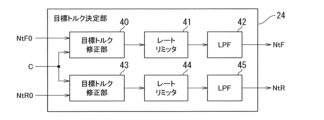
- FIG. 4 is a block diagram of an example of a functional configuration of a target torque determination unit.
- 4A is a schematic diagram of a vehicle body coordinate system and a front wheel coordinate system
- FIG. 4B is a schematic diagram of a front wheel braking force and a rear wheel driving force.
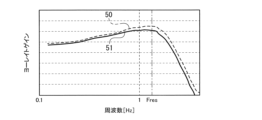
- FIG. 13 is a schematic diagram of a simulation result.
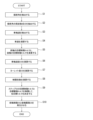
- 2 is a flowchart of an example of a vehicle vibration damping method according to an embodiment.
- (composition) 1 is a schematic diagram of a vehicle equipped with a vehicle vibration damping device according to an embodiment.
- a vehicle 100 includes a steering angle measuring device 1, a steering device 2, wheel speed measuring devices 3FR, 3FL, 3RR, and 3RL, a right front wheel 4FR, a left front wheel 4FL, a right rear wheel 4RR, and a left rear wheel 4RL, front wheel drive shafts 5FR and 5FL, rear wheel drive shafts 6RR and 6RL, a yaw rate sensor 7, a controller 8, a power converter 9, a front wheel drive source 10F, a rear wheel drive source 10R, and a battery 11.
- the right front wheel 4FR and the left front wheel 4FL may be collectively referred to as “front wheels 4F”, and the right rear wheel 4RR and the left rear wheel 4RL may be collectively referred to as “rear wheels 4R”.
- the steering angle measurement device 1 measures the steering angle ⁇ f of the steering wheel 2 a that steers the steered wheels (i.e., the front wheels 4 F) to change the traveling direction of the vehicle 100 , and outputs the measured steering angle ⁇ f to the controller 8 .
- the steering gear ratio Gstr can be variably controlled, and the steering gear ratio Gstr is determined, for example, according to the steering angle ⁇ f and the state of the vehicle 100.
- the steering angle measuring device 1 may measure the steering angle ⁇ of the front wheels 4F instead of the steering angle ⁇ f of the steering wheel 2a. In this case, in the description below, the steering angle ⁇ f can be replaced with Gstr x steering angle ⁇ .
- the steering angle measurement device 1 may acquire command values of the steering angle ⁇ f and the steering angle ⁇ generated by the steering assist system instead of the measured values of the steering angle ⁇ f and the steering angle ⁇ .
- the unit of the physical quantity acquired by the steering angle measurement device 1 is not limited to angle, and the steering angle measurement device 1 may detect an angular velocity, which is the first time differential of the steering angle ⁇ f or the turning angle ⁇ , or an angular acceleration, which is the second time differential.
- the steering device 2 is composed of a steering wheel 2a, a steering shaft 2b connected to it, and a steering mechanism (not shown) that can change the angle of the front wheels 4F relative to the vehicle 100.
- the steering angle measurement device 1 is connected to the steering device 2, and measures the change in angle of the steering shaft 2b that accompanies the rotation of the steering wheel 2a by the driver.
- the rotation of the steering shaft 2b is converted by the steering device into a change in the angle of the front wheels 4F relative to the vehicle 100.
- the drive shaft may be omitted.
- Wheel speed measurement devices 3FR, 3FL, 3RR and 3RL (hereinafter sometimes collectively referred to as “wheel speed measurement device 3") measure wheel speeds ⁇ FR, ⁇ FL, ⁇ RR and ⁇ RL of the right front wheel 4FR, left front wheel 4FL, right rear wheel 4RR and left rear wheel 4RL, respectively, and output them to controller 8.
- Front wheel drive shafts 5FR and 5FL are installed at positions corresponding to the right front wheel 4FR and left front wheel 4FL, respectively, and transmit driving force and braking force generated by front wheel drive source 10F to the right front wheel 4FR and left front wheel 4FL.
- a degree of rotational freedom is provided between the front wheel drive shafts 5FR and 5FL and the front wheels 4F, allowing the steering device 2 to change the steering angle ⁇ of the front wheels 4F.
- the rear wheel drive shafts 6RR and 6RL are installed at positions corresponding to the right rear wheel 4RR and the left rear wheel 4RL, respectively, and transmit the driving force and braking force generated by the rear wheel drive source 10R to the right rear wheel 4RR and the left rear wheel 4RL.
- there is a degree of rotational freedom between the rear wheel 4R and the rear wheel drive shafts 6RR and 6RL making it possible to change the steering angle of the rear wheel 4R.
- the yaw rate sensor 7 is fixed to a location of the vehicle 100 that is relatively rigid and close to the center of gravity, measures a yaw rate ⁇ r, which is the time rate of change of the yaw angle of the vehicle 100, and outputs the measured value to the controller 8.
- the controller 8 is an electronic control unit (ECU) that independently controls the driving force and braking force generated on the front wheels 4F and the driving force and braking force generated on the rear wheels 4R.
- the controller 8 includes a processor 8a and peripheral components such as a storage device 8b.
- the processor 8a may be, for example, a central processing unit (CPU) or a micro-processing unit (MPU).
- the storage device 8b may include a semiconductor storage device, a magnetic storage device, an optical storage device, or the like.
- the functions of the controller 8 described below are realized, for example, by the processor 8a executing a computer program stored in the storage device 8b.
- the controller 8 determines the target generated torques of the front wheel drive source 10F and the rear wheel drive source 10R based on the steering angle ⁇ f, the wheel speeds ⁇ FR, ⁇ FL, ⁇ RR and ⁇ RL, and the yaw rate ⁇ r obtained respectively from the steering angle measuring device 1, the wheel speed measuring device 3, and the yaw rate sensor 7, and outputs the determined target torques to the power converter 9.
- the power converter 9 converts the power supplied from the battery 11 electrically connected to the power converter 9 into power to be supplied to the front-wheel drive source 10F and the rear-wheel drive source 10R so as to realize the target generated torque commanded by the controller 8.
- the front-wheel drive source 10F and the rear-wheel drive source 10R are also used as generators, and regenerative power is supplied to the battery 11 through the power converter 9 to charge it.
- a single power converter 9 is shown for the front-wheel drive source 10F and the rear-wheel drive source 10R in FIG. 1, the power converter 9 can supply power independently so that the front-wheel drive source 10F and the rear-wheel drive source 10R can generate braking force and driving force independently.
- the front-wheel drive source 10F and the rear-wheel drive source 10R generate driving force and braking force for the front wheels 4F and the rear wheels 4R, respectively.
- the front-wheel drive source 10F and the rear-wheel drive source 10R may each include an electric motor and a reduction gear to which the rotating shaft is connected.
- the electric motor is connected to a power converter 9 and converts the power supplied from the power converter 9 into the rotational force of the rotor of the electric motor.
- the electric motor is used as a generator, and electricity is extracted from the rotational force and used to charge the battery 11.
- the reduction gear converts the rotational speed between the rotor and the front-wheel drive shafts 5FR and 5FL or the rear-wheel drive shafts 6RR and 6RL, thereby converting the rotational torque generated in the rotor into the driving torque or braking torque of the front-wheel drive shafts 5FR and 5FL or the rear-wheel drive shafts 6RR and 6RL.
- the power source of the front-wheel drive source 10F and/or the rear-wheel drive source 10R is not limited to an electric motor, and may be, for example, an internal combustion engine.
- the controller 8 includes a frequency component extractor 20, a vehicle speed calculator 21, a target torque calculator 22, a limiting coefficient calculator 23, and a target torque determiner 24.
- the frequency component extraction unit 20 extracts a frequency component FC of the steering angle ⁇ f.
- the purpose of the low-pass filter is to suppress the amplification of high-frequency noise components contained in the input signal by the differentiation process.
- the cutoff frequency fc1 of the low-pass filter process may be set so as to sufficiently remove high-frequency noise and not to affect the yaw resonance frequency. Note that, in the steering angle measurement device 1, when the time rate of change is directly detected, the differentiation process may be omitted.
- the frequency component extraction unit 20 may extract a desired frequency component FC that is a target of the steering input by applying a band-pass filter to the steering angle ⁇ f.
- the low-frequency cutoff frequency fc2 and the high-frequency cutoff frequency fc3 of the band-pass filter are set so that the target frequency exists between these frequencies and sufficient gain is obtained in the pass band.
- the vehicle speed calculation unit 21 calculates the vehicle speed V, which is the speed of the center of gravity of the body of the vehicle 100, based on the wheel speeds ⁇ FR, ⁇ FL, ⁇ RR, and ⁇ RL.
- the target torque calculation unit 22 calculates a target braking torque amount NtF0 to be instructed to the front wheel drive source 10F. Specifically, the target torque calculation unit 22 calculates a torque having a magnitude corresponding to the rate of change of the yaw rate as the target braking torque amount NtF0. For example, the target braking torque amount NtF0 having a magnitude proportional to the rate of change of the yaw rate is calculated.
- steady-state yaw rate ⁇ s the yaw rate when the steering angle is in a steady state (hereinafter referred to as "steady-state yaw rate ⁇ s") is given by the following equation (1) based on the equation of motion of a two-wheel model that approximates the right and left wheels 4F and 4R as one wheel located at the center of the axle.
- the target torque calculation unit 22 calculates the target braking torque amount NtF0 according to the following equation (2) based on the frequency component FC and the vehicle speed V.
- equation (2) can be replaced by the following equation (3).
- Equation (3) is obtained by replacing the time differential value ⁇ f of the steering angle ⁇ f included in equation (1) with the absolute value
- is used in order to generate the same control input regardless of whether the steering direction is positive or negative. Furthermore, when the steering angle ⁇ f is band-pass filtered to extract a desired frequency component FC, a target braking torque amount NtF0 having a value proportional to the desired frequency component of the yaw rate can be obtained.
- a yaw moment can be generated in a direction that cancels the yaw moment generated in the vehicle body by the steering associated with the turning of the vehicle 100, and the gain of the yaw rate response to the steering input (yaw rate gain) can be suppressed. This reduces the vibration of the vehicle body in the yaw direction and stabilizes the vehicle behavior.
- suppressing the yaw rate gain by generating a braking torque of the target braking torque amount NtF0 may be referred to as "control intervention by the target braking torque amount NtF0".
- control intervention by the target braking torque amount NtF0 the term “associated with turning of the vehicle” is used as a term to mean that an event occurs not only while the vehicle is turning, but also when transitioning from a straight-line state to a turning state or from a turning state to a straight-line state.
- the target torque calculation unit 22 also calculates the target driving torque amount NtR0 to be instructed to the rear wheel drive source 10R. For example, the target torque calculation unit 22 converts the target braking torque amount NtF0 into a braking force at the tire contact point of the front wheel 4F by multiplying the target braking torque amount NtF0 by the front wheel drive system gear ratio GmotF and dividing by the wheel radius rF of the front wheel 4F. The target torque calculation unit 22 calculates the driving torque that generates a driving force at the tire contact point of the rear wheel 4R that offsets this braking force as the target driving torque amount NtR0. For example, the target torque calculation unit 22 calculates the target driving torque amount NtR0 according to the following equation (4).
- the constant GmotR in formula (4) indicates the rear wheel drive system gear ratio.
- the target driving torque amount NtR0 is calculated so that the driving force generated at the rear wheel 4RF cancels out the entire braking force generated at the front wheel 4F, but the target driving torque amount NtR0 may be calculated so as to cancel out a part of the braking force generated by the target braking torque amount NtF0.
- the driving force generated by the target driving torque amount NtR0 may be equal to the braking force generated by the target braking torque amount NtF0, or may be smaller or larger than the braking force generated by the target braking torque amount NtF0.
- the target torque calculation section 22 outputs the target braking torque amount NtF0 and the target driving torque amount NtR0 to the target torque determination section 24.
- the limiting coefficient calculation unit 23 calculates a limiting coefficient C that limits the target braking torque amount NtF0 in accordance with the vehicle state of the vehicle 100.
- Fig. 3 is a block diagram of an example of a functional configuration of the limiting coefficient calculation unit 23.
- the limiting coefficient calculation unit 23 includes a vehicle speed-dependent limiting coefficient setting unit 30, a steady yaw rate calculation unit 31, a turning direction determination unit 32, a wheel speed difference-dependent limiting coefficient setting unit 33, a yaw rate difference-dependent limiting coefficient setting unit 34, and a limiting coefficient setting unit 35.
- the vehicle speed-dependent restriction coefficient setting unit 30 sets the vehicle speed-dependent restriction coefficient Cv in accordance with the vehicle speed.
- FIG. 4(a) shows an example of setting the vehicle speed-dependent limiting coefficient Cv.
- the vehicle speed-dependent limiting coefficient Cv has a value in the range from “0" to "1", and is "0" when the vehicle speed V is equal to or less than the threshold value V1 and when the vehicle speed V is equal to or more than the threshold value V4.
- the vehicle speed-dependent limiting coefficient Cv increases from "0" to a value Cv1 as the vehicle speed V increases.
- the vehicle speed-dependent limiting coefficient Cv changes from a value Cv1 to a value Cv2 as the vehicle speed V increases.
- the vehicle speed-dependent limiting coefficient Cv decreases from a value Cv2 to "0" as the vehicle speed V increases.
- the threshold values V1, V2 and the value Cv1 are determined so that the control intervention by the target braking torque amount NtF0 at the low vehicle speed is eliminated or the target braking torque amount NtF0 is reduced.
- the threshold values V3, V4 and the value Cv2 are set to the maximum vehicle speed at which the control intervention by the target braking torque amount NtF0 is performed, and are set when the upper limit is set to the speed in consideration of durability.
- the threshold values V1 to V4 and the values Cv1 and Cv2 may be appropriately set, for example, based on the vehicle specifications, simulations, and evaluations on an actual vehicle. In the example of FIG. 4A, Cv1 and Cv2 are set so that Cv1>Cv2, but Cv1 may be equal to or smaller than Cv2.
- the steady yaw rate calculation unit 31 calculates the steady yaw rate ⁇ s based on the steering angle ⁇ f, the vehicle speed V, and vehicle specifications. For example, the steady yaw rate calculation unit 31 may calculate the steady yaw rate ⁇ s according to the above formula (1).
- the turning direction determination unit 32 determines whether or not the turning direction determined from the driver's steering operation matches the turning direction detected from the yaw rate ⁇ r detected by the sensor.
- the turning direction determination unit 32 outputs a determination result flag Ct. If the turning direction determined from the driver's steering operation matches the turning direction detected from the yaw rate ⁇ r, the value of the determination result flag Ct is set to "1", and if they differ, the value is set to "0".
- the turning direction determination unit 32 sets the value of the determination result flag Ct to "1", and if they differ, the value is set to "0".
- control intervention using the target braking torque amount NtF0 is performed to suppress the yaw rate gain only when the vehicle turning direction based on the target yaw rate estimated from the driver's steering operation matches the vehicle turning direction based on the actual yaw rate of the vehicle 100 acquired by the sensor.
- the yaw rate gain is not suppressed, thereby preventing the behavior of the vehicle 100 from delaying in response to the driver's operation.
- Figure 4 (b) shows an example of how the front/rear wheel speed difference dependent limiting coefficient Cfr is set.
- the front/rear wheel speed difference dependent limiting coefficient Cfr has a value in the range from "0" to "1".
- the front/rear wheel speed difference dependent limiting coefficient Cfr is "1" when the wheel speed difference
- the thresholds ⁇ fr1 and ⁇ fr2 may be set appropriately using vehicle specifications, simulations, and experiments with an actual vehicle.
- the wheel speed difference dependent limiting coefficient setting unit 33 sets a left/right wheel speed difference dependent limiting coefficient Clrf that limits the target braking torque amount NtF0 when the wheel speed difference ⁇ lrf between the right front wheel 4FR and the left front wheel 4FL is excessively large (for example, when slippage occurs in either the right front wheel 4FR or the left front wheel 4FL).
- Fig. 4(c) shows an example of how the left/right wheel speed difference dependent limiting coefficient Clrf is set.
- the left/right wheel speed difference dependent limiting coefficient Clrf has a value ranging from "0" to "1".
- the left/right wheel speed difference dependent restriction coefficient Clrf is "1" when the wheel speed difference
- the threshold values ⁇ lrf1 and ⁇ lrf2 may be appropriately set using vehicle specifications, simulations, and experiments using an actual vehicle.
- the wheel speed difference dependent limiting coefficient setting unit 33 sets a left/right wheel speed difference dependent limiting coefficient Clrr that limits the target braking torque amount NtF0 when the wheel speed difference ⁇ lrr between the right rear wheel 4RR and the left rear wheel 4RL is excessively large (for example, when slippage occurs at either the right rear wheel 4RR or the left rear wheel 4RL).
- FIG. 4(d) shows an example of setting the yaw rate difference dependent limiting coefficient Cy.
- the yaw rate difference dependent limiting coefficient Cy has a value in the range from "0" to "1".
- the yaw rate difference dependent limiting coefficient Cy is "1" when the yaw rate difference
- the thresholds ⁇ 1 and ⁇ 2 may be set appropriately using vehicle specifications, simulations, and experiments with actual vehicles.
- the limit coefficient setting unit 35 outputs the limit coefficient C to the target torque determination unit 24.
- the target torque determination section 24 limits the target braking torque amount NtF0 and the target driving torque amount NtR0 calculated by the target torque calculation section 22 using a limiting coefficient C to calculate the limited target braking torque amount NtF and the limited target driving torque amount NtR.
- the target torque determination unit 24 includes target torque correction units 40 and 43, rate limiters 41 and 44, and low pass filters (LPFs) 42 and 45.
- a target torque correction unit 40 calculates a product C ⁇ NtF0 by multiplying the target braking torque amount NtF0 by a limiting coefficient C.
- a rate limiter 41 limits the time rate of change of the product C ⁇ NtF0.
- the output of the rate limiter 41 is passed through a low-pass filter 42 with a cutoff frequency fc4 to calculate the target braking torque amount NtF.
- a target torque correction unit 43 calculates the product C ⁇ NtR0 by multiplying the target drive torque amount NtR0 by a limit coefficient C.
- a rate limiter 44 limits the time rate of change of the product C ⁇ NtR0.
- a low-pass filter 45 with a cutoff frequency fc4 is applied to the output of the rate limiter 44 to calculate the target drive torque amount NtR.
- the change rate limit values and cutoff frequency fc4 of the rate limiters 41 and 44 are set so as not to affect the frequency band to be controlled.
- the controller 8 outputs a target braking torque amount NtF and a target driving torque amount NtR to the power converter 9.
- the power converter 9 supplies electric power to the front wheel driving source 10F and the rear wheel driving source 10R so as to realize the target braking torque amount NtF and the target driving torque amount NtR commanded by the controller 8.
- the front wheel driving source 10F and the rear wheel driving source 10R generate a braking force corresponding to the target braking torque amount NtF and a driving force corresponding to the target driving torque amount NtR to the front wheels 4F and the rear wheels 4R, respectively.
- FIG. 6A is a diagram showing the relationship between the vehicle body coordinate system and the front wheel coordinate system, and the relationship between the axial components of the braking force as viewed from each coordinate system.
- the vehicle body coordinate system (solid line) is a coordinate system in which the origin of the coordinate system is the wheel center, the x-axis is set parallel to the vehicle body left-right center line and the forward direction is the positive direction, the y-axis is set perpendicular to the x-axis and the left direction is the positive direction, and the z-axis is set to form a right-handed system with these x-axis and y-axis.
- the front wheel coordinate system (dotted line) is a coordinate system in which the origin of the coordinate system is the wheel center, the x-axis is set parallel to the front-rear direction of the wheel and the positive direction, the y-axis is set perpendicular to the x-axis and the left direction is the positive direction, and the z-axis is set to form a right-handed system with these x-axis and y-axis.
- the vehicle body coordinate system and the front wheel coordinate system share the same origin.
- the front wheel coordinate system (dashed line) rotates counterclockwise by ⁇ f/Gstr around the wheel center relative to the vehicle body coordinate system (solid line). This indicates that the front wheel 4F is steered by ⁇ f/Gstr relative to the vehicle body.
- the braking force is the product Kf ⁇ Sf of the front slip ratio Sf and the front traction coefficient Kf.
- the braking force Kf ⁇ Sf acts in the x-axis direction of the front wheel coordinate system, but when the front wheel 4F is steered by a steering angle ⁇ f/Gstr with respect to the vehicle body, it includes a y-axis direction component (Kf ⁇ Sf ⁇ sin( ⁇ f/Gstr) ⁇ Kf ⁇ Sf ⁇ f/Gstr) of the vehicle body coordinate system.
- the direction of this y-axis direction component (Kf ⁇ Sf ⁇ f/Gstr) is opposite to the turning direction. For this reason, if a braking force is generated on the front wheel 4F during steering, a yaw moment can be generated in a direction that cancels the yaw moment generated on the vehicle body by the steering.
- a braking force (Kf ⁇ Sf ⁇ cos( ⁇ f/Gstr) ⁇ Kf ⁇ Sf) is generated on the front wheel 4F in the negative direction of the x-axis of the vehicle body coordinate system, so that longitudinal acceleration occurs.
- FIG. 7 shows the frequency characteristics of the gain of the yaw rate response to the steering input.
- the dashed line 50 shows a comparative example of the gain when no front wheel braking torque is applied
- the solid line 51 shows the gain when a front wheel braking torque is applied.
- the vibration damping effect increases as the steering frequency increases.
- the target braking torque NtF based on the components extracted by applying a band-pass filter to the steering angle ⁇ f, the yaw rate gain in any frequency band can be reduced.
- FIG. 8 is a flowchart of an example of a vehicle vibration damping method according to the embodiment.
- the steering angle measurement device 1 detects the steering angle ⁇ f of the steering wheel 2a.
- the frequency component extraction unit 20 extracts the frequency component FC of the steering angle ⁇ f.
- the wheel speed measurement devices 3FR, 3FL, 3RR, and 3RL detect the wheel speeds ⁇ FR, ⁇ FL, ⁇ RR, and ⁇ RL.
- the vehicle speed calculation unit 21 calculates the vehicle speed V based on the wheel speeds ⁇ FR, ⁇ FL, ⁇ RR, and ⁇ RL.
- step S5 the target torque calculation unit 22 calculates the target braking torque amount NtF0 based on the frequency component FC and the vehicle speed V. It also calculates the target driving torque amount NtR0 that generates a driving force on the rear wheels 4R that offsets all or part of the braking force generated on the front wheels 4F by the target braking torque amount NtF0.
- step S6 the limiting coefficient calculation unit 23 calculates the wheel speed differences ⁇ fr, ⁇ lrf, and ⁇ lrr.
- step S7 the limiting coefficient calculation unit 23 calculates the yaw rate difference ⁇ .
- step S8 the limiting coefficient calculation unit 23 calculates the limiting coefficient C based on the vehicle speed V, the wheel speed differences ⁇ fr, ⁇ lrf, ⁇ lrr, the yaw rate difference ⁇ , the yaw rate ⁇ r detected by the sensor, and the steady yaw rate ⁇ s calculated from the steering operation.
- step S9 the target torque determination unit 24 calculates the limited target braking torque amount NtF and target driving torque amount NtR by limiting the target braking torque amount NtF0 and target driving torque amount NtR0 calculated in step S5 with the limit coefficient C.
- step S10 the power converter 9, the front wheel driving source 10F, and the rear wheel driving source 10R generate a braking force corresponding to the target braking torque amount NtF and a driving force corresponding to the target driving torque amount NtR to the front wheels 4F and the rear wheels 4R, respectively. The process then ends.
- the controller 8 can independently control a front-wheel drive source that generates a drive force and a braking force on the front wheels 4F and a rear-wheel drive source that generates a drive force on the rear wheels 4R to reduce vibrations of the vehicle 100.
- the controller 8 causes the front-wheel drive source to generate a braking force on the front wheels 4F, and causes the rear-wheel drive source to generate a drive force on the rear wheels 4R that offsets all or a part of the braking force of the front wheels 4F.
- the braking force generated on the front wheels 4F has a lateral force component against the vehicle body because the front wheels 4F are steered.
- a yaw moment is generated in the opposite direction to the turning direction, making it possible to control the yaw rate without independent torque control for the right and left wheels.
- a driving torque to the rear wheels 4R that generates a braking force that balances with the driving force generated by the front wheels 4F, acceleration and deceleration in the fore-and-aft direction of the vehicle body can be suppressed.
- the controller 8 may generate a braking force on the front wheels that is proportional to the time derivative of the steering angle.
- the higher the steering frequency the more the yaw motion of the vehicle 100 relative to the steering angle can be suppressed.
- the controller 8 may generate a braking force on the front wheels that is proportional to the magnitude of a predetermined frequency component of the steering angle. This makes it possible to apply a bandpass filter that extracts the frequency components near the yaw resonance frequency from the time component of the steering angle input, and to apply a front wheel braking input proportional to the extracted frequency components.As a result, it is possible to suppress the peak value of the yaw rate gain by limiting it to the yaw resonance frequency, while realizing yaw motion damping without affecting other frequency bands.
- the controller 8 may limit at least the braking force depending on the speed of the vehicle 100. In this way, when the speed of the vehicle 100 is slow, excessive vibration damping at low speeds can be suppressed by limiting the braking torque of the front wheels 4F. In general, the difference in yaw rate gain between steady-state steering and at the yaw resonance frequency becomes more pronounced at higher speeds and becomes smaller at lower speeds. For this reason, if a front wheel braking force is generated when the vehicle is steered relatively quickly while traveling at a low speed, steering response may be impaired. Therefore, if the front wheel braking force is limited when the vehicle speed is low and the front wheel braking force is increased as the vehicle speed increases, the vibration damping effect during high-speed traveling can be increased without impairing steering response at low speeds.
- the controller 8 may limit the magnitude of the amount of change in the braking force over time. In this way, if there is a time fluctuation in the target braking torque amount NtF0, the time fluctuation is limited, thereby making it possible to suppress abrupt changes in the behavior of the vehicle 100.
- the controller 8 may at least limit the braking force when the direction of change in the steering angle differs from the turning direction of the vehicle 100. This can prevent the driver from feeling that the vehicle is not turning as intended when the direction intended by the driver differs from the direction of movement of the vehicle.
- the controller 8 may limit at least the braking force when the difference in rotation speed between the front wheels 4F and the rear wheels 4R exceeds a first threshold value. This makes it possible to limit the front wheel braking force when excessive slip occurs in either or both of the front wheels 4F and the rear wheels 4R due to the generation of the target braking torque amount NtF, thereby reducing slippage of the four wheels and preventing the vehicle behavior from becoming unstable.
- the controller 8 may limit at least the braking force when the rotation speed difference between the right wheel and the left wheel exceeds a second threshold value.
- At least the braking force may be limited when the difference between the yaw rate calculated based on at least the steering angle and the yaw rate detected by the sensor exceeds a third threshold value. This makes it possible to limit the braking force on the front wheels when slippage occurs in any or all of the four wheels due to the generation of the target braking torque amount NtF, preventing the driver from turning as desired. This reduces slippage in the four wheels and prevents the vehicle's behavior from becoming unstable.
- 1...steering angle measuring device 2...steering device, 2a...steering wheel, 2b...steering shaft, 3...wheel speed measuring device, 3FL, 3FR, 3RL, 3RR...wheel speed measuring device, 4F...front wheel, 4FL...left front wheel, 4FR...right front wheel, 4R...rear wheel, 4RF...rear wheel, 4RL...left rear wheel, 4RR...right rear wheel, 5FL...front wheel drive shaft, 5FR...front wheel drive shaft, 6RL...rear wheel drive shaft, 6RR...rear wheel drive shaft, 7...yaw rate sensor, 8...controller, 8a...processor, 8b...storage device, 9...power converter, 10F...front wheel Driving source, 10R... rear wheel driving source, 11... battery, 20...
Landscapes
- Engineering & Computer Science (AREA)
- Power Engineering (AREA)
- Transportation (AREA)
- Mechanical Engineering (AREA)
- Regulating Braking Force (AREA)
Priority Applications (3)
| Application Number | Priority Date | Filing Date | Title |
|---|---|---|---|
| CN202280102240.5A CN120282892A (zh) | 2022-12-05 | 2022-12-05 | 车辆减振方法及车辆减振装置 |
| PCT/JP2022/044692 WO2024121887A1 (ja) | 2022-12-05 | 2022-12-05 | 車両制振方法及び車両制振装置 |
| JP2024562399A JPWO2024121887A1 (https=) | 2022-12-05 | 2022-12-05 |
Applications Claiming Priority (1)
| Application Number | Priority Date | Filing Date | Title |
|---|---|---|---|
| PCT/JP2022/044692 WO2024121887A1 (ja) | 2022-12-05 | 2022-12-05 | 車両制振方法及び車両制振装置 |
Publications (1)
| Publication Number | Publication Date |
|---|---|
| WO2024121887A1 true WO2024121887A1 (ja) | 2024-06-13 |
Family
ID=91378788
Family Applications (1)
| Application Number | Title | Priority Date | Filing Date |
|---|---|---|---|
| PCT/JP2022/044692 Ceased WO2024121887A1 (ja) | 2022-12-05 | 2022-12-05 | 車両制振方法及び車両制振装置 |
Country Status (3)
| Country | Link |
|---|---|
| JP (1) | JPWO2024121887A1 (https=) |
| CN (1) | CN120282892A (https=) |
| WO (1) | WO2024121887A1 (https=) |
Cited By (2)
| Publication number | Priority date | Publication date | Assignee | Title |
|---|---|---|---|---|
| US20240017702A1 (en) * | 2022-06-27 | 2024-01-18 | Tusimple, Inc. | Predictive anti-lag braking control for autonomous driving |
| US12377878B2 (en) | 2022-06-27 | 2025-08-05 | Tusimple, Inc. | Wheel torque estimation for autonomous driving |
Citations (2)
| Publication number | Priority date | Publication date | Assignee | Title |
|---|---|---|---|---|
| WO2007110967A1 (ja) * | 2006-03-28 | 2007-10-04 | Hitachi, Ltd. | 車両運動制御装置 |
| US20210253162A1 (en) * | 2020-02-18 | 2021-08-19 | Eric R. Thompson | Vehicle dig lock system |
-
2022
- 2022-12-05 CN CN202280102240.5A patent/CN120282892A/zh active Pending
- 2022-12-05 JP JP2024562399A patent/JPWO2024121887A1/ja active Pending
- 2022-12-05 WO PCT/JP2022/044692 patent/WO2024121887A1/ja not_active Ceased
Patent Citations (2)
| Publication number | Priority date | Publication date | Assignee | Title |
|---|---|---|---|---|
| WO2007110967A1 (ja) * | 2006-03-28 | 2007-10-04 | Hitachi, Ltd. | 車両運動制御装置 |
| US20210253162A1 (en) * | 2020-02-18 | 2021-08-19 | Eric R. Thompson | Vehicle dig lock system |
Cited By (3)
| Publication number | Priority date | Publication date | Assignee | Title |
|---|---|---|---|---|
| US20240017702A1 (en) * | 2022-06-27 | 2024-01-18 | Tusimple, Inc. | Predictive anti-lag braking control for autonomous driving |
| US12377878B2 (en) | 2022-06-27 | 2025-08-05 | Tusimple, Inc. | Wheel torque estimation for autonomous driving |
| US12427956B2 (en) * | 2022-06-27 | 2025-09-30 | Tusimple, Inc. | Predictive anti-lag braking control for autonomous driving |
Also Published As
| Publication number | Publication date |
|---|---|
| JPWO2024121887A1 (https=) | 2024-06-13 |
| CN120282892A (zh) | 2025-07-08 |
Similar Documents
| Publication | Publication Date | Title |
|---|---|---|
| JP6585444B2 (ja) | 車両姿勢制御装置 | |
| JP4145871B2 (ja) | 車両制御方法及び車両制御装置 | |
| RU2737640C1 (ru) | Способ и устройство управления электродвигателем электрического транспортного средства | |
| JP4193838B2 (ja) | 車輌の制駆動力制御装置 | |
| CN110239499B (zh) | 车辆的控制装置及车辆的控制方法 | |
| JP6279121B1 (ja) | 制御装置、および、ステアリング装置 | |
| KR102805124B1 (ko) | 차량의 휠 슬립 제어 방법 | |
| JP6328841B1 (ja) | 制御装置、および、ステアリング装置 | |
| AU2016201638A1 (en) | Vibration control device and vibration control system | |
| CN107848526A (zh) | 车辆转弯控制装置 | |
| JP4131269B2 (ja) | 車輌の制駆動力制御装置 | |
| JP2010081720A (ja) | 車両用駆動力制御装置 | |
| WO2024121887A1 (ja) | 車両制振方法及び車両制振装置 | |
| CN108263372A (zh) | 车辆行驶控制装置 | |
| JP6267440B2 (ja) | 車両制御装置 | |
| WO2020003549A1 (ja) | ステアリング制御装置及びステアリング装置 | |
| JP7850009B2 (ja) | 制駆動力制御装置 | |
| CN120003462B (zh) | 车辆控制方法、系统、装置、车辆、存储介质及程序产品 | |
| JP4228837B2 (ja) | 車輪速度推定装置、車体速度推定装置、および車両挙動制御装置 | |
| JP3573382B2 (ja) | 車両におけるヨーモーメント制御方法 | |
| JP5082656B2 (ja) | 車両の旋回挙動制御方法および装置 | |
| JP6237105B2 (ja) | 車両制御装置 | |
| JP2014080084A (ja) | ハイブリッド自動車のローリング抑制方法 | |
| CN114763125A (zh) | 车辆控制系统 | |
| JP2018129890A (ja) | 車両の出力制御装置 |
Legal Events
| Date | Code | Title | Description |
|---|---|---|---|
| 121 | Ep: the epo has been informed by wipo that ep was designated in this application |
Ref document number: 22967741 Country of ref document: EP Kind code of ref document: A1 |
|
| WWE | Wipo information: entry into national phase |
Ref document number: 2024562399 Country of ref document: JP |
|
| WWE | Wipo information: entry into national phase |
Ref document number: CN2022801022405 Country of ref document: CN Ref document number: 202280102240.5 Country of ref document: CN |
|
| NENP | Non-entry into the national phase |
Ref country code: DE |
|
| WWP | Wipo information: published in national office |
Ref document number: 202280102240.5 Country of ref document: CN |
|
| 122 | Ep: pct application non-entry in european phase |
Ref document number: 22967741 Country of ref document: EP Kind code of ref document: A1 |