WO2024117202A1 - 多孔質体および多孔質体の製造方法 - Google Patents
多孔質体および多孔質体の製造方法 Download PDFInfo
- Publication number
- WO2024117202A1 WO2024117202A1 PCT/JP2023/042811 JP2023042811W WO2024117202A1 WO 2024117202 A1 WO2024117202 A1 WO 2024117202A1 JP 2023042811 W JP2023042811 W JP 2023042811W WO 2024117202 A1 WO2024117202 A1 WO 2024117202A1
- Authority
- WO
- WIPO (PCT)
- Prior art keywords
- porous body
- body according
- solvent
- wet gel
- less
- Prior art date
- Legal status (The legal status is an assumption and is not a legal conclusion. Google has not performed a legal analysis and makes no representation as to the accuracy of the status listed.)
- Ceased
Links
Classifications
-
- C—CHEMISTRY; METALLURGY
- C08—ORGANIC MACROMOLECULAR COMPOUNDS; THEIR PREPARATION OR CHEMICAL WORKING-UP; COMPOSITIONS BASED THEREON
- C08G—MACROMOLECULAR COMPOUNDS OBTAINED OTHERWISE THAN BY REACTIONS ONLY INVOLVING UNSATURATED CARBON-TO-CARBON BONDS
- C08G77/00—Macromolecular compounds obtained by reactions forming a linkage containing silicon with or without sulfur, nitrogen, oxygen or carbon in the main chain of the macromolecule
- C08G77/02—Polysilicates
-
- C—CHEMISTRY; METALLURGY
- C08—ORGANIC MACROMOLECULAR COMPOUNDS; THEIR PREPARATION OR CHEMICAL WORKING-UP; COMPOSITIONS BASED THEREON
- C08G—MACROMOLECULAR COMPOUNDS OBTAINED OTHERWISE THAN BY REACTIONS ONLY INVOLVING UNSATURATED CARBON-TO-CARBON BONDS
- C08G77/00—Macromolecular compounds obtained by reactions forming a linkage containing silicon with or without sulfur, nitrogen, oxygen or carbon in the main chain of the macromolecule
- C08G77/04—Polysiloxanes
-
- C—CHEMISTRY; METALLURGY
- C08—ORGANIC MACROMOLECULAR COMPOUNDS; THEIR PREPARATION OR CHEMICAL WORKING-UP; COMPOSITIONS BASED THEREON
- C08J—WORKING-UP; GENERAL PROCESSES OF COMPOUNDING; AFTER-TREATMENT NOT COVERED BY SUBCLASSES C08B, C08C, C08F, C08G or C08H
- C08J9/00—Working-up of macromolecular substances to porous or cellular articles or materials; After-treatment thereof
- C08J9/28—Working-up of macromolecular substances to porous or cellular articles or materials; After-treatment thereof by elimination of a liquid phase from a macromolecular composition or article, e.g. drying of coagulum
Definitions
- the present invention relates to a porous body and a method for manufacturing a porous body, and more specifically to a porous body with improved strength and a method for manufacturing the same.
- a dry gel obtained by using a supercritical drying method on a wet gel is called an aerogel
- a dry gel obtained by drying under atmospheric pressure is called a xerogel
- a dry gel obtained by freeze-drying is called a cryogel.
- a low-density dry gel composed of a microporous solid whose dispersed phase is gas is called an "aerogel”.
- a porous body is generally a general term for an individual having holes (voids) inside a material, but in this embodiment, it is defined as a structure in which the maximum nitrogen adsorption amount at a relative pressure P/P 0 of the equilibrium pressure P to the saturated vapor pressure P 0 is 100 cm 3 (STP)/g or more when the relative pressure P/P 0 is 0 to 0.99 in the nitrogen adsorption isotherm obtained by the nitrogen adsorption measurement performed by the following method.
- Porous materials such as aerogels have a large number of fine pores, and are known to have many excellent functions, such as a high specific surface area, low density, high thermal insulation, unique optical properties, and unique electrical properties, and are expected to be used in catalysts, gas sensors, insulation materials, electronic circuit board materials, etc.
- they have high transparency to visible light, so their use as light reflective materials that utilize their ultra-low refractive index and as transparent insulation materials, such as in insulating window materials for homes and insulation materials for solar heat collector panels, is being considered.
- aerogel has the problem of being brittle and has low material strength.
- bulk or thin-film aerogel is prone to cracking or breaking due to impact or vibration, and the pore structure of granular or powdered aerogel can be damaged by the stress applied during mixing or kneading with resin.
- aerogel requires a special high-pressure process.
- aerogel and other porous bodies are produced using the sol-gel method, which is a liquid-phase reaction (see, for example, Patent Document 1).
- a sol made of starting materials is solidified into a wet gel (sol-gel transition), and then the dispersed components such as the solvent in the obtained wet gel are replaced with gas by drying, forming a pore structure.
- sol refers to the state before gelation occurs, in which the sol-like starting material or the product made of the starting material is dissolved or dispersed in a liquid medium and has fluidity.
- a wet gel refers to a gel solid in a wet state that contains a liquid medium but does not have fluidity.
- aerogels with high porosity can be obtained by using a method for drying the above-mentioned wet gel, in which the solvent contained in the wet gel is discharged as a supercritical fluid under a temperature and pressure environment above the critical point of the solvent (supercritical drying).
- this method is a high-pressure process, and issues arise, such as the need for expensive equipment and advanced safety measures. Therefore, if a method for producing porous bodies with high porosity without using supercritical drying could be established, it would be more preferable from a production standpoint, since general-purpose dryers using hot air, halogen heaters, etc. could be applied.
- a capillary force represented by the following formula is generated inside the gel when the wet gel is dried.
- P C is the capillary force
- ⁇ is the surface tension of the solvent
- ⁇ is the contact angle between the solvent and the capillary wall
- a is the pore radius.
- Silylation is a method of introducing an organosilicon structure by reacting functional groups such as -OH, -NH 2 , and -COOH with a silylating agent such as a silyl ether compound.
- a silylating agent such as a silyl ether compound.
- Patent Document 2 and other documents have proposed a method for producing a porous body in which a nonionic surfactant is dissolved in an acidic solution, an alkyl silicon alkoxide is added to the solution, a hydrolysis reaction is carried out, the product is solidified, and then dried by heating.
- alkyl silicon alkoxides are relatively expensive among alkoxysilanes, it would be cheaper and more preferable if a method for producing a porous body that does not primarily use alkyl silicon alkoxides could be established.
- the object of the present invention is to provide a porous body having high porosity and improved strength, and a method for producing the same.
- the present inventors have discovered that a porous body having a specific structure represented by -M-(OX) n -O-M-, obtained by a transesterification reaction between a metal alkoxide (A) and a crosslinkable compound (B), can be produced in a simple process, and that the porous body has high porosity and improved strength of the material skeleton, thereby completing the present invention. That is, the present invention provides the following inventions [1] to [18].
- M is a metal atom
- X is any divalent or higher organic group
- n is the number of repetitions of the above structure (an integer of 1 or more).
- X is a divalent or higher alkylene group.
- a method for producing a porous body comprising an ester exchange reaction step of carrying out an ester exchange reaction according to the following formula (2) and/or formula (3) using a metal alkoxide (A) and a crosslinkable compound (B) having a total of two or more alcoholic hydroxyl groups and/or ester bonds: Z-M-OR + R'OH ⁇ Z-M-OR' + ROH (2) Z-M-OR + R'COOR'' ⁇ Z-M-OR'' + R'COOR (3) (In the above formulas (2) and (3), M is a metal atom, R, R', and R'' are any organic groups, and Z is any group.) [15] The method for producing a porous body according to [14], wherein in the transesterification reaction step, the transesterification reaction according to the formula (2) and/or the formula (3) is allowed to proceed in a solution state.
- the present invention provides a porous body with improved strength and high porosity, and a method for producing the same.
- FIG. 2 is a diagram showing the pore area distribution of the aerogel obtained by the present invention, measured by the BJH method.
- FIG. 1 is a diagram showing a conventional method for producing an aerogel using a hydrogel precursor obtained through a hydrolysis reaction and a polycondensation reaction of a metal alkoxide.
- FIG. 1 is a diagram showing a method for producing an aerogel in which the steps are simplified by using a wet gel that has undergone an ester exchange reaction and encapsulates a solvent that is substantially free of water as a precursor according to the present invention. 1 shows the appearance of a bulk aerogel obtained according to the present invention.
- the porous body of the present invention has a structure represented by the following general formula (1).
- M is a metal atom
- X is any organic group having a valence of two or more
- n is an integer of 1 or more.
- the porous body of the present invention can improve the strength of the porous body by containing the structure represented by the above general formula (1), particularly by having a crosslinked structure of an organic chain X in which a metal atom M is connected to an oxygen atom O, represented by M-(OX) n -O-M.
- a bulk aerogel that does not crack or break when the wet gel is dried can be produced, and when used in a granular or powdered form, a porous body whose pore structure is not easily damaged by stress applied during mixing or kneading with a resin can be obtained.
- the porous body of the present invention can be obtained, for example, by a sol-gel method, and does not require a high-pressure process such as supercritical drying, and can be produced relatively easily and inexpensively because a bulk or powdered porous body can be produced by atmospheric pressure drying without performing a silylation treatment step.
- M may be any metal atom capable of existing as a metal alkoxide, and is not particularly limited. However, Si, Ti, Zr, Mg, Zn, Pb, Al, Ba, Y, W, V, Na, Li, In, etc. are preferred. From the viewpoint of having high transparency to visible light and therefore being suitable for use in applications requiring optical properties, Si and Ti are more preferred, and Si is particularly preferred.
- the metal atom M may be a single type or may contain two or more types.
- X may be any divalent or higher organic group, and is not particularly limited, but is preferably a linear, branched or cyclic divalent or higher alcohol residue or ester residue, more preferably a linear, branched or cyclic divalent or higher alkylene group, and even more preferably a linear or branched divalent or higher alkylene group, and preferably X has 2 or more carbon atoms, more preferably 2 to 10, even more preferably 2 to 6, even more preferably 2 to 4, and especially preferably 2. It is particularly preferred that X is a group represented by C m H 2m (m is preferably 2 or more, more preferably 2 to 10, even more preferably 2 to 6, even more preferably 2 to 4, and especially preferably 2).
- X examples include 1,1-ethylene group, 1,2-ethylene group, 1,2-propylene group, 1,3-propylene group, 1,2-butylene group, 1,3-butylene group, 1,4-butylene group, 2,3-butylene group, 1,2-pentylene group, 1,3-pentylene group, 1,4-pentylene group, 1,5-pentylene group, 2,3-pentylene group, 2,4-pentylene group, 1,2-hexylene group, 1,3-hexylene group, 1 ,4-hexylene group, 1,5-hexylene group, 1,6-hexylene group, 2,3-hexylene group, 2,4-hexylene group, 2,5-hexylene group, 3,4-hexylene group, 1,2-cyclohexylene group, 1,3-cyclohexylene group, 1,4-cyclohexylene group, 1,2-cyclopropylene group, 1,3-cyclopropylene group, 1,2-cyclobutylene group,
- 1,2-ethylene group, 1,2-propylene group, 1,2-butylene group, 1,2-pentylene group, 1,2-hexylene group are preferred, 1,2-ethylene group, 1,2-propylene group, 1,2-butylene group, 1,2-hexylene group are more preferred, 1,2-ethylene group, 1,2-propylene group are further preferred, and 1,2-ethylene group is particularly preferred.
- X may be a single type, or may contain two or more types.
- X may be a trivalent or higher organic group, and one X may form a structure in which it is bonded to three or more metal atoms M via three or more oxygen atoms. That is, when X is a trivalent organic group, one X may form a structure in which it is bonded to three metal atoms M via three oxygen atoms. Similarly, when X is a tetravalent or higher organic group, one X may form a structure in which it is bonded to four or more metal atoms M via four or more oxygen atoms.
- n is an integer of 1 or more, preferably 1 to 100, more preferably 1 to 10, even more preferably 1 to 4, and particularly preferably 1.
- the porous body of the present invention may contain a structure represented by the following general formula (4) in addition to the structure represented by the above general formula (1). That is, it may have a structure in which two metal atoms M are bonded via one oxygen atom. -M-O-M- (4) (In the above general formula (4), M is the same as in the above general formula (1).)
- the porous body of the present invention preferably exhibits a nitrogen adsorption isotherm classified as type IV as defined by IUPAC when the change in the nitrogen adsorption amount [g/g or cm 3 (STP)/g] is measured at a temperature of 77 Kelvin versus the relative pressure P/P 0.
- a type IV nitrogen adsorption isotherm indicates the presence of mesopores of 2 to 50 nm, and exhibits a phenomenon (hysteresis) in which the adsorption and desorption processes do not coincide, suggesting that a relatively strong interaction occurs between the porous body and the adsorbate.
- the porous body of the present invention has a pore volume of preferably 0.3 cm3 /g or more, more preferably 1.0 cm3 /g or more, further preferably 3.0 cm3/g or more, and particularly preferably 4.0 cm3 /g or more, as measured by the BJH method for nitrogen adsorption.
- the thermal conductivity can be further reduced.
- the "pore volume according to the BJH method” is the pore volume derived from pores with a pore radius of 1 nm or more and 100 nm or less, which is obtained by drying the sample to be measured at a temperature of 150°C for 2 hours or more under a vacuum of 1 kPa or less, obtaining a nitrogen adsorption isotherm at liquid nitrogen temperature, and analyzing it by the BJH method (Barrett, E.P.; Joyner, L.G.; Halenda, P.P., J. Am. Chem. Soc. 73, 373 (1951)), and can be measured by the method described in the examples below.
- the porous body of the present invention has a BET specific surface area of preferably 100 m2/g or more, more preferably 500 m2 /g or more, even more preferably 800 m2 /g or more, and particularly preferably 1000 m2 /g or more.
- the BET specific surface area can be measured, for example, by the method described in the Examples below.
- the porous body of the present invention preferably has a transmittance of linear transmitted light with a wavelength of 600 nm, converted to a thickness of 3 mm, of 10% or more, more preferably 30% or more, even more preferably 50% or more, even more preferably 60% or more, and particularly preferably 70% or more.
- the transmittance of linear transmitted light of the porous body can be measured by the method described in the examples below.
- the method for producing the porous body of the present invention is not particularly limited, but a method for producing a porous body including a step of carrying out an ester exchange reaction according to the following formula (2) and/or formula (3) using a metal alkoxide (A) and a crosslinkable compound (B) having a total of two or more alcoholic hydroxyl groups and/or ester bonds (hereinafter sometimes referred to as an "ester exchange reaction step") is preferable.
- the structure represented by the above general formula (1) i.e., the structure represented by M-(OX) n -O-M
- the structure represented by M-(OX) n -O-M can be suitably introduced by the above transesterification reaction step, thereby making it possible to suitably produce the porous body of the present invention.
- the production method of the present invention will now be described.
- Transesterification reaction process In the transesterification reaction step, a metal alkoxide (A) and a crosslinkable compound (B) having a total of two or more alcoholic hydroxyl groups and/or ester bonds are used to cause a transesterification reaction according to the above formula (2) and/or formula (3).
- the crosslinkable compounds (B) may react with each other to form a dimer or more before, after, or simultaneously with the transesterification reaction of the above formula (2) and/or formula (3), thereby forming a structure of the above general formula (1) (n is an integer greater than 1).
- the structure represented by the above general formula (1) can be formed by proceeding with an ester exchange reaction shown in the following formula (9) and then the following formula (10) and/or an ester exchange reaction shown in the following formula ( 11 ) and then the following formula (12). Also, when a compound represented by HOR5COOR6 is used, it is possible to form the structure represented by the above general formula (1) by a similar reaction.
- R 1 , R 3 , and R 6 are preferably linear, branched, or cyclic alkylene groups having a valence of at least two, and more preferably linear or branched alkylene groups having a val
- R 1 , R 3 , and R 6 are preferably alkylene groups having at least two carbon atoms, more preferably 2 to 10 carbon atoms, even more preferably 2 to 6 carbon atoms, even more preferably 2 to 4 carbon atoms, and particularly preferably 2 carbon atoms.
- the metal alkoxide (A) is not particularly limited and may be a compound containing a metal atom and one or more alkoxide groups.
- a metal atom As the metal atom, Si, Ti, Zr, Mg, Zn, Pb, Al, Ba, Y, W, V, Na, Li, In, etc. are preferred, Si, Ti, and Zr are more preferred, and Si is particularly preferred.
- the metal alkoxide (A) may be a single type or may contain two or more types.
- an alkoxysilane represented by the following general formula (13) can be suitably used as the metal alkoxide (A).
- Si(R 7 ) k (OR 8 ) 4-k (13) (In the above general formula (13), R7 is any organic group having 1 or more carbon atoms, R8 is an alkyl group having 1 or more carbon atoms, and k is an integer of 0 to 3.)
- R7 is an organic group having 1 or more carbon atoms, and is not particularly limited, and may have a functional group such as an alkyl group, an epoxy group, a glycidyl group, an isocyanate group, or a thiol group, or a halogen atom such as F, Cl, Br, or I. It is preferably an alkyl group, more preferably an alkyl group having 1 to 10 carbon atoms, even more preferably an alkyl group having 1 to 3 carbon atoms, and particularly preferably a methyl group having 1 carbon atom.
- the alkoxy group OR 8 is preferably an alkoxy group having 1 to 10 carbon atoms, more preferably an alkoxy group having 1 to 4 carbon atoms (methoxy group, ethoxy group, propoxy group, butoxy group), still more preferably an alkoxy group having 1 to 2 carbon atoms (methoxy group, ethoxy group), and particularly preferably an alkoxy group having 1 carbon atom (methoxy group).
- k is an integer of 0 to 3, preferably an integer of 0 to 2, more preferably 0 or 1, and particularly preferably 0.
- Si(OR 8 ) 4 is particularly preferred.
- Compounds in which some or all of the methoxy groups have been replaced with other alkoxy groups such as ethoxy groups can also be used.
- the metal alkoxide (A) it is possible to use an alkoxide in which the metal atom M is crosslinked with an organic component, and specific examples include bistrimethoxysilylmethane, bistrimethoxysilylethane, bistrimethoxysilylhexane, etc.
- bistrimethoxysilylmethane bistrimethoxysilylethane
- bistrimethoxysilylhexane bistrimethoxysilylhexane
- one type may be used alone or two or more types may be used in combination depending on the purpose, but in order to obtain a porous body having transparency and a high pore volume, it is preferable to use tetramethoxysilane or tetraethoxysilane alone.
- the ratio of the peak area derived from Q units to the total area of peaks derived from M units, D units, T units and Q units, which are basic structural units of the silica compound is preferably 10% or more, more preferably 40% or more, even more preferably 60% or more, and particularly preferably 80% or more. If it is less than the above range, the crosslinkable compound (B) is unlikely to be compatible, and the obtained porous body may be prone to becoming opaque.
- M a silicon-containing bond unit having one oxygen atom and three hydrogen atoms or monovalent organic groups bonded to one silicon atom
- D a silicon-containing bond unit having two oxygen atoms and two hydrogen atoms or monovalent organic groups bonded to one silicon atom
- T a silicon-containing bond unit having three oxygen atoms and one hydrogen atom or monovalent organic group bonded to one silicon atom
- Q a silicon-containing bond unit having four oxygen atoms bonded to one silicon atom.
- the organic group is a monovalent organic group in which the atom bonded to the silicon atom is a carbon atom.
- the ratio of the peak area derived from Q units to the total area of the peaks derived from M units, D units, T units and Q units can be measured, for example, by the method described in the Examples below.
- the crosslinkable compound (B) may be a compound having a total of two or more alcoholic hydroxyl groups and/or ester bonds, but in order to crosslink the metal atom M, it is necessary to have a total of two or more alcoholic hydroxyl groups or ester bonds, and a compound having two alcoholic hydroxyl groups is particularly preferred.
- compounds having two or more alcoholic hydroxyl groups include ethylene glycol, 1,2-propanediol, 1,3-propanediol, 2,2-dimethyl-1,3-propanediol, 1,2-butanediol, 1,3-butanediol, 1,4-butanediol, 2,3-butanediol, 1,2-pentanediol, 1,3-pentanediol, 1,4-pentanediol, 1,5-pentanediol, 2,3-pentanediol, ...pentanediol, 1,5-pentanediol, 2,3-pentanediol, ethylene glycol, 1,2-propanediol, 1,3-propanediol, 1,4-pentanediol, 1,5-pentanediol, 2,3-pentanediol, ethylene glyco
- compounds having two adjacent hydroxyl groups and a carbon number of 6 or less i.e., ethylene glycol, 1,2-propanediol, 1,2-butanediol, 2,3-butanediol, 1,2-pentanediol, 2,3-pentanediol, 1,2-hexanediol, 2,3-hexanediol, and 3,4-hexanediol, are preferred, compounds having two adjacent hydroxyl groups and a carbon number of 4 or less, i.e., ethylene glycol, 1,2-propanediol, 1,2-butanediol, and 2,3-butanediol, are more preferred, and ethylene glycol is even more preferred.
- the crosslinking density is appropriately controlled, and it is speculated that the strength of the wet gel is improved to the point where it can withstand the capillary force during drying, and cracks, breakage, or a reduced pore volume of the porous body can be prevented.
- Specific examples of compounds having two or more ester bonds as the crosslinkable compound (B) include diacylglycerol, triacylglycerol, cellulose acetate, polyester resin, polyvinyl acetate resin, ethylene-polyvinyl acetate copolymer, etc.
- polyvinyl acetate resin and ethylene-polyvinyl acetate copolymer can be used to introduce long alkyl chains, making them suitable for imparting flexibility.
- Specific examples of compounds having both an ester bond and a hydroxyl group include methyl glycolate and ethyl glycolate.
- the ratio of the metal alkoxide (A) to the crosslinkable compound (B) is not particularly limited and may be adjusted according to the amount of the structure represented by the general formula (1) introduced into the resulting porous body.
- the molar ratio of the metal alkoxide (A):crosslinkable compound (B) is preferably in the range of 1:0.1 to 1:10, more preferably in the range of 1:3 to 1:6, and even more preferably in the range of 1:3.5 to 1:4.5.
- the ratio of the metal alkoxide (A) to the crosslinkable compound (B) is preferably in the range of 1:0.05 to 1:5.0, more preferably in the range of 1:1.5 to 1:3, and even more preferably in the range of 1:1.75 to 1:2.25, in terms of the "total amount of alkoxide groups in the metal alkoxide (A):total amount of alcoholic hydroxyl groups and ester bonds in the crosslinkable compound (B)".
- a metal alkoxide (A) and a crosslinkable compound (B) are used, and are brought into contact with each other by mixing or the like to cause the transesterification reaction according to the above formula (2) and/or formula (3).
- a transesterification reaction between the metal alkoxide (A) and the crosslinkable compound (B) may be used in combination.
- the reaction with a compound having one hydroxyl group (monohydric alcohol) is shown in the following formula (14), and the reaction with a compound having one ester bond is shown in the following formula (15).
- the above-mentioned compound having one hydroxy group or ester bond is preferably a monohydric alcohol, and includes, but is not limited to, 2-propanol, tertiary butanol, allyl alcohol, 2-chloroethanol, 2,2,2-trifluoroethanol, 5-fluoropropanol (2,2,3,3,3-pentafluoro-1-propanol), 2-(perfluoro-n-octyl)ethanol, pentafluorophenol, 1-(pentafluorophenyl)ethanol, 1,1,1,3,3,3-hexafluoro-2-propanol, serine, and threonine.
- alcohols having fluorine atoms such as 2,2,2-trifluoroethanol are effective in imparting properties such as water repellency, low refractive index, and low dielectric constant derived from fluorine atoms.
- These monohydric alcohols may be used alone or in combination of two or more.
- the method for carrying out the above transesterification reaction is not particularly limited, but may include a method of stirring and mixing a liquid metal alkoxide (A) and a crosslinking compound (B), a method of leaving a wet gel consisting of a reaction product of the metal alkoxide (A) in a solution or vapor containing the crosslinking compound (B), and a method of immersing a wet gel having at least two alcoholic hydroxyl groups and/or ester bonds in its molecular structure in a solution containing the metal alkoxide (A). From the standpoint of reaction efficiency and work efficiency, however, a method of stirring and mixing a liquid metal alkoxide (A) and a crosslinking compound (B) is more preferable.
- the organic solvent used in the above transesterification reaction may be any solvent that dissolves the metal alkoxide (A) and the crosslinkable compound (B), and is not particularly limited.
- the organic solvent include aromatic hydrocarbons such as benzene and toluene; linear saturated hydrocarbons such as n-pentane and n-hexane; alicyclic saturated hydrocarbons such as cyclopentane and cyclohexane; ethers such as tetrahydrofuran, anisole, and diethyl ether; esters such as ethyl acetate and ethyl benzoate; ketones such as acetone, 2-methylethylketone, and acetophenone; aprotic polar solvents such as acetonitrile, dimethylformamide, dimethylacetamide, and dimethylsulfoxide.
- ketones and aprotic polar solvents are preferred, and 2-methylethylketone and acetonitrile are preferred, and 2-methylethylketone is more preferred, from the viewpoint of not inhibiting the reaction and being able to obtain a porous body with a higher pore volume.
- the organic solvent may be used alone or in combination of two or more types.
- the amount of organic solvent used is preferably 0.2 to 8.0, more preferably 1.0 to 4.0, and even more preferably 1.2 to 2.0, in terms of the weight ratio of organic solvent to metal alkoxide (A).
- the technology of the present invention is unique in that it can produce a wet gel made of a reaction product of a metal alkoxide without containing water in the sol made of the starting material or with as little water as possible.
- the metal alkoxide is reacted with water to develop the M-O-M skeleton by hydrolysis and polycondensation, so it is necessary to mix at least an equimolar amount of water with the alkoxide group of the metal alkoxide into the sol made of the starting material.
- the wet gel obtained by the sol-gel transition becomes a gel (hydrogel) containing a solvent whose main component is water.
- a solvent that is substantially free of water means a solvent in which the proportion of water in the solvent added to dissolve the metal alkoxide (A), the crosslinkable compound (B), etc. is 20% by weight or less.
- the technology of the present invention allows a porous body to be produced using a wet gel as a precursor that encapsulates a solvent that is substantially free of water, and is expected to provide the following advantages over conventional methods that use the aforementioned hydrogel as a precursor.
- a solvent having better dispersibility than water into a wet gel, the pore volume of the resulting porous body can be increased and the pore distribution can be changed.
- It can be effectively added to a sol comprising a hydrophobic component that is insoluble in water or a component that is inactivated by water. Details are explained below.
- the solvent can be effectively dispersed in the wet gel, and a pore structure different from that of the porous body obtained by the conventional method using the above-mentioned hydrogel as a precursor can be formed.
- a porous body is formed using a wet gel containing mainly 2-methyl ethyl ketone instead of water as a precursor
- the pore volume of the porous body will increase, and a pore structure will be formed in which pores with a pore diameter of 10 nm or less are more abundant than pores with a pore diameter of more than 10 nm or less than 100 nm in the pore area distribution measured by the BJH method ( Figure 1).
- this method makes it possible to obtain porous bodies with relatively large pore diameters.
- the capillary force generated during drying will decrease.
- the porous body is less likely to crack or break, and it is possible to suppress the decrease in pore volume.
- the ratio of water to the total amount of solvent contained in the sol consisting of the starting material is preferably 0.1 to 20% by weight or less, more preferably 1.0 to 15.0% by weight or less, even more preferably 2.0 to 10.0% by weight or less, and particularly preferably 4.0 to 8.0% by weight. If the water ratio is higher than the above range, the pore volume may not increase easily, and if it is lower than the above range, the hydrolysis reaction of the metal alkoxide (A) does not proceed easily, and a three-dimensional network structure does not develop, so the pore volume may not increase easily.
- the technology of the present invention allows the reaction to take place in a system that is substantially free of water, and therefore allows for easy compounding by effectively adding hydrophobic components or components reactive with water to a sol-like starting material made of metal alkoxide.
- the process of removing water from within the hydrogel which was performed in the conventional method using the above-mentioned hydrogel as a precursor, and the process of leaving the wet gel in a solution containing hydrophobic components or components reactive with water or in a steam atmosphere will no longer be necessary.
- hydrophobic component examples include epoxy resins, polyester resins, cellulose compounds, and nanofiber components
- components reactive with water examples include silylating agents and isocyanate compounds.
- the silylating agents and isocyanate compounds can be introduced by reacting with silanol groups generated by the hydrolysis reaction of metal alkoxide (A) or hydroxyl groups that are the unreacted parts of crosslinkable compound (B), and are expected to improve water resistance, mechanical strength, and heat insulation.
- metal alkoxide (A) or hydroxyl groups that are the unreacted parts of crosslinkable compound (B) are expected to improve water resistance, mechanical strength, and heat insulation.
- pores derived from the hydrophobic components can be formed by dissolving the hydrophobic components in the gel with a solvent, acid, or base, or removing them by heating.
- the nanofiber components include natural organic nanofibers such as cellulose nanofibers, chitin nanofibers, and chitosan nanofibers, and synthetic resin organic nanofibers such as aramid nanofibers, polyester nanofibers, and polyurethane nanofibers.
- the silylating agent may be chlorotrimethylsilane, hexamethyldisilazane, hexamethyldisiloxane, trimethylsilyl trifluoromethanesulfonate, chlorotriethylsilane, tertiary butyldimethylchlorosilane, chlorotriisopropylsilane, 1,3-dichloro-1,1,3,3-tetraisopropyldisiloxane, chloromethyltrimethylsilane, 3-methacryloxypropyltrichlorosilane, trichloromethylsilane, 3-methacryloxypropylmethyldichlorosilane, tris(N,N-dimethylamino)methylsilane, bis(N,N-dimethylamino)dimethylsilane, and (N,N-dimethylamino)trimethylsilane.
- hexamethyldisiloxane by adding hexamethyldisiloxane to a sol made of a starting material, it is possible to prepare a porous gel having a low bulk density and high thermal insulation.
- the above silylating agents may be used alone or in combination of two or more.
- the isocyanate compounds include monofunctional isocyanates such as methyl isocyanate, butyl isocyanate, phenyl isocyanate, methylphenyl isocyanate, and octadecyl isocyanate, 4,4'-methylenediphenyl diisocyanate (MDI), toluene-2,4-diisocyanate, 4-methoxy-1,3-phenylene diisocyanate, 4-isopropyl-1,3-phenylene diisocyanate, 4-chloro-1,3-phenylene diisocyanate, 4-butoxy-1,3-phenylene diisocyanate, 2,4-diisocyanate diphenyl ether, 1,4-phenylene diisocyanate, tolylene diisocyanate (TDI), xylylene diisocyanate (XDI), 1,5 aromatic diisocyanate compounds such as 4,4'-diisocyanate dibenzyl, o-naphthal
- polyisocyanate compounds having a basic structure such as an adduct, isocyanurate, biuret, or allophanate of the above isocyanate compounds can also be used.
- the isocyanate compounds may be used alone or in combination of two or more.
- examples of polyisocyanates include trifunctional or higher polyisocyanates (e.g., trifunctional triisocyanates and tetrafunctional tetraisocyanates). More specifically, examples of polyisocyanates include biuret or isocyanurate trimers of the above bifunctional polyisocyanates, adducts of polyols such as trimethylolpropane and bifunctional polyisocyanates, formalin condensates of benzene isocyanate, polyisocyanates having polymerizable groups such as methacryloyloxyethyl isocyanate, and lysine triisocyanate.
- trifunctional triisocyanates e.g., trifunctional triisocyanates and tetrafunctional tetraisocyanates
- examples of polyisocyanates include biuret or isocyanurate trimers of the above bifunctional polyisocyanates, adducts of polyols such as trimethylolpropane and bifunctional polyis
- trifunctional or higher polyisocyanates include trifunctional or higher polyisocyanates that are adducts (addition products) between a bifunctional polyisocyanate and a compound having three or more active hydrogen groups in the molecule (e.g., trifunctional or higher polyol, polyamine, or polythiol, etc.) (adduct-type trifunctional or higher polyisocyanates), and trimers (biuret type or isocyanurate type) of bifunctional polyisocyanates.
- the filler may be an inorganic filler or an organic filler.
- inorganic fillers include inorganic fine particles and flaky clay.
- inorganic fine particles include metal nanoparticles such as gold nanoparticles and silver nanoparticles, metal oxide particles such as alumina particles, copper oxide particles, iron oxide particles, cobalt oxide particles, titanium oxide particles, zinc oxide nanoparticles, zirconium oxide particles, and cerium oxide particles, silicon nanoparticles, silicon carbide nanoparticles, titanium carbide particles, gold nanowires, silver nanowires, titanium oxide nanowires, zinc oxide nanowires, gold nanorods, silicon carbide nanofibers, hollow silica, solid silica, and the like.
- flaky clay include synthetic saponite, montmorillonite, nanotalc, and micromica.
- organic fillers include cellulose nanofibers, carbon nanofibers, aramid nanofibers, and polyoxybenzoyl whiskers.
- the reinforcing material is preferably a component that disperses uniformly with the silica component, and examples of such materials include polymer compounds such as polyacrylic acid and polyvinylpyrrolidone, polysaccharides such as hydroxypropyl cellulose and carboxymethyl cellulose, and metal salts of the polysaccharides.
- the surfactant may be either a nonionic surfactant or an ionic surfactant, and the ionic surfactant may be a cationic surfactant, an anionic surfactant, or an amphoteric surfactant.
- nonionic surfactants include polyoxyethylene castor oil, polyoxyethylene nonylphenyl ether, polyoxyethylene octylphenyl ether, polyoxyethylene alkyl ether, polyoxypropylene alkyl ether, and block copolymers of polyoxyethylene and polyoxypropylene.
- Ionic surfactants include cationic surfactants such as cetyltrimethylammonium bromide or cetyltrimethylammonium chloride, and anionic surfactants such as sodium dodecylsulfonate.
- Amphoteric surfactants include acyl glutamic acid, lauryl dimethylaminoacetic acid betaine, lauryl dimethylaminoacetic acid betaine, stearyl dimethylaminoacetic acid betaine, and lauryl dimethylamine oxide.
- a catalyst from the viewpoint of efficiently proceeding with the transesterification reaction according to the above formula (2) and/or the above formula (3).
- an acidic or basic catalyst is usually used, but when selecting reaction conditions near neutral, it is also possible to use titanium compounds such as titanium tetraisopropoxide and titanium tetrabutoxide.
- acid catalysts are more preferable, and although not particularly limited, mineral acids, heteropolyacids, organic sulfonic acids, organic carboxylic acids, inorganic solid acids, acidic ion exchange resins, etc. can be used.
- sulfuric acid hydrochloric acid, nitric acid, boric acid, phosphoric acid, dodecylbenzenesulfonic acid, cumenesulfonic acid, xylenesulfonic acid, dinonylnaphthalenesulfonic acid, paratoluenesulfonic acid, oxalic acid, malonic acid, formic acid, propionic acid, acetic acid, etc.
- sulfuric acid, dodecylbenzenesulfonic acid and other organic sulfonic acids are preferred, and sulfuric acid is more preferred.
- metal atoms into the skeleton by using an acidic metal salt. More specifically, one method is to introduce Al atoms by using aluminum chloride, aluminum chloride hexahydrate, aluminum nitrate, aluminum nitrate nonahydrate, or the like as a catalyst.
- Basic catalysts include sodium methoxide, alkali metal hydroxides, alkali metal alkoxides, alkaline earth oxides, quaternary ammonium salt compounds, quaternary phosphonium salt compounds, basic ion exchange resins, etc., with alkali metal alkoxides and basic ion exchange resins being more preferred.
- the above catalysts can be used in a diluted state with a solvent such as water or an organic solvent, if necessary.
- a solvent such as water or an organic solvent
- concentration of sulfuric acid when added is preferably 0.1 to 80% by weight, more preferably 0.5 to 20% by weight, and even more preferably 1 to 5% by weight, diluted with water.
- the amount of catalyst used in the present invention varies depending on the type of metal alkoxide (A), the type of catalyst, the reaction temperature, etc., but when sulfuric acid is used, the amount of sulfuric acid component is preferably in the range of 0.01 mmol to 200 mmol, more preferably 0.10 mmol to 20 mmol, even more preferably 0.14 mmol to 1.00 mmol, and particularly preferably 0.16 mmol to 0.22 mmol, per mole of metal alkoxide (A). These catalysts can be used either alone or in combination of two or more types.
- the reaction temperature in the transesterification reaction step is not particularly limited, but is preferably 5 to 120°C, more preferably 20 to 80°C, and even more preferably 20 to 40°C. If the temperature is above the boiling point of the solvent, it is preferable to prevent the solvent from volatilizing by reflux or the like. If necessary, the reaction can be carried out under vacuum or while sealing in an inert gas such as nitrogen or argon.
- the reaction time is also not particularly limited, but is preferably 1 second to 6 hours, more preferably 30 minutes to 3 hours, and even more preferably 45 minutes to 90 minutes.
- water and a catalyst can be added before, after or simultaneously with the transesterification reaction step according to formula (2) and/or formula (3) as necessary to proceed with the hydrolysis reaction and polycondensation reaction of the metal alkoxide shown in formulas (16) to (18) below.
- the structure represented by general formula (1) above i.e., the structure represented by -M-(OX) n -O-M-
- the structure represented by general formula (4) above i.e., the structure represented by -M-O-M-
- the reactions represented by the above formulas (16) to (18) are considered to be mainly produced by the reaction of unreacted alkoxide groups in the metal alkoxide (A) that have not reacted with the crosslinking compound (B) with water, and therefore can be appropriately adjusted by the amounts of the metal alkoxide (A) and the crosslinking compound (B) used in the transesterification reaction step, the amount of water used, etc.
- the amount of water used is preferably 0 to 50 moles, more preferably 0 to 20 moles, even more preferably 0 to 3 moles, and particularly preferably 0.5 to 1 mole, per mole of the metal alkoxide (A).
- the M-O-M bond is insufficient, and the wet gel is likely to shrink when dried, or if it is larger, the hydrolysis and polycondensation reaction of the metal alkoxide (A) occurs preferentially, the transesterification reaction with the crosslinking compound (B) does not proceed efficiently, and the gel is likely to crack or break.
- the acid catalyst for the reactions of the above formulas (16) to (18) mineral acids, heteropolyacids, organic sulfonic acids, carboxylic acids, inorganic solid acids, acidic ion exchange resins, etc. can be used, similar to the acid catalyst used in the transesterification reaction step according to the above formula (2) and/or formula (3).
- the reactions of the above formulas (16) to (18) can be made to proceed simply by adding water simultaneously with or after the transesterification reaction step.
- the above acid catalysts may be used alone or in combination of two or more.
- the pH of the solution when the base catalyst is added in the above procedure is preferably 3.5 to 8.0, more preferably 5.0 to 7.8, and even more preferably 6.6 to 7.4. If the pH is higher than the above range, the sol-like reactant immediately gels, resulting in poor productivity, and if the pH is lower than the above range, it is difficult to obtain a bulk-like porous body.
- examples of base catalysts for the reactions of the above formulas (16) to (18) include, but are not limited to, carbonates such as calcium carbonate, potassium carbonate, sodium carbonate, barium carbonate, magnesium carbonate, lithium carbonate, ammonium carbonate, copper (II) carbonate, iron (II) carbonate, silver (I) carbonate, and aqueous solutions of ammonium zirconium carbonate; hydrogen carbonates such as calcium hydrogen carbonate, potassium hydrogen carbonate, sodium hydrogen carbonate, and ammonium hydrogen carbonate; alkali metal hydroxides such as lithium hydroxide, sodium hydroxide, potassium hydroxide, and cesium hydroxide; hydroxides of tetraalkylammonium such as tetramethylammonium hydroxide and tetraethylammonium hydroxide; metal hydroxides such as magnesium hydroxide and calcium hydroxide; ammonium compounds such as ammonium hydroxide, ammonium fluoride, ammonium chloride, and ammonium bromide
- amines include basic sodium phosphates such as thorium, sodium pyrophosphate, and sodium polyphosphate; aliphatic amines such as allylamine, diallylamine, triallylamine, isopropylamine, diisopropylamine, ethylamine, diethylamine, triethylamine, n-octylamine, 2-ethylhexylamine, 3-ethoxypropylamine, diisobutylamine, 3-(diethylamino)propylamine, di-2-ethylhexylamine, 3-(dibutylamino)propylamine, tetramethylethylenediamine, t-butylamine, sec-butylamine, propylamine, 3-(methylamino)propylamine, 3-(dimethylamino)propylamine, 3-methoxyamine, dimethylethanolamine, methyldiethanolamine, diethanolamine, and triethanolamine;
- a hydrolyzable compound that generates a basic product by hydrolysis or the like can also be used as a catalyst for the reactions of the above formulas (16) to (18).
- acid amides such as urea, formamide, N-methylformamide, N,N-dimethylformamide, acetamide, N-methylacetamide, and N,N-dimethylacetamide, as well as the cyclic nitrogen compound hexamethylenetetramine can be used, but there are no particular limitations as long as the compound makes the solvent basic after hydrolysis.
- ammonia water, n-octylamine, and urea are preferred, and ammonia water is more preferred.
- the above base catalysts may be used alone or in combination of two or more.
- the amount of base catalyst used is not particularly limited as long as it can be adjusted to the specified pH, but when ammonia water is used, the ammonia component is preferably in the range of 0.1 to 100 mmol, more preferably 2 to 20 mmol, and even more preferably 4 to 8 mmol, per mol of metal alkoxide (A).
- the method of gelation is not particularly limited, but it is sufficient to further proceed the ester exchange reaction according to the above formula (2) and/or the following formula (3) for the sol-like reaction product obtained through the above-mentioned ester exchange reaction process (and, if necessary, further proceed the reactions represented by the above formulas (16) to (18)), thereby creating conditions that cause gelation.
- a wet gel can be obtained by leaving the sol-like reaction product in a sealed container at room temperature or at an elevated temperature for several seconds to several days.
- the aging process is a process in which a predetermined energy is applied for a predetermined time to promote the crosslinking reaction of the wet gel, and an example of the energy is heat (temperature).
- the obtained wet gel can be aged in a closed container at an appropriate temperature and time.
- the aging process allows the transesterification reaction according to the above formula (2) and/or the above formula (3) and the hydrolysis and polycondensation reaction according to the above formulas (16) to (18) to proceed, and the three-dimensional network structure can be further developed.
- the aging conditions vary depending on the type of metal alkoxide (A), the boiling point of the solvent, the pH and volume of the sample, etc., but the aging temperature is preferably 5 to 120°C, more preferably 40 to 100°C, and even more preferably 50 to 80°C.
- the aging time is preferably 1 hour to 120 hours, more preferably 24 hours to 96 hours, and even more preferably 48 hours to 72 hours. By aging within the above range, a wet gel with a more suitable strength can be obtained.
- the sol gelation and the subsequent aging may be carried out as a continuous series of operations.
- the method for drying the wet gel obtained by the above method is not particularly limited, and examples thereof include atmospheric pressure drying, a method of drying under a temperature and pressure equal to or higher than the critical point of the solvent contained in the wet gel, a method of sealing in a gas such as CO2 and drying through the supercritical state of the sealed gas, and a method of sublimating the solvent by freeze-drying. From the viewpoint of productivity, however, atmospheric pressure drying is most preferable.
- the capillary force generated when drying the wet gel is proportional to the surface tension of the solvent contained in the wet gel according to the above-mentioned formula for capillary force. Therefore, drying a wet gel containing a solvent with high surface tension such as water is not preferable because it generates a large capillary force and is likely to cause cracks or destruction of the porous body or a decrease in the pore volume.
- a solvent with a surface tension of 30 mN/m or less at 20°C (hereinafter sometimes referred to as a "low surface tension solvent”) in the wet gel before performing the drying process.
- Methods for encapsulating a low surface tension solvent in a wet gel include solidifying a sol containing a solvent mainly composed of a low surface tension solvent by sol-gel transition, or replacing the solvent in the wet gel with a low surface tension solvent by the following method.
- a solvent replacement process may be performed to replace the solvent contained in the precursor wet gel with another solvent.
- the solvent replacement process the moisture remaining in the wet gel, catalyst, unreacted silicon compound or crosslinking compound (B), additives such as surfactants, etc. can be removed, and further, by incorporating a low surface tension solvent, the capillary force acting on the wet gel during drying can be weakened.
- the above-mentioned solvent replacement process may be a process in which the solvent contained in the wet gel is replaced with a different solvent, and then replaced with a further different solvent. That is, the solvent replacement process may be a multi-step process using different solvents. In addition, the solvent replacement process may be a process in which the same solvent is used multiple times to ensure sufficient replacement with a different solvent. That is, the solvent contained in the wet gel by the sol-gel transition may be replaced with a different solvent multiple times (e.g., three times), and then the operation of replacing with a further different solvent may be performed multiple times (e.g., three times).
- the wet gel obtained by the above-mentioned method is immersed in a sufficient amount of methanol and heated for about 24 hours, cooled to room temperature, the immersed methanol is removed, and the obtained wet gel is immersed in fresh methanol again and heated.
- n-heptane is used instead of methanol, and the same operation as the solvent replacement process using methanol is repeated three times to complete the solvent replacement with n-heptane.
- the solvent used in the solvent replacement process is not particularly limited, but it is first replaced with an organic polar solvent, or an alcohol such as methanol, ethanol, or propanol, and then, as a low surface tension solvent, a chain saturated hydrocarbon such as n-pentane or n-hexane, or a fluorine-based solvent containing at least one fluorine atom in the molecule such as 2,3-dihydrodecafluoropentane, perfluorohexane, perfluoroheptane, perfluorooctane, methyl nonafluorobutyl ether, or ethyl nonafluorobutyl ether, can be preferably used.
- an organic polar solvent or an alcohol such as methanol, ethanol, or propanol
- a chain saturated hydrocarbon such as n-pentane or n-hexane
- the solvent is replaced with an organic solvent that shows affinity for both the solvent added to the sol consisting of the starting material in the transesterification reaction process or the like and the low surface tension solvent, and then, by replacing it with a low surface tension solvent, the replacement with a low surface tension solvent can be efficiently performed.
- the capillary force generated during drying at atmospheric pressure can be reduced without a solvent replacement process.
- a low surface tension solvent such as 2-methylethylketone (25 mN/m) or acetonitrile (19 mN/m)
- the solvent replacement process can be simplified because the solvent can be directly replaced with a low surface tension solvent without going through a replacement process with a solvent that has affinity for both the solvent in the wet gel and the low surface tension solvent (Figure 3).
- the values in parentheses are surface tension values at 20°C.
- the drying conditions in the drying step are not particularly limited and may be appropriately selected depending on the type of solvent contained in the wet gel of the precursor, but are usually in the range of -30°C to 150°C at 0.01 MPa to 0.3 MPa, more preferably 0°C to 120°C at 0.05 MPa to 0.2 MPa, even more preferably 20°C to 80°C at 0.08 MPa to 0.12 MPa, and particularly preferably 20°C to 40°C at 0.08 MPa to 0.12 MPa.
- the drying time may be the shortest time required for the solvent in the wet gel to be completely removed, but is usually in the range of 1 hour to 120 hours, preferably 24 hours to 96 hours, and more preferably 48 hours to 72 hours.
- the porous gel obtained through the above steps can be pulverized into granules or powder for use depending on the application.
- the pulverization method is not particularly limited, but it is possible to process it into the desired shape by mechanical cutting using a mixer or the like.
- the porous body of the present invention has a high pore volume due to its porosity, which not only reduces thermal conductivity but also improves strength, making it suitable for use as a heat insulating material, soundproofing material, low dielectric constant material, and the like.
- the porous body of the present invention can be used as a catalyst, gas sensor, oil adsorbent, and the like by utilizing its high specific surface area, and furthermore, due to its excellent transparency, it can be used for various optical material applications such as low refractive index materials, and can also be used as a transparent heat insulating material for insulating window materials for homes and solar heat collector panels.
- the shape of the porous body of the present invention is not particularly limited and may be appropriately selected depending on the application, but it may be a molded body having a specific shape, or may be in the form of a panel, granules, or powder. Furthermore, it may be used as a paint by dissolving it in a solvent, or the paint may be compounded with a substrate such as cloth, paper, foam, film, glass plate, or metal plate. Even in these forms, it can be suitably used as a heat insulating material, soundproofing material, or low dielectric constant material.
- the method for producing a porous body of the present invention does not require a high-pressure process such as supercritical drying, and drying at atmospheric pressure is possible.
- a high-pressure process such as supercritical drying, and drying at atmospheric pressure is possible.
- the reduction in pore volume during drying and cracking or destruction of the porous body can be suppressed, making it possible to produce a porous body with a high pore volume relatively easily and inexpensively.
- Example 1 4.8 g of ethylene glycol (EG) as the crosslinkable compound (B), 4.2 g of 2-methylethylketone (MEK) as the solvent, and 3.0 g of tetramethoxysilane (TMOS) as the metal alkoxide (A) were mixed. At this time, a mixed solution separated into two phases was obtained. Next, the resulting mixed solution was stirred, and 18 ⁇ L of a 2 wt % aqueous sulfuric acid solution as an acid catalyst was dropped into the mixed solution under stirring at room temperature (25 ° C.), and the solution was stirred for 1 hour at room temperature to obtain a uniform transparent solution.
- EG ethylene glycol
- MEK 2-methylethylketone
- TMOS tetramethoxysilane
- the obtained wet gel was immersed in methanol at room temperature and left to stand in a sealed container at 60°C for 24 hours.
- the second solvent replacement process the methanol used for immersion was drained, and the obtained wet gel was immersed again in fresh methanol and left to stand in a sealed container at 60°C for 24 hours.
- the third solvent replacement process the same operation as the second process was carried out.
- the wet gel that had been immersed in methanol a total of three times as described above was removed from the sealed container, and as the first low surface tension solvent replacement process, the removed wet gel was immersed in n-heptane, a low surface tension solvent, at room temperature and left to stand in a sealed container at 60°C for 24 hours.
- the second low surface tension solvent replacement process the n-heptane used for immersion was drained, and the obtained wet gel was immersed again in fresh n-heptane and left to stand in a sealed container at 60°C for 24 hours.
- the third low surface tension solvent replacement process was also carried out using the same operations as the second process.
- the wet gel that had been immersed in n-heptane a total of three times was removed from the n-heptane and placed in a dryer for drying. Specifically, the wet gel was placed in a container with a 2 mm diameter hole in the center of the lid, and the container was left to dry at 37°C in a dry atmosphere for three days. By removing the solvent, a porous body without defects such as cracks or fractures, as shown in Figure 4, was obtained.
- Table 1 shows the amounts of each material used in the production and the evaluation results. Each evaluation was performed as follows.
- Example 1 it was confirmed by the following solid-state 13 CNMR measurement that the compound contained the structure represented by the above general formula (1) (i.e., the structure represented by -M-(OX) n -O-M-) (the same applies to Examples 2 to 23 described below).
- Solid-state 29Si -DD/MAS-NMR measurement The obtained porous gel was measured under the following conditions using a Fourier transform nuclear magnetic resonance apparatus ("Product name: JNM-ECA400", manufactured by JEOL Ltd.) to obtain a 29Si -DD/MAS-NMR spectrum, and the total values of the peak areas originating from M units, D units, T units and Q units were calculated, and the ratio of the peak area originating from Q units to the total value of all these peak areas was calculated.
- the area of each peak was calculated by performing waveform processing on the spectrum after Fourier transformation.
- a cylindrical porous body with a diameter of 8 mm and a height of 10 mm was prepared as a measurement sample.
- An Autograph product name "AG-IS", manufactured by Shimadzu Corporation
- AG-IS manufactured by Shimadzu Corporation
- Breaking strength is 40N or more.
- Breaking strength is between 20 and less than 40N.
- Breaking strength is between 4 and less than 20N.
- Breaking strength is less than 4N.
- Nitrogen Adsorption Amount For the obtained porous body, a specific surface area/pore distribution measuring device (product name "BELSORP MAX II", manufactured by Microtrack-Bell Corporation) was used to heat treat a measurement sample at 150°C for 2 hours under vacuum, and then nitrogen adsorption/desorption was measured at an adsorption temperature of 77 Kelvin to obtain a nitrogen adsorption/desorption isotherm.
- BELSORP MAX II manufactured by Microtrack-Bell Corporation
- the maximum amount of nitrogen adsorption when the relative pressure P/P 0 of the equilibrium pressure P to the saturated vapor pressure P 0 is 0 to 0.99 was evaluated as follows.
- the maximum amount of nitrogen adsorption is 3000 cm 3 (STP)/g or more.
- the maximum amount of nitrogen adsorption is 2000 to less than 3000 cm 3 (STP)/g.
- the maximum amount of nitrogen adsorption is 100 to less than 2000 cm 3 (STP)/g.
- the maximum amount of nitrogen adsorption is less than 100 cm 3 (STP)/g.
- Pore Volume was calculated from the adsorption/desorption isotherm obtained by the above method by the BJH method.
- the calculated pore volume was evaluated as follows. ⁇ : pore volume is 4.0 m 2 /g or more; ⁇ : pore volume is 2.0 to less than 4.0 m 2 /g; ⁇ : pore volume is 0.3 to less than 2.0 m 2 /g; ⁇ : pore volume is less than 0.3 m 2 /g or no clear pores are present, and appropriate pore volume cannot be calculated.
- the pore area distribution shown in Figure 1 was obtained by the BJH method, and the pore diameter at the peak top position of the pore area distribution was considered to be the pore diameter of the porous body.
- the pore area distribution is a curve showing the pore distribution in terms of the pore side area when the pores are assumed to be cylindrical.
- the pore structure was evaluated based on the pore diameter of the porous body determined by the above method and the peak height of the pore area distribution as follows.
- ⁇ Contains both pores with a pore diameter of 10 nm or less and pores with a diameter of more than 10 nm and less than 100 nm, and (maximum value of pore area distribution with a pore diameter of 10 nm or less)>(maximum value of pore area distribution with a pore diameter of more than 10 nm and less than 100 nm).
- ⁇ Contains both pores with a pore diameter of 10 nm or less and pores with a diameter of more than 10 nm and less than 100 nm, and (maximum value of pore area distribution with a pore diameter of 10 nm or less) ⁇ (maximum value of pore area distribution with a pore diameter of more than 10 nm and less than 100 nm).
- ⁇ Contains pores with a pore diameter of 10 nm or less, but no pores with a diameter of more than 10 nm and less than 100 nm are observed.
- No clear pores are observed in the pore diameter range of 100 nm or less (no clear peak top is observed at 100 nm or less in the pore area distribution).
- BET specific surface area was calculated by the BET method in the region where the relative pressure P/ P of the equilibrium pressure P to the saturated vapor pressure P is 0.05 to 0.30, which is excellent in linearity.
- the calculated BET specific surface area was evaluated as follows. ⁇ : BET specific surface area is 1000 m 2 /g or more. ⁇ : BET specific surface area is 500 to less than 1000 m 2 /g. ⁇ : BET specific surface area is 100 to less than 500 m 2 /g. ⁇ : BET specific surface area is less than 100 m 2 /g or no clear pores are present, and appropriate BET specific surface area cannot be calculated.
- the obtained porous body was subjected to measurement of the transmittance of linear transmitted light using an ultraviolet/visible spectrophotometer ("UV-3600 i plus", manufactured by Shimadzu Corporation) under conditions of a slit width of 2.0 nm and a measurement wavelength range of 800 nm to 200 nm.
- the transmittance of the obtained porous body to linear transmitted light was measured using an ultraviolet/visible spectrophotometer (UV-3600 i plus, manufactured by Shimadzu Corporation) with a slit width of 2.0 nm and a measurement wavelength range of 800 nm to 200 nm.
- the light transmittance of the porous body was measured at a wavelength of 600 nm (visible light) and was corrected to a value when the thickness of the porous body was 3 mm.
- Tc is the transmittance (%) after thickness correction
- t is the measured thickness (mm) of the porous body
- T' is the internal transmittance (%) relative to the measured transmittance T
- r is the surface reflectance (%)
- T' and r are calculated from the following formula.
- T is the actually measured transmittance at a wavelength of 600 nm
- n is the refractive index
- the light transmittance was evaluated as follows based on the thickness-corrected transmittance calculated by the above method. ⁇ : Transmittance Tc after thickness correction is 60% or more. ⁇ : Transmittance Tc after thickness correction is 40 to less than 60%. ⁇ : Transmittance Tc after thickness correction is 10 to less than 40%. ⁇ : Transmittance Tc after thickness correction is less than 10%.
- Example 2 A porous body was obtained and evaluated in the same manner as in Example 1, except that the amount of aqueous ammonia used was changed to the amount shown in Table 1. The results are shown in Table 1.
- Examples 3 and 4 A porous body was obtained and evaluated in the same manner as in Example 1, except that the amount of ethylene glycol (EG) used was changed to the amount shown in Table 1. The results are shown in Table 1.
- EG ethylene glycol
- Example 5 A porous body was obtained and evaluated in the same manner as in Example 1, except that hexamethyldisiloxane (HMDO) was used as a silylating agent in the amount shown in Table 1. The results are shown in Table 1. HMDO was added one hour after the aqueous sulfuric acid solution was mixed, and the mixture was stirred at room temperature for one hour.
- HMDO hexamethyldisiloxane
- Example 6 A porous body was obtained and evaluated in the same manner as in Example 1, except that the amount of the aqueous sulfuric acid solution was changed to 18 ⁇ L at 30% by weight, hexamethyldisilazane (HMDS) was used as a silylating agent in the amount shown in Table 1, and ammonia water was not used. The results are shown in Table 1. The HMDS was added 1 hour after the aqueous sulfuric acid solution was mixed.
- HMDS hexamethyldisilazane
- Example 7 Except for changing the amount of the aqueous sulfuric acid solution to 20% by weight and 18 ⁇ L, a porous body was obtained and evaluated in the same manner as in Example 1. The results are shown in Table 1.
- Example 8 A porous body was obtained and evaluated in the same manner as in Example 1, except that the amount of the aqueous sulfuric acid solution was changed to 12 ⁇ L at 100% by weight and that no ammonia water was used. The results are shown in Table 1.
- Example 9 A porous body was obtained and evaluated in the same manner as in Example 1, except that a 2 wt % dodecylbenzenesulfonic acid (DBS) aqueous solution was used in place of the sulfuric acid aqueous solution under the conditions shown in Table 1, and the amount of ammonia water used was changed to the amount shown in Table 1. The results are shown in Table 1.
- DBS dodecylbenzenesulfonic acid
- Example 10 A porous body was obtained and evaluated in the same manner as in Example 1, except that urea was added to the sol-like starting material in the amount shown in Table 1 and that aqueous ammonia was not used. The results are shown in Table 1.
- Example 11 A porous body was obtained and evaluated in the same manner as in Example 1, except that an n-octylamine solution prepared by adjusting n-octylamine to 50% by weight with 2-methyl ethyl ketone (MEK) was used in place of aqueous ammonia in the amounts shown in Table 1. The results are shown in Table 1.
- MEK 2-methyl ethyl ketone
- Example 12 A porous body was obtained in the same manner as in Example 1, except that 2,2,2-trifluoroethanol was used together with tetramethoxysilane and 2-methylethylketone in the amounts shown in Table 1, 18 ⁇ L of a 2 wt % aqueous sulfuric acid solution was added, and the mixture was stirred at room temperature for 1 hour, and then ethylene glycol was added in the amount shown in Table 1 and stirred at room temperature for 1 hour. The results are shown in Table 1.
- Examples 13 and 14 A porous body was obtained and evaluated in the same manner as in Example 1, except that 1,2-propanediol (1,2-PG) was used in place of ethylene glycol (EG) in the amounts shown in Tables 1 and 2. The results are shown in Tables 1 and 2.
- Example 15 A porous body was obtained and evaluated in the same manner as in Example 1, except that 1,2-propanediol (1,2-PG) was used in place of ethylene glycol (EG) in the amount shown in Table 2, and the amount of MEK used was changed to the amount shown in Table 2. The results are shown in Table 2.
- 1,2-propanediol (1,2-PG) was used in place of ethylene glycol (EG) in the amount shown in Table 2, and the amount of MEK used was changed to the amount shown in Table 2. The results are shown in Table 2.
- Example 16 A porous body was obtained and evaluated in the same manner as in Example 1, except that 1,2-butanediol (1,2-BG) was used in place of ethylene glycol (EG) in the amount shown in Table 2. The results are shown in Table 2.
- Example 17 A porous body was obtained and evaluated in the same manner as in Example 1, except that 1,2-hexanediol (1,2-HG) was used in place of ethylene glycol (EG) in the amount shown in Table 2. The results are shown in Table 2.
- Example 18 A porous body was obtained and evaluated in the same manner as in Example 1, except that acetonitrile was used instead of MEK and the amount of aqueous ammonia was changed to the amount shown in Table 2. The results are shown in Table 2.
- Example 19 A porous body was obtained and evaluated in the same manner as in Example 1, except that the amount of MEK used was changed to the amount shown in Table 2, and water was added so that the blending amount of water was the amount shown in Table 2. The results are shown in Table 2. Water was added immediately before the addition of ammonia water.
- Example 20 The sulfuric acid aqueous solution was changed to 18 ⁇ L at 10% by weight, and one hour after mixing the sulfuric acid aqueous solution, a hydrophobic epoxy resin ("Denacol (registered trademark) EX-991L", manufactured by Nagase ChemteX Corporation) was added as a hydrophobic component in an amount shown in Table 2 in parts by weight relative to 1.0 g of tetramethoxysilane, and the wet gel obtained by the aging step was dried for three days in a dry atmosphere at 60° C. without carrying out the solvent replacement step and the low surface tension solvent replacement step. A porous body was obtained and evaluated in the same manner as in Example 1. The results are shown in Table 2.
- Example 21 A porous body was obtained and evaluated in the same manner as in Example 1, except that tetraethoxysilane (TEOS) was used instead of tetramethoxysilane (TMOS) and the amount of ammonia water used was changed to the amount shown in Table 2. The results are shown in Table 2.
- TEOS tetraethoxysilane
- TMOS tetramethoxysilane
- Example 22> Instead of performing solvent replacement with methanol three times, the solvent was replaced once with methanol, and then twice with acetone at 60°C for 24 hours, and the resulting wet gel was immersed in a solution of a polyisocyanate compound ("Takenate (registered trademark) D-170N", manufactured by Mitsui Chemicals, Inc.) adjusted to 10% by weight with acetone, left to stand at 60°C for 24 hours, and then immersed in n-heptane and the rest of the procedure was the same as in Example 1 to obtain a porous body, which was then evaluated in the same manner. The results are shown in Table 2.
- a polyisocyanate compound ("Takenate (registered trademark) D-170N", manufactured by Mitsui Chemicals, Inc.) adjusted to 10% by weight with acetone, left to stand at 60°C for 24 hours, and then immersed in n-heptane and the rest of the procedure was the same as in Example 1 to obtain a porous body, which was then
- Example 23 A porous body was obtained in the same manner as in Example 1, except that 0.27 g of hexadecyltrimethylammonium bromide (CTAB) was added as a surfactant to the starting material, 2.7 g of tetramethoxysilane (TMOS) and 0.3 g of dimethyldimethoxysilane (DMDMS) were used as the metal alkoxide (A), and 0.06 g of ammonia water was used at 10.0 wt%.
- CTAB hexadecyltrimethylammonium bromide
- TMOS tetramethoxysilane
- DDMS dimethyldimethoxysilane
- Example 1 A porous body was produced in the same manner as in Example 1, except that ethylene glycol (EG) was not used and the amount of ammonia water used was changed to the amount shown in Table 2. However, a wet gel was not obtained, and a porous body could not be obtained. The results are shown in Table 2.
- EG ethylene glycol
- Example 2 A porous body was produced in the same manner as in Example 1, except that water was added instead of ethylene glycol (EG) and the amounts of water and aqueous ammonia used were changed to those shown in Table 2. However, the strength of the wet gel was low, the gel collapsed when dried, and a bulk porous body could not be obtained. The results are shown in Table 2.
- EG ethylene glycol
- Example 4 A porous body was produced in the same manner as in Example 1, except that 0.27 g of hexadecyltrimethylammonium bromide (CTAB) was added as a surfactant to the starting material, 1.2 g of tetramethoxysilane (TMOS) and 1.8 g of dimethyldimethoxysilane (DMDMS) were used as the metal alkoxide (A), and the amount of ammonia water was changed to 0.06 g at 10.0 wt %, but no wet gel was obtained and no porous body could be obtained.
- CTAB hexadecyltrimethylammonium bromide
- TMOS tetramethoxysilane
- DDMS dimethyldimethoxysilane
- Table 2 The values in Table 2 indicate the amount added relative to the total value of the number of moles of tetramethoxysilane (TMOS) and dimethyldimethoxysilane (DMDMS) added as the metal alkoxide (A). The results are shown in Table 2.
- TMOS tetramethoxysilane
- DDMS dimethyldimethoxysilane
- Example 24 The bulk porous body obtained in Example 1 above was pulverized using a powerful small pulverizer, Force Mill FM-1 (Osaka Chemical Co., Ltd.), and then sieved through a stainless steel sieve to obtain a powdered sample with a particle size of 100 ⁇ m to 500 ⁇ m. The evaluations were performed as follows. The results are shown in Table 3.
- the powdered porous body obtained by the above method was subjected to measurement of thermal conductivity at 23°C under air atmosphere using a thermal conductivity measuring device manufactured by Agne (ARC-TC-1000 type) by the hot wire method, which is a non-steady method.
- Example 25 Using the bulk porous body obtained in Example 5, a powder sample was obtained in the same manner as in Example 24. The results are shown in Table 3.
- TMOS tetramethoxysilane
- TEOS tetraethoxysilane
- DMDMS dimethyldimethoxysilane
- MEK 2-methylethylketone
- EG ethylene glycol
- 1,2-PG 1,2-propanediol
- 1,2-BG 1,2-butanediol
- 1,2-HG 1,2-hexanediol
- DBS dodecylbenzenesulfonic acid
- HMDO hexamethyldisiloxane
- HMDS hexamethyldisilazane
- CATB hexadecyltrimethylammonium bromide
- the amount of each compound except for the hydrophobic component is expressed in moles or millimoles relative to 1 mole of the metal alkoxide (A).
- the amount of the hydrophobic component is expressed in parts by weight when the total weight of the metal alkoxide (A) is 100 parts by weight
Landscapes
- Chemical & Material Sciences (AREA)
- Health & Medical Sciences (AREA)
- Chemical Kinetics & Catalysis (AREA)
- Medicinal Chemistry (AREA)
- Polymers & Plastics (AREA)
- Organic Chemistry (AREA)
- Engineering & Computer Science (AREA)
- Materials Engineering (AREA)
- Silicon Polymers (AREA)
Abstract
下記一般式(1)で表される構造を有する多孔質体を提供する。 -M-(OX)n-O-M- (1) (上記一般式(1)中、Mは金属原子であり、Xは2価以上のアルコール残基であり、nは1以上の整数である。)
Description
本発明は、多孔質体および多孔質体の製造方法に関し、さらに詳しくは、強度を向上した多孔質体およびその製造方法に関する。
広義には、湿潤ゲルに対して超臨界乾燥法を用いて得られた乾燥ゲルをエアロゲル、大気圧下での乾燥により得られた乾燥ゲルをキセロゲル、凍結乾燥により得られた乾燥ゲルをクライオゲルと称するが、本実施形態においては、湿潤ゲルのこれらの乾燥手法によらず、分散相が気体の微多孔性固体から構成される低密度の乾燥ゲルを「エアロゲル」と称する。また、多孔質体とは一般的には材料内部に孔(空隙)を持つ個体の総称であるが、本実施形態においては、下記の方法で行われる窒素吸着測定によって得られる窒素吸着等温線において、飽和蒸気圧P0に対する平衡圧力Pの相対圧力P/P0が0~0.99における窒素吸着量の最大値が100cm3(STP)/g以上である構造体と定義する。
エアロゲルなどの多孔質体は、多量な微細の気孔を有することから、高比表面積、低密度、高断熱性、特異な光学特性、特異な電気特性などの優れた機能を多数有する材料として知られており、触媒、ガスセンサー、断熱材、電子基板材料等への応用が期待されている。また、材料組成によっては可視光線に対して高い透明性を有するため、超低屈折率を利用した光反射材料や透明断熱材用途として住宅用断熱窓材やソーラーヒートコレクターパネル用断熱材に用いることが検討されている。
しかしながら、エアロゲルは材料強度が低く、脆いことが課題として挙げられる。そのため、バルク状や薄膜状のエアロゲルでは、衝撃や振動によって、ひび割れや破壊が生じやすく、また、顆粒状や粉末状のエアロゲルでは、樹脂との混合又は混練等の際にかかる応力によって、エアロゲルの細孔構造が破損してしまう可能性がある。
また、エアロゲルの製造には特殊な高圧プロセスが必要であることも課題視されている。通常、エアロゲルなどの多孔質体は液相反応であるゾル-ゲル法が用いられ(たとえば、特許文献1)、出発物質から成るゾルを湿潤ゲルに固化(ゾル-ゲル転移)させ、次いで、得られた湿潤ゲル内の溶媒等の分散成分を乾燥によって、気体に置き換えることで、細孔構造を形成させることができる。尚、ゾルとは、ゲル化が起こる前の状態であって、ゾル状の出発物質または出発物質から成る生成物が液体媒体中に溶解又は分散し、流動性を有している状態を意味する。また、湿潤ゲルとは、液体媒体を含んでいながらも、流動性を有しない湿潤状態のゲル固形物を意味する。
上記の湿潤ゲルの乾燥方法として、湿潤ゲルに内包された溶媒を溶媒の臨界点以上の温度と圧力環境下で超臨界流体として排出する方法(超臨界乾燥)を用いると、高い気孔率を有するエアロゲルが得られることが知られている。しかし、このような方法は高圧プロセスであるため、高額な設備と高度な安全対策が必要である等の課題が生じる。従って、超臨界乾燥を用いずに、高い気孔率を有する多孔質体の製造方法が確立されれば、熱風やハロゲンヒーター等を用いた汎用的な乾燥機が適用可能な点から、生産面でより好ましいと言える。
エアロゲルなどの多孔質体を超臨界乾燥の代わりに、湿潤ゲル内の溶媒の臨界点未満の温度および圧力下の乾燥(以下、「大気圧乾燥」と呼ぶことがある。)によって製造する場合、湿潤ゲルの乾燥時に下記式で表される毛細管力がゲル内部に生じる。
PC=-2γcos(θ)/a
(上記式において、PCは毛細管力、γは溶媒の表面張力、θは溶媒と毛細管壁の接触角、aは細孔半径)
PC=-2γcos(θ)/a
(上記式において、PCは毛細管力、γは溶媒の表面張力、θは溶媒と毛細管壁の接触角、aは細孔半径)
従って、大気圧乾燥によって多孔質体を得るためには、上記の毛細管力によって、湿潤ゲルの収縮に伴う細孔容量の減少を極力避ける必要があり、また、多孔質体をバルク状に製造するためには、乾燥時のヒビ割れや破壊を防ぐことが必要となる。
前記毛細管力を小さくするには、前記の毛細管力の式より、ゲルの細孔径aを大きくする、溶媒の表面張力γを小さくする、接触角θを大きくする(濡れにくくする)方法が考えられるが、これらの創意工夫のみでは、エアロゲルのような高い気孔率の多孔質体は得られにくく、特に、バルク状の大型の多孔質体を得る際は、乾燥時のヒビ割れや破壊が生じやすい。
上記の理由より、高い気孔率と実用的な強度を併せ持つエアロゲルなどの多孔質体を大気圧乾燥で作製するためには、多孔質体の骨格強度を向上させることが極めて重要である。金属アルコキシドの生成物から成る無機系エアロゲルの場合、骨格強度を向上するためには、無機成分と有機成分を複合化する有機-無機ハイブリッド法が有用であることが知られる。特に、エアロゲルの透明性を維持したまま、強度を向上させるためには、無機成分と有機成分が分子レベルに複合化させることが望ましく、具体的には、シリル化処理を行う手法、有機修飾基を有する金属アルコキシドを使用する手法、柔軟性を示すポリマー成分を複合化させる手法などが挙げられる。
シリル化処理とは、-OH、-NH2、-COOH等の官能基をシリルエーテル化合物等のシリル化剤と反応させ、有機ケイ素構造を導入する方法である。エアロゲルなどの多孔質体をシリル化する場合は、乾燥前の湿潤ゲルをシリル化剤が含まれた溶液又は蒸気環境下に静置して処理する方法が知られているが、この手法は、工程数が増え、場合によっては、塩酸等の副生成物が発生するため、生産面の点からあまり好ましくない。
また、有機修飾基を有する金属アルコキシドを使用する手法として、非イオン性界面活性剤を酸性溶液に溶解させ、ここにアルキルケイ素アルコキシドを添加して加水分解反応を行い、生成物を固化させた後に加熱乾燥する多孔質体の製造方法が特許文献2などに提案されているが、アルキルケイ素アルコキシドはアルコキシシランの中でも比較的高価であるため、アルキルケイ素アルコキシドを主に使用しない多孔質体の製造方法が確立されれば、より安価で好ましいと言える。
本発明の目的は、強度を向上した高い気孔率を有する多孔質体およびその製造方法を提供することにある。
本発明者等は、金属アルコキシド(A)と架橋性化合物(B)のエステル交換反応を介することで得られる-M-(OX)n-O-M-で表される特定の構造を有する多孔質体によれば、高い気孔率を有するかつ材料骨格の強度を向上した多孔質体を簡易的な工程で製造できることを見出し、本発明を完成させるに至った。
すなわち、本発明は、下記の[1]~[18]に係る発明を提供するものである。
すなわち、本発明は、下記の[1]~[18]に係る発明を提供するものである。
[1]下記一般式(1)で表される構造を有する多孔質体。
-M-(OX)n-O-M- (1)
(上記一般式(1)中、Mは金属原子であり、Xは2価以上の任意の有機基であり、nは上記構造の繰り返し数(1以上の整数)である。)
[2]上記一般式(1)中、Xは2価以上のアルコール残基またはエステル残基である[1]に記載の多孔質体。
[3]上記一般式(1)中、Xは2価以上のアルキレン基である[1]に記載の多孔質体。
[4]上記一般式(1)中、Xの炭素数が6以下である[1]~[3]のいずれかに記載の多孔質体。
[5]上記一般式(1)中、Mは、Siである[1]~[4]のいずれかに記載の多孔質体。
[6]温度77ケルビンの窒素吸着測定において、IUPACで定義されるIV型に分類される窒素吸脱着等温線を示す[1]~[5]のいずれかに記載の多孔質体。
[7]細孔径が100nm以下である細孔を有する[1]~[6]のいずれかに記載の多孔質体。
[8]細孔径が10nm以下である細孔を有する[1]~[7]のいずれかに記載の多孔質体。
[9]細孔径が10nm以下である細孔と、細孔径が10nm超、100nm以下である細孔とを有する[1]~[8]のいずれかに記載の多孔質体。
[10]BJH法によって得られる細孔径に対する細孔面積分布において、(細孔径が10nm以下の細孔面積分布の最大値)>(細孔径が10nm超、100nm以下の細孔面積分布の最大値)となることを特徴とする[1]~[9]のいずれかに記載の多孔質体。
[11]3mm厚みに換算した場合の波長600nmの直線透過光に対する透過率が10%以上である[1]~[10]のいずれかに記載の多孔質体。
[12]DD/MAS法を用いて測定された固体29Si-NMRスペクトルにおいて、含ケイ素結合単位であるM単位、D単位、T単位及びQ単位に由来するピークの合計面積のうち、Q単位に由来するピーク面積の割合が10%以上である[1]~[11]のいずれかに記載の多孔質体。
[13]バルク状である[1]~[12]のいずれかに記載の多孔質体。
[14]金属アルコキシド(A)と、アルコール性水酸基および/またはエステル結合を合計で2個以上有する架橋性化合物(B)とを用い、下記式(2)および/または下記式(3)によるエステル交換反応を進行させるエステル交換反応工程を含む多孔質体の製造方法。
Z-M-OR + R’OH → Z-M-OR’ + ROH (2)
Z-M-OR + R’COOR’’ → Z-M-OR’’ + R’COOR (3)
(上記式(2)、(3)中、Mは金属原子であり、R,R’,R’’は任意の有機基であり、Zは任意の基である。)
[15]前記エステル交換反応工程において、前記式(2)および/または前記式(3)によるエステル交換反応を、溶液状態で進行させる[14]に記載の多孔質体の製造方法。
[16]前記エステル交換反応工程を経た、水が実質的に含まれない溶媒を内包した湿潤ゲルを前駆体とした[14]又は[15]に記載の多孔質体の製造方法。
[17]前記エステル交換反応工程を経た、湿潤ゲルを溶媒に浸した状態で乾燥させる工程を含む[14]~[16]いずれかに記載の多孔質体の製造方法。
[18]前記エステル交換反応工程を経た、湿潤ゲルを湿潤ゲル中に内包した溶媒の臨界点未満の温度および/または圧力下で乾燥させる工程を含む[14]~[17]のいずれかに記載の多孔質体の製造方法。
-M-(OX)n-O-M- (1)
(上記一般式(1)中、Mは金属原子であり、Xは2価以上の任意の有機基であり、nは上記構造の繰り返し数(1以上の整数)である。)
[2]上記一般式(1)中、Xは2価以上のアルコール残基またはエステル残基である[1]に記載の多孔質体。
[3]上記一般式(1)中、Xは2価以上のアルキレン基である[1]に記載の多孔質体。
[4]上記一般式(1)中、Xの炭素数が6以下である[1]~[3]のいずれかに記載の多孔質体。
[5]上記一般式(1)中、Mは、Siである[1]~[4]のいずれかに記載の多孔質体。
[6]温度77ケルビンの窒素吸着測定において、IUPACで定義されるIV型に分類される窒素吸脱着等温線を示す[1]~[5]のいずれかに記載の多孔質体。
[7]細孔径が100nm以下である細孔を有する[1]~[6]のいずれかに記載の多孔質体。
[8]細孔径が10nm以下である細孔を有する[1]~[7]のいずれかに記載の多孔質体。
[9]細孔径が10nm以下である細孔と、細孔径が10nm超、100nm以下である細孔とを有する[1]~[8]のいずれかに記載の多孔質体。
[10]BJH法によって得られる細孔径に対する細孔面積分布において、(細孔径が10nm以下の細孔面積分布の最大値)>(細孔径が10nm超、100nm以下の細孔面積分布の最大値)となることを特徴とする[1]~[9]のいずれかに記載の多孔質体。
[11]3mm厚みに換算した場合の波長600nmの直線透過光に対する透過率が10%以上である[1]~[10]のいずれかに記載の多孔質体。
[12]DD/MAS法を用いて測定された固体29Si-NMRスペクトルにおいて、含ケイ素結合単位であるM単位、D単位、T単位及びQ単位に由来するピークの合計面積のうち、Q単位に由来するピーク面積の割合が10%以上である[1]~[11]のいずれかに記載の多孔質体。
[13]バルク状である[1]~[12]のいずれかに記載の多孔質体。
[14]金属アルコキシド(A)と、アルコール性水酸基および/またはエステル結合を合計で2個以上有する架橋性化合物(B)とを用い、下記式(2)および/または下記式(3)によるエステル交換反応を進行させるエステル交換反応工程を含む多孔質体の製造方法。
Z-M-OR + R’OH → Z-M-OR’ + ROH (2)
Z-M-OR + R’COOR’’ → Z-M-OR’’ + R’COOR (3)
(上記式(2)、(3)中、Mは金属原子であり、R,R’,R’’は任意の有機基であり、Zは任意の基である。)
[15]前記エステル交換反応工程において、前記式(2)および/または前記式(3)によるエステル交換反応を、溶液状態で進行させる[14]に記載の多孔質体の製造方法。
[16]前記エステル交換反応工程を経た、水が実質的に含まれない溶媒を内包した湿潤ゲルを前駆体とした[14]又は[15]に記載の多孔質体の製造方法。
[17]前記エステル交換反応工程を経た、湿潤ゲルを溶媒に浸した状態で乾燥させる工程を含む[14]~[16]いずれかに記載の多孔質体の製造方法。
[18]前記エステル交換反応工程を経た、湿潤ゲルを湿潤ゲル中に内包した溶媒の臨界点未満の温度および/または圧力下で乾燥させる工程を含む[14]~[17]のいずれかに記載の多孔質体の製造方法。
本発明によれば、強度を向上した高い気孔率を有する多孔質体およびその製造方法を提供することができる。
<多孔質体>
本発明の多孔質体は、下記一般式(1)で表される構造を有する多孔質体である。
-M-(OX)n-O-M- (1)
(上記一般式(1)中、Mは金属原子であり、Xは2価以上の任意の有機基であり、nは1以上の整数である。)
本発明の多孔質体は、下記一般式(1)で表される構造を有する多孔質体である。
-M-(OX)n-O-M- (1)
(上記一般式(1)中、Mは金属原子であり、Xは2価以上の任意の有機基であり、nは1以上の整数である。)
本発明の多孔質体は、上記一般式(1)で表される構造を含有することにより、特に、M-(OX)n-O-Mで表される、金属原子Mが酸素原子Oに介した有機鎖Xの架橋構造を有することで、多孔質体の強度を向上させることができる。その結果、湿潤ゲルの乾燥時にヒビ割れや破壊のないバルク状のエアロゲルを作製することや顆粒状や粉末状で使用する場合に、樹脂との混合又は混練等の際に掛かる応力によって、細孔構造が破損されにくい多孔質体を得るものである。また、本発明の技術によれば、高い細孔容量の多孔質体や細孔径が10nm以下の細孔が10nm超100nm以下の細孔よりも多く存在する多孔質体を製造することも可能である。本発明の多孔質体は、たとえば、ゾル-ゲル法により得ることができ、超臨界乾燥などの高圧プロセスを必要とせず、シリル化処理工程を行わずとも大気圧乾燥によってバルク状や粉末状の多孔質体を製造できる点から、比較的容易かつ安価に製造することが可能である。
上記一般式(1)中、Mは金属アルコキシドとして存在できる金属原子であればよく、特に限定されないが、Si、Ti、Zr、Mg、Zn、Pb、Al、Ba、Y、W、V、Na、Li、In等が好ましく、可視光に対する高い透明性を有し、これにより光学特性が必要とされる用途に好適に用いることができるという観点より、Si、Tiがより好ましく、Siが特に好ましい。尚、金属原子Mとしては、一種単独であってもよいし、二種以上が含まれたものであってもよい。
また、Xは2価以上の任意の有機基であればよく、特に限定されないが、直鎖状、分岐鎖状または環状の2価以上のアルコール残基またはエステル残基であることが好ましく、直鎖状、分岐鎖状または環状の2価以上のアルキレン基であることがより好ましく、直鎖状または分岐鎖状の2価以上のアルキレン基であることがさらに好ましく、Xの炭素数が2個以上であることが好ましく、2個~10個がより好ましく、2個~6個がさらに好ましく、2個~4個がさらにより好ましく、2個が特に好ましい。XはCmH2m(mは、好ましくは2以上であり、より好ましくは2~10であり、さらに好ましくは2~6であり、さらにより好ましくは2~4であり、特に好ましくは2である。)で表される基であることが特に好ましい。Xの具体例としては、1,1-エチレン基、1,2-エチレン基、1,2-プロピレン基、1,3-プロピレン基、1,2-ブチレン基、1,3-ブチレン基、1,4-ブチレン基、2,3-ブチレン基、1,2-ペンチレン基、1,3-ペンチレン基、1,4-ペンチレン基、1,5-ペンチレン基、2,3-ペンチレン基、2,4-ペンチレン基、1,2-ヘキシレン基、1,3-ヘキシレン基、1,4-ヘキシレン基、1,5-ヘキシレン基、1,6-ヘキシレン基、2,3-ヘキシレン基、2,4-ヘキシレン基、2,5-ヘキシレン基、3,4-ヘキシレン基、1,2-シクロヘキシレン基、1,3-シクロヘキシレン基、1,4-シクロヘキシレン基、1,2-シクロプロピレン基、1,3-シクロプロピレン基、1,2-シクロブチレン基、1,2-シクロプロピレン基などが挙げられる。これらの中でも、1,2-エチレン基、1,2-プロピレン基、1,2-ブチレン基、1,2-ペンチレン基、1,2-ヘキシレン基が好ましく、1,2-エチレン基、1,2-プロピレン基、1,2-ブチレン基、1,2-ヘキシレン基がより好ましく、1,2-エチレン基、1,2-プロピレン基がさらに好ましく、1,2-エチレン基が特に好ましい。Xとしては、一種単独であってもよいし、二種以上が含まれたものであてもよい。
尚、Xは3価以上の有機基であってもよく、1つのXが、3つ以上の酸素原子を介して、3つ以上の金属原子Mと結合したような構造を形成していてもよい。すなわち、Xが3価の有機基である場合は、1つのXが、3つの酸素原子を介して、3つの金属原子Mと結合したような構造を形成していてもよい。同様にXが4価以上の有機基である場合には、1つのXが、4つ以上の酸素原子を介して、4つ以上の金属原子Mと結合したような構造を形成していてもよい。
nは1以上の整数であり、好ましくは1~100、より好ましくは1~10であり、さらに好ましくは1~4であり、特に好ましくは1である。
また、本発明の多孔質体は、上記一般式(1)で表される構造に加えて、下記一般式(4)で表される構造を含有するものであってもよい。すなわち、2つの金属原子Mが、1つの酸素原子を介して結合した構造を有していてもよい。
-M-O-M- (4)
(上記一般式(4)中、Mは上記一般式(1)と同じである。)
-M-O-M- (4)
(上記一般式(4)中、Mは上記一般式(1)と同じである。)
本発明の多孔質体は温度77ケルビン下で相対圧力P/P0に対する窒素吸着量[g/gもしくはcm3(STP)/g]の変化を測定した場合、IUPACで定義されるIV型に分類される窒素吸着等温線を示すことが好ましい。IV型の窒素吸着等温線は、2~50nmのメソ細孔を有していることを示し、また吸着と脱着のプロセスが一致しない現象(ヒステリシス)が見られ、多孔質体と吸着質間に比較的強い相互作用が生じていると推測することができる。
また、本発明の多孔質体は、窒素吸着測定のBJH法による細孔容量が、好ましくは0.3cm3/g以上であり、より好ましくは1.0cm3/g以上、さらに好ましくは3.0cm3/g以上、特に好ましくは4.0cm3/g以上である。細孔容量が、上記範囲であることにより、熱伝導率をより低くすることができる。
上記「BJH法による細孔容量」は、測定対象のサンプルを、1kPa以下の真空下において、150℃の温度で2時間以上乾燥させ、その後液体窒素温度における窒素の吸着等温線を取得し、BJH法(Barrett,E.P.;Joyner,L.G.;Halenda,P.P.,J.Am.Chem.Soc.73,373(1951))により解析して得られる細孔半径1nm以上100nm以下の細孔に由来する細孔容量であり、後述する実施例に記載の方法により測定することができる。
本発明の多孔質体は、BET比表面積が、好ましくは100m2/g以上であり、より好ましくは500m2/g以上であり、さらに好ましくは800m2/g以上、特に好ましくは1000m2/g以上である。BET比表面積は、たとえば、後述する実施例に記載の方法により測定することができる。
また、本発明の多孔質体は、3mm厚みに換算した場合の波長600nmの直線透過光の透過率が10%以上であることが好ましく、より好ましくは30%以上であり、さらに好ましくは50%以上であり、さらにより好ましくは60%以上であり、特に好ましくは70%以上である。多孔質体の直線透過光の透過率は、後述する実施例に記載の方法により測定することができる。
<多孔質体の製造方法>
本発明の多孔質体の製造方法としては、特に限定されないが、金属アルコキシド(A)と、アルコール性水酸基および/またはエステル結合を合計で2個以上有する架橋性化合物(B)とを用い、下記式(2)および/または下記式(3)によるエステル交換反応を進行させる工程(以下、「エステル交換反応工程」ということがある)を含む多孔質体の製造方法が好適である。
Z-M-OR + R’OH → Z-M-OR’ + ROH (2)
Z-M-OR + R’COOR’’ → Z-M-OR’’ + R’COOR (3)
(上記式(2)、(3)中、Mは金属原子であり、R,R’,R’’は任意の有機基であり、Zは任意の基である。)
本発明の多孔質体の製造方法としては、特に限定されないが、金属アルコキシド(A)と、アルコール性水酸基および/またはエステル結合を合計で2個以上有する架橋性化合物(B)とを用い、下記式(2)および/または下記式(3)によるエステル交換反応を進行させる工程(以下、「エステル交換反応工程」ということがある)を含む多孔質体の製造方法が好適である。
Z-M-OR + R’OH → Z-M-OR’ + ROH (2)
Z-M-OR + R’COOR’’ → Z-M-OR’’ + R’COOR (3)
(上記式(2)、(3)中、Mは金属原子であり、R,R’,R’’は任意の有機基であり、Zは任意の基である。)
すなわち、本発明の製造方法によれば、上記エステル交換反応工程により、上記一般式(1)で表される構造(すなわち、M-(OX)n-O-Mで表される構造)を好適に導入することができ、これにより、本発明の多孔質体を好適に製造することができるものである。
以下、本発明の製造方法について、説明する。
以下、本発明の製造方法について、説明する。
(エステル交換反応工程)
エステル交換反応工程においては、金属アルコキシド(A)と、アルコール性水酸基および/またはエステル結合を合計で2個以上有する架橋性化合物(B)とを用い、上記式(2)および/または上記式(3)によるエステル交換反応を進行させるものである。
エステル交換反応工程においては、金属アルコキシド(A)と、アルコール性水酸基および/またはエステル結合を合計で2個以上有する架橋性化合物(B)とを用い、上記式(2)および/または上記式(3)によるエステル交換反応を進行させるものである。
そして、エステル交換反応工程において、たとえば、アルコール性水酸基を2個有する化合物、すなわち、R1(OH)2(R1は、任意の有機基)で表される化合物を用いた場合、下記式(5)次いで(6)に示すエステル交換反応を多段階的に進行させ、上記一般式(1)で表される構造(n=1)を形成することができるものである。
Z-M-OR + R1(OH)2 → Z-M-OR1-OH + ROH (5)
Z-M-OR1-OH + Z’-M-OR → Z-M-OR1-O-M-Z’ + ROH (6)
(上記式(5)、(6)中、Mは金属原子であり、R,R1は任意の有機基であり、Z、Z’は任意の基である。後述の式(7)~(12)、(14)~(18)においても同様。)
また、反応条件によっては、上記式(2)および/または上記式(3)によるエステル交換反応の前後もしくは同時に架橋性化合物(B)同士で2量体以上に反応することで、上記一般式(1)の構造(nが1よりも大きい整数)を形成することも可能である。
Z-M-OR + R1(OH)2 → Z-M-OR1-OH + ROH (5)
Z-M-OR1-OH + Z’-M-OR → Z-M-OR1-O-M-Z’ + ROH (6)
(上記式(5)、(6)中、Mは金属原子であり、R,R1は任意の有機基であり、Z、Z’は任意の基である。後述の式(7)~(12)、(14)~(18)においても同様。)
また、反応条件によっては、上記式(2)および/または上記式(3)によるエステル交換反応の前後もしくは同時に架橋性化合物(B)同士で2量体以上に反応することで、上記一般式(1)の構造(nが1よりも大きい整数)を形成することも可能である。
同様に、たとえば、エステル結合を2個有する化合物、すなわち、R2COOR3OOCR4(R2、R3、R4は、任意の有機基)で表される化合物を用いた場合、下記式(7)、次いで下記式(8)に示すエステル交換反応を進行させることで、上記一般式(1)で表される構造(n=1)を形成することができるものである。
Z-M-OR + R2COOR3OOCR4 → Z-M-OR3-OOCR4 + R2COOR (7)
Z-M-OR3-OOCR4 + Z’-M-OR → Z-M-OR3-O-M-Z’ + R4COOR (8)
(上記式(7)、(8)中、Mは金属原子であり、R,R2,R3,R4は任意の有機基であり、Z,Z’は任意の基である。)
Z-M-OR + R2COOR3OOCR4 → Z-M-OR3-OOCR4 + R2COOR (7)
Z-M-OR3-OOCR4 + Z’-M-OR → Z-M-OR3-O-M-Z’ + R4COOR (8)
(上記式(7)、(8)中、Mは金属原子であり、R,R2,R3,R4は任意の有機基であり、Z,Z’は任意の基である。)
同様に、たとえば、アルコール性水酸基を1個有し、かつ、エステル結合を1個有する化合物、すなわち、R5COOR6OH(R5、R6は、任意の有機基)で表される化合物を用いた場合、下記式(9)、次いで下記式(10)に示すエステル交換反応および/または下記式(11)、次いで下記式(12)に示すエステル交換反応を進行させることで、上記一般式(1)で表される構造を形成することができるものである。また、HOR5COOR6で表される化合物を用いた場合でも、同様の反応によって上記一般式(1)で表される構造を形成することも可能である。
Z-M-OR + R5COOR6OH → Z-M-OR6-OH + R5COOR (9)
Z-M-OR6-OH + Z’-M-OR → Z-M-OR6-O-M-Z’ + ROH (10)
または
Z-M-OR + R5COOR6OH → Z-M-OR6OOCR5 + ROH (11)
Z-M-OR6OOCR5 + Z’-M-OR → Z-M-OR6-O-M-Z’ + R5COOR (12)
(上記式(9)~(12)中、Mは金属原子であり、R、R5、R6は炭素数1以上の任意の有機基であり、Z、Z’は任意の基である。)
なお、上記式(5)~(12)において、R1,R3,R6は、好ましくは、直鎖状、分岐鎖状または環状の2価以上のアルキレン基であることがより好ましく、直鎖状または分岐鎖状の2価以上のアルキレン基であることがさらに好ましい。また、R1,R3,R6は、炭素数が2個以上のアルキレン基であることが好ましく、炭素数は2個~10個であることがより好ましく、2個~6個であることがさらに好ましく、2個~4個であることがさらにより好ましく、2個であることが特に好ましい。
Z-M-OR + R5COOR6OH → Z-M-OR6-OH + R5COOR (9)
Z-M-OR6-OH + Z’-M-OR → Z-M-OR6-O-M-Z’ + ROH (10)
または
Z-M-OR + R5COOR6OH → Z-M-OR6OOCR5 + ROH (11)
Z-M-OR6OOCR5 + Z’-M-OR → Z-M-OR6-O-M-Z’ + R5COOR (12)
(上記式(9)~(12)中、Mは金属原子であり、R、R5、R6は炭素数1以上の任意の有機基であり、Z、Z’は任意の基である。)
なお、上記式(5)~(12)において、R1,R3,R6は、好ましくは、直鎖状、分岐鎖状または環状の2価以上のアルキレン基であることがより好ましく、直鎖状または分岐鎖状の2価以上のアルキレン基であることがさらに好ましい。また、R1,R3,R6は、炭素数が2個以上のアルキレン基であることが好ましく、炭素数は2個~10個であることがより好ましく、2個~6個であることがさらに好ましく、2個~4個であることがさらにより好ましく、2個であることが特に好ましい。
金属アルコキシド(A)としては、特に限定されず、金属原子と、1個以上のアルコキシド基を含有する化合物であればよいが、金属原子としては、Si、Ti、Zr、Mg、Zn、Pb、Al、Ba、Y、W,V、Na、Li、In等が好ましく、Si、Ti、Zrがより好ましく、Siが特に好ましい。なお、金属アルコキシド(A)としては、一種単独であってもよいし、二種以上が含まれたものであってもよい。
金属アルコキシド(A)としては、下記一般式(13)で表されるアルコキシシランを好適に用いることができる。
Si(R7)k(OR8)4-k (13)
(上記一般式(13)中、R7は炭素数1以上の任意の有機基であり、R8は炭素数1以上のアルキル基であり、kは0~3の整数である。)
Si(R7)k(OR8)4-k (13)
(上記一般式(13)中、R7は炭素数1以上の任意の有機基であり、R8は炭素数1以上のアルキル基であり、kは0~3の整数である。)
上記一般式(13)中、R7は、炭素数1以上の有機基であり、特に限定されないが、アルキル基、エポキシ基、グリシジル基、イソシアネート基、チオール基等の官能基やF、Cl、Br、I等のハロゲン原子を有してもよい。好ましくはアルキル基であり、より好ましくは炭素数1~10のアルキル基、さらに好ましくは炭素数1~3のアルキル基、特に好ましくは炭素数1のメチル基である。
また、上記一般式(13)中、アルコキシ基OR8としては、好ましくは炭素数1~10のアルコキシ基であり、より好ましくは炭素数1~4(メトキシ基、エトキシ基、プロポキシ基、ブトキシ基)であり、さらに好ましくは炭素数1~2(メトキシ基、エトキシ基)であり、特に好ましくは炭素数1(メトキシ基)である。また、kは0~3の整数であり、好ましくは0~2の整数であり、より好ましくは0または1であり、特に好ましくは0である。すなわち、Si(OR8)4であることが特に好ましい。
上記一般式(13)中、k=1~3の金属アルコキシド(A)は、特に限定されないが、メチルトリメトキシシラン、エチルトリメトキシシラン、ジメチルジメトキシシラン、フェニルトリメトキシシラン、3-アミノプロピルトリメトキシシラン、3-グリシジルオキシプロピルトリメトキシシラン、(3-メルカプトプロピル)トリメトキシシラン、ビニルトリメトキシシラン等を挙げることができる。これらの化合物のメトキシ基の一部または全部がエトキシ基等の他のアルコキシ基に置換されたものも、同様に使用可能である。
上記一般式(13)中、k=0の金属アルコキシド(A)の具体例としては、特に限定されないが、テトラメトキシシラン、テトラエトキシシラン、テトラプロポキシシラン、テトラブトキシシランなどが挙げられ、これらの中でも、テトラメトキシシラン、テトラエトキシシランが好ましく、テトラメトキシシランがより好ましい。
また、金属アルコキシド(A)として金属原子Mが有機成分で架橋されたアルコキシドを使用することも可能であり、具体的にはビストリメトキシシリルメタン、ビストリメトキシシリルエタン、ビストリメトキシシリルヘキサン等を挙げることができる。上記金属アルコキシド(A)としては、目的に応じて一種単独で用いてもよいし、二種以上を組み合わせて用いてもよいが、透明性かつ高い細孔容量を有する多孔質体を得るには、テトラメトキシシランもしくはテトラエトキシシランを単独で用いるのが好ましい。
また、金属アルコキシド(A)としては、強度や撥水性などを改質させる目的で、上記一般式(13)中のk=1以上のアルコキシシランを使用してもよい。k=1以上のアルコキシシランを使用する場合は、k=1以上のアルコキシシランと架橋性高分子(B)との相溶性を向上できる点から、k=0のアルコキシシランと併用した方が好ましく、全アルコキシシランの合計重量のうち、k=0のアルコキシシランが占める割合は、好ましくは10重量%以上、より好ましくは40%重量以上、さらに好ましくは60重量%以上、特に好ましくは80重量%以上である。上記の範囲よりも少ない場合は、k=1以上のアルコキシシランと架橋性高分子(B)が相溶しにくく、不透明化しやすい恐れがある。
本発明の多孔質体は、DD/MAS法を用いて測定される固体29Si-NMRにおいて、シリカ化合物の基本構成単位であるM単位、D単位、T単位及びQ単位に由来するピークの合計面積のうち、Q単位に由来するピーク面積の割合が好ましくは10%以上、より好ましくは40%以上、さらに好ましくは60%以上、特に好ましくは80%以上である。上記範囲よりも少ない場合は架橋性化合物(B)が相溶しにくく、得られる多孔質体が不透明化しやすくなる恐れがある。
また、M単位、D単位、T単位及びQ単位の分類はそれぞれ以下の通りである。
M:1個のケイ素原子に結合した酸素原子が1個と水素原子又は1価の有機基が3個の含ケイ素結合単位
D:1個のケイ素原子に結合した酸素原子が2個と水素原子又は1価の有機基が2個の含ケイ素結合単位
T:1個のケイ素原子に結合した酸素原子が3個と水素原子又は1価の有機基が1個の含ケイ素結合単位
Q:1個のケイ素原子に結合した酸素原子が4個の含ケイ素結合単位。
なお、上記の分類における有機基とはケイ素原子に結合する原子が炭素原子である1価の有機基である。
M単位、D単位、T単位及びQ単位に由来するピークの合計面積のうち、Q単位に由来するピーク面積の割合は、たとえば、後述する実施例に記載の方法により測定することができる。
また、M単位、D単位、T単位及びQ単位の分類はそれぞれ以下の通りである。
M:1個のケイ素原子に結合した酸素原子が1個と水素原子又は1価の有機基が3個の含ケイ素結合単位
D:1個のケイ素原子に結合した酸素原子が2個と水素原子又は1価の有機基が2個の含ケイ素結合単位
T:1個のケイ素原子に結合した酸素原子が3個と水素原子又は1価の有機基が1個の含ケイ素結合単位
Q:1個のケイ素原子に結合した酸素原子が4個の含ケイ素結合単位。
なお、上記の分類における有機基とはケイ素原子に結合する原子が炭素原子である1価の有機基である。
M単位、D単位、T単位及びQ単位に由来するピークの合計面積のうち、Q単位に由来するピーク面積の割合は、たとえば、後述する実施例に記載の方法により測定することができる。
架橋性化合物(B)としては、アルコール性水酸基および/またはエステル結合を合計で2個以上有する化合物であればよいが、金属原子Mを架橋させるためにはアルコール性水酸基またはエステル結合を合計2個以上有する必要があり、特にアルコール性水酸基を2個有する化合物が好ましい。アルコール性水酸基を2個以上有する化合物の具体例としては、エチレングリコール、1,2-プロパンジオール、1,3-プロパンジオール、2,2-ジメチル-1,3-プロパンジオール、1,2-ブタンジオール、1,3-ブタンジオール、1,4-ブタンジオール、2,3-ブタンジオール、1,2-ペンタンジオール、1,3-ペンタンジオール、1,4-ペンタンジオール、1,5-ペンタンジオール、2,3-ペンタンジオール、2,4-ペンタンジオール、1,2-ヘキサンジオール、1,3-ヘキサンジオール、1,4-ヘキサンジオール、1,5-ヘキサンジオール、1,6-ヘキサンジオール、2,3-ヘキサンジオール、2,4-ヘキサンジオール、2,5-ヘキサンジオール、3,4-ヘキサンジオール、1,2-ヘプタンジオール、1,3-ヘプタンジオール、1,4-ヘプタンジオール、1,5-ヘプタンジオール、1、6-ヘプタンジオール、1,7-ヘプタンジオール、2,3-ヘプタンジオール、2,4-ヘプタンジオール、2,5-ヘプタンジオール、3,4-ヘプタンジオール、3,5-ヘプタンジオール、1,2-シクロヘキサンジオール、1,3-シクロヘキサンジオール、1,4-シクロヘキサンジオール、3-アリルオキシ-1,2-プロパンジオール、カテコール、レゾルシノール、ヒドロキノン、グリセリン、ジエチレングリコール、ジプロピレングリコール、ジブチルグリコール、トリエチレングリコール、ポリビニルアルコール、ポリエチレングリコール、エリトリトールやソルビトールといった糖アルコール、チキン、キトサン、ヒドロキシプロピルセルロース、ヒドロキシプロピルメチルセルロース、ヒドロキシエチルメチルセルロース、カルボキシメチルセルロースといったグリコシド結合によって単糖分子が多数重合した多糖類及び前記多糖類の金属塩などが挙げられる。これらの中でも、2つのヒドロキシ基が隣接し、炭素数が6以下の化合物、すなわちエチレングリコール、1,2-プロパンジオール、1,2-ブタンジオール、2,3-ブタンジオール、1,2-ペンタンジオール、2,3-ペンタンジオール、1,2-ヘキサンジオール、2,3-ヘキサンジオール、3,4-ヘキサンジオールが好ましく、2つのヒドロキシ基が隣接し、炭素数が4以下の化合物、すなわちエチレングリコール、1,2-プロパンジオール、1,2-ブタンジオール、2,3-ブタンジオールがより好ましく、エチレングリコールがさらに好ましい。上記の炭素数が6以下の化合物を用いると、ヒビや破壊のないバルク状の多孔質体や細孔容量の多い多孔質体を得ることができ、特に、エチレングリコールを使用した場合は、極めて高い細孔容量の多孔質体が作製できる。
この理由は定かではないが、以下のように推測している。架橋性化合物(B)の炭素数が6より多い場合、エステル交換反応によって形成される架橋構造の架橋点間距離が長くなり、架橋密度の低い湿潤ゲルが得られやすい。その結果、湿潤ゲルの強度が不足し、乾燥工程の際に多孔質体のヒビ割れや破壊又は細孔容量の減少が生じるやすい。一方で、上記の炭素数が6以下の架橋性化合物(B)を用いた場合は、架橋密度が適切に制御されることで、湿潤ゲルが乾燥時の毛細管力に耐えるほどに強度が向上し、多孔質体のヒビ割れや破壊又は細孔容量の減少を防ぐことができたと推測している。
さらに、エチレングリコールを架橋性化合物(B)として用いた場合では、エチレングリコールが金属アルコキシド(A)を含む溶液と混和しにくいため、一部の未反応のエチレングリコールが湿潤ゲルに内包されることで多孔質体の細孔容量を増大させたと推測している。
架橋性化合物(B)として、エステル結合を2個以上有する化合物の具体例としては、ジアシルグリセロール、トリアシルグリセロール、酢酸セルロース、ポリエステル樹脂、ポリ酢酸ビニル樹脂、エチレン-ポリ酢酸ビニル共重合体等が挙げられる。この中でもポリ酢酸ビニル樹脂やエチレン-ポリ酢酸ビニル共重合体を用いると長鎖のアルキル鎖を導入させることができ、柔軟性を付与する面で好適に使用できる。また、エステル結合と水酸基をそれぞれ併せ持つ化合物の具体例としては、グリコール酸メチル、グリコール酸エチル等が挙げられる。
金属アルコキシド(A)と、架橋性化合物(B)との使用割合は、特に限定されず、得られる多孔質体に含まれる上記一般式(1)で表される構造の導入量に応じて調整すればよいが、金属アルコキシド(A):架橋性化合物(B)のモル比で、好ましくは1:0.1~1:10の範囲、より好ましくは1:3~1:6の範囲、さらに好ましくは1:3.5~1:4.5の範囲である。また、金属アルコキシド(A)と、架橋性化合物(B)との使用割合は、「金属アルコキシド(A)中のアルコキシド基の総量:架橋性化合物(B)中のアルコール性水酸基およびエステル結合の総量」のモル比が、好ましくは1:0.05~1:5.0の範囲、より好ましくは1:1.5~1:3の範囲、さらに好ましくは1:1.75~1:2.25の範囲である。金属アルコキシド(A)と、架橋性化合物(B)との使用割合を上記範囲とすることにより、強度を向上した多孔質体を得ることができる。
そして、エステル交換反応工程においては、金属アルコキシド(A)と、架橋性化合物(B)とを用い、これらを混合等で接触をさせることで、上記式(2)および/または上記式(3)によるエステル交換反応を進行させるものである。
また、金属アルコキシド(A)と架橋性化合物(B)のエステル交換反応に加えて、金属アルコキシド(A)とヒドロキシ基またはエステル結合を1つ有する化合物とのエステル交換反応を併用してもよい。ヒドロキシ基1つ有する化合物(1価アルコール)との反応は下記式(14)で示され、エステル結合を1つ有する化合物との反応は下記式(15)で示される。
Z-M-OR + R9OH → Z-M-OR9 + ROH (14)
Z-M-OR + R10COOR11 → Z-M-OR11 + R10COOR (15)
(上記一般式(14)~(15)中、Mは金属原子であり、R、R9、R10、R11は炭素数1以上の任意の有機基であり、Zは任意の基である。)
Z-M-OR + R9OH → Z-M-OR9 + ROH (14)
Z-M-OR + R10COOR11 → Z-M-OR11 + R10COOR (15)
(上記一般式(14)~(15)中、Mは金属原子であり、R、R9、R10、R11は炭素数1以上の任意の有機基であり、Zは任意の基である。)
ヒドロキシ基もしくはエステル結合を1つ有する化合物によって、有機鎖が導入された場合、架橋構造は形成されず、得られる多孔質体の3次元網目構造の発達を阻害することから、機械的強度等の物性を制御することが期待できる。また、ビニル基、アリル基、エポキシ基、カルボン酸基などの反応性を有する官能基やF、Cr、Br、Iなどのハロゲン元素を導入することもできる。
上記のヒドロキシ基またはエステル結合を1つ有する化合物としては、1価アルコールがより好ましく、特に限定されないが、2-プロパノール、ターシャリーブタノール、アリルアルコール、2-クロロエタノール、2,2,2-トリフルオロエタノール、5-フッ化プロパノール(2,2,3,3,3―ペンタフルオロー1-プロパノール)、2-(ペルフルオロ-n-オクチル)エタノール、ペンタフルオロフェノール、1-(ペンタフルオロフェニル)エタノール、1,1,1,3,3,3-ヘキサフルオロ-2-プロパノール、セリン、トレオニンなどが挙げられる。この中でも2,2,2-トリフルオロエタノールなどのフッ素原子を有するアルコールは、フッ素原子由来の撥水性、低屈折率化、低誘電率化といった性能の付与に有効である。これら一価アルコールは一種単独で用いてもよいし、二種以上を組み合わせて用いてもよい。
上記エステル交換反応を進行させる方法は、特に限定されないが、液体状の金属アルコキシド(A)と、架橋性化合物(B)とを撹拌混合して行う方法、金属アルコキシド(A)の反応物から成る湿潤ゲルを、架橋性化合物(B)が含まれた溶液または蒸気中に静置する方法、アルコール性水酸基および/またはエステル結合を分子構造中に少なくとも2個有する湿潤ゲルを、金属アルコキシド(A)が含まれた溶液中に浸漬する方法等が考えられるが、反応効率や作業効率の観点から、液体状の金属アルコキシド(A)と、架橋性化合物(B)とを撹拌混合して行う方法がより好ましい。
上記エステル交換反応で用いる有機溶媒としては、金属アルコキシド(A)や架橋性化合物(B)を溶解する溶媒であればよく、特に限定されないが、ベンゼン、トルエンなどの芳香族炭化水素;n-ペンタン、n-へキサンなどの鎖状飽和炭化水素;シクロペンタン、シクロヘキサンなどの脂環式飽和炭化水素;テトラヒドロフラン、アニソール、ジエチルエーテルなどのエーテル;酢酸エチル、安息香酸エチルなどのエステル;アセトン、2-メチルエチルケトン、アセトフェノンなどのケトン;アセトニトリル、ジメチルホルムアミド、ジメチルアセトアミド、ジメチルスルホキシドなどの非プロトン性極性溶媒;などが挙げられる。これらの中でも、ケトンや、非プロトン性極性溶媒が好ましく、反応を阻害せず、かつ、より高い細孔容量の多孔質体を得ることができるという観点から、2-メチルエチルケトン、アセトニトリルが好ましく、2-メチルエチルケトンがより好ましい。有機溶媒は、一種単独で用いてもよいし、二種以上を組み合わせて用いてもよい。有機溶媒の使用量は、金属アルコキシド(A)に対する有機溶媒の重量比で好ましくは0.2~8.0、より好ましくは1.0~4.0、さらに好ましくは1.2~2.0である。
また、本発明の技術は、出発物質から成るゾル中に水を含まないもしくは水の混入量を極力少量で、金属アルコキシドの反応物から成る湿潤ゲルを作製できる点が特異的である。ハイドロゲルを前駆体とした従来法では、金属アルコキシドを水と反応させ、加水分解反応および重縮合反応によってM-O-M骨格を発達させるため、少なくとも金属アルコキシドのアルコキシド基と等モル程度の水を出発物質から成るゾルに混入する必要がある。その結果、ゾル-ゲル転移によって得られる湿潤ゲルは、水を主成分とした溶媒を内包したゲル(ハイドロゲル)となる。一方で、本発明の技術によれば、金属アルコキシド(A)を反応させるために水の添加が不要もしくは必要最小限で適用可能なため、水の代わりに有機溶剤やイオン液体等を使用することで、水が実質的に含まれない溶媒を内包した湿潤ゲルを多孔質体の前駆体として作製することができる。ここで、水が実質的に含まれない溶媒とは、金属アルコキシド(A)や架橋性化合物(B)などを溶解させるために加えられた溶媒の内、水分の占める割合が20重量%以下の溶媒であることを意味する。
本発明の技術によって、水が実質的に含まれない溶媒を内包した湿潤ゲルを前駆体として、多孔質体を作製することで、前記のハイドロゲルを前駆体とした従来法と比べて以下のような利点が期待できる。
(I)水よりも優れた分散性を有する溶媒を湿潤ゲルに内包させることで、得られる多孔質体の細孔容量を増やし、また細孔分布を変化させることができる。
(II)水に溶解しない疎水性成分や水に失活する成分をから成るゾルに効果的に添加することができる。
以下に詳細を説明する。
(I)水よりも優れた分散性を有する溶媒を湿潤ゲルに内包させることで、得られる多孔質体の細孔容量を増やし、また細孔分布を変化させることができる。
(II)水に溶解しない疎水性成分や水に失活する成分をから成るゾルに効果的に添加することができる。
以下に詳細を説明する。
(I)の利点に関して、ゾル-ゲル法によって得られる多孔質体は、湿潤ゲルに内包された溶媒を気体に置き換えて、細孔を形成させるため、湿潤ゲル内の溶媒の分散状態が細孔構造に大きく影響することが容易に推測できる。前記のハイドロゲルを前駆体とした従来法では、金属アルコキシドは疎水性のため、金属アルコキシドから成るゾル中に水は分散しにくい。一方で、本発明の技術によれば、水の代わりに金属アルコキシド(A)や架橋性化合物(B)に対して溶解性を示す有機溶剤を溶媒として主に用いることで、溶媒を湿潤ゲル内に効果的に分散させ、前記のハイドロゲルを前駆体とした従来法で得られる多孔質体とは異なる細孔構造を形成させることができる。
より具体的には、たとえば水の代わりに2-メチルエチルケトンを主に内包させた湿潤ゲルを前駆体として多孔質体を形成させると、多孔質体の細孔容量が増大し、かつ、BJH法による細孔面積分布において細孔径が10nm以下の細孔が10nm超、100nm以下の細孔よりも存在比が多い細孔構造が形成されると考えられる(図1)。さらに本手法によれば、細孔径が比較的大きな多孔質体を得ることが可能である。上記の毛細管力の式より、細孔径を大きくすることで、乾燥時に生じる毛細管力は減少する。その結果、孔質体にヒビや破壊が生じにくく、また、細孔容量の減少を抑制することが可能となる。
水が実質的に含まれない溶媒を内包した湿潤ゲルを前駆体とする場合は、出発物質から成るゾル中に含まれる溶媒の全量に対する水の割合として、0.1~20重量%以下が好ましく、1.0~15.0重量%以下がより好ましく、2.0~10.0重量%以下がさらに好ましく、4.0~8.0重量%が特に好ましい。上記範囲よりも水の割合が多い場合は、細孔容量が増大しにくい恐れがあり、上記範囲よりも少ない場合は、金属アルコキシド(A)の加水分解反応が進みにくく、3次元網目構造が発達しないことから、細孔容量が増大しにくい恐れがある。
(II)の利点に関して、前記のハイドロゲルを前駆体とした従来法において、出発物質から成るゾルに疎水性成分を加える場合は疎水性成分がゾル中の水と相分離し、不均一化しやすく、また、水に失活する成分を加える場合は水との失活によって効果的に添加することが困難である。そのため、前記のハイドロゲルを前駆体とした従来法では、出発物質から成るゾルに効果的に添加できる成分は、水との親和性が高いかつ水によって失活しない成分に限られていた。また、疎水性成分や水に失活する成分を多孔質体に効率的に導入する場合は、金属アルコキシドと水との反応を経て、ハイドロゲルを作製し、次いで、溶媒置換等の処理でハイドロゲル内の水を取り除いた後に、疎水性成分や水と反応性を有する成分を含む溶液中もしくは蒸気雰囲気下に湿潤ゲルを静置する等の工程が必要である。しかし、このような手法は、副生成物の除去が必要な場合が多く、また、煩雑な工程が増える点から、生産性の観点で好ましくない。
一方で、本発明の技術によれば、水が実質的に含まれない系にて反応を行うことができるため、金属アルコキシドから成るゾル状の出発物質に疎水性成分や水と反応性を有する成分を有効に添加することで、簡易的に複合化することができる。換言すれば、上記のハイドロゲルを前駆体とした従来法で行っていたハイドロゲル内の水分を取り除く工程と疎水性成分や水と反応性を有する成分を含む溶液中もしくは蒸気雰囲気下に湿潤ゲルを静置する工程を不要とすることが期待できる。
前記の疎水性成分としては、エポキシ樹脂、ポリエステル樹脂、セルロース化合物、ナノファイバー成分などが挙げられ、また、水と反応性を有する成分としては、シリル化剤やイソシアネート化合物などが挙げられる。前記のシリル化剤やイソシアネート化合物は金属アルコキシド(A)の加水分解反応によって生じるシラノール基や架橋性化合物(B)の未反応部であるヒドロキシ基等と反応することで導入が可能で、耐水性、機械的強度、断熱性の改善などが期待できる。また、上記の方法によって湿潤ゲル中に疎水性成分等を混合させた後、ゲル内の疎水成分を溶剤や酸、塩基で溶かす又は加熱によって除去することで、疎水性成分由来の細孔を形成させることも期待できる。
前記ナノファイバー成分としては、セルロースナノファイバー、キチンナノファイバー、キトサンナノファイバー等の天然物系の有機ナノファイバーや、アラミドナノファイバーやポリエステルナノファイバー、ポリウレタンナノファイバー等の合成樹脂系の有機ナノファイバーが挙げられる
前記シリル化剤としては、クロロトリメチルシラン、ヘキサメチルジシラザン、ヘキサメチルジシロキサン、トリメチルシリルトリフルオロメタンスルホネート、クロロトリエチルシラン、ターシャリーブチルジメチルクロロシラン、クロロトリイソプロピルシラン、1,3-ジクロロ-1,1,3,3-テトライソプロピルジシロキサン、クロロメチルトリメチルシラン、3-メタクリロキシプロピルトリクロロシラン、トリクロロメチルシラン、3-メタクリロキシプロピルメチルジクロロシシラン、トリス(N,N-ジメチルアミノ)メチルシラン、ビス(N,N-ジメチルアミノ)ジメチルシランおよび(N,N-ジメチルアミノ)トリメチルシランなどが挙げられ、これらの中でも、ヘキサメチルジシロキサンを出発物質から成るゾル中に加えることで、かさ密度が低く、断熱性の高い多孔質ゲルを作製することが可能である。上記シリル化剤は、一種単独で用いてもよいし、二種以上を組み合わせて用いてもよい。
前記イソシアネート化合物としては、イソシアン酸メチル、イソシアン酸ブチル、イソシアン酸フェニル、イソシアン酸メチルフェニル、イソシアン酸オクタデシル等の1官能イソシアネート、4,4’-ジイソシアン酸メチレンジフェニル(MDI)、トルエン-2,4-ジイソシアネート、4-メトキシ-1,3-フェニレンジイソシアネート、4-イソプロピル-1,3-フェニレンジイソシアネート、4-クロル-1,3-フェニレンジイソシアネート、4-ブトキシ-1,3-フェニレンジイソシアネート、2,4-ジイソシアネートジフェニルエーテル、1,4-フェニレンジイソシアネート、トリレンジイソシアネート(TDI)、キシリレンジイソシアネート(XDI)、1,5-ナフタレンジイソシアネート、ベンジジンジイソシアネート、o-ニトロベンジジンジイソシアネート、4,4’-ジイソシアネートジベンジル等の芳香族ジイソシアネート化合物;メチレンジイソシアネート、1,4-テトラメチレンジイソシアネート、1,5-ペンタメチレンジイソシアネート(PDI)、1,6-ヘキサメチレンジイソシアネート(HDI)、1,10-デカメチレンジイソシアネート等の脂肪族ジイソシアネート化合物;4-シクロヘキシレンジイソシアネート、4,4’-メチレンビス(シクロヘキシルイソシアネート)、1,5-テトラヒドロナフタレンジイソシアネート、イソホロンジイソシアネート(IPDI)等の脂環式ジイソシアネート化合物等が挙げられる。また、上記イソシアネート化合物から、アダクト体、イソシアヌレート体、ビウレット体、アロファネート体などの基本構造を有するポリイソシアネート化合物も使用可能である。イソシアネート化合物は、一種単独で用いてもよいし、二種以上を組み合わせて用いてもよい。
尚、上記では2官能の芳香族ポリイソシアネート及び脂肪族ポリイソシアネートを例示したが、ポリイソシアネートとしては、3官能以上のポリイソシアネート(例えば、3官能のトリイソシアネート、及び、4官能のテトライソシアネート)も挙げられる。より具体的には、ポリイソシアネートとしては、上記の2官能のポリイソシアネートの3量体であるビューレット体又はイソシアヌレート体、トリメチロールプロパン等のポリオールと2官能のポリイソシアネートとの付加体、ベンゼンイソシアネートのホルマリン縮合物、メタクリロイルオキシエチルイソシアネート等の重合性基を有するポリイソシアネート、及び、リジントリイソシアネートも挙げられる。なかでも、3官能以上のポリイソシアネートとしては、2官能のポリイソシアネートと分子中に3つ以上の活性水素基を有する化合物(例えば、3官能以上の、ポリオール、ポリアミン、又はポリチオール等)とのアダクト体(付加物)である3官能以上のポリイソシアネート(アダクト型である3官能以上のポリイソシアネート)、及び、2官能のポリイソシアネートの3量体(ビウレット型又はイソシアヌレート型)が挙げられる。
また、本発明の技術には、特に限定されないが、目的に応じて、フィラー、補強材、界面活性剤などの添加剤を出発物質から成るゾル中に加えることも可能である。フィラーは、無機フィラーであってもよく、有機フィラーであってもよい。無機フィラーとしては、無機微粒子、薄片状粘土等が挙げられる。無機微粒子としては、金ナノ粒子、銀ナノ粒子といった金属ナノ粒子、アルミナ粒子、酸化銅粒子、酸化鉄粒子、酸化コバルト粒子、酸化チタン粒子、酸化亜鉛ナノ粒子、酸化ジルコニウム粒子、酸化セリウム粒子といった金属酸化物粒子、シリコンナノ粒子、炭化ケイ素ナノ粒子、炭化チタン粒子、金ナノワイヤ、銀ナノワイヤ、酸化チタンナノワイヤ、酸化亜鉛ナノワイヤ、金ナノロッド、炭化ケイ素ナノファイバー、中空シリカ、中実シリカ等が挙げられる。薄片状粘土としては、合成サポナイト、モンモリロナイト、ナノタルク、ミクロマイカ等が挙げられる。有機フィラーとしては、セルロースナノファイバー、カーボンナノファイバー、アラミドナノファイバー、ポリオキシベンゾイルウイスカー等が挙げられる。
補強材としてはシリカ成分と均一に分散する成分が好ましく、例えば、ポリアクリル酸、ポリビニルピロリドン等のポリマー化合物やヒドロキシプロピルセルロースやカルボキシメチルセルロース等の多糖類及び前記多糖類の金属塩等が挙げられる。
界面活性剤は非イオン性界面活性剤およびイオン性界面活性剤のいずれも使用することができ、イオン性界面活性剤には、カチオン性界面活性剤、アニオン性界面活性剤および両イオン性界面活性剤を用いることができる。非イオン性界面活性剤としては、例えば、ポリオキシエチレンヒマシ油、ポリオキシエチレンノニルフェニルエーテル、ポリオキシエチレンオクチルフェニルエーテルおよびポリオキシエチレンアルキルエーテル、ポリオキシプロピレンアルキルエーテル、ポリオキシエチレンとポリオキシプロピレンのブロック共重合体等が挙げられる。
また、イオン性界面活性剤には、カチオン性界面活性剤として、臭化セチルトリメチルアンモニウムまたは塩化セチルトリメチルアンモニウム等が挙げられ、アニオン性界面活性剤として、ドデシルスルホン酸ナトリウム等が挙げられる。両イオン性界面活性剤として、アシルグルタミン酸、ラウリルジメチルアミノ酢酸ベタイン、ラウリルジメチルアミノ酢酸ベタイン、ステアリルジメチルアミノ酢酸ベタイン、ラウリルジメチルアミンオキシド等が挙げられる。
また、エステル交換反応工程においては、上記式(2)および/または上記式(3)によるエステル交換反応を効率的に進行させるという観点より、触媒を用いることが好ましく、触媒としては、通常、酸性もしくは塩基性のものが用いられるが、中性付近の反応条件を選ぶ場合にはチタンテトライソプロポキシド、チタンテトラブトキシドといったチタン化合物などを利用することも可能である。これらの中では酸触媒がより好ましく、特に限定されないが、鉱酸、ヘテロポリ酸、有機スルホン酸、有機カルボン酸、無機固体酸、酸性イオン交換樹脂などが利用できる。より具体的には、硫酸、塩酸、硝酸、ホウ酸、リン酸、ドデシルベンゼンスルホン酸、クメンスルホン酸、キシレンスルホン酸、ジノニルナフタレンスルホン酸、パラトルエンスルホン酸、シュウ酸、マロン酸、ギ酸、プロピオン酸、酢酸などを用いることができるが、これらの中でも、硫酸、ドデシルベンゼンスルホン酸などの有機スルホン酸が好ましく、硫酸がより好ましい。また、酸性を示す金属塩を用いることで、金属原子を骨格中に導入することも可能であり、より具体的には塩化アルミニウム、塩化アルミニウム6水和物、硝酸アルミニウム、硝酸アルミニウム9水和物などを触媒として使用することでAl原子を導入する手法が挙げられる。
塩基性触媒としては、ナトリウムメトキシド、アルカリ金属水酸化物、アルカリ金属アルコキシド、アルカリ土類酸化物、四級アンモニウム塩化合物、四級ホスホニウム塩化合物、塩基性イオン交換樹脂などが挙げられ、アルカリ金属アルコキシドや塩基性イオン交換樹脂がより好ましい。
上記触媒は必要に応じて、水や有機溶剤等の溶媒で希釈した状態で使用することができる。たとえば、硫酸を添加する際の濃度は、水で希釈して0.1~80重量%が好ましく、0.5~20重量%がより好ましく、1~5重量%が更に好ましい。
本発明における触媒の使用量は、金属アルコキシド(A)の種類、触媒の種類、反応温度等により異なるが、硫酸を使用した場合では金属アルコキシド(A)1モルに対して、硫酸成分が好ましくは0.01ミリモル~200ミリモル、より好ましくは0.10ミリモル~20ミリモル、さらに好ましくは0.14ミリモル~1.00ミリモル、特に好ましくは0.16ミリモル~0.22ミリモルの範囲である。これらの触媒は1 種類のみならず2 種類以上を組み合わせて利用することも可能である。
エステル交換反応工程における、反応温度は特に限定されないが、好ましくは5~120℃、より好ましくは20~80℃、さらに好ましくは20~40℃である。溶媒の沸点以上の温度域であれば、還流等で溶媒の揮発を防止する方が好ましい。また、必要に応じて、真空下もしくは窒素、アルゴン等の不活性ガスを封入しながら反応を行うことも可能である。また、反応時間も特に限定されないが、好ましくは1秒~6時間、より好ましくは30分~3時間、更に好ましくは45分~90分である。
そして、特に限定されないが、必要に応じて上記式(2)および/または上記式(3)によるエステル交換反応工程の前後もしくは同時に、水や触媒を添加し、下記式(16)~(18)に示す金属アルコキシドの加水分解反応及び重縮合反応を進行させることができる。この反応によって得られる多孔質体に、上記一般式(1)で表される構造(すなわち、-M-(OX)n-O-M-で表される構造)に加えて、上記一般式(4)で表される構造(すなわち、-M-O-M-で表される構造)を形成させることができる。
Z-M-OR + H2O → Z-M-OH + ROH (16)
Z-M-OH + Z’-M-OH → Z-M-O-M-Z’ + H2O (17)
Z-M-OH + Z’-M-OR → Z-M-O-M-Z’ + ROH (18)
(上記一般式(16)~(18)中、Mは金属原子であり、Rは炭素数1以上の任意の有機基であり、Z,Z’は任意の基である。)
Z-M-OR + H2O → Z-M-OH + ROH (16)
Z-M-OH + Z’-M-OH → Z-M-O-M-Z’ + H2O (17)
Z-M-OH + Z’-M-OR → Z-M-O-M-Z’ + ROH (18)
(上記一般式(16)~(18)中、Mは金属原子であり、Rは炭素数1以上の任意の有機基であり、Z,Z’は任意の基である。)
尚、上記式(16)~(18)で表される反応は、主として、金属アルコキシド(A)のうち、架橋性化合物(B)に対して反応していない、未反応のアルコキシド基と、水とが反応することにより生成するものであると考えられるため、エステル交換反応工程に使用する、金属アルコキシド(A)と架橋性化合物(B)との量、水の使用量などによって適宜調整することができる。水の使用量は、金属アルコキシド(A)1モルに対して、好ましくは0~50モル、より好ましくは0~20モル、さらに好ましくは0~3モル、特に好ましくは0.5~1モルの範囲である。上記範囲よりも小さい場合は、M-O-M結合が不足し、乾燥時に湿潤ゲルが収縮しやすく、または大きい場合は金属アルコキシド(A)の加水分解・重縮合反応が優先して起こり、架橋性化合物(B)とのエステル交換反応が効率的に進まず、ゲルのヒビ割れや破壊が発生しやすくなる。
上記式(16)~(18)の反応の酸触媒としては、上記式(2)および/または上記式(3)によるエステル交換反応工程に使用する酸触媒と同様に、鉱酸、ヘテロポリ酸、有機スルホン酸、カルボン酸類、無機固体酸、酸性イオン交換樹脂などが利用できる。尚、上記式(2)および/または上記式(3)によるエステル交換反応工程に酸触媒を使用した場合、エステル交換反応工程と同時または後に水を加えるのみで、上記式(16)~(18)の反応を進行させることもできる。上記酸触媒は、一種単独で用いてもよいし、二種以上を組み合わせて用いてもよい。
尚、上記式(2)および/または下記式(3)によるエステル交換反応及び上記式(16)~(18)の金属アルコキシド(A)の加水分解反応、重縮合反応をそれぞれ行うには、酸性条件下でエステル交換反応を行った後に、金属アルコキシドの加水分解反応、重縮合反応を進行させることが好ましい。具体的には、まず、金属アルコキシド(A)と架橋性化合物(B)から成る溶液に酸触媒を混合し、次いで、水と塩基触媒を加える手順、もしくは金属アルコキシド(A)と架橋性化合物(B)から成る溶液に酸触媒と塩基性の生成物を発生する加水分解性化合物を混合し、酸触媒によるエステル交換反応を行った後に、加水分解性化合物から塩基性生成物を発生させる手順が好ましい。前記手順で塩基触媒を加えた際の溶液のpHは3.5~8.0が好ましく、5.0~7.8がより好ましく、6.6~7.4がさらに好ましい。上記範囲よりpHが高いと、ゾル状の反応物質が即座にゲル化してしまうため、生産性に劣り、上記範囲よりpHが低いと、バルク状の多孔質体が得られにくい。
また、上記式(16)~(18)の反応の塩基触媒としては、特に限定されないが、炭酸カルシウム、炭酸カリウム、炭酸ナトリウム、炭酸バリウム、炭酸マグネシウム、炭酸リチウム、炭酸アンモニウム、炭酸銅(II)、炭酸鉄(II)、炭酸銀(I)、炭酸ジルコニウムアンモニウム水溶液等の炭酸塩類;炭酸水素カルシウム、炭酸水素カリウム、炭酸水素ナトリウム、炭酸水素アンモニウム等の炭酸水素塩類;水酸化リチウム、水酸化ナトリウム、水酸化カリウム、水酸化セシウム等のアルカリ金属水酸化物;水酸化テトラメチルアンモニウム、水酸化テトラエチルアンモニウム等のテトラアルキルアンモニウムの水酸化物;水酸化マグネシウム、水酸化カルシウム等の金属水酸化物;水酸化アンモニウム、フッ化アンモニウム、塩化アンモニウム、臭化アンモニウム等のアンモニウム化合物;メタ燐酸ナトリウム、ピロ燐酸ナトリウム、ポリ燐酸ナトリウム等の塩基性燐酸ナトリウム塩;アリルアミン、ジアリルアミン、トリアリルアミン、イソプロピルアミン、ジイソプロピルアミン、エチルアミン、ジエチルアミン、トリエチルアミン、n-オクチルアミン、2-エチルヘキシルアミン、3-エトキシプロピルアミン、ジイソブチルアミン、3-(ジエチルアミノ)プロピルアミン、ジ-2-エチルヘキシルアミン、3-(ジブチルアミノ)プロピルアミン、テトラメチルエチレンジアミン、t-ブチルアミン、sec-ブチルアミン、プロピルアミン、3-(メチルアミノ)プロピルアミン、3-(ジメチルアミノ)プロピルアミン、3-メトキシアミン、ジメチルエタノールアミン、メチルジエタノールアミン、ジエタノールアミン、トリエタノールアミン等の脂肪族アミン類やアンモニア水などが挙げられる。
また、加水分解反応などにより塩基性の生成物を発生する加水分解性化合物を上記式(16)~(18)の反応の触媒として使用することも可能であり、具体的には尿素、ホルムアミド、N-メチルホルムアミド、N,N-ジメチルホルムアミド、アセトアミド、N-メチルアセトアミド、N,N-ジメチルアセトアミドなどの酸アミド、および、環状窒素化合物であるヘキサメチレンテトラミンを用いることができるが、加水分解後に溶媒を塩基性にする化合物であれば特に制限はない。
上記塩基触媒の中でも、アンモニア水、n-オクチルアミン、尿素が好ましく、アンモニア水がより好ましい。上記塩基触媒は、一種単独で用いてもよいし、二種以上を組み合わせて用いてもよい。塩基触媒の使用量は、特に限定されず、規定のpHに調整できればよいが、アンモニア水を使用した場合では、金属アルコキシド(A)1モルに対して、アンモニア成分が好ましくは0.1~100ミリモル、より好ましくは2~20ミリモル、さらに好ましくは4~8ミリモルの範囲である。
ゲル化させる方法は特に限定されないが、上記したエステル交換反応工程を経て得られたゾル状の反応物について、上記式(2)および/または下記式(3)によるエステル交換反応をより進行させ(必要に応じて、上記式(16)~(18)で表される反応についても、より進行させ)、これによりゲル化が起こるような条件とすれよいが、ゾル状の反応物を密閉容器内で、室温または高温下で数秒~数日間静置することで、湿潤ゲルを得ることができる。
(熟成工程)
熟成工程は所定のエネルギーを、所定の時間をかけて、湿潤ゲルの架橋反応を進めるものであり、エネルギーの一例としては、熱(温度)が挙げられる。具体的には、得られた湿潤ゲルを密閉容器内で、適当な温度と時間を掛けることで湿潤ゲルを熟成させることができる。熟成工程によって上記式(2)および/または上記式(3)によるエステル交換反応や上記式(16)~(18)の加水分解および重縮合反応が進行し、3次元網目構造をより発達させることができる。熟成条件は、金属アルコキシド(A)の種類、溶媒の沸点、試料のpHや体積などによって変化するが、熟成温度は5~120℃が好ましく、40~100℃がより好ましく、50~80℃がさらに好ましい。また、熟成時間は1時間~120時間が好ましく、24時間~96時間がより好ましく、48時間~72時間がさらに好ましい。上記範囲で熟成を行うことで、より好適な強度の湿潤ゲルを得ることができる。
熟成工程は所定のエネルギーを、所定の時間をかけて、湿潤ゲルの架橋反応を進めるものであり、エネルギーの一例としては、熱(温度)が挙げられる。具体的には、得られた湿潤ゲルを密閉容器内で、適当な温度と時間を掛けることで湿潤ゲルを熟成させることができる。熟成工程によって上記式(2)および/または上記式(3)によるエステル交換反応や上記式(16)~(18)の加水分解および重縮合反応が進行し、3次元網目構造をより発達させることができる。熟成条件は、金属アルコキシド(A)の種類、溶媒の沸点、試料のpHや体積などによって変化するが、熟成温度は5~120℃が好ましく、40~100℃がより好ましく、50~80℃がさらに好ましい。また、熟成時間は1時間~120時間が好ましく、24時間~96時間がより好ましく、48時間~72時間がさらに好ましい。上記範囲で熟成を行うことで、より好適な強度の湿潤ゲルを得ることができる。
尚、ゾルのゲル化終了時点を判別することは困難な場合が多いため、ゾルのゲル化とその後の熟成とは、連続して一連の操作として行ってもよい。
(乾燥工程)
次いで、上記熟成工程を経て得られた、前駆体の湿潤ゲルについて、乾燥を行うことで多孔質体を得ることができる。
次いで、上記熟成工程を経て得られた、前駆体の湿潤ゲルについて、乾燥を行うことで多孔質体を得ることができる。
上記の方法で得られた湿潤ゲルの乾燥方法は、特に限定されず、大気圧乾燥、湿潤ゲルに内包された溶媒の臨界点以上の温度及び圧力下で乾燥する方法、CO2等のガスを封入し、封入したガスの超臨界状態を経て乾燥する方法、凍結乾燥によって溶媒を昇華させる方法等が挙げられるが、生産面の観点から、大気圧乾燥が最も好ましい。
大気圧乾燥を用いる場合、湿潤ゲルの乾燥時に生じる毛細管力は、前記の毛細管力の式より、湿潤ゲルに内包されている溶媒の表面張力と比例関係である。従って、水などの表面張力が高い溶媒を内包した湿潤ゲルを乾燥させると、大きな毛細管力が生じ、多孔質体のヒビや破壊又は細孔容量の減少が生じやすいため、好適でない。そのため、上記の多孔質体のヒビや破壊又は細孔容量の減少を防ぐためには、乾燥工程を行う前に、20℃における表面張力が30mN/m以下の溶媒(以下、「低表面張力溶媒」ということがある。)を湿潤ゲルに内包させておくことが極めて重要である。低表面張力溶媒を湿潤ゲルに内包させる方法としては、低表面張力溶媒を主成分とする溶媒を含んだゾルをゾル-ゲル転移によって固化させる、又は、下記の方法で、湿潤ゲル内の溶媒を低表面張力溶媒に置換する方法などが挙げられる。
本発明においては、乾燥工程を行う前に、前駆体の湿潤ゲルに含まれる溶媒を別の溶媒に置換する溶媒置換処理を行ってもよい。溶媒置換処理を行うことで、湿潤ゲル中に残存する水分、触媒、未反応のシリコン化合物や架橋性化合物(B)、界面活性剤等の添加剤を除去し、さらに、低表面張力溶媒を内包させることで乾燥時に湿潤ゲルに掛かる毛細管力を弱めることができる。
上記の溶媒置換処理は、湿潤ゲルに内包していた溶媒とは別の溶媒に置換した後に、さらに別の溶媒に置換する処理であってもよい。すなわち、溶媒置換処理は、異なる溶媒を用いた多段階の処理であってもよい。また、溶媒置換処理は、別の溶媒への置換を十分なものとするために、同じ溶媒による置換を複数回行ってもよい。すなわち、ゾル-ゲル転移によって湿潤ゲルに内包された溶媒を、別の溶媒に置換する操作を複数回(たとえば、3回)行い、次いで、さらに別の溶媒に置換する操作を複数回(たとえば、3回)行う処理であってもよい。たとえば、上記の方法で得られた湿潤ゲルを充分に浸漬される量のメタノールに浸した状態で24時間程度加熱し、室温まで冷却した後、浸漬していたメタノールを取り除き、得られた湿潤ゲルを再度新鮮なメタノールに浸漬させ、加熱する。この作業を3回繰り返した後、メタノールの代わりにn-ヘプタンを用いて、メタノールを用いた溶媒置換処理と同様の作業を3回繰り返すことでn-ヘプタンへの溶媒置換を完了することができる。
溶媒置換工程で使用する溶媒は、特に限定されないが、まず、有機系の極性溶媒、メタノール、エタノール、プロパノールなどのアルコール類に置換し、次いで、低表面張力溶媒としてn-ペンタン、n-へキサンなどの鎖状飽和炭化水素や2,3-ジハイドロデカフルオロペンタン、パーフロオロヘキサン、パーフルオロヘプタン、パーフルオロオクタン、メチルノナフルオロブチルエーテル、エチルノナフルオロブチルエーテルなどの分子中に少なくとも1個以上のフッ素原子を含むフッ素系溶媒を好適に使用することができる。すなわち、まず、エステル交換反応工程等で出発物質から成るゾルに加えられた溶媒と、低表面張力溶媒との両方に対して、親和性を示す有機溶剤に置換し、次いで、低表面張力溶媒に置換することで、効率的に低表面張力溶媒への置換えができる。
また、本発明の技術によれば、水が実質的に含まれない溶媒を内包した湿潤ゲルを前駆体とすることで、溶媒置換工程を簡略化もしくは無くすことが期待できる。水を実質的に含む溶媒を内包した湿潤ゲルを前駆体とした場合、ゾル-ゲル転移によって湿潤ゲルに内包された溶媒は炭化水素類などの疎水的な低表面張力溶媒と混和しにくいため、湿潤ゲル内の溶媒を直接的に低表面張力溶媒に置換することは困難である。そのため、まず、ゾル-ゲル転移によって湿潤ゲルに内包された溶媒をアルコール類などの溶媒に置換した後に、低表面張力溶媒に再度置換する工程がそれぞれ必要となる(図2)。これらの溶媒置換工程は数時間~1日間程度の作業を複数回繰り返す煩雑な工程であり、溶媒置換工程を簡略化できれば、生産面でより好ましいといえる。
本発明の技術によれば、ゾル-ゲル転移によって2-メチルエチルケトン(25mN/m)やアセトニトリル(19mN/m)のような表面張力の低い溶媒を湿潤ゲル中に予め内包させることで、溶媒置換工程なしでも、大気圧乾燥時に生じる毛細管力を小さくすることができ、また、n-ヘキサン(18mN/m)、n-ヘプタン(21mN/m)やフッ素系溶媒などの更に表面張力の低い溶媒に置換する場合においても、置換する溶媒と混和しやすい溶媒(たとえば、メタノール、エタノール、2-メチルエチルケトンなど)を予め湿潤ゲルに内包させることで、上記の湿潤ゲル内の溶媒と、低表面張力溶媒との両方に対して、親和性を示す溶媒への置換工程を仲介せず、直接的に低表面張力溶媒に置換できる点から、溶媒置換工程を簡略化することが期待できる(図3)。尚、()内の数値は20℃における表面張力の値である。
乾燥工程における乾燥条件としては、特に限定されず、前駆体の湿潤ゲルに内包される溶媒の種類に応じて適宜選択すればよいが、通常は、0.01MPa~0.3MPaで-30℃~150℃、より好ましくは0.05MPa~0.2MPaで0℃~120℃、さらに好ましくは0.08MPa~0.12MPaで20℃~80℃、特に好ましくは0.08MPa~0.12MPaで20℃~40℃の範囲であり、乾燥時間は湿潤ゲル内の溶媒が完全に除去されるまでの最短時間であればよいが、通常は1時間~120時間の範囲であり、好ましくは24時間~96時間、より好ましくは48時間~72時間とすることができる。また、乾燥速度を制御させ、得られる多孔質体のひび割れや破壊をより発生しにくくするために、湿潤ゲルをn-ヘプタン、n-ヘキサンなどの低表面張力溶媒に浸漬した状態のまま大気圧下で乾燥させることがより好ましい。また、乾燥工程終了後、多孔質体の3次元網目構造を更に発達させる等の目的で乾燥工程よりも高温の熱処理を行うことも可能である。
(粉砕工程)
本発明の技術によれば、用途に応じて、上記工程を経て得られた多孔質ゲルを顆粒状、粉末状に粉砕して使用することも可能である。粉砕方法は、特に限定されないが、ミキサー等による機械的な切削によって、目的とする形状に加工することが可能である。
本発明の技術によれば、用途に応じて、上記工程を経て得られた多孔質ゲルを顆粒状、粉末状に粉砕して使用することも可能である。粉砕方法は、特に限定されないが、ミキサー等による機械的な切削によって、目的とする形状に加工することが可能である。
以上のようにして、本発明の多孔質体を製造することができる。
本発明の多孔質体は、多孔質であることから高い細孔容量を有し、これにより、熱伝導率が低いことに加えて、強度を向上できる点から、断熱材、防音材、低誘電率材料などとして好適に用いることができる。また、本発明の多孔質体は、その高い比表面積を利用することで、触媒やガスセンサー、油吸着材などに用いることもでき、さらには、その優れた透明性により、低屈折率材料等の各種光学材料用途にも用いることができ、また、透明断熱材として、住宅用断熱窓材やソーラーヒートコレクターパネルの断熱材用途に用いることもできる。
本発明の多孔質体の形状は特に限定されず、用いる用途によって適宜選択すればよいが、特定の形状をした成形体であってもよいし、パネル状や、顆粒状・粉末状であってもよく、さらには、溶媒に溶解させることで、塗料として使用してもよいし、前記塗料を布、紙、発泡体、フィルム、ガラス板、金属板などの基材に複合化することも可能であり、これらの形態においても断熱材、防音材、低誘電率材料として好適に用いることができる。
また、本発明の多孔質体の製造方法によれば、超臨界乾燥などの高圧プロセスを必要とせず、大気圧下での乾燥が適用可能であり、また、乾燥時の細孔容量の減少や多孔質体のひび割れや破壊も抑制できることから、比較的容易かつ安価に、高い細孔容量の多孔質体を製造することが可能である。
次に、実施例を挙げて本発明を具体的に説明するが、本発明はこれらに限定されるものではない。
(バルク状多孔質体)
<実施例1>
架橋性化合物(B)としてエチレングリコール(EG)4.8g、溶媒として2-メチルエチルケトン(MEK)4.2g、および、金属アルコキシド(A)としてテトラメトキシシラン(TMOS)3.0gを混合した。この際、2相に分相した混合溶液が得られた。次いで、得られた混合溶液について撹拌を行い、撹拌下、室温(25℃)環境にて、酸触媒として2重量%の硫酸水溶液を、混合溶液中に18μL滴下させ、室温のまま1時間撹拌させることにより、均一な透明溶液を得た。次いで、塩基触媒として0.64重量%のアンモニア水を0.30g加え、数秒撹拌することで、ゾルを作製した。作製したゾルをゲル化する前にポリプロピレン製の密閉容器内に移し、密閉した状態で60℃で72時間静置することで、湿潤ゲルを作製し、熟成を行った。
<実施例1>
架橋性化合物(B)としてエチレングリコール(EG)4.8g、溶媒として2-メチルエチルケトン(MEK)4.2g、および、金属アルコキシド(A)としてテトラメトキシシラン(TMOS)3.0gを混合した。この際、2相に分相した混合溶液が得られた。次いで、得られた混合溶液について撹拌を行い、撹拌下、室温(25℃)環境にて、酸触媒として2重量%の硫酸水溶液を、混合溶液中に18μL滴下させ、室温のまま1時間撹拌させることにより、均一な透明溶液を得た。次いで、塩基触媒として0.64重量%のアンモニア水を0.30g加え、数秒撹拌することで、ゾルを作製した。作製したゾルをゲル化する前にポリプロピレン製の密閉容器内に移し、密閉した状態で60℃で72時間静置することで、湿潤ゲルを作製し、熟成を行った。
次に、1回目の溶媒置換工程として、得られた湿潤ゲルを、室温環境下でメタノールに浸漬させ、密閉容器内にて、60℃で24時間静置した。次いで、2回目の溶媒置換工程として、浸漬に用いたメタノールを排出し、得られた湿潤ゲルを再度新鮮なメタノールに浸漬し、密閉容器内にて、60℃で24時間静置した。次いで、3回目の溶媒置換工程として2回目の工程と同様の操作を行った。
次いで、上記にてメタノールに合計3回浸漬させた湿潤ゲルを密閉容器から取り出し、1回目の低表面張力溶媒の置換工程として、取り出した湿潤ゲルを、室温環境下で低表面張力溶媒であるn-ヘプタンに浸漬させ、密閉容器内にて、60℃で24時間静置した。次いで、2回目の低表面張力溶媒の置換工程として、浸漬に用いたn-ヘプタンを排出し、得られた湿潤ゲルを再度新鮮なn-ヘプタンに浸漬し、密閉容器内にて、60℃で24時間静置した。次いで、3回目の低表面張力溶媒の置換工程も2回目の工程と操作の作業を行った。
次いで、上記にてn-ヘプタンに合計3回浸漬させた湿潤ゲルをn-ヘプタンから取り出し、乾燥機内に静置し、乾燥を行った。具体的には、蓋の中心にφ2mmの穴を1個開けた容器内に湿潤ゲルを入れ、37℃の乾燥雰囲気下で3日間の条件で、湿潤ゲルの入った容器を静置することで乾燥操作を行い、溶媒を取り除くことにより、図4に示すようなヒビや割れ等の欠陥のない多孔質体を得た。表1に、製造に用いた各材料の使用量および評価結果を示した。尚、各評価は下記に従って行った。
また、実施例1において、下記の固体13CNMR測定により、上記一般式(1)で表される構造(すなわち、-M-(OX)n-O-M-で表される構造)を含有することを確認した(後述する実施例2~23においても同様。)。
・外観評価
乾燥終了後の実施例、比較例の各サンプルを目視で観察し、以下の通り評価した。
○:ヒビや割れ等の欠陥が目視で確認できない
△:割れ等の欠陥は目視で確認できないが、ヒビが目視で確認できる
×:湿潤ゲルが得られないもしくは割れ等の欠陥によってバルク状のサンプルが得られない
乾燥終了後の実施例、比較例の各サンプルを目視で観察し、以下の通り評価した。
○:ヒビや割れ等の欠陥が目視で確認できない
△:割れ等の欠陥は目視で確認できないが、ヒビが目視で確認できる
×:湿潤ゲルが得られないもしくは割れ等の欠陥によってバルク状のサンプルが得られない
・固体13C-NMR測定
得られた多孔質体について、フーリエ変換核磁気共鳴装置(「製品名:JNM-ECA400」、日本電子株式会社製)を用いて、以下の条件で測定し、13C-NMRスペクトルを得た。
温度:室温
観測核:13C
回転数:5kHz
積算回数:1000回
測定モード:CPMAS法
待ち時間:5s
上記条件から得られたNMRスペクトルにおいて、-Si-(OX)n-O-Si-構造(本実施例の場合、Si-O-CH2-CH2-O-Si構造)のXに該当するC原子由来のピークが45~55ppmに確認された。
得られた多孔質体について、フーリエ変換核磁気共鳴装置(「製品名:JNM-ECA400」、日本電子株式会社製)を用いて、以下の条件で測定し、13C-NMRスペクトルを得た。
温度:室温
観測核:13C
回転数:5kHz
積算回数:1000回
測定モード:CPMAS法
待ち時間:5s
上記条件から得られたNMRスペクトルにおいて、-Si-(OX)n-O-Si-構造(本実施例の場合、Si-O-CH2-CH2-O-Si構造)のXに該当するC原子由来のピークが45~55ppmに確認された。
・固体29Si-DD/MAS-NMR測定
得られた多孔質ゲルについて、フーリエ変換核磁気共鳴装置(「製品名:JNM-ECA400」、日本電子株式会社製)を用いて、以下の条件で測定し、29Si-DD/MAS-NMRスペクトルを得て、M単位、D単位、T単位及びQ単位に由来するピーク面積の合計値をそれぞれ求め、これら全ピーク面積の合計値に対するQ単位に由来するピーク面積の割合を求めた。尚、データ解析は、フーリエ変換後のスペクトルの波形処理を行った各ピークの面積を算出した。
温度:室温
観測核:29Si
回転数:5kHz
積算回数:8000回
測定モード:DD/MAS法
待ち時間:10s
尚、各ピークの帰属は以下の通りに行った。
Q単位由来のピーク:ピークトップが-75ppm以下のピーク
T単位由来のピーク:ピークトップが-50ppm~-75ppmのピーク
D単位由来のピーク:ピークトップが-10ppm~-50ppmのピーク
M単位由来のピーク:ピークトップが-10ppm以上のピーク
得られた多孔質ゲルについて、フーリエ変換核磁気共鳴装置(「製品名:JNM-ECA400」、日本電子株式会社製)を用いて、以下の条件で測定し、29Si-DD/MAS-NMRスペクトルを得て、M単位、D単位、T単位及びQ単位に由来するピーク面積の合計値をそれぞれ求め、これら全ピーク面積の合計値に対するQ単位に由来するピーク面積の割合を求めた。尚、データ解析は、フーリエ変換後のスペクトルの波形処理を行った各ピークの面積を算出した。
温度:室温
観測核:29Si
回転数:5kHz
積算回数:8000回
測定モード:DD/MAS法
待ち時間:10s
尚、各ピークの帰属は以下の通りに行った。
Q単位由来のピーク:ピークトップが-75ppm以下のピーク
T単位由来のピーク:ピークトップが-50ppm~-75ppmのピーク
D単位由来のピーク:ピークトップが-10ppm~-50ppmのピーク
M単位由来のピーク:ピークトップが-10ppm以上のピーク
・機械的強度の評価
直径8mm、高さ10mmの円柱形状の多孔質体を作製し、測定サンプルとした。そして、圧縮試験機としてオートグラフ(製品名「AG-IS」、島津製作所社製)を用いて、荷重測定部に針先形状が1mmφ、SR=0.5の突き刺し針を設置し、1mm/minの速度にて、円柱状の多孔質体の上面の中央部に向けて、圧縮方向に針を突き刺し、測定サンプルが破壊に至るまでの最大強度を、破壊強度とした。
直径8mm、高さ10mmの円柱形状の多孔質体を作製し、測定サンプルとした。そして、圧縮試験機としてオートグラフ(製品名「AG-IS」、島津製作所社製)を用いて、荷重測定部に針先形状が1mmφ、SR=0.5の突き刺し針を設置し、1mm/minの速度にて、円柱状の多孔質体の上面の中央部に向けて、圧縮方向に針を突き刺し、測定サンプルが破壊に至るまでの最大強度を、破壊強度とした。
上記の方法で測定した破壊強度を以下の通りに評価した。
◎:破壊強度が40N以上
○:破壊強度が20~40N未満
△:破壊強度が4~20N未満
×:破壊強度が4N未満
◎:破壊強度が40N以上
○:破壊強度が20~40N未満
△:破壊強度が4~20N未満
×:破壊強度が4N未満
・窒素吸着量の評価
得られた多孔質体について、比表面積・細孔分布測定装置(製品名「BELSORP MAX II」、マイクロトラック・ベル株式会社製)を使用し、測定サンプルを真空下で150℃2時間加熱処理した後、吸着温度77ケルビンにての窒素吸脱着測定を行い、窒素吸脱着等温線を得た。
得られた多孔質体について、比表面積・細孔分布測定装置(製品名「BELSORP MAX II」、マイクロトラック・ベル株式会社製)を使用し、測定サンプルを真空下で150℃2時間加熱処理した後、吸着温度77ケルビンにての窒素吸脱着測定を行い、窒素吸脱着等温線を得た。
上記の方法で得られた窒素吸脱着等温線において、飽和蒸気圧P0に対する平衡圧力Pの相対圧力P/P0が0~0.99における窒素吸着量の最大値を以下の通りに評価した。
◎:窒素吸着量の最大値が3000cm3(STP)/g以上である
○:窒素吸着量の最大値が2000~3000cm3(STP)/g未満である
△:窒素吸着量の最大値が100~2000cm3(STP)/g未満である
×:窒素吸着量の最大値が100cm3(STP)/g未満である
◎:窒素吸着量の最大値が3000cm3(STP)/g以上である
○:窒素吸着量の最大値が2000~3000cm3(STP)/g未満である
△:窒素吸着量の最大値が100~2000cm3(STP)/g未満である
×:窒素吸着量の最大値が100cm3(STP)/g未満である
・細孔容量の評価
上記の方法で得られた吸脱着等温線からBJH法によって細孔容量を算出した。算出した細孔容量を下記の通り評価した。
◎:細孔容量が4.0m2/g以上である
○:細孔容量が2.0~4.0m2/g未満である
△:細孔容量が0.3~2.0m2/g未満である
×:細孔容量が0.3m2/g未満であるもしくは明確な細孔が存在せず、適切な細孔容量が算出できない
上記の方法で得られた吸脱着等温線からBJH法によって細孔容量を算出した。算出した細孔容量を下記の通り評価した。
◎:細孔容量が4.0m2/g以上である
○:細孔容量が2.0~4.0m2/g未満である
△:細孔容量が0.3~2.0m2/g未満である
×:細孔容量が0.3m2/g未満であるもしくは明確な細孔が存在せず、適切な細孔容量が算出できない
・細孔分布の評価
BJH法から図1のような細孔面積分布が得られ、細孔面積分布のピークトップ位置に対する細孔径を多孔質体の細孔径と見なした。尚、上記の細孔面積分布とは、細孔がシリンダー状であると仮定した際の細孔分布を細孔側面積で示した曲線のことである。細孔側面積は下記式で示すことができる。
S=dV/dr=2πrL
(S:細孔側面積、V:細孔体積、r:細孔半径、L:細孔高さ)
BJH法から図1のような細孔面積分布が得られ、細孔面積分布のピークトップ位置に対する細孔径を多孔質体の細孔径と見なした。尚、上記の細孔面積分布とは、細孔がシリンダー状であると仮定した際の細孔分布を細孔側面積で示した曲線のことである。細孔側面積は下記式で示すことができる。
S=dV/dr=2πrL
(S:細孔側面積、V:細孔体積、r:細孔半径、L:細孔高さ)
細孔構造の評価方法として、上記の方法で見なした多孔質体の細孔径と細孔面積分布のピーク高さから以下の通りに評価した。
◎:細孔径が10nm以下の細孔と10nm超、100nm以下の細孔をどちらも有し、且つ(細孔径が10nm以下の細孔面積分布の最大値)>(細孔径が10nm超、100nm以下の細孔面積分布の最大値)である
○:細孔径が10nm以下の細孔と10nm超、100nm以下の細孔をどちらも有し、且つ(細孔径が10nm以下の細孔面積分布の最大値)≦(細孔径が10nm超、100nm以下の細孔面積分布の最大値)である
△:細孔径が10nm以下の細孔を有するが、細孔径が10nm超、100nm以下の細孔は確認されない
×:細孔径が100nm以下の範囲で明確な細孔が確認されない(細孔面積分布において100nm以下に明確なピークトップが確認されない)
◎:細孔径が10nm以下の細孔と10nm超、100nm以下の細孔をどちらも有し、且つ(細孔径が10nm以下の細孔面積分布の最大値)>(細孔径が10nm超、100nm以下の細孔面積分布の最大値)である
○:細孔径が10nm以下の細孔と10nm超、100nm以下の細孔をどちらも有し、且つ(細孔径が10nm以下の細孔面積分布の最大値)≦(細孔径が10nm超、100nm以下の細孔面積分布の最大値)である
△:細孔径が10nm以下の細孔を有するが、細孔径が10nm超、100nm以下の細孔は確認されない
×:細孔径が100nm以下の範囲で明確な細孔が確認されない(細孔面積分布において100nm以下に明確なピークトップが確認されない)
・BET比表面積の評価
上記の方法で得られた吸脱着等温線から飽和蒸気圧P0に対する平衡圧力Pの相対圧力P/P0が0.05~0.30の直線性に優れる領域でBET法を用いてBET比表面積を算出した。算出したBET比表面積を以下の通り評価した。
◎:BET比表面積が1000m2/g以上である
〇:BET比表面積が500~1000m2/g未満である
△:BET比表面積が100~500m2/g未満である
×:BET比表面積が100m2/g未満であるもしくは明確な細孔が存在せず、適切なBET比表面積が算出できない
上記の方法で得られた吸脱着等温線から飽和蒸気圧P0に対する平衡圧力Pの相対圧力P/P0が0.05~0.30の直線性に優れる領域でBET法を用いてBET比表面積を算出した。算出したBET比表面積を以下の通り評価した。
◎:BET比表面積が1000m2/g以上である
〇:BET比表面積が500~1000m2/g未満である
△:BET比表面積が100~500m2/g未満である
×:BET比表面積が100m2/g未満であるもしくは明確な細孔が存在せず、適切なBET比表面積が算出できない
・光透過率の評価
得られた多孔質体について、紫外/可視分光光度計(「UV-3600 i plus」、株式会社島津製作所製)を用いて、スリット幅は2.0nm、測定波長範囲は800nm~200nmの条件にて、直線透過光に対する透過率の測定を行った。
得られた多孔質体について、紫外/可視分光光度計(「UV-3600 i plus」、株式会社島津製作所製)を用いて、スリット幅は2.0nm、測定波長範囲は800nm~200nmの条件にて、直線透過光に対する透過率の測定を行った。
尚、多孔質体の光透過率は、波長600nm(可視光)に対する値を採用し、多孔質体の厚さが3mmのときの値となるよう補正した。厚さ補正後の透過率TCは、Lambertの式を変形して次式のように示される。
Tc=(T’/100)3/t×(1-r/100)2
ここでTcは厚さ補正後の透過率(%)、tは多孔質体の実測の厚み(mm)、T’は実測の透過率Tに対する内部透過率(%)、rは表面反射率(%)を示し、T’及びrは下記の式から算出される。
T’=T/(1-r/100)2
r(%) = 100×((n-1)/(n+1))2
ここで、Tは波長600nmに対する実測の透過率、nは屈折率を示し、n=1.03としてr、T’及びTcを算出した。
光透過率の評価方法として、上記の方法で算出された厚さ補正後の透過率から以下の通りに評価した。
◎:厚さ補正後の透過率Tcが60%以上
〇:厚さ補正後の透過率Tcが40~60%未満
△:厚さ補正後の透過率Tcが10~40%未満
×:厚さ補正後の透過率Tcが10%未満
得られた多孔質体について、紫外/可視分光光度計(「UV-3600 i plus」、株式会社島津製作所製)を用いて、スリット幅は2.0nm、測定波長範囲は800nm~200nmの条件にて、直線透過光に対する透過率の測定を行った。
得られた多孔質体について、紫外/可視分光光度計(「UV-3600 i plus」、株式会社島津製作所製)を用いて、スリット幅は2.0nm、測定波長範囲は800nm~200nmの条件にて、直線透過光に対する透過率の測定を行った。
尚、多孔質体の光透過率は、波長600nm(可視光)に対する値を採用し、多孔質体の厚さが3mmのときの値となるよう補正した。厚さ補正後の透過率TCは、Lambertの式を変形して次式のように示される。
Tc=(T’/100)3/t×(1-r/100)2
ここでTcは厚さ補正後の透過率(%)、tは多孔質体の実測の厚み(mm)、T’は実測の透過率Tに対する内部透過率(%)、rは表面反射率(%)を示し、T’及びrは下記の式から算出される。
T’=T/(1-r/100)2
r(%) = 100×((n-1)/(n+1))2
ここで、Tは波長600nmに対する実測の透過率、nは屈折率を示し、n=1.03としてr、T’及びTcを算出した。
光透過率の評価方法として、上記の方法で算出された厚さ補正後の透過率から以下の通りに評価した。
◎:厚さ補正後の透過率Tcが60%以上
〇:厚さ補正後の透過率Tcが40~60%未満
△:厚さ補正後の透過率Tcが10~40%未満
×:厚さ補正後の透過率Tcが10%未満
<実施例2>
アンモニア水の使用量を、表1に示す量となるように変更した以外は、実施例1と同様にして、多孔質体を得て、同様に評価を行った。結果を表1に示す。
アンモニア水の使用量を、表1に示す量となるように変更した以外は、実施例1と同様にして、多孔質体を得て、同様に評価を行った。結果を表1に示す。
<実施例3,4>
エチレングリコール(EG)の使用量を、表1に示す量となるように変更した以外は、実施例1と同様にして、多孔質体を得て、同様に評価を行った。結果を表1に示す。
エチレングリコール(EG)の使用量を、表1に示す量となるように変更した以外は、実施例1と同様にして、多孔質体を得て、同様に評価を行った。結果を表1に示す。
<実施例5>
シリル化剤としてのヘキサメチルジシロキサン(HMDO)を表1に示す量にて使用した以外は、実施例1と同様にして、多孔質体を得て、同様に評価を行った。結果を表1に示す。尚、HMDOの配合は、硫酸水溶液を混合してから1時間後に添加し、室温下環境にて1時間撹拌した。
シリル化剤としてのヘキサメチルジシロキサン(HMDO)を表1に示す量にて使用した以外は、実施例1と同様にして、多孔質体を得て、同様に評価を行った。結果を表1に示す。尚、HMDOの配合は、硫酸水溶液を混合してから1時間後に添加し、室温下環境にて1時間撹拌した。
<実施例6>
硫酸水溶液を30重量%で18μLに変更し、シリル化剤としてのヘキサメチルジシラザン(HMDS)を表1に示す量にて使用するとともに、アンモニア水を使用しなかった以外は、実施例1と同様にして、多孔質体を得て、同様に評価を行った。結果を表1に示す。尚、HMDSの配合は、硫酸水溶液を混合してから1時間後に添加した。
硫酸水溶液を30重量%で18μLに変更し、シリル化剤としてのヘキサメチルジシラザン(HMDS)を表1に示す量にて使用するとともに、アンモニア水を使用しなかった以外は、実施例1と同様にして、多孔質体を得て、同様に評価を行った。結果を表1に示す。尚、HMDSの配合は、硫酸水溶液を混合してから1時間後に添加した。
<実施例7>
硫酸水溶液を20重量%で18μLに変更した以外は、実施例1と同様にして、多孔質体を得て、同様に評価を行った。結果を表1に示す。
硫酸水溶液を20重量%で18μLに変更した以外は、実施例1と同様にして、多孔質体を得て、同様に評価を行った。結果を表1に示す。
<実施例8>
硫酸水溶液を100重量%で12μLに変更するとともに、アンモニア水を使用しなかった以外は、実施例1と同様にして、多孔質体を得て、同様に評価を行った。結果を表1に示す。
硫酸水溶液を100重量%で12μLに変更するとともに、アンモニア水を使用しなかった以外は、実施例1と同様にして、多孔質体を得て、同様に評価を行った。結果を表1に示す。
<実施例9>
硫酸水溶液に代えて、2重量%のドデシルベンゼンスルホン酸(DBS)水溶液を、表1に示す量となる条件にて使用するとともに、アンモニア水の使用量を、表1に示す量となるように変更した以外は、実施例1と同様にして、多孔質体を得て、同様に評価を行った。結果を表1に示す。
硫酸水溶液に代えて、2重量%のドデシルベンゼンスルホン酸(DBS)水溶液を、表1に示す量となる条件にて使用するとともに、アンモニア水の使用量を、表1に示す量となるように変更した以外は、実施例1と同様にして、多孔質体を得て、同様に評価を行った。結果を表1に示す。
<実施例10>
ゾル状の出発物質中に尿素を、表1に示す量となる条件にて添加し、アンモニア水を使用しなかった以外は、実施例1と同様にして、多孔質体を得て、同様に評価を行った。結果を表1に示す。
ゾル状の出発物質中に尿素を、表1に示す量となる条件にて添加し、アンモニア水を使用しなかった以外は、実施例1と同様にして、多孔質体を得て、同様に評価を行った。結果を表1に示す。
<実施例11>
アンモニア水に代えて、n-オクチルアミンを2-メチルエチルケトン(MEK)で50重量%となるように調整したn-オクチルアミン溶液を、表1に示す量となる条件にて使用した以外は、実施例1と同様にして、多孔質体を得て、同様に評価を行った。結果を表1に示す。
アンモニア水に代えて、n-オクチルアミンを2-メチルエチルケトン(MEK)で50重量%となるように調整したn-オクチルアミン溶液を、表1に示す量となる条件にて使用した以外は、実施例1と同様にして、多孔質体を得て、同様に評価を行った。結果を表1に示す。
<実施例12>
テトラメトキシシラン、2-メチルエチルケトンと共に2,2,2-トリフルオロエタノールを表1に示す量にて使用し、2重量%の硫酸水溶液を18μL添加後、室温で1時間撹拌し、次いでエチレングリコールを表1に示す量にて使用し、そのまま室温で1時間撹拌したこと以外は実施例1と同様にして、多孔質体を得て、同様に評価を行った。結果を表1に示す。
テトラメトキシシラン、2-メチルエチルケトンと共に2,2,2-トリフルオロエタノールを表1に示す量にて使用し、2重量%の硫酸水溶液を18μL添加後、室温で1時間撹拌し、次いでエチレングリコールを表1に示す量にて使用し、そのまま室温で1時間撹拌したこと以外は実施例1と同様にして、多孔質体を得て、同様に評価を行った。結果を表1に示す。
<実施例13,14>
エチレングリコール(EG)に代えて、1,2-プロパンジオール(1,2-PG)を表1、表2に示す量にて使用した以外は、実施例1と同様にして、多孔質体を得て、同様に評価を行った。結果を表1、表2に示す。
エチレングリコール(EG)に代えて、1,2-プロパンジオール(1,2-PG)を表1、表2に示す量にて使用した以外は、実施例1と同様にして、多孔質体を得て、同様に評価を行った。結果を表1、表2に示す。
<実施例15>
エチレングリコール(EG)に代えて、1,2-プロパンジオール(1,2-PG)を表2に示す量にて使用したとともに、MEKの使用量を、表2に示す量となるように変更した以外は、実施例1と同様にして、多孔質体を得て、同様に評価を行った。結果を表2に示す。
エチレングリコール(EG)に代えて、1,2-プロパンジオール(1,2-PG)を表2に示す量にて使用したとともに、MEKの使用量を、表2に示す量となるように変更した以外は、実施例1と同様にして、多孔質体を得て、同様に評価を行った。結果を表2に示す。
<実施例16>
エチレングリコール(EG)に代えて、1,2-ブタンジオール(1,2-BG)を表2に示す量にて使用した以外は、実施例1と同様にして、多孔質体を得て、同様に評価を行った。結果を表2に示す。
エチレングリコール(EG)に代えて、1,2-ブタンジオール(1,2-BG)を表2に示す量にて使用した以外は、実施例1と同様にして、多孔質体を得て、同様に評価を行った。結果を表2に示す。
<実施例17>
エチレングリコール(EG)に代えて、1,2-ヘキサンジオール(1,2-HG)を表2に示す量にて使用した以外は、実施例1と同様にして、多孔質体を得て、同様に評価を行った。結果を表2に示す。
エチレングリコール(EG)に代えて、1,2-ヘキサンジオール(1,2-HG)を表2に示す量にて使用した以外は、実施例1と同様にして、多孔質体を得て、同様に評価を行った。結果を表2に示す。
<実施例18>
MEKに代えて、アセトニトリルを使用したとともに、アンモニア水の使用量を、表2に示す量に変更した以外は、実施例1と同様にして、多孔質体を得て、同様に評価を行った。結果を表2に示す。
MEKに代えて、アセトニトリルを使用したとともに、アンモニア水の使用量を、表2に示す量に変更した以外は、実施例1と同様にして、多孔質体を得て、同様に評価を行った。結果を表2に示す。
<実施例19>
MEKの使用量を、表2に示す量となるように変更するともに、水の配合量が表2に示す量となるように、水を添加した以外は、実施例1と同様にして、多孔質体を得て、同様に評価を行った。結果を表2に示す。尚、水の添加は、アンモニア水を加える直前に行った。
MEKの使用量を、表2に示す量となるように変更するともに、水の配合量が表2に示す量となるように、水を添加した以外は、実施例1と同様にして、多孔質体を得て、同様に評価を行った。結果を表2に示す。尚、水の添加は、アンモニア水を加える直前に行った。
<実施例20>
硫酸水溶液を10重量%で18μLに変更するとともに、硫酸水溶液を混合してから1時間後に疎水性成分として疎水性エポキシ樹脂(「デナコール(登録商標)EX-991L」、ナガセケムテックス株式会社製))をテトラメトキシシラン1.0gに対する重量部で表2に示す量となるように添加し、熟成工程によって得られた湿潤ゲルを、溶媒置換工程および低表面張力溶媒の置換工程を行わずに、60℃の乾燥雰囲気下で3日間乾燥を行った以外は、実施例1と同様にして、多孔質体を得て、同様に評価を行った。結果を表2に示す。
硫酸水溶液を10重量%で18μLに変更するとともに、硫酸水溶液を混合してから1時間後に疎水性成分として疎水性エポキシ樹脂(「デナコール(登録商標)EX-991L」、ナガセケムテックス株式会社製))をテトラメトキシシラン1.0gに対する重量部で表2に示す量となるように添加し、熟成工程によって得られた湿潤ゲルを、溶媒置換工程および低表面張力溶媒の置換工程を行わずに、60℃の乾燥雰囲気下で3日間乾燥を行った以外は、実施例1と同様にして、多孔質体を得て、同様に評価を行った。結果を表2に示す。
<実施例21>
テトラメトキシシラン(TMOS)に代えて、テトラエトキシシラン(TEOS)を使用し、アンモニア水の使用量を、表2に示す量に変更した以外は、実施例1と同様にして、多孔質体を得て、同様に評価を行った。結果を表2に示す。
テトラメトキシシラン(TMOS)に代えて、テトラエトキシシラン(TEOS)を使用し、アンモニア水の使用量を、表2に示す量に変更した以外は、実施例1と同様にして、多孔質体を得て、同様に評価を行った。結果を表2に示す。
<実施例22>
メタノールで3回溶媒置換を行う代わりに、メタノールで1回溶媒置換した後に、アセトンで60℃24時間の溶媒置換を2回行い、ポリイソシアネート化合物(「タケネート(登録商標)D-170N」、三井化学株式会社製)をアセトンによって10重量%に調整した溶液中に得られた湿潤ゲルを浸漬し、60℃24時間静置し、次いでn-ヘプタンを用いた浸漬作業以降は実施例1と同様にして、多孔質体を得て、同様に評価を行った。結果を表2に示す。
メタノールで3回溶媒置換を行う代わりに、メタノールで1回溶媒置換した後に、アセトンで60℃24時間の溶媒置換を2回行い、ポリイソシアネート化合物(「タケネート(登録商標)D-170N」、三井化学株式会社製)をアセトンによって10重量%に調整した溶液中に得られた湿潤ゲルを浸漬し、60℃24時間静置し、次いでn-ヘプタンを用いた浸漬作業以降は実施例1と同様にして、多孔質体を得て、同様に評価を行った。結果を表2に示す。
<実施例23>
出発物質に界面活性剤として臭化ヘキサデシルトリメチルアンモニウム(CTAB)を0.27g加え、金属アルコキシド(A)としてテトラメトキシシラン(TMOS)2.7gとジメチルジメトキシシラン(DMDMS)を0.3gにし、アンモニア水を10.0重量%で0.06gに変更した以外は実施例1と同様にして、多孔質体を得て、同様に評価を行った。結果を表2に示す。尚、表2内の数値は、金属アルコキシド(A)として加えたテトラメトキシシラン(TMOS)とジメチルジメトキシシラン(DMDMS)のモル数の合計値に対する添加量を示した。結果を表2に示す。
出発物質に界面活性剤として臭化ヘキサデシルトリメチルアンモニウム(CTAB)を0.27g加え、金属アルコキシド(A)としてテトラメトキシシラン(TMOS)2.7gとジメチルジメトキシシラン(DMDMS)を0.3gにし、アンモニア水を10.0重量%で0.06gに変更した以外は実施例1と同様にして、多孔質体を得て、同様に評価を行った。結果を表2に示す。尚、表2内の数値は、金属アルコキシド(A)として加えたテトラメトキシシラン(TMOS)とジメチルジメトキシシラン(DMDMS)のモル数の合計値に対する添加量を示した。結果を表2に示す。
<比較例1>
エチレングリコール(EG)を使用せず、アンモニア水の使用量を表2に示す量となるように変更した以外は、実施例1と同様にして、多孔質体の製造を行ったものの、湿潤ゲルが得られず、多孔質体を得ることができなかった。結果を表2に示す。
エチレングリコール(EG)を使用せず、アンモニア水の使用量を表2に示す量となるように変更した以外は、実施例1と同様にして、多孔質体の製造を行ったものの、湿潤ゲルが得られず、多孔質体を得ることができなかった。結果を表2に示す。
<比較例2>
エチレングリコール(EG)に代えて、水を添加し、水とアンモニア水の使用量を、表2に示す量となるように変更した以外は、実施例1と同様にして、多孔質体の製造を行ったものの、湿潤ゲルの強度が低く、乾燥時にゲルが崩壊し、バルク状の多孔質体を得ることができなかった。結果を表2に示す。
エチレングリコール(EG)に代えて、水を添加し、水とアンモニア水の使用量を、表2に示す量となるように変更した以外は、実施例1と同様にして、多孔質体の製造を行ったものの、湿潤ゲルの強度が低く、乾燥時にゲルが崩壊し、バルク状の多孔質体を得ることができなかった。結果を表2に示す。
<比較例3>
熟成工程によって得られた湿潤ゲルを、溶媒置換工程および低表面張力溶媒の置換工程を行わずに、60℃の乾燥雰囲気下で3日間乾燥を行った以外は、実施例1と同様にして、生成物を得て、同様に評価を行った。得られた生成物は細孔構造をほとんど有していないため、細孔容量及びBET比表面積が適切に算出できなかった。結果を表2に示す。
熟成工程によって得られた湿潤ゲルを、溶媒置換工程および低表面張力溶媒の置換工程を行わずに、60℃の乾燥雰囲気下で3日間乾燥を行った以外は、実施例1と同様にして、生成物を得て、同様に評価を行った。得られた生成物は細孔構造をほとんど有していないため、細孔容量及びBET比表面積が適切に算出できなかった。結果を表2に示す。
<比較例4>
出発物質に界面活性剤として臭化ヘキサデシルトリメチルアンモニウム(CTAB)を0.27g加え、金属アルコキシド(A)としてテトラメトキシシラン(TMOS)1.2gとジメチルジメトキシシラン(DMDMS)1.8gとを使用し、アンモニア水を10.0重量%で0.06gに変更した以外は実施例1と同様にして、多孔質体の製造を行ったものの、湿潤ゲルが得られず、多孔質体を得ることができなかった。尚、表2内の数値は、金属アルコキシド(A)として加えたテトラメトキシシラン(TMOS)とジメチルジメトキシシラン(DMDMS)のモル数の合計値に対する添加量を示した。結果を表2に示す。
出発物質に界面活性剤として臭化ヘキサデシルトリメチルアンモニウム(CTAB)を0.27g加え、金属アルコキシド(A)としてテトラメトキシシラン(TMOS)1.2gとジメチルジメトキシシラン(DMDMS)1.8gとを使用し、アンモニア水を10.0重量%で0.06gに変更した以外は実施例1と同様にして、多孔質体の製造を行ったものの、湿潤ゲルが得られず、多孔質体を得ることができなかった。尚、表2内の数値は、金属アルコキシド(A)として加えたテトラメトキシシラン(TMOS)とジメチルジメトキシシラン(DMDMS)のモル数の合計値に対する添加量を示した。結果を表2に示す。
(粉末状多孔質体)
<実施例24>
上記の実施例1にて得られたバルク状の多孔質体を強力小型粉砕機フォースミルFM-1(大阪ケミカル株式会社)を用いて粉砕処理し、次いでステンレスふるいを用いて、粒径が100μm~500μmの粉末状の試料を得た。尚、各評価は下記に従って行った。結果を表3に示す。
<実施例24>
上記の実施例1にて得られたバルク状の多孔質体を強力小型粉砕機フォースミルFM-1(大阪ケミカル株式会社)を用いて粉砕処理し、次いでステンレスふるいを用いて、粒径が100μm~500μmの粉末状の試料を得た。尚、各評価は下記に従って行った。結果を表3に示す。
・熱伝導率の評価
上記の方法で得られた粉末状の多孔質体を、アグネ製熱伝導率測定装置(ARC-TC-1000型)を用いて、非定常法である熱線法により大気雰囲気下で23℃の熱伝導率を測定した。
上記の方法で得られた粉末状の多孔質体を、アグネ製熱伝導率測定装置(ARC-TC-1000型)を用いて、非定常法である熱線法により大気雰囲気下で23℃の熱伝導率を測定した。
・かさ密度の評価
上記の熱伝導率の評価の際に、50mLの測定セル内に試料をタッピングしながら、粉末状の試料を充填させた状態の試料重量を計測し、以下の式によって試料のかさ密度を算出した。
かさ密度[g/mL] = 測定セル内の試料重量[g]/測定セル体積[mL]
尚、上記のかさ密度とは多孔質体の表面及び内部に存在する細孔も試料の体積と見なした場合の単位体積当たりの重量のことを指す。
上記の熱伝導率の評価の際に、50mLの測定セル内に試料をタッピングしながら、粉末状の試料を充填させた状態の試料重量を計測し、以下の式によって試料のかさ密度を算出した。
かさ密度[g/mL] = 測定セル内の試料重量[g]/測定セル体積[mL]
尚、上記のかさ密度とは多孔質体の表面及び内部に存在する細孔も試料の体積と見なした場合の単位体積当たりの重量のことを指す。
<実施例25>
上記の実施例5にて得られたバルク状の多孔質体を用いて、実施例24と同様の方法により粉末状の試料を得た。結果を表3に示す。
上記の実施例5にて得られたバルク状の多孔質体を用いて、実施例24と同様の方法により粉末状の試料を得た。結果を表3に示す。

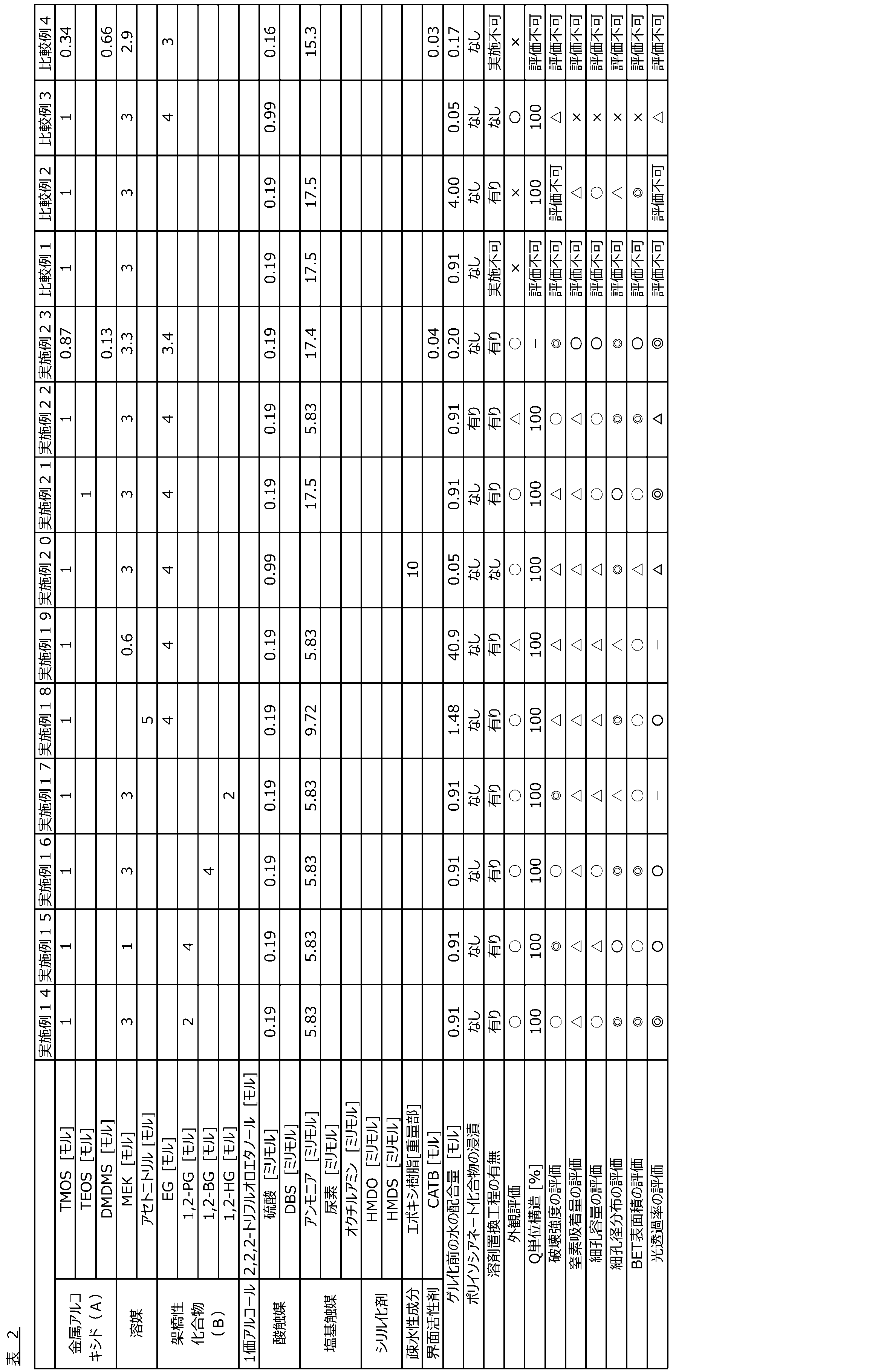
TMOS:テトラメトキシシラン
TEOS:テトラエトキシシラン
DMDMS:ジメチルジメトキシシラン
MEK:2-メチルエチルケトン
EG:エチレングリコール
1,2-PG:1,2-プロパンジオール
1,2-BG:1,2-ブタンジオール
1,2-HG:1,2-ヘキサンジオール
DBS:ドデシルベンゼンスルホン酸
HMDO:ヘキサメチルジシロキサン
HMDS:ヘキサメチルジシラザン
CATB:臭化ヘキサデシルトリメチルアンモニウム
また、表1、表2中、疎水性成分を除く各化合物の配合量は金属アルコキシド(A)1モルに対するモル数もしくはミリモル数で表記した。疎水性成分の配合量は金属アルコキシド(A)の総重量を100重量部とした場合における重量部で表記した。尚、水の混入量は酸触媒や塩基触媒中の水分量を含めた総量である。

表1、2に示すように、実施例1~23によれば、一般式(1)で表される構造(すなわち、-M-(OX)n-O-M-で表される構造)を含有する多孔質体は、強度の向上や細孔容量の増大が確認された。また、表3に示すように、実施例24、25によれば、粉末状の多孔質体において、優れた断熱性を示すことが確認され、さらに、ヘキサメチルジシロキサンを配合した多孔質体はかさ密度が低く、より高い断熱性を示すことが確認された。
Claims (18)
- 下記一般式(1)で表される構造を有する多孔質体。
-M-(OX)n-O-M- (1)
(上記一般式(1)中、Mは金属原子であり、Xは2価以上の任意の有機基であり、nは1以上の整数である。) - 上記一般式(1)中、Xは2価以上のアルコール残基またはエステル残基である請求項1に記載の多孔質体。
- 上記一般式(1)中、Xは2価以上のアルキレン基である請求項1に記載の多孔質体。
- 上記一般式(1)中、Xの炭素数が6以下である請求項1に記載の多孔質体。
- 上記一般式(1)中、Mは、Siである請求項1に記載の多孔質体。
- 温度77ケルビンの窒素吸脱着測定において、IUPACで定義されるIV型に分類される窒素吸脱着等温線を示す請求項1~5のいずれかに記載の多孔質体。
- 細孔径が100nm以下である細孔を有する請求項1~5のいずれかに記載の多孔質体。
- 細孔径が10nm以下である細孔を有する請求項1~5のいずれかに記載の多孔質体。
- 細孔径が10nm以下である細孔と、細孔径が10nm超、100nm以下である細孔とを有する請求項1~5のいずれかに記載の多孔質体。
- BJH法によって得られる細孔面積分布において、(細孔径が10nm以下の細孔面積分布の最大値)>(細孔径が10nm超、100nm以下の細孔面積分布の最大値)となることを特徴とする請求項1~5のいずれかに記載の多孔質体。
- 3mm厚みに換算した場合の波長600nmの直線透過光に対する透過率が10%以上である請求項1~5のいずれかに記載の多孔質体。
- DD/MAS法を用いて測定された固体29Si-NMRスペクトルにおいて、含ケイ素結合単位であるM単位、D単位、T単位及びQ単位に由来するピークの合計面積のうち、Q単位に由来するピーク面積の割合が10%以上である請求項1~5のいずれかに記載の多孔質体。
- バルク状である請求項1~5のいずれかに記載の多孔質体。
- 金属アルコキシド(A)と、アルコール性水酸基および/またはエステル結合を合計で2個以上有する架橋性化合物(B)とを用い、下記式(2)および/または下記式(3)によるエステル交換反応を進行させるエステル交換反応工程を含む多孔質体の製造方法。
Z-M-OR + R’OH → Z-M-OR’ + ROH (2)
Z-M-OR + R’COOR’’ → Z-M-OR’’ + R’COOR (3)
(上記式(2)、(3)中、Mは金属原子であり、R,R’,R’’は任意の有機基であり、Zは任意の基である。) - 前記エステル交換反応工程において、前記式(2)および/または前記式(3)によるエステル交換反応を、溶液状態で進行させる請求項14に記載の多孔質体の製造方法。
- 前記エステル交換反応工程を経た、水が実質的に含まれない溶媒を内包した湿潤ゲルを前駆体とした請求項14又は15に記載の多孔質体の製造方法。
- 前記エステル交換反応工程を経た、湿潤ゲルを溶媒に浸した状態で乾燥させる工程を含む請求項14又は15に記載の多孔質体の製造方法。
- 前記エステル交換反応工程を経た、湿潤ゲルを湿潤ゲル中に内包した溶媒の臨界点未満の温度及び/又は圧力下で乾燥させる工程を含む請求項14又は15に記載の多孔質体の製造方法。
Priority Applications (1)
| Application Number | Priority Date | Filing Date | Title |
|---|---|---|---|
| JP2024561550A JPWO2024117202A1 (ja) | 2022-12-02 | 2023-11-29 |
Applications Claiming Priority (4)
| Application Number | Priority Date | Filing Date | Title |
|---|---|---|---|
| JP2022193721 | 2022-12-02 | ||
| JP2022-193721 | 2022-12-02 | ||
| JP2023118673 | 2023-07-20 | ||
| JP2023-118673 | 2023-07-20 |
Publications (1)
| Publication Number | Publication Date |
|---|---|
| WO2024117202A1 true WO2024117202A1 (ja) | 2024-06-06 |
Family
ID=91323918
Family Applications (1)
| Application Number | Title | Priority Date | Filing Date |
|---|---|---|---|
| PCT/JP2023/042811 Ceased WO2024117202A1 (ja) | 2022-12-02 | 2023-11-29 | 多孔質体および多孔質体の製造方法 |
Country Status (2)
| Country | Link |
|---|---|
| JP (1) | JPWO2024117202A1 (ja) |
| WO (1) | WO2024117202A1 (ja) |
Cited By (1)
| Publication number | Priority date | Publication date | Assignee | Title |
|---|---|---|---|---|
| WO2025182436A1 (ja) * | 2024-02-29 | 2025-09-04 | 東洋製罐グループホールディングス株式会社 | 多孔質ゲルおよび多孔質ゲルの製造方法 |
Citations (2)
| Publication number | Priority date | Publication date | Assignee | Title |
|---|---|---|---|---|
| JP2012524127A (ja) * | 2009-03-12 | 2012-10-11 | コーニング インコーポレイテッド | 複合体並びに複合体の製造方法および使用方法 |
| JP2021503532A (ja) * | 2017-12-08 | 2021-02-12 | エルジー・ケム・リミテッド | エアロゲル前駆体およびそれを用いて製造したエアロゲル |
-
2023
- 2023-11-29 JP JP2024561550A patent/JPWO2024117202A1/ja active Pending
- 2023-11-29 WO PCT/JP2023/042811 patent/WO2024117202A1/ja not_active Ceased
Patent Citations (2)
| Publication number | Priority date | Publication date | Assignee | Title |
|---|---|---|---|---|
| JP2012524127A (ja) * | 2009-03-12 | 2012-10-11 | コーニング インコーポレイテッド | 複合体並びに複合体の製造方法および使用方法 |
| JP2021503532A (ja) * | 2017-12-08 | 2021-02-12 | エルジー・ケム・リミテッド | エアロゲル前駆体およびそれを用いて製造したエアロゲル |
Cited By (1)
| Publication number | Priority date | Publication date | Assignee | Title |
|---|---|---|---|---|
| WO2025182436A1 (ja) * | 2024-02-29 | 2025-09-04 | 東洋製罐グループホールディングス株式会社 | 多孔質ゲルおよび多孔質ゲルの製造方法 |
Also Published As
| Publication number | Publication date |
|---|---|
| JPWO2024117202A1 (ja) | 2024-06-06 |
Similar Documents
| Publication | Publication Date | Title |
|---|---|---|
| JP7375841B2 (ja) | エアロゲル複合体パウダーの製造方法 | |
| CN102574692B (zh) | 无定形二氧化硅及其制备方法 | |
| Shilova | Synthesis and structure features of composite silicate and hybrid TEOS-derived thin films doped by inorganic and organic additives | |
| EP3299340B1 (en) | Method for preparing spherical silica aerogel granules and spherical silica aerogel granules prepared thereby | |
| KR102103218B1 (ko) | 개선된 소수성 에어로겔 물질 | |
| KR102172825B1 (ko) | 실리카 함유 수지 조성물 및 그 제조 방법 그리고 실리카 함유 수지 조성물의 성형품 | |
| KR102840014B1 (ko) | 도액, 복합 재료 및 도막 | |
| KR101498562B1 (ko) | 실리카 에어로겔 분말 제조방법 | |
| KR101733042B1 (ko) | 수성 실리카 분산액 | |
| KR20160054462A (ko) | 에어로겔 재료의 제조방법 | |
| KR101141956B1 (ko) | 저유전율 특성을 가진 불화 마그네슘이 도핑된 실리카 복합 중공체, 그 제조 방법, 이를 포함하는 형성액 및 이 형성액으로 제조된 저유전율 기재 | |
| Duan et al. | Hydrophobic silica aerogels by silylation | |
| Zhang et al. | Insight into the organic–inorganic hybrid and microstructure tailor mechanism of sol–gel ORMOSIL antireflective coatings | |
| CN102245667A (zh) | 含二氧化硅的多元醇分散体的生产方法及其用于生产聚氨酯材料的用途 | |
| KR102638656B1 (ko) | 도액, 도막의 제조 방법 및 도막 | |
| WO2019069495A1 (ja) | 塗液、塗膜の製造方法及び塗膜 | |
| JPWO2018163354A1 (ja) | エアロゲル複合体の製造方法及びエアロゲル複合体 | |
| CA2782962A1 (en) | Polymeric hybrid organometalloglass | |
| WO2019069407A1 (ja) | 塗液、塗膜の製造方法及び塗膜 | |
| Abdali | Novel flexible glass composite film for stretchable devices applications | |
| WO2024117202A1 (ja) | 多孔質体および多孔質体の製造方法 | |
| KR102680525B1 (ko) | 구형 실리카 에어로겔 과립의 제조방법 | |
| KR20200061335A (ko) | 도액, 도막의 제조 방법 및 도막 | |
| KR20190067984A (ko) | 에어로겔 전구체 및 이를 이용하여 제조한 에어로겔 | |
| WO2025182436A1 (ja) | 多孔質ゲルおよび多孔質ゲルの製造方法 |
Legal Events
| Date | Code | Title | Description |
|---|---|---|---|
| 121 | Ep: the epo has been informed by wipo that ep was designated in this application |
Ref document number: 23897848 Country of ref document: EP Kind code of ref document: A1 |
|
| WWE | Wipo information: entry into national phase |
Ref document number: 2024561550 Country of ref document: JP |
|
| NENP | Non-entry into the national phase |
Ref country code: DE |
|
| 122 | Ep: pct application non-entry in european phase |
Ref document number: 23897848 Country of ref document: EP Kind code of ref document: A1 |