WO2024116819A1 - カラーフィルタ、及び表示装置 - Google Patents
カラーフィルタ、及び表示装置 Download PDFInfo
- Publication number
- WO2024116819A1 WO2024116819A1 PCT/JP2023/040871 JP2023040871W WO2024116819A1 WO 2024116819 A1 WO2024116819 A1 WO 2024116819A1 JP 2023040871 W JP2023040871 W JP 2023040871W WO 2024116819 A1 WO2024116819 A1 WO 2024116819A1
- Authority
- WO
- WIPO (PCT)
- Prior art keywords
- group
- mass
- colored layer
- substituent
- parts
- Prior art date
- Legal status (The legal status is an assumption and is not a legal conclusion. Google has not performed a legal analysis and makes no representation as to the accuracy of the status listed.)
- Ceased
Links
Images


Classifications
-
- G—PHYSICS
- G02—OPTICS
- G02B—OPTICAL ELEMENTS, SYSTEMS OR APPARATUS
- G02B5/00—Optical elements other than lenses
- G02B5/20—Filters
-
- G—PHYSICS
- G02—OPTICS
- G02F—OPTICAL DEVICES OR ARRANGEMENTS FOR THE CONTROL OF LIGHT BY MODIFICATION OF THE OPTICAL PROPERTIES OF THE MEDIA OF THE ELEMENTS INVOLVED THEREIN; NON-LINEAR OPTICS; FREQUENCY-CHANGING OF LIGHT; OPTICAL LOGIC ELEMENTS; OPTICAL ANALOGUE/DIGITAL CONVERTERS
- G02F1/00—Devices or arrangements for the control of the intensity, colour, phase, polarisation or direction of light arriving from an independent light source, e.g. switching, gating or modulating; Non-linear optics
- G02F1/01—Devices or arrangements for the control of the intensity, colour, phase, polarisation or direction of light arriving from an independent light source, e.g. switching, gating or modulating; Non-linear optics for the control of the intensity, phase, polarisation or colour
- G02F1/13—Devices or arrangements for the control of the intensity, colour, phase, polarisation or direction of light arriving from an independent light source, e.g. switching, gating or modulating; Non-linear optics for the control of the intensity, phase, polarisation or colour based on liquid crystals, e.g. single liquid crystal display cells
- G02F1/133—Constructional arrangements; Operation of liquid crystal cells; Circuit arrangements
- G02F1/1333—Constructional arrangements; Manufacturing methods
- G02F1/1335—Structural association of cells with optical devices, e.g. polarisers or reflectors
-
- G—PHYSICS
- G09—EDUCATION; CRYPTOGRAPHY; DISPLAY; ADVERTISING; SEALS
- G09F—DISPLAYING; ADVERTISING; SIGNS; LABELS OR NAME-PLATES; SEALS
- G09F9/00—Indicating arrangements for variable information in which the information is built-up on a support by selection or combination of individual elements
- G09F9/30—Indicating arrangements for variable information in which the information is built-up on a support by selection or combination of individual elements in which the desired character or characters are formed by combining individual elements
-
- H—ELECTRICITY
- H10—SEMICONDUCTOR DEVICES; ELECTRIC SOLID-STATE DEVICES NOT OTHERWISE PROVIDED FOR
- H10K—ORGANIC ELECTRIC SOLID-STATE DEVICES
- H10K59/00—Integrated devices, or assemblies of multiple devices, comprising at least one organic light-emitting element covered by group H10K50/00
- H10K59/30—Devices specially adapted for multicolour light emission
- H10K59/38—Devices specially adapted for multicolour light emission comprising colour filters or colour changing media [CCM]
Definitions
- the present invention relates to a color filter and a display device.
- Color filters are used in these liquid crystal display devices and organic light-emitting display devices. For example, when a color image is formed in an LCD display device, the light that passes through the color filter is directly colored with the color of each pixel that makes up the color filter, and these colors of light are combined to form a color image.
- white-emitting organic light-emitting elements or white-emitting inorganic light-emitting elements may be used as light sources in this case.
- organic light-emitting display devices use color filters for color adjustment, etc.
- a color filter generally has a substrate, a colored layer formed on the substrate and including colored patterns of the three primary colors, red, green, and blue, and a light-shielding portion formed on the substrate so as to partition each colored pattern.
- a method for forming such a colored layer a method is known in which a colored resin composition, in which a curable binder component and the like are added to a colorant dispersion liquid in which a colorant is dispersed, is applied to a substrate and cured.
- a colored resin composition in which a curable binder component and the like are added to a colorant dispersion liquid in which a colorant is dispersed
- Patent Document 1 discloses a colorant dispersion liquid and a colored resin composition that contain a specific lake colorant, a phthalocyanine pigment, and a specific acidic dispersant, and states that the colored resin composition has excellent dispersibility and storage stability even when the specific lake colorant and the phthalocyanine pigment are mixed in a desired range, and is capable of forming a colored layer that has improved substrate adhesion and coating uniformity.
- Patent Document 2 discloses a colored resin composition containing a specific phthalocyanine dye, and states that the colored resin composition has sufficient brightness for practical use and is capable of forming a pattern in which the generation of foreign matter is suppressed.
- a halogenated zinc phthalocyanine coloring material in which a substituent is bonded via an ether bond (-O-) has good solvent solubility and can be dissolved in a solvent as a dye and used in a colored resin composition.
- the present invention has been made in consideration of the above-mentioned circumstances, and aims to provide a color filter in which the occurrence of development residues on the blue or green colored layer is suppressed when a colored resin composition containing a halogenated zinc phthalocyanine coloring material dissolved in a solvent is used as a resin composition for forming a green colored layer, and a display device using the color filter and having excellent display characteristics.
- a color filter comprising at least a substrate and a colored layer provided on the substrate,
- the colored layer includes a green colored layer containing a halogenated zinc phthalocyanine coloring material having a substituent bonded thereto via an ether bond; and a blue colored layer containing at least one lake colorant selected from the group consisting of a colorant represented by the following general formula (1-1) and a colorant represented by the following general formula (1-2):
- A represents an a-valent organic group in which the carbon atom directly bonded to N does not have a ⁇ bond, and the organic group represents an aliphatic hydrocarbon group having a saturated aliphatic hydrocarbon group at least at an end directly bonded to N, or an aromatic group having the aliphatic hydrocarbon group, and may contain a heteroatom in the carbon chain.
- B c- represents a c-valent polyacid anion.
- R i to R v each independently represent a hydrogen atom, an alkyl group which may have a substituent, or an aryl group which may have a substituent, and R ii and R ii , and R iv and R v may bond to form a ring structure.
- R vi and R vii each independently represent an alkyl group which may have a substituent, an alkoxy group which may have a substituent, a halogen atom, or a cyano group.
- Ar 1 represents a divalent aromatic group which may have a substituent.
- a plurality of R i to R vii and Ar 1 may be the same or different.
- a and c represent integers of 2 or more, and b and d represent integers of 1 or more.
- e is 0 or 1, and when e is 0, no bond exists.
- f and g represent integers of 0 to 4, and f+e and g+e are 0 to 4. Multiple e, f, and g may be the same or different.
- R I to R VI each independently represent a hydrogen atom, an alkyl group which may have a substituent, or an aryl group which may have a substituent, and R I and R II , R III and R IV , and R V and R VI may be bonded to form a ring structure.
- R VII and R VIII each independently represent an alkyl group which may have a substituent, an alkoxy group which may have a substituent, a halogen atom, or a cyano group.
- Ar 2 represents a divalent aromatic heterocyclic group which may have a substituent, and a plurality of R I to R VIII and Ar 2 may be the same or different.
- E m- represents an m-valent polyacid anion.
- m represents an integer of 2 or more; j is 0 or 1, and when j is 0, no bond exists; k and l represent integers of 0 to 4, and k+j and l+j are 0 to 4. Multiple j, k and l may be the same or different.
- X 1 to X 16 each independently represent a hydrogen atom, a halogen atom, or -OR D , and R D represents a monovalent organic group. However, at least one of X 1 to X 16 represents a halogen atom, and at least one of X 1 to X 16 represents -OR D. )
- a colored resin composition containing a halogenated zinc phthalocyanine coloring material dissolved in a solvent is used as a resin composition for forming a green colored layer, it is possible to provide a color filter in which the occurrence of development residues on the blue or green colored layer is suppressed, and a display device using the color filter and having excellent display characteristics.
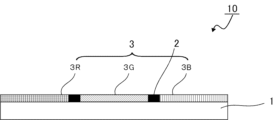
- FIG. 1 is a schematic diagram showing an example of the color filter of the present invention.
- FIG. 2 is a schematic diagram showing an example of a display device of the present invention.
- FIG. 3 is a schematic diagram showing another example of the display device of the present invention.
- light includes electromagnetic waves with wavelengths in the visible and invisible regions, as well as radiation
- radiation includes, for example, microwaves and electron beams. Specifically, it refers to electromagnetic waves with wavelengths of 5 ⁇ m or less and electron beams.
- the term "(meth)acrylic” refers to both acrylic and methacrylic
- the term "(meth)acrylate” refers to both acrylate and methacrylate.
- the use of "to" indicating a range of values is used to mean that the values before and after it are included as the lower limit and upper limit.
- the color filter according to the present invention is a color filter including at least a substrate and a colored layer provided on the substrate,
- the colored layer includes a green colored layer containing a halogenated zinc phthalocyanine coloring material having a substituent bonded thereto via an ether bond; and a blue colored layer containing at least one lake colorant selected from the group consisting of a colorant represented by the following general formula (1-1) and a colorant represented by the following general formula (1-2):
- A represents an a-valent organic group in which the carbon atom directly bonded to N does not have a ⁇ bond, and the organic group represents an aliphatic hydrocarbon group having a saturated aliphatic hydrocarbon group at least at an end directly bonded to N, or an aromatic group having the aliphatic hydrocarbon group, and may contain a heteroatom in the carbon chain.
- B c- represents a c-valent polyacid anion.
- R i to R v each independently represent a hydrogen atom, an alkyl group which may have a substituent, or an aryl group which may have a substituent, and R ii and R ii , and R iv and R v may bond to form a ring structure.
- R vi and R vii each independently represent an alkyl group which may have a substituent, an alkoxy group which may have a substituent, a halogen atom, or a cyano group.
- Ar 1 represents a divalent aromatic group which may have a substituent.
- a plurality of R i to R vii and Ar 1 may be the same or different.
- a and c represent integers of 2 or more, and b and d represent integers of 1 or more.
- e is 0 or 1, and when e is 0, no bond exists.
- f and g represent integers of 0 to 4, and f+e and g+e are 0 to 4. Multiple e, f, and g may be the same or different.
- R I to R VI each independently represent a hydrogen atom, an alkyl group which may have a substituent, or an aryl group which may have a substituent, and R I and R II , R III and R IV , and R V and R VI may be bonded to form a ring structure.
- R VII and R VIII each independently represent an alkyl group which may have a substituent, an alkoxy group which may have a substituent, a halogen atom, or a cyano group.
- Ar 2 represents a divalent aromatic heterocyclic group which may have a substituent, and a plurality of R I to R VIII and Ar 2 may be the same or different.
- E m- represents an m-valent polyacid anion.
- m represents an integer of 2 or more; j is 0 or 1, and when j is 0, no bond exists; k and l represent integers of 0 to 4, and k+j and l+j are 0 to 4. Multiple j, k and l may be the same or different.
- the color filter according to the present invention has a color layer that includes a green color layer containing a halogenated zinc phthalocyanine color material having a substituent bonded via an ether bond in combination with a blue color layer containing the specific lake color material, and therefore can be a color filter in which the generation of development residues on the blue color layer or the green color layer is suppressed.
- the halogenated zinc phthalocyanine coloring material to which the substituent is bonded via an ether bond has good solvent solubility.
- a resin composition for forming a blue colored layer is applied onto a green colored layer in which a halogenated zinc phthalocyanine colorant is present in molecular form
- the halogenated zinc phthalocyanine colorant is likely to interact with the copper phthalocyanine pigment in the resin composition for forming a blue colored layer, resulting in development residues of the blue resin composition.
- a green colored layer containing a halogenated zinc phthalocyanine coloring material to which a substituent is bonded via the ether bond is used in combination with a blue colored layer containing the specific lake coloring material.
- the blue colored layer of the present invention contains at least one lake coloring material selected from the group consisting of the coloring material represented by the general formula (1-1) and the coloring material represented by the general formula (1-2), and the lake coloring material has a skeleton different from that of the halogenated zinc phthalocyanine coloring material.
- the green colored layer in which the halogenated zinc phthalocyanine colorant in which blue development residues are suppressed is present in molecular form has improved transmittance
- the blue colored layer containing the specific lake colorant in which green development residues are suppressed also has improved transmittance, so it is estimated that the brightness of the entire color filter is also improved.
- FIG. 1 is a schematic cross-sectional view showing an example of a color filter according to the present invention.
- the color filter 10 according to the present invention has a substrate 1, light-shielding portions 2 formed on the substrate 1, and color layers 3 formed between the light-shielding portions 2 and including a red color layer 3R, a green color layer 3G, and a blue color layer 3B.
- the substrate may be a transparent substrate, a silicon substrate, or a transparent or silicon substrate on which an aluminum, silver, or silver/copper/palladium alloy thin film is formed, as described below.
- a transparent substrate a silicon substrate, or a transparent or silicon substrate on which an aluminum, silver, or silver/copper/palladium alloy thin film is formed, as described below.
- other color filter layers, resin layers, transistors such as TFTs, circuits, etc. may be formed.
- the transparent substrate in the color filter of the present invention is not particularly limited as long as it is a base material transparent to visible light, and a transparent substrate used in general color filters can be used.
- the transparent substrate include transparent rigid materials with no flexibility, such as quartz glass, non-alkali glass, and synthetic quartz plate, and transparent flexible materials with flexibility, such as transparent resin films, optical resin plates, and flexible glass.
- the thickness of the transparent substrate is not particularly limited, but may be, for example, about 100 ⁇ m to 1 mm depending on the application of the color filter of the present invention.
- the light-shielding portion in the color filter of the present invention is formed in a pattern on the substrate, and can be the same as that used as a light-shielding portion in a general color filter.
- the pattern shape of the light-shielding part is not particularly limited, and examples thereof include stripe-like and matrix-like shapes.
- the light-shielding part may be a thin metal film such as chromium formed by sputtering, vacuum deposition, or the like.
- the light-shielding part may be a resin layer containing light-shielding particles such as carbon fine particles, metal oxides, inorganic pigments, and organic pigments in a resin binder.
- a resin layer containing light-shielding particles there are a method of patterning by development using a photosensitive resist, a method of patterning using an inkjet ink containing light-shielding particles, a method of thermally transferring a photosensitive resist, and the like.
- the film thickness of the light-shielding part is set to approximately 0.2 ⁇ m or more and 0.4 ⁇ m or less in the case of a thin metal film, and is set to approximately 0.5 ⁇ m or more and 2 ⁇ m or less in the case of a black pigment dispersed or dissolved in a binder resin.
- the colored layer used in the color filter of the present invention comprises a green colored layer containing a halogenated zinc phthalocyanine coloring material having a substituent bonded via an ether bond; and a blue colored layer containing at least one lake colorant selected from the group consisting of the colorant represented by the general formula (1-1) and the colorant represented by the general formula (1-2).
- the colored layer is usually formed in the opening of the light-shielding part on the substrate, and usually has a colored pattern of three or more colors.
- the colored layer of the present invention includes at least the green colored layer and the blue colored layer, and may further include a red colored layer.
- the arrangement of the colored layers is not particularly limited, and may be, for example, a common arrangement such as a stripe type, a mosaic type, a triangle type, a four-pixel arrangement type, etc.
- the width, area, etc. of the colored layers may be set arbitrarily.
- the thickness of the colored layer is appropriately controlled by adjusting the coating method, the solid content concentration and the viscosity of the colored resin composition, etc., but it is usually preferable that the thickness is in the range of 1 ⁇ m to 5 ⁇ m.
- the colored layer usually contains a binder component in order to impart film-forming properties and adhesion to the coated surface.
- the colored layer of the present invention may be a cured product of a colored resin composition that contains a colorant, a binder component, and optionally a dispersant, a solvent, and further other components.
- the colored layers of each color will be described in detail below.
- the green colored layer used in the present invention contains a halogenated zinc phthalocyanine coloring material having a substituent bonded via an ether bond.
- the green colored layer may be a cured product of a colored resin composition that contains the specific halogenated zinc phthalocyanine coloring material, a binder component, a solvent, and, if necessary, a dispersant and other components.
- the coloring material in the green colored layer contains a halogenated zinc phthalocyanine coloring material having a substituent bonded via an ether bond, and may further contain other coloring materials.
- the halogenated zinc phthalocyanine coloring material may have high solvent solubility in order to easily exert the effects of the present invention.
- the halogenated zinc phthalocyanine coloring material may have a solubility at 25°C in 100g of at least one solvent selected from the group consisting of glycol alkyl ether acetates, glycol monoalkyl ethers, and glycol alkyl acetates of 0.1g or more, 0.5g or more, 8g or more, 10g or more, or 15g or more.
- the halogenated zinc phthalocyanine coloring material may have a solubility at 25°C in 100g of at least one solvent selected from the group consisting of propylene glycol monomethyl ether acetate, propylene glycol monomethyl ether, propylene glycol monoethyl ether, 1-methoxy-2 butanol, propylene glycol monopropyl ether, and diethylene glycol ethyl methyl ether of 0.1g or more, 0.5g or more, 8g or more, 10g or more, or 15g or more.
- the upper limit of the solubility is not limited, but may be 20 g or less.
- the phthalocyanine compound represented by the following general formula (2) is preferred in terms of brightness and solubility.
- X 1 to X 16 each independently represent a hydrogen atom, a halogen atom, or -OR D , and R D represents a monovalent organic group. However, at least one of X 1 to X 16 represents a halogen atom, and at least one of X 1 to X 16 represents -OR D. )
- examples of the halogen atom include a fluorine atom, a chlorine atom, a bromine atom, and an iodine atom.
- the halogen atoms may be the same or different from each other.
- the halogen atoms in X 1 to X 16 preferably include at least a fluorine atom, and more preferably are all fluorine atoms.
- the number of halogen atoms in X 1 to X 16 is preferably 4 or more, more preferably 6 or more, and even more preferably 7 or more.
- the number of halogen atoms in X 1 to X 16 is preferably 12 or less, more preferably 10 or less, and even more preferably 9 or less.
- the number of halogen atoms in X 1 to X 16 may be 8.
- 6 to 10, and more preferably 7 to 9 of X 1 to X 16 are fluorine atoms.
- X 1 to X 16 may be a hydrogen atom.
- the number of hydrogen atoms among X 1 to X 16 may be appropriately selected depending on the adjustment of the color tone, and may be 0 to 8, 0 to 4, or 0 to 2.
- R D in -O-R D is a monovalent organic group.
- the organic group refers to a group containing carbon atoms.
- R D may be a hydrocarbon group or a heterocyclic group which may have a substituent.
- Examples of the hydrocarbon group include linear, branched, or cyclic aliphatic hydrocarbon groups, aromatic hydrocarbon groups, and combinations thereof.
- the linear or branched aliphatic hydrocarbon group may be a linear or branched aliphatic hydrocarbon group having 1 to 10 carbon atoms
- the cyclic aliphatic hydrocarbon group may be an alicyclic hydrocarbon group having 3 to 20 carbon atoms
- the aromatic hydrocarbon group may be an aromatic hydrocarbon group having 6 to 20 carbon atoms
- the heterocyclic group may be a nitrogen-containing heterocycle, a sulfur-containing heterocycle, an oxygen-containing heterocycle, or the like, and may be either an aromatic ring or a non-aromatic ring.
- Examples of the linear or branched aliphatic hydrocarbon group include a methyl group, an ethyl group, a propyl group, a butyl group, a pentyl group, and a hexyl group, and examples of the alicyclic hydrocarbon group include a cyclopentyl group and a cyclohexyl group.
- Examples of the aromatic hydrocarbon group include a phenyl group, a naphthyl group, and a biphenyl group.
- heterocyclic group examples include groups having one free valence, such as a furan ring, a thiophene ring, a pyrrole ring, a 2H-pyran ring, a 4H-thiopyran ring, a pyridine ring, a 1,3-oxazole ring, an isoxazole ring, a 1,3-thiazole ring, an isothiazole ring, an imidazole ring, a pyrazole ring, a furazan ring, a pyrazine ring, a pyrimidine ring, and a pyridazine ring.
- groups having one free valence such as a furan ring, a thiophene ring, a pyrrole ring, a 2H-pyran ring, a 4H-thiopyran ring, a pyridine ring, a 1,3-oxazole ring, an isoxazo
- examples of the substituent include a halogen atom, -OR d1 , -COR d1 , -COOR d1 (wherein R d1 is a hydrocarbon group or a heterocyclic group), and specific examples thereof include an alkoxy group, an aryloxy group, an acyl group, an alkoxycarbonyl group, an aryloxycarbonyl group, and the like.
- R D in -O-R D is preferably an aromatic hydrocarbon group which may have a substituent, from the viewpoints of controlling crystallinity (suppressing deposition of foreign matter) during coating film curing (baking) and imparting solubility, and is preferably a monovalent group represented by the following formula (3):
- R d1 is an aliphatic hydrocarbon group having 1 to 10 carbon atoms which may have a substituent, an alicyclic hydrocarbon group having 3 to 12 carbon atoms which may have a substituent, or an aromatic hydrocarbon group having 6 to 20 carbon atoms which may have a substituent
- R d2 is a halogen atom, an alkyl group having 1 to 4 carbon atoms, or an alkoxy group having 1 to 4 carbon atoms
- p is an integer of 1 to 3
- q is an integer of 0 to 2.
- examples of the substituents of the aliphatic hydrocarbon group, alicyclic hydrocarbon group, and aromatic hydrocarbon group include an alkoxy group having 1 to 5 carbon atoms and a hydroxyl group.
- R d1 is preferably an aliphatic hydrocarbon group having 1 to 10 carbon atoms which may have a substituent, and particularly preferably an alkyl group having 1 to 10 carbon atoms which may have a substituent.
- the alkyl group is preferably an alkyl group having 1 to 5 carbon atoms, and more preferably a linear alkyl group having 1 to 5 carbon atoms.
- R d1 is a substituted alkyl group, it is preferably a group having an alkoxy group having 1 to 5 carbon atoms as a substituent.
- p is preferably 1 or 2, and more preferably 1.
- -CO-W-R d1 is preferably bonded to the 3- or 4-position relative to -O- in the above formula (3), and more preferably bonded to the 4-position.
- the two -CO-W-R d1 are preferably bonded to the 3- and 5-positions or the 2- and 4-positions relative to -O-, and more preferably bonded to the 3- and 5-positions.
- q is preferably 0 or 1, and more preferably 0.
- Preferred specific examples of the group represented by the above formula (3) include groups represented by each of the following formulas (3-1) to (3-10), but are not limited thereto.
- the number of -O-R D in X 1 to X 16 is preferably 4 or more, more preferably 6 or more, and even more preferably 7 or more, from the viewpoint of obtaining a desired transmission spectrum (high brightness) and controlling the crystallinity specific to the phthalocyanine compound during coating film curing (baking) (suppressing precipitation of foreign matter).
- the number of -O-R D in X 1 to X 16 is preferably 12 or less, more preferably 10 or less, and even more preferably 9 or less.
- the number of -O-R D in X 1 to X 16 may be 8.
- X 1 to X 16 , X 2 , X 3 , X 6 , X 7 , X 10 , X 11 , X 14 and X 15 are -O-R D , and it is particularly preferable that all of X 2 , X 3 , X 6 , X 7 , X 10 , X 11 , X 14 and X 15 are groups -O-R D and the remaining (X 1 , X 4 , X 5 , X 8 , X 9 , X 12 , X 13 and X 16 ) are halogen atoms.
- Preferred specific examples of the phthalocyanine compound represented by general formula (2) include, but are not limited to, the compounds represented by the following formulas (2-1) to (2-5).
- a conventionally known manufacturing method can be appropriately selected and used as a manufacturing method for the halogenated phthalocyanine colorant.
- a manufacturing method in which a phthalonitrile compound and a metal salt are subjected to a cyclization reaction in a molten state or in an organic solvent can be preferably used, and manufacturing can be performed by referring to, for example, JP-A-2014-43556 and JP-A-2020-42263.
- the phthalonitrile compound used as the starting material can also be synthesized by appropriately selecting a conventionally known manufacturing method, or a commercially available product can be used.
- the coloring material may further contain other coloring materials in addition to the specific halogenated zinc phthalocyanine coloring material.
- the other coloring materials are not particularly limited as long as they can produce the desired color, and various organic pigments, inorganic pigments, dyes, dye salt compounds, etc. can be used alone or in combination of two or more. Among them, organic pigments are preferably used because they have high color development and high heat resistance. Examples of organic pigments include compounds classified as pigments in the Color Index (C.I.; published by The Society of Dyers and Colourists), specifically, those assigned the following Color Index (C.I.) numbers.
- the other coloring material may be one or more selected from the group consisting of a yellow coloring material and other green coloring materials. From the viewpoint of color adjustment of the green colored layer, a yellow coloring material is preferable, but other green coloring materials or other coloring materials may be included within a range that does not impair the effects of the present invention.
- Yellow colorants include, for example, C.I. Pigment Yellow 1, 3, 12, 13, 14, 15, 16, 17, 20, 24, 31, 55, 60, 61, 65, 71, 73, 74, 81, 83, 93, 95, 97, 98, 100, 101, 104, 106, 108, 109, 110, 113, 114, 116, 117, 119, 120, 126, 127, 128, 129 , 138, 139, 150, 151, 152, 153, 154, 155, 156, 166, 168, 175, 185, 231, and derivative pigments thereof, and yellow dyes such as coumarin dyes, cyanine dyes, merocyanine dyes, azo dyes, methine dyes, azomethine dyes, and quinophthalone dyes.
- yellow dyes such as coumarin dyes, cyanine dyes, merocyanine dyes, azo dyes, methine dyes, azomethine dyes, and
- quinophthalone-based coloring materials are preferable because they have good heat resistance and light resistance and high transmittance. Quinophthalone-based coloring materials are also preferable because they have a hue suitable for use in color filters.
- the quinophthalone coloring material refers to a coloring material synthesized by condensation of a quinoline derivative such as quinaldine with a phthalic anhydride derivative or a naphthalic anhydride derivative, and may be any of a pigment, a dye, and a dye salt-forming compound.
- examples of quinophthalone pigments include C.I. Pigment Yellow 138 and the like.
- examples of quinophthalone dyes include C.I. Disperse Yellow 54, 64, 67, 134, 149, and 160, and C.I. Solvent Yellow 114 and 157.
- green colorants include green pigments such as C.I. Pigment Green 1, 2, 4, 7, 8, 10, 13, 14, 15, 17, 18, 19, 26, 36, 45, 48, 50, 51, 54, 55, 58, 59, 62, and 63, and green dyes such as squarylium, triarylmethane, anthraquinone, coumarin, cyanine, or azo dyes.
- green pigments such as C.I. Pigment Green 1, 2, 4, 7, 8, 10, 13, 14, 15, 17, 18, 19, 26, 36, 45, 48, 50, 51, 54, 55, 58, 59, 62, and 63
- green dyes such as squarylium, triarylmethane, anthraquinone, coumarin, cyanine, or azo dyes.
- the content ratio of the specific halogenated zinc phthalocyanine coloring material to the entire coloring material may be appropriately adjusted according to the desired chromaticity, is not particularly limited, and may be 100% by mass based on the entire coloring material including the specific halogenated zinc phthalocyanine coloring material.
- the specific halogenated zinc phthalocyanine coloring material may be contained in an amount of 30% to 95% by mass based on the entire coloring material including the specific halogenated zinc phthalocyanine coloring material from the viewpoint of desired chromaticity adjustment, and the lower limit may be 40 parts by mass or more, or 50 parts by mass or more, and the upper limit may be 85 parts by mass or less, or 80 parts by mass or less.
- the yellow coloring material when a yellow coloring material is contained, the yellow coloring material is appropriately selected and used alone or in combination of two or more kinds.
- the content ratio of the yellow coloring material relative to the specific halogenated zinc phthalocyanine coloring material may be appropriately adjusted according to the desired chromaticity, and is not particularly limited.
- the content ratio of the yellow coloring material may be 0 parts by mass to 233 parts by mass relative to 100 parts by mass of the specific halogenated zinc phthalocyanine coloring material
- the lower limit may be 5 parts by mass or more, 18 parts by mass or more, or 25 parts by mass or more
- the upper limit may be 150 parts by mass or less, or 100 parts by mass or less.
- the green colorant other than the specific halogenated zinc phthalocyanine colorant when a green colorant other than the specific halogenated zinc phthalocyanine colorant is contained, the green colorant other than the specific halogenated zinc phthalocyanine colorant is appropriately selected and used alone or in combination of two or more.
- the content ratio of the green coloring material different from the specific halogenated zinc phthalocyanine coloring material to the specific halogenated zinc phthalocyanine coloring material may be appropriately adjusted to a desired chromaticity within a range in which the effects of the present invention are not impaired.
- the content ratio of the green coloring material different from the specific halogenated zinc phthalocyanine coloring material may be, for example, 0 parts by mass to 50 parts by mass relative to 100 parts by mass of the specific halogenated zinc phthalocyanine coloring material, the lower limit may be 5 parts by mass or more, 10 parts by mass or more, or 15 parts by mass or more, and the upper limit may be 30 parts by mass or less, or 20 parts by mass or less.
- the content ratio of the green coloring material including the specific halogenated zinc phthalocyanine coloring material to the entire coloring material is not particularly limited as long as it is appropriately adjusted according to the desired chromaticity.
- the content ratio of the yellow coloring material relative to the green coloring material containing the specific halogenated zinc phthalocyanine coloring material is not particularly limited as long as it is appropriately adjusted according to the desired chromaticity.
- it is preferable to contain 5 parts by mass to 233 parts by mass of the yellow coloring material relative to 100 parts by mass of the green coloring material containing the specific halogenated zinc phthalocyanine coloring material or it may contain 18 parts by mass to 150 parts by mass, or it may contain 25 parts by mass to 100 parts by mass.
- the coloring material may further contain other coloring materials in addition to the green coloring material and the yellow coloring material, as long as the effects of the present invention are not impaired.
- the total content of the specific zinc halide phthalocyanine coloring material and the yellow coloring material may be 70% by mass to 100% by mass, particularly 80% by mass to 100% by mass, 90% by mass to 100% by mass, or even 100% by mass.
- the content of the coloring material is not particularly limited.
- the total content of the coloring material is, for example, preferably 20% by mass to 50% by mass, more preferably 25% by mass to 45% by mass, based on the total solid content of the green colored layer and the colored resin composition for forming the green colored layer, from the viewpoint of dispersibility and dispersion stability. If it is equal to or greater than the above lower limit, the green colored layer when the colored resin composition for forming the green colored layer is applied to a predetermined film thickness (usually 1.0 ⁇ m to 5.0 ⁇ m) has a sufficient color density.
- the total content of the coloring material is preferably 35% by mass to 50% by mass, more preferably 40% by mass to 45% by mass, based on the total solid content of the green colored layer and the colored resin composition for forming the green colored layer.
- the solid content refers to everything other than the solvent described below, including monomers dissolved in the solvent.
- the colored resin composition used in the present invention contains a binder component to impart film-forming properties and adhesion to the coated surface. It is preferable to contain a curable binder component to impart sufficient hardness to the coating film.
- the curable binder component is not particularly limited, and a curable binder component used to form a colored layer of a conventionally known color filter can be appropriately used.
- the colored layer may contain a cured product of the binder component.
- the curable binder component for example, a photocurable binder component containing a photocurable resin that can be polymerized and cured by visible light, ultraviolet light, electron beam, or the like, or a thermosetting binder component containing a thermosetting resin that can be polymerized and cured by heating can be used.
- a photosensitive binder component having alkali developability is preferably used.
- the photosensitive binder component may further contain a thermosetting binder component.
- the photosensitive binder component include a positive-type photosensitive binder component and a negative-type photosensitive binder component.
- the positive-type photosensitive binder component include a composition containing an alkali-soluble resin and an o-quinonediazide group-containing compound as a photosensitivity-imparting component.
- the negative photosensitive binder component a composition containing at least an alkali-soluble resin, a polyfunctional monomer, and a photoinitiator is preferably used.
- a negative photosensitive binder component is preferred from the viewpoint of easily forming a pattern by a photolithography method using an existing process.
- the alkali-soluble resin, the polyfunctional monomer, and the photoinitiator that constitute the negative photosensitive binder component will be described below.
- the alkali-soluble resin used in the present invention has an acidic group, acts as a binder resin, and can be appropriately selected from those that are soluble in an alkaline developer used in forming a pattern.
- an alkali-soluble resin can be defined as one having an acid value of 40 mgKOH/g or more.
- the preferred alkali-soluble resin in the present invention is a resin having an acidic group, usually a carboxy group.
- alkali-soluble resins include (meth)acrylic resins such as (meth)acrylic copolymers having a carboxy group and styrene-(meth)acrylic copolymers having a carboxy group, and epoxy (meth)acrylate resins having a carboxy group.
- alkali-soluble resins can be appropriately selected from conventionally known alkali-soluble resins.
- the photopolymerizable compound used in the present invention is not particularly limited as long as it is polymerizable by a photoinitiator.
- a compound having two or more ethylenically unsaturated bonds is preferably used, and in particular, a polyfunctional (meth)acrylate having two or more acryloyl groups or methacryloyl groups is preferable.
- Such a polyfunctional (meth)acrylate can be appropriately selected from conventionally known photopolymerizable compounds. Specific examples include those described in JP-A-2013-029832.
- paragraphs 0177 to 0179 of WO 2020/071041 can be referred to as a photopolymerizable compound.
- the photoinitiator used in the colored resin composition of the present invention is not particularly limited, and one or more types may be appropriately selected from various conventionally known initiators and used in combination.
- the photoinitiator include aromatic ketones, benzoin ethers, halomethyloxadiazole compounds, ⁇ -aminoketones, biimidazoles, N,N-dimethylaminobenzophenone, halomethyl-S-triazine compounds, thioxanthone, and oxime ester compounds.
- the photoinitiator reference can be made to, for example, paragraphs 0180 to 0184 of WO 2020/071041.
- the total content of the binder components is preferably 5% to 90% by mass, preferably 10% to 80% by mass, more preferably 20% to 70% by mass, and even more preferably 30% to 60% by mass, based on the total solid content of the colored resin composition, in terms of film-forming properties and adhesion of the colored layer to the substrate surface to be coated.
- a dispersant in the green colored layer and the colored resin composition for forming the green colored layer of the present invention, when a colorant is dispersed, a dispersant may be further contained from the viewpoints of colorant dispersibility and colorant dispersion stability.
- the dispersant can be appropriately selected from conventionally known dispersants.
- cationic, anionic, nonionic, amphoteric, silicone, fluorine-based surfactants can be used as the dispersant.
- the surfactants polymer dispersants are preferred because they can be uniformly and finely dispersed.
- polymeric dispersants include (co)polymers of unsaturated carboxylic acid esters such as polyacrylic acid esters; (partial) amine salts, (partial) ammonium salts, and (partial) alkylamine salts of (co)polymers of unsaturated carboxylic acids such as polyacrylic acid; (co)polymers of hydroxyl-containing unsaturated carboxylic acid esters such as hydroxyl-containing polyacrylic acid esters and modified products thereof; polyurethanes; unsaturated polyamides; polysiloxanes; long-chain polyaminoamide phosphates; polyethyleneimine derivatives (amides and their bases obtained by reacting poly(lower alkyleneimine) with polyesters containing free carboxyl groups); polyallylamine derivatives (reaction products obtained by reacting polyallylamine with one or more compounds selected from the following three compounds: polyesters having free carboxyl groups, polyamides, or co-condensates of esters and amides (polyester
- a polymer dispersant that contains nitrogen atoms in the main chain or side chain and has an amine value a polymer having a structural unit represented by the following general formula (I) as described in JP 2016-224447 A, or a dispersant that is at least one of a block copolymer and a salt-type block copolymer having a structural unit represented by the following general formula (I) as described in WO 2016/104493 A, may be used, because the main chain skeleton is not easily thermally decomposed and has high heat resistance.
- R1 represents a hydrogen atom or a methyl group
- A represents a divalent linking group
- R2 and R3 each independently represent a hydrogen atom or a hydrocarbon group which may contain a heteroatom, and R2 and R3 may be bonded to each other to form a ring structure.
- the colored resin composition for forming the colored layer used to form the colored layer of the present invention may contain a solvent.
- the solvent to be used is not particularly limited as long as it is an organic solvent that does not react with each component in the colored resin composition and can dissolve or disperse them.
- the solvent can be used alone or in combination of two or more kinds.
- WO 2016/104493 may be referred to as appropriate.
- the specific zinc halide phthalocyanine coloring material diffused in the system absorbs exposure light and is prone to lose radical generation from the photoinitiator, so in order to compensate for this, it is preferable to include a sensitizer in combination with the photoinitiator.
- a sensitizer in combination with the photoinitiator.
- Examples of the thiol-based sensitizer include monofunctional thiol compounds having one thiol group and polyfunctional thiol compounds having two or more thiol groups.
- Examples of monofunctional thiol compounds include 2-mercaptobenzothiazole, 2-mercaptobenzoxazole, 2-mercaptobenzimidazole, 2-mercapto-5-methoxybenzothiazole, 2-mercapto-5-methoxybenzimidazole, 3-mercaptopropionic acid, methyl 3-mercaptopropionate, ethyl 3-mercaptopropionate, and octyl 3-mercaptopropionate.
- polyfunctional thiol compounds include 1,4-bis(3-mercaptobutyryloxy)butane, 1,3,5-tris(3-mercaptobutyloxyethyl)-1,3,5-triazine-2,4,6(1H,3H,5H)-trione, trimethylolpropane tris(3-mercaptopropionate), pentaerythritol tetrakis(3-mercaptobutyrate), pentaerythritol tetrakis(3-mercaptopropionate), dipentaerythritol hexakis(3-mercaptopropionate), and tetraethylene glycol bis(3-mercaptopropionate).
- the content of a sensitizer when included, can be, for example, 0.5% by mass to 10% by mass based on the total solid content of the colored resin composition from the viewpoint of coating film curability.
- the content is more preferably within the range of 1% by mass to 6% by mass, and even more preferably 2% by mass to 5% by mass based on the total solid content of the colored resin composition.
- antioxidants In the green colored layer and the colored resin composition for forming the green colored layer of the present invention, other components can be appropriately selected and used from components used in conventionally known colored layers.
- other components include antioxidants, polymerization terminators, chain transfer agents, leveling agents, plasticizers, surfactants, defoamers, silane coupling agents, cissing inhibitors, aggregation inhibitors, ultraviolet absorbers, and adhesion promoters.
- antioxidant include those described in WO 2016/104493.
- surfactant and plasticizer include those described in JP-A-2013-029832.
- the blue colored layer used in the present invention contains at least one lake colorant selected from the group consisting of the colorant represented by the general formula (1-1) and the colorant represented by the general formula (1-2).
- the blue colored layer may be a cured product of a colored resin composition that contains a color material including the specific lake color material, a binder component, and optionally a dispersant, a solvent, and further other components.
- a color material including the specific lake color material, a binder component, and optionally a dispersant, a solvent, and further other components.
- the coloring material in the blue colored layer includes at least one lake coloring material selected from the group consisting of the coloring material represented by the general formula (1-1) and the coloring material represented by the general formula (1-2), and may further include other coloring materials.
- the colorant represented by the general formula (1-1) contains a divalent or higher anion and a divalent or higher cation, in the aggregate of the colorant, the anion and the cation are not simply ionic bonded one molecule to one molecule, but a molecular association in which a plurality of molecules associate via ionic bonds can be formed, so that the apparent molecular weight is significantly increased compared to the molecular weight of conventional lake pigments.
- a in the general formula (1-1) is an a-valent organic group in which the carbon atom directly bonded to N (nitrogen atom) does not have a ⁇ bond, and the organic group represents an aliphatic hydrocarbon group having at least a saturated aliphatic hydrocarbon group at the end directly bonded to N, or an aromatic group having the aliphatic hydrocarbon group, and may contain heteroatoms such as O (oxygen atom), S (sulfur atom), and N (nitrogen atom) in the carbon chain.
- the organic group represents an aliphatic hydrocarbon group having at least a saturated aliphatic hydrocarbon group at the end directly bonded to N and may contain heteroatoms such as O, S, and N in the carbon chain, or an aromatic group having an aliphatic hydrocarbon group at the end directly bonded to N and may contain heteroatoms such as O, S, and N in the carbon chain. Since the carbon atom directly bonded to N does not have a ⁇ bond, the color properties such as color tone and transmittance of the cationic color-developing moiety are not affected by the linking group A or other color-developing moieties, and can maintain the same color as the monomer.
- the aliphatic hydrocarbon group having a saturated aliphatic hydrocarbon group at least at the terminal directly bonded to N may be linear, branched or cyclic, as long as the terminal carbon atom directly bonded to N does not have a ⁇ bond, and a carbon atom other than the terminal may have an unsaturated bond or may have a substituent, and the carbon chain may contain O, S or N.
- a carbonyl group, a carboxy group, an oxycarbonyl group, an amide group or the like may be contained, and a hydrogen atom may be further substituted by a halogen atom or the like.
- the aromatic group having an aliphatic hydrocarbon group for A includes a monocyclic or polycyclic aromatic group having an aliphatic hydrocarbon group having a saturated aliphatic hydrocarbon group at least at an end directly bonded to N, which may have a substituent and may be a heterocycle containing O, S or N.
- A contains a cyclic aliphatic hydrocarbon group or an aromatic group.
- Examples of the cyclic aliphatic hydrocarbon group include groups containing cyclohexane, cyclopentane, norbornane, bicyclo[2.2.2]octane, tricyclo[5.2.1.0 2,6 ]decane, and adamantane.
- Examples of the aromatic group include groups containing a benzene ring and a naphthalene ring.
- examples of the aromatic group include linear, branched, or cyclic alkylene groups having 1 to 20 carbon atoms, and aromatic groups substituted with two alkylene groups having 1 to 20 carbon atoms, such as xylylene groups.
- A is an aliphatic hydrocarbon group having two or more cyclic aliphatic hydrocarbon groups, having a saturated aliphatic hydrocarbon group at an end directly bonded to N, and the carbon chain may contain O, S, or N.
- A is an aliphatic hydrocarbon group having two or more cycloalkylene groups, having a saturated aliphatic hydrocarbon group at an end directly bonded to N, and the carbon chain may contain O, S, or N, and among these, it is even more preferable that A has a structure in which two or more cyclic aliphatic hydrocarbon groups are linked by a linear or branched aliphatic hydrocarbon group.
- the two or more cyclic aliphatic hydrocarbon groups may be the same or different, and examples thereof include the same cyclic aliphatic hydrocarbon groups as those mentioned above, with cyclohexane and cyclopentane being preferred.
- A is a substituent represented by the following general formula (1a).
- R xi represents an alkylene group having 1 to 3 carbon atoms which may have an alkyl group having 1 to 4 carbon atoms or an alkoxy group having 1 to 4 carbon atoms as a substituent; R xii and R xiii each independently represent an alkyl group having 1 to 4 carbon atoms or an alkoxy group having 1 to 4 carbon atoms; p represents an integer of 1 to 3; and q and r each independently represent an integer of 0 to 4.
- the plurality of R xi , R xii , R xiii , and r may be the same or different from each other.
- R xi is preferably an alkylene group having 1 to 3 carbon atoms.
- Examples of such an alkylene group include a methylene group, an ethylene group, and a propylene group. Among them, a methylene group or an ethylene group is preferable, and a methylene group is more preferable.
- Examples of the alkyl group having 1 to 4 carbon atoms include a methyl group, an ethyl group, a propyl group, and a butyl group, and the alkyl group may be linear or branched.
- Examples of the alkoxy group having 1 to 4 carbon atoms include a methoxy group, an ethoxy group, a propoxy group, and a butoxy group, and the alkoxy group may be linear or branched.
- Examples of the alkyl group having 1 to 4 carbon atoms and the alkoxy group having 1 to 4 carbon atoms in R xii and R xiii are the same as the substituents that may be possessed by R xi .
- the number of cyclohexane (cyclohexylene group) is 2 or more and 4 or less, that is, p is 1 or more and 3 or less, from the viewpoint of heat resistance, and it is more preferable that p is 1 or more and 2 or less.
- the number of substituents R xii and R xiii in the cyclohexylene group is not particularly limited, but from the viewpoint of heat resistance, it is preferably 1 to 3, more preferably 1 to 2. That is, q and r are preferably integers of 1 to 3, more preferably q and r are integers of 1 to 2.
- linking groups A include, but are not limited to, the following:
- the alkyl group in R i to R v is not particularly limited.
- it may be a linear, branched or cyclic alkyl group having 1 to 20 carbon atoms, among which a linear or branched alkyl group having 1 to 8 carbon atoms may be used. From the viewpoint of brightness and heat resistance, a linear or branched alkyl group having 1 to 5 carbon atoms may be used.
- the alkyl group in R i to R v may be an ethyl group or a methyl group.
- the substituent that the alkyl group may have is not particularly limited, but may be, for example, an aryl group, a halogen atom, a hydroxyl group, an alkoxy group, or the like.
- an aralkyl group such as a benzyl group may be used.
- the aryl group in R i to R v is not particularly limited. Examples thereof include a phenyl group and a naphthyl group. Examples of the substituent that the aryl group may have include an alkyl group, a halogen atom, an alkoxy group, and a hydroxyl group.
- R i to R v each independently represent a hydrogen atom, an alkyl group having 1 to 5 carbon atoms, or a phenyl group, or that R ii and R iii , and R iv and R v are bonded to form a pyrrolidine ring, a piperidine ring, or a morpholine ring.
- At least one of R ii to R v is a cycloalkyl group which may have a substituent, or an aryl group which may have a substituent.
- R ii to R v be a cycloalkyl group or an aryl group, intermolecular interactions due to steric hindrance are reduced, and the effect of heat on the color-developing site can be suppressed, which is considered to result in excellent heat resistance.
- R ii to R v is a substituent represented by the following general formula (1b) or (1c).
- R xiv , R xv , and R xvi each independently represent a hydrogen atom, an alkyl group having 1 to 4 carbon atoms which may have a substituent, or an alkoxy group having 1 to 4 carbon atoms which may have a substituent.
- R xvii , R xviii , and R xix each independently represent a hydrogen atom, an alkyl group having 1 to 4 carbon atoms which may have a substituent, or an alkoxy group having 1 to 4 carbon atoms which may have a substituent.
- the alkyl group having 1 to 4 carbon atoms includes a methyl group, an ethyl group, a propyl group, and a butyl group, which may be linear or branched.
- the alkoxy group having 1 to 4 carbon atoms includes a methoxy group, an ethoxy group, a propoxy group, and a butoxy group, which may be linear or branched. Examples of the substituent that the alkyl group and alkoxy group may have include a halogen atom and a hydroxyl group.
- R xiv , R xv , and R xvi is an alkyl group having 1 to 4 carbon atoms which may have a substituent, or an alkoxy group having 1 to 4 carbon atoms which may have a substituent
- at least one of R xiv and R xv is an alkyl group having 1 to 4 carbon atoms which may have a substituent, or an alkoxy group having 1 to 4 carbon atoms which may have a substituent.
- R xvii , R xviii , and R xix is an alkyl group having 1 to 4 carbon atoms which may have a substituent, or an alkoxy group having 1 to 4 carbon atoms which may have a substituent
- at least one of R xvii and R xviii is an alkyl group having 1 to 4 carbon atoms which may have a substituent, or an alkoxy group having 1 to 4 carbon atoms which may have a substituent.
- R vi and R vii each independently represent an alkyl group which may have a substituent, an alkoxy group which may have a substituent, a halogen atom or a cyano group.
- the alkyl group in R vi and R vii is not particularly limited, but is preferably a linear or branched alkyl group having 1 to 8 carbon atoms, and more preferably an alkyl group having 1 to 4 carbon atoms. Examples of the alkyl group having 1 to 4 carbon atoms include a methyl group, an ethyl group, a propyl group, and a butyl group, and may be linear or branched.
- the substituent that the alkyl group may have is not particularly limited, but examples thereof include an aryl group, a halogen atom, a hydroxyl group, and an alkoxy group.
- the alkoxy group in R vi and R vii is not particularly limited, but is preferably a linear or branched alkoxy group having 1 to 8 carbon atoms, and more preferably an alkoxy group having 1 to 4 carbon atoms. Examples of the alkoxy group having 1 to 4 carbon atoms include a methoxy group, an ethoxy group, a propoxy group, and a butoxy group, and may be linear or branched.
- Examples of the substituent that the alkoxy group may have include, but are not particularly limited to, an aryl group, a halogen atom, a hydroxyl group, and an alkoxy group.
- Examples of the halogen atom in R vi and R vii include a fluorine atom, a chlorine atom, a bromine atom and an iodine atom.
- the number of substitutions of R vi and R vii that is, f and g each independently represent an integer of 0 to 4, preferably 0 to 2, and more preferably 0 to 1.
- a plurality of f and g may be the same or different.
- R vi and R vii may be substituted at any position of the aromatic ring having a resonance structure in the triarylmethane skeleton or the xanthene skeleton, and in particular, they are preferably substituted at the meta position based on the substitution position of the amino group represented by -NR ii R iii or -NR iv R v .
- the divalent aromatic group in Ar 1 is not particularly limited.
- the aromatic group in Ar 1 may be a heterocyclic group in addition to an aromatic hydrocarbon group consisting of a carbon ring.
- Examples of the aromatic hydrocarbon in the aromatic hydrocarbon group include condensed polycyclic aromatic hydrocarbons such as naphthalene ring, tetralin ring, indene ring, fluorene ring, anthracene ring, and phenanthrene ring, as well as benzene ring; and chain polycyclic hydrocarbons such as biphenyl, terphenyl, diphenylmethane, triphenylmethane, and stilbene.
- the chain polycyclic hydrocarbon may have O, S, or N in the chain skeleton, such as diphenyl ether.
- examples of the heterocycle in the heterocyclic group include 5-membered heterocycles such as furan, thiophene, pyrrole, oxazole, thiazole, imidazole, pyrazole, etc., 6-membered heterocycles such as pyran, pyrone, pyridine, pyrone, pyridazine, pyrimidine, pyrazine, etc., and condensed polycyclic heterocycles such as benzofuran, thionaphthene, indole, carbazole, coumarin, benzo-pyrone, quinoline, isoquinoline, acridine, phthalazine, quinazoline, quinoxaline, etc.
- These aromatic groups may further have, as a substituent, an alkyl group, an alkoxy group, a hydroxyl group, a
- a plurality of R i to R vii and Ar 1 present in one molecule may be the same or different. Depending on the combination of R i to R vii and Ar 1 , a desired color can be adjusted.
- the valence a in A is the number of color-developing cationic moieties that make up the cation, and a is an integer of 2 or more.
- the cation valence a is 2 or more, so it has excellent heat resistance, and it is preferable that the cation valence a is 3 or more.
- There is no particular upper limit for a but from the viewpoint of ease of production, it is preferable that a is 4 or less, and more preferably 3 or less.
- the cation represented by general formula (A) has excellent heat resistance and is easily prevented from changing in color when heated, so it is preferable that the molecular weight is 1200 or more, and preferably 1300 or more.
- the anion moiety (B c- ) is a c-valent polyacid anion, and is a divalent or higher anion, from the viewpoints of high luminance and excellent heat resistance.
- the upper limit of c is not limited, but may be an integer of 6 or less from the viewpoint of ease of production.
- the polyacid anion formed by condensing a plurality of oxoacids may be an isopolyacid anion ( MmOn ) c- or a heteropolyacid anion ( XlMmOn ) c- .
- M represents a polyatom
- X represents a heteroatom
- m represents the composition ratio of the polyatoms
- n represents the composition ratio of the oxygen atoms.
- the polyatom M include Mo, W, V, Ti, and Nb.
- the heteroatom X include Si, P, As, S, Fe, and Co.
- a counter cation such as Na + or H + may be partially contained.
- polyacids having one or more elements selected from tungsten (W) and molybdenum (Mo) are preferred because of their excellent heat resistance.
- examples of such polyacids include isopolyacids such as tungstate ion [W 10 O 32 ] 4 ⁇ and molybdate ion [Mo 6 O 19 ] 2 ⁇ , and heteropolyacids such as phosphotungstate ion [PW 12 O 40 ] 3 ⁇ , [P 2 W 18 O 62 ] 6 ⁇ , silicotungstate ion [SiW 12 O 40 ] 4 ⁇ , phosphomolybdate ion [PMo 12 O 40 ] 3 ⁇ , silicomolybdate ion [SiMo 12 O 40 ] 4 ⁇ , and phosphotungstomolybdate ion [PW 12 -s Mo s O 40 ] 3 ⁇ (s is an integer of 1 to 11), [P 2 W 18-t Mo t O 62 ] 6 ⁇
- tungsten (W) and molybdenum (Mo) from the viewpoints of heat resistance and ease of availability of raw materials, heteropolyacids are preferable among the above, and heteropolyacids containing phosphorus (P) are more preferable.
- any one of phosphotungstomolybdate ion [PW 10 Mo 2 O 40 ] 3 ⁇ , [PW 11 Mo 1 O 40 ] 3 ⁇ , and phosphotungstate ion [PW 12 O 40 ] 3 ⁇ is more preferable from the viewpoint of heat resistance.
- b represents the number of cations
- d represents the number of anions in the molecular association
- b and d represent integers of 1 or more.
- the multiple cations in the molecular association may be of one type alone or a combination of two or more types.
- d is 2 or more
- the multiple anions in the molecular association may be of one type alone or a combination of two or more types.
- the upper limit of b is not limited, but may be an integer of 6 or less from the viewpoint of ease of production.
- the upper limit of d is not limited, but may be an integer of 4 or less from the viewpoint of ease of production.
- the lake colorant represented by the general formula (1-1) used in the present invention one containing at least a triarylmethane skeleton is preferably used.
- the lake colorant represented by the general formula (1-1) can be prepared by referring to, for example, International Publication No. 2012/144520 and International Publication No. 2018/003706.
- R I to R VI each independently represent a hydrogen atom, an alkyl group which may have a substituent, or an aryl group which may have a substituent, and R I and R II , R III and R IV , and R V and R VI may be bonded to form a ring structure.
- R I to R VI may each be the same as R i to R v in the general formula (1-1) described above.
- R VII and R VIII each independently represent an alkyl group which may have a substituent, an alkoxy group which may have a substituent, a halogen atom or a cyano group, and these may be the same as R vi and R vii in the general formula (1-1) described above.
- Ar 2 represents a divalent aromatic heterocyclic group which may have a substituent, and Ar 2 may be the same as the aromatic heterocyclic group of Ar 1 in the above-mentioned general formula (1-1).
- E m- represents an m-valent polyacid anion
- the m-valent polyacid anion may be the same as the c-valent polyacid anion in the above-mentioned general formula (1-1).
- m represents the number of cations and the number of anions, and is an integer of 2 or more.
- the multiple cations in the general formula (1-2) may be one type alone or two or more types in combination.
- the anions may be one type alone or two or more types in combination.
- j is 0 or 1, and when j is 0, no bond exists.
- j in the general formula (1-2) may be the same as e in the general formula (1-1) described above.
- k and l in the general formula (1-2) may be the same as f and g in the general formula (1-1) described above.
- the lake colorant represented by the general formula (1-2) can be prepared, for example, by referring to JP-A-2017-16099.
- the coloring material may contain, in addition to the specific lake coloring material, other coloring materials in order to adjust the color tone within a range that does not impair the effects of the present invention.
- the other coloring materials known pigments, dyes, lake coloring materials, etc. can be used alone or in combination of two or more kinds.
- blue coloring materials include known organic blue pigments such as C.I. Pigment Blue 15, 15:1, 15:2, 15:3, 15:4, and 15:6, and triarylmethane lake colorants different from the colorants represented by the general formula (1-1) and the colorants represented by the general formula (1-2).
- purple colorants known organic purple pigments such as C.I. Pigment Violet 1, 14, 15, 19, 23, 29, 32, 33, 36, 37, and 38.
- red to reddish purple colorants include xanthene dyes and xanthene-based dye lake colorants described in, for example, WO 2020/071041, JP 2018-100323, WO 2014/123125, and the like.
- the basic-treated blue phthalocyanine pigment refers to a blue phthalocyanine pigment having a structure derived from a basic compound.
- a blue phthalocyanine pigment having a structure derived from a basic compound for example, a blue phthalocyanine pigment containing a basic compound such as a colorant derivative having a basic site can be mentioned as a suitable example.
- the phthalocyanine pigment used in the basic treatment is preferably a copper phthalocyanine pigment, because it has relatively excellent brightness.
- the copper phthalocyanine pigment used in the basic treatment may be a crude copper phthalocyanine pigment, or may be a copper phthalocyanine pigment having an ⁇ -type, ⁇ -type, ⁇ -type, ⁇ -type, or other crystal structure.
- the copper phthalocyanine pigment used in the basic treatment is preferably at least one selected from the group consisting of a copper phthalocyanine pigment having an ⁇ -type crystal structure and a copper phthalocyanine pigment having a ⁇ -type crystal structure, because it has excellent dispersion stability.
- a colorant derivative having a basic site or a derivative of a colorless compound having a basic site is preferably used.
- the term "having a basic site” refers to an embodiment in which a basic group is present as a substituent, or an embodiment in which an acidic group in the substituent forms a salt with a basic compound, etc.
- examples of the basic site possessed by the colorant derivative or the derivative of the colorless compound include an amino group, an ammonium sulfonate, a sulfonamide group having an amino group, an amide group having an amino group, a basic heterocyclic group, and the like.
- the basic treatment can be carried out with reference to paragraphs 0064 to 0077 of WO 2020/071041.
- the content ratio of at least one rake colorant selected from the group consisting of the colorant represented by the general formula (1-1) and the colorant represented by the general formula (1-2) relative to the entire colorant may be appropriately adjusted according to the desired chromaticity, and is not particularly limited, and may be 100% by mass relative to the entire colorant including the rake colorant.
- the content ratio of at least one rake colorant selected from the group consisting of the colorant represented by the general formula (1-1) and the colorant represented by the general formula (1-2) relative to the entire colorant including the rake colorant may be 15% by mass or more from the viewpoint of desired chromaticity adjustment.
- the content ratio of at least one rake colorant selected from the group consisting of the colorant represented by the general formula (1-1) and the colorant represented by the general formula (1-2) relative to the entire colorant may be 19% by mass or more, 28% by mass or more, 40% by mass or more, or 50% by mass or more.
- the upper limit of the content ratio of at least one rake colorant selected from the group consisting of the colorant represented by the general formula (1-1) and the colorant represented by the general formula (1-2) relative to the entire colorant including the rake colorant is not particularly limited, but from the viewpoint of adjusting to the desired chromaticity, it may be 95% by mass or less, 85% by mass or less, or 80% by mass or less.
- the other coloring material may be 0% by mass relative to the total coloring material including the lake coloring material.
- the other coloring material when the other coloring material is contained, from the viewpoint of desired chromaticity adjustment, the other coloring material may be 5% by mass or more, 15% by mass or more, or 20% by mass or more relative to the total coloring material including the lake coloring material. From the viewpoint of suppressing the generation of residues and improving brightness while adjusting to the desired chromaticity, the other coloring material may be 85% by mass or less, 81% by mass or less, 72% by mass or less, 60% by mass or less, or 50% by mass or less relative to the total coloring material including the lake coloring material.
- the dispersant used as necessary may be the same as that used in the green colored layer.
- the acidic dispersant preferably contains a polymer having at least one selected from the structural units represented by the following general formula (II), since this improves the dispersibility and heat resistance of the lake colorant and can suppress the chromaticity change of the lake colorant after heating.
- L 1 is a direct bond or a divalent linking group
- R 1 is a hydrogen atom or a methyl group
- R 2 is a hydroxyl group, a hydrocarbon group, -[CH(R 3 )-CH(R 4 )-O] x1 -R 5 , -[(CH 2 ) y1 -O] z1 -R 5 , or a monovalent group represented by -O-R 6
- R 6 is a hydrocarbon group, -[CH(R 3 )-CH(R 4 )-O] x1 -R 5 , -[(CH 2 ) y1 -O] z1 -R 5 , -C(R 7 )(R 8 )-C(R 9 )(R 10 )-OH, or a monovalent group represented by -CH 2 -C(R 11 )(R 12 )-CH 2 -OH.
- R 3 and R 4 are each independently a hydrogen atom or a methyl group
- R 13 is a hydrogen atom or an alkyl group having 1 to 5 carbon atoms.
- R 7 , R 8 , R 9 , R 10 , R 11 and R 12 are each independently a hydrogen atom, a hydrocarbon group, or a hydrocarbon group having one or more selected from an ether bond and an ester bond, and R 7 and R 9 may be bonded to each other to form a ring structure.
- the ring structure may further have a substituent R 14 , and R 14 is a hydrocarbon group or a hydrocarbon group having one or more selected from an ether bond and an ester bond.
- the hydrocarbon group may have a substituent.
- X represents a hydrogen atom or an organic cation.
- x1 represents an integer of 1 or more and 18 or less
- y1 represents an integer of 1 or more and 5 or less
- z1 represents an integer of 1 or more and 18 or less.
- acidic dispersants include dispersants having an acidic group.
- the acidic group include a carboxy group, a sulfonic acid group, and a phosphoric acid group.
- the acidic group contained in the dispersant of the other acidic dispersant is preferably a carboxy group in terms of excellent dispersibility.
- the acid value of the other acidic dispersant is preferably 40 mgKOH/g or more, more preferably 50 mgKOH/g or more, and even more preferably 70 mgKOH/g or more, from the viewpoint of excellent dispersibility.
- the acid value of the other acidic dispersant is preferably 200 mgKOH/g or less, more preferably 190 mgKOH/g or less, and even more preferably 180 mgKOH/g or less.
- polymeric dispersants having a carboxy group are preferred, since their use in combination with a polymer having at least one type of structural unit selected from those represented by the general formula (II) improves the suppression of development residues.
- the red colored layer used in the present invention may be a cured product of a colored resin composition that contains a colorant including a red colorant, a binder component, and optionally a dispersant, a solvent, and may further contain other components.
- a colorant including a red colorant, a binder component, and optionally a dispersant, a solvent
- the red colored layer and each component contained in the resin composition for forming the red colored layer will be described, but since the binder component, dispersant, solvent, and other components may be the same as those of the green colored layer, their description will be omitted here.
- organic pigments are preferably used because they have high color development and high heat resistance.
- examples of organic pigments include compounds classified as pigments in the Color Index (C.I.; published by The Society of Dyers and Colourists), specifically, compounds having the following Color Index (C.I.) numbers:
- Red colorants include, for example, C.I. Pigment Red 1, 2, 3, 4, 5, 6, 7, 8, 9, 10, 11, 12, 14, 15, 16, 17, 18, 19, 21, 22, 23, 30, 31, 32, 37, 38, 40, 41, 42, 48:1, 48:2, 48:3, 48:4, 49:1, 49:2, 50:1, 52:1, 53:1, 57, 57:1, 57:2, 58:2, 58:4, 60:1, 63:1, 63:2, 64:1, 81:1, 83, 88, 90:1, 97, 101, 102, 104, 105, 106, 108, 112, 113, 114, 122, 123, 144, 146, 149, 150, 151, 166, 168, 170, 171, 172, 174, 175, 176, 177, 178, 179, 180, 185, 187, 188, 190, 193, 194, 202, 206, 207, 208, 209, 215, 216, 220, 224, 226, 242, 243, 24
- R 61 and R 62 each independently represent a 4-chlorophenyl group or a 4-bromophenyl group.
- the red colorant in terms of expanding the color gamut, it is preferable to use a diketopyrrolopyrrole pigment, and the diketopyrrolopyrrole content is preferably 30% by mass or more, and more preferably 40% by mass or more, of the total amount of the colorant.
- the diketopyrrolopyrrole pigment include C.I. Pigment Red 254, 255, 264, 272, and 291, and the diketopyrrolopyrrole pigment represented by the general formula (i), and among these, at least one selected from C.I. Pigment Red 254, 272, and 291, and the diketopyrrolopyrrole pigment represented by the general formula (i) in which R 61 and R 62 are each a 4-bromophenyl group, is preferred.
- the red colorant preferably contains a diketopyrrolopyrrole pigment and C.I. Pigment Red 177 or C.I. Pigment Red 202 in terms of chromaticity adjustment.
- the red colorant contains at least C.I. Pigment Red 202 from the viewpoint of brightness.
- coloring materials may be used as the coloring material from the viewpoints of color adjustment, brightness improvement, and resolubility improvement.
- examples of other coloring materials include yellow coloring materials and orange coloring materials.
- yellow colorants include C.I. Pigment Yellow 1, 3, 12, 13, 14, 15, 16, 17, 20, 24, 31, 55, 60, 61, 65, 71, 73, 74, 81, 83, 93, 95, 97, 98, 100, 101, 104, 106, 108, 109, 110, 113, 114, 116, 117, 119, 120, 126, 127, 128, 129, 138, 139, 150, 151, 152, 153, 154, 155, 156, 166, 168, 175, 185, and derivative pigments of C.I. Pigment Yellow 150.
- examples of orange colorants include C.I. Pigment Orange 1, 5, 13, 14, 16, 17, 24, 34, 36, 38, 40, 43, 46, 49, 51, 61, 63, 64, 71, and 73.
- the total content of the red coloring material may be 100% by mass relative to the total amount of the coloring material, but is usually 50% by mass or more, and preferably 70% by mass or more, while it may be 99% by mass or less, or 90% by mass or less.
- the total content of the other coloring materials other than the red coloring material may be 0 mass % relative to the total amount of the coloring materials, but may be 1 mass % or more, or may be 10 mass % or more, and on the other hand, it is usually 50 mass % or less, and preferably 30 mass % or less.
- the method for producing the colored resin composition can be the same as the method for producing a resin composition for a colored layer of a general color filter, and for example, the colored resin composition can be produced by mixing the above-mentioned components in a solvent.
- the colored resin composition can be produced by mixing and stirring a dispersant in advance in a solvent to prepare a dispersant solution, and mixing a color material, a binder component, and other components in the dispersant solution.
- the manufacturing method of the colored layer is not particularly limited, and a manufacturing method of the colored layer in the conventionally known manufacturing method of color filters can be appropriately selected and used. For example, it can be manufactured by appropriately selecting according to the curing property of the binder component.
- the binder component is a photosensitive resin composition containing a photosensitive binder
- a so-called photolithography method can be mentioned.
- a coating film of the colored resin composition can be patterned and applied as necessary, and the coating film can be dried and then heated to obtain the colored resin composition.
- an inkjet method can be mentioned.
- the colored layer can be formed by the following method.
- a colored resin composition of any one color for example, red
- a coating means such as spray coating, dip coating, bar coating, roll coating, or spin coating to form a wet coating film.
- the wet coating film is dried using a hot plate or oven, and then exposed to light through a mask having a predetermined pattern to photopolymerize the alkali-soluble resin and the polyfunctional monomer, etc., to form a photosensitive coating film.
- light sources used for exposure include ultraviolet light from a low-pressure mercury lamp, a high-pressure mercury lamp, a metal halide lamp, etc., and electron beams.
- the amount of exposure is appropriately adjusted depending on the light source used and the thickness of the coating film.
- a heat treatment may be carried out.
- the heating conditions are appropriately selected depending on the blending ratio of each component in the colored resin composition used, the thickness of the coating film, and the like.
- the coating is developed using a developer to dissolve and remove the unexposed areas, forming a coating film in the desired pattern.
- the developer is usually a solution in which an alkali is dissolved in water or a water-soluble solvent.
- This alkaline solution may contain an appropriate amount of a surfactant.
- Conventional development methods can be used.
- the developer is usually washed away and the cured coating film of the colored resin composition is dried to form a colored layer of one color (e.g., red).
- a heat treatment may be performed to sufficiently cure the coating film.
- the heating conditions may be, for example, 200 to 250°C.
- a colored layer is formed in the same manner as above using a colored resin composition of another color (e.g., green), and then a colored layer is formed in the same manner as above using a colored resin composition of yet another color (e.g., blue), thereby producing a color filter having three colored layers, for example, a green colored layer, a blue colored layer, and a red colored layer.
- a colored resin composition of another color e.g., green
- a colored resin composition of yet another color e.g., blue
- the color filter of the present invention may be formed with, in addition to the above-mentioned substrate, light-shielding portion, and colored layer, for example, an overcoat layer, a transparent electrode layer, an alignment film for aligning the liquid crystal material, columnar spacers, etc.
- the color filter of the present invention is not limited to the configurations exemplified above, and any known configuration generally used in color filters can be appropriately selected and used.
- the display device according to the present invention is characterized by having the color filter according to the present invention.
- the configuration of the display device according to the present invention is not particularly limited, and can be appropriately selected from conventionally known display devices, such as liquid crystal display devices and organic light-emitting display devices.
- a liquid crystal display device of the present invention comprises the color filter according to the present invention described above, a counter substrate, and a liquid crystal layer formed between the color filter and the counter substrate. Such a liquid crystal display device of the present invention will be described with reference to the drawings.
- FIG. 2 is a schematic diagram showing an example of a liquid crystal display device of the present invention. As illustrated in FIG. 2, a liquid crystal display device 40 of the present invention has a color filter 10, a counter substrate 20 having a TFT array substrate or the like, and a liquid crystal layer 15 located between the color filter 10 and the counter substrate 20.
- FIG. 1 is a schematic diagram showing an example of a liquid crystal display device of the present invention.
- a liquid crystal display device 40 of the present invention has a color filter 10, a counter substrate 20 having a TFT array substrate or the like, and a liquid crystal layer 15 located between the color filter 10 and the counter substrate 20.
- FIG. 2 shows an example in which an alignment film 13a is located on the colored layer 3 side of the color filter 10 and an alignment film 13b is located on the counter substrate 20 side, and the liquid crystal layer 15 is located between the two alignment films 13a and 13b. Furthermore, FIG. 2 shows an example in which the liquid crystal display device 40 has a polarizing plate 25a located on the outside of the color filter 10, a polarizing plate 25b located on the outside of the counter substrate 20, and a backlight 30 located outside the polarizing plate 25b located on the counter substrate 20 side of the liquid crystal display device 40.
- the liquid crystal display device of the present invention is not limited to the configuration shown in FIG. 2, but may have any known configuration as a liquid crystal display device generally using color filters.
- the driving method of the liquid crystal display device of the present invention is not particularly limited, and any driving method generally used for liquid crystal display devices can be adopted. Examples of such driving methods include the TN method, the IPS method, the OCB method, and the MVA method. Any of these methods can be suitably used in the present invention.
- the counter substrate can be appropriately selected depending on the driving method of the liquid crystal display device of the present invention.
- various liquid crystals having different dielectric anisotropy and mixtures thereof can be used depending on the driving method of the liquid crystal display device of the present invention.
- the liquid crystal layer can be formed by any method generally used for producing liquid crystal cells, such as a vacuum injection method or a liquid crystal dropping method.
- a vacuum injection method for example, a liquid crystal cell is prepared in advance using a color filter and an opposing substrate, the liquid crystal is heated to make it an isotropic liquid, the liquid crystal is injected into the liquid crystal cell in the isotropic liquid state using the capillary effect, and the liquid crystal layer is formed by sealing with an adhesive. The liquid crystal cell is then gradually cooled to room temperature to align the enclosed liquid crystal.
- liquid crystal dropping method for example, a sealant is applied to the periphery of a color filter, the color filter is heated to a temperature at which the liquid crystal becomes isotropic, the liquid crystal is dropped in an isotropic liquid state using a dispenser or the like, the color filter and the opposing substrate are superimposed under reduced pressure, and bonded together via the sealant, thereby forming a liquid crystal layer.
- the liquid crystal cell is then gradually cooled to room temperature, whereby the enclosed liquid crystal can be aligned.
- the backlight used in the liquid crystal display device of the present invention can be appropriately selected depending on the application of the liquid crystal display device.
- the backlight can include a cold cathode fluorescent lamp (CCFL), a white LED, or a backlight unit using a white organic EL as a light source.
- CCFL cold cathode fluorescent lamp
- white LED white LED
- white organic EL white organic EL
- Examples of white LEDs include a white LED that obtains white light by mixing a red LED, a green LED, and a blue LED, a white LED that obtains white light by mixing a blue LED, a red LED, and a green phosphor, a white LED that obtains white light by mixing a blue LED, a red light-emitting phosphor, and a green light-emitting phosphor, a white LED that obtains white light by mixing a blue LED and a YAG phosphor, and a white LED that obtains white light by mixing an ultraviolet LED, a red light-emitting phosphor, a green light-emitting phosphor, and a blue light-emitting phosphor, etc.
- Quantum dots may be used as the phosphor.
- the light-emitting display device according to the present invention is characterized by having the color filter according to the present invention described above and a light-emitting body. Such a light-emitting display device of the present invention will be described with reference to the drawings. As shown in Fig. 3, the light-emitting display device 100 of the present invention has a color filter 10 and a light-emitting body 80. An organic protective layer 50 or an inorganic oxide film 60 may be provided between the color filter 10 and the light-emitting body 80.
- Examples of the lamination method of the light-emitting body 80 include a method of sequentially forming a transparent anode 71, a hole injection layer 72, a hole transport layer 73, a light-emitting layer 74, an electron injection layer 75, and a cathode 76 on the upper surface of a color filter, and a method of bonding the light-emitting body 80 formed on a separate substrate onto the inorganic oxide film 60.
- the transparent anode 71, the hole injection layer 72, the hole transport layer 73, the light-emitting layer 74, the electron injection layer 75, the cathode 76, and other components of the light-emitting body 80 may be appropriately selected from known components.
- the light-emitting display device 100 thus produced can be applied to, for example, both passively driven organic EL displays and actively driven organic EL displays.
- the light-emitting display device of the present invention is not limited to the light-emitting display device having the configuration shown in FIG. 3, but may have any known configuration as a light-emitting display device that generally uses color filters.
- the present invention will be described in detail below with reference to examples, but the present invention is not limited to these examples.
- the intermediate of the halogenated zinc phthalocyanine coloring material was analyzed by LC-MS (Agilent Technologies, quadrupole LC/MS, Agilent 1260 Infinity).
- the zinc phthalocyanine halide colorant and the lake colorant were analyzed by MALDI-TOF-MS (Shimadzu Corporation, MALDI-8020).
- the acid value was determined by a method according to the method described in JIS K 0070:1992.
- the weight average molecular weight (Mw) was determined by gel permeation chromatography (GPC) in terms of standard polystyrene. The following synthesis examples and examples were carried out at 25° C. unless otherwise specified.
- Intermediate 1 was analyzed by LC-MS (Agilent Technologies, quadrupole LC/MS, Agilent 1260 Infinity) and found to have the following structure: A representative chemical structural formula of Intermediate 1 is shown below.
- Intermediate 2 was analyzed by LC-MS (Agilent Technologies, quadrupole LC/MS, Agilent 1260 Infinity) and found to have the following structure: A representative chemical structural formula of Intermediate 2 is shown below.
- Intermediate 3 was analyzed by LC-MS (Agilent Technologies, quadrupole LC/MS, Agilent 1260 Infinity) and found to have the following structure: A representative chemical structural formula of Intermediate 3 is shown below.
- the obtained press cake was made into a slurry with 300 parts by mass of water, and 13 parts by mass of 1,1-diethyl-1,5-diazapentane was added, stirred at 65°C for 4 hours, filtered, washed with water and dried to obtain blue colorant derivative 1 having a basic site to be used for surface treatment. It was confirmed that the obtained blue colorant derivative 1 having a basic site has a structure represented by the following chemical formula. (TOF-MS: 768.35)
- C.I. Pigment Blue 15:6 ⁇ -type copper phthalocyanine pigment, FASTOGEN BLUE A510 manufactured by DIC
- 5 parts by mass of the blue colorant derivative 1 having a basic site were dry-ground in an attritor at 60°C for 1.5 hours.
- the ground product was further mixed with 5 parts by mass of the blue colorant derivative 1 having a basic site to obtain the desired basic-treated phthalocyanine pigment, basic-treated phthalocyanine pigment 1.
- AIBN ⁇ , ⁇ '-azobisisobutyronitrile
- the reaction solution was cooled to 80° C., 8.74 parts by mass of Karenz MOI (Showa Denko), 0.125 parts by mass of dibutyltin dilaurate, 0.125 parts by mass of p-methoxyphenol, and 10 parts by mass of PGMEA were added, and the mixture was stirred for 3 hours to obtain a 49.5% by mass solution of macromonomer MM-1.
- the obtained macromonomer MM-1 had a mass average molecular weight (Mw) of 4010, a number average molecular weight (Mn) of 1910, and a molecular weight distribution (Mw/Mn) of 2.10.
- a mixed solution of 67.34 parts by mass of the macromonomer MM-1 solution (solid content 33.33 parts by mass), 16.67 parts by mass of glycidyl methacrylate (abbreviated as GMA), 1.24 parts by mass of n-dodecyl mercaptan, 25.0 parts by mass of PGMEA, and 0.5 parts by mass of AIBN was added dropwise over 1.5 hours, heated and stirred for 3 hours, and then a mixed solution of 0.10 parts by mass of AIBN and 10.0 parts by mass of PGMEA was added dropwise over 10 minutes, and further aged at the same temperature for 1 hour to obtain a 25.0% by mass solution of graft copolymer A1.
- the obtained graft copolymer A1 was measured by GPC to find that it had a mass average molecular weight (Mw) of 10,570, a number average molecular weight (Mn) of 4,370 and a molecular weight distribution (Mw/Mn) of 2.42.
- glycidyl methacrylate 20 parts by mass of glycidyl methacrylate (GMA), 0.2 parts by mass of triethylamine, and 0.05 parts by mass of p-methoxyphenol were added to the obtained polymer solution, and the solution was heated at 110° C. for 10 hours to react the carboxylic acid group of the main chain methacrylic acid with the epoxy group of the glycidyl methacrylate. During the reaction, air was bubbled into the reaction solution to prevent polymerization of the glycidyl methacrylate. The reaction was followed by measuring the acid value of the solution.
- GMA glycidyl methacrylate
- triethylamine 0.2 parts by mass of triethylamine
- p-methoxyphenol 20 parts by mass of glycidyl methacrylate (GMA), 0.2 parts by mass of triethylamine, and 0.05 parts by mass of p-methoxyphenol were added to the obtained polymer solution,
- the obtained alkali-soluble resin A was a resin in which a side chain having an ethylenically unsaturated bond was introduced using GMA to a main chain formed by copolymerization of BzMA, MMA, and MAA, and had an acid value of 74 mg KOH/g and a mass average molecular weight of 12000.
- the alkali-soluble resin A solution had a solid content of 40 mass%.
- Pigment Green 58 (FASTOGEN GREEN A350, manufactured by DIC Corporation) as a coloring material
- 16.25 parts by mass of the alkali-soluble resin A solution, 61.00 parts by mass of PGMEA, and 100 parts by mass of zirconia beads with a particle size of 2.0 mm were placed in a mayonnaise bottle, and the mixture was shaken for 1 hour with a paint shaker (manufactured by Asada Iron Works Co., Ltd.) as a preliminary disintegration, and then the zirconia beads with a particle size of 2.0 mm were taken out, and 200 parts by mass of zirconia beads with a particle size of 0.1 mm were added, and the mixture was dispersed for 3 hours with a paint shaker as a main disintegration in the same manner to obtain a G58 dispersion.
- a paint shaker manufactured by Asada Iron Works Co., Ltd.
- Green Composition CG1 32.63 parts by mass of the G58 dispersion, 11.66 parts by mass of the Y138 dispersion, 21.48 parts by mass of the above-mentioned photosensitive binder component CR-1, 0.13 parts by mass of a sensitizer (pentaerythritol tetrakis(3-mercaptobutyrate), Karenz MT-PE1, manufactured by Showa Denko), 0.03 parts by mass of a fluorine-based surfactant (Megafac F559, manufactured by DIC Corporation), 0.34 parts by mass of a silane coupling agent (KBM503, manufactured by Shin-Etsu Silicones), and 33.73 parts by mass of PGMEA were added to obtain a green composition CG1.
- a sensitizer penentaerythritol tetrakis(3-mercaptobutyrate)
- Karenz MT-PE1 manufactured by Showa Denko
- a fluorine-based surfactant Mega
- a colorant dispersion liquid R177 was obtained in the same manner as in the preparation of colorant dispersion liquid R254, except that C.I. Pigment Red 177 was used instead of C.I. Pigment Red 254 as a colorant in the preparation of colorant dispersion liquid R254.
- Red Composition R1 2.77 parts by mass of colorant dispersion R254, 19.89 parts by mass of colorant dispersion R177, 31.69 parts by mass of the above-mentioned photosensitive binder component CR-3, 0.03 parts by mass of a fluorine-based surfactant (Megafac F559, manufactured by DIC Corporation), 0.34 parts by mass of a silane coupling agent (KBM503, manufactured by Shin-Etsu Silicones), and 45.27 parts by mass of PGMEA were added to obtain a red composition R1.
- a fluorine-based surfactant Megafac F559, manufactured by DIC Corporation
- KBM503 silane coupling agent
- PGMEA 45.27 parts by mass of PGMEA
- Colorant dispersion liquid R254 was obtained in the same manner as in the preparation of colorant dispersion liquid R254 of Production Example R1.
- (2) Preparation of Colorant Dispersion Liquid R202 A colorant dispersion liquid R202 was obtained in the same manner as in the preparation of colorant dispersion liquid R254, except that C.I. Pigment Red 202 was used instead of C.I. Pigment Red 254 as a colorant in the preparation of colorant dispersion liquid R254.
- Red Composition R2 3.86 parts by mass of colorant dispersion liquid R254, 9.55 parts by mass of colorant dispersion liquid R202, 36.14 parts by mass of the above-mentioned photosensitive binder component CR-3, 0.03 parts by mass of a fluorine-based surfactant (Megafac F559, manufactured by DIC Corporation), 0.34 parts by mass of a silane coupling agent (KBM503, manufactured by Shin-Etsu Silicones), and 50.08 parts by mass of PGMEA were added to obtain a red composition R2.
- a fluorine-based surfactant Megafac F559, manufactured by DIC Corporation
- KBM503 silane coupling agent
- PGMEA 50.08 parts by mass of PGMEA
- Red Composition R3 3.82 parts by mass of colorant dispersion liquid R291, 9.28 parts by mass of colorant dispersion liquid R202, 36.48 parts by mass of the above-mentioned photosensitive binder component CR-3, 0.03 parts by mass of a fluorine-based surfactant (Megafac F559, manufactured by DIC Corporation), 0.34 parts by mass of a silane coupling agent (KBM503, manufactured by Shin-Etsu Silicones), and 50.04 parts by mass of PGMEA were added to obtain a red composition R3.
- a fluorine-based surfactant Megafac F559, manufactured by DIC Corporation
- KBM503 silane coupling agent
- PGMEA 50.04 parts by mass of PGMEA
- Example 1 Formation of color filter substrate in the order of red ⁇ green ⁇ blue
- a curable resin composition for a black matrix was prepared in the same manner as in Example 1 of Japanese Patent No. 4833777, and a black matrix (10 ⁇ m wide) was formed on a glass substrate ("NA35" manufactured by NH Technoglass Co., Ltd.) having a thickness of 0.7 mm in the same manner as in paragraph 0085 of Japanese Patent No. 4833777.
- Red composition R1 was applied using a spin coater so that the film thickness after post-baking would be 2.3 ⁇ m. Then, the coating was dried by heating on a hot plate at 80°C for 3 minutes.
- a chrome mask with an opening size of 80 ⁇ m ⁇ 250 ⁇ m was placed on the pattern photomask (chrome mask) and exposed to ultraviolet light of 40 mJ/ cm2 using an ultra-high pressure mercury lamp to form a post-exposure coating film on the glass substrate.
- the coating was spin-developed using a 0.05 wt% potassium hydroxide aqueous solution as a developer, and developed by incubating in the developer for 60 seconds and then washing with pure water to obtain a red coating film in an independent fine line pattern. This was post-baked in a clean oven at 230°C for 25 minutes to form a red colored layer in an independent fine line pattern.
- the green colored layer G1 was used instead of the red colored layer R1, and was applied by a spin coater so that the film thickness after post-baking was 2.3 ⁇ m.
- a pattern photomask chrome mask
- the blue composition B1 was used instead of the red composition R1, and the blue composition B1 was applied by a spin coater so that the film thickness after post-baking would be 2.3 ⁇ m.
- a pattern photomask (chrome mask) was used to obtain an independent thin line patterned blue colored layer at a specified position different from the portion on which the red and green colored layers were formed.
- a color filter substrate having colored layers of three colors, RGB, was manufactured.
- Example 1-2 Formation of color filter substrate in the order of red ⁇ blue ⁇ green
- a color filter substrate was produced in the same manner as in Example 1-1, except that the order of forming the colored layers was changed to red, blue, and green.
- Example 2 (Examples 2 to 8, Comparative Examples 1 to 3)
- Example 1 at least one of the red composition, the green composition, and the blue composition was changed as shown in Tables 1 and 2.
- Example 2-1 to 8-1 and Comparative Examples 1-1 to 3-1 color filter substrates were produced in the order of red ⁇ green ⁇ blue
- Examples 2-2 to 8-2 and Comparative Examples 1-2 to 3-2 color filter substrates were produced in the order of red ⁇ blue ⁇ green in the same manner as in Example 1.
- Example 9-1 and Comparative Examples 4-1 to 5-1 color filter substrates were produced in the order of red ⁇ green ⁇ blue, and in Example 9-2 and Comparative Examples 4-2 to 5-2, color filter substrates were produced in the order of red ⁇ blue ⁇ green, in the same manner as in Example 1, except that at least one of the red composition, green composition, and blue composition in Example 1 was changed as shown in Tables 3 and 4.
- the optical performance was evaluated using the obtained color filter substrate.
- the central positions of the red colored layer, the green colored layer, and the blue colored layer in the width direction (80 ⁇ m) were subjected to spectroscopic measurement using a spectroscopic characteristic measuring device LCF (manufactured by Otsuka Electronics Co., Ltd.), and the chromaticity (x, y) and luminance (Y) of each color were calculated.
- the measured values of each color were used to calculate the white chromaticity and luminance.
- the increase rate of white luminance (Y-up rate) was calculated by taking the white luminance of the color filter substrate of Comparative Example 2, which corresponds to the conventional color filter, as the standard (100%).
- the Y-up rate of white luminance was judged as follows: ⁇ when it was 103% or more, ⁇ when it was 102.0% or more and less than 103%, and ⁇ when it was less than 102.0%.
- the glass plate on which the coating layer was formed was exposed to light at a specified position with an opening of 90 mm ⁇ 30 mm using a dedicated mask, and then shower-developed for 60 seconds using a 0.05 mass % potassium hydroxide aqueous solution as an alkaline developer, and washed with ion-exchanged water.
- the substrate on which the red colored layer was formed was then baked at 230 ° C. for 30 minutes.
- a green composition was applied onto the substrate on which the red colored layer was formed using a spin coater, and an opening of 90 mm x 30 mm was exposed using a dedicated mask at a specified position different from the part on which the red colored layer was formed, and then the composition was shower-developed for 60 seconds using a 0.05 mass% potassium hydroxide aqueous solution as an alkaline developer, and washed with ion-exchanged water. At this stage, the residue on the red colored layer was evaluated. Then, the substrate on which the red and green colored layers were formed was baked at 230°C for 30 minutes.
- a blue composition was applied onto the substrate on which the red and green colored layers were formed using a spin coater, and an opening of 90 mm x 30 mm was exposed using a dedicated mask at a specified position different from the part on which the red and green colored layers were formed, and then the composition was shower-developed for 60 seconds using a 0.05 mass% potassium hydroxide aqueous solution as an alkaline developer, and washed with ion-exchanged water. At this stage, the residue on the red and green colored layers was evaluated. Then, the substrate on which the red, green, and blue colored layers were formed was baked at 230°C for 30 minutes.
- the residue on each colored layer was evaluated by visually observing the monochrome exposed area (90 mm ⁇ 30 mm) of the glass substrate after the formation of the above colored layer, and then wiping it thoroughly with a lens cleaner soaked in ethanol (manufactured by Toray Industries, Inc., product name: Toraysee MK Clean Cloth), and visually observing the degree of coloration of the lens cleaner.
- B No development residue was observed by visual inspection, and slight discoloration of the lens cleaner was observed.
- C A slight development residue was observed by visual inspection, and discoloration of the lens cleaner was observed.
- Comparative Examples 1 and 4 are color filter substrates including a green colored layer containing a halogenated zinc phthalocyanine coloring material having a substituent bonded via an ether bond in combination with a blue colored layer containing a blue phthalocyanine pigment and a purple pigment, and therefore were prone to development residues on the blue or green colored layer.
- Comparative Examples 2 and 5 are color filter substrates including a green colored layer containing a conventionally known green pigment in combination with a blue colored layer containing a blue phthalocyanine pigment and a purple pigment. Although development residues were unlikely to occur, the brightness was poor.
- Comparative Example 3 is a color filter substrate including a green coloring layer containing a conventionally known green pigment in combination with a blue coloring layer containing the specific lake color material. Therefore, although development residues were less likely to occur, the brightness was inferior.
- the color filter substrate includes a green color layer containing a halogenated zinc phthalocyanine color material having a substituent bonded via an ether bond in combination with a blue color layer containing the specific lake color material, and therefore it was revealed that the occurrence of development residues on the blue color layer or the green color layer was suppressed.
- the green colored layer in which the halogenated zinc phthalocyanine coloring material in which blue development residue is suppressed exists in molecular form has an improved transmittance
- the blue colored layer containing the specific lake coloring material in which green development residue is suppressed also has an improved transmittance, and therefore the white luminance of the entire color filter was also improved.
Landscapes
- Physics & Mathematics (AREA)
- General Physics & Mathematics (AREA)
- Nonlinear Science (AREA)
- Optics & Photonics (AREA)
- Mathematical Physics (AREA)
- Chemical & Material Sciences (AREA)
- Crystallography & Structural Chemistry (AREA)
- Engineering & Computer Science (AREA)
- Theoretical Computer Science (AREA)
- Optical Filters (AREA)
Priority Applications (2)
| Application Number | Priority Date | Filing Date | Title |
|---|---|---|---|
| CN202380078311.7A CN120188076A (zh) | 2022-12-01 | 2023-11-14 | 滤色器及显示设备 |
| JP2024561325A JPWO2024116819A1 (https=) | 2022-12-01 | 2023-11-14 |
Applications Claiming Priority (2)
| Application Number | Priority Date | Filing Date | Title |
|---|---|---|---|
| JP2022-192586 | 2022-12-01 | ||
| JP2022192586 | 2022-12-01 |
Publications (1)
| Publication Number | Publication Date |
|---|---|
| WO2024116819A1 true WO2024116819A1 (ja) | 2024-06-06 |
Family
ID=91323466
Family Applications (1)
| Application Number | Title | Priority Date | Filing Date |
|---|---|---|---|
| PCT/JP2023/040871 Ceased WO2024116819A1 (ja) | 2022-12-01 | 2023-11-14 | カラーフィルタ、及び表示装置 |
Country Status (4)
| Country | Link |
|---|---|
| JP (1) | JPWO2024116819A1 (https=) |
| CN (1) | CN120188076A (https=) |
| TW (1) | TW202436525A (https=) |
| WO (1) | WO2024116819A1 (https=) |
Families Citing this family (1)
| Publication number | Priority date | Publication date | Assignee | Title |
|---|---|---|---|---|
| CN120842877B (zh) * | 2025-09-19 | 2026-01-02 | 浙江材华科技有限公司 | 一种高溶解度光刻胶用绿色酞菁染料及其合成方法 |
Citations (7)
| Publication number | Priority date | Publication date | Assignee | Title |
|---|---|---|---|---|
| JP2012181512A (ja) * | 2011-02-10 | 2012-09-20 | Fujifilm Corp | 着色硬化性組成物およびカラーフィルタ |
| US20170107224A1 (en) * | 2015-10-16 | 2017-04-20 | Samsung Sdi Co., Ltd. | Novel Compound, Photosensitive Resin Composition Comprising the Same, and Color Filter |
| KR20170048931A (ko) * | 2015-10-27 | 2017-05-10 | 삼성에스디아이 주식회사 | 신규한 화합물, 이를 포함하는 감광성 수지 조성물 및 컬러필터 |
| US20170253741A1 (en) * | 2016-03-02 | 2017-09-07 | Samsung Display Co., Ltd. | Dye and dye composition |
| CN108017650A (zh) * | 2017-03-08 | 2018-05-11 | 先尼科化工(上海)有限公司 | 一种用于滤光片的酞菁化合物及其制备方法和应用方法 |
| WO2020241328A1 (ja) * | 2019-05-29 | 2020-12-03 | 株式会社Dnpファインケミカル | カラーフィルタ用感光性着色樹脂組成物、硬化物、カラーフィルタ、及び表示装置 |
| WO2023136027A1 (ja) * | 2022-01-12 | 2023-07-20 | 富士フイルム株式会社 | フッ化フタロシアニン化合物、着色組成物、及びインクジェット用インク |
-
2023
- 2023-11-14 WO PCT/JP2023/040871 patent/WO2024116819A1/ja not_active Ceased
- 2023-11-14 JP JP2024561325A patent/JPWO2024116819A1/ja active Pending
- 2023-11-14 CN CN202380078311.7A patent/CN120188076A/zh active Pending
- 2023-11-17 TW TW112144485A patent/TW202436525A/zh unknown
Patent Citations (7)
| Publication number | Priority date | Publication date | Assignee | Title |
|---|---|---|---|---|
| JP2012181512A (ja) * | 2011-02-10 | 2012-09-20 | Fujifilm Corp | 着色硬化性組成物およびカラーフィルタ |
| US20170107224A1 (en) * | 2015-10-16 | 2017-04-20 | Samsung Sdi Co., Ltd. | Novel Compound, Photosensitive Resin Composition Comprising the Same, and Color Filter |
| KR20170048931A (ko) * | 2015-10-27 | 2017-05-10 | 삼성에스디아이 주식회사 | 신규한 화합물, 이를 포함하는 감광성 수지 조성물 및 컬러필터 |
| US20170253741A1 (en) * | 2016-03-02 | 2017-09-07 | Samsung Display Co., Ltd. | Dye and dye composition |
| CN108017650A (zh) * | 2017-03-08 | 2018-05-11 | 先尼科化工(上海)有限公司 | 一种用于滤光片的酞菁化合物及其制备方法和应用方法 |
| WO2020241328A1 (ja) * | 2019-05-29 | 2020-12-03 | 株式会社Dnpファインケミカル | カラーフィルタ用感光性着色樹脂組成物、硬化物、カラーフィルタ、及び表示装置 |
| WO2023136027A1 (ja) * | 2022-01-12 | 2023-07-20 | 富士フイルム株式会社 | フッ化フタロシアニン化合物、着色組成物、及びインクジェット用インク |
Also Published As
| Publication number | Publication date |
|---|---|
| TW202436525A (zh) | 2024-09-16 |
| CN120188076A (zh) | 2025-06-20 |
| JPWO2024116819A1 (https=) | 2024-06-06 |
Similar Documents
| Publication | Publication Date | Title |
|---|---|---|
| TWI428354B (zh) | 顏料分散液,彩色濾光片用負型光阻組成物,彩色濾光片,暨液晶顯示裝置及有機發光顯示裝置 | |
| TW202104172A (zh) | 彩色濾光片用感光性著色樹脂組合物、硬化物、彩色濾光片及顯示裝置 | |
| KR102210033B1 (ko) | 컬러 필터용 색재 분산액, 색재, 컬러 필터, 액정 표시 장치, 및 유기 발광 표시 장치 | |
| CN109415572B (zh) | 色材分散液、着色树脂组合物、滤色器、液晶显示设备和发光显示设备 | |
| TWI634149B (zh) | 非水系分散劑、彩色濾光片用色料分散液、彩色濾光片、液晶顯示裝置及有機發光顯示裝置 | |
| TW201441312A (zh) | 色材、色材分散液、彩色濾光片用著色樹脂組成物、彩色濾光片、液晶顯示裝置及有機發光顯示裝置 | |
| JP5110222B2 (ja) | 顔料分散液、カラーフィルタ用ネガ型レジスト組成物、カラーフィルタ、並びに、液晶表示装置及び有機発光表示装置 | |
| WO2017170263A1 (ja) | 感光性着色樹脂組成物、カラーフィルタ及びその製造方法、並びに表示装置 | |
| CN103365081B (zh) | 着色组合物、彩色滤光片、显示元件及颜料分散液 | |
| TW201316123A (zh) | 彩色濾光片用著色組成物、彩色濾光片及顯示元件 | |
| JP2017037302A (ja) | 感光性着色樹脂組成物、カラーフィルタ及びその製造方法、液晶表示装置、並びに発光表示装置 | |
| WO2024116819A1 (ja) | カラーフィルタ、及び表示装置 | |
| JP2019077861A (ja) | 着色樹脂組成物、カラーフィルタ基板および表示装置 | |
| WO2018025498A1 (ja) | 着色組成物、カラーフィルタ及びその製造方法、液晶表示装置、並びに、発光表示装置 | |
| CN117425856A (zh) | 感光性着色树脂组合物、固化物、滤色器、显示设备 | |
| TW202330650A (zh) | 感光性著色樹脂組合物、彩色濾光器、及顯示裝置 | |
| JP2018022023A (ja) | 感光性着色樹脂組成物、カラーフィルタ及びその製造方法、液晶表示装置、並びに発光表示装置 | |
| JP7675268B1 (ja) | カラーフィルタ用感光性着色樹脂組成物、カラーフィルタ、及び表示装置 | |
| TWI917671B (zh) | 鹵化酞菁色材、著色硬化性組合物、彩色濾光片、及顯示裝置 | |
| TWI914385B (zh) | 彩色濾光片用感光性著色樹脂組合物、硬化物、彩色濾光片、及顯示裝置 | |
| JP6582944B2 (ja) | 色材分散液、カラーフィルタ用着色樹脂組成物、カラーフィルタ及びその製造方法、液晶表示装置、並びに発光表示装置 | |
| WO2020071041A1 (ja) | 色材分散液、着色樹脂組成物及びその硬化物、カラーフィルタ、並びに表示装置 | |
| JP7593126B2 (ja) | 着色組成物、それを用いたカラーフィルタ基板およびその製造方法ならびに表示装置 | |
| WO2025047328A1 (ja) | 着色組成物、着色硬化膜の製造方法、カラーフィルタの製造方法、並びに表示装置の製造方法 | |
| CN116113649A (zh) | 滤色器用感光性着色树脂组合物、固化物、滤色器、和显示设备 |
Legal Events
| Date | Code | Title | Description |
|---|---|---|---|
| 121 | Ep: the epo has been informed by wipo that ep was designated in this application |
Ref document number: 23897470 Country of ref document: EP Kind code of ref document: A1 |
|
| WWE | Wipo information: entry into national phase |
Ref document number: 2024561325 Country of ref document: JP |
|
| WWE | Wipo information: entry into national phase |
Ref document number: 202380078311.7 Country of ref document: CN |
|
| WWP | Wipo information: published in national office |
Ref document number: 202380078311.7 Country of ref document: CN |
|
| NENP | Non-entry into the national phase |
Ref country code: DE |
|
| 122 | Ep: pct application non-entry in european phase |
Ref document number: 23897470 Country of ref document: EP Kind code of ref document: A1 |