WO2024111637A1 - 方向性電磁鋼板及びその製造方法 - Google Patents
方向性電磁鋼板及びその製造方法 Download PDFInfo
- Publication number
- WO2024111637A1 WO2024111637A1 PCT/JP2023/042039 JP2023042039W WO2024111637A1 WO 2024111637 A1 WO2024111637 A1 WO 2024111637A1 JP 2023042039 W JP2023042039 W JP 2023042039W WO 2024111637 A1 WO2024111637 A1 WO 2024111637A1
- Authority
- WO
- WIPO (PCT)
- Prior art keywords
- steel sheet
- grain
- groove
- cold
- oriented electrical
- Prior art date
- Legal status (The legal status is an assumption and is not a legal conclusion. Google has not performed a legal analysis and makes no representation as to the accuracy of the status listed.)
- Ceased
Links
Images


Classifications
-
- H—ELECTRICITY
- H01—ELECTRIC ELEMENTS
- H01F—MAGNETS; INDUCTANCES; TRANSFORMERS; SELECTION OF MATERIALS FOR THEIR MAGNETIC PROPERTIES
- H01F27/00—Details of transformers or inductances, in general
- H01F27/24—Magnetic cores
- H01F27/245—Magnetic cores made from sheets, e.g. grain-oriented
-
- C—CHEMISTRY; METALLURGY
- C22—METALLURGY; FERROUS OR NON-FERROUS ALLOYS; TREATMENT OF ALLOYS OR NON-FERROUS METALS
- C22C—ALLOYS
- C22C38/00—Ferrous alloys, e.g. steel alloys
- C22C38/004—Very low carbon steels, i.e. having a carbon content of less than 0,01%
-
- B—PERFORMING OPERATIONS; TRANSPORTING
- B24—GRINDING; POLISHING
- B24B—MACHINES, DEVICES, OR PROCESSES FOR GRINDING OR POLISHING; DRESSING OR CONDITIONING OF ABRADING SURFACES; FEEDING OF GRINDING, POLISHING, OR LAPPING AGENTS
- B24B29/00—Machines or devices for polishing surfaces on work by means of tools made of soft or flexible material with or without the application of solid or liquid polishing agents
- B24B29/005—Machines or devices for polishing surfaces on work by means of tools made of soft or flexible material with or without the application of solid or liquid polishing agents using brushes
-
- C—CHEMISTRY; METALLURGY
- C21—METALLURGY OF IRON
- C21D—MODIFYING THE PHYSICAL STRUCTURE OF FERROUS METALS; GENERAL DEVICES FOR HEAT TREATMENT OF FERROUS OR NON-FERROUS METALS OR ALLOYS; MAKING METAL MALLEABLE, e.g. BY DECARBURISATION OR TEMPERING
- C21D6/00—Heat treatment of ferrous alloys
- C21D6/008—Heat treatment of ferrous alloys containing Si
-
- C—CHEMISTRY; METALLURGY
- C21—METALLURGY OF IRON
- C21D—MODIFYING THE PHYSICAL STRUCTURE OF FERROUS METALS; GENERAL DEVICES FOR HEAT TREATMENT OF FERROUS OR NON-FERROUS METALS OR ALLOYS; MAKING METAL MALLEABLE, e.g. BY DECARBURISATION OR TEMPERING
- C21D7/00—Modifying the physical properties of iron or steel by deformation
- C21D7/02—Modifying the physical properties of iron or steel by deformation by cold working
- C21D7/04—Modifying the physical properties of iron or steel by deformation by cold working of the surface
-
- C—CHEMISTRY; METALLURGY
- C21—METALLURGY OF IRON
- C21D—MODIFYING THE PHYSICAL STRUCTURE OF FERROUS METALS; GENERAL DEVICES FOR HEAT TREATMENT OF FERROUS OR NON-FERROUS METALS OR ALLOYS; MAKING METAL MALLEABLE, e.g. BY DECARBURISATION OR TEMPERING
- C21D8/00—Modifying the physical properties of ferrous metals or ferrous alloys by deformation combined with, or followed by, heat treatment
- C21D8/12—Modifying the physical properties of ferrous metals or ferrous alloys by deformation combined with, or followed by, heat treatment during manufacturing of articles with special electromagnetic properties
- C21D8/1216—Modifying the physical properties of ferrous metals or ferrous alloys by deformation combined with, or followed by, heat treatment during manufacturing of articles with special electromagnetic properties characterised by the working steps
- C21D8/1222—Hot rolling
-
- C—CHEMISTRY; METALLURGY
- C21—METALLURGY OF IRON
- C21D—MODIFYING THE PHYSICAL STRUCTURE OF FERROUS METALS; GENERAL DEVICES FOR HEAT TREATMENT OF FERROUS OR NON-FERROUS METALS OR ALLOYS; MAKING METAL MALLEABLE, e.g. BY DECARBURISATION OR TEMPERING
- C21D8/00—Modifying the physical properties of ferrous metals or ferrous alloys by deformation combined with, or followed by, heat treatment
- C21D8/12—Modifying the physical properties of ferrous metals or ferrous alloys by deformation combined with, or followed by, heat treatment during manufacturing of articles with special electromagnetic properties
- C21D8/1216—Modifying the physical properties of ferrous metals or ferrous alloys by deformation combined with, or followed by, heat treatment during manufacturing of articles with special electromagnetic properties characterised by the working steps
- C21D8/1233—Cold rolling
-
- C—CHEMISTRY; METALLURGY
- C21—METALLURGY OF IRON
- C21D—MODIFYING THE PHYSICAL STRUCTURE OF FERROUS METALS; GENERAL DEVICES FOR HEAT TREATMENT OF FERROUS OR NON-FERROUS METALS OR ALLOYS; MAKING METAL MALLEABLE, e.g. BY DECARBURISATION OR TEMPERING
- C21D8/00—Modifying the physical properties of ferrous metals or ferrous alloys by deformation combined with, or followed by, heat treatment
- C21D8/12—Modifying the physical properties of ferrous metals or ferrous alloys by deformation combined with, or followed by, heat treatment during manufacturing of articles with special electromagnetic properties
- C21D8/1244—Modifying the physical properties of ferrous metals or ferrous alloys by deformation combined with, or followed by, heat treatment during manufacturing of articles with special electromagnetic properties characterised by the heat treatment
- C21D8/1261—Modifying the physical properties of ferrous metals or ferrous alloys by deformation combined with, or followed by, heat treatment during manufacturing of articles with special electromagnetic properties characterised by the heat treatment following hot rolling
-
- C—CHEMISTRY; METALLURGY
- C21—METALLURGY OF IRON
- C21D—MODIFYING THE PHYSICAL STRUCTURE OF FERROUS METALS; GENERAL DEVICES FOR HEAT TREATMENT OF FERROUS OR NON-FERROUS METALS OR ALLOYS; MAKING METAL MALLEABLE, e.g. BY DECARBURISATION OR TEMPERING
- C21D8/00—Modifying the physical properties of ferrous metals or ferrous alloys by deformation combined with, or followed by, heat treatment
- C21D8/12—Modifying the physical properties of ferrous metals or ferrous alloys by deformation combined with, or followed by, heat treatment during manufacturing of articles with special electromagnetic properties
- C21D8/1244—Modifying the physical properties of ferrous metals or ferrous alloys by deformation combined with, or followed by, heat treatment during manufacturing of articles with special electromagnetic properties characterised by the heat treatment
- C21D8/1272—Final recrystallisation annealing
-
- C—CHEMISTRY; METALLURGY
- C21—METALLURGY OF IRON
- C21D—MODIFYING THE PHYSICAL STRUCTURE OF FERROUS METALS; GENERAL DEVICES FOR HEAT TREATMENT OF FERROUS OR NON-FERROUS METALS OR ALLOYS; MAKING METAL MALLEABLE, e.g. BY DECARBURISATION OR TEMPERING
- C21D8/00—Modifying the physical properties of ferrous metals or ferrous alloys by deformation combined with, or followed by, heat treatment
- C21D8/12—Modifying the physical properties of ferrous metals or ferrous alloys by deformation combined with, or followed by, heat treatment during manufacturing of articles with special electromagnetic properties
- C21D8/1277—Modifying the physical properties of ferrous metals or ferrous alloys by deformation combined with, or followed by, heat treatment during manufacturing of articles with special electromagnetic properties involving a particular surface treatment
-
- C—CHEMISTRY; METALLURGY
- C21—METALLURGY OF IRON
- C21D—MODIFYING THE PHYSICAL STRUCTURE OF FERROUS METALS; GENERAL DEVICES FOR HEAT TREATMENT OF FERROUS OR NON-FERROUS METALS OR ALLOYS; MAKING METAL MALLEABLE, e.g. BY DECARBURISATION OR TEMPERING
- C21D8/00—Modifying the physical properties of ferrous metals or ferrous alloys by deformation combined with, or followed by, heat treatment
- C21D8/12—Modifying the physical properties of ferrous metals or ferrous alloys by deformation combined with, or followed by, heat treatment during manufacturing of articles with special electromagnetic properties
- C21D8/1277—Modifying the physical properties of ferrous metals or ferrous alloys by deformation combined with, or followed by, heat treatment during manufacturing of articles with special electromagnetic properties involving a particular surface treatment
- C21D8/1283—Application of a separating or insulating coating
-
- C—CHEMISTRY; METALLURGY
- C21—METALLURGY OF IRON
- C21D—MODIFYING THE PHYSICAL STRUCTURE OF FERROUS METALS; GENERAL DEVICES FOR HEAT TREATMENT OF FERROUS OR NON-FERROUS METALS OR ALLOYS; MAKING METAL MALLEABLE, e.g. BY DECARBURISATION OR TEMPERING
- C21D8/00—Modifying the physical properties of ferrous metals or ferrous alloys by deformation combined with, or followed by, heat treatment
- C21D8/12—Modifying the physical properties of ferrous metals or ferrous alloys by deformation combined with, or followed by, heat treatment during manufacturing of articles with special electromagnetic properties
- C21D8/1294—Modifying the physical properties of ferrous metals or ferrous alloys by deformation combined with, or followed by, heat treatment during manufacturing of articles with special electromagnetic properties involving a localised treatment
-
- C—CHEMISTRY; METALLURGY
- C21—METALLURGY OF IRON
- C21D—MODIFYING THE PHYSICAL STRUCTURE OF FERROUS METALS; GENERAL DEVICES FOR HEAT TREATMENT OF FERROUS OR NON-FERROUS METALS OR ALLOYS; MAKING METAL MALLEABLE, e.g. BY DECARBURISATION OR TEMPERING
- C21D9/00—Heat treatment, e.g. annealing, hardening, quenching or tempering, adapted for particular articles; Furnaces therefor
- C21D9/46—Heat treatment, e.g. annealing, hardening, quenching or tempering, adapted for particular articles; Furnaces therefor for sheet metals
-
- C—CHEMISTRY; METALLURGY
- C22—METALLURGY; FERROUS OR NON-FERROUS ALLOYS; TREATMENT OF ALLOYS OR NON-FERROUS METALS
- C22C—ALLOYS
- C22C38/00—Ferrous alloys, e.g. steel alloys
- C22C38/02—Ferrous alloys, e.g. steel alloys containing silicon
-
- C—CHEMISTRY; METALLURGY
- C22—METALLURGY; FERROUS OR NON-FERROUS ALLOYS; TREATMENT OF ALLOYS OR NON-FERROUS METALS
- C22C—ALLOYS
- C22C38/00—Ferrous alloys, e.g. steel alloys
- C22C38/60—Ferrous alloys, e.g. steel alloys containing lead, selenium, tellurium, or antimony, or more than 0.04% by weight of sulfur
-
- C—CHEMISTRY; METALLURGY
- C23—COATING METALLIC MATERIAL; COATING MATERIAL WITH METALLIC MATERIAL; CHEMICAL SURFACE TREATMENT; DIFFUSION TREATMENT OF METALLIC MATERIAL; COATING BY VACUUM EVAPORATION, BY SPUTTERING, BY ION IMPLANTATION OR BY CHEMICAL VAPOUR DEPOSITION, IN GENERAL; INHIBITING CORROSION OF METALLIC MATERIAL OR INCRUSTATION IN GENERAL
- C23G—CLEANING OR DE-GREASING OF METALLIC MATERIAL BY CHEMICAL METHODS OTHER THAN ELECTROLYSIS
- C23G1/00—Cleaning or pickling metallic material with solutions or molten salts
- C23G1/02—Cleaning or pickling metallic material with solutions or molten salts with acid solutions
- C23G1/08—Iron or steel
-
- C—CHEMISTRY; METALLURGY
- C23—COATING METALLIC MATERIAL; COATING MATERIAL WITH METALLIC MATERIAL; CHEMICAL SURFACE TREATMENT; DIFFUSION TREATMENT OF METALLIC MATERIAL; COATING BY VACUUM EVAPORATION, BY SPUTTERING, BY ION IMPLANTATION OR BY CHEMICAL VAPOUR DEPOSITION, IN GENERAL; INHIBITING CORROSION OF METALLIC MATERIAL OR INCRUSTATION IN GENERAL
- C23G—CLEANING OR DE-GREASING OF METALLIC MATERIAL BY CHEMICAL METHODS OTHER THAN ELECTROLYSIS
- C23G1/00—Cleaning or pickling metallic material with solutions or molten salts
- C23G1/02—Cleaning or pickling metallic material with solutions or molten salts with acid solutions
- C23G1/08—Iron or steel
- C23G1/081—Iron or steel solutions containing H2SO4
-
- C—CHEMISTRY; METALLURGY
- C23—COATING METALLIC MATERIAL; COATING MATERIAL WITH METALLIC MATERIAL; CHEMICAL SURFACE TREATMENT; DIFFUSION TREATMENT OF METALLIC MATERIAL; COATING BY VACUUM EVAPORATION, BY SPUTTERING, BY ION IMPLANTATION OR BY CHEMICAL VAPOUR DEPOSITION, IN GENERAL; INHIBITING CORROSION OF METALLIC MATERIAL OR INCRUSTATION IN GENERAL
- C23G—CLEANING OR DE-GREASING OF METALLIC MATERIAL BY CHEMICAL METHODS OTHER THAN ELECTROLYSIS
- C23G1/00—Cleaning or pickling metallic material with solutions or molten salts
- C23G1/02—Cleaning or pickling metallic material with solutions or molten salts with acid solutions
- C23G1/08—Iron or steel
- C23G1/085—Iron or steel solutions containing HNO3
-
- H—ELECTRICITY
- H01—ELECTRIC ELEMENTS
- H01F—MAGNETS; INDUCTANCES; TRANSFORMERS; SELECTION OF MATERIALS FOR THEIR MAGNETIC PROPERTIES
- H01F1/00—Magnets or magnetic bodies characterised by the magnetic materials therefor; Selection of materials for their magnetic properties
- H01F1/01—Magnets or magnetic bodies characterised by the magnetic materials therefor; Selection of materials for their magnetic properties of inorganic materials
- H01F1/03—Magnets or magnetic bodies characterised by the magnetic materials therefor; Selection of materials for their magnetic properties of inorganic materials characterised by their coercivity
- H01F1/12—Magnets or magnetic bodies characterised by the magnetic materials therefor; Selection of materials for their magnetic properties of inorganic materials characterised by their coercivity of soft-magnetic materials
- H01F1/14—Magnets or magnetic bodies characterised by the magnetic materials therefor; Selection of materials for their magnetic properties of inorganic materials characterised by their coercivity of soft-magnetic materials metals or alloys
- H01F1/147—Alloys characterised by their composition
-
- H—ELECTRICITY
- H01—ELECTRIC ELEMENTS
- H01F—MAGNETS; INDUCTANCES; TRANSFORMERS; SELECTION OF MATERIALS FOR THEIR MAGNETIC PROPERTIES
- H01F1/00—Magnets or magnetic bodies characterised by the magnetic materials therefor; Selection of materials for their magnetic properties
- H01F1/01—Magnets or magnetic bodies characterised by the magnetic materials therefor; Selection of materials for their magnetic properties of inorganic materials
- H01F1/03—Magnets or magnetic bodies characterised by the magnetic materials therefor; Selection of materials for their magnetic properties of inorganic materials characterised by their coercivity
- H01F1/12—Magnets or magnetic bodies characterised by the magnetic materials therefor; Selection of materials for their magnetic properties of inorganic materials characterised by their coercivity of soft-magnetic materials
- H01F1/14—Magnets or magnetic bodies characterised by the magnetic materials therefor; Selection of materials for their magnetic properties of inorganic materials characterised by their coercivity of soft-magnetic materials metals or alloys
- H01F1/16—Magnets or magnetic bodies characterised by the magnetic materials therefor; Selection of materials for their magnetic properties of inorganic materials characterised by their coercivity of soft-magnetic materials metals or alloys in the form of sheets
- H01F1/18—Magnets or magnetic bodies characterised by the magnetic materials therefor; Selection of materials for their magnetic properties of inorganic materials characterised by their coercivity of soft-magnetic materials metals or alloys in the form of sheets with insulating coating
-
- H—ELECTRICITY
- H01—ELECTRIC ELEMENTS
- H01F—MAGNETS; INDUCTANCES; TRANSFORMERS; SELECTION OF MATERIALS FOR THEIR MAGNETIC PROPERTIES
- H01F3/00—Cores, Yokes, or armatures
- H01F3/02—Cores, Yokes, or armatures made from sheets
-
- H—ELECTRICITY
- H01—ELECTRIC ELEMENTS
- H01F—MAGNETS; INDUCTANCES; TRANSFORMERS; SELECTION OF MATERIALS FOR THEIR MAGNETIC PROPERTIES
- H01F41/00—Apparatus or processes specially adapted for manufacturing or assembling magnets, inductances or transformers; Apparatus or processes specially adapted for manufacturing materials characterised by their magnetic properties
- H01F41/02—Apparatus or processes specially adapted for manufacturing or assembling magnets, inductances or transformers; Apparatus or processes specially adapted for manufacturing materials characterised by their magnetic properties for manufacturing cores, coils, or magnets
- H01F41/0206—Manufacturing of magnetic cores by mechanical means
- H01F41/0213—Manufacturing of magnetic circuits made from strip(s) or ribbon(s)
-
- C—CHEMISTRY; METALLURGY
- C21—METALLURGY OF IRON
- C21D—MODIFYING THE PHYSICAL STRUCTURE OF FERROUS METALS; GENERAL DEVICES FOR HEAT TREATMENT OF FERROUS OR NON-FERROUS METALS OR ALLOYS; MAKING METAL MALLEABLE, e.g. BY DECARBURISATION OR TEMPERING
- C21D2201/00—Treatment for obtaining particular effects
- C21D2201/05—Grain orientation
Definitions
- the present invention relates to a grain-oriented electrical steel sheet and a manufacturing method thereof.
- This application claims priority based on Japanese Patent Application No. 2022-186165, filed on November 22, 2022, the contents of which are incorporated herein by reference.
- Grain-oriented electrical steel sheet is a soft magnetic material that is primarily used as a transformer core material.
- Grain-oriented electrical steel sheet is a steel sheet that contains, for example, 2.00-6.00% Si, and the crystal orientation of the product is highly concentrated in the ⁇ 110 ⁇ 001> orientation. Its magnetic properties require high magnetic flux density, as represented by the B8 value, and low iron loss, as represented by W17/50.
- B8 value high magnetic flux density
- W17/50 low iron loss
- Patent Document 1 discloses a method of irradiating the surface of a grain-oriented electrical steel sheet after finish annealing with a laser beam to subdivide magnetic domains (reduce the magnetic domain width) and reduce eddy current loss, thereby reducing iron loss.
- the reduction in iron loss by this method utilizes the magnetic domain subdivision phenomenon caused mainly by thermal distortion introduced into the steel sheet by laser irradiation, and the method cannot be used for wound core applications that require stress relief annealing after forming the transformer core.
- Wound cores which are often used primarily in small and medium-sized transformers, are often manufactured using a core manufacturing method that involves mechanical bending.
- stress relief annealing for example, at 800°C for 2-4 hours
- stress relief annealing reduces or eliminates the distortion introduced into the core by the machining process
- the thermal distortion introduced for magnetic domain refinement disappears in steel sheets that have been subjected to magnetic domain control by the aforementioned laser irradiation.
- grain-oriented electrical steel sheets that have been subjected to magnetic domain refinement by the introduction of thermal distortion, as typified by laser irradiation are generally considered not applicable to wound cores.
- a widely known magnetic domain control technology that does not lose its magnetic domain control effect even when the above-mentioned strain relief annealing is performed is the "groove-introducing magnetic domain control technology" that forms linear grooves periodically in a direction intersecting the rolling direction.
- Such groove-introducing magnetic domain control technologies include groove formation technology by machining, groove formation technology by etching, and groove formation technology by laser irradiation.
- Patent Document 2 discloses a groove formation technology by laser irradiation.
- these groove formation methods alone are not sufficient to meet the increasing demand for iron loss reduction in recent years.
- Patent Document 3 discloses a technique in which sharp and fine irregularities are formed on the surface of a steel sheet before decarburization annealing to activate the surface, and an oxide layer rich in silica is formed after decarburization annealing.
- Patent Document 4 discloses a technology in which, in order to improve film properties and magnetic properties, an annealed film made of oxides mainly containing Mg, Si, and Al is provided on the surface, and the proportion of crystal orientation grains having a deviation angle of 10 degrees or less from the Goss orientation is set to 50% or less in the crystal orientation distribution of steel sheet crystal grains in a steel sheet portion within 3 ⁇ m of the boundary between the film and the steel sheet, or in a mixed region of the film and steel sheet crystal grains.
- an object of the present invention is to provide a grain-oriented electrical steel sheet having excellent magnetic properties (high magnetic flux density and low core loss commensurate with the magnetic flux density) and a manufacturing method thereof.
- the object of the present invention is to provide a grain-oriented electrical steel sheet that is manufactured without non-heat-resistant magnetic domain control (the aforementioned method of controlling magnetic domains by introducing thermal strain into the steel sheet through laser irradiation of the steel sheet surface) and that has excellent magnetic properties (high magnetic flux density and low core loss commensurate with the magnetic flux density) and a manufacturing method thereof, assuming application to iron cores that are subjected to stress relief annealing, such as wound cores.
- the inventors have investigated how to improve the magnetic properties of grain-oriented electrical steel sheets suitable for use in wound cores, i.e., how to increase magnetic flux density and reduce iron loss.
- they have found that by having one or more oxides of Mg, Al, and Si present at a predetermined density near the surface of the silicon steel sheet (base steel sheet) that the grain-oriented electrical steel sheet comprises, and by forming flat crystal grains on the surface side of the silicon steel sheet whose crystal orientation deviates by 10° or more from the Goss orientation ( ⁇ 110 ⁇ 001> orientation), it is possible to energetically control the 180° magnetic domain width to a small state, and as a result, it is possible to reduce eddy current loss and iron loss.
- the present inventors also investigated the influence of production conditions, and as a result, obtained the following findings. That is, the Goss orientation, which develops high magnetic properties in grain-oriented electrical steel sheets, is highly accumulated by the abnormal grain growth phenomenon called "secondary recrystallization" that utilizes the pinning effect of the precipitates, which are called inhibitors, and are precipitated at the grain boundaries in the final annealing process of the manufacturing process. After the accumulation of the Goss orientation in the steel sheet is completed, that is, after the steel sheet surface is almost completely covered with Goss orientation grains, the inhibitor that has completed its role is decomposed and oxidized by the temperature rise in the latter half of the final annealing process and removed from the steel sheet.
- the decomposition and oxidation of the inhibitor occur before the Goss orientation is sufficiently accumulated in the steel sheet. Furthermore, by suppressing the decomposition and oxidation of the inhibitor to a higher temperature, it is possible to accumulate the Goss orientation to a higher degree, that is, to accumulate crystals closer to the ideal Goss orientation. Therefore, a method is used to increase the heat resistance of the precipitates that act as inhibitors.
- the present inventors have found that, as a method for enhancing the heat resistance of the inhibitor, it is effective to make oxides capable of suppressing the decomposition and oxidation of the inhibitor present on the surface of the steel sheet during the decarburization annealing process normally performed in the manufacture of grain-oriented electrical steel sheets, which can be performed during the subsequent finish annealing.
- oxides capable of suppressing the decomposition and oxidation of the inhibitor present on the surface of the steel sheet by utilizing the decarburization annealing process before the finish annealing, it is possible to generate flat crystal grains whose crystal orientation is deviated from the Goss orientation by 10° or more near the interface between the oxides on the surface of the steel sheet and the steel sheet, and that these flat crystal grains contribute to improving the magnetic properties.
- the inventors also discovered that in order to generate more preferable flat crystal grains for improving magnetic properties, it is effective to form oxide particles more densely, thickly and uniformly on the surface side of the cold-rolled sheet that becomes the base steel sheet in the decarburization annealing process, and that in order to form oxide particles more densely, thickly and uniformly, it is effective to grind the cold-rolled sheet under specified conditions before the decarburization annealing process in order to remove reaction products with the surface of the steel sheet that inhibit uniform oxidation of the steel sheet surface during decarburization annealing.
- the flat crystal grains are present on a surface side of the silicon steel sheet, the flat crystal grains having an average thickness in a direction perpendicular to the surface of 0.5 to 5.0 ⁇ m, an aspect ratio which is a ratio of a grain width in a direction parallel to the surface to the average thickness of 1.5 or more, and a crystal orientation that deviates from the Goss orientation by 10° or more, and in the cross section in the sheet thickness direction, a length of the grain boundary of the flat crystal grains accounts for 70% or more of the length of the interface between the silicon steel sheet and the oxide layer.
- the average thickness of the flat crystal grains may be more than 2.0 ⁇ m and not more than 5.0 ⁇ m.
- the coverage of the oxide layer on the surfaces of the flat crystal grains constituting the interfaces may be 50% or more.
- the silicon steel sheet may have a plurality of grooves having a depth of 10 to 30 ⁇ m and extending in a direction at an angle of 80 to 100° to the rolling direction, and the distance between adjacent grooves in the rolling direction may be 1.0 to 20.0 mm.
- the grain-oriented electrical steel sheet according to [3] may have a plurality of grooves in the silicon steel sheet, each groove having a depth of 10 to 30 ⁇ m and extending in a direction at an angle of 80 to 100° to the rolling direction, and the distance between adjacent grooves in the rolling direction may be 1.0 to 20.0 mm.
- the grain-oriented electrical steel sheet according to [4] may have flat grains on the surface side of the grooves of the silicon steel sheet, the flat grains having an average diameter of 0.5 to 5.0 ⁇ m in a direction perpendicular to the surface of the grooves, an aspect ratio which is a ratio of a grain width in a direction parallel to the surface to the average diameter of 2.0 or more, and a crystal orientation which deviates from the Goss orientation by 10° or more, and in a cross section in the sheet thickness direction perpendicular to the extension direction of the grooves, the length of the grain boundaries of the flat grains in the grooves accounts for 70% or more of the length of the inner surface of the grooves.
- the grain-oriented electrical steel sheet according to [5] may have flat grains on the surface side of the groove of the silicon steel sheet, the flat grains having an average diameter of 0.5 to 5.0 ⁇ m in a direction perpendicular to the surface of the groove, an aspect ratio which is a ratio of a grain width in a direction parallel to the surface to the average diameter of 2.0 or more, and a crystal orientation which deviates from the Goss orientation by 10° or more, and in a cross section in the sheet thickness direction perpendicular to the extension direction of the groove, the length of the grain boundary of the flat grains in the groove accounts for 70% or more of the length of the inner surface of the groove.
- the average of the average diameter of the flat crystal grains in the grooves may be more than 2.0 ⁇ m and not more than 5.0 ⁇ m.
- the average of the average diameter of the flat crystal grains in the grooves may be more than 2.0 ⁇ m and not more than 5.0 ⁇ m.
- a method for producing a grain-oriented electrical steel sheet includes a hot rolling process of heating and hot rolling a slab to obtain a hot-rolled sheet, a hot-rolled sheet annealing process of annealing the hot-rolled sheet after the hot rolling process, a pickling process of pickling the hot-rolled sheet after the hot-rolled sheet annealing process, a cold rolling process of cold-rolling the hot-rolled sheet after the pickling process to obtain a cold-rolled sheet, a grinding process of grinding a surface of the cold-rolled sheet after the cold rolling process, a contacting process of contacting the cold-rolled sheet after the grinding process with an aqueous liquid having a pH of 4.0 to 10.0, a decarburization annealing process of performing decarburization annealing on the cold-rolled sheet after the contacting process, and a sintering process of the cold-rolled sheet after the decarburization annealing process.
- the method includes a finish annealing process in which a annealing separator is applied to the surface of the cold-rolled sheet which becomes a base steel sheet, and the surface is finish annealed to form an oxide layer made of one or more oxides of Mg, Al, and Si; and an insulating coating forming process in which an insulating coating layer is formed on the surface of the oxide layer after the finish annealing process.
- grinding is performed with a reduction amount of 1.0 to 5.0 mm and a grinding speed of 500 mpm or more using abrasive grains having a Knoop hardness of 1000 or more and a maximum particle size of more than 50 ⁇ m and not more than 500 ⁇ m, or abrasive paper, roll, or brush to which the abrasive grains are fixed, and the grinding amount of the cold-rolled sheet is 0.10 to 10.0 g/m 2 on at least one surface.
- the method for producing a grain-oriented electrical steel sheet according to [10] may further include, prior to the grinding step, a groove forming step of forming, in the cold-rolled sheet, a plurality of grooves having a depth of 10 to 30 ⁇ m, extending in a direction forming an angle of 80 to 100° with respect to the rolling direction, at intervals of 1.0 to 20 mm in the rolling direction.
- the groove in the groove forming step, the groove may be formed by irradiating a laser onto a surface of the cold-rolled sheet to melt a part of the steel sheet surface and removing the molten material from the surface.
- the above aspect of the present invention makes it possible to provide a grain-oriented electrical steel sheet with excellent magnetic properties and a method for manufacturing the same.
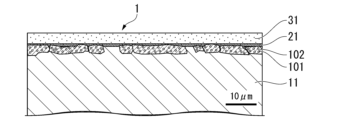
- FIG. 1 is a schematic diagram of a cross section of a grain-oriented electrical steel sheet according to an embodiment of the present invention.
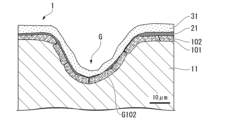
- FIG. FIG. 2 is a schematic diagram of a cross section of the grain-oriented electrical steel sheet according to the present embodiment when a groove is formed.
- FIG. 2 is a diagram for explaining a method for measuring the average thickness and aspect ratio of crystal grains.
- FIG. 2 is a diagram illustrating a method for measuring the coverage of an oxide layer on a flat crystal grain.
- grain-oriented electromagnetic steel sheet according to one embodiment of the present invention (grain-oriented electromagnetic steel sheet according to this embodiment) and its manufacturing method.
- the grain-oriented electrical steel sheet 1 has a silicon steel sheet 11 (hereinafter sometimes referred to as a base steel sheet or simply as a steel sheet), an oxide layer 21 formed on the surface of the silicon steel sheet 11 and made of one or more oxides of Mg, Al, and Si, and an insulating coating layer 31 formed on the surface of the oxide layer 21.
- the oxide layer 21 and the insulating coating layer 31 may be formed on only one side of the steel sheet, but it is preferable from the viewpoint of insulation properties and the like that they be formed on both sides. Each of these will be explained below.
- [Silicon steel sheet] One or more oxides of Mg, Al, and Si, each having a circle equivalent diameter of 0.1 to 3.0 ⁇ m, are present at a density of 0.010 to 0.200 pieces/ ⁇ m2 within a range of 10 ⁇ m in the plate thickness direction from the interface between the silicon steel plate and the oxide layer.)
- inhibitors precipitates present at grain boundaries, such as AlN
- the size of the precipitates that become inhibitors is very small, ranging from several tens of nm to about 100 nm in circle equivalent diameter. There is also a size distribution. When there is a size distribution, the decomposition and oxidation of small-sized inhibitors is completed at low temperatures, and the inhibitor effect is lost. In that case, secondary recrystallization in the Goss orientation closer to the ideal Goss orientation becomes difficult, and it is difficult to improve the magnetic flux density. On the other hand, the above problem can be solved by controlling the size distribution of the inhibitors to a constant value (so that the size difference is small), but this is extremely difficult industrially.
- the inhibitor can be made to exist up to high temperatures by suppressing decomposition and oxidation by some method even in a state where the size distribution of the inhibitor occurs, secondary recrystallization of crystal grains closer to the ideal Goss orientation can be caused.
- a method of using a highly heat-resistant inhibitor can be used to suppress the decomposition and oxidation of the inhibitor.
- oxide particles of Si hereinafter sometimes referred to as Si-based pre-oxides
- Si-based pre-oxides oxide particles of Si (hereinafter sometimes referred to as Si-based pre-oxides) formed on the steel sheet surface or in the surface layer of the steel sheet (in the steel) in the decarburization annealing process contribute.
- the mechanism is speculation, it is thought that the oxidation of the inhibitor occurs when a small amount of oxygen contained in the finish annealing atmosphere oxidizes AlN and the like on the steel sheet surface, and that the above-mentioned Si-based pre-oxides prevent and reduce the oxidation.
- the Si-based pre-oxides tend to be formed unevenly at various locations on the surface of the silicon steel sheet, and if the formation is uneven, the inhibitor's effect of suppressing decomposition and oxidation varies depending on the location on the steel sheet surface, making it difficult to obtain the intended effect.
- the present inventors have investigated the cause of the non-uniform formation of the oxide layer at each site on the surface after finish annealing, and have found that Fe-based oxides and reaction products between the surface metal of the steel sheet and oiliness agents or extreme pressure additives contained in the rolling oil used during cold rolling are present non-uniformly on the surface of the silicon steel sheet (cold-rolled sheet) before decarburization annealing, and that these Fe-based oxides and reaction products prevent the Si-based pre-oxide from being densely and uniformly formed in a certain thickness region from the surface during decarburization annealing.
- the present inventors have conducted research into neutralizing the factors inhibiting the formation of these Si-based pre-oxides.
- the inventors have found that by uniformly grinding the surface (at least one side) of the cold-rolled sheet before the decarburization annealing process using abrasive grains or abrasive paper, roll, or brush with abrasive grains fixed thereon to expose a clean metal surface, and then immediately contacting the surface with an aqueous liquid, it is possible to remove the Fe-based oxides and reaction products that are factors inhibiting the formation of Si-based pre-oxides from the surface of the steel sheet, and it is possible to form the Si-based pre-oxides at a predetermined number density in a region of a certain thickness from the surface of the steel sheet after the decarburization annealing process.
- oxides 101 oxide particles which are oxides of one or more of Mg, Al, and Si and have a circle equivalent diameter of 0.1 to 3.0 ⁇ m, and which are oxides formed by oxidation of an inhibitor or a solid-phase reaction with an annealing separator in a process such as finish annealing, are present at a density of 0.010 to 0.200 pieces/ ⁇ m 2.
- the oxides 101 may be one or more oxides of Mg, Al, and Si (including composite oxides), but when the manufacturing conditions described later are assumed, they are often oxides containing Mg, Al, and Si, such as spinel (MgAl 2 O 4 ), alumina (Al 2 O 3 ), and mullite (2SiO 2 ⁇ 3Al 2 O 3 ). If the number density of the oxides 101 is too small, the adhesion of the oxide layer 21 to the steel sheet is poor, and the formation of the flat crystal grains 102 described below becomes non-uniform. On the other hand, if the number density of the oxides 101 is too large, the area occupied by the metal portion of the steel sheet 11 is reduced, and the magnetic flux density is reduced.
- the proportion of the flat crystal grains 102 is relatively small, making it difficult to obtain the effect of reducing iron loss.
- the oxide 101 is uniformly formed in a predetermined region, which reduces the variation from location to location in the effect of suppressing the decomposition and oxidation of the inhibitor during finish annealing, thereby improving the magnetic flux density in the grain-oriented electrical steel sheet 1.
- the 180° magnetic domain width becomes smaller, and an iron loss reduction effect commensurate with the magnetic flux density can be obtained.
- the oxide 101 is often present in flat crystal grains 102, which will be described later.
- the decarburization annealing process is mainly used to uniformly form Si-based pre-oxides in the surface layer (within 10 ⁇ m from the surface) of the silicon steel sheet (base steel sheet), thereby suppressing the decomposition and oxidation of the inhibitor during the final annealing and allowing it to exist up to high temperatures.
- Hysteresis loss is reduced by improving the magnetic flux density.
- eddy current loss which is reduced by reducing the sheet thickness and increasing the resistivity of the steel sheet
- abnormal eddy current loss which is reduced by reducing the magnetic domain width formed in the Goss-oriented grains. Since the reduction in sheet thickness and the increase in the resistivity of the steel sheet in the reduction of classical eddy current loss often affect productivity, it is important to reduce the abnormal eddy current loss, i.e., to reduce the magnetic domain width.
- the magnetic domain width is generally correlated with the crystal grain size of the Goss orientation.
- the magnetic domain width of the so-called 180° magnetic domain generated in the grain-oriented electrical steel sheet is also reduced by reducing the grain size. That is, although the magnetic flux density is improved by controlling the above oxides, there is a concern that the abnormal eddy current loss increases due to the coarsening of the crystal grain size, and therefore the iron loss reduction effect commensurate with the improvement in magnetic flux density cannot be obtained.
- the inventors have studied a method of reducing iron loss commensurate with the improvement of magnetic flux density, that is, a method of reducing the magnetic domain width to solve the coarsening of the grain size that occurs secondarily after increasing the frequency of the ideal Goss orientation crystal grains.
- the average thickness of each flat crystal grain is preferably more than 2.0 ⁇ m and not more than 5.0 ⁇ m in order to fully obtain the effect of reducing the magnetic domain width.
- the length of the grain boundary of the flat crystal grains accounts for 70% or more of the length of the interface between the base steel sheet and the oxide layer in the cross section in the sheet thickness direction. If the ratio of flat crystal grains constituting the interface is small, the effect of reducing the magnetic domain width is insufficient, and therefore a sufficient effect of reducing iron loss cannot be obtained.
- the average thickness, aspect ratio, and deviation of crystal orientation of the crystal grains present on the surface side can be measured by the following method.
- a sample of, for example, about 20 mm square is cut out from the steel sheet so that a surface parallel to the rolling direction (RD direction) is obtained as a cross section, and the cross section is polished to a mirror surface.
- a polishing material such as colloidal silica is used in the final polishing process to prepare a polished sample so that no distortion is introduced.
- the polished sample is used to observe the cross-sectional shape with an FE-SEM, and then the crystal orientation is measured by EBSD measurement.
- FE-SEM For the FE-SEM, "SU-70" (manufactured by Hitachi High-Tech Corporation) is used as an example, and for the EBSD measurement, “Digiview” (manufactured by TSL Solutions) is used as an example. Specific examples of the method include the following.
- the cross section is observed with an FE-SEM at a magnification of 500 times, and an electron microscope image is obtained.
- the interface between the insulating coating layer and the oxide layer and the interface between the oxide layer and the steel sheet, which will be described later, are identified from the difference in electron density in the electron microscope image.
- the FE-SEM is equipped with an elemental analyzer (EDS)
- EDS elemental analyzer
- the crystal orientation of the steel sheet is measured by EBSD on the cross section of the same field of view. Specifically, in a 500x field of view where it is assumed that 100 or more flat grains are included, the crystal orientation is measured at measurement point pitches of 0.25 ⁇ m in an area with a cross-sectional length of 200 ⁇ m in the rolling direction and 70 ⁇ m in the sheet thickness direction.
- the boundary where the crystal orientation difference is 15° or more is defined as a grain boundary, and the area surrounded by this grain boundary is defined as a grain. If the number of grains in the field of view is less than 100, measurements are performed on additional fields of view. Regarding these crystal grains, the average thickness of the crystal grains is determined by the methods shown in a) to d) in FIG. a) Draw an imaginary line (1) in the thickness direction (normal direction) of the steel plate to determine both ends of the grain. b) Draw imaginary lines (2) in the thickness direction at 2.5% of the distance L between both ends of the crystal grain (the lines between them indicate 95% of the grain width).
- the crystal orientation of the Fe ferrite phase is measured for all of the above crystal grains with an average thickness of 0.5 to 5.0 ⁇ m and an aspect ratio of 1.5 or more.
- the measured crystal orientation is then used to obtain a crystal orientation map called an IPF map, which shows the crystal orientation relative to the rolling direction (RD direction) and the normal direction of the steel sheet surface (ND direction).
- the average orientation difference between each crystal grain and the Goss orientation is calculated, and this is taken as the deviation from the Goss orientation. If the deviation from the Goss orientation is 10° or more, the grain is considered to be a flattened grain.
- the average (simple average) of the average thickness of the flat crystal grains is obtained by dividing the sum of the average thicknesses of each flat crystal grain obtained above by the number of flat crystal grains.
- any method may be used to observe the cross section in the thickness direction, but the method of obtaining a cross section of the above-mentioned steel plate parallel to the rolling direction (RD direction) and obtaining a crystal orientation map by EBSD to confirm the presence of "flat crystal grains” is preferable because it has high accuracy.
- Another method of simply confirming the presence of "flat crystal grains” is to polish a surface parallel to the rolling direction (RD direction) to obtain a smooth cross section, and then to confirm by a method such as the so-called nital method (nitric acid ethanol method, described in JIS-G-0553 (2019)), which reveals the crystal grain boundaries.
- this method does not identify the crystal orientation, and it is necessary to measure the crystal orientation separately using EBSD, etc., so in this embodiment, the method of using the above-mentioned FE-SEM and EBSD in combination is adopted.
- the ratio of the length of the grain boundary of the flat crystal grains to the length of the interface between the base steel sheet and the oxide layer can be determined by the following method. For example, in a field of view observed at a magnification of 500 times, SEM observation and EBSD measurement are performed on an area of 200 ⁇ m in cross-sectional length in the rolling direction of the interface between the silicon steel sheet and the oxide layer. This is performed at five locations, that is, for an interface length of 1000 ⁇ m.
- the proportion (percentage) of the grain boundaries of flat crystal grains with an average thickness of 0.5 to 5.0 ⁇ m, an aspect ratio of 1.5 or more, and an orientation difference from the Goss orientation of 10° or more is measured in the length (1000 ⁇ m) of the interface between the silicon steel sheet and the oxide layer. Identification of the interfaces of the insulating coating layer, the oxide layer, and the silicon steel sheet, and of the flat crystal grains, etc. can be performed in the same manner as above.
- grooves G are formed on the surface of the base steel sheet 11 as shown in FIG. 2.
- the silicon steel sheet (base steel sheet) 11 has a plurality of grooves G with a depth (sheet thickness direction) of 10 to 30 ⁇ m and extending in a direction at an angle of 80 to 100° to the rolling direction, and the distance between adjacent grooves G in the rolling direction is 1.0 to 20.0 mm.
- the distance between adjacent grooves G in the rolling direction is more preferably 2.0 to 10.0 mm.
- the spacing of the grooves is the distance from the center of the width of one groove to the center of the width of the adjacent groove.
- the shape of the groove is not limited, and for example, the cross section is substantially rectangular or substantially triangular. The cross section may also be a bow shape constituting a part of a circle.
- the width of the groove is preferably about 0.5 to 3.0 times the depth of the groove. If the width of the groove is less than 0.5 times the depth of the groove, a sufficient magnetic domain control effect cannot be obtained, and the groove itself is difficult to form.
- the width of the groove is more than 3.0 times the depth of the groove, the occupancy rate of the groove on the steel sheet surface increases, resulting in a decrease in magnetic flux density, while the magnetic domain control effect is saturated, so that the iron loss reduction effect cannot be obtained, and may even lead to an increase in iron loss.
- the above-mentioned effect of reducing abnormal eddy current loss due to flat crystal grains is also effective for magnetic domain control material formed by grooves. That is, when the inner surface (bottom surface, side surface) of the groove is the surface of the base steel sheet, as shown in FIG.
- the flat crystal grains in the groove G102 there are flat crystal grains (flat crystal grains in the groove) G102 on the surface side of the groove of the base steel sheet, which have an average diameter in the direction perpendicular to the surface of 0.5 to 5.0 ⁇ m, an aspect ratio which is the ratio of the grain width in the direction parallel to the surface to the average diameter of 2.0 or more, and a deviation of the crystal orientation from the Goss orientation of 10° or more (the flat crystal grains in the groove G102 exist as grains constituting the outermost layer of the groove of the silicon steel sheet), and in a cross section in the plate thickness direction perpendicular to the extension direction, if the length of the grain boundary of the flat crystal grains in the groove G102 occupies 70% or more of the length of the inner surface of the groove G, in addition to the magnetic domain refinement effect due to the groove formation, the eddy current loss reduction effect due to the flat crystal grains in the groove G102 can be obtained, which is more preferable.
- the average diameter of the flat crystal grains G102 in the grooves is more
- the presence or absence of flat crystal grains in grooves, as well as their average diameter, aspect ratio, and deviation of crystal orientation from the Goss orientation, can be determined in the same manner as for the flat crystal grains on the surface of the base steel sheet described above.
- the grooves on the surface of the steel sheet are not straight but curved, for example, a cross section perpendicular to the tangent of the curve in the observation target portion is revealed.
- the deviation angle of the cross section with respect to the rolling direction (RD direction) is measured and corrected when measuring the crystal orientation of the flattened crystal grains.
- the length of the grain boundaries of the flat crystal grains in the groove relative to the length of the inner surface of the groove can be determined by performing EBSD measurement of a cross section in the plate thickness direction perpendicular to the extension direction of the groove in the same manner as the measurement of the flat crystal grains on the surface side of the silicon steel plate.
- the chemical composition of the silicon steel sheet is not limited as long as it is the same as the base steel sheet of a known grain-oriented electrical steel sheet.
- the composition may be within the range described below.
- the chemical composition of the silicon steel sheet contains, in mass%, 2.00 to 6.00% Si, in order to control the crystal orientation to a Goss texture concentrated in the ⁇ 110 ⁇ 001> orientation and ensure good magnetic properties.
- the other elements are not particularly limited, and known elements may be contained in known ranges in place of Fe, with the balance being Fe and impurities.
- Representative content ranges (mass %) of representative elements other than Si are as follows: C: 0 to 0.0050%, Mn: 0 to 1.0%, S: 0 to 0.0150%, Se: 0 to 0.0150%, Al: 0 to 0.0650%, N: 0 to 0.0050%, Cu: 0 to 0.40%, Bi: 0 to 0.010%, B: 0 to 0.080%, P: 0 to 0.50%, Ti: 0 to 0.0150%, Sn: 0 to 0.10%, Sb: 0 to 0.10%, Cr: 0 to 0.30%, Ni: 0 to 1.0%, Nb: 0 to 0.030%, V: 0 to 0.030%, Mo: 0 to 0.030%, Ta: 0 to 0.030%, W: 0 to 0.030%, These selective elements may be contained according to the purpose, so there is no need to limit the lower limit, and they may not be contained substantially.
- Impurities refer to elements that are unintentionally contained, and refer to elements that are mixed in from raw materials such as ores and scraps, or the manufacturing environment, when industrially manufacturing the base steel sheet.
- the chemical composition of the silicon steel sheet is determined by the following method.
- a solution is obtained by acid decomposing a silicon steel sheet with hydrochloric acid or the like.
- a calibration curve is obtained by ICP (inductively coupled plasma) analysis of each element solution whose concentration is already known.
- the solution obtained is then analyzed, and the elements contained therein are quantified and determined.
- an oxide layer and/or an insulating coating layer is formed on the surface of a silicon steel sheet (when a grain-oriented electrical steel sheet includes a silicon steel sheet, an oxide layer, and an insulating coating layer), the oxide layer and the insulating coating layer can be removed before measurement.
- the insulating coating layer is removed by immersing the grain-oriented electrical steel sheet having the insulating coating layer for 7 to 10 minutes in an aqueous sodium hydroxide solution at 80 to 90°C containing 30 to 50 mass% NaOH and 50 to 70 mass% H 2 O.
- the grain-oriented electrical steel sheet from which the insulating coating layer has been removed is washed with water, and then dried with a hot air blower for just under 1 minute.
- the oxide layer is removed by immersing the grain-oriented electrical steel sheet having the oxide layer for 1 to 10 minutes in an aqueous hydrochloric acid solution containing 10 mass% HCl at 80 to 90° C.
- a silicon steel sheet which is the base steel sheet, can be taken out from the grain-oriented electrical steel sheet on which the oxide layer and/or insulating coating layer is formed.
- the thickness of the silicon steel sheet of the grain-oriented electrical steel sheet according to this embodiment is not limited, but is preferably 0.15 to 0.35 mm. If the thickness exceeds 0.35 mm, the classical eddy current loss described above increases, resulting in large iron loss. On the other hand, if the thickness is less than 0.15 mm, the rolling efficiency decreases, which is disadvantageous in terms of productivity and cost.
- an oxide layer made of one or more oxides of Mg, Al, and Si is formed on the surface of the base steel sheet.
- This oxide layer is formed by a solid-phase reaction between Mg and/or Al contained in the annealing separator and the Si-based pre-oxide formed on the steel sheet surface during the final annealing.
- a forsterite (Mg 2 SiO 4 ) film is mainly formed as the oxide layer.
- AlN contained in the steel as an inhibitor is oxidized by oxygen in the annealing atmosphere on the surface of the silicon steel sheet in the latter half of the final annealing.
- spinel MgAl 2 O 4
- alumina Al 2 O 3
- mullite 2SiO 2 .3Al 2 O 3
- spinel MgAl 2 O 4
- the oxide layer covers the surfaces of the flat crystal grains, thereby improving the adhesion to the insulating coating layer applied thereon. To obtain a sufficient effect, it is preferable that the coverage of the oxide layer on the flat crystal grains is 50% or more.
- the coverage can be determined by the following method. That is, the presence of flat crystal grains is identified by EBSD in the manner described above. Then, attention is paid to FE-SEM images of each flat crystal grain or elemental analysis images obtained by performing elemental analysis using EDS or the like based on the FE-SEM images.
- the length of the flat crystal grain where one or more oxide layers of Mg, Al, and Si exist between the insulating coating layer and the flat crystal grain or in the projected portion from the surface side of the flat crystal grain toward the inside of the steel sheet is measured.
- the percentage of the length where the oxide layer exists per 1000 ⁇ m of the interface length between the oxide layer or insulating coating layer and the flat crystal grain is calculated. For example, in the state shown in FIG. 4, the coverage rate (%) can be calculated by (A1+A2+A3)/(a1+a2+a3) ⁇ 100.
- an insulating coating layer is formed on the surface (as an upper layer) of the oxide layer.
- This insulating coating layer is essential when the grain-oriented electrical steel sheet is used as a transformer.
- the grain-oriented electrical steel sheet is used as a transformer, it is laminated and used.
- the laminated steel sheets silicon steel sheets
- eddy currents are generated in the transformer core, which causes an increase in core core loss. Therefore, an insulating coating layer is formed on the surface of the steel sheet to impart electrical insulation, thereby reducing the core core loss of the transformer.
- the insulating coating of grain-oriented electrical steel sheets is also required to have various properties necessary for producing iron cores, such as corrosion resistance, heat resistance, and slipperiness.
- a coating type whose main components are phosphate and colloidal silica is used for the insulating coating.
- a coating whose main component is aluminum borate or a coating made of aluminum borate and silica may be used. Either coating may be a known coating formed by applying a coating liquid in which the components contained therein are dissolved or dispersed to the surface of an oxide layer and baking it.
- the grain-oriented electrical steel sheet according to this embodiment can obtain its effects as long as it has the above-mentioned characteristics regardless of the manufacturing method, but a manufacturing method including the following steps is preferable because it can be stably manufactured.
- a hot rolling step of heating and hot rolling the slab into a hot-rolled sheet
- a hot-rolled sheet annealing step of annealing the hot-rolled sheet after the hot rolling step
- IV a cold rolling step of cold rolling the hot-rolled sheet after the pickling step to obtain a cold-rolled sheet
- V a grinding step of grinding the surface of the cold-rolled sheet after the cold rolling step
- the method for producing a grain-oriented electrical steel sheet according to this embodiment may further include any one or more of the following steps.
- a groove forming step which is performed before the grinding step, further comprises forming a plurality of grooves having a depth of 10 to 30 ⁇ m in the cold-rolled sheet, the grooves extending in a direction at an angle of 80 to 100° with respect to the rolling direction, the grooves being spaced apart from each other in the rolling direction by 1.0 to 20.0 mm;
- the manufacturing method of the grain-oriented electrical steel sheet according to the present embodiment is characterized by the grinding step, the contacting step, and the groove forming step, while the hot rolling step, the hot-rolled sheet annealing step, the cold rolling step, the decarburization annealing step, the nitriding treatment step, the finish annealing step, and the insulating coating forming step can be performed under known conditions. Preferred conditions are described below. Even if conditions are not described, the reaction can be carried out under known conditions.
- a slab having a predetermined chemical composition (a chemical composition corresponding to the chemical composition of the silicon steel sheet of the grain-oriented electrical steel sheet according to this embodiment) is heated and hot rolled to form a hot-rolled sheet.
- the slab heating temperature is, for example, 1000 to 1400°C.
- the chemical composition of the slab to be subjected to hot rolling may be determined according to the desired chemical composition of the grain-oriented electrical steel sheet, taking into consideration changes in the chemical composition in each process.
- the hot rolling stage may contain, by mass%, C: 0.040 to 0.100%, Si: 2.00 to 6.00%, and in addition, Al, Mn, Se, S, B, N, etc. are contained in predetermined ranges as inhibitors to obtain AlN, MnS, MnSe, BN, and further elements such as Cu, Sn, Cr, Ni, Mo, Nb, Bi, Sb, P, Ti, V, Ta, W, etc. as necessary.
- the method for obtaining the slab is not limited.
- molten steel having a predetermined chemical composition may be melted and the molten steel may be used to produce the slab.
- the slab may be produced by a continuous casting method, or the molten steel may be used to produce an ingot and the ingot may be bloomed to produce the slab.
- the slab may be produced by other methods.
- the thickness of the slab is not particularly limited, but is, for example, 150 to 350 mm.
- the thickness of the slab is preferably 220 to 280 mm.
- As the slab a so-called thin slab having a thickness of 10 to 70 mm may be used.
- a so-called hot-rolled sheet (hot-rolled steel sheet) is obtained by hot rolling.
- the thickness (finished thickness) of the hot-rolled sheet is not particularly limited.
- the hot-rolled sheet is annealed, pickled, and then cold-rolled. It is known that the so-called cold rolling reduction rate affects the magnetic properties of the grain-oriented electrical steel sheet, and the thickness of the hot-rolled sheet is selected taking into account the required cold rolling reduction rate for the final thickness. For example, when the final thickness is 0.20 to 0.30 mm, the finished thickness of the hot-rolled sheet is preferably in the range of 2.0 to 4.0 mm.
- the hot-rolled sheet annealing process In the hot-rolled sheet annealing process, the hot-rolled sheet after the hot rolling process is annealed. By carrying out such annealing treatment, recrystallization occurs in the steel sheet structure, making it possible to realize good magnetic properties.
- the hot-rolled sheet annealing process of this embodiment the hot-rolled sheet manufactured through the hot rolling process may be annealed according to a known method.
- the means for heating the hot-rolled sheet during annealing is not particularly limited, and a known heating method can be adopted. For example, so-called continuous annealing may be used, or the hot-rolled sheet may be coiled and subjected to batch annealing.
- the annealing conditions are also not particularly limited, but for example, the hot-rolled sheet may be annealed for 10 seconds to 5 minutes in a temperature range of 900 to 1200 ° C.
- the atmosphere is not particularly limited, but it is preferable to suppress oxidation of the steel sheet, and it is preferable to perform the annealing in a non-oxidizing atmosphere such as nitrogen, argon, or hydrogen.
- the cold rolling process In the cold rolling process, the steel sheet after pickling is cold rolled to obtain a cold rolled sheet.
- the cold rolling may be a single cold rolling (a series of cold rolling without intermediate annealing) or may be multiple cold rollings with intermediate annealing by interrupting the cold rolling and performing at least one or more intermediate annealings before the final pass of the cold rolling process.
- the cold rolling conditions may be in accordance with known methods.
- the cold rolling reduction of grain-oriented electrical steel sheet has a large effect on its magnetic properties. In particular, the final reduction has a large effect, and the final reduction can be set to 80 to 95%.
- the final reduction is the cumulative reduction of cold rolling, and in the case where intermediate annealing is performed, it is the cumulative reduction of cold rolling after final intermediate annealing.
- intermediate annealing for example, the steel sheet is held at a temperature of 800 to 1200°C for 5 to 180 seconds.
- the annealing atmosphere is not particularly limited, but it is preferable to perform the annealing in a non-oxidizing atmosphere such as nitrogen, argon, or hydrogen in order to prevent oxidation of the steel sheet.
- the annealing method may be either so-called continuous annealing or batch annealing in a coil shape, or other methods may be used.
- the number of times intermediate annealing is preferably three or less, taking into account the manufacturing cost.
- grooves are formed in the cold-rolled sheet before the grinding step, extending in a direction at an angle of 80 to 100° with respect to the rolling direction, and having a depth of 10 to 30 ⁇ m.
- a plurality of grooves are formed so that the intervals in the rolling direction are 1.0 to 20.0 mm.
- the intervals in the rolling direction are more preferably 2.0 to 10.0 mm.
- the method for forming the grooves is not particularly limited, and known methods such as those shown below can be used. For example, physical contact methods (methods of scratching the surface of the steel sheet with a blade or the like, or methods of roll transfer or pressing using a die with a blade, etc.), non-physical contact methods (methods of locally melting a part of the steel sheet surface with a laser, electron beam, plasma, etc.
- grooves are introduced into the steel sheet at a pitch of 1.0 to 20.0 mm in the rolling direction, so the blades and dies are subject to significant wear when grooves are applied to a steel sheet coil that is several thousand meters long. This necessitates frequent replacement, which has the disadvantage of poor productivity.
- the chemical method as mentioned above, it is necessary to carry out multiple steps such as masking the steel sheet surface with a resin, removing a part of the mask, and then etching, which is a problem mainly in terms of productivity.
- a strong acidic solution with a pH of about 1, such as hydrochloric acid is often used for etching, and the costs of removing Fe dissolved in the strong acidic solution and treating the strong acidic solution as waste liquid are high.
- a method that does not rely on physical contact one method is to irradiate the surface of a cold-rolled sheet with a laser, melt a part of the steel sheet surface, and remove the molten material from the surface to form grooves.
- This method has the great advantage that it uses a high-energy source with high linearity such as a laser, which allows for high-level control of the irradiation position on the steel sheet surface and allows grooves to be formed accurately at a specified location.
- the molten material generated from the steel sheet during irradiation can be removed outside the system by installing a suction duct in the laser irradiation section, and this does not affect the laser irradiation control.
- a high-power laser generally used for industrial purposes, such as a fiber laser, a YAG laser, a semiconductor laser, or a CO2 laser, can be used.
- the output form may be a pulsed laser or a continuous wave laser.
- an assist gas for example, air, CO2 , argon, etc.
- the groove forming step is not essential and can be omitted.
- the grinding process In the grinding process, the surface of the cold-rolled sheet after the cold rolling process (the cold-rolled sheet after the groove forming process when the groove forming process is performed) is ground. At that time, grinding is performed using abrasive grains having a Knoop hardness of 1000 or more and a maximum particle size of more than 50 ⁇ m and 500 ⁇ m or less, or abrasive paper, rolls, or brushes to which the abrasive grains are fixed.
- abrasive grains having a Knoop hardness of 1000 or more and a maximum particle size of more than 50 ⁇ m and 500 ⁇ m or less, or abrasive paper, rolls, or brushes to which the abrasive grains are fixed.
- the inhibitors precipitates present at grain boundaries, such as AlN
- the inhibitors can exist at as high a temperature as possible during the final annealing, only crystal grains having a crystal orientation closer to the ideal Goss orientation are allowed to grow, thereby improving the magnetic flux density.
- the size of the inhibitor is very small, ranging from several tens of nm to about 100 nm, there is a size distribution. When there is a size distribution, the small size inhibitor starts to decompose at a low temperature.
- these Si-based pre-oxides are easily affected by the process before the decarburization annealing process, and the formation state of these pre-oxides tends to be non-uniform at each part of the steel sheet surface. If the formation state is non-uniform, the inhibitor's effect of suppressing decomposition and oxidation varies depending on the location on the steel sheet surface, and the desired effect cannot be obtained.
- Fe-based oxides that have been formed non-uniformly on the steel sheet surface during cold rolling, etc., and that inhibit the uniform formation of such oxide layers, as well as reaction products with the steel sheet surface such as oiliness agents or extreme pressure additives, are removed from the steel sheet surface before decarburization annealing in addition to grinding the steel sheet surface.
- At least one surface of the steel sheet is ground with abrasive grains having a Knoop hardness of 1000 or more and a maximum particle size exceeding 50 ⁇ m and not exceeding 500 ⁇ m, or with abrasive paper, roll or brush to which the abrasive grains are fixed, thereby removing the Fe-based oxide film and reaction products from the surface of the steel sheet.
- Knoop hardness is less than 1000, the hardness of the abrasive grains is insufficient for the steel plate, making grinding difficult. Or the grinding efficiency is reduced.
- the maximum particle size of the abrasive grains is 50 ⁇ m or less, the particle size of the abrasive grains becomes relatively small compared to the roughness of the steel plate surface, making grinding difficult.
- the grinding efficiency is reduced.
- the maximum particle size exceeds 500 ⁇ m, the particle size of the abrasive grains becomes too large relative to the roughness of the steel plate surface, making surface scratches more noticeable during grinding and reducing the quality of the product's appearance.
- the Knoop hardness is preferably 8000 or less, more preferably 5000 or less.
- the abrasive grains are mainly made of alumina (Knoop hardness: about 2000), silicon carbide (Knoop hardness: about 2500), boron nitride (Knoop hardness: about 5000), diamond (Knoop hardness: about 7000), or the like.
- the brush roll is a metal roll with a resin lining on the surface, and the abrasive grains are embedded in fibers made of acrylic resin or the like, which are then planted in the form of hairs on the resin layer surface of the roll.
- the sheet passing speed of the steel sheet when grinding the steel sheet with the brush roll is in the range of about 20 to 200 mpm (meter per minute), and the steel sheet is ground by contacting the brush roll, which rotates in the direction opposite to the sheet passing direction, with the steel sheet while moving the steel sheet at the position where the steel sheet and the brush roll contact each other.
- the steel sheet with the brush roll the steel sheet is sandwiched between the brush roll and the idle roll, and the brush roll is pressed down against the sheet passing line (pass line) to the idle roll side to perform grinding.
- the amount of reduction at this time is 1.0 to 5.0 mm. If the amount of reduction is small, the amount of grinding is small.
- the passing speed of the steel sheet is in the range of 20 to 200 mpm as mentioned above, and in this case, the grinding speed (corresponding to the rotation speed in the case of a brush roll) is set to 500 mpm or more. If the grinding speed (rotation speed in the case of a brush roll) is low, the amount of grinding becomes insufficient, and the Si-based preoxides are not sufficiently formed, resulting in insufficient formation of flat crystal grains. On the other hand, in the case of a brush roll, if the rotation speed exceeds 2000 mpm, the frictional force between the brush roll and the steel plate becomes too large, causing not only the above-mentioned "chatter" but also an overload on the motor driving the brush roll.
- the rotation speed of the brush roll is preferably 2000 mpm or less.
- the grinding amount is 0.10 g/ m2 or more on at least one surface.
- the service life of the abrasive grains is shortened and sludge generation due to grinding becomes significant, and the processing of the sludge is time-consuming, which causes defects on the steel sheet surface due to pressing, etc. Therefore, the grinding amount is 10.0 g/ m2 or less.
- the amount of grinding can be confirmed from the weight difference of the steel sheet before and after grinding.
- the amount of grinding is the amount of grinding per side. When grinding is performed on both sides, the amount of grinding per both sides is obtained, and for convenience, this value is halved, and from the viewpoint of removing the front and rear Fe-based oxide films and reaction products from the entire surface of the steel sheet, the preferable range of the amount of grinding is 0.30 g/ m2 or more and 3.0 g/ m2 or less.
- the optimum groove depth is 10 to 30 ⁇ m, and the steel sheet surface inside the groove is also ground, so the effect of grinding is also effective on the inner surface of the groove formed on the surface of the cold-rolled sheet. Therefore, flat crystal grains (flat crystal grains inside the groove) are also formed on the surface side inside the groove of the base steel sheet that has undergone decarburization annealing and finish annealing.
- the surface of the cold-rolled sheet is brought into contact with an aqueous liquid having a pH of 4.0 to 10.0. This removes the abrasive grains attached to the surface of the steel sheet during grinding and the steel sludge generated during grinding.
- the aqueous liquid may be ion-exchanged water, or may contain minerals such as Ca and Mg, or may contain carbonic acid or silicic acid as a counter ion.
- the pH may be added at about 0.01 wt %, and the pH may be adjusted with an alkali metal or alkaline earth metal.
- carboxylic acid and phosphonic acid are highly effective in removing abrasive grains and sludge from the steel sheet.
- the electrical conductivity is preferably 0.1 to 10 ⁇ S/cm from the viewpoint of preventing dissolution. If the pH is less than 4.0, the steel sheet surface is etched by the acidic aqueous solution, causing corrosion of the steel sheet.
- the alkaline aqueous solution acts to promote oxidation of the metal surface after grinding, reducing the effect of removing the Fe-based oxides that were unevenly formed on the steel sheet surface in the grinding process.
- the initial intended effect of uniformly forming an oxide layer and oxide particles after finish annealing cannot be sufficiently obtained.
- the contact time is preferably 0.1 to 60 seconds, more preferably 1 to 60 seconds, and even more preferably 5 to 60 seconds.
- the flow rate of the aqueous liquid is preferably 1 to 100 L/min.
- abrasive grains and sludge can be removed from the surface of the steel sheet, and factors that inhibit the uniform formation of an oxide layer and oxide particles after the finish annealing can be avoided.
- the surface of the cold-rolled sheet may be brought into contact with the aqueous liquid during the grinding step, but the above-mentioned effect cannot be obtained unless the contacting step is carried out after the grinding step.
- decarburization annealing process In the decarburization annealing process, the cold-rolled sheet after the grinding process is subjected to decarburization annealing, which removes (decarburizes) C, which adversely affects magnetic properties, from the steel sheet and causes primary recrystallization of the cold-rolled sheet.
- the decarburization annealing conditions are not limited, but the annealing is performed in a nitrogen/hydrogen mixed atmosphere for decarburization, in which the oxygen potential is increased by humidification.
- the humidification temperature (dew point) is determined from the viewpoints of the annealing temperature required for recrystallization and the oxygen potential capable of decarburization at the annealing temperature.
- the annealing temperature is about 700 to 900° C., and since annealing is generally performed in a continuous annealing process, soaking is performed for about 60 seconds.
- Si-based pre-oxides the so-called Si contained in the steel forms a layered oxide on the steel sheet surface and oxide particles inside the steel sheet.
- the nitrogen content of the steel sheet is increased to increase the amount of nitrides, thereby promoting secondary recrystallization of crystal grains closer to the Goss orientation in the finish annealing process.
- the nitrogen content of the steel sheet after the nitriding process is preferably 0.015 to 0.050 mass%.
- the method of the nitriding process is not limited, and any known method may be used.
- the nitriding step is not essential and may be omitted. If nitriding is performed, it is preferable to perform it between the decarburization annealing step and the finish annealing step.
- an annealing separator is applied to the cold-rolled sheet after the decarburization annealing process (or after the nitriding process if nitriding has been performed), and the cold-rolled sheet is then finish-annealed to form an oxide layer made of one or more oxides of Mg, Al, and Si on the surface of the cold-rolled sheet which becomes the base steel sheet (silicon steel sheet). Since the annealing time is long, the steel sheet is usually wound into a coil and then batch annealed. Since the temperature of the steel sheet rises to about 1200°C, an annealing separator is applied to prevent the coiled steel sheet from seizing.
- MgO is generally used as the annealing separator.
- Mg contained in the annealing separator reacts with the Si-based pre-oxide formed on the steel sheet surface in the decarburization annealing process in a solid phase, and an oxide layer consisting of one or more oxides of Mg and Si is formed on the surface of the cold-rolled sheet.
- a layer of forsterite (Mg 2 SiO 4 ) coating is mainly formed as the oxide layer.
- AlN contained in steel as an inhibitor is oxidized by oxygen in the annealing atmosphere on the surface of the steel sheet in the latter half of the finish annealing, and at that time, it forms spinel (MgAl 2 O 4 ), alumina (Al 2 O 3 ), or mullite (2SiO 2 .3Al 2 O 3 ).
- spinel MgAl 2 O 4
- Al 2 O 3 alumina
- mullite 2SiO 2 .3Al 2 O 3
- the size of the inhibitor is controlled to be larger and more uniform than usual in the cold-rolled sheet to be subjected to finish annealing, so that secondary recrystallization occurs only in grains close to the Goss orientation (grains having an orientation close to the Goss orientation).
- the conditions for the finish annealing are not limited, but for example, the temperature is raised from room temperature at a rate of 10 to 100°C/h, and in the temperature range of 900 to 1000°C, where secondary recrystallization in the Goss orientation generally occurs, the temperature is raised at a rate of 5 to 20°C/h to promote preferential growth (secondary recrystallization) in the Goss orientation, and then, as described above, the inhibitor that has completed its role is purified at around 1200°C (for example, 1150 to 1250°C).Then, the coil is slowly cooled in a non-oxidizing atmosphere such as hydrogen or nitrogen, and then removed from the furnace.
- a non-oxidizing atmosphere such as hydrogen or nitrogen
- an insulating coating layer is formed on the surface of the oxide layer after the final annealing step.
- the insulating coating layer can be formed by applying a coating solution containing phosphoric acid or a phosphate, colloidal silica, and chromic anhydride or a chromate to a cold-rolled sheet (base steel sheet + oxide layer) after finish annealing, and baking and drying at 300 to 950 ° C for 10 seconds or more.
- the atmosphere during baking is not particularly limited, but it is preferable to suppress oxidation of the steel sheet, and it is preferable to perform the baking in a non-oxidizing atmosphere such as nitrogen, argon, or hydrogen.
- a coating solution mainly composed of boric acid and alumina sol instead of the above-mentioned phosphate, or a coating solution mainly composed of boric acid and aluminosilicate (kaolin mineral, etc.), etc., as the coating type, and form an insulating coating mainly composed of aluminum borate.
- the application of aluminum borate can impart a large tension to the steel sheet, thereby reducing iron loss. This process also plays a role in flattening the coiled steel sheet produced by the batch annealing in the above-mentioned final annealing, by continuous annealing.
- the insulating coating is baked and the coiled steel sheet is subjected to continuous annealing at about 800°C while applying a certain tension to obtain a flat steel sheet. For this reason, it is sometimes called the flattening annealing process.
- a grain-oriented electrical steel sheet that comprises a silicon steel sheet (base steel sheet), an oxide layer, and an insulating coating layer.
- Example 1 Molten steel containing 3.25 mass% Si, 0.13 mass% Mn, 0.006 mass% S, 0.050 mass% C, 0.025 mass% acid-soluble Al, and 0.007 mass% N was continuously cast to obtain a slab with a thickness of 300 mm.
- the slab was heated at 1150° C. for 60 minutes in an electric furnace adjusted to a nitrogen atmosphere, and then roughly hot rolled to obtain a steel plate having a thickness of 40 mm.
- the slab was then finish rolled to obtain a hot rolled plate having a thickness of 2.3 mm. Thereafter, the hot-rolled sheet was annealed in a continuous annealing furnace adjusted to a nitrogen atmosphere by heating at 1100° C. for 60 seconds and then cooling.
- the obtained steel sheet (hot-rolled sheet) was pickled with 10% hydrochloric acid to remove scale from the steel sheet. Thereafter, cold rolling was carried out to obtain a cold-rolled sheet having a thickness of 0.22 mm.
- the surface of the obtained cold-rolled sheet was ground using various brushes containing abrasive grains as shown in Table 1 while flowing ion-exchanged water having a pH of 2.5 to 12.0. After grinding, the surface was brought into contact with ion-exchanged water having a pH of 2.5 to 12.0.
- Table 1 for comparison, some steel sheets were not ground, and were not brought into contact with ion-exchanged water after grinding. During the contact, the contact time was 5 seconds, and the flow rate of the aqueous liquid was 10 L/min.
- decarburization annealing was performed on the steel sheet that had been ground and contacted with an aqueous liquid (the cold-rolled sheet after cold rolling when neither was performed, or the cold-rolled sheet after the grinding process when no contact with an aqueous liquid was performed).
- the annealing atmosphere was a 50% nitrogen + 50% hydrogen atmosphere, and the oxygen potential (P H2O /P H2 ) was 0.33.
- the oxygen potential was adjusted by humidifying the atmosphere before introducing it into the furnace.
- decarburization annealing was performed by soaking at 850°C for 60 seconds. Thereafter, the material was subjected to nitriding treatment by soaking in a nitrogen-hydrogen-ammonia atmosphere at 750° C.
- an aqueous slurry of an annealing separator mainly composed of MgO was prepared, and the annealing separator was applied to both sides of the steel sheet so that the post-dry adhesion amount per side was 6 g/ m2 , and then dried.
- the composition of the annealing separator was 100 parts by mass of MgO, 5 parts by weight of TiO2 , and 0.020% by mass of FeCl2 as Cl.
- the sample was placed in a batch annealing furnace and heated at an average heating rate of 20°C/h in an atmosphere of 50% nitrogen and 50% hydrogen. After heating up to 1200°C, the atmosphere was switched to 100% hydrogen and soaked for 20 hours, and then cooled to room temperature. After the completion of the final annealing, the steel sheet was taken out of the furnace and the annealing separator was removed by washing with water. At this time, a glass coating made of forsterite and an oxide layer made of granular spinel (MgAl 2 O 4 ), alumina (Al 2 O 3 ) and/or mullite were formed on the surface of the steel sheet (silicon steel sheet).
- MgAl 2 O 4 granular spinel
- Al 2 O 3 alumina
- mullite a glass coating made of forsterite and an oxide layer made of granular spinel (MgAl 2 O 4 ), alumina (Al 2 O 3 ) and/or mullite were formed on the surface of the steel sheet (sili
- a chemical solution containing insulating coating components consisting of aluminum phosphate, colloidal silica, and chromic anhydride was applied to this steel sheet (a steel sheet having a glass coating, which is an oxide layer, formed on the surface of a silicon steel sheet, which is a base steel sheet), and the sheet was baked by heating to 800°C in a nitrogen atmosphere and holding for 30 seconds to form an insulating coating layer.
- the amount of the insulating coating layer attached was 4.8 g/ m2 per side.
- the oxides and flat crystal grains in the range of 10 ⁇ m from the interface with the oxide layer in the sheet thickness direction of the obtained silicon steel sheet were evaluated by the above-mentioned method. The results are shown in Table 2.
- one or more oxides of Mg, Al, and Si having a circle equivalent diameter of 0.1 to 3.0 ⁇ m within a range of 10 ⁇ m from the interface with the oxide layer in the plate thickness direction were spinel (MgAl 2 O 4 ), alumina (Al 2 O 3 ), and mullite (2SiO 2.3Al 2 O 3 ), that is, oxides containing Mg, Al, and Si.
- Example 2 The same molten steel and slab as those used in Example 1 were used, and hot rolling, hot-rolled sheet annealing, pickling, and cold rolling were carried out in the same manner as in Example 1 to obtain a cold-rolled sheet having a thickness of 0.22 mm.
- One side of the obtained cold-rolled sheet was irradiated with a laser using a commercially available fiber laser under the conditions of the laser output, focused spot diameter (sheet width direction TD and rolling direction RD), and scanning speed shown in the table.
- Argon was sprayed as an assist gas simultaneously with the laser irradiation so that the molten material generated from the steel sheet during the laser irradiation would not reattach to the steel sheet, and a suction duct was installed at a position opposite to the assist gas outlet to collect dust caused by the molten material generated by the laser irradiation.
- This laser irradiation formed linear grooves on the surface, with a cross-sectional projection shape of approximately a triangle and a width and depth shown in the table. The grooves extended in the direction shown in the table, and each groove was formed parallel to the rolling direction and periodically at intervals shown in the table in the rolling direction.
- the surface of the cold-rolled sheet on which the grooves were formed was ground while flowing ion-exchanged water having a pH of 4.0 to 6.0, and the surface was ground under the conditions shown in Table 2.
- the steel sheet was brought into contact with ion-exchanged water having a pH of 4.0 to 6.0.
- the contact time was 5 seconds, and the flow rate of the aqueous liquid was 10 L/min.
- Example 2 Thereafter, under the same conditions as in Example 1, decarburization annealing, nitriding treatment, application of an annealing separator containing MgO as a main component, and finish annealing were performed. After the final annealing, the annealing separator was removed by rinsing with water, and as a result, a glass film (oxide layer) was formed on the surface of the steel sheet.
- a chemical solution containing insulating coating components consisting of aluminum phosphate, colloidal silica, and chromic anhydride was applied to the silicon steel plate having the glass coating, and the insulating coating was baked by heating to 800°C in a nitrogen atmosphere and holding for 30 seconds. At this time, the amount of the insulating coating layer attached was 5.0 g/ m2 per side.
- the oxides in a range of 10 ⁇ m from the interface with the oxide layer in the plate thickness direction and the flat crystal grains were evaluated in the same manner as in Example 1. In this example, the flat crystal grains in the grooves were also evaluated.
- the present invention provides a grain-oriented electrical steel sheet with excellent magnetic properties and a manufacturing method thereof. Therefore, it has high industrial applicability.
Landscapes
- Chemical & Material Sciences (AREA)
- Engineering & Computer Science (AREA)
- Mechanical Engineering (AREA)
- Physics & Mathematics (AREA)
- Metallurgy (AREA)
- Organic Chemistry (AREA)
- Materials Engineering (AREA)
- Power Engineering (AREA)
- Crystallography & Structural Chemistry (AREA)
- Thermal Sciences (AREA)
- Manufacturing & Machinery (AREA)
- Electromagnetism (AREA)
- Dispersion Chemistry (AREA)
- General Chemical & Material Sciences (AREA)
- Chemical Kinetics & Catalysis (AREA)
- Manufacturing Of Steel Electrode Plates (AREA)
- Soft Magnetic Materials (AREA)
Priority Applications (4)
| Application Number | Priority Date | Filing Date | Title |
|---|---|---|---|
| CN202380080055.5A CN120225708A (zh) | 2022-11-22 | 2023-11-22 | 方向性电磁钢板及其制造方法 |
| EP23894641.2A EP4624612A4 (en) | 2022-11-22 | 2023-11-22 | GRAIN-ORIENTED ELECTRICAL STEEL SHEET AND ITS MANUFACTURING PROCESS |
| JP2024560191A JPWO2024111637A1 (https=) | 2022-11-22 | 2023-11-22 | |
| KR1020257016800A KR20250091289A (ko) | 2022-11-22 | 2023-11-22 | 방향성 전자 강판 및 그 제조 방법 |
Applications Claiming Priority (2)
| Application Number | Priority Date | Filing Date | Title |
|---|---|---|---|
| JP2022186165 | 2022-11-22 | ||
| JP2022-186165 | 2022-11-22 |
Publications (1)
| Publication Number | Publication Date |
|---|---|
| WO2024111637A1 true WO2024111637A1 (ja) | 2024-05-30 |
Family
ID=91196076
Family Applications (1)
| Application Number | Title | Priority Date | Filing Date |
|---|---|---|---|
| PCT/JP2023/042039 Ceased WO2024111637A1 (ja) | 2022-11-22 | 2023-11-22 | 方向性電磁鋼板及びその製造方法 |
Country Status (5)
| Country | Link |
|---|---|
| EP (1) | EP4624612A4 (https=) |
| JP (1) | JPWO2024111637A1 (https=) |
| KR (1) | KR20250091289A (https=) |
| CN (1) | CN120225708A (https=) |
| WO (1) | WO2024111637A1 (https=) |
Citations (11)
| Publication number | Priority date | Publication date | Assignee | Title |
|---|---|---|---|---|
| JPS5651522A (en) | 1979-10-03 | 1981-05-09 | Nippon Steel Corp | Production of magnetic steel sheet with superior iron loss characteristic for electric machinery |
| JPS6196082A (ja) * | 1984-10-18 | 1986-05-14 | Kawasaki Steel Corp | 方向性珪素鋼帯の製造方法 |
| JPS62151522A (ja) | 1985-12-26 | 1987-07-06 | Nippon Steel Corp | 二次再結晶の安定した低鉄損の薄手方向性電磁鋼板の製造法 |
| JP2003027194A (ja) | 2001-07-12 | 2003-01-29 | Nippon Steel Corp | 皮膜特性と磁気特性に優れた方向性電磁鋼板およびその製造方法 |
| JP2005059014A (ja) | 2003-08-14 | 2005-03-10 | Nippon Steel Corp | 磁気特性の優れた方向性電磁鋼板およびその製造方法 |
| WO2008062853A1 (en) * | 2006-11-22 | 2008-05-29 | Nippon Steel Corporation | Unidirectionally grain oriented electromagnetic steel sheet having excellent film adhesion, and method for manufacturing the same |
| JP2021123768A (ja) * | 2020-02-06 | 2021-08-30 | 日本製鉄株式会社 | 方向性電磁鋼板の製造方法および方向性電磁鋼板、ならびに焼鈍分離剤 |
| JP2022022494A (ja) * | 2020-06-24 | 2022-02-07 | 日本製鉄株式会社 | 方向性電磁鋼板 |
| JP2022515235A (ja) * | 2018-12-19 | 2022-02-17 | ポスコ | 方向性電磁鋼板およびその製造方法 |
| KR20220089467A (ko) * | 2020-12-21 | 2022-06-28 | 주식회사 포스코 | 방향성 전기강판 및 그의 제조방법 |
| JP2022186165A (ja) | 2021-06-04 | 2022-12-15 | キヤノン株式会社 | 情報処理システム、情報処理装置とその制御方法及びプログラム |
Family Cites Families (1)
| Publication number | Priority date | Publication date | Assignee | Title |
|---|---|---|---|---|
| EP3913091A4 (en) * | 2019-01-16 | 2022-10-12 | Nippon Steel Corporation | PROCESS FOR THE MANUFACTURE OF A CORNORATED ELECTRICAL STEEL SHEET |
-
2023
- 2023-11-22 JP JP2024560191A patent/JPWO2024111637A1/ja active Pending
- 2023-11-22 WO PCT/JP2023/042039 patent/WO2024111637A1/ja not_active Ceased
- 2023-11-22 CN CN202380080055.5A patent/CN120225708A/zh active Pending
- 2023-11-22 KR KR1020257016800A patent/KR20250091289A/ko active Pending
- 2023-11-22 EP EP23894641.2A patent/EP4624612A4/en active Pending
Patent Citations (11)
| Publication number | Priority date | Publication date | Assignee | Title |
|---|---|---|---|---|
| JPS5651522A (en) | 1979-10-03 | 1981-05-09 | Nippon Steel Corp | Production of magnetic steel sheet with superior iron loss characteristic for electric machinery |
| JPS6196082A (ja) * | 1984-10-18 | 1986-05-14 | Kawasaki Steel Corp | 方向性珪素鋼帯の製造方法 |
| JPS62151522A (ja) | 1985-12-26 | 1987-07-06 | Nippon Steel Corp | 二次再結晶の安定した低鉄損の薄手方向性電磁鋼板の製造法 |
| JP2003027194A (ja) | 2001-07-12 | 2003-01-29 | Nippon Steel Corp | 皮膜特性と磁気特性に優れた方向性電磁鋼板およびその製造方法 |
| JP2005059014A (ja) | 2003-08-14 | 2005-03-10 | Nippon Steel Corp | 磁気特性の優れた方向性電磁鋼板およびその製造方法 |
| WO2008062853A1 (en) * | 2006-11-22 | 2008-05-29 | Nippon Steel Corporation | Unidirectionally grain oriented electromagnetic steel sheet having excellent film adhesion, and method for manufacturing the same |
| JP2022515235A (ja) * | 2018-12-19 | 2022-02-17 | ポスコ | 方向性電磁鋼板およびその製造方法 |
| JP2021123768A (ja) * | 2020-02-06 | 2021-08-30 | 日本製鉄株式会社 | 方向性電磁鋼板の製造方法および方向性電磁鋼板、ならびに焼鈍分離剤 |
| JP2022022494A (ja) * | 2020-06-24 | 2022-02-07 | 日本製鉄株式会社 | 方向性電磁鋼板 |
| KR20220089467A (ko) * | 2020-12-21 | 2022-06-28 | 주식회사 포스코 | 방향성 전기강판 및 그의 제조방법 |
| JP2022186165A (ja) | 2021-06-04 | 2022-12-15 | キヤノン株式会社 | 情報処理システム、情報処理装置とその制御方法及びプログラム |
Non-Patent Citations (1)
| Title |
|---|
| See also references of EP4624612A1 |
Also Published As
| Publication number | Publication date |
|---|---|
| JPWO2024111637A1 (https=) | 2024-05-30 |
| KR20250091289A (ko) | 2025-06-20 |
| EP4624612A4 (en) | 2026-04-15 |
| EP4624612A1 (en) | 2025-10-01 |
| CN120225708A (zh) | 2025-06-27 |
Similar Documents
| Publication | Publication Date | Title |
|---|---|---|
| JP7269505B2 (ja) | 方向性電磁鋼板の製造方法 | |
| WO2019013351A1 (ja) | 方向性電磁鋼板及びその製造方法 | |
| JP7299511B2 (ja) | 方向性電磁鋼板の製造方法 | |
| JP7269504B2 (ja) | 方向性電磁鋼板の製造方法 | |
| WO2019182149A1 (ja) | 方向性電磁鋼板及び方向性電磁鋼板の製造方法 | |
| JPWO2020149340A1 (ja) | 方向性電磁鋼板およびその製造方法 | |
| WO2022215710A1 (ja) | 方向性電磁鋼板及び絶縁被膜の形成方法 | |
| JP7553869B2 (ja) | 方向性電磁鋼板 | |
| JP7727215B2 (ja) | 方向性電磁鋼板及び絶縁被膜の形成方法 | |
| RU2767356C1 (ru) | Способ производства листа электротехнической стали с ориентированной зеренной структурой | |
| JP7598060B2 (ja) | 方向性電磁鋼板 | |
| JP7712588B2 (ja) | 方向性電磁鋼板及びその製造方法 | |
| WO2024111637A1 (ja) | 方向性電磁鋼板及びその製造方法 | |
| RU2854814C2 (ru) | Лист анизотропной электротехнической стали и способ его изготовления | |
| EP4624613A1 (en) | Grain-oriented electromagnetic steel sheet and production method therefor | |
| JP7510078B2 (ja) | 方向性電磁鋼板の製造方法 | |
| RU2768094C1 (ru) | Способ производства листа электротехнической стали с ориентированной зеренной структурой | |
| RU2854808C2 (ru) | Лист анизотропной электротехнической стали и способ его производства | |
| EP4624617A1 (en) | Grain-oriented electrical steel sheet | |
| JP7656247B2 (ja) | 方向性電磁鋼板 | |
| EP4624616A1 (en) | Grain-oriented electrical steel sheet and manufacturing method therefor | |
| JP7730076B2 (ja) | 方向性電磁鋼板および絶縁被膜の形成方法 | |
| JP7151792B2 (ja) | 方向性電磁鋼板の製造方法 | |
| WO2025170059A1 (ja) | 方向性電磁鋼板及び絶縁被膜の形成方法 | |
| CN120898027A (zh) | 方向性电磁钢板以及绝缘覆盖膜形成方法 |
Legal Events
| Date | Code | Title | Description |
|---|---|---|---|
| 121 | Ep: the epo has been informed by wipo that ep was designated in this application |
Ref document number: 23894641 Country of ref document: EP Kind code of ref document: A1 |
|
| WWE | Wipo information: entry into national phase |
Ref document number: 2024560191 Country of ref document: JP |
|
| WWE | Wipo information: entry into national phase |
Ref document number: 202380080055.5 Country of ref document: CN |
|
| ENP | Entry into the national phase |
Ref document number: 20257016800 Country of ref document: KR Kind code of ref document: A |
|
| WWE | Wipo information: entry into national phase |
Ref document number: 202517051280 Country of ref document: IN |
|
| REG | Reference to national code |
Ref country code: BR Ref legal event code: B01A Ref document number: 112025010106 Country of ref document: BR |
|
| WWP | Wipo information: published in national office |
Ref document number: 202517051280 Country of ref document: IN |
|
| WWP | Wipo information: published in national office |
Ref document number: 1020257016800 Country of ref document: KR |
|
| WWE | Wipo information: entry into national phase |
Ref document number: 2023894641 Country of ref document: EP Ref document number: 2025116373 Country of ref document: RU |
|
| NENP | Non-entry into the national phase |
Ref country code: DE |
|
| WWP | Wipo information: published in national office |
Ref document number: 202380080055.5 Country of ref document: CN |
|
| ENP | Entry into the national phase |
Ref document number: 2023894641 Country of ref document: EP Effective date: 20250623 |
|
| WWP | Wipo information: published in national office |
Ref document number: 2025116373 Country of ref document: RU |
|
| WWP | Wipo information: published in national office |
Ref document number: 2023894641 Country of ref document: EP |
|
| ENP | Entry into the national phase |
Ref document number: 112025010106 Country of ref document: BR Kind code of ref document: A2 Effective date: 20250520 |
|
| WWG | Wipo information: grant in national office |
Ref document number: 2025116373 Country of ref document: RU |