WO2024111176A1 - 金属有機構造体膜およびその製造方法 - Google Patents
金属有機構造体膜およびその製造方法 Download PDFInfo
- Publication number
- WO2024111176A1 WO2024111176A1 PCT/JP2023/028969 JP2023028969W WO2024111176A1 WO 2024111176 A1 WO2024111176 A1 WO 2024111176A1 JP 2023028969 W JP2023028969 W JP 2023028969W WO 2024111176 A1 WO2024111176 A1 WO 2024111176A1
- Authority
- WO
- WIPO (PCT)
- Prior art keywords
- metal
- mof
- organic structure
- organic
- structure film
- Prior art date
- Legal status (The legal status is an assumption and is not a legal conclusion. Google has not performed a legal analysis and makes no representation as to the accuracy of the status listed.)
- Ceased
Links
Images







Classifications
-
- B—PERFORMING OPERATIONS; TRANSPORTING
- B01—PHYSICAL OR CHEMICAL PROCESSES OR APPARATUS IN GENERAL
- B01J—CHEMICAL OR PHYSICAL PROCESSES, e.g. CATALYSIS OR COLLOID CHEMISTRY; THEIR RELEVANT APPARATUS
- B01J20/00—Solid sorbent compositions or filter aid compositions; Sorbents for chromatography; Processes for preparing, regenerating or reactivating thereof
- B01J20/28—Solid sorbent compositions or filter aid compositions; Sorbents for chromatography; Processes for preparing, regenerating or reactivating thereof characterised by their form or physical properties
- B01J20/28002—Solid sorbent compositions or filter aid compositions; Sorbents for chromatography; Processes for preparing, regenerating or reactivating thereof characterised by their form or physical properties characterised by their physical properties
- B01J20/28004—Sorbent size or size distribution, e.g. particle size
- B01J20/28007—Sorbent size or size distribution, e.g. particle size with size in the range 1-100 nanometers, e.g. nanosized particles, nanofibers, nanotubes, nanowires or the like
-
- B—PERFORMING OPERATIONS; TRANSPORTING
- B01—PHYSICAL OR CHEMICAL PROCESSES OR APPARATUS IN GENERAL
- B01J—CHEMICAL OR PHYSICAL PROCESSES, e.g. CATALYSIS OR COLLOID CHEMISTRY; THEIR RELEVANT APPARATUS
- B01J20/00—Solid sorbent compositions or filter aid compositions; Sorbents for chromatography; Processes for preparing, regenerating or reactivating thereof
- B01J20/02—Solid sorbent compositions or filter aid compositions; Sorbents for chromatography; Processes for preparing, regenerating or reactivating thereof comprising inorganic material
- B01J20/06—Solid sorbent compositions or filter aid compositions; Sorbents for chromatography; Processes for preparing, regenerating or reactivating thereof comprising inorganic material comprising oxides or hydroxides of metals not provided for in group B01J20/04
-
- B—PERFORMING OPERATIONS; TRANSPORTING
- B01—PHYSICAL OR CHEMICAL PROCESSES OR APPARATUS IN GENERAL
- B01J—CHEMICAL OR PHYSICAL PROCESSES, e.g. CATALYSIS OR COLLOID CHEMISTRY; THEIR RELEVANT APPARATUS
- B01J20/00—Solid sorbent compositions or filter aid compositions; Sorbents for chromatography; Processes for preparing, regenerating or reactivating thereof
- B01J20/22—Solid sorbent compositions or filter aid compositions; Sorbents for chromatography; Processes for preparing, regenerating or reactivating thereof comprising organic material
-
- B—PERFORMING OPERATIONS; TRANSPORTING
- B01—PHYSICAL OR CHEMICAL PROCESSES OR APPARATUS IN GENERAL
- B01J—CHEMICAL OR PHYSICAL PROCESSES, e.g. CATALYSIS OR COLLOID CHEMISTRY; THEIR RELEVANT APPARATUS
- B01J20/00—Solid sorbent compositions or filter aid compositions; Sorbents for chromatography; Processes for preparing, regenerating or reactivating thereof
- B01J20/22—Solid sorbent compositions or filter aid compositions; Sorbents for chromatography; Processes for preparing, regenerating or reactivating thereof comprising organic material
- B01J20/223—Solid sorbent compositions or filter aid compositions; Sorbents for chromatography; Processes for preparing, regenerating or reactivating thereof comprising organic material containing metals, e.g. organo-metallic compounds, coordination complexes
- B01J20/226—Coordination polymers, e.g. metal-organic frameworks [MOF], zeolitic imidazolate frameworks [ZIF]
-
- B—PERFORMING OPERATIONS; TRANSPORTING
- B01—PHYSICAL OR CHEMICAL PROCESSES OR APPARATUS IN GENERAL
- B01J—CHEMICAL OR PHYSICAL PROCESSES, e.g. CATALYSIS OR COLLOID CHEMISTRY; THEIR RELEVANT APPARATUS
- B01J20/00—Solid sorbent compositions or filter aid compositions; Sorbents for chromatography; Processes for preparing, regenerating or reactivating thereof
- B01J20/28—Solid sorbent compositions or filter aid compositions; Sorbents for chromatography; Processes for preparing, regenerating or reactivating thereof characterised by their form or physical properties
-
- B—PERFORMING OPERATIONS; TRANSPORTING
- B01—PHYSICAL OR CHEMICAL PROCESSES OR APPARATUS IN GENERAL
- B01J—CHEMICAL OR PHYSICAL PROCESSES, e.g. CATALYSIS OR COLLOID CHEMISTRY; THEIR RELEVANT APPARATUS
- B01J20/00—Solid sorbent compositions or filter aid compositions; Sorbents for chromatography; Processes for preparing, regenerating or reactivating thereof
- B01J20/28—Solid sorbent compositions or filter aid compositions; Sorbents for chromatography; Processes for preparing, regenerating or reactivating thereof characterised by their form or physical properties
- B01J20/28014—Solid sorbent compositions or filter aid compositions; Sorbents for chromatography; Processes for preparing, regenerating or reactivating thereof characterised by their form or physical properties characterised by their form
- B01J20/28016—Particle form
-
- B—PERFORMING OPERATIONS; TRANSPORTING
- B01—PHYSICAL OR CHEMICAL PROCESSES OR APPARATUS IN GENERAL
- B01J—CHEMICAL OR PHYSICAL PROCESSES, e.g. CATALYSIS OR COLLOID CHEMISTRY; THEIR RELEVANT APPARATUS
- B01J20/00—Solid sorbent compositions or filter aid compositions; Sorbents for chromatography; Processes for preparing, regenerating or reactivating thereof
- B01J20/28—Solid sorbent compositions or filter aid compositions; Sorbents for chromatography; Processes for preparing, regenerating or reactivating thereof characterised by their form or physical properties
- B01J20/28014—Solid sorbent compositions or filter aid compositions; Sorbents for chromatography; Processes for preparing, regenerating or reactivating thereof characterised by their form or physical properties characterised by their form
- B01J20/28033—Membrane, sheet, cloth, pad, lamellar or mat
-
- B—PERFORMING OPERATIONS; TRANSPORTING
- B01—PHYSICAL OR CHEMICAL PROCESSES OR APPARATUS IN GENERAL
- B01J—CHEMICAL OR PHYSICAL PROCESSES, e.g. CATALYSIS OR COLLOID CHEMISTRY; THEIR RELEVANT APPARATUS
- B01J20/00—Solid sorbent compositions or filter aid compositions; Sorbents for chromatography; Processes for preparing, regenerating or reactivating thereof
- B01J20/30—Processes for preparing, regenerating, or reactivating
-
- B—PERFORMING OPERATIONS; TRANSPORTING
- B01—PHYSICAL OR CHEMICAL PROCESSES OR APPARATUS IN GENERAL
- B01J—CHEMICAL OR PHYSICAL PROCESSES, e.g. CATALYSIS OR COLLOID CHEMISTRY; THEIR RELEVANT APPARATUS
- B01J20/00—Solid sorbent compositions or filter aid compositions; Sorbents for chromatography; Processes for preparing, regenerating or reactivating thereof
- B01J20/30—Processes for preparing, regenerating, or reactivating
- B01J20/32—Impregnating or coating ; Solid sorbent compositions obtained from processes involving impregnating or coating
- B01J20/3202—Impregnating or coating ; Solid sorbent compositions obtained from processes involving impregnating or coating characterised by the carrier, support or substrate used for impregnation or coating
- B01J20/3204—Inorganic carriers, supports or substrates
-
- B—PERFORMING OPERATIONS; TRANSPORTING
- B01—PHYSICAL OR CHEMICAL PROCESSES OR APPARATUS IN GENERAL
- B01J—CHEMICAL OR PHYSICAL PROCESSES, e.g. CATALYSIS OR COLLOID CHEMISTRY; THEIR RELEVANT APPARATUS
- B01J20/00—Solid sorbent compositions or filter aid compositions; Sorbents for chromatography; Processes for preparing, regenerating or reactivating thereof
- B01J20/30—Processes for preparing, regenerating, or reactivating
- B01J20/32—Impregnating or coating ; Solid sorbent compositions obtained from processes involving impregnating or coating
- B01J20/3214—Impregnating or coating ; Solid sorbent compositions obtained from processes involving impregnating or coating characterised by the method for obtaining this coating or impregnating
- B01J20/3217—Resulting in a chemical bond between the coating or impregnating layer and the carrier, support or substrate, e.g. a covalent bond
- B01J20/3221—Resulting in a chemical bond between the coating or impregnating layer and the carrier, support or substrate, e.g. a covalent bond the chemical bond being an ionic interaction
-
- B—PERFORMING OPERATIONS; TRANSPORTING
- B01—PHYSICAL OR CHEMICAL PROCESSES OR APPARATUS IN GENERAL
- B01J—CHEMICAL OR PHYSICAL PROCESSES, e.g. CATALYSIS OR COLLOID CHEMISTRY; THEIR RELEVANT APPARATUS
- B01J20/00—Solid sorbent compositions or filter aid compositions; Sorbents for chromatography; Processes for preparing, regenerating or reactivating thereof
- B01J20/30—Processes for preparing, regenerating, or reactivating
- B01J20/32—Impregnating or coating ; Solid sorbent compositions obtained from processes involving impregnating or coating
- B01J20/3231—Impregnating or coating ; Solid sorbent compositions obtained from processes involving impregnating or coating characterised by the coating or impregnating layer
- B01J20/3234—Inorganic material layers
- B01J20/3236—Inorganic material layers containing metal, other than zeolites, e.g. oxides, hydroxides, sulphides or salts
-
- B—PERFORMING OPERATIONS; TRANSPORTING
- B01—PHYSICAL OR CHEMICAL PROCESSES OR APPARATUS IN GENERAL
- B01J—CHEMICAL OR PHYSICAL PROCESSES, e.g. CATALYSIS OR COLLOID CHEMISTRY; THEIR RELEVANT APPARATUS
- B01J20/00—Solid sorbent compositions or filter aid compositions; Sorbents for chromatography; Processes for preparing, regenerating or reactivating thereof
- B01J20/30—Processes for preparing, regenerating, or reactivating
- B01J20/32—Impregnating or coating ; Solid sorbent compositions obtained from processes involving impregnating or coating
- B01J20/3231—Impregnating or coating ; Solid sorbent compositions obtained from processes involving impregnating or coating characterised by the coating or impregnating layer
- B01J20/3242—Layers with a functional group, e.g. an affinity material, a ligand, a reactant or a complexing group
- B01J20/3244—Non-macromolecular compounds
- B01J20/3265—Non-macromolecular compounds with an organic functional group containing a metal, e.g. a metal affinity ligand
-
- B—PERFORMING OPERATIONS; TRANSPORTING
- B01—PHYSICAL OR CHEMICAL PROCESSES OR APPARATUS IN GENERAL
- B01J—CHEMICAL OR PHYSICAL PROCESSES, e.g. CATALYSIS OR COLLOID CHEMISTRY; THEIR RELEVANT APPARATUS
- B01J20/00—Solid sorbent compositions or filter aid compositions; Sorbents for chromatography; Processes for preparing, regenerating or reactivating thereof
- B01J20/30—Processes for preparing, regenerating, or reactivating
- B01J20/32—Impregnating or coating ; Solid sorbent compositions obtained from processes involving impregnating or coating
- B01J20/3231—Impregnating or coating ; Solid sorbent compositions obtained from processes involving impregnating or coating characterised by the coating or impregnating layer
- B01J20/3242—Layers with a functional group, e.g. an affinity material, a ligand, a reactant or a complexing group
- B01J20/3268—Macromolecular compounds
- B01J20/3272—Polymers obtained by reactions otherwise than involving only carbon to carbon unsaturated bonds
-
- B—PERFORMING OPERATIONS; TRANSPORTING
- B01—PHYSICAL OR CHEMICAL PROCESSES OR APPARATUS IN GENERAL
- B01J—CHEMICAL OR PHYSICAL PROCESSES, e.g. CATALYSIS OR COLLOID CHEMISTRY; THEIR RELEVANT APPARATUS
- B01J20/00—Solid sorbent compositions or filter aid compositions; Sorbents for chromatography; Processes for preparing, regenerating or reactivating thereof
- B01J20/30—Processes for preparing, regenerating, or reactivating
- B01J20/32—Impregnating or coating ; Solid sorbent compositions obtained from processes involving impregnating or coating
- B01J20/3291—Characterised by the shape of the carrier, the coating or the obtained coated product
- B01J20/3293—Coatings on a core, the core being particle or fiber shaped, e.g. encapsulated particles, coated fibers
Definitions
- the present invention relates to a metal-organic structure film and a method for producing the same.
- Patent Documents 1 to 4 There have been attempts to recover gases such as carbon dioxide using adsorbents.
- Metal-organic frameworks (MOFs) and amine compounds are known as adsorbents (Patent Documents 1 to 4).
- Patent Document 1 shows that a metal oxide is used as a precursor and then converted into a MOF to form a MOF membrane.
- Patent Document 2 proposes a carbon dioxide absorbent in which an amine compound is supported on porous particles in which hydrophilic fibers and porous powder are combined with a hydrophilic binder.
- MOF is used as the porous powder. It is described that the voids (pore diameter) are set to 1 ⁇ m to 20 ⁇ m in order to improve the carbon dioxide adsorption rate.
- Patent Document 3 describes a carbon dioxide adsorption material in which polyamine is supported on a composite membrane of a metal oxide membrane and an MOF.
- Patent Document 4 describes that a silica-based gas adsorption material with pores of about 100 nm can improve the specific surface area (i.e., increase the number of CO2 adsorption sites (amount of adsorption)).
- FIG. 13 is a schematic diagram of an MOF that shows the crystal structure of an MOF according to an example of the conventional technique.
- MA indicates a metal atom (particularly a metal atom ion), and OM indicates an organic molecule.
- FIG. 14 is a schematic diagram of an MOF that shows the crystal structure of an MOF according to another example of the conventional technology.
- MA represents a metal atom (particularly a metal atom ion), and OM represents an organic molecule.
- the present invention aims to provide a metal-organic framework (MOF) membrane with a higher gas adsorption rate.
- MOF metal-organic framework
- the present invention relates to a metal-organic structure film whose surface is covered with protrusions, and the protrusions have an average adjacent distance p of 1 nm or more and 100 nm or less.
- the present invention also relates to a method for producing a metal-organic structure film, in which a metal oxide is immersed in a solution containing organic molecules while being heated and subjected to ultrasonic waves.
- the metal organic structure film of the present invention exhibits a higher gas adsorption rate.
- the metal organic structure film of the present invention has a sufficiently large surface area, so the probability of contact with gas is relatively high.
- the metal organic structure film of the present invention also has a sufficient and moderate number of lattice defects, so gas can easily enter the crystal lattice and diffuse easily. As a result, it is believed that the metal organic structure film of the present invention has a sufficiently high gas adsorption rate.
- FIG. 1 is a schematic cross-sectional view illustrating an example of a structure of a metal oxide having a metal organic structure film of the present invention.
- FIG. 1B is a schematic enlarged perspective view of the metal-organic structure film for explaining the structure of the metal-organic structure film of the present invention, and is a schematic enlarged view of a portion X in FIG. 1A.
- FIG. 1 is a schematic diagram of a metal-organic framework showing a crystal structure of a metal-organic framework film according to the present invention.
- FIG. 2 is a schematic diagram of a metal-organic framework showing a crystal structure of a metal-organic framework film according to the present invention using 2-methylimidazole as an organic molecule.
- FIG. 1 is a schematic cross-sectional view illustrating an example of a structure of a metal oxide having a metal organic structure film of the present invention.
- FIG. 1B is a schematic enlarged perspective view of the metal-organic structure film for explaining the structure of the metal-organ
- FIG. 5 is a schematic plan view of an example of a gas sensor according to a second embodiment of the present invention.
- FIG. 4 is a schematic cross-sectional view of an example of a gas sensor according to a second embodiment of the present invention.
- 5A to 5C are schematic process diagrams showing a method for manufacturing a gas sensor according to a second embodiment of the present invention.
- FIG. 5 is a schematic plan view of an example of a multi-gas sensor according to a second embodiment of the present invention.
- FIG. 4 is a schematic cross-sectional view of an example of a multi-gas sensor according to a second embodiment of the present invention.
- FIG. 11 is a schematic diagram of an example of a gas adsorption filter according to a third embodiment of the present invention.
- FIG. 11 is a schematic diagram of an example of a gas removal device according to a fourth embodiment of the present invention.
- FIG. 1 is a schematic perspective view of a gas adsorption filter produced in an example. (1) shows the XRD spectrum of the metal organic framework (ZIF-8) alone, (2) shows the XRD spectrum of a sample in which a metal organic framework (ZIF-8) film is formed on zinc oxide (ZnO), and (3) shows the XRD spectrum of zinc oxide (ZnO) alone.
- 1 is an SEM photograph (magnification: 5000) of a sample taken from the outer surface of the gas adsorption filter produced in Example 1.
- 1 is a SEM photograph (5000x) of a sample taken from the outer surface of the gas adsorption filter produced in Example 2.
- 1 is a further enlarged SEM photograph (200,000 times) of a portion of a sample taken from the outer surface of the gas adsorption filter produced in Example 2.
- 1 is an SEM photograph (magnification: 5000) of a sample taken from the outer surface of the gas adsorption filter produced in Comparative Example 1.
- 1 is a further enlarged SEM photograph (200,000 times) of a portion of a sample taken from the outer surface of the gas adsorption filter produced in Comparative Example 1.
- 1 is a SEM photograph (1000x) of a sample taken from the outer surface of the gas adsorption filter produced in Comparative Example 2.
- 1 is a further enlarged SEM photograph (200,000 times) of a portion of a sample taken from the outer surface of the gas adsorption filter produced in Comparative Example 2.
- 1 is a SEM photograph (magnification: 5000) of a sample taken from the outer surface of the gas adsorption filter produced in Comparative Example 4.
- 1 is a further enlarged SEM photograph (200,000 times) of a portion of a sample taken from the outer surface of the gas adsorption filter produced in Comparative Example 4.
- 13 is an SEM photograph (magnification: 5000) of a sample taken from the outer surface of the gas adsorption filter produced in Comparative Example 5.
- FIG. 1 is a further enlarged SEM photograph (200,000 times) of a portion of a sample taken from the outer surface of the gas adsorption filter produced in Comparative Example 5.
- 1 is a graph showing the evaluation results of a gas adsorption test performed in Examples and Comparative Examples.
- FIG. 1 is a schematic diagram of a metal-organic framework, showing a crystal structure of an actual metal-organic framework.
- 1 is a graph showing the relationship between gap size and diffusion resistance.
- FIG. 1 is a schematic diagram of a metal-organic framework showing a crystal structure of a metal-organic framework according to an example of the prior art.
- FIG. 1 is a schematic diagram of a metal-organic framework showing a crystal structure of a metal-organic framework according to another example of the prior art.
- the first embodiment of the present invention provides a metal-organic framework film (hereinafter, sometimes referred to as MOF (Metal-Organic Framework) film).
- MOF Metal-Organic Framework
- the MOF film of the present invention has a surface covered with protrusions and has a nano-protrusion structure on the surface.
- the MOF film 1 is usually arranged (or formed) on the surface of a metal oxide 2, and the surface of the MOF film 1 is covered with nano-order-sized protrusions 11 as shown in FIG. 1B.
- FIG. 1A is a schematic cross-sectional view for explaining an example of the structure of a metal oxide having a metal-organic framework film of the present invention.
- FIG. 1A is a schematic cross-sectional view for explaining an example of the structure of a metal oxide having a metal-organic framework film of the present invention.
- FIG. 1B is a schematic enlarged perspective view of a metal-organic framework film for explaining the structure of the metal-organic framework film of the present invention, which is a schematic enlarged view of the X part in FIG. 1A.
- various elements in the drawings are merely shown typically and illustratively for understanding the present invention, and the appearance and dimensional ratio may differ from the actual ones.
- the "up-down direction”, “left-right direction” and “front-back direction” used directly or indirectly in this specification correspond to the up-down direction, left-right direction and front-back direction in the drawing, respectively, unless otherwise specified.
- the same reference numerals or symbols indicate the same components or have the same meanings, and may have different shapes.
- the surface being covered with protrusions means that multiple protrusions (or protruding portions) are formed relatively densely on one side of the MOF membrane 1 (usually the surface opposite the metal oxide 2 (hereinafter sometimes referred to as the "outer surface")).
- the proportion of the MOF crystal surface increases relatively, promoting the penetration of gas into the MOF membrane. This improves the gas adsorption rate.
- the degree of "density" of the protrusions is not particularly limited as long as the effects of the present invention are obtained.
- the protrusions may be formed on the outer surface so densely that villi (i.e., villi) are usually present on the inner surface of the small intestine.
- the average adjacent distance p of the protrusions is usually 1 nm or more and 100 nm or less, and from the viewpoint of further improving the gas adsorption rate, it is preferably 1 nm or more and 50 nm or less, more preferably 5 nm or more and 50 nm or less, even more preferably 10 nm or more and 30 nm or less, and particularly preferably 17 nm or more and 25 nm or less. If the average adjacent distance is too long, the gas adsorption rate decreases.
- the average adjacent distance p is the average value of the distance between any two adjacent protrusions, as shown in FIG. 1B, for example. More specifically, the distance between two protrusions may be the distance between the vertices of the two protrusions.
- the average adjacent distance is the average value obtained by measuring the distance between two protrusions in each of any 100 pairs in an SEM image showing the cross-section of a MOF membrane.
- An SEM image showing the cross-section of a MOF membrane can be obtained by scraping the surface with a FIB (Focused Ion Beam) to expose the cross-section and performing SEM observation. It is also possible to measure the cross-sectional shape and the spacing between protrusions using a TEM (Transmission Electron Microscope) instead of an SEM.
- TEM Transmission Electron Microscope
- a MOF membrane typically has protrusions 11 and a base 12 that supports the protrusions 11, and both the protrusions 11 and the base 12 are formed from MOFs.
- the protrusions 11 typically have an average depth d of 1 nm or more and 100 nm or less.
- the average depth d is preferably 1 nm or more and 50 nm or less, more preferably 5 nm or more and 50 nm or less, even more preferably 10 nm or more and 40 nm or less, and particularly preferably 20 nm or more and 30 nm or less.
- the average depth d is a characteristic value relating to the depth (height) from the apex to the base 12 of the protrusion 11, as shown in FIG. 1B, for example.
- the average depth d is the average value obtained by measuring the depth (height) of any 100 protrusions in an SEM image showing the cross section of the MOF membrane.
- the SEM image showing the cross section of the MOF membrane may be the same as the SEM image showing the cross section of the MOF membrane when measuring the average adjacent distance p.
- the base 12 typically has an average film thickness t of 1 nm or more and 1000 nm or less.
- the average film thickness t is preferably 1 nm or more and 500 nm or less, more preferably 5 nm or more and 200 nm or less, even more preferably 10 nm or more and 90 nm or less, sufficiently preferably 20 nm or more and 80 nm or less, and even more preferably 30 nm or more and 80 nm or less.
- the average film thickness t is a characteristic value relating to the thickness at the base 12, as shown in FIG. 1B, for example.
- the average film thickness t is the average value obtained by measuring the thickness directly below 100 arbitrary protrusions in an SEM image showing the cross section of the MOF membrane.
- the SEM image showing the cross section of the MOF membrane may be the same as the SEM image showing the cross section of the MOF membrane when measuring the average adjacent distance p.
- the protrusions 11 need only be formed relatively densely in at least a portion of the outer surface of the MOF membrane, and from the standpoint of further improving the gas adsorption rate, it is preferable that they are formed relatively densely over the entire (or entire) surface of the outer surface.
- the MOF membrane 1 is usually arranged (or formed) in direct contact with the surface of the metal oxide 2. More specifically, the MOF of the MOF membrane 1 may be formed using metal atoms constituting the metal oxide 2. For this reason, the MOF membrane 1 may be called an "altered membrane” (or “altered layer”). That is, the alteration of the "altered membrane” refers to the chemical alteration of the metal oxide 2, and the “altered membrane” may be a membrane (or layer) in which the MOF is formed using metal atoms of the metal oxide 2. More specifically, at the interface (or between) between the metal oxide 2 and the MOF of the MOF membrane 1, metal atoms shared by the metal oxide and the MOF are present.
- metal atoms constituting both the metal oxide and the MOF are present.
- the MOF is formed while including metal atoms constituting the metal oxide.
- the metal atoms are shared by both the metal oxide and the MOF between the metal oxide and the MOF (for example, at the interface).
- the MOF is formed on the surface of the metal oxide while sharing the metal atoms of the metal oxide, so the adhesion of the MOF membrane is sufficiently improved.
- the metal atoms are shared by the metal oxide and the MOF.
- the metal oxide 2 is not particularly limited as long as it is a metal oxide capable of supplying metal atoms capable of forming an MOF, and examples thereof include one or more metal oxides selected from the group consisting of zinc oxide, copper oxide, nickel oxide, iron oxide, indium oxide, and aluminum oxide. From the viewpoint of further improving the gas adsorption rate, it is preferable that the metal oxide 2 is composed of zinc oxide.
- the metal oxide 2 has a form in which two particles are connected, but it may have the form of a single particle, or may have the form of a molded body or a molded sintered body of multiple particles.
- the molded body of multiple particles is manufactured by a known method such as extrusion molding, and may contain a binder for connecting the particles.
- the molded sintered body of multiple particles is manufactured by sintering a molded body of multiple particles, and therefore does not contain a binder.
- the metal oxide 2 preferably has the form of a molded body or a molded sintered body of multiple particles, and more preferably has the form of a molded sintered body.
- the metal oxide 2 has the form of a molded body or a molded sintered body of multiple particles, it has a porous structure.
- the average primary particle size of the particles constituting the metal oxide 2 is usually 1 ⁇ m or more and 25 ⁇ m or less, and from the viewpoint of further improving the gas adsorption rate, it is preferably 2 ⁇ m or more and 25 ⁇ m or less, more preferably 2 ⁇ m or more and 20 ⁇ m or less, even more preferably 5 ⁇ m or more and 20 ⁇ m or less, and particularly preferably 6 ⁇ m or more and 15 ⁇ m or less.
- the average primary particle size of metal oxide 2 can be determined by averaging the particle sizes of any 50 particles that make up metal oxide 2 in an SEM image showing a cross section of the MOF membrane.
- the SEM image showing a cross section of the MOF membrane may be the same as the SEM image showing a cross section of the MOF membrane when measuring the average adjacent distance p.
- the MOF membrane 1 since the MOF membrane 1 has a sufficiently excellent gas adsorption rate, the MOF membrane 1 alone may be referred to as the "gas adsorption material", or a material that contains at least the MOF membrane 1 and the metal oxide that supports the MOF membrane 1 as components may be referred to as the "gas adsorption material”.
- the MOF membrane 1 is composed of MOFs, and is usually composed only of MOFs. "The MOF membrane 1 is composed only of MOFs" means that it does not intentionally contain any substances other than MOFs, and may contain, for example, unintended substances and impurities such as metal atoms and organic molecules that compose MOFs.
- MOF membrane 1 is, in detail, a porous membrane based on a coordinate bond between an organic molecule and a metal atom including a metal atom derived from metal oxide 2. More specifically, the MOF constituting MOF membrane 1 is a MOF based on a coordinate bond between an organic molecule and a metal atom including a metal atom derived from metal oxide 2, and MOF membrane 1 is constituted as a porous membrane. MOF is a crystalline complex formed by bridging a metal atom (particularly a metal atom ion) MA with an organic molecule OM as a ligand, as shown in FIG.
- FIG. 1C is a schematic diagram of an MOF that shows the crystal structure of the MOF membrane of the present invention.
- a MOF containing 2-methylimidazole as an organic molecule described below and a zinc atom as a metal atom may have a crystal structure as shown in FIG. 1D.
- any one or more of the 18 zinc atoms MA shown in FIG. 1D may be shared by the metal oxide.
- FIG. 1D is a schematic diagram of a MOF that shows the crystal structure of a MOF membrane according to the present invention using 2-methylimidazole as an organic molecule. This structure is merely a schematic diagram, and the crystal structure is, for example, described in the following document to be precise.
- the organic molecule may be any organic molecule known in the field of MOFs as an organic molecule capable of constituting an MOF.
- the organic molecule preferably includes one or more organic molecules selected from the group consisting of azole-based organic molecules, cyan-based organic molecules, and carboxylic acid-based organic molecules.
- the organic molecule more preferably includes one or more organic molecules selected from the group consisting of azole-based organic molecules and cyan-based organic molecules, and further preferably includes one or more organic molecules selected from the group consisting of azole-based organic molecules.
- azole-based organic molecules particularly imidazole-based organic molecules
- have a faster adsorption rate of gas particularly carbon dioxide gas
- the azole-based organic molecules constituting the MOF include organic molecules selected from the group consisting of imidazole, benzimidazole, triazole and purine. From the viewpoint of further improving the gas adsorption rate, imidazole, benzimidazole and purine are preferred, imidazole and benzimidazole are more preferred, and imidazole is even more preferred.
- the azole-based organic molecule may or may not have a substituent.
- the substituent that the azole organic molecule may have is, for example, one or more substituents selected from the group consisting of hydrophobic groups such as an alkyl group, a halogen atom, a nitro group, a phenyl group, a pyridyl group, and a cyano group; and hydrophilic groups such as an amino group and a carboxyl group.
- the alkyl group is, for example, an alkyl group having from 1 to 5 carbon atoms (particularly, from 1 to 3 carbon atoms).
- alkyl group examples include a methyl group, an ethyl group, an n-propyl group, an isopropyl group, an n-butyl group, an isobutyl group, a sec-butyl group, a tert-butyl group, and an n-pentyl group.
- halogen atom examples include a fluorine atom, a chlorine atom, and a bromine atom.
- the azole-based organic molecules constituting the MOF are preferably selected from the group consisting of azole-based organic molecules that have no substituents and, even if they have a substituent, only have a hydrophobic group (particularly an alkyl group or a nitro group), and more preferably are selected from the group consisting of azole-based organic molecules that have only a hydrophobic group (particularly an alkyl group).
- Azole-based organic molecules constituting MOFs include, for example, imidazole-based molecules represented by the following general formula (1), benzimidazole-based molecules represented by the following general formula (2), triazole-based molecules represented by the following general formulas (3) and (4), and purine-based molecules represented by the following general formula (5).
- R 1 to R 3 are each independently a hydrogen atom; a hydrophobic group such as an alkyl group, a halogen atom, a nitro group, a phenyl group, a pyridyl group, or a cyano group; or a hydrophilic group such as an amino group or a carboxyl group, and from the viewpoint of further improving the gas adsorption rate, a hydrogen atom or the above-mentioned hydrophobic group is preferable, and a hydrogen atom, an alkyl group, a halogen atom, a nitro group, or a cyano group is more preferable.
- R 1 is a hydrogen atom, an alkyl group, or a nitro group
- R 2 and R 3 are a hydrogen atom, an alkyl group, a halogen atom, or a nitro group
- R 1 is an alkyl group
- R 2 and R 3 are a hydrogen atom.
- imidazole-based molecule represented by the general formula (1) include the following compounds. Imidazole, methylimidazole (particularly 2-methylimidazole), ethylimidazole, nitroimidazole, aminoimidazole, chloroimidazole, bromoimidazole, imidazolecarbonitrile.
- R 11 to R 15 are each independently a hydrogen atom, a hydrophobic group such as an alkyl group, a halogen atom, a nitro group, a phenyl group, a pyridyl group, or a cyano group, or a hydrophilic group such as an amino group or a carboxyl group, and from the viewpoint of further improving the gas adsorption rate, preferably a hydrogen atom or the above-mentioned hydrophobic group, more preferably a hydrogen atom, an alkyl group, a halogen atom, a nitro group, or a cyano group.
- R 11 , R 14 , and R 15 are hydrogen atoms
- R 12 and R 13 are each independently a hydrogen atom, an alkyl group, a halogen atom, or a nitro group.
- benzimidazole-based molecule represented by the general formula (2) include the following compounds. Benzimidazole, chlorobenzimidazole, dichlorobenzimidazole, methylbenzimidazole, bromobenzimidazole, nitrobenzimidazole, aminobenzimidazole, benzimidazole carbonitrile.
- R 21 and R 22 each independently represent a hydrogen atom; a hydrophobic group such as an alkyl group, a halogen atom, a nitro group, a phenyl group, a pyridyl group, or a cyano group; or a hydrophilic group such as an amino group or a carboxyl group.
- a hydrophobic group such as an alkyl group, a halogen atom, a nitro group, a phenyl group, a pyridyl group, or a cyano group
- a hydrophilic group such as an amino group or a carboxyl group.
- each is preferably a hydrogen atom or the above-mentioned hydrophobic group, and more preferably a hydrogen atom.
- triazole-based molecule represented by the general formula (3) include the following compounds. 1,2,3-Triazole.
- R 31 and R 32 each independently represent a hydrogen atom; a hydrophobic group such as an alkyl group, a halogen atom, a nitro group, a phenyl group, a pyridyl group, or a cyano group; or a hydrophilic group such as an amino group or a carboxyl group.
- a hydrophobic group such as an alkyl group, a halogen atom, a nitro group, a phenyl group, a pyridyl group, or a cyano group
- a hydrophilic group such as an amino group or a carboxyl group.
- each is preferably a hydrogen atom or the above-mentioned hydrophobic group, and more preferably a hydrogen atom.
- triazole-based molecule represented by the general formula (4) include the following compounds. 1,2,4-Triazole.
- R 41 to R 43 each independently represent a hydrogen atom; a hydrophobic group such as an alkyl group, a halogen atom, a nitro group, a phenyl group, a pyridyl group, or a cyano group; or a hydrophilic group such as an amino group or a carboxyl group.
- R 41 to R 43 are preferably a hydrogen atom or the above-mentioned hydrophobic groups, and more preferably a hydrogen atom.
- purine molecule represented by general formula (5) include the following compounds. Pudding.
- Examples of the cyanide-based organic molecule include potassium ferricyanide, potassium ferrocyanide, and hydrocyanic acid.
- Examples of the carboxylic acid-based organic molecule terephthalic acid, benzenetricarboxylic acid, benzenedicarboxylic acid, etc. can be used.
- the metal atoms constituting the MOF are metal atoms including metal atoms capable of constituting metal oxide 2, and are selected from the group consisting of zinc atoms, copper atoms, nickel atoms, iron atoms, indium atoms, aluminum atoms, cobalt atoms, praseodymium atoms, cadmium atoms, mercury atoms, and manganese atoms, and from the viewpoint of further improving the gas adsorption rate, are preferably selected from the group consisting of zinc atoms, cobalt atoms, and iron atoms, more preferably selected from the group consisting of zinc atoms and cobalt atoms, and even more preferably zinc atoms.
- Compounds that supply such metal atoms are not particularly limited, and examples include zinc nitrate, copper nitrate, aluminum nitrate, and nickel nitrate.
- the combination of organic molecules and metal atoms in the MOF is not particularly limited. From the viewpoint of further improving the gas adsorption rate, the following combinations (C1) to (C3) are preferable, and the following combination (C1) is more preferable:
- Combination (C1) a combination of an imidazole molecule represented by general formula (1) (particularly 2-methylimidazole and/or nitroimidazole) and one or more metal atoms selected from the group consisting of zinc atoms and iron atoms (particularly zinc atoms);
- Combination (C2) a combination of an imidazole molecule represented by general formula (1) (particularly 2-methylimidazole and/or nitroimidazole) and one or more metal atoms selected from the group consisting of zinc atoms and cobalt atoms (particularly zinc atoms);
- Combination (C3) a combination of a benzimidazole molecule represented by general formula (2) and one or more metal atoms selected from the group consisting of zinc atoms and cobalt
- the ratio of organic molecules to metal atoms in a MOF is not particularly limited, but is usually determined by the types of organic molecules and metal atoms that constitute the MOF.
- a MOF containing only an imidazole-based molecule (Im) e.g., an imidazole-based molecule represented by general formula (1)
- one or more divalent metal atoms (M 1 ) selected from the group consisting of zinc atoms, cobalt atoms, and iron atoms can be represented by the composition formula: M 1 (Im) 2
- an MOF containing only a benzimidazole-based molecule (bIm) e.g., a benzimidazole-based molecule represented by general formula (2)
- one or more divalent metal atoms (M 1 ) selected from the group consisting of zinc atoms, cobalt atoms, and iron atoms can be represented by the composition formula: M 1 (bIm) 2 ;
- M 1 (bIm) 2
- an MOF containing only an imidazole-based molecule (Im) e.g., an imidazole-based molecule represented by general formula (1)
- a benzimidazole-based molecule (bIm) e.g., a benzimidazole-based molecule represented by general formula (2)
- M 1 divalent metal atoms selected from the group consisting of zinc atoms, cobalt atoms, and iron atoms
- the MOF constituting the MOF membrane 1 usually has a pore diameter of 1 ⁇ or more and 50 ⁇ or less.
- MOFs with appropriate pore diameters can be used in terms of the characteristics according to the application.
- a MOF with a pore diameter close to the size of the target gas molecule is desirable.
- a polyamine such as polyethyleneimine
- a MOF with a pore diameter of 5 ⁇ or more and 20 ⁇ or less, and more preferably 10 ⁇ or more and 15 ⁇ or less, is preferred due to the unit structure of the polyamine.
- the pore size depends on the types of organic molecules and metal atoms that make up the MOF. Therefore, the pore size can be adjusted by selecting the types of organic molecules and metal atoms.
- the pore diameter is defined as "the diameter of the largest sphere that can contain each atom in a crystal when it is treated as a hard sphere having a van der Waals radius," and is the pore diameter when no molecules are contained in the pore. Therefore, the pore diameter can be calculated from the crystal structure.
- Such pore diameters are described as dp ( ⁇ ) in Table 1 of the following document, and the values described in the document can be used: ANH PHAN et al., “Synthesis, Structure, and Carbon Dioxide Capture Properties of Zeolitic Imidazolate Frameworks” (ACCOUNTS OF CHEMICAL RESEARCH 58 67 January 2010 Vol. 43, No. 1)
- the MOF constituting the MOF membrane 1 may be, for example, the MOF shown below: ZIF-1 (composition formula: Zn(Im) 2 ); ZIF-4 (composition formula: Zn(Im) 2 ); ZIF-7 (composition formula: Zn(bIm) 2 ); ZIF-8 (composition formula: Zn(mIm) 2 ); ZIF-9 (composition formula: Co(bIm) 2 ); ZIF-14 (composition formula: Zn(eIm) 2 ); ZIF-81 (composition formula: Zn(cbIm)(nIm)); ZIF-75 (composition formula: Co(mbIm)(nIm)); ZIF-77 (composition formula: Zn(nIm) 2 ); ZIF-81 (composition formula: Zn(brbIm)(nIm)).
- ZIF-1 composition formula: Zn(Im) 2
- ZIF-4 composition formula: Zn(Im) 2
- ZIF-7 composition formula: Z
- composition formula represents the following compounds.
- Im imidazole
- bIm benzimidazole
- mlm methylimidazole
- eIm ethylimidazole
- nIm nitroimidazole
- cbIm chlorobenzimidazole
- brbIm bromobenzimidazole.
- the MOF membrane 1 may contain an adsorbent.
- the MOF membrane 1 may support an adsorbent within the crystal lattice constituting the MOF membrane.
- the adsorbent is not particularly limited as long as it can adsorb gas (particularly carbon dioxide gas), and any adsorbent used in the field of gas adsorption can be used. From the viewpoint of adsorption of carbon dioxide gas, it is preferable to use an amine compound as the adsorbent.
- the amine compound is not particularly limited as long as it is a substance having an amino group, and an amino group-containing organic compound is usually used.
- the weight average molecular weight of the amino group-containing organic substance is not particularly limited, and may be, for example, 100 or more.
- the weight average molecular weight of the amino group-containing organic substance is 300 or more, preferably 500 or more, from the viewpoint of preventing a decrease in the adsorption ability of carbon dioxide gas due to volatilization.
- the upper limit of the weight average molecular weight is not particularly limited, and the weight average molecular weight may usually be 10,000 or less, particularly 1,000 or less.
- Specific examples of amino group-containing polymers include polyethyleneimine, polyamidoamine, polyvinylamine, and the like.
- the amino group-containing polymer may be linear or branched, and is preferably branched from the viewpoint of further improving the carbon dioxide gas adsorption capacity.
- the adsorbent is preferably polyethyleneimine, in particular branched polyethyleneimine.
- the amine value of the amine compound is not particularly limited, but is usually 15 to 25 mmol/g solid, and from the viewpoint of further improving gas (particularly carbon dioxide gas) adsorption, is preferably 17 to 19 mmol/g solid.
- the amine value is calculated using the neutralization method based on the amount of hydrochloric acid required to neutralize the amine compound.
- the MOF membrane 1 has a crystal structure (or crystal lattice) but also has lattice defects.
- Lattice defects are metal and/or organic molecule defects that exist in a part (particularly a part of the surface) of the crystal lattice of the MOF crystal.
- gas molecules can easily penetrate into the MOF membrane 1, and the gas adsorption rate is increased.
- the MOF membrane 1 can be produced by the following method: While immersing a metal oxide in a solution containing organic molecules, heating and ultrasonic waves are applied to the metal oxide. For example, heating and ultrasonic waves are applied to the metal oxide and the organic molecule solution in a container with a lid made of polypropylene or stainless steel.
- the organic molecule is an organic molecule that constitutes the MOF membrane and may be selected from the organic molecules described above.
- the metal oxide is a metal oxide capable of supplying metal atoms constituting the MOF membrane, and may be selected from the metal oxides described above.
- the organic molecule concentration of the solution is not particularly limited as long as it is possible to form an MOF, and may be, for example, 5 g/L or more, preferably 50 g/L or more, and more preferably 120 g/L or more.
- the upper limit of the organic molecule concentration is not particularly limited, and the concentration may usually be 200 g/L or less, and particularly 150 g/L or less.
- the solvent that constitutes the solution is not particularly limited as long as it is a solvent that can dissolve the specified organic molecules, and examples include organic solvents such as N,N-diethylformamide, N,N-dimethylformamide, methanol, and ethanol; and water.
- the formation of the membrane (e.g., immersion) is carried out under heating.
- the heating temperature is usually 40°C or higher, and from the viewpoint of further improving the gas adsorption rate, it is preferably 50°C or higher, more preferably 55°C or higher, even more preferably 80°C or higher, and particularly preferably 140°C or higher. If the heating temperature is too low, protrusions will not be formed on the MOF membrane surface, and even if protrusions are formed, the average adjacent distance will be too long. This will result in a decrease in the gas adsorption rate.
- the heating temperature may usually be 150°C or lower.
- the heating time is not particularly limited as long as it is possible to form an MOF, and may be, for example, from 1 hour to 100 hours, and in particular from 1.5 hours to 24 hours.
- the formation of the membrane is carried out under application of ultrasound.
- the frequency of the ultrasound is usually 30 kHz or more. If the frequency is too low, protrusions will not be formed on the MOF membrane surface, and even if protrusions are formed, the average adjacent distance will be too long. This will result in a decrease in the gas adsorption rate.
- There is no particular upper limit to the frequency and the frequency may usually be 100 kHz or less (particularly 50 kHz or less).
- the formation of the film may or may not be performed under pressure.
- One method of applying pressure is, for example, applying pressure by heating in a container with a lid made of polypropylene or stainless steel.
- the pressure is not particularly limited, and may be, for example, 1 atm or more and 2 atm or less, particularly 1.2 atm or more and 1.5 atm or less.
- the heating method is not particularly limited, and may be electrical heating, or heating by ultrasonic waves or microwaves.
- the adsorbent When the MOF membrane 1 is supported with an adsorbent, the adsorbent may be dissolved in a solution containing organic molecules, or the produced MOF membrane may be immersed in a solution containing the adsorbent. This allows the adsorbent to be supported in the crystal lattice of the MOF membrane after drying. From the viewpoint of further improving the gas adsorption rate, it is preferable to produce the MOF membrane by dissolving the adsorbent in a solution containing organic molecules, and more preferably, it is more preferable to immerse the MOF membrane produced by dissolving the adsorbent in a solution containing organic molecules in a solution containing the adsorbent.
- the concentration of the adsorbent in the solution is not particularly limited, and may be, for example, 1 vol.% or more, and from the viewpoint of further improving the gas adsorption rate, it is preferably 5 vol.% or more, more preferably 10 vol.% or more.
- the upper limit of the adsorbent concentration is not particularly limited, and the adsorbent concentration may be, for example, 50 vol.% or less (particularly 20 vol.% or less).
- the solvent of the solution is not particularly limited as long as it can dissolve the adsorbent, and for example, water; or organic solvents such as methanol, ethanol, and dimethylformamide may be used.
- the MOF membrane may be immersed in a solution containing an adsorbent multiple times. Such immersion also provides a cleaning effect. Although washing may be performed using a solvent that does not contain the adsorbent alone, it is desirable to at least finally immerse the membrane in a solution containing the adsorbent and dry it in order to impregnate the adsorbent.
- Heating is preferably performed in a vacuum (or under a reduced pressure atmosphere).
- the heating temperature is not particularly limited and may be, for example, 40°C or higher, preferably 50°C or higher, and more preferably 80°C or higher.
- the upper limit of the heating temperature is not particularly limited and the heating temperature may usually be 100°C or lower.
- the drying time is not particularly limited and may be, for example, 1 minute or more, preferably 10 minutes or more, and more preferably 30 minutes or more.
- the upper limit of the drying time is not particularly limited and drying may usually be 200 minutes or less (particularly 50 minutes or less).
- protrusions can be formed on the MOF membrane surface at a predetermined average adjacent distance. Furthermore, lattice defects can be appropriately formed in the crystal structure (or crystal lattice) of the MOF membrane.
- the second embodiment of the present invention provides a sensor using the composite membrane structure according to the first embodiment.
- the sensor of the present invention may be a sensor for detecting gas (particularly carbon dioxide gas) or odor.
- the gas adsorption rate of the MOF membrane is sufficiently improved, as in the first embodiment. Therefore, a sensor with high adsorption properties can be obtained, and as a result, a highly reliable sensor (for example, a gas sensor and an odor sensor) can be realized.
- the MOF membrane is capable of adsorbing large amounts of gas due to its protrusions (preferably protrusions and lattice defects), and the amount of adsorption changes depending on the surrounding gas concentration. Therefore, the MOF membrane can function as a sensitive membrane for a gas sensor.
- the weight and electrical properties of the MOF change as a result of gas adsorption, making it possible to convert the amount of gas adsorbed into an electrical signal, i.e., to use it as a gas sensor.
- a weight change type gas sensor can be produced by successively forming a layer of metal oxide 2 and an MOF film 1 on the support.
- a weight change type gas sensor can be fabricated by forming a zinc oxide layer (metal oxide 2 layer) and an MOF film 1 such as ZIF-8 on a quartz crystal oscillator (support) by the method of the first embodiment.
- the metal oxide 2 layer can be formed by, for example, plating, CVD, vapor deposition, sputtering, or other methods.
- the constituent material of the layer of metal oxide 2 is not limited to zinc oxide, but may be selected from metal oxides similar to those described as the constituent material of metal oxide 2 in the first embodiment.
- the constituent materials of the MOF membrane 1 can be determined based on the target gas and the required sensitivity and selectivity.
- imidazole-based MOFs such as ZIF-1, ZIF-4, ZIF-7, and ZIF-8 can be used as the MOFs that constitute the MOF membrane 1.
- a heater particularly a heater for heating may be built in to heat the MOF membrane.
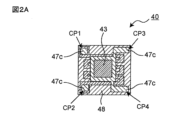
- FIG. 2A and 2B are a schematic plan view and a schematic cross-sectional view, respectively, of an example of a gas sensor according to a second embodiment of the present invention.
- the gas sensor 40 shown in Figures 2A and 2B includes a layer of metal oxide 2 (not shown) formed on a piezoelectric vibrator 41 and an MOF film 43 provided on the layer of metal oxide 2. Note that the layer of metal oxide 2 is omitted in Figure 2B.
- the piezoelectric vibrator 41 corresponds to the support, and includes a lower electrode 411, a piezoelectric film 412, and an upper electrode 413.
- the MOF film 43 corresponds to the MOF film 1 in the first embodiment.
- the gas sensor 40 typically further includes a silicon substrate 44, a support film 45 formed on the silicon substrate 44, a heater wiring 46 formed on the support film 45, a heater electrode 47a and a vibrator electrode 47b, wire bond contact pads 47c formed on the heater electrode 47a and the vibrator electrode 47b, and an insulating layer 48 for insulating the heater wiring 46 from the piezoelectric vibrator 41.
- CP1 is a connection terminal (positive) to the heater
- CP2 is a connection terminal (negative) to the heater
- CP3 is a connection terminal to the upper electrode of the vibrator
- CP4 is a connection terminal to the lower electrode of the vibrator.
- the wire bond contact pad 47c functions as such a connection terminal.
- the gas sensor 40 can be manufactured, for example, by the following method. Specifically, first, as shown in FIG. 2C, a support film 45 is formed on a silicon substrate 44 (step (1)). Next, a heater wiring 46, a heater electrode 47a, and a vibrator electrode 47b are formed on the support film 45, and a wire bond contact pad 47c is formed on the heater electrode 47a and the vibrator electrode 47b (step (2)). Furthermore, an insulating layer 48 is formed to insulate the heater wiring 46 from a piezoelectric vibrator 41 (described later) (step (3)).
- a lower electrode 411 is formed on the insulating layer 48 (step (4)), a piezoelectric film 412 is formed on the lower electrode 411 (step (5)), and an upper electrode 413 is formed on the piezoelectric film 412 (step (6)). Then, a layer of metal oxide 2 (not shown) is formed on the upper electrode 413, and then an MOF film 43 is formed on the layer of metal oxide 2 (not shown), and a part of the insulating layer 48 is etched to expose the wire bond contact pad 47c (step (7)).
- Fig. 2C is a schematic process diagram showing an example of a method for producing the gas sensor according to the second embodiment of the present invention.
- the gas sensor 40 consumes little power.
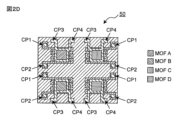
- FIG. 2D and 2E are a schematic plan view and a schematic cross-sectional view, respectively, of an example of a multi-gas sensor according to the second embodiment of the present invention.
- the multi-gas sensor 50 shown in Figures 2D and 2E has multiple (e.g., four) gas sensors 40 shown in Figures 2A and 2B, and the four gas sensors 40 have MOF membranes containing different MOFs.
- the multi-gas sensor 50 is manufactured in the same manner as the gas sensor 40, except that a plurality (e.g., four) of the gas sensors 40 shown in FIG. 2A and FIG. 2B are manufactured simultaneously, and the four gas sensors 40 have MOF membranes containing different MOFs.
- the MOFs of the four gas sensors 40 are different from each other and correspond to different gases.
- the multi-gas sensor 50 consumes little power.
- the multi-sensor 50 can function as an odor sensor.
- the third embodiment of the present invention provides a gas adsorption filter using the MOF membrane according to the first embodiment.
- the gas adsorption filter of the present invention may be a filter for adsorbing carbon dioxide gas.
- the gas adsorption rate of the MOF membrane is sufficiently improved, as in the first embodiment. Therefore, a highly reliable gas adsorption filter can be realized.
- the gas adsorption filter of this embodiment has a structure similar to that of the composite membrane structure of the first embodiment, except that an adsorbent material other than the MOF is attached or supported on the MOF membrane surface.
- the gas adsorption filter 60 includes a metal oxide layer 62 formed on a support 61 having a honeycomb structure, an MOF membrane 63 of the metal oxide layer 62, and an adsorbent 65 of the MOF thin film 63.
- the metal oxide layer 62 corresponds to the layer of metal oxide 2 in the first embodiment.
- the MOF membrane 63 corresponds to the MOF membrane 1 in the first embodiment.
- the adsorbent 65 corresponds to the adsorbent in the first embodiment.
- FIG. 2F is a schematic diagram of an example of a gas adsorption filter according to a third embodiment of the present invention.
- the surface area of the support itself can be made extremely large.
- the gas adsorption rate is improved.
- more MOFs can be attached or supported. Therefore, it is possible to attach or support more adsorbent 65 while maintaining the carbon dioxide gas adsorption rate per unit area. Therefore, the carbon dioxide gas adsorption capacity is significantly improved.
- the metal oxide layer 62 acts as an adhesion layer, so that the MOF membrane 63 can be sufficiently prevented from falling off, and durability is improved.
- the effective surface area in contact with carbon dioxide is extremely large due to the combined effect of the increased surface area due to the honeycomb structure of the support 61, the surface irregularities due to the porosity and protrusions of the MOF membrane 63, and the increased surface area due to the MOF crystals (internal irregularities (i.e. pores)).
- the carbon dioxide gas adsorption capacity is significantly improved.
- the metal oxide layer porous the carbon dioxide gas adsorption capacity can be further improved.
- the water resistance of the MOF is improved by using azole-based organic molecules (especially imidazole-based organic molecules) or cyanide-based organic molecules as the organic molecules that make up the MOF membrane. This makes it more reliable even when it supports an adsorbent (especially an amino group-containing polymer).
- the support 61 By making the support 61 into a honeycomb structure, it is possible to improve the carbon dioxide adsorption capacity while maintaining pressure loss.
- the gas adsorption filter of this embodiment can be manufactured by forming a metal oxide layer 62 (a layer of "metal oxide 2" in the first embodiment) and a thin MOF film 63 (a layer of "MOF film 1" in the first embodiment) on a support 61, then removing residual solvent and adsorbed gas by heating, and attaching or supporting the adsorbent 65. Heating is preferably performed in a vacuum (or in a reduced pressure atmosphere).
- the attachment or support of the adsorbent 65 can be achieved by impregnating the MOF membrane with an aqueous solution of the adsorbent (particularly an amine compound) and then drying. This allows a membrane of the adsorbent 65 (particularly an amine compound) to be formed on the MOF membrane.
- the fourth embodiment of the present invention provides a gas removal device (or gas removal system) including the gas adsorption filter 60 according to the third embodiment.
- the gas removal device of the present invention may be a device (or system) for removing carbon dioxide gas.
- the gas adsorption rate of the MOF membrane is sufficiently improved, and for example, the adsorption capacity of carbon dioxide gas can be significantly improved.
- the present invention makes it possible to realize a small-sized, energy-saving, low-cost, and highly reliable gas removal device (particularly a carbon dioxide gas removal device).
- the gas removal device of the present invention can also be used for general air conditioning.
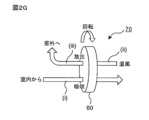
- FIG. 2G is a schematic diagram of an example of a gas removal device according to the fourth embodiment of the present invention.
- the adsorption (step (i)) and the release and discharge (steps (ii) and (iii)) of carbon dioxide may be performed simultaneously using different positions on the adsorption filter 60.
- the adsorption filter 60 can be rotated to change the release position to the discharge position and vice versa.
- the adsorption, release and discharge of carbon dioxide gas can be performed continuously.
- the adsorption of carbon dioxide (step (i)) and the release and discharge (steps (ii) and (iii)) may alternatively be performed sequentially using the same position on the adsorption filter 60.
- the present invention as described above includes the following preferred embodiments.
- a metal-organic framework film the surface of which is covered with protrusions, the protrusions having an average adjacent distance p of 1 nm or more and 100 nm or less.
- ⁇ 4> The metal-organic framework film according to ⁇ 3>, wherein a metal atom is shared by the metal oxide and the metal-organic framework at an interface between the metal oxide and the metal-organic framework constituting the metal-organic framework film.
- ⁇ 5> The metal-organic framework film according to ⁇ 3> or ⁇ 4>, wherein the metal-organic framework film is a porous film based on coordinate bonds between organic molecules and metal atoms including metal atoms derived from the metal oxide.
- ⁇ 6> The metal-organic structure film according to ⁇ 5>, wherein the organic molecules include one or more organic molecules selected from the group consisting of azole-based organic molecules, cyanide-based organic molecules, and carboxylic acid-based organic molecules.
- ⁇ 7> The metal organic structure film according to ⁇ 5> or ⁇ 6>, wherein the metal atoms include one or more metal atoms selected from the group consisting of zinc, copper, nickel, iron, indium, and aluminum.
- the metal oxide comprises one or more metal oxides selected from the group consisting of zinc oxide, copper oxide, nickel oxide, iron oxide, indium oxide, and aluminum oxide.
- the metal oxide has a form of particles, or a molded or sintered body of the particles.
- ⁇ 10> The metal-organic framework film according to ⁇ 9>, wherein the particles have an average primary particle size of 2 ⁇ m or more and 25 ⁇ m or less.
- ⁇ 11> The metal-organic structure film according to any one of ⁇ 1> to ⁇ 10>, wherein the metal-organic structure film has a thickness t of 10 nm or more and 1000 nm or less.
- ⁇ 12> The metal-organic framework film according to any one of ⁇ 1> to ⁇ 11>, wherein the metal-organic framework constituting the metal-organic framework film has a composition formula of Zn(mIm) 2 .
- ⁇ 13> The metal-organic structure film according to any one of ⁇ 1> to ⁇ 12>, wherein the metal-organic structure film is a gas adsorption material.
- An amine compound is contained in the metal-organic framework film, The metal-organic framework film according to ⁇ 13>, wherein the gas is carbon dioxide gas.
- ⁇ 15> The metal organic structure film according to ⁇ 14>, wherein the amine compound is an amino group-containing polymer having a weight average molecular weight of 100 or more.
- ⁇ 16> The metal organic structure film according to ⁇ 14> or ⁇ 15>, wherein the amine compound is polyethyleneimine.
- ⁇ 17> A method for producing a metal organic framework film, comprising immersing a metal oxide in a solution containing organic molecules, and applying heating and ultrasonic waves to the metal oxide.
- ⁇ 18> A method for producing a metal-organic structure film according to ⁇ 17>, comprising producing a metal-organic structure film according to any one of ⁇ 1> to ⁇ 16>.
- the heating is performed at 40° C. or higher, The method for producing a metal-organic framework film according to ⁇ 17> or ⁇ 18>, wherein the ultrasonic waves have a frequency of 30 kHz or more.
- This zinc oxide sintered body was used as a support, and an MOF membrane having a nano-projection structure was formed on its surface.
- the support was immersed in an ethanol solution containing raw materials for MOF synthesis (metal ions and organic molecules), and heated at 60 ° C for 2 hours while applying 40 kHz ultrasound.
- the support was immersed in an ethanol solution containing 10 vol% polyethyleneimine for 30 minutes. After that, the support containing the MOF membrane was taken out and dried at 80 ° C for 30 minutes to obtain a filter.
- Example 2 Formation of MOF Membrane A filter was obtained in the same manner as in Example 1, except that zinc oxide powder having an average primary particle size of 1 ⁇ m was used.
- X-ray diffraction (XRD) spectrum measurement was performed by the same method as in Example 1.
- XRD X-ray diffraction
- the peak of the X-ray diffraction (XRD) spectrum was at the same position as the peak position of the ZIF-8 particle alone and the peak position of the ZnO alone film. It was confirmed that it was a composite structure having both ZIF-8 and ZnO.
- Fig. 10 is a graph showing the evaluation results of the gas adsorption test performed in the examples and comparative examples.
- the presence of the nanoprotrusion structure increased the carbon dioxide adsorption rate. Furthermore, the carbon dioxide adsorption rate could be increased by appropriately increasing the zinc oxide particle size.
- MOF membranes are composed of metal ions and organic molecules, and typically have a crystal lattice without lattice defects, as shown in FIG. 13. However, in reality, as shown in FIG. 11, there are some lattice defects, and in the lattice defects, there are both parts where the lattice is terminated with metal and parts where it is terminated with organic molecules, so the pores are wide. Gas molecules can easily penetrate into the wide pores.
- the MOF membrane of the present invention has protrusions at a predetermined average adjacent distance, so that the surface area of the MOF membrane is increased and the lattice defects are appropriately increased, as shown in FIG. 1C. Therefore, it is considered that the penetration of gas molecules becomes easier, and the gas adsorption rate as a gas adsorption filter is increased.
- FIG. 11 is a schematic diagram of MOF that shows the crystal structure of an actual MOF.
- Example 2 Improvement of gas adsorption speed due to gaps between particles
- Large gaps between the particles that make up the support improve the gas flow and the adsorption speed in the gas adsorption filter.
- the diffusion resistance when gas flows through a straight hole on a capillary is as shown in Figure 12.
- the hole diameter is 1 ⁇ m or more, the diffusion resistance is small and the gas flows smoothly, improving the gas adsorption speed.
- the MOF filter made from zinc oxide particles with a particle size of 1 ⁇ m has narrower gaps between particles that are less than 1 ⁇ m.
- Example 1 the MOF filter made from zinc oxide particles with a particle size of 11 ⁇ m has narrower gaps that are 1 ⁇ m or more. This is thought to result in a further improvement in the gas adsorption rate in Example 1 due to the effect of the gaps in addition to the effect of the nanoprotrusion structure.
- Figure 12 is a graph showing the relationship between gap size and diffusion resistance.
- Example 3 Regarding the diameter of metal oxide particles in the substrate
- Example 1 even when a MOF membrane was formed on a molded product obtained by extruding and sintering zinc oxide having a particle diameter of 11 ⁇ m, the shape was maintained to be equivalent to that before the membrane was formed ( FIG. 3 ).
- Comparative Example 3 when an MOF membrane was formed on a molded product obtained by extruding and sintering zinc oxide having a particle size of 30 ⁇ m, the membrane collapsed. It can be seen that when the particle size is 11 ⁇ m, the filter shape can be maintained even without a binder, whereas when the particle size is too large, the filter shape cannot be maintained.
- metal oxide particles e.g., zinc oxide particles
- a particle size of 1 ⁇ m or more are required to obtain a void size of 1 ⁇ m or more.
- the MOF membrane of the present invention and the gas adsorption material having the MOF membrane are useful for sensors (particularly gas or odor sensors), gas adsorption filters, and gas removal devices.
- Metal-organic framework membrane (MOF membrane) 2 Metal oxide 11: Protrusion 12: Base 40: Gas sensor 50: Multi-gas sensor 60: Gas adsorption filter 61: Support 62: Metal oxide layer 63: Metal organic framework film (MOF film) 65: Adsorbent 70: Gas removal device
Landscapes
- Chemical & Material Sciences (AREA)
- Analytical Chemistry (AREA)
- Organic Chemistry (AREA)
- Chemical Kinetics & Catalysis (AREA)
- Inorganic Chemistry (AREA)
- Engineering & Computer Science (AREA)
- Crystallography & Structural Chemistry (AREA)
- Materials Engineering (AREA)
- Nanotechnology (AREA)
- Solid-Sorbent Or Filter-Aiding Compositions (AREA)
- Separation Using Semi-Permeable Membranes (AREA)
Priority Applications (3)
| Application Number | Priority Date | Filing Date | Title |
|---|---|---|---|
| CN202380071638.1A CN120018905A (zh) | 2022-11-22 | 2023-08-08 | 金属有机结构体膜及其制造方法 |
| JP2023579364A JP7722479B2 (ja) | 2022-11-22 | 2023-08-08 | 金属有機構造体膜およびその製造方法 |
| US19/087,809 US20250249431A1 (en) | 2022-11-22 | 2025-03-24 | Metal-organic framework film and method for producing same |
Applications Claiming Priority (2)
| Application Number | Priority Date | Filing Date | Title |
|---|---|---|---|
| JP2022-186639 | 2022-11-22 | ||
| JP2022186639 | 2022-11-22 |
Related Child Applications (1)
| Application Number | Title | Priority Date | Filing Date |
|---|---|---|---|
| US19/087,809 Continuation US20250249431A1 (en) | 2022-11-22 | 2025-03-24 | Metal-organic framework film and method for producing same |
Publications (1)
| Publication Number | Publication Date |
|---|---|
| WO2024111176A1 true WO2024111176A1 (ja) | 2024-05-30 |
Family
ID=91195336
Family Applications (1)
| Application Number | Title | Priority Date | Filing Date |
|---|---|---|---|
| PCT/JP2023/028969 Ceased WO2024111176A1 (ja) | 2022-11-22 | 2023-08-08 | 金属有機構造体膜およびその製造方法 |
Country Status (4)
| Country | Link |
|---|---|
| US (1) | US20250249431A1 (https=) |
| JP (1) | JP7722479B2 (https=) |
| CN (1) | CN120018905A (https=) |
| WO (1) | WO2024111176A1 (https=) |
Citations (8)
| Publication number | Priority date | Publication date | Assignee | Title |
|---|---|---|---|---|
| US20190168173A1 (en) * | 2017-10-27 | 2019-06-06 | Regents Of The University Of Minnesota | Nanocomposite membranes and methods of forming the same |
| KR102093124B1 (ko) * | 2018-10-26 | 2020-03-25 | 경희대학교 산학협력단 | 분무 열분해를 이용한 금속-zif 입자의 제조방법 |
| CN112657350A (zh) * | 2020-12-01 | 2021-04-16 | 大连理工大学 | 一种利用二维纳米片膜诱导的异质外延生长法制备mof@mof杂化膜的方法 |
| CN113617334A (zh) * | 2021-08-10 | 2021-11-09 | 黑龙江省科学院石油化学研究院 | 一种金属有机框架材料的制备方法 |
| WO2021261271A1 (ja) * | 2020-06-23 | 2021-12-30 | 株式会社村田製作所 | 複合膜構造体ならびに該複合膜構造体を用いたセンサ、ガス吸着フィルタおよびガス除去装置 |
| JP2022013828A (ja) * | 2020-06-29 | 2022-01-18 | アモーレパシフィック コーポレーション | 表面処理された無機粒子、その製造方法、その分散液およびこれを含む化粧料組成物 |
| CN114870650A (zh) * | 2022-05-16 | 2022-08-09 | 南京工业大学 | 一种互穿复合结构的锌基mof膜材料及其制备方法和应用 |
| CN115041142A (zh) * | 2022-06-22 | 2022-09-13 | 扬州工业职业技术学院 | 一种甲醛吸附用mof气凝胶及其制备方法 |
-
2023
- 2023-08-08 CN CN202380071638.1A patent/CN120018905A/zh active Pending
- 2023-08-08 WO PCT/JP2023/028969 patent/WO2024111176A1/ja not_active Ceased
- 2023-08-08 JP JP2023579364A patent/JP7722479B2/ja active Active
-
2025
- 2025-03-24 US US19/087,809 patent/US20250249431A1/en active Pending
Patent Citations (8)
| Publication number | Priority date | Publication date | Assignee | Title |
|---|---|---|---|---|
| US20190168173A1 (en) * | 2017-10-27 | 2019-06-06 | Regents Of The University Of Minnesota | Nanocomposite membranes and methods of forming the same |
| KR102093124B1 (ko) * | 2018-10-26 | 2020-03-25 | 경희대학교 산학협력단 | 분무 열분해를 이용한 금속-zif 입자의 제조방법 |
| WO2021261271A1 (ja) * | 2020-06-23 | 2021-12-30 | 株式会社村田製作所 | 複合膜構造体ならびに該複合膜構造体を用いたセンサ、ガス吸着フィルタおよびガス除去装置 |
| JP2022013828A (ja) * | 2020-06-29 | 2022-01-18 | アモーレパシフィック コーポレーション | 表面処理された無機粒子、その製造方法、その分散液およびこれを含む化粧料組成物 |
| CN112657350A (zh) * | 2020-12-01 | 2021-04-16 | 大连理工大学 | 一种利用二维纳米片膜诱导的异质外延生长法制备mof@mof杂化膜的方法 |
| CN113617334A (zh) * | 2021-08-10 | 2021-11-09 | 黑龙江省科学院石油化学研究院 | 一种金属有机框架材料的制备方法 |
| CN114870650A (zh) * | 2022-05-16 | 2022-08-09 | 南京工业大学 | 一种互穿复合结构的锌基mof膜材料及其制备方法和应用 |
| CN115041142A (zh) * | 2022-06-22 | 2022-09-13 | 扬州工业职业技术学院 | 一种甲醛吸附用mof气凝胶及其制备方法 |
Also Published As
| Publication number | Publication date |
|---|---|
| JPWO2024111176A1 (https=) | 2024-05-30 |
| JP7722479B2 (ja) | 2025-08-13 |
| US20250249431A1 (en) | 2025-08-07 |
| CN120018905A (zh) | 2025-05-16 |
Similar Documents
| Publication | Publication Date | Title |
|---|---|---|
| JP7452651B2 (ja) | 複合膜構造体を用いたガス吸着フィルタおよびガス除去装置 | |
| US6536604B1 (en) | Inorganic dual-layer microporous supported membranes | |
| JP7738486B2 (ja) | セラミック陽イオン交換材料 | |
| US10906010B2 (en) | Method of production of nanoporous membranes for water purification from metal ions at low differential pressures | |
| JP2021178322A (ja) | セラミック選択性膜 | |
| Zhang et al. | A simple and scalable method for preparing low-defect ZIF-8 tubular membranes | |
| KR101905862B1 (ko) | 위치 선택적 다공성 분리막의 제조방법 및 상기 제조된 다공성 분리막을 이용한 가스분리방법 | |
| CN108124433B (zh) | 用于水-和气体分离的含碳膜 | |
| US7329311B2 (en) | Porous sintered composite materials | |
| CN104144738B (zh) | 多孔支持体‑沸石膜复合体 | |
| JP2025179051A (ja) | セラミック陰イオン交換材料 | |
| JP2002338211A (ja) | アモルファス状金属酸化物の薄膜材料 | |
| Nian et al. | Preparation of a pure ZIF-67 membrane by self-conversion of cobalt carbonate hydroxide nanowires for H 2 separation | |
| CA2963431C (en) | Method of production of nanoporous membranes for water purification from metal ions at low differential pressures | |
| CN115856018B (zh) | 一种应用于电化学储能系统消防装备的高灵敏气体传感器 | |
| JP2022527132A (ja) | 大粒子高性能触媒テープ | |
| CN115725103B (zh) | 一种zif-8膜及其制备方法和应用 | |
| Liu et al. | Antifouling PVDF membrane grafted with zwitterionic poly (lysine methacrylamide) brushes | |
| JP7722479B2 (ja) | 金属有機構造体膜およびその製造方法 | |
| CN113648853B (zh) | 一种以电纺丝纳米纤维膜为支撑层的复合正渗透膜及其制备方法与应用 | |
| Ichinose et al. | Preparation of cross-linked ultrathin films based on layer-by-layer assembly of polymers | |
| WO2011033235A1 (fr) | Materiau composite comportant un materiau organique-inorganique, procede de preparation et applications | |
| JP2002220292A (ja) | 多孔質セラミック膜を有する多孔質無機材料及びその製造方法 | |
| KR101889177B1 (ko) | 수소 검출용 가스 센서 및 수소 검출용 가스 센서 제조방법 | |
| EP4101521A1 (en) | Separation membrane and metal organic structure |
Legal Events
| Date | Code | Title | Description |
|---|---|---|---|
| WWE | Wipo information: entry into national phase |
Ref document number: 2023579364 Country of ref document: JP |
|
| 121 | Ep: the epo has been informed by wipo that ep was designated in this application |
Ref document number: 23894192 Country of ref document: EP Kind code of ref document: A1 |
|
| WWE | Wipo information: entry into national phase |
Ref document number: 202380071638.1 Country of ref document: CN |
|
| WWP | Wipo information: published in national office |
Ref document number: 202380071638.1 Country of ref document: CN |
|
| NENP | Non-entry into the national phase |
Ref country code: DE |
|
| 122 | Ep: pct application non-entry in european phase |
Ref document number: 23894192 Country of ref document: EP Kind code of ref document: A1 |