WO2024106535A1 - 植物細胞壁溶解剤 - Google Patents
植物細胞壁溶解剤 Download PDFInfo
- Publication number
- WO2024106535A1 WO2024106535A1 PCT/JP2023/041466 JP2023041466W WO2024106535A1 WO 2024106535 A1 WO2024106535 A1 WO 2024106535A1 JP 2023041466 W JP2023041466 W JP 2023041466W WO 2024106535 A1 WO2024106535 A1 WO 2024106535A1
- Authority
- WO
- WIPO (PCT)
- Prior art keywords
- cation
- group
- zwitterion
- carbon atoms
- added
- Prior art date
- Legal status (The legal status is an assumption and is not a legal conclusion. Google has not performed a legal analysis and makes no representation as to the accuracy of the status listed.)
- Ceased
Links
Images
Classifications
-
- C—CHEMISTRY; METALLURGY
- C07—ORGANIC CHEMISTRY
- C07D—HETEROCYCLIC COMPOUNDS
- C07D233/00—Heterocyclic compounds containing 1,3-diazole or hydrogenated 1,3-diazole rings, not condensed with other rings
- C07D233/54—Heterocyclic compounds containing 1,3-diazole or hydrogenated 1,3-diazole rings, not condensed with other rings having two double bonds between ring members or between ring members and non-ring members
- C07D233/64—Heterocyclic compounds containing 1,3-diazole or hydrogenated 1,3-diazole rings, not condensed with other rings having two double bonds between ring members or between ring members and non-ring members with substituted hydrocarbon radicals attached to ring carbon atoms, e.g. histidine
-
- C—CHEMISTRY; METALLURGY
- C12—BIOCHEMISTRY; BEER; SPIRITS; WINE; VINEGAR; MICROBIOLOGY; ENZYMOLOGY; MUTATION OR GENETIC ENGINEERING
- C12N—MICROORGANISMS OR ENZYMES; COMPOSITIONS THEREOF; PROPAGATING, PRESERVING, OR MAINTAINING MICROORGANISMS; MUTATION OR GENETIC ENGINEERING; CULTURE MEDIA
- C12N1/00—Microorganisms; Compositions thereof; Processes of propagating, maintaining or preserving microorganisms or compositions thereof; Processes of preparing or isolating a composition containing a microorganism; Culture media therefor
- C12N1/06—Lysis of microorganisms
Definitions
- the present invention relates to a plant cell wall lysing agent.
- the present invention relates to a plant cell wall lysing agent that can be used directly for culturing microorganisms without the need to remove the lysing agent from the plant cell wall lysate.
- Plant biomass is an important raw material for biorefineries.
- the main components of plant cell walls are cellulose, hemicellulose, and lignin, but all of these components are robust, making their industrial use difficult.
- hydrolysis is considered, but this requires a lot of energy, so it was considered to liquefy the cell walls.
- a method using ionic liquid as a means of liquefying plant cell walls has been reported (Non-Patent Document 1).
- this ionic liquid makes it possible to dissolve the cell walls, it is difficult to remove the ionic liquid from the lysate.
- Non-Patent Document 2 discloses that when they tried to dissolve cellulose using a less toxic ionic liquid (zwitterion), they were able to reduce the toxicity and achieve one-pot ethanol production.
- the present invention therefore resides in the development of low toxicity zwitterions capable of achieving high concentrations of cellulose dissolution.
- zwitterions having one or more oxyalkylene groups between the cation moiety and the anion moiety, or zwitterions in which the cation moiety is a phosphate cation are low toxic and capable of dissolving high concentrations of cellulose with low viscosity, thus completing the present invention.
- R 1 represents a linear alkyl group having 1 to 8 carbon atoms, an alkenyl group having 2 to 8 carbon atoms, or a C1-8 linear alkyl group -(OCH 2 CH 2 ) m -;
- A is a cationic portion of a zwitterion and is a cation selected from the group consisting of imidazolium cation, phosphonium cation, ammonium cation, sulfonium cation, pyrazolium cation, pyridinium cation, pyrrolidinium cation, morpholinium cation, cyclopropenium cation and piperidinium cation;
- R2 represents an alkylene group having 1 to 4 carbon atoms;
- R3 represents an alkylene group having 2 to 4 carbon atoms;
- m represents the number 1 or 2;
- n represents a number from 0 to 10
- B represents an anion selected from -SO
- R 1 in general formula (1) is a linear alkyl group having 1 to 4 carbon atoms, an alkenyl group having 2 to 4 carbon atoms, or a C1-4-alkyl-(OCH 2 CH 2 ) m - (wherein m is the number 1 or 2).
- n in general formula (1) is a number from 1 to 6.
- B in general formula (1) is -COO- .
- [7] The zwitterion according to any one of [1] to [4], wherein in general formula (1), n is 0 to 6, and B is --P.dbd.O( OR.sup.4 )O.sup .-- or --OP.dbd.O( OR.sup.5 )O.sup .-- .
- a plant cell wall-lytic agent composition comprising the zwitterion according to any one of [1] to [7].
- a cellulose solubilizer composition comprising the zwitterion according to any one of [1] to [7].
- a method for lysing a cell wall of a plant comprising a step of contacting the plant with a composition containing the zwitterion according to any one of [1] to [7].
- a method for dissolving cellulose in a cellulose-containing plant comprising a step of contacting the plant with a composition containing the zwitterion according to any one of [1] to [7].
- the zwitterion of the present invention is an ionic liquid that easily dissolves plant cell walls, typically those containing high concentrations of cellulose, and is low toxic. Therefore, by dissolving plant cell walls using the zwitterion of the present invention, it is possible to biorefine a large amount of plant biomass, and for example, glucose, ethanol, etc. can be safely and industrially produced from plant biomass.
- One aspect of the present invention is a compound represented by the general formula (1)
- R 1 represents a linear alkyl group having 1 to 8 carbon atoms, an alkenyl group having 2 to 8 carbon atoms, or a C1-8 linear alkyl group -(OCH 2 CH 2 ) m -;
- A is a cationic portion of a zwitterion and is a cation selected from the group consisting of imidazolium cation, phosphonium cation, ammonium cation, sulfonium cation, pyrazolium cation, pyridinium cation, pyrrolidinium cation, morpholinium cation, cyclopropenium cation and piperidinium cation;
- R2 represents an alkylene group having 1 to 4 carbon atoms;
- R3 represents an alkylene group having 2 to 4 carbon atoms;
- m represents the number 1 or 2;
- n represents a number from 0 to 10
- B is the anion portion of the z
- a zwitterion is a molecule that has both positive and negative charges in one molecule.
- the zwitterion of the present invention has a cationic portion represented by A and an anionic portion represented by B.
- the zwitterion of the present invention is characterized in that it has one or more oxyalkylene groups between the cationic portion represented by A and the anionic portion represented by B.
- the alkyl group refers to a saturated chain hydrocarbon group, and includes a linear alkyl group and a branched alkyl group. It is preferably an alkyl group having 1 to 8 carbon atoms, and includes a linear or branched alkyl group having 1 to 8 carbon atoms. It is more preferably a linear or branched alkyl group having 1 to 6 carbon atoms, and more preferably a linear or branched alkyl group having 1 to 4 carbon atoms.
- alkyl groups include methyl, ethyl, n-propyl, isopropyl, n-butyl, isobutyl, sec-butyl, tert-butyl, n-pentyl, n-hexyl, n-heptyl, and n-octyl groups.
- the alkenyl group refers to an unsaturated chain hydrocarbon group having one double bond, and includes linear alkenyl groups and branched alkenyl groups. Preferably, it includes a linear or branched alkenyl group having 2 to 8 carbon atoms. More preferably, it is a linear or branched alkenyl group having 2 to 6 carbon atoms, and even more preferably, it is a linear or branched alkenyl group having 2 to 4 carbon atoms. Specific examples of these alkenyl groups include vinyl, 1-propenyl, 2-propenyl (allyl), butenyl, pentenyl, and hexenyl groups.
- an alkylene group is a divalent saturated chain-like hydrocarbon group, including linear and branched alkylene groups. It is preferably a linear or branched alkylene group having 1 to 4 carbon atoms, and more preferably a linear or branched alkylene group having 2 to 4 carbon atoms. Specific examples include a methylene group, an ethylene group, a trimethylene group, a propylene group, and a tetramethylene group.
- R 1 represents a linear alkyl group having 1 to 8 carbon atoms, an alkenyl group having 2 to 8 carbon atoms, or a C1-8 linear alkyl group -(OCH 2 CH 2 )m-.
- the linear alkyl group having 1 to 8 carbon atoms is preferably a linear alkyl group having 1 to 6 carbon atoms, and more preferably a linear alkyl group having 1 to 4 carbon atoms.
- these alkyl groups include a methyl group, an ethyl group, an n-propyl group, an n-butyl group, an isobutyl group, an n-pentyl group, an n-hexyl group, an n-heptyl group, an n-octyl group, etc.
- a methyl group, an ethyl group, an n-propyl group, an n-butyl group, an n-pentyl group, and an n-hexyl group are preferred, and a methyl group, an ethyl group, an n-propyl group, and an n-butyl group are more preferred.
- alkenyl group having 2 to 8 carbon atoms examples include linear or branched alkenyl groups having 2 to 8 carbon atoms.
- a linear or branched alkenyl group having 2 to 6 carbon atoms is preferred, and a linear or branched alkenyl group having 2 to 4 carbon atoms is more preferred.
- a vinyl group, a propenyl group, a butenyl group, a pentenyl group, or a hexenyl group is preferred, and a vinyl group, a 1-propenyl group, a 2-propenyl group (allyl group), or a butenyl group is more preferred.
- the C1-8 straight chain alkyl group is preferably a straight chain alkyl group having 1 to 6 carbon atoms, more preferably a straight chain alkyl group having 1 to 4 carbon atoms.
- Specific examples of these alkyl groups include a methyl group, an ethyl group, an n-propyl group, an n-butyl group, an isobutyl group, an n-pentyl group, an n-hexyl group, an n-heptyl group, an n-octyl group, etc.
- a methyl group, an ethyl group, an n-propyl group, an n-butyl group, an n-pentyl group, and an n-hexyl group are preferred, and a methyl group, an ethyl group, an n-propyl group, and an n-butyl group are more preferred.
- m is a number of 1 or 2.
- A is a cationic portion of the zwitterion and is a cation selected from the group consisting of imidazolium cation, phosphonium cation, ammonium cation, sulfonium cation, pyrazolium cation, pyridinium cation, pyrrolidinium cation, morpholinium cation, cyclopropenium cation and piperidinium cation.
- the imidazolium cation, the ammonium cation, the pyrazolium cation, the pyridinium cation, the pyrrolidinium cation, the morpholinium cation or the piperidinium cation is preferred, the imidazolium cation, the pyrazolium cation, the pyridinium cation, the pyrrolidinium cation or the piperidinium cation is more preferred, and the imidazolium cation is even more preferred.
- R2 represents an alkylene group having 1 to 4 carbon atoms, including linear or branched alkylene groups having 1 to 4 carbon atoms. Specific examples include a methylene group, an ethylene group, a trimethylene group, a propylene group, and a tetramethylene group.
- R3 may be a linear or branched alkylene group having 2 to 4 carbon atoms, specifically an ethylene group, a trimethylene group, a propylene group, or a tetramethylene group. Therefore, OR3 is preferably an oxyethylene group, an oxytrimethylene group, an oxypropylene group, or an oxytetramethylene group.
- n is preferably a number from 1 to 10, more preferably 1 to 8, even more preferably 1 to 6, and even more preferably 1 to 4.
- n is preferably a number from 0 to 10, more preferably 0 to 8, even more preferably 0 to 6, and even more preferably 0 to 4.
- B is the anion portion of the zwitterion and represents an anion selected from --SO.sub.3.sup.- , --COO.sup.- , --P.dbd.O( OR.sub.4 ) O.sub.- and --OP.dbd.O( OR.sub.5 )O.sub.-, and R.sub.4 and R.sub.5 may be the same or different and are each a hydrogen atom or an alkyl group having 1 to 8 carbon atoms which may have a heteroatom.
- R 4 and R 5 are preferably a hydrogen atom, a methyl group, an ethyl group, or the like.
- zwitterions represented by general formula (1) include the compounds shown in Table 1 below.
- the zwitterion represented by general formula (1) can be produced, for example, according to the following reaction scheme:
- R5 represents an alkyl group or an aromatic hydrocarbon group
- R6 represents an alkyl group, a halogenoalkyl group or an aromatic hydrocarbon group
- A, B, R1 , R2 , R3 and n have the same meanings as above.
- R5 represents an alkyl group or an aromatic hydrocarbon group.
- the alkyl group may be a straight-chain or branched-chain alkyl group having 1 to 8 carbon atoms. Specifically, a methyl group, an ethyl group, or a tert-butyl group is more preferable.
- the aromatic hydrocarbon group may be a phenyl group, a halogenophenyl group, or a nitrophenyl group.
- R6 represents an alkyl group, a halogenoalkyl group, or an aromatic hydrocarbon group. Examples of the alkyl group include linear or branched alkyl groups having 1 to 8 carbon atoms. Specifically, methyl and ethyl groups are more preferable.
- halogenoalkyl group examples include fluoroalkyl groups. Specifically, trifluoromethyl groups and the like are included.
- aromatic hydrocarbon group examples include alkylphenyl groups and the like. Specifically, p-toluene groups are included.
- the hydroxyl group is replaced with a leaving group in order to carry out a nucleophilic substitution reaction in a subsequent reaction. Representative leaving groups are given here, but they may be converted to other leaving groups such as halogen.
- Step (1) is a step of reacting compound (2) with compound (3) to obtain compound (4), which is a step of sulfonylation of the hydroxy group of compound (2).
- Compound (3) is a sulfonylating agent, and preferably a sulfonyl halide compound such as tosyl chloride, mesyl chloride, or trifluoromethylsulfonyl chloride is used.
- This reaction is preferably carried out in the presence of a base, such as a tertiary amine, e.g., triethylamine or 4-dimethylaminopyridine, or an inorganic base, e.g., sodium hydroxide, potassium hydroxide, or sodium hydrogen carbonate.
- a base such as a tertiary amine, e.g., triethylamine or 4-dimethylaminopyridine
- an inorganic base e.g., sodium hydroxide, potassium hydroxide, or sodium hydrogen carbonate.
- the reaction may be carried out in a solvent for about 1 to 40 hours at a temperature of 0° C. to 100° C.
- a general-purpose solvent such as a halogenated hydrocarbon such as dichloromethane, an aromatic hydrocarbon such as benzene or toluene, an ether, or acetonitrile can be used.
- Step (2) is a step of hydrolyzing compound (4) to obtain compound (5).
- a conventional hydrolysis reaction is used, and for example, an acid hydrolysis reaction using an acid such as hydrochloric acid, or a base hydrolysis reaction using sodium hydroxide, triethylammonium hydroxide, or the like is preferred.
- an acid hydrolysis reaction using an acid such as hydrochloric acid
- a base hydrolysis reaction using sodium hydroxide, triethylammonium hydroxide, or the like is preferred.
- a hydrolysis reaction using hydrochloric acid a small amount of hydrochloric acid may be added and the reaction may be carried out at 0° C. to 100° C. for several minutes to about 5 hours.
- Step (3) is a step of reacting compound (5) with compound (6) to obtain compound (7).
- This step is a reaction of binding compound (6) to compound (5) to cationize it.
- This reaction may be carried out in a solvent by stirring for about 1 to 20 hours at a temperature between room temperature and about 200° C.
- a general-purpose solvent such as a halogenated hydrocarbon such as dichloromethane, an aromatic hydrocarbon such as benzene or toluene, an ether, or acetonitrile may be used.
- step (4) compound (7) is zwitterionized.
- An anion exchange resin is added to neutralize the compound.
- An anion exchange resin having a quaternary ammonium group can be used as the anion exchange resin.
- the zwitterion represented by general formula (1) is liquid at room temperature and is stable without decomposition up to temperatures of 240°C or higher. Furthermore, it has been found that it is low toxic and has a high ability to dissolve cellulose, the main component of plant cell walls, and can dissolve even high concentrations of cellulose. Therefore, the zwitterion of the present invention is useful as a plant cell wall dissolving agent composition and a cellulose dissolving agent composition.
- a liquid containing only the zwitterion of the present invention may be used as is, or may be used in combination with other components. That is, the plant cell wall-lytic agent composition or the cellulose-lytic agent composition of the present invention may contain the zwitterion of the present invention in an amount of 5% by mass to 100% by mass.
- Other components that can be contained in the plant cell wall dissolving agent composition or the cellulose dissolving agent composition include other components that dissolve cellulose, such as ionic liquids and LiCl/dimethylacetamide.
- organic solvents that do not dissolve cellulose alone can dissolve cellulose when mixed with the organic solvent, so water, methanol, dimethyl sulfoxide, and the like are also candidates.
- Various medium components can also be added.
- the composition containing the zwitterion of the present invention may be brought into contact with a plant or a cellulose-containing plant.
- the plant may be added to the composition containing the zwitterion of the present invention and dissolved at a temperature of from room temperature to 240° C.
- the plants to be used include plants that are expected to be used as plant biomass raw materials, such as wood chips, various plants, waste materials from various plants, agricultural residues, thinned wood, waste paper, disposable chopsticks, paper cups, wood, waste materials, etc.
- the plant cell wall dissolving agent composition of the present invention By dissolving such materials using the plant cell wall dissolving agent composition of the present invention and carrying out the necessary treatment, it is expected that they can be used, for example, as ethanol, biodiesel, and other industrial raw materials and raw materials for useful substances.
- the plant biomass when producing ethanol from plant biomass, the plant biomass is pretreated with the plant cell wall lysing agent composition of the present invention to dissolve cellulose, etc., and then, according to a conventional method, the cellulose is enzymatically hydrolyzed to glucose, which is then fermented by microorganisms to obtain ethanol.
- plant cell wall lysing agents are difficult to remove, and there is a concern that if they remain, they will be toxic when enzymes or microorganisms are used in subsequent treatments.
- the plant cell lysing agent composition of the present invention has low toxicity to enzymes and microorganisms, making it possible to expand the options for subsequent treatments.
- the aqueous layer after separation was not concentrated, but was collected as it was and dropped into a concentration meter for measurement.
- Viscosity Measurement The viscometer utilized a Brookfield LVDV2TCP and a CPE52 spindle, or a Brookfield RVDV2T and a CPE52 spindle. (DSC-60A Plus) Manufacturer: Shimadzu Corporation Experimental method: Under N2 atmosphere, liquid nitrogen was used for cooling.
- Tetrahydrofuran with stabilizer and hydrochloric acid were purchased from FUJIFILM Wako Pure Chemical Corporation.
- Aluminum oxide active, basic, Brockmann 1
- Amberlite IRN-78, ion exchange resin, nuclear grade was purchased from Alfa Aesar.
- tert-butyl 12-hydroxy-4,7,10-trioxadodecanoate was purchased from Accela ChemBio.
- OE2im was prepared with reference to Cellulose, 29, 3017-3024.
- sodium hydroxide 2.5 equivalents, 55 g, 1.38 mol
- water 55 g
- the solution was added to a solution of diethylene glycol monomethyl ether (1 equivalent, 60 g, 0.5 mol) in toluene (1000 mL), followed by diethylene glycol monomethyl ether.
- a catalytic amount of benzyltrimethylammonium hydroxide (10 mL) was added and stirred in an ice bath.
- benzenesulfonyl chloride (97 g, 0.6 mol) was added dropwise under stirring and refluxed at 70° C. for 6 hours. After evaporating the toluene, the resulting solution was dissolved in dichloromethane, washed once with water (3000 mL), and dried over sodium sulfate to obtain the product.
- OE2im 1-(2-(2-methoxyethoxy)ethyl)imidazole
- an aqueous solution of sodium hydroxide was prepared using sodium hydroxide (2.5 equivalents, 56.4 g, 1.4 mol) and an equal amount of water (57 g).
- the anion exchange resin was removed using filter paper (5C, ADVANTEC), and the reaction solution was transferred to a 50 mL eggplant flask. The resulting reaction solution was concentrated, and the neutralization reaction and the production reaction of OE 2 imC 2 OE 3 C were allowed to proceed. Then, diethyl ether was added to the 50 mL eggplant flask containing the product and washed (30 mL, 1 day, 3 times). After washing, the product was dried under reduced pressure to obtain a liquid product. The purity was 98%, and the yield was about 50% relative to tert-butyl 12-hydroxy-4,7,10-trioxadodecanoate.
- 1-Ethylimidazole, toluene, dichloromethane, methanol, chloroform-d 1 , 99.8 atom % D with 0.03 vol % TMS, and dimethyl sulfoxide-d 6 , 99.9 atom % D with 0.03 vol % TMS were purchased from Kanto Chemical Co., Ltd.
- Hydrochloric acid was purchased from FUJIFILM Wako Pure Chemical Corporation.
- Amberlite IRN-78, ion exchange resin, nuclear grade was purchased from Alfa Aesar.
- the DCM layer dried under reduced pressure was transferred to a 300 mL eggplant flask, an excess of water 100 mL was added, and the mixture was stirred at 60 ° C. for 1 hour to decompose unreacted p-toluenesulfonyl chloride.
- the reaction solution was dissolved in DCM, charged into a separatory funnel, water was added, and the pH was measured using pH test paper, and separation was performed until the pH of the aqueous layer reached 6.
- the DCM layer was dried under reduced pressure to obtain p-toluenesulfonyl PEG4 acid (2a) (properties: liquid, yield: 20% based on the initial amount of raw materials).
- the DCM layer dried under reduced pressure was transferred to a 300 mL eggplant flask, an excess of water 100 mL was added, and the mixture was stirred at 60 ° C. for 1 hour to decompose unreacted p-toluenesulfonyl chloride.
- the reaction solution was dissolved in DCM, charged into a separatory funnel, water was added, and the pH was measured using pH test paper, and separation was performed until the pH of the aqueous layer reached 6.
- the DCM layer was dried under reduced pressure to obtain p-toluenesulfonyl PEG4 acid (2a) (properties: liquid, yield: 39% based on the initial amount of raw materials).
- 1-Vinylimidazole, toluene, dichloromethane, methanol, chloroform-d 1 , 99.8 atom% D with 0.03 vol% TMS, and dimethyl sulfoxide-d 6 , 99.9 atom% D with 0.03 vol% TMS were purchased from Kanto Chemical Co., Ltd.
- Hydrochloric acid was purchased from FUJIFILM Wako Pure Chemical Corporation.
- Amberlite IRN-78, ion exchange resin, nuclear grade was purchased from Alfa Aesar.
- the DCM layer dried under reduced pressure was transferred to a 300 mL eggplant flask, an excess of water 100 mL was added, and the mixture was stirred at 60 ° C. for 1 hour to decompose unreacted p-toluenesulfonyl chloride.
- the reaction solution was dissolved in DCM, charged into a separatory funnel, water was added, and the pH was measured using pH test paper, and separation was performed until the pH of the aqueous layer reached 6.
- the DCM layer was dried under reduced pressure to obtain p-toluenesulfonyl PEG4 acid (2a) (properties: liquid, yield: 39% based on the initial amount of raw materials).
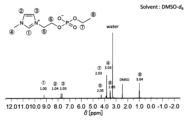
- C 1 imC 3 P was synthesized using 1-Methylimidazole and Diethyl (3-Bromopropyl) phosphate. The raw materials were reacted at 40°C for 48 hours using acetone as a solvent, and an intermediate of C 1 imC 3 P was synthesized. After that, it was washed with diethyl ether and ion-exchanged.
- C 1 imC 2 P was synthesized by reacting the raw materials in a ratio of 2:1 without a solvent at 27°C for 48 hours.
- the synthesized C 1 imC 2 P was diluted with water and mixed and stirred with anion exchange resin (Amberlite IRN78 hydroxide form). After removing the anion exchange resin by filtration and distilling off the water under reduced pressure, the mixture was washed with an excess amount of diethyl ether, and high purity C 1 imC 2 P was synthesized.
- anion exchange resin Amberlite IRN78 hydroxide form
- Test Example 2 Differential scanning calorimetry was carried out on the C 1 imC 2 OE 3 C obtained in Synthesis Example 1. As a result, it was found that this compound did not change up to about 250°C and remained in a liquid state from room temperature to about 250°C.
- Table 2 shows that the zwitterions of the present invention are liquid at room temperature, have low viscosity, and can dissolve high concentrations of cellulose, making them useful as plant cell wall dissolving agents.
- Test Example 6 The toxicity of C 1 imC 2 P to yeast was examined. Kulveromyces marsianus was used as the yeast. C 1 imC 2 P was added to the liquid medium at concentrations of 0 mol/L, 0.01 mol/L, 0.05 mol/L, 0.1 mol/L, 0.5 mol/L, and 1.0 mol/L. Bacteria were inoculated into the medium and cultured at 50° C., and OD 600 was measured with a plate reader after 0, 2, 4, and 6 hours. OD 600 indicates the density of the bacteria. Furthermore, Relative OD 600 is a relative parameter when the control is set to 1.00. The higher the Relative OD 600 value, the lower the toxicity of the zwitterion. The Relative OD 600 of C 1 imC 2 P was 0.77, which was low toxicity.
Landscapes
- Chemical & Material Sciences (AREA)
- Organic Chemistry (AREA)
- Life Sciences & Earth Sciences (AREA)
- Engineering & Computer Science (AREA)
- Health & Medical Sciences (AREA)
- Bioinformatics & Cheminformatics (AREA)
- Zoology (AREA)
- Biotechnology (AREA)
- Wood Science & Technology (AREA)
- Genetics & Genomics (AREA)
- Mycology (AREA)
- Biomedical Technology (AREA)
- Virology (AREA)
- Microbiology (AREA)
- Tropical Medicine & Parasitology (AREA)
- Medicinal Chemistry (AREA)
- Biochemistry (AREA)
- General Engineering & Computer Science (AREA)
- General Health & Medical Sciences (AREA)
- Organic Low-Molecular-Weight Compounds And Preparation Thereof (AREA)
Priority Applications (1)
| Application Number | Priority Date | Filing Date | Title |
|---|---|---|---|
| JP2024558956A JPWO2024106535A1 (https=) | 2022-11-18 | 2023-11-17 |
Applications Claiming Priority (2)
| Application Number | Priority Date | Filing Date | Title |
|---|---|---|---|
| JP2022-185119 | 2022-11-18 | ||
| JP2022185119 | 2022-11-18 |
Publications (1)
| Publication Number | Publication Date |
|---|---|
| WO2024106535A1 true WO2024106535A1 (ja) | 2024-05-23 |
Family
ID=91084579
Family Applications (1)
| Application Number | Title | Priority Date | Filing Date |
|---|---|---|---|
| PCT/JP2023/041466 Ceased WO2024106535A1 (ja) | 2022-11-18 | 2023-11-17 | 植物細胞壁溶解剤 |
Country Status (2)
| Country | Link |
|---|---|
| JP (1) | JPWO2024106535A1 (https=) |
| WO (1) | WO2024106535A1 (https=) |
Citations (6)
| Publication number | Priority date | Publication date | Assignee | Title |
|---|---|---|---|---|
| GB1327173A (en) * | 1971-03-23 | 1973-08-15 | Bayer Ag | Agents for regulating plant growth |
| US3929678A (en) * | 1974-08-01 | 1975-12-30 | Procter & Gamble | Detergent composition having enhanced particulate soil removal performance |
| JPS51142489A (en) * | 1975-04-02 | 1976-12-08 | Procter & Gamble | Detergent compounds |
| US4420399A (en) * | 1978-04-20 | 1983-12-13 | Petrolite Corporation | Quaternary aminomethyl phosphonates as scale inhibitors |
| JP2003017148A (ja) * | 2001-07-04 | 2003-01-17 | Fuji Photo Film Co Ltd | 電解質組成物、光電変換素子及び光電気化学電池 |
| JP2019094389A (ja) * | 2017-11-20 | 2019-06-20 | 国立大学法人金沢大学 | 多糖類含有組成物の製造方法、並びに、ゲル及び繊維 |
-
2023
- 2023-11-17 WO PCT/JP2023/041466 patent/WO2024106535A1/ja not_active Ceased
- 2023-11-17 JP JP2024558956A patent/JPWO2024106535A1/ja active Pending
Patent Citations (6)
| Publication number | Priority date | Publication date | Assignee | Title |
|---|---|---|---|---|
| GB1327173A (en) * | 1971-03-23 | 1973-08-15 | Bayer Ag | Agents for regulating plant growth |
| US3929678A (en) * | 1974-08-01 | 1975-12-30 | Procter & Gamble | Detergent composition having enhanced particulate soil removal performance |
| JPS51142489A (en) * | 1975-04-02 | 1976-12-08 | Procter & Gamble | Detergent compounds |
| US4420399A (en) * | 1978-04-20 | 1983-12-13 | Petrolite Corporation | Quaternary aminomethyl phosphonates as scale inhibitors |
| JP2003017148A (ja) * | 2001-07-04 | 2003-01-17 | Fuji Photo Film Co Ltd | 電解質組成物、光電変換素子及び光電気化学電池 |
| JP2019094389A (ja) * | 2017-11-20 | 2019-06-20 | 国立大学法人金沢大学 | 多糖類含有組成物の製造方法、並びに、ゲル及び繊維 |
Non-Patent Citations (4)
| Title |
|---|
| COCKS S, KOCH R.; MODRO A.: "Alkylating properties of phosphate esters. 1. Oxygen .fwdarw. nitrogen methyl transfer in dimethyl (2-pyridylmethyl) phosphate", THE JOURNAL OF ORGANIC CHEMISTRY, AMERICAN CHEMICAL SOCIETY, vol. 51, no. 2, 1 January 1986 (1986-01-01), pages 265 - 267, XP093170044, ISSN: 0022-3263, DOI: 10.1021/jo00352a033 * |
| COCKS SARAH, MODRO TOMASZ A: "Alkylating properties of phosphate esters. Part 2. Reactivity of dimethyl (arylalkyl)and dimethyl (aryl)phosphates containing pyridyl (or quinolyl) substituentsf", SOUTH AFRICAN JOURNAL OF CHEMISTRY, vol. 41, no. 2, 1 January 1998 (1998-01-01), pages 56 - 62, XP093170042 * |
| DATABASE Registry 21 July 2020 (2020-07-21), ANONYMOUS: "INDEX NAME NOT YET ASSIGNED", XP093171254, retrieved from STNext Database accession no. 2447519-12-0 * |
| DATABASE Registry 23 January 1996 (1996-01-23), ANONYMOUS: " Pyridinium, 4-ethenyl-1-[2-(2-phosphonoethoxy)ethyl]-, inner salt (9CI) (CA INDEX NAME)", XP093171251, retrieved from STNext Database accession no. 172501-70-1 * |
Also Published As
| Publication number | Publication date |
|---|---|
| JPWO2024106535A1 (https=) | 2024-05-23 |
Similar Documents
| Publication | Publication Date | Title |
|---|---|---|
| JP5402634B2 (ja) | 精製された含フッ素ビススルホニルイミドのアンモニウム塩の製造方法 | |
| JP5738451B2 (ja) | 含フッ素n−アルキルスルホニルイミド化合物の製造方法およびイオン性化合物の製造方法 | |
| CN109776362B (zh) | 一种双三氟磺酰亚胺盐的新工艺 | |
| Chen et al. | Dialkoxy functionalized quaternary ammonium ionic liquids as potential electrolytes and cellulose solvents | |
| WO2007083843A1 (ja) | パーフルオロアルキル基を有する芳香族化合物ゲル化剤 | |
| WO2024106535A1 (ja) | 植物細胞壁溶解剤 | |
| JP2008303161A (ja) | 含フッ素アルコキシアルカンの製造方法 | |
| CN1036135C (zh) | 制备β-取代的磺酸和/或磺酸盐的方法 | |
| JP2017095416A (ja) | ケイ素含有スルホン酸塩 | |
| EP4497749A1 (en) | Synthesis method for alkylene carbonate | |
| JP4939836B2 (ja) | イオン性化合物 | |
| JP5813472B2 (ja) | テトラシアノボレート塩の製造方法 | |
| WO2014061482A1 (ja) | イオン液体 | |
| CN100532359C (zh) | 室温离子液体的合成方法 | |
| EP2851362A1 (en) | A method for the production of sulfate or sulfonate esters | |
| JP5544892B2 (ja) | 2−シアノ−1,3−ジケトネート塩の製造法及びイオン液体 | |
| WO2010113492A1 (ja) | 含フッ素n-アルキルスルホニルイミド化合物及びその製造方法、並びにイオン性化合物の製造方法 | |
| WO2008035677A1 (fr) | Nouveau chlorofluorosulfonimide et son procédé de fabrication | |
| KR101784806B1 (ko) | 상온 이온성 액체, 이의 제조방법 및 이를 이용한 2-아지도알콜의 합성방법 | |
| US20250051687A1 (en) | Malonate and furan based surfactants | |
| JP2013100265A (ja) | エポキシ付加物の製造方法 | |
| JP2020015688A (ja) | 硫黄を含むホスホニウム型カチオン及び硫黄を含むホスホニウム型イオン液体 | |
| JPH10251400A (ja) | 末端に環状極性基を有するアルキレンオキシドオリゴマー | |
| Han et al. | Valorisation of phosphine tail gas into phosphorus-containing single-ion conducting polymers with high hydrolytic stability and potential recyclability | |
| JP2025133717A (ja) | アリル基を有するフルオロアルキルスルホンアミド及びその製造方法、並びにフルオロアルキルスルホンイミド塩化合物、その重合体及び製造方法 |
Legal Events
| Date | Code | Title | Description |
|---|---|---|---|
| 121 | Ep: the epo has been informed by wipo that ep was designated in this application |
Ref document number: 23891680 Country of ref document: EP Kind code of ref document: A1 |
|
| WWE | Wipo information: entry into national phase |
Ref document number: 2024558956 Country of ref document: JP |
|
| NENP | Non-entry into the national phase |
Ref country code: DE |
|
| 122 | Ep: pct application non-entry in european phase |
Ref document number: 23891680 Country of ref document: EP Kind code of ref document: A1 |