WO2024100792A1 - インダクタ - Google Patents
インダクタ Download PDFInfo
- Publication number
- WO2024100792A1 WO2024100792A1 PCT/JP2022/041685 JP2022041685W WO2024100792A1 WO 2024100792 A1 WO2024100792 A1 WO 2024100792A1 JP 2022041685 W JP2022041685 W JP 2022041685W WO 2024100792 A1 WO2024100792 A1 WO 2024100792A1
- Authority
- WO
- WIPO (PCT)
- Prior art keywords
- terminal
- conductive shield
- core
- coil
- contact
- Prior art date
- Legal status (The legal status is an assumption and is not a legal conclusion. Google has not performed a legal analysis and makes no representation as to the accuracy of the status listed.)
- Ceased
Links
Images




Classifications
-
- H—ELECTRICITY
- H01—ELECTRIC ELEMENTS
- H01F—MAGNETS; INDUCTANCES; TRANSFORMERS; SELECTION OF MATERIALS FOR THEIR MAGNETIC PROPERTIES
- H01F27/00—Details of transformers or inductances, in general
- H01F27/34—Special means for preventing or reducing unwanted electric or magnetic effects, e.g. no-load losses, reactive currents, harmonics, oscillations, leakage fields
- H01F27/36—Electric or magnetic shields or screens
- H01F27/363—Electric or magnetic shields or screens made of electrically conductive material
-
- H—ELECTRICITY
- H01—ELECTRIC ELEMENTS
- H01F—MAGNETS; INDUCTANCES; TRANSFORMERS; SELECTION OF MATERIALS FOR THEIR MAGNETIC PROPERTIES
- H01F27/00—Details of transformers or inductances, in general
- H01F27/28—Coils; Windings; Conductive connections
- H01F27/288—Shielding
- H01F27/2885—Shielding with shields or electrodes
-
- H—ELECTRICITY
- H01—ELECTRIC ELEMENTS
- H01F—MAGNETS; INDUCTANCES; TRANSFORMERS; SELECTION OF MATERIALS FOR THEIR MAGNETIC PROPERTIES
- H01F27/00—Details of transformers or inductances, in general
- H01F27/28—Coils; Windings; Conductive connections
- H01F27/29—Terminals; Tapping arrangements for signal inductances
-
- H—ELECTRICITY
- H01—ELECTRIC ELEMENTS
- H01F—MAGNETS; INDUCTANCES; TRANSFORMERS; SELECTION OF MATERIALS FOR THEIR MAGNETIC PROPERTIES
- H01F27/00—Details of transformers or inductances, in general
- H01F27/28—Coils; Windings; Conductive connections
- H01F27/29—Terminals; Tapping arrangements for signal inductances
- H01F27/292—Surface mounted devices
-
- H—ELECTRICITY
- H01—ELECTRIC ELEMENTS
- H01F—MAGNETS; INDUCTANCES; TRANSFORMERS; SELECTION OF MATERIALS FOR THEIR MAGNETIC PROPERTIES
- H01F27/00—Details of transformers or inductances, in general
- H01F27/34—Special means for preventing or reducing unwanted electric or magnetic effects, e.g. no-load losses, reactive currents, harmonics, oscillations, leakage fields
- H01F27/36—Electric or magnetic shields or screens
Definitions
- the present invention relates to an inductor.
- Patent Document 1 discloses an inductor having a core body (115) surrounding a coil (310), a terminal (lead portion (120) in Patent Document 1) electrically connecting to the coil (310), and a conductive shield (shielding device (500) in Patent Document 1) covering at least a portion of the outer surface of the core body (115).
- the conductive shield is electrically connected to a solder pad (900)
- the terminal is electrically connected to a solder pad (910) different from the solder pad (900) to which the conductive shield is connected, and the inductor is grounded.
- the present invention was made in consideration of the above-mentioned problems, and provides an inductor that does not impair the freedom of circuit design.
- the inductor of the present invention is an inductor having a coil, a core containing the coil, a pair of terminals electrically connected to the coil, and a conductive shield covering the surface of the core, characterized in that the conductive shield covers at least a portion of the upper or side surface of the core, the conductive shield is directly electrically connected to one of the pair of terminals, and the conductive shield is indirectly electrically connected to the other terminal via the coil.
- the inductor of the present invention allows eddy currents to flow in the circuit to which the terminals are connected by electrically connecting the conductive shield and the terminals, eliminating the need to provide a separate circuit for passing eddy currents. This allows for freedom in the design of the electronic circuits around the inductor.
- FIG. 1 is a perspective view showing an example of an inductor according to a first embodiment of the present invention, with a brazing material omitted.
- 2 is a perspective view showing a coil and a terminal of the inductor according to the first embodiment.
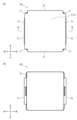
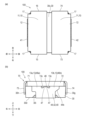
- FIG. 3A and 3B are top views of the inductor according to the first embodiment.
- the brazing material is omitted.
- the conductive shield is omitted.
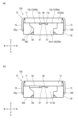
- 4(a) and 4(b) are front views of the inductor according to the first embodiment, in which the brazing material is omitted.
- 5A and 5B are rear and right side views of the inductor according to the first embodiment.
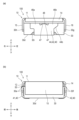
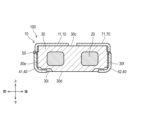
- FIG. 6(a) is a longitudinal sectional view of the inductor according to the first embodiment taken along the dashed line in Fig. 3(a) and seen in the direction of the arrows VI-VI.
- Fig. 6(b) is an enlarged view of the portion X shown by the dotted line in Fig. 6(a).
- FIG. 11 is a front view of an inductor according to a second embodiment.
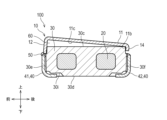
- FIG. 11 is a longitudinal sectional view of an inductor according to a third embodiment.
- FIG. 13 is a perspective view of an inductor according to a fourth embodiment.
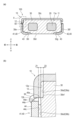
- 10 is a longitudinal sectional view of the inductor according to the fourth embodiment taken along the dashed dotted line shown in FIG. 9 and seen in the direction of the arrows XX.
- 11A and 11B are top and rear views of the inductor according to the fourth embodiment.
- the various components of the inductor of the present invention do not need to be independent entities, and it is acceptable for multiple components to be formed as a single member, for one component to be formed from multiple members, for one component to be part of another component, or for part of one component to overlap with part of another component, etc.
- the front, back, left, right, top and bottom directions are defined as shown in the drawings. However, this is defined for the sake of convenience in order to easily explain the relative relationships between components, and does not limit the directions when manufacturing or using a product embodying the present invention.
- the center side of the inductor is sometimes called the inside and the opposite side the outside, and the direction from the surface of the inductor toward the center is sometimes called the inward direction and the opposite direction the outward direction.
- the term "flat surface” as used herein means a shape that is physically formed with a flat surface as a goal, and it is not necessarily required that the surface be a geometrically perfect flat surface.
- FIG. 1 is a perspective view showing an example of an inductor according to a first embodiment of the present invention.
- the inductor 100 includes a coil 20, a core 30 containing the coil 20, a pair of terminals 40 electrically connected to the coil 20, and a conductive shield 10 covering the surface of the core 30.
- the conductive shield 10 covers at least a portion of the upper or side surface of the core 30.
- the conductive shield 10 and one of the pair of terminals 40 (front terminal 41) are directly electrically connected.
- the conductive shield 10 and the other terminal (rear terminal 42) are indirectly electrically connected via the coil 20.
- the coil 20 is formed by winding a wire (coil wire, etc.) made of a conductive material such as metal.
- the part of the coil 20 around which the wire is wound is sometimes referred to as a winding portion 21.
- the wire may have a circular cross section or a flat cross section (e.g., an ellipse or a horizontally long rectangle).
- the winding axis direction of the coil 20 is the up-down direction, but is not limited to this.
- the winding axis direction of the coil 20 may be the left-right direction, the front-back direction, etc. As shown in FIG.
- the coil 20 is enclosed in the core 30.
- enclosed means that substantially the entire coil 20 is disposed inside the envelope volume of the core 30. A part of the coil 20 may not be covered by the core 30 and may be visible from the outside.
- the lead-out portion 22 (a portion drawn out from the winding portion 21), which is one end of the wire of the coil 20, may be disposed outside the core 30.
- the entire winding portion 21 of the coil 20, or the entire coil 20 including the winding portion 21 and the lead-out portion 22 both ends of the coil wire, etc. is covered by the core 30.
- the core 30 is a magnetic member that surrounds the coil 20.
- Examples of the magnetic material that forms the core 30 include ferrite.
- the core 30 also extends radially inside the coil 20, forming a closed loop as a whole.
- the core 30 in this embodiment is integrally formed by placing the coil 20 and the terminal 40 in a mold and pouring a resin containing a magnetic material such as ferrite into the mold. That is, the inductor 100 in this embodiment is a molded coil.
- the core 30 may be divided into a plurality of pieces, as will be described later in a modified example.
- the core 30 of this embodiment has a generally rectangular parallelepiped shape. As shown in Fig. 4(a) or 6(a), the core 30 has an upper surface 30c facing upward, a lower surface 30d facing downward, a front surface 30e facing forward, a rear surface 30f facing backward, a left surface 30g facing left, and a right surface 30h facing right.
- the areas of the upper surface 30c and the lower surface 30d of the core 30 are larger than the areas of the front surface 30e, the rear surface 30f, the left surface 30g, and the right surface 30h, respectively, and the core 30 has a generally flat shape.
- the shape of the core 30 is not limited to a rectangular parallelepiped, and may be, for example, a cylinder or a prism with a polygonal base.
- the surfaces constituting the core 30 do not need to be completely flat, and may be curved or distorted.
- the front surface 30e and the rear surface 30f of the core 30 are formed in a step-like shape. That is, for example, the front surface 30e (see Fig.
- FIG. 6(a) includes a concave surface 30e2 formed on the inside in the front-rear direction, a step surface 30e1 facing upward, and a convex surface 30e3 formed on the outside in the front-rear direction, as shown in Fig. 6(b).
- the rear surface 30f also includes a concave surface, a step surface, and a convex surface.
- the concave surface 30e2 is slightly inclined outward in the front-rear direction toward the bottom
- the convex surface 30e3 is slightly inclined inward in the front-rear direction toward the bottom.
- the inductor 100 has a pair of terminals 40, a front terminal 41 and a rear terminal 42.
- the inductor 100 has a pair of terminals 40, which means that the inductor 100 has at least a pair of terminals 40 connected to both ends of the coil wire.
- the inductor 100 may have terminals other than the pair of terminals.
- the front terminal 41 and the rear terminal 42 are conductive with one end and the other end of the coil 20, respectively. Specifically, as shown in FIG. 2, the end of the terminal 40 inserted into the core 30 (connection branch 46a described later) is bent into a U-shape and holds one end or the other end of the coil 20, sandwiching one end of the coil 20 in the vertical direction.
- the one end of the coil 20 and the terminal 40 are joined by a method such as laser welding or resistance welding.
- the mode of conduction between the coil 20 and the terminal 40 is not limited to this direct contact.
- the coil 20 and the terminal 40 may be conductive through a separate member.
- one end of the wire forming the coil may be wound around a winding terminal that is a separate member from the terminal 40, and the winding terminal may be connected to the terminal 40, so that the coil 20 and the terminal 40 are electrically connected via the winding terminal.
- the coil 20 and the terminal 40 may be integrally formed from the same member.
- the terminal 40 includes a mounting portion 43 joined to a mounting board (not shown), an outer surface arrangement portion 44 extending to a side surface of the core 30 (the front surface 30e or the rear surface 30f in this embodiment), and an insertion portion 45 inserted into the core 30.
- the upper end of the terminal 40 is the insertion portion 45
- the lower end is the mounting portion 43
- a portion between the insertion portion 45 and the mounting portion 43 is the outer surface arrangement portion 44.
- An inserted portion 45 at the upper end of the terminal 40 is inserted into the core 30.
- a terminal upper surface 45a of the inserted portion 45 and a stepped surface 30e1 on the front surface 30e of the core 30 are flush with each other.
- the terminal 40 protrudes forward or backward from the side surface (front surface 30e or rear surface 30f) of the core 30. That is, in this embodiment, the front-rear direction is the protruding direction of the terminal 40.
- the portion of the terminal 40 protruding outward from the core 30 is bent with respect to the insertion portion 45, and the part protruding from the core 30 (outer surface arrangement portion 44) is arranged along the front surface 30e or rear surface 30f of the core 30. Further, the terminal 40 is bent between the mounting portion 43 and the outer surface arrangement portion 44.
- the mounting portion 43 which is the lower end portion of the terminal 40, is approximately parallel to the lower surface 30d of the core 30. As shown in Fig.
- a part of the mounting portion 43 is arranged inside the terminal arrangement portion 30i formed by being recessed upward in the lower surface 30d of the core 30.
- the lower surface of the mounting portion 43 is arranged below the lower surface 30d of the core 30 so that the mounting portion 43 protrudes from the lower surface 30d of the core 30.
- the upper end of the terminal 40 branches out as described below to form two or more branches 46 (connecting branch 46a and non-contact branch 46b).
- a convex portion 48 formed in an upward convex shape is provided between the connecting branch 46a and the non-contact branch 46b at the base end of the branch 46.
- the convex portion 48 protrudes along the side surface of the core 30 without being bent like the branch 46.
- a downwardly recessed recess 47 is formed between the convex portion 48 and the connecting branch 46a, and between the convex portion 48 and the non-contact branch 46b.
- the outer surface arrangement portion 44 has a wide portion at the top and a narrower portion at the bottom, so that the outer surface arrangement portion 44 has an overall T-shape.
- a portion of the wide portion that connects to a non-contact branch portion 46b (described later) is chamfered to form a slope 44b, while a portion that connects to a connecting branch portion 46a is not chamfered and has a corner.
- the width of the outer surface arrangement portion 44 (the width of the narrow portion of the outer surface arrangement portion 44) is preferably one-third or more, or one-half or more, of the lateral width of the second surface or the third surface of the core 30, which will be described later.
- the outer surface arrangement portion 44 Since the outer surface arrangement portion 44 has a large width and widely covers the second surface or the third surface, leakage magnetic flux is blocked by the outer surface arrangement portion 44.
- the inductor 100 is grounded to the mounting board so that the mounting portion 43 is in contact with the mounting board.
- the mounting portion 43 and the mounting board are joined by soldering or the like and electrically connected.
- the terminals are terminals for surface mounting, with a flat mounting portion, but are not limited to this.
- the terminals 40 may be terminals with a mounting portion 43 in the shape of a pin.
- the conductive shield 10 is made of a conductive thin plate.
- An example of the conductive material is a metal such as copper.
- the conductive shield 10 covers a portion of each of the top surface 30c, the left surface 30g, the right surface 30h, the front surface 30e, and the rear surface 30f of the core 30, as described later.
- the conductive shield 10 may cover only a portion of the top surface or only a portion of the side surface.
- the conductive shield 10 may cover the entire surface of the core 30, as described later in a modified example. More specifically, the conductive shield 10 is formed by bending a thin metal plate as shown in Fig. 1, and covers the top and side surfaces of the core 30.
- the thin metal plate is formed into an X-shape, and the central part of the X-shape (a cover part 11 described later) covers almost the entire top surface 30c of the core 30 as shown in Fig. 3(a).
- a part of the conductive shield 10 extending forward from the top surface 30c of the core 30 (a front lip part 12 described later) is bent near the boundary between the top surface 30c and the front surface 30e of the core 30, and covers the front surface 30e of the core 30.
- the length of the front lip part 12 (the dimension extending downward from the top surface 30c of the core 30) is preferably equal to or greater than the distance from the top surface 30c of the core 30 to the terminal top surface 45a of the front terminal 41. In other words, it is preferable that the length of the front lip portion 12 is equal to or greater than the distance to the step surface 30e1 of the front surface 30e based on the top surface 30c of the core 30. In this embodiment, the length of the front lip portion 12 is equal to the distance to the terminal top surface 45a of the front terminal 41 based on the top surface 30c of the core 30, and is also equal to the distance to the step surface 30e1 based on the top surface 30c of the core 30. As shown in Fig.
- the portion of the conductive shield 10 that extends rearward beyond the upper surface 30c of the core 30 and is bent covers a part of the back surface 30f of the core 30.
- the length of the rear lip portion 14 is preferably shorter than the distance from the upper surface 30c of the core 30 to the terminal upper surface 45a of the front terminal 41.
- the portion of the conductive shield 10 that extends rightward or leftward beyond the upper surface 30c and is bent covers the right surface 30h or left surface 30g of the core 30.
- the length of the right lip portion 15 and the left lip portion 16 is preferably half or more, more preferably two-thirds or more, of the thickness of the core 30.
- Fig. 5(b) shows a right side view of the inductor 100, but the right side of the inductor 100 is mirror-symmetrical to the left side.
- the conductive shield 10 may not have lip portions (front lip portion 12, rear lip portion 14, right lip portion 15, and left lip portion 16) and may only include a cover portion 11 that covers the upper surface 30c (a first surface described later). Also, the conductive shield 10 may not cover all four side surfaces, and only some of the side surfaces may be covered by lip portions.
- notches 17 are provided between the front lip 12, the rear lip 14, the right lip 15 and the left lip 16, and these lips protrude independently from the cover portion 11.
- the provision of the notches 17 allows the conductive shield 10 to flexibly deform and cover the core 30.
- the cutouts 17 may not be provided, and the portions of the conductive shield 10 covering the respective side surfaces may be connected together in a continuous manner.
- direct electrical continuity between the conductive shield 10 and the front terminal 41 means that electrical continuity between the conductive shield 10 and the front terminal 41 does not pass through the coil 20.
- the conductive shield 10 (front lip portion 12) and the terminal 40 are in contact with each other, and the conductive shield 10 and the terminal 40 are directly electrically connected, but this is not limited to the above.
- the conductive shield 10 and the front terminal 41 may be electrically connected through a member other than the coil 20.
- the conductive shield 10 may not have a front lip portion 12, and the cover portion 11 of the conductive shield 10 and the terminal 40 may be electrically connected through a conductor.
- the conductive shield 10 and the rear terminal 42 being indirectly conductive means that they are conductive via the coil 20.
- the conductive shield 10 and the rear terminal 42 are conductive via the front terminal 41 and the coil 20. If the conductive shield 10 and the rear terminal 42 were conductive via a path that does not pass through the coil 20, the front terminal 41 and the rear terminal 42 would be conductive via two paths, one including the conductive shield 10 and the other including the coil 20, resulting in a short circuit. In contrast, in this embodiment, the conductive shield 10 and the rear terminal 42 are not in contact with each other as shown in FIG. 5A, and therefore no short circuit occurs.
- the core 30 has a first surface to which the end surface of the coil 20 (winding portion 21) faces.
- the end surface of the coil 20 faces up or down, and the first surface is the upper surface 30c or the lower surface 30d of the core 30.
- the first surface in this embodiment is the upper surface 30c of the core 30.
- the first surface is the front surface 30e or the back surface 30f, or the left surface 30g or the right surface 30h.
- the conductive shield 10 has a cover portion 11 that covers at least a part of the first surface (top surface 30c). In this embodiment, as shown in FIG.
- the cover portion 11 covers almost the entire top surface 30c, but since the cover portion 11 has a cutout portion 17, each corner of the rectangular top surface 30c is locally exposed from the cover portion 11 in a plan view.
- the cover portion 11 may cover the entire top surface 30c, or the cover portion 11 may cover a part of the top surface 30c that has a smaller shape and size. It is preferable that the end face of the coil 20 and the cover portion 11 overlap when viewed from the winding axis direction of the coil (the vertical direction in this embodiment). Furthermore, it is more preferable that the end face of the coil 20 is covered by the cover portion 11 when viewed from the winding axis direction of the coil.
- the core 30 has a second surface along which one terminal (front terminal 41) extends.
- the second surface is a part of the side surface.
- the surface of the core 30 along which the terminal 40 extends is, more specifically, the surface along which the outer surface arrangement portion 44 of the terminal 40 extends.
- the outer surface arrangement portion 44 of the front terminal 41 is arranged along the front surface 30e of the core 30.
- the second surface is the front surface 30e of the core 30.
- the second surface may be another surface of the side surface (the right surface 30h, the left surface 30g, or the back surface 30f).
- a portion of the conductive shield 10 covers a portion of the second surface (front surface 30e).
- the front lip portion 12 covers substantially the entirety of the front surface 30e of the core 30 that is located above the terminal upper surface 45a (see Fig. 6(b)) of the front terminal 41.
- the front lip portion 12 may extend below the terminal upper surface 45a of the front terminal 41 to cover the underside of the front surface 30e of the core 30.
- the conductive shield 10 (front lip portion 12) covering the second surface (front surface 30e) is in contact with one terminal (front terminal 41).
- the upper surface (terminal upper surface 45a) of the front terminal 41 is in surface contact with the end surface 12b of the front lip portion 12.
- the front terminal 41 and the front lip portion 12 may be in substantial line contact. Also, the front terminal 41 and the front lip portion 12 may be in point contact.
- the conductive shield 10 cover a portion of the second surface (front surface 30e), magnetic flux leaking from the core 30 can be blocked more effectively.
- the inner surface (lip inner surface 12a) of a portion (front lip portion 12) of the conductive shield 10 covering the second surface (front surface 30e) of the core 30 is disposed inward in a plan view from the inner surface (terminal inner surface 44c) that is aligned with the second surface of one terminal (front terminal 41). More precisely, the lip inner surface 12a is disposed inward in the protruding direction (front-rear direction) of the terminal 40 from the terminal inner surface 44c.
- the terminal inner surface 44c that is aligned with the front surface 30e of the front terminal 41 is the inner surface of the outer surface arrangement portion 44 of the front terminal 41.
- a plan view means being disposed toward the center of the inductor 100 when viewed from above.
- a plan view does not necessarily mean being able to be directly confirmed with the naked eye.
- the lip portion inner surface 12a is disposed on the inside in the front-rear direction of the terminal inner surface 44c of the front terminal 41 when viewed in a vertical cross section as shown in FIG. 6(b).
- the terminal 40 is bent between the insertion portion 45 and the outer surface arrangement portion 44, and the outer surface of the bent portion is a curved surface 44d.
- the lip portion inner surface 12a By arranging the lip portion inner surface 12a on the inside of the terminal inner surface 44c of the front terminal 41 in the terminal protruding direction, at least a part of the end surface 12b (including the sides of the rectangular end surface 12b) of the front lip portion 12 contacts the upper surface (terminal upper surface 45a) of the insertion portion 45 of the front terminal 41 as shown in Fig. 6(b).
- a part of the inner side of the end surface 12b of the front lip portion 12 in the terminal protruding direction contacts the horizontal terminal upper surface 45a of the insertion portion 45, and another part of the outer side of the end surface 12b in the terminal protruding direction faces the curved surface 44d at a distance.
- the entire end surface 12b of the front lip portion 12 may contact the terminal upper surface 45a of the insertion portion 45.
- the outer surface of the front lip portion 12 is preferably positioned more inward in the terminal protruding direction than the terminal inner surface 44c of the front terminal 41, or is preferably positioned on the same plane as the terminal inner surface 44c of the front terminal 41.
- the lip inner surface 12a of the front lip 12 and the terminal inner surface 44c of the front terminal 41 are offset from each other in the front-rear direction, and the front lip 12 and the front terminal 41 are in surface contact at the end surface 12b, thereby providing good electrical conduction between the front terminal 41 and the conductive shield.
- a part of the end surface 12b of the front lip 12 faces the curved surface 44d of the front terminal 41, forming a recess that is surrounded by the end surface 12b of the front lip 12 and the curved surface 44d of the front terminal 41 and narrows toward the inside in the terminal protrusion direction.
- Solder 50 which will be described later, enters the recess, thereby firmly connecting the conductive shield 10 and the front terminal 41.
- the distance between the lip inner surface 12a and the terminal inner surface 44c of the front terminal 41 is preferably at least one-quarter of the thickness (dimension in the front-to-rear direction) of the front lip portion 12, or at least half of that thickness.
- the thickness of the front lip portion 12 is, in other words, the front-to-rear width of the end face 12b of the front lip portion 12.
- the maximum value of distance Z1 is equal to or smaller than the thickness of the front lip portion 12.
- the distance between the lip inner surface 12a and the terminal inner surface 44c is the distance in the terminal protruding direction between the lower end of the lip inner surface 12a and the upper end of the terminal inner surface 44c.
- the lip portion inner surface 12a is disposed on the same plane as the upper end of the convex surface 30e3 of the front surface 30e of the core 30.
- the conductive shield 10 may be in contact with a portion of the front terminal 41 other than the terminal inner surface 44c (such as the curved surface 44d).
- the lip inner surface 12a and the terminal inner surface 44c of the front terminal 41 may be disposed on the same plane, or the lip inner surface 12a of the front lip 12 may be disposed outward of the terminal inner surface 44c of the front terminal 41.
- the conductive shield 10 and the front terminal 41 are substantially in line contact or not in contact at all, it is preferable to sufficiently ensure electrical continuity between the conductive shield 10 and the front terminal 41 by brazing or the like.
- a portion (shield covering portion 30a) of the second surface (front surface 30e) of the core 30 that is covered by the conductive shield 10 is formed inward in a plan view from a portion (terminal covering portion 30b) of the second surface that is covered by one terminal.
- the shield covering portion 30a is a region of the front surface 30e of the core 30 that is covered by the conductive shield 10.
- substantially the entire portion except for a portion exposed from the cutout portion 17 is the shield covering portion 30a.
- the distance between the shield covering portion 30a and the terminal covering portion 30b is the distance between the lower end of the shield covering portion 30a and the upper end of the terminal covering portion 30b in the terminal protruding direction.
- the entire part (concave surface 30e2) above the step surface 30e1 of the front surface 30e of the core 30 is disposed inward in the terminal protruding direction from the entire part (convex surface 30e3) below the step surface 30e1 of the front surface 30e of the core 30.
- the shield covering portion 30a of the front surface 30e may be recessed backward, and the recessed shield covering portion 30a may be disposed inward in the terminal protruding direction from the terminal covering portion 30b.
- only the terminal covering portion 30b of the front surface 30e of the core 30 may protrude forward, and the protruding terminal covering portion 30b may be disposed outward in the terminal protruding direction from the shield covering portion 30a.
- the portion not covered by the front lip portion 12 may be disposed outward or inward from the terminal covering portion 30b in the terminal protruding direction. Due to the misalignment between the shield covering portion 30a and the terminal covering portion 30b on the second surface, the front lip portion 12 is more likely to be disposed inward in a plan view than the front terminal 41. In other words, the end face 12b of the front lip portion 12 is more likely to come into surface contact with the front terminal 41, making it easier to maintain good electrical continuity between the conductive shield 10 and the front terminal 41.
- the inner surface of the cover portion 11 (the cover portion inner surface 11 a ) is disposed substantially parallel to the upper surface 30 c of the core 30 .
- An insulating material may or may not be applied by coating or the like to a portion of the surface of the core 30 that is covered by the conductive shield 10 (part of the top and side surfaces) or to substantially the entire inner surface of the conductive shield 10.
- the cover portion inner surface 11a of the cover portion 11 and the top surface 30c of the core 30 are arranged along each other with the insulating material sandwiched therebetween.
- the conductive shield 10 and one terminal are joined by welding or brazing.
- welding include fusion welding using a laser or gas.
- brazing include soldering using solder or other metal brazing materials.
- the conductive shield 10 and the front terminal 41 are brazed with solder 50.
- the conductive shield 10 may be brazed or welded to both branches 46 of the front terminal 41, which will be described later, or may be brazed or welded to only one of the branches.
- the conductive shield 10 and the front terminal 41 do not have to be joined by brazing or welding.
- the conductive shield 10 and the front terminal 41 may be abutted against each other to ensure electrical continuity.
- the conductive shield 10 and the front terminal 41 may be fixed to each other by an adhesive.
- one terminal has two or more branches formed by branching one end.
- the front terminal 41 has two branches 46.
- the branches 46 are formed so as to protrude upward from the outer surface arrangement portion 44, in other words, the branches 46 are formed by branching the terminal 40 at the upper part of the outer surface arrangement portion 44. That is, in the front terminal 41, a connecting branch 46a (to be described later) is formed from the upper right of the outer surface arrangement portion 44, and a non-contact branch 46b (to be described later) is formed from the upper left of the outer surface arrangement portion 44.
- the branch 46 is not limited to such a shape, and for example, the branch 46 may be formed by branching from the middle of the outer surface arrangement portion 44, or may be formed by branching from the middle of the insertion portion 45.
- the base end (the root part where the terminal 40 branches) of the branch 46 is located outside the core 30 as in this embodiment. 2 , a portion of each of the branches 46 is inserted into the core 30.
- substantially the entirety of the branch 46 is inserted into the core 30, and a portion of the base end side of the branch 46 is disposed outside the core 30.
- the branch 46 is the same as the inserted portion 45.
- the other terminal (rear terminal 42), like the front terminal 41, is branched to form a branch portion 46, and a part of the branch portion 46 is inserted into the core 30.
- the front terminal 41 and the rear terminal 42 have shapes that are mirror images of each other.
- connection branch 46a is directly conductive with the coil 20
- non-contact branch 46b is indirectly conductive with the coil 20 via the one branch (connection branch 46a).
- the indirect conductive connection between the non-contact branch 46b and the coil 20 means that the non-contact branch 46b is conductive via the connection branch 46a. In other words, the entire non-contact branch 46b is not in contact with the coil 20.
- the non-contact branch 46b and the coil 20 are conductive via the connection branch 46a and the outer surface arrangement portion 44.
- the non-contact branch 46b and the conductive shield 10 are soldered with solder 50.
- the solder 50 penetrates into the gap between the front terminal 41 and the conductive shield 10, and is also disposed, for example, between the end surface 12b of the front lip portion 12 and the curved surface 44d of the front terminal 41 as shown in Fig. 6(b).
- the connection branch 46a is in contact with the conductive shield 10, but it does not have to be in contact. It is preferable that the connection branch 46a and the conductive shield 10 are not joined.
- the solder 50 is not disposed between the contact portions 13, 13 described below, but it may be disposed therebetween.
- the connecting branch 46a By joining the non-contact branch 46b, which is not directly conductive with the coil 20, to the conductive shield 10 in this manner, it is not necessary to join the connecting branch 46a, which is directly conductive with the coil 20, to the conductive shield 10. This makes it possible to minimize the thermal load on the connecting branch 46a.
- the connecting branch 46a and the conductive shield 10 may be joined, and the non-contact branch 46b and the conductive shield 10 may not be joined.
- Second Embodiment differs from the first embodiment only in the manner in which the conductive shield 10 and the front terminal 41 are joined; the conductive shield 10, coil 20, core 30 and terminal 40 of the inductor 100 in this embodiment are common to the first embodiment.
- the conductive shield 10 and one terminal (front terminal 41) are joined by welding or brazing.
- one terminal has two or more branches 46 formed by branching one end, and a portion of each of the branches 46 is inserted into the core 30.
- each of the two or more branches 46 (the connection branch 46a and the non-contact branch 46b shown in Fig. 4(a)) is joined to the conductive shield 10.
- the solder 50 joining the connection branch 46a to the conductive shield 10 and the solder 50 joining the non-contact branch 46b to the conductive shield 10 may be continuous or divided, as described below. In this manner, each of the two or more branches 46 is joined to the conductive shield 10, thereby firmly connecting the front terminal 41 and the conductive shield 10.
- one terminal contacts the conductive shield 10 at each of two or more contact portions 13 spaced apart from each other, as in the first embodiment shown in Fig. 4(a).
- the connection branch portion 46a contacts the conductive shield 10
- the non-contact branch portion 46b contacts the conductive shield 10.
- the contact portion 13 refers to the portion of the front terminal 41 that contacts the conductive shield 10 and a portion of its vicinity, and in this embodiment refers to a portion of the terminal upper surface 45a of the front terminal 41 and its vicinity.
- the contact portion 13 in this embodiment is a portion of the base end side of the branch portion 46 (the front end portion of the inserted portion 45 and the bent portion between the inserted portion 45 and the outer surface disposed portion 44).
- a brazing material solder 50
- a part of the solder 50 is disposed between the opposing end faces 13c, 13c (see FIG. 4(a)) of the contact portions 13 facing each other.
- a recess surrounded by one contact portion 13a, the upper end face 44a (see FIG. 2 or FIG.
- solder 50 enters and accumulates in the recess as shown in FIG. 7. More specifically, the solder 50 is in contact with each of the upper end face 44a (see FIG. 6(b)) of the front terminal 41, the end face 12b of the front lip portion 12, and the opposing end face 13c (see FIG. 4(a)) of the contact portion 13. In this embodiment, as shown in Fig. 4(a) and Fig. 7, the solder 50 joins the upper end surface 44a (see Fig. 6(b)) of the front terminal 41 to the end surface 12b of the front lip portion 12.
- first contact portion 13a, the second contact portion 13b, and the area between the first contact portion 13a and the second contact portion 13b of the first terminal (front terminal 41) are all joined to the conductive shield 10 by the brazing material (solder 50). Also, the solder 50 joining the first contact portion 13a, the second contact portion 13b, and the area between the first contact portion 13a and the second contact portion 13b of the first terminal (front terminal 41) to the conductive shield 10 is arranged in a continuous manner.
- the solder 50 By arranging the solder 50 between the contact portions 13, 13, the solder 50 can accumulate on the upper end surface 44a of the front terminal 41, particularly within the recess 47, thereby preventing the liquid solder 50 from flowing off when the front terminal 41 and the conductive shield 10 are soldered together.
- the solder 50 contacts not only the curved surface 44d of the front terminal 41 but also the upper end surface 44a on which the recessed portion 47 and the protruding portion 48 are formed, so that the solder 50 contacts the front terminal 41 in various directions. This prevents the solder 50 from peeling off from the front terminal 41.
- the cross section of the solder 50 disposed between the contact portions 13a, 13b (a cross section perpendicular to the extending direction of the solder, i.e., the left-right direction) has a larger dimension and a different shape than the cross section of the solder 50 disposed on the upper edge of the contact portion 13. That is, the thickness (dimension in the front-to-rear direction) of the solder 50 disposed between the contact portions 13a, 13b is larger than the thickness of the solder 50 disposed in the vicinity of the contact portion 13. For this reason, even when subjected to thermal load over time, the solder 50 disposed between the contact portions 13a, 13b is less likely to crack, and the bond between the conductive shield 10 and the terminal 40 can be maintained.
- Fig. 8 differs from the first or second embodiment only in the manner in which the conductive shield 10 is placed.
- the conductive shield 10, coil 20, core 30, terminal 40, and solder 50 of the inductor 100 in this embodiment are common to the inductor 100 in the first or second embodiment, and the shape as viewed from above is generally common to the inductor 100 of the first embodiment shown in Fig. 3(a).
- Fig. 8 is a vertical cross-sectional view of the inductor 100 of the third embodiment. The position and viewing direction of the vertical cross-section shown in Fig. 8 are common to the arrow VI-VI shown in Fig. 3(a) according to the first embodiment.
- a part of the cover part 11 (core contact part 11b) and the core 30 are in contact with each other, and a hollow part 60 is provided between another part of the cover part 11 (separation part 11c) and a part of the first surface (upper surface 30c).
- the length of the front lip part 12 is greater than the distance to the terminal upper surface 45a of the front terminal 41 based on the upper surface 30c of the core 30. Therefore, as a result of the front lip part 12 and the front terminal 41 being in contact with each other, a part of the second surface side of the cover part inner surface 11a (see FIG. 6(a)) is separated from a part of the upper surface 30c of the core 30.
- one end of the end surface 12b of the front lip part 12 on the inside in the terminal protruding direction (for example, an inner side in the terminal protruding direction of the rectangular end surface 12b) is in contact with the front terminal 41.
- the front lip part 12 is in contact with the terminal upper surface 45a or the curved surface 44d of the front terminal 41.
- the height of the hollow portion 60 is exaggerated.
- the maximum height of the hollow portion 60 (the dimension from the top surface 30c of the core 30 to the highest point of the hollow portion 60) is preferably smaller than the plate thickness of the conductive shield 10 (cover portion 11).
- the core contact portion 11b that contacts the core 30 is a part of the rear side of the cover portion 11, and the separation portion 11c is a part of the cover portion 11 that is further forward (on the second surface side) than the core contact portion 11b.
- the core contact portion 11b contacts a corner that is a boundary between the upper surface 30c and the rear surface 30f of the core 30.
- the conductive shield 10 is in contact with the lower end of the inner surface of the rear lip portion 14 and part of the lip portion inner surface 12a (see FIG. 6(b)) of the front lip portion 12.
- the lower end of the inner surface of the rear lip portion 14 is in contact with the back surface 30f of the core 30, and the lip portion inner surface 12a (see FIG. 6(b)) of the front lip portion 12 is in contact with a corner that forms the boundary between the top surface 30c and the front surface 30e of the core 30.
- the hollow portion 60 is a space defined by the separation portion 11 c , the lip portion inner surface 12 a of the front lip portion 12 , the first surface (upper surface 30 c ), and the inner surfaces of the right lip portion 15 and the left lip portion 16 .
- the hollow portion 60 may be provided without the cover portion inner surface 11a being in contact with the core 30.
- the cover portion inner surface 11a may not be in contact with a corner of the boundary between the upper surface 30c and the rear surface 30f of the core 30, and the lower end of the rear lip portion 14 may be in contact with the core 30. Because there is a hollow portion 60 between the core 30 and the cover portion 11, the core 30 and the cover portion 11 can be insulated by the air in the hollow portion 60 without having to apply insulating material to the surface of the core 30 covered by the cover portion 11 or to the inner surface 11a of the cover portion.
- the cover portion 11 is inclined downward from the other portion (separation portion 11c) toward the other portion (core contact portion 11b) so as to approach the first surface (upper surface 30c).
- the downward inclination does not necessarily mean a downward inclination in the actual up-down relationship, but means an inclination approaching the first surface when the first surface is used as a reference.
- the cover portion 11 intersects with the first surface.
- the thickness (dimension in the up-down direction) of the hollow portion 60 gradually increases toward the second surface (front surface 30e) and gradually decreases toward the back surface 30f of the core 30.
- the front lip portion 12 and the front terminal 41 can be reliably abutted against each other.
- this embodiment differs from the first, second or third embodiment in that it has not only the conductive shield 10 but also a second conductive shield 70.
- the coil 20, core 30, terminals 40 and solder 50 in the inductor 100 of this embodiment are common to the first, second or third embodiment.
- the inductor 100 of this embodiment has a second conductive shield (second conductive shield 70).
- the second conductive shield 70 covers at least a part of the top or side surface of the core.
- the second conductive shield 70 and the other terminal (rear terminal 42) are in direct electrical continuity, and the second conductive shield 70 and the one terminal (front terminal 41) are indirectly electrical continuity via the coil 20.
- Direct electrical continuity between the second conductive shield 70 and the rear terminal 42 means that the second conductive shield 70 and the rear terminal 42 are electrical continuity via a path that does not go through the coil 20.
- the second conductive shield 70 and the rear terminal 42 may also be electrical continuity via a member other than the coil 20 (e.g., a conductor, etc.).
- the second conductive shield 70 has a rear lip portion 72 that covers a portion of the third surface (the rear surface 30f of the core 30 in this embodiment) to which the outer surface arrangement portion 44 of the rear terminal 42 extends, a right lip portion 73 that covers the right surface 30h of the core 30, and a left lip portion 74 that covers the left surface 30g of the core 30.
- the rear lip portion 72 of the second conductor shield 70 contacts the rear terminal 42. Similar to the front lip portion 12 of the conductor shield 10, the rear lip portion 72 contacts the rear terminal 42 at a surface of the lower end surface.
- the contact portion between the rear lip portion 72 and the rear terminal 42 may be substantially a line or may be a point.
- the conductive shield 10 and the second conductive shield 70 cover only a portion of the first surface (the upper surface 30c of the core 30). Specifically, the conductive shield 10 covers the front half of the upper surface 30c, but does not cover the rear half of the upper surface 30c. Also, the second conductive shield 70 covers the rear half of the upper surface 30c, but does not cover the front half. More specifically, the conductive shield 10 and the second conductive shield 70 have the same shape and dimensions, and the areas of the upper surface 30c covered by the conductive shield 10 and the second conductive shield 70 are approximately equal.
- the dimensions of the cover portion 11 of the conductive shield 10 and the dimensions of the second cover portion 71 covering the first surface of the second conductive shield 70 may be larger or smaller, respectively.
- Either the conductive shield 10 or the second conductive shield 70 may cover the center of the upper surface 30c, and either the conductive shield 10 or the second conductive shield 70 may overlap an end face of the coil 20 when viewed from the winding axis direction of the coil 20.
- the front side of the upper surface 30c of the core 30 is covered by the conductive shield 10
- the rear side is covered by the second conductive shield 70.
- this is not limited to this.
- the right side of the upper surface 30c of the core 30 may be covered by the conductive shield 10
- the left side may be covered by the second conductive shield 70.
- the second cover part 71 and the first surface (top surface 30c) are substantially parallel, and substantially the entire inner surface of the second cover part 71 is in contact with the top surface 30c.
- a part of the second cover part 71 may be in contact with the core 30, and a hollow part may be provided between another part of the second cover part 71 and a part of the top surface 30c.
- a hollow part is provided, one end on the front side of the second cover part 71 is in contact with the top surface 30c of the core 30, and the second cover part 71 is inclined downward with respect to the first surface (top surface 30c) from one end on the third surface (back surface 30f) side to the other end on the second surface (front surface 30e) side.
- substantially the entire cover portion 11 of the conductive shield 10 contacts the front half of the upper surface 30c of the core 30. If a hollow portion is provided between the conductive shield 10 and the core 30, one end of the rear side of the conductive shield 10 contacts the upper surface 30c of the core 30.
- the second conductive shield 70 and the rear terminal 42 are joined by welding or brazing.
- the manner of joining is similar to the joining between the conductive shield 10 and the front terminal 41, in that the rear terminal 42 has two or more branches 46, and each of the two or more branches 46 may be joined to the second conductive shield 70, or only one branch 46 may be joined to the conductive shield 10.
- the inner surface of the rear lip portion 72 covering the rear surface 30f which is the third surface, is located more inward in a plan view than the inner surface of the rear terminal 42 that is along the rear surface 30f. Also, it is preferable that the part of the third surface that is covered by the second conductive shield 70 is formed more inward in a plan view than the other part of the third surface that is covered by the rear terminal 42. This allows the second conductive shield 70 and the rear terminal 42 to come into surface contact and provide good electrical conductivity.
- the conductive shield 10 and the second conductive shield 70 are spaced apart from each other. A sufficient creepage distance is maintained so that the conductive shield 10 and the second conductive shield 70 are not directly conductive to each other.
- the rear-facing end face of the conductive shield 10 and the forward-facing end face of the second conductive shield 70 face each other at a distance.
- the conductive shield 10 and the second conductive shield 70 are arranged so that their end faces face each other and are aligned, and the distance between the conductive shield 10 and the second conductive shield 70 is approximately uniform.
- the length of the rear lip portion 72 can be made longer than in the first, second, and third embodiments. This allows leakage magnetic flux to be blocked over a wider area of the back surface 30f of the core 30.
- the conductive shield 10 covers a portion of the surface of the core 30, but this is not limited thereto, and the conductive shield 10 may cover the entire surface of the core 30.
- the conductive shield 10 may be a rectangular parallelepiped having a cavity capable of containing the entire core 30, with only the mounting portion 43 exposed to the outside of the conductive shield 10. In this case, a sufficient creepage distance is maintained between the conductive shield 10 and the rear terminal 42 so that they are not directly conductive without passing through the coil 20.
- the front lip portion 12 and the front terminal 41 do not have to be in contact. In that case, the front lip portion 12 and the front terminal 41 are electrically connected via a separate member.
- the front lip portion 12 and the front terminal 41 are joined by solder 50, and the front lip portion 12 and the front terminal 41 are electrically connected via the solder 50.
- the terminal 40 having the branch portion 46 is exemplified, but this is not limited to the above.
- the terminal 40 may not have the branch portion 46 and may be in contact with the conductive shield 10 at one contact portion 13.
- the front terminal 41 may be joined to the conductive shield 10 at the entire contact portion 13, or the front terminal 41 may be joined to the conductive shield 10 at one part of the contact portion 13 and not joined to the conductive shield 10 at another part of the contact portion 13.
- the core 30 is integrally formed, but this is not limiting, and the core 30 may be composed of multiple parts.
- the core 30 may be divided into an upper core and a lower core by a stepped surface 30e1 (see FIG. 6(b)) provided on the core 30 described later.
- the core 30 may be a pot core.
- the core 30 may be formed by combining a core that covers the circumferential surface and one end face of the coil 20, a columnar core that is inserted through the center of the coil 20, and a plate-shaped core that covers the other end face of the coil 20. In this case, for example, it is recommended to arrange the conductive shield 10 so as to cover the upper side of the plate-shaped core.
- An inductor having a coil, a core containing the coil, a pair of terminals electrically connected to the coil, and a conductive shield covering a surface of the core, the conductive shield covers at least a portion of a top surface or a side surface of the core; the conductive shield and one of the pair of terminals are directly conductive to each other, An inductor, wherein the conductive shield and another terminal are indirectly conductive with each other via the coil.
- the core has a first surface to which an end surface of the coil faces, The inductor according to (1), wherein the conductive shield has a cover portion that covers at least a portion of the first surface.
- the core has a second surface from which the one terminal extends, a portion of the conductive shield covering a portion of the second surface;
- a part of the cover portion is in contact with the core,
- the one terminal has two or more branch portions formed by branching one end portion, A portion of each of the branches is inserted into the core, One of the branches is in direct electrical communication with the coil, At least one of the other branches is indirectly conductive with the coil via the one branch, The inductor according to (8), wherein the other branch portion and the conductive shield are in contact with each other and joined together.
- the one terminal has two or more branch portions formed by branching one end portion, A portion of each of the branches is inserted into the core, The inductor according to (8), wherein each of the two or more branches is joined to the conductive shield.
- the one terminal is in contact with the conductive shield at two or more contact portions spaced apart from each other,
- the inductor of (10) wherein the brazing material is disposed between one of the contact portions and the other of the contact portions, and the one of the contact portions, the other of the contact portions, and the portion between the one of the contact portions and the other of the contact portions in the one of the terminals are all joined to the conductive shield by the brazing material.
- a second conductive shield is provided; the second conductive shield covers at least a portion of a top or side surface of the core; the second conductive shield and the other terminal are in direct electrical contact; the second conductive shield and the one terminal are indirectly conductive to each other via the coil,
- the inductor according to any one of (1) to (11), wherein the conductive shield and the second conductive shield are spaced apart from each other.
- An inductor wherein the length of the portion of the conductive shield that covers the second surface is equal to or greater than the distance to the one terminal based on the first surface.
- An inductor wherein at least a portion of an end surface of a portion of the conductive shield that covers the second surface comes into surface contact with the one terminal.
- conductive shield 11 cover portion 11a cover portion inner surface 11b core contact portion 11c separation portion 12 front lip portion 12a lip portion inner surface 12b end surface 13 contact portion 13a one contact portion 13b other contact portion 13c opposing end surface 14 rear lip portion 15 right lip portion 16 left lip portion 17 notch portion 20 coil 21 winding portion 22 lead-out portion 30 core 30a shield covering portion 30b terminal covering portion 30c upper surface 30d lower surface 30e front surface 30e1 step surface 30e2 concave surface 30e3 convex surface 30f rear surface 30g left surface 30h right surface 30i terminal arrangement portion 40 terminal 41 front terminal 42 rear terminal 43 mounting portion 44 outer surface arrangement portion 44a upper end surface 44b inclined surface 44c Terminal inner surface 44d, curved surface 45, inserted portion 45a, terminal upper surface 46, branch portion 46a, connecting branch portion 46b, non-contact branch portion 47, recess 48, protrusion 50, solder 60, hollow portion 70, second conductive shield 71, second cover portion 72, rear lip portion 73, right lip portion 74,
Landscapes
- Engineering & Computer Science (AREA)
- Power Engineering (AREA)
- Coils Or Transformers For Communication (AREA)
Priority Applications (4)
| Application Number | Priority Date | Filing Date | Title |
|---|---|---|---|
| PCT/JP2022/041685 WO2024100792A1 (ja) | 2022-11-09 | 2022-11-09 | インダクタ |
| JP2024556910A JPWO2024100792A1 (https=) | 2022-11-09 | 2022-11-09 | |
| CN202280101679.6A CN120153448A (zh) | 2022-11-09 | 2022-11-09 | 电感器 |
| US19/185,612 US20250259781A1 (en) | 2022-11-09 | 2025-04-22 | Inductor |
Applications Claiming Priority (1)
| Application Number | Priority Date | Filing Date | Title |
|---|---|---|---|
| PCT/JP2022/041685 WO2024100792A1 (ja) | 2022-11-09 | 2022-11-09 | インダクタ |
Related Child Applications (1)
| Application Number | Title | Priority Date | Filing Date |
|---|---|---|---|
| US19/185,612 Continuation US20250259781A1 (en) | 2022-11-09 | 2025-04-22 | Inductor |
Publications (1)
| Publication Number | Publication Date |
|---|---|
| WO2024100792A1 true WO2024100792A1 (ja) | 2024-05-16 |
Family
ID=91032528
Family Applications (1)
| Application Number | Title | Priority Date | Filing Date |
|---|---|---|---|
| PCT/JP2022/041685 Ceased WO2024100792A1 (ja) | 2022-11-09 | 2022-11-09 | インダクタ |
Country Status (4)
| Country | Link |
|---|---|
| US (1) | US20250259781A1 (https=) |
| JP (1) | JPWO2024100792A1 (https=) |
| CN (1) | CN120153448A (https=) |
| WO (1) | WO2024100792A1 (https=) |
Citations (6)
| Publication number | Priority date | Publication date | Assignee | Title |
|---|---|---|---|---|
| JPS5515356Y2 (https=) * | 1975-04-10 | 1980-04-09 | ||
| JPS63152311U (https=) * | 1987-03-24 | 1988-10-06 | ||
| JPH01100412U (https=) * | 1987-12-23 | 1989-07-05 | ||
| JP2013120919A (ja) * | 2011-12-09 | 2013-06-17 | Alps Green Devices Co Ltd | コイル封入圧粉コア及び前記コイル封入圧粉コアを有するデバイス、ならびに、前記コイル封入圧粉コアの製造方法、及び、前記デバイスの製造方法 |
| JP2019516246A (ja) * | 2016-04-20 | 2019-06-13 | ヴィシェイ デール エレクトロニクス エルエルシー | 遮蔽誘導子および製造方法 |
| US20190259529A1 (en) * | 2018-02-22 | 2019-08-22 | Samsung Electro-Mechanics Co., Ltd. | Coil component |
-
2022
- 2022-11-09 JP JP2024556910A patent/JPWO2024100792A1/ja active Pending
- 2022-11-09 CN CN202280101679.6A patent/CN120153448A/zh active Pending
- 2022-11-09 WO PCT/JP2022/041685 patent/WO2024100792A1/ja not_active Ceased
-
2025
- 2025-04-22 US US19/185,612 patent/US20250259781A1/en active Pending
Patent Citations (6)
| Publication number | Priority date | Publication date | Assignee | Title |
|---|---|---|---|---|
| JPS5515356Y2 (https=) * | 1975-04-10 | 1980-04-09 | ||
| JPS63152311U (https=) * | 1987-03-24 | 1988-10-06 | ||
| JPH01100412U (https=) * | 1987-12-23 | 1989-07-05 | ||
| JP2013120919A (ja) * | 2011-12-09 | 2013-06-17 | Alps Green Devices Co Ltd | コイル封入圧粉コア及び前記コイル封入圧粉コアを有するデバイス、ならびに、前記コイル封入圧粉コアの製造方法、及び、前記デバイスの製造方法 |
| JP2019516246A (ja) * | 2016-04-20 | 2019-06-13 | ヴィシェイ デール エレクトロニクス エルエルシー | 遮蔽誘導子および製造方法 |
| US20190259529A1 (en) * | 2018-02-22 | 2019-08-22 | Samsung Electro-Mechanics Co., Ltd. | Coil component |
Also Published As
| Publication number | Publication date |
|---|---|
| US20250259781A1 (en) | 2025-08-14 |
| JPWO2024100792A1 (https=) | 2024-05-16 |
| CN120153448A (zh) | 2025-06-13 |
Similar Documents
| Publication | Publication Date | Title |
|---|---|---|
| JP7538622B2 (ja) | コイル装置 | |
| TWI786632B (zh) | 線圈裝置 | |
| US10170234B2 (en) | Coil device capable of performing a wire connection | |
| US20150061811A1 (en) | Coil component | |
| JP7816933B2 (ja) | コイル装置 | |
| US12300425B2 (en) | Coil component | |
| CN114141499B (zh) | 线圈装置 | |
| JP4791270B2 (ja) | 磁性素子 | |
| JP7411882B2 (ja) | コネクタ | |
| US11664145B2 (en) | Inductor | |
| JP7172050B2 (ja) | 電子部品および電子回路モジュール | |
| WO2024100792A1 (ja) | インダクタ | |
| JP4512420B2 (ja) | インダクタ | |
| JP2022189573A (ja) | 基板用コネクタ | |
| JP7510826B2 (ja) | コイル装置 | |
| US12191615B2 (en) | Electrical apparatus and method of manufacturing same | |
| JP2003008164A (ja) | 電気部品取付構造 | |
| JP6498974B2 (ja) | 回路基板と電子部品との接合構造、電子回路基板、回路基板の製造方法 | |
| JP7800015B2 (ja) | コイル部品 | |
| JP7569643B2 (ja) | コイル装置 | |
| US20260052620A1 (en) | Wiring board | |
| JP2025013615A (ja) | 基板実装部品、および基板実装部品の製造方法 | |
| JP2024007794A (ja) | 半導体装置 | |
| WO2023119787A1 (ja) | 基板表面実装ヒューズ、及び基板表面実装ヒューズの製造方法 | |
| WO2025134812A1 (ja) | トランス |
Legal Events
| Date | Code | Title | Description |
|---|---|---|---|
| 121 | Ep: the epo has been informed by wipo that ep was designated in this application |
Ref document number: 22965117 Country of ref document: EP Kind code of ref document: A1 |
|
| WWE | Wipo information: entry into national phase |
Ref document number: 2024556910 Country of ref document: JP |
|
| WWE | Wipo information: entry into national phase |
Ref document number: 202280101679.6 Country of ref document: CN |
|
| NENP | Non-entry into the national phase |
Ref country code: DE |
|
| WWP | Wipo information: published in national office |
Ref document number: 202280101679.6 Country of ref document: CN |
|
| 122 | Ep: pct application non-entry in european phase |
Ref document number: 22965117 Country of ref document: EP Kind code of ref document: A1 |