WO2024095814A1 - 多孔質サンドイッチ構造体及びそれを用いた一体化成形体 - Google Patents
多孔質サンドイッチ構造体及びそれを用いた一体化成形体 Download PDFInfo
- Publication number
- WO2024095814A1 WO2024095814A1 PCT/JP2023/038261 JP2023038261W WO2024095814A1 WO 2024095814 A1 WO2024095814 A1 WO 2024095814A1 JP 2023038261 W JP2023038261 W JP 2023038261W WO 2024095814 A1 WO2024095814 A1 WO 2024095814A1
- Authority
- WO
- WIPO (PCT)
- Prior art keywords
- sandwich structure
- core layer
- resin
- porous sandwich
- thermoplastic resin
- Prior art date
- Legal status (The legal status is an assumption and is not a legal conclusion. Google has not performed a legal analysis and makes no representation as to the accuracy of the status listed.)
- Ceased
Links
Images
Classifications
-
- B—PERFORMING OPERATIONS; TRANSPORTING
- B29—WORKING OF PLASTICS; WORKING OF SUBSTANCES IN A PLASTIC STATE IN GENERAL
- B29B—PREPARATION OR PRETREATMENT OF THE MATERIAL TO BE SHAPED; MAKING GRANULES OR PREFORMS; RECOVERY OF PLASTICS OR OTHER CONSTITUENTS OF WASTE MATERIAL CONTAINING PLASTICS
- B29B11/00—Making preforms
- B29B11/14—Making preforms characterised by structure or composition
- B29B11/16—Making preforms characterised by structure or composition comprising fillers or reinforcement
-
- B—PERFORMING OPERATIONS; TRANSPORTING
- B29—WORKING OF PLASTICS; WORKING OF SUBSTANCES IN A PLASTIC STATE IN GENERAL
- B29C—SHAPING OR JOINING OF PLASTICS; SHAPING OF MATERIAL IN A PLASTIC STATE, NOT OTHERWISE PROVIDED FOR; AFTER-TREATMENT OF THE SHAPED PRODUCTS, e.g. REPAIRING
- B29C70/00—Shaping composites, i.e. plastics material comprising reinforcements, fillers or preformed parts, e.g. inserts
- B29C70/04—Shaping composites, i.e. plastics material comprising reinforcements, fillers or preformed parts, e.g. inserts comprising reinforcements only, e.g. self-reinforcing plastics
- B29C70/06—Fibrous reinforcements only
- B29C70/10—Fibrous reinforcements only characterised by the structure of fibrous reinforcements, e.g. hollow fibres
- B29C70/12—Fibrous reinforcements only characterised by the structure of fibrous reinforcements, e.g. hollow fibres using fibres of short length, e.g. in the form of a mat
-
- B—PERFORMING OPERATIONS; TRANSPORTING
- B29—WORKING OF PLASTICS; WORKING OF SUBSTANCES IN A PLASTIC STATE IN GENERAL
- B29C—SHAPING OR JOINING OF PLASTICS; SHAPING OF MATERIAL IN A PLASTIC STATE, NOT OTHERWISE PROVIDED FOR; AFTER-TREATMENT OF THE SHAPED PRODUCTS, e.g. REPAIRING
- B29C70/00—Shaping composites, i.e. plastics material comprising reinforcements, fillers or preformed parts, e.g. inserts
- B29C70/04—Shaping composites, i.e. plastics material comprising reinforcements, fillers or preformed parts, e.g. inserts comprising reinforcements only, e.g. self-reinforcing plastics
- B29C70/06—Fibrous reinforcements only
- B29C70/10—Fibrous reinforcements only characterised by the structure of fibrous reinforcements, e.g. hollow fibres
- B29C70/16—Fibrous reinforcements only characterised by the structure of fibrous reinforcements, e.g. hollow fibres using fibres of substantial or continuous length
-
- B—PERFORMING OPERATIONS; TRANSPORTING
- B29—WORKING OF PLASTICS; WORKING OF SUBSTANCES IN A PLASTIC STATE IN GENERAL
- B29C—SHAPING OR JOINING OF PLASTICS; SHAPING OF MATERIAL IN A PLASTIC STATE, NOT OTHERWISE PROVIDED FOR; AFTER-TREATMENT OF THE SHAPED PRODUCTS, e.g. REPAIRING
- B29C70/00—Shaping composites, i.e. plastics material comprising reinforcements, fillers or preformed parts, e.g. inserts
- B29C70/04—Shaping composites, i.e. plastics material comprising reinforcements, fillers or preformed parts, e.g. inserts comprising reinforcements only, e.g. self-reinforcing plastics
- B29C70/28—Shaping operations therefor
- B29C70/40—Shaping or impregnating by compression not applied
-
- B—PERFORMING OPERATIONS; TRANSPORTING
- B29—WORKING OF PLASTICS; WORKING OF SUBSTANCES IN A PLASTIC STATE IN GENERAL
- B29C—SHAPING OR JOINING OF PLASTICS; SHAPING OF MATERIAL IN A PLASTIC STATE, NOT OTHERWISE PROVIDED FOR; AFTER-TREATMENT OF THE SHAPED PRODUCTS, e.g. REPAIRING
- B29C70/00—Shaping composites, i.e. plastics material comprising reinforcements, fillers or preformed parts, e.g. inserts
- B29C70/68—Shaping composites, i.e. plastics material comprising reinforcements, fillers or preformed parts, e.g. inserts by incorporating or moulding on preformed parts, e.g. inserts or layers, e.g. foam blocks
-
- B—PERFORMING OPERATIONS; TRANSPORTING
- B32—LAYERED PRODUCTS
- B32B—LAYERED PRODUCTS, i.e. PRODUCTS BUILT-UP OF STRATA OF FLAT OR NON-FLAT, e.g. CELLULAR OR HONEYCOMB, FORM
- B32B3/00—Layered products comprising a layer with external or internal discontinuities or unevennesses, or a layer of non-planar shape; Layered products comprising a layer having particular features of form
- B32B3/02—Layered products comprising a layer with external or internal discontinuities or unevennesses, or a layer of non-planar shape; Layered products comprising a layer having particular features of form characterised by features of form at particular places, e.g. in edge regions
- B32B3/08—Layered products comprising a layer with external or internal discontinuities or unevennesses, or a layer of non-planar shape; Layered products comprising a layer having particular features of form characterised by features of form at particular places, e.g. in edge regions characterised by added members at particular parts
-
- B—PERFORMING OPERATIONS; TRANSPORTING
- B32—LAYERED PRODUCTS
- B32B—LAYERED PRODUCTS, i.e. PRODUCTS BUILT-UP OF STRATA OF FLAT OR NON-FLAT, e.g. CELLULAR OR HONEYCOMB, FORM
- B32B5/00—Layered products characterised by the non- homogeneity or physical structure, i.e. comprising a fibrous, filamentary, particulate or foam layer; Layered products characterised by having a layer differing constitutionally or physically in different parts
- B32B5/22—Layered products characterised by the non- homogeneity or physical structure, i.e. comprising a fibrous, filamentary, particulate or foam layer; Layered products characterised by having a layer differing constitutionally or physically in different parts characterised by the presence of two or more layers which are next to each other and are fibrous, filamentary, formed of particles or foamed
- B32B5/24—Layered products characterised by the non- homogeneity or physical structure, i.e. comprising a fibrous, filamentary, particulate or foam layer; Layered products characterised by having a layer differing constitutionally or physically in different parts characterised by the presence of two or more layers which are next to each other and are fibrous, filamentary, formed of particles or foamed one layer being a fibrous or filamentary layer
Definitions
- the present invention relates to a porous sandwich structure suitable for applications that require excellent design, and an integrated molded body using the same.
- a molded structure in which a sandwich structure consisting of a core layer made of reinforcing fibers and resin and a skin layer made of reinforcing fibers and resin is joined to another structure to form an integrated structure, thereby making the structure smaller and lighter.
- a sandwich structure consisting of a core layer made of reinforcing fibers and resin and a skin layer made of reinforcing fibers and resin is joined to another structure to form an integrated structure, thereby making the structure smaller and lighter.
- Patent Document 1 discloses an integrated molded body that, when integrating a sandwich structure with another structure, allows for the formation of an excellent design surface, is lightweight, has high strength and high rigidity, has high bonding strength with the other structure, and allows for thinning, as well as a manufacturing method for the same.
- Patent document 2 describes it as "a composite material in which a thermoplastic resin is extruded and coated around a reinforcing core material, the reinforcing core material being made of thermoplastic resin and randomly oriented carbon fibers, and characterized in that the reinforcing core material is a fiber-reinforced composite sheet with a porosity of 10-60% molded into an irregular cross-sectional shape," and discloses that by using it as a reinforcing core material with a porosity in the range of 10-60%, it is possible to ensure impact resistance even in bent materials, while preventing cracks and breaks, and providing excellent moldability.
- Patent Document 1 does not suggest the detailed core structure of a sandwich structure with a thickness deviation structure, and does not suggest the optimal shape of the core structure.
- Patent Document 2 does not mention the void structure of the core material, is not suitable for materials that cannot be extruded, and there is no mention or suggestion of joining it to another laminate or member by press molding.
- the objective of the present invention is to provide a porous sandwich structure and integrated molded body that is lightweight, has high bonding strength with another structure, and allows for thin-walled structures, by integrating a porous sandwich structure having a specific internal structure with another structure, in response to the recent demand for thin-walled and complex shapes.
- a porous sandwich structure comprising a core layer in which discontinuous reinforcing fibers arranged three-dimensionally are bound with a thermoplastic resin, and skin layers containing continuous reinforcing fibers and a matrix resin arranged on both sides of the core layer, In the core layer, the thermoplastic resin spread in a planar shape in an area surrounded by a plurality of discontinuous reinforcing fibers has a plurality of holes,
- a porous sandwich structure characterized in that the porosity of the core layer is 50% by volume or more and 76% by volume or less.
- the core layer is composed of 5% by weight or more and 75% by weight or less of the discontinuous reinforcing fibers and 25% by weight or more and 95% by weight or less of the thermoplastic resin, and the discontinuous reinforcing fibers are arranged to have a three-dimensional mesh structure.
- thermoplastic resin is at least one selected from the group consisting of polyolefin resins, polyamide resins, polyester resins, polycarbonate resins, polystyrene resins, modified polyphenylene ether resins, polyarylene sulfide resins, and polyether ketone resins.
- a step portion having a reduced thickness is formed at an end of the porous sandwich structure,
- the step portion is composed of a pressing portion having the smallest thickness and a boundary portion whose thickness decreases from a main body portion whose thickness is not reduced toward the pressing portion,
- the porous sandwich structure according to any one of [1] to [6], wherein the porosity of the core layer in the boundary portion and the pressing portion is smaller than the porosity of the core layer in the main body portion.
- An integrated molded body obtained by joining a member made of another molded body to the pressing portion of the porous sandwich structure described in [7].
- the present invention provides a porous sandwich structure and an integrated molded body that are lightweight, have high bonding strength with the other structure, and can be made thin by integrating a porous sandwich structure having a specific internal structure with another structure.
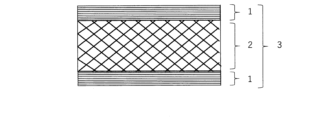
- FIG. 1 is a schematic side view showing one embodiment of a porous sandwich structure according to the present invention.
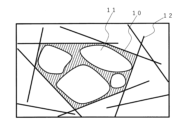
- FIG. 2 is a schematic plan view of a core layer according to the present invention.
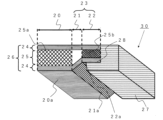
- FIG. 1 is a perspective view showing an embodiment of an integrally molded body according to the present invention.
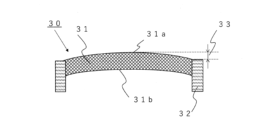
- FIG. 2 is a schematic side view showing an integrally molded body according to the present invention having a curved surface.
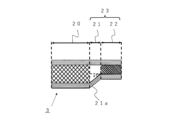
- 4 is an enlarged schematic side view of the step portion and its vicinity of the integrally molded body shown in FIG. 3.
- the porous sandwich structure 3 is a porous sandwich structure 3 in which discontinuous reinforcing fibers are arranged to have a three-dimensional mesh structure as shown in FIG. 1, and discontinuous reinforcing fibers 12 are bonded to each other with thermoplastic resin 10 as shown in FIG.
- the core layer 2 is a porous sandwich structure in which the area surrounded by the discontinuous reinforcing fibers 12 arranged in the three-dimensional mesh structure is covered with thermoplastic resin 10 in a planar manner, and the planar area covered with thermoplastic resin 10 has multiple holes 11, and the ratio (void ratio) of the space in which the thermoplastic resin 10 and the discontinuous fibers 12 do not exist in the core layer 2 to the entire core layer 2 is 50% by volume or more and 76% by volume or less.
- Continuous fibers are reinforcing fibers contained in the surface layer that constitutes the porous sandwich structure 3 that are arranged substantially continuously over the entire length or width of the porous sandwich structure.
- Discontinuous fibers which will be described later, are reinforcing fibers that are intermittently broken.
- fibers used as unidirectional reinforced fiber resins correspond to continuous fibers
- reinforcing fibers contained in SMC (sheet molding compound) base materials used in press molding and pellet materials used in injection molding correspond to discontinuous fibers.
- the continuous fibers used in the skin layer 1 include metal fibers such as aluminum fibers, brass fibers, and stainless steel fibers; glass fibers; carbon fibers and graphite fibers such as polyacrylonitrile, rayon, lignin, and pitch; organic fibers such as aromatic polyamide fibers, polyaramid fibers, PBO fibers, polyphenylene sulfide fibers, polyester fibers, acrylic fibers, nylon fibers, and polyethylene fibers; and silicon carbide fibers, silicon nitride fibers, alumina fibers, silicon carbide fibers, and boron fibers. These may be used alone or in combination of two or more types.
- These fiber materials may be surface-treated.
- surface treatments include metal deposition, treatment with a coupling agent, treatment with a sizing agent, and treatment with an additive.
- carbon fibers such as polyacrylonitrile (PAN)-based carbon fibers, rayon-based carbon fibers, lignin-based carbon fibers, and pitch-based carbon fibers, which have excellent specific strength and specific rigidity, are preferably used.
- PAN polyacrylonitrile
- rayon-based carbon fibers rayon-based carbon fibers
- lignin-based carbon fibers lignin-based carbon fibers
- pitch-based carbon fibers which have excellent specific strength and specific rigidity
- PAN polyacrylonitrile
- the tensile modulus of the fibers is preferably in the range of 200 GPa to 1,000 GPa in terms of the rigidity of the porous sandwich structure, and more preferably in the range of 400 GPa to 900 GPa in terms of the handling of the prepreg. If the tensile modulus of the carbon fibers is less than 200 GPa, the rigidity of the porous sandwich structure may be poor, and if it is greater than 1,000 GPa, it is necessary to increase the crystallinity of the carbon fibers, making it difficult to manufacture the carbon fibers.
- the tensile modulus of the carbon fibers is within the above range, it is preferable in terms of further improving the rigidity of the porous sandwich structure and improving the manufacturability of the carbon fibers.
- the tensile modulus of the carbon fibers can be measured by a strand tensile test described in JIS R7601-1986.
- the density is preferably 1.6 g/cm3 or more and 2.0 g/ cm3 or less in the case of polyacrylonitrile (PAN)-based carbon fibers, 1.8 g/ cm3 or more and 2.0 g/cm3 or less from the viewpoint of improving rigidity, 2.0 g/ cm3 or more and 2.5 g/ cm3 or less in the case of pitch-based carbon fibers, and further 2.0 g/cm3 or more and 2.3 g/cm3 or less from the viewpoint of cost.
- PAN-based carbon fibers which have excellent processability, are preferred.
- a fiber woven substrate can also be used for the skin layer 1 of the porous sandwich structure 3.
- a fiber woven substrate is a substrate in which continuous reinforcing fiber bundles of 1,000 continuous reinforcing fibers are used as warp and weft threads, and two sets of threads are crossed at substantially right angles using a loom.
- a continuous reinforcing fiber bundle of 1,000 fibers is generally called 1K
- a bundle of 3,000 fibers is called 3K
- a bundle of 12,000 fibers is called 12K.
- the fiber fabric substrate is preferably at least one fabric selected from plain weave, twill weave, satin weave, and satin weave. Since the fiber fabric substrate has a distinctive fiber pattern, by using a fiber fabric substrate that accentuates the distinctive fiber pattern as the outermost layer (design surface side) of the porous sandwich structure, an integrated molded body that exhibits a novel surface pattern can be obtained.
- 1K to 24K is preferable, and from the viewpoint of the stability of the fiber pattern during processing, 1K to 6K is even more preferable.
- the resin that constitutes the skin layer 1 of the porous sandwich structure 3 may be either a thermoplastic resin or a thermosetting resin.
- thermosetting resin any of the thermosetting resins exemplified below can be used.
- thermosetting resins such as unsaturated polyester resin, vinyl ester resin, epoxy resin, phenol (resole type) resin, urea-melamine resin, polyimide resin, maleimide resin, and benzoxazine resin can be preferably used. These may be applied by blending two or more kinds.
- epoxy resin is particularly preferable from the viewpoint of the mechanical properties and heat resistance of the molded body.
- epoxy resin is preferably included as the main component of the resin used, and specifically, it is preferable that it is included in an amount of 60% by weight or more and less than 97% by weight per resin composition.
- thermoplastic resin any of the thermoplastic resins exemplified below can be used.
- polyester resins such as polyethylene terephthalate (PET) resin, polybutylene terephthalate (PBT) resin, polytrimethylene terephthalate (PTT) resin, polyethylene naphthalate (PEN resin), liquid crystal polyester resin, etc.
- polyolefin resins such as polyethylene (PE resin), polypropylene (PP resin), polybutylene resin, etc.
- polyarylene sulfide resins such as polyoxymethylene (POM) resin, polyamide (PA) resin, polyphenylene sulfide (PPS) resin, etc.
- polyketone (PK) resin polyether ketone (PEK) resin, polyether ether ketone (PEEK) resin, polyether ketone ketone (PEKK) resin, polyether nitrile (PEN) resin, polytetrafluoroethylene resin, etc.
- PET polyethylene terephthalate
- PBT
- Fluorine-based resins such as liquid crystal polymers (LCP), and styrene-based resins, as well as amorphous resins such as polycarbonate (PC) resin, polymethyl methacrylate (PMMA) resin, polyvinyl chloride (PVC) resin, polyphenylene ether (PPE) resin, polyimide (PI) resin, polyamideimide (PAI) resin, polyetherimide (PEI) resin, polysulfone (PSU) resin, polyethersulfone resin, and polyarylate (PAR) resin, as well as phenol-based resin, phenoxy resin, and thermoplastic elastomers such as polystyrene-based resin, polyurethane-based resin, polybutadiene-based resin, polyisoprene-based resin, and acrylonitrile-based resin, as well as thermoplastic resins selected from copolymers and modified products thereof.
- PC polycarbonate
- PMMA polymethyl methacrylate
- PVC polyvinyl
- polyolefin resins are preferred from the viewpoint of the light weight of the resulting molded product
- polyamide resins are preferred from the viewpoint of strength
- amorphous resins such as polycarbonate resins, styrene-based resins, and modified polyphenylene ether-based resins are preferred from the viewpoint of surface appearance
- polyarylene sulfide resins are preferred from the viewpoint of heat resistance
- polyether ether ketone resins are preferably used from the viewpoint of continuous use temperature.
- the exemplified thermoplastic resins may contain impact resistance improvers such as elastomers or rubber components, other fillers, and additives, to the extent that the object of the present invention is not impaired.
- impact resistance improvers such as elastomers or rubber components, other fillers, and additives, to the extent that the object of the present invention is not impaired.
- these include inorganic fillers, flame retardants, conductivity imparting agents, crystal nucleating agents, UV absorbers, antioxidants, vibration dampers, antibacterial agents, insect repellents, deodorants, color inhibitors, heat stabilizers, release agents, antistatic agents, plasticizers, lubricants, colorants, pigments, dyes, foaming agents, foam control agents, and coupling agents.
- the discontinuous reinforcing fibers 12 constituting the core layer 2 form a three-dimensional mesh structure
- the thermoplastic resin 10 exists as a matrix resin of the three-dimensional mesh structure.
- the thermoplastic resin 10 is spread out in a planar manner in an area surrounded by an outline formed by a plurality of discontinuous reinforcing fibers 12 arranged in a ring in the mesh of the three-dimensional mesh structure formed by the discontinuous reinforcing fibers 12, and forms a plurality of holes 11.
- the outline formed by the discontinuous reinforcing fibers 12 arranged in a ring is not limited to the hexagon shown in FIG.
- thermoplastic resin 10 spreading in a planar manner is less likely to break in the stretching direction when stretched, and the bonded state of the discontinuous reinforcing fibers 12 can be maintained, so that the discontinuous reinforcing fibers 12 can be bonded more firmly than in a state in which the holes 11 are not formed in the thermoplastic resin 10. Furthermore, since the thermoplastic resin 10 has a plurality of holes 11, it can be stretched more greatly to increase the porosity of the core layer 2, and further weight reduction can be expected. This structure has the effect of increasing the rigidity of the porous sandwich structure 3.
- discontinuous reinforcing fibers 12 used in the core layer 2 include metal fibers such as aluminum, brass, and stainless steel; polyacrylonitrile (PAN)-based, rayon-based, lignin-based, and pitch-based carbon fibers, graphite fibers, and insulating fibers such as glass; organic fibers such as aramid resin, polyphenylene sulfide resin, polyester resin, acrylic resin, nylon resin, and polyethylene resin; and inorganic fibers such as silicon carbide and silicon nitride.
- PAN polyacrylonitrile
- organic fibers such as aramid resin, polyphenylene sulfide resin, polyester resin, acrylic resin, nylon resin, and polyethylene resin
- inorganic fibers such as silicon carbide and silicon nitride.
- These fibers may also be surface-treated. Surface treatments include coating with metal as a conductor, treatment with a coupling agent, treatment with a sizing agent, treatment with a bundling agent, and treatment with additives.
- These discontinuous reinforcing fibers may be used alone or in combination with two or more types.
- PAN polyacrylonitrile
- pitch rayon-based carbon fibers, which have excellent specific strength and specific stiffness, are preferably used from the standpoint of weight reduction.
- Aramid fibers are preferably used from the viewpoint of improving the economic efficiency of the resulting porous sandwich structure 3 and the integrated molded body 30 described below.
- carbon fibers and aramid fibers in combination from the viewpoint of the balance between mechanical properties and shock absorption.
- reinforced fibers coated with metals such as nickel, copper, and ytterbium can also be used.
- PAN-based carbon fibers which have excellent mechanical properties such as strength and elastic modulus, are more preferably used.
- PAN polyacrylonitrile
- discontinuous reinforcing fibers 12 of the present invention there are no particular limitations on the shape of the discontinuous reinforcing fibers 12 of the present invention, but from the perspective of layering for use, a sheet shape is preferable.
- the discontinuous reinforcing fibers 12 used in the core layer 2 do not need to be virgin materials, and may be fiber-reinforced plastic pieces obtained by crushing fiber-reinforced plastic made of thermoplastic resin or thermosetting resin, or fibers obtained from fiber-reinforced plastic pieces that have been crushed, classified, and heat-treated for recycling. More preferably, from the viewpoint of reducing waste to be disposed of in landfills, recycled fibers obtained from waste fiber-reinforced plastic using thermosetting resin are preferred.
- thermoplastic resins as those used for the skin layer 1 described above can be used for the core layer 2 that constitutes the porous sandwich structure 3.
- polyolefin resins are preferred from the viewpoint of the light weight of the resulting molded product
- polyamide resins are preferred from the viewpoint of strength
- amorphous resins such as polycarbonate resins, styrene-based resins, and modified polyphenylene ether-based resins are preferred from the viewpoint of surface appearance
- polyarylene sulfide resins are preferred from the viewpoint of heat resistance
- polyether ether ketone resins are preferably used from the viewpoint of continuous use temperature.
- thermoplastic resin used in the core layer 2 of the porous sandwich structure 3 has strain hardening properties. This can increase the bonding strength between the discontinuous reinforcing fibers 12 in the core layer 2, contributing to improved rigidity.
- Strain hardening is the property of increasing the viscosity of a thermoplastic resin when it is subjected to a certain amount of deformation in a molten state.
- a thermoplastic resin with strain hardening properties when the thermoplastic resin deforms in conjunction with the deformation of the fiber-reinforced resin, the viscosity of the thermoplastic resin in the deformed portion increases specifically, resulting in a difference in viscosity between the deformed and undeformed portions. This causes the deformation of the undeformed portion, which has a low viscosity, to progress, allowing the thermoplastic resin to deform uniformly, allowing the thermoplastic resin to be stretched without breaking.
- the viscosity of the thinly stretched parts increases specifically, allowing the thermoplastic resin to expand without breaking. That is, in the porous sandwich structure 3, the thermoplastic resin 10 has multiple holes 11 and tends to spread out in a planar shape. In addition, because the viscosity of the stretched parts increases specifically, it expands uniformly and dense voids can be formed.
- thermoplastic resin has strain hardening properties
- suitable thermoplastic resins with strain hardening properties include thermoplastic resins with a molecular weight of 300,000 or more, thermoplastic resins with long-chain branching structures, and thermoplastic resins with pseudo-crosslinking structures, such as polystyrene resin.
- the elasticity of the discontinuous reinforcing fibers 12 can be improved by heating the thermoplastic resin 10 constituting the core layer 2 to melt or soften it.
- the porous sandwich structure 3 can be easily expanded and compressed.
- the porosity of the core layer 2 increases, and when it is compressed, the porosity of the core layer 2 decreases.
- the spacing between the discontinuous reinforcing fibers 12 in the core layer 2 becomes wider, and the thermoplastic resin 10 covering the area formed by the three-dimensional mesh structure expands in a planar manner so as to bond the discontinuous reinforcing fibers 12 together, thereby achieving both weight reduction and high rigidity.
- the specific gravity of the porous sandwich structure 3 is preferably 0.5 or more and 1.4 or less.
- the porosity of the core layer 2 must be 50% by volume or more and 76% by volume or less. If the porosity is less than 50% by volume, the spacing between the discontinuous reinforcing fibers 12 is small, making it difficult to form holes 11 in the thermoplastic resin 10. Compared to a case where holes 11 are not formed, it is difficult to create a difference in the bonding strength between the discontinuous reinforcing fibers 12, and therefore the rigidity of the skin layer 1 becomes dominant in the rigidity of the entire porous sandwich structure 3. This is also undesirable from the standpoint of weight reduction and cost.
- the porosity of the core layer 2 is 76% by volume or more, the spacing between the discontinuous reinforcing fibers 12 will become larger, and the area of the thermoplastic resin 10 in contact with each discontinuous reinforcing fiber will become smaller. Furthermore, the pores 11 of the thermoplastic resin 10 that spread in a planar shape will become larger, causing stress concentration and reducing the rigidity of the porous sandwich structure 3. Therefore, in order to satisfy the requirement of being lightweight and highly rigid, it is necessary for the porosity of the core layer 2 to be 50% by volume or more and 76% by volume or less. More preferably, it is 60% by volume or more and 76% by volume or less.
- the discontinuous reinforcing fibers 12 constituting the core layer 2 are in the range of 5% by weight to 75% by weight, and the thermoplastic resin 10 is in the range of 25% by weight to 95% by weight.
- the blend ratio of the discontinuous reinforcing fibers 12 to the thermoplastic resin 10 is one factor that determines the void ratio.
- thermoplastic resin 10 there are no particular limitations on how to determine the blend ratio of discontinuous reinforcing fibers 12 and thermoplastic resin 10, but for example, it can be determined by removing the thermoplastic resin 10 contained in the core layer 2 and measuring the weight of only the remaining discontinuous reinforcing fibers 12.
- Examples of methods for removing the resin components contained in the core layer 2 include dissolving or burning off.
- the weight can be measured using an electronic scale or balance.
- the blend ratio of the core layer 2 is preferably 7% by weight or more and 70% by weight or less of discontinuous reinforcing fibers, and 30% by weight or more and 93% by weight or less of thermoplastic resin, more preferably 20% by weight or more and 50% by weight or less of discontinuous reinforcing fibers, and 50% by weight or more and 80% by weight or less of thermoplastic resin, and even more preferably 25% by weight or more and 40% by weight or less of discontinuous reinforcing fibers, and 60% by weight or more and 75% by weight or less of thermoplastic resin.
- the amount of discontinuous reinforcing fibers is less than 5% by weight and the amount of thermoplastic resin is more than 95% by weight, expansion using the elasticity of the discontinuous reinforcing fibers is difficult to occur, making it difficult to increase the porosity, and it may be difficult to create areas with different porosity in the core layer 2. As a result, the bonding strength with the second member 27 described below also decreases. On the other hand, if the amount of discontinuous reinforcing fibers is more than 75% by weight and the amount of thermoplastic resin is less than 25% by weight, the specific rigidity of the porous sandwich structure 3 decreases.
- thermoplastic resin 10 constituting the porous sandwich structure 3 spreads in a planar (membrane-like) shape within the area surrounded by the discontinuous reinforcing fibers 12 and has multiple holes 11.
- the remaining thermoplastic resin 10 has a network-like shape.
- the planar region of the thermoplastic resin 10 branches out so that arms extend in three to eight directions, i.e., so as to form arm-like portions, and it is more preferable that it branches out in four to five directions.
- the number of holes 11 formed in the thermoplastic resin 10 of the core layer 2 constituting the porous sandwich structure 3 is preferably 2 to 300 per 4 mm2 in a two-dimensional plane in a cross-sectional image described later, and more preferably 20 to 240 per 4 mm2.
- the cross-sectional observation method for the porous sandwich structure 3 of the present invention involves polishing the skin layer 1 perpendicular to the lamination direction (parallel to the lamination order) of the skin layer 1 and the core layer 2 to expose the core layer 2, and observing using an optical microscope (Keyence, VHX-6000).
- the observation conditions are a magnification of 500 times, coaxial illumination, and a supercharge value of the illumination of 30 ms to 40 ms.
- the cross-sectional image is then binarized, and the number of holes 11 formed in the thermoplastic resin 10 is counted and evaluated.
- the porous sandwich structure 3 described above has a step portion 23 on one end of the surface. If the surface with the least step is the design surface and the surface with the step is the non-design surface, this step portion 23 is composed of a boundary portion 21 having a boundary connecting the main body portion 20 that forms the thickest area and the pressing portion 22 that forms the thinnest area, and a pressing portion 22.
- the porosity of the core layer 2 in the boundary portion 21 and the pressing portion 22 is configured to be lower than the porosity of the core layer in the main body portion 20.
- a second member 27 made of a separate molded body to a part of the pressing portion 22 to form an integrated molded body 30, it is possible to further reduce the thickness and improve the reliability of the joint.
- the maximum thickness of the porous sandwich structure 3 is preferably 0.3 mm or more and 2.0 mm or less. If it is less than 0.3 mm, the rigidity of the integrated molded body 30 is likely to be insufficient. Furthermore, if the maximum thickness 29 of the porous sandwich structure 3 exceeds 2.0 mm, the lightweight nature may be impaired. From the viewpoint of lightweight nature and rigidity, the maximum thickness is more preferably 0.7 mm or more and 1.5 mm or less. The maximum thickness is the value measured at the thickest part of the porous sandwich structure 3.
- the second member 27 is bonded over the entire circumference of the outer periphery of the porous sandwich structure 3.
- a bonding surface 28 with the second member 27 over the entire circumference of the outer periphery of the porous sandwich structure 3, it is possible to achieve high bonding strength and thin-walledness for the entire integrated molded body 30.
- a frame made of the second member can be separately manufactured in advance and then insert molded, or it can be directly outsert molded into the porous sandwich structure 3.
- injection molding is mainly preferred.
- the second member 27 be a fiber-reinforced resin made of reinforcing fibers and resin.
- the reinforcing fibers constituting the second member 27 can be the reinforcing fibers used in the continuous fibers described above. From the viewpoint of increasing the strength of the second member 27, glass fiber and carbon fiber are preferred, and from the viewpoint of antenna performance, it is more preferred to use glass fiber. On the other hand, although carbon fiber is inferior to glass fiber in terms of antenna performance, it can be usefully used for the purpose of improving strength and rigidity.
- thermoplastic resin used for the core layer 2 described above can be preferably used as the material for the second member 27.
- the second member 27 contains reinforcing fibers.
- the reinforcing fibers may be the same type of reinforcing fibers as those used in the core layer 2 described above. It is more preferable that the reinforcing fibers are discontinuous fibers, and it is preferable that the weight average fiber length of these discontinuous fibers is 0.3 mm or more and 3 mm or less.
- the fiber length of the discontinuous fibers can be measured, for example, by extracting the discontinuous fibers directly from the integrally molded body 30 and observing them under a microscope. If resin is attached to the discontinuous fibers, the resin can be dissolved from the discontinuous fibers using a solvent that dissolves only the resin attached to them, and the remaining discontinuous fibers can be filtered out and measured under a microscope (dissolution method). If there is no solvent that dissolves the resin, the resin can be burned off in a temperature range where the discontinuous fibers do not oxidize and lose weight, and the discontinuous fibers can be separated and measured under a microscope (burn-off method). 400 discontinuous fibers can be randomly selected, and their lengths can be measured to the nearest 1 ⁇ m under an optical microscope to determine the fiber length and its ratio.
- the weight fiber content of the discontinuous fibers contained in the second member 27 is preferably 1% by weight or more and 60% by weight or less. This increases the bonding strength with the porous sandwich structure and reduces warping of the integrated molded body. If it is less than 1% by weight, it may be difficult to ensure the strength of the molded body, and if it exceeds 60% by weight, the filling of the second member 27 may be partially insufficient during injection molding. From the viewpoint of moldability of the second member 27, it is preferably 5% by weight or more and 55% by weight or less, more preferably 8% by weight or more and 50% by weight or less, and even more preferably 12% by weight or more and 45% by weight or less.
- the porous sandwich structure 3 and the second member 27 are bonded not only to the outer peripheral side portion of the porous sandwich structure 3, but also to the outer peripheral edge portion of the surface (non-design surface 31b) opposite the design surface 31a of the porous sandwich structure 3.
- the bonding surface 28 with the second member 27 is formed on the non-design surface 31b of the porous sandwich structure 3.
- step portion 23 of the porous sandwich structure 3 The details of the step portion 23 of the porous sandwich structure 3 are explained using Figure 5.
- the boundary portion 21 has an inclined surface at an angle ⁇ (°) with respect to the in-plane direction of the porous sandwich structure 3 (the direction parallel to the surface of the main body portion 20).
- ⁇ angle
- This increases the bonding area, and compared to simply bonding another structure to the flat side portion of the porous sandwich structure, the bonding area can be made larger, resulting in an effect of increasing the bonding strength.
- the angle ⁇ (°) of the inclined surface of the step portion 23 with respect to the in-plane direction of the porous sandwich structure is preferably 1° or more and 20° or less, more preferably 1° or more and 15° or less, from the viewpoint of the moldability of the porous sandwich structure 3.
- the porosity of the main body core layer 25a in the region forming the main body 20 in the integrated molded body 30 is 50% by volume or more and 76% by volume or less, and more preferably 66% by volume or more and 76% by volume or less.
- the porosity of the main body 20 is less than 50% by volume, the difference in rigidity between the porous sandwich structure 3 having a plurality of holes 11 and the sandwich structure not having a plurality of holes 11 is small, and the difference in rigidity is large in the region with a higher porosity, which is also preferable from the viewpoint of weight reduction.
- the porosity of the main body 20 exceeds 76% by volume, the stretched thermoplastic resin 10 is broken, and the bonding strength between the discontinuous reinforcing fibers 12 and the thermoplastic resin 10 decreases.
- the porosity of the pressing portion core layer 25b in the area forming the thinnest portion is preferably 0% by volume or more and less than 50% by volume, and more preferably 0% by volume or more and less than 30% by volume.
- the integrated molded body 30 according to the present invention preferably has a concave portion in a portion of the non-design surface 31b from the non-design surface 31b toward the design surface 31a.
- the concave portion is a curved surface, and it is more preferable that the entire surface is a curved surface from the viewpoint of ease of molding.
- the area of the curved portion is more preferably 80% or more of the exposed area of the porous sandwich structure 3, and even more preferably 90% or more, and it is particularly preferable that the curved portion is formed in the entire area. In this case, it is preferable that the areas other than the concave portion are flat.
- the height difference 33 between the extension line extending horizontally from the maximum height part of the surface layer on the design surface 31a side of the porous sandwich structure 31 and the extension line extending horizontally from the minimum height part of the surface layer on the design surface 31a side is greater than 0 mm and not greater than 5 mm. If the height difference 33 is 0 mm (completely flat), there is a risk of interference with internal components when the porous sandwich structure 3 is made thicker than a certain level. On the other hand, if the height difference 33 exceeds 5 mm, interference with internal components is avoided, but when viewed from the design surface 31a side, the convex shape is noticeable, which may be disadvantageous in terms of appearance.
- the preferred range of the height difference 33 varies depending on the part and purpose of use in the integrated molded body 30, but when considering the appearance and the like, it is often preferable for it to be 4 mm or less, and more preferably 2 mm or less, and from the viewpoint of ensuring space for inserting internal components, it may be preferable for it to be greater than 0 mm and 0.5 mm or less, and from the viewpoint of both ensuring space for inserting internal components and the appearance, it may be more preferable for it to be greater than 0 mm and 0.1 mm or less, and even more preferably it is in the range of greater than 0 mm and 0.05 mm or less.
- the height difference 33 is 1 mm or more.
- the specific ratio of the design surface in the area where the convex shape portion is formed in a plan view is the same as the preferred ratio for the concave shape portion in the non-design surface 31b.
- it is preferable that at least a part of the area is a curved surface.
- a certain area is a curved surface, and the convex shape portion is continuously higher from the periphery in the in-plane direction of the porous sandwich structure 3 toward the center or a position shifted from the center.
- One of the optimal aspects is that one curved convex shape portion is formed in the entire area of the design surface 31a.
- the porous sandwich structure 3 and integrally molded body 30 according to the present invention have a rectangular shape, and are suitable for use in the top plate of an electronic device housing such as a laptop computer. Note that the rectangular shape also includes a nearly rectangular shape. In addition, by being rectangular when viewed from above, the area of the second member 27 is small, which makes it possible to achieve low warpage of the integrally molded body.
- porous sandwich structure and integrated molded body of the present invention can be used in any application that requires light weight, high strength, high rigidity and thin wall thickness.
Landscapes
- Engineering & Computer Science (AREA)
- Mechanical Engineering (AREA)
- Chemical & Material Sciences (AREA)
- Composite Materials (AREA)
- Textile Engineering (AREA)
- Laminated Bodies (AREA)
Priority Applications (2)
| Application Number | Priority Date | Filing Date | Title |
|---|---|---|---|
| JP2023565844A JPWO2024095814A1 (https=) | 2022-10-31 | 2023-10-24 | |
| CN202390000582.6U CN224158912U (zh) | 2022-10-31 | 2023-10-24 | 多孔质夹层结构体及使用其的一体化成型体 |
Applications Claiming Priority (2)
| Application Number | Priority Date | Filing Date | Title |
|---|---|---|---|
| JP2022174189 | 2022-10-31 | ||
| JP2022-174189 | 2022-10-31 |
Publications (1)
| Publication Number | Publication Date |
|---|---|
| WO2024095814A1 true WO2024095814A1 (ja) | 2024-05-10 |
Family
ID=90930305
Family Applications (1)
| Application Number | Title | Priority Date | Filing Date |
|---|---|---|---|
| PCT/JP2023/038261 Ceased WO2024095814A1 (ja) | 2022-10-31 | 2023-10-24 | 多孔質サンドイッチ構造体及びそれを用いた一体化成形体 |
Country Status (4)
| Country | Link |
|---|---|
| JP (1) | JPWO2024095814A1 (https=) |
| CN (1) | CN224158912U (https=) |
| TW (1) | TW202438300A (https=) |
| WO (1) | WO2024095814A1 (https=) |
Citations (6)
| Publication number | Priority date | Publication date | Assignee | Title |
|---|---|---|---|---|
| JP2002011797A (ja) * | 2000-06-28 | 2002-01-15 | Sumitomo Chem Co Ltd | 繊維強化熱可塑性樹脂軽量成形体 |
| JP2015085613A (ja) * | 2013-10-31 | 2015-05-07 | 東レ株式会社 | 一体化成形体及びその製造方法 |
| JP2016049649A (ja) * | 2014-08-29 | 2016-04-11 | 東レ株式会社 | 一体化成形体及びその製造方法 |
| WO2018110293A1 (ja) * | 2016-12-12 | 2018-06-21 | 東レ株式会社 | 一体化成形体及びその製造方法 |
| JP2018520022A (ja) * | 2015-06-12 | 2018-07-26 | ハンファ アズデル インコーポレイテッド | 耐衝撃性アンダーボディシールド材及び物品、ならびにそれらの使用方法 |
| WO2018142971A1 (ja) * | 2017-01-31 | 2018-08-09 | 東レ株式会社 | 一体化成形体及びその製造方法 |
-
2023
- 2023-10-24 JP JP2023565844A patent/JPWO2024095814A1/ja active Pending
- 2023-10-24 CN CN202390000582.6U patent/CN224158912U/zh active Active
- 2023-10-24 WO PCT/JP2023/038261 patent/WO2024095814A1/ja not_active Ceased
- 2023-10-30 TW TW112141482A patent/TW202438300A/zh unknown
Patent Citations (6)
| Publication number | Priority date | Publication date | Assignee | Title |
|---|---|---|---|---|
| JP2002011797A (ja) * | 2000-06-28 | 2002-01-15 | Sumitomo Chem Co Ltd | 繊維強化熱可塑性樹脂軽量成形体 |
| JP2015085613A (ja) * | 2013-10-31 | 2015-05-07 | 東レ株式会社 | 一体化成形体及びその製造方法 |
| JP2016049649A (ja) * | 2014-08-29 | 2016-04-11 | 東レ株式会社 | 一体化成形体及びその製造方法 |
| JP2018520022A (ja) * | 2015-06-12 | 2018-07-26 | ハンファ アズデル インコーポレイテッド | 耐衝撃性アンダーボディシールド材及び物品、ならびにそれらの使用方法 |
| WO2018110293A1 (ja) * | 2016-12-12 | 2018-06-21 | 東レ株式会社 | 一体化成形体及びその製造方法 |
| WO2018142971A1 (ja) * | 2017-01-31 | 2018-08-09 | 東レ株式会社 | 一体化成形体及びその製造方法 |
Also Published As
| Publication number | Publication date |
|---|---|
| TW202438300A (zh) | 2024-10-01 |
| JPWO2024095814A1 (https=) | 2024-05-10 |
| CN224158912U (zh) | 2026-04-24 |
Similar Documents
| Publication | Publication Date | Title |
|---|---|---|
| JP6960108B2 (ja) | 一体化成形体及びその製造方法 | |
| TWI353303B (en) | Sandwich structure and integrated molding using th | |
| JP2015085613A (ja) | 一体化成形体及びその製造方法 | |
| CN118043385A (zh) | 预浸体、预制件和纤维强化树脂成形品 | |
| US20210244118A1 (en) | Layered article | |
| JP5668349B2 (ja) | 放熱性部材及び筐体 | |
| US20250340023A1 (en) | Porous body | |
| KR20120066141A (ko) | 인쇄회로기판의 절연층, 이의 제조방법, 및 이를 포함하는 인쇄회로기판 | |
| WO2024095814A1 (ja) | 多孔質サンドイッチ構造体及びそれを用いた一体化成形体 | |
| JP2011207048A (ja) | 繊維強化樹脂積層体 | |
| JP2010131804A (ja) | 複合成形品およびその製造方法 | |
| US20240316897A1 (en) | Integrated molded body and electronic device housing | |
| JP2012028508A (ja) | 枠状部材及び筐体 | |
| WO2024247728A1 (ja) | サンドイッチ構造体およびそれを用いた一体化成形体 | |
| CN117693423A (zh) | 三明治结构体和其制造方法以及电子设备壳体 | |
| KR20240157638A (ko) | 성형 기재, 다공질체, 스킨-코어 구조체 및 구조 부재 | |
| CN221022068U (zh) | 一体化成型体 | |
| JP7347719B1 (ja) | 一体化成形体 | |
| CN223590168U (zh) | 一体化成型体及电子设备框体 | |
| WO2025105360A1 (ja) | サンドイッチ構造体およびそれを用いた一体化成形体 |
Legal Events
| Date | Code | Title | Description |
|---|---|---|---|
| ENP | Entry into the national phase |
Ref document number: 2023565844 Country of ref document: JP Kind code of ref document: A |
|
| 121 | Ep: the epo has been informed by wipo that ep was designated in this application |
Ref document number: 23885574 Country of ref document: EP Kind code of ref document: A1 |
|
| NENP | Non-entry into the national phase |
Ref country code: DE |
|
| 122 | Ep: pct application non-entry in european phase |
Ref document number: 23885574 Country of ref document: EP Kind code of ref document: A1 |