WO2024090395A1 - 生産管理装置、生産管理方法、生産管理プログラム、および記録媒体 - Google Patents
生産管理装置、生産管理方法、生産管理プログラム、および記録媒体 Download PDFInfo
- Publication number
- WO2024090395A1 WO2024090395A1 PCT/JP2023/038243 JP2023038243W WO2024090395A1 WO 2024090395 A1 WO2024090395 A1 WO 2024090395A1 JP 2023038243 W JP2023038243 W JP 2023038243W WO 2024090395 A1 WO2024090395 A1 WO 2024090395A1
- Authority
- WO
- WIPO (PCT)
- Prior art keywords
- production management
- display information
- unit
- timing
- management device
- Prior art date
- Legal status (The legal status is an assumption and is not a legal conclusion. Google has not performed a legal analysis and makes no representation as to the accuracy of the status listed.)
- Ceased
Links
Images



Classifications
-
- G—PHYSICS
- G05—CONTROLLING; REGULATING
- G05B—CONTROL OR REGULATING SYSTEMS IN GENERAL; FUNCTIONAL ELEMENTS OF SUCH SYSTEMS; MONITORING OR TESTING ARRANGEMENTS FOR SUCH SYSTEMS OR ELEMENTS
- G05B19/00—Program-control systems
- G05B19/02—Program-control systems electric
- G05B19/418—Total factory control, i.e. centrally controlling a plurality of machines, e.g. direct or distributed numerical control [DNC], flexible manufacturing systems [FMS], integrated manufacturing systems [IMS] or computer integrated manufacturing [CIM]
Definitions
- This disclosure relates to a production management device, a production management method, a production management program, and a recording medium.
- Patent Document 1 describes a production instruction system that monitors the production status of a production line and predicts changes in inventory in the process.
- a production management device includes an acquisition unit that acquires the production quantity at a predetermined time for a first process among manufacturing processes, a prediction unit that predicts the timing when the production quantity for the first process can become the work-in-progress inventory amount for the second process based on the time when the product of the first process can be transported to the second process that is the next process of the first process, and a display information generation unit that generates display information showing the relationship between the work-in-progress inventory amount and the timing and displays the display information on a display unit.
- a production management method includes an acquisition step of acquiring a production quantity at a predetermined time for a first process among manufacturing processes, a prediction step of predicting a timing when the production quantity of the first process can become the work-in-process inventory amount for the second process based on the time when the product of the first process can be delivered to the second process that is the next process of the first process, and a display step of generating display information showing the relationship between the work-in-process inventory amount and the timing and displaying the information on a display unit.
- the production management device may be realized by a computer.
- the control program of the production management device that causes the computer to operate as each unit (software element) of the production management device to realize the production management device, and the computer-readable recording medium on which it is recorded, also fall within the scope of the present disclosure.
- FIG. 1 is a diagram showing an overview of a production management device according to the present disclosure.
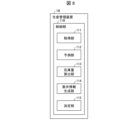
- FIG. 2 is a block diagram showing a configuration example of a production management device.
- FIG. 13 is a diagram illustrating an example of a prediction in a prediction unit of the production management device.
- 11 is a diagram showing an example of display information that a display information generating unit causes a display unit to display.
- FIG. 10 is a flowchart showing an example of a process flow in a production management device.
- FIG. 13 is a block diagram showing another example of the configuration of the production management device. 13 is a diagram showing an example of another display information that the display information generating unit causes to be displayed on the display unit;
- FIG. 13 is a block diagram showing yet another example of the configuration of the production management device.
- FIG. 13 is a diagram illustrating an example of a determination method in a determination unit of the production management device.
- FIG. 1 shows an overview of a production management device 1 according to the present disclosure.
- the production management device 1 performs production management in, for example, a first process and a second process of a manufacturing process 501.
- the manufacturing process 501 has a plurality of manufacturing steps. Any one of the manufacturing processes 501 is a "first step", and the step following the first step is a "second step". In other words, of any two consecutive steps in the manufacturing process 501, the step that is performed first is the first step, and the step that is performed next is the second step.
- the manufacturing process may have three or more steps, in which case the first step and the second step will vary depending on the two consecutive steps that are of interest, rather than on a specific step in the manufacturing process.
- the second step takes in and processes the product produced in the first step.
- the first and second steps may each be performed by multiple manufacturing machines, or by a single manufacturing machine.
- the first step is performed by manufacturing machine A, manufacturing machine B, and manufacturing machine C.
- the second step is performed by a single manufacturing machine.
- each manufacturing machine may be installed in a different location, and each step may be performed in a different location.
- the production management device 1 can obtain the production quantity of each manufacturing machine in the first process and display the inventory amount available in the second process on the display unit 2.
- the following describes an example of a production management device 1 that manages the production of manufacturing process 501, but the production management device 1 according to the present disclosure is not limited to this. It may be applied to any manufacturing process as long as it has multiple steps.
- Fig. 2 is a block diagram showing the configuration of the main parts of the production management device 1.
- the production management device 1 includes a control unit 11.
- the control unit 11 executes various processes in the production management device 1, and includes an acquisition unit 111, a prediction unit 112, and a display information generation unit 114.
- the production management device 1 and the display unit 2 are connected to each other so that they can communicate with each other via a communication means.
- a wireless LAN Local Area Network
- Any means capable of mediating the transmission and reception of electronic data can be used as the communication means, and for example, a wired communication means may be used.
- the acquisition unit 111 acquires the production quantity at a specified time for the first process of the manufacturing process 501.
- the acquisition unit 111 may acquire the production quantity at the specified time, for example, from manufacturing machines A, B, and C of the first process, or from a manufacturing data storage unit (not shown) arranged in the manufacturing process 501.
- the acquisition unit 111 may store the acquired information in a storage unit (not shown).
- the acquisition unit 111 outputs information representing the acquired production quantity to the prediction unit 112.
- the prediction unit 112 predicts the timing when the production quantity of the first process can become the work-in-process inventory of the second process, based on the time when the product of the first process can be transported to the second process, which is the next process of the first process.
- work-in-process inventory refers to the amount of the product of the first process that is ready to be taken into the second process.
- the prediction unit 112 predicts the timing when the amount of work-in-progress inventory for the second process can be determined based on the time when delivery is possible, using the information indicating the production quantity acquired by the acquisition unit 111.
- the prediction unit 112 then transmits the prediction result to the inventory amount calculation unit 113, the display information generation unit 114, and the determination unit 115.
- the prediction method used by the prediction unit 112 will be described later with reference to different drawings.
- the display information generating unit 114 generates display information showing the relationship between the amount of in-process inventory and timing, and displays it on the display unit 2. Specifically, the display information generating unit 114 uses information related to the prediction sent from the prediction unit 112 to generate display information showing the relationship between the amount of in-process inventory and timing, and sends it to the display unit 2. Specific examples of the display information displayed on the display unit 2 will be described later with reference to the drawings.
- FIG. 3 shows an example of a prediction in the prediction unit 112.
- a graph is displayed in which the vertical axis indicates the production quantity of the first process (the in-process inventory amount of the second process) and the horizontal axis indicates time.
- the dashed line indicates the production quantity of the first process
- the solid line indicates the in-process inventory amount of the second process.
- the prediction unit 112 predicts the timing when the production quantity of the first process can become the work-in-progress inventory of the second process based on the time when the product of the first process can be delivered to the second process.
- Figure 3 shows the result of calculating the time when the product of the first process can be delivered to the second process by adding the travel time required to move the product of the first process from the manufacturing machine performing the first process to the manufacturing machine performing the second process to a specified time, and predicting the timing.
- the amount of the item produced in the first process at 11:00 can be made into the work-in-process inventory in the second process at 14:00, three hours after it is produced.
- the timing is predicted using the travel time from the manufacturing machine performing the first process to the manufacturing machine performing the second process, so it is possible to shorten the waiting time that occurs when the product of the first process has not yet arrived at the manufacturing machine performing the second process. Therefore, it is possible to reduce the waste of energy in the manufacturing process.
- the time available for delivery may be a time that takes into consideration the travel time, the production capacity of the second process, the setup time for the travel, and the amount of energy consumed during the travel, or may be a time calculated by any combination of these.
- Fig. 4 shows an example of the display information that the display information generating unit 114 causes to be displayed on the display unit 2.
- the display information displayed on the display screen 20 of the display unit 2 is shown.
- the display unit 2 displays the display information generated by the display information generating unit 114.
- the display screen 20 of the display unit 2 displays graphs 201 and 202 that show the relationship between the in-process inventory amount and timing that are generated by the display information generating unit 114.
- the display screen 20 also shows the display information that shows the relationship between the in-process inventory amount and timing for each manufacturing machine that is generated by the display information generating unit 114.
- graphs 201 and 202 show the relationship between the production quantity in manufacturing machine A and manufacturing machine B in the first process, respectively, and the timing when it can become the work-in-process inventory amount in the second process. Furthermore, graphs 201 and 202 are display information generated using the results of predictions made in the same way as the prediction example in Figure 3, with the dashed line representing the production quantity in the first process and the solid line representing the work-in-process inventory amount in the second process. In this way, the timing when the production quantity in the manufacturing machine in the first process can become the work-in-process inventory amount in the second process is displayed, allowing the user to understand the amount of product that can be taken into the second process at that timing.
- the display unit 2 shows the display information for each manufacturing machine, the manufacturing status of each manufacturing machine is visualized. This makes it easier for users to manage the manufacturing process. Furthermore, because the display information is in the form of a graph, users can grasp the changes in the amount of work-in-process inventory over time. This makes it easier for users to manage the manufacturing process.
- Fig. 5 is a flow chart showing the flow of processing in the production management device 1.
- the production management device 1 first acquires the production quantity at a predetermined time for the first process of the manufacturing process from a control unit (not shown) that manages the production of the first process (step S11, acquisition step).
- the prediction unit 112 predicts the timing when the production quantity for the first process acquired from the acquisition unit 111 can become the work-in-process inventory amount for the second process based on the time when the product of the first process can be transported to the second process, which is the next process of the first process (step S12, prediction step).
- the display information generation unit 114 generates display information showing the relationship between the work-in-process inventory amount predicted by the prediction unit 112 and the timing, and outputs the display information to the display unit 2 for display (step S13, display step).
- the production management device 1 displays the timing at which the production quantity can become the work-in-process inventory amount by using the time until the production quantity can be brought into the second process. This makes it possible to prevent a situation in which the work-in-process inventory amount is displayed, but the amount of inventory that can actually be used differs from that work-in-process inventory amount. In other words, the production management device 1 can present the work-in-process inventory amount that can be used in the second process more accurately than ever before.
- the production management device 1A includes a control unit 11A.
- the control unit 11A includes an inventory amount calculation unit 113 in addition to the acquisition unit 111, the prediction unit 112, and the display information generation unit 114 described above.
- the inventory amount calculation unit 113 calculates the inventory amount of the second process by subtracting the quantity of products taken into the second process at the timing predicted by the prediction unit 112 from the work-in-process inventory amount at the timing predicted by the prediction unit 112. Specifically, the inventory amount calculation unit 113 calculates the inventory amount using the work-in-process inventory amount at the timing predicted by the prediction unit 112 and the quantity of products taken into the second process, and transmits information representing the inventory amount to the display information generation unit 114.
- the quantity of products taken into the second process may be acquired by the acquisition unit 111 or the display information generation unit 114.
- the display information generating unit 114 receives information indicating the inventory amount, generates display information indicating the relationship between the inventory amount and time, and displays it on the display unit 2.
- the inventory amount of the second process is displayed in real time, making it possible to present the accurate inventory amount of the second process at each time.
- FIG. 7 an example of display information that the display information generating unit 114 causes to be displayed on the display unit 2 in the first modification example is shown.
- the display unit 2 displays graphs 201 to 203, which are display information displayed on the display screen 20A.
- the display screen 20A displays display information for multiple manufacturing processes, which is generated by the display information generation unit 114, side by side.
- graph 203 shows the relationship between the inventory amount and time for the second process.
- Graphs 201 and 202 are the same display information as graphs 201 and 202 displayed on display screen 20, so the description thereof will not be repeated.
- the user can easily understand the production quantity for the first process and the inventory amount for the second process. This makes it easier for the user to manage the manufacturing processes. This prevents a situation from occurring where the display shows a work-in-process inventory amount, but the actual usable inventory amount differs from that work-in-process inventory amount.
- a production management device 1B includes a control unit 11B.
- the control unit 11B includes a determination unit 115 in addition to the acquisition unit 111, the prediction unit 112, and the display information generation unit 114 described above.
- the control unit 11B may also include an inventory amount calculation unit 113.
- the determination unit 115 uses the relationship between the amount of in-process inventory and timing for each of the multiple manufacturing machines to determine from which of the multiple manufacturing machines the product will be transported to the second process. Information representing the relationship between the amount of in-process inventory and timing is obtained from the prediction unit 112. The determination unit 115 outputs the determined information to a control unit (not shown) that manages the production of the first process.
- Fig. 9 shows an example of a method for determining which of a plurality of manufacturing machines should carry the product to the second process.
- a graph is displayed showing the inventory amount of the second process on the vertical axis and time on the horizontal axis.
- Fig. 9, 1-A etc. indicate the manufacturing machines of the first process.
- FIG. 9 is a graph showing an example of a method for determining which of the manufacturing machines 1-A, 1-B, and 1-C in the first process will deliver the product to the second process.
- the product when the inventory amount in the second process is equal to or greater than the dashed line A, the product is delivered from the manufacturing machine 1-A to the second process.
- the inventory amount is equal to or greater than the dashed line B, the product is delivered from the manufacturing machine 1-B to the second process.
- the inventory amount is equal to or greater than the dashed line C
- the product is delivered from the manufacturing machine 1-C to the second process.
- the determination unit 115 may determine whether or not to adjust the operation of the manufacturing machine for the first process based on the relationship between the amount of work-in-progress inventory for each of the multiple manufacturing machines and the timing. Examples of adjustments to operation include changing the production volume and stopping production. When changing the production volume, for example, the production volume of a manufacturing machine that is far from the second process can be increased and the production volume of a manufacturing machine that is close to the second process can be decreased. By making such adjustments, it is possible to further shorten the waiting time caused by the product of the first process not reaching the manufacturing machine that performs the second process. Therefore, it is possible to reduce unnecessary energy consumption in the manufacturing process.
- the decision unit 115 may also set an upper threshold for the inventory amount, and determine which of the multiple manufacturing machines should bring the product to the second process so as not to exceed the threshold.
- an upper threshold for the inventory amount is set, as indicated by a dashed line.
- the decision unit 115 can output information to manufacturing machine A to stop production, and adjust the inventory amount so as not to exceed the upper threshold.
- the functions of the production management device 1 are realized by a program for causing a computer to function as the device, and by a program for causing a computer to function as each control block of the device (particularly each part included in the control unit 11).
- the device includes a computer having at least one control device (e.g., a processor) and at least one storage device (e.g., a memory) as hardware for executing the program.
- control device e.g., a processor
- storage device e.g., a memory
- the program may be recorded on one or more computer-readable recording media, not on a temporary basis.
- the recording media may or may not be included in the device. In the latter case, the program may be supplied to the device via any wired or wireless transmission medium.
- each of the above control blocks can be realized by a logic circuit.
- the scope of this disclosure also includes an integrated circuit in which a logic circuit that functions as each of the above control blocks is formed.
- each process described in each of the above embodiments may be executed by AI (Artificial Intelligence).
- AI Artificial Intelligence
- the AI may run on the control device, or may run on another device (such as an edge computer or a cloud server).
- the production management device 1 includes an acquisition unit 111 that acquires a production quantity at a specified time for a first process in a manufacturing process 501, a prediction unit 112 that predicts the timing when the production quantity of the first process can become the work-in-process inventory amount of the second process based on the time when the product of the first process can be transported to the second process which is the next process of the first process, and a display information generation unit 114 that generates display information showing the relationship between the work-in-process inventory amount and the timing and displays the display information on a display unit 2.
- the prediction unit 112 may make the prediction by adding the travel time required for the product to travel from the manufacturing machine performing the first process to the manufacturing machine performing the second process to the specified time.
- the production management device 1 may include an inventory amount calculation unit 113 that calculates the inventory amount of the second process in aspect 1 or 2 by subtracting the quantity of the product that was taken into the second process at the timing from the work-in-progress inventory amount at the timing.
- the first process may be executed by a plurality of manufacturing machines, and the display information generating unit 114 may generate display information indicating the relationship between the in-process inventory amount and the timing for each of the manufacturing machines.
- the production management device 1 may include a determination unit 115 that, in aspect 4, determines which of the multiple manufacturing machines will transport the product to the second process using the relationship between the in-process inventory amount and the timing for each of the multiple manufacturing machines.
- the display information generating unit 114 may display the display information for multiple manufacturing processes side-by-side on the display unit 2.
- the display information generating unit 114 may generate a graph showing the relationship between the in-process inventory amount and the timing as the display information.
- the production management method includes an acquisition step of acquiring a production quantity at a predetermined time for a first process among the manufacturing processes, a prediction step of predicting the timing at which the production quantity for the first process can become the work-in-process inventory amount for the second process based on the time when the product of the first process can be delivered to the second process that is the next process of the first process, and a display step of generating display information showing the relationship between the work-in-process inventory amount and the timing and displaying the information on a display unit.
- the production management program according to aspect 9 of the present disclosure is a production management program for causing a computer to function as the production management device 1 described in aspect 1, and causes a computer to function as the prediction unit 112 and the display information generation unit 114.
- a computer-readable recording medium records the production management program described in aspect 9.
Landscapes
- Engineering & Computer Science (AREA)
- General Engineering & Computer Science (AREA)
- Manufacturing & Machinery (AREA)
- Quality & Reliability (AREA)
- Physics & Mathematics (AREA)
- General Physics & Mathematics (AREA)
- Automation & Control Theory (AREA)
- Management, Administration, Business Operations System, And Electronic Commerce (AREA)
- General Factory Administration (AREA)
Priority Applications (1)
| Application Number | Priority Date | Filing Date | Title |
|---|---|---|---|
| JP2024553053A JPWO2024090395A1 (https=) | 2022-10-25 | 2023-10-24 |
Applications Claiming Priority (2)
| Application Number | Priority Date | Filing Date | Title |
|---|---|---|---|
| JP2022-170894 | 2022-10-25 | ||
| JP2022170894 | 2022-10-25 |
Publications (1)
| Publication Number | Publication Date |
|---|---|
| WO2024090395A1 true WO2024090395A1 (ja) | 2024-05-02 |
Family
ID=90830762
Family Applications (1)
| Application Number | Title | Priority Date | Filing Date |
|---|---|---|---|
| PCT/JP2023/038243 Ceased WO2024090395A1 (ja) | 2022-10-25 | 2023-10-24 | 生産管理装置、生産管理方法、生産管理プログラム、および記録媒体 |
Country Status (2)
| Country | Link |
|---|---|
| JP (1) | JPWO2024090395A1 (https=) |
| WO (1) | WO2024090395A1 (https=) |
Citations (5)
| Publication number | Priority date | Publication date | Assignee | Title |
|---|---|---|---|---|
| JPH10161708A (ja) * | 1996-11-29 | 1998-06-19 | Nec Corp | 生産制御装置 |
| JP2004038405A (ja) * | 2002-07-01 | 2004-02-05 | Mitsubishi Electric Corp | 生産スケジュール作成装置 |
| JP2013012100A (ja) * | 2011-06-30 | 2013-01-17 | Olympus Corp | 生産管理方法および生産管理システム |
| JP2019028819A (ja) * | 2017-08-01 | 2019-02-21 | 株式会社神戸製鋼所 | 生産管理支援装置および方法 |
| JP2019035123A (ja) * | 2017-08-17 | 2019-03-07 | 新日鐵住金株式会社 | 操業スケジュール作成方法、装置及びプログラム |
-
2023
- 2023-10-24 JP JP2024553053A patent/JPWO2024090395A1/ja active Pending
- 2023-10-24 WO PCT/JP2023/038243 patent/WO2024090395A1/ja not_active Ceased
Patent Citations (5)
| Publication number | Priority date | Publication date | Assignee | Title |
|---|---|---|---|---|
| JPH10161708A (ja) * | 1996-11-29 | 1998-06-19 | Nec Corp | 生産制御装置 |
| JP2004038405A (ja) * | 2002-07-01 | 2004-02-05 | Mitsubishi Electric Corp | 生産スケジュール作成装置 |
| JP2013012100A (ja) * | 2011-06-30 | 2013-01-17 | Olympus Corp | 生産管理方法および生産管理システム |
| JP2019028819A (ja) * | 2017-08-01 | 2019-02-21 | 株式会社神戸製鋼所 | 生産管理支援装置および方法 |
| JP2019035123A (ja) * | 2017-08-17 | 2019-03-07 | 新日鐵住金株式会社 | 操業スケジュール作成方法、装置及びプログラム |
Also Published As
| Publication number | Publication date |
|---|---|
| JPWO2024090395A1 (https=) | 2024-05-02 |
Similar Documents
| Publication | Publication Date | Title |
|---|---|---|
| JP6904064B2 (ja) | タスク配備プログラム、タスク配備方法、およびタスク配備装置 | |
| US20180356793A1 (en) | Machine learning device, controller, and computer-readable medium | |
| JP2004318474A (ja) | システムの使用資源を調整する装置および方法 | |
| CN111324471B (zh) | 服务调整方法、装置、设备及存储介质 | |
| US12353192B2 (en) | Machine learning device, computer device, control system, and machine learning method | |
| CN112219191B (zh) | 数据中心中的服务和服务器的自配置 | |
| CN112884393A (zh) | 一种库存补货方法、装置和电子设备 | |
| CN116800613A (zh) | 一种集群部署方法、装置及计算机存储介质 | |
| KR20230006318A (ko) | 제품의 생산 스케줄링을 수행하는 장치, 방법 및 컴퓨터 프로그램 | |
| GB2599196A (en) | Continuous network slicing in a 5G cellular communications network via a delayed deep deterministic policy gradient | |
| WO2024090395A1 (ja) | 生産管理装置、生産管理方法、生産管理プログラム、および記録媒体 | |
| TWI584667B (zh) | 多請求的排程方法及排程裝置 | |
| WO2024065779A1 (en) | Method for manufacturing operation management, edge device, cloud device, and storage medium | |
| CN112416620B (zh) | 一种消息处理方法及装置 | |
| CN110895504A (zh) | 调度仿真系统和调度仿真方法 | |
| JP2001184115A (ja) | 生産計画立案システム及びこれを用いた生産計画立案方法 | |
| KR101973537B1 (ko) | 하둡 분산 파일 시스템에서의 하트비트 교환 주기 관리 장치 및 방법 | |
| CN119398358B (zh) | 共享制造模式下订单分配方法、模型构建方法和装置 | |
| JP3825642B2 (ja) | 生産計画立案方法 | |
| CN118170542B (zh) | 用于配置任务资源的方法、相关装置及计算机程序产品 | |
| US20240231927A1 (en) | Proactive resource provisioning in large-scale cloud service with intelligent pooling | |
| CN113347265B (zh) | 一种服务端灰度发布控制方法及系统 | |
| WO2024184964A1 (ja) | 生産計画作成方法及びシステム | |
| JP2001159907A (ja) | 生産計画作成システム | |
| CN121488486A (zh) | 检查图像保存系统以及检查图像保存方法 |
Legal Events
| Date | Code | Title | Description |
|---|---|---|---|
| 121 | Ep: the epo has been informed by wipo that ep was designated in this application |
Ref document number: 23882600 Country of ref document: EP Kind code of ref document: A1 |
|
| WWE | Wipo information: entry into national phase |
Ref document number: 2024553053 Country of ref document: JP |
|
| NENP | Non-entry into the national phase |
Ref country code: DE |
|
| 122 | Ep: pct application non-entry in european phase |
Ref document number: 23882600 Country of ref document: EP Kind code of ref document: A1 |