WO2024089958A1 - 不織布およびこれを用いた吸収性物品用表面シート - Google Patents
不織布およびこれを用いた吸収性物品用表面シート Download PDFInfo
- Publication number
- WO2024089958A1 WO2024089958A1 PCT/JP2023/026724 JP2023026724W WO2024089958A1 WO 2024089958 A1 WO2024089958 A1 WO 2024089958A1 JP 2023026724 W JP2023026724 W JP 2023026724W WO 2024089958 A1 WO2024089958 A1 WO 2024089958A1
- Authority
- WO
- WIPO (PCT)
- Prior art keywords
- nonwoven fabric
- fibers
- density
- fiber
- less
- Prior art date
- Legal status (The legal status is an assumption and is not a legal conclusion. Google has not performed a legal analysis and makes no representation as to the accuracy of the status listed.)
- Ceased
Links
Classifications
-
- A—HUMAN NECESSITIES
- A61—MEDICAL OR VETERINARY SCIENCE; HYGIENE
- A61F—FILTERS IMPLANTABLE INTO BLOOD VESSELS; PROSTHESES; DEVICES PROVIDING PATENCY TO, OR PREVENTING COLLAPSING OF, TUBULAR STRUCTURES OF THE BODY, e.g. STENTS; ORTHOPAEDIC, NURSING OR CONTRACEPTIVE DEVICES; FOMENTATION; TREATMENT OR PROTECTION OF EYES OR EARS; BANDAGES, DRESSINGS OR ABSORBENT PADS; FIRST-AID KITS
- A61F13/00—Bandages or dressings; Absorbent pads
- A61F13/15—Absorbent pads, e.g. sanitary towels, swabs or tampons for external or internal application to the body; Supporting or fastening means therefor; Tampon applicators
- A61F13/51—Absorbent pads, e.g. sanitary towels, swabs or tampons for external or internal application to the body; Supporting or fastening means therefor; Tampon applicators characterised by the outer layers of the pads
- A61F13/511—Topsheet, i.e. the permeable cover or layer facing the skin
-
- D—TEXTILES; PAPER
- D04—BRAIDING; LACE-MAKING; KNITTING; TRIMMINGS; NON-WOVEN FABRICS
- D04H—MAKING TEXTILE FABRICS, e.g. FROM FIBRES OR FILAMENTARY MATERIAL; FABRICS MADE BY SUCH PROCESSES OR APPARATUS, e.g. FELTS, NON-WOVEN FABRICS; COTTON-WOOL; WADDING ; NON-WOVEN FABRICS FROM STAPLE FIBRES, FILAMENTS OR YARNS, BONDED WITH AT LEAST ONE WEB-LIKE MATERIAL DURING THEIR CONSOLIDATION
- D04H1/00—Non-woven fabrics formed wholly or mainly of staple fibres or like relatively short fibres
- D04H1/40—Non-woven fabrics formed wholly or mainly of staple fibres or like relatively short fibres from fleeces or layers composed of fibres without existing or potential cohesive properties
- D04H1/54—Non-woven fabrics formed wholly or mainly of staple fibres or like relatively short fibres from fleeces or layers composed of fibres without existing or potential cohesive properties by welding together the fibres, e.g. by partially melting or dissolving
- D04H1/541—Composite fibres, e.g. sheath-core, sea-island or side-by-side; Mixed fibres
Definitions
- the present invention relates to a nonwoven fabric that combines texture and soft feces permeability, and a top sheet for absorbent articles that uses the same.
- top sheets for absorbent articles such as disposable diapers and sanitary napkins continue to be improved in pursuit of greater comfort.
- top sheets for absorbent articles such as diapers must have an excellent texture and the ability to quickly transport liquids (liquid permeability) to the absorbent body when dealing with various liquids and solids with different viscosities, such as urine, loose stools, and menstrual blood.
- Through-air nonwoven fabrics are known as nonwoven fabrics used as surface materials for absorbent articles and the like.
- Through-air nonwoven fabrics are obtained by heat-treating a web made of composite fibers composed of at least two types of thermoplastic resins with different melting points.
- a method for heat-treating a web for example, a method of thermally bonding composite fibers together using a heat treatment device (for example, a hot air penetration type heat treatment device, a hot air blowing type heat treatment device) equipped with a transport support that supports and transports the web has been disclosed (for example, Patent Document 1).
- Patent Document 2 also discloses a nonwoven fabric having openings between protrusions protruding from the skin-facing side as a top sheet of an absorbent article.
- loose stool discharged onto such a top sheet is held between the protrusions of the sheet, which not only causes discomfort to the wearer, but also necessitates the formation of a complex structure with irregularities and openings, resulting in high manufacturing costs.
- the present invention was made against the background of the above-mentioned conventional technology, and its purpose is to provide a nonwoven fabric, a top sheet for absorbent articles, and an absorbent article that combines texture and soft stool permeability with a simple structure.
- loose stool permeability tended to improve but was insufficient, and that fibers with a large fineness caused high friction with the skin and impaired the texture. In light of these circumstances, the inventors conducted further research.
- the present invention has the following configuration.
- a nonwoven fabric made of composite fibers whose intersections are thermally bonded, the composite fibers having a fineness of 3.0 to 6.0 dtex, a fiber density in a high-density portion of the nonwoven fabric being 13.0 fibers/ mm2 or less, and a fiber density ratio between the high-density portion and the low-density portion of the nonwoven fabric being 1.4 or less.
- the present invention provides a nonwoven fabric, a top sheet for absorbent articles, and an absorbent article that combines texture and soft stool permeability with a simple structure.
- the nonwoven fabric of the present invention is characterized in that it is made of composite fibers whose intersections are thermally bonded, the composite fibers have a fineness of 3.0 to 6.0 dtex, the fiber density of the high density portion of the nonwoven fabric is 13.0 fibers/ mm2 or less, and the fiber density ratio of the high density portion to the low density portion is 1.4 or less.
- the composite fiber used in the nonwoven fabric of the present invention is not particularly limited as long as it can be melted by heat to form adhesive points, and examples of such composite fibers include concentric sheath-core composite fibers, eccentric sheath-core composite fibers, and parallel composite fibers.
- the cross-sectional shape of the composite fiber is not particularly limited, and any of the following may be used: round, such as a circle or an ellipse, angular, such as a triangle or a square, irregular, such as a star or an octave, segmented, or hollow.
- the thermoplastic resin constituting the composite fiber is not particularly limited, and examples thereof include polyethylene-based resins such as low-density polyethylene (LDPE), linear low-density polyethylene (LLDPE), or high-density polyethylene (HDPE), polypropylene-based resins such as crystalline polypropylene (PP) or a copolymer of propylene and ⁇ -olefins (excluding propylene) (Co-PP) with propylene as the main component, polyester-based resins such as polyethylene terephthalate (PET), polybutylene terephthalate, copolymerized polyethylene terephthalate (Co-PET), polylactic acid, polyglycolic acid, or polybutylene succinate, polyvinyl alcohol-based resins, polyvinyl acetate-based resins, acrylic resins, polystyrene-based resins, polyurethane-based resins, polyamide-based resins, or fluorine-based resins.
- thermoplastic resins constituting the composite fiber is not particularly limited, but the melting point difference is preferably 10°C or more, and more preferably 20°C or more.
- Specific examples of combinations of high melting point component/low melting point component of thermoplastic resins include PP/HDPE, PP/LLDPE, PP/Co-PP, PET/HDPE, PET/LLDPE, PET/Co-PET, and PET/PP. From the viewpoints of texture, raw material costs, production stability, etc., the combinations of PP/HDPE or PET/HDPE are preferred, and the combination of PET/HDPE is more preferred.
- the low melting point component occupies 50% or more of the surface of the composite fiber, and more preferably 70% or more.
- the volume ratio of the low melting point component to the high melting point component is not particularly limited, but a large proportion of the low melting point component tends to improve the strength of the bonded joints between the composite fibers and produce a strong nonwoven fabric, while a large proportion of the high melting point component tends to improve the texture of the nonwoven fabric and textile products. From this perspective, the volume ratio of the low melting point component to the high melting point component is preferably 20/80 to 80/20, and more preferably 30/70 to 70/30.
- thermoplastic resin constituting the composite fiber may contain additives such as antioxidants, light stabilizers, UV absorbers, neutralizing agents, nucleating agents, epoxy stabilizers, lubricants, antibacterial agents, deodorants, flame retardants, antistatic agents, pigments, or plasticizers, as necessary, to the extent that the effects of the present invention are not impaired.
- additives such as antioxidants, light stabilizers, UV absorbers, neutralizing agents, nucleating agents, epoxy stabilizers, lubricants, antibacterial agents, deodorants, flame retardants, antistatic agents, pigments, or plasticizers, as necessary, to the extent that the effects of the present invention are not impaired.
- the fineness of the composite fiber used in the nonwoven fabric of the present invention is 3.0 to 6.0 dtex, and preferably 4.5 to 6.0 dtex. If the composite fiber fineness is 3.0 dtex or more, the fiber density of the nonwoven fabric can be reduced, and a nonwoven fabric with excellent softness and permeability can be obtained, and if it is 6.0 dtex or less, a nonwoven fabric with excellent texture can be obtained.
- the fiber length of the composite fiber is not particularly limited, but is preferably 20 to 102 mm, and more preferably 30 to 51 mm. If the fiber length is 20 to 102 mm, it becomes easier to form a web with excellent openability and texture in the web formation process using a carding method or the like, and a nonwoven fabric with uniform physical properties can be obtained.
- the nonwoven fabric of the present invention is characterized in that it is made of composite fibers whose intersections are thermally bonded, the composite fibers have a fineness of 3.0 to 6.0 dtex, the fiber density of the high-density part of the nonwoven fabric is 13.0 fibers/ mm2 or less, and the fiber density ratio of the high-density part to the low-density part is 1.4 or less.
- the conventional method of thermally bonding the intersections of the composite fibers by blowing hot air it was possible to satisfy the fiber density of the high-density part of the nonwoven fabric of 13.0 fibers/mm2 or less by increasing the fineness of the fibers used, but such a nonwoven fabric had a poor texture.
- the present invention has discovered that by thermally bonding the intersections of composite fibers having a fineness of 3.0 to 6.0 dtex without pressure, it is possible to simultaneously satisfy the fiber density of the high-density portion of the nonwoven fabric being 13.0 fibers/ mm2 or less and the fiber density ratio of the high-density portion to the low-density portion being 1.4 or less, thereby making it possible to significantly improve soft stool permeability while maintaining the conventional texture.
- the "high density area” and “low density area” refer to the area with higher fiber density when measuring fiber density in the upper and lower areas of the nonwoven fabric divided into three equal parts in the thickness direction, and the area with lower fiber density is referred to as the "high density area” and the “low density area” respectively.
- fiber density in this specification is expressed as the number of fibers per unit area in the cross section of the nonwoven fabric, and the unit can be, for example, fibers/ mm2 .
- the method for measuring the fiber density will be described in detail in the Examples.
- the fiber density of the high density portion of the nonwoven fabric of the present invention is 13.0 fibers/ mm2 or less, preferably 12.0 fibers/ mm2 or less, and more preferably 8.0 fibers/ mm2 or less.
- the fiber density is 13.0 fibers/ mm2 or less, a nonwoven fabric excellent in soft stool permeability can be obtained.
- the lower limit of the fiber density of the high density portion is not particularly limited, and from the viewpoint of obtaining a nonwoven fabric with a sufficient number of fibers in contact with each other, suppressing fluffing and providing a good texture, the fiber density of the high density portion is preferably 5.5 fibers/ mm2 or more.
- the fiber density of the low density portion may be such that the ratio of the fiber density of the high density portion to the low density portion is 1.4 or less, that is, 3.9 to 13.0 fibers/ mm2 .
- the fiber density ratio between the high density and low density regions in the nonwoven fabric of the present invention is 1.4 or less, preferably 1.3 or less, and more preferably 1.2 or less. If the fiber density ratio between the high density and low density regions is 1.4 or less, even if a composite fiber with a relatively small fineness is used, the fiber density of the high density region of the nonwoven fabric will not become too large, and blockage of soft stool in the high density region can be suppressed. In addition, even if a composite fiber with a relatively large fineness is used, the texture is less likely to be damaged.
- the fiber density ratio between the high density and low density regions is preferably 1.3 or less, and more preferably 1.2 or less.
- the lower limit of the fiber density ratio between the high-density and low-density areas is 1.0, and the closer it is to 1.0, the more the fiber densities of the high-density and low-density areas are equal, i.e., the closer it is to the ideal state according to the present invention.
- the lower limit of the strength per unit area weight of the nonwoven fabric of the present invention is not particularly limited, but in order to obtain a nonwoven fabric that does not fluff or break, it is preferably 0.40 N/50 mm or more, more preferably 0.75 N/50 mm or more, and even more preferably 1.00 N/50 mm or more.
- the upper limit of the strength per unit area weight is not particularly limited, but in consideration of the texture of the nonwoven fabric, it is preferably 3.00 N/50 mm or less, more preferably 2.00 N/50 mm or less, and even more preferably 1.50 N/50 mm or less.
- the specific volume of the nonwoven fabric is not particularly limited, but is preferably 80 cm3/g or more, more preferably 100 cm3/g or more, and even more preferably 110 cm3/g or more. If the specific volume is 80 cm3 /g or more, the bulkiness of the nonwoven fabric is satisfactory.
- the upper limit of the specific volume is not particularly limited, but is practically 300 cm3 /g or less in consideration of the strength of the nonwoven fabric.
- the basis weight of the nonwoven fabric is not particularly limited, but is preferably 15 to 40 g/m 2. If the basis weight is 15 g/m 2 or more, the strength is sufficient and the return of loose stool can be suppressed, and if it is 40 g/m 2 or less, the permeability to loose stool is good.
- the nonwoven fabric of the present invention may contain fibers that do not have thermal adhesive properties (hereinafter referred to as "non-thermal adhesive fibers"), such as natural fibers (wood fibers, etc.), regenerated fibers (rayon, etc.), semi-synthetic fibers (acetate, etc.), chemical fibers, and synthetic fibers (polyester fibers, acrylic fibers, nylon fibers, polyvinyl chloride fibers, etc.).
- non-thermal adhesive fibers refer to fibers that do not undergo thermal changes (melting or softening) that are involved in thermal adhesion during the thermal adhesion process carried out when manufacturing the nonwoven fabric.
- the proportion of non-thermal adhesive fibers to the total weight of the nonwoven fabric is not limited as long as it does not impair the effects of the present invention, but can be, for example, 1 to 30% by weight, and preferably 3 to 15% by weight. If the proportion of non-thermal adhesive fibers is 1% by weight or more, an effect commensurate with the use can be obtained, and if it is 30% by weight or less, a nonwoven fabric that is less likely to fluff can be obtained.
- the nonwoven fabric of the present invention may be made of one type of (single layer) nonwoven fabric, or may be made of two or more types of nonwoven fabrics that differ in fineness, composition, density, etc.
- two or more types of nonwoven fabrics are laminated, for example, by laminating nonwoven fabrics of different fineness, the size of the gaps formed between the fibers can be changed in the thickness direction of the nonwoven fabric, making it possible to control the texture and soft stool permeability.
- the hydrophilicity and hydrophobicity of the nonwoven fabric can be changed in the thickness direction of the nonwoven fabric, making it possible to control the soft stool permeability.
- the nonwoven fabric of the present invention may be laminated with a nonwoven fabric, film, or sheet other than the nonwoven fabric of the present invention, such as, but not limited to, a through-air nonwoven fabric, a spunbond nonwoven fabric, a meltblown nonwoven fabric, a spunlace nonwoven fabric, a needle-punched nonwoven fabric, a film, a mesh, or a net.
- a through-air nonwoven fabric such as a spunbond nonwoven fabric, a meltblown nonwoven fabric, a spunlace nonwoven fabric, a needle-punched nonwoven fabric, a film, a mesh, or a net.
- the method of laminating and integrating includes, but is not limited to, a method of laminating and integrating with an adhesive such as a hot melt, and a method of laminating and integrating with heat bonding such as through-air or heat embossing.
- the nonwoven fabric may be subjected to antistatic treatment, water repellency treatment, hydrophilic treatment, antibacterial treatment, ultraviolet absorption treatment, near infrared absorption treatment, electret treatment, or the like according to the purpose, as long as the effect of the present invention is not impaired.
- the nonwoven fabric of the present invention includes, but is not limited to, a step of forming a web containing composite fibers having a fineness of 3.0 to 6.0 dtex (hereinafter, sometimes referred to as a web forming step), and a step of thermally bonding the intersections of the composite fibers without pressure (hereinafter, sometimes referred to as a thermal bonding step).
- a thermal bonding step a step of thermally bonding the intersections of the composite fibers without pressure
- the intersections of the fibers can be thermally bonded while maintaining the shape of the web, i.e., with little variation in density in the thickness direction, and with a specific fiber density, to obtain a nonwoven fabric that combines a good texture with soft feces permeability.
- the web containing composite fibers is not particularly limited, but may be a long fiber web formed by a spunbond method, meltblown method, or tow-spreading method, or a short fiber web formed by a carding method, airlaid method, or wet method using short fibers (staples or chopped). Of these, from the viewpoint of improving bulkiness and texture, a web formed by a carding method or airlaid method is preferable, and a web formed by a carding method is more preferable.
- "web” refers to a fiber aggregate in which the fibers are somewhat entangled, and means a state in which the intersections of the composite fibers are not bonded.
- the heat medium in the thermal bonding process is not particularly limited, and examples include hot air or superheated steam, but it is preferable to use superheated steam in terms of its resistance to pilling, excellent texture, and productivity of the nonwoven fabric.
- An example of the thermal bonding process is a method in which the web is introduced into a furnace filled with hot air or superheated steam gas on a transport conveyor or the like to continuously obtain the nonwoven fabric.
- the temperature of the heat medium is not particularly limited, but can be, for example, 0 to 30°C above the melting point or softening point of the low melting point component that constitutes the composite fiber.
- the air speed at which the heat medium is sprayed is not particularly limited, but is preferably less than 0.1 m/sec so that the fiber density ratio between the high density and low density areas of the resulting nonwoven fabric is 1.4 or less.
- the pressure at which the heat medium is sprayed is not particularly limited, but is preferably less than 0.1 kPa so that the fiber density ratio between the high density and low density areas of the resulting nonwoven fabric is 1.4 or less.
- the processing time for the thermal bonding step is not particularly limited, but is preferably 60 seconds or less, and more preferably 30 seconds or less. If the processing time is 60 seconds or less, it is possible to manufacture nonwoven fabric with satisfactory productivity.
- the nonwoven fabric of the present invention combines texture and soft stool permeability, making it ideal for use as a top sheet for absorbent articles.
- ⁇ Fiber Density in High-Density Region and Low-Density Region> (1) Observation sample preparation method The nonwoven fabric sample was heated in an oven at 80°C for 5 minutes to reset the stress history of the nonwoven fabric. Next, the nonwoven fabric cut into 1 cm (flow direction of the nonwoven fabric; MD direction) x 2 cm (width direction of the nonwoven fabric; CD direction) was sufficiently impregnated with a photocurable resin (UV-LED resin Hoshi no Shizuku [soft] manufactured by PADICO) and the photocurable resin was cured by UV irradiation.
- a photocurable resin UV-LED resin Hoshi no Shizuku [soft] manufactured by PADICO
- the cured sample was cut to a thickness of 10 ⁇ m in the MD direction to obtain an observation sample of 10 ⁇ m (MD direction) x 2 cm (CD direction).
- the microtome cut surface of the observation sample was observed at 20 to 50 magnifications, and the number of fibers per area (fibers/ mm2 ) was measured at the upper and lower parts of the cut surface divided into three equal parts in the thickness direction. The larger value was taken as the fiber density of the high-density part, and the smaller value was taken as the fiber density of the low-density part. Each fiber density was taken as the average value of two measurements.
- Fiber density ratio of high density portion to low density portion fiber density of high density portion (fibers/mm 2 ) ⁇ fiber density of low density portion (fibers/mm 2 )
- the thickness (mm) of the nonwoven fabric was determined by applying a pressure of 3.5 g/ cm2 using a 35 mm diameter indenter (load) using a laser thickness meter (IL-S065 manufactured by KEYENCE). The thickness was determined as the average value of measurements taken at five points.
- ⁇ Strength per unit weight> A sample of 50 mm x 150 mm cut long in the MD direction was pulled using an autograph (AGX-J) manufactured by Shimadzu Corporation at a chuck distance of 100 mm and a pulling speed of 100 mm/min. The maximum strength measured was taken as the strength of the nonwoven fabric, and the value obtained by dividing this by the basis weight (g/ m2 ) of the nonwoven fabric was taken as the strength per unit basis weight of the nonwoven fabric. The strength per unit basis weight was taken as the average value of two measurements.
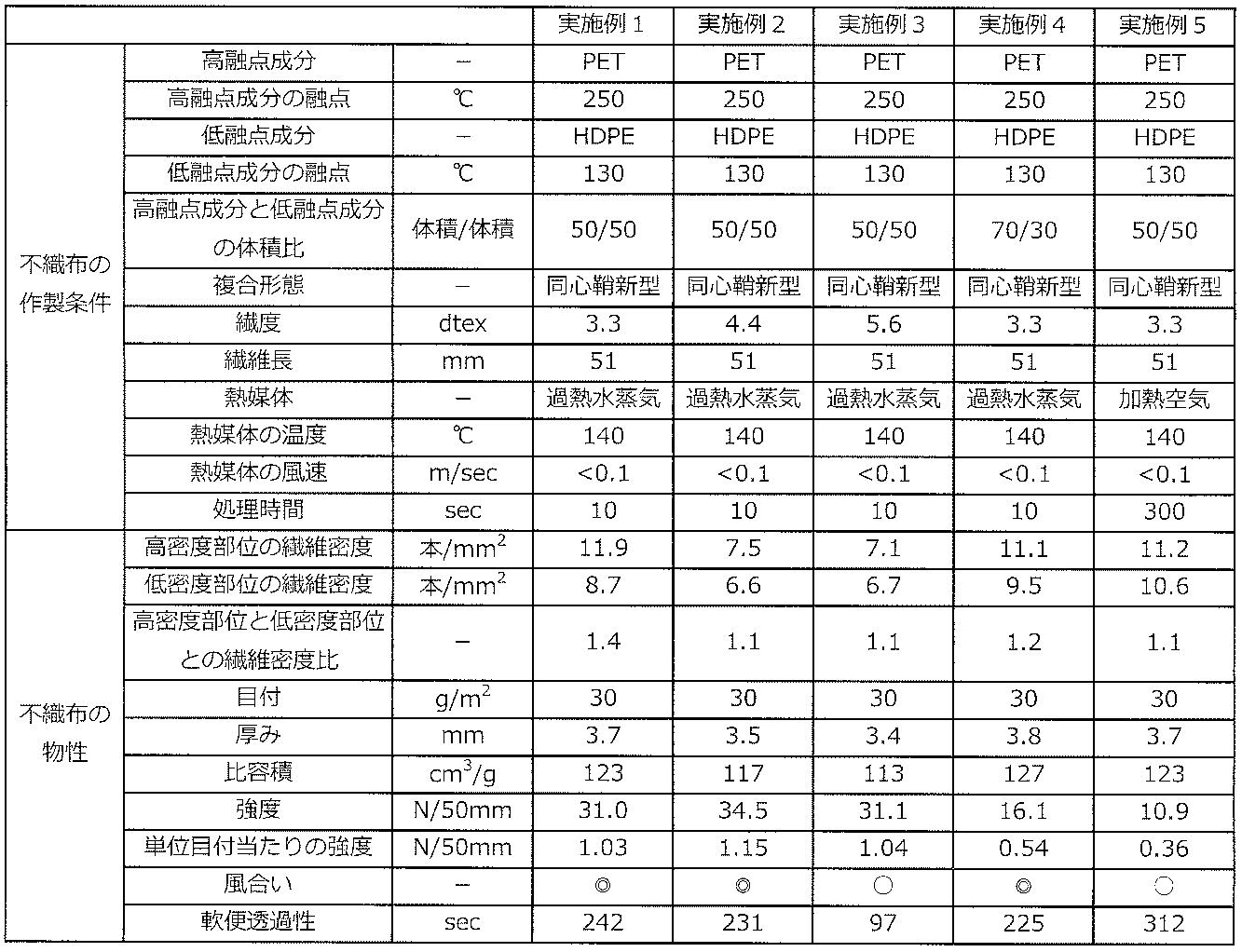
- Example 1 The composite fibers were prepared as concentric sheath-core composite fibers having a fineness of 3.3 dtex and a fiber length of 51 mm, with a core of polyethylene terephthalate (melting point 250° C.) and a sheath of high density polyethylene (melting point 130° C.) in a volume ratio of 50/50.
- a web made of composite fibers was prepared by a carding method, and the web was introduced for 10 seconds into a furnace filled with superheated steam at 140° C. to obtain a nonwoven fabric.
- the wind speed of the superheated steam gas was less than 0.1 m/sec.
- Example 2 The composite fibers were prepared as concentric sheath-core composite fibers having a fineness of 4.4 dtex and a fiber length of 51 mm, with a core of polyethylene terephthalate (melting point 250° C.) and a sheath of high density polyethylene (melting point 130° C.) in a volume ratio of 50/50.
- a web made of composite fibers was prepared by a carding method, and the web was introduced for 10 seconds into a furnace filled with superheated steam at 140° C. to obtain a nonwoven fabric.
- the wind speed of the superheated steam gas was less than 0.1 m/sec.
- Example 3 The composite fibers were prepared as concentric sheath-core composite fibers having a fineness of 5.6 dtex and a fiber length of 51 mm, with a core of polyethylene terephthalate (melting point 250° C.) and a sheath of high density polyethylene (melting point 130° C.) in a volume ratio of 50/50.
- a web made of composite fibers was prepared by a carding method, and the web was introduced for 10 seconds into a furnace filled with superheated steam at 140° C. to obtain a nonwoven fabric.
- the wind speed of the superheated steam gas was less than 0.1 m/sec.
- Example 4 The composite fibers were prepared as concentric sheath-core composite fibers having a fineness of 3.3 dtex and a fiber length of 51 mm, with a core of polyethylene terephthalate (melting point 250° C.) and a sheath of high density polyethylene (melting point 130° C.) in a volume ratio of 60/40.
- a web made of composite fibers was prepared by a carding method, and the web was introduced for 10 seconds into a furnace filled with superheated steam at 140° C. to obtain a nonwoven fabric.
- the wind speed of the superheated steam was less than 0.1 m/sec.
- Example 5 A web was prepared by a carding method using the same composite fiber as in Example 1, and the web was introduced into an oven filled with heated air at 140° C. for 300 seconds to obtain a nonwoven fabric. The velocity of the heated air was less than 0.1 m/sec.
- the composite fibers were prepared as concentric sheath-core composite fibers having a fineness of 2.6 dtex and a fiber length of 51 mm, with a core of polyethylene terephthalate (melting point 250° C.) and a sheath of high density polyethylene (melting point 130° C.) in a volume ratio of 50/50.
- a web made of composite fibers was prepared by a carding method, and the web was introduced for 10 seconds into a furnace filled with superheated steam at 140° C. to obtain a nonwoven fabric.
- the wind speed of the superheated steam was less than 0.1 m/sec.
- the composite fibers were prepared as concentric sheath-core composite fibers having a fineness of 6.5 dtex and a fiber length of 51 mm, with a core of polyethylene terephthalate (melting point 250° C.) and a sheath of high density polyethylene (melting point 130° C.) in a volume ratio of 50/50.
- a web made of composite fibers was prepared by a carding method, and the web was introduced for 10 seconds into a furnace filled with superheated steam at 140° C. to obtain a nonwoven fabric.
- the wind speed of the superheated steam was less than 0.1 m/sec.
- Example 3 A web was prepared by a carding method using the same conjugate fibers as in Example 1, and treated with hot air at 130° C. and a circulating air speed of 1.0 m/sec for 10 seconds in a hot air circulation dryer to obtain a nonwoven fabric.
- Example 4 A web was prepared by a carding method using the same conjugate fibers as in Example 2, and treated with hot air at 130° C. and a circulating air speed of 1.0 m/sec for 10 seconds in a hot air circulation dryer to obtain a nonwoven fabric.
- Example 5 A web was prepared by a carding method using the same conjugate fibers as in Example 3, and treated with hot air at 130° C. and a circulating air speed of 1.0 m/sec for 10 seconds in a hot air circulation dryer to obtain a nonwoven fabric.
- the nonwoven fabric of Example 3 was found to have very excellent soft stool permeability while maintaining a texture at the same level as the conventional one.
- Examples 1 to 3 in which the low-melting point component was 50% by volume, had higher strength per unit basis weight and were extremely less likely to fluff than Example 4, in which the low-melting point component was 40% by volume.
- the nonwoven fabric of Comparative Example 1 in which the fineness of the composite fiber was reduced compared to Examples 1 to 3, had excellent texture but poor soft stool permeability. This is believed to be because the use of composite fibers with a small fineness caused the fiber density of the high-density area to exceed 13.0 fibers/ mm2 , resulting in blockage of soft stool.
- the nonwoven fabric of Comparative Example 2 in which the fineness of the composite fiber was increased compared to Examples 1 to 3, had excellent soft stool permeability but impaired texture.
- Comparative Examples 3 to 5 are nonwoven fabrics obtained using the same composite fibers as Examples 1 to 3 under conditions of high heated air velocity (conventional through-air method), but the fiber density ratio between the high-density area and the low-density area was 1.4 or more, and the fiber density of the high-density area was increased, resulting in blockage of soft stool and impaired texture.
- the nonwoven fabric of the present invention has a simple structure, but is capable of providing a nonwoven fabric that combines texture and soft feces permeability, and is particularly capable of providing a top sheet for absorbent articles.
Landscapes
- Health & Medical Sciences (AREA)
- Engineering & Computer Science (AREA)
- Life Sciences & Earth Sciences (AREA)
- Biomedical Technology (AREA)
- Heart & Thoracic Surgery (AREA)
- Vascular Medicine (AREA)
- Epidemiology (AREA)
- Animal Behavior & Ethology (AREA)
- General Health & Medical Sciences (AREA)
- Public Health (AREA)
- Veterinary Medicine (AREA)
- Textile Engineering (AREA)
- Nonwoven Fabrics (AREA)
Abstract
Description
[1]交点が熱接着されている複合繊維からなる不織布であって、前記複合繊維の繊度が3.0~6.0dtexであり、前記不織布の高密度部位の繊維密度が13.0本/mm2以下であり、前記不織布における高密度部位と低密度部位との繊維密度比が1.4以下である、不織布。
[2]前記高密度部位の繊維密度が5.5~8.0本/mm2である、[1]に記載の不織布。
[3]前記複合繊維の繊度が4.5~6.0dtexである、[1]または[2]に記載の不織布。
[4]前記不織布の単位目付当たりの強度が1.00~1.50N/50mmである、[1]~[3]のいずれかに記載の不織布。
[5][1]~[4]のいずれかに記載の不織布を用いた吸収性物品用表面シート。
[6][1]~[4]のいずれかに記載の吸収性物品。
本発明の不織布に用いられる複合繊維は、熱によって溶融し接着点を形成できるものであれば特に限定されず、同心鞘芯型複合繊維、偏心鞘芯型複合繊維、または並列型複合繊維を例示できる。また、複合繊維の断面形状は、特に限定されず、円や楕円などの丸型、三角や四角などの角型、星型や八葉型などの異型、分割、または中空などのいずれも使用することができる。
本発明の不織布は、交点が熱接着されている複合繊維からなり、複合繊維の繊度が3.0~6.0dtexであり、不織布の高密度部位の繊維密度が13.0本/mm2以下であり、高密度部位と低密度部位との繊維密度比が1.4以下であることを特徴とする。従来のように、熱風を吹き付けることによって複合繊維の交点を熱接着させる方法では、使用する繊維の繊度を大きくすることで、不織布の高密度部位の繊維密度が13.0本/mm2以下を満たすことは可能であったが、そのような不織布は、風合いが損なわれるものであった。また、熱ロールなどで圧密処理する方法では、高密度部位と低密度部位との繊維密度比が1.4以下を満たすことが可能であったが、繊維密度が13.0本/mm2を超えるものとなり、満足できる軟便透過性が得られなかった。これに対して、本発明は、繊度が3.0~6.0dtexの複合繊維の交点を非圧下で熱接着させることによって、不織布の高密度部位の繊維密度が13.0本/mm2以下であり、高密度部位と低密度部位との繊維密度比が1.4以下を同時に満たすことが可能であること、それによって、従来並みの風合いを維持しつつ、軟便透過性を著しく向上させることができることを見出したものである。
本発明の不織布は、特に限定されないが、繊度が3.0~6.0dtexの複合繊維を含有するウェブを形成する工程(以下、ウェブ形成工程と言う場合がある。)と、複合繊維の交点を非圧下で熱接着させる工程(以下、熱接着工程という場合がある)、を含む。この方法によれば、ウェブの形状を維持して、すなわち厚み方向の粗密の少ない状態で、かつ特定の繊維密度となるように繊維の交点を熱接着することができ、風合いと軟便透過性を兼ね備えた不織布を得ることができる。
JIS L 1015に準拠し、複合繊維の繊度を測定した。
(1)観察用サンプル作製方法
不織布サンプルを80℃のオーブンで5分間加熱し、不織布の応力履歴をリセットした。次いで、1cm(不織布の流れ方向;MD方向)×2cm(不織布の幅方向;CD方向)に切断した不織布に、光硬化性樹脂(PADICO製のUV-LEDレジン 星の雫 [ソフト])を十分含浸させ、UV照射することで光硬化性樹脂を硬化させた。次いで、ミクロトーム(Leica製のRM2265)を用い、MD方向の厚さが10μmとなるように硬化させたサンプルを切断し、10μm(MD方向)×2cm(CD方向)の観察用サンプルを得た。
(2)繊維密度の測定
マイクロスコープ(KEYENCE製のVHX-6000)および偏光板を用いて、観察用サンプルのミクロトーム切断面を20~50倍で観察し、切断面を厚み方向に三等分した上下部位において、それぞれ面積当たり繊維本数を測定し(本/mm2)、その値の大きい方を高密度部位の繊維密度、小さい方を低密度部位の繊維密度とした。各繊維密度は、2回測定した時の平均値とした。
上記方法にて得られた高密度部位の繊維密度と低密度部位の繊維密度の値を用いて、以下の式により、高密度部位と低密度部位との繊維密度比を算出した。
高密度部位と低密度部位との繊維密度比=高密度部位の繊維密度(本/mm2)÷低密度部位の繊維密度(本/mm2)
100mm×100mmに切り出した不織布重量を測定し、単位面積あたりに換算した値を不織布の目付(g/m2)とした。目付は、2回測定した時の平均値とした。
レーザー厚み計(KEYENCE製のIL‐S065)を用いて、直径35mmの圧力子(荷重)によって、3.5g/cm2の圧力を掛けたときの厚みを不織布の厚み(mm)とした。厚みは、5か所測定した時の平均値とした。
不織布の目付(g/m2)及び厚み(mm)から、以下の式により、不織布の比容積を算出した。
比容積(cm3/g)=厚み(mm)÷目付(g/m2)×1000
50mm×150mmの大きさで、MD方向に長く切り出したサンプルを、島津製作所製のオートグラフ(AGX-J)を用い、チャック間距離100mm、引張速度100mm/minで引っ張った時の最大強力を不織布の強度とし、これを不織布の目付(g/m2)で除した値を、不織布の単位目付あたりの強度とした。単位目付当たりの強度は、2回測定した時の平均値とした。
パネラー20名に不織布を触ってもらい、以下の基準で点数をつけ、その合計点によって風合いを評価した。
(1)基準
良好:2点
普通:1点
不良:0点
(2)風合い評価
◎:合計点数が31~40点
〇:合計点数が21~30点(従来技術レベル)
△:合計点数が11~20点
×:合計点数が0~10点
底部にメッシュを貼り付けた直径3.5cmの円筒を不織布の高密度側の面の中央部上に置き、以下の方法により調製した人工軟便8.75gを円筒に流し入れた。人工軟便の注入を開始してから、人工軟便がメッシュを通して不織布へ移行して行き、円筒底のメッシュが完全に露出するまでの時間を計測し、その時間を通液時間とした。通液時間は、2回測定したときの平均値とした。通液時間が短いほど、軟便透過性が優れることを意味する。
人工軟便の調製方法
以下の(1)~(7)の成分を混合、撹拌し、さらに粘度が2000cPになるようにイオン交換水で希釈して、人工軟便を調整した。
(1)イオン交換水;71.9重量部
(2)塩化ナトリウム;1.0重量部
(3)グリセリン;15.0重量部
(4)カルボキシメチルセルロースナトリウム;2.0重量部
(5)トリトンX-100;0.05重量部
(6)粉末セルロース;10.0重量部
(7)Acid Blue 9;0.05重量部
複合繊維として、芯にポリエチレンテレフタレート(融点250℃)、鞘に高密度ポリエチレン(融点130℃)を体積比50/50で配した、繊度3.3dtex、繊維長51mmの同心鞘芯型の複合繊維を準備した。
次いで、カード法により、複合繊維からなるウェブを作製し、140℃の過熱水蒸気が充填された炉内に10秒間導入することで不織布を得た。過熱水蒸気ガスの風速は0.1m/sec未満であった。
複合繊維として、芯にポリエチレンテレフタレート(融点250℃)、鞘に高密度ポリエチレン(融点130℃)を体積比50/50で配した、繊度4.4dtex、繊維長51mmの同心鞘芯型の複合繊維を準備した。
次いで、カード法により、複合繊維からなるウェブを作製し、140℃の過熱水蒸気が充填された炉内に10秒間導入することで不織布を得た。過熱水蒸気ガスの風速は0.1m/sec未満であった。
複合繊維として、芯にポリエチレンテレフタレート(融点250℃)、鞘に高密度ポリエチレン(融点130℃)を体積比50/50で配した、繊度5.6dtex、繊維長51mmの同心鞘芯型の複合繊維を準備した。
次いで、カード法により、複合繊維からなるウェブを作製し、140℃の過熱水蒸気が充填された炉内に10秒間導入することで不織布を得た。過熱水蒸気ガスの風速は0.1m/sec未満であった。
複合繊維として、芯にポリエチレンテレフタレート(融点250℃)、鞘に高密度ポリエチレン(融点130℃)を体積比60/40で配した、繊度3.3dtex、繊維長51mmの同心鞘芯型の複合繊維を準備した。
次いで、カード法により、複合繊維からなるウェブを作製し、140℃の過熱水蒸気が充填された炉内に10秒間導入することで不織布を得た。過熱水蒸気の風速は0.1m/sec未満であった。
実施例1と同様の複合繊維を用いて、カード法によりウェブを作製し、140℃の加熱空気が充填された炉内に300秒間導入することで不織布を得た。加熱空気の風速は0.1m/sec未満であった。
複合繊維として、芯にポリエチレンテレフタレート(融点250℃)、鞘に高密度ポリエチレン(融点130℃)を体積比50/50で配した、繊度2.6dtex、繊維長51mmの同心鞘芯型の複合繊維を準備した。
次いで、カード法により、複合繊維からなるウェブを作製し、140℃の過熱水蒸気が充填された炉内に10秒間導入することで不織布を得た。過熱水蒸気の風速は0.1m/sec未満であった。
複合繊維として、芯にポリエチレンテレフタレート(融点250℃)、鞘に高密度ポリエチレン(融点130℃)を体積比50/50で配した、繊度6.5dtex、繊維長51mmの同心鞘芯型の複合繊維を準備した。
次いで、カード法により、複合繊維からなるウェブを作製し、140℃の過熱水蒸気が充填された炉内に10秒間導入することで不織布を得た。過熱水蒸気の風速は0.1m/sec未満であった。
実施例1と同様の複合繊維を用いて、カード法によりウェブを作製し、熱風循環式ドライヤーにて130℃、1.0m/secの循環風速の熱風で10秒間処理することで不織布を得た。
実施例2と同様の複合繊維を用いて、カード法によりウェブを作製し、熱風循環式ドライヤーにて130℃、1.0m/secの循環風速の熱風で10秒間処理することで不織布を得た。
実施例3と同様の複合繊維を用いて、カード法によりウェブを作製し、熱風循環式ドライヤーにて130℃、1.0m/secの循環風速の熱風で10秒間処理することで不織布を得た。
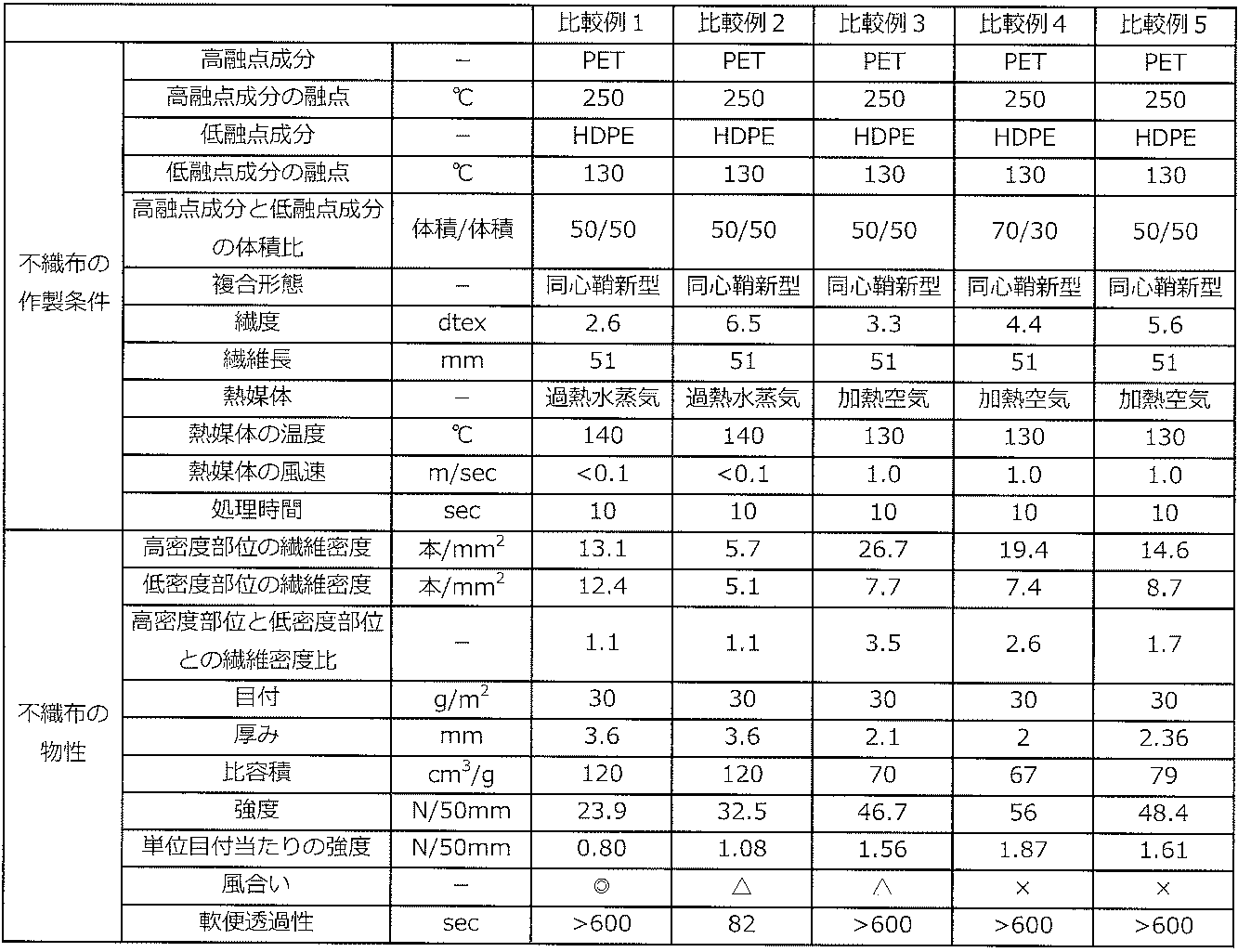
一方、実施例1~3に対して、複合繊維の繊度を小さくした比較例1の不織布は、風合いに優れるものの、軟便透過性に劣るものであった。これは、繊度が小さい複合繊維を使用したことによって、高密度部位の繊維密度が13.0本/mm2を超え、軟便の閉塞が生じたものと考えられる。また、実施例1~3に対して、複合繊維の繊度を大きくした比較例2の不織布は、軟便透過性に優れるものの、風合いが損なわれたものであった。これは、繊度が大きい複合繊維を使用したことによって、肌との摩擦が大きくなったためと考えられる。さらに、比較例3~5は、実施例1~3と同じ複合繊維を使用して、加熱空気の風速が大きい条件(従来のスルーエアー法)で得られた不織布であるが、高密度部位と低密度部位との繊維密度比が1.4以上となり、高密度部位の繊維密度が大きくなって軟便が閉塞したことに加え、風合いも損なわれる結果となった。
Claims (6)
- 交点が熱接着されている複合繊維からなる不織布であって、前記複合繊維の繊度が3.0~6.0dtexであり、前記不織布の高密度部位の繊維密度が13.0本/mm2以下あり、前記不織布における高密度部位と低密度部位との繊維密度比が1.4以下である、不織布。
- 前記高密度部位の繊維密度が5.5~8.0本/mm2である、請求項1に記載の不織布。
- 前記複合繊維の繊度が4.5~6.0dtexである、請求項2に記載の不織布。
- 前記不織布の単位目付当たりの強度が1.00~1.50N/50mmである、請求項3に記載の不織布。
- 請求項1~4のいずれか1項に記載の不織布を用いた吸収性物品用表面シート。
- 請求項1~4のいずれか1項に記載の不織布を用いた吸収性物品。
Priority Applications (2)
| Application Number | Priority Date | Filing Date | Title |
|---|---|---|---|
| CN202380061844.4A CN119768579A (zh) | 2022-10-27 | 2023-07-21 | 无纺布及使用其的吸收性物品用表面片材 |
| JP2024552834A JPWO2024089958A1 (ja) | 2022-10-27 | 2023-07-21 |
Applications Claiming Priority (2)
| Application Number | Priority Date | Filing Date | Title |
|---|---|---|---|
| JP2022-172008 | 2022-10-27 | ||
| JP2022172008 | 2022-10-27 |
Publications (1)
| Publication Number | Publication Date |
|---|---|
| WO2024089958A1 true WO2024089958A1 (ja) | 2024-05-02 |
Family
ID=90830545
Family Applications (1)
| Application Number | Title | Priority Date | Filing Date |
|---|---|---|---|
| PCT/JP2023/026724 Ceased WO2024089958A1 (ja) | 2022-10-27 | 2023-07-21 | 不織布およびこれを用いた吸収性物品用表面シート |
Country Status (3)
| Country | Link |
|---|---|
| JP (1) | JPWO2024089958A1 (ja) |
| CN (1) | CN119768579A (ja) |
| WO (1) | WO2024089958A1 (ja) |
Cited By (3)
| Publication number | Priority date | Publication date | Assignee | Title |
|---|---|---|---|---|
| WO2025121091A1 (ja) * | 2023-12-04 | 2025-06-12 | Jnc株式会社 | 不織布およびそれを用いた吸収性物品用表面シート |
| WO2025215896A1 (ja) * | 2024-04-11 | 2025-10-16 | Jnc株式会社 | 不織布 |
| WO2025248849A1 (ja) * | 2024-05-29 | 2025-12-04 | Jnc株式会社 | 不織布およびその製造方法 |
Citations (6)
| Publication number | Priority date | Publication date | Assignee | Title |
|---|---|---|---|---|
| JP2013124430A (ja) * | 2011-12-15 | 2013-06-24 | Kao Corp | 不織布の製造方法 |
| JP2015212449A (ja) * | 2014-04-18 | 2015-11-26 | ダイワボウホールディングス株式会社 | 吸収性物品用複合短繊維、その製造方法、並びにそれを含む吸収性物品用熱接着不織布、及び吸収性物品 |
| US20190240083A1 (en) * | 2018-02-02 | 2019-08-08 | Sandler Ag | Liquid absorption and distribution nonwoven fabric for hygiene articles |
| JP2021152237A (ja) * | 2020-03-18 | 2021-09-30 | 三洋化成工業株式会社 | 軟便透過性付与剤、繊維、不織布及び吸水性物品 |
| WO2022196527A1 (ja) * | 2021-03-18 | 2022-09-22 | 東レ株式会社 | スパンボンド不織布および積層不織布、これらの製造方法ならびに衛生材料 |
| WO2022202142A1 (ja) * | 2021-03-23 | 2022-09-29 | Jnc株式会社 | 不織布及びその製造方法 |
-
2023
- 2023-07-21 JP JP2024552834A patent/JPWO2024089958A1/ja active Pending
- 2023-07-21 CN CN202380061844.4A patent/CN119768579A/zh active Pending
- 2023-07-21 WO PCT/JP2023/026724 patent/WO2024089958A1/ja not_active Ceased
Patent Citations (6)
| Publication number | Priority date | Publication date | Assignee | Title |
|---|---|---|---|---|
| JP2013124430A (ja) * | 2011-12-15 | 2013-06-24 | Kao Corp | 不織布の製造方法 |
| JP2015212449A (ja) * | 2014-04-18 | 2015-11-26 | ダイワボウホールディングス株式会社 | 吸収性物品用複合短繊維、その製造方法、並びにそれを含む吸収性物品用熱接着不織布、及び吸収性物品 |
| US20190240083A1 (en) * | 2018-02-02 | 2019-08-08 | Sandler Ag | Liquid absorption and distribution nonwoven fabric for hygiene articles |
| JP2021152237A (ja) * | 2020-03-18 | 2021-09-30 | 三洋化成工業株式会社 | 軟便透過性付与剤、繊維、不織布及び吸水性物品 |
| WO2022196527A1 (ja) * | 2021-03-18 | 2022-09-22 | 東レ株式会社 | スパンボンド不織布および積層不織布、これらの製造方法ならびに衛生材料 |
| WO2022202142A1 (ja) * | 2021-03-23 | 2022-09-29 | Jnc株式会社 | 不織布及びその製造方法 |
Cited By (3)
| Publication number | Priority date | Publication date | Assignee | Title |
|---|---|---|---|---|
| WO2025121091A1 (ja) * | 2023-12-04 | 2025-06-12 | Jnc株式会社 | 不織布およびそれを用いた吸収性物品用表面シート |
| WO2025215896A1 (ja) * | 2024-04-11 | 2025-10-16 | Jnc株式会社 | 不織布 |
| WO2025248849A1 (ja) * | 2024-05-29 | 2025-12-04 | Jnc株式会社 | 不織布およびその製造方法 |
Also Published As
| Publication number | Publication date |
|---|---|
| CN119768579A (zh) | 2025-04-04 |
| JPWO2024089958A1 (ja) | 2024-05-02 |
Similar Documents
| Publication | Publication Date | Title |
|---|---|---|
| JP7080251B2 (ja) | エアレイド複合シート材料 | |
| JP6633783B2 (ja) | 伸張性不織布 | |
| JP2008542570A (ja) | 被成形繊維の布地 | |
| ES2935200T3 (es) | Fibras discontinuas o cortas de bicomponente trilobulares y sus usos | |
| CN110268113B (zh) | 液压处理的非织造织物及其制造方法 | |
| US10767296B2 (en) | Multi-denier hydraulically treated nonwoven fabrics and method of making the same | |
| JP6607609B2 (ja) | 極細繊維不織布 | |
| WO2022202142A1 (ja) | 不織布及びその製造方法 | |
| CN105358111A (zh) | 非织造织物及形成其的方法 | |
| CN119768579A (zh) | 无纺布及使用其的吸收性物品用表面片材 | |
| JP2026053420A (ja) | 衛生物品 | |
| CZ2016612A3 (cs) | Spunbondová netkaná textilie pro akvizičně distribuční vrstvu a absorpční výrobek | |
| CN113710289A (zh) | 具有三维热熔融粘结的层合体的吸收制品 | |
| JP2019080907A (ja) | 吸収性物品 | |
| TW201732107A (zh) | 親水性蓬鬆不織布 | |
| JP4605653B2 (ja) | 表面材およびそれを用いた吸収性物品 | |
| JP5067808B2 (ja) | 有孔不織布シートおよびその製造方法 | |
| KR20230169896A (ko) | 3d 엠보싱을 갖는 셀룰로오스 부직포 라미네이트 | |
| US20190240083A1 (en) | Liquid absorption and distribution nonwoven fabric for hygiene articles | |
| JP7538038B2 (ja) | 吸収性物品用不織布、その製造方法、吸収性物品用表面シート、及び吸収性物品 | |
| JP7131735B1 (ja) | 不織布及びその製造方法 | |
| JP2023110380A (ja) | 吸収性物品用不織布およびその製造方法、ならびに吸収性物品 | |
| WO2025215896A1 (ja) | 不織布 | |
| WO2025109833A1 (ja) | 不織布 | |
| WO2025248849A1 (ja) | 不織布およびその製造方法 |
Legal Events
| Date | Code | Title | Description |
|---|---|---|---|
| 121 | Ep: the epo has been informed by wipo that ep was designated in this application |
Ref document number: 23882175 Country of ref document: EP Kind code of ref document: A1 |
|
| WWE | Wipo information: entry into national phase |
Ref document number: 2024552834 Country of ref document: JP |
|
| WWE | Wipo information: entry into national phase |
Ref document number: 202380061844.4 Country of ref document: CN |
|
| WWP | Wipo information: published in national office |
Ref document number: 202380061844.4 Country of ref document: CN |
|
| WWE | Wipo information: entry into national phase |
Ref document number: 2501002674 Country of ref document: TH |
|
| NENP | Non-entry into the national phase |
Ref country code: DE |
|
| 122 | Ep: pct application non-entry in european phase |
Ref document number: 23882175 Country of ref document: EP Kind code of ref document: A1 |