WO2024084597A1 - 情報処理装置、情報処理制御方法及び記録媒体 - Google Patents
情報処理装置、情報処理制御方法及び記録媒体 Download PDFInfo
- Publication number
- WO2024084597A1 WO2024084597A1 PCT/JP2022/038818 JP2022038818W WO2024084597A1 WO 2024084597 A1 WO2024084597 A1 WO 2024084597A1 JP 2022038818 W JP2022038818 W JP 2022038818W WO 2024084597 A1 WO2024084597 A1 WO 2024084597A1
- Authority
- WO
- WIPO (PCT)
- Prior art keywords
- terminal device
- passenger
- face
- authentication
- image
- Prior art date
- Legal status (The legal status is an assumption and is not a legal conclusion. Google has not performed a legal analysis and makes no representation as to the accuracy of the status listed.)
- Ceased
Links
Images






Classifications
-
- G—PHYSICS
- G07—CHECKING-DEVICES
- G07C—TIME OR ATTENDANCE REGISTERS; REGISTERING OR INDICATING THE WORKING OF MACHINES; GENERATING RANDOM NUMBERS; VOTING OR LOTTERY APPARATUS; ARRANGEMENTS, SYSTEMS OR APPARATUS FOR CHECKING NOT PROVIDED FOR ELSEWHERE
- G07C9/00—Individual registration on entry or exit
- G07C9/30—Individual registration on entry or exit not involving the use of a pass
- G07C9/32—Individual registration on entry or exit not involving the use of a pass in combination with an identity check
- G07C9/37—Individual registration on entry or exit not involving the use of a pass in combination with an identity check using biometric data, e.g. fingerprints, iris scans or voice recognition
Definitions
- This disclosure relates to the technical fields of information processing devices, information processing methods, and recording media.
- Patent Document 1 For example, a device has been proposed that, based on the results of comparing a face image acquired from a user with multiple registered face images registered in a database, guides the user to a face recognition lane where identity verification is performed by face recognition, or a face-to-face lane where identity verification is performed by face-to-face contact (see Patent Document 1).
- the objective of this disclosure is to provide an information processing device, an information processing method, and a recording medium that aim to improve upon the technology described in prior art documents.
- One aspect of the information processing device includes an image acquisition means for acquiring a first image including a predetermined area through which multiple subjects pass, an information acquisition means for acquiring the position of a terminal device carried by a user, and a determination means for determining a priority for notifying multiple authentication results of face authentication performed using the first image based on the position of the terminal device and the positions of the multiple subjects detected based on the first image.
- One aspect of the information processing method involves acquiring a first image including a predetermined area through which multiple subjects pass, acquiring the position of a terminal device carried by a user, and determining a priority for notifying multiple authentication results of face authentication performed using the first image based on the position of the terminal device and the positions of the multiple subjects detected based on the first image.
- a computer program is recorded to cause a computer to execute an information processing method that acquires a first image including a predetermined area through which multiple subjects pass, acquires the position of a terminal device carried by a user, and determines the priority of notifying multiple authentication results of face authentication performed using the first image based on the position of the terminal device and the positions of the multiple subjects detected based on the first image.
- FIG. 1 is a block diagram showing an example of a configuration of an information processing device.
- FIG. 1 is a block diagram showing an example of a configuration of an airport system.
- FIG. 1 is a plan view showing an example of a floor where boarding gates of an airport are provided.
- FIG. 11 is a plan view showing an example of a virtual authentication area.
- FIG. 13 is a block diagram showing another example of the configuration of the information processing device.
- FIG. 2 is a diagram illustrating an example of a face database included in the information processing device.
- FIG. 13 is a diagram for explaining passenger tracking processing.
- FIG. 13 is a diagram illustrating an example of an ID correspondence table.
- FIG. 10 is a flowchart showing a determination operation according to the second embodiment.
- FIG. 13 is a diagram illustrating an example of a screen displayed on a terminal device.
- FIG. 2 is a block diagram showing an example of a configuration of an authentication device.
- FIG. 11 is a diagram showing another example of a screen displayed on the terminal device.
- FIG. 11 is a diagram showing another example of a screen displayed on the terminal device.
- FIG. 11 is a diagram showing another example of a screen displayed on the terminal device.
- FIG. 11 is a diagram showing another example of a screen displayed on the terminal device.
- FIG. 11 is a diagram showing another example of a screen displayed on the terminal device.
- FIG. 2 is a block diagram showing an example of the configuration of a terminal device.
- This section describes embodiments of an information processing device, an information processing method, and a recording medium.
- the information processing device 1 includes an image acquisition unit 11, an information acquisition unit 12, and a determination unit 13.
- the image acquisition unit 11 acquires an image including a predetermined area.
- the predetermined area is an area through which multiple subjects pass. Therefore, the image acquired by the image acquisition unit 11 may include one or multiple subjects passing through the predetermined area.
- the information acquisition unit 12 acquires the location of the terminal device carried by the user.
- the terminal device is configured to be able to notify the user of at least a portion of the authentication results of the face authentication performed using the image acquired by the image acquisition unit 11.
- the user may be a person different from the multiple subjects to be authenticated.
- the user may be at least one of a guide and a security guard.
- the determination unit 13 determines the priority of notifying the multiple authentication results corresponding to each of the multiple authentication subjects based on the position of the terminal device and the positions of the multiple authentication subjects.
- the multiple authentication results are the authentication results of face recognition performed using an image acquired by the image acquisition unit 11. For example, if the distance between one authentication subject and the terminal device is shorter than the distance between another authentication subject and the terminal device, the determination unit 13 may set the priority of the authentication result of the one authentication subject higher than the priority of the authentication results of the other authentication subjects.
- the terminal device can notify the user (e.g., at least one of the guide and the security guard) of at least a portion of the facial recognition authentication results.
- the terminal device may display at least a portion of the facial recognition authentication results based on priority. For example, the terminal device may display authentication results with a higher priority at the top of the screen than authentication results with a lower priority. That is, the terminal device may determine (or change) the display order of the authentication results based on priority. That is, the terminal device may change the display content based on priority.
- a user is often located near a terminal device. For this reason, the location of the terminal device can be interpreted as the location of the user. However, it is difficult for a user to deal with all of the multiple subjects to be authenticated.
- the priority of the authentication results is determined based on the terminal device location and the location of the subjects to be authenticated, and the display content of the terminal device is changed based on the priority, thereby reducing the number of subjects to be authenticated that the user must deal with.
- the priority of the authentication result is determined based on the position of the terminal device and the positions of multiple authenticated people (for example, the priority of an authenticated person closer to the terminal device is higher than the priority of an authenticated person far from the terminal device), so it is expected that the user will be able to deal with authenticated people efficiently.
- the facial recognition gate device may allow people whose facial recognition has been successful to pass through, but may not allow people whose facial recognition has been unsuccessful to pass through.
- the facial recognition gate device may determine that facial recognition has been successful when the face of the person attempting to pass through the facial recognition gate device corresponds to a face shown in a pre-registered facial image.
- the facial recognition gate device may determine that facial recognition has been successful when the person attempting to pass through the facial recognition gate device is present among the people whose facial images have been pre-registered.
- the facial recognition gate device will not allow that person to pass through (for example, if the facial recognition gate device is a flap-type gate device, the flap will be in a closed state). For this reason, when a person whose facial image has not been registered enters a facial recognition gate device, the flow of people passing through the facial recognition gate device is impeded because that person will not be allowed to pass through. In other words, the throughput of the facial recognition gate device will decrease.
- the result of face authentication performed using an image acquired by the image acquisition unit 11 may indicate whether or not the person to be authenticated can pass through the face recognition gate device.
- the determination unit 13 may determine the priority of the authentication results based on the position of the terminal device and the positions of multiple people to be authenticated, so that the authentication results indicating that the person cannot pass through the face recognition gate device are notified to the user with priority.
- the user e.g., at least one of the guide and the security guard
- the information processing device 1 can prevent a decrease in the throughput of the facial recognition gate device.
- the image acquisition unit 11 may acquire an image including a predetermined area through which multiple subjects pass.
- the information acquisition unit 12 may acquire the position of a terminal device carried by a user.
- the determination unit 13 may determine the priority of multiple authentication results of face authentication performed using an image, based on the position of the terminal device and the positions of multiple subjects detected based on the image.
- Such an information processing device 1 may be realized, for example, by a computer reading a computer program recorded on a recording medium.
- the recording medium records a computer program for causing a computer to execute an information processing method that acquires an image including a predetermined area through which multiple subjects pass, acquires the position of a terminal device carried by the user, and determines the priority of notifying multiple authentication results of face authentication performed using the image based on the position of the terminal device and the positions of the multiple subjects detected based on the image.
- Second Embodiment A second embodiment of the display control device, the display control method, and the recording medium will be described with reference to Fig. 2 to Fig. 12. In the following, the second embodiment of the information processing device, the information processing method, and the recording medium will be described using an information processing device 3 used in an airport.
- the airport system 2 of the airport will be described with reference to FIG. 2.
- the airport system 2 comprises a management server 21, a check-in terminal 22, and a plurality of gate devices installed at the boarding gates.
- the management server 21, the check-in terminal 22, and the plurality of gate devices are connected to each other via a network NW.
- the airport system 2 may include other check-in terminals in addition to the check-in terminal 22.
- the airport system 2 may include multiple check-in terminals.
- the network NW may be a wide area network (WAN) such as the Internet, or a local area network (LAN).
- WAN wide area network
- LAN local area network
- the multiple gate devices have a facial recognition function that performs facial recognition processing, and include a facial recognition gate device 23 that determines whether or not a passenger can pass based on the results of the facial recognition processing, and a gate device 24 that determines whether or not a passenger can pass based on the airline ticket held by the passenger.
- Gate device 24 will hereinafter be referred to as "normal gate device 24" as appropriate.
- the airport is provided with boarding gates G1, G2, and G3.
- the facial recognition gate device 23 and normal gate device 24 are provided at boarding gate G1.
- air ticket may mean at least one of a paper airline ticket and an electronic airline ticket.
- air ticket may also be a concept that includes something that indicates personal information associated with an electronic airline ticket (e.g., a passport, a credit card used to purchase the airline ticket, etc.).
- the management server 21 has a face database 211 (hereinafter referred to as “face DB 211”), an operation database 212 (hereinafter referred to as “operation DB 212”), and a gate database 213 (hereinafter referred to as “gate DB 213").
- Facial images used in facial recognition processing are registered in face DB211.
- features related to facial images may be registered in face DB211.
- Flight information (so-called flight information) of aircraft is registered in operation DB212. Flight information may include the flight name of the aircraft, gate identification information for identifying the boarding gate (e.g., boarding gate number), and boarding start time. Note that the flight name, identification information, and boarding start time of the aircraft may be associated with each other.
- Gate DB213 has registered therein a plurality of pieces of boarding gate information corresponding to a plurality of boarding gates.
- the person who manages and/or operates airport system 2 may be different from the airport company that manages and operates the airport and the airline that operates the aircraft.
- the plurality of pieces of boarding gate information registered in gate DB213 may be obtained from a system related to at least one of the airport company and the airline.
- Gate DB213 may be shared between airport system 2 and a system related to at least one of the airport company and the airline.
- the boarding gate information may include gate identification information (e.g., boarding gate number) for identifying the boarding gate and device information related to the installed gate device.
- the device information may be information indicating at least one of the number of gate devices, the type, operating status, and installation location of each gate device.
- the type of gate device may include a first type capable of face authentication and a second type not capable of face authentication.
- the second type of gate device may include a gate device capable of reading information (e.g., ID) for identifying a passenger (e.g., a two-dimensional barcode, etc.).
- the operating status of the gate device may include an operating state in which the gate device is operating and an inactive state in which the gate device is inactive (i.e., not operating).
- the installation location of the gate device may be expressed as the relative positional relationship of the two or more gate devices.
- the installation location of the gate device may be expressed as the coordinates of each gate device in a coordinate system related to the floor (so-called departure floor) on which the boarding gates of the airport are installed. If only one gate device is installed at one boarding gate, the device information does not need to include the installation location of the gate device.
- the resting state may include a state in which no power is supplied to the gate device (e.g., power OFF state) and a state in which power is supplied to part of the gate device but the gate device cannot perform its function (so-called standby state).
- the multiple boarding gate information registered in the gate DB 213 may be determined in advance according to at least one of the airline and the flight of the aircraft.
- the multiple boarding gate information registered in the gate DB 213 may be automatically updated according to the departure time of the aircraft, etc.
- the check-in terminal 22 is a terminal used for boarding procedures (i.e., check-in).
- the check-in terminal 22 may be operated by airport staff or by passengers (i.e., the check-in terminal 22 may be a so-called automatic check-in machine).
- "airport staff" is not limited to people who belong to the airport company that manages and operates the airport, but also includes people who work at the airport, such as people who belong to the airlines that operate aircraft.
- the check-in terminal 22 performs check-in procedures for passengers based on the airline tickets held by the passengers.
- the check-in terminal 22 may acquire facial images of passengers during check-in procedures.
- the check-in terminal 22 may acquire facial images of passengers by capturing images of the passengers with a camera, or may acquire facial images of passengers by reading facial photographs printed on the passports held by the passengers. Note that the check-in terminal 22 does not have to acquire facial images of all passengers.
- the check-in terminal 22 transmits passenger information (e.g., name and flight number) of a passenger who has completed boarding procedures and a facial image of the passenger to the management server 21.
- the check-in terminal 22 may obtain the passenger information from information printed on the airline ticket (in other words, information associated with the airline ticket).
- the management server 21 registers the passenger information and facial image sent from the check-in terminal 22 in the face DB 211 in association with each other. At this time, the management server 21 may assign passenger identification information for identifying the passenger to the passenger information and facial image. As described below, the facial image is used in facial recognition processing. For this reason, the passenger identification information assigned to the passenger information and facial image will hereinafter be referred to as an "authentication ID" as appropriate.
- the passenger's facial image may be acquired by an application (e.g., an application provided by an airline) installed on a terminal device (e.g., a smartphone) carried by the passenger in addition to or instead of the check-in terminal 22, or may be acquired by a gate device installed in the immigration area of the airport.
- the management server 21 may identify, based on the current time, from the flight information registered in the flight DB 212, the flight name of an aircraft that is a first predetermined time (e.g., several minutes to several tens of minutes) before the boarding start time. Based on the gate identification information associated with the identified flight name, the management server 21 may extract gate information corresponding to the gate identification information from multiple gate information registered in the gate DB 213. Based on the extracted gate information, the management server 21 may determine whether or not a facial recognition gate device (e.g., facial recognition gate device 23) is installed at the boarding gate corresponding to the extracted gate information.
- a facial recognition gate device e.g., facial recognition gate device 23
- the management server 21 may extract from the face DB 211 a facial image of a passenger associated with passenger information including the specified flight name (in other words, scheduled to board an aircraft with the specified flight name). The management server 21 may transmit the extracted facial image to a facial recognition gate device (e.g., facial recognition gate device 23) specified by the extracted gate information. If it is determined that a facial recognition gate device is not installed, the management server 21 may not perform these processes. If it is determined that a facial recognition gate device is installed, the management server 21 may determine whether the installed facial recognition gate device is in operation based on the extracted gate information. If features related to a facial image are registered in the face DB 211, the management server 21 may transmit the features related to the facial image to the facial recognition gate device instead of or in addition to the facial image.
- a facial recognition gate device e.g., facial recognition gate device 23
- the facial recognition gate device 23 has a camera 231, a face database 232 (hereinafter referred to as "face DB 232"), and a facial recognition unit 233. Face images transmitted from the management server 21 are registered in the face DB 232.
- the facial recognition gate device 23 may have a display device 234.
- the display device 234 may display at least one of an image captured by the camera 231 and information indicating the results of the facial recognition process.
- the facial recognition unit 233 performs facial recognition processing using an image captured by the camera 231 (e.g., an image that includes the passenger's face) and a facial image registered in the face DB 232. If facial recognition is successful, the facial recognition gate device 23 allows the passenger to pass. On the other hand, if facial recognition is unsuccessful, the facial recognition gate device 23 does not allow the passenger to pass. Note that various existing methods (e.g., at least one of a two-dimensional (2D) authentication method and a three-dimensional (3D) authentication method) can be applied to the facial recognition processing.
- 2D two-dimensional
- 3D three-dimensional
- the face recognition gate device 23 may be a flap-type gate device.
- the face recognition device 233 may extract features of an image captured by the camera 231.
- the face recognition device 233 may compare the extracted features with features related to face images registered in the face DB 232. At this time, the face recognition device 233 may calculate a matching score (or a similarity score) based on the extracted features and features related to face images registered in the face DB 232. If the matching score is equal to or greater than a threshold (i.e., if face recognition is successful), the face recognition device 233 may allow the passenger to pass through. At this time, the face recognition device 233 may identify an authentication ID related to the passenger.
- the face recognition gate device 23 may open the flap. If the matching score is less than a threshold (i.e., if face recognition is unsuccessful), the face recognition device 233 may not allow the passenger to pass through. In this case, the face recognition gate device 23 may close the flap. Note that the face DB 232 may register features related to the face image instead of or in addition to the face image.
- the facial recognition device 233 of the facial recognition gate device 23 may extract features of the image captured by the camera 231.
- the facial recognition device 233 may transmit the extracted features to the other device.
- the other device may compare the features transmitted from the facial recognition device 233 with features related to a facial image registered in a face database (e.g., the face DB 211).
- the other device may transmit information indicating the matching result (e.g., information indicating whether the matching score is equal to or greater than a threshold) to the facial recognition gate device 23.
- the other device may include an authentication ID related to the passenger in the information indicating the matching result. If the information indicating the matching result indicates that the matching score is equal to or greater than the threshold, the facial recognition device 233 may allow the passenger to pass. If the information indicating the matching result indicates that the matching score is less than the threshold, the facial recognition device 233 may not allow the passenger to pass.
- the facial recognition gate device 23 is expected to enable passengers to pass through at a faster rate than the normal gate device 24. In other words, the number of passengers passing through the facial recognition gate device 23 in a given period of time is expected to be greater than the number of passengers passing through the normal gate device 24. In other words, the facial recognition gate device 23 can improve throughput at the boarding gate.
- the facial recognition gate device 23 only passengers whose faces have been successfully authenticated can pass through the facial recognition gate device 23.
- the passenger's facial image must be registered in the face DB 232 of the facial recognition gate device 23. If a passenger whose facial image is not registered in the face DB 232 enters the facial recognition gate device 23, the throughput at the boarding gate will decrease because the passenger will not be allowed to pass through.
- the information processing device 3 determines whether or not a passenger can pass through the facial recognition gate device 23 before the passenger enters the facial recognition gate device 23. In other words, the information processing device 3 determines whether or not a passenger can pass through the facial recognition gate device 23 separately from the facial recognition gate device 23.
- a virtual authentication area RA is provided around boarding gate G1 where face recognition gate device 23 and normal gate device 24 are installed.
- the authentication area RA is an area through which multiple passengers heading to either face recognition gate device 23 or normal gate device 24 pass.
- the authentication area RA corresponds to an example of the "predetermined area" in the first embodiment described above.
- airport staff e.g., at least one of a guide and a security guard
- A1 and A2 are located around the boarding gate G1.
- Staff A1 possesses a terminal device 41.
- Staff A2 possesses a terminal device 42.
- the terminal devices 41 and 42 are connected to the information processing device 3 via the network NW.
- “possession” is not limited to the meaning of "wearing”. For example, even if staff A1 has the terminal device 41 away from his/her body, if he/she has substantial control over the terminal device 41, it may be interpreted that staff A1 possesses the terminal device 41.
- the terminal devices 41 and 42 may be configured as any one of a tablet terminal, a smartphone, and AR (Augmented Reality) glasses.
- terminal devices 41 and 42 may constitute a part of the airport system 2.
- the airport system 2 may be equipped with at least one of the terminal devices 41 and 42.
- terminal devices 41 and 42 there may be other terminal devices.
- the camera CAM is installed so that it can capture the authentication area RA.
- the camera CAM may be connected to the information processing device 3 via the network NW.
- the camera CAM does not have to be installed so that the entire authentication area RA is included within its viewing angle. In other words, the camera CAM may be installed so that it can capture at least a part of the authentication area RA.
- the camera CAM may be installed in a position that does not interfere with the passage of passengers (for example, a position higher than the passenger's head). As described later, the image captured by the camera CAM may be used for face recognition processing. For this reason, the camera CAM may be a high-resolution camera such as a 4K resolution camera.
- the camera CAM does not have to be connected to the information processing device 3 via the network NW. In this case, the camera CAM may be connected to the information processing device 3 via a cable (for example, a USB (Universal Serial Bus) cable).
- a cable for example, a USB (Universal Serial Bus) cable
- the camera CAM may capture an image of the authentication area RA to generate a first image that includes the authentication area RA.
- the first image may be an image that corresponds to one frame of a video.
- the information processing device 3 performs face recognition processing using a first image generated by the camera CAM capturing an image of the recognition area RA, and determines whether or not a passenger included in the first image is able to pass through the face recognition gate device 23 before the passenger enters the face recognition gate device 23.
- the information processing device 3 will be described in detail below.
- the information processing device 3 includes a calculation device 31, a storage device 32, and a communication device 33.
- the information processing device 3 may include an input device 34 and an output device 35.
- the information processing device 3 may include a face database 36 (hereinafter, referred to as "face DB 36").
- face DB 36 a face database 36
- the information processing device 3 may not include at least one of the input device 34 and the output device 35.
- the calculation device 31, the storage device 32, the communication device 33, the input device 34, the output device 35, and the face DB 36 may be connected via a data bus 37.
- the information processing device 3 is connected to the management server 21 via the communication device 33 and the network NW.
- the information processing device 3 may constitute a part of the airport system 2. In other words, the airport system 2 may include the information processing device 3.
- the computing device 31 may include, for example, at least one of a CPU (Central Processing Unit), a GPU (Graphics Processing Unit), an FPGA (Field Programmable Gate Array), a TPU (Tensor Processing Unit), and a quantum processor.
- a CPU Central Processing Unit
- GPU Graphics Processing Unit
- FPGA Field Programmable Gate Array
- TPU Torsor Processing Unit
- quantum processor a quantum processor
- the storage device 32 may include, for example, at least one of a RAM (Random Access Memory), a ROM (Read Only Memory), a hard disk device, a magneto-optical disk device, a Solid State Drive (SSD), and an optical disk array.
- the storage device 32 may include a non-transient recording medium.
- the storage device 32 is capable of storing desired data.
- the storage device 32 may temporarily store a computer program executed by the arithmetic device 31.
- the storage device 32 may temporarily store data that is temporarily used by the arithmetic device 31 when the arithmetic device 31 is executing a computer program.
- the communication device 33 is capable of communicating with the management server 21 via the network NW.
- the communication device 33 may also be capable of communicating with devices external to the information processing device 3 other than the management server 21 via the network NW.
- the communication device 33 may perform wired communication or wireless communication.
- the input device 34 is a device capable of accepting information input to the information processing device 3 from the outside. It may include an operating device (e.g., a keyboard, a mouse, a touch panel, etc.) that can be operated by an operator of the information processing device 3.
- the input device 34 may include a recording medium reading device that can read information recorded on a recording medium that is detachable from the information processing device 3, such as a USB memory. Note that when information is input to the information processing device 3 via the communication device 33 (in other words, when the display control device 2 obtains information via the communication device 33), the communication device 33 may function as an input device.
- the output device 35 is a device capable of outputting information to the outside of the information processing device 3.
- the output device 35 may output visual information such as characters and images, auditory information such as sound, or tactile information such as vibration, as the above information.
- the output device 35 may include at least one of a display, a speaker, a printer, and a vibration motor, for example.
- the output device 35 may be capable of outputting information to a recording medium that is detachable from the information processing device 3, such as a USB memory. Note that when the information processing device 3 outputs information via the communication device 33, the communication device 33 may function as an output device.
- the arithmetic device 31 may have the image acquisition unit 311, the information acquisition unit 312, the tracking unit 313, the face authentication unit 314, and the determination unit 315 as logically realized functional blocks or as physically realized processing circuits. At least one of the image acquisition unit 311, the information acquisition unit 312, the setting unit 313, the tracking unit 313, the face authentication unit 314, and the determination unit 315 may be realized in a form in which a logical functional block and a physical processing circuit (i.e., hardware) are mixed.
- a logical functional block and a physical processing circuit i.e., hardware
- the image acquisition unit 311, the information acquisition unit 312, the setting unit 313, the tracking unit 313, the face authentication unit 314, and the determination unit 315 are functional blocks, at least a part of the image acquisition unit 311, the information acquisition unit 312, the setting unit 313, the tracking unit 313, the face authentication unit 314, and the determination unit 315 may be realized by the arithmetic device 31 executing a predetermined computer program.
- the arithmetic device 31 may obtain (in other words, read) the above-mentioned specific computer program from the storage device 32.
- the arithmetic device 31 may read the above-mentioned specific computer program stored in a computer-readable and non-transient recording medium using a recording medium reading device (not shown) provided in the information processing device 3.
- the arithmetic device 31 may obtain (in other words, download or read) the above-mentioned specific computer program from a device (not shown) external to the information processing device 3 via the communication device 33.
- the recording medium for recording the above-mentioned specific computer program executed by the arithmetic device 31 may be at least one of an optical disk, a magnetic medium, a magneto-optical disk, a semiconductor memory, and any other medium capable of storing a program.
- the management server 21 transmits at least a part of the facial image registered in the face DB 211 together with the authentication ID (i.e., passenger identification information) assigned to the facial image to the information processing device 3.
- the management server 21 may transmit gate identification information and boarding start time in addition to the facial image to the information processing device 3.
- the management server 21 may identify the gate identification information and boarding start time based on the flight name of the aircraft included in the passenger information associated with the facial image registered in the face DB 211 and the operation information registered in the operation DB 212. In other words, the management server 21 may identify the gate identification information and boarding start time related to the aircraft on which the passenger indicated by the facial image will board. Note that, if feature amounts related to the facial image are registered in the face DB 211 instead of or in addition to the facial image, the management server 21 may transmit the feature amounts related to the facial image instead of or in addition to the facial image to the information processing device 3.
- the information processing device 3 registers the facial image transmitted from the management server 21 in the face DB 36.
- the information processing device 3 may register gate identification information and boarding start time in the face DB 36 in addition to the facial image.
- the face DB 36 may include (i) a plurality of facial images and (ii) a table that associates an authentication ID, gate identification information (e.g., boarding gate number), boarding start time, and facial image with each other.
- the management server 21 may transmit at least a part of the facial images registered in the face DB 211 to the information processing device 3 at a predetermined period.
- the information processing device 3 may update the facial images registered in the face DB 36 every time a facial image is transmitted from the management server 21.
- the management server 21 transmits a feature amount related to the facial image to the information processing device 3 instead of or in addition to the facial image
- the feature amount related to the facial image may be registered in the face DB 36 instead of or in addition to the facial image.
- the image acquisition unit 311 of the calculation device 31 may acquire one or more first images generated by the camera CAM via the communication device 33.
- the image acquisition unit 311 may store the acquired one or more first images in the storage device 32.
- the information acquisition unit 312 of the calculation device 31 acquires boarding gate information related to boarding gate G1 from the gate DB 213 of the management server 21 via the communication device 33.
- the information acquisition unit 312 may store the acquired boarding gate information in the storage device 32.
- the information acquisition unit 312 of the computing device 31 acquires terminal position information indicating the positions of each of the terminal devices 41 and 42.
- the information acquisition unit 312 may acquire the terminal position information from each of the terminal devices 41 and 42.
- the position of the terminal device 41 may be detected by the position information function of the terminal device 41.
- the position of the terminal device 42 may be detected by the position information function of the terminal device 42.
- the tracking unit 313 of the calculation device 31 uses the multiple first images acquired by the image acquisition unit 311 (i.e., the multiple first images generated by the camera CAM) to track one or more passengers passing through the authentication area RA.
- the face recognition unit 314 of the calculation device 31 uses the multiple first images acquired by the image acquisition unit 311 to perform face recognition processing of one or more passengers passing through the authentication area RA.
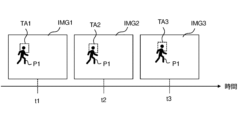
- the tracking unit 313 performs tracking processing of passenger P1 passing through the authentication area RA shown in FIG. 4 and the face authentication unit 314 performs face authentication processing of passenger P1 will be described with reference to FIG. 7.
- passenger P1 is also the subject of the face authentication processing, and may therefore be referred to as the person to be authenticated.
- Images IMG1, IMG2, and IMG3 shown in FIG. 7 are images that include passenger P1 (in other words, images in which passenger P1 is captured).
- Image IMG1 is an image generated by camera CAM capturing an image of authentication area RA at time t1.
- Image IMG2 is an image generated by camera CAM capturing an image of authentication area RA at time t2, which is later than time t1.
- Image IMG3 is an image generated by camera CAM capturing an image of authentication area RA at time t3, which is later than time t2.
- Each of images IMG1, IMG2, and IMG3 may be an image corresponding to one frame of a video.
- image IMG2 does not have to be an image corresponding to the frame immediately following the frame corresponding to image IMG1.
- image IMG2 may be an image corresponding to a frame that is two or more frames later than the frame corresponding to image IMG1.
- image IMG3 does not have to be an image corresponding to the frame immediately following the frame corresponding to image IMG2.
- image IMG3 may be an image corresponding to a frame that is two or more frames later than the frame corresponding to image IMG2.
- the tracking unit 313 detects the head of passenger P1 contained in image IMG1 from image IMG1. Note that existing technology is applied to the method of detecting a person's head from an image, so a detailed explanation is omitted. Based on the detected head of passenger P1, the tracking unit 313 sets the area including the head of passenger P1 as a tracking area TA1.
- the tracking unit 313 sets the tracking area TA1, it sets a tracking ID, which is identification information for identifying the passenger P1 related to the tracking area TA1, to the passenger P1.
- the tracking unit 313 calculates the position of the passenger P1 based on the tracking area TA1. Note that since existing technology can be applied to a method for calculating the position of a subject contained in an image from the image, a detailed explanation is omitted.
- the tracking unit 313 may register the tracking ID and the position of the passenger P1 in an ID correspondence table 321 stored in the storage device 32 in correspondence with each other.
- the tracking unit 313 may determine whether or not the face of passenger P1 is reflected in the tracking area TA1. In other words, the tracking unit 313 may perform face detection on the tracking area TA1. When it is determined that the face of passenger P1 is reflected in the tracking area TA1, the tracking unit 313 generates a face image including the face area of passenger P1. The tracking unit 313 associates the generated face image with the tracking ID related to passenger P1 and transmits it to the face authentication unit 314. Note that when it is determined that the face of passenger P1 is not reflected in the tracking area TA1, the tracking unit 313 does not need to generate a face image.
- the face authentication unit 314 performs face authentication processing using the face image transmitted from the tracking unit 313 and the face image registered in the face DB 36.
- the face authentication unit 314 may extract features of the face image transmitted from the tracking unit 313.
- the face authentication unit 314 may compare the features of the face image transmitted from the tracking unit 313 with features related to the face image registered in the face DB 36.
- the face authentication unit 314 may calculate a matching score (or a similarity score) based on the extracted features and the features related to the face image registered in the face DB 36.
- the face authentication unit 314 may compare the matching score with a threshold value.
- the face authentication unit 314 may determine that the face indicated by the face image transmitted from the tracking unit 313 corresponds to the face indicated by one of the face images registered in the face DB 36. If the matching score is less than the threshold value, it may be determined that a face image showing a face corresponding to the face shown in the face image sent from the tracking unit 313 is not registered in the face DB 36.
- the facial authentication unit 314 registers the authentication ID associated with the one facial image in the ID correspondence table 321 in association with the tracking ID associated with the facial image transmitted from the tracking unit 313. In addition to the authentication ID, the facial authentication unit 314 may register the authentication time, which is the time when the facial authentication process was performed, in the ID correspondence table 321.
- the facial authentication unit 314 may register information indicating that there is no corresponding person (e.g., "N/A (Not Applicable)" in the ID correspondence table 321 by associating it with the tracking ID associated with the facial image transmitted from the tracking unit 313.
- the face authentication unit 314 may register failure reason information indicating the reason for the failure of the face authentication in the ID correspondence table 321.
- the reason for the failure of the face authentication may include a first reason indicating that the face authentication failed due to the image (e.g., face image) being inappropriate for face authentication, and a second reason indicating that the face authentication failed even though the image (e.g., face image) is appropriate for face authentication.
- the image inappropriate for face authentication may include an image in which the face area of the passenger included in the face image is inappropriate for face authentication because the face of the passenger (e.g., passenger P1) is facing down or to the side, or part of the face is hidden by an obstruction, a face image of a passenger that is different from the normal face (in other words, different from the face shown by the face image registered in the face DB 36) (e.g., a face image including at least one of beard, glasses, and a mask), and an image that is out of focus or blurred.
- the reason for the failure of the face authentication may be the second reason when the face image showing the face of the passenger (e.g., passenger P1) to be subjected to the face authentication process is not registered in the face DB 36.
- the tracking unit 313 may use images IMG2 and IMG1 to identify passenger P1 included in image IMG2. Identifying passenger P1 included in image IMG2 is synonymous with associating passenger P1 included in image IMG1 with passenger P1 included in image IMG2. Therefore, at least one of a matching method and an optical flow method for associating images can be applied to identify passenger P1 included in image IMG2. Note that since various existing aspects can be applied to each of the matching method and optical flow method, detailed explanations thereof will be omitted.
- the tracking unit 313 detects the head of passenger P1. Based on the detected head of passenger P1, the tracking unit 313 sets the area including the head of passenger P1 as tracking area TA2. Since passenger P1 included in image IMG1 and passenger P1 included in image IMG2 are the same passenger, the tracking ID of passenger P1 related to tracking area TA2 is the same as the tracking ID of passenger P1 related to tracking area TA1. The tracking unit 313 calculates the position of passenger P1 based on tracking area TA2.
- the tracking unit 313 registers the position of passenger P1 in the ID correspondence table 321 in association with the tracking ID related to passenger P1. In this case, since the position of passenger P1 calculated based on tracking area TA1 is registered in the ID correspondence table 321, the tracking unit 313 registers the position of passenger P1 calculated based on tracking area TA2 in the ID correspondence table 321, thereby updating the position of passenger P1.
- the tracking unit 313 may determine whether or not the face of the passenger P1 is reflected in the tracking area TA2. In other words, the tracking unit 313 may perform face detection on the tracking area TA2. When it is determined that the face of the passenger P1 is reflected in the tracking area TA2, the tracking unit 313 generates a face image including the face area of the passenger P1. The tracking unit 313 transmits the generated face image to the face authentication unit 314 in association with the tracking ID related to the passenger P1. Note that, when it is determined that the face of the passenger P1 is not reflected in the tracking area TA2, the tracking unit 313 does not need to generate a face image.
- the tracking unit 313 does not need to generate a face image.
- the face authentication unit 314 performs face authentication processing using the face image sent from the tracking unit 313 and the face image registered in the face DB 36. If the face indicated by the face image sent from the tracking unit 313 corresponds to the face indicated by one of the face images registered in the face DB 36 (in other words, if face authentication is successful), the face authentication unit 314 registers the authentication ID associated with the one face image in the ID correspondence table 321 in association with the tracking ID associated with the face image sent from the tracking unit 313. In addition to the authentication ID, the face authentication unit 314 may register the authentication time, which is the time when the face authentication processing was performed, in the ID correspondence table 321. Note that if the authentication time has already been registered in the ID correspondence table 321 (i.e., if face authentication has been successful in the past), the face authentication unit 314 may update the authentication time registered in the ID correspondence table 321.
- the facial authentication unit 314 may register information indicating that there is no corresponding person in the ID correspondence table 321 in association with the tracking ID associated with the facial image transmitted from the tracking unit 313. In this case, the facial authentication unit 314 may register failure reason information indicating the reason for the failure of facial authentication in the ID correspondence table 321.
- the tracking unit 313 may use the images IMG3 and IMG2 to identify passenger P1 included in image IMG3.
- the tracking unit 313 detects the head of passenger P1.
- the tracking unit 313 sets an area including the head of passenger P1 as a tracking area TA3. Since passenger P1 included in image IMG2 and passenger P1 included in image IMG3 are the same passenger, the tracking ID of passenger P1 related to tracking area TA3 is the same as the tracking ID of passenger P1 related to tracking area TA2.
- the tracking unit 313 calculates the position of passenger P1 based on tracking area TA3.
- the tracking unit 313 registers the position of passenger P1 in the ID correspondence table 321 in association with the tracking ID related to passenger P1. In this case, since the position of passenger P1 calculated based on tracking area TA2 is registered in the ID correspondence table 321, the tracking unit 313 registers the position of passenger P1 calculated based on tracking area TA3 in the ID correspondence table 321, thereby updating the position of passenger P1.
- the tracking unit 313 may determine whether or not the face of the passenger P1 is reflected in the tracking area TA3. In other words, the tracking unit 313 may perform face detection on the tracking area TA3. When it is determined that the face of the passenger P1 is reflected in the tracking area TA3, the tracking unit 313 generates a face image including the face area of the passenger P1. The tracking unit 313 transmits the generated face image to the face authentication unit 314 in association with the tracking ID related to the passenger P1. Note that, when it is determined that the face of the passenger P1 is not reflected in the tracking area TA3, the tracking unit 313 does not need to generate a face image.
- the tracking unit 313 does not need to generate a face image.
- the face authentication unit 314 performs face authentication processing using the face image sent from the tracking unit 313 and the face image registered in the face DB 36. If the face indicated by the face image sent from the tracking unit 313 corresponds to the face indicated by one of the face images registered in the face DB 36 (in other words, if face authentication is successful), the face authentication unit 314 registers the authentication ID associated with the one face image in the ID correspondence table 321 in association with the tracking ID associated with the face image sent from the tracking unit 313. In addition to the authentication ID, the face authentication unit 314 may register the authentication time, which is the time when the face authentication processing was performed, in the ID correspondence table 321. Note that if the authentication time has already been registered in the ID correspondence table 321 (i.e., if face authentication has been successful in the past), the face authentication unit 314 may update the authentication time registered in the ID correspondence table 321.
- the facial authentication unit 314 may register information indicating that there is no corresponding person in the ID correspondence table 321 in association with the tracking ID associated with the facial image transmitted from the tracking unit 313. In this case, the facial authentication unit 314 may register failure reason information indicating the reason for the failure of facial authentication in the ID correspondence table 321.
- the tracking unit 313 and the face authentication unit 314 may repeat the above-mentioned process until passenger P1 passes through the authentication area RA. As described above, the tracking unit 313 calculates the position of passenger P1. In other words, it can be said that the tracking unit 313 detects the position of passenger P1. For this reason, the tracking unit 313 may be referred to as a position detection means.
- a tracking ID, a tracking position (e.g., the position of passenger P1), an authentication ID, and an authentication time may be associated with each other.
- a tracking ID is associated with a specific authentication ID in the ID correspondence table 321 this indicates that a facial image of a person corresponding to the passenger to whom the tracking ID is set is registered in the face DB 36.
- a tracking ID is associated with the character string "N/A"
- this indicates that a facial image of a person corresponding to the passenger to whom the tracking ID is set is not registered in the face DB 36.
- a tracking ID is not associated with an authentication ID (i.e., when the authentication ID field is blank), this indicates that facial recognition processing has never been performed.
- the tracking unit 313 may perform the following process. After tracking of passenger P1 is interrupted, the tracking unit 313 may determine whether a new passenger has been detected from the first image acquired by the image acquisition unit 311 (i.e., the first image generated by the camera CAM). A "new passenger" refers to a passenger for whom a tracking ID has not been set.
- the tracking unit 313 may compare the feature amount of the tracking area related to passenger P1 (e.g., at least one of tracking areas TA1, TA2, and TA3) with the feature amount of the tracking area related to the new passenger to determine whether passenger P1 and the new passenger are the same person. If it is determined that passenger P1 and the new passenger are the same person, the tracking unit 313 may set the tracking ID related to passenger P1 to the new passenger. As a result, the tracking unit 313 can track passenger P1 again.
- the feature amount may be a feature amount related to the passenger's head, a feature amount related to the passenger's upper body, or a feature amount related to the passenger's entire body. Therefore, the tracking area may include the passenger's head, the passenger's upper body, or the passenger's entire body.
- the feature amount may be obtained, for example, by Person Re-Identification technology.
- the tracking unit 313 and the face authentication unit 314 may perform the above-mentioned tracking process and face authentication process for each of the multiple passengers included in one first image generated by the camera CAM.
- the authentication area RA may be, for example, an area of 5 meters by 5 meters. A distance of 5 meters is a distance that allows 5 to 6 passengers to pass in a horizontal line. If the authentication area RA is an area of 5 meters by 5 meters, 20 to 30 passengers may be present within the authentication area RA. Therefore, as shown in FIG. 9, the information processing device 3 can perform tracking process and face authentication process for multiple passengers based on one first image generated by the camera CAM. Note that the multiple dotted rectangles in FIG. 9 represent the tracking area.
- the tracking area (e.g., at least one of tracking areas TA1, TA2, and TA3) may include parts of the passenger other than the head (e.g., shoulders) in addition to the head of the passenger (e.g., passenger P1) for which the tracking unit 313 performs tracking processing.
- the tracking area may be set to include the upper body of the passenger, or may be set to include the entire body of the passenger.
- the tracking unit 313 detects one or more passengers (i.e., people) from the first image acquired by the image acquisition unit 311 (i.e., the first image generated by the camera CAM) (step S101).
- the tracking unit 313 may detect the head of the passenger.
- the tracking unit 313 may set a tracking area including the detected head of the passenger based on the detected head of the passenger.
- the tracking unit 313 may perform face detection of the detected one or more passengers.
- the tracking unit 313 performs a tracking process of at least one of the one or more passengers detected in the process of step S101 using another first image acquired by the image acquisition unit 311 (step S102). In the process of step S102, the tracking unit 313 may perform face detection of the detected one or more passengers. If the face of at least one of the one or more passengers is detected in the process of at least one of steps S101 and S102, the tracking unit 313 transmits a face image including the facial area of at least one person to the face authentication unit 314.
- the face authentication unit 314 performs face authentication processing using the face image sent from the tracking unit 313 (step S103).
- the face authentication unit 314 registers the result of the face authentication processing in the ID correspondence table 321, or updates the ID correspondence table 321 based on the result of the face authentication processing (step S104).
- the determination unit 315 may determine whether passenger P2 can pass through the face recognition gate device 23 based on the ID correspondence table 321. If the tracking ID for passenger P2 is associated with a specific authentication ID in the ID correspondence table 321, the determination unit 315 may determine that there is a match for passenger P2. If the tracking ID for passenger P2 is associated with the character string "N/A" in the ID correspondence table 321, the determination unit 315 may determine that there is no match for passenger P2. If the tracking ID for passenger P2 is not associated with an authentication ID (i.e., if the authentication ID field is blank), the determination unit 315 may determine that passenger P2 is "unauthenticated.”
- the determination unit 315 may make the following determination. If the tracking ID for passenger P2 is associated with the character string "N/A" and the failure reason information is the second reason (i.e., a reason indicating that facial recognition failed even though the image is appropriate for facial recognition), the determination unit 315 may determine that passenger P2 is "not matched.” If the tracking ID for passenger P2 is associated with the character string "N/A” and the failure reason information is the first reason (i.e., a reason indicating that facial recognition failed because the image is inappropriate for facial recognition), the determination unit 315 may determine that passenger P2 is "not authenticated.”
- the determination unit 315 may determine whether passenger P2 is allowed to pass through the facial recognition gate device 23 based on the authentication ID of passenger P2 and the face DB 36. For example, the determination unit 315 may determine whether the boarding gate number (see FIG. 6) associated with the authentication ID in the face DB 36 matches the boarding gate number at which the facial recognition gate device 23 is installed. If the boarding gate number associated with the authentication ID does not match the boarding gate number at which the facial recognition gate device 23 is installed, the determination unit 315 may determine that the passenger cannot pass through the facial recognition gate device 23.
- the determination unit 315 may determine that the passenger is allowed to pass through the facial recognition gate device 23. Alternatively, if it is determined that the boarding gate number associated with the authentication ID matches the boarding gate number where the facial recognition gate device 23 is installed, the determination unit 315 may compare the boarding start time associated with the authentication ID in the face DB 36 with the current time to determine whether or not the passenger is allowed to pass through the facial recognition gate device 23.
- the facial recognition gate device 23 is installed at boarding gate G1. If the boarding gate of the aircraft on which passenger P2 is boarding is not boarding gate G1, the decision unit 315 may determine that passenger P2 cannot pass through the facial recognition gate device 23. If the boarding gate of the aircraft on which passenger P2 is boarding is boarding gate G1 but the current time is more than a second predetermined time (e.g., several tens of minutes to several tens of minutes) before the boarding start time, the decision unit 315 may determine that passenger P2 cannot pass through the facial recognition gate device 23. If the boarding gate of the aircraft on which passenger P2 is boarding is boarding gate G1 and the current time is not more than the second predetermined time before the boarding start time, the decision unit 315 may determine that passenger P2 can pass through the facial recognition gate device 23.
- a second predetermined time e.g., several tens of minutes to several tens of minutes
- the determination unit 315 may output, as the determination result for passenger P2, any of the following: (i) a first determination result indicating that a person who fits the criteria is present and that the person can pass through the facial recognition gate device 23; (ii) a second determination result indicating that a person who fits the criteria is present but that the person cannot pass through the facial recognition gate device 23; (iii) a third determination result indicating that a person who fits the criteria is not present; and (iv) a fourth determination result indicating that the person has not been authenticated.
- the determination unit 315 may classify multiple passengers into any of a first type corresponding to the first determination result, a second type corresponding to the second determination result, a third type corresponding to the third determination result, and a fourth type corresponding to the fourth determination result. It can be said that the third type and the fourth type are types indicating that facial recognition has failed. It can be said that the determination result by the determination unit 315 is based on the result of the facial recognition process performed by the facial recognition unit 314. For this reason, the determination result by the determination unit 315 may be rephrased as the result of the facial recognition process or the authentication result. In addition, since the determination unit 315 classifies passengers by determining the type of passenger, the determination unit 315 may be referred to as a type determination means.
- the determination unit 315 determines the priority of the determination result for passenger P2 based on the type of passenger P2 based on the determination result and the respective positions of terminal devices 41 and 42 indicated by the terminal position information. The determination unit 315 may determine whether or not to transmit the determination result for passenger P2 to at least one of terminal devices 41 and 42 based on the determined priority. Alternatively, the determination unit 315 may determine whether or not to preferentially transmit the determination result for passenger P2 to at least one of terminal devices 41 and 42 based on the determined priority.
- the method by which the determination unit 315 determines the priority is arbitrary.
- An example of a method by which the determination unit 315 determines the priority is described below. If the priority of the determination result is higher than the criterion, the determination result is transmitted to at least one of the terminal devices 41 and 42, and if the priority of the determination result is lower than the criterion, the determination result is not transmitted to either of the terminal devices 41 and 42. Note that if the priority and the criterion are "equal,” it may be treated as including either case. Note that the priority may be expressed as a numerical value or as a category (for example, high, medium, low).
- the determination unit 315 may lower the priority of the determination result relating to a first type of passenger (i.e., a passenger who is determined to be eligible and able to pass through the facial recognition gate device 23) below the standard so that the determination result is not transmitted to the terminal devices 41 and 42.
- a first type of passenger i.e., a passenger who is determined to be eligible and able to pass through the facial recognition gate device 23
- the determination unit 315 may set the priority of the determination results relating to the second type of passengers (i.e., passengers who are determined to be eligible but cannot pass through the facial recognition gate device 23), the third type of passengers (i.e., passengers who are determined to be not eligible), and the fourth type of passengers (i.e., passengers who are determined to be unauthenticated) higher than the standard so that these determination results are transmitted to at least one of the terminal devices 41 and 42.
- the determination unit 315 may set the priority of the determination results relating to passengers who cannot pass through the facial recognition gate device 23 higher than the standard so that the determination results are transmitted to at least one of the terminal devices 41 and 42.
- the determination unit 315 may set the priority of the determination result related to the second type of passengers, among the determination results transmitted to the terminal device 41, lower than the priority of the determination result related to the third type of passengers and the priority of the determination result related to the fourth type of passengers. Note that the priority of the determination result related to the second type of passengers is higher than the standard. In this case, the determination unit 315 may set the priority of the determination result related to the third type of passengers higher than the priority of the determination result related to the fourth type of passengers.
- the determination unit 315 may set the priority of the determination result related to the second type of passengers, among the determination results transmitted to the terminal device 42, higher than the priority of the determination result related to the third type of passengers and the priority of the determination result related to the fourth type of passengers. Note that the priority of the determination result related to the third type of passengers and the priority of the determination result related to the fourth type of passengers are higher than the standard. In this case, the determination unit 315 may set the priority of the determination result related to the third type of passengers higher than the priority of the determination result related to the fourth type of passengers.
- the determination unit 315 may determine that passenger P2 is "not a matched person" regardless of the failure reason information (i.e., determine that passenger P2 is a third type passenger). In this case, the determination unit 315 may determine the priority of the determination result of passenger P2 based on the failure reason information.
- the determination unit 315 may set the priority of the determination result of passenger P2 when the failure reason information indicates a first reason (i.e., a reason indicating that facial recognition failed due to the image being inappropriate for facial recognition) lower than the priority of the determination result of passenger P2 when the failure reason information indicates a second reason (i.e., a reason indicating that facial recognition failed despite the image being appropriate for facial recognition).
- a first reason i.e., a reason indicating that facial recognition failed due to the image being inappropriate for facial recognition
- a second reason i.e., a reason indicating that facial recognition failed despite the image being appropriate for facial recognition
- the determination unit 315 may determine (or change) the priority of the determination result related to the passenger (e.g., passenger P2) based on the determination result and the positional relationship between the position of the terminal device 41 or 42 and the facial recognition gate device 23.
- the distance from the facial recognition gate device 23 to the end of the authentication area RA on the facial recognition gate device 23 side is set as the predetermined distance.
- the distance between the terminal device 41 and the facial recognition gate device 23 can be said to be shorter than the predetermined distance.
- the distance between the terminal device 41 and the facial recognition gate device 23 can be said to be longer than the predetermined distance.
- the decision unit 315 may set the priority of the determination result related to the second type of passengers, among the determination results transmitted to the terminal device 41, lower than the priority of the determination result related to the third type of passengers and the priority of the determination result related to the fourth type of passengers.
- the decision unit 315 may set the priority of the determination result related to the passenger higher than when the distance between the terminal device 41 and the facial recognition gate device 23 is shorter than the predetermined distance and the type related to the passenger is the second type.
- the decision unit 315 may set the priority of the determination result related to the second type of passengers, among the determination results transmitted to the terminal device 42, higher than the priority of the determination result related to the third type of passengers and the priority of the determination result related to the fourth type of passengers.
- the decision unit 315 may set a higher priority of the determination result related to the passenger, compared to when the distance between the terminal device 42 and the facial recognition gate device 23 is longer than a predetermined distance and the type related to the passenger is the third type or the fourth type.
- the determination unit 315 determines the priority of each of the multiple determination results corresponding to the multiple passengers (step S201).
- the determination unit 315 generates information to be transmitted to at least one of the terminal devices 41 and 42 based on the determined priority and the multiple determination results (step S202).
- the determination unit 315 transmits the information generated in the processing of step S202 to at least one of the terminal devices 41 and 42 via the communication device 33.
- the information transmitted to at least one of the terminal devices 41 and 42 is displayed on at least one of the terminal devices 41 and 42, thereby notifying at least one of the staff members A1 and A2 (step S203).
- the terminal devices 41 and 42 may determine the display order of the notification information based on the priority determined by the determination unit 315.
- the information transmitted from the decision unit 315 to at least one of the terminal devices 41 and 42 via the communication device 33 is displayed on at least one of the terminal devices 41 and 42, thereby notifying at least one of the staff members A1 and A2. Therefore, the information generated by the decision unit 315 in the processing of step S202 may be referred to as notification information.
- notification information the information generated by the decision unit 315 in the processing of step S202 will be referred to as "notification information" as appropriate.
- the notification information may include information indicating the determination result and information indicating the priority of the determination result.
- the notification information may include information indicating the determination result, information indicating the priority of the determination result, and an image of the passenger detected by the tracking unit 313 from the first image (i.e., the first image generated by the camera CAM). If the determination result is a determination result related to a second type of passenger, the determination unit 315 may include in the notification information information indicating the determination result, information indicating the priority of the determination result, and information related to the second type of passenger (e.g., at least one of the name, face image, and boarding gate number).
- FIG. 12 shows an example of the screen of the terminal device 42 when the notification information transmitted from the determination unit 315 is displayed on the terminal device 42.
- images 421, 422, and 423 including a human figure represent images including a passenger (i.e., a person to be authenticated).
- Images 421, 422, and 423 i.e., images including passengers
- images 421, 422, and 423 may be images that actually capture the entire body of a passenger. Such images may be extracted from the first image generated by the camera CAM.
- the image including a passenger may be a face image used in the face recognition process by the face recognition unit 314, or may be a symbol indicating a person (e.g., an icon).
- the solid border of image 423 indicates that the passenger type is the third type (i.e., a passenger who has been determined to be unsuitable) or the fourth type (i.e., a passenger who has been determined to be unauthenticated).
- the terminal device 42 may display the passenger's name and a specific destination based on the information related to the second type of passenger on the screen (see dotted circle C1 in FIG. 12). The terminal device 42 may set the specific destination for the third type and fourth type of passenger to a normal gate device.
- the determination unit 315 may set the priority of the determination results related to the second type of passengers, among the determination results transmitted to the terminal device 42, higher than the priority of the determination results related to the third type of passengers and the priority of the determination results related to the fourth type of passengers.
- the terminal device 42 may determine or change the display order of the determination results based on the priority of the determination results.
- the terminal device 42 may generate display information to be displayed on the screen based on the determined or changed display order of the determination results. As a result, the terminal device 42 displays information related to the second type of passengers in priority over information related to the third or fourth type of passengers.
- staff member A2 may recognize passengers who should be given priority based on the information displayed on the terminal device 42.
- staff member A2 may tap a button labeled "Guidance Complete" (see FIG. 12) displayed on the terminal device 42.
- the terminal device 42 may update the screen so that information related to the passenger for whom the "Guidance Complete" button was tapped disappears from the screen (in other words, the display information displayed on the screen may be changed).
- the terminal device 42 may further transmit information indicating the passenger served by staff member A2 (for example, a tracking ID related to the passenger) to the information processing device 3.
- the information processing device 3, which has received information indicating the passenger served by staff member A2 from the terminal device 42 may delete the information related to the passenger indicated by the received information from the ID correspondence table 321.
- the determination unit 315 may set the priority of the determination results related to the third type of passengers and the fourth type of passengers, among the determination results transmitted to the terminal device 41, to be higher than the priority of the determination results related to the second type of passengers.
- the terminal device 41 may determine or change the display order of the determination results based on the priority of the determination results.
- the terminal device 41 may generate display information to be displayed on the screen based on the determined or changed display order of the determination results. As a result, the terminal device 41 displays information related to the third type or fourth type of passengers in priority to information related to the second type of passengers.
- the operations of the information processing device 3 described above may be realized by the information processing device 3 reading a computer program recorded on a recording medium.
- the recording medium has recorded thereon a computer program for causing the information processing device 3 to execute the operations described above.
- the priority of at least a part of the multiple determination results corresponding to each of the multiple passengers is determined based on the types of the multiple passengers and the positions of the terminal devices (for example, at least one of the terminal devices 41 and 42). Therefore, the information processing device 3 notifies the airport staff (for example, at least one of the staff A1 and A2) who owns the terminal device of the high priority determination result.
- the airport staff can easily recognize passengers who should be dealt with preferentially. For example, the airport staff can easily recognize (or extract) passengers who cannot pass through the facial recognition gate device 23.
- the information processing device 3 can prevent a decrease in the throughput of the facial recognition gate device.
- the information processing device 3 may be applied to, for example, at least one of the security gates at airports (i.e., gates installed at security checkpoints at airports) and immigration gates.
- the display control device 3 may be applied to, for example, at least one of offices, train stations, theme parks, and event venues that use face recognition gate devices for at least one of entry and exit.
- the information processing device 3 (specifically, the face authentication unit 314) performs face authentication processing.
- the information processing device 3 may not perform face authentication processing.
- the information processing device 3 may not include the face authentication unit 314 and the face DB 36.
- the face authentication processing may be performed by an authentication device 5 different from the information processing device 3.
- the information processing device 3 and the authentication device 5 may be connected via a network NW.
- the information processing device 3 and the authentication device 5 may constitute one system.
- the one system may be referred to as an information processing system or an authentication system.
- At least one of the terminal devices 41 and 42 may constitute a part of the above system.
- the above system may include the information processing device 3, the authentication device 5, and the terminal devices 41 and 42.
- the authentication device 5 includes a face authentication unit 51 and a face database 52 (hereinafter referred to as "face DB 52").
- the face authentication unit 51 is configured to be able to execute face authentication processing.
- the authentication device 5 is an authentication device having a face authentication function.
- the management server 21 of the airport system 2 may transmit at least a part of the face image registered in the face DB 211 to the authentication device 5 together with an authentication ID (i.e., passenger identification information) assigned to the face image.
- the management server 21 may transmit gate identification information and boarding start time in addition to the face image to the authentication device 5.
- the authentication device 5 may register the face image transmitted from the management server 21 in the face DB 52.
- the authentication device 5 may register gate identification information and boarding start time in addition to the face image in the face DB 52.
- the tracking unit 313 of the information processing device 3 may detect a passenger (e.g., passenger P1) included in the image acquired by the image acquisition unit 311.
- the tracking unit 313 may set a tracking area including the head of the detected passenger.
- the tracking unit 313 may perform face detection of the detected passenger.
- the tracking unit 313 may transmit a face image including the passenger's face area to the authentication device 5 via the communication device 33.
- the face authentication unit 51 of the authentication device 5 may perform face authentication processing using the face image transmitted from the information processing device 3 (specifically, the tracking unit 313) and the face DB 52.
- the face authentication unit 51 may transmit information indicating the result of the face authentication processing to the information processing device 3.
- the information processing device 3 may register the result of the face authentication processing indicated by the information transmitted from the authentication device 5 (specifically, the face authentication unit 51) in the ID correspondence table 321.
- the tracking unit 313 may identify the position of a passenger determined by the determination unit 315 to be unauthenticated (i.e., a fourth type passenger) based on a tracking ID related to the passenger.
- the tracking unit 313 may perform face detection of the passenger using a plurality of first images (i.e., a plurality of first images generated by the camera CAM). In this case, the tracking unit 313 may set the frequency of face detection of the passenger to be higher than the frequency of face detection of other passengers. With this configuration, the face recognition unit 314 can perform face recognition processing on the passenger relatively frequently.
- the tracking unit 313 may identify the position of the passenger based on the tracking ID of the passenger whose failure reason information indicates the first reason (i.e., a reason indicating that face recognition failed due to the image being inappropriate for face recognition).
- the tracking unit 313 may perform face detection of the passenger using multiple first images (i.e., multiple first images generated by the camera CAM). In this case, the tracking unit 313 may set the frequency of face detection of the passenger to be higher than the frequency of face detection of other passengers.
- the face recognition unit 314 can perform face recognition processing on the passenger relatively frequently. In other words, it can be said that the face recognition unit 314 may repeatedly perform face recognition processing using multiple first images for a passenger whose failure reason information indicates the first reason.
- the determination unit 315 may determine (change) the priority so that among the judgment results (e.g., judgment results of passengers who have been judged as unable to pass through the facial recognition gate device 23) sent to the terminal device 41, the judgment results of passengers closer to the facial recognition gate device 23 are given a higher priority.
- the judgment results e.g., judgment results of passengers who have been judged as unable to pass through the facial recognition gate device 23
- the determination unit 315 may determine the priority of the determination results (specifically, the determination results related to the second type of passengers, the third type of passengers, and the fourth type of passengers) transmitted to at least one of the terminal devices 41 and 42 as either "high” or "low.” In other words, the determination unit 315 may classify the priority into two types. The determination unit 315 may also classify the priority into three or more types. The determination unit 315 may calculate the priority as a numerical value.
- the priority of the determination result included in the notification information transmitted from the determination unit 315 is either a "high" priority or a "low” priority.
- the terminal device 42 may display the notification information transmitted from the determination unit 315 by priority using a tab display function.
- the determination unit 315 may set the priority of the determination result related to the second type of passengers, among the determination results (in other words, the notification information) transmitted to the terminal device 42, higher than the priority of the determination result related to the third type of passengers and the priority of the determination result related to the fourth type of passengers.
- the determination unit 315 may determine the priority of the determination result related to the second type of passengers to be a "high" priority.
- the determination unit 315 may determine the priority of the determination result related to the third type of passengers and the priority of the determination result related to the fourth type of passengers to be a "low" priority. For this reason, the terminal device 42 may display information related to the second type of passengers in a tab called “priority: high”. The terminal device 42 may display information related to the third type of passengers and information related to the fourth type of passengers in a tab labeled "Priority: Low” (not shown).
- the terminal device 41 may display the notification information transmitted from the determination unit 315 by priority using a tab display function.
- the determination unit 315 may set the priority of the determination result related to the third or fourth type passengers higher than the priority of the determination result related to the second type passengers among the determination results (in other words, the notification information) transmitted to the terminal device 41. That is, the determination unit 315 may determine the priority of the determination result related to the third type passengers and the determination result related to the fourth type passengers to a priority of "high”. The determination unit 315 may determine the priority of the determination result related to the second type passengers to a priority of "low”. For this reason, the terminal device 41 may display information related to the third or fourth type passengers in a tab labeled "priority: high”. The terminal device 41 may display information related to the second type passengers in a tab labeled "priority: low” (not shown).
- the notification information transmitted from the determination unit 315 may include failure reason information in the judgment result related to the third type of passenger (i.e., the judgment result indicating that there is no relevant person).
- the terminal device 41 may display on the screen the reason for the failure of the facial recognition based on the failure reason information.
- the judgment result related to the third type of passenger includes failure reason information indicating the first reason (the reason indicating that the facial recognition failed due to the image being inappropriate for facial recognition)
- the terminal device 41 may include the description "Error: Unrecognized Person" in the information related to the third type of passenger (see dotted circle C3 in FIG. 15).
- the terminal device 41 may include the description "Error: Unregistered Person” in the information related to the third type of passenger (see dotted circle C2 in FIG. 15). Furthermore, the terminal device 41 may include the statement "Error: Unregistered person” in the information related to the fourth type of passenger.
- the terminal devices 41 and 42 may display information related to passengers for which one of the staff members A1 and A2 has completed their handling in a tab called "guidance completed.”
- the "guidance completed" button When the "guidance completed" button is tapped by one of the staff members A1 and A2, one of the terminal devices 41 and 42 may transmit status information indicating the status of the passenger for whom the "guidance completed” button was tapped (i.e., guidance completed) to the information processing device 3.
- the status information may include a tracking ID related to the passenger and information indicating "guidance completed.”
- the information processing device 3 that has received status information from one of the terminal devices 41 and 42 may transmit information corresponding to the received status information to the other of the terminal devices 41 and 42.
- the other of the terminal devices 41 and 42 may display information related to the corresponding passenger in a tab called "guidance completed" based on the information received from the information processing device 3.
- the staff members A1 and A2 can share passengers for whom guidance has been completed.
- Two staff members may be positioned near the face recognition gate device 23 (e.g., near staff member A1 in FIG. 4).
- the two staff members may each carry a terminal device 41a and 41b.
- the same information i.e., notification information
- the information displayed on the terminal devices 41a and 41b may be the same. For example, as shown in FIG. 16 and FIG. 17, information on passengers P11 and P12 is displayed on the terminal devices 41a and 41b.
- the terminal device 41a may determine that the staff member is handling passenger P11. In this case, the terminal device 41a may change the situation (e.g., status) related to passenger P11 from "not handling" to "handling.” The terminal device 41a may further transmit situation information indicating the situation related to passenger P11 to the information processing device 3.
- the situation information may include information for identifying the staff member carrying the terminal device 41a, a tracking ID related to passenger P11, and information indicating the situation related to passenger P11 (e.g., handling).
- the information processing device 3 that receives the status information from the terminal device 41a may transmit information corresponding to the received status information to the terminal device 41b via the communication device 33.
- the information corresponding to the status information may include information for identifying the staff member possessing the terminal device 41a, a tracking ID related to passenger P11, and information indicating the status related to passenger P11 (e.g., currently being handled).
- the terminal device 41b may change the status of passenger P11 from “not yet handled” to "guide a is handling it". As a result, the staff member carrying the terminal device 41b may be notified that the staff member carrying the terminal device 41a is handling passenger P11. With this configuration, the staff member carrying the terminal device 41b can handle passenger P12, who has not yet been handled. In other words, it is possible to prevent the staff member carrying the terminal device 41a and the staff member carrying the terminal device 41b from handling the same passenger.
- the terminal device 41a may fix the display position of the pinned information related to passenger P11. This configuration can prevent the display position of the information related to passenger P11 from being changed while the staff member carrying the terminal device 41a is serving the passenger.
- the tracking unit 313 may detect a change in at least one of the facial direction and the line of sight of each of the multiple passengers based on the first image (i.e., the first image generated by the camera CAM).
- the first image i.e., the first image generated by the camera CAM.
- Existing technology may be applied to the method of detecting the facial direction and the line of sight.
- Existing technology may also be applied to the method of detecting a change in at least one of the facial direction and the line of sight based on the detected facial direction and/or line of sight. For this reason, detailed explanations of these methods will be omitted.
- the tracking unit 313 may be referred to as a detection means, since it may detect a change in at least one of the facial direction and the line of sight.
- the determination unit 315 may determine the priority based on the detected change in at least one of the facial direction and the line of sight, in addition to the passenger's position and the position of the terminal device (e.g., at least one of the terminal devices 41 and 42). In this case, the determination unit 315 may set a higher priority the greater the detected change in at least one of the facial direction and the line of sight.
- the determination unit 315 may not determine the priority. In this case, the determination unit 315 may determine the determination result to be sent to the terminal devices 41 and 42 (in other words, the determination result to be notified to at least one of the staff members A1 and A2) based on the position of the passenger and the positions of the terminal devices 41 and 42. Note that there may be other terminal devices in addition to the terminal devices 41 and 42. In other words, there may be three or more terminal devices.
- the decision unit 315 may transmit the determination result related to the one passenger to the terminal device 41 in priority to the determination result related to the other passengers.
- the one passenger and the other passengers may be passengers of a second type (i.e., passengers who are determined to be a matched person but cannot pass through the facial recognition gate device 23), passengers of a third type (i.e., passengers who are determined to be a matched person), or passengers of a fourth type (i.e., passengers who are determined to be unauthenticated).
- the image acquisition unit 311 may acquire a second image including at least one of staff members A1 and A2.
- the second image may be generated by the camera CAM capturing an image of at least one of staff members A1 and A2, or may be generated by a camera different from the camera CAM capturing an image of at least one of staff members A1 and A2.
- the tracking unit 313 may detect the facial orientation of at least one of the staff members A1 and A2 based on the second image. Since existing technology can be applied to the facial orientation detection method, detailed explanation is omitted.
- the detection of the facial orientation of at least one of the staff members A1 and A2 may be performed by a functional block different from the tracking unit 313.
- the calculation device 31 may have a functional block that detects the facial orientation of at least one of the staff members A1 and A2. Since the tracking unit 313 may detect the facial orientation, it may be referred to as a facial orientation detection means.
- the determination unit 315 may determine the determination result to be sent to the terminal devices 41 and 42 (in other words, the determination result to be notified to at least one of the staff members A1 and A2) based on the position of the passenger, the positions of the terminal devices 41 and 42, and the facial orientation of at least one of the staff members A1 and A2.
- the decision unit 315 may determine the determination result to be transmitted to the terminal device 41 from the determination result related to one or more passengers located in the direction in which staff member A1's face is facing, based on the position of the passenger and the position of the terminal device 41 (e.g., based on the distance between the passenger and the terminal device 41). Based on the facial direction of staff member A1, the decision unit 315 may decide not to transmit to the terminal device 41 the determination result related to one or more passengers located in the direction in which staff member A1's face is not facing.
- the decision unit 315 may determine the determination result to be transmitted to the terminal device 42 from the determination result related to one or more passengers located in the direction in which staff member A2's face is facing, based on the position of the passenger and the position of the terminal device 42 (e.g., based on the distance between the passenger and the terminal device 42). Based on the facial direction of staff member A2, the decision unit 315 may decide not to transmit to the terminal device 42 the determination result related to one or more passengers located in the direction in which staff member A2's face is not facing.
- the tracking unit 313 may estimate a visibility range, which is the range in which at least one of staff members A1 and A2 is visible, based on the facial direction of at least one of staff members A1 and A2.
- the tracking unit 313 may estimate a visibility range F1 (see FIG. 4) of staff member A1 based on the facial direction of staff member A1.
- the tracking unit 313 may estimate a visibility range F2 (see FIG. 4) of staff member A2 based on the facial direction of staff member A2. Note that existing technology can be applied to the method of estimating the visibility range, so a detailed explanation is omitted. Note that if the detection of the facial direction is performed by a functional block different from the tracking unit 313, the estimation of the visibility range may be performed by a functional block different from the tracking unit 313.
- the decision unit 315 may identify the determination result for one or more passengers included in the visible range F1 of staff A1 based on the passenger's position.
- the decision unit 315 may determine the determination result to be transmitted to the terminal device 41 from the determination result for one or more passengers included in the visible range F1 of staff A1 based on the passenger's position and the position of the terminal device 41 (e.g., based on the distance between the passenger and the terminal device 41).
- the decision unit 315 may decide not to transmit to the terminal device 41 the determination result for one or more passengers not included in the visible range F1 of staff A1.
- the decision unit 315 may identify the determination result for one or more passengers included in the visible range F2 of staff A2 based on the passenger's position.
- the decision unit 315 may determine the determination result to be transmitted to the terminal device 42 from the determination result for one or more passengers included in the visible range F2 of staff A2 based on the passenger's position and the position of the terminal device 42 (e.g., based on the distance between the passenger and the terminal device 42).
- the decision unit 315 may decide not to transmit the determination result for one or more passengers not included in the visible range F2 of staff A2 to the terminal device 42.
- the determination unit 315 may take into account the movement direction of passengers in addition to the visual range (e.g., at least one of the visual ranges F1 and F2) of staff (e.g., at least one of staff A1 and A2).
- the tracking unit 313 may estimate the movement direction of each of multiple passengers based on multiple first images (i.e., multiple first images generated by the camera CAM). Note that existing technology can be applied to the method of estimating the movement direction from multiple images, so detailed explanations are omitted.
- the decision unit 315 may identify the determination results for one or more passengers included in the visible range F1 of staff member A1 based on the passenger's position.
- the decision unit 315 may determine the determination results to be transmitted to the terminal device 41 from the determination results for one or more passengers included in the visible range F1 of staff member A1 based on the position of the terminal device 41 and the moving direction of the passenger. In this case, the decision unit 315 may decide to transmit to the terminal device 41 the determination results for passengers whose moving direction is toward the terminal device 41. On the other hand, the decision unit 315 may decide not to transmit to the terminal device 41 the determination results for passengers whose moving direction is away from the terminal device 41.
- the decision unit 315 may identify the determination results for one or more passengers included in the visible range F2 of staff member A2 based on the passenger's position.
- the decision unit 315 may determine the determination results to be transmitted to the terminal device 42 from the determination results for one or more passengers included in the visible range F2 of staff member A2 based on the position of the terminal device 42 and the passenger's movement direction. In this case, the decision unit 315 may decide to transmit to the terminal device 42 the determination results for passengers whose movement direction is toward the terminal device 42. On the other hand, the decision unit 315 may decide not to transmit to the terminal device 42 the determination results for passengers whose movement direction is away from the terminal device 42.
- the decision unit 315 may determine the judgment result to be sent to the terminal device based on the position of the terminal device (e.g., at least one of the terminal devices 41 and 42) and the direction of movement of the passenger (in this case, the decision unit 315 does not need to take into account the visual range of the staff).
- the decision unit 315 may determine which determination result to transmit to the terminal device 41 from the determination results related to multiple passengers, based on the position of the terminal device 41 and the moving direction of the passenger. In this case, the decision unit 315 may determine to transmit to the terminal device 41 the determination result related to a passenger whose moving direction is toward the terminal device 41. On the other hand, the decision unit 315 may determine not to transmit to the terminal device 41 the determination result related to a passenger whose moving direction is away from the terminal device 41.
- the decision unit 315 may determine which determination result to transmit to the terminal device 42 from the determination results related to multiple passengers, based on the position of the terminal device 42 and the moving direction of the passenger. In this case, the decision unit 315 may determine to transmit to the terminal device 42 the determination result related to a passenger whose moving direction is toward the terminal device 42. On the other hand, the decision unit 315 may determine not to transmit to the terminal device 42 the determination result related to a passenger whose moving direction is away from the terminal device 42.
- the terminal device 41 may display an image in which the position of the terminal device 41 and at least some of the positions of the multiple passengers are illustrated in a plan view, as shown in FIG. 18.
- the position of the terminal device 41 and at least some of the positions of the multiple passengers may be displayed superimposed on a floor map of the airport.
- the floor map of the airport may include facility information.
- the facility information may include store information and equipment information (for example, at least one of toilets, stairs, escalators, and elevator halls).
- the black circle M1 indicates the position of the terminal device 41.
- the multiple white circles indicate the positions of passengers.
- the solid-line rectangles M11 and M12 surrounding the white circle indicate that the passenger type is the third type (i.e., a passenger who has been determined to be a matched person) or the fourth type (i.e., a passenger who has been determined to be unauthenticated).
- the dashed-line rectangle M13 surrounding the white circle indicates that the passenger type is the second type (i.e., a passenger who has been determined to be a matched person but cannot pass through the face recognition gate device 23). Note that in addition to the position of the terminal device 41 (black circle M1 in FIG. 18), the positions of other terminal devices (e.g., terminal device 42) may be displayed on the terminal device 41.
- the terminal device 41 may detect that staff member A1 taps on the screen of the terminal device 41.
- the terminal device 41 may identify the passenger tapped by staff member A1 (e.g., the passenger corresponding to any of the rectangles M11, M12, and M13) based on the position of the tap on the screen.
- the terminal device 41 may transition the display from the screen shown in FIG. 18 to a screen including information related to the identified passenger (e.g., the screen shown in FIG. 15).
- terminal device 41 may identify the passenger who was tapped by staff member A1 based on the position of the tap on the screen. Terminal device 41 may transition the display from the screen shown in FIG. 15 to a screen showing the position of the identified passenger (for example, the screen shown in FIG. 18).
- At least one of the terminal devices 41 and 42 may acquire one or more determination results from the information processing device 3.
- the one terminal device may change the display order of the multiple determination results based on the positions of the multiple passengers corresponding to the multiple determination results and the position of the one terminal device.
- the one terminal device may illustrate the position of the one terminal device and at least some of the positions of the multiple passengers (for example, see FIG. 18).
- the determination unit 315 may determine the priority based on the location of the passenger and the location of the terminal device.
- the determination unit 315 may determine the priority so that, among the multiple authentication results, the authentication results of passengers who are closest to the terminal device (e.g., at least one of the terminal devices 41 and 42) are displayed on the terminal device in descending order. For example, if the distance between one passenger and the terminal device 41 is shorter than the distance between another passenger and the terminal device 41, the determination unit 315 may set the priority of the determination result related to the one passenger higher than the priority of the determination result related to the other passenger. Based on the priority, the determination unit 315 may transmit at least a portion of the multiple authentication results and the positions of the passengers corresponding to the at least a portion of the authentication results to the terminal device via the communication device 33. In this case, the determination unit 315 may transmit the authentication results with the highest priority to the terminal device.
- the determination unit 315 may transmit the authentication results with the highest priority to the terminal device.
- the first passenger and the other passengers may be second type passengers (i.e., passengers who are determined to be eligible but cannot pass through the facial recognition gate device 23), third type passengers (i.e., passengers who are determined to be not eligible), or fourth type passengers (i.e., passengers who are determined to be unauthenticated).
- the determination unit 315 may determine the priority based on the passenger position and the terminal device position only for the determination results of the second type passengers, the third type passengers, and the fourth type passengers (in other words, passengers who are determined to be unable to pass through the facial recognition gate device 23).
- the image acquisition unit 311 may acquire a second image including at least one of staff members A1 and A2.
- the second image may be generated by the camera CAM capturing an image of at least one of staff members A1 and A2, or may be generated by a camera different from the camera CAM capturing an image of at least one of staff members A1 and A2.
- the tracking unit 313 may detect the facial orientation of at least one of the staff members A1 and A2 based on the second image. Since existing technology can be applied to the facial orientation detection method, detailed explanation is omitted.
- the detection of the facial orientation of at least one of the staff members A1 and A2 may be performed by a functional block different from the tracking unit 313.
- the calculation device 31 may have a functional block that detects the facial orientation of at least one of the staff members A1 and A2. Since the tracking unit 313 may detect the facial orientation, it may be referred to as a facial orientation detection means.
- the determination unit 315 may determine the priority of the judgment results based on the position of the passenger and the positions of the terminal devices 41 and 42, as well as the facial orientation of at least one of the staff members A1 and A2.
- the determination unit 315 may lower the priority of the judgment results related to passengers located in the direction in which the face of staff member A1 is not facing, compared to the priority of the judgment results related to passengers located in the direction in which the face of staff member A1 is facing.
- the determination unit 315 may determine the priority of the judgment results of each of the multiple passengers based on the position of each of the multiple passengers and the position of the terminal device 41 (for example, based on the distance between each of the multiple passengers and the terminal device 41). In this case, the determination unit 315 may give a higher priority to a judgment result in which the distance between the passenger and the terminal device 41 is short than a judgment result in which the distance between the passenger and the terminal device 41 is long.
- the determination unit 315 may give a lower priority to a determination result relating to a passenger located in the direction in which staff member A2's face is not facing than a priority to a determination result relating to a passenger located in the direction in which staff member A2's face is facing. If there are multiple passengers in the direction in which staff member A2's face is facing, the determination unit 315 may determine the priority of the determination result for each of the multiple passengers based on the position of each of the multiple passengers and the position of the terminal device 42 (e.g., based on the distance between each of the multiple passengers and the terminal device 42). In this case, the determination unit 315 may give a higher priority to a determination result in which the distance between the passenger and the terminal device 42 is short than a determination result in which the distance between the passenger and the terminal device 42 is long.
- the tracking unit 313 may estimate a visibility range, which is the range in which at least one of staff members A1 and A2 is visible, based on the facial direction of at least one of staff members A1 and A2.
- the tracking unit 313 may estimate a visibility range F1 (see FIG. 4) of staff member A1 based on the facial direction of staff member A1.
- the tracking unit 313 may estimate a visibility range F2 (see FIG. 4) of staff member A2 based on the facial direction of staff member A2. Note that existing technology can be applied to the method of estimating the visibility range, so a detailed explanation is omitted. Note that if the detection of the facial direction is performed by a functional block different from the tracking unit 313, the estimation of the visibility range may be performed by a functional block different from the tracking unit 313.
- the determination unit 315 may identify the determination results related to one or more passengers included in the visible range F1 of staff A1 based on the passenger's position. The determination unit 315 may give a higher priority to the determination results related to passengers included in the visible range F1 of staff A1 than the priority of the determination results related to passengers not included in the visible range F1. The determination unit 315 may determine the priority of multiple determination results related to multiple passengers included in the visible range F1 of staff A1 based on the passenger's position and the position of the terminal device 41 (e.g., based on the distance between the passenger and the terminal device 41). In this case, the determination unit 315 may give a higher priority to a determination result in which the distance between the passenger and the terminal device 41 is short than the priority of a determination result in which the distance between the passenger and the terminal device 41 is long.
- the determination unit 315 may identify the determination results related to one or more passengers included in the visible range F2 of staff A2 based on the passenger's position. The determination unit 315 may give a higher priority to the determination results related to passengers included in the visible range F2 of staff A2 than the priority of the determination results related to passengers not included in the visible range F2. The determination unit 315 may determine the priority of multiple determination results related to multiple passengers included in the visible range F2 of staff A2 based on the passenger's position and the position of the terminal device 42 (e.g., based on the distance between the passenger and the terminal device 42). In this case, the determination unit 315 may give a higher priority to a determination result in which the distance between the passenger and the terminal device 42 is short than the priority of a determination result in which the distance between the passenger and the terminal device 42 is long.
- the determination unit 315 may take into account the movement direction of passengers in addition to the visual range (e.g., at least one of the visual ranges F1 and F2) of staff (e.g., at least one of staff A1 and A2).
- the tracking unit 313 may estimate the movement direction of each of multiple passengers based on multiple first images (i.e., multiple first images generated by the camera CAM). Note that various existing methods can be applied to the method of estimating the movement direction from multiple images, so detailed explanations are omitted.
- the determination unit 315 may identify the determination results for one or more passengers included in the visible range F1 of staff member A1 based on the passenger's position.
- the determination unit 315 may determine the priority of the determination results for one or more passengers included in the visible range F1 of staff member A1 based on the position of the terminal device 41 and the passenger's movement direction. In this case, the determination unit 315 may give a higher priority to the determination results for passengers whose movement direction is toward the terminal device 41 than the priority of the determination results for passengers whose movement direction is away from the terminal device 41.
- the determination unit 315 may identify the determination results for one or more passengers included in the visible range F2 of staff A2 based on the passenger's position.
- the determination unit 315 may determine the priority of the determination results for one or more passengers included in the visible range F2 of staff A2 based on the position of the terminal device 42 and the passenger's movement direction. In this case, the determination unit 315 may give a higher priority to the determination results for passengers whose movement direction is toward the terminal device 42 than the priority of the determination results for passengers whose movement direction is away from the terminal device 42.
- the determination unit 315 may determine the priority of the judgment result based on the position of the terminal device (e.g., at least one of the terminal devices 41 and 42) and the direction of movement of the passenger (in this case, the determination unit 315 does not need to take into account the visual range of the staff).
- the determination unit 315 may determine the priority of the determination result based on the position of the terminal device 41 and the moving direction of the passenger. In this case, the determination unit 315 may set the priority of the determination result related to a passenger whose moving direction is toward the terminal device 41 higher than the priority of the determination result related to a passenger whose moving direction is away from the terminal device 41.
- the determination unit 315 may determine the priority of the determination result based on the terminal device 42 and the moving direction of the passenger. In this case, the determination unit 315 may set the priority of the determination result related to a passenger whose moving direction is toward the terminal device 42 higher than the priority of the determination result related to a passenger whose moving direction is away from the terminal device 42.
- the terminal device 41 may display an image in which the position of the terminal device 41 and at least some of the positions of the multiple passengers are illustrated in a plan view, as shown in FIG. 18.
- the position of the terminal device 41 and at least some of the positions of the multiple passengers may be displayed superimposed on a floor map of the airport.
- the floor map of the airport may include facility information.
- the facility information may include store information and equipment information (for example, at least one of toilets, stairs, escalators, and elevator halls).
- the black circle M1 indicates the position of the terminal device 41.
- the multiple white circles indicate the positions of passengers.
- the solid-line rectangles M11 and M12 surrounding the white circle indicate that the passenger type is the third type (i.e., a passenger who has been determined to be a matched person) or the fourth type (i.e., a passenger who has been determined to be unauthenticated).
- the dashed-line rectangle M13 surrounding the white circle indicates that the passenger type is the second type (i.e., a passenger who has been determined to be a matched person but cannot pass through the face recognition gate device 23). Note that in addition to the position of the terminal device 41 (black circle M1 in FIG. 18), the positions of other terminal devices (e.g., terminal device 42) may be displayed on the terminal device 41.
- the terminal device 41 may detect that staff member A1 taps on the screen of the terminal device 41.
- the terminal device 41 may identify the passenger tapped by staff member A1 (e.g., the passenger corresponding to any of the rectangles M11, M12, and M13) based on the position of the tap on the screen.
- the terminal device 41 may transition the display from the screen shown in FIG. 18 to a screen including information related to the identified passenger (e.g., the screen shown in FIG. 15).
- terminal device 41 may identify the passenger who was tapped by staff member A1 based on the position of the tap on the screen. Terminal device 41 may transition the display from the screen shown in FIG. 15 to a screen showing the position of the identified passenger (for example, the screen shown in FIG. 18).
- the information processing device 3 does not need to include the face authentication unit 314.
- the face authentication process may be performed by an authentication device 5 different from the information processing device 3.
- one information processing system may be configured by the information processing device 3 and the authentication device 5.
- the information processing system includes an image acquisition unit 311 that acquires a first image including a predetermined area RA through which multiple passengers pass, a face authentication unit 51 that performs face authentication using the first image, an information acquisition unit 312 that acquires the position of a terminal device (e.g., at least one of terminal devices 41 and 42) carried by an employee (e.g., at least one of employees A1 and A2), and a determination unit 315 that determines the priority of notifying multiple authentication results of face authentication based on the position of the terminal device and the positions of multiple passengers detected based on the first image.
- a terminal device e.g., at least one of terminal devices 41 and 42
- employee e.g., at least one of employees A1 and A2
- a determination unit 315 that determines the priority of notifying multiple authentication results of face authentication based on the position of the terminal device and the positions of multiple passengers detected based on the first image.
- the terminal device 6 is a terminal device equivalent to at least one of the terminal devices 41 and 42 in the second embodiment described above.
- the terminal device 6 includes a calculation device 61, a storage device 62, a communication device 63, an input device 64, and an output device 65.
- the calculation device 61, the storage device 62, the communication device 63, the input device 64, and the output device 65 may be connected via a data bus 66.
- the calculation device 61 has an information acquisition unit 611 and a decision unit 612 as a logically realized functional block or as a physically realized processing circuit.
- the terminal device 6 may be connected to the information processing device 3 via a network NW.
- the information acquisition unit 611 of the computing device 61 may acquire the ID correspondence table 321 from the information processing device 3.
- the information acquisition unit 611 may store the ID correspondence table 321 in the storage device 62.
- the determination unit 612 of the calculation device 61 may output a determination result for each of the multiple passengers based on the ID correspondence table 321.
- the determination unit 612 may output, as the determination result for each of the multiple passengers, any of the following: (i) a first determination result indicating that a match is found and that the passenger can pass through the facial recognition gate device 23; (ii) a second determination result indicating that a match is found but that the passenger cannot pass through the facial recognition gate device 23; (iii) a third determination result indicating that a match is not found; and (iv) a fourth determination result indicating that the passenger has not been authenticated.
- the determination unit 612 may classify the multiple passengers into any of a first type corresponding to the first determination result, a second type corresponding to the second determination result, a third type corresponding to the third determination result, and a fourth type corresponding to the fourth determination result.
- the determination unit 612 may determine the priority of the determination result for the passenger based on the passenger type based on the determination result and the position of the terminal device 6 (i.e., its own position). The determination unit 612 may determine whether or not to display the determination result for the passenger based on the determined priority. In other words, the determination unit 612 may change the display content based on the priority. Since the display content is changed based on the priority, the priority may be referred to as the "display priority.”
- the information processing device 3 does not need to have the determination unit 315.
- the determination unit 315 may output a determination result for each of the multiple passengers based on the ID correspondence table 321.
- the determination unit 315 may transmit the determination result for each of the multiple passengers to the terminal device 6 via the communication device 33.
- the determination unit 612 may determine the priority of the determination result for one passenger based on the type of the passenger based on the determination result for each of the multiple passengers transmitted from the determination unit 315 and the location of the terminal device 6.
- the priority may be determined by the determination unit 315 of the information processing device 3. In this case, the determination unit 612 may determine whether to display the determination result based on the priority determined by the determination unit 315.
- the operations of the terminal device 6 described above may be realized by the terminal device 6 reading a computer program recorded on a recording medium.
- the recording medium has recorded thereon a computer program for causing the terminal device 6 to execute the operations described above.
- the determination unit 612 may determine the priority based on the position of the passenger and the position of the terminal device.
- the determination unit 612 may change the display content based on the determined priority.
- An information processing device comprising:
- the plurality of authenticatees include a first authenticatee and a second authenticatee, the locations of the plurality of authenticated persons include a location of the first authenticated person and a location of the second authenticated person; the plurality of authentication results include a first authentication result which is a result of the face authentication performed on the first person to be authenticated, and a second authentication result which is a result of the face authentication performed on the second person to be authenticated,
- the information processing device described in Appendix 2 wherein the determination means, based on the position of the terminal device, the position of the first authenticated person, and the position of the second authenticated person, sets the priority of the first authentication result higher than the priority of the second authentication result if the first authenticated person is closer to the terminal device than the second authenticated person.
- Appendix 4 The information processing device according to any one of appendixes 1 to 3, wherein the determination means transmits, to the terminal device, at least a portion of the authentication results of the plurality of authentication results and a location of the person to be authenticated corresponding to the at least a portion of the authentication results based on the priority.
- the image acquisition means acquires a second image including the user;
- the information processing device includes a face direction detection means for detecting a face direction of the user based on the second image,
- the information processing device according to any one of claims 1 to 4, wherein the determining means determines the priority based on a position of the terminal device, the detected face direction, and positions of the plurality of persons to be authenticated.
- the face direction detection means estimates a visible range, which is a range that the user can view, from the detected face direction;
- the information processing device according to claim 5, wherein the determining means determines the priority based on a position of the terminal device, the estimated visible range, and positions of the plurality of users to be authenticated.
- the determining means estimates a moving direction of each of the plurality of subjects based on the plurality of first images;
- the information processing device according to claim 6, wherein the determining means determines the priority based on a position of the terminal device, the estimated visible range, and a moving direction of each of the plurality of users to be authenticated.
- the determining means estimates a moving direction of each of the plurality of subjects based on the plurality of first images;
- the information processing device according to any one of claims 1 to 4, wherein the determining means determines the priority based on a position of the terminal device and a moving direction of each of the plurality of users to be authenticated.
- the predetermined area is an area through which a person heading towards the face recognition gate device passes
- the authentication result includes either first type information indicating that the person to be authenticated is allowed to pass through the face recognition gate device or second type information indicating that the person to be authenticated is not allowed to pass through the face recognition gate device
- the information processing device according to any one of appendixes 1 to 8, wherein the determination means determines the priority for authentication results including the second type information among the plurality of authentication results based on a location of the terminal device and the locations of the plurality of subjects to be authenticated.
- a first image including a predetermined area through which a plurality of subjects pass is acquired; Acquire the location of a terminal device carried by the user; An information processing method for determining a priority for notifying multiple authentication results of face authentication performed using the first image based on a position of the terminal device and the positions of the multiple subjects detected based on the first image.
- a first image including a predetermined area through which a plurality of subjects pass is acquired; Acquire the location of a terminal device carried by the user; A recording medium having a computer program recorded thereon for executing an information processing method for determining a priority for notifying multiple authentication results of face authentication performed using the first image based on the position of the terminal device and the positions of the multiple subjects detected based on the first image.
- an image acquisition means for acquiring a first image including a predetermined area through which a plurality of subjects pass;
- An authentication means for performing face authentication using the first image;
- An information acquisition means for acquiring the location of a terminal device carried by a user; a determination means for determining a priority of notifying a plurality of authentication results of the face authentication based on a position of the terminal device and the positions of the plurality of subjects detected based on the first image;
- An information processing system comprising:
- Appendix 14 acquiring at least a part of a plurality of authentication results of face authentication performed using a first image including a predetermined area through which a plurality of subjects pass; a display order of the at least some of the authentication results is changed based on a position of a terminal device carried by a user and the positions of the plurality of authentication subjects detected based on the first image.
- a terminal device owned by a user An acquisition means for acquiring at least a part of a plurality of authentication results of face authentication performed using a first image including a predetermined area through which a plurality of subjects pass; A display means for changing the display contents based on the display priority; Equipped with the display content includes at least a part of the plurality of authentication results; The priority is determined based on a position of the terminal device and the positions of the plurality of persons to be authenticated detected based on the first image.
- Reference Signs List 1 3 Information processing device 2 Airport system 5 Authentication device 6, 41, 42 Terminal device 11, 311 Image acquisition unit 12, 312 Information acquisition unit 13, 315 Decision unit 21 Management server 22 Check-in terminal 23 Face recognition gate device 24 Normal gate device 31 Arithmetic device 32 Storage device 33 Communication device 34 Input device 35 Output device 36, 52, 211, 232 Face database 51, 314 Face recognition unit 313 Tracking unit
Landscapes
- Engineering & Computer Science (AREA)
- Human Computer Interaction (AREA)
- Physics & Mathematics (AREA)
- General Physics & Mathematics (AREA)
- Collating Specific Patterns (AREA)
Priority Applications (2)
| Application Number | Priority Date | Filing Date | Title |
|---|---|---|---|
| PCT/JP2022/038818 WO2024084597A1 (ja) | 2022-10-18 | 2022-10-18 | 情報処理装置、情報処理制御方法及び記録媒体 |
| JP2024551107A JP7823763B2 (ja) | 2022-10-18 | 2022-10-18 | 情報処理装置、情報処理制御方法及び記録媒体 |
Applications Claiming Priority (1)
| Application Number | Priority Date | Filing Date | Title |
|---|---|---|---|
| PCT/JP2022/038818 WO2024084597A1 (ja) | 2022-10-18 | 2022-10-18 | 情報処理装置、情報処理制御方法及び記録媒体 |
Publications (1)
| Publication Number | Publication Date |
|---|---|
| WO2024084597A1 true WO2024084597A1 (ja) | 2024-04-25 |
Family
ID=90737157
Family Applications (1)
| Application Number | Title | Priority Date | Filing Date |
|---|---|---|---|
| PCT/JP2022/038818 Ceased WO2024084597A1 (ja) | 2022-10-18 | 2022-10-18 | 情報処理装置、情報処理制御方法及び記録媒体 |
Country Status (2)
| Country | Link |
|---|---|
| JP (1) | JP7823763B2 (https=) |
| WO (1) | WO2024084597A1 (https=) |
Citations (3)
| Publication number | Priority date | Publication date | Assignee | Title |
|---|---|---|---|---|
| WO2017072923A1 (ja) * | 2015-10-29 | 2017-05-04 | 株式会社 テクノミライ | デジタルセフテイ・サポートシステム、方法及びプログラム |
| JP2021056869A (ja) * | 2019-09-30 | 2021-04-08 | 株式会社デンソーウェーブ | 施設利用者管理システム |
| JP2021163457A (ja) * | 2020-03-31 | 2021-10-11 | 日本電気株式会社 | 情報処理装置、情報処理方法及びプログラム |
Family Cites Families (3)
| Publication number | Priority date | Publication date | Assignee | Title |
|---|---|---|---|---|
| JP2017017488A (ja) * | 2015-06-30 | 2017-01-19 | キヤノン株式会社 | 監視システム、撮影制御方法及びプログラム |
| JP6904723B2 (ja) * | 2017-02-20 | 2021-07-21 | セコム株式会社 | 監視システム |
| JP7248040B2 (ja) * | 2019-01-11 | 2023-03-29 | 日本電気株式会社 | 監視装置、監視方法、およびプログラム |
-
2022
- 2022-10-18 WO PCT/JP2022/038818 patent/WO2024084597A1/ja not_active Ceased
- 2022-10-18 JP JP2024551107A patent/JP7823763B2/ja active Active
Patent Citations (3)
| Publication number | Priority date | Publication date | Assignee | Title |
|---|---|---|---|---|
| WO2017072923A1 (ja) * | 2015-10-29 | 2017-05-04 | 株式会社 テクノミライ | デジタルセフテイ・サポートシステム、方法及びプログラム |
| JP2021056869A (ja) * | 2019-09-30 | 2021-04-08 | 株式会社デンソーウェーブ | 施設利用者管理システム |
| JP2021163457A (ja) * | 2020-03-31 | 2021-10-11 | 日本電気株式会社 | 情報処理装置、情報処理方法及びプログラム |
Also Published As
| Publication number | Publication date |
|---|---|
| JP7823763B2 (ja) | 2026-03-04 |
| JPWO2024084597A1 (https=) | 2024-04-25 |
Similar Documents
| Publication | Publication Date | Title |
|---|---|---|
| US11798332B2 (en) | Information processing apparatus, information processing system, and information processing method | |
| JPWO2020075280A1 (ja) | 情報処理装置、情報処理方法及びプログラム | |
| JP7127703B2 (ja) | 情報処理装置、情報処理方法及びプログラム | |
| US12554818B2 (en) | System, server apparatus, authentication method, and storage medium | |
| US12361813B2 (en) | Server device, visitor notification system, visitor notification method, and storage medium | |
| JP7663849B2 (ja) | 情報処理装置、情報処理方法及びプログラム | |
| JP7363981B2 (ja) | システム、サーバ装置、サーバ装置の制御方法及びプログラム | |
| JP2026016517A (ja) | 情報処理装置、情報処理制御方法及び記録媒体 | |
| JPWO2020138348A1 (ja) | 情報処理装置、情報処理方法及びプログラム | |
| WO2021059537A1 (ja) | 情報処理装置、端末装置、情報処理システム、情報処理方法及び記録媒体 | |
| US20250117078A1 (en) | Display controlling apparatus, display controlling method and non-transitory recording medium | |
| US12198489B2 (en) | Information processing apparatus, information processing method, and storage medium | |
| JP7028385B1 (ja) | サーバ装置、システム、サーバ装置の制御方法及びコンピュータプログラム | |
| US20250061178A1 (en) | Terminal, system, control method of terminal, and storage medium | |
| JP7823763B2 (ja) | 情報処理装置、情報処理制御方法及び記録媒体 | |
| US20250118077A1 (en) | Server apparatus, system, control method of server apparatus, and storage medium | |
| WO2023145059A1 (ja) | 入場管理装置、入場管理方法およびプログラム記憶媒体 | |
| WO2024084595A1 (ja) | 情報処理装置、情報処理制御方法及び記録媒体 | |
| EP4607483A1 (en) | Display control device, display control method, and recording medium | |
| JP2022047542A (ja) | サーバ装置、システム、サーバ装置の制御方法及びコンピュータプログラム | |
| WO2024195121A1 (ja) | 認証システム、認証方法及び記録媒体 | |
| WO2022038709A1 (ja) | 情報処理装置、情報処理方法及び記録媒体 | |
| JP7540542B2 (ja) | サーバ装置、システム、サーバ装置の制御方法及びコンピュータプログラム | |
| US20260119633A1 (en) | Biometric authentication apparatus, biometric authentication system, method, and non-transitory computer-readable storage medium | |
| JP7516297B2 (ja) | 画像照合装置、画像照合方法、およびプログラム |
Legal Events
| Date | Code | Title | Description |
|---|---|---|---|
| 121 | Ep: the epo has been informed by wipo that ep was designated in this application |
Ref document number: 22962709 Country of ref document: EP Kind code of ref document: A1 |
|
| WWE | Wipo information: entry into national phase |
Ref document number: 2024551107 Country of ref document: JP |
|
| NENP | Non-entry into the national phase |
Ref country code: DE |
|
| 122 | Ep: pct application non-entry in european phase |
Ref document number: 22962709 Country of ref document: EP Kind code of ref document: A1 |