WO2024080208A1 - 不飽和アルデヒドの製造方法および不飽和アルデヒドの製造装置 - Google Patents
不飽和アルデヒドの製造方法および不飽和アルデヒドの製造装置 Download PDFInfo
- Publication number
- WO2024080208A1 WO2024080208A1 PCT/JP2023/036249 JP2023036249W WO2024080208A1 WO 2024080208 A1 WO2024080208 A1 WO 2024080208A1 JP 2023036249 W JP2023036249 W JP 2023036249W WO 2024080208 A1 WO2024080208 A1 WO 2024080208A1
- Authority
- WO
- WIPO (PCT)
- Prior art keywords
- reaction
- catalyst
- unsaturated aldehyde
- temperature
- catalyst layer
- Prior art date
- Legal status (The legal status is an assumption and is not a legal conclusion. Google has not performed a legal analysis and makes no representation as to the accuracy of the status listed.)
- Ceased
Links
Images
Classifications
-
- B—PERFORMING OPERATIONS; TRANSPORTING
- B01—PHYSICAL OR CHEMICAL PROCESSES OR APPARATUS IN GENERAL
- B01J—CHEMICAL OR PHYSICAL PROCESSES, e.g. CATALYSIS OR COLLOID CHEMISTRY; THEIR RELEVANT APPARATUS
- B01J23/00—Catalysts comprising metals or metal oxides or hydroxides, not provided for in group B01J21/00
- B01J23/70—Catalysts comprising metals or metal oxides or hydroxides, not provided for in group B01J21/00 of the iron group metals or copper
- B01J23/76—Catalysts comprising metals or metal oxides or hydroxides, not provided for in group B01J21/00 of the iron group metals or copper combined with metals, oxides or hydroxides provided for in groups B01J23/02 - B01J23/36
- B01J23/84—Catalysts comprising metals or metal oxides or hydroxides, not provided for in group B01J21/00 of the iron group metals or copper combined with metals, oxides or hydroxides provided for in groups B01J23/02 - B01J23/36 with arsenic, antimony, bismuth, vanadium, niobium, tantalum, polonium, chromium, molybdenum, tungsten, manganese, technetium or rhenium
- B01J23/85—Chromium, molybdenum or tungsten
- B01J23/88—Molybdenum
- B01J23/887—Molybdenum containing in addition other metals, oxides or hydroxides provided for in groups B01J23/02 - B01J23/36
-
- B—PERFORMING OPERATIONS; TRANSPORTING
- B01—PHYSICAL OR CHEMICAL PROCESSES OR APPARATUS IN GENERAL
- B01J—CHEMICAL OR PHYSICAL PROCESSES, e.g. CATALYSIS OR COLLOID CHEMISTRY; THEIR RELEVANT APPARATUS
- B01J35/00—Catalysts, in general, characterised by their form or physical properties
- B01J35/50—Catalysts, in general, characterised by their form or physical properties characterised by their shape or configuration
- B01J35/51—Spheres
-
- C—CHEMISTRY; METALLURGY
- C07—ORGANIC CHEMISTRY
- C07B—GENERAL METHODS OF ORGANIC CHEMISTRY; APPARATUS THEREFOR
- C07B61/00—Other general methods
-
- C—CHEMISTRY; METALLURGY
- C07—ORGANIC CHEMISTRY
- C07C—ACYCLIC OR CARBOCYCLIC COMPOUNDS
- C07C45/00—Preparation of compounds having >C = O groups bound only to carbon or hydrogen atoms; Preparation of chelates of such compounds
- C07C45/27—Preparation of compounds having >C = O groups bound only to carbon or hydrogen atoms; Preparation of chelates of such compounds by oxidation
- C07C45/32—Preparation of compounds having >C = O groups bound only to carbon or hydrogen atoms; Preparation of chelates of such compounds by oxidation with molecular oxygen
- C07C45/33—Preparation of compounds having >C = O groups bound only to carbon or hydrogen atoms; Preparation of chelates of such compounds by oxidation with molecular oxygen of CHx-moieties
- C07C45/34—Preparation of compounds having >C = O groups bound only to carbon or hydrogen atoms; Preparation of chelates of such compounds by oxidation with molecular oxygen of CHx-moieties in unsaturated compounds
- C07C45/35—Preparation of compounds having >C = O groups bound only to carbon or hydrogen atoms; Preparation of chelates of such compounds by oxidation with molecular oxygen of CHx-moieties in unsaturated compounds in propene or isobutene
-
- C—CHEMISTRY; METALLURGY
- C07—ORGANIC CHEMISTRY
- C07C—ACYCLIC OR CARBOCYCLIC COMPOUNDS
- C07C47/00—Compounds having —CHO groups
- C07C47/20—Unsaturated compounds having —CHO groups bound to acyclic carbon atoms
- C07C47/21—Unsaturated compounds having —CHO groups bound to acyclic carbon atoms with only carbon-to-carbon double bonds as unsaturation
- C07C47/22—Acryaldehyde; Methacryaldehyde
Definitions
- the present invention relates to a method and apparatus for producing the corresponding unsaturated aldehyde by gas-phase catalytic oxidation of an alkene with molecular oxygen or a molecular oxygen-containing gas.
- Patent Document 1 technology relating to the atomic ratios of iron, cobalt, and nickel is described in Patent Document 1.
- Technology relating to the atomic ratio of iron to cobalt and/or nickel is described in Patent Document 2.
- Patent Document 3 technology relating to the atomic ratios of nickel to bismuth, nickel to alkali metal components, and bismuth to alkali metal components is described in Patent Document 3.
- Patent Document 4 an improvement to the compositional ratio of bismuth to molybdenum is described in Patent Document 4.
- a hot spot generally refers to the maximum temperature inside the catalyst layer, and usually occurs in the catalyst layer on the gas inlet side where the raw material concentration is high, but it can also occur in the highly active catalyst layer located on the gas outlet side due to deactivation of the inlet side catalyst, sudden external disturbance factors, or various fluctuations in conditions.
- External disturbance factors here refer to, for example, changes in the flow rate of the heat transfer medium supplied to the reaction bath jacket or fluctuations in the flow rate of the raw material gas due to air temperature.
- Patent Document 5 discloses a technique for lowering the hot spot temperature by using a catalyst whose activity is adjusted by changing the loading amount and by using a catalyst whose activity is adjusted by changing the calcination temperature of the catalyst.
- Patent Document 6 discloses a technique for using a catalyst whose activity is adjusted by changing the ratio of the apparent densities of the catalyst.
- Patent Document 7 discloses a technique for using a catalyst whose activity is adjusted by changing the content of inactive components in the catalyst molded body, as well as changing the volume occupied by the catalyst molded body, the type and/or amount of alkali metal, and the calcination temperature of the catalyst.
- Patent Document 8 discloses a technique for providing reaction zones whose volume occupied by the catalyst molded body is changed, and mixing an inactive substance in at least one of the reaction zones.
- Patent Document 9 discloses a technique for using a catalyst whose activity is adjusted by changing the calcination temperature of the catalyst.
- Patent Document 10 discloses a technique for using a catalyst whose activity is adjusted by changing the volume occupied by the catalyst, the calcination temperature, and/or the type and amount of alkali metal.
- reaction tubes where the catalyst deterioration is concentrated at the inlet of the raw gas, reaction tubes where the catalyst deterioration is gradual throughout, and even more surprisingly, reaction tubes where the catalyst at the outlet of the raw gas is more deteriorated than the catalyst at the inlet. This suggests that the hot spot temperature of the catalyst layer on the outlet side of the raw gas may have been abnormally high, which may cause a runaway reaction in some cases.
- Previous manufacturing techniques used a multi-layer packing method in which a low activity catalyst was used on the gas inlet side of the reaction tube and a high activity catalyst was used on the gas outlet side of the reaction tube, with the packing length of the catalyst layer near the gas outlet side being longer than that on the gas inlet side.
- a method for improving the acrolein yield is described in, for example, Patent Document 11, but another problem may occur. That is, in acrolein production, the reaction temperature range in which the acrolein yield is stable is narrower than other similar partial oxidation reactions such as acrylic acid production. The details are described below. In acrolein production by partial oxidation using propylene as a starting material, acrylic acid as a successive oxidation product is treated as a by-product. If the reaction bath temperature is increased to increase the propylene conversion rate and obtain a large amount of acrolein, the amount of acrylic acid produced will also increase, which is not preferable.
- the reaction bath temperature range in which the acrolein yield is stable is narrower. Furthermore, it is known to those skilled in the art that on the low reaction bath temperature side, the propylene conversion rate changes sharply with respect to the reaction bath temperature, so that the acrolein yield also changes sharply. That is, in acrolein production, the reaction bath temperature range in which the acrolein yield is stable tends to be narrower on both the high temperature side and the low temperature side.
- the background of the above-mentioned problems is that, particularly in the method for producing acrolein from propylene, the reactor and process are designed so that successive oxidation does not occur, since acrylic acid, which is a product of successive oxidation, is regarded as a by-product as described above.
- the change in the acrolein yield due to the change in the reaction bath temperature is significant, and the reaction bath temperature range (hereinafter referred to as the operation window) in which the yield is stable becomes narrow, making it difficult to maintain a high yield and operate stably.
- the inventors have thoroughly investigated the current situation and problems described above, and have found that when carrying out a reaction in a reaction tube having a catalyst layer divided into two or more layers, by filling the catalyst layer closest to the outlet so that there is a certain relationship between the temperature data and the reaction bath temperature, it is possible to widen the operation window in which the acrolein yield is stable, thereby realizing stable plant operation with a high yield.
- the present invention can be applied not only to the reaction from propylene to acrolein, but also to the reaction from tert-butyl alcohol and/or isobutylene to methacrolein, for example.
- the present invention relates to the following 1) to 11).
- a process for producing a corresponding unsaturated aldehyde by partially oxidizing an alkene using a fixed-bed multitubular reactor comprising the steps of:
- the fixed-bed multi-tubular reactor comprises a plurality of reaction tubes and a reaction bath for adjusting a temperature of the plurality of reaction tubes,
- the reaction tube is provided with two or more catalyst layers in a gas flow direction
- a method for producing an unsaturated aldehyde in which the reaction bath temperature at which the yield of the unsaturated aldehyde is maximized is A (°C), the reaction bath temperatures at which the yield is 1.0 percentage points lower than the maximum value are A1 (°C) and A2 (°C), the reaction bath temperature between A1 and A2 is plotted as BT (°C) on the horizontal axis and the peak temperature in the catalyst layer closest to the outlet side is plotted as PTf (°C) on the vertical axis, the slope of an approximation line
- thermocouples are arranged at equal intervals throughout the gas flow direction of the two or more catalyst layers provided in the reaction tube, and spot temperatures T1 j (°C) (j is 1 to p) at p measurement points in the reaction tube when an unsaturated aldehyde is produced at a reaction bath temperature A (°C) are obtained using the thermocouples.
- a spot heating temperature T2j is calculated, which is the spot temperature T1j (°C) minus the reaction bath temperature A (°C), i.e., ( T1j -A). However, if T1j - A is a negative value, the spot heating temperature T2j of the measurement point is set to 0.
- St The sum of the spot heat generation temperatures T2j at all the measurement points in the reaction tube is defined as St.
- the reaction tube is provided with three catalyst layers in a gas flow direction, 7) The method for producing an unsaturated aldehyde according to any one of 1) to 7) above, wherein a ratio of a sum of the packing lengths of the first and second layers counted from an inlet side of the reaction tube to a packing length of the third layer ((packing length of the first layer + packing length of the second layer) / packing length of the third layer) is 1.5 or more and 3.5 or less.
- Catalytic reaction rate k -Ln(1-x/100) (II)
- x is the feed gas conversion rate (%) when the catalyst is packed in a differential reactor and the partial oxidation reaction of the alkene is carried out at a reaction bath temperature of 360°C.
- An apparatus for producing an unsaturated aldehyde comprising:
- the present invention includes a fixed-bed multi-tubular reactor having a plurality of reaction tubes and a reaction bath for adjusting the temperature of the plurality of reaction tubes,
- the reaction tube is provided with two or more catalyst layers in a gas flow direction
- An apparatus for producing an unsaturated aldehyde in which the reaction bath temperature at which the yield of the unsaturated aldehyde is maximized is A (°C), the reaction bath temperatures at which the yield is 1.0 percentage points lower than the maximum value are A1 (°C) and A2 (°C), the reaction bath temperature between A1 and A2 is plotted as BT (°C) on the horizontal axis and the peak temperature in the catalyst layer closest to the outlet side is plotted as PTf (°C) on the vertical axis, the slope of an approximation line obtained by the least squares method, ⁇ PTf/ ⁇ BT, is 2.70 or less.
- a process for producing a corresponding unsaturated aldehyde by partially oxidizing an alkene using a fixed-bed multitubular reactor comprising the steps of:
- the fixed-bed multi-tubular reactor comprises a plurality of reaction tubes and a reaction bath for adjusting a temperature of the plurality of reaction tubes,
- the reaction tube is provided with two or more catalyst layers in a gas flow direction,
- a method for producing an unsaturated aldehyde in which the following formula (1) holds for Sf and St when an unsaturated aldehyde is produced at a reaction bath temperature A (° C.) at which the yield of the unsaturated aldehyde is maximized.
- thermocouples are arranged at equal intervals throughout the gas flow direction of the two or more catalyst layers provided in the reaction tube, and spot temperatures T1 j (°C) (j is 1 to p) at p measurement points in the reaction tube when an unsaturated aldehyde is produced at a reaction bath temperature A (°C) are obtained using the thermocouples.
- a spot heating temperature T2j is calculated, which is the spot temperature T1j (°C) minus the reaction bath temperature A (°C), i.e., ( T1j -A). However, if T1j - A is a negative value, the spot heating temperature T2j of the measurement point is set to 0.
- St The sum of the spot heat generation temperatures T2j at all the measurement points in the reaction tube is defined as St.
- the present invention when producing the corresponding unsaturated aldehyde using an alkene or an alcohol that can produce alkenes through an intramolecular dehydration reaction as a raw material, it is possible to safely and stably maintain a high yield over a long period of time even in an industrial plant.
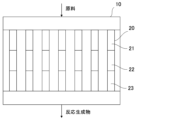
- FIG. 1 is a schematic diagram showing an example of an apparatus for producing an unsaturated aldehyde.
- FIG. 1 is a schematic diagram showing an unsaturated aldehyde manufacturing apparatus 1.
- the manufacturing apparatus 1 includes a fixed-bed multitubular reactor equipped with a plurality of reaction tubes 20 and a reaction bath 30. Catalyst layers 21, 22, and 23 are provided inside the reaction tube 20, and a different catalyst is disposed in each catalyst layer. The temperature of the reaction tube 20 can be adjusted by the reaction bath 30.
- a raw material gas for reaction containing, for example, an alkene is introduced from the top of the manufacturing apparatus 1, and the raw material gas is passed through the reaction tube 20 to cause a reaction, thereby obtaining a reaction product containing an unsaturated aldehyde.
- the present invention is characterized in that when the reaction bath temperature at which the yield of unsaturated aldehyde is at its maximum is A (°C), the reaction bath temperatures at which the yield is 1.0 percentage points lower than the maximum value are A1 (°C) and A2 (°C), the reaction bath temperature between A1 and A2 is plotted on the horizontal axis as BT (°C) and the peak temperature in the catalyst layer closest to the outlet side is plotted on the vertical axis as PTf (°C), the slope of the approximation line obtained by the least squares method, ⁇ PTf/ ⁇ BT, is 2.7 or less.
- yield means molar yield.
- the present invention relates to a method and an apparatus for producing an unsaturated aldehyde, and in essence, to a method for filling a catalyst layer.
- a (°C) the reaction bath temperature at which the yield of the unsaturated aldehyde is maximized
- A1 (°C) and A2 (°C) the reaction bath temperatures at which the yield is 1.0% points lower than the maximum value
- A1, A1 and A2 are defined as follows: A: The reaction bath temperature at which the yield of unsaturated aldehyde is the highest.
- A1, A2 The reaction bath temperature at which the yield of unsaturated aldehyde is 1.0% points lower than that at reaction bath temperature A.
- ⁇ PTf/ ⁇ BT is 2.70 or less.
- a specific method for calculating ⁇ PTf/ ⁇ BT is as follows. That is, when all the measurement points of the most outlet side peak temperature (PTf) and BT at three or more points actually measured within the ranges of A1 and A2 are plotted as a scatter diagram, the slope of the approximation line by the least squares method, which has an intercept at the most outlet side peak temperature, which is the vertical axis, and is assumed to be a linear function with respect to BT, is defined as ⁇ PTf/ ⁇ BT. In addition, when there are two measurement points, the slope of the line passing through the two points is defined as ⁇ PTf/ ⁇ BT.
- the measurement points used in calculating ⁇ PTf/ ⁇ BT are set so that the difference (BT2-BT1) between the reaction bath temperature BT1 at the measurement point with the lowest reaction bath temperature (BT) and the reaction bath temperature BT2 at the measurement point with the highest reaction bath temperature is 30% or more of (A2-A1).
- ⁇ PTf/ ⁇ BT is preferably 2.50 or less, more preferably 2.00 or less, and particularly preferably 1.90 or less.
- the lower limit is not particularly limited and can be 0 or more, but ⁇ PTf/ ⁇ BT is preferably 0.80 or more, and more preferably 1.00 or more. If the catalyst is filled so as to satisfy this condition, (A2-A1) can be increased.
- (A2-A1) is the reaction bath temperature range (operation window) in which the acrolein yield is stable, and the larger (A2-A1) is, the higher the yield of the unsaturated aldehyde can be obtained in a wider reaction bath temperature range.
- (A2-A1) is, for example, 10°C or higher.
- A1 and A2 do not need to be calculated from the relationship between the actually measured acrolein yield and BT, and may be calculated from the interpolation or extrapolation of a series of data obtained by measuring the acrolein yield by changing the BT.
- the calculation is performed by a linear approximation formula by the least squares method, assuming that there is an intercept on the vertical axis of the acrolein yield when as many actually measured measurement points as possible (acrolein yield relative to BT) are plotted as a scatter diagram.
- thermocouples are arranged at equal intervals throughout the gas flow direction of two or more catalyst layers provided in a reaction tube, and spot temperatures T1 i (°C) (i is 1 to p) at p measurement points in the reaction tube when an unsaturated aldehyde is produced at a reaction bath temperature A (°C) are obtained using the thermocouples.
- Sf means the sum of the heat values of the most outlet catalyst layer
- St means the sum of the heat values of all catalyst layers, according to Fourier's law of heat conduction. That is, when Sf and St satisfy the relationship of formula (1), it means that the heat value in the most outlet catalyst layer is 42.0% or less of the heat value in all catalyst layers, and the raw material gas is certainly reacting before it reaches the highly active most outlet catalyst layer. It is known to those skilled in the art that the reaction rate of alkenes to unsaturated aldehydes by partial oxidation is first order with respect to the partial pressure of the alkene.
- reaction rate and reactivity decrease toward the lower layer of the reactor, so when multi-layer packing is adopted in this reaction, it is common to select a highly active catalyst at the most outlet side.
- reaction rate taking into account the effect of catalyst shape and dilution rate by inert carrier decrease toward the lower layer of the reactor, so when multi-layer packing is adopted in this reaction, it is common to select a highly active catalyst at the most outlet side.
- the lower limit is, in order of preference, 1, 5, 7, 9, 11, 12, 13, 14, 15, 16, 17, and 18, and the upper limit is, in order of preference, 40, 37, 35, 33, 31, 30, 29, and 28.
- Sf/St ⁇ 100 is preferably 1 or more and 40 or less, more preferably 5 or more and 40 or less, more preferably 7 or more and 40 or less, more preferably 11 or more and 40 or less, more preferably 12 or more and 37 or less, more preferably 13 or more and 35 or less, more preferably 14 or more and 33 or less, more preferably 15 or more and 31 or less, more preferably 16 or more and 30 or less, more preferably 17 or more and 29 or less, and most preferably 18 or more and 28 or less.
- thermocouples are inserted into the reaction tube at a predetermined interval in the depth direction so that temperature information of the catalyst layer filled with a catalyst and/or the inert layer filled with an inert carrier can be obtained.
- the method of inserting the thermocouples is not limited as long as it is a method known to those skilled in the art, and examples thereof include the following.
- the direction in which the thermocouple is inserted is the depth direction of the reaction tube and/or a direction perpendicular to the depth direction of the reaction tube
- the method of inserting the thermocouple is a method of directly inserting the thermocouple parallel to the reaction tube and/or a method of inserting a case (thermowell) into which the thermocouple is inserted and inserting the thermocouple inside it (i.e., the reaction tube has a double tube structure)
- the method of moving the thermocouple over time is a fixed type that does not move at all and/or a type that moves to an arbitrary position in the reaction tube over time.
- the reaction tubes into which the thermocouples are inserted are not all of the reaction tubes in the reactor, but only some of them.
- reaction tubes Of the several thousand to tens of thousands of reaction tubes, usually 5 to 100, preferably 6 to 50, more preferably 7 to 40, and particularly preferably 8 to 16 reaction tubes are selected.
- reaction tubes into which thermocouples are inserted may be selected only from some of the sections, or may be selected as evenly as possible from all the sections.
- at least one reaction tube is selected from 40% or more of all the sections, more preferably from 60% or more of the sections, and even more preferably from 75% or more of the sections.
- the reaction tube into which the thermocouples are inserted is also simply referred to as a reaction tube.
- the positions of the thermocouples in the depth direction are not particularly limited, but a method of arranging the thermocouples at equal intervals or a method of changing the intervals of the thermocouples as necessary can be adopted.
- the temperature distribution in the catalyst packed bed on the gas inlet side shows a steep rise in the depth direction, so that the intervals of the thermocouples are narrow, and conversely, the intervals of the thermocouples are wide in the catalyst packed bed on the gas outlet side.
- thermocouples rather than measuring temperature information at the same depth position for all of the selected multiple reaction tubes, it is preferable to arrange the measurement positions in each reaction tube at different depths, since this makes it easier to grasp the temperature distribution of the entire reactor.
- the measurement positions in each reaction tube at different depths, since this makes it easier to grasp the temperature distribution of the entire reactor.
- the catalyst used in the present invention is preferably a catalyst having a composition represented by the following formula (I). Mo a Bi b Ni c Co d Fe e X f Y g Z h O i (I)
- Mo, Bi, Ni, Co, Fe and O represent molybdenum, bismuth, nickel, cobalt, iron and oxygen, respectively
- X represents at least one element selected from tungsten, antimony, tin, zinc, chromium, manganese, magnesium, silicon, aluminum, cerium and titanium
- Y represents at least one element selected from sodium, potassium, cesium, rubidium and thallium
- Z represents an element belonging to Groups 1 to 16 of the periodic table
- Mo, Bi, N a, b, c, d, e, f, g, h, and i respectively represent the numbers of atoms of molybdenum, bismuth, nickel, cobalt, iron, X, Y,
- the preferred ranges of b to h are as follows:
- the lower limit of b is, in order of preference, 0.10, 0.20, 0.30, 0.40, 0.50, 0.60, and 0.70
- the upper limit is, in order of preference, 6.0, 5.0, 4.0, 3.0, 2.0, 1.8, 1.5, 1.2, and 1.0.
- b is preferably 0.10 or more and 6.0 or less, more preferably 0.10 or more and 5.0 or less, more preferably 0.10 or more and 4.0 or less, more preferably 0.20 or more and 3.0 or less, more preferably 0.30 or more and 2.0 or less, more preferably 0.40 or more and 1.8 or less, more preferably 0.50 or more and 1.5 or less, more preferably 0.60 or more and 1.2 or less, and most preferably 0.70 or more and 1.0 or less.
- the lower limit of c is, in order of preference, 0.20, 0.50, 0.80, 1.0, 1.5, 1.8, 2.0, 2.5, and 2.8, and the upper limit is, in order of preference, 8.0, 7.0, 6.0, 5.0, 4.0, 3.5, and 3.3.
- c is preferably 0.20 or more and 8.0 or less, more preferably 0.50 or more and 8.0 or less, more preferably 0.80 or more and 8.0 or less, more preferably 1.0 or more and 7.0 or less, more preferably 1.5 or more and 6.0 or less, more preferably 1.8 or more and 5.0 or less, more preferably 2.0 or more and 4.0 or less, more preferably 2.5 or more and 3.5 or less, and most preferably 2.8 or more and 3.3 or less.
- the lower limit of d is, in order of preference, 1.0, 2.0, 3.0, 4.0, and 5.0
- the upper limit is, in order of preference, 9.5, 9.0, 8.5, 8.0, 7.5, 7.0, 6.5, and 6.3.
- d is preferably 1.0 to 9.5, more preferably 1.0 to 9.0, more preferably 1.0 to 8.5, more preferably 1.0 to 8.0, more preferably 2.0 to 7.5, more preferably 3.0 to 7.0, more preferably 4.0 to 6.3, and most preferably 5.0 to 6.3.
- the lower limit of c+d is, in order of preference, 0.0, 2.0, 4.0, 6.0, 8.0, and 8.3, and the upper limit is, in order of preference, 20.0, 15.0, 12.5, 11.0, 10.0, and 9.0.
- c+d is preferably 0.0 or more and 20.0 or less, more preferably 2.0 or more and 15.0 or less, more preferably 4.0 or more and 12.5 or less, more preferably 6.0 or more and 11.0 or less, more preferably 8.0 or more and 10.0 or less, and most preferably 8.3 or more and 9.0 or less.
- the lower limit of e is, in order of preference, 0.10, 0.20, 0.50, 0.80, 1.0, 1.5, and 1.6
- the upper limit is, in order of preference, 4.5, 4.0, 3.5, 3.0, 2.5, 2.0, and 1.9.
- e is preferably 0.10 or more and 4.5 or less, more preferably 0.20 or more and 4.0 or less, more preferably 0.50 or more and 3.5 or less, more preferably 0.80 or more and 3.0 or less, more preferably 1.0 or more and 2.5 or less, more preferably 1.5 or more and 2.0 or less, and most preferably 1.6 or more and 1.9 or less.
- the upper limit of f is preferably 1.8, 1.5, 1.0, 0.80, and 0.50, and the lower limit is preferably 0. That is, f is more preferably 0 or more and 1.5 or less, more preferably 0 or more and 1.0 or less, more preferably 0 or more and 0.80 or less, more preferably 0 or more and 0.50 or less, and most preferably 0.
- the lower limit of g is, in order of preference, 0.010, 0.020, 0.030, 0.040, 0.050, and 0.060
- the upper limit is, in order of preference, 2.0, 1.0, 0.50, 0.40, 0.30, 0.20, 0.15, and 0.090. That is, g is preferably 0.010 or more and 2.0 or less, more preferably 0.010 or more and 1.0 or less, more preferably 0.010 or more and 0.50 or less, more preferably 0.020 or more and 0.40 or less, more preferably 0.030 or more and 0.30 or less, more preferably 0.040 or more and 0.20 or less, more preferably 0.050 or more and 0.15 or less, and most preferably 0.060 or more and 0.090 or less.
- the upper limit of h is, in order of preference, 4.0, 3.0, 2.0, 1.8, 1.5, 1.0, 0.80, and 0.50, and the lower limit is preferably 0. That is, h is more preferably 0 or more and 4.0 or less, more preferably 0 or more and 3.0 or less, more preferably 0 or more and 2.0 or less, more preferably 0 or more and 1.8 or less, more preferably 0 or more and 1.5 or less, more preferably 0 or more and 1.0 or less, more preferably 0 or more and 0.80 or less, more preferably 0 or more and 0.50 or less, and most preferably 0.
- X is preferably tungsten, antimony, zinc, magnesium or cerium, and particularly preferably antimony or zinc.
- Y is preferably sodium, potassium or cesium, more preferably potassium or cesium.
- Z in the formula (1) is preferably vanadium, copper, niobium, zirconium, calcium, beryllium, strontium, barium, lead or phosphorus.
- the catalytically active component of the catalyst contained in the first layer preferably has a composition represented by the following formula (I-1).
- the catalyst layer closest to the inlet side of the reaction raw material gas preferably has a composition represented by the following formula (I-1).
- the catalyst layer closest to the outlet side preferably contains a catalyst having a composition represented by formula (I-1).
- Mo, Bi, Ni, Co, Fe, Cs, and O represent molybdenum, bismuth, nickel, cobalt, iron, cesium, and oxygen, respectively;
- X represents at least one element selected from tungsten, antimony, tin, zinc, chromium, manganese, magnesium, silicon, aluminum, cerium, and titanium;
- Z represents an element belonging to Groups 1 to 16 of the periodic table and is selected from elements other than Mo, Bi, Ni, Co, Fe, Cs, O, and X.
- preferred b1 to f1, h1, and X and Z are the same as b to f, h, and X and Z in formula (I), including preferred embodiments thereof.
- the lower limit is, in order of preference, 0.0010, 0.0050, 0.010, 0.015, 0.020, and 0.030
- the upper limit is, in order of preference, 2.0, 1.0, 0.50, 0.40, 0.30, 0.20, 0.15, 0.090, and 0.060.
- g1 is preferably 0.0010 or more and 2.0 or less, more preferably 0.0010 or more and 1.0 or less, more preferably 0.0010 or more and 0.50 or less, more preferably 0.0010 or more and 0.40 or less, more preferably 0.0050 or more and 0.30 or less, more preferably 0.010 or more and 0.20 or less, more preferably 0.015 or more and 0.15 or less, more preferably 0.020 or more and 0.090 or less, and most preferably 0.030 or more and 0.060 or less.
- the catalytically active component of the catalyst contained in the catalyst layer closest to the outlet preferably has a composition represented by the following formula (I-2).
- the catalytically active component contained in the third catalyst layer has a composition represented by formula (I-2)
- the catalytically active component contained in the catalyst layer closest to the outlet has a composition represented by formula (I-2).
- Mo, Bi, Ni, Co, Fe, K and O represent molybdenum, bismuth, nickel, cobalt, iron, potassium and oxygen, respectively;
- X represents at least one element selected from tungsten, antimony, tin, zinc, chromium, manganese, magnesium, silicon, aluminum, cerium and titanium;
- Z represents at least one element belonging to Groups 1 to 16 of the periodic table and selected from elements other than Mo, Bi, Ni, Co, Fe, K and X.
- preferred b2 to f2, h2, X, and Z are the same as b to f, h, X, and Z in formula (I), including preferred embodiments thereof.
- the lower limit is, in order of preference, 0.0010, 0.0050, 0.010, 0.015, 0.020, and 0.030
- the upper limit is, in order of preference, 2.0, 1.0, 0.50, 0.40, 0.30, 0.20, 0.15, and 0.10.
- g2 is preferably 0.0010 or more and 2.0 or less, more preferably 0.0010 or more and 1.0 or less, more preferably 0.0010 or more and 0.50 or less, more preferably 0.0050 or more and 0.40 or less, more preferably 0.010 or more and 0.30 or less, more preferably 0.015 or more and 0.20 or less, more preferably 0.020 or more and 0.15 or less, and most preferably 0.030 or more and 0.10 or less.
- the reaction rate k of this reaction is calculated from the following equation (II).
- k -Ln (1 - x / 100) (II)
- k is the reaction rate of this reaction (unitless)
- Ln is the natural logarithm
- x is the propylene conversion rate (unit: %).
- the reaction rate of each catalyst layer is calculated under the same conditions using this method, and then the actual reaction rate ak of each catalyst layer in the plant is calculated using the following formula (III).
- the dilution ratio is synonymous with the dilution ratio by an inert substance described later
- the packing length is the packing length shown in units of cm. It is preferable to use an actual measurement value rather than a design value for the packing length. In a plant, since there are often multiple reaction tubes, an average value obtained from the measurement results of some of them can also be used.
- the catalyst can be packed in order from the top of the reaction tube to the bottom, and the space length above each layer can be measured using a tape measure or the like to calculate the packing length.
- akt/akn is calculated by the following formula (IV).
- the preferred numerical ranges of akt/akn are, in order of preference, 1.41, 1.42, 1.43, 1.44, and 1.45 in lower limit and 10.00, 7.50, 5.00, 4.00, 3.00, 2.75, 2.65, 2.55, and 2.50 in upper limit.
- akt/akn is preferably 1.41 or more and 10.00 or less, more preferably 1.41 or more and 7.50 or less, more preferably 1.41 or more and 5.00 or less, more preferably 1.41 or more and 4.00 or less, more preferably 1.41 or more and 3.00 or less, more preferably 1.42 or more and 2.75 or less, more preferably 1.42 or more and 2.65 or less, more preferably 1.42 or more and 2.55 or less, and most preferably 1.45 to 2.50.
- akt/akn (sum of actual reaction rates ak of all catalyst layers) ⁇ (actual reaction rate ak of the catalyst layer closest to the outlet of the reaction tube) (IV)
- the above-mentioned raw material gas conversion rate x is calculated by the following method.
- the propylene flow rate at the outlet is calculated by a calibrated gas chromatograph, and the propylene conversion rate x is calculated by the following formula.
- the particle size of the catalyst layer closest to the outlet of the reaction tube may be different from the particle size of the catalyst layers of the other catalyst layers, and may be larger or smaller.
- the particle size of the catalyst on the outlet side of the reaction tube is large, the gas retention at the outlet side is reduced, resulting in an increase in the yield of the target product, and as a secondary effect, ⁇ PTf/ ⁇ BT can be adjusted to be small.
- the particle size of each catalyst layer when the pressure in the reaction tube is high, and/or the reaction bath temperature is low, and/or the inner diameter of the reaction tube is large, and/or the inlet propylene concentration is low, it is preferable to increase the particle size of each catalyst layer, and particularly, it is preferable to increase the particle size of the catalyst layer on the inlet side of the reaction tube.
- the particle diameter ratio particle diameter of the catalyst in the catalyst layer closest to the outlet of the reaction tube divided by the particle diameter of the catalyst in the other catalyst layers
- the lower limit is 0.50, 0.60, 0.70, 0.80, 0.90, and 1.00
- the upper limit is 1.50, 1.40, 1.30, 1.20, and 1.10, in that order.
- the particle diameter ratio is preferably 0.50 or more and 1.50 or less, more preferably 0.60 or more and 1.50 or less, more preferably 0.70 or more and 1.40 or less, more preferably 0.80 or more and 1.30 or less, more preferably 0.90 or more and 1.20 or less, and most preferably 1.00 or more and 1.10 or less.
- the weighted average of the catalyst particle diameters weighted by the packing length of each catalyst layer other than the catalyst layer closest to the outlet is defined as the "particle diameter of the catalyst in the other catalyst layers".
- the inert material layer is provided closer to the outlet side than the catalyst layer, thereby increasing the pressure difference on the inlet side of the reaction tube, and the reaction can proceed steadily on the inlet side of the reaction tube.
- the length of the inert material packed on the outlet side varies depending on the raw material load and the diameter of the reaction tube, but is, for example, 5 cm or more, preferably 10 cm or more, more preferably 20 cm or more, and most preferably 30 cm or more.
- the length of the inert material packed on the outlet side may be, for example, 50 cm or less.
- the catalyst is easily activated at the inlet side of the reaction tube by increasing the inlet gas temperature, and the reaction can proceed steadily.
- the inlet gas temperature is preferably 150° C. or higher, 200° C. or higher, 250° C. or higher, 270° C. or higher, 290° C. or higher, 300° C. or higher, 310° C. or higher, 320° C. or higher, 330° C. or higher, or 340° C. or higher.
- the inlet gas temperature may be, for example, 360° C. or lower.
- the method (1) for adjusting the packing length of the catalyst layer will be described in detail with the packing length of the catalyst layer being defined as follows.
- Ln the packing length of the nth layer counted from the gas inlet side of the reaction tube when n layers of catalyst layers are provided in the gas flow direction of the reaction tube
- L the total packing length from the 1st layer to the n-1th layer counted from the gas inlet side of the reaction tube.
- a preferred packing method is when L/Ln is 1.5 to 3.5. It is more preferable that the catalyst layer has the above-mentioned catalyst composition.
- L/Ln More preferable upper limits of this L/Ln are 3.4, 3.3, 3.2, and 3.1, and particularly preferably 3.0. Also, preferable lower limits are 1.6, 1.7, 1.8, and 1.9, and particularly preferably 2.0. Therefore, L/Ln is preferably 1.6 to 3.4, more preferably 1.7 to 3.3, more preferably 1.8 to 3.2, more preferably 1.9 to 3.1, and most preferably 2.0 to 3.0.
- the number n of divided catalyst layers is preferably 2 to 5 layers, more preferably 2 to 4 layers, particularly preferably 2 to 3 layers, and most preferably 3 layers.
- the shape of the catalyst contained in the catalyst layer used in the present invention is not particularly limited, and it can be spherical, cylindrical, ring-shaped, powdery, etc., but spherical is particularly preferred.
- both the catalyst in the upper layer and the catalyst in the lower layer may be diluted with an inert substance, but it is more preferable not to dilute either the upper or lower layer.
- the preferred range of the dilution ratio with the inert substance is described below.
- the dilution ratio here is a numerical value indicating the mass ratio of the catalyst in the catalyst layer composed of the catalyst and the inert substance.
- a catalyst layer diluted by 80% by mass means that the catalyst is 80% by mass and the inert substance is 20% by mass.
- the dilution ratio is calculated based on the mass of the catalyst including the inert carrier.
- n 2 or 3 as an example, but the present invention is not limited to this.
- the middle layer is a catalyst containing a catalytically active component represented by formula (I-1) and the dilution ratio is 100 mass %
- the upper layer is a catalyst obtained by diluting the same catalyst as the middle layer with an inert substance and the dilution ratio is 60 mass % or more and less than 100 mass %
- the lower layer is a catalyst containing a catalytically active component having a composition represented by formula (I-2) and the dilution ratio is 100 mass %.
- the inert substance includes known substances such as silica, alumina, titania, zirconia, niobia, silica alumina, silicon carbide, carbides, and mixtures thereof. Among these, silica, alumina, or mixtures thereof are preferred, silica and alumina are particularly preferred, and a mixture of silica and alumina is most preferred.
- the shape of the inactive substance is not particularly limited, but is preferably spherical.
- the average particle size of the inactive substance is preferably 3 mm to 10 mm, more preferably 3.5 mm to 9 mm, and particularly preferably 4 mm to 8 mm.
- the catalyst used in the present invention can be produced, for example, by the following steps a) to e). ⁇ Step a) Preparation>
- the starting materials of each element constituting the catalytic active component are not particularly limited.
- molybdenum component raw material molybdenum oxide such as molybdenum trioxide, molybdic acid, molybdic acid or its salt such as ammonium molybdate, heteropolyacid containing molybdenum such as phosphomolybdic acid and silicomolybdic acid or its salt can be used. It is preferable to use ammonium molybdate, which can provide a high-performance catalyst.
- ammonium molybdate compounds such as ammonium dimolybdate, ammonium tetramolybdate, and ammonium heptamolybdate, and among them, it is most preferable to use ammonium heptamolybdate.
- Bismuth salts such as bismuth nitrate, bismuth subcarbonate, bismuth sulfate, and bismuth acetate, bismuth trioxide, and metallic bismuth can be used as the bismuth component raw material.
- Bismuth nitrate is more preferable, and when used, a high-performance catalyst can be obtained.
- raw materials for iron, cobalt, nickel, and other elements oxides or nitrates, carbonates, organic acid salts, hydroxides, etc. that can be converted to oxides by ignition, or mixtures thereof can be used.
- the iron component raw material and the cobalt component raw material and/or nickel component raw material are dissolved and mixed in water at a desired ratio under conditions of 10 to 80°C, mixed with a separately prepared molybdenum component raw material and Z component raw material aqueous solution or slurry under conditions of 20 to 90°C, heated and stirred for about 1 hour under conditions of 20 to 90°C, and then an aqueous solution in which the bismuth component raw material is dissolved and, if necessary, an X component raw material and a Y component raw material are added to obtain an aqueous solution or slurry containing the catalyst components.
- the aqueous solution or slurry obtained in this manner is collectively referred to as the prepared liquid (A).
- the prepared liquid (A) does not necessarily need to contain all of the catalytically active component elements, and some of the elements or some of the amounts may be added in a subsequent step. Furthermore, when preparing the prepared liquid (A), if the amount of water in which each component raw material is dissolved, or if an acid such as sulfuric acid, nitric acid, hydrochloric acid, tartaric acid, or acetic acid is added for dissolution, is not suitable for preparation, for example, in the range of 5% to 99% by mass, the acid concentration in the aqueous solution sufficient to dissolve the raw materials, the prepared liquid (A) may take the form of a clay-like lump. In this case, an excellent catalyst cannot be obtained.
- the prepared liquid (A) is preferably in the form of an aqueous solution or a slurry, as this produces an excellent catalyst.
- the preparation liquid (A) obtained above is dried to obtain a dry powder.
- the drying method is not particularly limited as long as it can completely dry the preparation liquid (A), and examples thereof include drum drying, freeze drying, spray drying, and evaporation to dryness.
- spray drying is particularly preferred, which can dry the slurry into powder or granules in a short time.
- the drying temperature of the spray drying varies depending on the concentration of the slurry, the liquid sending speed, etc., but is generally 70 to 150°C at the outlet of the dryer. It is also preferable to dry the mixture so that the average particle size of the dry powder obtained at this time is 10 to 700 ⁇ m. In this way, a dry powder (B) is obtained.
- Step c) Pre-firing>
- the resulting dry powder (B) is calcined under air flow at 200°C to 600°C, preferably 300°C to 600°C, which tends to improve the moldability, mechanical strength, and catalytic performance of the catalyst.
- the calcination time is preferably 1 hour to 12 hours. In this way, a pre-calcined powder (C) is obtained.
- the pre-sintered powder (C) may be molded into a spherical shape using a molding machine, but a method in which the pre-sintered powder (C) (containing a molding aid and a strength improver, if necessary) is supported on a carrier such as an inactive ceramic is preferred.
- the widely known methods of support include a rolling granulation method, a method using a centrifugal fluidized coating device, and a wash coat method.
- the method can uniformly support the pre-calcined powder (C) on the carrier, but when considering the production efficiency of the catalyst and the performance of the catalyst prepared, it is more preferable to use an apparatus having a flat or uneven disk at the bottom of a fixed cylindrical container, which is rotated at high speed to vigorously stir the carrier charged in the container by repeated rotation and revolution of the carrier itself, and to which the pre-calcined powder (C) and, if necessary, a molding aid and/or a strength improver are added to support the powder components on the carrier. In this way, a molded body (D) is obtained.
- binders that can be used include water, ethanol, methanol, propanol, polyhydric alcohols, polyvinyl alcohol as a polymer binder, and silica sol aqueous solution as an inorganic binder.
- Ethanol, methanol, propanol, and polyhydric alcohols are preferred, and diols such as ethylene glycol and triols such as glycerin are more preferred.
- a catalyst with particularly high performance can be obtained when an aqueous solution of glycerin with a concentration of 5% by mass or more is used.
- the amount of these binders used is usually 2 to 80 parts by mass per 100 parts by mass of the pre-calcined powder (C).
- An inert carrier with a diameter of about 2 to 8 mm is usually used, and the pre-calcined powder (C) is supported on it.
- the support rate is determined taking into consideration the catalyst use conditions, such as the space velocity of the reaction raw materials and the raw material concentration, and is usually 20% to 80% by mass.
- the support rate is defined by the following formula (4).
- Support rate (mass%) 100 x [mass of pre-calcined powder (C) used for molding / (mass of pre-calcined powder (C) used for molding + mass of inert carrier used for molding)] (4)
- the molded body (D) obtained in step d) tends to have improved catalytic activity and selectivity by calcining it at a temperature of 200 to 600°C for about 1 to 12 hours.
- the calcination temperature is preferably 400°C to 600°C, more preferably 500°C to 600°C.
- Air is the preferred gas to be passed through for simplicity, but it is also possible to use inert gases, gases for creating a reducing atmosphere, and mixtures thereof.
- inert gases include nitrogen and carbon dioxide.
- gases for creating a reducing atmosphere include nitrogen oxide-containing gases, ammonia-containing gases, and hydrogen gas. In this way, the catalyst (E) is obtained.
- the catalytic gas phase oxidation reaction of an alkene in the present invention is carried out by introducing a mixed gas consisting of 6 to 12 volume % of an alkene (more preferably 6 to 10 volume %), 5 to 18 volume % of molecular oxygen, 0 to 60 volume % of water vapor and 20 to 70 volume % of an inert gas such as nitrogen or carbon dioxide onto the catalyst prepared as described above at a temperature in the range of 250 to 450° C. and a pressure of normal pressure to 10 atm, preferably normal pressure to 5 atm, more preferably normal pressure to 3 atm, for a contact time of 0.5 to 10 seconds.
- the volume ratio of oxygen to alkene in the raw material gas is preferably 1.0 or more and 1.8 or less. More preferred upper limits of oxygen/alkene are 1.7 and 1.6, respectively, and more preferably 1.5. More preferred lower limits are 1.1, 1.2, and 1.3, respectively. From the above, oxygen/alkene is more preferably 1.1 or more and 1.7 or less, even more preferably 1.2 or more and 1.6 or less, and most preferably 1.3 or more and 1.5 or less.
- alkene includes alcohols that produce alkenes in their intramolecular dehydration reaction, such as tertiary butyl alcohol.
- a higher space velocity of the reaction substrate, such as an alkene, relative to the catalyst volume is preferable from the viewpoint of production efficiency, but if it is too high, the yield of the target product may decrease or the catalyst life may be shortened. Therefore, in practice, the space velocity of the reaction substrate relative to the catalyst volume is preferably 40 to 200 hr -1 , more preferably 60 to 180 hr -1 .
- NL represents the volume of the reaction substrate under standard conditions.
- the conversion rate of the alkene is preferably near the conversion rate at which a high acrolein yield is obtained, and is usually 90 to 99.9%, preferably 95 to 99.5%, more preferably 96 to 99%.
- the activity of the entire catalyst layer will decrease, and the reaction bath temperature required to obtain the normal raw material conversion rate and obtain the target product may rise too much. If the reaction bath temperature becomes too high, the hot spot of the n-1th catalyst layer counting from the inlet side will become hot, which may cause the catalyst on the gas inlet side to deteriorate or its performance to decrease. In some cases, early deterioration of the catalyst on the gas inlet side may cause a high-temperature hot spot to occur in the highly active catalyst layer on the gas outlet side, causing a sudden decrease in the selectivity and yield of the target product.
- the reaction bath temperature is set appropriately depending on the catalyst characteristics, usage conditions, required catalyst life, etc., so it cannot be generalized, but the reaction bath temperature at the beginning of the reaction is preferably 350°C or less, more preferably 340°C or less.
- the lower limit is 300°C or more, more preferably 310°C or more. That is, the reaction bath temperature at the beginning of the reaction is preferably 300°C or higher and 350°C or lower, and more preferably 310°C or higher and 340°C or lower.
- the reaction bath temperature is a set temperature that is set to obtain an appropriate raw material conversion rate.
- Acrolein yield (mol%) (number of moles of acrolein produced/number of moles of propylene supplied) x 100
- the powder obtained by mixing 5 parts by mass of crystalline cellulose with 100 parts by mass of the pre-calcined powder was adjusted to an inert carrier (alumina, a spherical material having a diameter of 4.5 mm mainly composed of silica) so that the loading rate defined by the above formula (4) was 50% by mass.
- an inert carrier alumina, a spherical material having a diameter of 4.5 mm mainly composed of silica
- a 20% by mass aqueous glycerin solution was used as a binder, and the catalyst was molded into a spherical shape having a diameter of 5.20 mm to obtain a supported catalyst.
- the catalyst was calcined at a calcination temperature of 530° C. for 4 hours under an air atmosphere to obtain catalyst A1.
- catalyst B1 with a diameter of 5.20 mm.
- the reaction rate k of catalyst B1 was 0.35.
- Catalyst B2 The pre-calcined powder obtained in the preparation of catalyst B1 was molded into a 4.0 mm diameter spherical material containing alumina and silica as the main components as an inert carrier so that the loading rate was 60 mass %, and catalyst B2 having a diameter of 5.00 mm was obtained in the same manner as catalyst B1.
- the reaction rate k of catalyst B2 was 0.43.
- Example 1 A jacket for circulating molten salt as a heat medium and a thermocouple for measuring the catalyst layer temperature were installed on the tube axis of a stainless steel reactor with an inner diameter of 25 mm. A temperature sheath for the thermocouple with an outer diameter of 3 mm was installed, and 1 cm of silica-alumina spheres with a diameter of 5.2 mm were packed from the raw gas inlet side.
- the feed material was circulated so that the space velocity of propylene was 190 hr -1 , and the pressure at the outlet side of the reaction tube during total gas circulation was 110 kPaG. After 300 hours had elapsed since the start of the reaction, the reaction bath temperature was changed to carry out the oxidation reaction of propylene.
- Table 1 The results of investigating the reaction results by changing the reaction bath temperature are shown in Table 1.
- Table 1 where there is no peak temperature or reaction result for each layer in A1 and A2 mean that A1 and A2 are calculated values calculated by interpolation or extrapolation of the measured data (the same applies hereinafter).
- the reaction was started in the same manner as in Example 1, except that the feedstock was circulated so that the space velocity of propylene was 100 hr -1 and the pressure at the outlet side of the reaction tube during total gas flow was 35 kPaG, and the reaction results were examined. The results are shown in Table 3.
- the reaction was started in the same manner as in Example 1, except that the propylene space velocity was 180 hr -1 and the pressure at the outlet side of the reaction tube during the entire gas flow was 90 kPaG, and the reaction results were examined. The results are shown in Table 4.
- Table 8 shows that the operation window (A2-A1) can be made wider by setting ⁇ PTf/ ⁇ BT to a small value. This is particularly beneficial in the method of producing acrolein from propylene, as it leads to stable plant operation within the constraints of the reactor and process mentioned above. Similarly, it can be seen that the operation window becomes significantly wider by lowering Sf/St below a specific value at the reaction bath temperature where the acrolein yield is maximized. In this way, it can be seen that ⁇ PTf/ ⁇ BT and Sf/St can be controlled by akt/akn as described above.
- the present invention makes it possible to maintain a stable yield over a wide operating window in an unsaturated aldehyde production plant, and also to achieve a yield improvement effect. This makes it possible to maintain a stable yield and stable operation in an industrial plant over the long term.
Landscapes
- Chemical & Material Sciences (AREA)
- Organic Chemistry (AREA)
- Engineering & Computer Science (AREA)
- Materials Engineering (AREA)
- Chemical Kinetics & Catalysis (AREA)
- Low-Molecular Organic Synthesis Reactions Using Catalysts (AREA)
- Catalysts (AREA)
- Organic Low-Molecular-Weight Compounds And Preparation Thereof (AREA)
Priority Applications (1)
| Application Number | Priority Date | Filing Date | Title |
|---|---|---|---|
| JP2024506139A JP7551027B2 (ja) | 2022-10-12 | 2023-10-04 | 不飽和アルデヒドの製造方法および不飽和アルデヒドの製造装置 |
Applications Claiming Priority (2)
| Application Number | Priority Date | Filing Date | Title |
|---|---|---|---|
| JP2022163793 | 2022-10-12 | ||
| JP2022-163793 | 2022-10-12 |
Publications (1)
| Publication Number | Publication Date |
|---|---|
| WO2024080208A1 true WO2024080208A1 (ja) | 2024-04-18 |
Family
ID=90669191
Family Applications (1)
| Application Number | Title | Priority Date | Filing Date |
|---|---|---|---|
| PCT/JP2023/036249 Ceased WO2024080208A1 (ja) | 2022-10-12 | 2023-10-04 | 不飽和アルデヒドの製造方法および不飽和アルデヒドの製造装置 |
Country Status (2)
| Country | Link |
|---|---|
| JP (1) | JP7551027B2 (https=) |
| WO (1) | WO2024080208A1 (https=) |
Citations (3)
| Publication number | Priority date | Publication date | Assignee | Title |
|---|---|---|---|---|
| JP2010077087A (ja) * | 2008-09-26 | 2010-04-08 | Toagosei Co Ltd | アクリル酸の製造方法 |
| WO2019198763A1 (ja) * | 2018-04-10 | 2019-10-17 | 日本化薬株式会社 | 不飽和アルデヒド及び不飽和カルボン酸の少なくとも一方の製造方法並びに不飽和アルデヒド及び不飽和カルボン酸の少なくとも一方の製造用触媒 |
| WO2020203266A1 (ja) * | 2019-03-29 | 2020-10-08 | 日本化薬株式会社 | 不飽和アルデヒドの製造方法 |
Family Cites Families (6)
| Publication number | Priority date | Publication date | Assignee | Title |
|---|---|---|---|---|
| JP4024699B2 (ja) * | 2002-03-11 | 2007-12-19 | 三菱化学株式会社 | 接触気相酸化方法 |
| US7588739B2 (en) * | 2003-07-14 | 2009-09-15 | Mitsubishi Rayon Co., Ltd. | Fixed bed multitube reactor |
| JP2005289919A (ja) * | 2004-04-01 | 2005-10-20 | Mitsubishi Chemicals Corp | (メタ)アクリル酸または(メタ)アクロレインの製造方法 |
| US9440903B2 (en) * | 2012-09-24 | 2016-09-13 | Arkema Inc. | Shell and tube oxidation reactor with improved resistance to fouling |
| WO2023157699A1 (ja) * | 2022-02-18 | 2023-08-24 | 日本化薬株式会社 | 多管式反応器の運転またはその準備行為をサポートする方法および装置 |
| CN118647449A (zh) * | 2022-02-18 | 2024-09-13 | 日本化药株式会社 | 支持多管式反应器的空气处理的方法和装置 |
-
2023
- 2023-10-04 JP JP2024506139A patent/JP7551027B2/ja active Active
- 2023-10-04 WO PCT/JP2023/036249 patent/WO2024080208A1/ja not_active Ceased
Patent Citations (3)
| Publication number | Priority date | Publication date | Assignee | Title |
|---|---|---|---|---|
| JP2010077087A (ja) * | 2008-09-26 | 2010-04-08 | Toagosei Co Ltd | アクリル酸の製造方法 |
| WO2019198763A1 (ja) * | 2018-04-10 | 2019-10-17 | 日本化薬株式会社 | 不飽和アルデヒド及び不飽和カルボン酸の少なくとも一方の製造方法並びに不飽和アルデヒド及び不飽和カルボン酸の少なくとも一方の製造用触媒 |
| WO2020203266A1 (ja) * | 2019-03-29 | 2020-10-08 | 日本化薬株式会社 | 不飽和アルデヒドの製造方法 |
Also Published As
| Publication number | Publication date |
|---|---|
| JPWO2024080208A1 (https=) | 2024-04-18 |
| JP7551027B2 (ja) | 2024-09-13 |
Similar Documents
| Publication | Publication Date | Title |
|---|---|---|
| JP3793317B2 (ja) | 触媒及び不飽和アルデヒドおよび不飽和酸の製造方法 | |
| JP6527499B2 (ja) | 不飽和アルデヒドおよび/または不飽和カルボン酸の製造方法 | |
| JP6199972B2 (ja) | 不飽和アルデヒドおよび/または不飽和カルボン酸の製造方法 | |
| JP6831920B2 (ja) | 不飽和アルデヒド及び不飽和カルボン酸の少なくとも一方の製造方法並びに不飽和アルデヒド及び不飽和カルボン酸の少なくとも一方の製造用触媒 | |
| JP6932292B1 (ja) | 触媒、触媒の充填方法、および触媒を用いた化合物の製造方法 | |
| JP7506031B2 (ja) | 不飽和アルデヒドの製造方法 | |
| WO2014014041A1 (ja) | 不飽和アルデヒドおよび/または不飽和カルボン酸の製造方法 | |
| CN101848883B (zh) | 异丁烯醛和/或甲基丙烯酸的制造方法 | |
| JP7551027B2 (ja) | 不飽和アルデヒドの製造方法および不飽和アルデヒドの製造装置 | |
| JP7551026B2 (ja) | 不飽和アルデヒドの製造方法および不飽和アルデヒドの製造装置 | |
| JP5607865B2 (ja) | メタクリル酸の製造方法 | |
| WO2025100265A1 (ja) | 不飽和アルデヒドまたは不飽和カルボン酸の製造方法 | |
| JP5479803B2 (ja) | (メタ)アクロレインまたは(メタ)アクリル酸の製造方法 | |
| JP5590382B2 (ja) | 不飽和アルデヒド及び/又は不飽和カルボン酸の製造方法 | |
| WO2025100267A1 (ja) | 不飽和アルデヒドの製造方法 | |
| JP2016106082A (ja) | 不飽和アルデヒドおよび/または不飽和カルボン酸の製造方法 |
Legal Events
| Date | Code | Title | Description |
|---|---|---|---|
| ENP | Entry into the national phase |
Ref document number: 2024506139 Country of ref document: JP Kind code of ref document: A |
|
| 121 | Ep: the epo has been informed by wipo that ep was designated in this application |
Ref document number: 23877213 Country of ref document: EP Kind code of ref document: A1 |
|
| NENP | Non-entry into the national phase |
Ref country code: DE |
|
| 122 | Ep: pct application non-entry in european phase |
Ref document number: 23877213 Country of ref document: EP Kind code of ref document: A1 |