WO2024080176A1 - 吸収性物品 - Google Patents
吸収性物品 Download PDFInfo
- Publication number
- WO2024080176A1 WO2024080176A1 PCT/JP2023/035841 JP2023035841W WO2024080176A1 WO 2024080176 A1 WO2024080176 A1 WO 2024080176A1 JP 2023035841 W JP2023035841 W JP 2023035841W WO 2024080176 A1 WO2024080176 A1 WO 2024080176A1
- Authority
- WO
- WIPO (PCT)
- Prior art keywords
- absorbent core
- absorbent
- vertical groove
- longitudinal
- core portion
- Prior art date
- Legal status (The legal status is an assumption and is not a legal conclusion. Google has not performed a legal analysis and makes no representation as to the accuracy of the status listed.)
- Ceased
Links
Images


Classifications
-
- A—HUMAN NECESSITIES
- A61—MEDICAL OR VETERINARY SCIENCE; HYGIENE
- A61F—FILTERS IMPLANTABLE INTO BLOOD VESSELS; PROSTHESES; DEVICES PROVIDING PATENCY TO, OR PREVENTING COLLAPSING OF, TUBULAR STRUCTURES OF THE BODY, e.g. STENTS; ORTHOPAEDIC, NURSING OR CONTRACEPTIVE DEVICES; FOMENTATION; TREATMENT OR PROTECTION OF EYES OR EARS; BANDAGES, DRESSINGS OR ABSORBENT PADS; FIRST-AID KITS
- A61F13/00—Bandages or dressings; Absorbent pads
- A61F13/15—Absorbent pads, e.g. sanitary towels, swabs or tampons for external or internal application to the body; Supporting or fastening means therefor; Tampon applicators
- A61F13/53—Absorbent pads, e.g. sanitary towels, swabs or tampons for external or internal application to the body; Supporting or fastening means therefor; Tampon applicators characterised by the absorbing medium
- A61F13/534—Absorbent pads, e.g. sanitary towels, swabs or tampons for external or internal application to the body; Supporting or fastening means therefor; Tampon applicators characterised by the absorbing medium having an inhomogeneous composition through the thickness of the pad
- A61F13/535—Absorbent pads, e.g. sanitary towels, swabs or tampons for external or internal application to the body; Supporting or fastening means therefor; Tampon applicators characterised by the absorbing medium having an inhomogeneous composition through the thickness of the pad inhomogeneous in the plane of the pad, e.g. core absorbent layers being of different sizes
- A61F13/536—Absorbent pads, e.g. sanitary towels, swabs or tampons for external or internal application to the body; Supporting or fastening means therefor; Tampon applicators characterised by the absorbing medium having an inhomogeneous composition through the thickness of the pad inhomogeneous in the plane of the pad, e.g. core absorbent layers being of different sizes having discontinuous areas of compression
Definitions
- This disclosure relates to absorbent articles.
- Patent Document 1 discloses an absorbent article (claim 1) comprising an absorbent core containing superabsorbent polymer particles, the absorbent article having a longitudinal direction including a front and a rear, a width direction and a thickness direction, and being partitioned into a front body and a rear body, the absorbent core comprising a first layer and a second layer adjacent to each other in the thickness direction, the first layer comprising, disposed in the front body, (i) a groove portion extending along the longitudinal direction, penetrating through the thickness direction and having an end at the rear position, and (ii) a base portion disposed adjacent to the rear position of the groove portion with the end sandwiched therebetween, the second layer comprising a groove portion corresponding portion and a base portion corresponding portion, respectively, at positions overlapping the groove portion and the base portion in the thickness direction, and the average density of the super
- the absorbent article of Patent Document 1 has room for improvement in terms of the absorption speed, thickness of the absorbent article, and the like when repeatedly absorbing body fluids. Therefore, an object of the present disclosure is to provide an absorbent article that has an excellent absorption rate and is less likely to become thick when repeatedly absorbing body fluids.
- the present inventors have discovered an absorbent article having a longitudinal direction and a width direction and including an absorbent core, the absorbent article having a widthwise centerline passing through the longitudinal center of the absorbent article and extending in the width direction, the absorbent core being partitioned by the widthwise centerline into a first absorbent core portion having a relatively small mass and a second absorbent core portion having a relatively large mass, the absorbent core having vertical grooves extending in the longitudinal direction across the widthwise centerline and arranged continuously from the first absorbent core portion to the second absorbent core portion, the vertical grooves having a relatively narrow portion arranged in the first absorbent core portion and a relatively wide portion arranged in the second absorbent core portion.
- the absorbent article disclosed herein has excellent absorption speed and is less likely to become thick when repeatedly absorbing bodily fluids.
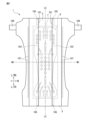
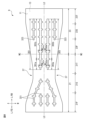
- FIG. 1 is a diagram for illustrating a disposable diaper 1 according to a first embodiment.
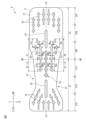
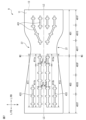
- FIG. 2 is a diagram for illustrating the disposable diaper 1 according to the first embodiment.
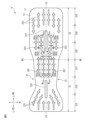
- FIG. 3 is a diagram for illustrating the disposable diaper 1 according to the first embodiment.
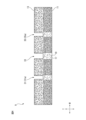
- FIG. 4 is a diagram for illustrating the disposable diaper 1 according to the first embodiment.
- FIG. 5 is a diagram for explaining a disposable diaper according to the second embodiment.
- FIG. 6 is a diagram for explaining a disposable diaper according to the third embodiment.
- FIG. 7 is a diagram for explaining a disposable diaper according to the fourth embodiment.
- FIG. 8 is a diagram for explaining a disposable diaper according to the fifth embodiment.
- An absorbent article having a longitudinal direction and a width direction and including an absorbent core
- the absorbent article has a widthwise centerline passing through a center of the absorbent article in the longitudinal direction and extending in the width direction, the absorbent core is partitioned by the widthwise centerline into a first absorbent core portion having a relatively small mass and a second absorbent core portion having a relatively large mass, the absorbent core has longitudinal grooves extending in the longitudinal direction, the longitudinal grooves being arranged continuously from the first absorbent core portion to the second absorbent core portion across the widthwise centerline,
- the flutes have a relatively narrow portion disposed in the first absorbent core portion and a relatively wide portion disposed in the second absorbent core portion.
- the above-mentioned absorbent article has vertical grooves with narrow portions in the first absorbent core portion, where the mass of the absorbent core is relatively small, and wide portions in the second absorbent core portion, where the mass of the absorbent core is relatively large. Therefore, when bodily fluids (e.g., urine) reach the absorbent core, the wide portions of the vertical grooves make it easier for the bodily fluids to be diffused relatively to the second absorbent core portion, where the mass of the absorbent core is relatively large. Since the second absorbent core portion has a relatively large mass, it has a large absorption capacity for bodily fluids and is excellent in repeated absorption and absorption speed of bodily fluids.
- bodily fluids e.g., urine
- the narrow portion of the vertical groove makes it relatively difficult for the body fluids to diffuse into the first absorbent core portion, which has a relatively small mass, and therefore the first absorbent core portion is less likely to thicken when body fluids are repeatedly absorbed.
- the absorbent article when the absorbent article repeatedly absorbs body fluids, it has an excellent absorption rate and the absorbent core is unlikely to become thick. Furthermore, when the absorbent article repeatedly absorbs body fluids, it has a high absorption rate and the absorbent core is unlikely to become thick, so that the absorbent core can be made thinner, and therefore the absorbent article can be made thinner.
- the first absorbent core portion and the second absorbent core portion are disposed at the front and rear, respectively, so that absorbed body fluids are preferentially diffused to the second absorbent core portion disposed at the rear, and are preferentially absorbed by the second absorbent core portion disposed at the rear. Therefore, the above absorbent article is unlikely to cause discomfort in the wearer's groin area when repeatedly absorbing body fluids.
- the first absorbent core portion and the second absorbent core portion are disposed at the rear and front, respectively, so that absorbed body fluids are preferentially diffused to the second absorbent core portion disposed at the front, and can be preferentially absorbed by the second absorbent core portion disposed at the front. Therefore, the above absorbent article is unlikely to cause discomfort in the buttocks of the wearer when repeatedly absorbing body fluids.
- the absorbent core having a longitudinal centerline extending through the widthwise center in the longitudinal direction;
- the absorbent core has a region in the second absorbent core portion in which the wide portion of the longitudinal groove is disposed so as to move away from the longitudinal centerline as it approaches an end of the absorbent core.
- the wide portion of the vertical groove has a predetermined area, so that the second absorbent core portion can easily diffuse body fluids outward in the width direction of the second absorbent core portion, and the second absorbent core portion can easily absorb body fluids as a whole.
- the absorbent article repeatedly absorbs body fluids, it has a superior absorption speed and the second absorbent core portion of the absorbent core is less likely to become thick locally.
- the absorbent core having a longitudinal centerline extending through the widthwise center in the longitudinal direction;
- the absorbent core has a region in a first absorbent core portion in which the narrow portions of the longitudinal grooves are disposed so as to move away from the longitudinal centerline as they approach the end portions of the absorbent core.
- the narrow portion of the vertical groove has a predetermined area, so that the first absorbent core portion can easily diffuse body fluids outward in the width direction of the first absorbent core portion, and the first absorbent core portion can easily absorb body fluids as a whole.
- the absorbent article repeatedly absorbs body fluids, it has a superior absorption speed and the first absorbent core portion of the absorbent core is less likely to become thick locally.
- the first absorbent core portion is divided into three equal parts in the longitudinal direction, and partitioned into a first absorbent core first portion, a first absorbent core second portion, and a first absorbent core third portion in that order from the end portion of the absorbent core; The narrow portion is disposed in the third portion of the first absorbent core.
- the narrow portion is disposed in the third portion of the first absorbent core, which is in contact with the widthwise center line of the first absorbent core portion, the narrow portion of the vertical groove makes it relatively difficult for bodily fluids to diffuse into the first absorbent core portion, which has a relatively small mass.
- the first absorbent core portion is less likely to become thick, and the absorbent article is more likely to exhibit the effect of mode 1.
- the second absorbent core portion is divided into three equal parts in the longitudinal direction, and partitioned into a second absorbent core first portion, a second absorbent core second portion, and a second absorbent core third portion in this order from the widthwise center line; The wide portion is disposed in the first portion of the second absorbent core.
- the wide portion is disposed in the second absorbent core first portion that is in contact with the widthwise center line of the second absorbent core portion, and therefore the wide portion of the vertical groove tends to diffuse bodily fluids relatively more easily toward the second absorbent core portion, which has a relatively larger mass.
- the second absorbent core portion tends to have excellent repetitive absorbency and absorption speed of body fluids, and the absorbent article tends to exhibit the effect of mode 1 more easily.
- Aspect 8 The absorbent article according to any one of aspects 1 to 7, wherein the narrow portion and the wide portion of the longitudinal groove are directly connected to each other. In the absorbent article, the narrow portion and the wide portion have a connecting portion that directly connects them, and therefore the absorbent article is more likely to exhibit the effect of aspect 1.
- Aspect 9 The absorbent article of any one of aspects 1 to 8, wherein the absorbent core comprises a pair of waisted portions in the first absorbent core portion.
- the thigh-corresponding portion that corresponds to the wearer's thighs is pinched between the wearer's thighs when the absorbent article is in use, which tends to narrow the width (length in the width direction), and the thigh-corresponding portion tends to have poor absorbency for bodily fluids (especially instantaneous absorbency). Furthermore, when the thigh-corresponding portion absorbs bodily fluids and becomes thicker, the wearer is more likely to feel uncomfortable.
- the absorbent core has a pair of narrowed portions in the first absorbent core portion that correspond to the thighs.
- the narrow portions of the vertical grooves make it relatively difficult for bodily fluids to diffuse into the first absorbent core portion, which has a relatively smaller mass than the second absorbent core portion, and the first absorbent core portion is less likely to thicken when bodily fluids are repeatedly absorbed.
- the absorbent article has a high absorption rate when repeatedly absorbing body fluids, and the absorbent core, especially the pair of constricted portions, is unlikely to become thick.
- the absorbent core comprises pulp fibers and a superabsorbent polymer;
- the absorbent core has a skin side and a non-skin side, the average density of the superabsorbent polymer on the skin-side surface of the absorbent core is higher than the average density of the superabsorbent polymer on the non-skin-side surface of the absorbent core;
- the average density of the superabsorbent polymer on the skin side of the absorbent core is higher than the average density of the superabsorbent polymer on the non-skin side of the absorbent core, so that when body fluids are repeatedly absorbed, the absorbent core can diffuse the body fluid on the non-skin side, providing excellent diffusion of body fluids and easily reducing free water on the skin side, making the wearer feel dry. From the viewpoint of the effect, it is preferable that the above average density relationship is satisfied in the region in the thickness direction of the absorbent article where the longitudinal grooves of the absorbent core are not present.
- An absorbent article comprising an absorbent core having a longitudinal direction and a width direction, the absorbent core is partitioned by a widthwise centerline that passes through the center of the absorbent article in the longitudinal direction and extends in the width direction into a front absorbent core portion that is relatively large in mass and disposed at the front side of the absorbent article, and a rear absorbent core portion that is relatively small in mass and disposed at the rear side of the absorbent article, the absorbent core has longitudinal grooves extending in the longitudinal direction, the longitudinal grooves being arranged continuously from the front absorbent core portion to the rear absorbent core portion across the widthwise centerline, the longitudinal grooves have a relatively narrow portion disposed in the front absorbent core portion and a relatively wide portion disposed in the rear absorbent core portion;
- the absorbent article as described above.
- the front absorbent core portion is pinched between the wearer's thighs, which tends to narrow its width (length in the width direction).
- the area area on the liquid-permeable sheet side
- the absorbent core tends to become thicker, which tends to make the article less comfortable to wear.
- the above-mentioned absorbent article has vertical grooves that have narrow portions in the front absorbent core portion where the mass of the absorbent core is relatively large, and wide portions in the rear absorbent core portion where the mass of the absorbent core is relatively small.
- the wide portions of the vertical grooves tend to preferentially diffuse the bodily fluid to the rear absorbent core portion. Therefore, the bodily fluid can be actively absorbed and retained in the rear absorbent core portion. Also, in the early stages of bodily fluid absorption, when the bodily fluid (e.g., urine) reaches the absorbent core, the narrow portions of the vertical grooves tend to relatively less diffuse the bodily fluid to the front absorbent core portion, making it less likely for the front absorbent core portion to thicken and less likely for the front absorbent core portion to become uncomfortable to wear.
- the bodily fluid e.g., urine
- the rear absorbent core portion may have difficulty absorbing the body fluid.
- the front absorbent core portion since the mass of the front absorbent core portion of the absorbent article is relatively large, the front absorbent core portion can absorb the body fluid, and the absorbent article has a superior absorption rate of body fluids.
- the absorbent article is less likely to have an increased thickness in the absorbent core, is less likely to be uncomfortable to wear, and has an excellent absorption rate even when it repeatedly absorbs body fluids.
- the absorbent core having a longitudinal centerline extending through the widthwise center in the longitudinal direction; the absorbent core has a region in the front absorbent core portion in which the narrow portions of the longitudinal grooves are disposed so as to move away from the longitudinal centerline as they approach the end of the absorbent core; 12.
- the narrow portion of the vertical groove has a predetermined area, so that when body fluids are repeatedly absorbed, the front absorbent core portion is more likely to diffuse the body fluid outward in the width direction of the front absorbent core portion, making it easier for the entire front absorbent core portion to absorb the body fluid.
- the above absorbent article repeatedly absorbs body fluids, it has a superior absorption speed and the front absorbent core portion of the absorbent core is less likely to become thick locally.
- the absorbent core having a longitudinal centerline extending through the widthwise center in the longitudinal direction; the absorbent core has an area in the rear absorbent core portion where the wide portion of the longitudinal groove is disposed so as to move away from the longitudinal centerline as it approaches the end of the absorbent core, 13.
- the wide portion of the vertical groove has a predetermined area, so that the rear absorbent core portion can easily diffuse body fluids outward in the width direction of the rear absorbent core portion, and the entire rear absorbent core portion can easily absorb body fluids. As a result, the effect of aspect 11 can be more easily achieved.
- the front absorbent core portion is divided into three equal parts in the longitudinal direction, and is partitioned into a front absorbent core first part, a front absorbent core second part and a front absorbent core third part in this order from the end of the absorbent core, The narrow portion is disposed at least in the front absorbent core third portion.
- the absorbent article according to any one of aspects 11 to 13.
- the narrow portion is disposed at least in the front absorbent core third portion that is in contact with the widthwise center line of the front absorbent core portion, so that when body fluids are repeatedly absorbed and the rear absorbent core portion has difficulty absorbing body fluids, the narrow portion of the vertical groove makes it easier for the front absorbent core portion to absorb the body fluids.
- Aspect 15 Aspects 15. The absorbent article according to any one of aspects 11 to 14, wherein the narrow portion and the wide portion of the longitudinal groove are directly connected to each other. In the absorbent article, the narrow portion and the wide portion have a connecting portion that directly connects them, and therefore the absorbent article is more likely to exhibit the effect of aspect 11.
- direction along a predetermined direction refers to a direction having an intersecting angle of less than 45° with the predetermined direction.
- the above-mentioned direction along a predetermined direction refers to a direction having an intersecting angle of preferably 30° or less, more preferably 20° or less, and even more preferably 5° or less with the predetermined direction.
- direction parallel to a predetermined direction means a direction having an intersection angle of 5° or less with the predetermined direction.
- the direction parallel to the predetermined direction preferably has an intersection angle of 3° or less with the predetermined direction, more preferably 1° or less, and even more preferably 0°.
- the predetermined direction include the longitudinal direction, the width direction, and the thickness direction. In this specification, when something is simply referred to as extending in a certain direction, or (a length) in a certain direction, it means a direction having an intersecting angle of 0° with the certain direction.
- Figures 1 to 4 are diagrams for explaining an absorbent article, specifically a disposable diaper 1, according to one embodiment of the present disclosure (hereinafter, may be referred to as the "first embodiment").
- Figure 1 is a plan view of the disposable diaper 1.
- Figure 2 is a plan view of the absorbent body 7 of the disposable diaper 1 (plan view of the non-skin side 13 of the absorbent core 9).
- Figure 3 is a plan view of the non-skin side 13 of the absorbent core 9 of the disposable diaper 1.
- Figure 4 is an end view taken along the line IV-IV of Figure 3.
- the disposable diaper 1 has a longitudinal direction L including a front direction FD and a rear direction RD, which are perpendicular to each other, a width direction W, and a thickness direction T.
- the disposable diaper 1 also has a longitudinal centerline LC that passes through the center of the width direction W of the disposable diaper 1 and extends in the longitudinal direction L of the disposable diaper 1, and a widthwise centerline WC that passes through the center of the longitudinal direction L of the disposable diaper 1 and extends in the width direction W of the disposable diaper 1.
- the disposable diaper 1 comprises a liquid-permeable sheet 3, a liquid-impermeable sheet 5, and an absorbent body 7 between the liquid-permeable sheet 3 and the liquid-impermeable sheet 5.
- the disposable diaper 1 has a pair of leak-proof walls 101 including elastic members 103, fixing parts 105 for fixing the leak-proof walls 101 to the liquid-permeable sheet 3, elastic members 107, tape fasteners 109, etc., but these are well known in the art and therefore will not be described here.
- the absorbent body 7 has the same longitudinal direction L, width direction W, and thickness direction T as the disposable diaper 1, which are perpendicular to each other, and is composed of an absorbent core 9 having a skin side 11 on the liquid permeable sheet 3 side and a non-skin side 13 on the liquid impermeable sheet 5 side, and a core wrap 15 made of tissue that covers the skin side 11 and non-skin side 13 of the absorbent core 9.
- the absorbent core 9 contains pulp fibers 17 and superabsorbent polymer 19 .
- the absorbent core 9 is partitioned into a first absorbent core portion 21 disposed forward FD of the widthwise centerline WC, and a second absorbent core portion 23 disposed rearward RD of the widthwise centerline WC.
- the first absorbent core portion 21 has a relatively smaller mass than the second absorbent core portion 23.
- the first absorbent core portion 21 is divided into three equal parts in the longitudinal direction L, and is partitioned into a first absorbent core first part 21F, a first absorbent core second part 21S, and a first absorbent core third part 21T, in order from the end on the front FD side of the absorbent core 9.
- the second absorbent core portion 23 is divided into three equal parts in the longitudinal direction L, and is partitioned into a second absorbent core first part 23F, a second absorbent core second part 23S, and a second absorbent core third part 23T, in order from the widthwise center line WC.
- the absorbent core 9 has three vertical grooves extending along the longitudinal direction L, namely, a right vertical groove 31, a central vertical groove 33, and a left vertical groove 35, which are arranged continuously from the first absorbent core part 21 to the second absorbent core part 23 across the widthwise center line WC.
- the right vertical groove 31, the central vertical groove 33, and the left vertical groove 35 are arranged in order from the right to the left of the wearer.
- the right vertical groove 31, the central vertical groove 33, and the left vertical groove 35 are arranged on the non-skin side surface 13 of the absorbent core 9. In other words, the right vertical groove 31, the central vertical groove 33, and the left vertical groove 35 are recessed from the non-skin side surface 13 of the absorbent core 9 toward the skin side surface 11 of the absorbent core 9.
- the right vertical groove 31 is composed of a right vertical groove first narrow portion 31a arranged continuously from the first absorbent core portion 21 to the second absorbent core portion 23, a right vertical groove second wide portion 31b arranged in the second absorbent core portion 23, and a right vertical groove third narrow portion 31c arranged in the second absorbent core portion 23.
- Each of the right vertical groove first narrow portion 31a, the right vertical groove second wide portion 31b, and the right vertical groove third narrow portion 31c has a plurality of lateral grooves (not indicated with reference numerals) extending in the width direction W.
- the right vertical groove first narrow portion 31a and the right vertical groove second wide portion 31b are arranged to extend in the longitudinal direction L (longitudinal centerline LC), and the right vertical groove third narrow portion 31c is arranged to be farther from the longitudinal centerline LC the further rearward RD it is.
- the left vertical groove 35 is composed of a left vertical groove first narrow portion 35a arranged continuously from the first absorbent core portion 21 to the second absorbent core portion 23, a left vertical groove second wide portion 35b arranged in the second absorbent core portion 23, and a left vertical groove third narrow portion 35c arranged in the second absorbent core portion 23.
- Each of the left vertical groove first narrow portion 35a, the left vertical groove second wide portion 35b, and the left vertical groove third narrow portion 35c has a plurality of lateral grooves (not indicated with reference numerals) extending in the width direction W.
- the first narrow portion 35a of the left vertical groove and the second wide portion 35b of the left vertical groove are arranged to extend in the longitudinal direction L (longitudinal centerline LC), and the third narrow portion 35c of the left vertical groove is arranged to be farther from the longitudinal centerline LC the further rearward RD.
- the disposable diaper 1 tends to have an excellent absorption rate when repeatedly absorbing body fluids, and the absorbent core 9 is less likely to become thick.
- the average density of the superabsorbent polymer 19 on the skin side 11 of the absorbent core 9 is higher than the average density of the superabsorbent polymer 19 on the non-skin side 13 of the absorbent core 9.
- the absorbent core 9 can diffuse the body fluid on the non-skin side 13, providing excellent diffusion of body fluids and making it easier to reduce free water on the skin side 11, making the wearer feel dryer.
- the right and left first narrow portions 31a, 35a are disposed in the first absorbent core third portion 21T, so that the first absorbent core portion 21 is less likely to become thick when it absorbs body fluids repeatedly.
- the right vertical groove second wide portion 31b and the left vertical groove second wide portion 35b are disposed in the second absorbent core first portion 23F, so that when body fluids are repeatedly absorbed, the second absorbent core portion 23 tends to have excellent repetitive body fluid absorption properties and absorption speed.
- the absorbent core 9 has an hourglass shape, and the first absorbent core portion 21 has a pair of constricted portions 37 recessed toward the longitudinal center line LC. This allows the disposable diaper 1 to have a high absorption rate when repeatedly absorbing body fluids, and prevents the absorbent core 9, and in particular the pair of constricted portions 37, from becoming thick.
- the right vertical groove first narrow portion 31a and the right vertical groove second wide portion 31b have a connecting portion (not shown) that directly connects them
- the left vertical groove first narrow portion 35a and the left vertical groove second wide portion 35b have a connecting portion (not shown) that directly connects them.
- the absorbent core 9 has, in the first absorbent core portion 21, six vertical grooves 51 arranged on the non-skin side 13, and an aperture portion 55 which is a through hole that penetrates from the skin side 11 to the non-skin side 13.
- the absorbent core 9 also has, in the second absorbent core portion 23, eight vertical grooves 53 arranged on the non-skin side 13, and an aperture portion 57 which is a through hole that penetrates from the skin side 11 to the non-skin side 13, but a description of these will be omitted.
- FIG. 5 is a diagram for explaining a disposable diaper (not shown) according to another embodiment of the present disclosure (hereinafter, may be referred to as a "second embodiment").
- Fig. 5 is a plan view of the non-skin side surface 13 of an absorbent core 9 included in the disposable diaper.
- the disposable diaper according to the second embodiment is the same as the disposable diaper 1 according to the first embodiment except for the absorbent core 9, and therefore a description of the parts other than the absorbent core 9 will be omitted.
- a description of the same parts as those of the absorbent core 9 according to the first embodiment will be omitted.
- the absorbent core 9 has four vertical grooves extending along the longitudinal direction L, the rightmost vertical groove 201, the right vertical groove 203, the left vertical groove 205, and the leftmost vertical groove 207, which are arranged continuously from the first absorbent core part 21 to the second absorbent core part 23 across the widthwise center line WC.
- the rightmost vertical groove 201, the right vertical groove 203, the left vertical groove 205, and the leftmost vertical groove 207 are arranged in order from the right to the left of the wearer.
- the rightmost vertical groove 201, the right vertical groove 203, the left vertical groove 205, and the leftmost vertical groove 207 are arranged on the non-skin side surface 13 of the absorbent core 9.
- the rightmost vertical groove 201, the right vertical groove 203, the left vertical groove 205, and the leftmost vertical groove 207 are recessed from the non-skin side surface 13 of the absorbent core 9 toward the skin side surface 11 of the absorbent core 9.
- the right vertical groove 203 is composed of a right vertical groove first narrow portion 203a arranged continuously from the first absorbent core portion 21 to the second absorbent core portion 23, a right vertical groove second wide portion 203b arranged in the second absorbent core portion 23, and a right vertical groove third narrow portion 203c arranged in the second absorbent core portion 23.
- Each of the right vertical groove first narrow portion 203a, the right vertical groove second wide portion 203b, and the right vertical groove third narrow portion 203c has a plurality of lateral grooves (not indicated with reference numerals) extending in the width direction W.
- the right vertical groove first narrow portion 203a and the right vertical groove third narrow portion 203c are arranged to extend in the longitudinal direction L (longitudinal centerline LC), and the right vertical groove second wide portion 203b is arranged to be farther from the longitudinal centerline LC the further rearward RD it is.
- the left vertical groove 205 is composed of a left vertical groove first narrow portion 205a arranged continuously from the first absorbent core portion 21 to the second absorbent core portion 23, a left vertical groove second wide portion 205b arranged in the second absorbent core portion 23, and a left vertical groove third narrow portion 205c arranged in the second absorbent core portion 23.
- Each of the left vertical groove first narrow portion 205a, the left vertical groove second wide portion 205b, and the left vertical groove third narrow portion 205c has a plurality of lateral grooves (not indicated with reference numerals) extending in the width direction W.
- the left vertical groove first narrow portion 205a and the left vertical groove third narrow portion 205c are arranged to extend in the longitudinal direction L (longitudinal centerline LC), and the left vertical groove second wide portion 205b is arranged to be farther from the longitudinal centerline LC the further rearward RD it is.
- the disposable diaper tends to have a superior absorption rate when repeatedly absorbing body fluids, and the absorbent core 9 is less likely to become thick.
- the right vertical groove second wide portion 203b and the left vertical groove second wide portion 205b are arranged in the second absorbent core portion 23 so that they are farther away from the longitudinal centerline LC the closer they are to the end of the absorbent core 9, i.e., the further rearward RD.
- This makes it easier for the second absorbent core portion 23 to diffuse bodily fluids to the outside in the width direction W of the second absorbent core portion 23, making it easier for the entire second absorbent core portion 23 to absorb bodily fluids.
- the right and left first narrow portions 203a, 205a are disposed in the first absorbent core third portion 21T, so that the first absorbent core portion 21 is less likely to become thick when it absorbs body fluids repeatedly.
- the right vertical groove second wide portion 203b and the left vertical groove second wide portion 205b are disposed in the second absorbent core first portion 23F, so that when body fluids are repeatedly absorbed, the second absorbent core portion 23 tends to have excellent repetitive body fluid absorption properties and absorption speed.
- the right vertical groove first narrow portion 203a and the right vertical groove second wide portion 203b have a connecting portion (not shown) that directly connects them
- the left vertical groove first narrow portion 205a and the left vertical groove second wide portion 205b have a connecting portion (not shown) that directly connects them. This provides a high absorption speed and prevents the absorbent core 9 from becoming thick when the disposable diaper repeatedly absorbs bodily fluids.
- the absorbent core 9 has, in the first absorbent core portion 21, six vertical grooves 221 arranged on the non-skin side 13, and an aperture portion 225 which is a through hole that penetrates from the skin side 11 to the non-skin side 13.
- the absorbent core 9 also has, in the second absorbent core portion 23, eight vertical grooves 223 arranged on the non-skin side 13, and an aperture portion 227 which is a through hole that penetrates from the skin side 11 to the non-skin side 13, but a description of these will be omitted.
- FIG. 6 is a diagram for explaining a disposable diaper (not shown) according to still another embodiment (hereinafter, may be referred to as a "third embodiment") of the present disclosure.
- Fig. 6 is a plan view of the skin side surface 11 of an absorbent core 9 included in the disposable diaper.
- the disposable diaper according to the third embodiment is the same as the disposable diaper 1 according to the first embodiment except for the absorbent core 9, and therefore a description of the parts other than the absorbent core 9 will be omitted.
- a description of the same parts as those of the absorbent core 9 according to the first embodiment will be omitted.
- the absorbent core 9 has two vertical grooves, a right vertical groove 301 and a left vertical groove 303, which are arranged continuously from the first absorbent core portion 21 to the second absorbent core portion 23 across the widthwise center line WC and extend in the longitudinal direction L.
- the right vertical groove 301 and the left vertical groove 303 are arranged in order from the right to the left of the wearer.
- the right vertical groove 301 and the left vertical groove 303 are arranged on the skin side surface 11 of the absorbent core 9. In other words, the right vertical groove 301 and the left vertical groove 303 are recessed from the skin side surface 11 of the absorbent core 9 toward the non-skin side surface 13 of the absorbent core 9.
- the right vertical groove 301 is composed of a right vertical groove first narrow portion 301a arranged in the first absorbent core portion 21 and a right vertical groove second wide portion 301b arranged continuously from the first absorbent core portion 21 to the second absorbent core portion 23.
- Each of the right vertical groove first narrow portion 301a and the right vertical groove second wide portion 301b includes a plurality of lateral grooves (not indicated with reference numerals) extending in the width direction W.
- the right vertical groove first narrow portion 301a and the right vertical groove second wide portion 301b are directly connected to each other via a connecting portion (not shown), and the relationship between the width W301a in the width direction W of the right vertical groove first narrow portion 301a and the width W301b in the width direction W of the right vertical groove second wide portion 301b is as follows: Width W 301b > Width W 301a
- the left vertical groove 303 is composed of a left vertical groove first narrow portion 303a arranged in the first absorbent core portion 21 and a left vertical groove second wide portion 303b arranged continuously from the first absorbent core portion 21 to the second absorbent core portion 23.
- Each of the left longitudinal groove first narrow portion 303a and the left longitudinal groove second wide portion 303b includes a plurality of lateral grooves (not indicated with reference numerals) extending in the width direction W.
- the first narrow portion 303a and the second wide portion 303b of the left vertical groove have a connecting portion (not shown) that directly connects them, and the relationship between the width W303a of the first narrow portion 303a in the width direction W and the width W303b of the second wide portion 303b in the width direction W is as follows: Width W 303b > Width W 303a
- the disposable diaper tends to have a superior absorption rate when repeatedly absorbing body fluids, and the absorbent core 9 is less likely to become thick.
- the right and left first narrow portions 301a, 303a are disposed in the first absorbent core third portion 21T, so that the first absorbent core portion 21 is less likely to become thick when it absorbs body fluids repeatedly.
- the right vertical groove second wide portion 301b and the left vertical groove second wide portion 303b are disposed in the second absorbent core first portion 23F, so that when body fluids are repeatedly absorbed, the second absorbent core portion 23 tends to have excellent repetitive body fluid absorption properties and absorption speed.
- the right vertical groove first narrow portion 301a and the right vertical groove second wide portion 301b have a connecting portion (not shown) that directly connects them
- the left vertical groove first narrow portion 303a and the left vertical groove second wide portion 303b have a connecting portion (not shown) that directly connects them. This provides a high absorption speed and prevents the absorbent core 9 from becoming thick when the disposable diaper repeatedly absorbs bodily fluids.
- the absorbent core 9 has four vertical grooves 321 arranged only in the first absorbent core portion 21 and two vertical grooves 323 arranged only in the second absorbent core portion 23 on the skin side 11, but a description of these will be omitted.
- FIG. 7 is a diagram for explaining a disposable diaper (not shown) according to still another embodiment (hereinafter, may be referred to as a "fourth embodiment") of the present disclosure.
- Fig. 7 is a plan view of the skin side surface 11 of an absorbent core 9 included in the disposable diaper.
- the disposable diaper according to the fourth embodiment is the same as the disposable diaper 1 according to the first embodiment except for the absorbent core 9, and therefore a description of the parts other than the absorbent core 9 will be omitted. Also, with regard to the absorbent core 9 according to the fourth embodiment, a description of the same parts as those of the absorbent core 9 according to the first embodiment will be omitted.
- the absorbent core 9 contains pulp fibers (not shown) and a superabsorbent polymer (not shown).
- the absorbent core 9 is partitioned into a first absorbent core portion 401 disposed rearward RD of the widthwise centerline WC, and a second absorbent core portion 403 disposed forward FD of the widthwise centerline WC.
- the first absorbent core portion 401 has a relatively smaller mass than the second absorbent core portion 403.
- the first absorbent core portion 401 is divided into three equal parts in the longitudinal direction L, and is partitioned into a first absorbent core first portion 401F, a first absorbent core second portion 401S, and a first absorbent core third portion 401T, in order from the end portion on the rear RD side of the absorbent core 9.
- the second absorbent core portion 403 is also divided into three equal parts in the longitudinal direction L, and is partitioned into a second absorbent core first portion 403F, a second absorbent core second portion 403S, and a second absorbent core third portion 403T, in order from the widthwise center line WC.
- the absorbent core 9 has a skin side 11 on the liquid permeable sheet 3 side and a non-skin side 13 on the liquid impermeable sheet 5 side.
- the absorbent core 9 has two vertical grooves, a right vertical groove 411 and a left vertical groove 413, which are arranged continuously from the first absorbent core part 401 to the second absorbent core part 403 across the widthwise center line WC and extend in the longitudinal direction L.
- the right vertical groove 411 and the left vertical groove 413 are arranged in order from the right to the left of the wearer.
- the right vertical groove 411 and the left vertical groove 413 are also arranged on the skin side surface 11 of the absorbent core 9. In other words, the right vertical groove 411 and the left vertical groove 413 are recessed from the skin side surface 11 of the absorbent core 9 towards the non-skin side surface 13 of the absorbent core 9.
- the right vertical groove 411 is composed of a right vertical groove first narrow portion 411a arranged continuously from the first absorbent core portion 401 to the second absorbent core portion 403, and a right vertical groove second wide portion 411b arranged in the second absorbent core portion 403.
- Each of the right vertical groove first narrow portion 411a and the right vertical groove second wide portion 411b includes a plurality of lateral grooves (not indicated with reference numerals) extending in the width direction W.
- the right vertical groove first narrow portion 411a and the right vertical groove second wide portion 411b have a connecting portion (not shown) that directly connects them, and the relationship between the width W411a of the right vertical groove first narrow portion 411a in the width direction W and the width W411b of the right vertical groove second wide portion 411b in the width direction W is as follows. Width W 411b > Width W 411a
- the left vertical groove 413 is composed of a left vertical groove first narrow portion 413a arranged continuously from the first absorbent core portion 401 to the second absorbent core portion 403, and a left vertical groove second wide portion 413b arranged in the second absorbent core portion 403.
- Each of the left vertical groove first narrow portion 413a and the left vertical groove second wide portion 413b includes a plurality of lateral grooves (not indicated with reference numerals) extending in the width direction W.
- the absorbent core 9 has an hourglass shape, and the first absorbent core portion 401 has a pair of constricted portions 37 that are recessed toward the longitudinal center line LC. This allows the disposable diaper to have a high absorption rate when repeatedly absorbing body fluids, and also prevents the absorbent core 9, and in particular the pair of constricted portions 37, from becoming thick.
- the first narrow portion 413a and the second wide portion 413b of the left vertical groove have a connecting portion (not shown) that directly connects them, and the relationship between the width W413a of the first narrow portion 413a in the width direction W and the width W413b of the second wide portion 413b in the width direction W is as follows: Width W 413b > Width W 413a
- the disposable diaper becomes more likely to have an excellent absorption rate when repeatedly absorbing body fluids, and the absorbent core 9 is less likely to become thick.
- the right and left first narrow portions 411a, 413a are disposed in the first absorbent core third portion 401T, so that the first absorbent core portion 401 is less likely to become thick when it absorbs body fluids repeatedly.
- the right vertical groove second wide portion 411b and the left vertical groove second wide portion 413b are each disposed across the second absorbent core first portion 403F to the second absorbent core third portion 403T, so that when body fluids are repeatedly absorbed, the second absorbent core portion 403 tends to have excellent repetitive body fluid absorption properties and absorption speed.
- the right vertical groove first narrow portion 411a and the right vertical groove second wide portion 411b have a connecting portion (not shown) that directly connects them
- the left vertical groove first narrow portion 413a and the left vertical groove second wide portion 413b have a connecting portion (not shown) that directly connects them. This provides a high absorption speed and prevents the absorbent core 9 from becoming thick when the disposable diaper repeatedly absorbs bodily fluids.
- the absorbent core 9 has four vertical grooves 431 arranged only in the first absorbent core portion 401 and two vertical grooves 433 arranged only in the second absorbent core portion 403 on the skin side 11, but a description of these will be omitted.
- Fig. 8 is a diagram for explaining a disposable diaper (not shown) according to still another embodiment (hereinafter, may be referred to as a "fifth embodiment") of the present disclosure.
- Fig. 8 is a plan view of the skin side surface 11 of an absorbent core 9 included in the disposable diaper.
- the disposable diaper according to the fifth embodiment is the same as the disposable diaper 1 according to the first embodiment except for the absorbent core 9, and therefore a description of the parts other than the absorbent core 9 will be omitted. Also, with regard to the absorbent core 9 according to the fifth embodiment, a description of the same parts as those of the absorbent core 9 according to the first embodiment will be omitted.
- the absorbent core 9 contains pulp fibers (not shown) and a superabsorbent polymer (not shown).
- the absorbent core 9 is divided into a front absorbent core part 501 disposed forward FD from the widthwise centerline WC, and a rear absorbent core part 503 disposed rearward RD from the widthwise centerline WC.
- the front absorbent core part 501 has a relatively larger mass than the rear absorbent core part 503.
- the front absorbent core part 501 is divided into three equal parts in the longitudinal direction L, and is divided into a front absorbent core first part 501F, a front absorbent core second part 501S, and a front absorbent core third part 501T in order from the end of the front FD side of the absorbent core 9.
- the rear absorbent core part 503 is also divided into three equal parts in the longitudinal direction L, and is divided into a rear absorbent core first part 503F, a rear absorbent core second part 503S, and a rear absorbent core third part 503T in order from the widthwise centerline WC.
- the absorbent core 9 has a skin side 11 on the liquid permeable sheet 3 side and a non-skin side 13 on the liquid impermeable sheet 5 side.
- the absorbent core 9 has two vertical grooves, a right vertical groove 505 and a left vertical groove 507, which are arranged from the front absorbent core part 501 to the rear absorbent core part 503 across the widthwise centerline WC and extend along the longitudinal direction L.
- the right vertical groove 505 and the left vertical groove 507 are arranged in order from the right to the left of the wearer.
- the right vertical groove 505 and the left vertical groove 507 are arranged on the skin side surface 11 of the absorbent core 9. In other words, the right vertical groove 505 and the left vertical groove 507 are recessed from the skin side surface 11 of the absorbent core 9 towards the non-skin side surface 13 of the absorbent core 9.
- the right vertical groove 505 is composed of a right vertical groove first narrow portion 505a arranged in the front absorbent core portion 501 and a right vertical groove second wide portion 505b arranged continuously from the front absorbent core portion 501 to the rear absorbent core portion 503.
- Each of the right vertical groove first narrow portion 505a and the right vertical groove second wide portion 505b includes a plurality of lateral grooves (not indicated with reference numerals) extending in the width direction W.
- the right vertical groove first narrow portion 505a and the right vertical groove second wide portion 505b have a connecting portion (not shown) that directly connects them, and the relationship between the width W505a of the right vertical groove first narrow portion 505a in the width direction W and the width W505b of the right vertical groove second wide portion 505b in the width direction W is as follows: Width W 505b > Width W 505a
- the left vertical groove 507 is composed of a left vertical groove first narrow portion 507a arranged in the front absorbent core portion 501 and a left vertical groove second wide portion 507b arranged continuously from the front absorbent core portion 501 to the rear absorbent core portion 503.
- Each of the left longitudinal groove first narrow portion 507a and the left longitudinal groove second wide portion 507b includes a plurality of lateral grooves (not indicated with reference numerals) extending in the width direction W.
- the first narrow portion 507a and the second wide portion 507b of the left vertical groove have a connecting portion (not shown) that directly connects them, and the relationship between the width W507a of the first narrow portion 507a in the width direction W and the width W507b of the second wide portion 507b in the width direction W is as follows: Width W 507b > Width W 507a
- the disposable diaper becomes more likely to have an excellent absorption rate when repeatedly absorbing body fluids, and the absorbent core 9 becomes less likely to become thick.
- the first narrow portion 505a of the right vertical groove and the first narrow portion 507a of the left vertical groove are disposed in the second portion 501S of the front absorbent core and the third portion 501T of the front absorbent core, respectively, so that the front absorbent core portion 501 is less likely to become thick when repeatedly absorbing body fluids.
- the right vertical groove second wide portion 505b and the left vertical groove second wide portion 507b are each continuously disposed from the front absorbent core third portion 501T to the rear absorbent core third portion 503T, so that when body fluids are repeatedly absorbed, the rear absorbent core portion 503 tends to have excellent repetitive body fluid absorption properties and absorption speed.
- the right vertical groove first narrow portion 505a and the right vertical groove second wide portion 505b have a connecting portion (not shown) that directly connects them
- the left vertical groove first narrow portion 507a and the left vertical groove second wide portion 507b have a connecting portion (not shown) that directly connects them. This provides a high absorption rate and prevents the absorbent core 9 from becoming thick when the disposable diaper repeatedly absorbs bodily fluids.
- the front absorbent core portion 501 has a region (not shown) in which the right vertical groove first narrow portion 505a and the left vertical groove first narrow portion 507a are each arranged so as to be farther away from the longitudinal centerline LC the closer they are to the end on the front FD side of the absorbent core 9. This makes it easier for the front absorbent core portion 501 to diffuse bodily fluids outward in the width direction W of the front absorbent core portion 501, making it easier for the entire front absorbent core portion 501 to absorb bodily fluids.
- the absorbent core 9 has six vertical grooves 521 arranged only in the front absorbent core portion 501 and two vertical grooves 523 arranged only in the rear absorbent core portion 503 on the skin side 11, but a description of these will be omitted.
- the absorbent article according to the present disclosure (hereinafter, sometimes referred to as "First Disclosure") is not particularly limited, and examples thereof include disposable diapers, urine absorption pads, incontinence pads, incontinence liners, and the like.
- the longitudinal direction and the width direction respectively refer to the longitudinal direction and the width direction of the absorbent article, unless otherwise specified.
- the absorbent core according to the present disclosure often has the same longitudinal direction and width direction as the longitudinal direction and the width direction of the absorbent article, respectively.
- the absorbent article according to the present disclosure has a widthwise centerline passing through a center in a longitudinal direction of the absorbent article and extending in a width direction of the absorbent article.
- the absorbent article according to the present disclosure also has a longitudinal centerline passing through a center in a width direction of the absorbent article and extending in a longitudinal direction of the absorbent article.
- the above-mentioned widthwise centerline and longitudinal centerline respectively refer to the widthwise centerline and longitudinal centerline of the absorbent article.
- the widthwise centerline that defines the first absorbent core portion and the second absorbent core portion of the absorbent core is the above-mentioned widthwise centerline of the absorbent article.
- the first absorbent core portion can be divided into three equal parts in the longitudinal direction, and can be partitioned into a first absorbent core first portion, a first absorbent core second portion, and a first absorbent core third portion, in that order from the end of the absorbent core.
- the end means the front end when the first absorbent core portion is disposed in the front, and means the rear end when the first absorbent core portion is disposed in the rear.
- the second absorbent core portion can be divided into three equal parts in the longitudinal direction, and partitioned in order from the widthwise center line into a second absorbent core first portion, a second absorbent core second portion, and a second absorbent core third portion.
- the absorbent core may contain pulp fibers, superabsorbent polymer particles, etc.
- the absorbent core may be arranged as an absorbent body including the absorbent core and a core wrap covering the absorbent core from the skin side and/or the non-skin side.
- the core wrap may be any of those known in the art, such as tissue, nonwoven fabric (e.g., spunbond nonwoven fabric, SMS nonwoven fabric, spunlace nonwoven fabric, etc.), etc.
- the manufacturing method of the absorbent core is not particularly limited, but examples thereof include an integrally molded absorbent core.
- the pulp fibers may be any known pulp fiber in the art, and may include, for example, wood pulp fibers and non-wood pulp fibers.
- the wood pulp fibers may include, for example, softwood pulp fibers and hardwood pulp fibers.
- the non-wood pulp fibers may include, for example, straw pulp fibers, bagasse pulp fibers, reed pulp fibers, kenaf pulp fibers, mulberry pulp fibers, bamboo pulp fibers, hemp pulp fibers, cotton pulp fibers (for example, cotton linters), etc.
- the above-mentioned superabsorbent polymer particles may be any that are known in the art, without any particular restrictions, and examples thereof include superabsorbent polymer particles such as polyacrylates, polysulfonates, maleic anhydrides, polyacrylamides, polyvinyl alcohols, polyethylene oxides, polyaspartates, polyglutamates, polyalginates, starch, and cellulose; starch- or cellulose-based superabsorbent polymer particles such as starch-acrylic acid (salt) graft copolymers, saponified starch-acrylonitrile copolymers, and crosslinked products of sodium carboxymethylcellulose.
- superabsorbent polymer particles such as polyacrylates, polysulfonates, maleic anhydrides, polyacrylamides, polyvinyl alcohols, polyethylene oxides, polyaspartates, polyglutamates, polyalginates, starch, and cellulose
- starch- or cellulose-based superabsorbent polymer particles such as starch-
- the absorbent core according to the present disclosure may further include other materials known in the art, such as fibers other than pulp fibers, such as natural fibers, synthetic fibers, semi-synthetic fibers, etc.
- the natural fibers include regenerated cellulose fibers.
- the regenerated cellulose fibers include rayon fibers, such as viscose rayon, polynosic, and modal obtained from viscose, cuprammonium rayon fibers (also called "cupra") obtained from a cuprammonium salt solution of cellulose, and lyocell and tencel obtained by an organic solvent spinning method using an organic solvent that is a mixed solution of an organic compound and water, without going through a cellulose derivative.
- the semi-synthetic fibers include semi-synthetic cellulose fibers, such as acetate fibers, such as triacetate fibers and diacetate fibers.
- the absorbent core comprises pulp fibers in a basis weight of preferably 50 to 400 g/m 2 , and more preferably 100 to 350 g/m 2 .
- the absorbent core according to the present disclosure comprises superabsorbent polymer particles
- the absorbent core comprises superabsorbent polymer particles in a basis weight of preferably 50 to 400 g/m 2 , and more preferably 100 to 350 g/m 2 .
- the basis weight of the absorbent core and the superabsorbent polymer particles is measured as follows.
- the absorbent core is removed from the absorbent article by a method known in the art, and a sample A of a predetermined size (e.g., 5 cm x 5 cm) is cut out. After drying in an atmosphere of 100°C or higher, the mass: m A (g) and area: S A (m 2 ) of sample A are measured.
- the absorbent core is divided by the widthwise centerline into a first absorbent core portion having a relatively small mass and a second absorbent core portion having a relatively large mass (i.e., the second absorbent core portion having a larger mass than the first absorbent core portion).
- the second absorbent core portion has a greater mass than the first absorbent core portion, preferably by 1 to 60% by mass, more preferably by 5 to 50% by mass, and even more preferably by 15 to 45% by mass.
- bodily fluids e.g., urine
- the wide portions of the vertical grooves make it easier for the bodily fluids to spread relatively to the second absorbent core portion, which has a relatively larger mass
- the narrow portions of the vertical grooves make it harder for the bodily fluids to spread relatively to the first absorbent core portion, which has a relatively smaller mass.
- the mass of the first absorbent core portion and the mass of the second absorbent core portion can be compared by removing the absorbent core from the absorbent article by methods known in the art and directly measuring the mass of the first absorbent core portion and the mass of the second absorbent core portion.
- the first and second absorbent core portions can be disposed at the front and rear of the absorbent article, respectively, such that the absorbent article is less likely to cause discomfort in the groin area of the wearer when repeatedly absorbing body fluids.
- the first and second absorbent core portions can be disposed at the rear and front of the absorbent article, respectively, so that the absorbent article is less likely to cause discomfort to the wearer's buttocks when repeatedly absorbing body fluids.
- the absorbent core has longitudinal grooves extending in the longitudinal direction, straddling the widthwise centerline and arranged continuously from the first absorbent core portion to the second absorbent core portion.
- the longitudinal groove may be one or more, and may be arranged symmetrically with respect to the longitudinal center line.
- the longitudinal grooves may be disposed on either the skin side or the non-skin side of the absorbent core, in view of the effects of the present disclosure.
- the longitudinal groove may further include one or more lateral grooves extending in a direction along the width direction.
- the longitudinal groove which is a main groove
- a lateral groove which is a secondary groove
- the body fluid can be diffused in the width direction.
- the width of the lateral grooves which are the minor grooves (the length in the longitudinal direction of the absorbent article), is preferably narrower than the width of the longitudinal grooves, which are the major grooves (the length in the width direction of the absorbent article), in order to diffuse bodily fluids in the longitudinal direction.
- the lateral grooves may be lateral grooves with ends (lateral grooves that are not connected to other longitudinal grooves), and may not have ends and may connect multiple longitudinal grooves, but lateral grooves with ends are preferred. This is to preferentially diffuse bodily fluids in the longitudinal direction.
- the vertical grooves have the horizontal grooves does not affect the fact that the vertical grooves are arranged continuously from the first absorbent core portion to the second absorbent core portion. This is because even if the vertical grooves further have horizontal grooves, the vertical grooves can still allow the body fluid absorbed by the absorbent article to flow in the longitudinal direction along the vertical grooves.
- the vertical grooves have a relatively narrow portion located in the first absorbent core portion and a relatively wide portion (i.e., a wide portion wider than the narrow portion) located in the second absorbent core portion. This allows the absorbent article to have a high absorption rate and prevent the absorbent core from becoming thick when repeatedly absorbing body fluids.
- the widths of the narrow and wide portions refer to the lengths in the width direction, similar to the width of the longitudinal grooves.
- the absorbent core according to the present disclosure has a plurality of longitudinal grooves, it is sufficient that some of the plurality of longitudinal grooves have the narrow portion and the wide portion, from the viewpoint of the effect of the present disclosure.
- the wide portion preferably has a width of 4.0 to 8.0 mm, more preferably 4.5 to 7.5 mm, and even more preferably 5.0 to 7.0 mm.
- the narrow portion assuming a smaller width than the wide portion, preferably has a width of 2.0 to 6.0 mm, more preferably 2.5 to 5.5 mm, and even more preferably 3.0 to 6.0 mm.
- the wide portion also has a larger width than the narrow portion, preferably 1.0 to 3.0 mm, more preferably 1.3 to 2.7 mm, and even more preferably 1.5 to 2.5 mm, which is larger than the narrow portion. This allows the absorbent article to have a superior absorption rate and makes it difficult for the absorbent core to become thick when repeatedly absorbing bodily fluids.
- the width of the flutes is measured as follows. (1) After the absorbent article is immersed in liquid nitrogen and frozen, the absorbent article is cut with a razor or the like at multiple locations passing through the longitudinal grooves to obtain multiple cross-sectional samples. The multiple cross-sectional samples are formed in the width direction and the thickness direction. (2) Return the multiple cross-sectional samples to room temperature, and use an electron microscope (e.g., Keyence VE7800) to obtain cross-sectional images at a magnification of 50. From the multiple cross-sectional images, the width of the vertical grooves on the surface (skin side or non-skin side) is determined. (3) The average width of the longitudinal grooves for the ten samples is taken as the width of the longitudinal grooves. (4) For optional transverse grooves, measurements are similarly performed, except that a plurality of cross-sectional samples (formed in the longitudinal and thickness directions) are obtained at a plurality of locations of the absorbent article passing through the transverse grooves.
- an electron microscope e.g., Keyence VE7800
- the narrow portion of the longitudinal groove and the wide portion of the longitudinal groove may have the same depth (depth in the thickness direction of the absorbent article), which makes it easier to achieve the effects of the present invention.
- the narrow portion of the longitudinal groove and the wide portion of the longitudinal groove may have a depth greater than a depth of the narrow portion, which makes it easier to achieve the effects of the present invention.
- the absorbent article has an excretory opening contact area that contacts the wearer's excretory opening, and the absorbent core has an excretory opening contact area equivalent area that corresponds to the excretory opening contact area.
- the excretory opening contact area equivalent area completely overlaps with the excretory opening contact area in the thickness direction of the absorbent article.
- the narrow and wide portions do not have to be directly connected as long as they are connected via the area equivalent to the excretory opening contact area. This is because bodily fluids excreted from the wearer's excretory opening reach the area equivalent to the excretory opening contact area of the absorbent core from the excretory opening contact area of the absorbent article, and so the effects of the present disclosure can be achieved as long as the narrow and wide portions are connected via the area equivalent to the excretory opening contact area.
- the vertical groove when the narrow portion and the wide portion are connected via a region corresponding to the excretion opening contact area, the vertical groove may be narrower than the narrow portion in the region corresponding to the excretion opening contact area, or may be wider than the narrow portion and narrower than the wide portion, or may be wider than the wide portion.
- the longitudinal grooves have connecting portions that directly connect the narrow portions and the wide portions. This allows the absorbent article to have a high absorption rate when repeatedly absorbing bodily fluids, and the absorbent core is less likely to become thick.
- connection point when the narrow portion and the wide portion have the connection point, it is preferable that the connection point is present in the third portion of the first absorbent core, the widthwise centerline, or the first portion of the second absorbent core. This provides a high absorption rate and prevents the absorbent core from becoming thick when the absorbent article repeatedly absorbs bodily fluids.
- the longitudinal groove further comprises a transverse groove
- the width of the longitudinal groove changes in front and behind the transverse groove (i.e., there is a narrow portion in front or behind the transverse groove, and a wide portion in front or behind the transverse groove)
- the narrow portion and the wide portion start in the longitudinal center of the transverse groove.
- the absorbent core may have an area in the second absorbent core portion where the wide portion of the longitudinal groove is disposed so as to move away from the longitudinal centerline the closer it is to the end of the absorbent core. This makes it easier for the second absorbent core portion to diffuse bodily fluids outward in the width direction of the second absorbent core portion, making it easier for the entire second absorbent core portion to absorb bodily fluids.
- the absorbent core may have an area in the first absorbent core portion where the narrow portions of the longitudinal grooves are arranged so as to move further away from the longitudinal centerline the closer they are to the end of the absorbent core. This makes it easier for the first absorbent core portion to diffuse bodily fluids outward in the width direction of the first absorbent core portion, making it easier for the entire first absorbent core portion to absorb bodily fluids.
- the narrow portion is disposed at least in the third portion of the first absorbent core, so that the narrow portion of the longitudinal groove makes it difficult for bodily fluids to diffuse into the first absorbent core portion having a relatively small mass.
- the end of the narrow portion on the first absorbent core first portion side can be arranged in the first absorbent core first portion, the first absorbent core second portion or the first absorbent core third portion, and the end of the narrow portion on the second absorbent core third portion side can be arranged in the first absorbent core third portion or the second absorbent core first portion.
- the narrow portion can be arranged, for example, only in the first absorbent core third part, can be arranged from the second absorbent core first part to the first absorbent core third part, can be arranged from the first absorbent core third part to the first absorbent core second part, and can be arranged from the first absorbent core third part to the first absorbent core first part via the first absorbent core second part.
- the narrow portion has a length in the longitudinal direction that is preferably 5% or more, more preferably 20% or more, even more preferably 50% or more, even more preferably 70% or more, and even more preferably 100% or more of the length in the longitudinal direction of the third portion of the first absorbent core.
- the narrow portion also has a length in the longitudinal direction that is preferably 300% or less, more preferably 250% or less, even more preferably 200% or less, and even more preferably 150% or less of the length in the longitudinal direction of the third portion of the first absorbent core. This allows the narrow portion of the vertical groove to diffuse body fluids to a certain extent in the first absorbent core portion, which has a relatively small mass of the absorbent core, while making it relatively more difficult for the body fluids to diffuse in the second absorbent core portion.
- the wide portion is disposed at least in the first portion of the second absorbent core, so that the wide portion of the longitudinal groove can spread bodily fluids more easily toward the second absorbent core portion having a relatively large mass.
- the end of the wide portion on the first absorbent core first portion side can be arranged in the first absorbent core third portion or the second absorbent core first portion.
- the end of the wide portion on the second absorbent core third portion side can be arranged in the second absorbent core first portion, the second absorbent core second portion or the second absorbent core third portion.
- the wide portion can be arranged, for example, only in the second absorbent core first part, can be arranged from the first absorbent core third part to the second absorbent core first part, can be arranged from the second absorbent core first part to the second absorbent core second part, and can be arranged from the second absorbent core first part to the second absorbent core third part via the second absorbent core second part.
- the wide portion has a length in the longitudinal direction of preferably 5% or more, more preferably 20% or more, even more preferably 50% or more, even more preferably 70% or more, and even more preferably 100% or more of the length in the longitudinal direction of the first part of the second absorbent core.
- the wide portion also has a length in the longitudinal direction of preferably 300% or less, more preferably 250% or less, even more preferably 200% or less, and even more preferably 150% or less of the length in the longitudinal direction of the first part of the second absorbent core. This makes it easier for the wide portion of the vertical groove to diffuse bodily fluids relative to the second absorbent core part, which has a relatively large mass of the absorbent core.
- the absorbent core may have any outer shape commonly used in the art, for example, a rectangular shape or an hourglass shape having a pair of waisted portions.
- the pair of waisted portions are preferably located in the first absorbent core portion, so that when the absorbent article repeatedly absorbs body fluids, the absorbent core, particularly the pair of waisted portions, is prevented from becoming thicker while providing a superior absorption rate.
- the absorbent core when the absorbent core contains pulp fibers and a superabsorbent polymer, it is preferable that the average density of the superabsorbent polymer on the skin side of the absorbent core is higher than the average density of the superabsorbent polymer on the non-skin side of the absorbent core, so that when the absorbent article repeatedly absorbs body fluids, the absorbent core can diffuse the body fluid on the non-skin side, providing excellent diffusion of body fluids and easily reducing free water on the skin side, making the wearer feel dry. It is preferable that the above average density relationship is satisfied in the thickness direction of the absorbent article in an area where the absorbent core does not have longitudinal grooves.
- the average density of a superabsorbent polymer can be evaluated, for example, as follows. After the absorbent article is immersed in liquid nitrogen and frozen, the absorbent article is cut in the thickness direction using a razor or the like to obtain a cross-sectional sample at a plane intersecting the direction in which the longitudinal grooves extend. The sample is then returned to room temperature, and a cross-sectional image is obtained at a magnification of 50 times using an electron microscope (e.g., Keyence VE7800). The average density of the superabsorbent polymer particles in the cross-sectional image is then visually evaluated.
- an electron microscope e.g., Keyence VE7800
- the absorbent core can be partitioned by a front absorbent core portion and a rear absorbent core portion, instead of the partition by the first absorbent core portion and the second absorbent core portion described above.
- the front absorbent core portion is disposed at the front side of the absorbent article by the widthwise center line, and has a relatively larger mass than the rear absorbent core portion.
- the rear absorbent core portion is disposed at the rear side of the absorbent article by the widthwise center line, and has a relatively smaller mass than the front absorbent core portion.
- the absorbent core has vertical grooves extending in the longitudinal direction, arranged continuously from the front absorbent core portion to the rear absorbent core portion across the widthwise centerline, and the vertical grooves have a relatively narrow portion arranged in the front absorbent core portion and a relatively wide portion arranged in the rear absorbent core portion.
- the portions other than the front absorbent core portion and the rear absorbent core portion are the same as those in the first disclosure.
- the narrow and wide portions in the second disclosure have the same preferred ranges as those in the first disclosure, and therefore will not be described here.
- the first and second absorbent core portions can be read as the front and rear absorbent core portions, respectively.
- the absorbent article, particularly the absorbent core, according to the present disclosure can be manufactured based on the disclosure of Patent Document 1, etc.
- the absorbent core No. 1 shown in Fig. 3 was manufactured with reference to Patent Document 1, and a disposable diaper No. 1 including the absorbent core No. 1 was manufactured.
- Absorbent core No. 1 had an average basis weight of 580 g/m 2 (pulp fiber: 300 g/m 2 , superabsorbent polymer: 280 g/m 2 ), a first absorbent core portion weight of 13.8 g, and a second absorbent core portion weight of 18.5 g.
- the thickness of the disposable diaper No. 1 was measured using a Peacock dial gauge manufactured by Ozaki Seisakusho Co., Ltd., with the intersection of the longitudinal centerline and the widthwise centerline as the center, and was found to be 3.5 mm.
- the absorbent core No. 3 shown in Fig. 8 was manufactured with reference to Patent Document 1, and a disposable diaper No. 3 including the absorbent core No. 3 was manufactured.
- Absorbent core No. 3 had an average basis weight of 540 g/m 2 (pulp fiber: 300 g/m 2 , superabsorbent polymer: 240 g/m 2 ), a mass of the first absorbent core portion: 10.1 g, and a mass of the second absorbent core portion: 7.9 g.
- the thickness of the disposable diaper No. 2 was measured with a Peacock dial gauge manufactured by Ozaki Seisakusho Co., Ltd., with the intersection of the longitudinal centerline and the widthwise centerline as the center, and was found to be 3.0 mm.
- Example 1 and Comparative Example 1 The disposable diapers No. 1 to No. 4 were subjected to the absorbency test specified below to evaluate the absorption time. The results are shown in Tables 1 and 2.
- a disposable diaper is set in a U-shaped device that is substantially U-shaped in side view.
- the disposable diaper is set in the U-shaped device such that the longitudinal center line of the disposable diaper is aligned with the center of the U-shaped device (the position with the lowest height).
- the diffusion length (240 mL or 160 mL) of the artificial urine on the ventral and dorsal sides is recorded from the longitudinal center position of the absorbent body, from both the liquid-permeable sheet (TS) side and the liquid-impermeable sheet (BS) side.
- the thickness of the disposable diaper No. 1 is measured using a Peacock dial gauge manufactured by Ozaki Seisakusho Co., Ltd., with the intersection of the longitudinal center line and the widthwise center line as the center.
- the artificial urine was prepared by dissolving 200 g of urea, 80 g of sodium chloride, 8 g of magnesium sulfate, 3 g of calcium chloride, and approximately 1 g of dye: Blue No. 1 in 10 L of ion-exchanged water.
Landscapes
- Health & Medical Sciences (AREA)
- Epidemiology (AREA)
- Engineering & Computer Science (AREA)
- Biomedical Technology (AREA)
- Heart & Thoracic Surgery (AREA)
- Vascular Medicine (AREA)
- Life Sciences & Earth Sciences (AREA)
- Animal Behavior & Ethology (AREA)
- General Health & Medical Sciences (AREA)
- Public Health (AREA)
- Veterinary Medicine (AREA)
- Absorbent Articles And Supports Therefor (AREA)
Abstract
Description
例えば、特許文献1には、高吸収性ポリマー粒子を含む吸収コアを備えている吸収性物品であって、前記吸収性物品が、前方及び後方を含む長手方向、幅方向並びに厚さ方向を有し、そして前身頃及び後身頃に区画され、前記吸収コアが、前記厚さ方向にお互いに隣接する第1層及び第2層を備え、第1層が、前記前身頃に配置された、(i)前記長手方向に沿って延在する溝部であって、前記厚さ方向に貫通しており且つ前記後方の位置に終端を備えている溝部と、(ii)前記終端を間に挟んで、前記溝部の前記後方の位置に隣接して配置されている基部とを備え、第2層が、前記溝部及び基部と、前記厚さ方向に重複する位置に、それぞれ、溝部対応部及び基部対応部を備え、前記基部に含まれる前記高吸収性ポリマー粒子の平均密度と、前記基部対応部に含まれる前記高吸収性ポリマー粒子の平均密度とが、前記溝部対応部に含まれる前記高吸収性ポリマー粒子の平均密度よりも高い、ことを特徴とする、前記吸収性物品(請求項1)が開示されている。
従って、本開示は、体液を繰り返し吸収する際に、吸収速度に優れるとともに、厚さが厚くなりにくい吸収性物品を提供することを目的とする。
[態様1]
長手方向及び幅方向を有するとともに、吸収コアを備えている吸収性物品であって、
上記吸収性物品が、上記吸収性物品の上記長手方向の中心を通り、上記幅方向に延びている幅方向中心線を備えており、
上記吸収コアが、上記幅方向中心線により、質量が相対的に小さい第1吸収コア部分と、質量が相対的に大きい第2吸収コア部分とに区画されており、
上記吸収コアが、上記幅方向中心線を跨いで、第1吸収コア部分から第2吸収コア部分に連続して配置されている、上記長手方向に沿う方向に延びている縦溝を備えており、
上記縦溝が、第1吸収コア部分に配置された、相対的に幅の狭い幅狭部分と、第2吸収コア部分に配置された、相対的に幅の広い幅広部分とを備えている、
ことを特徴とする、上記吸収性物品。
以上より、上記吸収性物品は、体液を繰り返し吸収した場合に、吸収速度に優れるとともに、吸収コアが厚くなりにくい。
また、上記吸収性物品は、体液を繰り返し吸収した場合に、吸収速度に優れるとともに、吸収コアが厚くなりにくいことから、吸収コアを薄型化し、ひいては吸収性物品を薄型化することができる。
第1吸収コア部分及び第2吸収コア部分が、それぞれ、前方及び後方に配置されている、態様1に記載の吸収性物品。
第1吸収コア部分及び第2吸収コア部分が、それぞれ、後方及び前方に配置されている、態様1に記載の吸収性物品。
上記吸収コアが、上記幅方向の中心を通って上記長手方向に延びている長手方向中心線を備えており、
上記吸収コアが、第2吸収コア部分において、上記縦溝の上記幅広部分が、上記吸収コアの端部に近づくほど、上記長手方向中心線から遠ざかるように配置されている領域を備えている、
態様1~3のいずれか一項に記載の吸収性物品。
上記吸収コアが、上記幅方向の中心を通って上記長手方向に延びている長手方向中心線を備えており、
上記吸収コアが、第1吸収コア部分において、上記縦溝の上記幅狭部分が、上記吸収コアの端部に近づくほど、上記長手方向中心線から遠ざかるように配置されている領域を備えている、
態様1~4のいずれか一項に記載の吸収性物品。
第1吸収コア部分が、上記長手方向に3等分され、上記吸収コアの端部から順に、第1吸収コア第1部分、第1吸収コア第2部分及び第1吸収コア第3部分に区画されており、
上記幅狭部分が、第1吸収コア第3部分に配置されている、
態様1~5のいずれか一項に記載の吸収性物品。
上記吸収性物品では、幅狭部分が第1吸収コア部分の、幅方向中心線に接している第1吸収コア第3部分に配置されていることから、縦溝の幅狭部分が、体液を、吸収コアの質量が相対的に小さい第1吸収コア部分に相対的に拡散させにくくなる。
その結果、体液を繰り返し吸収した場合に、第1吸収コア部分が厚くなりにくく、吸収性物品が、態様1の効果をより発揮しやすくなる。
第2吸収コア部分が、上記長手方向に3等分され、上記幅方向中心線から順に、第2吸収コア第1部分、第2吸収コア第2部分及び第2吸収コア第3部分に区画されており、
上記幅広部分が、第2吸収コア第1部分に配置されている、
態様1~6のいずれか一項に記載の吸収性物品。
上記吸収性物品では、幅広部分が、第2吸収コア部分の、幅方向中心線に接している第2吸収コア第1部分に配置されていることから、縦溝の幅広部分が、体液を、吸収コアの質量が相対的に大きい第2吸収コア部分に相対的に拡散させやすくなる。
その結果、体液を繰り返し吸収した場合に、第2吸収コア部分が、体液の繰り返しの吸収性及び吸収速度に優れやすくなり、吸収性物品が、態様1の効果をより発揮しやすくなる。
上記縦溝において、上記幅狭部分と、上記幅広部分とが、直接連結されている、態様1~7のいずれか一項に記載の吸収性物品。
上記吸収性物品では、幅狭部分と、幅広部分とが、直接連結されている連結部を有することから、上記吸収性物品が、態様1の効果をより発揮しやすくなる。
上記吸収コアが、第1吸収コア部分に一対のくびれ部分を備えている、態様1~8のいずれか一項に記載の吸収性物品。
上記吸収コアが、パルプ繊維及び高吸水性ポリマーを含み、
上記吸収コアが、肌側面及び非肌側面を備えており、
上記吸収コアの、上記肌側面における高吸水性ポリマーの平均密度が、上記吸収コアの、上記非肌側面における高吸水性ポリマーの平均密度よりも高い、
態様1~9のいずれか一項に記載の吸収性物品。
なお、上記平均密度の関係は、吸収性物品の厚さ方向において、上記吸収コアの縦溝が存在しない領域において満たすことが好ましい。当該効果の観点からである。
長手方向及び幅方向を有する吸収コアを備えている吸収性物品であって、
上記吸収コアが、上記吸収性物品の上記長手方向の中心を通り、上記幅方向に延びている幅方向中心線により、質量が相対的に大きく且つ上記吸収性物品の前側に配置された前側吸収コア部分と、質量が相対的に小さく且つ上記吸収性物品の後側に配置された後側吸収コア部分とに区画されており、
上記吸収コアが、上記幅方向中心線を跨いで、上記前側吸収コア部分から上記後側吸収コア部分に連続して配置されている、上記長手方向に延びている縦溝を備えており、
上記縦溝が、上記前側吸収コア部分に配置された、相対的に幅の狭い幅狭部分と、上記後側吸収コア部分に配置された、相対的に幅の広い幅広部分と備えている、
ことを特徴とする、上記吸収性物品。
以上より、上記吸収性物品は、吸収コアが厚くなりにくく、着用感が悪化しにくいとともに、体液を繰り返し吸収する場合であっても、吸収速度に優れる。
上記吸収コアが、上記幅方向の中心を通って上記長手方向に延びている長手方向中心線を備えており、
上記吸収コアが、上記前側吸収コア部分において、上記縦溝の上記幅狭部分が、上記吸収コアの端部に近づくほど、上記長手方向中心線から遠ざかるように配置されている領域を備えている、
態様11に記載の吸収性物品。
上記吸収コアが、上記幅方向の中心を通って上記長手方向に延びている長手方向中心線を備えており、
上記吸収コアが、上記後側吸収コア部分において、上記縦溝の上記幅広部分が、上記吸収コアの端部に近づくほど、上記長手方向中心線から遠ざかるように配置されている領域を備えている、
態様11又は12に記載の吸収性物品。
上記前側吸収コア部分が、上記長手方向に3等分され、上記吸収コアの端部から順に、前側吸収コア第1部分、前側吸収コア第2部分及び前側吸収コア第3部分に区画されており、
上記幅狭部分が、前側吸収コア第3部分に少なくとも配置されている、
態様11~13のいずれか一項に記載の吸収性物品。
上記吸収性物品では、幅狭部分が前側吸収コア部分の、幅方向中心線に接している前側吸収コア第3部分に少なくとも配置されていることから、体液を繰り返し吸収して、後側吸収コア部分が体液を吸収しにくくなった場合に、縦溝の幅狭部分が、体液を前側吸収コア部分で吸収させやすくなる。
上記縦溝において、上記幅狭部分と、上記幅広部分とが、直接連結されている、態様11~14のいずれか一項に記載の吸収性物品。
上記吸収性物品では、幅狭部分と、幅広部分とが、直接連結されている連結部を有することから、上記吸収性物品が、態様11の効果をより発揮しやすくなる。
・「所定の方向に沿う方向」
本明細書では、「所定の方向に沿う方向」とは、所定の方向と、45°未満の交差角を有する方向を意味する。上記所定の方向に沿う方向は、所定の方向と、好ましくは30°以下、より好ましくは20°以下、そしてさらに好ましくは5°以下の交差角を有する方向を意味する。
上記所定の方向としては、例えば、長手方向、幅方向、厚さ方向等が挙げられる。
なお、本明細書において、単に、所定の方向に延びている、所定の方向における(長さ)等と称する場合には、所定の方向と0°の交差角を有する方向を意味する。
<第1実施形態>
図1~図4は、本開示の実施形態の1つ(以下、「第1実施形態」と称する場合がある)に従う吸収性物品、具体的には、使い捨ておむつ1を説明するための図である。具体的には、図1は、使い捨ておむつ1の平面図である。図2は、使い捨ておむつ1の吸収体7の平面図(吸収コア9の非肌側面13の平面図)である。図3は、使い捨ておむつ1の吸収コア9の非肌側面13の平面図である。図4は、図3のIV-IV端面における端面図である。
使い捨ておむつ1は、液透過性シート3と、液不透過性シート5と、液透過性シート3及び液不透過性シート5の間の吸収体7とを備えている。
吸収コア9は、幅方向中心線WCよりも前方FDに配置された、第1吸収コア部分21と、幅方向中心線WCより後方RDに配置された、第2吸収コア部分23とに区画される。第1吸収コア部分21は、第2吸収コア部分23よりも質量が相対的に小さい。第1吸収コア部分21が前方FDに配置され、そして第2吸収コア部分23が後方RDに配置されることにより、使い捨ておむつ1が、体液を繰り返し吸収した場合に、着用者の鼠径部に違和感を覚えさせにくくなる。
右縦溝第1幅狭部分31aと、右縦溝第2幅広部分31bと、右縦溝第3幅狭部分31cとのそれぞれは、幅方向Wに延びている複数の横溝(符号を付せず)を備えている。
幅W31b>幅W31a=幅W31c
左縦溝第1幅狭部分35aと、左縦溝第2幅広部分35bと、左縦溝第3幅狭部分35cとのそれぞれは、幅方向Wに延びている複数の横溝(符号を付せず)を備えている。
幅W35b>幅W35a=幅W35c
右縦溝第2幅広部分31b及び左縦溝第2幅広部分35bのそれぞれは、第2吸収コア第1部分23Fに配置されている。それにより、体液を繰り返し吸収した場合に、第2吸収コア部分23が、体液の繰り返しの吸収性及び吸収速度に優れやすくなる。
図5は、本開示の別の実施形態(以下、「第2実施形態」と称する場合がある)に従う使い捨ておむつ(図示せず)を説明するための図である。具体的には、図5は、使い捨ておむつが備えている吸収コア9の非肌側面13の平面図である。
なお、第2実施形態に従う使い捨ておむつは、吸収コア9を除き、第1実施形態に従う使い捨ておむつ1と同一であるため、吸収コア9以外の部分については、説明を省略する。また、第2実施形態に係る吸収コア9に関しても、第1実施形態に係る吸収コア9と同一の部分については、説明を省略する。
右縦溝第1幅狭部分203aと、右縦溝第2幅広部分203bと、右縦溝第3幅狭部分203cとのそれぞれは、幅方向Wに延びている複数の横溝(符号を付せず)を備えている。
幅W203b>幅W203a=幅W203c
左縦溝第1幅狭部分205aと、左縦溝第2幅広部分205bと、左縦溝第3幅狭部分205cとのそれぞれは、幅方向Wに延びている複数の横溝(符号を付せず)を備えている。
幅W205b>幅W205a=幅W205c
右縦溝第2幅広部分203b及び左縦溝第2幅広部分205bのそれぞれは、第2吸収コア第1部分23Fに配置されている。それにより、体液を繰り返し吸収した場合に、第2吸収コア部分23が、体液の繰り返しの吸収性及び吸収速度に優れやすくなる。
図6は、本開示のさらに別の実施形態(以下、「第3実施形態」と称する場合がある)に従う使い捨ておむつ(図示せず)を説明するための図である。具体的には、図6は、使い捨ておむつが備えている吸収コア9の肌側面11の平面図である。
なお、第3実施形態に従う使い捨ておむつは、吸収コア9を除き、第1実施形態に従う使い捨ておむつ1と同一であるため、吸収コア9以外の部分については、説明を省略する。また、第3実施形態に係る吸収コア9に関しても、第1実施形態に係る吸収コア9と同一の部分については、説明を省略する。
右縦溝第1幅狭部分301aと、右縦溝第2幅広部分301bとのそれぞれは、幅方向Wに延びている複数の横溝(符号を付せず)を備えている。
幅W301b>幅W301a
左縦溝第1幅狭部分303aと、左縦溝第2幅広部分303bとのそれぞれは、幅方向Wに延びている複数の横溝(符号を付せず)を備えている。
幅W303b>幅W303a
右縦溝第2幅広部分301b及び左縦溝第2幅広部分303bのそれぞれは、第2吸収コア第1部分23Fに配置されている。それにより、体液を繰り返し吸収した場合に、第2吸収コア部分23が、体液の繰り返しの吸収性及び吸収速度に優れやすくなる。
図7は、本開示のさらに別の実施形態(以下、「第4実施形態」と称する場合がある)に従う使い捨ておむつ(図示せず)を説明するための図である。具体的には、図7は、使い捨ておむつが備えている吸収コア9の肌側面11の平面図である。
なお、第4実施形態に従う使い捨ておむつは、吸収コア9を除き、第1実施形態に従う使い捨ておむつ1と同一であるため、吸収コア9以外の部分については、説明を省略する。また、第4実施形態に係る吸収コア9に関しても、第1実施形態に係る吸収コア9と同一の部分については、説明を省略する。
吸収コア9は、幅方向中心線WCよりも後方RDに配置された、第1吸収コア部分401と、幅方向中心線WCより前方FDに配置された、第2吸収コア部分403とに区画される。第1吸収コア部分401が後方RDに配置され、そして第2吸収コア部分403が前方FDに配置されることにより、使い捨ておむつが、体液を繰り返し吸収した場合に、着用者の臀部に違和感を覚えさせにくくなる。
吸収コア9は、液透過性シート3側の肌側面11と、液不透過性シート5側の非肌側面13とを備えている。
右縦溝第1幅狭部分411aと、右縦溝第2幅広部分411bとのそれぞれは、幅方向Wに延びている複数の横溝(符号を付せず)を備えている。
幅W411b>幅W411a
左縦溝第1幅狭部分413aと、左縦溝第2幅広部分413bとのそれぞれは、幅方向Wに延びている複数の横溝(符号を付せず)を備えている。
幅W413b>幅W413a
右縦溝第2幅広部分411b及び左縦溝第2幅広部分413bのそれぞれは、第2吸収コア第1部分403Fから第2吸収コア第3部分403Tに渡って配置されている。それにより、体液を繰り返し吸収した場合に、第2吸収コア部分403が、体液の繰り返しの吸収性及び吸収速度に優れやすくなる。
図8は、本開示のさらに別の実施形態(以下、「第5実施形態」と称する場合がある)に従う使い捨ておむつ(図示せず)を説明するための図である。具体的には、図8は、使い捨ておむつが備えている吸収コア9の肌側面11の平面図である。
なお、第5実施形態に従う使い捨ておむつは、吸収コア9を除き、第1実施形態に従う使い捨ておむつ1と同一であるため、吸収コア9以外の部分については、説明を省略する。また、第5実施形態に係る吸収コア9に関しても、第1実施形態に係る吸収コア9と同一の部分については、説明を省略する。
吸収コア9は、幅方向中心線WCよりも前方FDに配置された、前側吸収コア部分501と、幅方向中心線WCより後方RDに配置された、後側吸収コア部分503とに区画される。前側吸収コア部分501は、後側吸収コア部分503よりも質量が相対的に大きい。前側吸収コア部分501は、長手方向Lに3等分され、吸収コア9の前方FD側の端部から順に、前側吸収コア第1部分501F、前側吸収コア第2部分501S及び前側吸収コア第3部分501Tに区画される。また、後側吸収コア部分503は、長手方向Lに3等分され、幅方向中心線WCから順に、後側吸収コア第1部分503F、後側吸収コア第2部分503S及び後側吸収コア第3部分503Tに区画される。
吸収コア9は、液透過性シート3側の肌側面11と、液不透過性シート5側の非肌側面13とを備えている。
右縦溝第1幅狭部分505aと、右縦溝第2幅広部分505bとのそれぞれは、幅方向Wに延びている複数の横溝(符号を付せず)を備えている。
幅W505b>幅W505a
左縦溝第1幅狭部分507aと、左縦溝第2幅広部分507bとのそれぞれは、幅方向Wに延びている複数の横溝(符号を付せず)を備えている。
幅W507b>幅W507a
右縦溝第2幅広部分505b及び左縦溝第2幅広部分507bのそれぞれは、前側吸収コア第3部分501Tから後側吸収コア第3部分503Tに渡って連続して配置されている。それにより、体液を繰り返し吸収した場合に、後側吸収コア部分503が、体液の繰り返しの吸収性及び吸収速度に優れやすくなる。
本開示では、長手方向及び幅方向は、特に言及のない限り、それぞれ、吸収性物品の長手方向及び幅方向を有する。なお、本開示に係る吸収コアは、吸収性物品の長手方向及び幅方向とそれぞれ同一の長手方向及び幅方向を有する場合が多い。
なお、本開示では、上記幅方向中心線及び長手方向中心線は、それぞれ、吸収性物品における幅方向中心線及び長手方向中心線を意味する。特に、吸収コアの第1吸収コア部分及び第2吸収コア部分を確定する幅方向中心線は、吸収性物品における上述の幅方向中心線であることに留意すべきである。
上記吸収コアは、その製法は特に制限されないが、例えば、一体成形されたものが挙げられる。
(1)吸収性物品から吸収コアを当技術分野で公知の方法により取り出し、所定のサイズ(例えば、5cm×5cm)のサンプルAを切り出し、100℃以上の雰囲気にて乾燥した後に、サンプルAの質量:mA(g)と、サンプルAの面積:SA(m2)を測定する。
(2)サンプルAの坪量:bsA(g/m2)を次の式:
bsA(g/m2)=mA/SA
により算出する。
(4)吸収コアから所定のサイズ(例えば、4mm×4mm)のサンプルBを切り出し、、100℃以上の雰囲気にて乾燥した後に、サンプルBの質量:mB(g)を測定する。
(5)サンプルBに含まれるパルプ繊維と、高吸収性ポリマー粒子とを選別し、パルプ繊維の質量:mpf(g)と、高吸収性ポリマー粒子のmsap(g)とを測定する。
bspf(g/m2)=BSA×mpf/mB
により算出する。
(7)同様の測定を計10回繰り返し、10個のパルプ繊維の坪量:bspf(g/m2)の平均を、パルプ繊維の坪量:BSpf(g/m2)とする。
(8)サンプルB中の高吸収性ポリマー粒子の坪量:bssap(g/m2)を、次の式:
bssap(g/m2)=BSA×msap/mB
により算出する。
(9)同様の測定を計10回繰り返し、10個の高吸収性ポリマー粒子の坪量:bssap(g/m2)の平均を、高吸収性ポリマー粒子の坪量:BSsap(g/m2)とする。
また、第1吸収コア部分及び第2吸収コア部分は、それぞれ、吸収性物品の後方及び前方に配置されることができる。それにより、上記吸収性物品は、体液を繰り返し吸収した場合に、着用者の臀部に違和感を覚えさせにくくなる。
上記縦溝は、1本であっても、複数本であってもよい。上記縦溝は、上述の長手方向中心線を基準として線対称に配置されることができる。
上記縦溝は、吸収コアの肌側面及び非肌側面のいずれに配置されてもよい。本開示の効果の観点からである。
従溝である横溝の幅(吸収性物品の長手方向における長さ)は、主溝である縦溝の幅(吸収性物品の幅方向における長さ)よりも、幅が狭いことが好ましい。体液を長手方向に拡散させるためである。
本開示に係る吸収コアが、複数の縦溝を備えている場合には、複数の縦溝のうちの一部の縦溝が上記幅狭部分及び幅広部分を備えていればよい。本開示の効果の観点からである。
(1)吸収性物品を液体窒素に含浸させて凍結させた後、剃刀等を用いて、吸収性物品を、縦溝を通る複数箇所でカットし、複数の断面サンプルを得る。なお、上記複数の断面サンプルは、幅方向且つ厚さ方向に形成する。
(2)複数の断面サンプルを常温に戻し、電子顕微鏡(例えば、キーエンス社VE7800)を用いて、50倍の倍率の断面画像を得る。そして当該複数の断面画像から、表面(肌側面又は非肌側面)における縦溝の幅を求める。
(3)10個のサンプルにおける縦溝の幅の平均値を、縦溝の幅として採用する。
(4)所望による横溝についても、上記吸収性物品を、横溝を通る複数箇所で、複数の断面サンプル(長手方向且つ厚さ方向に形成する)を得る以外は、同様に測定する。
また、上記縦溝の上記幅狭部分と、上記縦溝の上記幅広部分とは、幅広部分の深さが、幅狭部分の深さよりも深くともよい。それにより、本願発明に係る効果をより発揮しやすくなる。
また、上記観点から、上記幅狭部分は、第1吸収コア第1部分側の端部が、第1吸収コア第1部分、第1吸収コア第2部分又は第1吸収コア第3部分に配置されることができる。また、上記幅狭部分は、第2吸収コア第3部分側の端部が、第1吸収コア第3部分又は第2吸収コア第1部分に配置されることができる。
また、上記観点から、上記幅広部分は、第1吸収コア第1部分側の端部が、第1吸収コア第3部分又は第2吸収コア第1部分に配置されることができる。また、上記幅広部分は、第2吸収コア第3部分側の端部が、第2吸収コア第1部分、第2吸収コア第2部分又は第2吸収コア第3部分に配置されることができる。
上記吸収コアが一対のくびれ部分を備えている砂時計形状を有する場合には、一対のくびれ部分は、第1吸収コア部分に配置されていることが好ましい。それにより、上記吸収性物品が、体液を繰り返し吸収した場合に、吸収速度に優れるとともに、吸収コア、特に、一対のくびれ部分が厚くなりにくくなる。
なお、上記平均密度の関係は、吸収性物品の厚さ方向において、上記吸収コアの縦溝が存在しない領域において満たすことが好ましい。
吸収性物品を液体窒素に含浸させて凍結させた後、剃刀等を用いて、吸収性物品を厚さ方向にカットし、縦溝が延びている方向と交差する面における断面のサンプルを得る。次いで、当該サンプルを常温に戻し、電子顕微鏡(例えば、キーエンス社VE7800)を用いて、50倍の倍率の断面画像を得る。そして当該断面画像において、高吸収性ポリマー粒子の平均密度の高低を目視により評価する。
以下、例を挙げて本開示を説明するが、本開示はこれらの例に限定されるものではない。
[製造例1]
図3に示される吸収コアNo.1を、特許文献1を参照して製造し、吸収コアNo.1を備える使い捨ておむつNo.1を製造した。
吸収コアNo.1は、平均坪量:580g/m2(パルプ繊維:300g/m2,高吸水性ポリマー:280g/m2)であり、第1吸収コア部分の質量:13.8g、第2吸収コア部分の質量:18.5gを有していた。
W31a=W31c=W35a=W35c=4.0mmであり、W31b=W35b=6.0mmであった。
使い捨ておむつNo.1の厚さは、長手方向中心線及び幅方向中心線の交点を中心として、尾崎製作所株式会社製のピーコックダイヤルゲージを用いて測定したところ、3.5mmであった。
W31b=W35b=4.0mmとした以外は、製造例1と同様にして、吸収コアNo.2を備える使い捨ておむつNo.2を製造した。
図8に示される吸収コアNo.3を、特許文献1を参照して製造し、吸収コアNo.3を備える使い捨ておむつNo.3を製造した。
吸収コアNo.3は、平均坪量:540g/m2(パルプ繊維:300g/m2,高吸水性ポリマー:240g/m2)であり、第1吸収コア部分の質量:10.1g、第2吸収コア部分の質量:7.9gを有していた。
W505a=W507a=4.0mmであり、W505b=W507b=6.0mmであった。
使い捨ておむつNo.2の厚さは、長手方向中心線及び幅方向中心線の交点を中心として、尾崎製作所株式会社製のピーコックダイヤルゲージで測定したところ、3.0mmであった。
W505b=W507b=4.0mmとした以外は、製造例2と同様にして、吸収コアNo.4を備える使い捨ておむつNo.4を製造した。
使い捨ておむつNo.1~No.4に、以下に規定する吸収性試験を行い、吸収時間を評価した。結果を表1及び表2に示す。
(1)使い捨ておむつを、側面視が略U字型であるU字器具にセットする。なお、使い捨ておむつは、U字器具に、使い捨ておむつの長手方向中心線と、U字器具中央部(最も高さが低い位置)との位置を合わせるようにセットする。
(2)吸収体の中央位置に、ビュレットから、120mL(又は80mL)の人工尿(1回目)を、100mL/10秒の速度で注入する。
(3)1回目の人工尿の注入開始から、液透過性シート上の人工尿がなくなるまでの時間を、吸収時間(120mL又は80mL)として記録する。
(4)1回目の人工尿の注入開始から3分後、吸収体の長手方向の中央位置から、腹側及び背側の人工尿の拡散長(120mL又は80mL)を、液透過性シート(TS)側及び液不透過性シート(BS)側の両面から記録する。
(5)1回目の人工尿の注入開始から10分後、吸収体の中央位置に、ビュレットから、120mL(又は80mL)の人工尿(2回目)を、100mL/10秒の速度で注入する。
(6)2回目の人工尿の注入開始から、液透過性シート上の人工尿がなくなるまでの時間を、吸収時間(240mL又は160mL)として記録する。
(7)2回目の人工尿の注入開始から3分後、吸収体の長手方向の中央位置から、腹側及び背側の人工尿の拡散長(240mL又は160mL)を、液透過性シート(TS)側及び液不透過性シート(BS)側の両面から記録する。
(8)2回目の人工尿の注入開始から4分後、使い捨ておむつNo.1の厚さを、尾崎製作所株式会社製のピーコックダイヤルゲージを用いて、その長手方向中心線及び幅方向中心線の交点を中心として測定する。
(9)2回目の人工尿の注入開始から10分後、吸収体の中央位置に、ビュレットから、120mL(又は80mL)の人工尿(3回目)を、100mL/10秒の速度で注入する。
(10)3回目の人工尿の注入開始から、液透過性シート上の人工尿がなくなるまでの時間を、吸収時間(360mL又は240mL)として記録する。
(11)3回目の人工尿の注入開始から3分後、吸収体の長手方向の中央位置から、腹側及び背側の人工尿の拡散長(360mL又は240mL)を、液透過性シート(TS)側及び液不透過性シート(BS)側の両面から記録する。
(13)3回目の人工尿の注入開始から8分後、錘を取り除いて、ろ紙の質量を測定し、試験前のろ紙の質量を差し引き、その差分をリウェット(g)とする。
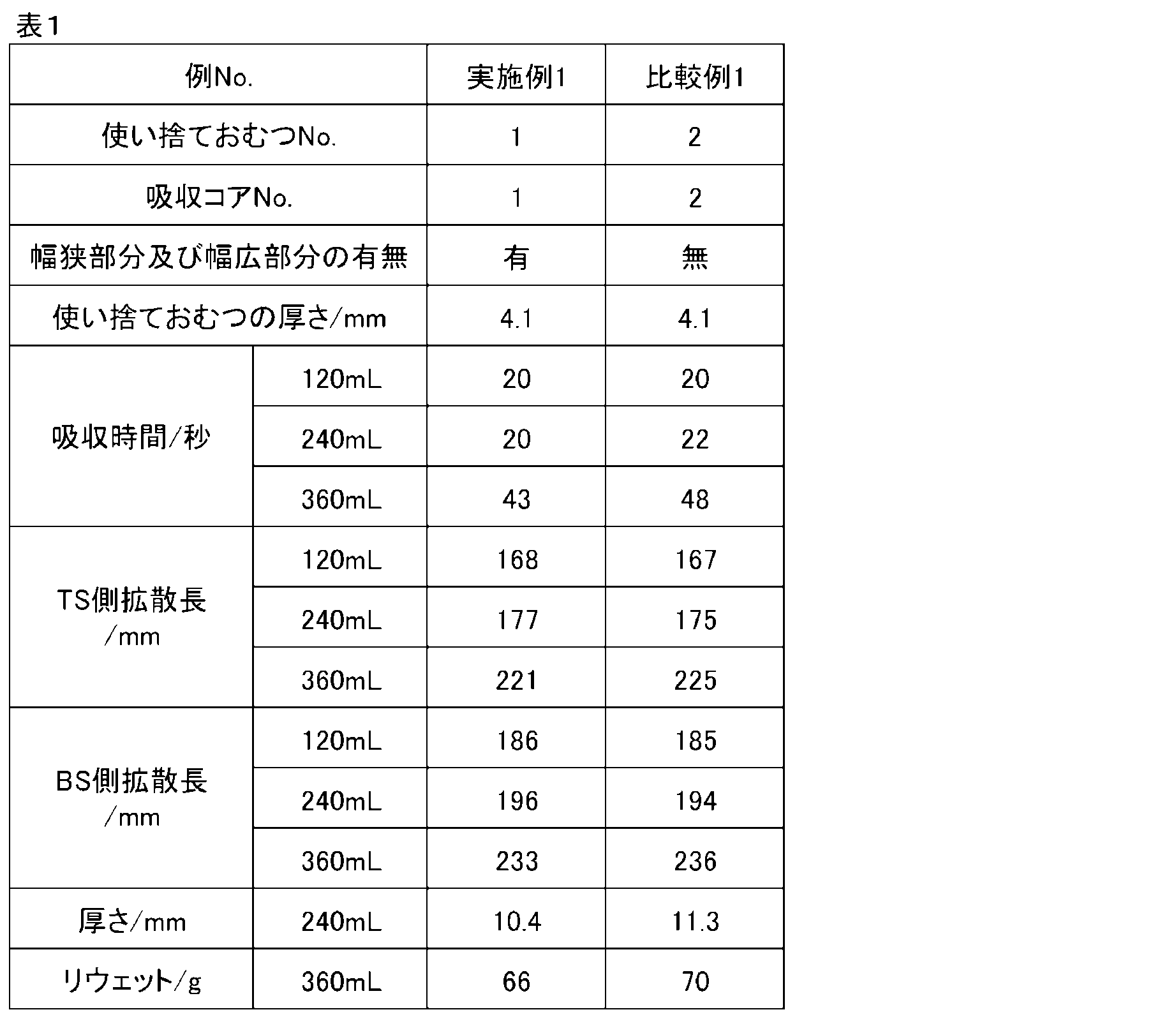
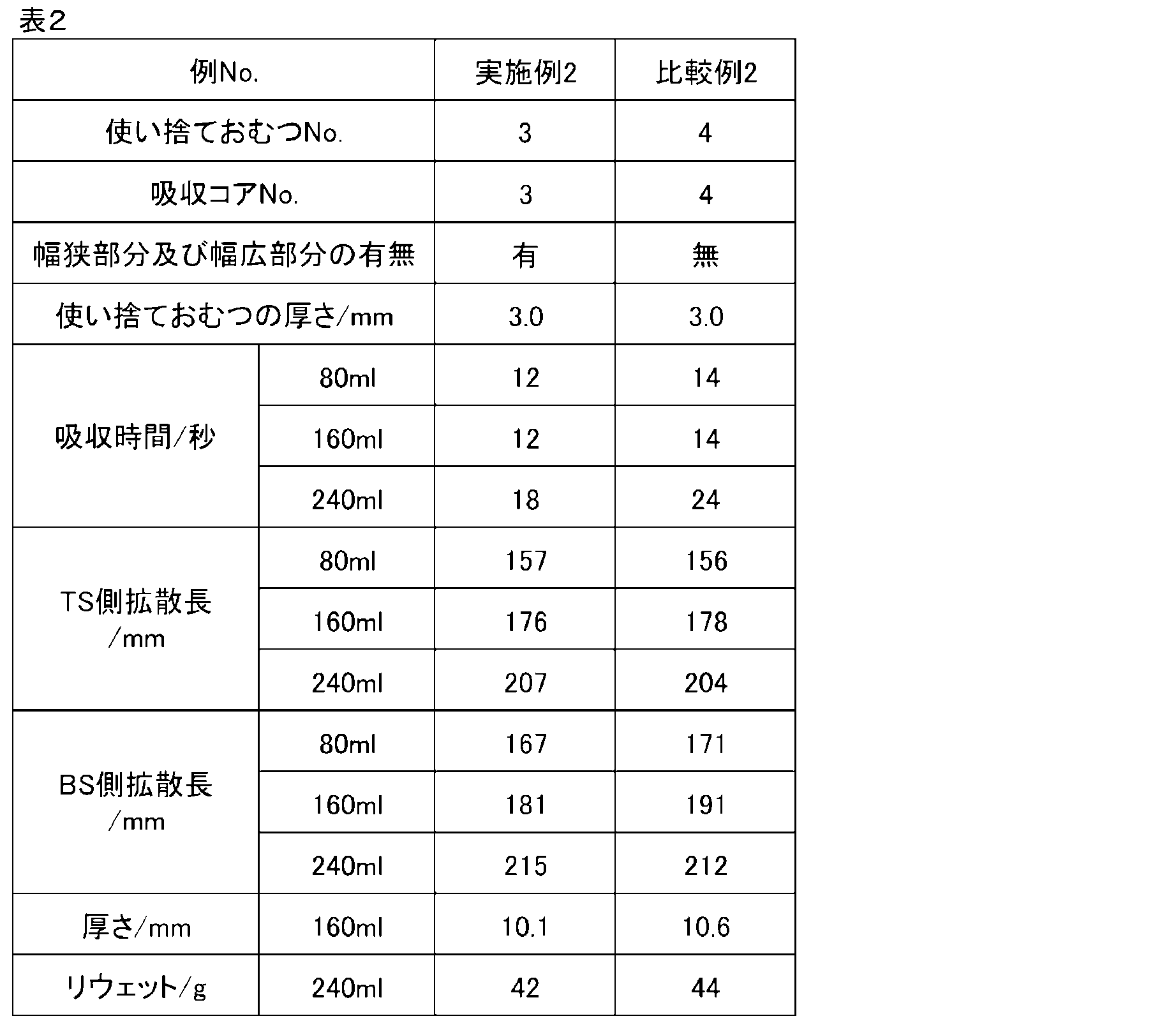
3 液透過性シート
5 液不透過性シート
7 吸収体
9 吸収コア
11 肌側面
13 非肌側面
15 コアラップ
17 パルプ繊維
19 高吸水性ポリマー
21 第1吸収コア部分
23 第2吸収コア部分
31 右縦溝
33 中央縦溝
35 左縦溝
L 長手方向
W 幅方向
T 厚さ方向
FD 前方
RD 後方
LC 長手方向中心線
WC 幅方向中心線
Claims (12)
- 長手方向及び幅方向を有するとともに、吸収コアを備えている吸収性物品であって、
前記吸収性物品が、前記吸収性物品の前記長手方向の中心を通り、前記幅方向に延びている幅方向中心線を備えており、
前記吸収コアが、前記幅方向中心線により、質量が相対的に小さい第1吸収コア部分と、質量が相対的に大きい第2吸収コア部分とに区画されており、
前記吸収コアが、前記幅方向中心線を跨いで、第1吸収コア部分から第2吸収コア部分に連続して配置されている、前記長手方向に沿う方向に延びている縦溝を備えており、
前記縦溝が、第1吸収コア部分に配置された、相対的に幅の狭い幅狭部分と、第2吸収コア部分に配置された、相対的に幅の広い幅広部分とを備えている、
ことを特徴とする、前記吸収性物品。 - 第1吸収コア部分及び第2吸収コア部分が、それぞれ、前方及び後方に配置されている、請求項1に記載の吸収性物品。
- 第1吸収コア部分及び第2吸収コア部分が、それぞれ、後方及び前方に配置されている、請求項1に記載の吸収性物品。
- 前記吸収コアが、前記幅方向の中心を通って前記長手方向に延びている長手方向中心線を備えており、
前記吸収コアが、第2吸収コア部分において、前記縦溝の前記幅広部分が、前記吸収コアの端部に近づくほど、前記長手方向中心線から遠ざかるように配置されている領域を備えている、
請求項1~3のいずれか一項に記載の吸収性物品。 - 前記吸収コアが、前記幅方向の中心を通って前記長手方向に延びている長手方向中心線を備えており、
前記吸収コアが、第1吸収コア部分において、前記縦溝の前記幅狭部分が、前記吸収コアの端部に近づくほど、前記長手方向中心線から遠ざかるように配置されている領域を備えている、
請求項1~4のいずれか一項に記載の吸収性物品。 - 第1吸収コア部分が、前記長手方向に3等分され、前記吸収コアの端部から順に、第1吸収コア第1部分、第1吸収コア第2部分及び第1吸収コア第3部分に区画されており、
前記幅狭部分が、第1吸収コア第3部分に配置されている、
請求項1~5のいずれか一項に記載の吸収性物品。 - 第2吸収コア部分が、前記長手方向に3等分され、前記幅方向中心線から順に、第2吸収コア第1部分、第2吸収コア第2部分及び第2吸収コア第3部分に区画されており、
前記幅広部分が、第2吸収コア第1部分に配置されている、
請求項1~6のいずれか一項に記載の吸収性物品。 - 前記縦溝において、前記幅狭部分と、前記幅広部分とが、直接連結されている、請求項1~7のいずれか一項に記載の吸収性物品。
- 前記吸収コアが、第1吸収コア部分に一対のくびれ部分を備えている、請求項1~8のいずれか一項に記載の吸収性物品。
- 前記吸収コアが、パルプ繊維及び高吸水性ポリマーを含み、
前記吸収コアが、肌側面及び非肌側面を備えており、
前記吸収コアの、前記肌側面における高吸水性ポリマーの平均密度が、前記吸収コアの、前記非肌側面における高吸水性ポリマーの平均密度よりも高い、
請求項1~9のいずれか一項に記載の吸収性物品。 - 長手方向及び幅方向を有する吸収コアを備えている吸収性物品であって、
前記吸収コアが、前記吸収性物品の前記長手方向の中心を通り、前記幅方向に延びている幅方向中心線により、質量が相対的に大きく且つ前記吸収性物品の前側に配置された前側吸収コア部分と、質量が相対的に小さく且つ前記吸収性物品の後側に配置された後側吸収コア部分とに区画されており、
前記吸収コアが、前記幅方向中心線を跨いで、前記前側吸収コア部分から前記後側吸収コア部分に連続して配置されている、前記長手方向に延びている縦溝を備えており、
前記縦溝が、前記前側吸収コア部分に配置された、相対的に幅の狭い幅狭部分と、前記後側吸収コア部分に配置された、相対的に幅の広い幅広部分と備えている、
ことを特徴とする、前記吸収性物品。 - 前記吸収コアが、前記幅方向の中心を通って前記長手方向に延びている長手方向中心線を備えており、
前記吸収コアが、前記前側吸収コア部分において、前記縦溝の前記幅狭部分が、前記吸収コアの端部に近づくほど、前記長手方向中心線から遠ざかるように配置されている領域を備えている、
請求項11に記載の吸収性物品。
Applications Claiming Priority (2)
| Application Number | Priority Date | Filing Date | Title |
|---|---|---|---|
| JP2022165630A JP2024058339A (ja) | 2022-10-14 | 2022-10-14 | 吸収性物品 |
| JP2022-165630 | 2022-10-14 |
Publications (1)
| Publication Number | Publication Date |
|---|---|
| WO2024080176A1 true WO2024080176A1 (ja) | 2024-04-18 |
Family
ID=90669155
Family Applications (1)
| Application Number | Title | Priority Date | Filing Date |
|---|---|---|---|
| PCT/JP2023/035841 Ceased WO2024080176A1 (ja) | 2022-10-14 | 2023-10-02 | 吸収性物品 |
Country Status (2)
| Country | Link |
|---|---|
| JP (1) | JP2024058339A (ja) |
| WO (1) | WO2024080176A1 (ja) |
Citations (2)
| Publication number | Priority date | Publication date | Assignee | Title |
|---|---|---|---|---|
| WO2019116956A1 (ja) * | 2017-12-14 | 2019-06-20 | 花王株式会社 | 吸収性物品 |
| WO2022004499A1 (ja) * | 2020-06-30 | 2022-01-06 | ユニ・チャーム株式会社 | 吸収性物品 |
-
2022
- 2022-10-14 JP JP2022165630A patent/JP2024058339A/ja active Pending
-
2023
- 2023-10-02 WO PCT/JP2023/035841 patent/WO2024080176A1/ja not_active Ceased
Patent Citations (2)
| Publication number | Priority date | Publication date | Assignee | Title |
|---|---|---|---|---|
| WO2019116956A1 (ja) * | 2017-12-14 | 2019-06-20 | 花王株式会社 | 吸収性物品 |
| WO2022004499A1 (ja) * | 2020-06-30 | 2022-01-06 | ユニ・チャーム株式会社 | 吸収性物品 |
Also Published As
| Publication number | Publication date |
|---|---|
| JP2024058339A (ja) | 2024-04-25 |
Similar Documents
| Publication | Publication Date | Title |
|---|---|---|
| JP7367247B2 (ja) | 吸収性物品 | |
| KR102313864B1 (ko) | 흡수성 물품 | |
| TWI777019B (zh) | 吸收性物品 | |
| CN109907885B (zh) | 吸收性物品用的吸收体 | |
| US20130165884A1 (en) | Liner for incontinence | |
| KR20220106757A (ko) | 흡수성 물품 | |
| JP6159636B2 (ja) | 吸収性物品 | |
| JP7412979B2 (ja) | 吸収性物品、及び、吸収性物品の製造方法 | |
| JP4804321B2 (ja) | 吸収性物品 | |
| JP2024058339A (ja) | 吸収性物品 | |
| JP2019042397A (ja) | 吸収性物品 | |
| CN214104886U (zh) | 纸尿裤 | |
| TWI763882B (zh) | 吸收性物品的透液性薄片用不織布及不織布卷 | |
| WO2015046516A1 (ja) | 吸収性物品 | |
| RU2762866C1 (ru) | Впитывающее изделие | |
| WO2025004360A1 (ja) | 吸収性物品 | |
| JP7362451B2 (ja) | 吸収性物品 | |
| JP7412978B2 (ja) | 吸収性物品 | |
| JP6604883B2 (ja) | 吸収性物品 | |
| JP7514818B2 (ja) | 軽失禁パッド | |
| JP7150531B2 (ja) | 吸収性物品 | |
| WO2025225337A1 (ja) | 吸収性物品 | |
| JPH08120590A (ja) | 拡散性吸収紙 | |
| WO2024069969A1 (ja) | 吸収性物品用の吸収体、及び当該吸収体の製造方法 | |
| JPH02168948A (ja) | 吸収性物品 |
Legal Events
| Date | Code | Title | Description |
|---|---|---|---|
| 121 | Ep: the epo has been informed by wipo that ep was designated in this application |
Ref document number: 23877181 Country of ref document: EP Kind code of ref document: A1 |
|
| WWE | Wipo information: entry into national phase |
Ref document number: 2501002173 Country of ref document: TH |
|
| WWE | Wipo information: entry into national phase |
Ref document number: 202517032529 Country of ref document: IN |
|
| REG | Reference to national code |
Ref country code: BR Ref legal event code: B01A Ref document number: 112025006357 Country of ref document: BR |
|
| WWP | Wipo information: published in national office |
Ref document number: 202517032529 Country of ref document: IN |
|
| NENP | Non-entry into the national phase |
Ref country code: DE |
|
| 122 | Ep: pct application non-entry in european phase |
Ref document number: 23877181 Country of ref document: EP Kind code of ref document: A1 |
|
| ENP | Entry into the national phase |
Ref document number: 112025006357 Country of ref document: BR Kind code of ref document: A2 Effective date: 20250331 |