WO2024075172A1 - 光送信器 - Google Patents
光送信器 Download PDFInfo
- Publication number
- WO2024075172A1 WO2024075172A1 PCT/JP2022/037036 JP2022037036W WO2024075172A1 WO 2024075172 A1 WO2024075172 A1 WO 2024075172A1 JP 2022037036 W JP2022037036 W JP 2022037036W WO 2024075172 A1 WO2024075172 A1 WO 2024075172A1
- Authority
- WO
- WIPO (PCT)
- Prior art keywords
- driver
- optical modulator
- optical
- modulator chip
- chip
- Prior art date
- Legal status (The legal status is an assumption and is not a legal conclusion. Google has not performed a legal analysis and makes no representation as to the accuracy of the status listed.)
- Ceased
Links
Images


Classifications
-
- G—PHYSICS
- G02—OPTICS
- G02F—OPTICAL DEVICES OR ARRANGEMENTS FOR THE CONTROL OF LIGHT BY MODIFICATION OF THE OPTICAL PROPERTIES OF THE MEDIA OF THE ELEMENTS INVOLVED THEREIN; NON-LINEAR OPTICS; FREQUENCY-CHANGING OF LIGHT; OPTICAL LOGIC ELEMENTS; OPTICAL ANALOGUE/DIGITAL CONVERTERS
- G02F1/00—Devices or arrangements for the control of the intensity, colour, phase, polarisation or direction of light arriving from an independent light source, e.g. switching, gating or modulating; Non-linear optics
- G02F1/01—Devices or arrangements for the control of the intensity, colour, phase, polarisation or direction of light arriving from an independent light source, e.g. switching, gating or modulating; Non-linear optics for the control of the intensity, phase, polarisation or colour
- G02F1/015—Devices or arrangements for the control of the intensity, colour, phase, polarisation or direction of light arriving from an independent light source, e.g. switching, gating or modulating; Non-linear optics for the control of the intensity, phase, polarisation or colour based on semiconductor elements having potential barriers, e.g. having a PN or PIN junction
- G02F1/017—Structures with periodic or quasi periodic potential variation, e.g. superlattices, quantum wells
Definitions
- This disclosure relates to an optical transmitter used in optical communications. More specifically, it relates to an implementation form of an optical transmitter that includes a semiconductor optical modulator and its driver IC.
- an optical transceiver in which an optical receiver and an optical transmitter are integrated is used.
- broadband analog components such as radio frequency (RF) electrical circuits are required; for example, an optical modulator requires a modulation bandwidth of 40 GHz or more.
- RF radio frequency
- HB-CDM High-Bandwidth Coherent Driver Modulator
- ICR Integrated Coherent Receiver
- semiconductor-based optical modulators are attracting attention as an alternative to conventional lithium niobate (LN) optical modulators due to their compact size and low cost.
- Compound semiconductors such as InP are mainly used for faster modulation operations.
- Si-based optical devices Furthermore, in systems where compact size and low cost are important, research and development is focused on Si-based optical devices.
- semiconductor optical modulators also have their own advantages and disadvantages, and for example, in an InP optical modulator, temperature control of the optical modulator chip is essential during operation to control the band edge absorption effect.
- an optical modulator made of LiNbO3 hereinafter referred to as "LN optical modulator”
- an optical modulator made of Si hereinafter referred to as "Si optical modulator”
- LN optical modulator LiNbO3
- Si optical modulator Si optical modulator
- the operating temperature (case temperature) of the optical transmitter must be in the range of at least -5°C to 75°C. In order to ensure such an operating temperature, it was common to only mount the optical modulator chip on the Peltier element, taking into account power consumption (Patent Document 1).
- this disclosure provides a new configuration and implementation form of an optical transmitter that suppresses the temperature dependency of an optical transmitter including a driver IC, has excellent high-speed performance, and is capable of stable operation regardless of the environmental temperature.
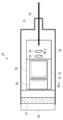
- the present disclosure provides an optical transmitter that includes an optical modulator chip, a driver IC that operates the optical modulator chip, and a Peltier element, the driver IC being placed on the Peltier element, and only the driver IC being temperature controlled.
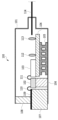
- FIG. 1 is a cross-sectional side view showing an implementation of a prior art HB-CDM optical transmitter.
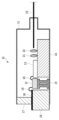
- FIG. 2 is a side cross-sectional view showing a first implementation of an optical transmitter using HB-CDM.
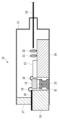
- FIG. 3 is a side cross-sectional view showing a second implementation of an optical transmitter using HB-CDM.
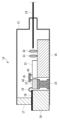
- FIG. 4 is a side cross-sectional view showing a third implementation of an optical transmitter using HB-CDM.
- FIG. 5 is a side cross-sectional view showing a fourth implementation of an optical transmitter using HB-CDM.
- FIG. 6 is a top view showing a modification of the fourth implementation form of the optical transmitter using HB-CDM.
- FIG. 7 is a side cross-sectional view showing another example of the fourth implementation of an optical transmitter according to HB-CDM.
- This disclosure presents new configurations for improving the temperature dependency of the high-frequency characteristics of an optical transmitter in an optical transmitter in which an optical modulator and its driver IC are integrally packaged, and implementation forms compatible with each configuration.
- the configuration for improving the temperature dependency includes a new use of a temperature regulator (TEC: Thermo Electric Cooler) in the optical transmitter.
- TEC Thermo Electric Cooler
- various implementation forms of the driver IC, optical modulator chip, and spatial optical components compatible with the new use of the TEC are also proposed.
- TECs are also known as thermoelectric coolers, and are known as small cooling devices that use Peltier junctions. TECs are made up of n-type semiconductors, p-type semiconductors, and metals, and when a direct current is passed through both sides of the plate-shaped element, heat is absorbed on one side and dissipated on the other. Reversing the direction of the current switches between heat absorption and dissipation, allowing for localized and precise temperature control of ICs and electronic components. For simplicity's sake, in the following explanation, the temperature regulator will be referred to as a TEC and described as a Peltier element. Any device that can control the temperature of a driver IC or optical modulator chip is not limited to one that uses a Peltier element.
- FIG. 1 is a side cross-sectional view showing the mounting form of an optical transmitter 100 using HB-CDM, a conventional technology.
- the optical transmitter 100 contains a driver IC 102, an optical modulator chip 103, and lenses 112 and 113, which are spatial optical components, inside a package housing 101 made of ceramic, metal, or a combination of these. More specifically, the optical modulator chip 103 is mounted on the bottom inside the housing 101 via a subcarrier 104 on a Peltier element 105. The right end of the optical modulator chip 103 in the drawing has an output end face for modulated light, and lenses 112 and 113 for optically coupling the modulated light to an optical fiber 114 are also mounted on the subcarrier.
- a driver IC 102 is mounted on a metal block or ceramic material 106 adjacent to the optical modulator chip 103.
- the package housing 101 has a wiring board base 107 and a package wall 108 as the left wall in the drawing, which, together with the package housing 101, separate the outside from the internal space of the optical transmitter.
- the optical transmitter 100 can also be constructed so that the entire package is airtight.
- the modulated electrical signal supplied from an external digital signal processor (DSP) is supplied to the optical modulator chip 103 via the wiring layer 109 and driver IC 102 of the wiring board base 107.
- the wiring layer 109 and the driver IC 102, and the driver IC 102 and the optical modulator chip 103 are connected by gold wires 110, 111, etc., respectively.
- the modulated electrical signal includes an I channel and a Q channel for each of the X polarization and the Y polarization.
- one channel is supplied as an electrical signal in a differential signal format, at least eight signal wirings and a GND wiring are required for one optical modulator, but the modulated signal format is not limited to this.
- the optical transmitter 100 shown in FIG. 1 can be mounted on a common device substrate together with an ICR package in which the receiving side TIA and optical receiver are integrated, and a DSP, to form an optical transmitting and receiving device.
- the Peltier element 105 in the optical transmitter 100. Temperature control is essential for the optical modulator chip 103 fabricated on an InP substrate, and the Peltier element 105 controls the temperature to a predetermined operating temperature. As shown in FIG. 1, the Peltier element 105 has a size that covers at least the entire area of the optical modulator chip 103, and its position may overlap the area of spatial optical components such as lenses.
- the optical transmitter 100 of the conventional technology it was considered that temperature control of the driver IC 102 was not necessary, and it was fixed in the package by a member 106 such as a metal block or ceramic. If the external temperature (ambient temperature) of the optical transmitter 100 rises, the operating temperature of the driver IC 102 also rises.
- the driver IC is also a heat source, so considering the heat generated by the driver IC, the operating temperature of the driver IC is estimated to be about +5 to 10°C higher than the external temperature.
- the maximum environmental temperature for use of an optical transceiver including an optical transmitter reaches 85°C
- the temperature of the driver IC 102 itself also reaches at least 85°C.
- the driver IC also consumes a large amount of power, and the driver IC itself generates heat. This means that the backside temperature of the driver IC exceeds the maximum environmental temperature of 85°C due to the influence of heat generated by the driver IC.
- the driver IC has temperature-dependent amplification characteristics (high frequency characteristics) of high frequency electrical signals, and at high temperatures the high frequency band tends to decrease compared to room temperature. Conversely, at low temperatures the high frequency band tends to increase compared to room temperature. Thus, the high frequency characteristics of the driver IC differ between low and high temperatures.
- the modulation signal supplied to the driver IC is optimized and compensated in various ways by the DSP at room temperature. However, dynamically updating such compensation in line with temperature fluctuations is a complex process and is not generally implemented. Because operation continues at a constant compensation state at room temperature, the compensation state of the modulation signal deviates from the optimal point when the state changes to a low or high temperature. This causes fluctuations and deterioration in the optical transmission characteristics and waveform quality of the optical transmitter.
- the IQ modulator of the optical modulator chip 103 is a linear modulator that preserves the amplitude and phase of the electrical signal, and fluctuations in the level and waveform quality of the modulated electrical signal directly affect the quality of the modulated output light. If the external temperature changes while the optical transmitter is in operation, the optical modulator chip itself is maintained at a constant temperature because it is temperature-controlled by a Peltier element, but the operating temperature of the driver IC changes. As a result, fluctuations in the level and quality of the HB-CDM modulated light occur, and temporal changes in the environmental temperature can cause deterioration and instability in the transmission characteristics.
- the deterioration of characteristics due to the environmental temperature on the high frequency side of the electrical signal causes waveform distortion of the modulated signal, degrading the modulation accuracy of the modulated output light from the optical modulator.
- a floor appears in the BER characteristics, leading to a deterioration in the transmission characteristics of the system.
- optical transmitter according to the present disclosure will be described in detail with reference to the drawings.
- the optical transmitter according to the present disclosure will be described as being in the form of an HB-CDM with a flexible printed circuit board (FPC) interface.
- FPC flexible printed circuit board
- Figure 2 is a side cross-sectional view showing a first implementation of an optical transmitter using the HB-CDM of the present disclosure.
- the optical transmitter 10 has an optical modulator chip 13, its driver IC 12, and other components integrated inside a package housing 11 aligned with the HB-CDM, similar to the conventional technology configuration shown in Figure 1.
- a driver IC 12 an optical modulator chip 13, and optical components (lenses 21 and 22, which are spatial optical components, are depicted as examples in Figure 2) are housed inside a package housing 11. More specifically, on the bottom surface of the housing 11, the optical modulator chip 13 is mounted face-up on a carrier 14 made of a metal block or a dielectric substrate, and the driver IC 12 is mounted face-up on a Peltier element 15. At the right end of the optical modulator chip 13 in the drawing is the emission end face of the modulated light, and lenses 21 and 22 for optically coupling the modulated light with an optical fiber 23 are also mounted on the carrier 14.
- the optical transmitter 10 includes a wiring board base 16 and a package wall 17 as the wall surface on the left side of the package housing 11 in the drawing, which, together with the package housing 11, separate the internal space of the optical transmitter from the outside.
- the wiring board base 16 also has an RF terrace (package terrace), and a wiring layer 18 formed on the upper surface of the RF terrace is connected to a flexible printed circuit board (FPC) as a high-frequency interface.
- the optical transmitter 10 can also be constructed with the entire package being airtight, but unlike an InP optical modulator, airtightness is not necessarily required in this implementation form which uses an LN optical modulator or a Si optical modulator.
- the modulated electrical signal supplied from an external digital signal processor (DSP) is supplied to the optical modulator chip 13 via the wiring layer 18 of the wiring board base 16 and the driver IC 12.
- the wiring layer 18 and the driver IC 12 are connected by a wire 19.
- the driver IC 12 and the optical modulator chip 13 are also connected by a wire 20.
- the wires 19 and 20 can be, for example, bonding wires such as gold wires.
- the optical modulator is not InP, but an LN optical modulator or a Si optical modulator made of LiNbO3 or Si that does not require temperature control.
- the optical transmitter 10 does not have a Peltier element for controlling the optical modulator.
- the optical modulator is mounted on the carrier 14, and is not mounted on the Peltier element. That is, in this implementation, only the driver IC 12 is mounted on the Peltier element 15, and the temperature control of the driver IC 12 is possible.
- the driver IC 12 must be mounted on the Peltier element 15 using conductive paste or solder with excellent thermal conductivity, with a thermal conductivity of 30 W/mK or more, to improve heat dissipation by the Peltier element 15.
- the carrier 14 functions as a base for fixing and holding the optical modulator chip 13 and the spatial optical components. If wiring is required on the carrier 14 to take out the DC wiring of the optical modulator chip, the carrier 14 can be made of a dielectric substrate, or the carrier 14 can be made of a metal block with a dielectric substrate provided on at least a portion of its upper surface for forming the wiring.
- the carrier 14 is depicted as being made up of one layer because it may be a metal block, but if the carrier 14 is made up of a dielectric substrate, it may be made up of multiple layers. Making it multi-layered makes it possible to implement a flexible element and wiring layout that makes full use of multi-layer wiring when there are a large number of DC wirings to the optical modulator or when cross wiring is required to change the order of the terminals. In addition, when a dielectric substrate is used, it is also possible to form positioning markers for mounting spatial optical components using metal patterns.
- the driver IC 12 and the optical modulator chip 13, and the wiring layer 18 formed on the upper surface of the RF terrace provided with the driver IC 12 and the wiring board base 16 are assumed to be connected using wire lines 19 and 20, which are, for example, bonding wires.
- wire lines 19 and 20 are, for example, bonding wires.
- the first mounting form regulations are set for the height direction and the planar direction.
- this first mounting form as shown in FIG. 2, nothing is sandwiched between the driver IC 12 and the Peltier element 15, and the driver IC 12 is mounted directly above the Peltier element 15.
- the optical modulator chip 13 and lenses 21, 22 are mounted on a carrier 14, and the height difference between the driver IC 12 and the modulator chip 13 is adjusted by adjusting the thickness of this carrier 14.
- the height difference between the driver IC 12 and the RF terrace can be set to the desired difference by adjusting the height of the wiring board base 16.
- the thickness of each component is adjusted so that the difference in height between the electrode pads of the driver IC 12 and the electrode pads of the optical modulator chip 13, and between the electrode pads of the driver IC 12 and the electrode pads of the RF terrace, is 100 ⁇ m or less.
- This value is shown as an example of a realistically achievable range when considering variations in mounting and variations in the thickness of the optical modulator chip 13 and driver IC 12, and by adjusting the thickness of each component, the height of the electrode pads on the top surface of the driver IC 12 and the optical modulator chip 13 can be made uniform.
- the height of the optical modulator chip 13 side slightly lower than the driver IC 12, and to mount the wire so that it rises from the optical modulator chip 13 side to the driver IC 12 side.
- the driver IC 12 and the RF terrace it is desirable to make the height of the driver IC 12 slightly lower than the RF terrace.
- the height of the optical modulator chip 13 side and the height of the driver IC 12, and the height of the driver IC and the RF terrace are the same.
- the planar gap between the optical modulator chip 13 and the driver IC 12 is directly related to the length of the wire, so it is desirable for the gap between the optical modulator chip 13 and the driver IC 12 to be as small as possible. Considering the accuracy of the mounting process and the risk of shorts, it is desirable for this gap to be controlled to, for example, 50 ⁇ m or less. Furthermore, even if the gap between the optical modulator chip and the driver IC is controlled, if the respective electrode pads are formed away from the chip end, there is no effect of shortening the length of the wire, so the electrode pads are formed at a position 50 ⁇ m or less from each chip end. If the distance from the chip end to the electrode pad is 50 ⁇ m or less, this can be achieved by ordinary dicing or cleaving.
- the driver IC is a heating element and was not considered to be a target for temperature control by a Peltier element. Driving power is required to operate the Peltier element, and no consideration was given to using extra power for a heating element.
- the inventors came up with the new idea of adding temperature control to the driver IC, which is a heating element.
- the optical transmitter 10 in the first implementation is composed of an optical modulator that does not require temperature control, such as an LN optical modulator or a Si optical modulator, and a driver IC.
- the optical modulator chip that does not require temperature control is mounted on a carrier 14 made of a metal block or a dielectric substrate, and only the driver IC is mounted on a Peltier element, making it possible to control the temperature of the driver IC, which requires temperature management, while also achieving power savings.
- the optical modulator itself does not require temperature control, and since it has almost no temperature dependency, there is no need to consider the effects of heat inflow from the Peltier element or driver IC, or thermal isolation from them.
- the optical transmitter of this implementation does not require a TEC for the optical modulator, and only the driver IC is mounted on the TEC, so the total power consumption is not significantly inferior to that of a conventional optical transmitter in which only an InP optical modulator is mounted on the TEC.
- the high-frequency characteristics of the driver IC 12 are better at low temperatures than at high temperatures, and from this perspective, the lower the set temperature of the Peltier element 15 that controls the temperature of the driver IC 12, the better.
- the set temperature is set too low, the improvement in the high-frequency characteristics of the driver IC is limited compared to the amount of power consumption of the Peltier element. Therefore, considering that the operating environment temperature of the optical transmitter 10 varies in the range of approximately -5°C to 85°C, it is most appropriate to control the Peltier element at a constant temperature in the range of 25°C to 50°C from the perspective of balancing power consumption and high-frequency characteristics.
- an optical transmitter can be realized in which the high-frequency characteristics do not deteriorate even when the outside temperature is high, and the high-frequency characteristics do not change even when the outside temperature changes.
- you prioritize characteristics and do not care about power consumption it is effective to set the temperature lower than 25°C to ensure the characteristics.
- the optical transmitter 10 of this implementation includes an optical modulator 13, a driver IC that operates the optical modulator, and a Peltier element 15, and the driver IC is placed on the Peltier element, so that the optical transmitter can be implemented as one in which only the driver IC is temperature controlled.
- Figure 3 is a side cross-sectional view showing a second implementation of an optical transmitter using the HB-CDM of the present disclosure.
- the optical transmitter 10 of the second implementation shown in Figure 3 has an optical modulator chip 13, its driver IC 12, and other components integrated inside a package housing 11 aligned with the HB-CDM, similar to the configuration shown in Figure 2.
- the package housing 11 has a wiring board base 16 and a package wall 17 as the wall on the left side of the drawing, and the configuration for dividing the inside and outside of the package is also the same.
- the driver IC 12 is mounted on the Peltier element 15 via a subcarrier 31 made of a metal block or a dielectric substrate.
- the subcarrier 31 may be made of a dielectric substrate, as in the carrier 14 on which the optical modulator chip 13 is mounted, or the subcarrier 31 may be made of a metal block and a dielectric substrate for forming wiring may be provided on at least a portion of the upper surface.
- the subcarrier 31 is made of a material with excellent thermal conductivity, such as aluminum nitride (AIN).
- the subcarrier is made of a dielectric substrate, it is preferable to use an AIN substrate that allows multilayer wiring.
- the thickness of the subcarrier 31 it is possible to adjust the height between the driver IC 12 and the optical modulator chip 13, and between the driver IC 12 and the RF terrace.
- a multi-layer AIN substrate can be used as the subcarrier 31, similar to the optical modulator chip described above.
- FIG. 4 is a side cross-sectional view showing a third implementation of an optical transmitter using the HB-CDM of the present disclosure.
- the optical modulator chip 13 and its driver IC 12 are integrally configured inside the package housing 11 along the HB-CDM, similar to the configuration shown in FIG. 2 and FIG. 3.
- the package housing 11 has a wiring board base 16 and a package wall surface 17 as the wall surface on the left side of the drawing, and the configuration for dividing the inside and outside of the package is also similar.
- the driver IC 12 and the optical modulator chip 13 are both connected by wires, but in the optical transmitter of this third implementation, the driver IC 12 and the optical modulator chip 13 are connected by a wiring board 41 instead of by wire connection.
- the driver IC 12 is mounted on the Peltier element 15, and the optical modulator chip 13 is mounted on the carrier 14, both in a face-up form.
- the driver IC 12 and the optical modulator chip 13 are connected by flip-chip mounting the wiring board 41 face-down.
- the driver IC 12 and the optical modulator chip 13 are connected by flip-chip mounting the wiring board 41 face-down. At this time, if there is a difference in height between the driver IC 12 and the optical modulator chip 13 of a certain level or more, the wiring board cannot be mounted properly. Therefore, in this third mounting form, the difference in height between the driver IC 12 and the optical modulator chip 13 is set to be as small as possible.
- the Au bumps/pillars or Cu bumps/pillars used for flip-chip mounting generally have a diameter and height of 100 ⁇ m or less. Therefore, it is desirable to control the difference in height between the driver IC 12 and the optical modulator chip 13 to at least 100 ⁇ m or less, and preferably 50 ⁇ m or less.
- the wiring board 41 when the wiring board 41 is flip-flop mounted, if the inclination of the height direction of the main surface of the wiring board 41 with respect to the main surface of the driver IC 12 or the optical modulator chip 13 exceeds ⁇ 3°, a bonding failure such as a gap may occur at the joint. In addition, a stress concentration part may occur at the joint, which may cause the joint to be fragile against vibration and shock and may cause the joint to break, and as a result, the long-term reliability of the device cannot be ensured.
- the thickness of the Peltier element 15 and the dielectric substrate 14 are the same, and the thickness of the driver IC 12 and the optical modulator chip 13 are also the same, so that the heights of the surfaces of the driver IC 12 and the optical modulator chip 13 are adjusted to match.
- the heights of the surfaces of the driver IC 12 and the optical modulator chip 13 are the same, so that the wiring substrate 41 is flip-chip mounted and connected as shown in FIG. 4, and it is possible to connect them using Au bumps/pillars or Cu bumps/pillars 42, 43.
- This third mounting form is a mounting form that does not use wires to connect the driver IC 12 and the optical modulator chip 13, so that the inductance can be greatly reduced compared to the first and second mounting forms.
- the distance between the driver IC and the optical modulator chip can be freely set, but taking into account the size of the pillars/bumps during implementation and the implementation accuracy, it is desirable to keep them apart by 300 ⁇ m or more. Also, from the perspective of strength during joining and degradation of high-frequency characteristics, it is desirable to keep the length of the wiring board to 2 mm or less at the longest, and the smaller the values of the dielectric constant and dielectric tangent, the more advantageous it is from the perspective of high frequency. Therefore, in this third implementation, it is desirable for the distance between the driver IC and the optical modulator chip to be in the range of 300 ⁇ m to 2 mm.
- an AIN board may be mounted between the driver IC and the Peltier element, as in the second mounting form in Figure 3.
- Other configurations and concepts are also the same as those in the second mounting form in Figure 3, so explanations of these will be omitted.
- the most desirable configuration is to mount the driver IC directly on a TEC such as a Peltier element.
- FIG. 5 is a cross-sectional side view showing a fourth implementation of an optical transmitter using HB-CDM according to the present disclosure.
- the optical transmitter 10 of the fourth embodiment shown in FIG. 5 has the driver IC 52 and the optical modulator chip 53 flip-chip mounted in a face-down configuration. Face-down means that the pad surfaces of the driver IC 52 and the optical modulator chip 53 are mounted facing downward in the drawing.
- the optical modulator chip 53 and its driver IC 52 are integrally configured inside the package housing 11 along the HB-CDM.
- the package housing 11 has a wiring board base 16 and a package wall surface 17 as the wall surface on the left side of the drawing, and the configuration for dividing the inside and outside of the package is also similar.
- the driver IC 12 and the optical modulator chip 13 are both flip-chip mounted face-down on the subcarrier 51 using Au pillars/bumps or Cu pillars/bumps.
- the driver IC 52 or the optical modulator chip 53 it is very important to manage the flatness of the top surface of the subcarrier 51 on which each component is mounted so that the mounted components do not tilt. For example, it is desirable that the flatness of the top surface of the subcarrier 51 on which each component is mounted is 0.05 mm or less.
- the temperature of the driver IC 52 flip-chip mounted face-down is controlled by the Peltier element 15, it is desirable that the gap between the driver IC 52 and the dielectric substrate 51 is filled with an underfill material 54 with excellent thermal conductivity.
- the underfill material with excellent thermal conductivity has a thermal conductivity of 3 W/mK or more.
- the optical modulator chip 53 in the fourth mounting form is an LN optical modulator or a Si optical modulator that does not require temperature control, like the above mounting forms, so there is no need to embed an underfill material 55 with high thermal conductivity between the optical modulator chip 53 and the subcarrier 51.
- embedding an underfill material 55 between each element mounted on the subcarrier and the dielectric substrate is very effective in terms of ensuring connection strength. For this reason, it is desirable to use an underfill material in the gap between the optical modulator chip and the subcarrier, although it may be the same material as the underfill material used between the driver IC and the subcarrier or a different material.
- flip-chip mounting is used for the connection between the driver IC and the optical modulator, which reduces the inductance of the electrical signal path to about 1/5 to 1/10 compared to normal wire connections, making it possible to achieve a wide bandwidth.
- the wiring is too long, losses increase and the high-frequency characteristics deteriorate, so it is better to have the distance between the driver IC and the optical modulator chip as close as possible.
- the subcarrier 51 of the fourth embodiment is composed of a dielectric substrate, on which wiring for taking out the DC wiring of the driver IC 52 and the optical modulator chip 53, RF lines for making an RF connection between the driver IC 52 and the optical modulator chip 53, etc. are formed by metal patterns.
- the subcarrier 51 is drawn as if it were a single layer, but as mentioned above, multiple DC wiring and RF lines are routed on the subcarrier 51, so it is desirable to configure it in multiple layers and layout it well so that the wiring does not interfere with each other.
- the temperature control of the driver IC 52 by the Peltier element 15 is performed via this subcarrier 51.
- the driver IC 52 also generates a large amount of heat. For this reason, it is desirable to use a material with as good thermal conductivity as possible for the subcarrier 51. Furthermore, since it also forms a high-frequency line, it is desirable for the dielectric constant and dielectric tangent to be as small as possible.
- a ceramic substrate such as an AIN substrate is suitable as a subcarrier made of a material with good thermal conductivity. If the subcarrier is made of an AIN substrate, multi-layer wiring is possible.
- the high frequency wiring for connecting the driver IC 52 and the optical modulator chip 53 in the subcarrier 51 is formed on the top surface of the subcarrier 51.
- the high frequency signal line is formed on the top surface, there is a possibility that the underfill material will end up on the high frequency signal line. It is difficult to control with high precision how much the underfill material protrudes around the chip. This can lead to asymmetry in the pair of high frequency signal lines (for example, I+ and I-) made up of differential lines, as well as variations between channels, which can adversely affect the high frequency characteristics and transmission characteristics.
- FIG. 6 is a top view showing a modified example of the fourth mounting form, and corresponds to a top view of the circuit surface inside the module when the housing 11 of the optical transmitter 10 shown in FIG. 5 is cut away.
- grooves 56-1 and 56-2 are formed on the top surface of the subcarrier 51 as shown by dotted lines in order to prevent the underfill material from flowing into the high-frequency signal lines of the subcarrier 51.
- the high-frequency wiring of the subcarrier 51 is configured in the dotted area 57 between the driver IC 52 and the optical modulator chip 53.
- the driver IC 52 and the optical modulator chip 53 each have electrode pads formed around them.
- a linear groove 56-1 is formed on only one side of the high-frequency wiring area 57 for the driver IC 52, and a rectangular groove 56-2 is formed near the periphery of the chip 4 for the optical modulator chip 53.
- the shape of the groove is not limited to the configuration shown in FIG. 6, and can be changed according to the properties of the underfill material and the shape of the wiring on the subcarrier that should not be affected.
- the groove 56-1 of the driver IC 52 is only on one side on the optical modulator chip side, but it may be formed in a rectangular shape around the periphery of the driver IC 4.
- a linear groove may be added to one side of the driver IC on the RF terrace side, i.e., on the wiring board base 16 side.
- the underfill material rises up near the chip end face on the lens side of the optical modulator chip 53, the underfill material may adhere to the emission end face, deteriorating the optical coupling with the lenses 21 and 22.
- the groove on one side of the rectangular groove 56-1 on the lens 21 side of the optical modulator chip 53 shown in FIG. 6 is also effective in avoiding such optical coupling problems.
- the subcarrier 51 is formed in a multi-layer structure, it is possible to avoid the effects of the above-mentioned underfill material by configuring the high-frequency lines as inner layers of the dielectric substrate. Also, if the high-frequency wiring is configured as an inner layer, a groove can be formed at any location on the top surface of the subcarrier 51 between the optical modulator chip and the driver IC. Needless to say, sufficient consideration must be given to the effects on disconnection of the inner layer wiring and characteristic impedance. On the other hand, when designing high-frequency wiring with the same line impedance, the signal line width becomes narrower in the inner layer wiring due to the effects of the effective dielectric constant of the subcarrier. Furthermore, since it is also affected by the dielectric loss tangent of the subcarrier, it is desirable to have a wiring pattern on the outermost surface of the subcarrier 51 when only considering the loss of the high-frequency line.
- lenses 21 and 22 are arranged on the carrier 14 on the side opposite the driver IC 52 of the optical modulator chip 53.
- at least one lens can also be arranged on the upper or lower side of the optical modulator chip 53 when viewed from the top view of FIG. 6. That is, the spatial optics is mounted above the carrier 14 on a side different from the side of the optical modulator chip facing the driver IC 12.
- a groove for allowing excess underfill material to escape can be formed near the side of the optical modulator chip that corresponds to the spatial optics.
- the optical modulator chip 53 is mounted in a face-down form. Therefore, the waveguide that emits the modulator output light of the optical modulator chip 53 is located close to the subcarrier 51 in the height direction. Depending on the height of the waveguide from the bottom surface of the optical modulator chip 53, the height of the Au pillar/bump or Cu pillar/bump, and the size of the lens, it may be difficult to mount the lens. Therefore, in this mounting form, the subcarrier 51 is mainly located only under the driver IC and the optical modulator chip, as shown in FIG. 5, and the spatial optical member is mounted directly on the carrier 14. That is, in this mounting form, the subcarrier 51 is not present in the part where the spatial optical member (lenses 24, 25 in FIG. 5) is mounted, and the lens can be mounted by providing a height difference between the position of the waveguide and the upper surface of the carrier 14 where the lens is mounted, which is equal to the thickness of the subcarrier 51.
- the height adjustment carrier 14 is made of a dielectric substrate, an alignment mark for optical mounting can be provided on it.
- FIG. 7 is a side cross-sectional view showing another example of the fourth implementation form shown in FIG. 5.
- the optical transmitter 10 in FIG. 7 differs from the optical transmitter 10 in FIG. 5 in the implementation form of the lenses 21 and 22.
- the thickness of the carrier 14 is changed between the mounting area of the optical modulator chip and the mounting area of the spatial optical components such as lenses, making it easier to optically couple the lenses.
- the carrier part 14-1 in the mounting area of the lenses 21 and 22 is thinner than the carrier part 14-2 in the area of the optical modulator chip 53. It is desirable to make the thickness of the carrier for the carrier part 14-1 mounting the spatial optical components equal to or greater than the radius of the lens. For example, assuming that the diameter of the lens is 500 ⁇ m, the carrier part 14-1 needs to be lowered from the top surface by at least 250 ⁇ m or more to make it thinner.
- the thickness of the underfill materials 54 and 55 By controlling the thickness of the underfill materials 54 and 55 to be the same height as the Au pillar or Cu pillar, it is possible to align the optical axis from the emission point of the optically modulated output light to the optical fiber 23.
- the height of the carrier 14 can also be changed by using the carrier as a multilayer board and reducing the number of layers of the subcarrier part 14-2 in the mounting area of the lenses 21 and 22.
- FIG. 5 only a driver IC and an optical modulator chip are mounted on the subcarrier 51, and an example is shown in which the subcarrier is not present in the area where the spatial optical component is mounted.
- the subcarrier 51 may be extended to the area where the spatial optical component is mounted, and the spatial optical component may be mounted on the subcarrier 51. In that case, a step may be formed by slightly removing the area of the subcarrier 51 where the spatial optical component is mounted.
- Fig. 5 and Fig. 7 show examples in which a lens is used as a spatial optical element to optically couple the optical modulator and the optical fiber
- a lens may not be implemented.
- the optical modulator and the optical fiber are directly optically coupled without using a lens, it is possible to easily align the optical axis between the light emitted from the optical modulator and the optical fiber in accordance with the shape of the fiber, etc.
- the connection between the driver IC and the RF terrace may be made by flip-chip mounting using a wiring board and pillars/bumps instead of wires.
- the height difference between the upper surfaces of the driver IC and the wiring layer of the RF terrace must be at least 100 ⁇ m or less (ideally 50 ⁇ m or less), and the inclination of the surface of the wiring board used for connection with respect to the surface of the wiring layer of the driver IC and the RF terrace must be within ⁇ 3°.
- the material of the wiring board and the pillars/bumps may be the same as or different from the wiring board 41 and the pillars/bumps 42, 43 in the third mounting form, but it is preferable to use the same material from the viewpoint of cost.
- the input/output pads of the driver IC are the same, and the pad shape and pitch of the connection part between the optical modulator chip and the wiring layer are the same, so that the same wiring board can be used to reduce costs.
- first to fourth mounting forms all have a configuration in which a lens is mounted as the spatial optical component, they can also be implemented in the same way for optical transmitters with configurations other than those that mount a lens.
- the mounted component may be a component for fixing optical fiber, a PBC (Polarization Beam Combiner), etc., in addition to a lens.
- PBC Poly Beam Combiner
- it is not limited to mounting a lens, and it may also be a configuration in which a spatial optical component other than a lens is mounted, or a configuration in which no spatial optical component is mounted.
- this disclosure makes it possible to realize a new configuration and implementation form of an optical transmitter that suppresses the temperature dependency of the optical transmitter including the driver IC, has excellent high speed, and is capable of stable operation regardless of the environmental temperature.
- This invention can be used in optical communication networks.
Landscapes
- Physics & Mathematics (AREA)
- Nonlinear Science (AREA)
- General Physics & Mathematics (AREA)
- Optics & Photonics (AREA)
- Optical Modulation, Optical Deflection, Nonlinear Optics, Optical Demodulation, Optical Logic Elements (AREA)
Priority Applications (2)
| Application Number | Priority Date | Filing Date | Title |
|---|---|---|---|
| PCT/JP2022/037036 WO2024075172A1 (ja) | 2022-10-03 | 2022-10-03 | 光送信器 |
| JP2024555494A JPWO2024075172A1 (https=) | 2022-10-03 | 2022-10-03 |
Applications Claiming Priority (1)
| Application Number | Priority Date | Filing Date | Title |
|---|---|---|---|
| PCT/JP2022/037036 WO2024075172A1 (ja) | 2022-10-03 | 2022-10-03 | 光送信器 |
Publications (1)
| Publication Number | Publication Date |
|---|---|
| WO2024075172A1 true WO2024075172A1 (ja) | 2024-04-11 |
Family
ID=90607719
Family Applications (1)
| Application Number | Title | Priority Date | Filing Date |
|---|---|---|---|
| PCT/JP2022/037036 Ceased WO2024075172A1 (ja) | 2022-10-03 | 2022-10-03 | 光送信器 |
Country Status (2)
| Country | Link |
|---|---|
| JP (1) | JPWO2024075172A1 (https=) |
| WO (1) | WO2024075172A1 (https=) |
Citations (13)
| Publication number | Priority date | Publication date | Assignee | Title |
|---|---|---|---|---|
| JP2003209267A (ja) * | 2002-01-17 | 2003-07-25 | Hitachi Cable Ltd | 光部品の実装方法 |
| JP2003243444A (ja) * | 2002-02-20 | 2003-08-29 | Nippon Telegr & Teleph Corp <Ntt> | 基板実装構造及び半導体装置 |
| JP2008517459A (ja) * | 2004-10-14 | 2008-05-22 | アギア システムズ インコーポレーテッド | 熱エネルギー放散を改善したプリント回路板組立体 |
| JP2011221370A (ja) * | 2010-04-13 | 2011-11-04 | Nippon Telegr & Teleph Corp <Ntt> | 光送信機 |
| US8300994B2 (en) * | 2001-10-09 | 2012-10-30 | Infinera Corporation | Transmitter photonic integrated circuit (TxPIC) chip |
| JP2014035293A (ja) * | 2012-08-09 | 2014-02-24 | Hitachi Medical Corp | 放射線検出器及びx線ct装置 |
| JP2014203971A (ja) * | 2013-04-04 | 2014-10-27 | 日東電工株式会社 | アンダーフィルフィルム、封止シート、半導体装置の製造方法及び半導体装置 |
| US20150180580A1 (en) * | 2012-11-14 | 2015-06-25 | Infinera Corp. | Interconnect Bridge Assembly for Photonic Integrated Circuits |
| US20150260930A1 (en) * | 2010-11-19 | 2015-09-17 | Electronics And Telecommunications Research Institute | Optical modules |
| JP2017123379A (ja) * | 2016-01-05 | 2017-07-13 | 富士通株式会社 | 半導体装置 |
| JP2018189699A (ja) * | 2017-04-28 | 2018-11-29 | 日本電信電話株式会社 | 光送信器 |
| JP2020095122A (ja) * | 2018-12-11 | 2020-06-18 | 日本電信電話株式会社 | 光送信機 |
| JP2021509483A (ja) * | 2017-12-26 | 2021-03-25 | 住友電気工業株式会社 | 光モジュール及び光モジュールの組立方法 |
-
2022
- 2022-10-03 WO PCT/JP2022/037036 patent/WO2024075172A1/ja not_active Ceased
- 2022-10-03 JP JP2024555494A patent/JPWO2024075172A1/ja active Pending
Patent Citations (13)
| Publication number | Priority date | Publication date | Assignee | Title |
|---|---|---|---|---|
| US8300994B2 (en) * | 2001-10-09 | 2012-10-30 | Infinera Corporation | Transmitter photonic integrated circuit (TxPIC) chip |
| JP2003209267A (ja) * | 2002-01-17 | 2003-07-25 | Hitachi Cable Ltd | 光部品の実装方法 |
| JP2003243444A (ja) * | 2002-02-20 | 2003-08-29 | Nippon Telegr & Teleph Corp <Ntt> | 基板実装構造及び半導体装置 |
| JP2008517459A (ja) * | 2004-10-14 | 2008-05-22 | アギア システムズ インコーポレーテッド | 熱エネルギー放散を改善したプリント回路板組立体 |
| JP2011221370A (ja) * | 2010-04-13 | 2011-11-04 | Nippon Telegr & Teleph Corp <Ntt> | 光送信機 |
| US20150260930A1 (en) * | 2010-11-19 | 2015-09-17 | Electronics And Telecommunications Research Institute | Optical modules |
| JP2014035293A (ja) * | 2012-08-09 | 2014-02-24 | Hitachi Medical Corp | 放射線検出器及びx線ct装置 |
| US20150180580A1 (en) * | 2012-11-14 | 2015-06-25 | Infinera Corp. | Interconnect Bridge Assembly for Photonic Integrated Circuits |
| JP2014203971A (ja) * | 2013-04-04 | 2014-10-27 | 日東電工株式会社 | アンダーフィルフィルム、封止シート、半導体装置の製造方法及び半導体装置 |
| JP2017123379A (ja) * | 2016-01-05 | 2017-07-13 | 富士通株式会社 | 半導体装置 |
| JP2018189699A (ja) * | 2017-04-28 | 2018-11-29 | 日本電信電話株式会社 | 光送信器 |
| JP2021509483A (ja) * | 2017-12-26 | 2021-03-25 | 住友電気工業株式会社 | 光モジュール及び光モジュールの組立方法 |
| JP2020095122A (ja) * | 2018-12-11 | 2020-06-18 | 日本電信電話株式会社 | 光送信機 |
Also Published As
| Publication number | Publication date |
|---|---|
| JPWO2024075172A1 (https=) | 2024-04-11 |
Similar Documents
| Publication | Publication Date | Title |
|---|---|---|
| KR100575969B1 (ko) | 티오-캔 구조의 광 모듈 | |
| JP5144628B2 (ja) | To−can型tosaモジュール | |
| US20150116809A1 (en) | Optical module | |
| US6404042B1 (en) | Subcarrier and semiconductor device | |
| JP6770478B2 (ja) | 光送信器 | |
| US6735353B2 (en) | Module for optical transmitter | |
| JP4718135B2 (ja) | 光モジュール | |
| JP6984801B1 (ja) | 半導体レーザ光源装置 | |
| WO2020075530A1 (ja) | 光モジュール | |
| WO2024134864A1 (ja) | 光モジュール | |
| WO2024075172A1 (ja) | 光送信器 | |
| JP2006072171A (ja) | 光モジュール | |
| JP7817633B2 (ja) | 光送信器 | |
| US20260126675A1 (en) | Optical Transmitter | |
| WO2024075168A1 (ja) | 光送信器 | |
| WO2024075166A1 (ja) | 光送信器 | |
| US20250383577A1 (en) | Optical device and optical transmission apparatus using the same | |
| WO2024075171A1 (ja) | 光送信器 | |
| WO2024075170A1 (ja) | 光送信器 | |
| WO2024075169A1 (ja) | 光送信器 | |
| US20260128798A1 (en) | Optical Transmitter | |
| JP5837389B2 (ja) | 光通信装置 | |
| US20260029595A1 (en) | Light Modulation Device | |
| US12210231B2 (en) | Optical module and manufacturing method of optical module for optical communication | |
| JP7705071B2 (ja) | 光送信器 |
Legal Events
| Date | Code | Title | Description |
|---|---|---|---|
| 121 | Ep: the epo has been informed by wipo that ep was designated in this application |
Ref document number: 22961362 Country of ref document: EP Kind code of ref document: A1 |
|
| WWE | Wipo information: entry into national phase |
Ref document number: 2024555494 Country of ref document: JP |
|
| NENP | Non-entry into the national phase |
Ref country code: DE |
|
| 122 | Ep: pct application non-entry in european phase |
Ref document number: 22961362 Country of ref document: EP Kind code of ref document: A1 |