WO2024062804A1 - プラズマ処理装置及びプラズマ処理方法 - Google Patents
プラズマ処理装置及びプラズマ処理方法 Download PDFInfo
- Publication number
- WO2024062804A1 WO2024062804A1 PCT/JP2023/029469 JP2023029469W WO2024062804A1 WO 2024062804 A1 WO2024062804 A1 WO 2024062804A1 JP 2023029469 W JP2023029469 W JP 2023029469W WO 2024062804 A1 WO2024062804 A1 WO 2024062804A1
- Authority
- WO
- WIPO (PCT)
- Prior art keywords
- period
- length
- substrate support
- plasma processing
- voltage
- Prior art date
- Legal status (The legal status is an assumption and is not a legal conclusion. Google has not performed a legal analysis and makes no representation as to the accuracy of the status listed.)
- Ceased
Links
Images



Classifications
-
- H—ELECTRICITY
- H01—ELECTRIC ELEMENTS
- H01J—ELECTRIC DISCHARGE TUBES OR DISCHARGE LAMPS
- H01J37/00—Discharge tubes with provision for introducing objects or material to be exposed to the discharge, e.g. for the purpose of examination or processing thereof
- H01J37/32—Gas-filled discharge tubes
- H01J37/32009—Arrangements for generation of plasma specially adapted for examination or treatment of objects, e.g. plasma sources
- H01J37/32082—Radio frequency generated discharge
- H01J37/32174—Circuits specially adapted for controlling the RF discharge
-
- C—CHEMISTRY; METALLURGY
- C23—COATING METALLIC MATERIAL; COATING MATERIAL WITH METALLIC MATERIAL; CHEMICAL SURFACE TREATMENT; DIFFUSION TREATMENT OF METALLIC MATERIAL; COATING BY VACUUM EVAPORATION, BY SPUTTERING, BY ION IMPLANTATION OR BY CHEMICAL VAPOUR DEPOSITION, IN GENERAL; INHIBITING CORROSION OF METALLIC MATERIAL OR INCRUSTATION IN GENERAL
- C23C—COATING METALLIC MATERIAL; COATING MATERIAL WITH METALLIC MATERIAL; SURFACE TREATMENT OF METALLIC MATERIAL BY DIFFUSION INTO THE SURFACE, BY CHEMICAL CONVERSION OR SUBSTITUTION; COATING BY VACUUM EVAPORATION, BY SPUTTERING, BY ION IMPLANTATION OR BY CHEMICAL VAPOUR DEPOSITION, IN GENERAL
- C23C16/00—Chemical coating by decomposition of gaseous compounds, without leaving reaction products of surface material in the coating, i.e. chemical vapour deposition [CVD] processes
- C23C16/44—Chemical coating by decomposition of gaseous compounds, without leaving reaction products of surface material in the coating, i.e. chemical vapour deposition [CVD] processes characterised by the method of coating
-
- G—PHYSICS
- G01—MEASURING; TESTING
- G01R—MEASURING ELECTRIC VARIABLES; MEASURING MAGNETIC VARIABLES
- G01R19/00—Arrangements for measuring currents or voltages or for indicating presence or sign thereof
- G01R19/145—Indicating the presence of current or voltage
- G01R19/155—Indicating the presence of voltage
-
- H—ELECTRICITY
- H01—ELECTRIC ELEMENTS
- H01J—ELECTRIC DISCHARGE TUBES OR DISCHARGE LAMPS
- H01J37/00—Discharge tubes with provision for introducing objects or material to be exposed to the discharge, e.g. for the purpose of examination or processing thereof
- H01J37/32—Gas-filled discharge tubes
- H01J37/32009—Arrangements for generation of plasma specially adapted for examination or treatment of objects, e.g. plasma sources
- H01J37/32082—Radio frequency generated discharge
- H01J37/32137—Radio frequency generated discharge controlling of the discharge by modulation of energy
- H01J37/32146—Amplitude modulation, includes pulsing
-
- H—ELECTRICITY
- H01—ELECTRIC ELEMENTS
- H01J—ELECTRIC DISCHARGE TUBES OR DISCHARGE LAMPS
- H01J37/00—Discharge tubes with provision for introducing objects or material to be exposed to the discharge, e.g. for the purpose of examination or processing thereof
- H01J37/32—Gas-filled discharge tubes
- H01J37/32431—Constructional details of the reactor
- H01J37/32697—Electrostatic control
- H01J37/32706—Polarising the substrate
-
- H—ELECTRICITY
- H01—ELECTRIC ELEMENTS
- H01J—ELECTRIC DISCHARGE TUBES OR DISCHARGE LAMPS
- H01J37/00—Discharge tubes with provision for introducing objects or material to be exposed to the discharge, e.g. for the purpose of examination or processing thereof
- H01J37/32—Gas-filled discharge tubes
- H01J37/32431—Constructional details of the reactor
- H01J37/32715—Workpiece holder
-
- H—ELECTRICITY
- H05—ELECTRIC TECHNIQUES NOT OTHERWISE PROVIDED FOR
- H05H—PLASMA TECHNIQUE; PRODUCTION OF ACCELERATED ELECTRICALLY-CHARGED PARTICLES OR OF NEUTRONS; PRODUCTION OR ACCELERATION OF NEUTRAL MOLECULAR OR ATOMIC BEAMS
- H05H1/00—Generating plasma; Handling plasma
- H05H1/24—Generating plasma
- H05H1/46—Generating plasma using applied electromagnetic fields, e.g. high frequency or microwave energy
-
- H—ELECTRICITY
- H10—SEMICONDUCTOR DEVICES; ELECTRIC SOLID-STATE DEVICES NOT OTHERWISE PROVIDED FOR
- H10P—GENERIC PROCESSES OR APPARATUS FOR THE MANUFACTURE OR TREATMENT OF DEVICES COVERED BY CLASS H10
- H10P14/00—Formation of materials, e.g. in the shape of layers or pillars
- H10P14/20—Formation of materials, e.g. in the shape of layers or pillars of semiconductor materials
- H10P14/29—Formation of materials, e.g. in the shape of layers or pillars of semiconductor materials characterised by the substrates
-
- H—ELECTRICITY
- H10—SEMICONDUCTOR DEVICES; ELECTRIC SOLID-STATE DEVICES NOT OTHERWISE PROVIDED FOR
- H10P—GENERIC PROCESSES OR APPARATUS FOR THE MANUFACTURE OR TREATMENT OF DEVICES COVERED BY CLASS H10
- H10P50/00—Etching of wafers, substrates or parts of devices
- H10P50/20—Dry etching; Plasma etching; Reactive-ion etching
- H10P50/24—Dry etching; Plasma etching; Reactive-ion etching of semiconductor materials
- H10P50/242—Dry etching; Plasma etching; Reactive-ion etching of semiconductor materials of Group IV materials
-
- H—ELECTRICITY
- H01—ELECTRIC ELEMENTS
- H01J—ELECTRIC DISCHARGE TUBES OR DISCHARGE LAMPS
- H01J37/00—Discharge tubes with provision for introducing objects or material to be exposed to the discharge, e.g. for the purpose of examination or processing thereof
- H01J37/32—Gas-filled discharge tubes
- H01J37/32009—Arrangements for generation of plasma specially adapted for examination or treatment of objects, e.g. plasma sources
- H01J37/32082—Radio frequency generated discharge
- H01J37/32091—Radio frequency generated discharge the radio frequency energy being capacitively coupled to the plasma
Definitions
- the exemplary embodiments of the present disclosure relate to a plasma processing apparatus and a plasma processing method.
- a plasma processing apparatus is used in plasma processing of a substrate.
- the plasma processing apparatus includes a chamber and a substrate support.
- a substrate support is provided within the chamber.
- the plasma processing apparatus described in Patent Document 1 below applies a DC negative pulse voltage to a substrate support in order to draw ions into the substrate from plasma generated within a chamber.
- the present disclosure provides techniques for adjusting the maximum voltage level of each of a plurality of voltage pulses applied as an electrical bias to a substrate support of a plasma processing apparatus.
- a plasma processing apparatus in one exemplary embodiment, includes a chamber, a substrate support, a plasma generation unit, and a bias power supply.
- the substrate support is disposed within the chamber.
- the plasma generation unit is configured to generate a plasma from a gas within the chamber.
- the bias power supply is configured to apply a sequence of a plurality of voltage pulses as an electrical bias to the substrate support.
- the bias power supply is configured to adjust a maximum voltage level of each of the plurality of voltage pulses by adjusting the length of an ON period of each of the plurality of voltage pulses.
- FIG. 1 is a diagram for explaining a configuration example of a plasma processing system.
- FIG. 2 is a diagram for explaining a configuration example of a capacitively coupled plasma processing apparatus.
- 1 is a timing chart of an example electrical bias used in a plasma processing apparatus according to an example embodiment.
- FIG. 3 is a diagram showing the relationship between the voltage level of an example voltage pulse and the length of an ON period. 1 is a timing chart of an example electrical bias used in a plasma processing apparatus according to an example embodiment.
- FIG. 3 is a diagram for explaining another configuration example of a capacitively coupled plasma processing apparatus.
- 1 is a flowchart of a plasma processing method according to one exemplary embodiment.
- FIG. 1 is a diagram for explaining a configuration example of a plasma processing system.
- a plasma processing system includes a plasma processing apparatus 1 and a controller 2.
- the plasma processing system is an example of a substrate processing system
- the plasma processing apparatus 1 is an example of a substrate processing apparatus.
- the plasma processing apparatus 1 includes a plasma processing chamber 10, a substrate support section 11, and a plasma generation section 12.
- the plasma processing chamber 10 has a plasma processing space.
- the plasma processing chamber 10 also includes at least one gas supply port for supplying at least one processing gas to the plasma processing space, and at least one gas exhaust port for discharging gas from the plasma processing space.
- the gas supply port is connected to a gas supply section 20, which will be described later, and the gas discharge port is connected to an exhaust system 40, which will be described later.
- the substrate support section 11 is disposed within the plasma processing space and has a substrate support surface for supporting a substrate.
- the plasma generation unit 12 is configured to generate plasma from at least one processing gas supplied into the plasma processing space.
- the plasmas formed in the plasma processing space are capacitively coupled plasma (CCP), inductively coupled plasma (ICP), and ECR plasma (Electron-Cyclotron-Resonance Plasma).
- CCP capacitively coupled plasma
- ICP inductively coupled plasma
- ECR plasma Electro-Cyclotron-Resonance Plasma
- HWP Helicon wave excited plasma
- SWP surface wave plasma
- various types of plasma generation sections may be used, including an AC (Alternating Current) plasma generation section and a DC (Direct Current) plasma generation section.
- the AC signal (AC power) used in the AC plasma generator has a frequency in the range of 100 kHz to 10 GHz. Therefore, the AC signal includes an RF (Radio Frequency) signal and a microwave signal.
- the RF signal has a frequency within the range of 100kHz to 150MHz.
- the control unit 2 processes computer-executable instructions that cause the plasma processing apparatus 1 to perform various steps described in this disclosure.
- the control unit 2 may be configured to control each element of the plasma processing apparatus 1 to perform the various steps described herein. In one embodiment, part or all of the control unit 2 may be included in the plasma processing apparatus 1.
- the control unit 2 may include a processing unit 2a1, a storage unit 2a2, and a communication interface 2a3.
- the control unit 2 is realized by, for example, a computer 2a.
- the processing unit two a1 may be configured to read a program from the storage unit two a2 and perform various control operations by executing the read program. This program may be stored in the storage unit 2a2 in advance, or may be acquired via a medium when necessary.
- the acquired program is stored in the storage unit 2a2, and is read out from the storage unit 2a2 and executed by the processing unit 2a1.
- the medium may be various storage media readable by the computer 2a, or may be a communication line connected to the communication interface 2a3.
- the processing unit 2a1 may be a CPU (Central Processing Unit).
- the storage unit 2a2 may include a RAM (Random Access Memory), a ROM (Read Only Memory), an HDD (Hard Disk Drive), an SSD (Solid State Drive), or a combination thereof. Good.
- the communication interface 2a3 may communicate with the plasma processing apparatus 1 via a communication line such as a LAN (Local Area Network).
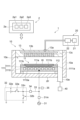
- FIG. 2 is a diagram for explaining a configuration example of a capacitively coupled plasma processing apparatus.
- the capacitively coupled plasma processing apparatus 1 includes a plasma processing chamber 10, a gas supply section 20, and an exhaust system 40. Further, the plasma processing apparatus 1 includes a substrate support section 11 and a gas introduction section. The gas inlet is configured to introduce at least one processing gas into the plasma processing chamber 10 .
- the gas introduction section includes a shower head 13.
- Substrate support 11 is arranged within plasma processing chamber 10 .
- the shower head 13 is arranged above the substrate support section 11 . In one embodiment, showerhead 13 forms at least a portion of the ceiling of plasma processing chamber 10 .
- the plasma processing chamber 10 has a plasma processing space 10s defined by a shower head 13, a side wall 10a of the plasma processing chamber 10, and a substrate support 11. Plasma processing chamber 10 is grounded.
- the shower head 13 and the substrate support section 11 are electrically insulated from the casing of the plasma processing chamber 10.
- the substrate support section 11 includes a main body section 111 and a ring assembly 112.
- the main body portion 111 has a central region 111a for supporting the substrate W and an annular region 111b for supporting the ring assembly 112.
- a wafer is an example of a substrate W.
- the annular region 111b of the main body 111 surrounds the central region 111a of the main body 111 in plan view.
- the substrate W is placed on the central region 111a of the main body 111, and the ring assembly 112 is placed on the annular region 111b of the main body 111 so as to surround the substrate W on the central region 111a of the main body 111. Therefore, the central region 111a is also called a substrate support surface for supporting the substrate W, and the annular region 111b is also called a ring support surface for supporting the ring assembly 112.
- the main body 111 includes a base 1110 and an electrostatic chuck 1111.
- Base 1110 includes a conductive member.
- the conductive member of the base 1110 can function as a lower electrode.
- Electrostatic chuck 1111 is placed on base 1110.
- Electrostatic chuck 1111 includes a ceramic member 1111a and an electrostatic electrode 1111b disposed within ceramic member 1111a.
- Ceramic member 1111a has a central region 111a. In one embodiment, ceramic member 1111a also has an annular region 111b. Note that another member surrounding the electrostatic chuck 1111, such as an annular electrostatic chuck or an annular insulating member, may have the annular region 111b.
- ring assembly 112 may be placed on the annular electrostatic chuck or the annular insulation member, or may be placed on both the electrostatic chuck 1111 and the annular insulation member.
- at least one electrode coupled to a high frequency power source 31 and/or a bias power source 32, which will be described later, may be arranged within the ceramic member 1111a.
- at least one electrode functions as a lower electrode. If the electrical bias described below is supplied to at least one electrode, the at least one electrode is also referred to as a bias electrode.
- the conductive member of the base 1110 and at least the electrodes may function as a plurality of lower electrodes.
- the electrostatic electrode 1111b may function as a lower electrode. Therefore, the substrate support 11 includes at least one lower electrode.
- the ring assembly 112 includes one or more annular members.
- the one or more annular members include one or more edge rings and at least one cover ring.
- the edge rings are formed of a conductive or insulating material, and the cover rings are formed of an insulating material.
- the substrate support unit 11 may include a temperature control module configured to adjust at least one of the electrostatic chuck 1111, the ring assembly 112, and the substrate to a target temperature.
- the temperature control module may include a heater, a heat transfer medium, a flow path 1110a, or a combination thereof.
- a heat transfer fluid such as brine or gas flows through the flow path 1110a.
- a channel 1110a is formed within the base 1110 and one or more heaters are disposed within the ceramic member 1111a of the electrostatic chuck 1111.
- the substrate support section 11 may include a heat transfer gas supply section configured to supply heat transfer gas to the gap between the back surface of the substrate W and the central region 111a.
- the shower head 13 is configured to introduce at least one processing gas from the gas supply section 20 into the plasma processing space 10s.
- the shower head 13 has at least one gas supply port 13a, at least one gas diffusion chamber 13b, and a plurality of gas introduction ports 13c.
- the processing gas supplied to the gas supply port 13a passes through the gas diffusion chamber 13b and is introduced into the plasma processing space 10s from the plurality of gas introduction ports 13c.
- the showerhead 13 also includes at least one upper electrode.
- the gas introduction section may include one or more side gas injectors (SGI) attached to one or more openings formed in the side wall 10a.
- SGI side gas injectors
- the gas supply section 20 may include at least one gas source 21 and at least one flow rate controller 22.
- the gas supply 20 is configured to supply at least one process gas from a respective gas source 21 to the showerhead 13 via a respective flow controller 22 .
- Each flow controller 22 may include, for example, a mass flow controller or a pressure-controlled flow controller.
- gas supply 20 may include at least one flow modulation device that modulates or pulses the flow rate of at least one process gas.
- the exhaust system 40 may be connected to a gas exhaust port 10e provided at the bottom of the plasma processing chamber 10, for example.
- Evacuation system 40 may include a pressure regulating valve and a vacuum pump. The pressure within the plasma processing space 10s is adjusted by the pressure regulating valve.
- the vacuum pump may include a turbomolecular pump, a dry pump, or a combination thereof.
- the plasma processing apparatus 1 may further include a high frequency power source 31 as the plasma generation section 12.
- Radio frequency power supply 31 is configured to generate source radio frequency power to generate a plasma from a gas within chamber 10 .
- the source radio frequency power has a frequency within the range of 10 MHz to 150 MHz.
- the high frequency power source 31 is electrically connected to the lower electrode or the upper electrode via a matching box 31m.
- the matching box 31m has a matching circuit for matching the impedance of the load of the high frequency power source 31 to the output impedance of the high frequency power source 31.
- the high frequency power source 31 may supply continuous waves of source high frequency power.
- the high frequency power supply 31 may periodically supply pulses of source high frequency power.
- the pulses of source high frequency power may be synchronized with the pulses of electrical bias described below.
- the plasma processing apparatus 1 further includes a bias power supply 32.
- Bias power supply 32 is configured to supply an electrical bias to substrate support 11 .
- An electrical bias may be provided to the bottom electrode.
- the electrical bias may be continuously supplied to the substrate support 11.
- pulses of electrical bias may be provided to the substrate support 11.
- the electrical bias pulses may be provided with the same repetition period as the source RF power pulses and in synchronization with the source RF power pulses.
- the filter 34 may be connected between the bias power supply 32 and the substrate support 11.
- Filter 34 is an electrical filter that attenuates or blocks source high frequency power that may flow into bias power supply 32 .
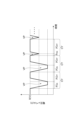
- FIG. 3 is a timing diagram of an example electrical bias used in a plasma processing apparatus according to an example embodiment.
- the electrical bias and its pulses are a sequence of voltage pulses VP.
- Each of the plurality of voltage pulses VP may be a negative voltage or a pulse of negative DC voltage.
- the electrical bias and its pulses ie the sequence of voltage pulses VP, have a waveform period CY.
- the waveform period CY includes an ON period P ON and an OFF period P OFF .
- the bias power supply 32 outputs a voltage during the ON period P ON , and stops outputting the voltage during the OFF period P OFF .
- one voltage pulse VP is output within the waveform period CY.
- the bias frequency which is the reciprocal of the time length of the waveform period CY, is a frequency within the range of 100 kHz to 13.56 MHz, and is, for example, 400 kHz.
- the bias power supply 32 may include a DC power supply 32p, a first switch 32a, and a second switch 32b.
- the DC power supply 32p may be a variable DC power supply.
- the positive electrode of the DC power supply 32p is connected to ground.
- the negative electrode of the DC power supply 32p is electrically connected to the substrate support 11 (for example, the lower electrode) via the first switch 32a.
- the second switch 32b is connected between the ground and a node 33n on the electrical path 33 that electrically connects the DC power supply 32p and the substrate support section 11 to each other.
- the node 33n is provided in the electrical path 33 between the first switch 32a and the substrate support 11.
- the first switch 32a is closed during the ON period P ON and opened during the OFF period P OFF .
- the second switch 32b is opened during the ON period P ON and closed during the OFF period P OFF .
- the bias power supply 32 is configured to adjust the length of the ON period P ON of each of the multiple voltage pulses PV, thereby adjusting the maximum voltage level of each of the multiple voltage pulses VP, as shown in Fig. 3.
- the maximum voltage level is the voltage level whose absolute value is the maximum in the voltage pulse.
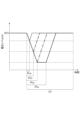
- FIG. 4 is a diagram showing the relationship between the voltage level of an example voltage pulse and the length of the ON period.
- the voltage level of the voltage pulse VP changes from the start of the ON period PON toward its maximum voltage level.
- the maximum voltage level of the voltage pulse VP depends on the length of the ON period P ON in the range where the bias power supply 32 does not reach the level corresponding to the maximum absolute value of the voltage that can be output. . Therefore, by adjusting the length of the ON period P ON , it is possible to adjust the maximum voltage level of each of the plurality of voltage pulses VP.
- the controller 2 is configured to determine the length of the ON period P ON from the maximum voltage level of each of the plurality of voltage pulses VP to be applied to the substrate support 11 using a relational expression.
- This relational expression is a function that relates the maximum voltage level of the voltage pulse VP to the length of the ON period P ON , and may be prepared in advance. This relational expression may be specified when plasma processing is performed on the substrate W.
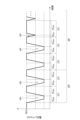
- FIG. 5 is a timing diagram of an example electrical bias used in a plasma processing apparatus according to an example embodiment.
- the control unit 2 obtains a temporal change in the voltage level of at least one voltage pulse VP during the period CP.
- the period CP may be a period during which the substrate W to be processed in the subsequent period AP is placed on the substrate support 11 and plasma used in the period AP is generated.
- the time change in the voltage level of the at least one voltage pulse VP is a time change from the start of application of the at least one voltage pulse VP.
- At least one voltage pulse VP has the maximum voltage level that bias power supply 32 can output.
- the time change in the voltage level of at least one voltage pulse VP may be measured by the voltage sensor 35 (see FIG. 2).
- Voltage sensor 35 measures the voltage of electrical path 33 or the lower electrode.
- the time change in the voltage level of at least one voltage pulse VP may be measured by a voltage sensor 36 shown in FIG.
- the voltage sensor 36 is placed directly under the substrate W and is configured to measure the potential of the substrate W.
- the control unit 2 identifies a relational expression between the length of the ON period P ON and the maximum voltage level of the voltage pulse VP from the time change of the voltage level of at least one voltage pulse VP. Note that the relational expression may be specified in a control unit other than the control unit 2.
- the bias power supply 32 sets the length of the ON period P ON of each of the multiple voltage pulses VP to the length of the ON period P ON determined by the control unit 2.
- the bias power supply 32 sets the length of the ON period P ON of each of the multiple voltage pulses VP to the length of the ON period P ON determined by the control unit 2 in the period AP after the period CP.
- the bias power supply 32 sets the length of the period in which the first switch 32a is closed to the length of the ON period P ON determined by the control unit 2.
- the second switch 23b is opened. Note that the length of the ON period P ON of each of the multiple voltage pulses VP may be determined in a control unit other than the control unit 2 and specified to the bias power supply 32.
- FIG. 7 is a flowchart of a plasma processing method according to one exemplary embodiment.
- each part of the plasma processing apparatus 1 can be controlled by the control unit 2.
- Method MT includes a step STa and a step STb.
- the substrate W is placed on the substrate support 11 prior to step STa.
- step STa plasma is generated within the chamber 10.
- gas is supplied into the chamber 10 from a gas supply 20 for the generation of plasma.
- the pressure within the chamber 10 is also regulated to a specified pressure by the exhaust system 40.
- high frequency power is supplied from a high frequency power supply 31. Step STa continues until step STb ends.
- the method MT may further include a step STc and a step STd, where the step STc is performed in a period CP.
- step STb is performed in the period AP after the period CP.
- step STc as described above, at least one voltage pulse VP is applied from the bias power supply 32 to the substrate support portion 11.
- step STd the above-mentioned relational expression is specified from the temporal change in the voltage level of at least one voltage pulse VP.
- the relational expression can be determined in the control unit 2 or in another control unit.
- step STb a sequence of a plurality of voltage pulses PV is applied to the substrate support 11 from the bias power supply 32 in order to draw ions from the plasma into the substrate W on the substrate support 11 .
- Process STb includes process STb1 and process STb2.
- step STb1 the length of the ON period P ON of the voltage pulse VP is determined from the maximum voltage level of the voltage pulse VP to be applied to the substrate support portion 11 based on the above-mentioned relational expression. The length of the ON period P ON may be determined by the controller 2 or another controller.
- step STb2 the length of the ON period P ON of the voltage pulse VP is set to the length of the ON period P ON determined in step STb1.
- a voltage pulse PV having a set ON period P ON length is applied to the substrate support section 11 .
- step STJ after step STb2, it is determined whether a stop condition is satisfied.
- the stop condition may be met when the period specified by the recipe data ends. If it is determined in step STJ that the stop condition is not satisfied, steps STb1 and STb2 are repeated. By repeating steps STb1 and STb2, a sequence of a plurality of voltage pulses PV is applied to the substrate support portion 11. If it is determined in step STJ that the stop condition is satisfied, method MT ends.
- Plasma processing apparatus 10... Chamber, 11... Substrate support part, 12... Plasma generation part, 32... Bias power supply.
Landscapes
- Physics & Mathematics (AREA)
- Chemical & Material Sciences (AREA)
- Engineering & Computer Science (AREA)
- Plasma & Fusion (AREA)
- Analytical Chemistry (AREA)
- General Physics & Mathematics (AREA)
- General Chemical & Material Sciences (AREA)
- Spectroscopy & Molecular Physics (AREA)
- Electromagnetism (AREA)
- Chemical Kinetics & Catalysis (AREA)
- Materials Engineering (AREA)
- Mechanical Engineering (AREA)
- Metallurgy (AREA)
- Organic Chemistry (AREA)
- Plasma Technology (AREA)
- Chemical Vapour Deposition (AREA)
- Drying Of Semiconductors (AREA)
Priority Applications (4)
| Application Number | Priority Date | Filing Date | Title |
|---|---|---|---|
| CN202380064933.4A CN119856573A (zh) | 2022-09-21 | 2023-08-14 | 等离子体处理装置和等离子体处理方法 |
| JP2024548130A JPWO2024062804A1 (https=) | 2022-09-21 | 2023-08-14 | |
| KR1020257011627A KR20250072991A (ko) | 2022-09-21 | 2023-08-14 | 플라스마 처리 장치 및 플라스마 처리 방법 |
| US19/084,788 US20250218725A1 (en) | 2022-09-21 | 2025-03-20 | Plasma processing apparatus and plasma processing method |
Applications Claiming Priority (2)
| Application Number | Priority Date | Filing Date | Title |
|---|---|---|---|
| JP2022-150094 | 2022-09-21 | ||
| JP2022150094 | 2022-09-21 |
Related Child Applications (1)
| Application Number | Title | Priority Date | Filing Date |
|---|---|---|---|
| US19/084,788 Continuation US20250218725A1 (en) | 2022-09-21 | 2025-03-20 | Plasma processing apparatus and plasma processing method |
Publications (1)
| Publication Number | Publication Date |
|---|---|
| WO2024062804A1 true WO2024062804A1 (ja) | 2024-03-28 |
Family
ID=90454200
Family Applications (1)
| Application Number | Title | Priority Date | Filing Date |
|---|---|---|---|
| PCT/JP2023/029469 Ceased WO2024062804A1 (ja) | 2022-09-21 | 2023-08-14 | プラズマ処理装置及びプラズマ処理方法 |
Country Status (6)
| Country | Link |
|---|---|
| US (1) | US20250218725A1 (https=) |
| JP (1) | JPWO2024062804A1 (https=) |
| KR (1) | KR20250072991A (https=) |
| CN (1) | CN119856573A (https=) |
| TW (1) | TW202431316A (https=) |
| WO (1) | WO2024062804A1 (https=) |
Citations (4)
| Publication number | Priority date | Publication date | Assignee | Title |
|---|---|---|---|---|
| JPH0927399A (ja) * | 1995-07-13 | 1997-01-28 | Hitachi Ltd | プラズマ処理方法および装置 |
| JP2019129546A (ja) * | 2018-01-22 | 2019-08-01 | 東京電子株式会社 | パルス電源装置 |
| JP2020529180A (ja) * | 2017-08-25 | 2020-10-01 | イーグル ハーバー テクノロジーズ, インク.Eagle Harbor Technologies, Inc. | ナノ秒パルスを使用する任意波形の発生 |
| JP2021118314A (ja) * | 2020-01-29 | 2021-08-10 | 東京エレクトロン株式会社 | プラズマ処理装置及びプラズマ処理方法 |
Family Cites Families (1)
| Publication number | Priority date | Publication date | Assignee | Title |
|---|---|---|---|---|
| JP5224837B2 (ja) | 2008-02-01 | 2013-07-03 | 株式会社東芝 | 基板のプラズマ処理装置及びプラズマ処理方法 |
-
2023
- 2023-08-14 JP JP2024548130A patent/JPWO2024062804A1/ja active Pending
- 2023-08-14 CN CN202380064933.4A patent/CN119856573A/zh active Pending
- 2023-08-14 KR KR1020257011627A patent/KR20250072991A/ko active Pending
- 2023-08-14 WO PCT/JP2023/029469 patent/WO2024062804A1/ja not_active Ceased
- 2023-09-07 TW TW112134008A patent/TW202431316A/zh unknown
-
2025
- 2025-03-20 US US19/084,788 patent/US20250218725A1/en active Pending
Patent Citations (4)
| Publication number | Priority date | Publication date | Assignee | Title |
|---|---|---|---|---|
| JPH0927399A (ja) * | 1995-07-13 | 1997-01-28 | Hitachi Ltd | プラズマ処理方法および装置 |
| JP2020529180A (ja) * | 2017-08-25 | 2020-10-01 | イーグル ハーバー テクノロジーズ, インク.Eagle Harbor Technologies, Inc. | ナノ秒パルスを使用する任意波形の発生 |
| JP2019129546A (ja) * | 2018-01-22 | 2019-08-01 | 東京電子株式会社 | パルス電源装置 |
| JP2021118314A (ja) * | 2020-01-29 | 2021-08-10 | 東京エレクトロン株式会社 | プラズマ処理装置及びプラズマ処理方法 |
Also Published As
| Publication number | Publication date |
|---|---|
| KR20250072991A (ko) | 2025-05-26 |
| JPWO2024062804A1 (https=) | 2024-03-28 |
| US20250218725A1 (en) | 2025-07-03 |
| TW202431316A (zh) | 2024-08-01 |
| CN119856573A (zh) | 2025-04-18 |
Similar Documents
| Publication | Publication Date | Title |
|---|---|---|
| JP7719860B2 (ja) | プラズマ処理装置及び基板処理方法 | |
| JP2023001473A (ja) | プラズマ処理装置及びプラズマ処理方法 | |
| WO2022163535A1 (ja) | プラズマ処理装置及びソース高周波電力のソース周波数を制御する方法 | |
| US20240347320A1 (en) | Plasma processing apparatus, power system, control method, and storage medium | |
| US20250014872A1 (en) | Plasma processing method and plasma processing apparatus | |
| WO2023223866A1 (ja) | プラズマ処理装置及びプラズマ処理方法 | |
| KR20230023571A (ko) | 플라스마 처리 장치 및 플라스마 처리 방법 | |
| TW202333540A (zh) | 電漿處理裝置及處理方法 | |
| WO2022163530A1 (ja) | プラズマ処理装置及びソース高周波電力のソース周波数を制御する方法 | |
| KR20240002720A (ko) | 플라즈마 처리 시스템 및 플라즈마 처리 방법 | |
| WO2024014398A1 (ja) | プラズマ処理装置及びプラズマ処理方法 | |
| WO2023176555A1 (ja) | プラズマ処理装置及びプラズマ処理方法 | |
| WO2024004766A1 (ja) | プラズマ処理装置及びプラズマ処理方法 | |
| WO2023090256A1 (ja) | プラズマ処理装置、電源システム、制御方法、プログラム、及び記憶媒体 | |
| JP2024031067A (ja) | エッチング方法及びプラズマ処理装置 | |
| JP7671717B2 (ja) | プラズマ処理装置及びプラズマ処理方法 | |
| WO2024062804A1 (ja) | プラズマ処理装置及びプラズマ処理方法 | |
| US20220392748A1 (en) | Plasma processing apparatus and plasma processing method | |
| WO2024024681A1 (ja) | プラズマ処理装置及びソース高周波電力のソース周波数を制御する方法 | |
| JP2023129234A (ja) | プラズマ処理装置 | |
| KR102918969B1 (ko) | 플라스마 처리 장치 및 제어 방법 | |
| JP7799906B2 (ja) | プラズマエッチング装置及びプラズマエッチング方法 | |
| US20250266248A1 (en) | Electric bias control in plasma processing | |
| WO2023074816A1 (ja) | プラズマ処理装置、給電システム、制御方法、プログラム、及び記憶媒体 | |
| WO2024106257A1 (ja) | プラズマ処理装置及びプラズマ処理方法 |
Legal Events
| Date | Code | Title | Description |
|---|---|---|---|
| 121 | Ep: the epo has been informed by wipo that ep was designated in this application |
Ref document number: 23867929 Country of ref document: EP Kind code of ref document: A1 |
|
| WWE | Wipo information: entry into national phase |
Ref document number: 2024548130 Country of ref document: JP |
|
| WWE | Wipo information: entry into national phase |
Ref document number: 202380064933.4 Country of ref document: CN |
|
| ENP | Entry into the national phase |
Ref document number: 20257011627 Country of ref document: KR Kind code of ref document: A |
|
| WWE | Wipo information: entry into national phase |
Ref document number: 1020257011627 Country of ref document: KR |
|
| WWP | Wipo information: published in national office |
Ref document number: 202380064933.4 Country of ref document: CN |
|
| NENP | Non-entry into the national phase |
Ref country code: DE |
|
| WWE | Wipo information: entry into national phase |
Ref document number: 11202501881W Country of ref document: SG |
|
| WWP | Wipo information: published in national office |
Ref document number: 11202501881W Country of ref document: SG |
|
| 122 | Ep: pct application non-entry in european phase |
Ref document number: 23867929 Country of ref document: EP Kind code of ref document: A1 |