WO2024062744A1 - リチウムイオン二次電池用正極材料及びその製造方法、リチウムイオン二次電池用正極、ならびにリチウムイオン二次電池 - Google Patents
リチウムイオン二次電池用正極材料及びその製造方法、リチウムイオン二次電池用正極、ならびにリチウムイオン二次電池 Download PDFInfo
- Publication number
- WO2024062744A1 WO2024062744A1 PCT/JP2023/025739 JP2023025739W WO2024062744A1 WO 2024062744 A1 WO2024062744 A1 WO 2024062744A1 JP 2023025739 W JP2023025739 W JP 2023025739W WO 2024062744 A1 WO2024062744 A1 WO 2024062744A1
- Authority
- WO
- WIPO (PCT)
- Prior art keywords
- positive electrode
- ion secondary
- secondary battery
- particles
- lithium ion
- Prior art date
- Legal status (The legal status is an assumption and is not a legal conclusion. Google has not performed a legal analysis and makes no representation as to the accuracy of the status listed.)
- Ceased
Links
Images
Classifications
-
- C—CHEMISTRY; METALLURGY
- C01—INORGANIC CHEMISTRY
- C01B—NON-METALLIC ELEMENTS; COMPOUNDS THEREOF; METALLOIDS OR COMPOUNDS THEREOF NOT COVERED BY SUBCLASS C01C
- C01B25/00—Phosphorus; Compounds thereof
- C01B25/16—Oxyacids of phosphorus; Salts thereof
- C01B25/26—Phosphates
- C01B25/45—Phosphates containing plural metal, or metal and ammonium
-
- H—ELECTRICITY
- H01—ELECTRIC ELEMENTS
- H01M—PROCESSES OR MEANS, e.g. BATTERIES, FOR THE DIRECT CONVERSION OF CHEMICAL ENERGY INTO ELECTRICAL ENERGY
- H01M10/00—Secondary cells; Manufacture thereof
- H01M10/05—Accumulators with non-aqueous electrolyte
- H01M10/052—Li-accumulators
- H01M10/0525—Rocking-chair batteries, i.e. batteries with lithium insertion or intercalation in both electrodes; Lithium-ion batteries
-
- H—ELECTRICITY
- H01—ELECTRIC ELEMENTS
- H01M—PROCESSES OR MEANS, e.g. BATTERIES, FOR THE DIRECT CONVERSION OF CHEMICAL ENERGY INTO ELECTRICAL ENERGY
- H01M4/00—Electrodes
- H01M4/02—Electrodes composed of, or comprising, active material
- H01M4/13—Electrodes for accumulators with non-aqueous electrolyte, e.g. for lithium-accumulators; Processes of manufacture thereof
- H01M4/136—Electrodes based on inorganic compounds other than oxides or hydroxides, e.g. sulfides, selenides, tellurides, halogenides or LiCoFy
-
- H—ELECTRICITY
- H01—ELECTRIC ELEMENTS
- H01M—PROCESSES OR MEANS, e.g. BATTERIES, FOR THE DIRECT CONVERSION OF CHEMICAL ENERGY INTO ELECTRICAL ENERGY
- H01M4/00—Electrodes
- H01M4/02—Electrodes composed of, or comprising, active material
- H01M4/13—Electrodes for accumulators with non-aqueous electrolyte, e.g. for lithium-accumulators; Processes of manufacture thereof
- H01M4/139—Processes of manufacture
- H01M4/1397—Processes of manufacture of electrodes based on inorganic compounds other than oxides or hydroxides, e.g. sulfides, selenides, tellurides, halogenides or LiCoFy
-
- H—ELECTRICITY
- H01—ELECTRIC ELEMENTS
- H01M—PROCESSES OR MEANS, e.g. BATTERIES, FOR THE DIRECT CONVERSION OF CHEMICAL ENERGY INTO ELECTRICAL ENERGY
- H01M4/00—Electrodes
- H01M4/02—Electrodes composed of, or comprising, active material
- H01M4/36—Selection of substances as active materials, active masses, active liquids
- H01M4/362—Composites
- H01M4/366—Composites as layered products
-
- H—ELECTRICITY
- H01—ELECTRIC ELEMENTS
- H01M—PROCESSES OR MEANS, e.g. BATTERIES, FOR THE DIRECT CONVERSION OF CHEMICAL ENERGY INTO ELECTRICAL ENERGY
- H01M4/00—Electrodes
- H01M4/02—Electrodes composed of, or comprising, active material
- H01M4/36—Selection of substances as active materials, active masses, active liquids
- H01M4/58—Selection of substances as active materials, active masses, active liquids of inorganic compounds other than oxides or hydroxides, e.g. sulfides, selenides, tellurides, halogenides or LiCoFy; of polyanionic structures, e.g. phosphates, silicates or borates
- H01M4/5825—Oxygenated metallic salts or polyanionic structures, e.g. borates, phosphates, silicates, olivines
-
- H—ELECTRICITY
- H01—ELECTRIC ELEMENTS
- H01M—PROCESSES OR MEANS, e.g. BATTERIES, FOR THE DIRECT CONVERSION OF CHEMICAL ENERGY INTO ELECTRICAL ENERGY
- H01M4/00—Electrodes
- H01M4/02—Electrodes composed of, or comprising, active material
- H01M4/62—Selection of inactive substances as ingredients for active masses, e.g. binders, fillers
-
- H—ELECTRICITY
- H01—ELECTRIC ELEMENTS
- H01M—PROCESSES OR MEANS, e.g. BATTERIES, FOR THE DIRECT CONVERSION OF CHEMICAL ENERGY INTO ELECTRICAL ENERGY
- H01M4/00—Electrodes
- H01M4/02—Electrodes composed of, or comprising, active material
- H01M4/62—Selection of inactive substances as ingredients for active masses, e.g. binders, fillers
- H01M4/624—Electric conductive fillers
- H01M4/625—Carbon or graphite
-
- H—ELECTRICITY
- H01—ELECTRIC ELEMENTS
- H01M—PROCESSES OR MEANS, e.g. BATTERIES, FOR THE DIRECT CONVERSION OF CHEMICAL ENERGY INTO ELECTRICAL ENERGY
- H01M4/00—Electrodes
- H01M4/02—Electrodes composed of, or comprising, active material
- H01M4/64—Carriers or collectors
- H01M4/66—Selection of materials
- H01M4/661—Metal or alloys, e.g. alloy coatings
-
- Y—GENERAL TAGGING OF NEW TECHNOLOGICAL DEVELOPMENTS; GENERAL TAGGING OF CROSS-SECTIONAL TECHNOLOGIES SPANNING OVER SEVERAL SECTIONS OF THE IPC; TECHNICAL SUBJECTS COVERED BY FORMER USPC CROSS-REFERENCE ART COLLECTIONS [XRACs] AND DIGESTS
- Y02—TECHNOLOGIES OR APPLICATIONS FOR MITIGATION OR ADAPTATION AGAINST CLIMATE CHANGE
- Y02E—REDUCTION OF GREENHOUSE GAS [GHG] EMISSIONS, RELATED TO ENERGY GENERATION, TRANSMISSION OR DISTRIBUTION
- Y02E60/00—Enabling technologies; Technologies with a potential or indirect contribution to GHG emissions mitigation
- Y02E60/10—Energy storage using batteries
Definitions
- the present invention relates to a positive electrode material for lithium ion secondary batteries, a method for manufacturing the same, a positive electrode for lithium ion secondary batteries, and a lithium ion secondary battery.
- Lithium-ion secondary batteries have higher energy density and output density than lead batteries and nickel-metal hydride batteries, and are used in a variety of applications, including small electronic devices such as smartphones, household backup power supplies, and power tools.
- large-capacity lithium-ion secondary batteries are being put into practical use for use in vehicles such as electric vehicles, and for storing renewable energy such as solar power generation and wind power generation.
- a lithium ion secondary battery includes at least a positive electrode, a negative electrode, and an electrolyte.
- Electrode materials constituting the positive electrode include lithium cobalt oxide (LiCoO 2 ) and lithium manganate (LiMn 2 O 4 ), which are oxide-based positive electrode materials, and lithium iron phosphate (LiFePO 4 ), which is an olivine-based positive electrode material.
- Lithium metal composite oxide which has the property of being able to reversibly insert and remove lithium ions, is used, and improvements are being considered from various perspectives such as increasing battery capacity, extending battery life, improving safety, and reducing cost. ing.
- the lithium iron phosphate (LiFePO 4 ) uses iron, which is an abundant resource and is inexpensive, so it is a material that can be easily reduced in cost.
- lithium iron phosphate has excellent safety characteristics that oxide-based cathode materials such as lithium cobalt oxide do not have, as it does not release oxygen at high temperatures due to the strong covalent bond between phosphorus and oxygen. It has certain characteristics.
- lithium iron phosphate has an olivine structure, which means that it has low Li ion diffusivity and low electronic conductivity, resulting in poorer input/output characteristics than oxide-based positive electrode materials.
- the particles of lithium iron phosphate are made finer and the surface of each particle is coated with a conductive carbon film to improve the diffusibility of Li ions and the electronic conductivity. It is proposed to improve.
- Patent Document 1 describes primary particles having an olivine crystal structure and having an Al compound present in at least a part of the grain boundaries of polycrystalline particles whose chemical composition is represented by the following general formula (1).
- a positive electrode active material for non-aqueous electrolyte batteries has been proposed.
- Patent Document 1 it is possible to increase the ratio of the discharge capacity obtained during high rate discharge to the discharge capacity obtained during low rate discharge.
- the primary particles proposed in Patent Document 1 that are configured such that the Al compound is present in at least a part of the crystal grain boundaries of the polycrystalline particles are crystals of a phase having the crystal structure in the production process of the primary particles. Growth is suppressed, resulting in a state in which a large number of multiple crystal grains exist, and the surface area of the phase having the crystal structure is increased compared to the conventional one. As a result, electrochemical reactivity increases and the discharge capacity ratio is improved.
- one aspect of the present invention provides a positive electrode material containing lithium iron phosphate that has high input/output characteristics when used as a positive electrode of a lithium ion secondary battery, a method for manufacturing the same, and a method for manufacturing the same.
- the purpose of the present invention is to provide a positive electrode for an ion secondary battery and a lithium ion secondary battery.
- a positive electrode material for a lithium ion secondary battery comprising aggregated particles in which a plurality of primary particles of a positive electrode active material coated with a carbonaceous film are aggregated,
- a positive electrode material for a lithium ion secondary battery comprising at least
- the lithium according to ⁇ 1> wherein the Ca content in the positive electrode material is 100 mass ppm or more and 5000 mass ppm or less, and the Al content in the positive electrode material is 100 mass ppm or more and 5000 mass ppm or less.
- the positive electrode material is the lithium according to ⁇ 1> or ⁇ 2>, which has a crystallite diameter of 80 nm or more and 150 nm or less, and a specific surface area of 6.0 m 2 /g or more and 14.0 m 2 /g or less.
- Positive electrode material for ion secondary batteries is the lithium according to ⁇ 1> or ⁇ 2>, which has a crystallite diameter of 80 nm or more and 150 nm or less, and a specific surface area of 6.0 m 2 /g or more and 14.0 m 2 /g or less.
- the positive electrode material has a tap density of 0.8 g/cm 3 or more and an NMP absorption amount of 40 mL/100 g or less, and a pressure of 16 kN is applied to the positive electrode material in a circle with a diameter of 20 mm.
- a method for producing a positive electrode material for a lithium ion secondary battery according to ⁇ 1> or ⁇ 2> a crystallization step of obtaining crystallized particles by a crystallization reaction using a metal source having a valence of divalent, trivalent, or both, and a phosphate source; a water washing step of washing the crystallized particles with water and drying them to obtain a precursor of the positive electrode active material; a mixing step of mixing the precursor of the positive electrode active material, a lithium source, and a carbon source to obtain a raw material mixture; a calcination step of calcining the raw material mixture in a non-oxidizing atmosphere to obtain a positive electrode material containing the positive electrode active material; Equipped with The method for producing a positive electrode material for a lithium ion secondary battery, wherein in the crystallization step, one or more selected from the group consisting of a Ca source and an Al source are added during crystallization, and at least one of calcium phosphate ( Ca3 ( PO4
- a positive electrode for a lithium ion secondary battery comprising an aluminum current collector and a positive electrode composite layer formed on the aluminum current collector, A positive electrode for a lithium ion secondary battery, wherein the positive electrode mixture layer contains the positive electrode material for a lithium ion secondary battery according to ⁇ 1> or ⁇ 2>.
- a lithium ion secondary battery having at least a positive electrode, a negative electrode, and an electrolyte,
- the positive electrode is a lithium ion secondary battery, wherein the positive electrode is the positive electrode for a lithium ion secondary battery according to ⁇ 6>.
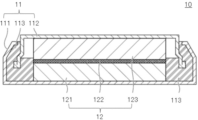
- FIG. 2 is a schematic diagram of a cross-sectional structure of a coin-type battery produced in Examples and Comparative Examples.
- the positive electrode material for a lithium ion secondary battery of the present embodiment is a positive electrode material for a lithium ion secondary battery that includes aggregated particles in which a plurality of primary particles of a positive electrode active material coated with a carbonaceous film are aggregated, and includes:
- the positive electrode material for a lithium ion secondary battery of this embodiment contains lithium iron phosphate as a positive electrode active material, and has a structure having a conductive carbonaceous coating for improving the conductivity of the positive electrode material.
- the positive electrode material for lithium ion secondary batteries may be simply referred to as a "positive electrode material.”
- lithium iron phosphate may be simply referred to as "LFP.”
- LFP is synthesized by heating, such as by firing, in its manufacturing process. Further, a carbonaceous film can be applied during the synthesis of LFP, but if the carbonaceous film is formed in a separate process, it is necessary to perform heat treatment together with the carbon source.
- LFP has a particle structure consisting of secondary particles formed by the aggregation of primary particles.
- the lithium ion secondary battery When the sintered material is used as a positive electrode of a lithium-ion secondary battery in a state where sintering has progressed, a sufficient contact area with the electrolyte cannot be obtained, and the distance of electronic conduction and lithium (Li) ion conduction within the coarse particles increases, resulting in a deterioration in the charge/discharge characteristics of the battery.
- the lithium ion secondary battery may be simply referred to as the "battery".
- At least one of calcium phosphate ( Ca3 ( PO4 )2) particles and aluminum phosphate ( AlPO4 ) particles is present on the surfaces of primary particles of the LFP, which is the positive electrode active material, on the grain boundaries between the primary particles, or on both the surfaces and the grain boundaries.
- at least one of calcium phosphate ( Ca3 ( PO4 ) 2 ) particles and aluminum phosphate ( AlPO4 ) particles may be simply referred to as "phosphate particles”.
- the presence of phosphoric acid particles acts as pillars during firing, making it possible to retard the progress of sintering between the primary particles, and thus suppress the formation of coarse particles.
- the phosphoric acid particles only need to be formed on the surface of the primary particles of LFP, on the grain boundaries between the primary particles, or on a part of both the surface and the grain boundaries, and it is not necessary to form them on all the surfaces and grain boundaries. There isn't. Further, the phosphoric acid particles may be present either directly on the surface of the LFP acting as the positive electrode active material or on a carbonaceous film covering the positive electrode active material.
- the phosphoric acid particles are not particularly limited, and at least some of the particles can have a diameter of 10 nm to 500 nm, preferably 20 nm to 300 nm.
- the presence of particles of such a size makes it possible to further delay the progress of sintering between primary particles, thereby further suppressing the formation of coarse particles.
- the maximum diameter of the phosphoric acid particles is preferably 1 ⁇ m or less.
- the size of the phosphoric acid particles can be confirmed by observing the surface or cross section of the LFP particles using a scanning electron microscope, a transmission electron microscope, or the like.
- the Ca content in the cathode material is preferably 100 mass ppm to 5000 mass ppm, more preferably 150 mass ppm to 3000 mass ppm, still more preferably 200 mass ppm to 2000 mass ppm, even more preferably. is 450 mass ppm to 2000 mass ppm.
- the Al content in the positive electrode material is preferably 100 mass ppm to 5000 mass ppm, more preferably 150 mass ppm to 3000 mass ppm, still more preferably 200 mass ppm to 2000 mass ppm, even more preferably 450 mass ppm. ⁇ 2000 ppm by mass.
- Ca and Al By setting the Ca content and Al content in the positive electrode material to the above range, a sufficient amount of phosphoric acid particles can be formed on the surface and interface of the primary particles, and coarse particles can be formed by sintering the primary particles. formation can be suppressed.
- Ca and Al only need to have at least a part of their content forming phosphoric acid particles, and may exist in a state other than forming phosphoric acid particles, such as in a solid solution state in LFP.
- the contents of Ca and Al can be analyzed, for example, by ICP emission spectroscopy.
- the total content of Ca and Al is preferably 500 mass ppm or more, more preferably 1000 mass ppm or more, and even more preferably 1150 mass ppm or more.
- the positive electrode material of this embodiment includes aggregated particles in which a plurality of primary particles of a positive electrode active material containing LFP having the composition as described above are aggregated.
- the LFP can contain at least one element selected from the group consisting of Mg, Zn, Co, Mn, Ni, Ti, and V as the additive element A.
- additive element A battery characteristics when the positive electrode material is used in a battery can be improved.
- x which is the ratio of lithium (Li) to a metal element other than Li, within the above range, the crystallinity of the olivine structure can be improved.
- the composition of the LFP described above does not include Ca and Al that form phosphoric acid particles, trace amounts of Ca and Al can also be included in the additive element A as described above.
- the positive electrode material of this embodiment can have a crystallite diameter of 80 nm or more and 150 nm or less.
- the crystallite diameter is preferably 80 nm or more and 130 nm or less, more preferably 80 nm or more and 120 nm or less, and even more preferably 80 nm or more and 110 nm or less.
- the crystallite diameter can be determined from the peak of the X-ray diffraction pattern using Scherrer's equation.
- the positive electrode material can have a specific surface area of 6.0 m 2 /g or more and 14.0 m 2 /g or less. This makes it possible to have sufficient contact between the electrolyte and the positive electrode material to provide high charge/discharge characteristics, suppress the generation of fine particles, and increase the packing density within the battery.
- the specific surface area is preferably 6.5 m 2 /g or more and 14.0 m 2 /g or less, more preferably 8.0 m 2 /g or more and 14.0 m 2 /g or less, and 8.0 m 2 /g or more and 14.0 m 2 /g or less. It is more preferably .7 m 2 /g or more and 14.0 m 2 /g or less.
- the positive electrode material can have a tap density of 0.8 g/cm 3 or more.
- the tap density is an index of the filling density in the battery, and by setting it to 0.8 g/cm 3 or more, the charge/discharge capacity per unit volume can be sufficiently increased.
- the tap density is preferably 1.1 g/cm 3 or more.
- the upper limit of the tap density is not particularly limited, but may be, for example, 3.0 g/cm 3 or less.
- the tap density is preferably 2.0 g/cm 3 or less, more preferably 1.2 g/cm 3 or less.
- the positive electrode material can have an absorption amount of NMP (N-methyl-2-pyrrolidone) of 40 mL/100 g or less.
- the amount of NMP absorbed is an index representing the amount of voids in the positive electrode material, and by setting the amount of NMP absorbed to 40 mL/100 g or less, the amount of voids can be limited and the packing density within the battery can be increased.
- the lower limit of the NMP absorption amount is not particularly limited, but from the viewpoint of ensuring good contact with the electrolyte, it can be set to 20 mL/100 g or more.
- the NMP absorption amount is preferably 26 mL/100 g or more and 40 mL/100 g or less, more preferably 33 mL/100 g or more and 40 mL/100 g or less, and 37 mL/100 g or more and 40 mL/100 g or less. More preferred.
- the NMP absorption amount can be measured in accordance with JIS K6217-4:2017 using NMP instead of DBP (dibutyl phthalate).
- the positive electrode material can have a green compact density of 2.4 g/cm 3 or more when compressed under a pressure of 16 kN. Thereby, a high-density positive electrode can be formed, and the charge/discharge capacity per unit volume of the battery can be sufficiently increased.
- the green compact density is not particularly limited, but can be 3.0 g/cm 3 or less.
- the method for measuring the green compact density is not particularly limited, but for example, a certain amount of sample is placed in a mold with an inner diameter of 20 mm, and a load of 16 kN is applied.
- the volume of the sample is calculated from the measured value of the sample height under a load, and the green compact density can be determined by dividing the mass of the sample by the volume.
- the method for manufacturing a positive electrode material for a lithium ion secondary battery of the present embodiment is a method for manufacturing the positive electrode material for a lithium ion secondary battery of the present embodiment described above, and includes a crystallization step, a water washing step, and a mixing step. and a firing step.
- this manufacturing method the method for manufacturing a positive electrode material for a lithium ion secondary battery of this embodiment may be simply referred to as "this manufacturing method.”
- This manufacturing method Each step of the present manufacturing method will be explained below, but the explanation of the previously mentioned parts may be omitted.
- crystallized particles are obtained by a crystallization reaction using a metal source having a divalent, trivalent, or both valences and a phosphoric acid source.
- a metal phosphate composite compound is usually obtained.
- one or more selected from the group consisting of a Ca source and an Al source is added during crystallization, and the surfaces of the primary particles of the resulting crystallized particles, the grain boundaries between the primary particles, or At least one of calcium phosphate (Ca 3 (PO 4 ) 2 ) particles and aluminum phosphate (AlPO 4 ) particles is present on both the surface and grain boundaries.
- a portion of Ca and Al may be dissolved in solid solution in the crystallized particles.
- the raw material solution in which the metal source and the phosphoric acid source are dissolved and coexist as ions is added to a reaction aqueous solution whose pH is adjusted to a range of 7 to 10 based on a liquid temperature of 25° C. to cause coprecipitation. Since the raw material solution exhibits acidity, by dropping an alkali into the reaction aqueous solution and dropping the raw material solution while maintaining the pH within the above range, crystallized particles as a coprecipitate can be obtained.
- the raw material solution in which the metal source and the phosphoric acid source are dissolved has a uniform composition, and the metal The ratio of phosphoric acid and phosphoric acid is controlled, and crystallized particles with a uniform composition can be obtained.
- the ratio of the amount of metal to phosphoric acid in the positive electrode active material obtained by this manufacturing method is almost the same as that of the crystallized particles. Further, the ratio of the amount of metal to phosphorus in the crystallized particles is approximately the same as that in the raw material solution. Therefore, by controlling the composition of the raw material solution, the composition of the desired LFP can be controlled.
- the ratio of the amounts of iron and phosphoric acid can be set to 1, similar to the composition of the target LFP, but should be set to about 0.9 to 1.1, taking into account the effects of additive elements and impurities. Can be done.
- a water-soluble divalent or trivalent metal salt preferably a sulfate
- a sulfate a water-soluble divalent or trivalent metal salt
- iron sulfate, magnesium sulfate, zinc sulfate, cobalt sulfate, nickel sulfate, titanium sulfate, vanadium sulfate, etc. can be used as the metal source.
- acid-soluble hydroxides can also be used. Only one type of metal source may be used, or two or more types may be used in combination, but it is preferable to use only one type.
- the phosphoric acid source only needs to be water-soluble, and phosphoric acid compounds can be used, such as orthophosphoric acid (H 3 PO 4 ) and ammonium dihydrogen phosphate (NH 4 H 2 PO 4 ), which have little risk of contamination with impurities. , diammonium hydrogen phosphate ((NH 4 ) 2 HPO 4 ), etc. can be preferably used. Although only one type of phosphoric acid source may be used or a mixture of two or more types may be used, it is preferable to use only one type.
- a raw material solution When preparing a raw material solution, it can be added to an oxidizing agent reaction aqueous solution such as a hydrogen peroxide (H 2 O 2 ) aqueous solution in order to adjust the valence of the metal source in the raw material solution.
- a oxidizing agent reaction aqueous solution such as a hydrogen peroxide (H 2 O 2 ) aqueous solution
- H 2 O 2 hydrogen peroxide
- the amount of the oxidizing agent added is not particularly limited, but may be in the range of 0.3 to 3.0 times the amount of the metal source.
- One type of oxidizing agent may be used, or two or more types may be used in combination.
- one or more types selected from the group consisting of sodium hydroxide and lithium hydroxide can be used as the alkali source.
- One type of alkali source may be used, or two or more types may be used in combination.
- a complexing agent may be added to the aqueous reaction solution together with the alkali source.
- the complexing agent is not particularly limited as long as it can form a complex by bonding with iron ions, other metal ions, etc. in an aqueous solution, and examples include ammonium ion donors.
- One type of complexing agent may be used, or two or more types may be used in combination.
- the ammonium ion donor is not particularly limited, but for example, ammonia, ammonium sulfate, ammonium chloride, ammonium carbonate, ammonium fluoride, etc. can be used.
- the ammonium ion concentration in the aqueous reaction solution can range from 3 g/L to 25 g/L.
- One type of ammonium ion donor may be used, or two or more types may be used in combination.
- a Ca source, an Al source, or both a Ca source and an Al source are added to the reaction aqueous solution.
- calcium phosphate (Ca 3 (PO 4 ) 2 ) particles and aluminum phosphate (AlPO 4 ) At least one type of particles can be present.
- the Ca source may be added as an aqueous solution to the reaction aqueous solution individually or to the raw material solution.
- calcium hydroxide or the like can be used as the Ca source.
- the phosphoric acid source or the metal source contains Ca as an impurity
- the Ca contained in the phosphoric acid source or the metal source may be used. That is, the Ca source can be contained in the crystallized particles in a desired amount, for example, so that the desired Ca content in LFP is 100 mass ppm to 5000 mass ppm, without any restriction on the method of addition.
- the method of adding the Al source is not limited, as with the Ca source, and the Al source can be contained in a desired amount in the crystallized particles, for example, so that the Al content in the target LFP is 100 ppm by mass to 5000 ppm by mass.
- the Al source may be aluminum hydroxide, aluminum sulfate, sodium aluminate, or the like.
- the Ca source and the Al source may each be used independently, either alone or in combination of two or more.
- the crystallized particles obtained in the crystallization step are washed with water and dried to obtain a precursor of the positive electrode active material.
- the precursor of the positive electrode active material may be simply referred to as "precursor”.
- Washing with water can be carried out by any conventional method as long as it reduces impurities.
- the crystallized particles can be mixed with pure water, distilled water, or ion-exchanged water, which are free of impurities, and stirred, and then the crystallized particles can be washed with water after solid-liquid separation.
- the crystallized particles can be dried in a non-oxidizing atmosphere such as a vacuum atmosphere or an inert gas atmosphere.
- the composition ratio of the metal element and phosphoric acid of the precursor obtained in the water washing process is inherited by the composition of the desired positive electrode active material, so the metal source used in the crystallization process, the phosphoric acid
- At least one of calcium phosphate (Ca 3 (PO4) 2 ) particles and aluminum phosphate (AlPO 4 ) particles is present on the surface of the primary particles of the precursor, on the grain boundaries between the primary particles, or on both the surfaces and the grain boundaries. Seeds exist. A portion of Ca and Al may be dissolved in solid solution in the precursor.
- the precursor can also be expressed by the general formula Fe y A 1-y (PO 4 ) 1+ ⁇ , for example. Since y, ⁇ , and element M in the formula have already been explained, their explanation will be omitted here.
- the precursor and the lithium source have a ratio x (Li/Me) of the number of atoms of lithium (Li) to the number of atoms of metal other than lithium (Me) in the obtained LFP exceeding 0.9 and 1. It is preferable to mix it so that it becomes less than .1.
- x may decrease, albeit slightly, due to volatilization of lithium during the firing process. Therefore, it is preferable to make x in the mixing step higher than x in the target LFP by the amount of decrease in x. Since the decrease in x is approximately constant depending on the firing conditions, it can be easily determined by preliminary tests.
- the lithium source is not particularly limited, and lithium carbonate, lithium hydroxide, lithium sulfate, etc. can be used, and lithium carbonate and lithium hydroxide without any impurities can be preferably used. Although only one type of lithium source may be used or a mixture of two or more types may be used, it is preferable to use only one type.
- Carbon sources include, for example, graphite such as natural graphite and artificial graphite, carbon blacks such as acetylene black and Ketjen black, carbon fiber, sucrose, ascorbic acid, and other organic compounds that produce carbonaceous substances by decomposition. can be used alone or in combination of two or more. One type of carbon source may be used, or two or more types may be used in combination.
- the amount of carbon source to be mixed is not particularly limited, as long as the LFP is coated with a conductive carbonaceous film, and 1 to 5 mass % of carbon can be mixed with the LFP.
- a general mixer can be used as a mixing means when mixing the precursor and the lithium compound, such as a shaker mixer, Loedige mixer, Julia mixer, V blender, etc. Can be used.
- the firing step the raw material mixture obtained in the mixing step is fired in a non-oxidizing atmosphere to obtain a positive electrode material containing a positive electrode active material.
- the firing temperature at which the raw material mixture is fired is not particularly limited, but is preferably, for example, 600°C to 850°C, more preferably 600°C to 750°C. .
- the firing temperature to 600°C or higher, lithium can be sufficiently diffused into the precursor, and the crystal structure of the obtained LFP can be made particularly uniform, and when used as a positive electrode active material. It is possible to sufficiently improve battery characteristics. Furthermore, since the reaction between the lithium source and the precursor can proceed sufficiently, it is possible to further suppress residual lithium and unreacted precursor particles.
- the holding time at the firing temperature can be, for example, 0.5 to 12 hours, preferably 2 to 6 hours.
- phosphoric acid particles exist on the surface and grain boundaries of the primary particles of the precursor, and do not react with the lithium source etc. even during firing, and remain in the state of phosphoric acid particles. Therefore, the phosphoric acid particles can delay the progress of sintering between the primary particles and suppress the formation of coarse particles.
- the holding time at the firing temperature is not particularly limited, but can be set to the general conditions for firing LFP.
- the atmosphere during firing may be a non-oxidizing atmosphere, and is not particularly limited, and may be, for example, an inert atmosphere such as nitrogen, or a reducing atmosphere.
- the atmosphere during firing is an atmosphere excluding gases generated by reactions during firing, and can be, for example, an atmospheric gas supplied to a firing furnace.
- calcination can be performed at a temperature lower than the firing temperature.
- the calcination temperature can be, for example, 350°C to 550°C, preferably 400°C to 500°C.
- the holding time at the calcination temperature can be, for example, 0.5 to 12 hours, preferably 2 to 6 hours.
- the product After calcination, the product can be once cooled and then subjected to calcination, but it is also possible to raise the temperature from the calcination temperature to the calcination temperature and continuously perform the calcination step.
- the atmosphere in which the temporary firing is performed is not particularly limited, but may be the same atmosphere as in the firing process, for example.
- the firing furnace is not particularly limited, and may be any furnace capable of firing the raw material mixture in an inert atmosphere or a reducing atmosphere. From the viewpoint of maintaining a uniform atmosphere inside the furnace, an electric furnace that does not generate gas is preferable, and either a batch or continuous furnace may be used. In addition, either a furnace in which the raw material mixture is filled into a firing container and fired, or a furnace in which the raw material mixture is fired in a flowing manner may be used. However, from the viewpoint of particularly increasing productivity, it is preferable to use a continuous firing furnace in the firing process.
- the powder of the positive electrode material obtained through the firing process may be agglomerated or slightly sintered.
- the present manufacturing method may optionally include a crushing step of crushing the powder after the firing step.
- crushing refers to applying mechanical energy to an aggregate consisting of multiple secondary particles, which is generated due to sinter necking between secondary particles during firing, to destroy most of the secondary particles themselves. This is an operation that separates secondary particles and loosens aggregates.
- the composition of the positive electrode material manufactured by the present manufacturing method described above is not particularly limited.
- the positive electrode material is a positive electrode material containing a positive electrode active material consisting of aggregated particles in which a plurality of primary particles coated with a carbonaceous film are aggregated, Calcium phosphate (Ca 3 (PO 4 ) 2 ) particles, aluminum phosphate (AlPO 4 ) are present on the surface of the primary particles of LFP contained in the positive electrode active material, or on the grain boundaries between the primary particles, or on both the surface and the grain boundaries.
- x satisfies 0.9 ⁇ x ⁇ 1.1
- y satisfies 0.2 ⁇ y ⁇ 1.0
- ⁇ satisfies -0.1 ⁇ 0.1.
- Element A can be at least one additional element selected from the group consisting of Mg, Zn, Co, Mn, Ni, Ti, and V.
- a portion of Ca and Al may be solidly dissolved in the LFP.
- the positive electrode active material can also be expressed by the general formula Li x Fe y A 1-y (PO 4 ) 1+ ⁇ , for example. Since x, y, ⁇ , and element A in the formula have already been explained, their explanation will be omitted here.
- the positive electrode for a lithium ion secondary battery of the present embodiment is a positive electrode for a lithium ion secondary battery comprising an aluminum current collector and a positive electrode composite material layer formed on the aluminum current collector,
- the positive electrode mixture layer contains the positive electrode material for a lithium ion secondary battery of the present embodiment described above.
- the positive electrode is a sheet-like member, and is formed, for example, by applying a positive electrode composite paste containing the above-mentioned positive electrode material as a positive electrode active material onto the surface of an aluminum foil current collector (aluminum current collector) and drying it.
- the positive electrode is appropriately processed according to the battery to be used, for example, by cutting to a size appropriate for the target secondary battery, or by compressing with a roll press or the like to increase the electrode density.
- the positive electrode mixture paste is formed by adding a solvent to the positive electrode mixture and kneading the mixture.
- the positive electrode composite material is formed by mixing the above-mentioned positive electrode material in powder form, a conductive material, and a binder.
- the conductive material is added to give the electrode appropriate conductivity.
- This conductive material is not particularly limited, and for example, graphite (natural graphite, artificial graphite, expanded graphite, etc.); carbon black-based materials such as acetylene black, Ketjen black (registered trademark), etc. can be used.
- One type of conductive material may be used, or two or more types may be used in combination.
- the binder plays a role of binding the positive electrode active material particles.
- the binder used in this positive electrode composite material is not particularly limited, but includes, for example, polyvinylidene fluoride (PVDF), polytetrafluoroethylene (PTFE), fluororubber, ethylene propylene diene rubber, styrene butadiene, cellulose resin, Polyacrylic acid or the like can be used. Only one type of binder may be used, or two or more types may be used in combination.
- activated carbon or the like may be added to the positive electrode mixture.
- the electric double layer capacity of the positive electrode can be increased.
- the solvent dissolves the binder and disperses the positive electrode active material, conductive material, activated carbon, etc. in the binder.
- This solvent is not particularly limited, but for example, an organic solvent such as N-methyl-2-pyrrolidone can be used.
- One type of solvent may be used, or two or more types may be used in combination.
- the mixing ratio of each substance in the positive electrode composite paste is not particularly limited.
- the content of the positive electrode mixture excluding the solvent is 100 parts by mass
- the content of the positive electrode active material is 60 parts by mass to 98 parts by mass
- the content of the conductive material is 60 parts by mass to 98 parts by mass, similar to the positive electrode of general lithium ion secondary batteries.
- the amount can be 1 part by mass to 20 parts by mass
- the content of the binder can be 1 part by mass to 20 parts by mass.
- the positive electrode can include the positive electrode material of this embodiment described above.
- an example of the configuration of the battery of this embodiment will be explained for each component.
- the battery of this embodiment is a general one except that the cathode material of the cathode, more specifically, the cathode material obtained by the above-described method for producing a cathode material for a lithium ion secondary battery was used as the cathode active material. It has a structure substantially similar to that of a lithium-ion secondary battery.
- the battery of this embodiment has a structure including a case, a positive electrode, a negative electrode, a nonaqueous electrolyte, and, if necessary, a separator housed within the case. More specifically, if a non-aqueous electrolyte is used, for example, a positive electrode and a negative electrode are laminated via a separator to form an electrode body, the resulting electrode body is impregnated with a non-aqueous electrolyte, and the positive electrode Connect between the positive electrode current collector and the positive terminal connected to the outside, and between the negative electrode current collector of the negative electrode and the negative electrode terminal connected to the outside, using current collection leads, etc., and seal them in the case. By this, the secondary battery of this embodiment is formed.
- the structure of the secondary battery of this embodiment is not limited to the above example, and various shapes such as a cylindrical shape and a laminated shape can be adopted as the external shape. Since the positive electrode has already been described, a description thereof will be omitted.
- the negative electrode is a sheet-like member formed by applying a negative electrode composite paste to the surface of a metal foil current collector made of copper or the like and drying the paste.
- This negative electrode is formed by substantially the same method as the positive electrode, although the components and composition of the negative electrode composite paste, the material of the current collector, etc. are different, and like the positive electrode, various treatments are performed as necessary. will be held.
- the negative electrode mixture paste is made by adding an appropriate solvent to the negative electrode mixture, which is a mixture of the negative electrode active material and binder, to create a paste.
- the negative electrode active material for example, a material containing lithium such as metallic lithium or a lithium alloy, or an occluding material that can insert and extract lithium ions can be used.
- the storage material is not particularly limited, but for example, natural graphite, artificial graphite, a fired organic compound such as phenol resin, and a powdered carbon material such as coke can be used.
- a fluorine-containing resin such as PVDF can be used as a binder, similar to the positive electrode, and a solvent for dispersing the negative electrode active material in the binder is Organic solvents such as N-methyl-2-pyrrolidone can be used.
- the separator is placed between a positive electrode and a negative electrode when a non-aqueous electrolyte is used, and has the function of separating the positive electrode and negative electrode and retaining the electrolyte.
- the separator may be, for example, a thin film made of polyethylene or polypropylene having many fine holes, but is not particularly limited as long as it has the above-mentioned functions.
- Non-aqueous electrolyte As the non-aqueous electrolyte, for example, a non-aqueous electrolyte can be used. As the non-aqueous electrolyte, for example, a solution in which a lithium salt as a supporting salt is dissolved in an organic solvent can be used. Further, as the non-aqueous electrolyte, an ionic liquid in which a lithium salt is dissolved may be used. Note that the ionic liquid refers to a salt that is composed of cations and anions other than lithium ions and is liquid even at room temperature (25° C.).
- Organic solvents include cyclic carbonates such as ethylene carbonate, propylene carbonate, butylene carbonate and trifluoropropylene carbonate; linear carbonates such as diethyl carbonate, dimethyl carbonate, ethylmethyl carbonate and dipropyl carbonate; tetrahydrofuran, 2-methyltetrahydrofuran and dimethoxy Ether compounds such as ethane; sulfur compounds such as ethyl methyl sulfone and butane sultone; phosphorus compounds such as triethyl phosphate and trioctyl phosphate, etc. can be used.
- the organic solvent one type selected from the above compound group may be used alone, or two or more types can be used in combination.
- the supporting salt LiPF 6 , LiBF 4 , LiClO 4 , LiAsF 6 , LiN(CF 3 SO 2 ) 2 , complex salts thereof, and the like can be used.
- the nonaqueous electrolyte may contain a radical scavenger, a surfactant, a flame retardant, and the like.
- One type of supporting salt may be used, or two or more types may be used in combination.
- a solid electrolyte may be used as the non-aqueous electrolyte.
- a solid electrolyte has the property of being able to withstand high voltage.
- Examples of solid electrolytes include inorganic solid electrolytes and organic solid electrolytes.
- Examples of the inorganic solid electrolyte include oxide-based solid electrolytes, sulfide-based solid electrolytes, and the like.
- the oxide-based solid electrolyte is not particularly limited, and for example, one containing oxygen (O) and having lithium ion conductivity and electronic insulation can be suitably used.
- the oxide solid electrolyte include lithium phosphate ( Li 3 PO 4 ), Li 3 PO 4 N X , LiBO 2 N SiO 4 -Li 3 PO 4 , Li 4 SiO 4 -Li 3 VO 4 , Li 2 O-B 2 O 3 -P 2 O 5 , Li 2 O-SiO 2 , Li 2 O-B 2 O 3 -ZnO, Li 1 +X Al X Ti 2-X ( PO 4 ) 3 (0 ⁇ X ⁇ 1 ), Li 1 + X Al Li3XLa2 /3- XTiO3 ( 0 ⁇ X ⁇ 2 / 3 ) , Li5La3Ta2O12 , Li7La3Zr2O12 , Li6BaLa2Ta2O12 , Li3. 6 Si 0.6 P 0.4 O 4 and the like
- the sulfide-based solid electrolyte is not particularly limited, and for example, one containing sulfur (S) and having lithium ion conductivity and electronic insulation can be suitably used.
- examples of the sulfide solid electrolyte include Li 2 SP 2 S 5 , Li 2 S-SiS 2 , LiI-Li 2 S-SiS 2 , LiI-Li 2 SP 2 S 5 , LiI-Li 2 S-B 2 S 3 , Li 3 PO 4 -Li 2 S-Si 2 S, Li 3 PO 4 -Li 2 S-SiS 2 , LiPO 4 -Li 2 S-SiS, LiI-Li 2 Examples include SP 2 O 5 and LiI-Li 3 PO 4 -P 2 S 5 .
- the sulfide-based solid electrolyte one or more types selected from these can be used.
- inorganic solid electrolyte other than those mentioned above may be used, for example, Li 3 N, LiI, Li 3 N-LiI-LiOH, etc. may be used.
- the organic solid electrolyte is not particularly limited as long as it is a polymer compound that exhibits ionic conductivity, and for example, polyethylene oxide, polypropylene oxide, copolymers thereof, etc. can be used. Moreover, the organic solid electrolyte may contain a supporting salt (lithium salt). Only one type of organic solid electrolyte may be used, or two or more types may be used.
- the battery of this embodiment can be formed into various shapes such as a cylindrical shape and a stacked shape. Regardless of the shape, if the secondary battery of this embodiment uses a non-aqueous electrolyte as the non-aqueous electrolyte, a positive electrode and a negative electrode are laminated with a separator interposed therebetween to form an electrode body. The obtained electrode body is impregnated with a non-aqueous electrolyte, and current collection leads, etc. are connected between the positive electrode current collector and the positive electrode terminal leading to the outside, and between the negative electrode current collector and the negative electrode terminal leading to the outside. It can be connected using the battery case and sealed in the battery case.
- the battery according to the present embodiment is not limited to a form using a non-aqueous electrolyte as the non-aqueous electrolyte, but may be, for example, a secondary battery using a solid non-aqueous electrolyte, that is, an all-solid-state battery. You can also do that. In the case of an all-solid-state battery, configurations other than the positive electrode material can be changed as necessary.
- the battery according to this embodiment uses the positive electrode material according to this embodiment as a positive electrode material, and therefore has excellent battery capacity and input/output characteristics. Therefore, the battery according to this embodiment can be used in mobile phones, smartphones, tablets, portable information terminals such as notebook computers, portable music players, digital cameras, medical devices, HEVs (Hybrid Electric Vehicles), EVs (Electric Vehicles), PHEVs, etc. It can be suitably used as a chargeable and dischargeable battery for clean energy vehicles such as (Plug-in Hybrid Electric Vehicle).
- composition of the positive electrode material was measured by ICP emission spectrometry.
- Crystallite diameter of positive electrode material Diffraction patterns were measured using an X-ray diffraction device under the following measurement conditions. Radiation source: Cu-K ⁇ Step size: 0.01°/step Scan speed: 3 seconds/step In the measured diffraction pattern, the crystallite diameter was calculated from the following formulas (i) and (ii) using the half-width (B) of the peak with 2 ⁇ in the range of 28.8 to 30.8°.
- B is the half-value width of a peak whose 2 ⁇ is in the range of 28.8 to 30.8° in the diffraction pattern measured for the positive electrode active material particles
- the specific surface area of the positive electrode material was determined by the BET single point method using nitrogen gas adsorption.
- the tap density of the positive electrode material was measured by shaking a sample container containing the positive electrode material 500 times using a tapping machine (KRS-409, manufactured by Kuramochi Scientific Instruments Manufacturing Co., Ltd.).
- NMP absorption amount of positive electrode material Measured according to JISK6217-4:2017 using NMP instead of DBP (dibutyl phthalate).
- Green density of positive electrode material 3 g of sample was placed in a mold with an inner diameter of 20 mm, and the mold was vibrated several times to flatten the sample surface. After applying a pre-load of 10 kN to the mold and releasing it three times, a further load of 16 kN was applied to the mold. The volume of the sample was calculated from the measured values of the sample height with the load applied and with the load released, and the compressed densities at the time of pressurization and depressurization were determined, respectively.
- a coin-shaped secondary battery 10 for evaluation (see FIG. 1) was manufactured, and battery characteristics (load characteristics and DC resistance) were evaluated.
- the method for manufacturing the coin-type secondary battery 10 and the method for evaluating battery characteristics are as follows.
- NMP N-methyl-2-pyrrolidone
- this slurry was applied onto a 30 ⁇ m thick aluminum (Al) foil (current collector) and vacuum dried at 120° C. for 12 hours. Thereafter, a strip with a coating width of 35 mm was cut out and pressed twice using a roll press machine at a roll gap of 5 ⁇ m and a roll feed speed of 0.5 m/min to produce positive electrodes for each example and comparative example.
- the coin-type secondary battery 10 includes a case 11 and an electrode 12 housed within the case 11.
- the case 11 has a positive electrode can 111 that is hollow and has an open end, and a negative electrode can 112 that is placed in the opening of the positive electrode can 111.
- a space for accommodating the electrode 12 is formed between the negative electrode can 112 and the positive electrode can 111.
- the electrode 12 consists of a positive electrode 121, a separator 122, and a negative electrode 123, which are stacked in this order so that the positive electrode 121 contacts the inner surface of the positive electrode can 111 and the negative electrode 123 contacts the inner surface of the negative electrode can 112. It is housed in case 11.
- the case 11 includes a gasket 113, which prevents relative movement between the positive electrode can 111 and the negative electrode can 112 so as to maintain a non-contact state, that is, an electrically insulated state. Regulated and fixed. Furthermore, the gasket 113 also has the function of sealing the gap between the positive electrode can 111 and the negative electrode can 112, thereby creating an airtight and liquid-tight seal between the inside of the case 11 and the outside.
- This coin-type secondary battery 10 was produced as follows. First, a positive electrode 121 was punched out into a 2 cm 2 disk shape from the obtained positive electrode. Further, a lithium metal plate was punched out in the same manner as the positive electrode 121 to obtain a negative electrode 123.
- a separator 122 made of porous polypropylene having a thickness of 25 ⁇ m is sandwiched between the positive electrode and the negative electrode, and the separator 122 is 2 cm in diameter and 3.2 mm in thickness. It was placed in a coin cell container 11.
- An electrolytic solution was injected into the coin cell container 11 and sealed, thereby producing a lithium ion secondary battery (coin type secondary battery 10) for evaluating battery characteristics.
- the obtained coin-shaped secondary battery 10 was evaluated by the following method.
- the coin-type secondary battery 10 was repeatedly charged and discharged three times at a constant current of 0.1C at a cutoff voltage of 2.0V to 4.1V at room temperature (25°C), and the third discharge was performed. The capacity was set to a discharge capacity of 0.1C. Next, the battery was charged at a cutoff voltage of 2.0V to 4.1V and 0.1C, and discharged at 3C.
- Load characteristics (%) (3C discharge capacity/0.1C discharge capacity) x 100...
- a 10-minute rest period was provided when changing the energization direction and energization current at each current.
- Example 1 (Preparation of Positive Electrode Active Material Precursor) 279 g of FeSO 4 ⁇ 7H 2 O was dissolved in pure water as an Fe source. 131 g of H 3 PO 4 (75% aqueous solution) and 0.42 g of Ca (OH) 2 were mixed and dissolved in the resulting solution as a P source. Next, 170 g of H 2 O 2 (30 W / V % aqueous solution) as an oxidizing agent and pure water for concentration adjustment were added to the mixed aqueous solution to prepare a raw material solution. In addition, sodium hydroxide (30 mass % aqueous solution) and ammonia water (28 mass % aqueous solution) were mixed in a molar ratio of 1:1 to prepare a buffer solution.
- the reaction aqueous solution was filtered and dehydrated and washed multiple times with distilled water to obtain cake-shaped crystallized particles.
- the crystallized particles were vacuum-dried at 50° C. for 24 hours to obtain a precursor powder (FePO 4 ) of the positive electrode active material.
- the obtained precursor was observed with a scanning electron microscope, it was found that it was composed of secondary particles formed by agglomeration of primary particles of FePO 4 , and that the surface of the primary particles contained fine Ca 3 particles of 10 nm to 300 nm. It was confirmed that (PO 4 ) 2 particles were present.
- the obtained raw material mixture was heat-treated at 700°C for 5 hours in a nitrogen atmosphere to synthesize the positive electrode active material and support carbon on the particle surface of the positive electrode active material.
- a positive electrode material for a secondary battery was produced.
- the positive electrode active material was composed of secondary particles formed by agglomeration of primary particles of LFP, and the particle surface of the primary particles had a particle size of 10 nm to 10 nm. It was confirmed that 300 nm fine calcium phosphate (Ca 3 (PO 4 ) 2 ) particles were maintained from the precursor and existed.
- Table 1 shows the evaluation results of the positive electrode material.
- Example 2 When preparing the precursor of the positive electrode active material, the lithium ion dioxide of Example 2 was prepared in the same manner as in Example 1 , except that 0.65 g of Al(OH) 3 was mixed instead of Ca(OH) 2. A positive electrode material for a next battery was produced and evaluated.
- the positive electrode active material was composed of secondary particles formed by agglomeration of primary particles of LFP, and the particle surface of the primary particles had a particle size of 10 nm to 10 nm. It was confirmed that fine aluminum phosphate (AlPO 4 ) particles of 400 nm were present and maintained from the precursor.
- the evaluation results of the positive electrode materials are summarized in Table 1.
- Example 3 When preparing the precursor of the positive electrode active material, the lithium of Example 3 was prepared in the same manner as in Example 1, except that 0.14 g of Ca(OH) 2 and 0.22 g of Al(OH) 3 were mixed. A positive electrode material for ion secondary batteries was produced and evaluated.
- LFP was produced as a positive electrode active material in the obtained positive electrode material.
- the positive electrode active material was composed of secondary particles formed by agglomeration of primary particles of LFP, and the surface of the primary particles had a particle size of 10 nm to 10 nm. It was confirmed that fine calcium phosphate (Ca 3 (PO 4 ) 2 ) particles and aluminum phosphate (AlPO 4 ) particles of 350 nm were maintained from the precursor and existed.
- the evaluation results of the positive electrode materials are summarized in Table 1.
- Example 4 A positive electrode material for a lithium ion secondary battery of Example 4 is produced in the same manner as in Example 1, except that 0.70 g of Ca(OH) 2 is mixed when producing the precursor of the positive electrode active material. It was evaluated along with
- Table 1 The evaluation results of the positive electrode materials are summarized in Table 1.
- Example 5 When preparing the precursor of the positive electrode active material, the lithium of Example 5 was prepared in the same manner as in Example 1, except that 0.42 g of Ca(OH) 2 and 0.22 g of Al(OH) 3 were mixed. A positive electrode material for ion secondary batteries was produced and evaluated. In the obtained positive electrode material, it was confirmed by X-ray diffraction analysis that LFP was produced as a positive electrode active material. Furthermore, when the obtained positive electrode material was observed with a scanning electron microscope, it was found that the positive electrode active material was composed of secondary particles formed by agglomeration of primary particles of LFP, and the particle surface of the primary particles had a particle size of 10 nm to 10 nm. It was confirmed that 400 nm fine calcium phosphate (Ca 3 (PO 4 ) 2 ) particles and aluminum phosphate (AlPO 4 ) particles were maintained from the precursor and existed.
- Ca 3 (PO 4 ) 2 calcium phosphate
- AlPO 4 aluminum phosphate
- the evaluation results of the positive electrode materials are summarized in Table 1.
- Comparative example 1 A positive electrode material for a lithium ion secondary battery of Comparative Example 1 was prepared and evaluated in the same manner as in Example 1, except that Ca(OH) 2 was not mixed when preparing the precursor of the positive electrode active material.
- LFP was produced as a positive electrode active material in the obtained positive electrode material. Further, when the obtained positive electrode material was observed with a scanning electron microscope, it was confirmed that the positive electrode active material was composed of secondary particles formed by agglomeration of primary particles of LFP.
- the evaluation results of the positive electrode materials are summarized in Table 1.
- Comparative Example 1 has no fine calcium phosphate (Ca 3 (PO 4 ) 2 ) particles and aluminum phosphate (AlPO 4 ) particles, and has a lower specific surface area than Examples 1 to 5. It is thought that sintering of the primary particles is progressing.
- the positive electrode material and manufacturing method of this embodiment make it possible to provide a positive electrode material containing lithium iron phosphate that has high input/output characteristics when used as a positive electrode of a lithium ion secondary battery. It is confirmed that
Landscapes
- Chemical & Material Sciences (AREA)
- Chemical Kinetics & Catalysis (AREA)
- Electrochemistry (AREA)
- General Chemical & Material Sciences (AREA)
- Engineering & Computer Science (AREA)
- Materials Engineering (AREA)
- Inorganic Chemistry (AREA)
- Manufacturing & Machinery (AREA)
- Composite Materials (AREA)
- Organic Chemistry (AREA)
- Crystallography & Structural Chemistry (AREA)
- Battery Electrode And Active Subsutance (AREA)
Priority Applications (3)
| Application Number | Priority Date | Filing Date | Title |
|---|---|---|---|
| JP2024548103A JPWO2024062744A1 (https=) | 2022-09-22 | 2023-07-12 | |
| CN202380066367.0A CN119895593A (zh) | 2022-09-22 | 2023-07-12 | 锂离子二次电池用正极材料及其制造方法、锂离子二次电池用正极、以及锂离子二次电池 |
| EP23867871.8A EP4593119A1 (en) | 2022-09-22 | 2023-07-12 | Positive electrode material for lithium ion secondary battery, production method therefor, positive electrode for lithium ion secondary battery, and lithium ion secondary battery |
Applications Claiming Priority (2)
| Application Number | Priority Date | Filing Date | Title |
|---|---|---|---|
| JP2022150910 | 2022-09-22 | ||
| JP2022-150910 | 2022-09-22 |
Publications (1)
| Publication Number | Publication Date |
|---|---|
| WO2024062744A1 true WO2024062744A1 (ja) | 2024-03-28 |
Family
ID=90454434
Family Applications (1)
| Application Number | Title | Priority Date | Filing Date |
|---|---|---|---|
| PCT/JP2023/025739 Ceased WO2024062744A1 (ja) | 2022-09-22 | 2023-07-12 | リチウムイオン二次電池用正極材料及びその製造方法、リチウムイオン二次電池用正極、ならびにリチウムイオン二次電池 |
Country Status (4)
| Country | Link |
|---|---|
| EP (1) | EP4593119A1 (https=) |
| JP (1) | JPWO2024062744A1 (https=) |
| CN (1) | CN119895593A (https=) |
| WO (1) | WO2024062744A1 (https=) |
Cited By (1)
| Publication number | Priority date | Publication date | Assignee | Title |
|---|---|---|---|---|
| CN118877850A (zh) * | 2024-09-06 | 2024-11-01 | 湖北虹润高科新材料有限公司 | 磷酸铁材料、其制备方法、正极材料、正极极片及二次电池 |
Citations (5)
| Publication number | Priority date | Publication date | Assignee | Title |
|---|---|---|---|---|
| JP2012033481A (ja) * | 2010-08-02 | 2012-02-16 | Qinghua Univ | 電極用複合材料及びその製造方法、それを採用したリチウムイオン電池 |
| JP2013518372A (ja) * | 2010-01-28 | 2013-05-20 | フォステック リチウム インコーポレイテッド | カソード材料の最適化方法および強化された電気化学的特性を備えるカソード材料 |
| CN103165882A (zh) * | 2011-12-15 | 2013-06-19 | 河南科隆集团有限公司 | 一种磷酸铁锂正极材料的制备方法 |
| CN108448070A (zh) * | 2018-01-23 | 2018-08-24 | 四川大学 | 金属掺杂磷酸铁锂/碳复合材料及制备方法 |
| JP2022528497A (ja) * | 2019-04-11 | 2022-06-13 | ジョンソン、マッセイ、パブリック、リミテッド、カンパニー | リチウム金属リン酸塩、その調製及び使用 |
-
2023
- 2023-07-12 JP JP2024548103A patent/JPWO2024062744A1/ja active Pending
- 2023-07-12 EP EP23867871.8A patent/EP4593119A1/en active Pending
- 2023-07-12 WO PCT/JP2023/025739 patent/WO2024062744A1/ja not_active Ceased
- 2023-07-12 CN CN202380066367.0A patent/CN119895593A/zh active Pending
Patent Citations (5)
| Publication number | Priority date | Publication date | Assignee | Title |
|---|---|---|---|---|
| JP2013518372A (ja) * | 2010-01-28 | 2013-05-20 | フォステック リチウム インコーポレイテッド | カソード材料の最適化方法および強化された電気化学的特性を備えるカソード材料 |
| JP2012033481A (ja) * | 2010-08-02 | 2012-02-16 | Qinghua Univ | 電極用複合材料及びその製造方法、それを採用したリチウムイオン電池 |
| CN103165882A (zh) * | 2011-12-15 | 2013-06-19 | 河南科隆集团有限公司 | 一种磷酸铁锂正极材料的制备方法 |
| CN108448070A (zh) * | 2018-01-23 | 2018-08-24 | 四川大学 | 金属掺杂磷酸铁锂/碳复合材料及制备方法 |
| JP2022528497A (ja) * | 2019-04-11 | 2022-06-13 | ジョンソン、マッセイ、パブリック、リミテッド、カンパニー | リチウム金属リン酸塩、その調製及び使用 |
Cited By (2)
| Publication number | Priority date | Publication date | Assignee | Title |
|---|---|---|---|---|
| CN118877850A (zh) * | 2024-09-06 | 2024-11-01 | 湖北虹润高科新材料有限公司 | 磷酸铁材料、其制备方法、正极材料、正极极片及二次电池 |
| WO2026051096A1 (zh) * | 2024-09-06 | 2026-03-12 | 湖北虹润高科新材料有限公司 | 磷酸铁材料、其制备方法、正极材料、正极极片及二次电池 |
Also Published As
| Publication number | Publication date |
|---|---|
| CN119895593A (zh) | 2025-04-25 |
| EP4593119A1 (en) | 2025-07-30 |
| JPWO2024062744A1 (https=) | 2024-03-28 |
Similar Documents
| Publication | Publication Date | Title |
|---|---|---|
| US8753532B2 (en) | Positive electrode materials combining high safety and high power in a Li rechargeable battery | |
| US11482700B2 (en) | Positive electrode active material for nonaqueous electrolyte secondary batteries and method for producing positive electrode active material for nonaqueous electrolyte secondary batteries | |
| US11990618B2 (en) | Positive electrode active material for non-aqueous electrolyte secondary battery and process for producing same, and non-aqueous electrolyte secondary battery | |
| JP6350376B2 (ja) | 非水系電解質二次電池用正極活物質及びその製造方法、並びにその正極活物質を用いた非水系電解質二次電池 | |
| JP2024038150A (ja) | リチウムイオン二次電池用正極活物質およびリチウムイオン二次電池 | |
| JPWO2007034823A1 (ja) | 正極活物質の製造方法およびそれを用いた非水電解質電池 | |
| JP2019164961A (ja) | 合金、負極活物質、負極及び非水電解質蓄電素子 | |
| JP7235130B2 (ja) | リチウムイオン二次電池用正極活物質およびリチウムイオン二次電池 | |
| JP3624205B2 (ja) | 非水電解質二次電池用電極活物質、それを含む電極及び電池 | |
| JP2022179554A (ja) | リチウム化合物 | |
| JP5505868B2 (ja) | リチウム二次電池用正極活物質の前駆体とその製造方法 | |
| JP7389347B2 (ja) | リチウムイオン二次電池用正極活物質、リチウムイオン二次電池用正極活物質の製造方法、リチウムイオン二次電池 | |
| KR20250093399A (ko) | 리튬 이온 이차전지용 양극 활물질, 리튬 이온 이차전지 | |
| JP2018107130A (ja) | 負極活物質、負極、非水電解質蓄電素子、及び非水電解質蓄電素子の製造方法 | |
| JP5769140B2 (ja) | リチウム二次電池用正極活物質の製造方法 | |
| WO2024062744A1 (ja) | リチウムイオン二次電池用正極材料及びその製造方法、リチウムイオン二次電池用正極、ならびにリチウムイオン二次電池 | |
| US20260112611A1 (en) | Lithium-ion secondary battery positive electrode material and method for manufacturing same, lithium-ion secondary battery positive electrode, and lithium-ion secondary battery | |
| JP2020033234A (ja) | 遷移金属複合水酸化物の製造方法、遷移金属複合水酸化物、リチウムイオン二次電池用正極活物質の製造方法、リチウムイオン二次電池用正極活物質 | |
| JP7207323B2 (ja) | 非水系電解質二次電池用正極活物質前駆体、非水系電解質二次電池用正極活物質前駆体の製造方法 | |
| KR20250079022A (ko) | 리튬 이온 이차전지용 양극 활물질, 리튬 이온 이차전지 | |
| KR20250079021A (ko) | 리튬 이온 이차전지용 양극 활물질, 리튬 이온 이차전지 | |
| JP2020066560A (ja) | 金属複合水酸化物とその製造方法、リチウムイオン二次電池用正極活物質とその製造方法、及び、それを用いたリチウムイオン二次電池 | |
| JP7473527B2 (ja) | リチウムイオン二次電池用正極活物質、リチウムイオン二次電池用正極活物質の製造方法、リチウムイオン二次電池 | |
| WO2019065195A1 (ja) | 非水電解質二次電池 | |
| JP7194493B2 (ja) | 非水系電解質二次電池用正極活物質 |
Legal Events
| Date | Code | Title | Description |
|---|---|---|---|
| 121 | Ep: the epo has been informed by wipo that ep was designated in this application |
Ref document number: 23867871 Country of ref document: EP Kind code of ref document: A1 |
|
| WWE | Wipo information: entry into national phase |
Ref document number: 2024548103 Country of ref document: JP |
|
| WWE | Wipo information: entry into national phase |
Ref document number: 202380066367.0 Country of ref document: CN |
|
| WWE | Wipo information: entry into national phase |
Ref document number: 2023867871 Country of ref document: EP |
|
| NENP | Non-entry into the national phase |
Ref country code: DE |
|
| WWP | Wipo information: published in national office |
Ref document number: 202380066367.0 Country of ref document: CN |
|
| ENP | Entry into the national phase |
Ref document number: 2023867871 Country of ref document: EP Effective date: 20250422 |
|
| WWP | Wipo information: published in national office |
Ref document number: 2023867871 Country of ref document: EP |