WO2024057714A1 - 配車装置、配車システム及び配車方法 - Google Patents
配車装置、配車システム及び配車方法 Download PDFInfo
- Publication number
- WO2024057714A1 WO2024057714A1 PCT/JP2023/026626 JP2023026626W WO2024057714A1 WO 2024057714 A1 WO2024057714 A1 WO 2024057714A1 JP 2023026626 W JP2023026626 W JP 2023026626W WO 2024057714 A1 WO2024057714 A1 WO 2024057714A1
- Authority
- WO
- WIPO (PCT)
- Prior art keywords
- loading
- unloading
- vehicle
- point
- route
- Prior art date
- Legal status (The legal status is an assumption and is not a legal conclusion. Google has not performed a legal analysis and makes no representation as to the accuracy of the status listed.)
- Ceased
Links
Images



Classifications
-
- G—PHYSICS
- G01—MEASURING; TESTING
- G01C—MEASURING DISTANCES, LEVELS OR BEARINGS; SURVEYING; NAVIGATION; GYROSCOPIC INSTRUMENTS; PHOTOGRAMMETRY OR VIDEOGRAMMETRY
- G01C21/00—Navigation; Navigational instruments not provided for in groups G01C1/00 - G01C19/00
- G01C21/26—Navigation; Navigational instruments not provided for in groups G01C1/00 - G01C19/00 specially adapted for navigation in a road network
- G01C21/34—Route searching; Route guidance
-
- G—PHYSICS
- G08—SIGNALLING
- G08G—TRAFFIC CONTROL SYSTEMS
- G08G1/00—Traffic control systems for road vehicles
- G08G1/123—Traffic control systems for road vehicles indicating the position of vehicles, e.g. scheduled vehicles; Managing passenger vehicles circulating according to a fixed timetable, e.g. buses, trains, trams
-
- G—PHYSICS
- G16—INFORMATION AND COMMUNICATION TECHNOLOGY [ICT] SPECIALLY ADAPTED FOR SPECIFIC APPLICATION FIELDS
- G16Y—INFORMATION AND COMMUNICATION TECHNOLOGY SPECIALLY ADAPTED FOR THE INTERNET OF THINGS [IoT]
- G16Y10/00—Economic sectors
- G16Y10/40—Transportation
-
- G—PHYSICS
- G16—INFORMATION AND COMMUNICATION TECHNOLOGY [ICT] SPECIALLY ADAPTED FOR SPECIFIC APPLICATION FIELDS
- G16Y—INFORMATION AND COMMUNICATION TECHNOLOGY SPECIALLY ADAPTED FOR THE INTERNET OF THINGS [IoT]
- G16Y20/00—Information sensed or collected by the things
- G16Y20/20—Information sensed or collected by the things relating to the thing itself
-
- G—PHYSICS
- G16—INFORMATION AND COMMUNICATION TECHNOLOGY [ICT] SPECIALLY ADAPTED FOR SPECIFIC APPLICATION FIELDS
- G16Y—INFORMATION AND COMMUNICATION TECHNOLOGY SPECIALLY ADAPTED FOR THE INTERNET OF THINGS [IoT]
- G16Y40/00—IoT characterised by the purpose of the information processing
- G16Y40/60—Positioning; Navigation
Definitions
- the present invention relates to a vehicle dispatch device, a vehicle dispatch system, and a vehicle dispatch method.
- Patent Document 1 discloses that when a second user's dispatch request comes after a vehicle allocation plan is set in which a shared vehicle arrives at a desired pick-up/drop-off location at a first user's desired boarding/alighting time, this shared vehicle is dispatched to the second user.
- a technique has been disclosed that changes the travel route of the set vehicle allocation plan if the shared vehicle can arrive at the first user's desired boarding and alighting time even after the first user's desired boarding and alighting time.
- An object of the present invention is to improve the quality of service to passengers in a transportation service that mixes passengers and luggage.
- a vehicle dispatching device includes a process of acquiring information on a request to transport passengers as a first vehicle dispatch request, a process of acquiring information on a request to transport luggage as a second vehicle dispatch request, and a process of acquiring information on a request to transport luggage as a second vehicle dispatch request.
- the process of acquiring information and the estimated value of the loading/unloading cost which is the cost required for loading and unloading the cargo transported by the vehicle at the loading/unloading point between the start point and the end point of the first travel route, are calculated according to the loading/unloading point.
- the controller includes at least one controller that executes a process of causing a terminal device to output a route change notification informing the user of the change in route.
- the quality of service to passengers can be improved in a transportation service that co-loads passengers and luggage.
- FIG. 1 is a schematic configuration diagram of an example of a vehicle dispatch system according to an embodiment.
- FIG. 3 is a block diagram of an example of a functional configuration of a controller of the control device. It is a schematic diagram explaining an example of the loading/unloading cost which a passenger incurs by loading/unloading luggage.
- 1 is a flowchart of an example of a vehicle allocation method according to the present invention.
- 5 is a flowchart of an example of the incurred cost estimation process of FIG. 4.
- FIG. 3 is a block diagram of an example of a functional configuration of a controller of the control device. It is a schematic diagram explaining an example of the loading/unloading cost which a passenger incurs by loading/unloading luggage.
- 1 is a flowchart of an example of a vehicle allocation method according to the present invention.
- 5 is a flowchart of an example of the incurred cost estimation process of FIG. 4.
- FIG. 1 is a schematic configuration diagram of an example of a vehicle dispatch system according to an embodiment.
- the vehicle dispatch system 1 is a system that provides a passenger transportation service and a luggage delivery service by transporting passengers and luggage together in a vehicle 3 (service vehicle).
- passenger transportation services and baggage delivery services may be collectively referred to as "transportation services.”
- the vehicle dispatch system 1 includes a control device 2 , a plurality of vehicles 3 , a first electronic device 4 , and a second electronic device 5 .
- the control device 2 is an information processing device that controls the allocation of vehicles 3 that provide transportation services in one or more business areas (hereinafter sometimes referred to as "service areas").
- the control device 2 may be a server device provided in a transportation service management center.
- the control device 2 is an example of a "vehicle dispatch device” described in the claims.
- the control device 2 includes a communication device 20, a map database (map DB) 21, a passenger information database (passenger information DB) 22, a baggage information database (baggage information DB) 23, and a loading/unloading/boarding point database (loading/unloading point database). /boarding/alighting point DB) 24, a vehicle information database (vehicle information DB) 25, a vehicle allocation plan database (vehicle allocation plan DB) 26, and a controller 27.
- map DB map database
- passenger information database passenger information database
- baggage information DB baggage information database
- /boarding/alighting point DB 24
- vehicle information database vehicle information
- the communication device 20 provides a communication function between the control device 2 and external devices.
- the communication method by the communication device 20 may be, for example, wired communication using a public mobile communication network, wireless communication, satellite communication, road-to-vehicle communication with the vehicle 3, or the like.
- the control device 2 transmits and receives data between the vehicle 3 , the first electronic device 4 , and the second electronic device 5 using the communication device 20 .
- the map DB 21 stores map information of service areas where the vehicle dispatch system 1 provides transportation services.
- the map information may be, for example, map data for navigation (hereinafter simply referred to as "navigation map").
- the passenger information DB 22 stores information on a vehicle allocation request requesting the allocation of a vehicle 3 for transporting a passenger (that is, a request requesting the vehicle 3 to transport a passenger).
- a vehicle allocation request requesting the allocation of a vehicle 3 for transporting passengers may be referred to as a "passenger transportation request.”
- the passenger transportation request information may include, for example, passenger identification information, desired pick-up point, and desired drop-off point information.
- the passenger transportation request information may include passenger attribute information.
- the attribute information may be information on the passenger's gender and age (including age group).
- the information on the passenger transportation request is calculated based on the cost incurred by the passengers riding in the vehicle 3 due to the loading and unloading of baggage to be transported by the vehicle 3 and the getting on and off of the vehicle 3 by other passengers who share the same with the passengers riding in the vehicle 3. may include information on conditions (permissible conditions) under which the condition is permissible.
- the cost incurred by passengers boarding the vehicle 3 due to loading and unloading of luggage transported by the vehicle 3 may be referred to as "loading and unloading cost.”
- the cost incurred by passengers riding in the vehicle 3 when other passengers who share the vehicle get on and off the vehicle 3 may be referred to as "boarding and alighting costs.”
- loading and unloading costs are the costs incurred by passengers when loading and unloading luggage while they are on the vehicle 3 (for example, waiting time during loading and unloading, delay time due to delay in arriving at the unloading point) It may be.
- loading and unloading costs are costs incurred by passengers due to loading and unloading luggage transported by the vehicle 3 from the time a passenger transport request is received until the vehicle 3 picks up the passenger at the boarding point (e.g. (delay time during which arrival at the boarding point is delayed).
- the loading/unloading cost may be the number of times the vehicle 3 stops for loading/unloading luggage or for boarding/unloading other passengers while a passenger is on the vehicle 3.
- the boarding and alighting costs may be costs incurred by passengers due to other passengers boarding and alighting while they are boarding the vehicle 3 (for example, waiting time between boarding and alighting, and delay time due to delay in arriving at the alighting point).
- boarding and alighting costs are costs incurred by passengers when other passengers get on and off from the time a passenger transport request is received until the vehicle 3 picks up the passenger at the boarding point (for example, the cost of getting on and off at the boarding point). may be delayed (delay time).
- the boarding and alighting cost may be the number of times the vehicle 3 stops to allow other passengers to board and alight while a passenger is on the vehicle 3.
- Tolerance conditions include, for example, the upper limit of the time required for loading and unloading baggage and boarding and alighting other passengers, and the delay time required for loading and unloading baggage and boarding and alighting other passengers. It may be an upper limit value. Further, the permissible condition may be an upper limit on the number of times the vehicle 3 stops for loading/unloading luggage or for boarding/alighting other passengers while a passenger is on the vehicle 3 .
- the baggage information DB 23 stores information on a vehicle allocation request requesting the allocation of a vehicle 3 for transporting baggage (that is, a request requesting that the vehicle 3 transport the baggage).
- a vehicle allocation request requesting the allocation of a vehicle 3 for transporting luggage may be referred to as a "baggage transport request.”
- the information of the luggage transportation request includes the identification information of the luggage, the identification information of the recipient to whom the luggage is delivered, the loading point where the luggage is loaded onto the vehicle 3, and the information about the unloading point where the luggage is unloaded from the vehicle 3. good.
- the information on the luggage transportation request may include attribute information on the luggage.
- the attribute information may be information on the amount (namely, the number, weight, and size), shape, and type (content) of the luggage.
- the information on the cargo transportation request may include a desired time for loading and unloading the cargo at the loading/unloading point.
- the loading/unloading/boarding/unloading point DB 24 stores information about candidates for loading/unloading points, boarding points where passengers can board the vehicle 3, and candidates for getting off the vehicle 3.
- the boarding point and the alighting point may be collectively referred to as the "boarding and alighting point.”
- the information on the loading/unloading point may include information on the address of the loading/unloading point and coordinate information (for example, latitude and longitude).
- the information on the loading/unloading point may also include basic loading/unloading cost information that is the basis for calculating the time required for loading and unloading the cargo at the loading/unloading point.
- the loading/unloading cost basic information may be, for example, information on whether a trolley can be used at the loading/unloading point or attribute information of the loading/unloading point.
- the attribute information of the loading/unloading point may be information on the presence or absence of staff on the recipient's side to receive the luggage at the loading/unloading point, or information on the recipient's system for receiving the luggage.
- the attribute information of the loading/unloading point may be facility information at the loading/unloading point (for example, information on the presence or absence of a dedicated space for loading and unloading cargo, etc.).
- basic loading/unloading cost information includes information on the time required for the recipient's staff to travel from the recipient's facility to the loading/unloading point, and the distance traveled from the recipient's facility to the loading/unloading point. information on the travel distance and travel time from the point where the vehicle 3 can be stopped at the loading/unloading point to the delivery destination where the recipient is located, and information on the work items and work time for loading and unloading at the loading/unloading point. You can.
- the loading/unloading cost basic information may include performance information of the time required when actually loading and unloading cargo at the loading/unloading point in the past.
- the information on the candidate boarding and alighting points for passengers may include the address and coordinate information (for example, latitude and longitude) of the boarding and alighting point candidates.
- the information on the candidate boarding and alighting points may include actual information on the time required for boarding and alighting when passengers actually boarded and alighted the vehicle at the boarding and alighting points in the past.
- the vehicle information DB 25 stores vehicle information that is information regarding the vehicle 3 used for transporting passengers and/or transporting luggage.
- the vehicle information may include, for example, identification information of the vehicle 3 and current position information of the vehicle 3.
- the vehicle allocation plan DB 26 stores a vehicle allocation plan for each vehicle 3 based on a vehicle allocation request.
- the vehicle allocation plan includes a travel route along which the vehicle 3 is to travel based on the vehicle allocation request.
- the vehicle allocation plan may include a travel route for the vehicle 3 to travel based on the passenger transportation request.
- the vehicle allocation plan includes, for example, the travel route from the current location of the vehicle 3 serving as the starting point to the passenger's boarding point (hereinafter sometimes referred to as the "pick-up route"), and the travel route from the passenger's boarding point to the alighting point. May include routes.
- the vehicle allocation plan may include information on estimated arrival times at each of the pick-up and drop-off points.
- the vehicle allocation plan When transporting passengers and luggage together, the vehicle allocation plan includes a driving route that passes through a loading/unloading point for luggage during the pick-up route, or a driving route that passes through a loading/unloading point for luggage between the passenger pick-up point and the drop-off point. It may also include a driving route. In addition, when transporting only cargo, the vehicle allocation plan may include, for example, the driving route from the current location of the vehicle 3 serving as the starting point to the loading point where the cargo is loaded, or the unloading point from the cargo loading point to the unloading point where the cargo is unloaded. It may also include the driving route up to.
- the controller 27 is a computing device that executes information processing in the control device 2.
- Controller 27 may include a processor 28 and peripheral components such as a storage device 29.
- the processor 28 may be, for example, a CPU (Central Processing Unit) or an MPU (Micro-Processing Unit).
- the storage device 29 may include any one of a semiconductor storage device, a magnetic storage device, and an optical storage device.
- the storage device 29 may include memories such as a register, a cache memory, a ROM (Read Only Memory) used as a main storage device, and a RAM (Random Access Memory).
- the functions of the controller 27 described below are realized, for example, by the processor 28 executing a computer program stored in the storage device 29. The functions and processing of the controller 27 will be described later.
- the vehicle 3 is a vehicle (so-called on-demand transportation vehicle) that operates in response to requests from passengers in a passenger transportation service, and may be, for example, a shared taxi or a robot taxi.
- the vehicle 3 may be a manually operated vehicle driven by a driver (human) according to a dispatch plan transmitted from the control device 2 .
- the vehicle 3 can prompt the driver to operate the vehicle 3 in accordance with the vehicle allocation plan by presenting the vehicle allocation plan transmitted from the control device 2 to the driver.
- the vehicle 3 may be an automatic driving vehicle in which the controller 35 automatically drives the vehicle 3 without the driver's involvement.
- the vehicle 3 includes a sensor 30, a positioning device 31, a map database (map DB) 32, a communication device 33, a terminal device 34, a controller 35, and an actuator 38.
- the sensor 30 includes an object sensor that detects objects around the vehicle 3 and a vehicle sensor that detects various information (vehicle status) obtained from the vehicle 3.
- the object sensor detects the surrounding environment of the vehicle 3, such as the relative position of the vehicle 3 and an object existing around the vehicle 3, the distance between the vehicle 3 and the object, and the direction in which the object exists.
- the object sensor may include, for example, a camera that photographs the surrounding environment of the vehicle 3.
- the object sensor may include a distance measuring device such as a laser range finder (LRF), a radar, or a LiDAR (Light Detection and Ranging) laser radar.
- LRF laser range finder
- the object sensor outputs surrounding environment information, which is information about the detected surrounding environment of the vehicle 3, to the controller 35.
- Vehicle sensors include, for example, a vehicle speed sensor that detects the running speed (vehicle speed) of the vehicle 3, a wheel speed sensor that detects the rotational speed of each tire included in the vehicle 3, and acceleration (including deceleration) in three axial directions of the vehicle 3.
- a vehicle speed sensor that detects the running speed (vehicle speed) of the vehicle 3, a wheel speed sensor that detects the rotational speed of each tire included in the vehicle 3, and acceleration (including deceleration) in three axial directions of the vehicle 3.
- the vehicle sensor outputs vehicle status information to the controller 35.
- the positioning device 31 measures the current position and orientation of the vehicle 3.
- the positioning device 31 may include, for example, a Global Positioning System (GNSS) receiver.
- the GNSS receiver may be, for example, a Global Positioning System (GPS) receiver or the like.
- the positioning device 31 may include an inertial navigation device.
- the positioning device 31 outputs current position information of the measured current position to the controller 35.
- the controller 35 transmits identification information and current position information of the vehicle 3 to the control device 2 via the communication device 33.
- the map DB 32 stores map information.
- the map information may include navigation map data and high-precision map data suitable as a map for automatic driving (hereinafter simply referred to as "high-precision map").
- Communication device 33 provides a communication function between vehicle 3 and external devices.
- the communication method used by the communication device 33 may be, for example, wireless communication using a public mobile communication network, satellite communication, road-to-vehicle communication, or the like.
- the vehicle 3 transmits and receives data to and from the control device 2 using the communication device 33 .
- the terminal device 34 is an interface device that sends and receives information to and from the driver of the vehicle 3 or the delivery person.
- the terminal device 34 includes a display device that outputs visual information output from the controller 35, and a speaker or buzzer that outputs alarm sounds, notification sounds, and audio information.
- a terminal device 34 may be provided as an interface for providing information to passengers riding in the vehicle 3.
- the terminal device 34 is an example of a "terminal device" described in the claims.
- the controller 35 is an electronic control unit (ECU) that controls the vehicle 3.
- the controller 35 includes a processor 36 and peripheral components such as a storage device 37.
- the processor 36 may be, for example, a CPU or an MPU.
- the storage device 37 may include a non-temporary tangible storage medium such as a register, a cache memory, or a memory such as a ROM or RAM used as a main storage device.
- the functions of the controller 35 described below are realized, for example, by the processor 36 executing a computer program stored in the storage device 37.
- the controller 35 uses the control device to Automatic driving control is executed to cause the vehicle 3 to travel according to the vehicle allocation plan transmitted from the vehicle 2. For example, the controller 35 calculates a target travel trajectory for the vehicle 3 based on the current position and orientation of the vehicle 3, the travel route included in the vehicle allocation plan, the high-precision map, and the surrounding environment of the vehicle 3. .
- the controller 35 generates, for example, a route space map that expresses the route around the vehicle 3 and the presence or absence of objects, and a risk map that quantifies the degree of danger during driving.
- a target travel trajectory is generated based on vehicle state information, a route space map, and a risk map.
- the controller 35 then drives the actuator 38 so that the vehicle 3 travels along the generated target travel trajectory.
- the actuator 38 operates the steering device, drive device, and braking device of the vehicle 3 in response to a control signal from the controller 35 to generate vehicle behavior of the vehicle 3, thereby automatically driving the vehicle 3. .
- the actuator 38 includes a steering actuator, an accelerator opening actuator, and a brake control actuator.
- the first electronic device 4 is an information processing device used by passengers who are users of passenger transportation services.
- the first electronic device 4 is, for example, a portable information terminal or a small computer that is easy to carry.
- the first electronic device 4 is another example of the "terminal device" described in the claims.
- the first electronic device 4 includes a communication device 40, a human machine interface (HMI) 41, and a controller 42.
- the communication device 40 provides a communication function between the first electronic device 4 and an external device.
- the communication method used by the communication device 40 may be, for example, wireless communication using a public mobile communication network, satellite communication, or the like.
- the first electronic device 4 transmits and receives data to and from the control device 2 using the communication device 40 .
- the HMI 41 is an interface device that exchanges information between the first electronic device 4 and passengers.
- the HMI 41 includes a display device that is visible to passengers, and a speaker and buzzer that output alarm sounds, notification sounds, and audio information.
- the HMI 41 includes an operator and a voice input device that accept operational inputs to the first electronic device 4 by passengers.
- the operator may be a button, switch, lever, dial, keyboard, touch panel, or the like.
- the controller 42 is an electronic control unit that controls the operation of the first electronic device 4.
- the controller 42 includes a processor 43 and peripheral components such as a storage device 44.
- the processor 43 may be, for example, a CPU or an MPU.
- the storage device 44 may include a non-temporary tangible storage medium such as a memory such as ROM or RAM used as a main storage device, a memory register, or a cache memory.
- a passenger Before reserving a passenger transport service, a passenger may install a dedicated application software for using the dispatch system 1 on the first electronic device 4 in advance, and make a reservation using the dedicated application software. good.
- dedicated application software will simply be referred to as “dedicated software.”
- the passenger may use the browser function of the first electronic device 4 to reserve a passenger transportation service on a site that accepts reservations for passenger transportation services on the Internet.
- the first electronic device 4 accepts input operations on the HMI 41 by passengers regarding reservations for passenger transportation services.
- the passenger inputs information about the passenger's identification information, desired boarding point, and desired alighting point. Further, for example, the passenger inputs the passenger's attribute information and the information on the permissible conditions that the passenger allows for the loading/unloading cost and the boarding/unloading cost.
- the controller 42 generates a passenger transportation request for applying for a reservation for a passenger transportation service based on the information input by the passenger.
- the controller 42 transmits passenger transportation request information to the control device 2 via the communication device 40 .
- the control device 2 stores information on the passenger transportation request in the passenger information DB 22.
- the control device 2 transmits information regarding the travel route for transporting passengers to the first electronic device 4 .
- the boarding point where a passenger can board the vehicle 3 i.e., the scheduled boarding time
- the drop-off point where the passenger can get off the vehicle 3 i.e., the scheduled get-off time
- HMI 41 presents this information to the passenger.
- the second electronic device 5 is an information processing device used by a delivery requester who generates a luggage transportation request.
- the delivery requester may be, for example, a luggage delivery business that requests a transportation service business that operates the vehicle dispatch system 1 to transport luggage, or may be an individual user. Further, the delivery requester may be an operator who belongs to a transportation service company that operates the vehicle dispatch system 1 and is in charge of arranging delivery of packages.
- the second electronic device 5 is another example of the "terminal device" described in the claims.
- the second electronic device 5 includes a communication device 50, an HMI 51, and a controller 52.
- the communication device 50 provides a communication function between the second electronic device 5 and an external device.
- the communication method used by the communication device 50 may be, for example, wireless communication using a public mobile communication network, satellite communication, or the like.
- the second electronic device 5 transmits and receives data to and from the control device 2 using the communication device 50 .
- the HMI 51 is an interface device that exchanges information between the second electronic device 5 and the delivery requester.
- the HMI 51 includes a display device that can be viewed by the delivery requester, and a speaker and buzzer that output alarm sounds, notification sounds, and audio information.
- the HMI 51 also includes an operator and a voice input device that accept operation inputs to the second electronic device 5 by the delivery requester.
- the operator may be a button, switch, lever, dial, keyboard, touch panel, or the like.
- the controller 52 is an electronic control unit that controls the operation of the second electronic device 5.
- the controller 52 includes a processor 53 and peripheral components such as a storage device 54.
- the processor 53 may be, for example, a CPU or an MPU.
- the storage device 54 may include a non-temporary tangible storage medium such as a memory such as ROM or RAM used as a main storage device, a memory register, or a cache memory.
- the second electronic device 5 receives an input operation on the HMI 51 by the delivery requester when generating a luggage transportation request.
- the delivery requester inputs attribute information of the package, identification information of the recipient, and information about the loading point where the package is loaded and the unloading point where the package is unloaded (that is, the loading/unloading point of the package). If there is a desired time for loading and unloading the cargo (that is, the time when the vehicle 3 collects the cargo or the time when the cargo is delivered), information on the desired time is input.
- the controller 52 generates a cargo transportation request based on information input from a delivery requester.
- the controller 52 transmits information on the luggage transportation request to the control device 2 through the communication device 50 .
- the control device 2 stores information on the luggage transportation request in the luggage information DB 23.
- FIG. 2 is a block diagram of an example of the functional configuration of the controller 27 of the control device 2.
- the controller 27 includes a vehicle dispatch request reception section 60, a vehicle information reception section 61, a vehicle dispatch request information acquisition section 62, a loading/unloading/boarding/dropping point setting section 63, a driving route calculation section 64, a cost calculation section 65, and a vehicle dispatch request information acquisition section 62. It includes a plan setting section 66, a route change notification section 67, and a travel route instruction section 68.
- the vehicle allocation request reception unit 60 receives information on the passenger transportation request transmitted from the first electronic device 4 through the communication device 20 .
- the vehicle dispatch request reception unit 60 receives information on a luggage transportation request transmitted from the second electronic device 5 through the communication device 20 .
- the vehicle allocation request reception unit 60 stores information on the received passenger transportation request and luggage transportation request in the passenger information DB 22 and luggage information DB 23, respectively.
- the vehicle information receiving unit 61 receives identification information and current position information of the vehicle 3 from the vehicle 3, and stores the information in the vehicle information DB 25.
- the vehicle allocation request information acquisition unit 62 acquires from the passenger information DB 22 any information on passenger transport requests for which the vehicle 3 has not yet been allocated.
- the passenger of the passenger transportation request obtained here will be referred to as the "first passenger" for convenience of explanation.
- the loading/unloading/boarding/alighting point setting unit 63 sets a boarding point where the first passenger gets on the vehicle 3 and an alighting point where the first passenger gets off the vehicle 3. For example, the first passenger is selected based on the desired boarding point and desired alighting point of the passenger transport request acquired by the vehicle allocation request information acquisition unit 62 and the information on the boarding/alighting point candidates stored in the loading/unloading/boarding/alighting point DB 24.
- the boarding point for getting on the vehicle and the getting off point for getting off the vehicle For example, among the boarding and alighting point candidates stored in the loading/unloading point DB 24, one of the candidates close to the desired boarding point and the desired alighting point may be selected as the boarding point and the alighting point, respectively.
- the travel route calculation unit 64 selects the vehicle 3 to be dispatched in response to the passenger transportation request. For example, the travel route calculation unit 64 may select the vehicle 3 existing within a predetermined distance from the boarding point set by the loading/unloading/boarding/disembarking point setting unit 63 or the vehicle 3 closest to the boarding point.
- the travel route calculation unit 64 calculates a travel route for the vehicle 3 to travel based on the passenger transportation request. Specifically, the pick-up route is a travel route from the current position of the selected vehicle 3 to the boarding point set by the loading/unloading/boarding point setting unit 63, and the boarding point set by the loading/unloading/boarding/boarding point setting unit 63. Calculate the driving route from to the drop-off point.
- the travel route calculation unit 64 may calculate these travel routes using an algorithm such as the A* route search method or Dijkstra's algorithm so that the route becomes the shortest route (so that the cost is minimized).
- the travel route calculated by the travel route calculation unit 64 based on the boarding point information and the alighting point information of the passenger transportation request will be referred to as a "first travel route.”
- the travel route calculation unit 64 calculates the expected travel time from the current position of the vehicle 3 to the boarding point and the expected travel time from the boarding point to the alighting point.
- the travel route calculation unit 64 calculates the scheduled arrival times at which the vehicle 3 will arrive at the boarding point and the alighting point, respectively, based on these estimated travel times.
- the vehicle allocation plan setting unit 66 stores information on the first travel route, expected travel time, and scheduled arrival time in the vehicle allocation plan DB 26 as a vehicle allocation plan for the vehicle 3. Additionally, information regarding the travel route is transmitted to the first electronic device 4 of the first passenger. For example, information includes the boarding point where the first passenger can board the vehicle 3, the scheduled arrival time of the vehicle 3 at the boarding point, the alighting point where the first passenger can get off the vehicle 3, and the scheduled arrival time of the vehicle 3 at the alighting point. Send.
- the controller 42 of the first electronic device 4 may present the received information to the first passenger output from the HMI 41.
- the travel route instruction unit 68 transmits the first travel route stored in the vehicle allocation plan DB 26 to the vehicle 3.
- the controller 35 of the vehicle 3 presents information on the first travel route transmitted from the control device 2 via the terminal device 34 .
- information about the first travel route is displayed on the terminal device 34. Thereby, the driver can be urged to drive the vehicle 3 along the first travel route.
- the controller 35 of the vehicle 3 When the vehicle 3 runs under automatic driving control, the controller 35 of the vehicle 3, based on the surrounding environment information and vehicle status information from the sensor 30, the positioning result of the positioning device 31, and the high-precision map of the map DB 32, Automatic driving control is executed to cause the vehicle 3 to travel along the first travel route transmitted from the control device 2 .
- the dispatch request information acquisition unit 62 acquires from the luggage information DB 23 luggage transportation request information for luggage candidates to be transported jointly with the first passenger.
- baggage that is transported together with the first passenger may be referred to as "common baggage.”
- the vehicle dispatch request information acquisition unit 62 may collect the cargo for which the loading point of the cargo is within a predetermined distance from the first travel route among the cargo transportation requests for which the vehicle 3 has not been dispatched as a consolidated cargo. , and extract information on loading/unloading points of candidates for consolidated cargo.
- the travel route calculation unit 64 may select a vehicle that has already loaded luggage before the first passenger gets on board.
- the baggage that has already been loaded on the vehicle 3 before the first passenger gets on the vehicle will be referred to as "loaded baggage.”
- the vehicle allocation request information acquisition unit 62 may acquire luggage transportation request information for loaded luggage from the luggage information DB 23.
- the traveling route calculation unit 64 may extract information on unloading points of loaded luggage, from among the loaded luggage, where the loading/unloading point where the loaded luggage is unloaded from the vehicle 3 is within a predetermined distance range from the first traveling route. .
- the cost calculation unit 65 calculates the loading/unloading cost incurred by the first passenger by loading and/or unloading the combined baggage candidate onto the vehicle 3 at the loading/unloading point of the combined baggage candidate. And/or the cost calculation unit 65 calculates the loading/unloading cost incurred by the first passenger by unloading the loaded luggage from the vehicle 3 at the loaded luggage loading/unloading point. For example, the cost calculation unit 65 acquires basic loading/unloading cost information at these loading/unloading points from the loading/unloading/boarding/unloading point DB 24. The cost calculation unit 65 calculates the time required for loading and unloading the cargo at the loading/unloading point as the loading/unloading cost based on the basic loading/unloading cost information.
- the cost calculation unit 65 may calculate the time required for loading and unloading depending on whether the trolley can be used. For example, at a loading/unloading point where a trolley cannot be used, the required time may be calculated to be longer than at a loading/unloading point where a trolley can be used. For example, the cost calculation unit 65 may calculate the time required for loading and unloading according to the attribute information of the loading and unloading point. For example, the required time may be calculated at a loading/unloading point where there is no staff on the recipient side who receives the package than at a loading/unloading point where there is staff.
- the time required for loading and unloading may be calculated according to the recipient's baggage receiving system and facility information at the loading and unloading point. For example, a loading/unloading point without a dedicated space for loading and unloading cargo may calculate a longer travel time than a loading/unloading point with a dedicated space.
- the staff on the recipient's side who receives the package can calculate the time required to travel from the recipient's facility to the loading/unloading point, the distance traveled from the recipient's facility to the loading/unloading point, and the number of vehicles at the loading/unloading point.
- the time required for loading and unloading may be calculated based on the travel distance and travel time from the point where the vehicle can be stopped to the delivery destination where the recipient is located. For these loading and unloading points where the required time, travel time, and travel distance are long, the required time may be calculated to be longer than the loading and unloading points where the required time, travel time, and travel distance are short.
- the time required for loading and unloading may be calculated according to the work items and work time for loading and unloading at the loading and unloading point. For example, a loading/unloading point with many work items may calculate a longer required time than a loading/unloading point with fewer work items. Furthermore, for example, at a loading/unloading point where the work time is long, the required time may be calculated to be longer than at a loading/unloading point where the work items are short. Furthermore, for example, the cost calculation unit 65 may calculate the required time based on actual information on the required time when actually loading and unloading cargo at the loading/unloading point in the past.
- the cost calculation unit 65 may calculate the time required for loading and unloading the cargo at the loading/unloading point based on information other than the basic loading/unloading cost information. For example, the cost calculation unit 65 may calculate the required time according to the attributes (for example, age and gender) of the delivery person (for example, the driver of the vehicle 3) who rides the vehicle 3 and delivers the package. Further, the cost calculation unit 65 may calculate the time required for loading and unloading the cargo according to the amount, shape, or type of the cargo to be loaded and unloaded at the loading/unloading point.
- the attributes for example, age and gender
- the delivery person for example, the driver of the vehicle 3
- the cost calculation unit 65 may calculate the time required for loading and unloading the cargo according to the amount, shape, or type of the cargo to be loaded and unloaded at the loading/unloading point.
- a loading/unloading point with a large amount of cargo to be loaded/unloaded may calculate a longer travel time than a loading/unloading point with a small amount of cargo.
- the required time may be calculated to be longer than in other cases.
- the cost calculation unit 65 may calculate the time required for loading and unloading the cargo depending on the weather at the loading/unloading point.
- a loading/unloading point with bad weather may calculate a longer travel time than a loading/unloading point with good weather.
- the vehicle allocation plan setting unit 66 acquires from the passenger information DB 22 information on permissible conditions that allow the first passenger to pay loading and unloading costs incurred by loading and unloading luggage. For example, information on the upper limit of waiting time between loading and unloading of luggage is acquired.
- the vehicle allocation plan setting unit 66 determines whether the loading/unloading cost at the loading/unloading point calculated by the cost calculating unit 65 satisfies the allowable condition for the first passenger. For example, it is determined whether the time required for loading and unloading the luggage at the loading/unloading point calculated by the cost calculation unit 65 is less than or equal to the upper limit for the first passenger that can tolerate the waiting time between loading and unloading the luggage.
- the vehicle allocation plan setting unit 66 calculates a second traveling route by changing the first traveling route so as to pass through the loading/unloading point. If the loading/unloading cost does not meet the allowable conditions, the first travel route is not changed.
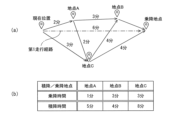
- FIGS. 3(a) and 3(b) Examples of loading/unloading costs and allowable conditions will be described with reference to FIGS. 3(a) and 3(b). It is now assumed that the vehicle 3 is carrying the first passenger and is traveling from the current position to the drop-off point. Here, the vehicle allocation request information acquisition unit 62 extracts loading/unloading points A, B, and C as shown in FIG. 3(a) as the loading/unloading points of the mixed cargo. As shown in FIG. 3(b), the required times for loading and unloading cargo at loading/unloading points A to C calculated by the cost calculation unit 65 are "5 minutes", "4 minutes", and "8 minutes", respectively.
- the vehicle allocation plan setting unit 66 assumes the following candidates as a route from the current position to the unloading point via the loading/unloading point.
- 1st route candidate Current position - Loading/unloading point A - Loading/unloading point C - Loading/unloading point B - Unloading point
- 2nd route candidate Current position - Loading/unloading point A - Loading/unloading point C - Unloading point
- 3rd route candidate Current position - Loading and unloading point A - Loading and unloading point B - Dropping point 4th route candidate: Current position - Loading and unloading point C - Loading and unloading point B - Dropping point
- the total time required for loading and unloading luggage when traveling from the first route candidate to the fourth route candidate is "17 minutes,”"13minutes,””9minutes,” and "12 minutes,” respectively.
- the vehicle allocation plan setting unit 66 selects the third route candidate as the second travel route, and changes the travel route of the vehicle 3 from the first travel route to the second travel route. Note that if there is no route candidate that satisfies the permissible conditions, the travel route of the vehicle 3 is not changed from the first travel route.
- the cost calculation unit 65 may calculate the delay time during which the vehicle 3 arrives at the boarding point or the disembarking point for loading and unloading the luggage as the loading/unloading cost. For example, as shown in FIG. 3, the travel time for the vehicle 3 to travel from the current location to the passenger loading/unloading point along the first traveling route is "6 minutes", and the traveling time from the current location to the loading/unloading point A is "6 minutes”. The travel time from the current location to the loading/unloading point C is "3 minutes", the traveling time from the loading/unloading point A to the loading/unloading point B is "3 minutes”, and the traveling time from the current location to the loading/unloading point C is "3 minutes”.
- the traveling time from A to loading/unloading point C is "2 minutes"
- the traveling time from loading/unloading point C to loading/unloading point B is "4 minutes”
- the traveling time from loading/unloading point B to the boarding/unloading point Assume that the travel time from the loading/unloading point C to the boarding/unloading point is "4 minutes”.
- the time required to travel from the first route candidate to the fourth route candidate, load and unload luggage at each loading/unloading point, and travel from the current location to the boarding/unloading point is “26 minutes” and “21 minutes,” respectively. minutes,” “15 minutes,” and “20 minutes.” Therefore, compared to the time required for traveling along the first travel route (6 minutes), the delay time for the vehicle 3 to arrive at the boarding and alighting point for loading and unloading the luggage is “20 minutes” and "20 minutes,” respectively. 15 minutes,” “9 minutes,” and “14 minutes.”
- the vehicle allocation plan setting unit 66 selects the third route candidate or the fourth route candidate as the second travel route. For example, the vehicle allocation plan setting unit 66 may select the third route candidate with the shortest delay time from among the third route candidates or the fourth route candidates.
- the cost calculation unit 65 calculates the delay time for the vehicle 3 to arrive at the boarding and alighting point based on the desired time for loading and unloading the luggage. It's fine.
- the delay time may be calculated to include the waiting time for the vehicle 3 to arrive or stay at the loading/unloading point at the desired time.
- the cost calculation unit 65 may calculate the number of times the vehicle 3 stops for loading and unloading luggage while a passenger is riding in the vehicle 3.
- the number of times the vehicle 3 stops when traveling from the first route candidate to the fourth route candidate and loading and unloading cargo at each loading/unloading point is "3 times", “2 times", and “2 times", respectively. "times” and "twice times”. If the upper limit for the number of stops allowed for the first passenger to load and unload luggage is "two", then the second route candidate to the fourth route candidate satisfy the allowable condition. Therefore, the vehicle allocation plan setting unit 66 selects the second route candidate to the fourth route candidate as the second travel route.
- the vehicle dispatch plan setting unit 66 combines a plurality of allowable conditions and calculates a second travel route in which the first travel route is changed to pass through the loading/unloading point when the loading/unloading cost satisfies all of the respective allowable conditions.
- the upper limit for the waiting time between loading and unloading luggage is ⁇ 10 minutes
- the upper limit for the delay time for arriving at the boarding and alighting point for loading and unloading luggage is ⁇ 14 minutes.
- a third route candidate that satisfies the upper limit value of "2 times" for the number of stops for unloading may be selected as the second travel route, and the travel route of the vehicle 3 may be changed from the first travel route to the second travel route. .
- the vehicle allocation plan setting unit 66 may give priority to driving directly to the boarding point rather than loading luggage on the pick-up route that travels to the boarding point of the passenger. For example, regardless of whether the loading/unloading cost for loading luggage satisfies the allowable conditions for the first passenger, there is no need to change the pick-up route to pass through the loading/unloading point for loading luggage. . Thereby, the delay in the vehicle 3 arriving at the boarding point can be suppressed, so passengers can be encouraged to board the vehicle 3.
- the pick-up route may be changed to pass through this loading/unloading point. This makes it possible to reduce the amount of luggage loaded on the vehicle 3 at the time the passenger gets on board, thereby improving passenger comfort.
- the vehicle allocation request information acquisition unit 62 acquires passenger transport request information of other passenger candidates to be transported together with the first passenger from the passenger information DB 22.
- another passenger who is transported together with the first passenger may be referred to as a "second passenger.”
- the vehicle allocation request information acquisition unit 62 selects passengers whose boarding point is within a predetermined distance range from the first travel route as candidates for second passengers among passenger transport requests for which the vehicle 3 has not been allocated. information on the boarding and alighting point of the second passenger candidate is obtained.
- the boarding point and the alighting point of the second passenger are, for example, the desired boarding point and the desired alighting point of the passenger transportation request and the boarding and alighting point candidates stored in the loading/disembarking point DB 24, as in the case of the first passenger.
- the decision may be made based on the information.
- the cost calculation unit 65 calculates the boarding and alighting cost incurred by the first passenger when the second passenger gets on and off the vehicle 3 at the second passenger's boarding and alighting point.
- the cost calculation unit 65 acquires from the loading/unloading point DB 24 actual information on the time required for boarding and alighting when a passenger actually boarded and alighted at the second passenger boarding and alighting point in the past.
- the cost calculation unit 65 may calculate the time required for the second passenger to get on and off at the boarding and alighting point as the boarding and alighting cost based on the performance information.
- the cost calculation unit 65 may also calculate the delay time during which arrival at the boarding and alighting point is delayed due to the boarding and alighting of the second passenger as the boarding and alighting cost.
- the cost calculation unit 65 may also calculate the number of times the vehicle 3 stops for the second passenger to get on and off as the boarding and alighting cost.
- the vehicle allocation plan setting unit 66 determines whether the boarding and alighting cost at the boarding and alighting point calculated by the cost calculation unit 65 satisfies the allowable conditions for the first passenger. When the boarding and alighting cost satisfies the allowable conditions, the vehicle allocation plan setting unit 66 calculates a second travel route by changing the first travel route so as to pass through the second passenger's boarding and alighting point. If the cost of boarding and alighting does not meet the allowable conditions, the first travel route is not changed.
- the vehicle allocation plan setting unit 66 stores the calculated second travel route in the vehicle allocation plan DB 26 as a vehicle allocation plan for the vehicle 3.
- the driving route instruction unit 68 transmits the second driving route stored in the vehicle allocation plan DB 26 to the vehicle 3.
- the controller 35 of the vehicle 3 presents information on the second travel route transmitted from the control device 2 via the terminal device 34 .
- the controller 35 of the vehicle 3 executes automatic driving control to cause the vehicle 3 to travel along the second travel route transmitted from the control device 2.
- the route change notification unit 67 sends a route change notification informing of the change of the first traveling route to the first route used by the first passenger.
- the route change notification may be a notification that informs the number of stops or stop time required for loading and unloading luggage or getting on and off the second passenger.
- the route change notification unit 67 may transmit the route change notification at the timing when the vehicle allocation plan setting unit 66 changes the travel route of the vehicle 3 from the first travel route to the second travel route.
- the controller 42 of the first electronic device 4 outputs the route change notification transmitted from the route change notification unit 67 from the HMI 41 and notifies the first passenger of the route change notification.
- the route change notification may be displayed on the display device of the HMI 41, or audio information of the route change notification may be output from the speaker of the HMI 41.
- the terminal device 34 of the vehicle 3 can be used as an interface for providing information to passengers, the route change notification unit 67 may output a route change notification to the vehicle 3.
- the controller 35 of the vehicle 3 outputs the route change notification transmitted from the route change notification unit 67 from the terminal device 34, and notifies the first passenger of the route change notification.
- the route change notification may be displayed on the display device of the terminal device 34, or the audio information of the route change notification may be output from the speaker of the terminal device 34.
- FIG. 4 is a flowchart of an example of the vehicle allocation method of the present invention.
- the vehicle allocation request reception unit 60 receives a passenger transport request for a first passenger as a first vehicle allocation request.
- the loading/unloading point setting unit 63 selects the boarding point and the unloading point of the first vehicle allocation request.
- the travel route calculation unit 64 calculates the first travel route of the first vehicle allocation request.
- step S4 the vehicle dispatch plan setting unit 66 extracts information on the first passenger's permissible conditions from the first vehicle dispatch request.
- step S5 the vehicle dispatch request information acquisition unit 62 acquires luggage transportation request information for candidates for combined luggage and loaded luggage from the luggage information DB 23 as a second vehicle dispatch request. And/or the passenger transportation request of the second passenger candidate is acquired from the passenger information DB 22 as a second dispatch request.
- step S6 the vehicle dispatch request information acquisition unit 62 extracts the loading/unloading point and the boarding/disembarking point of the second vehicle dispatch request.
- step S7 the cost calculation unit 65 performs an incurred cost estimation process.
- the incurred cost estimation process calculates the loading and unloading costs incurred by the first passenger by loading and unloading luggage at the loading and unloading point of the second vehicle dispatch request, and the loading and unloading costs incurred by the second passenger at the loading and unloading point of the second vehicle dispatch request.
- the boarding and alighting costs incurred by the first passenger are calculated. Details of the incurred cost estimation process will be described later.
- step S8 the vehicle allocation plan setting unit 66 determines whether the loading/unloading cost and the boarding/unloading cost satisfy the allowable conditions.
- step S8: Y If the loading/unloading cost and the boarding/unloading cost satisfy the allowable conditions (step S8: Y), the process proceeds to step S10. If the loading/unloading cost and the boarding/unloading cost do not satisfy the allowable conditions (step S8: N), the process proceeds to step S9. In step S9, the driving route instruction unit 68 transmits the first driving route to the vehicle 3. As a result, the vehicle 3 travels along the first travel route. The process then ends.
- step S10 the traveling route calculation unit 64 calculates a second traveling route by changing the first traveling route so as to pass through the loading/unloading point and the boarding/disembarking point.
- the route change notification unit 67 transmits a route change notification to the first electronic device 4 used by the first passenger. Or send it to vehicle 3.
- the first electronic device 4 or the terminal device 34 of the vehicle 3 outputs a route change notification.
- the driving route instruction unit 68 transmits the second driving route to the vehicle 3. As a result, the vehicle 3 travels along the second travel route. The process then ends.
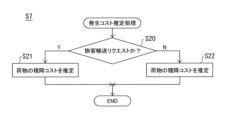
- FIG. 5 is a flowchart of an example of the incurred cost estimation process (step S7).
- the cost calculation unit 65 determines whether the second vehicle allocation request is a passenger transportation request. If the second vehicle allocation request is a passenger transportation request (step S20: Y), the process advances to step S21. If the second vehicle allocation request is a luggage transportation request (step S20: N), the process proceeds to step S22.
- step S21 the cost calculation unit 65 calculates the boarding and alighting cost based on the actual information on the time required for boarding and alighting when a passenger actually boarded and alighted at the second passenger boarding and alighting point in the past. Thereafter, the process proceeds to step S8 in FIG.
- step S22 the cost calculation unit 65 calculates the loading/unloading cost based on the basic loading/unloading cost information at the loading/unloading point. The loading/unloading cost may be calculated based on actual information on the time required when actually loading/unloading cargo at the loading/unloading point in the past. Thereafter, the process proceeds to step S8 in FIG.
- the controller 27 of the control device 2 performs processing to obtain information on a request to transport passengers as a first dispatch request, processing to obtain information on a request to transport luggage as a second dispatch request, and a process to obtain information on a request to transport luggage as a second dispatch request.
- the process of acquiring the information on the unloading point and the estimated value of the loading/unloading cost, which is the cost required for loading and unloading the cargo transported by the vehicle 3 at the loading/unloading point between the start point and the end point of the first travel route, are a process of calculating according to the loading/unloading point; a process of calculating a second driving route by changing the first driving route so as to pass through the loading/unloading point when the loading/unloading cost satisfies a predetermined allowable condition; A process of causing a terminal device to output a route change notification informing of a change in the travel route is executed.
- the loading/unloading cost required to load/unload cargo is calculated according to the loading/unloading point, the loading/unloading cost can be estimated with higher accuracy.
- the passenger of the first dispatch request for loading/unloading the baggage is incurred. This can prevent costs from becoming excessive. As a result, it is possible to improve the quality of service for the passenger requesting the first dispatch request.
- the predetermined permissible conditions may be set for each passenger. As a result, if the permissible conditions for each passenger are not satisfied, it is possible to prohibit changing the first travel route to pass through the loading/unloading point.
- Loading and unloading costs are the time required to load and unload cargo at the loading and unloading point, or the boarding point where passengers board the vehicle 3 or the unloading point where passengers alight from the vehicle 3 to load and unload luggage at the loading and unloading point. It may be a delay time in which arrival at a point is delayed. Thereby, it is possible to calculate the cost incurred by the passenger of the first dispatch request for loading and unloading the luggage.
- the second vehicle allocation request may include a desired time for loading and unloading the cargo at the loading/unloading point.
- the controller 27 may calculate the delay time based on the desired time. Thereby, loading and unloading costs can be calculated with higher accuracy.
- the first travel route may include a pick-up route that travels to a passenger boarding point. The controller 27 does not need to change the pick-up route so as to pass through the loading/unloading point where the cargo is loaded. Thereby, the delay in the vehicle 3 arriving at the boarding point can be suppressed, so passengers can be encouraged to board the vehicle 3.
- the first travel route may include a pick-up route that travels to a passenger boarding point. If the loading/unloading point at which the cargo loaded on the vehicle 3 is unloaded is on the pickup/unloading point, the controller 27 may change the pickup/unloading point to pass through the loading/unloading point. This makes it possible to reduce the amount of luggage loaded on the vehicle 3 at the time the passenger gets on board, thereby improving passenger comfort.
- the route change notification may include notification of at least one of the number of stops or the stopping time required for loading and unloading the cargo. Thereby, the passenger making the first dispatch request can predict how much the loading/unloading cost will be required for loading/unloading the luggage at the loading/unloading point.
- the controller 27 may cause the terminal device to output a route change notification at the timing of changing the first travel route to the second travel route. This allows the passenger requesting the first vehicle to be informed in advance that the travel route will be changed in order to load and unload luggage at the loading/unloading point.
- the controller 27 determines the actual value of past loading/unloading costs at the loading/unloading point, the attributes of the delivery person who delivers the parcel with the vehicle 3, the amount, shape, or type of the parcel, whether or not a trolley is used at the loading/unloading point, Weather information, attributes of the loading/unloading point, time required for the recipient to travel to the cargo receiving point at the loading/unloading point, travel distance or travel time from a possible stopping position at the loading/unloading point to the delivery destination of the parcel, or the loading/unloading point
- the loading and unloading cost may be calculated based on at least one of the work items of loading and unloading in . Thereby, loading and unloading costs can be calculated with higher accuracy.
- SYMBOLS 1...Vehicle dispatch system 2...Control device, 3...Vehicle, 4...First electronic device, 5...Second electronic device, 20, 33, 40, 50...Communication device, 21, 32...Map database, 22...Passenger information Database, 23... Baggage information database, 24... Boarding and alighting point database, 25... Vehicle information database, 26... Vehicle dispatch plan database, 27, 35, 42, 52... Controller, 28, 36, 43, 53...
Landscapes
- Engineering & Computer Science (AREA)
- Radar, Positioning & Navigation (AREA)
- Remote Sensing (AREA)
- Computing Systems (AREA)
- Physics & Mathematics (AREA)
- General Physics & Mathematics (AREA)
- Automation & Control Theory (AREA)
- Operations Research (AREA)
- Business, Economics & Management (AREA)
- Accounting & Taxation (AREA)
- Development Economics (AREA)
- Economics (AREA)
- General Business, Economics & Management (AREA)
- Traffic Control Systems (AREA)
- Management, Administration, Business Operations System, And Electronic Commerce (AREA)
Priority Applications (1)
| Application Number | Priority Date | Filing Date | Title |
|---|---|---|---|
| JP2024546737A JP7754336B2 (ja) | 2022-09-15 | 2023-07-20 | 配車装置、配車システム及び配車方法 |
Applications Claiming Priority (2)
| Application Number | Priority Date | Filing Date | Title |
|---|---|---|---|
| JP2022146731 | 2022-09-15 | ||
| JP2022-146731 | 2022-09-15 |
Publications (1)
| Publication Number | Publication Date |
|---|---|
| WO2024057714A1 true WO2024057714A1 (ja) | 2024-03-21 |
Family
ID=90274688
Family Applications (1)
| Application Number | Title | Priority Date | Filing Date |
|---|---|---|---|
| PCT/JP2023/026626 Ceased WO2024057714A1 (ja) | 2022-09-15 | 2023-07-20 | 配車装置、配車システム及び配車方法 |
Country Status (2)
| Country | Link |
|---|---|
| JP (1) | JP7754336B2 (https=) |
| WO (1) | WO2024057714A1 (https=) |
Cited By (1)
| Publication number | Priority date | Publication date | Assignee | Title |
|---|---|---|---|---|
| US20250013958A1 (en) * | 2023-07-04 | 2025-01-09 | Toyota Jidosha Kabushiki Kaisha | Delivery vehicle management system |
Citations (2)
| Publication number | Priority date | Publication date | Assignee | Title |
|---|---|---|---|---|
| JP2021156684A (ja) * | 2020-03-26 | 2021-10-07 | 株式会社野村総合研究所 | 配送最適化装置 |
| WO2022162842A1 (ja) * | 2021-01-28 | 2022-08-04 | 日産自動車株式会社 | 貨客混載システム、貨客混載システムの配車装置及び貨客混載システムの配車方法 |
Family Cites Families (2)
| Publication number | Priority date | Publication date | Assignee | Title |
|---|---|---|---|---|
| JP2018194354A (ja) | 2017-05-15 | 2018-12-06 | 三菱電機株式会社 | ナビゲーション装置およびナビゲーションプログラム |
| JP7215257B2 (ja) | 2019-03-15 | 2023-01-31 | トヨタ自動車株式会社 | 情報処理装置、情報処理方法、及び情報処理プログラム |
-
2023
- 2023-07-20 WO PCT/JP2023/026626 patent/WO2024057714A1/ja not_active Ceased
- 2023-07-20 JP JP2024546737A patent/JP7754336B2/ja active Active
Patent Citations (2)
| Publication number | Priority date | Publication date | Assignee | Title |
|---|---|---|---|---|
| JP2021156684A (ja) * | 2020-03-26 | 2021-10-07 | 株式会社野村総合研究所 | 配送最適化装置 |
| WO2022162842A1 (ja) * | 2021-01-28 | 2022-08-04 | 日産自動車株式会社 | 貨客混載システム、貨客混載システムの配車装置及び貨客混載システムの配車方法 |
Cited By (1)
| Publication number | Priority date | Publication date | Assignee | Title |
|---|---|---|---|---|
| US20250013958A1 (en) * | 2023-07-04 | 2025-01-09 | Toyota Jidosha Kabushiki Kaisha | Delivery vehicle management system |
Also Published As
| Publication number | Publication date |
|---|---|
| JPWO2024057714A1 (https=) | 2024-03-21 |
| JP7754336B2 (ja) | 2025-10-15 |
Similar Documents
| Publication | Publication Date | Title |
|---|---|---|
| US10082793B1 (en) | Multi-mode transportation planning and scheduling | |
| CN112189224B (zh) | 上下车位置决定方法、上下车位置决定装置以及上下车位置决定系统 | |
| US11341857B2 (en) | Drone coordination device, vehicle management device, drone coordination method, and program | |
| WO2018230676A1 (ja) | ライドシェア管理装置、ライドシェア管理方法、およびプログラム | |
| TWI550534B (zh) | 共乘者媒合配對之系統及其方法 | |
| US10337876B2 (en) | Constrained-transportation directions | |
| JP7390441B2 (ja) | システム、方法、および、コンピュータプログラム | |
| US20190258270A1 (en) | Traveling control system for autonomous traveling vehicles, server apparatus, and autonomous traveling vehicle | |
| CN113168663A (zh) | 自主车辆的多目的地行程 | |
| CN110782051A (zh) | 一种提醒服务请求者的方法及系统 | |
| US20210302978A1 (en) | Accommodation area management device | |
| JP7754336B2 (ja) | 配車装置、配車システム及び配車方法 | |
| JP7808508B2 (ja) | 配車支援装置、配車支援方法、配車支援システム | |
| CN111178559A (zh) | 一种提醒服务请求者的方法及系统 | |
| WO2021049073A1 (ja) | 配達候補提案システム、配達候補提案端末および配達候補提案プログラム | |
| JP2022049211A (ja) | 輸送計画生成装置、輸送計画生成システム、および輸送計画生成プログラム | |
| US20210295218A1 (en) | Accommodation area management device | |
| JP7344444B2 (ja) | 荷役支援システム、荷役支援プログラムおよび荷役支援端末 | |
| JP7796952B2 (ja) | 配車支援装置、配車支援方法、配車支援システム | |
| JP7638177B2 (ja) | 配車装置及び配車方法 | |
| US11989795B1 (en) | Partner trip application programming interface | |
| JP7720266B2 (ja) | 配車支援装置、配車支援方法、配車支援システム | |
| JP7768363B2 (ja) | 車両用経路計画装置、車両用経路計画方法、車両用経路計画システム | |
| JP2024018290A (ja) | 車両運行計画装置及び車両運行計画方法 | |
| JP7685629B2 (ja) | 走行支援装置及び走行支援方法 |
Legal Events
| Date | Code | Title | Description |
|---|---|---|---|
| 121 | Ep: the epo has been informed by wipo that ep was designated in this application |
Ref document number: 23864137 Country of ref document: EP Kind code of ref document: A1 |
|
| WWE | Wipo information: entry into national phase |
Ref document number: 2024546737 Country of ref document: JP |
|
| NENP | Non-entry into the national phase |
Ref country code: DE |
|
| 122 | Ep: pct application non-entry in european phase |
Ref document number: 23864137 Country of ref document: EP Kind code of ref document: A1 |