WO2024048231A1 - 配車管理装置及び配車管理方法 - Google Patents
配車管理装置及び配車管理方法 Download PDFInfo
- Publication number
- WO2024048231A1 WO2024048231A1 PCT/JP2023/029096 JP2023029096W WO2024048231A1 WO 2024048231 A1 WO2024048231 A1 WO 2024048231A1 JP 2023029096 W JP2023029096 W JP 2023029096W WO 2024048231 A1 WO2024048231 A1 WO 2024048231A1
- Authority
- WO
- WIPO (PCT)
- Prior art keywords
- vehicle
- vehicle allocation
- plan
- dispatch
- management device
- Prior art date
- Legal status (The legal status is an assumption and is not a legal conclusion. Google has not performed a legal analysis and makes no representation as to the accuracy of the status listed.)
- Ceased
Links
Images



Classifications
-
- B—PERFORMING OPERATIONS; TRANSPORTING
- B65—CONVEYING; PACKING; STORING; HANDLING THIN OR FILAMENTARY MATERIAL
- B65G—TRANSPORT OR STORAGE DEVICES, e.g. CONVEYORS FOR LOADING OR TIPPING, SHOP CONVEYOR SYSTEMS OR PNEUMATIC TUBE CONVEYORS
- B65G61/00—Use of pick-up or transfer devices or of manipulators for stacking or de-stacking articles not otherwise provided for
-
- G—PHYSICS
- G08—SIGNALLING
- G08G—TRAFFIC CONTROL SYSTEMS
- G08G1/00—Traffic control systems for road vehicles
- G08G1/123—Traffic control systems for road vehicles indicating the position of vehicles, e.g. scheduled vehicles; Managing passenger vehicles circulating according to a fixed timetable, e.g. buses, trains, trams
Definitions
- the present invention relates to vehicle dispatch management technology, and in particular to a vehicle dispatch management device and a vehicle dispatch management method for managing on-demand dispatch of vehicles that can carry both passengers and cargo (baggage). Regarding.
- Mobility services are known as services that provide smooth transportation of passengers and/or luggage by vehicle.
- mobility services have been proposed that transport passengers and luggage simultaneously in a single vehicle.
- Patent Document 1 listed below discloses an on-demand passenger cargo consolidation system that determines the route of an operating vehicle carrying passengers and luggage together based on passenger movement requests and baggage movement requests.
- the present invention has been made in view of the above-mentioned problems, and is an object of the present invention to improve vehicle dispatch efficiency and/or loading efficiency in an on-demand dispatch service for vehicles capable of passenger/cargo consolidation (consolidated cargo/passenger loading).
- the purpose is to improve vehicle dispatch efficiency and/or loading efficiency in an on-demand dispatch service for vehicles capable of passenger/cargo consolidation (consolidated cargo/passenger loading).
- the present invention for solving the above problems is constituted by including the following invention specific matters or technical features.
- the present invention is a vehicle allocation management device that manages on-demand vehicle allocation using a plurality of vehicles that can carry passengers and luggage together.
- the vehicle dispatch management device includes a vehicle dispatch request acquisition unit that acquires a vehicle dispatch request for either boarding or baggage delivery by a user, and one vehicle that is selected from the plurality of vehicles in response to the obtained vehicle dispatch request. and a vehicle allocation instruction section that transmits a vehicle allocation instruction based on the vehicle allocation plan to the one vehicle. Further, at the time when the vehicle dispatch plan creation unit creates the vehicle dispatch plan for the one vehicle in response to the vehicle dispatch request for package delivery, if there is no other vehicle dispatch request, the vehicle dispatch plan creation unit may not create the vehicle dispatch plan. temporarily put on hold.
- the present invention according to another aspect is a vehicle allocation management method using a vehicle allocation management device that manages on-demand vehicle allocation using a plurality of vehicles that can carry passengers and luggage together.
- the method includes acquiring a vehicle dispatch request for either a ride or a package delivery from a user's terminal device, and dispatching a vehicle to one vehicle selected from the plurality of vehicles in response to the acquired vehicle dispatch request.
- the method includes creating a plan, and transmitting a vehicle allocation instruction based on the confirmed vehicle allocation plan to the one vehicle. Further, creating the vehicle allocation plan means that at the time when the vehicle allocation plan for the one vehicle is created in response to the vehicle allocation request for package delivery, if there is no other vehicle allocation request, the vehicle allocation plan is Including temporarily suspending creation.
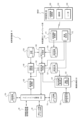
- FIG. 1 is a diagram illustrating an example of a vehicle allocation management system according to an embodiment of the present invention.
- FIG. 2 is a block diagram showing an example of a functional configuration model of a vehicle allocation management device according to an embodiment of the present invention.
- FIG. 3 is a diagram for explaining derivation of a route pattern in the vehicle allocation management system according to an embodiment of the present invention.
- FIG. 4 is a diagram for explaining various delay limit times in a vehicle allocation plan by a vehicle allocation management device according to an embodiment of the present invention.
- FIG. 5 is a sequence chart for explaining an overview of a vehicle dispatch service in a vehicle dispatch management system according to an embodiment of the present invention.
- FIG. 1 is a diagram illustrating an example of a vehicle allocation management system according to an embodiment of the present invention.
- FIG. 2 is a block diagram showing an example of a functional configuration model of a vehicle allocation management device according to an embodiment of the present invention.
- FIG. 3 is a diagram for explaining derivation of a route pattern in the
- FIG. 6A is a flowchart for explaining an example of vehicle allocation management processing by the vehicle allocation management device according to an embodiment of the present invention.
- FIG. 6B is a flowchart for explaining an example of vehicle allocation management processing by the vehicle allocation management device according to an embodiment of the present invention.
- FIG. 1 is a diagram illustrating an example of a vehicle allocation management system according to an embodiment of the present invention.
- the vehicle allocation management system 1 includes a vehicle allocation management device 10, a terminal device 20, and a vehicle V, which are connected to each other via a communication network N so that they can communicate with each other.
- the vehicle dispatch management system 1 of the present disclosure provides, for example, an on-demand vehicle dispatch service using a plurality of vehicles V, targeting a certain area.
- "On-demand vehicle dispatch service” refers to a service that allocates (dispatch) a predetermined vehicle to a user in immediate response to a vehicle dispatch request from the user. In other words, in an on-demand vehicle dispatch service, there is no vehicle dispatch reservation time specified by the user.
- immediate response is a concept that includes not only dispatching a vehicle without delay in response to a vehicle dispatch request from a user, but also including a certain amount of time that the user can usually tolerate.
- the vehicle dispatch management system 1 of the present disclosure is based on the premise of such an "on-demand vehicle dispatch service" and provides efficient delivery by adjusting the timing of dispatch for a specific vehicle dispatch request under predetermined conditions. Realize ride-hailing services.
- the vehicle dispatch management device 10 is a computing device that centrally manages vehicle dispatch services by a plurality of vehicles V in a target area.
- the vehicle dispatch management device 10 implements the vehicle dispatch service of the present disclosure by implementing, for example, a vehicle dispatch management server program and executing the vehicle dispatch management server program under the control of a processor.
- the vehicle dispatch management device 10 includes various databases 12 that manage data necessary to realize such a vehicle dispatch service.
- the database 12 includes, for example, an operation record database 12a, a baggage information database 12b, a user information database 12c, a map database 12d, a vehicle information database 12e, and a vehicle dispatch plan database 12f (see FIG. 2).
- the database 12 is configured as a part of the vehicle allocation management device 10, but the database 12 is not limited to this, and all or part of it may be configured separately from the vehicle allocation management device 10.
- the vehicle dispatch management device 10 receives a dispatch request for a vehicle V from a user who wishes to dispatch a vehicle, and creates and finalizes a dispatch plan for one vehicle V selectively allocated in response to the dispatch request. Then, a vehicle allocation instruction is given to one vehicle V in accordance with the confirmed vehicle allocation plan. The vehicle allocation plan is confirmed, for example, after receiving the user's consent.
- vehicle dispatch requests include a vehicle dispatch request for a ride from a user who is a passenger (hereinafter referred to as a "vehicle dispatch request"), and a vehicle dispatch request from a user who is a shipper (package delivery company or general user).
- vehicle dispatch request There is a vehicle allocation request for package delivery (hereinafter referred to as “vehicle allocation request for package delivery”).
- vehicle allocation request for package delivery a vehicle allocation request for package delivery
- a general user who is not a package delivery company can also request a package delivery vehicle in order to have his or her package delivered.
- a vehicle dispatch request includes, for example, the user name, the type of vehicle dispatch request, the departure/arrival location (boarding and disembarking locations for passengers, loading and unloading locations for cargo), transportation details (number of passengers and cargo). If so, it includes information on the number, size, type of luggage, etc.
- the vehicle allocation plan starts from the place where the vehicle V waits (the starting point), passes through several points along the way (departure/arrival points) for boarding and alighting and/or loading/unloading cargo, and then goes to the final point (the waiting point). (This may not be the same as the initial waiting location.)
- the vehicle allocation management device 10 temporarily suspends a specific vehicle allocation plan according to predetermined suspension conditions.
- the predetermined suspension condition is, for example, a case where no other vehicle allocation request is received at the time of creating a vehicle allocation plan for a vehicle allocation request for package delivery.
- the vehicle allocation management device 10 releases the suspension of the vehicle allocation plan according to predetermined release conditions, and adjusts the vehicle allocation plan so that it is a so-called mixed freight and passenger loading based on the vehicle allocation request for baggage delivery and the vehicle allocation request for boarding. Recreate it, propose it to the user, and confirm.
- the predetermined cancellation condition is, for example, when a request for dispatching a new ride is subsequently received.
- Vehicle V is a vehicle registered in the vehicle information database 12e that is available for use by the user.
- the type of vehicle V (for example, sedan, minivan, SUV, etc.) does not matter, but it is assumed that it is at least a type that can carry cargo and passengers together.
- the vehicle V may be an electric vehicle (EV) powered by an on-board battery. Further, the vehicle V may be a self-driving car capable of completely autonomous driving, and the so-called self-driving level does not matter.
- the vehicle V includes a control device 300 that controls the vehicle V itself or its onboard equipment (for example, a navigation device) according to instructions from the vehicle allocation management device 10 (see FIG. 2).
- the control device 300 acquires position information of the vehicle V via a GPS system, transmits this to the vehicle dispatch management device 10, receives a dispatch instruction from the vehicle dispatch management device 10, and controls various devices of the vehicle V or Control the operation of the device.
- the control device 300 includes, for example, a navigation function that presents an operating route according to a vehicle allocation plan, and an autonomous driving control function that follows the operating route of the vehicle V in the case of a fully autonomous vehicle.
- the terminal device 20 is a computing device that allows a user, such as a ride applicant or a luggage delivery company, to request a ride by operating a user interface.
- the terminal device 20 is, for example, a smartphone, a pad computer, a notebook personal computer, a desktop computer, etc., but is not limited to these.
- the terminal device 20 implements, for example, a vehicle dispatch management client program (so-called vehicle dispatch application).
- vehicle dispatch application enables the user to use the vehicle dispatch service of the vehicle dispatch management device 10 by executing a vehicle dispatch application under the control of the processor.
- the user makes a vehicle dispatch request from a vehicle dispatch request screen (not shown) on the user interface of the terminal device 20, and in response, accepts the vehicle dispatch plan created by the vehicle dispatch management device 10. You can make reservations for rides or baggage delivery.
- the vehicle allocation plan based on the vehicle allocation request for package delivery is temporarily suspended according to the predetermined suspension conditions, so that the vehicles V can be efficiently operated.
- the temporarily suspended vehicle allocation plan is re-created together with subsequent new vehicle allocation requests, so that the vehicle V allocation efficiency and/or loading rate can be improved.
- the created vehicle allocation plan is proposed to the user, and if the user accepts the proposal, the vehicle allocation plan is finalized, so vehicles V can be operated flexibly in response to various vehicle allocation requests. , vehicle dispatch efficiency can be improved.
- FIG. 2 is a block diagram showing an example of a functional configuration model of a vehicle allocation management device according to an embodiment of the present invention.
- the vehicle allocation management device 10 includes, for example, a front end processing unit 110, a demand information acquisition unit 120, a vehicle allocation request acquisition unit 130, a departure/arrival point determination unit 140, a vehicle allocation plan creation unit 150, It is configured as a functional configuration model including functional components such as a travel route planning section 160 and a vehicle communication interface section 170. Further, the vehicle allocation management device 10 includes various databases 12, as described above. Such a functional model is realized by the vehicle dispatch management device 10 executing a vehicle dispatch management server program under the control of a processor, thereby cooperating with various hardware resources.
- the functional configuration model shown here is an example, and all or part of the functions of a certain functional component may be realized by other functional components.
- the terminal device 20 as a terminal device for package delivery companies and general users, and a part of the configuration of the control device 300 in the vehicle V are also shown.
- the operation record database 12a stores, for example, information regarding the past operation record of each vehicle V (operation record information).
- the operation record information includes various specification information such as operation time (operation start time and end time), operation route, and mileage for each vehicle V, for example.
- the operation record information may indicate the demand record of the vehicle V in a certain time zone and/or a certain area based on the operation time of each vehicle V.
- the package information database 12b stores information regarding package delivery (package information).
- the package information includes, for example, information regarding the package delivery company name, business attributes, delivery base, package ID, package delivery status, customer information, and the like.
- the user information database 12c stores user information regarding users who use the dispatch service.
- the user information includes, for example, a user ID and password, personal attributes, and information regarding service usage status.
- the user information is registered in the user information database 12c under the control of the vehicle dispatch management device 10, for example, when the user inputs predetermined information when the vehicle dispatch application is first activated.
- the user information may include the user's own specific behavior history.
- the specific behavior history includes, for example, the user's purchase history in the target area of the ride-hailing service. Such behavior history can be used by the demand information acquisition unit 120, for example, to predict whether there is a possibility that the user will request a ride soon after making a purchase.
- the map database 12d stores at least map data in the target area of the dispatch service.
- the map data includes, for example, information regarding addresses, place names, roads, facility names, and the like. Additionally, the map data may include information necessary for route search and environmental information such as road congestion conditions.
- Map data can be used, and for example, it may be an external map database that can be connected via an API.
- the vehicle information database 12e stores information (vehicle information) regarding the vehicle V provided for use by the user.
- Vehicle information includes, for example, vehicle ID, vehicle attributes (vehicle registration number, vehicle type, maximum number of passengers/maximum loading capacity, etc.), current dispatch plan, current location, and current status (service status, remaining battery capacity, number of passengers, etc.). , cargo loading capacity, etc.).
- vehicle ID vehicle ID
- vehicle attributes vehicle registration number, vehicle type, maximum number of passengers/maximum loading capacity, etc.
- current dispatch plan current location
- current status service status, remaining battery capacity, number of passengers, etc.
- cargo loading capacity etc.
- the vehicle allocation plan database 12f stores a vehicle allocation plan for each vehicle V based on the vehicle allocation request.
- the vehicle allocation plan includes an operation route from a waiting location as a starting point to a waiting location as an end point via several points. Furthermore, each vehicle allocation plan is associated with status information such as whether it is temporarily on hold or confirmed.
- the front end processing unit 110 performs various processes with the user's terminal device 20.
- the front-end processing unit 110 refers to the user information database 12c and performs login authentication processing in accordance with a login request from a vehicle dispatch application on the user's terminal device 20.
- the front-end processing unit 110 receives a vehicle dispatch request from a vehicle dispatch application on the user's terminal device 20, passes it to the vehicle dispatch request acquisition unit 130, and in response, the front end processing unit 110 receives a vehicle dispatch request from a vehicle dispatch application on the user's terminal device 20, passes it to the vehicle dispatch request acquisition unit 130, and in response, the vehicle dispatch plan creation unit 150 It interacts with the terminal device 20 in order to receive the user's approval or disapproval of the created vehicle allocation plan.
- the front end processing unit 110 acquires the user's action history transmitted from the user's terminal device 20 and stores it in the user information database 12c. A user's behavior history can be used to predict future demand.
- the demand information acquisition unit 120 acquires demand information indicating the current and/or future demand amount of the vehicle V at a predetermined timing.
- the demand information acquisition unit 120 includes, for example, a current demand calculation unit 121 that calculates the current demand for the vehicle V, and a demand prediction unit 122 that predicts the future demand.
- a current demand calculation unit 121 that calculates the current demand for the vehicle V
- a demand prediction unit 122 that predicts the future demand.
- the current demand calculation unit 121 refers to the vehicle allocation plan database 12f, calculates the current demand amount based on the number of waiting vehicles V to which no vehicle allocation plan is assigned at the present time (the number of waiting vehicles), and is output as demand information.
- the demand forecasting unit 122 refers to the operation record database 12a, predicts the future demand for the vehicle V based on past operation record information, and outputs this as demand information.
- future demand may be based on vehicles that are expected to be in demand at specific times or time periods such as 10 minutes, 20 minutes, 30 minutes, and 1 hour after a reference time (for example, the current time).
- the number of units may be V.
- the predicted number of vehicles V based on the user's behavior history is taken into consideration. In other words, when a user who does not have a means of transportation goes shopping at a shopping mall or the like within the target area, there is a possibility that the user requests a ride. is counted as the expected number of vehicles V.
- the demand forecasting unit 122 may predict the future demand amount by considering environmental factors such as temporal/seasonal factors and event holdings in addition to operation performance information.
- the demand forecasting unit 122 may include a demand forecasting model subjected to machine learning according to a predetermined machine learning algorithm, using, for example, operating performance information as an explanatory variable and a predicted demand amount as an objective variable. In this way, the demand forecasting unit 122 can create an optimal vehicle plan by predicting future demand, and the vehicles V can be operated efficiently.
- the vehicle allocation request acquisition unit 130 receives and acquires a vehicle allocation request from the user via the front end processing unit 110.
- the time when the vehicle dispatch request acquisition unit 130 receives the vehicle dispatch request becomes the time at which the holding limit time, which will be described later, starts to be counted.
- the types of vehicle allocation requests made by the user include vehicle allocation requests for rides and vehicle allocation requests for package delivery.
- the vehicle allocation request acquisition unit 130 delivers the acquired vehicle allocation request to the departure/arrival point determination unit 140 and the vehicle allocation plan creation unit 150, respectively.
- the departure and arrival point determining unit 140 refers to the map database 12d and determines the departure and arrival points shown on the map where the user can actually get on and off the vehicle. That is, the departure/arrival point determining unit 140 refers to the map database 12d for the departure/arrival point indicated in the dispatch request, and indicates a geographical position on the service route where the user can actually get on and off or load/unload luggage. Generate departure and destination information. The departure and arrival point determining unit 140 delivers the generated departure and arrival point information to the vehicle allocation plan creation unit 150.
- the vehicle allocation plan creation unit 150 creates and finalizes a vehicle allocation plan for one vehicle V selected from a plurality of candidate vehicles (candidate vehicles) V, based on the vehicle allocation request and departure/arrival point information. A vehicle allocation instruction is given to one vehicle V according to the vehicle allocation plan.
- the vehicle allocation plan creation unit 150 if the vehicle allocation plan creation unit 150 has not received any other vehicle allocation requests at the time of creating the vehicle allocation plan for the package delivery vehicle allocation request, the vehicle allocation plan creation unit 150 temporarily suspends the vehicle allocation plan for the package delivery vehicle allocation request. . If, for example, a new vehicle dispatch request is received while the vehicle dispatch plan is on hold, the vehicle dispatch plan creation unit 150 releases the suspension of the vehicle dispatch plan, and dispatches the dispatch request for baggage delivery and the dispatch of a ride.
- the vehicle allocation plan is updated or re-created so that it becomes a so-called mixed cargo/passenger loading, and this is proposed to the user and confirmed. In this way, since the vehicle allocation plan is proposed to the user before it is finalized, the user can determine whether the proposed vehicle allocation plan meets his or her wishes.
- the vehicle allocation plan creation unit 150 stores the confirmed vehicle allocation plan in the vehicle allocation plan database 12f, and notifies the vehicle allocation instruction unit 172 to instruct the vehicle V to allocate the vehicle.
- the vehicle allocation plan creation unit 150 first requests the driving route planning unit 160 to derive a route pattern in accordance with the acquired vehicle allocation request.
- the route pattern indicates a route that passes through all the departure and arrival points when a new departure and arrival point is added to the route that passes through the determined departure and arrival points (stopover points).
- the route pattern may include a route pattern based on a freight and passenger mixed vehicle dispatch plan based on a vehicle dispatch request for boarding and a vehicle dispatch request for package delivery.
- the driving route planning unit 160 refers to the map database 12d and the vehicle information database 12e and extracts one or more vehicles V that can match the vehicle allocation request as candidate vehicles v. For each of the extracted candidate vehicles v, a route pattern is derived according to the departure and arrival point information, and the derived route pattern is delivered to the vehicle allocation plan creation section 150.
- candidate vehicles v(1) to v(3) are extracted from the geographical relationship between the pick-up location Req_PU and the drop-off location Req_DO based on the vehicle allocation request.
- candidate vehicle v(1) is a vehicle for which a route passing through points P(0) to P(1) to P(2) has already been set.
- candidate vehicle v(2) is a vehicle waiting at waiting location S.
- candidate vehicle v(3) is a vehicle for which a route passing through points P(0) to P(1) has already been set.
- route patterns of candidate vehicles v(2) and V(3) are one pattern and three patterns, respectively.
- the vehicle allocation plan creation unit 150 next attempts to create a vehicle allocation plan based on each route pattern of the candidate vehicle v derived by the travel route planning unit 160.
- the vehicle allocation plan includes an operation route in which a waiting location serving as a starting point and a waiting location serving as an ending point are added to the route pattern.
- the vehicle allocation plan creation unit 150 narrows down the vehicle allocation plans by deleting or excluding vehicle allocation plans that meet predetermined exclusion conditions from among the created vehicle allocation plans. Examples of the predetermined exclusion conditions include (i) to (iv) below, but are not limited to these.
- FIG. 4 is a diagram for explaining various delay limit times in a vehicle allocation plan by a vehicle allocation management device according to an embodiment of the present invention.
- the scheduled operating time T_Tra according to the dispatch plan of a certain vehicle V based on the dispatch request is the time from the dispatch request reception time T_Req to the scheduled disembarkation time (scheduled loading/unloading time) T_DO.
- the vehicle allocation delay limit time refers to the time from the vehicle allocation request reception time T_Req to the scheduled boarding time (scheduled loading time) T_PU.
- the boarding delay limit time refers to the time from the scheduled boarding time T_PU to the boarding limit time TL_PU.
- the deboarding delay limit time refers to the time from the scheduled departure time T_Dep to the deboarding limit time (loading/unloading delay limit time) TL_DO, for example, from the boarding place (loading place) to the unloading place (loading/unloading place).
- the time is set to be 1.2 times the time it would take if the vehicle V went straight to the destination.
- the holding limit time is a time that allows temporary holding of the vehicle allocation plan, and is measured from the time when the vehicle allocation request is received.
- the hold limit time is an example of a predetermined release condition.
- the vehicle dispatch plan creation unit 150 excludes the vehicle dispatch plan ( Exclusion condition (ii)).
- the vehicle dispatch plan creation unit 150 determines that the alighting time of the related user will exceed the delay limit time due to the addition of pick-up point Req_PU and drop-off point Req_DO in a vehicle dispatch plan based on a certain route pattern, the vehicle dispatch plan creation unit 150 Exclude the plan (exclusion condition (iii)).
- the vehicle allocation plan creation unit 150 next calculates evaluation values for the narrowed-down vehicle allocation plans according to a predetermined evaluation function, and selects the optimal vehicle allocation plan according to the calculated evaluation values. For example, if the predetermined evaluation function is a request for dispatch of a ride, the shorter the riding time from the boarding time to the time of disembarkation, the higher the evaluation value, and if it is a request for dispatch of a package delivery, the evaluation value is based on the travel cost based on the distance traveled. This is a function defined such that the smaller the value, the higher the evaluation value. In this case, the vehicle allocation plan creation unit 150 selects the vehicle allocation plan with the highest evaluation value.
- a predetermined evaluation function is a request for dispatch of a ride
- the shorter the riding time from the boarding time to the time of disembarkation the higher the evaluation value
- the evaluation value is based on the travel cost based on the distance traveled. This is a function defined such that the smaller the value, the higher the evaluation value. In this
- the selected vehicle allocation plan is a provisional (temporary) vehicle allocation plan.
- a tentative vehicle allocation plan is a vehicle allocation plan that has not yet been finalized and is subject to modification or cancellation.
- the vehicle allocation plan creation unit 150 selects the one with the highest evaluation value based on the evaluation function. In this way, by using the evaluation function, it is possible to select the optimal vehicle allocation plan from among a plurality of vehicle allocation plans.
- different evaluation functions are used for requests for vehicle allocation for boarding and requests for vehicle allocation for package delivery, so it is possible to select a vehicle allocation plan that is more in line with the content of transportation.
- the vehicle allocation plan creation unit 150 may temporarily suspend the creation of the vehicle allocation plan.
- the vehicle allocation management device 10 temporarily stores the suspended vehicle allocation plan in the vehicle allocation plan database 12f. If, for example, a new vehicle dispatch request is received while the vehicle dispatch plan is on hold, the vehicle dispatch plan creation unit 150 cancels the suspension of the vehicle dispatch plan and creates a new vehicle dispatch request based on the package delivery vehicle dispatch request and the ride dispatch request.
- a new route pattern is derived, a vehicle allocation plan is re-created so that it will be a so-called mixed cargo/passenger load, and this is finalized.
- the vehicle allocation plan creation unit 150 can temporarily suspend the creation of a vehicle allocation plan based on a vehicle allocation request for package delivery and release the suspension, according to demand-dependent suspension conditions and release conditions. As an example, if the future demand predicted by the demand forecasting unit 122 exceeds the first upper limit, the vehicle allocation plan creation unit 150 temporarily suspends creation of the vehicle allocation plan. That is, when a certain amount of future demand for vehicles V is expected, the vehicle allocation plan creation unit 150 temporarily suspends the creation of the vehicle allocation plan in preparation for future vehicle allocation requests. As a result, it is possible to avoid delivering individual packages as much as possible, and it is possible to efficiently operate the vehicle V in consideration of future demand.
- the vehicle allocation plan creation section 150 Creation of the vehicle allocation plan is temporarily suspended.
- the vehicle allocation plan creation unit 150 temporarily suspends the creation of the vehicle allocation plan in preparation for future vehicle allocation requests.
- the vehicle allocation plan creation unit 150 when the current demand calculated by the current demand calculation unit 121 exceeds the second upper limit, the vehicle allocation plan creation unit 150 does not suspend the vehicle allocation plan or suspends the vehicle allocation plan. unlock. That is, when the current demand is high, the vehicle allocation plan creation unit 150 releases the suspension of the vehicle allocation plan in order to prevent demand from being missed. Thereby, a high operating rate of the vehicle V can be maintained, and the vehicle V can be operated efficiently.
- the vehicle allocation plan creation unit 150 may finalize the vehicle allocation plan without suspending the creation of the vehicle allocation plan if the number of packages indicated by the vehicle allocation request for package delivery is equal to or greater than a predetermined limit number of pending packages. .
- the vehicle allocation plan creation unit 150 determines that when the ratio of the future demand amount predicted by the demand forecasting unit 122 to the current demand amount calculated by the current demand calculation unit 121 exceeds a predetermined rate of change. , the predetermined limit number of held baggage may be changed to a smaller value.
- the vehicle allocation plan creation unit 150 can arbitrarily set a hold limit time for a vehicle allocation request for package delivery.
- the vehicle allocation plan creation unit 150 may set a holding limit time according to attribute information of a user who has made a request for vehicle allocation for package delivery. More specifically, if the user who requested a vehicle for parcel delivery is a general user, the holding limit time is set as a relatively short first holding limit time, whereas if the user is a parcel delivery company. In this case, the hold limit time is set as a second first hold limit time that is longer than the first hold limit time.
- the vehicle allocation plan creation unit 150 may set the holding limit time according to the package attribute information indicated by the vehicle allocation request for package delivery. More specifically, if the package is a product that requires refrigeration or perishable food, and if there is a risk that delaying or delaying the delivery time will reduce the value of the package, the holding time limit is relatively short. Set as the hold limit time. In other words, by setting a shorter holding limit time for requests for delivery of parcels such as perishable foods, it becomes possible to support delivery services for parcels that must be delivered quickly in a short period of time.
- the vehicle allocation plan creation unit 150 may set the holding limit time according to the loading point information indicated by the vehicle allocation request for package delivery. More specifically, if the loading point of the package is the general user's home, the holding limit time is set as the first holding limit time, whereas if the loading point of the package is the business office of the package delivery company. In this case, the hold limit time is set as a second first hold limit time that is longer than the first hold limit time. In other words, by setting the hold limit time shorter for a one-off package delivery request made by a general user, and by allowing package delivery companies to hold their vehicle dispatch plans to a certain extent, it is possible to improve the satisfaction of general users with the ride dispatch service. It is expected that this will improve ride-hailing services and further revitalize ride-hailing services.
- the vehicle communication interface unit 170 exchanges various information with the vehicle V via the communication network N.
- the vehicle communication interface unit 170 includes a vehicle information acquisition unit 171 that acquires vehicle information including location information of the vehicle V, and a vehicle allocation instruction unit 172 that instructs the vehicle V to move according to a vehicle allocation plan.
- the vehicle information acquisition unit 171 communicates with the communication unit 310 of the control device 300 and acquires the position information etc. acquired by the position information acquisition unit 320.
- the vehicle allocation instruction unit 172 refers to the vehicle allocation plan database 12f in accordance with the instruction from the vehicle allocation plan creation unit 150, identifies a corresponding vehicle allocation plan, and transmits an operation instruction to the vehicle V according to the identified vehicle allocation plan.
- the control device 300 of the vehicle V which has received the operation instruction, uses the navigation function to display a travel route according to the vehicle allocation plan, for example, on a user interface (indicated as "UI" in the figure) 330.
- FIG. 5 is a sequence chart for explaining an overview of a vehicle dispatch service in a vehicle dispatch management system according to an embodiment of the present invention.
- the vehicle V transmits its own position information obtained from the GPS system to the vehicle allocation management device 10 at a predetermined timing (S501). Note that the vehicle V acquires and transmits the position information periodically or in response to a transmission request from the vehicle allocation management device 10. Thereby, the vehicle allocation management device 10 acquires the position information transmitted from the vehicle V (S502).
- a user who wishes to use a ride-hailing service executes a ride-hailing application installed on the terminal device 20 and inputs the necessary information for a ride-hailing request on the ride-hailing request screen displayed on the user interface.
- the terminal device 20 transmits a vehicle allocation request to the vehicle allocation management device 10 (S503).
- a user who wishes to ride a vehicle inputs the boarding location, the alighting location, the number of passengers, etc.
- a user who wishes to have a package delivered inputs the loading and unloading locations, the number, size, type, etc. of the packages.
- the pick-up and drop-off locations may be selected from, for example, a geographic map displayed by the ride-hailing app. Further, the boarding place (loading place) may be the current position obtained by, for example, a GPS function installed in the user's smartphone.
- the vehicle allocation management device 10 When the vehicle allocation management device 10 receives the vehicle allocation request from the terminal device 20 (S504), it creates a vehicle allocation plan for the vehicle V based on the received vehicle allocation request, and in order to propose this to the user, the vehicle allocation management device 10 creates the contents of the created vehicle allocation plan. is transmitted to the terminal device 20 (S505). In addition, when the received vehicle allocation request is a vehicle allocation request for package delivery, the vehicle allocation management device 10 does not receive any other vehicle allocation request at the time of creating a vehicle allocation plan based on the vehicle allocation request for package delivery. , temporarily suspends the creation of a vehicle dispatch plan for vehicle V based on the vehicle dispatch request for said package delivery, releases the suspension under predetermined conditions, and updates or re-creates the vehicle dispatch plan as necessary. .
- the terminal device 20 When the terminal device 20 receives the contents of the vehicle allocation plan, it displays this as a vehicle allocation plan proposal screen on the user interface and prompts the user to accept or reject (accept or reject) the proposed vehicle allocation plan (S506).
- the terminal device 20 transmits a notification of acceptance/disapproval to the vehicle allocation management device 10 (S507), and the vehicle allocation management device 10 receives the notification sent from the terminal device 20.
- a notification of acceptance/rejection is received (S508).
- the vehicle allocation management device 10 finalizes the vehicle allocation plan for the vehicle V according to the vehicle allocation plan, sends a confirmation notification of the vehicle allocation reservation to the terminal device 20, and A vehicle allocation instruction according to the vehicle allocation plan is transmitted to vehicle V (S509).
- the terminal device 20 When the terminal device 20 receives the confirmation notification of the vehicle allocation reservation, it displays this on the user interface to inform the user that the vehicle allocation reservation has been confirmed (S510). On the other hand, upon receiving the vehicle allocation instruction, the vehicle V displays, for example, on the navigation screen an operating route according to the vehicle allocation plan indicated by the vehicle allocation instruction, in order to navigate the driver (S511). This allows the driver to operate the vehicle V in an on-demand manner in response to a user's dispatch request.
- FIGS. 6A and 6B are flowcharts for explaining an example of vehicle allocation management processing by the vehicle allocation management device according to an embodiment of the present invention. Such processing is realized by the vehicle dispatch management device executing the vehicle dispatch management server program under the control of the processor, thereby cooperating with various hardware resources.
- the vehicle allocation management device 10 waits until a new vehicle allocation request is received from the user (S601).
- a user who desires a ride or delivery of luggage operates a ride allocation application on the user interface of the terminal device 20 and inputs a ride allocation request.
- the vehicle allocation management device 10 receives a vehicle allocation request from the user (S601: Yes)
- the vehicle allocation management device 10 refers to the map database 12d and determines departure and arrival points based on the vehicle allocation request (S602).
- the vehicle allocation management device 10 extracts one or more candidate vehicles v according to the departure and arrival points (S603). For example, the vehicle allocation management device 10 extracts a vehicle V that is waiting or moving near the departure point as a candidate vehicle v.
- the vehicle allocation management device 10 derives a route pattern for each extracted candidate vehicle v by referring to the map database 12d (S604).
- the route pattern indicates a route that passes through all the departure and arrival points when a new departure and arrival point is added to the route that passes through the determined departure and arrival points (stopover points).
- the vehicle allocation management device 10 creates a vehicle allocation plan based on the derived route pattern (S605).
- the vehicle allocation plan includes an operation route in which a waiting location serving as a starting point and a waiting location serving as an ending point are added to the route pattern.
- the vehicle allocation management device 10 narrows down the vehicle allocation plans by excluding the vehicle allocation plans that do not meet the predetermined exclusion conditions from among the created vehicle allocation plans (S606). For example, if the boarding time of the user who has made a new vehicle allocation request exceeds the vehicle allocation delay limit time, the vehicle allocation management device 10 excludes the vehicle allocation plan.
- the vehicle allocation management device 10 calculates evaluation values for the narrowed-down vehicle allocation plans according to a predetermined evaluation function, and selects one vehicle allocation plan with the highest calculated evaluation value (S607). If there is a vehicle allocation plan for mixed cargo and passenger loading, the vehicle allocation plan creation unit 150 selects the one with the highest evaluation value based on the evaluation function.
- the vehicle allocation management device 10 then refers to the vehicle allocation plan database 12f and determines whether there is a temporarily suspended vehicle allocation plan (S608).
- a pending dispatch plan in this disclosure, is a dispatch plan based on a dispatch request for a single package delivery.
- the vehicle dispatch management device 10 determines whether the current vehicle dispatch request is a luggage dispatch request. (S609).
- the vehicle dispatch management device 10 determines that there is a temporarily pending vehicle dispatch plan (Yes in S608), as will be described later, the vehicle dispatch management device 10 determines that there is a vehicle dispatch plan based on the current vehicle dispatch request and a pending vehicle dispatch plan.
- the vehicle allocation plan is updated or re-created based on the vehicle allocation plan (S620).
- the vehicle dispatch management device 10 determines whether the vehicle dispatch plan is for mixed freight and passenger loading (S610). ). In other words, when the vehicle allocation plan is re-created (S620), there is a possibility that freight and passengers will be mixed.
- the vehicle allocation management device 10 determines that the current vehicle allocation plan is for mixed cargo and passenger loading (Yes in S610)
- the vehicle allocation management device 10 proposes the contents of the vehicle allocation plan to the user (S612 in FIG. 6B). That is, the vehicle dispatch management device 10 transmits the contents of the created current vehicle dispatch plan to the terminal device 20, and in response, the terminal device 20 displays the contents on the user interface to inform the user of the vehicle dispatch plan. Ask them to accept or reject the request.
- the vehicle dispatch management device 10 determines that the current vehicle dispatch request is a request for dispatching packages (Yes in S609), the vehicle dispatch management device 10 further determines that the number of packages indicated by the vehicle dispatch request is a predetermined number of held packages. It is determined whether the number is greater than or equal to the limit number (S611). If the vehicle dispatch management device 10 determines that the number of packages indicated by the vehicle dispatch request is equal to or greater than the predetermined limit number of held packages (Yes in S611), the vehicle dispatch management device 10 informs the user of the contents of the vehicle dispatch plan. A proposal is made (S612).
- the vehicle allocation management device 10 may determine whether the package is larger than a predetermined size.
- the vehicle allocation management device 10 determines whether consent has been received from the user for the vehicle allocation plan proposal (S613). When the vehicle allocation management device 10 receives consent from the user for the vehicle allocation plan proposal (S613: Yes), the vehicle allocation management device 10 finalizes the current vehicle allocation plan (S614). The vehicle allocation management device 10 stores the confirmed vehicle allocation plan in the vehicle allocation plan database 12f. Subsequently, the vehicle allocation management device 10 transmits a confirmation notification of the vehicle allocation reservation to the terminal device 20, and also transmits a vehicle allocation instruction based on the vehicle allocation plan to the vehicle V (S615).
- the vehicle allocation management device 10 when the vehicle allocation management device 10 receives a disapproval (rejection) from the user to the vehicle allocation plan proposal (No in S613), the vehicle allocation management device 10 cancels the current vehicle allocation plan based on the user's vehicle allocation request ( S616). In this case, the vehicle allocation management device 10 returns the temporarily suspended vehicle allocation plan used to recreate the vehicle allocation plan to the original pending vehicle allocation plan. If the user desires another vehicle dispatch service, he or she will make a new vehicle dispatch request.
- the vehicle allocation management device 10 determines whether the elapsed hold time of the held vehicle allocation plan exceeds the hold limit time (S617 in FIG. 6B). This is to prevent further delays in package delivery if the current vehicle allocation plan exceeds the hold limit time from the time when the package delivery request for vehicle allocation is received.
- the vehicle dispatch management device 10 determines that the pending elapsed time of the pending vehicle dispatch plan has exceeded the pending limit time (S617: Yes), as described above, the vehicle dispatch management device 10 proposes the contents of the current vehicle dispatch plan to the user (S612). ). In other words, when the vehicle dispatch management device 10 determines that the elapsed time on hold of the vehicle dispatch plan recreated based on the put on hold vehicle dispatch plan has exceeded the hold limit time, the vehicle dispatch management device 10 releases the hold on the vehicle dispatch plan. . In this way, if the elapsed time on hold for a vehicle dispatch plan exceeds the holding limit time, the vehicle dispatch plan is released from hold, so the user's waiting time for a vehicle dispatch request may be longer than necessary. can be prevented.
- the vehicle dispatch management device 10 determines whether the vehicle dispatch plan is on hold under the demand-dependent hold conditions (No in S617). It is determined whether or not the following is satisfied (S618). As an example, the vehicle allocation management device 10 determines that the vehicle allocation plan satisfies the reservation condition when the predicted future demand exceeds the first upper limit value (Yes in S618). As another example, if the current demand is below a predetermined lower limit, the vehicle allocation management device 10 determines that the vehicle allocation plan does not satisfy the reservation condition (No in S618).
- the vehicle allocation management device 10 determines that the vehicle allocation plan does not satisfy the reservation conditions (No in S618), the vehicle allocation management device 10 proposes the contents of the current vehicle allocation plan to the user (S612). On the other hand, if the vehicle allocation management device 10 determines that the vehicle allocation plan satisfies the suspension conditions (S618: Yes), it determines to suspend the current vehicle allocation plan (S619). The vehicle allocation management device 10 stores the vehicle allocation plan that has been decided to be put on hold in the vehicle allocation plan database 12f. The suspended vehicle dispatch plan will be referenced when the next vehicle dispatch request is made.
- the vehicle dispatch management device 10 determines that there is a pending vehicle dispatch plan (Yes in S608), the vehicle dispatch management device 10 creates a vehicle dispatch plan based on the current vehicle dispatch plan and the pending vehicle dispatch plan. is re-created (S620). For example, when a new vehicle allocation request is received, the vehicle allocation management device 10 re-creates a vehicle allocation plan so that freight and passengers are mixed. Thereby, the loading rate of the vehicle V can be increased, and efficient operation becomes possible.
- the vehicle allocation plan re-creation process is performed by the vehicle allocation management device 10 executing processes corresponding to the processes from S603 to S607 based on the vehicle allocation plan based on the current vehicle allocation request and the pending vehicle allocation plan. .
- the vehicle allocation management device 10 extracts candidate vehicles v based on the departure and arrival points indicated by the vehicle allocation plan based on the current vehicle allocation request and the departure and arrival points indicated by the pending vehicle allocation plan (processing corresponding to S603). . Subsequently, the vehicle allocation management device 10 derives a route pattern for each extracted candidate vehicle v (processing corresponding to S604). Next, the vehicle allocation management device 10 re-creates a vehicle allocation plan based on the derived route pattern (processing corresponding to S605).
- the vehicle allocation management device 10 narrows down the operation route by excluding, from among the re-created vehicle allocation plans, unsatisfactory vehicle allocation plans that meet predetermined exclusion conditions (processing corresponding to S606). Then, the vehicle allocation management device 10 calculates evaluation values for the narrowed-down vehicle allocation plans according to a predetermined evaluation function, and selects one vehicle allocation plan with the largest calculated evaluation value (S607 ).
- the vehicle allocation management device 10 selects one vehicle allocation plan, as described above, it determines whether the current vehicle allocation request is a luggage allocation request (S609), and similarly performs the subsequent processing.
- the vehicle allocation management device 10 determines whether there is a pending vehicle allocation plan (S608) in response to obtaining a vehicle allocation request from the user (S601). Not limited. Although not shown, the vehicle dispatch management device 10 determines whether or not the elapsed time of the pending vehicle dispatch plan has exceeded the limit time for the pending vehicle dispatch plan, even if no vehicle dispatch request has been obtained. If it is determined that the hold limit time has been exceeded, the hold of the vehicle allocation plan may be canceled and a proposal may be made to the user.
- the vehicle allocation plan based on the vehicle allocation request for package delivery is temporarily suspended under predetermined conditions, so that the vehicle V can be efficiently operated.
- the temporarily suspended vehicle allocation plan is re-created together with the vehicle allocation plan based on the subsequent vehicle allocation request, the vehicle allocation efficiency and/or loading rate of the vehicle V is improved.
- the created vehicle allocation plan is proposed to the user, and if the user accepts the proposal, the vehicle allocation plan is finalized, so vehicles V can be operated flexibly in response to various vehicle allocation requests. , vehicle allocation efficiency and/or loading rate can be improved.
- steps, acts, or functions may be performed in parallel or in a different order unless the results are inconsistent.
- the steps, acts, and functions described are provided by way of example only, and some of the steps, acts, and functions may be omitted or combined with each other without departing from the spirit of the invention. It is also possible to add other steps, actions, or functions.
Landscapes
- Engineering & Computer Science (AREA)
- Radar, Positioning & Navigation (AREA)
- Remote Sensing (AREA)
- Physics & Mathematics (AREA)
- General Physics & Mathematics (AREA)
- Management, Administration, Business Operations System, And Electronic Commerce (AREA)
Priority Applications (1)
| Application Number | Priority Date | Filing Date | Title |
|---|---|---|---|
| JP2024544083A JP7782708B2 (ja) | 2022-08-31 | 2023-08-09 | 配車管理装置及び配車管理方法 |
Applications Claiming Priority (2)
| Application Number | Priority Date | Filing Date | Title |
|---|---|---|---|
| JP2022-138146 | 2022-08-31 | ||
| JP2022138146 | 2022-08-31 |
Publications (1)
| Publication Number | Publication Date |
|---|---|
| WO2024048231A1 true WO2024048231A1 (ja) | 2024-03-07 |
Family
ID=90099350
Family Applications (1)
| Application Number | Title | Priority Date | Filing Date |
|---|---|---|---|
| PCT/JP2023/029096 Ceased WO2024048231A1 (ja) | 2022-08-31 | 2023-08-09 | 配車管理装置及び配車管理方法 |
Country Status (2)
| Country | Link |
|---|---|
| JP (1) | JP7782708B2 (https=) |
| WO (1) | WO2024048231A1 (https=) |
Citations (4)
| Publication number | Priority date | Publication date | Assignee | Title |
|---|---|---|---|---|
| JP2009146004A (ja) * | 2007-12-11 | 2009-07-02 | Hitachi Information & Control Solutions Ltd | 配車計画装置及び配車計画方法 |
| JP2022003458A (ja) * | 2020-06-23 | 2022-01-11 | 日産自動車株式会社 | 配車管理装置及び配車管理方法 |
| JP2022504037A (ja) * | 2018-10-10 | 2022-01-13 | ウェイモ エルエルシー | 自律型車両用のスマート標識 |
| WO2022162842A1 (ja) * | 2021-01-28 | 2022-08-04 | 日産自動車株式会社 | 貨客混載システム、貨客混載システムの配車装置及び貨客混載システムの配車方法 |
-
2023
- 2023-08-09 WO PCT/JP2023/029096 patent/WO2024048231A1/ja not_active Ceased
- 2023-08-09 JP JP2024544083A patent/JP7782708B2/ja active Active
Patent Citations (4)
| Publication number | Priority date | Publication date | Assignee | Title |
|---|---|---|---|---|
| JP2009146004A (ja) * | 2007-12-11 | 2009-07-02 | Hitachi Information & Control Solutions Ltd | 配車計画装置及び配車計画方法 |
| JP2022504037A (ja) * | 2018-10-10 | 2022-01-13 | ウェイモ エルエルシー | 自律型車両用のスマート標識 |
| JP2022003458A (ja) * | 2020-06-23 | 2022-01-11 | 日産自動車株式会社 | 配車管理装置及び配車管理方法 |
| WO2022162842A1 (ja) * | 2021-01-28 | 2022-08-04 | 日産自動車株式会社 | 貨客混載システム、貨客混載システムの配車装置及び貨客混載システムの配車方法 |
Also Published As
| Publication number | Publication date |
|---|---|
| JPWO2024048231A1 (https=) | 2024-03-07 |
| JP7782708B2 (ja) | 2025-12-09 |
Similar Documents
| Publication | Publication Date | Title |
|---|---|---|
| JP7621000B2 (ja) | 情報処理装置、情報処理方法及びプログラム | |
| US11062415B2 (en) | Systems and methods for allocating networked vehicle resources in priority environments | |
| Atasoy et al. | The concept and impact analysis of a flexible mobility on demand system | |
| EP3332365A1 (en) | Systems and methods for adjusting ride-sharing schedules and routes | |
| CN107767322B (zh) | 拼车方法和装置 | |
| CN111819123A (zh) | 队列行驶运用系统以及队列行驶运用方法 | |
| JP7359083B2 (ja) | 配車計画装置、配車計画システム、及び配車計画プログラム | |
| KR20200013243A (ko) | 셔틀 서비스 관리 및 셔틀 서비스 루트 및 서비스 도출을 위한 시스템 및 방법 | |
| Bischoff et al. | A framework for agent based simulation of demand responsive transport systems | |
| CN111738646A (zh) | 配送安排系统以及配送安排方法 | |
| JP7663455B2 (ja) | 情報処理装置、情報処理方法、プログラム及び情報処理システム | |
| JP2019175393A (ja) | 相乗り支援システム、相乗り支援方法、プログラム、及び移動体 | |
| JP7223623B2 (ja) | 車両管理装置及びプログラム | |
| JP2024035060A (ja) | 配車管理装置及び配車管理方法 | |
| CN112232537A (zh) | 用于接送机服务的车辆智能分配方法及系统 | |
| JP2019133356A (ja) | 乗換支援システム、乗換支援方法、乗換支援プログラム、移動体 | |
| WO2024048231A1 (ja) | 配車管理装置及び配車管理方法 | |
| JP2024110559A (ja) | 配車管理装置及び配車管理方法 | |
| JP2024080802A (ja) | 配車管理装置及び配車管理方法 | |
| JP7800736B2 (ja) | 配車管理装置及び配車管理方法 | |
| JP2023094094A (ja) | プログラム及び情報処理装置 | |
| JP7819790B2 (ja) | 配車管理装置及び配車管理方法 | |
| JP2024092465A (ja) | 配車管理装置及び配車管理方法 | |
| US20170308971A1 (en) | Method of organization of passenger travel in a transport system, associated computer program product and system of organization | |
| JP2025005843A (ja) | 配車管理装置及び配車管理方法 |
Legal Events
| Date | Code | Title | Description |
|---|---|---|---|
| 121 | Ep: the epo has been informed by wipo that ep was designated in this application |
Ref document number: 23858427 Country of ref document: EP Kind code of ref document: A1 |
|
| WWE | Wipo information: entry into national phase |
Ref document number: 2024544083 Country of ref document: JP |
|
| NENP | Non-entry into the national phase |
Ref country code: DE |
|
| 122 | Ep: pct application non-entry in european phase |
Ref document number: 23858427 Country of ref document: EP Kind code of ref document: A1 |