WO2024047831A1 - 冷凍サイクル装置および空気調和装置 - Google Patents
冷凍サイクル装置および空気調和装置 Download PDFInfo
- Publication number
- WO2024047831A1 WO2024047831A1 PCT/JP2022/032911 JP2022032911W WO2024047831A1 WO 2024047831 A1 WO2024047831 A1 WO 2024047831A1 JP 2022032911 W JP2022032911 W JP 2022032911W WO 2024047831 A1 WO2024047831 A1 WO 2024047831A1
- Authority
- WO
- WIPO (PCT)
- Prior art keywords
- refrigerant
- temperature
- heat exchanger
- refrigeration cycle
- defrosting
- Prior art date
- Legal status (The legal status is an assumption and is not a legal conclusion. Google has not performed a legal analysis and makes no representation as to the accuracy of the status listed.)
- Ceased
Links
Images






Classifications
-
- F—MECHANICAL ENGINEERING; LIGHTING; HEATING; WEAPONS; BLASTING
- F25—REFRIGERATION OR COOLING; COMBINED HEATING AND REFRIGERATION SYSTEMS; HEAT PUMP SYSTEMS; MANUFACTURE OR STORAGE OF ICE; LIQUEFACTION SOLIDIFICATION OF GASES
- F25B—REFRIGERATION MACHINES, PLANTS OR SYSTEMS; COMBINED HEATING AND REFRIGERATION SYSTEMS; HEAT PUMP SYSTEMS
- F25B1/00—Compression machines, plants or systems with non-reversible cycle
-
- F—MECHANICAL ENGINEERING; LIGHTING; HEATING; WEAPONS; BLASTING
- F25—REFRIGERATION OR COOLING; COMBINED HEATING AND REFRIGERATION SYSTEMS; HEAT PUMP SYSTEMS; MANUFACTURE OR STORAGE OF ICE; LIQUEFACTION SOLIDIFICATION OF GASES
- F25B—REFRIGERATION MACHINES, PLANTS OR SYSTEMS; COMBINED HEATING AND REFRIGERATION SYSTEMS; HEAT PUMP SYSTEMS
- F25B47/00—Arrangements for preventing or removing deposits or corrosion, not provided for in another subclass
- F25B47/02—Defrosting cycles
Definitions
- This technology relates to refrigeration cycle devices and air conditioners.
- the present invention relates to defrosting control in a refrigerant circuit using a refrigerant having a temperature gradient.
- a refrigeration cycle device such as an air conditioner circulates a refrigerant filled in a refrigerant circuit to exchange heat with a fluid such as air or water, thereby heating or cooling the fluid.
- GWP global warming potential
- Refrigerants with a high global warming potential cause global warming when released into the atmosphere.
- refrigerants used in refrigeration cycle devices to shift to refrigerants with lower global warming coefficients due to increased environmental awareness. Therefore, in recent years, a non-azeotropic mixed refrigerant, which is a mixture of multiple types of refrigerants with different boiling points, has been used as a refrigerant with a low global warming potential.
- the air conditioner of Patent Document 1 described above uniformly determines the determination value depending on the type of refrigerant. For this reason, especially in the case of a refrigerant circuit using a refrigerant having a temperature gradient such as a non-azeotropic mixed refrigerant, defrosting may be started at an early timing depending on the conditions. For this reason, there was a possibility that the performance would be reduced.
- a refrigeration cycle device has a refrigerant circuit configured by connecting a compressor, a condenser, an expansion valve, and an evaporator with piping, and circulates a mixed refrigerant having a temperature gradient.
- a two-phase pipe temperature sensor detects the temperature of the mixed refrigerant passing through the heat exchanger, corrects the heat exchanger passage temperature detected by the two-phase pipe temperature sensor, and defrosts the evaporator based on the corrected temperature.
- a control device that determines whether or not to perform defrosting based on the determination.
- the air conditioner according to this disclosure performs heating and cooling of a target space using the above-mentioned refrigeration cycle device.
- the control device corrects the heat exchanger passing temperature detected by the two-phase pipe temperature sensor, and determines whether to perform defrosting based on the corrected temperature. , perform defrosting based on the determination. Therefore, it is possible to determine whether to perform defrosting after correcting the heat exchanger passing temperature to a more accurate temperature. Therefore, the refrigeration cycle device can more accurately determine the timing to start defrosting and can defrost.
- FIG. 1 is a diagram showing the configuration of a refrigeration cycle device according to Embodiment 1.
- FIG. 1 is a diagram showing a schematic configuration of an example of a heat exchanger according to Embodiment 1.
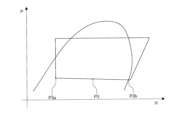
- FIG. 3 is a diagram illustrating the configuration of a control device 400 in the air conditioner 1 according to the first embodiment. It is a pH diagram in a refrigeration cycle device.
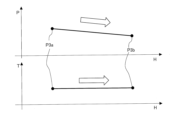
- FIG. 3 is a diagram showing the relationship between pressure and temperature in the evaporation process of a non-azeotropic mixed refrigerant when the pressure in the evaporator is constant in the refrigeration cycle device according to the first embodiment.
- FIG. 3 is a diagram showing the relationship between pressure and temperature in the evaporation process of a non-azeotropic mixed refrigerant when a pressure difference occurs in the evaporator in the refrigeration cycle device according to the first embodiment.
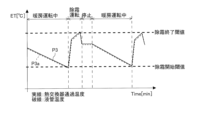
- FIG. 3 is a diagram showing a change in refrigerant temperature over time when the amount of refrigerant circulation is small in the outdoor heat exchanger 230 of the air conditioner 1 according to the first embodiment.
- FIG. 6 is a diagram showing a temporal change in refrigerant temperature when the amount of refrigerant circulation is large in the outdoor heat exchanger 230 of the air conditioner 1 according to the first embodiment.
- FIG. 7 is a diagram illustrating processing related to defrosting of the refrigeration cycle device according to the second embodiment.
- 3 is a diagram showing the configuration of a control device 400 according to Embodiment 3.
- FIG. FIG. 4 is a diagram showing the configuration of a control device 400 according to a fourth embodiment.
- FIG. 1 is a diagram showing the configuration of a refrigeration cycle device according to Embodiment 1.
- the air conditioner 1 according to the first embodiment includes an outdoor unit 200, an indoor unit 100, and two refrigerant pipes 300.
- the compressor 210, four-way valve 220, and outdoor heat exchanger 230 of the outdoor unit 200 are connected to the indoor heat exchanger 110 and expansion valve 120 of the indoor unit 100 by a refrigerant pipe 300, and the refrigerant is circulated.
- the outdoor unit 200 may include the expansion valve 120.
- the air conditioner 1 according to the first embodiment is configured such that one outdoor unit 200 and one indoor unit 100 are connected by piping. However, the number of connected devices is not limited to this.
- the air conditioner 1 uses a non-azeotropic mixed refrigerant as the refrigerant that circulates within the refrigerant circuit.
- a non-azeotropic mixed refrigerant is a refrigerant that is a mixture of multiple component refrigerants and whose composition changes when it evaporates and condenses.
- a non-azeotropic mixed refrigerant is in a gas-liquid two-phase state under the same pressure and does not settle at a constant temperature as the composition changes. For example, in the evaporation process under the same pressure, the temperature of the non-azeotropic mixed refrigerant at the end of evaporation is lower than the refrigerant temperature at the start of evaporation.
- the refrigerant temperature of the non-azeotropic mixed refrigerant at the end of condensation is lower than the refrigerant temperature at the start of condensation.
- the temperature difference between the start and end of evaporation or condensation is the temperature gradient.
- the non-azeotropic mixed refrigerant used in the air conditioner 1 in the first embodiment is R454B, which is a mixture of R32 refrigerant and R1234yf refrigerant, which are HFC (hydrofluorocarbon) refrigerants, at a ratio of 68.1:31.9. It shall be a refrigerant.
- Outdoor unit 200 in Embodiment 1 includes a compressor 210, a four-way valve 220, and an outdoor heat exchanger 230 as devices constituting a refrigerant circuit. Furthermore, the outdoor unit 200 includes an outdoor blower 240 and a control device 400.
- the compressor 210 compresses and discharges the sucked refrigerant.
- Compressor 210 is, for example, a scroll compressor, a reciprocating compressor, a vane compressor, or the like.
- the capacity of the refrigerant discharged by the compressor 210 can be changed by arbitrarily changing the driving frequency of the compressor 210 using, for example, an inverter circuit.
- the four-way valve 220 serving as a flow path switching device is, for example, a valve that switches the flow of refrigerant between cooling operation and heating operation.
- the four-way valve 220 connects the discharge side of the compressor 210 and the indoor heat exchanger 110 and connects the suction side of the compressor 210 and the outdoor heat exchanger 230 when heating operation is performed. Furthermore, the four-way valve 220 connects the discharge side of the compressor 210 to the outdoor heat exchanger 230 and connects the suction side of the compressor 210 to the indoor heat exchanger 110 when cooling operation is performed.
- a flow path switching device may be formed by combining a plurality of two-way valves.
- the outdoor heat exchanger 230 is a heat exchanger that exchanges heat between the refrigerant and outdoor air.
- the outdoor heat exchanger 230 of Embodiment 1 functions as an evaporator during heating operation, absorbs heat from the refrigerant, evaporates it, and vaporizes the refrigerant into a gaseous refrigerant (hereinafter referred to as gas refrigerant).
- gas refrigerant a gaseous refrigerant
- it functions as a condenser, condenses the refrigerant, radiates heat, liquefies it as a liquid refrigerant (hereinafter referred to as liquid refrigerant), and passes it through.
- the configuration of the outdoor heat exchanger 230 will be further explained later.
- the outdoor blower 240 forms a flow of air that causes air from outside the outdoor unit 200 to pass through the outdoor heat exchanger 230 and flow out from inside the outdoor unit 200, thereby facilitating heat exchange in the outdoor heat exchanger 230. prompt.
- the indoor unit 100 performs indoor air conditioning.
- Indoor unit 100 includes an indoor heat exchanger 110 and an expansion valve 120 as devices that constitute a refrigerant circuit. Furthermore, the indoor unit 100 includes an indoor blower 130.
- the expansion valve 120 which serves as a throttle device or the like, is a valve that reduces the pressure of the refrigerant and expands it.
- the expansion valve 120 is composed of, for example, an electronic expansion valve.
- the expansion valve 120 adjusts its opening based on instructions from a control device 400 or the like, which will be described later, to reduce the pressure and control the amount of refrigerant passing through.
- the indoor heat exchanger 110 is a heat exchanger that exchanges heat between indoor air, which is a space to be air-conditioned, and a refrigerant. For example, during heating operation, indoor heat exchanger 110 functions as a condenser, condenses refrigerant, and passes liquid refrigerant.
- the indoor heat exchanger 110 functions as an evaporator, evaporates the refrigerant, and passes the gas refrigerant.
- the indoor blower 130 causes air to pass through the indoor heat exchanger 110 to promote heat exchange in the indoor heat exchanger 110, and supplies the air that has passed through the indoor heat exchanger 110 into the room that is the space to be air-conditioned.
- each device in the air conditioner 1 will be explained based on the flow of refrigerant.
- the operation of each device in the refrigerant circuit during heating operation will be explained based on the flow of refrigerant.
- Solid line arrows in FIG. 1 indicate the flow of refrigerant during heating operation.
- the high temperature and high pressure gas refrigerant compressed and discharged by the compressor 210 passes through the four-way valve 220 and flows into the indoor heat exchanger 110. While passing through the indoor heat exchanger 110, the gas refrigerant condenses and liquefies, for example, by exchanging heat with the air in the air-conditioned space.
- the condensed and liquefied refrigerant passes through the expansion valve 120.
- the refrigerant passes through the expansion valve 120, its pressure is reduced.
- the refrigerant whose pressure is reduced by the expansion valve 120 and becomes a gas-liquid two-phase state passes through the outdoor heat exchanger 230.
- the outdoor heat exchanger 230 the refrigerant that is evaporated and gasified by exchanging heat with the outdoor air sent from the outdoor blower 240 passes through the four-way valve 220 and is sucked into the compressor 210 again.
- the refrigerant of the air conditioner 1 is circulated, and air conditioning related to heating is performed.
- the outdoor heat exchanger 230 performs a heating operation as an evaporator.
- Dotted arrows in FIG. 1 indicate the flow of refrigerant during cooling operation.
- the high temperature and high pressure gas refrigerant compressed and discharged by the compressor 210 passes through the four-way valve 220 and flows into the outdoor heat exchanger 230.
- the refrigerant then passes through the outdoor heat exchanger 230 and exchanges heat with the outdoor air supplied by the outdoor blower 240, thereby condensing and liquefying the refrigerant.
- the liquefied refrigerant passes through the expansion valve 120.
- the pressure is reduced and the refrigerant enters a gas-liquid two-phase state.
- the refrigerant whose pressure is reduced by the expansion valve 120 and becomes a gas-liquid two-phase state passes through the indoor heat exchanger 110. Then, in the indoor heat exchanger 110, for example, the refrigerant that is evaporated and gasified by exchanging heat with the air in the air-conditioned space passes through the four-way valve 220 and is sucked into the compressor 210 again. As described above, the refrigerant of the air conditioner 1 circulates, and air conditioning related to cooling is performed.
- defrosting operation will be explained.
- the flow of refrigerant in defrosting operation is the same as in cooling operation.
- the high temperature and high pressure gas refrigerant compressed and discharged by the compressor 210 passes through the four-way valve 220 and flows into the outdoor heat exchanger 230.
- the refrigerant passing through the outdoor heat exchanger 230 radiates heat and supplies heat to the frost attached to the outdoor heat exchanger 230.
- the refrigerant that radiated heat condenses.
- frost that receives heat melts and is discharged as drain water.
- FIG. 2 is a diagram showing a schematic configuration of an example of the heat exchanger according to the first embodiment.
- the heat exchanger in FIG. 2 is the outdoor heat exchanger 230, but it is also assumed that the indoor heat exchanger 110 has a similar configuration.
- the outdoor heat exchanger 230 is, for example, a fin tube type heat exchanger.
- the outdoor heat exchanger 230 has a heat exchanger main body 231 that exchanges heat between outdoor air and a refrigerant.
- the heat exchanger main body 231 includes a plurality of heat exchanger tubes that serve as flow paths for the refrigerant and a plurality of fins that promote heat exchange between the refrigerant and outdoor air.
- the heat exchanger main body 231 has one end connected to a refrigerant distributor 232 via a plurality of capillary tubes 233, and the other end connected to a header 234.
- the distributor 232 and the header 234 distribute or join the refrigerant to the plurality of heat transfer tubes of the heat exchanger main body 231.
- a two-phase tube temperature sensor 500 and a heat exchanger mouth temperature sensor 510 are attached to the outdoor heat exchanger 230.
- the two-phase pipe temperature sensor 500 and the heat exchanger mouth temperature sensor 510 are detection devices that detect the temperature of the refrigerant at the position where they are installed and send signals related to the detection to the control device 400, which will be described later.
- the two-phase pipe temperature sensor 500 detects the temperature of the refrigerant in the heat exchanger as the heat exchanger passing temperature.
- the two-phase pipe temperature sensor 500 is attached so as to be able to detect the temperature of the refrigerant at a position approximately in the middle of the stroke through the heat exchanger main body 231. do.
- the two-phase tube temperature sensor 500 is attached to a holder brazed to a U-shaped portion of a hairpin tube included in the heat exchanger body 231.
- the position where the two-phase tube temperature sensor 500 is attached is, for example, a position where it is assumed that the temperature at point P3 in the ph diagram of FIG. 4, which will be described later, will be detected. Therefore, the heat exchanger passing temperature is usually the saturation temperature (evaporation temperature) of a gas-liquid two-phase refrigerant during the evaporation process of the refrigeration cycle.
- the heat exchanger mouth temperature sensor 510 is a detection device that detects the temperature of the refrigerant flowing into and out of the outdoor heat exchanger 230 as the heat exchanger mouth temperature, and sends a signal related to the detection to the control device 400.
- the outdoor heat exchanger 230 functions as an evaporator, it becomes a liquid pipe temperature sensor that detects the temperature of the refrigerant including the liquid refrigerant flowing into the outdoor heat exchanger 230.
- the heat exchanger mouth temperature sensor 510 is attached via the refrigerant pipe 300 at a position that forms a refrigerant flow path between the expansion valve 120 and the outdoor heat exchanger 230.
- the heat exchanger mouth temperature sensor 510 is attached to a capillary tube 233 that connects the heat exchanger main body 231 and the distributor 232.
- the heat exchanger mouth temperature sensor 510 detects the temperature of the refrigerant flowing out from the outdoor heat exchanger 230.
- FIG. 3 is a diagram illustrating the configuration of the control device 400 in the air conditioner 1 according to the first embodiment.
- the control device 400 is a device that controls the air conditioner 1. Although the description here assumes that the outdoor unit 200 includes the control device 400, the present invention is not limited to this. Other units may include the control device 400. Further, the control device 400 may be a device independent from a unit having devices that constitute the air conditioner 1.
- the control device 400 has a control section 410 and a storage section 420.
- the control unit 410 includes, for example, a control processing unit such as a CPU (Central Processing Unit) or a microcomputer.
- the control unit 410 in the first embodiment particularly includes a determination unit 411, a correction unit 412, a defrosting control unit 413, and a circulation amount estimation unit 414.
- the determination unit 411 performs determination processing regarding defrosting. For this reason, for example, the determination unit 411 includes a correction determination unit 411A that determines the correction value to be corrected by the correction unit 412. Further, the determination unit 411 includes a defrost determination unit 411B that determines whether the defrost control unit 413 performs defrosting.
- the correction unit 412 corrects the heat exchanger passage temperature based on the determination by the correction determination unit 411A.
- the defrosting control unit 413 performs a defrosting operation.
- the circulation amount estimation unit 414 estimates the refrigerant circulation amount of the refrigerant passing through the heat exchanger serving as the evaporator.
- the circulation amount estimation section 414 has a drive frequency acquisition section 414A, and estimates the circulation amount based on the obtained drive frequency of the compressor 210. presume.
- the storage unit 420 also includes, for example, a volatile storage device (not shown) such as a random access memory (RAM) that can temporarily store data, and a non-volatile auxiliary storage device (not shown) such as a flash memory.
- a volatile storage device such as a random access memory (RAM) that can temporarily store data
- a non-volatile auxiliary storage device such as a flash memory.
- the storage unit 420 has data in the form of a program of processing procedures performed by the control arithmetic processing device.
- the control unit 410 then executes processing based on the data of the program.
- the present invention is not limited to this, and the control device 400 may be a device (hardware) dedicated to control.
- FIG. 4 is a pH diagram of the refrigeration cycle device.
- the temperature of the refrigerant that serves as a reference for determining defrosting of the refrigerant is the heat exchanger passing temperature detected by the two-phase pipe temperature sensor 500 described above.
- the two-phase tube temperature sensor 500 is arranged to detect the temperature of the refrigerant at a point P3 on the ph diagram (Mollier diagram) shown in FIG.
- the pressure of the refrigerant in the evaporator is determined from point P3a, which is the refrigerant inlet of the evaporator, to point P3b, which is the refrigerant outlet, through point P3, and the pressure on the evaporator side (low pressure side of the refrigerant circuit).
- a general characteristic of refrigerants is a tendency to decrease by the amount of loss.
- FIG. 5 is a diagram showing the relationship between pressure and temperature in the evaporation process of a non-azeotropic mixed refrigerant when the pressure in the evaporator is constant in the refrigeration cycle device according to the first embodiment.
- FIG. 6 is a diagram showing the relationship between pressure and temperature in the evaporation process of the non-azeotropic mixed refrigerant when a pressure difference occurs in the evaporator in the refrigeration cycle device according to the first embodiment.
- the arrows shown in FIGS. 5 and 6 indicate the direction in which the refrigerant flows.
- the evaporation temperatures of the refrigerants involved in mixing are different. Therefore, the enthalpy increases and the temperature of the refrigerant also increases. Therefore, as shown in FIG. 5, for example, if there is no pressure difference or can be ignored between the pressure at point P3a and the pressure at point P3b, due to the physical properties of the non-azeotropic mixed refrigerant, the refrigerant inlet of the evaporator The temperature of the refrigerant increases from the point to the refrigerant outlet.
- the non-azeotropic mixed refrigerant tends to have a lower heat exchanger mouth temperature as detected by the heat exchanger mouth temperature sensor 510 than the heat exchanger passage temperature as detected by the two-phase tube temperature sensor 500. be. For this reason, if the defrosting start is determined based on the heat exchanger mouth temperature, the defrosting start timing becomes earlier and the efficiency deteriorates.
- the heat exchanger passage temperature detected by the two-phase pipe temperature sensor 500 also changes depending on the passage condition of the refrigerant in the evaporator. For example, as shown in Figure 6, if a pressure difference occurs between the refrigerant inlet and the refrigerant outlet of the evaporator due to pressure loss occurring within the evaporator, The temperature of the refrigerant decreases toward the refrigerant outlet. Therefore, the temperature decrease of the refrigerant due to pressure loss and the temperature increase due to the physical properties of the non-azeotropic mixed refrigerant work in a direction that offsets each other. FIG.
- the correction unit 412 corrects the heat exchanger passing temperature based on the determination by the determination unit 411.
- FIG. 7 is a diagram showing the change in refrigerant temperature over time when the amount of refrigerant circulation is small in the outdoor heat exchanger 230 of the air conditioner 1 according to the first embodiment.
- FIG. 8 is a diagram showing a temporal change in refrigerant temperature when the amount of refrigerant circulation is large in the outdoor heat exchanger 230 of the air conditioner 1 according to the first embodiment.
- the outdoor heat exchanger 230 here functions as an evaporator.
- the pressure difference that occurs within the evaporator changes depending on the amount of refrigerant circulated. When the amount of refrigerant circulation is large, the pressure loss is large, and when the amount of refrigerant circulation is small, the pressure loss is small.
- the determination unit 411 of the control device 400 determines whether the heat exchanger related to the temperature gradient is determined based on the heat exchanger passing temperature detected by the two-phase pipe temperature sensor 500. A correction value for the temperature passing through the chamber is determined and corrected by the correction unit 412. Then, the determining unit 411 of the control device 400 determines whether to perform defrosting based on the corrected heat exchanger passing temperature, and the defrosting control unit 413 controls defrosting based on the determination. Therefore, the actual heat exchanger passing temperature detected by the two-phase pipe temperature sensor 500 can be corrected to a more accurate temperature. Then, the control device 400 of the air conditioner 1 can more accurately determine the timing to start defrosting and perform defrosting.
- control device 400 can more accurately make decisions regarding defrosting, etc., using a small number of temperature sensors, based on the temperature of the refrigerant detected by the two-phase pipe temperature sensor 500. It can be carried out.
- FIG. 9 is a diagram illustrating processing related to defrosting of the refrigeration cycle device according to the second embodiment.
- the processing in FIG. 9 will be described as being performed by the control device 400.
- the circulation amount estimating section 414 of the control device 400 includes the driving frequency obtaining section 414A, as described above. Therefore, the circulation amount estimation unit 414 estimates the refrigerant circulation amount based on the drive frequency of the compressor 210 (step S1).
- the refrigerant circulation amount can generally be obtained based on the following equation (1).
- Refrigerant circulation amount volumetric efficiency x driving frequency x suction refrigerant density x displacement volume...(1)
- the drive frequency is a term that affects when estimating the amount of refrigerant circulation. Therefore, in the second embodiment, when the circulation amount estimating unit 414 estimates the refrigerant circulation amount, it is assumed that the volumetric efficiency, the suction refrigerant density, and the displacement volume are constant values. Therefore, the amount of refrigerant circulation can be approximated as an amount that depends on the drive frequency of the compressor 210.
- the correction determination unit 411A of the determination unit 411 compares the estimated refrigerant circulation amount with a set threshold value stored in the storage unit 420, and determines whether the refrigerant circulation amount is equal to or greater than the set threshold value. is determined (step S2).
- the set threshold value is set, for example, to a value that provides a refrigerant circulation amount that is 50% of the maximum refrigerant circulation amount of the refrigerant passing through the indoor unit 100.
- a set threshold value is set for the maximum refrigerant circulation amount in each indoor unit 100, respectively.
- the correcting unit 412 corrects the heat exchanger passing temperature detected by the two-phase pipe temperature sensor 500 with the first correction value (Ste S3).
- a second correction value that is larger than the first correction value is applied to the heat exchanger detected by the two-phase pipe temperature sensor 500. The passing temperature is corrected (step S4).
- the correction unit 412 corrects the first correction value and the second correction value corresponding to the evaporation temperature.
- the first correction value and the second correction value are stored in the storage unit 420 as data.
- the defrosting determining unit 411B of the determining unit 411 determines whether to perform defrosting based on the corrected heat exchanger passing temperature (step S5).
- the process returns to step S1.
- step S6 when the defrosting determination unit 411B determines to perform defrosting, the defrosting control unit 413 starts defrosting and performs defrosting operation.
- the defrosting control unit 413 of the control device 400 finishes controlling the defrosting operation the process returns to step S1.
- the end of defrosting as the frost on the evaporator melts, the temperature of the evaporator changes, so regardless of the type of refrigerant, it is possible to determine the timing to end defrosting. can.
- the effects described in the first embodiment can be obtained. Furthermore, in the air conditioner 1 according to the second embodiment, the control device 400 corrects the heat exchanger passage temperature based on the drive frequency. Therefore, a more accurate refrigerant circulation amount can be easily obtained.
- FIG. 10 is a diagram showing the configuration of a control device 400 according to the third embodiment.
- the circulation amount estimating section 414 of the control device 400 in the third embodiment includes an intake temperature determining section 414B.
- the suction temperature determination unit 414B determines the suction temperature of the refrigerant sucked into the compressor 210 based on the heat exchanger passing temperature detected by the two-phase tube temperature sensor 500 attached to the evaporator.
- the circulation amount estimation unit 414 of the second embodiment estimates the refrigerant circulation amount based on the drive frequency of the compressor 210 and the suction density based on the suction temperature determined by the suction temperature determination unit 414B.
- the control device 400 determines and corrects the correction value based on the refrigerant circulation amount of the refrigerant circulating in the refrigerant circuit. Therefore, if the control device 400 can obtain a more accurate refrigerant circulation amount, it can perform more accurate correction.
- the circulation amount estimation unit 414 of the control device 400 estimates the refrigerant circulation amount by setting the suction refrigerant density to a constant value.
- Control device 400 in Embodiment 3 estimates the refrigerant circulation amount based not only on the drive frequency of compressor 210 but also on the suction refrigerant density obtained from the suction temperature of the refrigerant suctioned by compressor 210.
- the control section 410 of the control device 400 includes the suction temperature determination section 414B, and determines the suction temperature based on the heat exchanger passage temperature. Therefore, the control device 400 can estimate the refrigerant circulation amount including the suction refrigerant density obtained from the suction temperature. Therefore, since the control device 400 can more accurately estimate the refrigerant circulation amount and make a determination, it can more accurately determine whether to perform defrosting.
- the refrigeration cycle device according to the third embodiment is the air conditioner 1 that performs air conditioning in a target space, it is possible to provide comfortable air conditioning for people in the room.
- FIG. 11 is a diagram showing the configuration of a control device 400 according to the fourth embodiment.
- Control device 400 in Embodiment 4 has suction temperature estimation section 414C.
- the suction temperature estimation unit 414C estimates the suction temperature of the refrigerant sucked into the compressor 210 based on the opening degree of the expansion valve 120.
- the circulation amount estimating section 414 of the fourth embodiment estimates the refrigerant circulation amount based on the drive frequency of the compressor 210 and the suction temperature estimated by the suction temperature estimating section 414C.
- the suction temperature estimation unit 414C can obtain the Cv value of the expansion valve 120 based on the opening degree of the expansion valve 120. Further, the suction temperature estimating unit 414C estimates the low pressure on the low pressure side of the refrigerant circuit from the Cv value and the amount of refrigerant circulation, and further estimates the suction temperature.
- the control device 400 can estimate not only the driving frequency of the compressor 210 but also the refrigerant circulation amount based on the estimated suction temperature.
- the suction temperature estimating unit 414C of the control device 400 operates based on the opening degree of the expansion valve 120 that expands high-pressure refrigerant to reduce the pressure to low-pressure refrigerant. , estimate the inlet temperature. Therefore, it is possible to obtain a more accurate amount of refrigerant circulation and make a determination, and control can be performed efficiently.
- the refrigeration cycle device according to the fourth embodiment is the air conditioner 1 that performs air conditioning in a target space, comfortable air conditioning can be performed for people in the room.
- control section 410 of the control device 400 has the suction temperature determination section 414B
- control section 410 of the control device 400 has the suction temperature estimation section 414C. there were. However, it is not limited to those having either one of them.
- the control unit 410 of the control device 400 may be configured to include both an intake temperature determination unit 414B and an intake temperature estimation unit 414C, and may perform processing for each of them.
- the refrigeration cycle device of the first embodiment described above uses R454B refrigerant in which R32 refrigerant and R1234yf refrigerant are mixed at a ratio of 68.1:31.9 as the non-azeotropic mixed refrigerant that circulates in the refrigerant circuit.
- R454B refrigerant in which R32 refrigerant and R1234yf refrigerant are mixed at a ratio of 68.1:31.9 as the non-azeotropic mixed refrigerant that circulates in the refrigerant circuit.
- a non-azeotropic refrigerant mixture such as R407C may be used.
- a pseudo-threat boiling mixed refrigerant having a temperature gradient may be used.
- the refrigeration cycle device can be applied to various types of non-azeotropic mixed refrigerants, a refrigerant with a low GWP can be employed, and the refrigeration cycle device can be made in consideration of the global environment. Further, the refrigeration cycle device can be made compliant with the standards and standards of each region of the market.
- the configuration of the refrigerant circuit in the refrigeration cycle device is not limited to the configuration of the air conditioner 1 in FIG. 1 described in the first embodiment described above.
- the refrigeration cycle device may have an accumulator between the evaporator, which is the low-pressure side of the refrigerant circuit, and the suction side of the compressor 210.
- the accumulator is a container that allows gas refrigerant to pass through and stores liquid refrigerant.
- the refrigeration cycle device may have a receiver between the suction side of the compressor 210, which is the high-pressure side of the refrigerant circuit, and the heat exchanger, which is the evaporator. Receivers are known for storing excess refrigerant in the refrigerant circuit on the high pressure side of the refrigerant circuit.
- the heat exchanger is used as the outdoor heat exchanger 230 of the outdoor unit 200, but the present invention is not limited to this. It may be used for the indoor heat exchanger 110 of the indoor unit 100, or may be used for both the outdoor heat exchanger 230 and the indoor heat exchanger 110.
- the defrosting control unit 413 of the control device 400 has been described as performing a defrosting operation, but the present invention is not limited to this.
- the refrigeration cycle device includes a defrosting heater (not shown)
- the evaporator may be defrosted by controlling the heating by the heater.
- the air conditioner 1 has been described, but the present invention can also be applied to other refrigeration cycle devices, such as a refrigerator, a freezing device, and a hot water supply device.
- other refrigeration cycle devices such as a refrigerator, a freezing device, and a hot water supply device.
- Air conditioner 100 Indoor unit, 110 Indoor heat exchanger, 120 Expansion valve, 130 Indoor blower, 200 Outdoor unit, 210 Compressor, 220 Four-way valve, 230 Outdoor heat exchanger, 231 Heat exchanger body, 232 Distributor , 233 capillary tube, 234 header, 240 outdoor blower, 300 refrigerant piping, 400 control device, 410 control unit, 411 determination unit, 411A correction determination unit, 411B defrost determination unit, 412 correction unit, 413 defrost control unit, 414 Circulation amount estimation section, 414A driving frequency acquisition section, 414B suction temperature determination section, 414C suction temperature estimation section, 420 storage section, 500 two-phase pipe temperature sensor, 510 heat exchanger mouth temperature sensor.
Landscapes
- Engineering & Computer Science (AREA)
- Physics & Mathematics (AREA)
- Mechanical Engineering (AREA)
- Thermal Sciences (AREA)
- General Engineering & Computer Science (AREA)
- Air Conditioning Control Device (AREA)
Priority Applications (2)
| Application Number | Priority Date | Filing Date | Title |
|---|---|---|---|
| JP2024543722A JP7724978B2 (ja) | 2022-09-01 | 2022-09-01 | 冷凍サイクル装置および空気調和装置 |
| PCT/JP2022/032911 WO2024047831A1 (ja) | 2022-09-01 | 2022-09-01 | 冷凍サイクル装置および空気調和装置 |
Applications Claiming Priority (1)
| Application Number | Priority Date | Filing Date | Title |
|---|---|---|---|
| PCT/JP2022/032911 WO2024047831A1 (ja) | 2022-09-01 | 2022-09-01 | 冷凍サイクル装置および空気調和装置 |
Publications (1)
| Publication Number | Publication Date |
|---|---|
| WO2024047831A1 true WO2024047831A1 (ja) | 2024-03-07 |
Family
ID=90098987
Family Applications (1)
| Application Number | Title | Priority Date | Filing Date |
|---|---|---|---|
| PCT/JP2022/032911 Ceased WO2024047831A1 (ja) | 2022-09-01 | 2022-09-01 | 冷凍サイクル装置および空気調和装置 |
Country Status (2)
| Country | Link |
|---|---|
| JP (1) | JP7724978B2 (https=) |
| WO (1) | WO2024047831A1 (https=) |
Citations (4)
| Publication number | Priority date | Publication date | Assignee | Title |
|---|---|---|---|---|
| JPH08320158A (ja) * | 1995-05-26 | 1996-12-03 | Matsushita Refrig Co Ltd | 冷暖房装置 |
| JP2017053566A (ja) * | 2015-09-10 | 2017-03-16 | ジョンソンコントロールズ ヒタチ エア コンディショニング テクノロジー(ホンコン)リミテッド | 冷凍サイクル装置 |
| WO2018229864A1 (ja) * | 2017-06-13 | 2018-12-20 | 三菱電機株式会社 | 空気調和装置 |
| JP2021014962A (ja) * | 2019-07-12 | 2021-02-12 | ダイキン工業株式会社 | 冷凍装置の室内機 |
Family Cites Families (2)
| Publication number | Priority date | Publication date | Assignee | Title |
|---|---|---|---|---|
| JP2007101126A (ja) | 2005-10-06 | 2007-04-19 | Mitsubishi Electric Corp | 空気調和装置 |
| JP5430602B2 (ja) | 2011-04-04 | 2014-03-05 | 三菱電機株式会社 | 空気調和装置 |
-
2022
- 2022-09-01 JP JP2024543722A patent/JP7724978B2/ja active Active
- 2022-09-01 WO PCT/JP2022/032911 patent/WO2024047831A1/ja not_active Ceased
Patent Citations (4)
| Publication number | Priority date | Publication date | Assignee | Title |
|---|---|---|---|---|
| JPH08320158A (ja) * | 1995-05-26 | 1996-12-03 | Matsushita Refrig Co Ltd | 冷暖房装置 |
| JP2017053566A (ja) * | 2015-09-10 | 2017-03-16 | ジョンソンコントロールズ ヒタチ エア コンディショニング テクノロジー(ホンコン)リミテッド | 冷凍サイクル装置 |
| WO2018229864A1 (ja) * | 2017-06-13 | 2018-12-20 | 三菱電機株式会社 | 空気調和装置 |
| JP2021014962A (ja) * | 2019-07-12 | 2021-02-12 | ダイキン工業株式会社 | 冷凍装置の室内機 |
Also Published As
| Publication number | Publication date |
|---|---|
| JP7724978B2 (ja) | 2025-08-18 |
| JPWO2024047831A1 (https=) | 2024-03-07 |
Similar Documents
| Publication | Publication Date | Title |
|---|---|---|
| CN108731187B (zh) | 三管热回收多联机系统及其控制方法 | |
| US10508826B2 (en) | Refrigeration cycle apparatus | |
| AU2019436796B2 (en) | Air-conditioning apparatus | |
| JP7112057B1 (ja) | 空気調和装置 | |
| CN112437856B (zh) | 空调装置 | |
| US20130213072A1 (en) | Combined air-conditioning and hot-water supply system | |
| JP2001221526A (ja) | 冷凍空調装置 | |
| KR101901540B1 (ko) | 공기 조화 장치 | |
| JP2019184207A (ja) | 空気調和装置 | |
| JP6257809B2 (ja) | 冷凍サイクル装置 | |
| US20200049383A1 (en) | Refrigeration cycle device | |
| JP7716599B2 (ja) | 冷凍サイクル装置および空気調和装置 | |
| JP6758506B2 (ja) | 空気調和装置 | |
| CN213089945U (zh) | 一种空调装置 | |
| JPWO2024047954A5 (https=) | ||
| JP7724978B2 (ja) | 冷凍サイクル装置および空気調和装置 | |
| US20220235982A1 (en) | Refrigeration cycle apparatus | |
| JPWO2019008744A1 (ja) | 冷凍サイクル装置 | |
| JP7796887B2 (ja) | 冷凍サイクル装置および空気調和装置 | |
| US11156393B2 (en) | Air-conditioning apparatus with pressure control for defrosting and heating | |
| JP7724979B2 (ja) | 冷凍サイクル装置および空気調和装置 | |
| JP2023091255A (ja) | 冷媒の状態を検知する複数のセンサを備える冷凍装置 | |
| JPWO2024047833A5 (https=) | ||
| US12571568B2 (en) | Refrigerant circuit expansion valve control | |
| JPWO2024047831A5 (https=) |
Legal Events
| Date | Code | Title | Description |
|---|---|---|---|
| 121 | Ep: the epo has been informed by wipo that ep was designated in this application |
Ref document number: 22957426 Country of ref document: EP Kind code of ref document: A1 |
|
| ENP | Entry into the national phase |
Ref document number: 2024543722 Country of ref document: JP Kind code of ref document: A |
|
| NENP | Non-entry into the national phase |
Ref country code: DE |
|
| 122 | Ep: pct application non-entry in european phase |
Ref document number: 22957426 Country of ref document: EP Kind code of ref document: A1 |