WO2024038727A1 - 積層セラミック電子部品、および積層セラミック電子部品の製造方法 - Google Patents
積層セラミック電子部品、および積層セラミック電子部品の製造方法 Download PDFInfo
- Publication number
- WO2024038727A1 WO2024038727A1 PCT/JP2023/026389 JP2023026389W WO2024038727A1 WO 2024038727 A1 WO2024038727 A1 WO 2024038727A1 JP 2023026389 W JP2023026389 W JP 2023026389W WO 2024038727 A1 WO2024038727 A1 WO 2024038727A1
- Authority
- WO
- WIPO (PCT)
- Prior art keywords
- ceramic
- internal electrode
- electronic component
- main component
- side margin
- Prior art date
- Legal status (The legal status is an assumption and is not a legal conclusion. Google has not performed a legal analysis and makes no representation as to the accuracy of the status listed.)
- Ceased
Links
Images





Classifications
-
- H—ELECTRICITY
- H01—ELECTRIC ELEMENTS
- H01G—CAPACITORS; CAPACITORS, RECTIFIERS, DETECTORS, SWITCHING DEVICES, LIGHT-SENSITIVE OR TEMPERATURE-SENSITIVE DEVICES OF THE ELECTROLYTIC TYPE
- H01G4/00—Fixed capacitors; Processes of their manufacture
- H01G4/30—Stacked capacitors
-
- H—ELECTRICITY
- H01—ELECTRIC ELEMENTS
- H01C—RESISTORS
- H01C7/00—Non-adjustable resistors formed as one or more layers or coatings; Non-adjustable resistors made from powdered conducting material or powdered semi-conducting material with or without insulating material
- H01C7/02—Non-adjustable resistors formed as one or more layers or coatings; Non-adjustable resistors made from powdered conducting material or powdered semi-conducting material with or without insulating material having positive temperature coefficient
-
- H—ELECTRICITY
- H01—ELECTRIC ELEMENTS
- H01C—RESISTORS
- H01C7/00—Non-adjustable resistors formed as one or more layers or coatings; Non-adjustable resistors made from powdered conducting material or powdered semi-conducting material with or without insulating material
- H01C7/04—Non-adjustable resistors formed as one or more layers or coatings; Non-adjustable resistors made from powdered conducting material or powdered semi-conducting material with or without insulating material having negative temperature coefficient
-
- H—ELECTRICITY
- H01—ELECTRIC ELEMENTS
- H01C—RESISTORS
- H01C7/00—Non-adjustable resistors formed as one or more layers or coatings; Non-adjustable resistors made from powdered conducting material or powdered semi-conducting material with or without insulating material
- H01C7/06—Non-adjustable resistors formed as one or more layers or coatings; Non-adjustable resistors made from powdered conducting material or powdered semi-conducting material with or without insulating material including means to minimise changes in resistance with changes in temperature
-
- H—ELECTRICITY
- H01—ELECTRIC ELEMENTS
- H01C—RESISTORS
- H01C7/00—Non-adjustable resistors formed as one or more layers or coatings; Non-adjustable resistors made from powdered conducting material or powdered semi-conducting material with or without insulating material
- H01C7/10—Non-adjustable resistors formed as one or more layers or coatings; Non-adjustable resistors made from powdered conducting material or powdered semi-conducting material with or without insulating material voltage responsive, i.e. varistors
-
- H—ELECTRICITY
- H01—ELECTRIC ELEMENTS
- H01G—CAPACITORS; CAPACITORS, RECTIFIERS, DETECTORS, SWITCHING DEVICES, LIGHT-SENSITIVE OR TEMPERATURE-SENSITIVE DEVICES OF THE ELECTROLYTIC TYPE
- H01G4/00—Fixed capacitors; Processes of their manufacture
- H01G4/002—Details
- H01G4/005—Electrodes
- H01G4/012—Form of non-self-supporting electrodes
-
- H—ELECTRICITY
- H01—ELECTRIC ELEMENTS
- H01G—CAPACITORS; CAPACITORS, RECTIFIERS, DETECTORS, SWITCHING DEVICES, LIGHT-SENSITIVE OR TEMPERATURE-SENSITIVE DEVICES OF THE ELECTROLYTIC TYPE
- H01G4/00—Fixed capacitors; Processes of their manufacture
- H01G4/002—Details
- H01G4/018—Dielectrics
- H01G4/06—Solid dielectrics
- H01G4/08—Inorganic dielectrics
- H01G4/12—Ceramic dielectrics
-
- H—ELECTRICITY
- H01—ELECTRIC ELEMENTS
- H01G—CAPACITORS; CAPACITORS, RECTIFIERS, DETECTORS, SWITCHING DEVICES, LIGHT-SENSITIVE OR TEMPERATURE-SENSITIVE DEVICES OF THE ELECTROLYTIC TYPE
- H01G4/00—Fixed capacitors; Processes of their manufacture
- H01G4/002—Details
- H01G4/018—Dielectrics
- H01G4/06—Solid dielectrics
- H01G4/08—Inorganic dielectrics
- H01G4/12—Ceramic dielectrics
- H01G4/1209—Ceramic dielectrics characterised by the ceramic dielectric material
-
- H—ELECTRICITY
- H01—ELECTRIC ELEMENTS
- H01G—CAPACITORS; CAPACITORS, RECTIFIERS, DETECTORS, SWITCHING DEVICES, LIGHT-SENSITIVE OR TEMPERATURE-SENSITIVE DEVICES OF THE ELECTROLYTIC TYPE
- H01G4/00—Fixed capacitors; Processes of their manufacture
- H01G4/002—Details
- H01G4/228—Terminals
- H01G4/232—Terminals electrically connecting two or more layers of a stacked or rolled capacitor
-
- Y—GENERAL TAGGING OF NEW TECHNOLOGICAL DEVELOPMENTS; GENERAL TAGGING OF CROSS-SECTIONAL TECHNOLOGIES SPANNING OVER SEVERAL SECTIONS OF THE IPC; TECHNICAL SUBJECTS COVERED BY FORMER USPC CROSS-REFERENCE ART COLLECTIONS [XRACs] AND DIGESTS
- Y02—TECHNOLOGIES OR APPLICATIONS FOR MITIGATION OR ADAPTATION AGAINST CLIMATE CHANGE
- Y02E—REDUCTION OF GREENHOUSE GAS [GHG] EMISSIONS, RELATED TO ENERGY GENERATION, TRANSMISSION OR DISTRIBUTION
- Y02E60/00—Enabling technologies; Technologies with a potential or indirect contribution to GHG emissions mitigation
- Y02E60/13—Energy storage using capacitors
Definitions
- the present invention relates to a multilayer ceramic electronic component and a method for manufacturing the multilayer ceramic electronic component.
- Multilayer ceramic electronic components such as multilayer ceramic capacitors are used in various electronic devices for the purpose of voltage stabilization through charging and discharging, noise removal, etc.
- the side margin material is often made of a different material from the dielectric material of the capacitor part. (For example, see Patent Documents 1 and 2).
- the sintering state differs between the capacitor part and the side margin due to the influence of diffusion of metal components in the internal electrode layer and the influence of density difference. Therefore, if the same material is used for the capacitor portion and the side margin, if the firing temperature is low, the side margin may be insufficiently densified, resulting in insufficient moisture resistance.
- the present invention has been made in view of the above problems, and provides a multilayer ceramic electronic component and a method for manufacturing the same, which can solve the problems of insufficient moisture resistance due to insufficient densification of side margins and insufficient reliability due to abnormal grain growth. With the goal.
- a multilayer ceramic electronic component includes an element body including a laminated portion in which a plurality of dielectric layers and a plurality of internal electrode layers are laminated, and each of the plurality of internal electrode layers is located opposite to the element body.
- the element body has a first direction in which the plurality of internal electrode layers face each other, and a second direction in which the two end faces face each other.
- the plurality of dielectric layers and the plurality of internal electrode layers are provided outside the capacitive part, which is a region facing each other, and have a side margin in which the vanadium concentration with respect to the main component ceramic is higher than that of the capacitive part.
- the side margin in the third direction, has a first region close to the capacitive part and a second region far from the capacitive part, and the vanadium concentration with respect to the main component ceramic is in the first region. may be lower than that in the second region.
- the vanadium concentration in the main component ceramic may be 0.05 at% or more higher in the side margin than in the capacitive part.
- the capacitor portion may contain vanadium.
- the capacitor portion in the third direction, has a central region and an outer region located outside the central region, and the vanadium concentration in the main component ceramic is higher in the center than in the outer region.
- the area may be lower.
- the vanadium concentration in the main component ceramic may be 0.02 at% or more higher in the outer region than in the central region.
- the average thickness of the plurality of dielectric layers in the first direction may be 0.8 ⁇ m or less.
- the average thickness of the plurality of internal electrode layers in the first direction may be 0.7 ⁇ m or less.
- the method for manufacturing a laminated ceramic electronic component according to the present invention includes a step of forming an internal electrode pattern on a ceramic green sheet, and a step of forming an internal electrode pattern around the internal electrode pattern with a higher vanadium concentration relative to the main component ceramic than in the ceramic green sheet.
- the method includes a step of forming a dielectric pattern, a step of laminating the ceramic green sheets on which the internal electrode patterns and the dielectric pattern are formed to obtain a laminate, and a step of firing the laminate.
- the vanadium concentration in the main component ceramic may be 0.1 at% or more higher in the dielectric pattern than in the ceramic green sheet.
- Another method for manufacturing a laminated ceramic electronic component according to the present invention includes a step of forming an internal electrode pattern on a ceramic green sheet, and a step of laminating the ceramic green sheets on which the internal electrode pattern is formed to obtain a laminate. a step of forming a side margin portion having a higher vanadium concentration with respect to the main component ceramic than the ceramic green sheet around the internal electrode pattern; and a step of firing the laminate in which the side margin portion is formed. , including.
- the vanadium concentration in the main component ceramic may be 0.05 at% or more higher in the side margin portion than in the ceramic green sheet.
- the present invention it is possible to provide a multilayer ceramic electronic component and a method for manufacturing the same that can solve the problems of insufficient moisture resistance due to insufficient densification of side margins and insufficient reliability due to abnormal grain growth.
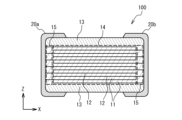
- FIG. 2 is a partial cross-sectional perspective view of a multilayer ceramic capacitor.
- FIG. 2 is a cross-sectional view taken along line AA in FIG. 1.
- 2 is a sectional view taken along line BB in FIG. 1.
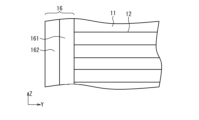
- FIG. It is a figure which illustrates the 1st area
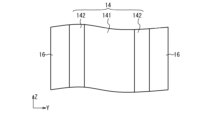
- FIG. 3 is a diagram illustrating an inner region and an outer region in a capacitor section.
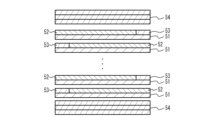
- FIG. 3 is a diagram illustrating a flow of a method for manufacturing a multilayer ceramic capacitor.
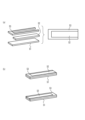
- (a) and (b) are diagrams illustrating an internal electrode forming process. It is a figure which illustrates a crimping process. It is a figure which illustrates a side margin part.
- FIG. 3 is a diagram illustrating LA-ICP-MS measurement results in the Y-axis direction.
- FIG. 1 is a partially cross-sectional perspective view of a multilayer ceramic capacitor 100 according to an embodiment.
- FIG. 2 is a cross-sectional view taken along line AA in FIG.
- FIG. 3 is a sectional view taken along line BB in FIG.
- the multilayer ceramic capacitor 100 includes an element body 10 having a substantially rectangular parallelepiped shape, and external electrodes 20a and 20b provided on two opposing end surfaces of the element body 10. .
- the external electrodes 20a and 20b extend on the top surface, bottom surface, and two side surfaces of the element body 10 in the stacking direction. However, the external electrodes 20a and 20b are spaced apart from each other.
- the Z-axis direction (first direction) is the lamination direction, and is the direction in which the internal electrode layers face each other.
- the X-axis direction (second direction) is the length direction of the element body 10, the direction in which the two end surfaces of the element body 10 face each other, and the direction in which the external electrode 20a and the external electrode 20b face each other.
- the Y-axis direction (third direction) is the width direction of the internal electrode layer, and is the direction in which two of the four side surfaces of the element body 10 other than the two end surfaces face each other.
- the X-axis direction, the Y-axis direction, and the Z-axis direction are orthogonal to each other.
- the element body 10 has a structure in which dielectric layers 11 containing a ceramic material functioning as a dielectric and internal electrode layers 12 are alternately laminated. The edges of each internal electrode layer 12 are alternately exposed on the end surface of the element body 10 where the external electrode 20a is provided and the end surface where the external electrode 20b is provided. Thereby, each internal electrode layer 12 is alternately electrically connected to the external electrodes 20a and 20b.
- multilayer ceramic capacitor 100 has a structure in which a plurality of dielectric layers 11 are stacked with internal electrode layers 12 in between.
- the internal electrode layer 12 is disposed as the outermost layer in the stacking direction, and the top and bottom surfaces of the laminate are covered with a cover layer 13.
- the cover layer 13 has a ceramic material as its main component.
- the cover layer 13 may have the same composition as the dielectric layer 11 or may have a different composition. Note that the structure is not limited to the configurations shown in FIGS. 1 to 3 as long as the internal electrode layer 12 is exposed on two different surfaces and electrically connected to different external electrodes.
- the size of the multilayer ceramic capacitor 100 is, for example, 0.25 mm long, 0.125 mm wide, and 0.125 mm high, or 0.4 mm long, 0.2 mm wide, 0.2 mm high, or long.
- the length is 1.6 mm, or the length is 4.5 mm, the width is 3.2 mm, and the height is 2.5 mm, but the size is not limited to these.
- the internal electrode layer 12 mainly contains a base metal such as nickel (Ni), copper (Cu), and tin (Sn).
- a base metal such as nickel (Ni), copper (Cu), and tin (Sn).
- noble metals such as platinum (Pt), palladium (Pd), silver (Ag), and gold (Au), or alloys containing these metals may be used.
- the average thickness of the internal electrode layer 12 in the Z-axis direction is, for example, 0.35 ⁇ m or more and 0.70 ⁇ m or less, and 0.65 ⁇ m or less.
- the thickness of the internal electrode layer 12 was determined by observing the cross section of the multilayer ceramic capacitor 100 with a SEM (scanning electron microscope), measuring the thickness at 10 points for each of the 10 different internal electrode layers 12, and calculating the average value of all the measurement points. It can be measured by deriving .
- the dielectric layer 11 has, for example, a ceramic material having a perovskite structure represented by the general formula ABO3 as a main phase.
- the perovskite structure includes ABO 3- ⁇ that deviates from the stoichiometric composition.
- the ceramic materials include barium titanate (BaTiO 3 ), calcium zirconate (CaZrO 3 ), calcium titanate (CaTiO 3 ), strontium titanate (SrTiO 3 ), magnesium titanate (MgTiO 3 ), and perovskite structures. Select and use at least one of Ba 1-x-y Ca x Sry Ti 1-z Zr z O 3 (0 ⁇ x ⁇ 1, 0 ⁇ y ⁇ 1, 0 ⁇ z ⁇ 1) to form.
- Ba 1-x-y Ca x Sry Ti 1-z Zr z O 3 is barium strontium titanate, barium calcium titanate, barium zirconate, barium zirconate titanate, calcium zirconate titanate, and zirconate titanate. Barium calcium, etc.
- the main component ceramic is 90 at % or more.
- the thickness of the dielectric layer 11 is, for example, 0.40 ⁇ m or more and 0.80 ⁇ m or less, and 0.75 ⁇ m or less.
- the thickness of the dielectric layer 11 is determined by observing the cross section of the multilayer ceramic capacitor 100 with a SEM (scanning electron microscope), measuring the thickness of each of the 10 different dielectric layers 11 at 10 points, and calculating the average value of all measurement points. It can be measured by deriving .
- Additives may be added to the dielectric layer 11.
- Additives to the dielectric layer 11 include zirconium (Zr), hafnium (Hf), magnesium (Mg), manganese (Mn), molybdenum (Mo), vanadium (V), chromium (Cr), and rare earth elements (yttrium).
- the region where the internal electrode layer 12 connected to the external electrode 20a and the internal electrode layer 12 connected to the external electrode 20b face each other is a region in which capacitance occurs in the multilayer ceramic capacitor 100. . Therefore, the region that generates the electric capacitance is referred to as a capacitor section 14. That is, the capacitive portion 14 is a region where adjacent internal electrode layers 12 connected to different external electrodes face each other.
- a region where the internal electrode layers 12 connected to the external electrode 20a face each other without interposing the internal electrode layer 12 connected to the external electrode 20b is referred to as an end margin 15. Further, the end margin 15 is also a region where the internal electrode layers 12 connected to the external electrode 20b face each other without interposing the internal electrode layer 12 connected to the external electrode 20a. That is, the end margin 15 is a region where internal electrode layers 12 connected to the same external electrode face each other without interposing the internal electrode layers 12 connected to a different external electrode. The end margin 15 is an area where no capacitance occurs.
- the side margin 16 is a region provided to cover the ends (ends in the Y-axis direction) of the dielectric layer 11 and the internal electrode layer 12 on the two side surfaces. It is. That is, the side margin 16 is a region provided outside the capacitor section 14 in the Y-axis direction. The side margin 16 is also a region that does not generate capacitance.
- the side margin 16 is mainly made of ceramic material.
- the main component ceramic of the side margin 16 may have the same composition as the main component ceramic of the dielectric layer 11 in the capacitor section 14, or may have a different composition.
- the side margin 16 can be formed by sintering ceramic powder by firing.
- the dielectric layer 11 can also be formed by sintering ceramic powder by firing. During this firing, the capacitive portion 14 is easily affected by the diffusion of the metal component of the internal electrode layer 12. Furthermore, since the capacitor section 14 includes the internal electrode layer 12, a density difference may occur between the capacitor section 14 and the side margin 16. Therefore, if the same dielectric material is used for the capacitor portion 14 and the side margin 16, if the firing temperature is low, the side margin 16 may be insufficiently densified, resulting in insufficient moisture resistance.
- the multilayer ceramic capacitor 100 according to the present embodiment has a configuration that can solve the lack of moisture resistance caused by insufficient densification of the side margin 16 and the lack of reliability caused by abnormal grain growth. .
- the side margin 16 contains a large amount of V (vanadium), which improves sinterability. Thereby, sintering of the side margin 16 can be promoted without using a large amount of liquid phase components to generate a liquid phase during firing.
- the vanadium concentration in the main component ceramic is made higher in the side margin 16 than in the dielectric layer 11 of the capacitive part 14.
- the vanadium concentration with respect to the main component ceramic is the atomic concentration (at%) of vanadium when the amount of the B-site element in the perovskite structure is 100 at%. If the main component ceramic is barium titanate, this is the atomic concentration (at%) of vanadium when the amount of Ti is 100at%.
- sintering of the side margin 16 can be promoted while suppressing sintering of the dielectric layer 11 of the capacitive part 14. This makes it possible to solve the problem of insufficient moisture resistance caused by insufficient densification of the side margins 16. Furthermore, since it is not necessary to use a large amount of liquid phase component or no liquid phase component, the lack of reliability caused by abnormal grain growth can be solved.
- the vanadium concentration relative to the main component ceramic in the entire side margin 16 is preferably higher than the vanadium concentration relative to the main component ceramic in the entire dielectric layer 11 of the capacitor section 14 by 0.05 at% or more. It is more preferable that it is higher than 1 at%, and even more preferably that it is higher than 0.2 at%.
- the difference between the vanadium concentration in the main component ceramic in the side margin 16 and the vanadium concentration in the main component ceramic in the dielectric layer 11 of the capacitor section 14 is preferably 1.0 at% or less. , more preferably 0.5 at% or less, and still more preferably 0.3 at% or less.
- the vanadium concentration relative to the main component ceramic in the entire side margin 16 is preferably 0.05 at% or more, more preferably 0.1 at% or more, and still more preferably 0.15 at% or more. preferable.
- the vanadium concentration relative to the main component ceramic in the entire side margin 16 is preferably 1.0 at% or less, more preferably 0.5 at% or less, and still more preferably 0.3 at% or less. preferable.
- the vanadium concentration relative to the main component ceramic in the entire dielectric layer 11 of the capacitive part 14 is preferably 1.0 at% or less, more preferably 0.5 at% or less, and 0.3 at% or less. It is more preferable that
- the vanadium concentration in the main component ceramic in the region near the capacitor section 14 in the Y-axis direction is lower than the vanadium concentration in the main component ceramic in the region far from the capacitor section 14.
- the side margin 16 has a first region 161 close to the capacitor section 14 and a second region 162 far from the capacitor section 14 in the Y-axis direction.
- the vanadium concentration in the main component ceramic in the first region 161 is preferably lower than the vanadium concentration in the main component ceramic in the second region 162.
- the vanadium concentration in the main component ceramic gradually increases (gradually increases) along the Y-axis direction from the capacitive portion 14 side toward the outside.
- the sintered state in the side margin 16 can be made more uniform, and the entire side margin 16 can be made more dense.
- “gradually increasing” here includes a continuous increase (monotonically increasing), and also includes increasing the amount of the main component ceramic at multiple sample points from the capacitive part 14 side to the outside along the Y-axis direction.
- the vanadium concentration is measured, it includes an overall decrease while repeating up and down.
- the vanadium concentration in the main component ceramic in the central region is lower than the vanadium concentration in the main component ceramic in the outer region.
- the capacitor section 14 has a central region 141 and an outer region 142 outside the central region 141.
- the vanadium concentration for the main component ceramic in the central region 141 is preferably lower than the vanadium concentration for the main component ceramic in the outer region 142.
- the concentration of vanadium in the main component ceramic in the outer region 142 is preferably 0.02 at% or more higher than the vanadium concentration in the main component ceramic in the central region 141, more preferably 0.05 at% or more higher, It is more preferable that the content is higher than .08 at%.
- the total concentration of (silicon + boron) in the main component ceramic in the side margin 16 is preferably 2.5 at% or less, more preferably 2.0 at% or less.
- FIG. 6 is a diagram illustrating a flow of a method for manufacturing the multilayer ceramic capacitor 100.
- a dielectric material for forming the dielectric layer 11 is prepared.
- the A-site element and the B-site element contained in the dielectric layer 11 are usually contained in the dielectric layer 11 in the form of a sintered body of ABO 3 particles.
- barium titanate is a tetragonal compound having a perovskite structure and exhibits a high dielectric constant.
- This barium titanate can generally be obtained by reacting a titanium raw material such as titanium dioxide with a barium raw material such as barium carbonate to synthesize barium titanate.
- Various methods are conventionally known for synthesizing the main component ceramic of the dielectric layer 11, such as a solid phase method, a sol-gel method, a hydrothermal method, and the like. In this embodiment, any of these can be adopted.
- Additive compounds include zirconium, hafnium, magnesium, manganese, molybdenum, vanadium, chromium, oxides of rare earth elements (yttrium, samarium, europium, gadolinium, terbium, dysprosium, holmium, erbium, thulium, and ytterbium), or cobalt, Mention may be made of oxides containing nickel, lithium, boron, sodium, potassium or silicon, or glasses containing cobalt, nickel, lithium, boron, sodium, potassium or silicon.
- a ceramic material is prepared by wet-mixing a compound containing an additive compound with a ceramic raw material powder, drying and pulverizing the mixture.
- the ceramic material obtained as described above may be pulverized to adjust the particle size, if necessary, or may be combined with a classification process to adjust the particle size.
- a dielectric material is obtained.
- the dielectric pattern material includes the main component ceramic powder of the side margins 16 .
- the main component ceramic powder for example, a main component ceramic powder of a dielectric material can be used.
- Predetermined additive compounds are added depending on the purpose. At least, the vanadium concentration relative to the main component ceramic in the dielectric pattern material is made higher than the vanadium concentration relative to the main component ceramic in the dielectric material.
- a binder such as polyvinyl butyral (PVB) resin, an organic solvent such as ethanol or toluene, and a plasticizer are added to the obtained raw material powder and wet-mixed.
- a ceramic green sheet 51 is coated on a base material by, for example, a die coater method or a doctor blade method, and then dried.
- the base material is, for example, a polyethylene terephthalate (PET) film. Figures illustrating the coating process are omitted.
- a metal conductive paste for forming internal electrodes containing an organic binder is printed on the surface of the ceramic green sheet 51 by screen printing, gravure printing, etc., thereby forming an internal electrode layer.
- An internal electrode pattern 52 is arranged.
- ceramic particles are added as a co-material to the metal conductive paste.
- the main component of the ceramic particles is not particularly limited, it is preferably the same as the main component ceramic of the dielectric layer 11.
- a binder such as ethyl cellulose and an organic solvent such as terpineol are added to the dielectric pattern material obtained in the raw material powder manufacturing process, and the mixture is kneaded in a roll mill to form a dielectric pattern paste for the reverse pattern layer.
- the dielectric pattern 53 is arranged by printing a dielectric pattern paste in the peripheral area where the internal electrode pattern 52 is not printed, and the internal electrode pattern 53 is arranged. Fill in the gap with 52.
- the ceramic green sheet 51 on which the internal electrode pattern 52 and the dielectric pattern 53 are printed is referred to as a laminated unit.
- the internal electrode layers 12 and the dielectric layers 11 are arranged alternately, and the internal electrode layers 12 have edge edges on both longitudinal end surfaces of the dielectric layers 11.
- the laminated units are stacked so that they are alternately exposed and drawn out alternately to a pair of external electrodes 20a and 20b having different polarities.
- the number of stacked layers of the internal electrode pattern 52 is set to 100 to 500 layers.
- cover sheets 54 are laminated on top and bottom of the laminate in which the laminate units are laminated and bonded by thermocompression.
- Firing process After debinding the thus obtained ceramic laminate in an N 2 atmosphere, a metal paste that will become the base layer of the external electrodes 20a and 20b is applied by a dip method, and the oxygen partial pressure is 10 ⁇ 12 MPa to 10 Firing is performed for 5 minutes to 10 hours in a reducing atmosphere of ⁇ 9 MPa and 1160° C. to 1280° C. (for example, 1180° C. or higher and 1230° C. or lower).
- Re-oxidation treatment process In order to return oxygen to barium titanate, which is the partially reduced main phase of the dielectric layer 11 fired in a reducing atmosphere, N 2 and water vapor are heated at about 1000° C. to the extent that the internal electrode layer 12 is not oxidized. Heat treatment may be performed in a mixed gas or in the atmosphere at 500°C to 700°C. This process is called a reoxidation process.
- the vanadium concentration with respect to the main component ceramic in the dielectric pattern 53 is higher than the vanadium concentration with respect to the main component ceramic in the ceramic green sheet 51.
- the vanadium concentration in the main component ceramic be 0.1 at % or more higher in the dielectric pattern 53 than in the ceramic green sheet 51.
- the side margin portion may be attached or coated on the side surface of the laminated portion.
- a laminated portion is obtained by alternately laminating ceramic green sheets 51 and internal electrode patterns 52 having the same width as the ceramic green sheets 51.
- a sheet formed of dielectric pattern paste may be attached as the side margin portion 55 to the side surface of the laminated portion.
- the vanadium concentration in the main component ceramic is higher in the side margin portion 55 than in the ceramic green sheet 51.
- the vanadium concentration in the main component ceramic in the side margin portion 55 is set a lower limit on the difference between the vanadium concentration in the main component ceramic in the side margin portion 55 and the vanadium concentration in the main component ceramic in the ceramic green sheet 51.
- the vanadium concentration in the main component ceramic be 0.05 at % or more higher in the side margin portion 55 than in the ceramic green sheet 51.
- a multilayer ceramic capacitor has been described as an example of a multilayer ceramic electronic component, but the present invention is not limited thereto.
- other laminated ceramic electronic components such as varistors and thermistors may be used.
- a slurry containing BaTiO 3 as a main component is mixed and applied to obtain a ceramic green sheet.
- a dielectric pattern was printed around the internal electrode pattern.
- Nickel powder was used for the internal electrode pattern.
- the vanadium concentration with respect to the main component ceramic in the dielectric pattern was made higher than the vanadium concentration with respect to the main component ceramic in the ceramic green sheet.
- the vanadium concentration in the ceramic green sheet was 0.1 at% based on BaTiO 3 .
- the vanadium concentration in the dielectric pattern was 0.2 at% based on BaTiO 3 .
- FIG. 10 is a diagram illustrating the measurement results of LA (Laser Ablation)-ICP (Inductively Coupled Plasma)-MS (Mass Spectrometry) in the Y-axis direction.
- the horizontal axis indicates the distance ( ⁇ m) from the surface of the side margin 16 in the Y-axis direction. Therefore, 0 ⁇ m means the surface of the side margin 16.
- the left vertical axis indicates the atomic ratio (at%) of vanadium when titanium is 100at%.
- the cumulative count of nickel is approximately constant at a distance greater than 40 ⁇ m. This is because the internal electrode layer 12 is present at a distance greater than 40 ⁇ m.
- the cumulative count of nickel gradually decreases from around 460 ⁇ m. This is because the interface between the capacitive portion 14 and the side margin 16 exists around 460 ⁇ m.
- the position at which the cumulative count of nickel begins to decrease can be defined as the interface between the capacitive portion 14 and the side margin 16.
- Comparative example 1 In Comparative Example 1, the vanadium concentration in the ceramic green sheet and the vanadium concentration in the dielectric pattern were made the same. Both the vanadium concentration in the ceramic green sheet and the vanadium concentration in the dielectric pattern were set to 0.1 at%. Other conditions were the same as in the example.
- Comparative example 2 In Comparative Example 2, the vanadium concentration in the ceramic green sheet and the vanadium concentration in the dielectric pattern were made the same. Both the vanadium concentration in the ceramic green sheet and the vanadium concentration in the dielectric pattern were set to 0.1 at%. The silicon concentration for the main component ceramic in the dielectric pattern was made higher than the silicon concentration for the main component ceramic in the ceramic green sheet. Other conditions were the same as in the example.
- High temperature load test A high temperature load test was conducted on the multilayer ceramic capacitors of Examples and Comparative Examples 1 and 2. In the high temperature load test, a voltage of 6V was applied for 500 hours at a temperature of 85°C. As a result, a failure was determined when the initial IR (insulation resistance) deteriorated by one digit or a short circuit occurred. For each of Examples and Comparative Examples 1 and 2, the number of samples was 800. The ratio of the number of failed samples to 800 samples was measured as the failure rate.
- Comparative Example 1 the failure rate was high in the moisture resistance test. This is considered to be because the side margins were not sufficiently dense because the vanadium concentration in the side margins was made the same as the vanadium concentration in the dielectric layer of the capacitor section. In Comparative Example 2, the failure rate was low in the moisture resistance test, but the failure rate was high in the high temperature load test. Although we were able to promote the densification of the side margin by making the vanadium concentration in the side margin the same as the vanadium concentration in the dielectric layer of the capacitive part and by adding a large amount of liquid phase component to the side margin, This is considered to be because a large amount of side margin liquid phase components sometimes appeared, causing abnormal grain growth.
Landscapes
- Engineering & Computer Science (AREA)
- Power Engineering (AREA)
- Microelectronics & Electronic Packaging (AREA)
- Manufacturing & Machinery (AREA)
- Chemical & Material Sciences (AREA)
- Ceramic Engineering (AREA)
- Physics & Mathematics (AREA)
- Electromagnetism (AREA)
- Inorganic Chemistry (AREA)
- Ceramic Capacitors (AREA)
- Fixed Capacitors And Capacitor Manufacturing Machines (AREA)
Priority Applications (4)
| Application Number | Priority Date | Filing Date | Title |
|---|---|---|---|
| CN202380060132.0A CN119731755A (zh) | 2022-08-17 | 2023-07-19 | 层叠陶瓷电子部件和层叠陶瓷电子部件的制造方法 |
| JP2024541465A JPWO2024038727A1 (https=) | 2022-08-17 | 2023-07-19 | |
| KR1020257004386A KR20250048256A (ko) | 2022-08-17 | 2023-07-19 | 적층 세라믹 전자 부품 및 적층 세라믹 전자 부품의 제조 방법 |
| DE112023003458.3T DE112023003458T5 (de) | 2022-08-17 | 2023-07-19 | Keramische Mehrschichtelektronikkomponente und Herstellungsverfahren einer keramischen Mehrschichtelektronikkomponente |
Applications Claiming Priority (2)
| Application Number | Priority Date | Filing Date | Title |
|---|---|---|---|
| JP2022130126 | 2022-08-17 | ||
| JP2022-130126 | 2022-08-17 |
Publications (1)
| Publication Number | Publication Date |
|---|---|
| WO2024038727A1 true WO2024038727A1 (ja) | 2024-02-22 |
Family
ID=89941488
Family Applications (1)
| Application Number | Title | Priority Date | Filing Date |
|---|---|---|---|
| PCT/JP2023/026389 Ceased WO2024038727A1 (ja) | 2022-08-17 | 2023-07-19 | 積層セラミック電子部品、および積層セラミック電子部品の製造方法 |
Country Status (5)
| Country | Link |
|---|---|
| JP (1) | JPWO2024038727A1 (https=) |
| KR (1) | KR20250048256A (https=) |
| CN (1) | CN119731755A (https=) |
| DE (1) | DE112023003458T5 (https=) |
| WO (1) | WO2024038727A1 (https=) |
Cited By (1)
| Publication number | Priority date | Publication date | Assignee | Title |
|---|---|---|---|---|
| WO2025018005A1 (ja) * | 2023-07-19 | 2025-01-23 | 株式会社村田製作所 | 積層セラミック電子部品 |
Citations (4)
| Publication number | Priority date | Publication date | Assignee | Title |
|---|---|---|---|---|
| JP2014143392A (ja) * | 2012-12-28 | 2014-08-07 | Murata Mfg Co Ltd | セラミック電子部品の製造方法及びセラミック電子部品 |
| JP2017011172A (ja) * | 2015-06-24 | 2017-01-12 | 太陽誘電株式会社 | 積層セラミックコンデンサ及びその製造方法 |
| JP2018148117A (ja) * | 2017-03-08 | 2018-09-20 | 太陽誘電株式会社 | 積層セラミックコンデンサ及びその製造方法 |
| JP2019201134A (ja) * | 2018-05-17 | 2019-11-21 | 太陽誘電株式会社 | 積層セラミックコンデンサおよびその製造方法 |
Family Cites Families (1)
| Publication number | Priority date | Publication date | Assignee | Title |
|---|---|---|---|---|
| KR101701049B1 (ko) | 2015-08-07 | 2017-01-31 | 삼성전기주식회사 | 적층 세라믹 전자부품 및 적층 세라믹 전자부품의 제조방법 |
-
2023
- 2023-07-19 WO PCT/JP2023/026389 patent/WO2024038727A1/ja not_active Ceased
- 2023-07-19 CN CN202380060132.0A patent/CN119731755A/zh active Pending
- 2023-07-19 KR KR1020257004386A patent/KR20250048256A/ko active Pending
- 2023-07-19 DE DE112023003458.3T patent/DE112023003458T5/de active Pending
- 2023-07-19 JP JP2024541465A patent/JPWO2024038727A1/ja active Pending
Patent Citations (4)
| Publication number | Priority date | Publication date | Assignee | Title |
|---|---|---|---|---|
| JP2014143392A (ja) * | 2012-12-28 | 2014-08-07 | Murata Mfg Co Ltd | セラミック電子部品の製造方法及びセラミック電子部品 |
| JP2017011172A (ja) * | 2015-06-24 | 2017-01-12 | 太陽誘電株式会社 | 積層セラミックコンデンサ及びその製造方法 |
| JP2018148117A (ja) * | 2017-03-08 | 2018-09-20 | 太陽誘電株式会社 | 積層セラミックコンデンサ及びその製造方法 |
| JP2019201134A (ja) * | 2018-05-17 | 2019-11-21 | 太陽誘電株式会社 | 積層セラミックコンデンサおよびその製造方法 |
Cited By (1)
| Publication number | Priority date | Publication date | Assignee | Title |
|---|---|---|---|---|
| WO2025018005A1 (ja) * | 2023-07-19 | 2025-01-23 | 株式会社村田製作所 | 積層セラミック電子部品 |
Also Published As
| Publication number | Publication date |
|---|---|
| JPWO2024038727A1 (https=) | 2024-02-22 |
| DE112023003458T5 (de) | 2025-05-28 |
| CN119731755A (zh) | 2025-03-28 |
| KR20250048256A (ko) | 2025-04-08 |
Similar Documents
| Publication | Publication Date | Title |
|---|---|---|
| JP7348890B2 (ja) | セラミック電子部品およびその製造方法 | |
| JP7424740B2 (ja) | 積層セラミックコンデンサおよびその製造方法 | |
| JP2023003087A (ja) | セラミック電子部品 | |
| CN113327768B (zh) | 陶瓷电子元件及其制造方法 | |
| TW202242927A (zh) | 陶瓷電子零件及其製造方法 | |
| JP2022157148A (ja) | セラミック電子部品およびその製造方法 | |
| KR20190121143A (ko) | 적층 세라믹 커패시터 | |
| JP2023050840A (ja) | セラミック電子部品およびその製造方法 | |
| JP2023132183A (ja) | 積層セラミック電子部品、および積層セラミック電子部品の製造方法 | |
| JP2022114552A (ja) | セラミック電子部品およびその製造方法 | |
| US20240212938A1 (en) | Multilayer ceramic electronic component and method for manufacturing multilayer ceramic electronic component | |
| JP2021082644A (ja) | セラミック電子部品の製造方法 | |
| JP2018139253A (ja) | 積層セラミックコンデンサおよびその製造方法 | |
| US20250391607A1 (en) | Multilayer ceramic electronic device and manufacturing method of the same | |
| JP7427460B2 (ja) | セラミック電子部品、回路基板、およびセラミック電子部品の製造方法 | |
| WO2024038727A1 (ja) | 積層セラミック電子部品、および積層セラミック電子部品の製造方法 | |
| JP2019021817A (ja) | 積層セラミックコンデンサおよびその製造方法 | |
| JP2022188286A (ja) | 積層セラミックコンデンサおよびその製造方法 | |
| JP2023135336A (ja) | 積層セラミック電子部品、および積層セラミック電子部品の製造方法 | |
| US20250308804A1 (en) | Ceramic electronic device | |
| WO2024195186A1 (ja) | 積層セラミック電子部品 | |
| JP2023136777A (ja) | セラミック電子部品およびその製造方法 | |
| JP2023136776A (ja) | セラミック電子部品およびその製造方法 | |
| JP2025028625A (ja) | 積層セラミック電子部品およびその製造方法 | |
| WO2024195253A1 (ja) | 積層セラミック電子部品 |
Legal Events
| Date | Code | Title | Description |
|---|---|---|---|
| 121 | Ep: the epo has been informed by wipo that ep was designated in this application |
Ref document number: 23854764 Country of ref document: EP Kind code of ref document: A1 |
|
| WWE | Wipo information: entry into national phase |
Ref document number: 2024541465 Country of ref document: JP |
|
| ENP | Entry into the national phase |
Ref document number: 20257004386 Country of ref document: KR Kind code of ref document: A |
|
| WWE | Wipo information: entry into national phase |
Ref document number: 202380060132.0 Country of ref document: CN |
|
| WWE | Wipo information: entry into national phase |
Ref document number: 112023003458 Country of ref document: DE |
|
| WWP | Wipo information: published in national office |
Ref document number: 202380060132.0 Country of ref document: CN |
|
| WWP | Wipo information: published in national office |
Ref document number: 1020257004386 Country of ref document: KR |
|
| WWP | Wipo information: published in national office |
Ref document number: 112023003458 Country of ref document: DE |
|
| 122 | Ep: pct application non-entry in european phase |
Ref document number: 23854764 Country of ref document: EP Kind code of ref document: A1 |