WO2024034239A1 - 荷電粒子ビーム照射システム - Google Patents
荷電粒子ビーム照射システム Download PDFInfo
- Publication number
- WO2024034239A1 WO2024034239A1 PCT/JP2023/020710 JP2023020710W WO2024034239A1 WO 2024034239 A1 WO2024034239 A1 WO 2024034239A1 JP 2023020710 W JP2023020710 W JP 2023020710W WO 2024034239 A1 WO2024034239 A1 WO 2024034239A1
- Authority
- WO
- WIPO (PCT)
- Prior art keywords
- charged particle
- particle beam
- ray
- irradiation
- beam irradiation
- Prior art date
- Legal status (The legal status is an assumption and is not a legal conclusion. Google has not performed a legal analysis and makes no representation as to the accuracy of the status listed.)
- Ceased
Links
Images







Classifications
-
- A—HUMAN NECESSITIES
- A61—MEDICAL OR VETERINARY SCIENCE; HYGIENE
- A61N—ELECTROTHERAPY; MAGNETOTHERAPY; RADIATION THERAPY; ULTRASOUND THERAPY
- A61N5/00—Radiation therapy
- A61N5/10—X-ray therapy; Gamma-ray therapy; Particle-irradiation therapy
- A61N5/1048—Monitoring, verifying, controlling systems and methods
- A61N5/1049—Monitoring, verifying, controlling systems and methods for verifying the position of the patient with respect to the radiation beam
-
- A—HUMAN NECESSITIES
- A61—MEDICAL OR VETERINARY SCIENCE; HYGIENE
- A61N—ELECTROTHERAPY; MAGNETOTHERAPY; RADIATION THERAPY; ULTRASOUND THERAPY
- A61N5/00—Radiation therapy
- A61N5/10—X-ray therapy; Gamma-ray therapy; Particle-irradiation therapy
- A61N5/1077—Beam delivery systems
-
- A—HUMAN NECESSITIES
- A61—MEDICAL OR VETERINARY SCIENCE; HYGIENE
- A61N—ELECTROTHERAPY; MAGNETOTHERAPY; RADIATION THERAPY; ULTRASOUND THERAPY
- A61N5/00—Radiation therapy
- A61N5/10—X-ray therapy; Gamma-ray therapy; Particle-irradiation therapy
- A61N5/1042—X-ray therapy; Gamma-ray therapy; Particle-irradiation therapy with spatial modulation of the radiation beam within the treatment head
-
- A—HUMAN NECESSITIES
- A61—MEDICAL OR VETERINARY SCIENCE; HYGIENE
- A61N—ELECTROTHERAPY; MAGNETOTHERAPY; RADIATION THERAPY; ULTRASOUND THERAPY
- A61N5/00—Radiation therapy
- A61N5/10—X-ray therapy; Gamma-ray therapy; Particle-irradiation therapy
- A61N5/1048—Monitoring, verifying, controlling systems and methods
-
- A—HUMAN NECESSITIES
- A61—MEDICAL OR VETERINARY SCIENCE; HYGIENE
- A61N—ELECTROTHERAPY; MAGNETOTHERAPY; RADIATION THERAPY; ULTRASOUND THERAPY
- A61N5/00—Radiation therapy
- A61N5/10—X-ray therapy; Gamma-ray therapy; Particle-irradiation therapy
- A61N5/1048—Monitoring, verifying, controlling systems and methods
- A61N5/1049—Monitoring, verifying, controlling systems and methods for verifying the position of the patient with respect to the radiation beam
- A61N2005/1061—Monitoring, verifying, controlling systems and methods for verifying the position of the patient with respect to the radiation beam using an x-ray imaging system having a separate imaging source
-
- A—HUMAN NECESSITIES
- A61—MEDICAL OR VETERINARY SCIENCE; HYGIENE
- A61N—ELECTROTHERAPY; MAGNETOTHERAPY; RADIATION THERAPY; ULTRASOUND THERAPY
- A61N5/00—Radiation therapy
- A61N5/10—X-ray therapy; Gamma-ray therapy; Particle-irradiation therapy
- A61N2005/1085—X-ray therapy; Gamma-ray therapy; Particle-irradiation therapy characterised by the type of particles applied to the patient
- A61N2005/1087—Ions; Protons
-
- A—HUMAN NECESSITIES
- A61—MEDICAL OR VETERINARY SCIENCE; HYGIENE
- A61N—ELECTROTHERAPY; MAGNETOTHERAPY; RADIATION THERAPY; ULTRASOUND THERAPY
- A61N5/00—Radiation therapy
- A61N5/10—X-ray therapy; Gamma-ray therapy; Particle-irradiation therapy
- A61N2005/1085—X-ray therapy; Gamma-ray therapy; Particle-irradiation therapy characterised by the type of particles applied to the patient
- A61N2005/109—Neutrons
Definitions
- the present invention relates to a charged particle beam irradiation system.
- particle beam therapy (sometimes called proton beam therapy) has been used as a treatment method for cancer, in which the affected area is treated by irradiating charged particle beams such as proton beams or heavy particle beams (e.g. carbon rays). It's being done.
- the dose of the charged particle beam to the affected area is reduced by irradiating the charged particle beam from various directions in order to concentrate the charged particle beam on the affected area while suppressing exposure to areas other than the affected area.
- enhance Patent Documents 1 and 2 disclose an apparatus for irradiating a charged particle beam, in which a beam transport system and an irradiation unit are configured to rotate around the patient so that the patient can be irradiated with the charged particle beam from all directions.
- Patent Document 3 discloses a charged particle beam irradiation device that can irradiate a charged particle beam from any angle without using a rotating irradiation device.
- the charged particle beam irradiation device described in Patent Document 3 is smaller than those in Patent Documents 1 and 2 by not using a mechanism for rotating the irradiation unit, which is one of the causes of the device becoming large. has been realized.
- the charged particle beam must be accurately irradiated onto the treatment area of the patient.
- respiratory gated irradiation which is a treatment that takes the patient's breathing into consideration.
- One example of implementing this irradiation method is to use X-rays to monitor the condition of markers placed in the tumor and its surroundings as well as organs inside the patient during treatment irradiation to confirm the treatment area as the irradiation position of the charged particle beam.
- the X-ray generating part and the detecting part that perform monitoring need to be installed in suitable positions that can realize high-precision detection, but in the case of a rotating gantry like the one disclosed in Patent Document 1 and Patent Document 2, the installation space is limited. There are restrictions and it is often necessary to install it in a specific location. For example, by providing an X-ray generation section and a detection section facing it so as to rotate on the same axis as the charged particle beam irradiation system and so as not to obstruct the irradiation of the charged particle beam, it is possible to It can detect the state of organs and irradiate them with charged particle beams.
- a rotating gantry (hereinafter referred to as a full gantry) having a rotation angle of 360 degrees or more as disclosed in Patent Document 1 is used, the irradiation axis of each charged particle beam generated when irradiating from different angles is formed.
- the surface formed by the axis connecting the X-ray generating section and the detecting section is formed on the same plane. That is, as the irradiation section rotates, the X-ray generation section and the detection section are also rotated.
- the X-ray generation part and the detection part are the irradiation part. It may be installed without rotating at the same time. By not rotating, the installation accuracy of the X-ray generating section and the detecting section and the repeated position repeatability of the X-ray generating section and the detecting section after rotation are improved.
- the equipment is arranged so that the X-rays or proton beams travel in a cross section perpendicular to the patient's cranio-caudal direction, there is a possibility that the irradiation nozzle and the FPD (Flat Panel Detector) will interfere with each other, or if the This was difficult to achieve because the X-ray generator and the irradiation device interfered with each other.
- FPD Full Panel Detector
- the present invention has been made in view of the above problems, and aims to provide a charged particle beam irradiation system that can perform treatment using respiratory gated irradiation using X-rays even when a rotating gantry is not used. purpose.
- a charged particle beam irradiation system provides a charged particle beam irradiation system in which a charged particle beam that is transported after being emitted from an accelerator is incident and can be emitted toward an isocenter. It has a particle beam irradiation device, a first X-ray generating section and a first detecting section, a second X-ray generating section and a second detecting section, and a first X-ray generating section and a second detecting section.
- the X-rays generated from the X-ray generating section pass through the isocenter and are detected by the first detecting section and the second detecting section, respectively, and the first X-ray generating section and the second X-ray generating section are
- the charged particle beam irradiation device is arranged to sandwich a virtual plane formed by a plurality of selectable trajectories of the charged particle beam, and the side where the charged particle beam enters the charged particle beam irradiation device is the upstream side, and When the side from which the charged particle beam is emitted from the charged particle beam irradiation device is defined as the downstream side, the first detection section and the second detection section are connected to the first X-ray generation section and the second X-ray generation section. located upstream or downstream from the
- treatment using respiratory gated irradiation using X-rays can be performed even when a rotating gantry is not used.
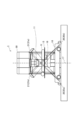
- FIG. 1 is a schematic diagram of a particle beam therapy facility.
- FIG. 2(a) is a side view of the vicinity of the irradiation nozzle
- FIG. 2(b) is a front view of the vicinity of the irradiation nozzle.
- FIG. 3 is a perspective view of the charged particle beam irradiation system without the X-ray generation section.
- 4(a) is a left side view of the charged particle beam irradiation system shown in FIG. 3
- FIG. 4(b) is a right side view of the same charged particle beam irradiation system.
- FIG. 5 is a front view of the charged particle beam irradiation system shown in FIG. 3.
- FIG. 6(a) is a top view of the charged particle beam irradiation system shown in FIG. 3, and FIG. 6(b) is a rear view of the same charged particle beam irradiation system.
- FIG. 7 is a perspective view of a charged particle beam irradiation system including an X-ray generating section, an X-ray detecting section, and a moving vehicle on which a patient is placed.
- FIG. 8 is a right side view of the charged particle beam irradiation system shown in FIG. 7.
- FIG. 9 is a front view of the charged particle beam irradiation system shown in FIG. 7.
- FIG. 10 is a diagram illustrating a mechanism of charged particle beam irradiation by a charged particle beam irradiation device.
- FIG. 10 is a diagram illustrating a mechanism of charged particle beam irradiation by a charged particle beam irradiation device.
- FIG. 11 is an example of a top view of a treatment room equipped with a charged particle beam irradiation device.
- FIG. 12 is a schematic diagram showing the installation conditions of the X-ray imaging device.
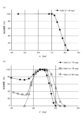
- FIG. 13 is a diagram showing the relationship between the effective field of view and the installation angle of the X-ray imaging device.
- FIG. 14 is a system configuration diagram showing an example of the system configuration of a charged particle beam irradiation device.
- FIG. 15 is a block diagram showing a configuration example of an information processing device that controls charged particle beam irradiation by a charged particle beam irradiation device.
- FIG. 16 is a flowchart showing an example of the control operation of the charged particle beam irradiation device by the information processing device.
- FIG. 12 is a schematic diagram showing the installation conditions of the X-ray imaging device.
- FIG. 13 is a diagram showing the relationship between the effective field of view and the installation angle of the X-ray imaging device.
- FIG. 14 is
- FIG. 17 is an example of a timing chart when a respiratory waveform is predicted and therapeutic irradiation is performed.
- FIG. 18 is another example of a timing chart when a respiratory waveform is predicted and therapeutic irradiation is performed.
- FIG. 19(a) is a diagram showing the arrangement relationship between the charged particle beam irradiation system, the X-ray generation section, and the detection section according to the present embodiment
- FIG. 19(b) is a diagram showing the charged particle beam irradiation system in the conventional full gantry.
- FIG. 19(c) is a diagram showing the arrangement relationship between the irradiation system, the X-ray generation section, and the detection section
- FIG. 19(c) shows the arrangement relationship between the charged particle beam irradiation system, the FIG.
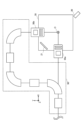
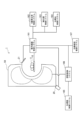
- FIG. 1 is a schematic diagram of a particle beam therapy facility implementing the present invention.
- a charged particle beam extracted from an accelerator passes through a beam transport system 90 and is transported to the treatment room 30.
- the accelerator is a device that generates a charged particle beam, and is realized by, for example, a synchrotron, a cyclotron, or a linear accelerator.
- the beam transport system 90 includes a vacuum duct and a charged particle beam adjustment device.
- the charged particle beam adjustment device includes a beam slit for adjusting the beam shape and/or dose, a bending electromagnet for adjusting the traveling direction of the charged particle beam, and a quadrupole electromagnet for adjusting the beam shape of the charged particle beam. , and a steering electromagnet for finely adjusting the beam position of the charged particle beam according to specifications, and adjusting the beam shape and dose of the charged particle beam.
- the treatment room is covered on all sides with concrete walls for radiation shielding purposes. There is an irradiation nozzle in the treatment room at the end of the beam transport system, and the charged particle beam passes through the irradiation nozzle and is irradiated to the patient lying on the treatment table.
- the treatment room can be irradiated from two directions: horizontally (irradiation nozzle of charged particle beam irradiator 50a) and vertically (irradiator nozzle of charged particle beam irradiator 50b). ing.
- the horizontal traveling direction of the charged particle beam is X
- the vertical traveling direction is Y
- the direction perpendicular to each of X and Y is Z.
- Charged particle beams traveling in the horizontal and vertical directions intersect at a point O called the isocenter.
- the irradiation nozzle includes a scanning electromagnet for scanning the charged particle beam in the shape of the irradiation target, a dose monitor for measuring the dose, a position monitor for measuring the beam position, an energy modulation device, and the like.
- the treatment room is equipped with a positioning device for positioning the patient. Patient positioning may mean specifying the relative positional relationship of the patient (treatment site) with respect to the irradiation nozzle (with respect to the charged particle beam irradiation device) in the treatment room.
- the positioning device includes an X-ray tube as the X-ray generator 20, an image diagnostic device including a flat panel detector (hereinafter referred to as FPD) as the detector, and a device for transmitting and receiving positioning data.
- FPD flat panel detector
- two FPDs 21 are installed so as to be suspended from the ceiling (not shown).
- the X-ray tubes 20 are installed at positions symmetrical to the FPD 21 with the point O in between.
- two X-ray tubes are installed under the floor.
- the FPD 21 is placed on the ceiling side and the X-ray tube 20 is placed under the floor, but this does not limit the arrangement of the two, and the FPD may be placed on the floor side and the X-ray tube placed on the ceiling side.
- an X-ray CT or MRI may be installed in the treatment room as other image diagnostic equipment.
- the FPD 21 is suspended from the ceiling, but the present invention is not limited to this, and may be attached to a device in the treatment room.
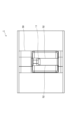
- FIG. 2(a) is a schematic side view of the vicinity of the irradiation nozzle that realizes the first embodiment
- FIG. 2(b) is a front view of the vicinity of the irradiation nozzle that realizes the first embodiment.
- an imaginary surface formed by charged particle beams in two directions, horizontal and vertical is defined as a virtual plane P
- a point O is within the virtual plane P.
- the paired positioning devices are the X-ray tube 20a and the FPD 21a, and the X-ray tube 20b and the FPD 21b
- the FPD 21a and the FPD 21b generate more charged particle beams than the X-ray tube 20a and the X-ray tube 20b, as shown in FIG. 2(a).
- the FPD 21 is installed upstream of the X-ray tube 20 in this embodiment, the FPD 21 may be installed downstream of the X-ray tube 20.
- the X-ray tube 20a and the X-ray tube 20b are at symmetrical positions with respect to the virtual plane P.
- the FPD 21a and the FPD 21b are located at symmetrical positions with respect to the virtual plane P.
- the X-ray tube 20a and the FPD 21a, and the X-ray tube 20b and the FPD 21b are installed symmetrically with respect to the point O as shown in FIG.
- the tube 20a and the FPD 21b are arranged, and the X-ray tube 20b and the FPD 21a are arranged on the opposite side.
- the X-ray tubes 20a and 20b are arranged symmetrically with respect to the virtual plane P
- the X-ray tube 20a and the X-ray tube 20b do not have to be arranged symmetrically with respect to the virtual plane P.
- the FPD 21a may be provided on the rear side (backward side of the paper) than shown in the drawing in the front-rear (depth) direction of the paper of FIG. 2(b).
- the Z direction is the cranio-caudal direction of the patient.
- the patient lies on the treatment table, and patient positioning and treatment irradiation are performed.
- the FPD 21a and the FPD 21b and the X-ray tube 20a and the X-ray tube 20b are installed with the virtual plane P in between, a wide area in the cranio-caudal direction can be imaged.
- FIG. 2(a) it is possible to install two FPDs 21 (21a, 21b) between the horizontal irradiation nozzle and the vertical irradiation nozzle, making the space effective. It is possible to utilize it.
- an axis connecting the X-ray tube 20 and the FPD 21 is formed by a virtual plane P formed by the irradiation axis of the charged particle beam.
- the X-ray tube 20 and the FPD 21 are installed so that their surfaces are flush with each other.
- the X-ray tube 20 and FPD 21 are installed such that the plane formed by the axis connecting the X-ray tube 20 and FPD 21 is inclined with respect to the horizontal side with respect to the virtual plane P. That is, one of the FPDs 21 will be installed on the downstream side in the beam traveling direction and on the open space side in the treatment room. In this case, it becomes difficult to access the irradiation port from the downstream side in the horizontal beam traveling direction, and a configuration such as retracting the FPD 21 is required to prevent interference between the FPD 21 and a person. In this embodiment, it is possible to access from the downstream side to the upstream side in the horizontal beam traveling direction without retracting the FPD 21, and it is possible to improve work efficiency.
- the FPD 21 does not need to be evacuated, it is expected that the accuracy of the installation position will be improved, and highly accurate therapeutic irradiation such as respiratory gated irradiation will be possible. Further, if the FPD 21 cannot be installed on the upstream side, the treatment table may cover the imaging range, and there is a possibility that the imaging conditions may change. In this embodiment, this can be avoided, the imaging conditions can be made uniform regardless of the position of the treatment table, and it is expected that the treatment accuracy will be improved.
- FIG. 3 is a perspective view of a charged particle beam irradiation system in a state in which an X-ray generating section and a detection device for detecting the X-rays are not arranged, and a charged particle beam irradiation device is not arranged.
- FIG. 4(a) is a right side view of the charged particle beam irradiation device shown in FIG. 3.
- FIG. 4(b) is a left side view of the same charged particle beam irradiation device.
- FIG. 5 is a front view of the charged particle beam irradiation device shown in FIG. 3.
- 6(a) is a top view of the charged particle beam irradiation device shown in FIG. 3, and
- FIG. 6(b) is a rear view of the same charged particle beam irradiation device.
- the charged particle beam irradiation device As shown in FIGS. 3 to 6 (particularly FIG. 4), when viewed from the side, the charged particle beam irradiation device according to the second embodiment has a semicircular shape with a portion cut out. A charged particle beam is irradiated from the semicircular recess 51 toward the isocenter O located at the center of the semicircle. An irradiation nozzle 11 is provided in the recess 51, and a charged particle beam is irradiated from the irradiation nozzle 11 to an affected area (isocenter) that is an irradiation target.
- the irradiation nozzle 11 is slidable within a semicircular range along a guide rail 52 provided in a recess 51 of the charged particle beam irradiation device, and irradiates the charged particle beam from various directions within this range. Note that the irradiation nozzle 11 is not an essential component, and the charged particle beam can be irradiated from the concave surface of the recess 51 even without the irradiation nozzle 11.
- Example 2 the mechanism of charged particle beam irradiation by the charged particle beam irradiation device (non-rotating gantry) in Example 2 will be briefly described using FIG. 10. Note that in FIG. 10, the irradiation nozzle 11 is omitted.
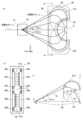
- FIG. 10(a) is a schematic view schematically showing the path of the charged particle beam when the deflecting electromagnet 80 provided in the charged particle beam irradiation device 50 of the charged particle beam irradiation system is viewed from the right side. That is, FIG. 10(a) corresponds to FIG. 4(a) or FIG. 8, which will be described later.
- the charged particle beam irradiation device 50 includes a distribution electromagnet 70 and a deflection electromagnet 80.
- the charged particle beam input to the charged particle beam irradiation device (left end in FIG. 10) is accelerated by an accelerator (not shown), and input to the charged particle beam irradiation device via a beam transport system (not shown).
- an accelerator not shown
- a beam transport system not shown
- FIG. 10(a) shows an example of a plurality of beam paths that differ for each deflection angle ⁇ and convergence angle ⁇ .
- the traveling direction of the charged particle beam is the X-axis
- the direction of the magnetic field generated by the bending electromagnet 80 is the Z-axis
- the direction perpendicular to the X-axis and the Z-axis is the Y-axis.
- the deflection electromagnet 80 is configured to converge, on the isocenter O, a charged particle beam incident from a wide range of deflection angles ⁇ with respect to the X axis in the XY plane. Note that in FIG.
- the irradiation nozzle is omitted, and to simplify the explanation, the isocenter O is the origin of the XYZ space, and the upstream side (accelerator side, left side of the paper in FIG. 10(a)) is It is in the positive direction of the axis.
- the range of the deflection angle ⁇ is from more than -90 degrees to less than +90 degrees, and the positive (+Y-axis direction) deflection angle range and the negative (-Y-axis direction) deflection angle range may be different (asymmetrical). ).
- the deflection angle ⁇ is not limited to these angles.
- the deflection electromagnet 80 includes one or more coil pairs, and the coil pairs are oriented in a direction (Z-axis direction in the figure) perpendicular to the traveling direction of the charged particle beam and the spread direction of the deflection angle ⁇ of the charged particle beam. They generate a uniform magnetic field (effective magnetic field regions 81a, 81b) and are arranged to sandwich the path of the charged particle beam.
- the effective magnetic field area generated by one coil pair of the bending electromagnet 80 has a crescent shape in the XY plane, as shown in FIG. 10(a), and the details thereof will be described later. Note that the gap between the opposing coil pairs through which the charged particle beam passes (distance in the Z-axis direction) is sufficiently small compared to the range in which the charged particle beam spreads in the XY plane. Directional spread is not considered.
- FIG. 10(b) is a cross-sectional view of the bending electromagnet 80 taken along the line AA.
- Bending electromagnet 80 preferably includes at least two coil pairs 84a, 84b. Magnetic poles 85a and 85b are incorporated inside the coils 84a and 84b, respectively, and a yoke 86 is connected to the magnetic poles 85a and 85b.
- a power supply device (not shown) is connected to the deflection electromagnet 80, and when current (excitation current) is supplied from the power supply device to the coil pair 84a, 84b, the deflection electromagnet 80 is excited, and the effective magnetic field area 81a, 81b (also collectively referred to as effective magnetic field region 81) is formed.
- the range of the effective magnetic field region 81a and the range of the effective magnetic field region 81b may be different (asymmetrical). For example, if the range of the positive (+Y-axis direction) deflection angle ⁇ and the range of the negative (-Y-axis direction) deflection angle ⁇ are asymmetric, the effective magnetic field regions 81a and 81b can also be formed asymmetrically accordingly. , the unused effective magnetic field area can be reduced.
- the positive maximum deflection angle ⁇ MAX is an angle of 10 degrees or more and less than 90 degrees
- the negative maximum deflection angle - ⁇ MAX is an angle of more than -90 degrees and less than -10 degrees.
- the deflection angle ⁇ and the irradiation angle ⁇ which will be described later, are angles of the path of the charged particle beam with respect to the X axis in the XY plane.
- the directions of the magnetic fields in the effective magnetic field region 81a and the effective magnetic field region 81b are opposite to each other.
- the deflection angle ⁇ of the charged particle beam incident on the deflection electromagnet 80 is controlled by the distribution electromagnet 70.
- the sorting electromagnet 70 generates a magnetic field oriented in a direction (Z-axis in the figure) perpendicular to the traveling direction (X-axis in the figure) of a charged particle beam supplied from an accelerator (not shown), and directs the charged particle beam to pass through. It includes an electromagnet that deflects the magnetic field, and a control unit that controls the strength and direction of the magnetic field (both not shown).
- the distribution electromagnet 70 deflects the charged particle beam in the XY plane by controlling the strength and direction (Z-axis direction) of the magnetic field, and the deflection electromagnet 80 deflects the charged particle beam deflected at the deflection angle ⁇ at the deflection origin Q. emitted to.
- the deflection origin Q and the isocenter O are on the X axis (on the same horizontal plane).
- a calculation formula for forming the effective magnetic field region 81a of the bending electromagnet 80 will be explained with reference to FIG. 10(c). Note that in this embodiment, since the deflection of the charged particle beam in the Z-axis direction is not considered, the formation of the effective magnetic field region in the XY plane will be described. The effective magnetic field area 81a of the bending electromagnet 80 will be described, but the same applies to the effective magnetic field area 81b, so the description will be omitted.
- the boundary of the effective magnetic field region 81a on the charged particle beam output side 83 of the deflection electromagnet 80 is determined to be a range equidistant r1 from the isocenter O.
- the boundary of the effective magnetic field region 81a on the incident side 82 of the charged particle beam of the deflection electromagnet 80 is determined based on the relational expressions (1) to (5) described later, at a virtual position at a predetermined distance L from the isocenter O.
- the incident charged particle beam is deflected at a deflection angle ⁇ at a deflection starting point Q, and is determined to converge on an isocenter O.
- the virtual deflection starting point Q is a point at which the charged particle beam is assumed to receive a kick with a deflection angle ⁇ at the center of the distribution electromagnet 70 over a very short distance.
- the charged particle beam transported at a deflection angle ⁇ enters from an arbitrary point P1 on the boundary of the effective magnetic field region 81a on the incident side 82, and performs a circular motion with a radius of curvature r2 within the effective magnetic field region 81a (at this time, The central angle is ( ⁇ + ⁇ ).)
- the beam exits from a point P2 on the boundary of the effective magnetic field region 81a on the output side 83 and is irradiated toward the isocenter O. That is, point P1 and point P2 are on a circular arc with radius r2 and central angle ( ⁇ + ⁇ ).
- a magnetic field with a uniform magnetic flux density B is generated in the effective magnetic field region 81a, and if the momentum of the charged particle beam is p (approximately depends on the accelerator) and the electric charge is q, the electric charge deflected in the magnetic field is The radius of curvature r2 of the particle beam is expressed by equation (5).
- the boundary of the effective magnetic field area 81a can be adjusted.
- the shape can be adjusted. That is, the boundary is determined so that the distance between any point P2 on the boundary of the effective magnetic field region 81a on the output side 83 and the isocenter O is equal distance r1, and the magnetic flux density B of the effective magnetic field region 81a is adjusted.
- the boundary between the effective magnetic field regions 81a and 81b of the bending electromagnet 80 determined as described above has an ideal shape for converging the charged particle beam to the isocenter O.
- the amount of excitation (magnetic flux density B) of the bending electromagnet 80 is finely adjusted for each deflection angle ⁇ , and the information is
- the charged particle beam can be deflected in accordance with the isocenter O by storing this in the power supply and controlling the deflection angle ⁇ and the amount of current of the deflection electromagnet 80 so that they are linked.
- the trajectory of the charged particle beam can be finely adjusted by correcting the shape and arrangement of the coil pairs 84a, 84b and the magnetic poles 85a, 85b of the bending electromagnet 80. It is also possible.
- the charged particle beam can be irradiated onto the affected area (isocenter O) at a desired angle.
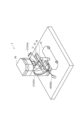
- FIG. 7 is a perspective view showing a charged particle beam irradiation system in which an X-ray generating unit 20 is arranged in the charged particle beam irradiation device, and a mobile vehicle 10 on which a patient is placed is arranged.
- FIG. 8 is a right side view of the charged particle beam irradiation device shown in FIG. 7.
- FIG. 9 is a front view of the charged particle beam irradiation system shown in FIG. 3.
- the positional relationship between the charged particle beam irradiation device, the X-ray generation section, and its detection section will be explained using FIGS. 7 to 9.
- FIGS. 7 to 9 the top wall and back wall shown in FIG. 3 and the charged particle beam irradiation device are shown in order to make it easier to see the X-ray generator irradiation device and the moving vehicle 10 in which the patient is placed.
- the structure on the accelerator side after the 50th wall is not shown.
- the charged particle beam irradiation device is installed within a predetermined treatment room.
- the patient U to be treated is placed on the treatment table 15 of the mobile vehicle 10 and transported under automatic control to the treatment position of the charged particle beam irradiation device.
- the treatment table 15 on which the patient U is placed is connected to an arm 16 provided on the mobile vehicle 10, and when this arm 16 is driven (the axis of the arm 16 rotates), the patient U is placed on the treatment table 15.
- the placed treatment site of the patient U can be moved to the position of the isocenter O of the charged particle beam irradiation device.
- the mobile vehicle 10 may be automatically controlled by a program or manually controlled by an operator using a remote control.
- the charged particle beam irradiation system 1 includes a charged particle beam irradiation device 50, an X-ray generation section 20 (20a, 20b), and a detection section 21 (21a, 21b).
- the charged particle beam irradiation device 50 is a device that can irradiate a charged particle beam toward the isocenter.
- the X-ray generating section 20 is a device that irradiates X-rays
- the detecting section 21 is located opposite to the X-ray generating section 20 and detects the X-rays that have passed through the body of the patient U to generate an X-ray image. It is a device that generates.
- X-rays are schematically indicated by dotted lines.
- the X-ray image generated by the detection unit 21 may be a moving image or a still image.
- the X-ray image generated by the detection unit 21 is transmitted to the information processing device 100, which will be described later, which determines the timing of irradiation with the charged particle beam.
- the X-ray generation unit 20 (20a, 20b) is located in the treatment room where the charged particle beam irradiation device is arranged, and is located on the irradiation nozzle 11 side (charged They are installed near the floor surface, such as under the floor, on both sides of the charged particle beam irradiation device (on the particle beam irradiation source side). By providing it under the floor, for example, it can be prevented from interfering with the movement of the vehicle 10 or the movement of people within the treatment room.
- the detection units 21 (21a, 21b) that detect the X-rays emitted from the X-ray generation unit 20 are located near the ceiling in the treatment room so as to face the X-ray generation unit 20 (20a, 20b), respectively. established in That is, the detection section 21 is installed on the downstream side of the X-ray generation section 20 in the traveling direction of the charged particle beam. Note that the arrangement positions of the X-ray generating section 20 and the detecting section 21 may be reversed. That is, the detection section 21 may be arranged upstream of the X-ray generation section 20 in the traveling direction of the charged particle beam.
- a dashed line (17) shown in FIG. 9 indicates a virtual plane 17 (corresponding to the above-mentioned virtual plane P) indicating a path through which the charged particle beam passes.
- the charged particle beam passes through the center of the apparatus in FIG. 9 and passes through a virtual plane 17 that is a vertical plane.
- the X-rays emitted from the X-ray generator 20 are emitted so as to intersect with the virtual plane 17 and pass through the isocenter O.
- the X-ray generation section 20a and the detection section 21b are arranged on the same side so as not to sandwich the virtual plane 17, and the X-ray generation section 20b and the detection section 21a are also arranged on the same side. Similarly, they are arranged on the same side so as not to sandwich the virtual plane 17 between them.
- the X-ray generating section 20a and the X-ray generating section 20b do not need to be arranged in the treatment room so that they are located on both sides of the virtual plane 17, and similarly, the detecting section 21a and the detecting section 21b are arranged on both sides of the virtual plane 17. It does not have to be placed in the treatment room so that it can be targeted.
- FIG. 11 is a top view of a treatment room that implements this embodiment.
- the interior dimensions of the treatment room are approximately 8 m x approximately 6 m, but are not limited thereto.
- the charged particle beam irradiation device 50 has a structure in which only a portion of the tip, including the irradiation nozzle 11, is visible to the patient's eyes with a decorative wall 55 in between. There is. Since the decorative wall 55 is often made of plywood, the quality of captured images generally deteriorates when X-rays are passed through the decorative wall 55. Therefore, it is preferable to install the beam downstream of the decorative wall 55 from the X-ray generating section and the detecting section.
- the X-ray generating section 20 and the detecting section 21 need to be installed on the downstream side of the beam from the decorative wall 55 shown in FIG. 11 in order to allow the X-rays to pass through the isocenter O.
- the edge of the charged particle beam irradiation device 50, the irradiation nozzle 11, the arm 16 of the moving vehicle 10 and its drive mechanism 16' interfere with the X-ray imaging area (broken line in FIG. 9), the X-rays are attenuated. The effective field of view will be narrowed. Therefore, we will describe the installation conditions that allow imaging of a wide area in the craniocaudal direction without changing the imaging conditions or expanding the treatment room, and that allows for respiratory synchronized irradiation.
- the positional relationship between the X-ray generation section and the detection section when viewed from the Z direction is expressed as an angle ⁇ [deg]
- the X-ray generation when viewed from the X direction is expressed as an angle ⁇ [deg].
- ⁇ and ⁇ on the effective field of view of the detected image when the positional relationship between the detection unit and the detection unit was set at an angle ⁇ [deg].
- the angle ⁇ is the angle formed by the X-ray flux with respect to the horizontal plane on the XY plane
- the angle ⁇ is the angle formed by the X-ray flux with respect to the horizontal plane on the YZ plane.
- the effective field of view refers to an area where the X-ray flux generated from the X-ray generation section 20 is detected by the detection section 21 without interfering with the charged particle beam irradiation device, the treatment table (mobile vehicle), or the like. Further, when the entire screen area (the entire detection range by the detection unit 21) is 100, and the area occupied by the effective field of view is 80, it is assumed that the effective field of view is 80%.
- the arrangement of the X-ray generating section and the detecting section to form an ideal effective field of view is to arrange the axes connecting the two pairs of X-ray generating sections 20 and the detecting section 21 to be perpendicular to each other. As shown in FIG. 13(a), when ⁇ becomes smaller than 45 degrees, that is, the larger the difference between the axes connecting the two pairs of X-ray generators 20 and detectors 21, the less interference with the charged particle beam irradiation device. becomes smaller.
- the effective visual field was 100% when 42 ⁇ 45. Further, when 38 ⁇ 47, the effective visual field was 80%. When ⁇ was fixed at 78 degrees and the influence of the value of ⁇ on the effective visual field was checked, the effective visual field was 100% when 41 ⁇ 46. Further, when 39 ⁇ 48, the effective visual field was 80%. When ⁇ was fixed at 82 degrees and the influence of the value of ⁇ on the effective visual field was checked, the effective visual field was 100% when 41 ⁇ 48. Further, when 39 ⁇ 50, the effective visual field was 80%.
- the higher the effective field of view the wider the imaging range of the X-ray image obtained by X-ray imaging and the better the image quality, so the larger the percentage of the effective field of view is, the better.
- the X-ray generation unit and detection unit in an area that covers more than 80% of the effective field of view, it is possible to add the function of respiratory gated irradiation and perform highly accurate therapeutic irradiation without increasing the size of the device. Note that this does not mean that the arrangement of the X-ray generating section 20 and the detecting section 21 that provides an effective field of view of 80% or more is essential.
- FIG. 14 is a system configuration diagram for implementing this embodiment.
- the treatment integrated control system 167 is the upper system, and there are an irradiation control system 166 for performing treatment irradiation and an indoor equipment control system 161 for positioning the patient.
- the treatment general control system 167 instructs the focusing electromagnet and irradiation nozzle to enable treatment from a desired angle.
- the focusing electromagnet is excited to perform irradiation from a desired angle, and the irradiation nozzle is driven to irradiate the isocenter O with a charged particle beam.
- the indoor equipment control system 161 drives the treatment table 15 using the treatment table control system 164, and transports the patient to a position where treatment irradiation is performed.
- the X-ray generator control system 162 performs X-ray exposure
- the detector control system 163 acquires an image.
- the X-ray generating section 20 and the detecting section 21 are not installed in the traveling direction of the charged particle beam emitted from the irradiation nozzle, it is necessary to evacuate the X-ray generating section 20 and the detecting section 21 during treatment irradiation. There isn't. As a result, the installation accuracy of the X-ray generating section 20 and the detecting section 21 does not change due to the drive due to evacuation, compared to the case where the X-ray generating section 20 and the detecting section 21 are retracted to be stored in the ceiling or under the floor. Therefore, treatment accuracy does not decrease.
- the space from the X-ray generating section 20 to the detecting section 21 is not obstructed by driving the irradiation nozzle. Therefore, it is possible to position the patient while changing the treatment irradiation angle, and it is possible to shorten the treatment time. As a result, the number of patients treated per treatment room can be increased.
- a virtual plane 17 formed by the irradiation axis of the charged particle beam and two pairs of the X-ray generating section 20 and the detecting section 21 are used. It is installed on horizontal and vertical beam lines where the planes formed by the connecting axes are perpendicular to each other and on the same plane. As long as there are images taken from at least two directions, positioning is possible regardless of the arrangement direction, so that the same patient positioning accuracy as in the prior art can be obtained even in the arrangement of the X-ray generating section 20 and the detecting section 21 of the present invention.
- the present invention is applicable to non-coplanar irradiation, in which the treatment beam is irradiated not only in a section perpendicular to the longitudinal direction of the patient but also from a non-coplanar plane to reduce the dose to normal tissues and major adjacent vital organs. Contributes to improving accuracy.
- the treatment table is rotated around the isocenter and irradiation is started so that irradiation is performed on the desired non-coplanar surface. Treatment is performed depending on the accuracy of movement of the treatment table.
- the two pairs of X-ray generation section 20 and detection section 21 are arranged in the long axis direction of the patient, a wide space around the patient is secured. Therefore, the patient's position can be confirmed with a fixed X-ray imaging system while ensuring a space for the treatment table to rotate around the isocenter, improving treatment accuracy in non-coplanar irradiation.
- the two pairs of X-ray generators 20 and detectors 21 rotate, so the patient positioning arrangement is in the forward direction, and the in-vivo monitor during irradiation is arranged depending on the irradiation angle.
- images acquired as an in-body monitor during patient positioning and irradiation during a series of treatments can be evaluated with the same geometrical arrangement regardless of the irradiation angle.
- positioning the patient use bones that are less affected by respiratory movement as landmarks.
- respiratory gated irradiation positioning is required in consideration of the movement of respiratory organs and the relative positional relationship of bones, and two-step position confirmation is performed.
- the building that houses the irradiation equipment is about half the size of a rotating gantry, which requires a huge cylindrical structure with a height and depth of about 10 meters as a rotating space. Therefore, the cost of introducing treatment equipment can be significantly reduced.
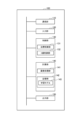
- FIG. 15 is a block diagram showing a configuration example of an information processing apparatus 100 that controls a charged particle beam irradiation system.
- the information processing device 100 is a computer system that controls irradiation of a charged particle beam from a charged particle beam irradiation device to a treatment area of a patient, and may be realized by a so-called server device, a PC, a tablet terminal, etc. It is not limited.
- the information processing device 100 includes a communication section 110, an input section 120, a control section 130, and a calculation section 140. Further, the information processing device 100 may include an output unit 150.
- the communication unit 110 is a communication interface that can communicate with external devices.
- the communication unit 110 transmits instruction information that instructs the irradiation unit of the charged particle beam irradiation device to irradiate the charged particle beam, for example, in accordance with an instruction from the control unit 130. Further, according to instructions from the communication section 110 and the control section 130, the X-ray generation section 20 is instructed to irradiate X-rays, and the detection section 21 is instructed to transmit an X-ray image.
- the communication unit 110 also receives information regarding patient treatment from an external device and transmits it to the control unit 130.
- the input unit 120 is an input interface that has the function of receiving input from the operator of the information processing device 100 and transmitting it to the control unit 130.
- the input unit 120 may be implemented by, for example, an input device such as a keyboard or a mouse, but is not limited to these.
- the input unit 120 receives, for example, input of information regarding patient treatment, and transmits the received input content to the control unit 130.
- the control unit 130 is a processor that has a function of controlling each unit of the information processing device 100.
- the control unit 130 functions as the information processing device 100 by executing a program included in the calculation unit 140.
- the control unit 130 includes a treatment control unit 131 and an X-ray control unit 132 as functions to be performed by the information processing apparatus 100.
- the treatment control unit 131 has a function of transmitting, via the communication unit 110, instruction information that instructs the charged particle beam irradiation device to irradiate a charged particle beam.
- the X-ray control unit 132 instructs the X-ray generation unit 20 to irradiate X-rays via the communication unit 110, and acquires the X-ray image detected by the detection unit 21.
- the X-ray control unit 132 transmits the acquired X-ray image to the treatment control unit 131.
- the calculation unit 140 has a function of analyzing the X-ray image acquired by the X-ray control unit 132 and identifying the relative position of the target region to be treated with respect to the patient.
- the image processing unit 141 performs image processing on the X-ray image acquired by the X-ray control unit 132, analyzes the feature amount in the image, and calculates the position of the target treatment region. At this time, an optimal combination of existing image filters (for example, noise removal filters and contour enhancement filters) is executed to reduce the burden on the radiologist when positioning the patient, but the details are omitted here.
- the calculation section 140 has a storage section 142.
- the storage unit 142 is a storage medium that has a function of storing various programs and various data necessary for the operation of the information processing apparatus 100.
- the storage unit 142 can be realized by, for example, an HDD (Hard Disc Drive), an SSD (Solid State Drive), a flash memory, etc., but is not limited to these.
- the storage unit 142 stores a learning model 143 for determining the irradiation timing of the charged particle beam. Further, as shown in FIG. 15, the position of the treatment site may be calculated using a learning model registered in the learning model 143.
- the learning model 143 is stored in the storage unit 142.
- An example of the learning model 143 is a learning model that has learned the correspondence between X-ray images and the positions of organs, and uses the X-ray images and information indicating the treatment area as input to identify the relative position of the target area with respect to the patient. do.
- the image processing unit 141 determines whether the target treatment region is located in an irradiation possible region including the irradiation position (isocenter) of the charged particle beam, and specifies the irradiation timing. Therefore, the learning model 143 is generated by learning a plurality of pieces of teacher data, using information in which an X-ray image and information indicating the parts of various organs associated with the X-ray image are associated with each other as teacher data.
- This learning model 143 is basically a patient-specific model that has learned the patient's X-ray image and treatment target position according to each patient. It may be a general-purpose model that has learned X-ray images and treatment target positions. While preparing a model specialized for each patient can be expected to improve the accuracy of treatment compared to using a general-purpose model, a general-purpose model does not require preparing a model each time a different patient is treated. get well.
- the X-ray images used for learning are the X-ray images taken by the X-ray generating section 20 and the detecting section 21 arranged at the positions shown in FIGS. 7 to 9. That is, it is an X-ray image obtained by irradiating X-rays obliquely with respect to the human body height direction (longitudinal direction) and the horizontal direction with respect to the human body height direction.
- This X-ray image is associated with information (annotation) indicating which part is which part of which organ in the image, thereby forming training data and generating a learning model 143.
- a first learning model 143 corresponding to the X-ray image captured by the detection unit 21a and a second learning model 143 corresponding to the X-ray image captured by the detection unit 21b are prepared. It is preferable to keep it. Note that the annotation may be added by a medical professional or the like. Further, the image used for learning here may be a digital reconstructed radiograph generated by simulating an X-ray image from a CT image. Furthermore, a plurality of learning models may be registered in the learning model 143. Another example of a learning model is a learning model that optimizes the image filter by learning the correspondence between the irradiation region to be treated, the exposure conditions of the X-ray image, and the image filter.
- the image filter selected by the learning model 143 is applied to the acquired X-ray image, and the image processing unit 141 analytically detects the target object.
- the relative position of the target region with respect to the patient is specified, and the image processing unit 141 determines whether the target treatment region has arrived at the irradiation possible region including the irradiation position (isocenter) of the charged particle beam.
- the output unit 150 has a function of outputting information specified by the control unit 130.
- the output unit 150 may be realized by, for example, a monitor or a speaker, but is not limited thereto.
- the output of information by the output unit 150 may be realized by transmitting the information to an external device.
- the output unit 150 may output information regarding the treatment site under instructions from the control unit 130.
- FIG. 16 is a flowchart illustrating an operation example of charged particle beam irradiation control by the information processing apparatus 100.
- the communication unit 110 of the information processing device 100 receives an X-ray image.
- the communication unit 110 transmits the received X-ray image to the control unit 130.
- the control unit 130 receives input of an X-ray image for performing respiratory synchronization of proton beam therapy (step S1601). That is, the control section 130 detects the X-rays emitted from the X-ray generation section 20 by the detection section 21, and receives the input of the X-ray image obtained by the detection.
- the X-ray image is obtained by irradiating the patient's body with X-rays parallel to the charged particle beam (the same plane as the virtual plane formed by the irradiation path of the charged particle beam).
- the image is taken not with a line but with an X-ray irradiated in a manner that intersects a virtual plane formed by a line through which the charged particle beam passes.
- the image is taken using X-rays irradiated obliquely onto the human body.
- the X-ray images accepted here only need to be information that can estimate the state of internal organs in the body, and may be streaming videos, continuous still images, or It may be a video in units of time (for example, it may be in units of 0.1 seconds, but is not limited to this).
- the communication unit 110 or the input unit 120 of the information processing device 100 receives input of information regarding the patient's treatment area and transmits it to the control unit 130 (step S1602).
- the information regarding the treatment site may be information that allows the information processing device 100 to specify at least the relative position of the target site to be treated with respect to the patient.
- the control unit 130 successively receives input of X-ray images from the communication unit 110, and inputs the X-ray images and information regarding the treatment site to the learning model 143 (step S1603). Thereby, the treatment control unit 131 specifies the timing at which the charged particle beam should be irradiated (step S1604).
- the treatment control unit 131 transmits instruction information that instructs the charged particle beam irradiation device to perform irradiation via the communication unit 110 so that the charged particle beam is irradiated at a specific timing (step S1605).
- the information processing device 100 can control the irradiation of the charged particle beam at appropriate timing.
- the information processing device 100 specifies the relative position of the irradiation target organ and the positional relationship between the irradiation target organ and other organs for organs that move respirably, thereby reducing the work required by the radiologist. , the exposure dose due to X-ray exposure can be reduced.
- X-ray images for one breathing cycle are continuously acquired as in-vivo information, and the information is simultaneously acquired using a plurality of external in-vivo information acquisition devices.
- information processing can be performed to determine the relative position of the irradiated organ and the positional relationship between the irradiated organ and other organs using only external information during treatment.
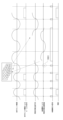
- FIG. 17 shows a first control example in which an unstable respiratory waveform is predicted from the data accumulated in the storage unit 142 of the calculation unit 140 and irradiation is performed.
- 3 is a timing chart schematically showing the timing etc. of FIG.
- FIG. 17 shows the waveform of the external monitor information, the waveform of the beam ON signal based on the external monitor information, the waveform of the irradiation target position information by X-ray irradiation, the waveform of the X-ray exposure ON signal, and the irradiation target position information.
- the waveform of the beam ON signal and the irradiation waveform of the charged particle beam are shown.
- the external monitor information may be information about images taken outside the patient, for example, images taken of the patient's abdomen, and based on those images, the degree of expansion of the abdomen is schematically shown. It may be waveform information.
- the beam ON signal based on the external monitor information is information indicating an instruction to irradiate a charged particle beam, and is information about an irradiation instruction made when the patient's breathing is stable based on the external monitor information.
- Irradiation target position information by X-ray exposure is information that is obtained by imaging the inside of a patient's body by performing X-ray exposure, and indicates the position of a treatment region (a portion to be irradiated with a charged particle beam).
- the X-ray exposure ON signal is a signal that instructs the X-ray generation section 20 to emit X-rays.
- the beam ON signal based on irradiation target position information is a signal that instructs irradiation of a charged particle beam to a treatment target region specified by X-ray irradiation.
- the irradiation at the bottom of FIG. 17 shows the irradiation timing of the charged particle beam performed by the beam ON signal based on the irradiation target position information.
- the image processing unit 141 analyzes the external monitor information of the patient undergoing treatment.
- the external monitor information may be a captured image of the patient's abdomen or the like.
- the charged particle beam irradiation device can detect that breathing is stable based on the information from the external monitor (the part where the external monitor information shows a stable wave system in Figure 17), , when the patient's body is in a predetermined state, for example, in the example of FIG. 17, when the value of the external monitor information shows a positive value (a predetermined value or more), that is, at a timing when the patient's peritoneum is expanded beyond a predetermined value,
- the beam ON signal is turned ON based on the external monitor information, and charged particle beam irradiation is executed.
- the patient's external monitor information registered in the storage unit 142 of the calculation unit 140 and the respiratory waveform data at that time are referred to, and unstable respiratory waveforms are predicted in advance.
- an unstable respiratory waveform 1701 surrounded by a broken line of the respiratory waveform starting from the arrow part in the external monitor information in FIG. 17 is predicted. That is, the external monitor information is input to the learning model 143 to estimate whether or not the patient's breathing disturbance is likely to occur.
- an unstable respiratory waveform occurs, accurate therapeutic irradiation cannot be performed. Therefore, when the occurrence of an unstable respiratory waveform is predicted, imaging using X-rays is performed.
- the X-ray generating section 20 instructs the X-ray generating section 20 to start emitting X-rays and the detecting section 21 to take an image. Then, when the treatment site (irradiation target position information) detected by X-ray irradiation comes to the irradiation position, irradiation with the charged particle beam is executed. While performing X-ray exposure, prediction of the respiratory waveform based on the learning model 143 and external monitor information is continued. Then, the X-ray imaging is stopped at the stage when it is predicted that the respiratory waveform will be stabilized from the external monitor information (the stage in the area surrounded by the dotted line 1702 in FIG. 17). This makes it possible to reduce unnecessary exposure doses.
- the timing to return to the charged particle beam irradiation control based on the external monitor information is when it is predicted that the respiratory waveform will stabilize, and the position of the treatment target area based on the external monitor information and the X-ray exposure
- the timing may be synchronized with the position of the treatment target region detected by radiation.
- FIG. 18 shows a second control example in which X-ray imaging is performed at timings near the ON signal and near the end of the ON signal of the breathing gate that performs irradiation based on external monitor information. The contents of each signal in FIG. 18 are the same as those in FIG.
- a waveform for irradiation target position prediction indicating the position of the treatment target region predicted from the external monitor information is added.
- detection of the irradiation target position by X-ray exposure is performed periodically. Since the patient's breathing is basically periodic, X-rays are irradiated only at the timing of inhalation and exhalation, and it is determined whether the irradiation target position exists at a desired position.
- the ON control of the charged particle beam is executed based on the external monitor information, as in the first control example. That is, irradiation with the charged particle beam is executed at the timing when the external monitor information is equal to or higher than a predetermined value.
- the external monitor information if it is detected that the irradiation target position is not at the desired position based on the X-ray image (see dotted line 1801 in FIG. 18), the external monitor information, the periodic timing of X-ray irradiation, and It is possible to detect that there is a shift in the relative relationship between the two. If such a shift can be detected, the charged particle beam irradiation system switches the X-ray exposure from intermittent exposure to continuous exposure. During continuous X-ray exposure, the position of the treatment target region is continuously identified based on the X-ray images. Then, irradiation with the charged particle beam is performed at the timing when the treatment target region reaches the irradiation position.
- the charged particle beam irradiation system synchronizes the position of the treatment target area identified by X-ray exposure with the position of the treatment target area identified from the external monitor information, The irradiation timing of periodic X-ray exposure is determined. Once the irradiation timing is determined, continuous X-ray exposure is stopped and intermittent X-ray exposure is resumed.
- a large space around the patient can be secured, so that an external information acquisition device such as a 3D camera or an ultrasound device can be installed. can.
- an external information acquisition device such as a 3D camera or an ultrasound device
- space can also be secured for installing a relatively large device such as an MRI that does not involve exposure to radiation, in order to pinpoint the location more precisely.
- the information processing device 100 can identify the relative position of the irradiation target organ and the positional relationship between the irradiation target organ and other organs with higher precision, and It is possible to irradiate at the appropriate timing.
- FIG. 19 is a diagram schematically showing the relative positional relationship between the X-ray generating section 20 and the detecting section 21 in the conventional full gantry and half gantry, and the relative positional relationship between the X-ray generating section and the detecting section in the present invention.
- FIG. 19(a) is a diagram showing an example of the arrangement of the X-ray generating section and the detecting section in a charged particle beam irradiation system that is not a rotating gantry according to the present invention
- FIG. 19(b) is a diagram showing an example of the arrangement of the FIG. 19C is a diagram showing the relative positional relationship between the X-ray generating part and the detecting part in the half gantry.
- 19(a) to 19(c) indicate a virtual plane P(17) generated from a plurality of trajectories of the irradiated charged particle beam.
- F1 and F2 each indicate a detection section
- X1 and X2 indicate an X-ray generation section.
- the upstream side is the charged particle beam generation source side of the charged particle beam irradiation device
- the downstream side is the charged particle beam emission side.
- the charged particle beam irradiation system that is not a rotating gantry according to the present invention is different from the conventional full gantry and half gantry.
- an axis connecting the pair of X-ray generating sections (X1, X2) and detecting sections (F1, F2) that is, a line connecting X-ray generating section X1 and detecting section F1, and an axis connecting X-ray generating section X2 and detecting section F2. They are common in that lines connecting them (both not shown) intersect on the virtual plane P.
- the direction from upstream to downstream of the device is parallel to the virtual plane P.
- the direction from upstream to downstream of the device is parallel to the virtual plane P.
- the charged particle beam irradiation system, which is not a rotating gantry, according to the present invention, and the conventional full gantry all the detection parts The difference is whether or not it is located upstream of the X-ray generating section.
- FIG. 19(a) and FIG. 19(c) all the detection parts The difference is whether or not it is located upstream of the X-ray generating section.
- the X-ray generating section (X1, X2) and the detecting section (F1, F2) are located with the virtual plane P in between. They differ depending on whether they are on the same side or not.
- one of the features of the charged particle beam irradiation system that is not a rotating gantry according to the present invention is that (i) the X-ray generation section and the detection section are not located on the same side with respect to the virtual plane P; (ii) All detection units (or X-ray generation units) are arranged upstream of the X-ray generation unit (or detection unit). .
- the first X-ray generation section and the second X-ray generation section are charged and
- the particle beam irradiation device is arranged in plane symmetry with respect to a virtual plane formed by a plurality of selectable trajectories of the charged particle beam, and the side where the charged particle beam enters the charged particle beam irradiation device is the upstream side, and the charged particle
- the side from which the beam is emitted from the charged particle beam irradiation device is defined as the downstream side
- the first detecting section and the second detecting section are located closer to each other than the first X-ray generating section and the second X-ray generating section.
- the X-ray generator and detector By placing the X-ray generator and detector on the ground and ceiling to the left and right of the charged particle beam irradiation device, they are separated from the irradiator, so there is no need to evacuate the X-ray generator and detector during treatment beam irradiation. Ample space is secured around the patient. Therefore, the installation precision of the X-ray generating section and the detecting section does not change due to insertion/retraction driving, and the treatment precision does not deteriorate. Furthermore, it is possible to perform patient positioning while changing the treatment irradiation angle, which makes it possible to shorten treatment time and increase the number of patients to be treated per treatment room. Furthermore, while ensuring a space for the treatment table to rotate around the isocenter, the patient's position can be confirmed with a fixed geometrical arrangement of X-ray images, improving treatment accuracy in non-coplanar irradiation.
- the information processing device 100 may include a learning section for learning the learning model 143. That is, the learning model 143 may be provided with a function of performing learning according to a predetermined algorithm based on a plurality of teacher data and generating the learning model 143.
- the information processing device 100 may include a relearning unit that receives input of new teacher data and relearns the learning model 143.
- a relearning unit that receives input of new teacher data and relearns the learning model 143.
- the above embodiment describes a case where there is one learning model 143, there may be a plurality of learning models 143. That is, the learning model 143 may be created for each organ to be treated, for example. By subdividing the learning model 143 for each organ, more accurate learning can be performed, and highly accurate charged particle beam irradiation can be achieved.
- the learning model 143 may be created for each patient receiving treatment, and in that case, the learning model 143 adds the patient's treatment area to the X-ray image as annotation information, It may also be something for learning.
- the learning model 143 can be constructed not only from prior image information etc. taken before the treatment of the patient to be treated, but also from X-ray images etc. of unspecified patients who have been treated so far. In some cases, it is constructed from patient data before the patient is treated. This can be expected to improve treatment accuracy by increasing the number of learning data. This approach is expected to improve the accuracy of skeletal positioning using X-ray images of bones, as well as irradiation control during treatment of organs that involve respiratory movement.
- the angle formed between the X-rays and the virtual plane 17 is arbitrary, and the X-ray generating unit 20 is provided on both sides of the charged particle beam irradiation device so as not to interfere with the movement of the moving vehicle 10. It should be . At this time, it is better to install the X-ray generator 20 as close to the charged particle beam irradiation device as possible to prevent the treatment room from becoming too large. It is desirable that the moving vehicle 10 be placed in a position that does not interfere with the acquisition of X-ray images.
- the program of each embodiment of the present disclosure may be provided in a state stored in a storage medium readable by an information processing device.
- the storage medium may be a "non-transitory tangible medium" capable of storing the program.
- the program may include, for example, a software program or an information processing device program.
- the storage medium may, where appropriate, include one or more semiconductor-based or other integrated circuits (ICs) (e.g., field programmable gate arrays (FPGAs), application specific integrated circuits (ASICs), etc.), hard drives, etc.
- ICs semiconductor-based or other integrated circuits
- Storage media may be volatile, non-volatile, or a combination of volatile and non-volatile, where appropriate.
- the program of the present disclosure may be provided to the information processing device 100 via any transmission medium (communication network, broadcast wave, etc.) that can transmit the program.
- any transmission medium communication network, broadcast wave, etc.
- each embodiment of the present disclosure can also be realized in the form of a data signal embedded in a carrier wave, in which the program is embodied by electronic transmission.
- program of the present disclosure may be implemented using any programming language such as a script language such as JavaScript (registered trademark) or Python, C language, Go language, Swift, Koltin, or Java (registered trademark). .
- a script language such as JavaScript (registered trademark) or Python
- C language such as Go language, Swift, Koltin, or Java (registered trademark).
- the present invention may be a method of controlling a charged particle beam from a charged particle beam irradiation device by the information processing device 100. That is, one aspect of the present invention includes a deflecting electromagnet that continuously changes the irradiation angle of the charged particle beam to the isocenter by deflecting the charged particle beam; a charged particle beam irradiation device comprising: an irradiation nozzle that moves continuously with a beam; an X-ray generation section that irradiates X-rays; and a detection section that detects the X-rays; The particle beam passes through the irradiation nozzle and is irradiated to the isocenter, and the virtual line connecting the X-ray generation section and the detection section is a virtual line formed by the charged particle beam irradiated from the irradiation nozzle to the isocenter.
- step S1601 and step S1602 may be performed first, or the processing in step S1601 and the processing in step S1602 may be performed simultaneously.
Landscapes
- Health & Medical Sciences (AREA)
- Engineering & Computer Science (AREA)
- Biomedical Technology (AREA)
- Pathology (AREA)
- Nuclear Medicine, Radiotherapy & Molecular Imaging (AREA)
- Radiology & Medical Imaging (AREA)
- Life Sciences & Earth Sciences (AREA)
- Animal Behavior & Ethology (AREA)
- General Health & Medical Sciences (AREA)
- Public Health (AREA)
- Veterinary Medicine (AREA)
- Radiation-Therapy Devices (AREA)
Priority Applications (3)
| Application Number | Priority Date | Filing Date | Title |
|---|---|---|---|
| KR1020257006810A KR20250047772A (ko) | 2022-08-08 | 2023-06-02 | 하전 입자 빔 조사 시스템 |
| CN202380069068.2A CN119947790A (zh) | 2022-08-08 | 2023-06-02 | 带电粒子束照射系统 |
| EP23852223.9A EP4570311A1 (en) | 2022-08-08 | 2023-06-02 | Charged particle beam irradiation system |
Applications Claiming Priority (2)
| Application Number | Priority Date | Filing Date | Title |
|---|---|---|---|
| JP2022-126627 | 2022-08-08 | ||
| JP2022126627A JP2024023069A (ja) | 2022-08-08 | 2022-08-08 | 荷電粒子ビーム照射システム |
Publications (1)
| Publication Number | Publication Date |
|---|---|
| WO2024034239A1 true WO2024034239A1 (ja) | 2024-02-15 |
Family
ID=89033871
Family Applications (1)
| Application Number | Title | Priority Date | Filing Date |
|---|---|---|---|
| PCT/JP2023/020710 Ceased WO2024034239A1 (ja) | 2022-08-08 | 2023-06-02 | 荷電粒子ビーム照射システム |
Country Status (6)
| Country | Link |
|---|---|
| EP (1) | EP4570311A1 (https=) |
| JP (3) | JP2024023069A (https=) |
| KR (1) | KR20250047772A (https=) |
| CN (1) | CN119947790A (https=) |
| TW (1) | TW202406593A (https=) |
| WO (1) | WO2024034239A1 (https=) |
Citations (8)
| Publication number | Priority date | Publication date | Assignee | Title |
|---|---|---|---|---|
| JP2003220151A (ja) * | 2002-01-30 | 2003-08-05 | Mitsubishi Heavy Ind Ltd | 動体追尾装置、放射線治療装置及び放射線照射方法 |
| JP2007037629A (ja) * | 2005-08-01 | 2007-02-15 | Hitachi Ltd | 放射線治療装置 |
| CN105920745A (zh) * | 2016-06-16 | 2016-09-07 | 四川大学 | 放射治疗系统 |
| JP6158334B2 (ja) | 2012-09-11 | 2017-07-05 | イヨン ベアム アプリカスィヨン エッス.アー. | 可動フロアを有するハドロン治療装置 |
| JP6387476B1 (ja) | 2018-07-02 | 2018-09-05 | 株式会社ビードットメディカル | 荷電粒子ビーム照射装置 |
| JP6523076B2 (ja) | 2015-06-30 | 2019-05-29 | 株式会社日立製作所 | 粒子線治療システム |
| JP2019166098A (ja) * | 2018-03-23 | 2019-10-03 | 株式会社日立製作所 | 放射線治療装置及びベッド位置決め装置並びにベッドの位置決め方法 |
| JP2019180654A (ja) * | 2018-04-05 | 2019-10-24 | 株式会社ビードットメディカル | 収束電磁石及び荷電粒子ビーム照射装置 |
Family Cites Families (2)
| Publication number | Priority date | Publication date | Assignee | Title |
|---|---|---|---|---|
| US9101761B2 (en) | 2011-03-22 | 2015-08-11 | National University Corporation Hokkaido University | Moving object tracking system for radiotherapy |
| JP6698429B2 (ja) | 2016-05-26 | 2020-05-27 | 株式会社日立製作所 | 放射線治療システム |
-
2022
- 2022-08-08 JP JP2022126627A patent/JP2024023069A/ja active Pending
- 2022-08-18 JP JP2022130496A patent/JP7394487B1/ja active Active
-
2023
- 2023-06-02 KR KR1020257006810A patent/KR20250047772A/ko active Pending
- 2023-06-02 EP EP23852223.9A patent/EP4570311A1/en active Pending
- 2023-06-02 CN CN202380069068.2A patent/CN119947790A/zh active Pending
- 2023-06-02 WO PCT/JP2023/020710 patent/WO2024034239A1/ja not_active Ceased
- 2023-07-12 TW TW112126075A patent/TW202406593A/zh unknown
-
2025
- 2025-08-14 JP JP2025135203A patent/JP2025169356A/ja active Pending
Patent Citations (8)
| Publication number | Priority date | Publication date | Assignee | Title |
|---|---|---|---|---|
| JP2003220151A (ja) * | 2002-01-30 | 2003-08-05 | Mitsubishi Heavy Ind Ltd | 動体追尾装置、放射線治療装置及び放射線照射方法 |
| JP2007037629A (ja) * | 2005-08-01 | 2007-02-15 | Hitachi Ltd | 放射線治療装置 |
| JP6158334B2 (ja) | 2012-09-11 | 2017-07-05 | イヨン ベアム アプリカスィヨン エッス.アー. | 可動フロアを有するハドロン治療装置 |
| JP6523076B2 (ja) | 2015-06-30 | 2019-05-29 | 株式会社日立製作所 | 粒子線治療システム |
| CN105920745A (zh) * | 2016-06-16 | 2016-09-07 | 四川大学 | 放射治疗系统 |
| JP2019166098A (ja) * | 2018-03-23 | 2019-10-03 | 株式会社日立製作所 | 放射線治療装置及びベッド位置決め装置並びにベッドの位置決め方法 |
| JP2019180654A (ja) * | 2018-04-05 | 2019-10-24 | 株式会社ビードットメディカル | 収束電磁石及び荷電粒子ビーム照射装置 |
| JP6387476B1 (ja) | 2018-07-02 | 2018-09-05 | 株式会社ビードットメディカル | 荷電粒子ビーム照射装置 |
Also Published As
| Publication number | Publication date |
|---|---|
| TW202406593A (zh) | 2024-02-16 |
| JP7394487B1 (ja) | 2023-12-08 |
| EP4570311A1 (en) | 2025-06-18 |
| JP2024023069A (ja) | 2024-02-21 |
| JP2025169356A (ja) | 2025-11-12 |
| CN119947790A (zh) | 2025-05-06 |
| JP2024023107A (ja) | 2024-02-21 |
| KR20250047772A (ko) | 2025-04-04 |
Similar Documents
| Publication | Publication Date | Title |
|---|---|---|
| US7834334B2 (en) | Particle therapy system | |
| US8542797B2 (en) | Radiotherapy apparatus configured to track a motion of a target region using a combination of a multileaf collimator and a patient support | |
| EP3015133B1 (en) | Radiotherapy apparatus | |
| US11446520B2 (en) | Radiation therapy apparatus configured to track a tracking object moving in an irradiation object | |
| CN104540547B (zh) | 用于照射靶区的方法和辐照装置 | |
| US20080071131A1 (en) | Radiation therapy system and method for adapting an irradiation field | |
| US20160174921A1 (en) | Method and imaging system for determining a reference radiograph for a later use in radiation therapy | |
| WO2012019162A1 (en) | Systems and methods for real-time tumor tracking during radiation treatment using ultrasound imaging | |
| JP2006239403A (ja) | イオンビーム治療装置及びそのベッド位置決め方法 | |
| JP2008000456A (ja) | 放射線治療装置制御装置および放射線照射方法 | |
| US20190168025A1 (en) | Image-guided radiation therapy | |
| JP2016144573A (ja) | 画像処理装置および粒子線治療装置 | |
| JP7802907B2 (ja) | エネルギー調整器による撮像および治療のためのビームエネルギーの変調 | |
| JP6465283B2 (ja) | 放射線治療システム | |
| JP2008154861A (ja) | 放射線治療システム | |
| JP7394487B1 (ja) | 荷電粒子ビーム照射システム | |
| KR101977382B1 (ko) | 방사선 치료 장치 | |
| US10124191B2 (en) | Hadron therapy installation comprising an imaging device | |
| JP6582128B2 (ja) | 粒子線治療システム | |
| JP4643544B2 (ja) | ベッド位置決めシステム、放射線治療システム及び粒子線治療システム | |
| JP7739477B2 (ja) | 治療用および非治療用のビームの併用による3d画像化 | |
| CN118369139A (zh) | 使用非正交机载成像进行放射治疗的位置验证和校正 | |
| JP2025081112A (ja) | 位置決め装置および位置決め装置を有する放射線治療システム、位置決め方法 | |
| JP2003334260A (ja) | 標的移動型粒子線照射装置 |
Legal Events
| Date | Code | Title | Description |
|---|---|---|---|
| 121 | Ep: the epo has been informed by wipo that ep was designated in this application |
Ref document number: 23852223 Country of ref document: EP Kind code of ref document: A1 |
|
| ENP | Entry into the national phase |
Ref document number: 20257006810 Country of ref document: KR Kind code of ref document: A |
|
| WWE | Wipo information: entry into national phase |
Ref document number: 2023852223 Country of ref document: EP |
|
| NENP | Non-entry into the national phase |
Ref country code: DE |
|
| ENP | Entry into the national phase |
Ref document number: 2023852223 Country of ref document: EP Effective date: 20250310 |
|
| WWE | Wipo information: entry into national phase |
Ref document number: 202380069068.2 Country of ref document: CN |
|
| WWP | Wipo information: published in national office |
Ref document number: 1020257006810 Country of ref document: KR |
|
| WWP | Wipo information: published in national office |
Ref document number: 202380069068.2 Country of ref document: CN |
|
| WWP | Wipo information: published in national office |
Ref document number: 2023852223 Country of ref document: EP |