EP4570311A1 - Charged particle beam irradiation system - Google Patents
Charged particle beam irradiation system Download PDFInfo
- Publication number
- EP4570311A1 EP4570311A1 EP23852223.9A EP23852223A EP4570311A1 EP 4570311 A1 EP4570311 A1 EP 4570311A1 EP 23852223 A EP23852223 A EP 23852223A EP 4570311 A1 EP4570311 A1 EP 4570311A1
- Authority
- EP
- European Patent Office
- Prior art keywords
- charged particle
- particle beam
- ray generation
- generation unit
- irradiation
- Prior art date
- Legal status (The legal status is an assumption and is not a legal conclusion. Google has not performed a legal analysis and makes no representation as to the accuracy of the status listed.)
- Pending
Links
Images





Classifications
-
- A—HUMAN NECESSITIES
- A61—MEDICAL OR VETERINARY SCIENCE; HYGIENE
- A61N—ELECTROTHERAPY; MAGNETOTHERAPY; RADIATION THERAPY; ULTRASOUND THERAPY
- A61N5/00—Radiation therapy
- A61N5/10—X-ray therapy; Gamma-ray therapy; Particle-irradiation therapy
- A61N5/1048—Monitoring, verifying, controlling systems and methods
- A61N5/1049—Monitoring, verifying, controlling systems and methods for verifying the position of the patient with respect to the radiation beam
-
- A—HUMAN NECESSITIES
- A61—MEDICAL OR VETERINARY SCIENCE; HYGIENE
- A61N—ELECTROTHERAPY; MAGNETOTHERAPY; RADIATION THERAPY; ULTRASOUND THERAPY
- A61N5/00—Radiation therapy
- A61N5/10—X-ray therapy; Gamma-ray therapy; Particle-irradiation therapy
- A61N5/1077—Beam delivery systems
-
- A—HUMAN NECESSITIES
- A61—MEDICAL OR VETERINARY SCIENCE; HYGIENE
- A61N—ELECTROTHERAPY; MAGNETOTHERAPY; RADIATION THERAPY; ULTRASOUND THERAPY
- A61N5/00—Radiation therapy
- A61N5/10—X-ray therapy; Gamma-ray therapy; Particle-irradiation therapy
- A61N5/1042—X-ray therapy; Gamma-ray therapy; Particle-irradiation therapy with spatial modulation of the radiation beam within the treatment head
-
- A—HUMAN NECESSITIES
- A61—MEDICAL OR VETERINARY SCIENCE; HYGIENE
- A61N—ELECTROTHERAPY; MAGNETOTHERAPY; RADIATION THERAPY; ULTRASOUND THERAPY
- A61N5/00—Radiation therapy
- A61N5/10—X-ray therapy; Gamma-ray therapy; Particle-irradiation therapy
- A61N5/1048—Monitoring, verifying, controlling systems and methods
-
- A—HUMAN NECESSITIES
- A61—MEDICAL OR VETERINARY SCIENCE; HYGIENE
- A61N—ELECTROTHERAPY; MAGNETOTHERAPY; RADIATION THERAPY; ULTRASOUND THERAPY
- A61N5/00—Radiation therapy
- A61N5/10—X-ray therapy; Gamma-ray therapy; Particle-irradiation therapy
- A61N5/1048—Monitoring, verifying, controlling systems and methods
- A61N5/1049—Monitoring, verifying, controlling systems and methods for verifying the position of the patient with respect to the radiation beam
- A61N2005/1061—Monitoring, verifying, controlling systems and methods for verifying the position of the patient with respect to the radiation beam using an x-ray imaging system having a separate imaging source
-
- A—HUMAN NECESSITIES
- A61—MEDICAL OR VETERINARY SCIENCE; HYGIENE
- A61N—ELECTROTHERAPY; MAGNETOTHERAPY; RADIATION THERAPY; ULTRASOUND THERAPY
- A61N5/00—Radiation therapy
- A61N5/10—X-ray therapy; Gamma-ray therapy; Particle-irradiation therapy
- A61N2005/1085—X-ray therapy; Gamma-ray therapy; Particle-irradiation therapy characterised by the type of particles applied to the patient
- A61N2005/1087—Ions; Protons
-
- A—HUMAN NECESSITIES
- A61—MEDICAL OR VETERINARY SCIENCE; HYGIENE
- A61N—ELECTROTHERAPY; MAGNETOTHERAPY; RADIATION THERAPY; ULTRASOUND THERAPY
- A61N5/00—Radiation therapy
- A61N5/10—X-ray therapy; Gamma-ray therapy; Particle-irradiation therapy
- A61N2005/1085—X-ray therapy; Gamma-ray therapy; Particle-irradiation therapy characterised by the type of particles applied to the patient
- A61N2005/109—Neutrons
Definitions
- the present invention relates to the charged particle beam irradiation system.
- particle beam treatment (sometimes called proton beam treatment) for irradiating an affected area with a charged particle beam such as a proton beam or a heavy particle beam (for example, a carbon beam) to perform treatment has been performed as a cancer treatment method.
- a charged particle beam such as a proton beam or a heavy particle beam (for example, a carbon beam)
- the dose of the charged particle beam to the affected area is increased by irradiating the affected area with the charged particle beam from various directions while concentrating the charged particle beam on the affected area to suppress exposure of areas other than the affected area.
- Patent Literature 1 and 2 disclose an apparatus that radiates a charged particle beam, which is a rotating irradiation apparatus, in which a beam transport system and an irradiation unit are configured to rotate around a patient so that the patient can be irradiated with the charged particle beam from all directions.
- a rotating irradiation apparatus hereinafter referred to as a rotary gantry
- Patent Literature 3 discloses an apparatus that radiates a charged particle beam, which is a charged particle beam irradiation apparatus that can radiate a charged particle beam from any angle without using a rotating irradiation apparatus.
- the charged particle beam irradiation apparatus described in Patent Literature 3 can be made smaller than those in Patent Literature 1 and 2 by not using a mechanism for rotating the irradiation unit, which is one of causes of the apparatus becoming larger.
- the charged particle beam must be radiated accurately and precisely to a patient's treatment site.
- a patient's organs are constantly moving due to the patient's breathing, pulsation, or the like, there is a problem that the treatment site is constantly moving at an irradiation position of the charged particle beam. Therefore, there is an irradiation method called respiratory gated irradiation, which is a treatment that is performed in consideration of patient's breathing, or the like.
- An example of realizing this irradiation method includes a method of monitoring a state of a tumor, markers placed around the tumor, or organs inside a patient with X-rays at the time of treatment irradiation to confirm a treatment site as an irradiation position of a charged particle beam, and controlling the radiation of the charged particle beam at appropriate timing.
- An X-ray generation unit and a detection unit that perform the monitoring need to be installed in suitable positions where high-precision detection can be realized, but in the case of a rotary gantry such as those in Patent Literature 1 and 2, there are restrictions on installation spaces, and the X-ray generation unit and the detection unit often need to be installed in specific positions.
- an X-ray generation unit and a detection unit facing the X-ray generation unit are provided so that the X-ray generation unit and the detection unit rotate coaxially like the charged particle beam irradiation system and do not interfere with the radiation of the charged particle beam, making it possible to detect the state of the organs inside the patient and radiate the charged particle beam.
- the full gantry is generally configured so that a plane formed by an irradiation axis of each charged particle beam generated at the time of irradiation from different angles and a plane formed by an axis connecting the X-ray generation unit to the detection unit are formed on the same plane.
- the X-ray generation unit and the detection unit also rotate as the irradiation unit rotates.
- an X-ray generation unit and a detection unit may be installed while not rotating at the same time as an irradiation unit, unlike a full gantry.
- the installation accuracy of the X-ray generation unit and the detection unit, and the repeatability of positions of the X-ray generation unit and the detection unit after rotation are improved due to not rotating.
- the present invention has been made in consideration of the above problems, and an object of the present invention is to provide a charged particle beam irradiation system capable of treatment using respiratory gated irradiation with X-rays even in the case of a non-rotary gantry.
- a charged particle beam irradiation system includes a charged particle beam irradiation apparatus on which a charged particle beam transported after being emitted from an accelerator is incident and from which the charged particle beam is emitted toward an isocenter; and a first X-ray generation unit and a first detection unit, and a second X-ray generation unit and a second detection unit, wherein respective X-rays generated from the first X-ray generation unit and the second X-ray generation unit pass through the isocenter and are detected by the first detection unit and the second detection unit, the first X-ray generation unit and the second X-ray generation unit are disposed to sandwich a virtual plane between the first X-ray generation unit and the second X-ray generation unit, the virtual plane being formed by a plurality of trajectories of the charged particle beam selectable by the charged particle beam irradiation apparatus, and when a side where the charged particle beam is incident on the charged particle beam irradiation
- treatment using respiratory gated irradiation with X-rays can be performed even when a gantry is not a rotary gantry.
- FIG. 1 is a schematic diagram of a particle beam treatment facility in which the present invention is carried out.
- a charged particle beam extracted from an accelerator passes through a beam transport system 90 and is transported to a treatment room 30.
- the accelerator is an apparatus that generates a charged particle beam, and is realized by, for example, a synchrotron, a cyclotron, or a linear accelerator.
- the beam transport system 90 includes a vacuum duct and a charged particle beam adjustment apparatus.
- the charged particle beam adjustment apparatus includes a beam slit for adjusting a beam shape and/or dose, a deflection electromagnet for adjusting a traveling direction of a charged particle beam, a quadrupole electromagnet for adjusting a beam shape of the charged particle beam, and a steering electromagnet for finely adjusting a beam position of the charged particle beam, appropriately according to a specification, and adjusts a beam shape and dose of the charged particle beam.
- All four surrounding sides of the treatment room are walls made of concrete in consideration of radiation shielding.
- the treatment room at the end of the beam transport system has an irradiation nozzle, and the charged particle beam passes through the irradiation nozzle and is radiated to a patient lying on a treatment table.
- Example 1 discloses an example in which irradiation can be performed from two directions, horizontally (irradiation nozzle of a charged particle beam irradiation apparatus 50a) and vertically (irradiation nozzle of a charged particle beam irradiation apparatus 50b), in the treatment room.
- a horizontal traveling direction of the charged particle beam is defined as X
- a vertical traveling direction is defined as Y
- a direction perpendicular to both X and Y is defined as Z.
- the charged particle beams traveling in the horizontal and vertical directions intersect at a point O called an isocenter.
- the irradiation nozzle includes a scanning electromagnet for performing scanning with the charged particle beam in an irradiation target shape, a dose monitor for measuring a dose, a position monitor for measuring a beam position, an energy modulation device, and the like.
- the treatment room includes a positioning apparatus for performing patient positioning. Patient positioning may refer to specifying a relative positional relationship of the patient (treatment site) with respect to the irradiation nozzle (with respect to the charged particle beam irradiation apparatus) in the treatment room.
- the positioning apparatus includes an image diagnostic apparatus configured of an X-ray tube as an X-ray generation unit 20 and a flat panel detector (hereinafter, FPD) as the detection unit, and a device for transmitting and receiving positioning data.
- FPD flat panel detector
- two FPDs 21 are installed to be suspended from a ceiling (not illustrated).
- the X-ray tube 20 is installed at a position symmetrical to the FPD 21 with respect to the point O.
- two X-ray tubes are installed under a floor.
- the FPD 21 is on the ceiling side and the X-ray tube 20 is under the floor, but this does not limit the disposition of the FPD 21 and the X-ray tube 20, and the FPD may be on the floor side and the X-ray tube may be on the ceiling side.
- other image diagnostic apparatuses such as an X-ray CT or MRI apparatus may be installed in the treatment room.
- the FPD 21 is suspended from the ceiling, but the present invention is not limited thereto, and the FPD may be attached to an apparatus in the treatment room.
- FIG. 2(a) is a schematic diagram of a side view of the vicinity of the irradiation nozzle that realizes Example 1
- FIG. 2(b) is a front view of the vicinity of the irradiation nozzle that realizes Example 1.
- a virtual plane formed by the charged particle beams in two directions including a horizontal direction and a vertical direction is defined as a virtual plane P, and the point O is within the virtual plane P.
- pairs of positioning apparatuses are an X-ray tube 20a and an FPD 21a, and an X-ray tube 20b and an FPD 21b
- the FPD 21a and the FPD 21b are installed upstream of the X-ray tube 20a and the X-ray tube 20b in a traveling direction of the charged particle beam, as illustrated in FIG. 2(a) .
- the FPD 21 is installed upstream of the X-ray tube 20, but the FPD 21 may be installed downstream of the X-ray tube 20.
- the X-ray tube 20a and the X-ray tube 20b are located symmetrically with respect to the virtual plane P.
- the FPD 21a and the FPD 21b are located symmetrically with respect to the virtual plane P.
- the X-ray tube 20a and the FPD 21a, and the X-ray tube 20b and the FPD 21b are installed symmetrically with respect to the point O as illustrated in FIG. 2(b) , the X-ray tube 20a and the FPD 21b are disposed on the same side of the virtual plane P, and the X-ray tube 20b and the FPD 21a are disposed on the opposite side.
- the X-ray tube 20a and the X-ray tube 20b may not be disposed symmetrically with respect to the virtual plane P, and for example, the FPD 21a may be disposed further back (further behind the plane of the paper) than illustrated in the drawing in a front-back (depth) direction of the paper in FIG. 2(b) .
- a Z direction is the patient's craniocaudal direction.
- the patient lies on the treatment table, and patient positioning and treatment irradiation are performed.
- the FPD 21a and the FPD 21b, and the X-ray tube 20a and the X-ray tube 20b are installed to sandwich the virtual plane P therebetween, a wide area in the craniocaudal direction can be imaged.
- the two FPDs 21 (21a and 21b) can be installed between a horizontal irradiation nozzle and a vertical irradiation nozzle, and the space can be effectively used.
- the X-ray tube 20 and the FPD 21 are installed so that the virtual plane P formed by an irradiation axis of the charged particle beam and a plane formed by an axis connecting the X-ray tube 20 to the FPD 21 are on the same plane.
- the X-ray tube 20 and the FPD 21 are installed so that the plane formed by the axis connecting the X-ray tube 20 to the FPD 21 is inclined with respect to the horizontal side relative to the virtual plane P. That is, one of the FPDs 21 is installed downstream in the beam travel direction on the open space side of the treatment room. In this case, it becomes difficult to access an irradiation port from the downstream side in a horizontal beam travel direction, and a configuration such as retracting the FPD 21 is required to prevent interference between the FPD 21 and a person. In the present example, it is possible to access the upstream side from the downstream side in the horizontal beam travel direction without retracting the FPD 21, and work efficiency can be improved.
- the installation position accuracy will be improved by eliminating the need to retract the FPD 21, and high-precision treatment irradiation such as respiratory gated irradiation is possible.
- the treatment table may overlap an imaging range, and there is concern that imaging conditions may change. In the present example, this situation can be avoided, the imaging conditions can be made uniform regardless of a position of the treatment table, and it is expected that the accuracy of treatment will be improved.
- FIG. 3 is a perspective view of the charged particle beam irradiation system in a state in which a charged particle beam irradiation apparatus in a state in which an X-ray generation unit and a detection apparatus for detecting X-rays are not installed is not installed.
- FIG. 4(a) is a right side view of the charged particle beam irradiation apparatus illustrated in FIG. 3 .
- FIG. 4(b) is a left side view of the charged particle beam irradiation apparatus.
- FIG. 5 is a front view of the charged particle beam irradiation apparatus illustrated in FIG. 3 .
- FIG. 6(a) is a top view of the charged particle beam irradiation apparatus illustrated in FIG. 3
- FIG. 6(b) is a rear view of the charged particle beam irradiation apparatus.
- the charged particle beam irradiation apparatus has a shape with a partial semicircular cutout when viewed from the side, and a charged particle beam is radiated from a semicircular recess 51 toward the isocenter O at a center of a semicircle.
- An irradiation nozzle 11 is provided in the recess 51, and the charged particle beam is radiated from the irradiation nozzle 11 to the affected area (isocenter) that is the irradiation target.
- the irradiation nozzle 11 can slide within a semicircular range along a guide rail 52 provided in the recess 51 of the charged particle beam irradiation apparatus, and radiates the charged particle beam from various directions within this range.
- the irradiation nozzle 11 is not an essential component, and the charged particle beam can be radiated from a concave surface of the recess 51 even without the irradiation nozzle 11.
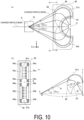
- FIG. 10 a mechanism of radiation of the charged particle beam by the charged particle beam irradiation apparatus (non-rotary gantry) in the present Example 2 will be briefly described using FIG. 10 .
- the irradiation nozzle 11 is omitted in FIG. 10 .
- FIG. 10(a) is a schematic diagram schematically illustrating paths of the charged particle beam as viewed from the right side of a deflection electromagnet 80 provided in a charged particle beam irradiation apparatus 50 of the charged particle beam irradiation system. That is, FIG. 10(a) corresponds to FIG. 4(a) or FIG. 8 which will be described later. As illustrated in FIG. 10(a) , the charged particle beam irradiation apparatus 50 includes a distribution electromagnet 70 and the deflection electromagnet 80.
- the charged particle beam (left end of FIG. 10 ) input to the charged particle beam irradiation apparatus is accelerated by an accelerator (not illustrated) and input to the charged particle beam irradiation apparatus via a beam transport system (not illustrated).
- an accelerator not illustrated
- a beam transport system not illustrated
- FIG. 10(a) illustrates an example of a plurality of beam paths that differ for each deflection angle ⁇ and convergence angle ⁇ .
- a traveling direction of the charged particle beam is defined as an X-axis
- a direction of a magnetic field generated by the deflection electromagnet 80 is defined as a Z-axis
- a direction perpendicular to the X-axis and Z-axis is defined as a Y-axis.
- the deflection electromagnet 80 is configured to converge the charged particle beam incident from a wide range of deflection angles ⁇ with respect to the X-axis on an XY plane on the isocenter O.
- the irradiation nozzle is omitted, and for simplicity of the description, the isocenter O is set as an origin of an XYZ space, and the upstream side (the accelerator side and the left side of the paper in FIG. 10(a) ) is set as a positive direction of the X axis.
- a range of the deflection angle ⁇ is greater than -90 degrees and less than +90 degrees, and a positive (+Y-axis) deflection angle range and a negative (-Y-axis) deflection angle range may be different (asymmetric).
- a maximum deflection angle on the positive side ⁇ MAX
- the deflection angle ⁇ is not limited to these angles.
- the deflection electromagnet 80 includes one or more pairs of coils, and the pair of coils are disposed to generate a uniform magnetic field (effective magnetic field regions 81a and 81b) that is oriented in a direction perpendicular to the traveling direction of the charged particle beam and a direction of spread of the deflection angle ⁇ of the charged particle beam (Z-axis direction in the figure), and to sandwich the path of the charged particle beam therebetween.
- the effective magnetic field region generated by one pair of coils of the deflection electromagnet 80 has a crescent shape on the XY plane as illustrated in FIG. 10(a) , and details thereof will be described later.
- FIG. 10(b) is a cross-sectional view of the deflection electromagnet 80 taken along line A-A.
- the deflection electromagnet 80 preferably includes at least two pairs of coils 84a and 84b. Magnetic poles 85a and 85b are built into the coils 84a and 84b, respectively, and a yoke 86 is connected to the magnetic poles 85a and 85b.
- a range of the effective magnetic field region 81a and a range of the effective magnetic field region 81b may be different (asymmetric). For example, when a range of the positive (+Y-axis) deflection angle ⁇ and a range of the negative (-Y-axis) deflection angle ⁇ are asymmetric, the effective magnetic field regions 81a and 81b are formed asymmetrically accordingly, thereby making it possible to reduce the unused effective magnetic field region.
- the deflection angle ⁇ and an irradiation angle ⁇ to be described later are angles of paths of the charged particle beam relative to the X-axis on the XY plane.
- the charged particle beam incident in the positive deflection angle range ( ⁇ is from more than 0 to ⁇ MAX) is deflected by the effective magnetic field region 81a of the first pair of coils 84a, passes through the irradiation nozzle 11, and is radiated to the isocenter O.
- the charged particle beam incident in the negative deflection angle range ( ⁇ is from less than 0 to - ⁇ MAX) is deflected by the effective magnetic field region 81b of the second pair of coils 84b, passes through the irradiation nozzle 11, and is radiated to the isocenter O.
- the magnetic fields of the effective magnetic field regions 81a and 81b are oriented in opposite directions.
- the charged particle beam incident on the deflection electromagnet 80 at the deflection angle ⁇ of 0 from the distribution electromagnet 70 passes through either or both of the effective magnetic field regions 81a and 81b, and is converged on the isocenter O through the irradiation nozzle (not illustrated).
- the deflection angle ⁇ of the charged particle beam incident on the deflection electromagnet 80 is controlled by the distribution electromagnet 70.
- the distribution electromagnet 70 includes an electromagnet that generates a magnetic field oriented in a direction (Z-axis in the figure) perpendicular to a traveling direction (X-axis in the figure) of the charged particle beam supplied from the accelerator (not illustrated), and deflects the passing charged particle beam, and a control unit that controls a strength and direction of the magnetic field (both not illustrated).
- the distribution electromagnet 70 controls the strength and direction (Z-axis direction) of the magnetic field to deflect the charged particle beam on the XY plane, and emits the charged particle beam deflected at the deflection angle ⁇ at a deflection starting point Q to the deflection electromagnet 80.
- the deflection starting point Q and the isocenter O are on the X-axis (on the same horizontal plane).
- the boundary of the effective magnetic field region 81a on an emission side 83 of the charged particle beam in the deflection electromagnet 80 is determined to be in a range at an equal distance r1 from the isocenter O.
- the boundary of the effective magnetic field region 81a on an incidence side 82 of the charged particle beam in the deflection electromagnet 80 is determined based on relational Equations (1) to (5) to be described later so that the incident charged particle beam deflected at the deflection angle ⁇ at the imaginary deflection starting point Q located at a predetermined distance L from the isocenter O converges on the isocenter O.
- the imaginary deflection starting point Q is a point at which the charged particle beam is assumed to receive a kick of the deflection angle ⁇ over an extremely short distance at a center of the distribution electromagnet 70.
- the charged particle beam transported at the deflection angle ⁇ enters from any point P1 on the boundary of the effective magnetic field region 81a on the incidence side 82, performs a circular motion with a curvature radius r2 within the effective magnetic field region 81a (a central angle in this case is ( ⁇ + ⁇ )), exits from a point P2 on the boundary of the effective magnetic field region 81a on the emission side 83, and is radiated toward the isocenter O.
- the points P1 and P2 are on an arc with the radius r2 and the central angle ( ⁇ + ⁇ ).
- a shape and disposition of the pair of coils 84a and the magnetic pole 85a of the deflection electromagnet 80 are adjusted based on the relational Equations (1) to (5) and a current flowing through the pair of coils 84a is adjusted so that a shape of the boundary of the effective magnetic field region 81a can be adjusted.
- the boundary is determined so that a distance between any point P2 on the boundary of the effective magnetic field region 81a on the emission side 83 and the isocenter O becomes the equal distance r1, r2 is determined from Equation (5) by adjusting the magnetic flux density B of the effective magnetic field region 81a, and the boundary of the effective magnetic field region 81a on the incidence side 82 is determined so that the distance R between the point P1 on the boundary of the effective magnetic field region 81a on the incidence side 82 and the deflection starting point Q has a relationship of Equation (4).
- a maximum value of ⁇ in Equation (3) is the maximum deflection angle ⁇ MAX.
- disposition of the deflection starting point Q, the deflection electromagnet 80, and the isocenter O is preferably adjusted so that the charged particle beam passing through the deflection starting point Q converges on the isocenter O without being deflected by the deflection electromagnet 80 because an apparatus configuration can be further simplified.
- the boundary between the effective magnetic field regions 81a and 81b of the deflection electromagnet 80 obtained as described above has an ideal shape for converging the charged particle beam on the isocenter O.
- an excitation amount (the magnetic flux density B) of the deflection electromagnet 80 is finely adjusted in advance for each deflection angle ⁇ , information about the adjustment is stored in the power supply, and the deflection angle ⁇ and the amount of current of the deflection electromagnet 80 are controlled to be linked to each other, thereby making it possible to deflect the charged particle beam according to the isocenter O.
- the trajectory of the charged particle beam can be finely adjusted by correcting the shape and disposition of the pairs of coils 84a and 84b and the magnetic poles 85a and 85b of the deflection electromagnet 80.
- FIG. 7 is a perspective view illustrating the charged particle beam irradiation system in a state in which the X-ray generation unit 20 is disposed in the charged particle beam irradiation apparatus and a movable vehicle 10 carrying a patient is also disposed.
- FIG. 8 is a right side view of the charged particle beam irradiation apparatus illustrated in FIG. 7 .
- FIG. 9 is a front view of the charged particle beam irradiation system illustrated in FIG. 3 . A positional relationship between the charged particle beam irradiation apparatus, the X-ray generation unit, and detection unit thereof will be described with reference to FIGS. 7 to 9 .
- FIGS. 7 A positional relationship between the charged particle beam irradiation apparatus, the X-ray generation unit, and detection unit thereof will be described with reference to FIGS. 7 to 9 .
- FIGS. 7 A positional relationship between the charged particle beam irradiation apparatus, the X-ray generation unit, and detection unit thereof will be described with reference to FIGS
- the charged particle beam irradiation apparatus is installed in a predetermined treatment room.
- a patient U who is a treatment target is placed on a treatment table 15 of the movable vehicle 10 and is transported to a treatment position of the charged particle beam irradiation apparatus by automatic control.
- the treatment table 15 on which the patient U is placed is connected to an arm 16 provided on the movable vehicle 10, and a treatment site of the patient U placed on the treatment table 15 can be moved to a position of the isocenter O of the charged particle beam irradiation apparatus by driving the arm 16 (rotating an axis of the arm 16).
- the movable vehicle 10 may be automatically controlled by a program or manually controlled by an operator using remote control.
- the charged particle beam irradiation system 1 includes the charged particle beam irradiation apparatus 50, the X-ray generation unit 20 (20a and 20b), and a detection unit 21 (21a and 21b).
- the charged particle beam irradiation apparatus 50 is an apparatus that can irradiate the isocenter with a charged particle beam.
- the X-ray generation unit 20 is an apparatus that radiates X-rays
- the detection unit 21 is an apparatus that faces the X-ray generation unit 20 and detects X-rays that have passed through a body of the patient U to generate an X-ray image.
- the X-rays are illustrated diagrammatically by dotted lines.
- the X-ray image generated by the detection unit 21 may be a moving image or a still image.
- the X-ray image generated by the detection unit 21 is transmitted to an information processing device 100 (described later) that determines timing of radiating the charged particle beam.
- the X-ray generation units 20 (20a and 20b) are provided in the treatment room in which the charged particle beam irradiation apparatus is disposed, near a floor surface, such as under the floor, on both sides of the charged particle beam irradiation apparatus on the irradiation nozzle 11 side (the irradiation source side of the charged particle beam) as viewed from the isocenter O.
- the X-ray generation units 20 are provided under the floor, for example, it is possible to curb interfering with the movement of the vehicle 10 or the movement of people in the treatment room.
- the detection units 21 (21a and 21b) that detect the X-rays irradiated from the X-ray generation units 20 are provided near a ceiling in the treatment room to face the X-ray generation units 20 (20a and 20b). That is, the detection units 21 are installed downstream of the X-ray generation units 20 in the traveling direction of the charged particle beam. Disposition positions of the X-ray generation units 20 and the detection units 21 may be reversed. That is, the detection unit 21 may be disposed upstream of the X-ray generation unit 20 in the traveling direction of the charged particle beam.
- a dotted chain line (17) in FIG. 9 indicates a virtual plane 17 (corresponding to the virtual plane P described above) illustrating a path through which the charged particle beam passes.
- the charged particle beam passes through the virtual plane 17, which is a vertical plane that passes through a center of the apparatus in FIG. 9 .
- the X-rays radiated from the X-ray generation unit 20 are radiated to intersect with the virtual plane 17 and pass through the isocenter O.
- the X-ray generation unit 20a and the detection unit 21b are disposed on the same side not to sandwich the virtual plane 17 therebetween, and the X-ray generation unit 20b and the detection unit 21a are also disposed on the same side not to sandwich the virtual plane 17 therebetween.
- the X-ray generation unit 20a and the X-ray generation unit 20b may not be disposed in the treatment room to be symmetrical across the virtual plane 17, and similarly, the detection unit 21a and the detection unit 21b may not be disposed in the treatment room to be symmetrical across the virtual plane 17.
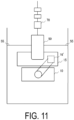
- FIG. 11 is a top view of a treatment room in which the present example is realized. Dimensions of the treatment room are approximately 8 m ⁇ 6 m, but are not limited thereto.
- the charged particle beam irradiation apparatus 50 is structured so that only a part of a tip including the irradiation nozzle 11 is visible to the patient with a decorative wall 55 in between. Since the decorative wall 55 is often made of plywood, generally, when X-rays pass through the decorative wall 55, the image quality deteriorates. Therefore, the X-ray generation unit and the detection unit is preferably installed on the beam downstream side relative to the decorative wall 55.
- the X-ray generation unit 20 and the detection unit 21 need to be installed on the beam downstream side from the decorative wall 55 illustrated in FIG. 11 so that the X-rays pass through the isocenter O.
- the X-ray generation unit 20 and the detection unit 21 need to be installed on the beam downstream side from the decorative wall 55 illustrated in FIG. 11 so that the X-rays pass through the isocenter O.
- an edge of the charged particle beam irradiation apparatus 50, the irradiation nozzle 11, the arm 16 of the movable vehicle 10 and a drive mechanism 16' thereof interfere with the X-ray imaging area (broken line in FIG. 9 ), the X-rays are attenuated and the effective field of view is narrowed. Therefore, installation conditions that allow imaging of a wide area in the craniocaudal direction without changing the imaging conditions or enlarging the treatment room, and allow the respiratory gated irradiation will be described.
- the effective field of view refers to an area in which the X-ray flux generated from the X-ray generation unit 20 is detected by the detection unit 21 without interfering with the charged particle beam irradiation apparatus, the treatment table (movable vehicle), or the like. Further, when an entire screen area (an entire detection range of the detection unit 21) is 100 and an area occupied by the effective field of view is 80, the effective field of view is said to be 80%.
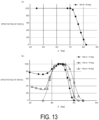
- the disposition of the X-ray generation unit and the detection unit that form an ideal effective field of view is a disposition in which axes connecting two pairs of X-ray generation units 20 and detection units 21 are perpendicular to each other. As illustrated in FIG. 13(a) , when ⁇ is smaller than 45 degrees, that is, the greater an opening between the axes connecting the two pairs of X-ray generation units 20 and detection units 21, the smaller the interference with the charged particle beam irradiation apparatus.
- the effective field of view was 100% when 42 ⁇ ⁇ ⁇ 45. Further, when 38 ⁇ ⁇ ⁇ 47, the effective field of view was 80%.
- the effective field of view was 100% when 41 ⁇ ⁇ ⁇ 46. Further, when 39 ⁇ ⁇ ⁇ 48, the effective field of view was 80%.
- the effective field of view was 100% when 41 ⁇ ⁇ ⁇ 48. Further, when 39 ⁇ ⁇ ⁇ 50, the effective field of view was 80%.
- the X-ray generation unit and the detection unit are installed in an area in which the effective field of view is 80% or more, highly accurate treatment irradiation can be performed without increasing a size of the apparatus while adding a function of respiratory gated irradiation. This does not mean that disposition of the X-ray generation unit 20 and the detection unit 21 in which the effective field of view is 80% or more is essential.
- FIG. 14 is a system configuration diagram for carrying out the present example.
- a treatment integrated control system 167 is an upper system, and there is an irradiation control system 166 for performing treatment irradiation, and an indoor equipment control system 161 for performing patient positioning.
- the treatment integrated control system 167 instructs a converging electromagnet or an irradiation nozzle to enable the treatment from a desired angle.
- the converging electromagnet is excited so that irradiation can be performed from the desired angle, and the irradiation nozzle is driven to irradiate the isocenter O with the charged particle beam.
- the indoor equipment control system 161 drives the treatment table 15 using the treatment table control system 164, and transports the patient to a position for treatment irradiation.
- an X-ray generation unit control system 162 performs X-ray exposure
- a detection unit control system 163 acquires an image.
- the X-ray generation unit 20 or the detection unit 21 since the X-ray generation unit 20 or the detection unit 21 is not installed in the traveling direction of the charged particle beam emitted from the irradiation nozzle, there is no need to retract the X-ray generation unit 20 and the detection unit 21 at the time of treatment irradiation.
- the installation accuracy of the X-ray generation unit 20 and the detection unit 21 does not change due to the drive for retraction, the treatment accuracy does not decrease compared to a case in which the X-ray generation unit 20 and the detection unit 21 are retracted to be stored in the ceiling or under the floor.
- a space from the X-ray generation unit 20 to the detection unit 21 is not blocked due to the drive of the irradiation nozzle. Therefore, patient positioning can be performed while changing the treatment irradiation angle, and the treatment time can be shortened. As a result, the number of treated patients per treatment room can be increased.
- the virtual plane 17 formed by the irradiation axis of the charged particle beam and a plane formed by an axis connecting the two pairs of X-ray generation units 20 and detection units 21 are perpendicular to each other and installed on horizontal and vertical beam lines on the same plane.
- the present invention contributes to improving the treatment accuracy for non-coplanar irradiation in which the treatment beam is radiated not only from a cross section perpendicular to a longitudinal axis direction of the patient but also from a non-coplanar plane, and the dose to normal tissue or major adjacent important organs is reduced.
- treatment dependent on the accuracy of the movement of the treatment table in which the treatment table is rotated around the isocenter to start the irradiation so that irradiation is performed on a desired non-coplanar plane is performed.
- the two pairs of X-ray generation units 20 and detection units 21 are disposed in the longitudinal axis direction of the patient, a large space is secured around the patient. Therefore, a patient's position can be confirmed with a constant X-ray imaging system while securing a space in which the treatment table rotates around the isocenter, improving the treatment accuracy in non-coplanar irradiation.
- patient positioning disposition is a disposition dependent on a forward direction
- in-body monitoring during irradiation is a disposition dependent on the irradiation angle.
- images obtained as in-body monitoring during patient positioning and irradiation may be evaluated in the same geometric disposition regardless of the irradiation angle during a series of treatments.
- bones less affected by respiratory movement are used as landmarks.
- positioning considering a relative positional relationship between the movement of organs moving due to breathing and the bones is required, and two-stage position confirmation is performed.
- Similar confirmation is also performed for irradiation when a movement of an irradiation target changes over time due to movement within the body during irradiation such as a prostate affected by intestinal gas movement.
- irradiation accuracy is improved in treatments that require organ position reproducibility, such as the respiratory gated irradiation.
- the two pairs of X-ray generation units 20 and detection units 21 are installed in a patient longitudinal direction relative to a non-rotary gantry, which prevents equipment installation and building structure from becoming complicated, and allows easy maintenance and miniaturization of the entire apparatus.
- at least one X-ray generation unit 20 and at least one detection unit 21 of the two pairs of X-ray generation units 20 and detection units 21 disposed on the upstream side of the beam is disposed inside a cylindrical rotary gantry. Therefore, a complex support is required for equipment installation inside the rotary gantry, and maintenance work is performed inside the rotary gantry, which places a heavy burden on a worker.
- a building to house the irradiation apparatus does not rotate, a building to house the irradiation apparatus has about half the size of a rotary gantry that requires a huge cylindrical structure with a height and depth of about 10 m as a rotation space, and installation cost of the treatment apparatus can be greatly reduced.
- FIG. 15 is a block diagram illustrating an example of a configuration of the information processing device 100 that controls the charged particle beam irradiation system.
- the information processing device 100 is a computer system that controls the radiation of the charged particle beam from the charged particle beam irradiation apparatus to a treatment site of a patient, and may be realized by a so-called server device, a PC, a tablet terminal, or the like, but is not limited thereto.
- the information processing device 100 includes a communication unit 110, an input unit 120, a control unit 130, and a calculation unit 140.
- the information processing device 100 may also include an output unit 150.
- the communication unit 110 is a communication interface capable of communicating with an external apparatus.
- the communication unit 110 transmits instruction information for indicating timing of radiating the charged particle beam to an irradiation unit of the charged particle beam irradiation apparatus, for example, according to an instruction from the control unit 130. Further, the communication unit 110 instructs the X-ray generation unit 20 to radiate the X-rays and instructs the detection unit 21 to transmit the X-ray image according to an instruction from the control unit 130. Further, the communication unit 110 receives information related to the patient's treatment from an external apparatus and transmits the information to the control unit 130.
- the input unit 120 is an input interface having a function of receiving input from an operator of the information processing device 100 and transmitting the input to the control unit 130.
- the input unit 120 may be realized by, for example, an input device such as a keyboard or a mouse, but is not limited thereto.
- the input unit 120 receives, for example, input of information related to the patient's treatment and transmits received input content to the control unit 130.
- the control unit 130 is a processor having a function of controlling each unit of the information processing device 100.
- the control unit 130 functions as the information processing device 100 by executing a program built into the calculation unit 140.
- the control unit 130 includes a treatment control unit 131 and an X-ray control unit 132 as functions to be performed as the information processing device 100.
- the treatment control unit 131 has a function of transmitting instruction information to the charged particle beam irradiation apparatus to instruct the charged particle beam irradiation apparatus to radiate the charged particle beam via the communication unit 110.
- the X-ray control unit 132 instructs the X-ray generation unit 20 to radiate X-rays via the communication unit 110 and acquires the X-ray image detected by the detection unit 21.
- the X-ray control unit 132 transmits the acquired X-ray image to the treatment control unit 131.
- the calculation unit 140 has a function of analyzing the X-ray image acquired by the X-ray control unit 132 and specifying the relative position of the target site as the treatment target with respect to the patient.
- An image processing unit 141 processes the X-ray image acquired by the X-ray control unit 132, analyzes a feature quantity in the image, and calculates a position of the treatment site of the target. In this case, an optimal combination of an existing image filter (for example, a noise removal filter or edge enhancement filter)) and the like is executed to reduce the burden on the radiographer at the time of patient positioning, but details thereof are omitted here.
- the calculation unit 140 also includes a memory unit 142.
- the memory unit 142 is a storage medium having a function of storing various programs and various types of data required for the operation of the information processing device 100.
- the memory unit 142 may be realized by, for example, a hard disk drive (HDD), a solid state drive (SSD), a flash memory, or the like, but is not limited thereto.
- the memory unit 142 stores a learning model 143 for determining timing of radiation of the charged particle beam. Also, as illustrated in FIG. 15 , the position of the treatment site may be calculated via a learning model registered in the learning model 143.
- the learning model 143 is stored in the memory unit 142.
- An example of the learning model 143 is a learning model that has learned a correspondence relationship between the X-ray image and a position of an organ, and specifies the relative position of the target site with respect to the patient using the X-ray image and information indicating the treatment site as input.
- the image processing unit 141 determines whether the treatment site of the target is located in an irradiation area including the irradiation position (isocenter) of the charged particle beam, and specifies the irradiation timing. Therefore, the learning model 143 is generated by learning a plurality of teaching data, which is information in which the X-ray image is associated with information indicating sites of various organs in the X-ray image.
- the learning model 143 is preferably a patient-specific model that has basically learned the X-ray image and a treatment target position of each patient who is a treatment target according to the patient, but may be a general-purpose model that has learned X-ray images and treatment target positions of a plurality of different patients.
- the X-ray image used for learning is an X-ray image captured by the X-ray generation unit 20 and the detection unit 21 disposed at the positions illustrated in FIGS. 7 to 9 . That is, the X-ray image is an X-ray image obtained by radiating the X-rays in a human body height direction (longitudinal direction) and diagonally with respect to a horizontal direction relative to the human body height direction.
- the learning model 143 indicating which part of which organ is which part in the X-ray image is associated with the X-ray image to form teaching data, and to generate the learning model 143.
- the annotation may be added by a medical professional or the like.
- an image used for learning may also be a digital reconstructed radiograph generated by simulating an X-ray image from a CT image.
- a plurality of learning models may be registered in the learning model 143.
- the learning model is a learning model that learns a correspondence relationship between, for example, an image filter and an irradiation site as a treatment target or exposure conditions in acquiring the X-ray image, and optimizes the image filter.
- An image filter selected by the learning model 143 is applied to the acquired X-ray image, and a target object is analytically detected by the image processing unit 141.
- the relative position of the target site with respect to the patient is also specified, and the image processing unit 141 can determine whether the treatment site of the target has arrived at the irradiation area including the irradiation position (isocenter) of the charged particle beam, and identify the relative position of the target site with respect to the patient for specifying the irradiation timing.
- the output unit 150 has a function of outputting information designated by the control unit 130.
- the output unit 150 may be realized, for example, by a monitor or a speaker, but is not limited thereto.
- the output of information by the output unit 150 may be realized in the form of transmitting information to an external apparatus.
- the output unit 150 may output information about the treatment site under instructions from the control unit 130, for example.
- FIG. 16 is a flowchart illustrating an example of an operation of controlling the radiation of the charged particle beam of the information processing device 100.
- the communication unit 110 of the information processing device 100 receives an X-ray image.
- the communication unit 110 transmits the received X-ray image to the control unit 130.
- the control unit 130 receives input of an X-ray image for performing respiratory gating of proton beam treatment (step S1601). That is, the control unit 130 detects the X-rays radiated from the X-ray generation unit 20 using the detection unit 21, and receives input of the X-ray image obtained by the detection.
- the X-ray image is an image obtained by imaging the human body of a patient with X-rays irradiated to intersect with a virtual plane formed by a line through which the charged particle beam passes, rather than X-rays radiated in parallel to the charged particle beam (the same plane as a virtual plane formed by an irradiation path of the charged particle beam) as in the related art.
- the image is an image captured by the X-rays obliquely radiated to the human body.
- the X-ray image received here only needs to be information that allows the state of the in-body organ to be estimated, and may be a streaming video, may be a series of still images, or may be a moving image for each predetermined time unit (for example, 0.1 second units, but the present invention is not limited thereto).
- the communication unit 110 or the input unit 120 of the information processing device 100 receives input of information about the treatment site of the patient and transmits the information to the control unit 130 (step S1602).
- the information about the treatment site only needs to be information that allows the information processing device 100 to specify at least a relative position of the target site that is a treatment target with respect to the patient.
- the control unit 130 sequentially receives input of X-ray images from the communication unit 110, and inputs the X-ray images and the information about the treatment site to the learning model 143 (step S1603). Accordingly, the treatment control unit 131 specifies timing at which the charged particle beam is radiated (step S1604).
- the treatment control unit 131 transmits instruction information to the charged particle beam irradiation apparatus via the communication unit 110 to instruct the charged particle beam irradiation apparatus to perform irradiation so that the charged particle beam is radiated at specific timing (step S1605).
- a relative position of the irradiation target organ with respect to an organ moving due to breathing and a positional relationship between another organ and the irradiation target organ are specified in the information processing device 100, thereby making it possible to reduce work of the radiographer and reduce radiation dose due to the X-ray exposure.
- X-ray images for one breathing cycle are continuously acquired as internal body information, and the information is simultaneously acquired by a plurality of extracorporeal information acquisition devices installed outside.
- the information processing device 100 can predict the relative position of the irradiation target organ or a positional relationship between another organ and the irradiation target organ using only the extracorporeal information during treatment, and can perform irradiation at the appropriate timing. This eliminates the need for exposure during irradiation, and reduces an amount of radiation exposure to the patient. Further, it is possible to perform X-ray imaging and confirm the relative relationship only when there is concern about an unstable respiratory waveform based on the body outside monitoring information.
- FIG. 17 illustrates a first control example in which an unstable respiratory waveform is predicted from data stored in the memory unit 142 of the calculation unit 140 and irradiation is performed, and is a timing chart schematically illustrating timing of X-ray irradiation, charged particle beam exposure, and the like.
- FIG. 17 illustrates from the top a waveform of the body outside monitoring information, a waveform of the beam ON signal based on the body outside monitoring information, a waveform of irradiation target position information obtained by the X-ray exposure, a waveform of an X-ray exposure ON signal, a waveform of the beam ON signal based on the irradiation target position information, and a radiation waveform of the charged particle beam.
- the body outside monitoring information may be information of a video obtained by filming the outside of the patient, may be, for example, a video obtained by filming a patient's abdomen, and may be waveform information schematically indicating a degree of abdominal expansion based on these videos.
- the beam ON signal based on the body outside monitoring information is information indicating an irradiation instruction for the charged particle beam, and is information about an irradiation instruction that is issued when the patient's breathing is stable based on the body outside monitoring information.
- the irradiation target position information obtained by the X-ray exposure is information indicating the position of the treatment site (irradiation target part of the charged particle beam) by imaging the inside of the patient's body by performing X-ray exposure.
- the X-ray exposure ON signal is a signal for instructing the X-ray generation unit 20 to perform the X-ray exposure.
- the beam ON signal based on the irradiation target position information is a signal for issuing instruction about the radiation of the charged particle beam to the treatment target site identified by X-ray exposure.
- the irradiation at a bottom of FIG. 17 indicates irradiation timing of the charged particle beam by the beam ON signal based on the irradiation target position information.
- the image processing unit 141 analyzes the body outside monitoring information of the patient during treatment.
- the body outside monitoring information may be a captured video of the patient's abdomen, or the like.
- the beam-ON signal is turned on based on the body outside monitoring information at the timing when the patient's body is in a predetermined state, for example, when a value of the body outside monitoring information in the example of FIG. 17 is a positive value (a predetermined value or more), that is, at timing when a patient's peritoneum expands to a predetermined degree or more, and radiation of the charged particle beam is executed.
- the body outside monitoring information of the patient registered in the memory unit 142 of the calculation unit 140 and the data of the respiratory waveform at that time are referenced, and an unstable respiratory waveform is predicted in advance.
- an unstable respiratory waveform 1701 surrounded by a dashed line on the respiratory waveform with an arrow part in the body outside monitoring information in FIG. 17 as a starting point is predicted. That is, the body outside monitoring information is input to the learning model 143 as an input, and it is estimated whether or not the patient's breathing is likely to become disturbed.
- an unstable respiratory waveform is generated, it becomes impossible to perform treatment irradiation with high accuracy. Therefore, when the generation of an unstable respiratory waveform is predicted, imaging using X-rays is performed.
- the X-ray generation unit 20 is instructed to start X-ray exposure and the detection unit 21 is instructed to perform imaging.
- the treatment site (irradiation target position information) detected by the X-ray exposure reaches the irradiation position, the radiation of the charged particle beam is performed.
- prediction of the respiratory waveform is continued using the learning model 143 and the body outside monitoring information.
- a stage in which it is predicted from the body outside monitoring information that the respiratory waveform will be stable (a stage of an area surrounded by a dotted line 1702 in FIG. 17 ).
- X-ray imaging is stopped. This makes it possible to reduce unnecessary radiation dose.
- the process then returns to the control of the radiation of the charged particle beam based on the body outside monitoring information.
- Timing for returning to the control of the radiation of the charged particle beam based on the body outside monitoring information may be timing in a stage in which it is predicted that the respiratory waveform will be stable and a timing when the position of the treatment target site based on the body outside monitoring information is synchronized with the position of the treatment target site detected by the X-ray exposure.
- the first control example since the X-ray exposure is performed only at timing when breathing is unstable, a processing load of the apparatus can be reduced compared to continuous X-ray exposure during treatment. Also, according to the first control example, even when detection of the treatment target site based on the body outside monitoring information becomes impossible due to disturbance in breathing, the detection of the treatment target site based on the body outside monitoring information can be resumed.
- the radiation dose due to X-ray imaging can be reduced by performing X-ray imaging only at start timing and end timing of an irradiation gate (timing near the start and end of an ON signal of a respiratory gate), confirming that the irradiation target is within a predetermined range, and correcting the timing of irradiation based on the respiratory waveform when there is a deviation from the initial relative relationship.
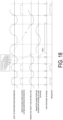
- FIG. 18 illustrates a second control example in which X-ray imaging is performed at timing near the ON signal and near the end of the ON signal of the respiratory gate that performs irradiation based on the body outside monitoring information. The content of each signal in FIG. 18 is the same as that in FIG.
- a waveform of irradiation target position prediction indicating the position of the treatment target site predicted from the body outside monitoring information is added.
- the detection of the irradiation target position by the X-ray exposure is periodically executed, as illustrated in the figure. Since the patient's breathing is basically cyclical, X-ray exposure is performed only at timing of inhalation and exhalation and it is determined whether the irradiation target position is a desired position.
- ON control for the charged particle beam is executed based on the body outside monitoring information as in the first control example. That is, the radiation of the charged particle beam is executed at timing when the body outside monitoring information is equal to or greater than a predetermined value.
- the charged particle beam irradiation system switches the X-ray exposure from intermittent exposure to continuous exposure.
- the position of the treatment target site is continuously identified based on the X-ray image while the continuous X-ray exposure is performed.
- the radiation of the charged particle beam is executed at timing when the treatment target site reaches the irradiation position.
- the charged particle beam irradiation system synchronizes the position of the treatment target site specified by the X-ray exposure with the position of the treatment target site specified from the body outside monitoring information, and determines irradiation timing of the periodic X-ray exposure. When the irradiation timing is determined, the continuous X-ray exposure is stopped and intermittent X-ray exposure is resumed.
- an extracorporeal information acquisition device such as a 3D camera or an ultrasound device can be installed.
- a space can be secured to install a radiation-free apparatus such as an MRI that is a relatively large apparatus in order to specify the position more precisely, in addition to the extracorporeal information.
- the relative position of the irradiation target organ or a positional relationship between the irradiation target organ and the other organ can be specified with high accuracy from the information processing device 100, and irradiation can be performed at appropriate timing.
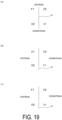
- FIG. 19 is a diagram schematically illustrating a relative positional relationship between the X-ray generation unit 20 and the detection unit 21 in a full gantry and half gantry of the related art, and a relative positional relationship between the X-ray generation unit and the detection unit in the present invention.
- FIG. 19(a) is a diagram illustrating an example of a disposition of the X-ray generation unit and the detection unit in the charged particle beam irradiation system according to the present invention, which is not a rotary gantry
- FIG. 19(b) is a diagram illustrating a relative positional relationship between an X-ray generation unit and a detection unit in a full gantry
- FIG. 19(a) is a diagram illustrating an example of a disposition of the X-ray generation unit and the detection unit in the charged particle beam irradiation system according to the present invention, which is not a rotary gantry
- FIG. 19(b) is a diagram illustrating a relative positional relationship between an X
- FIGS. 19(a) to 19(c) are diagram illustrating a relative positional relationship between an X-ray generation unit and a detection unit in a half gantry. Dotted lines in FIGS. 19(a) to 19(c) indicate the virtual plane P (17) generated from a plurality of trajectories of the radiated charged particle beam. F1 and F2 indicate the respective detection units, and X1 and X2 indicate the X-ray generation units. Further, for upstream and downstream, the upstream side is a side where the charged particle beam is generated in the charged particle beam irradiation apparatus, and the downstream side is a side where the charged particle beam is emitted.
- the charged particle beam irradiation system according to the present invention which is not a rotary gantry, and the full gantry or the half gantry of the related art are the same in that axes connecting the pairs of X-ray generation units (X1 and X2) and detection units (F1 and F2), that is, a line connecting the X-ray generation unit X1 to the detection unit F1 and a line connecting the X-ray generation unit X2 to the detection unit F2 (both not illustrated) intersect on the virtual plane P.
- the charged particle beam irradiation system according to the present invention which is not a rotary gantry, and the full gantry or the half gantry of the related art can be said to differ in that a direction from the upstream to the downstream of the apparatus is parallel or perpendicular to the virtual plane P.
- the charged particle beam irradiation system according to the present invention which is not a rotary gantry, and the full gantry of the related art differ in whether or not all the detection units are located upstream of the X-ray generation units. Further, as is clear from a comparison of FIGS.
- the charged particle beam irradiation system according to the present invention and the full gantry of the related art are different in whether or not the X-ray generation units (X1 and X2) and the detection units (F1 and F2) are on the same side of the virtual plane P.
- one of characteristics of the charged particle beam irradiation system according to the present invention which is not a rotary gantry, is that two conditions including (i) the X-ray generation unit and the detection unit are not on the same side with respect to the virtual plane P, and (ii) all detection units (or X-ray generation units) are disposed upstream of the X-ray generation unit (or detection unit) are satisfied.
- a rotary gantry is not used as an apparatus for radiating a charged particle beam
- the first X-ray generation unit and the second X-ray generation unit are disposed symmetrically with respect to the virtual plane formed by the plurality of trajectories of the charged particle beam selectable by the charged particle beam irradiation apparatus, and when the side where the charged particle beam is incident on the charged particle beam irradiation apparatus is defined as the upstream side and the side where the charged particle beam is emitted from the charged particle beam irradiation apparatus is defined as the downstream side, the first detection unit and the second detection unit are positioned upstream or downstream of the first X-ray generation unit and the second X-ray generation unit, thereby making it possible to realize respiratory gating method using X-rays while curbing an increase in size of the charged particle beam irradiation apparatus.
- the X-ray generation unit and the detection unit are disposed on the ground and the ceiling on the left and right sides of the charged particle beam irradiation apparatus, the X-ray generation unit and the detection unit are separated from the irradiation apparatus, and thus, a large space is secured around the patient without the need to retract the X-ray generation unit and the detection unit when the treatment beam is radiated. Therefore, the installation accuracy of the X-ray generation unit and the detection unit does not change due to the drive caused by insertion/retraction, and the treatment accuracy does not decrease. Further, it is possible to perform patient positioning while changing the treatment irradiation angle, to shorten the treatment time, and to increase the number of treated patients per treatment room. Further, a patient's position can be confirmed in a certain geometric disposition for X-ray imaging while securing the space in which the treatment table rotates around the isocenter, and the treatment accuracy in non-coplanar irradiation is improved.
- images acquired for the patient positioning and in-body monitoring during the irradiation may be evaluated in the same geometric disposition regardless of the irradiation angle.
- bones less affected by respiratory movement are used as a reference, positioning considering a relative positional relationship between the movement of organs moving due to breathing and the bones is required, and two-stage position confirmation is performed.
- the geometric disposition of the two pairs of X-ray generation units and detection units at the time of patient positioning and the time of in-body monitoring is the same, the treatment accuracy of respiratory gated irradiation is improved.
- the charged particle beam irradiation system and the information processing device 100 described in the embodiment are not limited to the aspects described in the embodiment. Appropriate modifications are possible within the knowledge of those skilled in the art. Hereinafter, various modification examples will be described.
- the storage medium may, where appropriate, include one or more semiconductor-based or other integrated circuits (ICs) (for example, field programmable gate arrays (FPGAs) or application specific ICs (ASICs)), hard disk drives (HDDs), hybrid hard drives (HHDs), optical discs, optical disk drives (ODDs), magneto-optical disks, magneto-optical drives, floppy diskettes, floppy disk drives (FDDs), magnetic tapes, solid state drives (SSDs), RAM drives, secure digital cards or drives, any other suitable storage media, or any suitable combination of two or more of these.
- ICs semiconductor-based or other integrated circuits
- HDDs hard disk drives
- HDs hybrid hard drives
- ODDs optical disk drives
- magneto-optical disks magneto-optical drives
- FDDs floppy diskettes
- FDDs floppy disk drives
- SSDs solid state drives
- RAM drives secure digital cards or drives, any other suitable storage media, or any suitable combination of two or more of these.
- the program of the present disclosure may also be provided to the information processing device 100 via any transmission medium (such as a communication network or broadcast waves) capable of transmitting the program.
- any transmission medium such as a communication network or broadcast waves
- each embodiment of the present disclosure can be realized in the form of a data signal embedded in carrier waves, in which the program is embodied by electronic transmission.
- the program of the present disclosure may be implemented using any programming language, such as a scripting language such as JavaScript (trade name) or Python, C language, Go language, Swift, Koltin, and Java (trade name).
- a scripting language such as JavaScript (trade name) or Python
- C language such as Go language, Swift, Koltin, and Java (trade name).
- the present invention may also be a method for controlling the charged particle beam from the charged particle beam irradiation apparatus in the information processing device 100. That is, an aspect of the present invention provides a method for controlling radiation of a charged particle beam in a charged particle beam irradiation system including a charged particle beam irradiation apparatus including a deflection electromagnet that deflects a charged particle beam to continuously change the irradiation angle of the charged particle beam to an isocenter, and an irradiation nozzle that moves continuously along a shape on an emission side of an effective magnetic field region of the deflection electromagnet, an X-ray generation unit that radiates X-rays, and a detection unit that detects the X-rays, wherein the X-ray generation unit and the detection unit are disposed so that the charged particle beam emitted from the deflection electromagnet passes through the irradiation nozzle and radiated to the isocenter, and a virtual line connecting the X-ray generation unit to the
- Processing of the flowchart illustrated in FIG. 16 can be appropriately changed within a range in which similar results can be obtained.
- the processing of step S1602 may be first executed, or the processing of step S1601 and step S1602 may be executed simultaneously.
Landscapes
- Health & Medical Sciences (AREA)
- Engineering & Computer Science (AREA)
- Biomedical Technology (AREA)
- Pathology (AREA)
- Nuclear Medicine, Radiotherapy & Molecular Imaging (AREA)
- Radiology & Medical Imaging (AREA)
- Life Sciences & Earth Sciences (AREA)
- Animal Behavior & Ethology (AREA)
- General Health & Medical Sciences (AREA)
- Public Health (AREA)
- Veterinary Medicine (AREA)
- Radiation-Therapy Devices (AREA)
Applications Claiming Priority (2)
| Application Number | Priority Date | Filing Date | Title |
|---|---|---|---|
| JP2022126627A JP2024023069A (ja) | 2022-08-08 | 2022-08-08 | 荷電粒子ビーム照射システム |
| PCT/JP2023/020710 WO2024034239A1 (ja) | 2022-08-08 | 2023-06-02 | 荷電粒子ビーム照射システム |
Publications (1)
| Publication Number | Publication Date |
|---|---|
| EP4570311A1 true EP4570311A1 (en) | 2025-06-18 |
Family
ID=89033871
Family Applications (1)
| Application Number | Title | Priority Date | Filing Date |
|---|---|---|---|
| EP23852223.9A Pending EP4570311A1 (en) | 2022-08-08 | 2023-06-02 | Charged particle beam irradiation system |
Country Status (6)
| Country | Link |
|---|---|
| EP (1) | EP4570311A1 (https=) |
| JP (3) | JP2024023069A (https=) |
| KR (1) | KR20250047772A (https=) |
| CN (1) | CN119947790A (https=) |
| TW (1) | TW202406593A (https=) |
| WO (1) | WO2024034239A1 (https=) |
Family Cites Families (10)
| Publication number | Priority date | Publication date | Assignee | Title |
|---|---|---|---|---|
| JP3790481B2 (ja) * | 2002-01-30 | 2006-06-28 | 三菱重工業株式会社 | 放射線治療装置 |
| JP4382014B2 (ja) | 2005-08-01 | 2009-12-09 | 株式会社日立製作所 | 放射線治療装置 |
| US9101761B2 (en) | 2011-03-22 | 2015-08-11 | National University Corporation Hokkaido University | Moving object tracking system for radiotherapy |
| BE1021408B1 (fr) | 2012-09-11 | 2015-11-17 | Ion Beam Applications S.A. | Installation de hadron-therapie avec plancher mobile. |
| JP6523076B2 (ja) | 2015-06-30 | 2019-05-29 | 株式会社日立製作所 | 粒子線治療システム |
| JP6698429B2 (ja) | 2016-05-26 | 2020-05-27 | 株式会社日立製作所 | 放射線治療システム |
| CN105920745B (zh) * | 2016-06-16 | 2019-02-15 | 四川大学 | 放射治疗系统 |
| JP7082366B2 (ja) | 2018-03-23 | 2022-06-08 | 株式会社日立製作所 | 放射線治療装置及びベッド位置決め装置並びにベッドの位置決め方法 |
| JP6387476B1 (ja) | 2018-07-02 | 2018-09-05 | 株式会社ビードットメディカル | 荷電粒子ビーム照射装置 |
| JP6364141B1 (ja) | 2018-04-05 | 2018-07-25 | 株式会社ビードットメディカル | 収束電磁石及び荷電粒子ビーム照射装置 |
-
2022
- 2022-08-08 JP JP2022126627A patent/JP2024023069A/ja active Pending
- 2022-08-18 JP JP2022130496A patent/JP7394487B1/ja active Active
-
2023
- 2023-06-02 KR KR1020257006810A patent/KR20250047772A/ko active Pending
- 2023-06-02 EP EP23852223.9A patent/EP4570311A1/en active Pending
- 2023-06-02 CN CN202380069068.2A patent/CN119947790A/zh active Pending
- 2023-06-02 WO PCT/JP2023/020710 patent/WO2024034239A1/ja not_active Ceased
- 2023-07-12 TW TW112126075A patent/TW202406593A/zh unknown
-
2025
- 2025-08-14 JP JP2025135203A patent/JP2025169356A/ja active Pending
Also Published As
| Publication number | Publication date |
|---|---|
| TW202406593A (zh) | 2024-02-16 |
| JP7394487B1 (ja) | 2023-12-08 |
| WO2024034239A1 (ja) | 2024-02-15 |
| JP2024023069A (ja) | 2024-02-21 |
| JP2025169356A (ja) | 2025-11-12 |
| CN119947790A (zh) | 2025-05-06 |
| JP2024023107A (ja) | 2024-02-21 |
| KR20250047772A (ko) | 2025-04-04 |
Similar Documents
| Publication | Publication Date | Title |
|---|---|---|
| US20210370096A1 (en) | Automated treatment in particle therapy | |
| US20190299027A1 (en) | Particle therapy planning apparatus, particle therapy system, and dose distribution calculation program | |
| US7834334B2 (en) | Particle therapy system | |
| US7239684B2 (en) | Radiotherapy apparatus monitoring therapeutic field in real-time during treatment | |
| EP3015133B1 (en) | Radiotherapy apparatus | |
| EP2305350A1 (en) | Radiation treatment apparatus | |
| US11446520B2 (en) | Radiation therapy apparatus configured to track a tracking object moving in an irradiation object | |
| JP2006239403A (ja) | イオンビーム治療装置及びそのベッド位置決め方法 | |
| JP2008000456A (ja) | 放射線治療装置制御装置および放射線照射方法 | |
| JP2004097646A (ja) | 放射線治療装置 | |
| US20210370094A1 (en) | Radiation therapy apparatus and control method of radiation therapy apparatus | |
| US9999787B1 (en) | Beam limiting device for intensity modulated proton therapy | |
| WO2020137234A1 (ja) | 粒子線治療システムおよび線量分布評価システム、ならびに粒子線治療システムの作動方法 | |
| JP6465283B2 (ja) | 放射線治療システム | |
| EP4570311A1 (en) | Charged particle beam irradiation system | |
| US20240100363A1 (en) | Devices and methods for adaptively controlling a radiotherapy apparatus | |
| KR101977382B1 (ko) | 방사선 치료 장치 | |
| US20180104513A1 (en) | Method and apparatus for an ion beam accelerator and beam delivery system integrated on a rotating gantry | |
| JP2013013613A (ja) | 荷電粒子線照射装置 | |
| CN116867547A (zh) | 射野监视方法、放疗设备、显示装置及系统 | |
| US12544594B2 (en) | Devices and methods for adaptively controlling a radiotherapy apparatus | |
| EP4344735A1 (en) | Devices and methods for adaptively controlling a radiotherapy apparatus | |
| JP7739477B2 (ja) | 治療用および非治療用のビームの併用による3d画像化 | |
| HK40106710A (zh) | 粒子治疗中的自动治疗 | |
| JPWO2017179091A1 (ja) | 粒子線治療システム |
Legal Events
| Date | Code | Title | Description |
|---|---|---|---|
| STAA | Information on the status of an ep patent application or granted ep patent |
Free format text: STATUS: THE INTERNATIONAL PUBLICATION HAS BEEN MADE |
|
| PUAI | Public reference made under article 153(3) epc to a published international application that has entered the european phase |
Free format text: ORIGINAL CODE: 0009012 |
|
| STAA | Information on the status of an ep patent application or granted ep patent |
Free format text: STATUS: REQUEST FOR EXAMINATION WAS MADE |
|
| 17P | Request for examination filed |
Effective date: 20250306 |
|
| AK | Designated contracting states |
Kind code of ref document: A1 Designated state(s): AL AT BE BG CH CY CZ DE DK EE ES FI FR GB GR HR HU IE IS IT LI LT LU LV MC ME MK MT NL NO PL PT RO RS SE SI SK SM TR |
|
| DAV | Request for validation of the european patent (deleted) | ||
| DAX | Request for extension of the european patent (deleted) |