WO2023286711A1 - 銅-銅積層体の分離方法及び銅-銅積層体 - Google Patents
銅-銅積層体の分離方法及び銅-銅積層体 Download PDFInfo
- Publication number
- WO2023286711A1 WO2023286711A1 PCT/JP2022/027099 JP2022027099W WO2023286711A1 WO 2023286711 A1 WO2023286711 A1 WO 2023286711A1 JP 2022027099 W JP2022027099 W JP 2022027099W WO 2023286711 A1 WO2023286711 A1 WO 2023286711A1
- Authority
- WO
- WIPO (PCT)
- Prior art keywords
- copper
- conductor film
- laminate
- copper conductor
- layer
- Prior art date
- Legal status (The legal status is an assumption and is not a legal conclusion. Google has not performed a legal analysis and makes no representation as to the accuracy of the status listed.)
- Ceased
Links
Images





Classifications
-
- B—PERFORMING OPERATIONS; TRANSPORTING
- B32—LAYERED PRODUCTS
- B32B—LAYERED PRODUCTS, i.e. PRODUCTS BUILT-UP OF STRATA OF FLAT OR NON-FLAT, e.g. CELLULAR OR HONEYCOMB, FORM
- B32B15/00—Layered products comprising a layer of metal
- B32B15/01—Layered products comprising a layer of metal all layers being exclusively metallic
-
- B—PERFORMING OPERATIONS; TRANSPORTING
- B09—DISPOSAL OF SOLID WASTE; RECLAMATION OF CONTAMINATED SOIL
- B09B—DISPOSAL OF SOLID WASTE NOT OTHERWISE PROVIDED FOR
- B09B3/00—Destroying solid waste or transforming solid waste into something useful or harmless
- B09B3/70—Chemical treatment, e.g. pH adjustment or oxidation
-
- B—PERFORMING OPERATIONS; TRANSPORTING
- B09—DISPOSAL OF SOLID WASTE; RECLAMATION OF CONTAMINATED SOIL
- B09B—DISPOSAL OF SOLID WASTE NOT OTHERWISE PROVIDED FOR
- B09B5/00—Operations not covered by a single other subclass or by a single other group in this subclass
-
- B—PERFORMING OPERATIONS; TRANSPORTING
- B32—LAYERED PRODUCTS
- B32B—LAYERED PRODUCTS, i.e. PRODUCTS BUILT-UP OF STRATA OF FLAT OR NON-FLAT, e.g. CELLULAR OR HONEYCOMB, FORM
- B32B15/00—Layered products comprising a layer of metal
- B32B15/20—Layered products comprising a layer of metal comprising aluminium or copper
-
- B—PERFORMING OPERATIONS; TRANSPORTING
- B32—LAYERED PRODUCTS
- B32B—LAYERED PRODUCTS, i.e. PRODUCTS BUILT-UP OF STRATA OF FLAT OR NON-FLAT, e.g. CELLULAR OR HONEYCOMB, FORM
- B32B43/00—Operations specially adapted for layered products and not otherwise provided for, e.g. repairing; Apparatus therefor
- B32B43/006—Delaminating
-
- B—PERFORMING OPERATIONS; TRANSPORTING
- B32—LAYERED PRODUCTS
- B32B—LAYERED PRODUCTS, i.e. PRODUCTS BUILT-UP OF STRATA OF FLAT OR NON-FLAT, e.g. CELLULAR OR HONEYCOMB, FORM
- B32B7/00—Layered products characterised by the relation between layers; Layered products characterised by the relative orientation of features between layers, or by the relative values of a measurable parameter between layers, i.e. products comprising layers having different physical, chemical or physicochemical properties; Layered products characterised by the interconnection of layers
- B32B7/04—Interconnection of layers
- B32B7/06—Interconnection of layers permitting easy separation
-
- C—CHEMISTRY; METALLURGY
- C22—METALLURGY; FERROUS OR NON-FERROUS ALLOYS; TREATMENT OF ALLOYS OR NON-FERROUS METALS
- C22B—PRODUCTION AND REFINING OF METALS; PRETREATMENT OF RAW MATERIALS
- C22B15/00—Obtaining copper
- C22B15/0002—Preliminary treatment
- C22B15/0004—Preliminary treatment without modification of the copper constituent
- C22B15/0006—Preliminary treatment without modification of the copper constituent by dry processes
-
- B—PERFORMING OPERATIONS; TRANSPORTING
- B09—DISPOSAL OF SOLID WASTE; RECLAMATION OF CONTAMINATED SOIL
- B09B—DISPOSAL OF SOLID WASTE NOT OTHERWISE PROVIDED FOR
- B09B2101/00—Type of solid waste
-
- B—PERFORMING OPERATIONS; TRANSPORTING
- B09—DISPOSAL OF SOLID WASTE; RECLAMATION OF CONTAMINATED SOIL
- B09B—DISPOSAL OF SOLID WASTE NOT OTHERWISE PROVIDED FOR
- B09B2101/00—Type of solid waste
- B09B2101/15—Electronic waste
- B09B2101/17—Printed circuit boards [PCB]
-
- B—PERFORMING OPERATIONS; TRANSPORTING
- B32—LAYERED PRODUCTS
- B32B—LAYERED PRODUCTS, i.e. PRODUCTS BUILT-UP OF STRATA OF FLAT OR NON-FLAT, e.g. CELLULAR OR HONEYCOMB, FORM
- B32B2457/00—Electrical equipment
-
- Y—GENERAL TAGGING OF NEW TECHNOLOGICAL DEVELOPMENTS; GENERAL TAGGING OF CROSS-SECTIONAL TECHNOLOGIES SPANNING OVER SEVERAL SECTIONS OF THE IPC; TECHNICAL SUBJECTS COVERED BY FORMER USPC CROSS-REFERENCE ART COLLECTIONS [XRACs] AND DIGESTS
- Y02—TECHNOLOGIES OR APPLICATIONS FOR MITIGATION OR ADAPTATION AGAINST CLIMATE CHANGE
- Y02P—CLIMATE CHANGE MITIGATION TECHNOLOGIES IN THE PRODUCTION OR PROCESSING OF GOODS
- Y02P10/00—Technologies related to metal processing
- Y02P10/20—Recycling
Definitions
- the present invention relates to a copper-copper laminate separation method and a copper-copper laminate suitable for recycling structures such as electronic devices.
- Electronic substrates, cladding materials, or composite structures thereof having Cu thin film electrodes often have bonding interfaces between Cu—Cu or between copper—copper laminates.
- Laminates containing electronic devices often use flexible organic substrates for the purpose of thinness, weight reduction, and biocompatibility. ing. Therefore, it is important to provide a method that maintains a strong bonding force from material compositing (bonding) to actual operation, and that enables solid phase separation of dissimilar materials from the bonding interface or bonding interface after the end of service life. Directly linked to load reduction.
- a vapor-assisted vacuum ultraviolet light irradiation technique (V-VUV; Vapor-assisted vacuum ultraviolet irradiation technique) is being used. Details of the vapor-assisted vacuum ultraviolet light irradiation technique are disclosed in Patent Documents 1 and 2, for example. An outline of the process for inorganic materials containing Cu disclosed in these documents is shown below. (1) Add pure water vapor to atmospheric pressure nitrogen atmosphere. (2) A sample is introduced into the atmosphere of (1) and irradiated with vacuum ultraviolet light.
- Irradiation of vacuum ultraviolet light causes removal of adsorbed contaminants on the material surface, partial reduction of native oxides, and formation of a crosslinked layer on the cationic sites.
- (3) The surfaces of (2) are brought into contact with each other at room temperature, and then heated to, for example, about 150° C. to promote the dehydration condensation reaction between the crosslinked layers to obtain bonding.
- the vacuum ultraviolet light here is ultraviolet light with a wavelength of 10 to 200 nm.
- Vacuum ultraviolet light is strongly absorbed by oxygen molecules in the air in the wavelength band of 150 to 200 nm, but is transmitted through nitrogen. Therefore, this wavelength range can be used in an oxygen-free atmosphere (generally pure nitrogen) without using an expensive vacuum chamber. Examples include 193 nm photolithography equipment (for semiconductor manufacturing) or circular dichroism spectrometers.
- the crosslinked layer formed on the Cu surface by the vapor-assisted vacuum ultraviolet light irradiation method is usually amorphous Cu(OH) 2. [H 2 O] 2 , which is produced by the separation of water by vacuum ultraviolet light irradiation. This is due to the action of H and OH radical species.
- the growth of the crosslinked layer thickness is proportional to the product of the water vapor density and the vacuum ultraviolet light irradiation time (defined as the exposure amount (s kg/m 3 )) until the reaction to the cation sites is saturated. It is clear. It has been confirmed that a general Cu thin film grows to a thickness of about 15 to 20 nm at 3 to 4 s ⁇ kg/m 3 and saturates.
- a laminate containing an electronic device is a composite material.
- a method of introducing substances with different thermal expansion coefficients as a peeling layer, or a method of hydrogen doping the adherend surface in advance to cause thermal foaming is proposed.
- all of these methods have the problem of lacking process simplicity.
- the present inventors have investigated whether it is possible to apply a compound having a normal positive coefficient of thermal expansion at room temperature but a negative coefficient of thermal expansion at a low temperature below a predetermined temperature to the crosslinked layer. bottom. That is, the present inventor believes that if a laminate of a laminated substrate can be formed by using a compound that rapidly expands only in the vicinity of a specific temperature for the crosslinked layer, the laminate has a simple structure derived from the laminated substrate and the laminate can be formed.
- the present invention was completed based on the idea that it is possible to obtain a laminate having a structure that can be separated at the junction using the compound when discarded. According to the structure of the laminate of the present invention, substances having different coefficients of thermal expansion can be introduced as the peeling layer, so physical peeling at the interface can be achieved by a simple process.
- the copper-copper laminate separation method of the present invention includes, for example, as shown in FIGS. A second structure 24 having a second copper conductor film 20 on the bonding surface, and copper (II) oxide nanocrystals between the bonding surfaces of the first structure 14 and the second structure 24.
- the cross-linking layer 30 is constructed, and the cross-linking layer 30 is cooled below the magnetic transition temperature of copper (II) oxide to separate the first copper conductor film 10 and the second copper conductor film 20. is the separation method of
- the film thickness of the cross-linking layer is such that copper ions from the first and/or second copper conductor films to the copper (II) oxide diffusion reaches the entire film of the crosslinked layer.
- the thickness of the crosslinked layer is preferably 1 nm or more and 20 nm or less.
- the cooling temperature of the crosslinked layer is at least equal to the temperature at which the coefficient of thermal expansion of copper (II) oxide turns to a negative value. .
- the temperature at which the coefficient of thermal expansion of copper (II) oxide in the present invention takes a negative value is in the range of ⁇ 100° C. or more and ⁇ 90° C. or less because there is some variation compared to a perfect single crystal.
- the nanocrystals of copper (II) oxide contained in the crosslinked layer are formed in a crosslinked substance produced by a vapor-assisted vacuum ultraviolet light irradiation technique.
- the vapor-assisted vacuum ultraviolet light irradiation method means that vacuum ultraviolet light with a wavelength of 150 nm or more and 200 nm or less is humidified with water vapor under an oxygen-free nitrogen gas atmosphere under atmospheric pressure to form the first structure. and the second structure.
- the bonding surface between the first structure and the second structure is cleaned by the irradiation of the vacuum ultraviolet light. After that, the bonding surfaces of the first structure and the second structure are press-bonded to obtain a copper-copper laminate.
- the crosslinked layer is With the first copper conductor film and the second copper conductor film separated from each other, the first copper conductor film and the second copper conductor film are subjected to a nitrogen gas atmosphere containing no oxygen.
- the cross-linking substance is preferably Cu(OH) 2 ⁇ [H 2 O] 2 .
- [H 2 O] is theoretically 2, but in reality, two water molecules are not evenly attached at all times, and the value is less than 2 on average for the entire sample. often Therefore, it may be expressed as Cu(OH) 2 ⁇ [H 2 O] 2-x .
- the subscript (2-x) in this expression is relatively common in papers and the like as a method of writing the index of a compound.
- the copper-copper laminate of the present invention includes a first structure 14 having a first copper conductor film 10 on the bonding surface and a second copper conductor film, as shown in FIG. a second structure 24 having 20 on the joint surface; and a bridging layer 30 containing nanocrystals of copper (II) oxide between the joint surfaces of the first structure 14 and the second structure 24. have.
- the crystal grain size of the nanocrystals is preferably 1 nm or more and 10 nm or less.
- Solid-phase separability can be expressed by utilizing the formation. Said solid-phase separability can be developed by application of slight shear stress without adding special steps to the bonding process by using cooling at temperatures that can be reached in an industrial freezer.
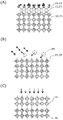
- FIG. 1 is a conceptual diagram of the solid phase separation method of the present invention by cooling a copper-copper laminate.
- FIG. FIG. 1A(A) is a cross-sectional view of the configuration of a copper-copper laminate sandwiching a general negative thermal expansion coefficient material as a cross-linking layer
- FIG. 1A(B) is an explanatory view of partial breakage of a copper conductor film
- FIG. 1A(C) is an explanatory diagram of defect propagation in the crosslinked layer.
- FIG. 1 is a conceptual diagram of a solid-phase separation method by forming a crosslinked layer using a vapor-assisted vacuum ultraviolet light irradiation technique and cooling, which is an embodiment of the present invention.
- FIG. 1B(A) is a structural cross-sectional view of a copper-copper laminate sandwiched between bridging layers
- FIG. 1B(B) is an electron micrograph of CuO nanocrystals
- FIG. 1B(C) is a It is an explanatory diagram of the organization.
- FIG. 2 is a diagram illustrating the state of solid-phase separation of a copper-copper laminate.
- FIG. 1C(A) is a cross-sectional view of a configuration in which a copper-copper laminate is joined by a cross-linking layer 30, and FIG. be. It is explanatory drawing of the process of a vapor-assisted vacuum-ultraviolet light irradiation process.
- FIG. 2(A) shows the process of purifying the surface of the copper conductor film by irradiating it with vacuum ultraviolet light
- FIG. 2(B) shows the state after the surface of the copper conductor film has been purified
- FIG. 2(C) shows the structure. The process of bringing the copper conductor films on the body surfaces closer to each other to form a cross-linking layer is shown, and FIG.
- FIG. 10 is an explanatory diagram of steps of a surface-activated room-temperature bonding process as a comparative example, and is an atomic-level explanatory diagram of the surface of a copper conductor film.
- FIG. 3A shows the organic contaminants 13 and 23 (adhesion of organic compounds) adsorbed on the respective surfaces of the first copper conductor film 10 and the second copper conductor film 20 in the initial state, and the natural oxide layer. 12 and 22 atoms or molecules are shown.
- FIG. 3B shows a cleaning process on the surface of the copper conductor film with vacuum ultraviolet light.
- 3C shows the bonding of copper conductor films without significant heating, such as low temperature heating in vacuum.
- 1 is a top view of an atmospheric pressure low temperature bonding apparatus; FIG.
- 41 is a sample inlet
- 50 and 52 are waiting chambers
- 72 is a sample stage (41, 50, 52, and 72 may be simply referred to as stages).
- 40 is an airtight chamber (airlock chamber)
- 60 is an X-ray photoelectron spectroscopy chamber (XPS chamber)
- 70 is a bonding chamber (40, 60, and 70 may be simply referred to as chambers).
- the vacuum ultraviolet light irradiation method is performed in an airtight chamber (airlock chamber) 40 . After the sample is allowed to stand in the sample inlet 41, the solvent vapor finely atomized by the atomizer 44 is mixed with high-purity nitrogen. Then, vacuum ultraviolet light is irradiated from the vacuum ultraviolet light source 46 . After that, the sample is transported to an X-ray photoelectron spectroscopy chamber (XPS chamber) 60 or a bonding chamber 70 via waiting chambers 50 and 52 .
- XPS chamber X-ray photoelectron spectroscopy chamber
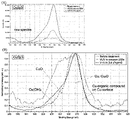
- FIG. 5A (A) is an XPS Cu2p3 as-is spectrum showing changes in the chemical bonding state of the CMP-Cu surface before and after vacuum ultraviolet light irradiation.
- FIG. 5A(B) normalizes the spectrum of FIG. 5A(A) by the maximum intensity and emphasizes the difference in the chemical bonding state of Cu.
- the -OH and -O peaks derived from contamination are attenuated, but the Cu(OH) 2 peak, which is the source of oxide nanoparticles that function as bonding and separation layers, is attenuated.
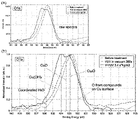
- FIG. 5B(A) is an XPS O1s as-is spectrum showing changes in the chemical bonding state of the CMP-Cu surface before and after vacuum ultraviolet light irradiation.
- FIG. 5B(B) normalizes the spectrum of FIG. 5B(A) by the maximum intensity and emphasizes the difference in the chemical bonding state of O.
- peaks originating from coordinated molecular water appeared, suggesting the formation of Cu(OH) 2 .
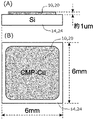
- FIG. 6A(A) shows the sample shape from the side of the sample.
- FIG. 6A(B) shows the shape of the sample viewed from above.
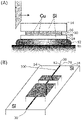
- FIG. 4 is a schematic explanatory diagram of a test performed on a laminate sample;
- FIG. 6B(A) is a drawing explaining the method of the shear strength test in the example.
- FIG. 6B(B) is a drawing illustrating an observation method (interfacial electron microscope observation) of an SEM image of a Cu bonding interface.
- 1 shows a laminate having crosslinks formed by a vapor-assisted vacuum ultraviolet light irradiation technique, and shows an example of a sample before cooling treatment.
- FIG. 7A(A) shows a state in which the base material is broken from inside the Si chip without breaking or peeling while the Cu--Cu interface remains adhered.
- FIG. 7A(B) shows a state in which the Cu--Cu interface remained adhered and did not break or peel, and the adhesive used for fixing the sample to the shear strength test stage was peeled. That is, it shows that solid phase separation cannot be performed without cooling treatment.
- 1 shows a laminate having crosslinks formed by a vapor-assisted vacuum ultraviolet light irradiation technique, and shows an example of a sample after cooling treatment.
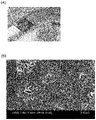
- FIG. 7B(A) shows the sample surface after the cooling treatment.
- FIG. 7B(B) is an SEM image of the surface of the sample after the cooling treatment.
- FIG. 7B(A) shows an overall image in which the two chips are solid-phase separated without any clear breakage of the Si chip or the Cu thin film by stress application by direct gripping by human power.
- FIG. 7B(B) shows the enlarged image of FIG. 7B(B), it can be seen that the Cu thin film is not significantly fractured and that the surface of the Cu thin film is roughened due to the expansion of the oxide nanoparticles.
- FIG. 1A is a conceptual diagram of a solid phase separation method by cooling a copper-copper laminate according to one embodiment of the present invention.
- FIG. 1A (A) is a cross-sectional view of a copper-copper laminate sandwiching a general negative thermal expansion coefficient material as a cross-linking layer 30, and
- FIG. 1A (B) is a cross-linking layer of a negative thermal expansion coefficient material and
- FIG. 1A (C) is an explanatory diagram of the origin of defects that occur involuntarily near the interface between a crosslinked layer and a structure (hereinafter sometimes referred to as a base material), and
- FIG. 1A (C) is an unpredictable direction from the defect origin of FIG. 1A (B).
- the copper-copper laminate to be treated includes a first copper conductor film 10, a second copper conductor film 20, a base material that is the first structure 14, a base material that is the second structure 24, and a bridge. It consists of layers 30 .
- the structure (base material) typically includes a silicon substrate, a printed wiring board, a Si wafer, or the like, and a copper foil is used as a copper conductor film on the base material.
- a wiring pattern (copper thin film wiring pattern) is provided.
- the first copper conductor film 10 is laminated on the surface of the first structure (base material) 14 to form a bonding surface
- the second copper conductor film 20 is laminated on the surface of the second structure (base material) 24 . is laminated on the surface of the to form a joint surface (see FIG. 1A (A)). Since the first copper conductor film 10 and the first structure 14 and the second copper conductor film 20 and the second structure 24 are thicker than the bridging layer 30, the first structure is shown in this figure.
- the copper conductor film 10 and the first structure 14 are collectively shown as the first copper conductor film 10, and the second copper conductor film 20 and the second structure 24 are collectively shown as the second copper conductor film 20. Illustrated.
- a stress determined by a temperature change near the magnetic transition temperature of copper (II) oxide and a thermal expansion coefficient is applied to the first copper layer sandwiching the cross-linking layer 30. It acts on the conductor film 10 and the second copper conductor film 20 .
- a peeling fracture 91 occurs inside the cross-linking layer 30, and a partial fracture 90 of the copper conductor film occurs only in the vicinity of the interface with the cross-linking layer 30 (see FIG. 1A(B)).
- defect propagation 92 in the cross-linked layer occurs, in which the defect propagates within the cross-linked layer 30 (see FIG. 1A(C)).
- the magnetic transition is also referred to as the trigger temperature because the temperature change near the magnetic transition temperature finally causes the solid state rupture.
- the magnetic transition temperature of copper(II) oxide in the present invention is -100° C. or higher and -80° C. or lower because it varies as compared with pure copper(II) oxide single crystals.
- FIG. 1B is a conceptual diagram of a solid phase separation method by cooling a copper-copper laminate using a vapor-assisted vacuum ultraviolet light irradiation technique, which is an embodiment of the present invention.
- FIG. 1B (A) is a cross-sectional view showing the configuration of a copper-copper laminate sandwiched between cross-linking layers
- FIG. 1B(C) is an explanatory diagram of the structure in the crosslinked layer.
- a cross-linking layer 30 exists between the first copper conductor film 10 and the second copper conductor film 20 (FIG. 1B(A)). Between the bridging layer 30 are native oxide layers 12 and 22, respectively (FIG. 1B(C)).
- CuO nanocrystals can be generated in the vicinity of the interface over time by the reaction represented by the following formula (1) (Fig. 1B (B) reference).
- Cu(OH) 2 ⁇ CuO+ H2O (1)
- CuO nanocrystals are crystals with a crystal grain size of 1 to 20 nm, and as shown in FIG. 1B(B), the crystal grain size can be measured by an electron microscope technique such as a transmission electron microscope.
- the grain size of the CuO nanocrystals is 1 nm or more and 10 nm or less.
- FIG. 1C is a diagram illustrating the state of solid-phase separation of a copper-copper laminate.
- FIG. 1C(A) is a structural cross-sectional view of a copper-copper laminate bonded via a cross-linking layer 30, and
- FIG. 1C(B) is an explanation of solid phase separation at the cross-linking layer 30 of the copper-copper laminate. It is a diagram.
- a bridge layer 30 is located between the first copper conductor film 10 and the second copper conductor film 20 .
- the film thickness of the cross-linking layer 30 is, for example, 15 to 20 nm.
- the CuO nanocrystal layer near the interface abruptly expands with constant stress near the magnetic transition temperature, which is the trigger temperature (see FIG. 1C(A)).
- the remaining cross-linking layers 34a and 34b are located on the old joint surfaces of the first copper conductor film 10 and the second copper conductor film 20, and are crushed.
- the grained CuO nanocrystals 34c remain (see FIG. 1C(B)).
- FIG. 2 is an illustration of the steps of the vapor-assisted vacuum ultraviolet light bonding process.
- FIG. 2(A) shows the process of purifying the surface of the copper conductor film by irradiating it with vacuum ultraviolet light
- FIG. 2(B) shows the state after the surface of the copper conductor film has been purified
- FIG. 2(C) shows the structure. The process of bringing the copper conductor films on the body surfaces closer to each other to form a cross-linking layer is shown
- FIG. 2D shows the process of joining the structure surfaces with the cross-linking layer by contact at room temperature and low-temperature heating.
- FIG. 2A the surface of the copper conductor film is irradiated with vacuum ultraviolet light while controlling the amount of exposure.
- FIG. 2B the organic contaminants 23 present on the surfaces of the copper conductor films 10 and 20 and part of the natural oxide layers 12 and 22 are removed by vacuum ultraviolet light.
- FIG. 2C portions of the native oxide layers 12 and 22 on the surfaces of the copper conductor films 10 and 20 are reduced to form a bridging layer 30 .
- FIG. 2A the surface of the copper conductor film is irradiated with vacuum ultraviolet light while controlling the amount of exposure.
- FIG. 2B the organic contaminants 23 present on the surfaces of the copper conductor films 10 and 20 and part of the natural oxide layers 12 and 22 are removed by vacuum ultraviolet light.
- FIG. 2C portions of the native oxide layers 12 and 22 on the surfaces of the copper conductor films 10 and 20 are reduced to form a bridging layer 30
- the first copper conductor film 10 and the second copper conductor film 20 are joined via the cross-linking layer 30 to form the first structure and the second copper conductor film 20 .
- a copper-copper laminate is formed in which the two structures are bonded.
- a crosslinked layer 30 of hydroxide hydrate with a thickness of several nm is formed on the metal surface modified by the vapor-assisted vacuum ultraviolet light irradiation method, and the surfaces are brought into contact with each other at room temperature and then heated to, for example, about 150°C. A strong bond can be obtained by promoting the dehydration condensation reaction.
- a film of native metal oxide ie native oxide of copper
- metal ions copper ions
- surplus metal ions that did not contribute to the formation of the crosslinked layer react with water molecules generated by the dehydration condensation reaction to generate oxide nanocrystals in the crosslinked layer.
- the boundary between the crosslinked layer 30 and the natural oxide layers 12 and 22 disappears and becomes ambiguous over time at the bonding interface of the laminate of the present invention. can be prevented.
- the above-described change in the boundary surface over time is sometimes referred to as "ion diffusion" by focusing on the movement of metal ions that occurs.
- the dehydration-condensation reaction and diffusion of ions improve the strength of the joined body.
- FIG. 3 is an explanatory diagram of steps of a surface-activated room-temperature bonding process as a comparative example, and the process is explained at the atomic level. Therefore, in order to verify the effectiveness of the cross-linked layer, the surface activation normal temperature bonding method, which provides an ideal direct bonding interface, is used as a comparison target.
- FIG. 3A shows organic contaminants (adhesion of organic compounds) 13 and 23 and a natural oxide layer adsorbed on the surfaces of the first copper conductor film 10 and the second copper conductor film 20 in the initial state, respectively. 12 and 22 atoms or molecules are shown.
- FIG. 3B shows a cleaning process on the surface of the copper conductor film with vacuum ultraviolet light.
- 3C shows the bonding of copper conductor films without significant heating, such as low temperature heating in vacuum.
- a chemically stable layer such as an oxide is removed by an Ar fast atom beam 65 (hereinafter referred to as Ar-FAB) in a high vacuum (see FIG. 3(B)), and atomistically
- Ar-FAB Ar fast atom beam 65
- FIG. 4 is a configuration diagram of an atmospheric pressure low temperature bonding apparatus. According to this apparatus, bonding by vapor-assisted vacuum ultraviolet light irradiation technique and surface activation room temperature bonding process can be performed.
- the atmospheric pressure low temperature bonding apparatus includes an airtight chamber (airlock chamber) 40 , standby chambers 50 and 52 , an X-ray photoelectron spectroscopy chamber (XPS chamber) 60 and a bonding chamber 70 .
- An airtight chamber (airlock chamber) 40 is provided with a sample inlet 41 , a vacuum pump 42 , a sprayer 44 , a vacuum ultraviolet light source 46 , and a temperature/humidity sensor 48 .
- a sample loading port 41 is an entrance for loading a sample to be processed into an airtight chamber (airlock chamber) 40 .
- the atomizer 44 supplies a nitrogen gas atmosphere containing atomized pure water vapor into the air-tight chamber (airlock chamber) 40 .
- a vacuum pump 42 evacuates the air in an airtight chamber (airlock chamber) 40 to enable replacement with a nitrogen atmosphere by a sprayer 44 .
- An excimer lamp for example, can be used as the vacuum ultraviolet light source 46 .
- An excimer lamp utilizes light (excimer light) generated by discharge plasma (dielectric barrier discharge) generated in a lamp containing a rare gas.
- the main wavelengths of excimer lamps are 126 nm (Ar2), 146 nm ( Kr2 ), 172 nm ( Xe2), 222 nm ( KrCl ), and 308 nm (XeCl).
- a lamp unit using Xe 2 and having a main wavelength of 172 nm is suitable for surface modification and hydrophilic treatment (improving wettability).
- the temperature/humidity sensor 48 is a device for measuring the humidity and pressure inside the airtight room (airlock room) 40 .
- the waiting room 50 and the waiting room 52 are waiting places for sending the sample surface-modified in the airtight room (airlock room) 40 to the X-ray photoelectron spectroscopy room (XPS room) 60 and the bonding room 70 .
- An X-ray photoelectron spectroscopy chamber (XPS chamber) 60 is a chamber for taking an X-ray photoelectron spectrograph of a sample surface, and is provided with X-ray sources 62 and 64 .
- the X-ray sources 62 and 64 can deflect the beams along the three axes of the XYZ directions, and can irradiate the ion beams at arbitrary locations on the sample.
- XPS X-ray Photoelectron Spectroscopy
- the copper conductor films of the samples are bonded together.
- copper conductor films are bonded together via a cross-linking layer.
- the surface-activated room-temperature bonding process does not include a cross-linking layer because the copper conductor films are directly bonded by utilizing the attractive force generated between atomically clean copper conductor films.
- the following two points are essential for solid-phase separation of the bonding interface containing Cu by cooling: (1) forming a crosslinked layer with a simple compound derived from a copper conductor film; and (2) the crosslinked layer undergoes significant volume expansion only in a temperature range very close to the magnetic transition temperature, which is a distinct trigger temperature. thing. If the magnetic transition temperature, which is the trigger temperature, is sufficiently lower than the normal operating temperature of the electronic equipment, normal use of the electronic equipment will not be affected.
- the Cu hydroxide hydrate crosslinkage formed on the Cu surface modified by the vapor-assisted vacuum ultraviolet light irradiation technique is used as it is.
- this crosslinked layer it was found by transmission electron microscope (TEM) observation that CuO nanocrystals precipitated over time (see FIG. 1B(B)). These CuO nanocrystals are formed by water molecules generated by the dehydration condensation reaction of Cu(OH) 2 ⁇ [H 2 O] 2 forming a crosslinked layer, and by vacuum ultraviolet light irradiation in the vapor-assisted vacuum ultraviolet light irradiation method.
- TEM transmission electron microscope
- the laminate is cooled to below the magnetic transition temperature of copper (II) oxide (CuO) (range of ⁇ 100° C. or more and ⁇ 80° C. or less), thereby
- CuO copper oxide
- the CuO nanocrystals contained in the layer expand to generate stress at the interface, resulting in a solid-phase breaking effect.
- the stress generated at the bonding interface is considered to be proportional to the density of nanocrystals. Therefore, the simplest process control condition is to use the exposure amount, which is a parameter of the vapor-assisted vacuum ultraviolet light irradiation method.
- the cross-linking layer thickness may be used as the process control condition.
- FIG. 6A the result of solid-phase separation of a laminate of CMP (chemical mechanical polishing)-Cu thin films formed on a Si chip is shown (see FIG. 6A).
- This combination is one of typical structures for flattened wiring of laminated electronic substrates.
- the effect of the difference in thermal expansion coefficient between materials is eliminated, and only the effect of stress caused by the expansion of the crosslinked layer is extracted.
- surface activation by Ar high-speed atomic beam bombardment in high vacuum was performed in order to clarify whether the presence or absence of the crosslinked layer exerted the solid phase separation effect.
- Samples were also produced by surface activated bonding (hereinafter referred to as SAB method), and changes in bond strength before and after cooling were evaluated by a shear test for the samples produced by both bonding methods.
- SAB method surface activated bonding
- a CMP-Cu thin film is deposited on a Si wafer with a native oxide film with a thickness of about 1 ⁇ m and an average surface roughness of about 2 nm (see FIG. 6A).
- the sample was ultrasonically cleaned with acetone, ethanol, and water in this order for 180 s each to remove initial adsorbates, and then introduced into an atmospheric pressure low temperature bonding apparatus (FIG. 4).
- FIG. 4 With the atmospheric pressure low temperature bonding apparatus shown in FIG. 4, XPS observation can be performed without exposing the sample surface to the outside air after each surface modification process.
- the cross-linking layer thickness reaches about 15 to 20 nm and saturates on a general CMP-Cu thin film.
- (3) The CMP-Cu surfaces on which the crosslinked layers were formed were brought into contact with each other at room temperature, and after applying a load of up to 500 N, heating was started. (4) Heating was performed to 150° C. and held for 600 seconds to obtain a laminate.
- the wavelength of the vacuum ultraviolet light source was selected from those having sufficient energy to decompose water vapor and various adsorbates on the surface of the material, and wavelengths that can be irradiated with a commercially available device.
- the load applied at the time of contact in (3) above is to follow the tilt of the sample on one side using a swinging jig because it is difficult to achieve complete mechanical contact between flat surfaces at room temperature. be. Therefore, an applied load is not necessarily required.
- the heating retention time is also an apparatus-dependent numerical value.
- FIGS. 5A and 5B are XPS (X-ray Photoelectron Spectroscopy) spectra showing changes in the chemical bonding state of the CMP-Cu surface before and after vacuum ultraviolet light irradiation.
- FIG. 5A shows Cu2p3 and FIG. 5B shows O1s.
- FIGS. 5A(A) and 5B(A) show as-is measured spectra.
- Figures 5A(B) and 5B(B) show spectra normalized by maximum peak intensity. According to FIGS.
- a sample was manufactured by the surface activation room temperature bonding method in the following procedure.
- (1) In a high vacuum atmosphere with a background vacuum pressure of about 1.0 ⁇ 10 ⁇ 6 Pa, an Ar fast atom beam was excited with an output of 2 kV and 20 mA and irradiated for 300 seconds. This etched (oxide removed) about 15 nm of the CMP-Cu surface.
- (2) The atomically clean surfaces were immediately brought into contact at room temperature in the same high vacuum atmosphere. (3) It was held for 600 seconds while being pressurized at room temperature.
- the load was quickly removed after bonding and transported to an industrial freezer (atmospheric atmosphere) set at -90 ° C. and held for 24 hours (cooling treatment).
- a shear test was performed on the laminate after the cooling pretreatment.
- the shear test as shown in FIG. 6B(A), the sample laminate is fixed on the stage 80 via an adhesive 82, and a load cell with a maximum load of 500 N is used to shear the Si wafer, which is the first structure 14. A force was gradually applied to the laminate, and changes in the bond strength and fracture mode of the laminate were observed.
- the state of the bonding interface of the laminate of the sample was observed with a scanning electron microscope (hereinafter referred to as SEM) as follows.
- SEM scanning electron microscope
- FIGS. 7A-7D show a laminate having a crosslinked layer formed by a vapor-assisted vacuum ultraviolet light irradiation technique, and shows an example of a sample before cooling treatment.
- FIG. 7B shows a laminate having a crosslinked layer formed by a vapor-assisted vacuum ultraviolet light irradiation technique, and shows an example of a sample after cooling treatment.
- FIG. 7A (A) shows a state in which the Cu--Cu interface remains adhered and does not break or peel, and breaks from the inside of the Si chip.
- FIG. 7A(B) shows a state in which the Cu--Cu interface remained adhered and did not break or peel, and the adhesive used for fixing the sample to the shear strength test stage was peeled. That is, it can be seen from FIG. 7A that strong bonding was maintained before cooling in the laminate crosslinked by the vapor-assisted vacuum ultraviolet light irradiation method.
- FIG. 7B(A) after cooling, the two chips can be solid-phase separated without clear breakage of the Si chip and the Cu thin film by applying stress by directly gripping by human power. I understand. Further, in the enlarged image of FIG. 7B(B), it can be seen that the Cu thin film is not significantly broken. Further, the enlarged image of FIG.
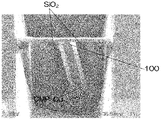
- FIG. 7C is an SEM image showing a structural change of a laminate having a crosslinked layer formed by a vapor-assisted vacuum ultraviolet light irradiation method, and shows an example of a sample before cooling treatment.
- FIG. 7D is an SEM image showing a structural change of a laminate having a crosslinked layer formed by a vapor-assisted vacuum ultraviolet light irradiation method, and shows an example of a sample after cooling treatment.
- bright portions are CMP-Cu.
- FIG. 7C an interface consisting of Cu native oxide and cross-linked layer was confirmed between CMP-Cu. It can be seen in FIG.
- FIG. 7A(B) shows a laminate formed by the vapor-assisted vacuum ultraviolet light irradiation method, in which the Cu--Cu interface was not broken or peeled, and the laminate was peeled from the joint with the stage by the adhesive.
- the same behavior was observed even after cooling for the laminate obtained by the surface activation normal temperature bonding method, that is, the laminate in which the crosslinked layer was not formed, so that the Cu hydroxide hydrate crosslinked layer It can be said that the presence or absence of the solid phase separability is controlled.
- the laminate obtained by the vapor-assisted vacuum ultraviolet light irradiation method had a bonding strength of about 0.7 MPa or less after the cooling treatment, and could be peeled off by direct gripping by human power. Peeling of the sample after the cooling treatment occurred at the Cu-Cu interface, and there was no significant damage to the CMP-Cu thin film or Si chip, indicating solid phase separation (Fig.
- FIGS. 1 to 7 have been shown as examples of the present invention, the present invention is not limited to these, and various embodiments are conceivable within the scope obvious to those skilled in the art. Therefore, such obvious scope is included in the scope of the present invention.
- the copper-copper laminate separation method of the present invention is suitably used for recycling structures including electronic devices.
- Flexible organic substrates are often used in structures including electronic devices for the purpose of thinness, weight reduction, and biocompatibility. ing. Therefore, it is important to provide a method that maintains a strong bonding force from material compositing (bonding) to actual operation, and that enables solid phase separation of dissimilar materials from the bonding interface or bonding interface after the end of service life. Directly linked to load reduction.
- the growth behavior of the thickness of the cross-linked layer can be controlled by a simple parameter (exposure amount), it is possible to design a comprehensive life cycle of the composite material at the time of bonding. , which contributes to the efficiency of product manufacturing process design. For example, cross-sectoral utilization is expected in the next-generation automobile industry, where the cost of IoT (Internet of things) devices is expected to exceed 40% of the total.
- First copper conductor film 12 Natural oxide layer of copper conductor film 13: Organic contamination 14: First structure (base material) 20: Second copper conductor film 22: Natural oxide layer of copper conductor film 23: Organic contamination 24: Second structure (base material) 30: Crosslinked layers 34a, 34b: Remaining crosslinked layer 34c: Particulate CuO nanocrystals 40: Airtight chamber (airlock chamber) 41: Sample inlet 42: Vacuum pump 44: Sprayer 46: Vacuum ultraviolet light source 48: Temperature/humidity sensor 50, 52: Waiting chamber 60: X-ray photoelectron spectroscopy chamber (XPS chamber) 62, 64: X-ray source and photoelectron detector 65: Ar fast atom beam 70: Bonding chamber 80: Stage 82: Adhesive 90: Partial copper conductor film fracture 91: Peel fracture 92: Defect propagation in bridging layer 100: Cu interface
Landscapes
- Engineering & Computer Science (AREA)
- Environmental & Geological Engineering (AREA)
- Chemical & Material Sciences (AREA)
- Health & Medical Sciences (AREA)
- Toxicology (AREA)
- General Health & Medical Sciences (AREA)
- General Chemical & Material Sciences (AREA)
- Chemical Kinetics & Catalysis (AREA)
- Materials Engineering (AREA)
- Organic Chemistry (AREA)
- Metallurgy (AREA)
- Mechanical Engineering (AREA)
- Manufacturing & Machinery (AREA)
- Laminated Bodies (AREA)
Priority Applications (3)
| Application Number | Priority Date | Filing Date | Title |
|---|---|---|---|
| JP2023534776A JP7597418B2 (ja) | 2021-07-13 | 2022-07-08 | 銅-銅積層体の分離方法及び銅-銅積層体 |
| EP22842055.0A EP4371678A4 (en) | 2021-07-13 | 2022-07-08 | METHOD FOR SEPARATING A COPPER-COPPER LAMINATE, AND COPPER-COPPER LAMINATE |
| KR1020237038023A KR102918834B1 (ko) | 2021-07-13 | 2022-07-08 | 구리-구리 적층체의 분리 방법 및 구리-구리 적층체 |
Applications Claiming Priority (2)
| Application Number | Priority Date | Filing Date | Title |
|---|---|---|---|
| JP2021115527 | 2021-07-13 | ||
| JP2021-115527 | 2021-07-13 |
Publications (1)
| Publication Number | Publication Date |
|---|---|
| WO2023286711A1 true WO2023286711A1 (ja) | 2023-01-19 |
Family
ID=84919416
Family Applications (1)
| Application Number | Title | Priority Date | Filing Date |
|---|---|---|---|
| PCT/JP2022/027099 Ceased WO2023286711A1 (ja) | 2021-07-13 | 2022-07-08 | 銅-銅積層体の分離方法及び銅-銅積層体 |
Country Status (4)
| Country | Link |
|---|---|
| EP (1) | EP4371678A4 (https=) |
| JP (1) | JP7597418B2 (https=) |
| KR (1) | KR102918834B1 (https=) |
| WO (1) | WO2023286711A1 (https=) |
Citations (4)
| Publication number | Priority date | Publication date | Assignee | Title |
|---|---|---|---|---|
| JPH0885830A (ja) * | 1994-09-16 | 1996-04-02 | Kobe Steel Ltd | 銅または銅合金表面のめっき剥離法 |
| CN101092663A (zh) * | 2007-04-13 | 2007-12-26 | 浙江理工大学 | 一种从镀金废料中回收黄金的方法 |
| JP2015051542A (ja) * | 2013-09-05 | 2015-03-19 | 独立行政法人物質・材料研究機構 | 接合方法、及び接合装置 |
| WO2016116980A1 (ja) * | 2015-01-19 | 2016-07-28 | 凸版印刷株式会社 | 配線基板積層体及びこれを用いた半導体装置の製造方法 |
Family Cites Families (1)
| Publication number | Priority date | Publication date | Assignee | Title |
|---|---|---|---|---|
| JP7018223B2 (ja) | 2018-05-18 | 2022-02-10 | 国立研究開発法人物質・材料研究機構 | 積層体の製造方法、積層体、及び、暖房便座装置 |
-
2022
- 2022-07-08 WO PCT/JP2022/027099 patent/WO2023286711A1/ja not_active Ceased
- 2022-07-08 JP JP2023534776A patent/JP7597418B2/ja active Active
- 2022-07-08 KR KR1020237038023A patent/KR102918834B1/ko active Active
- 2022-07-08 EP EP22842055.0A patent/EP4371678A4/en active Pending
Patent Citations (4)
| Publication number | Priority date | Publication date | Assignee | Title |
|---|---|---|---|---|
| JPH0885830A (ja) * | 1994-09-16 | 1996-04-02 | Kobe Steel Ltd | 銅または銅合金表面のめっき剥離法 |
| CN101092663A (zh) * | 2007-04-13 | 2007-12-26 | 浙江理工大学 | 一种从镀金废料中回收黄金的方法 |
| JP2015051542A (ja) * | 2013-09-05 | 2015-03-19 | 独立行政法人物質・材料研究機構 | 接合方法、及び接合装置 |
| WO2016116980A1 (ja) * | 2015-01-19 | 2016-07-28 | 凸版印刷株式会社 | 配線基板積層体及びこれを用いた半導体装置の製造方法 |
Non-Patent Citations (1)
| Title |
|---|
| See also references of EP4371678A4 * |
Also Published As
| Publication number | Publication date |
|---|---|
| JP7597418B2 (ja) | 2024-12-10 |
| KR20230165328A (ko) | 2023-12-05 |
| KR102918834B1 (ko) | 2026-01-27 |
| JPWO2023286711A1 (https=) | 2023-01-19 |
| EP4371678A4 (en) | 2025-08-06 |
| EP4371678A1 (en) | 2024-05-22 |
Similar Documents
| Publication | Publication Date | Title |
|---|---|---|
| KR101453135B1 (ko) | 직접 접합 방법에서의 질소-플라즈마 표면 처리 | |
| JP6388272B1 (ja) | 基板接合方法、基板接合システムおよび親水化処理装置の制御方法 | |
| KR102658526B1 (ko) | 산화물 단결정 박막을 구비한 복합 웨이퍼의 제조 방법 | |
| US7645681B2 (en) | Bonding method, device produced by this method, and bonding device | |
| JP2009220151A (ja) | 接合方法およびこの方法により作成されるデバイス、接合装置並びにこの方法により接合される基板 | |
| CN107615448A (zh) | 具备氧化物单晶薄膜的复合晶片的制造方法 | |
| WO2015025777A1 (ja) | デスミア処理方法およびデスミア処理装置 | |
| CN107636802A (zh) | 具备氧化物单晶薄膜的复合晶片的制造方法 | |
| CN106537555B (zh) | 薄型基板及其制造方法、以及基板的输送方法 | |
| US20090246935A1 (en) | Method for producing soi substrate | |
| JP7512641B2 (ja) | 接合基板の製造方法 | |
| CN1943021A (zh) | 电子装置用基板及其处理方法 | |
| Okada et al. | Vacuum ultraviolet irradiation treatment for reducing Gold–Gold bonding temperature | |
| WO2023286711A1 (ja) | 銅-銅積層体の分離方法及び銅-銅積層体 | |
| JP3124508B2 (ja) | 窒化物表面の改質方法及びその方法により表面改質された窒化物 | |
| JP2024009082A (ja) | 基板接合方法および基板接合システム | |
| JP6008095B2 (ja) | チップの表面処理方法、接合方法、及び表面処理装置 | |
| JP2009158866A (ja) | 半導体装置および電子機器 | |
| JP4671900B2 (ja) | 接合方法および接合装置 | |
| Ohtsubo et al. | Removal of oxygen atoms from a SiO2 surface by incoherent vacuum ultraviolet excimer irradiation | |
| JP2011192764A (ja) | 膜の除去方法及び膜除去用装置 | |
| JP2006258958A (ja) | 基板接着方法及び基板接着装置 | |
| Shigetou et al. | VUV-assisted low temperature bonding for organic/inorganic hybrid integration at atmospheric pressure | |
| JP2010145543A (ja) | 光導波路の製造方法および光導波路 | |
| JP2009158867A (ja) | 積層基板、半導体装置および電子機器 |
Legal Events
| Date | Code | Title | Description |
|---|---|---|---|
| 121 | Ep: the epo has been informed by wipo that ep was designated in this application |
Ref document number: 22842055 Country of ref document: EP Kind code of ref document: A1 |
|
| WWE | Wipo information: entry into national phase |
Ref document number: 2023534776 Country of ref document: JP |
|
| ENP | Entry into the national phase |
Ref document number: 20237038023 Country of ref document: KR Kind code of ref document: A |
|
| WWE | Wipo information: entry into national phase |
Ref document number: 1020237038023 Country of ref document: KR |
|
| WWE | Wipo information: entry into national phase |
Ref document number: 2022842055 Country of ref document: EP |
|
| NENP | Non-entry into the national phase |
Ref country code: DE |
|
| ENP | Entry into the national phase |
Ref document number: 2022842055 Country of ref document: EP Effective date: 20240213 |