WO2023286706A1 - Alめっき鋼板、Alめっき鋼板の製造方法、及びホットスタンプ成形体の製造方法 - Google Patents
Alめっき鋼板、Alめっき鋼板の製造方法、及びホットスタンプ成形体の製造方法 Download PDFInfo
- Publication number
- WO2023286706A1 WO2023286706A1 PCT/JP2022/027091 JP2022027091W WO2023286706A1 WO 2023286706 A1 WO2023286706 A1 WO 2023286706A1 JP 2022027091 W JP2022027091 W JP 2022027091W WO 2023286706 A1 WO2023286706 A1 WO 2023286706A1
- Authority
- WO
- WIPO (PCT)
- Prior art keywords
- layer
- steel sheet
- thickness
- plated steel
- oxide layer
- Prior art date
- Legal status (The legal status is an assumption and is not a legal conclusion. Google has not performed a legal analysis and makes no representation as to the accuracy of the status listed.)
- Ceased
Links
Images

Classifications
-
- C—CHEMISTRY; METALLURGY
- C22—METALLURGY; FERROUS OR NON-FERROUS ALLOYS; TREATMENT OF ALLOYS OR NON-FERROUS METALS
- C22C—ALLOYS
- C22C21/00—Alloys based on aluminium
-
- C—CHEMISTRY; METALLURGY
- C22—METALLURGY; FERROUS OR NON-FERROUS ALLOYS; TREATMENT OF ALLOYS OR NON-FERROUS METALS
- C22C—ALLOYS
- C22C21/00—Alloys based on aluminium
- C22C21/02—Alloys based on aluminium with silicon as the next major constituent
-
- C—CHEMISTRY; METALLURGY
- C22—METALLURGY; FERROUS OR NON-FERROUS ALLOYS; TREATMENT OF ALLOYS OR NON-FERROUS METALS
- C22C—ALLOYS
- C22C38/00—Ferrous alloys, e.g. steel alloys
-
- C—CHEMISTRY; METALLURGY
- C22—METALLURGY; FERROUS OR NON-FERROUS ALLOYS; TREATMENT OF ALLOYS OR NON-FERROUS METALS
- C22C—ALLOYS
- C22C38/00—Ferrous alloys, e.g. steel alloys
- C22C38/18—Ferrous alloys, e.g. steel alloys containing chromium
- C22C38/40—Ferrous alloys, e.g. steel alloys containing chromium with nickel
- C22C38/58—Ferrous alloys, e.g. steel alloys containing chromium with nickel with more than 1.5% by weight of manganese
-
- C—CHEMISTRY; METALLURGY
- C23—COATING METALLIC MATERIAL; COATING MATERIAL WITH METALLIC MATERIAL; CHEMICAL SURFACE TREATMENT; DIFFUSION TREATMENT OF METALLIC MATERIAL; COATING BY VACUUM EVAPORATION, BY SPUTTERING, BY ION IMPLANTATION OR BY CHEMICAL VAPOUR DEPOSITION, IN GENERAL; INHIBITING CORROSION OF METALLIC MATERIAL OR INCRUSTATION IN GENERAL
- C23C—COATING METALLIC MATERIAL; COATING MATERIAL WITH METALLIC MATERIAL; SURFACE TREATMENT OF METALLIC MATERIAL BY DIFFUSION INTO THE SURFACE, BY CHEMICAL CONVERSION OR SUBSTITUTION; COATING BY VACUUM EVAPORATION, BY SPUTTERING, BY ION IMPLANTATION OR BY CHEMICAL VAPOUR DEPOSITION, IN GENERAL
- C23C2/00—Hot-dipping or immersion processes for applying the coating material in the molten state without affecting the shape; Apparatus therefor
- C23C2/04—Hot-dipping or immersion processes for applying the coating material in the molten state without affecting the shape; Apparatus therefor characterised by the coating material
- C23C2/12—Aluminium or alloys based thereon
-
- C—CHEMISTRY; METALLURGY
- C23—COATING METALLIC MATERIAL; COATING MATERIAL WITH METALLIC MATERIAL; CHEMICAL SURFACE TREATMENT; DIFFUSION TREATMENT OF METALLIC MATERIAL; COATING BY VACUUM EVAPORATION, BY SPUTTERING, BY ION IMPLANTATION OR BY CHEMICAL VAPOUR DEPOSITION, IN GENERAL; INHIBITING CORROSION OF METALLIC MATERIAL OR INCRUSTATION IN GENERAL
- C23C—COATING METALLIC MATERIAL; COATING MATERIAL WITH METALLIC MATERIAL; SURFACE TREATMENT OF METALLIC MATERIAL BY DIFFUSION INTO THE SURFACE, BY CHEMICAL CONVERSION OR SUBSTITUTION; COATING BY VACUUM EVAPORATION, BY SPUTTERING, BY ION IMPLANTATION OR BY CHEMICAL VAPOUR DEPOSITION, IN GENERAL
- C23C2/00—Hot-dipping or immersion processes for applying the coating material in the molten state without affecting the shape; Apparatus therefor
- C23C2/26—After-treatment
- C23C2/261—After-treatment in a gas atmosphere, e.g. inert or reducing atmosphere
-
- C—CHEMISTRY; METALLURGY
- C23—COATING METALLIC MATERIAL; COATING MATERIAL WITH METALLIC MATERIAL; CHEMICAL SURFACE TREATMENT; DIFFUSION TREATMENT OF METALLIC MATERIAL; COATING BY VACUUM EVAPORATION, BY SPUTTERING, BY ION IMPLANTATION OR BY CHEMICAL VAPOUR DEPOSITION, IN GENERAL; INHIBITING CORROSION OF METALLIC MATERIAL OR INCRUSTATION IN GENERAL
- C23C—COATING METALLIC MATERIAL; COATING MATERIAL WITH METALLIC MATERIAL; SURFACE TREATMENT OF METALLIC MATERIAL BY DIFFUSION INTO THE SURFACE, BY CHEMICAL CONVERSION OR SUBSTITUTION; COATING BY VACUUM EVAPORATION, BY SPUTTERING, BY ION IMPLANTATION OR BY CHEMICAL VAPOUR DEPOSITION, IN GENERAL
- C23C2/00—Hot-dipping or immersion processes for applying the coating material in the molten state without affecting the shape; Apparatus therefor
- C23C2/26—After-treatment
- C23C2/28—Thermal after-treatment, e.g. treatment in oil bath
-
- C—CHEMISTRY; METALLURGY
- C23—COATING METALLIC MATERIAL; COATING MATERIAL WITH METALLIC MATERIAL; CHEMICAL SURFACE TREATMENT; DIFFUSION TREATMENT OF METALLIC MATERIAL; COATING BY VACUUM EVAPORATION, BY SPUTTERING, BY ION IMPLANTATION OR BY CHEMICAL VAPOUR DEPOSITION, IN GENERAL; INHIBITING CORROSION OF METALLIC MATERIAL OR INCRUSTATION IN GENERAL
- C23C—COATING METALLIC MATERIAL; COATING MATERIAL WITH METALLIC MATERIAL; SURFACE TREATMENT OF METALLIC MATERIAL BY DIFFUSION INTO THE SURFACE, BY CHEMICAL CONVERSION OR SUBSTITUTION; COATING BY VACUUM EVAPORATION, BY SPUTTERING, BY ION IMPLANTATION OR BY CHEMICAL VAPOUR DEPOSITION, IN GENERAL
- C23C2/00—Hot-dipping or immersion processes for applying the coating material in the molten state without affecting the shape; Apparatus therefor
- C23C2/34—Hot-dipping or immersion processes for applying the coating material in the molten state without affecting the shape; Apparatus therefor characterised by the shape of the material to be treated
- C23C2/36—Elongated material
- C23C2/40—Plates; Strips
Definitions
- the present invention relates to an Al-plated steel sheet, a method for producing an Al-plated steel sheet, and a hot stamped product, and more specifically, an Al-plated steel sheet for hot stamping, a method for producing the same, and a method for producing a hot stamped product using the same. Regarding.
- the hot stamping method is known as a technique for forming high-strength steel (in particular, ultra-high-strength steel of 1500 MPa or more) with high dimensional accuracy for which it is difficult to ensure formability.
- high-strength steel in particular, ultra-high-strength steel of 1500 MPa or more
- the problem of formability is eliminated by forming a steel sheet while it is heated to a high temperature of 800° C. or higher, and a desired high strength is obtained by cooling after forming.
- Japanese Patent Application Laid-Open No. 2003-193187 describes that crack generation during processing is suppressed by setting the Al content of the Fe—Al coating to 35% or less.
- International Publication No. 2019/160106 describes an Fe—Al plated hot stamp member having a predetermined structure of the Fe—Al plated layer in order to improve the corrosion resistance of the molded part and the corrosion resistance after painting.
- hydrogen may enter the steel material as the Al plating is oxidized.
- An Al-plated steel sheet is an Al-plated steel sheet for hot stamping, and includes a steel substrate and an Al plated layer containing Al and Si formed on the steel substrate. It comprises a plating layer and an oxide layer formed on the Al plating layer, and the chemical composition of the steel base material is C: 0.1 to 0.6% and Si: 0.01 to 0.01% by mass.
- the thickness of the oxide layer is 10 to 400 nm
- the oxide layer includes a hydroxide layer
- the A ratio of the thickness of the hydroxide layer to the thickness of the oxide layer is 30% or less.
- the thickness of the oxide layer is defined as the depth from the surface when the integrated intensity of the oxide becomes 1/2 of the maximum value in the depth direction analysis by X-ray photoelectron spectroscopy
- the hydroxide layer The thickness of is defined as the depth from the surface when the integrated intensity of hydroxide becomes half of the maximum value in depth direction analysis by X-ray photoelectron spectroscopy.
- a method for manufacturing an Al-plated steel sheet according to one embodiment of the present invention is the above-described method for manufacturing an Al-plated steel sheet, and includes a preliminary oxidation step of heating the Al-plated steel sheet to a temperature of 120 to 600°C.
- a hot-stamped compact according to one embodiment of the present invention includes a step of hot-stamping the above Al-plated steel sheet.
- the present invention it is possible to obtain a highly reliable Al-plated steel sheet that can suppress hydrogen embrittlement that progresses due to hydrogen entering the steel material accompanying oxidation of the Al plating during hot stamping. According to the present invention, it is also possible to obtain a hot-stamped article in which hydrogen embrittlement is suppressed.
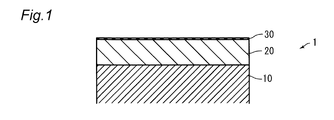
- FIG. 1 is a schematic cross-sectional view of an Al-plated steel sheet according to one embodiment of the present invention.
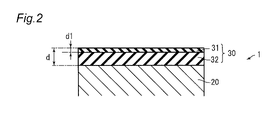
- FIG. 2 is a schematic cross-sectional view showing an enlarged structure of the oxide layer in FIG.
- FIG. 3 is an example of an O 1s spectrum measured by XPS.
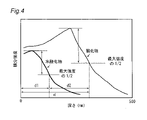
- FIG. 4 is an example depth profile of the integrated intensity of oxides and hydroxides.
- the inventors studied the relationship between the oxide layer formed on the surface of the Al-plated steel sheet and the amount of hydrogen that penetrates into the steel when the Al-plated steel sheet is subjected to the hot stamping process. In the course of the study, it was found that the amount of hydrogen that penetrates into the steel material is reduced by performing a preliminary oxidation step of heating the Al-plated steel sheet under predetermined conditions and then performing a hot stamping step.
- An Al-plated steel sheet has an oxide layer (initial oxide layer) with a thickness of several nanometers on the surface immediately after plating.
- This initial oxide layer includes, in order from the surface side, a hydroxide layer containing a large amount of hydroxide and an oxide layer containing a small amount of hydroxide.
- Hydroxides here include OH groups (hydroxyl groups) in their structure, such as Al(OH) 3 and AlOOH.
- an oxide is represented by a chemical formula of only metal and oxygen, such as Al 2 O 3 and AlFeO 4 .
- the ratio of the thickness of the hydroxide layer to the thickness of the oxide layer is relatively high.
- the oxide layer becomes thicker and the ratio of the thickness of the hydroxide layer to the thickness of the oxide layer decreases.
- the hydrogen that enters the steel material during the hot stamping process is assumed to be hydrogen from the hydroxide on the surface of the steel material and hydrogen from the moisture in the atmosphere. It is believed that the pre-oxidation step described above contributes to the reduction of both hydrogens. That is, the preliminary oxidation process promotes the release of hydrogen from the hydroxide on the surface of the steel material, and the oxide layer with reduced hydroxide functions as a protective layer against further oxidation, suppressing the oxidation reaction in the hot stamping process. It is thought that the dissociation reaction of moisture in the atmosphere is suppressed.
- FIG. 1 is a schematic cross-sectional view of an Al-plated steel sheet 1 according to one embodiment of the present invention.
- the Al-plated steel sheet 1 includes a steel substrate 10 , an Al plating layer 20 formed on the steel substrate 10 , and an oxide layer 30 formed on the Al plating layer 20 .
- the Al plating layer 20 and the oxide layer 30 may be formed on one side of the steel base 10 or may be formed on both sides of the steel base 10 .
- the oxide layer 30 is a layer formed by oxidizing the surface of the Al plating layer 20, and contains Al oxide and Al hydroxide.
- Al oxides are, for example, Al 2 O 3 and AlFeO 4 .
- Al hydroxides are, for example, Al(OH) 3 and AlOOH.
- the oxide layer 30 may contain oxides other than Al oxides and hydroxides other than Al hydroxides.
- FIG. 2 is a schematic cross-sectional view showing an enlarged configuration of the oxide layer 30.
- the oxide layer 30 includes a hydroxide layer 31 that is a layer containing a large amount of hydroxide and an oxide layer 32 that is a layer containing a small amount of hydroxide. Hydroxide contained in the oxide layer 30 is mostly distributed on the surface side of the oxide layer 30 . Therefore, a hydroxide layer 31 is formed on the surface side and an oxide layer 32 is formed on the substrate side.
- the thickness d of the oxide layer 30 is 10 to 400 nm, and the ratio of the thickness d1 of the hydroxide layer 31 to the thickness d of the oxide layer 30 is 30% or less.
- the oxide layer 30 functions as a protective layer against further oxidation of the Al-plated steel sheet 1. That is, by forming the oxide layer 30 having a predetermined thickness on the Al-plated steel sheet 1 in advance, the oxidation reaction in the hot stamping process can be suppressed. This can reduce the amount of hydrogen that penetrates into the steel substrate 10 during the hot stamping process. This effect cannot be sufficiently obtained if the thickness d of the oxide layer 30 is less than 10 nm. On the other hand, when the thickness d of the oxide layer 30 exceeds 400 nm, the influence of hydrogen in the hydroxide contained in the oxide layer 30 increases.
- the lower limit of the thickness d of the oxide layer 30 is preferably 20 nm.
- the upper limit of the thickness d of the oxide layer 30 is preferably 300 nm, more preferably 200 nm, still more preferably 100 nm, still more preferably 50 nm.
- the hydroxide contained in the oxide layer 30 can be a source of hydrogen that penetrates into the steel substrate 10.
- the ratio of the thickness d1 of the hydroxide layer 31 to the thickness d of the oxide layer 30 is preferably 25% or less, more preferably 20% or less, still more preferably 15% or less.
- the thickness d of the oxide layer 30 and the thickness d1 of the hydroxide layer 31 are measured by depth direction analysis by X-ray photoelectron spectroscopy (XPS) as follows.
- Fig. 3 is an example of an O 1s spectrum measured by XPS.
- the O 1s spectrum contains an oxide peak and a hydroxide peak.
- the background is subtracted from this O 1s spectrum, the oxide peak and the hydroxide peak are waveform-separated, and the integrated intensity of each is obtained.
- Background processing uses the Shirley method typical of XPS data processing.
- the integrated intensity ratio obtained here agrees with the existing ratio of oxide and hydroxide at the depth being measured.
- FIG. 4 is an example depth profile of the integrated intensity of oxides and hydroxides.
- the layer boundary between the hydroxide layer 31 and the oxide layer 32 is defined as the position where the integrated intensity of hydroxide is 1/2 of the maximum value.
- a layer boundary between the oxide layer 32 and the Al plating layer 20 is defined as a position where the integrated intensity of the oxide is 1/2 of the maximum value.
- the thickness d1 of the hydroxide layer 31 is the depth from the surface when the integrated intensity of the hydroxide becomes 1/2 of the maximum value.
- the thickness d of the oxide layer 30 is the depth from the surface when the integrated intensity of the oxide is 1/2 of the maximum value.
- the thickness d2 of the oxide layer 32 is obtained by subtracting the thickness d1 of the hydroxide layer 31 from the thickness d of the oxide layer 30 .
- the Al plating layer 20 is a plating layer containing Al and Si.
- an intermetallic compound of Al, Fe and Si may be formed in the Al plating layer 20, an intermetallic compound of Al, Fe and Si may be formed.
- the chemical composition of the Al plating layer 20 (average composition in the thickness direction, hereinafter the same in this paragraph) is not limited to this, for example, Al: 20 to 100% by mass, Si: 1 to 20% by mass, Fe: 0 to 60% by mass.
- the lower limit of the Al content of the Al plating layer 20 is preferably 25% by mass.
- the upper limit of the Al content of the Al plating layer 20 is preferably 95% by mass, more preferably 90% by mass, still more preferably 70% by mass, still more preferably 55% by mass.
- the lower limit of the Si content of the Al plating layer 20 is preferably 2% by mass, more preferably 5% by mass.
- the upper limit of the Si content of the Al plating layer 20 is preferably 15% by mass, more preferably 12% by mass.
- the lower limit of the Fe content of the Al plating layer 20 is preferably 20% by mass.
- the upper limit of the Fe content of the Al plating layer 20 is preferably 50% by mass, more preferably 40% by mass.
- the Al plating layer 20 may contain elements other than Al, Si, and Fe. Specifically, Be, Mg, Ca, Sr, Ba, Sc, Ti, V, Cr, Mn, Co, Ni, Cu, Zn, Zr, Y, Nb, Ce, and Ta may be added. be.
- the total content of elements other than Al, Si, and Fe is preferably 10% by mass or less, more preferably 5% by mass or less, still more preferably 3% by mass or less, and still more preferably 1% by mass. It is below.
- the thickness of the Al plating layer 20 is not particularly limited, it is, for example, 1 to 100 ⁇ m.
- the lower limit of the thickness of the Al plating layer 20 is preferably 5 ⁇ m, more preferably 10 ⁇ m, still more preferably 15 ⁇ m.
- the upper limit of the thickness of the Al plating layer 20 is preferably 50 ⁇ m, more preferably 40 ⁇ m, and still more preferably 30 ⁇ m.
- the steel base material 10 is, for example, a hot-rolled steel plate or a cold-rolled steel plate.
- the chemical composition of the steel base material 10 will be described below.
- "%" of element content means % by mass.
- C 0.1-0.6% Carbon (C) is contained to ensure the desired mechanical strength. If the C content is less than 0.1%, sufficient improvement in mechanical strength cannot be obtained. On the other hand, when the C content exceeds 0.6%, the elongation and reduction of area are likely to decrease.
- the upper limit of the C content is preferably 0.5%.
- Si 0.01-1.50%
- Silicon (Si) is an element that improves mechanical strength, and like C, is contained to ensure the desired mechanical strength. If the Si content is less than 0.01%, sufficient improvement in mechanical strength cannot be obtained. On the other hand, if the Si content exceeds 1.50%, the influence of Si oxides formed on the surface layer of the steel base material may reduce the wettability during plating, resulting in non-plating.
- the upper limit of Si content is preferably 0.60%.
- Mn 0.10-3.00%
- Manganese (Mn) is one of the strengthening elements that strengthen steel and is also one of the elements that improve hardenability. Mn is also effective in preventing hot shortness due to S, which is one of the impurities. If the Mn content is less than 0.10%, these effects cannot be sufficiently obtained. On the other hand, if the Mn content exceeds 3.00%, the amount of retained austenite may become too large and the strength may decrease.
- the lower limit of Mn content is preferably 0.50%.
- the upper limit of the Mn content is preferably 2.00%.
- P 0.05% or less Phosphorus (P) is an impurity contained in the steel base material.
- P contained in the steel base may segregate at the grain boundaries of the steel base and reduce the toughness of the steel base. It is preferable to reduce the P content as much as possible.
- S 0.020% or less Sulfur (S) is an impurity contained in the steel base material.
- S contained in the steel substrate may form sulfides and reduce the toughness of the steel substrate. It is preferable to reduce the S content as much as possible.
- Al 0.10% or less
- Aluminum (Al) is generally used for the purpose of deoxidizing steel. However, when the Al content is high, the Ac 3 point of the steel substrate increases, so it is necessary to raise the heating temperature necessary to ensure the hardenability of the steel during the hot stamping process. Therefore, the Al content is preferably 0.10% or less. The Al content is more preferably 0.05% or less, still more preferably 0.01% or less.
- Titanium is one of strength enhancing elements. If the Ti content is less than 0.01%, the effect of improving strength and the effect of improving oxidation resistance cannot be sufficiently obtained. On the other hand, when the Ti content exceeds 0.10%, carbides and nitrides are formed, which may soften the steel.
- B 0.0001 to 0.0100% Boron (B) acts during quenching and has the effect of improving strength. If the B content is less than 0.0001%, a sufficient strength improvement effect cannot be obtained. On the other hand, if the B content exceeds 0.0100%, inclusions may be formed to embrittle the steel base material and reduce the fatigue strength.
- N 0.015% or less Nitrogen (N) is an impurity contained in the steel base material.
- N contained in the steel substrate may form nitrides and reduce the toughness of the steel substrate.
- N contained in the steel base material may combine with B to reduce the amount of solid solution B, thereby reducing the hardenability improvement effect of B. It is preferable to reduce the N content as much as possible.
- the upper limit of the N content is preferably 0.010%.
- the steel base material 10 may contain one or more of Cr, Mo, Ni, Cu, and Nb. Cr, Mo, Ni, Cu, and Nb are all optional elements. That is, the steel base material 10 may not contain any or all of Cr, Mo, Ni, Cu, and Nb.
- Chromium (Cr) improves hardenability and increases temper softening resistance through carbide formation. It is also effective in improving corrosion resistance and high-temperature strength. Therefore, it may be contained as necessary.
- the lower limit of Cr content is preferably 0.01%. On the other hand, even if the content exceeds 1.0%, the effect is saturated, leading to an increase in cost.
- Mo 0-1.0% Molybdenum (Mo) easily forms carbides and increases temper softening resistance. The effect is enhanced by combined addition with Cr. In addition, a small amount of N improves hardenability, raises the grain coarsening temperature, and is highly effective in preventing temper embrittlement. Therefore, it may be contained as necessary.
- the lower limit of Mo content is preferably 0.01%. On the other hand, even if the content exceeds 1.0%, the effect is saturated, leading to an increase in cost.
- Ni 0-1.0% Nickel (Ni) significantly lowers the A1 transformation point and improves strength, toughness and hardenability. Combined addition of Cr and Mo tends to produce a synergistic effect. It also improves corrosion resistance and suppresses low-temperature embrittlement. Therefore, it may be contained as necessary.
- the lower limit of the Ni content is preferably 0.01%. On the other hand, even if the content exceeds 1.0%, the effect is saturated, leading to an increase in cost.
- Cu 0-1.0% Copper (Cu) improves hardenability and corrosion resistance. Therefore, it may be contained as necessary.
- the lower limit of Cu content is preferably 0.01%. On the other hand, even if the content exceeds 1.0%, the effect is saturated, leading to an increase in cost.
- Niobium (Nb) improves hardenability.
- Nb has a larger metal radius than Fe, which is the main component of steel, and has a higher density. have. It also suppresses temper embrittlement. Therefore, it may be contained as necessary.
- the lower limit of the Nb content is preferably 0.01%. On the other hand, even if the content exceeds 1.0%, the effect is saturated, leading to an increase in cost.
- the rest of the chemical composition of the steel base 10 is Fe and impurities.
- impurities refers to elements mixed in from ores and scraps used as raw materials for steel, or elements mixed in from the environment during the manufacturing process. Impurities include, for example, Zn, Co, Sn, V, As, Zr, Ca, Mg, etc., in addition to the elements listed above.
- An Al plating layer 20 is formed on the surface of the steel base 10 by hot dip plating.
- the temperature of the plating bath is preferably 600-700°C. If the temperature of the plating bath is lower than 600° C., the viscosity of the plating bath will be low, making uniform plating difficult. If the temperature of the plating bath is higher than 700° C., the components change in a short time due to volatilization, making process control difficult.
- the plating bath contains Si in addition to Al.
- the Si content in the plating bath is, for example, 1-20 mass %, preferably 5-15 mass %.
- the plating bath may contain elements other than Al and Si. Specifically, in addition to Fe, Al, Si, O, and H, the plating bath contains Be, Mg, Ca, Sr, Ba, Sc, Ti, V, Cr, Mn, Co, Ni, Cu, and Zn. , Zr, Y, Nb, Ce, and Ta may be added.
- the metal component ratios of the Al plated layer 20 and the oxide layer 30 are subject to change depending on the chemical composition of the plating bath, but are applicable as long as the plated layer formed in the plating process is mainly composed of Al.
- the lower limit of the Al content in the plating bath is preferably 70% by mass, preferably 80% by mass, more preferably 85% by mass, still more preferably 88% by mass.
- the plating process is preferably carried out in a non-oxidizing atmosphere (including a reducing atmosphere). This is because in an oxidizing atmosphere, the surface of the steel substrate 10 may oxidize, resulting in non-uniform plating, and in addition, loss may occur due to oxidation of the plating bath.
- the thickness of the Al plating layer 20 can be adjusted by the temperature, viscosity, immersion time, gas spraying, etc. of the plating bath.
- the plating layer may be formed by vapor deposition or thermal spraying instead of the hot dipping method.
- an Al alloy may be used, or Al and the additive element may be vapor-deposited or thermally sprayed separately.
- Preliminary oxidation step A preliminary oxidation step is performed in which the Al-plated steel sheet is heated under predetermined conditions. Specifically, the Al-plated steel sheet is heated to a temperature of 120 to 600° C. (an arbitrary temperature within the range of 120° C. to 600° C.).
- the temperature of the preliminary oxidation is lower than 120° C., the progress of dehydration from the initial oxidation layer is slow, and the ratio of the thickness d1 of the hydroxide layer 31 to the thickness d of the oxide layer 30 cannot be sufficiently reduced. There is on the other hand, if the preliminary oxidation temperature exceeds 600° C., it may become difficult to appropriately control the thickness d of the oxide layer 30 .
- the Al plating layer 20 may form an alloy with the steel base 10 or the steel base 10 may be deteriorated, resulting in reduced workability and unsuitability as a steel sheet for hot stamping.
- the lower limit of the pre-oxidation temperature is preferably 150°C, more preferably 180°C.
- the upper limit of the pre-oxidation temperature is preferably 400°C, more preferably 300°C, still more preferably 250°C.
- the holding time depends on the temperature and other conditions, but is for example 1 minute to 48 hours.
- the lower limit of the retention time is preferably 20 minutes, more preferably 40 minutes.
- the upper limit of the retention time is preferably 24 hours, more preferably 12 hours, still more preferably 4 hours, still more preferably 2 hours.
- the preliminary oxidation step is preferably carried out in an oxidizing atmosphere, and particularly preferably in the air from the viewpoint of cost.
- the preliminary oxidation step can be performed in any atmosphere other than an excessively non-oxidizing atmosphere.
- the desired oxide layer 30 can be formed depending on the conditions.
- the atmosphere of the preliminary oxidation step preferably has a dew point of ⁇ 70° C. or higher, more preferably ⁇ 30° C. or higher, further preferably 0° C. or higher.
- the atmosphere of the preliminary oxidation step preferably has an oxygen partial pressure of 0.001 MPa or more, more preferably 0.01 MPa or more.
- the heating method for the preliminary oxidation process is arbitrary, and for example, a high-temperature furnace or electric heating can be used.
- the temperature rise rate and temperature drop rate are arbitrary, and can be, for example, 10 to 1000° C./s.
- the preliminary oxidation process can be performed at any time after the plating process and before the plated steel sheet is subjected to the hot stamping process.
- the preliminary oxidation process may be performed at any timing during the winding process after the plating process, during roll storage after winding, or during roll development before the hot stamping process.
- the Al-plated steel sheet 1 is manufactured through the above steps.
- the thickness d of the oxide layer 30 is 10 to 400 nm, and the ratio of the thickness d1 of the hydroxide layer 31 to the thickness d of the oxide layer 30 is 30% or less.
- the Al-plated steel sheet 1 can be suitably used as a steel sheet for hot stamping.
- the hot stamping process applied to the Al-plated steel sheet 1 is not particularly limited, the following is an example.
- the heating method may be either a high-temperature furnace or electric heating.
- the holding temperature is preferably 850 to 950° C., and the holding time is preferably 2 minutes or longer. After heating, it is molded in a mold and cooled in the mold at the same time.
- a method for manufacturing a hot-stamped product according to one embodiment of the present invention includes a step of hot-stamping an Al-plated steel sheet 1 .
- the Al-plated steel sheet 1 can suppress hydrogen embrittlement that progresses due to hydrogen entering the steel material accompanying oxidation of the Al plating during hot stamping. Therefore, according to the method for manufacturing a hot-stamped article according to the present embodiment, a hot-stamped article in which hydrogen embrittlement is suppressed can be obtained.
- Al plating layers were formed on both sides of the steel sheet by hot dip plating.
- the chemical composition of the plating bath was Al-10 wt% Si-2 wt% Fe. Fe in the plating bath is inevitably supplied from plating equipment and steel sheets.
- the temperature of the plating bath during hot-dip plating was 700°C. After the steel sheet was immersed in the plating bath, the coating weight was adjusted to 70 g/m 2 per side by gas wiping.
- Short-time sputtering and XPS measurements were repeated to obtain the depth profiles of the integrated intensity of oxides and hydroxides.
- Sputtering with Ar + ions was performed at an acceleration voltage of 4 kV and a sputtering area of 1 mm ⁇ 1 mm.
- the sputtering rate was 75.1 nm/min in terms of SiO2 .
- the thickness d of the oxide layer 30 and the thickness d1 of the hydroxide layer 31 were obtained from the profile of the integrated intensity of the oxide and hydroxide in the depth direction by the method described above.
- the hot-stamped compact was stored in liquid nitrogen, and thermal desorption analysis was performed as it was to quantify the amount of hydrogen. A hydrogen amount integrated value up to 250° C. was obtained. It should be noted that if the amount of hydrogen exceeds 0.7 ppm by mass, it is unsuitable for 1.5 GPa class steel, and if it exceeds 0.5 mass ppm, it is considered unsuitable for 1.8 GPa class.
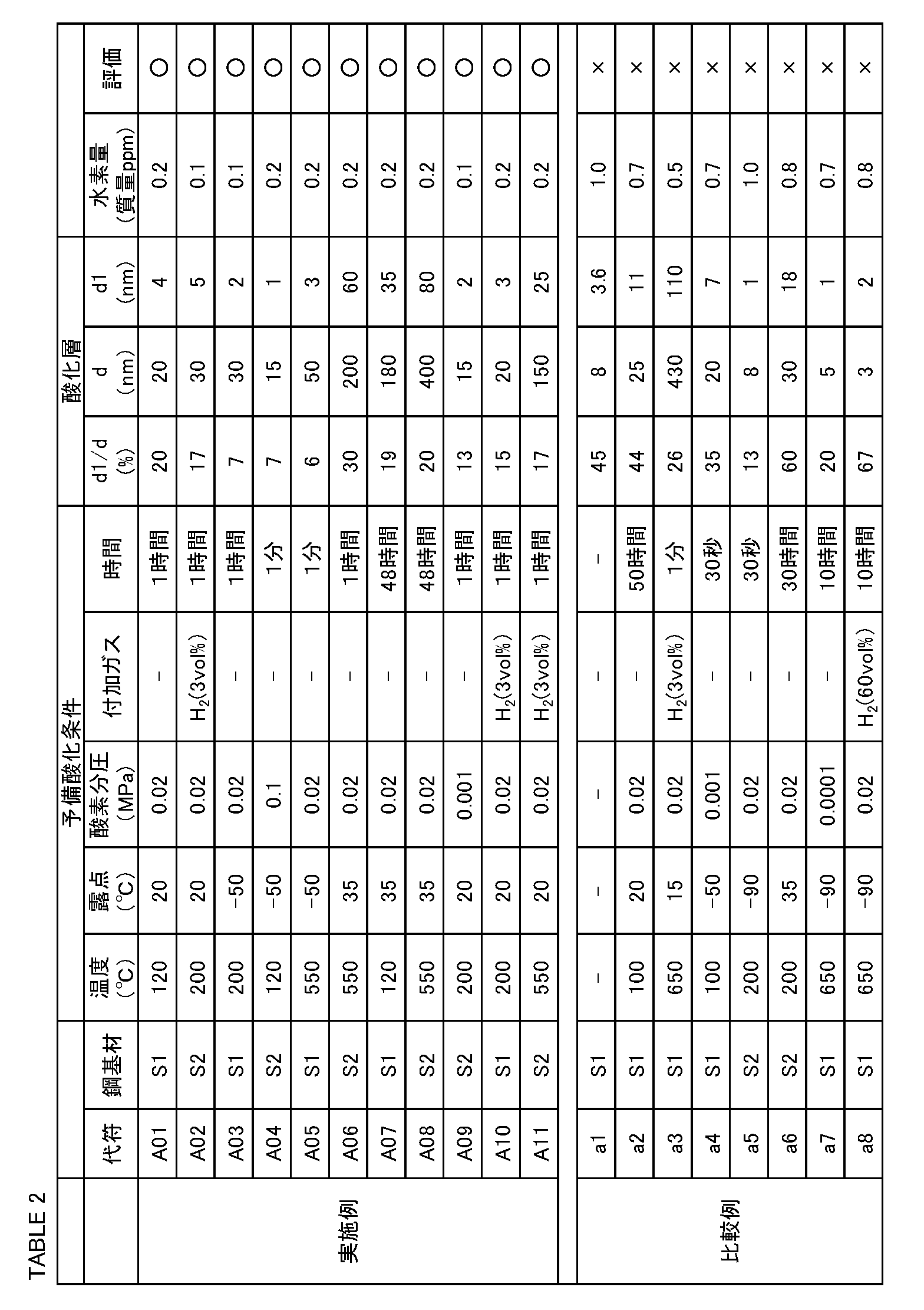
- Table 2 shows the conditions of the preliminary oxidation process, the results of surface analysis by XPS, and the results of hydrogen analysis.
- the thickness d of the oxide layer is within the range of 10 to 400 nm, and the ratio of the thickness d1 of the hydroxide layer to the thickness d of the oxide layer is The ratio was 30% or less.
- the amount of hydrogen in hot-stamped bodies produced from these Al-plated steel sheets was 0.2 ppm by mass or less.
- the amount of hydrogen in the hot-stamped compacts produced from the Al-plated steel sheets of symbols a1 to a8 was 0.5 ppm by mass or more.
- the Al-plated steel sheet with symbol a1 is an example in which the preliminary oxidation process was not performed.
- the thickness d of the oxide layer was less than 10 nm, and the ratio of the thickness d1 of the hydroxide layer to the thickness d of the oxide layer was higher than 30%.
- the thickness d of the oxide layer was within the range of 10 to 400 nm, but the ratio of the thickness d1 of the hydroxide layer to the thickness d of the oxide layer was higher than 30%.
- the ratio of the thickness d1 of the hydroxide layer to the thickness d of the oxide layer was 30% or less, but the thickness d of the oxide layer was greater than 400 nm.
- the ratio of the thickness d1 of the hydroxide layer to the thickness d of the oxide layer was 30% or less, but the thickness d of the oxide layer was smaller than 10 nm.
- the ratio of the thickness d1 of the hydroxide layer to the thickness d of the oxide layer was higher than 30%, and the thickness d of the oxide layer was also smaller than 10 nm.
Landscapes
- Chemical & Material Sciences (AREA)
- Engineering & Computer Science (AREA)
- Materials Engineering (AREA)
- Mechanical Engineering (AREA)
- Metallurgy (AREA)
- Organic Chemistry (AREA)
- Chemical Kinetics & Catalysis (AREA)
- Physics & Mathematics (AREA)
- Oil, Petroleum & Natural Gas (AREA)
- Thermal Sciences (AREA)
- Coating With Molten Metal (AREA)
Abstract
Description
図1は、本発明の一実施形態によるAlめっき鋼板1の模式的断面図である。Alめっき鋼板1は、鋼基材10と、鋼基材10の上に形成されたAlめっき層20と、Alめっき層20の上に形成された酸化層30とを備えている。Alめっき層20及び酸化層30は、鋼基材10の片面に形成されていてもよいし、鋼基材10の両面に形成されていてもよい。
酸化層30は、Alめっき層20の表面が酸化されて形成された層であり、Alの酸化物及びAlの水酸化物を含んでいる。Alの酸化物は例えば、Al2O3やAlFeO4である。Alの水酸化物は例えば、Al(OH)3やAlOOHである。酸化層30は、Alの酸化物以外の酸化物や、Alの水酸化物以外の水酸化物を含んでいてもよい。
Alめっき層20は、AlとSiとを含むめっき層である。Alめっき層20では、AlとFe及びSiとの金属間化合物が形成されている場合がある。Alめっき層20の化学組成(厚さ方向の平均組成。以下、この段落において同じ。)は、これに限定されないが、例えばAl:20~100質量%、Si:1~20質量%、Fe:0~60質量%である。Alめっき層20のAl含有量の下限は、好ましくは25質量%である。Alめっき層20のAl含有量の上限は、好ましくは95質量%であり、さらに好ましくは90質量%であり、さらに好ましくは70質量%であり、さらに好ましくは55質量%である。Alめっき層20のSi含有量の下限は、好ましくは2質量%であり、さらに好ましくは5質量%である。Alめっき層20のSi含有量の上限は、好ましくは15質量%であり、さらに好ましくは12質量%である。Alめっき層20のFe含有量の下限は、好ましくは20質量%である。Alめっき層20のFe含有量の上限は、好ましくは50質量%であり、さらに好ましくは40質量%である。
鋼基材10は、例えば熱延鋼板や冷延鋼板である。以下、鋼基材10の化学組成について説明する。以下の説明において、元素の含有量の「%」は、質量%を意味する。
炭素(C)は、目的とする機械的強度を確保するために含有される。C含有量が0.1%未満の場合には、十分な機械的強度の向上が得られない。一方、C含有量が0.6%を超える場合には、伸び、絞りが低下しやすくなる。C含有量の上限は、好ましくは0.5%である。
シリコン(Si)は、機械的強度を向上させる元素であり、Cと同様に目的とする機械的強度を確保するために含有される。Si含有量が0.01%未満の場合には、十分な機械的強度の向上が得られない。一方、Si含有量が1.50%を超える場合には、鋼基材表層に形成したSi酸化物の影響により、めっきを行う際に濡れ性が低下して不めっきが生じるおそれがある。Si含有量の上限は、好ましくは0.60%である。
マンガン(Mn)は、鋼を強化させる強化元素の一つであり、焼入れ性を高める元素の一つでもある。Mnはまた、不純物の一つであるSによる熱間脆性を防止するのにも有効である。Mn含有量が0.10%未満の場合には、これらの効果が十分に得られない。一方、Mn含有量が3.00%を超える場合には、残留オーステナイトが多くなり過ぎて強度が低下する恐れがある。Mn含有量の下限は、好ましくは0.50%である。Mn含有量の上限は、好ましくは2.00%である。
リン(P)は、鋼基材中に含まれる不純物である。鋼基材に含まれるPは、鋼基材の結晶粒界に偏析して鋼基材の靱性を低下させる場合がある。P含有量はできる限り少なくすることが好ましい。
硫黄(S)は、鋼基材中に含まれる不純物である。鋼基材に含まれるSは、硫化物を形成して鋼基材の靱性を低下させる場合がある。S含有量はできる限り少なくすることが好ましい。
アルミニウム(Al)は、一般に鋼の脱酸目的で使用される。しかし、Al含有量が多い場合、鋼基材のAc3点が上昇するため、ホットスタンプ工程の際に鋼の焼入れ性確保に必要な加熱温度を上昇させる必要がある。そのため、Al含有量は好ましくは0.10%以下である。Al含有量は、より好ましくは0.05%以下であり、さらに好ましくは0.01%以下である。
チタン(Ti)は、強度強化元素の一つである。Ti含有量が0.01%未満の場合には、強度向上効果や耐酸化性向上効果が十分に得られない。一方、Ti含有量が0.10%を超える場合には、炭化物や窒化物が形成され、鋼が軟質化する恐れがある。
ボロン(B)は、焼入れ時に作用して強度を向上させる効果を有する。B含有量が0.0001%未満の場合には、強度向上効果が十分に得られない。一方、B含有量が0.0100%を超える場合には、介在物が形成されて鋼基材が脆化し、疲労強度が低下する恐れがある。
窒素(N)は、鋼基材中に含まれる不純物である。鋼基材に含まれるNは、窒化物を形成して鋼基材の靱性を低下させる場合がある。さらに、鋼基材に含まれるNは、Bと結合して固溶B量を減らし、Bの焼入れ性向上効果を低下させる場合がある。N含有量はできる限り少なくすることが好ましい。N含有量の上限は、好ましくは0.010%である。
クロム(Cr)は焼入れ性を向上させるとともに、炭化物形成により焼戻し軟化抵抗を大きくする。また、耐食性を良くし、高温強度の向上にも有効である。そのため、必要に応じて含有させてもよい。Cr含有量の下限は、好ましくは0.01%である。一方、1.0%を超えて含有させても効果が飽和し、コストの上昇を招く。
モリブデン(Mo)は炭化物を作りやすく、焼戻し軟化抵抗を大きくする。Crと複合添加することで効果が増す。また、少量で焼入れ性を良くし、結晶粒粗大化温度を上昇させ、焼戻し脆性の防止効果も高い。そのため、必要に応じて含有させてもよい。Mo含有量の下限は、好ましくは0.01%である。一方、1.0%を超えて含有させても効果が飽和し、コストの上昇を招く。
ニッケル(Ni)はA1変態点を著しく低下させ、強度、靱性、及び焼入れ性を向上させる。CrやMoとの複合添加により相乗効果が現れやすい。また耐食性を良くし、低温脆化も抑止する。そのため、必要に応じて含有させてもよい。Ni含有量の下限は、好ましくは0.01%である。一方、1.0%を超えて含有させても効果が飽和し、コストの上昇を招く。
銅(Cu)は焼入れ性及び耐食性を向上させる。そのため、必要に応じて含有させてもよい。Cu含有量の下限は、好ましくは0.01%である。一方、1.0%を超えて含有させても効果が飽和し、コストの上昇を招く。
ニオブ(Nb)は、焼入れ性を向上させる。Nbは鋼の主成分であるFeよりも金属半径が大きく、密度も高い点から、Feのマトリックスに固溶しにくく、鋼材の結晶粒界に析出することで結晶粒の粗大化を防ぐ役割を有する。また、焼戻し脆性も抑止する。そのため、必要に応じて含有させてもよい。Nb含有量の下限は、好ましくは0.01%である。一方、1.0%を超えて含有させても効果が飽和し、コストの上昇を招く。
次に、Alめっき鋼板1の製造方法の一例を説明する。
溶融めっき法により鋼基材10の表面にAlめっき層20を形成する。めっき浴の温度は、好ましくは600~700℃である。めっき浴の温度が600℃よりも低いと、めっき浴が低粘度になり、均一なめっきが困難になる。めっき浴の温度が700℃よりも高いと、揮発によって短時間に成分が変化し、工程管理が困難になる。
Alめっきされた鋼板を所定の条件で加熱する予備酸化工程を行う。具体的には、Alめっきされた鋼板を120~600℃の温度(120℃以上600℃以下の範囲内の任意の温度)に加熱する。
本発明の一実施形態によるホットスタンプ成形体の製造方法は、Alめっき鋼板1をホットスタンプする工程を備えている。Alめっき鋼板1は、ホットスタンプ時にAlめっきの酸化に付随して鋼材に侵入する水素により進行する水素脆化を抑制することができる。そのため、本実施形態によるホットスタンプ成形体の製造方法によれば、水素脆化が抑制されたホットスタンプ成形体が得られる。

XPS測定は、アルバック・ファイ株式会社製、PHI Quantera SXMを使用した。X線光源には、単色化されたAl Kα線(1486.6eV)を使用し、X線照射領域は直径約100μmの領域とした。
予備酸化工程後のAlめっき鋼板を炉温900℃の電気抵抗炉において均熱時間が5分間となるように加熱した。その後、金型で成形すると同時に金型で冷却して、ホットスタンプ成形体を得た。
10 鋼基材
20 Alめっき層
30 酸化層
31 水酸化物層
32 酸化物層
Claims (3)
- ホットスタンプ用のAlめっき鋼板であって、
鋼基材と、
前記鋼基材の上に形成された、AlとSiとを含むめっき層であるAlめっき層と、
前記Alめっき層の上に形成された酸化層とを備え、
前記鋼基材の化学組成が、質量%で、
C :0.1~0.6%、
Si:0.01~1.50%、
Mn:0.10~3.00%、
P :0.05%以下、
S :0.020%以下、
Al:0.10%以下、
Ti:0.01~0.10%、
B :0.0001~0.0100%、
N :0.015%以下、
Cr:0~1.0%、
Mo:0~1.0%、
Ni:0~1.0%、
Cu:0~1.0%、
Nb:0~1.0%、
残部:Fe及び不純物であり、
前記酸化層の厚さが、10~400nmであり、
前記酸化層は、水酸化物層を含み、前記酸化層の厚さに対する前記水酸化物層の厚さの比率が30%以下である、Alめっき鋼板。
ここで、前記酸化層の厚さは、X線光電子分光法による深さ方向分析において、酸化物の積分強度が最大値の1/2になるときの表面からの深さとし、前記水酸化物層の厚さは、X線光電子分光法による深さ方向分析において、水酸化物の積分強度が最大値の1/2になるときの表面からの深さとする。 - 請求項1に記載のAlめっき鋼板の製造方法であって、
Alめっきされた鋼板を120~600℃の温度に加熱する予備酸化工程を含む、Alめっき鋼板の製造方法。 - 請求項1に記載のAlめっき鋼板をホットスタンプする工程を含む、ホットスタンプ成形体の製造方法。
Priority Applications (3)
| Application Number | Priority Date | Filing Date | Title |
|---|---|---|---|
| JP2023534773A JP7594219B2 (ja) | 2021-07-14 | 2022-07-08 | Alめっき鋼板、Alめっき鋼板の製造方法、及びホットスタンプ成形体の製造方法 |
| KR1020237038687A KR102856725B1 (ko) | 2021-07-14 | 2022-07-08 | Al 도금 강판, Al 도금 강판의 제조 방법, 및 핫 스탬프 성형체의 제조 방법 |
| CN202280038201.3A CN117396627B (zh) | 2021-07-14 | 2022-07-08 | 镀Al钢板、镀Al钢板的制造方法及热冲压成型体的制造方法 |
Applications Claiming Priority (2)
| Application Number | Priority Date | Filing Date | Title |
|---|---|---|---|
| JP2021116156 | 2021-07-14 | ||
| JP2021-116156 | 2021-07-14 |
Publications (1)
| Publication Number | Publication Date |
|---|---|
| WO2023286706A1 true WO2023286706A1 (ja) | 2023-01-19 |
Family
ID=84919402
Family Applications (1)
| Application Number | Title | Priority Date | Filing Date |
|---|---|---|---|
| PCT/JP2022/027091 Ceased WO2023286706A1 (ja) | 2021-07-14 | 2022-07-08 | Alめっき鋼板、Alめっき鋼板の製造方法、及びホットスタンプ成形体の製造方法 |
Country Status (4)
| Country | Link |
|---|---|
| JP (1) | JP7594219B2 (ja) |
| KR (1) | KR102856725B1 (ja) |
| CN (1) | CN117396627B (ja) |
| WO (1) | WO2023286706A1 (ja) |
Citations (4)
| Publication number | Priority date | Publication date | Assignee | Title |
|---|---|---|---|---|
| WO2016157665A1 (ja) * | 2015-03-31 | 2016-10-06 | 日新製鋼株式会社 | 吸放熱鋼板および吸放熱部材 |
| JP2018162508A (ja) * | 2017-03-27 | 2018-10-18 | 日新製鋼株式会社 | めっき鋼板および塗装めっき鋼板の製造方法 |
| US20190040513A1 (en) * | 2016-02-08 | 2019-02-07 | Salzgitter Flachstahl Gmbh | Aluminium-based coating for steel sheets or steel strips and method for the production thereof |
| WO2019193434A1 (en) * | 2018-03-09 | 2019-10-10 | Arcelormittal | A manufacturing process of press hardened parts with high productivity |
Family Cites Families (13)
| Publication number | Priority date | Publication date | Assignee | Title |
|---|---|---|---|---|
| JPH06272017A (ja) | 1993-03-22 | 1994-09-27 | Tosoh Corp | アルミニウム合金被覆耐熱材料の製造方法 |
| JP4022063B2 (ja) | 2001-12-25 | 2007-12-12 | 新日本製鐵株式会社 | 加工性、加工部耐食性に優れた高強度アルミ系めっき鋼板及び高強度自動車部品 |
| JP5565191B2 (ja) * | 2010-08-12 | 2014-08-06 | Jfeスチール株式会社 | 溶融Al−Zn系めっき鋼板 |
| US10344360B2 (en) | 2011-03-09 | 2019-07-09 | Nippon Steel & Sumitomo Metal Corporation | Steel sheet for hot stamping use, method of production of same, and method of production of high strength part |
| JP6202065B2 (ja) | 2014-09-24 | 2017-09-27 | Jfeスチール株式会社 | 水素用鋼構造物 |
| DE102016107152B4 (de) * | 2016-04-18 | 2017-11-09 | Salzgitter Flachstahl Gmbh | Bauteil aus pressformgehärtetem, auf Basis von Aluminium beschichtetem Stahlblech und Verfahren zur Herstellung eines solchen Bauteils und dessen Verwendung |
| KR102010048B1 (ko) * | 2017-06-01 | 2019-10-21 | 주식회사 포스코 | 도장 밀착성과 도장 후 내식성이 우수한 열간 프레스 성형 부재용 강판 및 그 제조방법 |
| KR102428588B1 (ko) * | 2017-12-05 | 2022-08-03 | 닛폰세이테츠 가부시키가이샤 | 알루미늄계 도금 강판, 알루미늄계 도금 강판의 제조 방법 및 자동차용 부품의 제조 방법 |
| IN202017021813A (ja) | 2018-02-15 | 2020-08-21 | Nippon Steel Corp | |
| US10996819B2 (en) | 2018-11-12 | 2021-05-04 | Citrix Systems, Inc. | Systems and methods for intellisense for SaaS application |
| KR102144194B1 (ko) * | 2018-11-26 | 2020-08-12 | 현대제철 주식회사 | 핫 스탬핑 부품의 제조방법 |
| JP6813133B2 (ja) * | 2018-11-30 | 2021-01-13 | 日本製鉄株式会社 | アルミめっき鋼板、ホットスタンプ部材及びホットスタンプ部材の製造方法 |
| KR102325753B1 (ko) * | 2019-12-20 | 2021-11-11 | 주식회사 포스코 | 흑색 도금 강판 및 그 제조방법 |
-
2022
- 2022-07-08 CN CN202280038201.3A patent/CN117396627B/zh active Active
- 2022-07-08 WO PCT/JP2022/027091 patent/WO2023286706A1/ja not_active Ceased
- 2022-07-08 KR KR1020237038687A patent/KR102856725B1/ko active Active
- 2022-07-08 JP JP2023534773A patent/JP7594219B2/ja active Active
Patent Citations (4)
| Publication number | Priority date | Publication date | Assignee | Title |
|---|---|---|---|---|
| WO2016157665A1 (ja) * | 2015-03-31 | 2016-10-06 | 日新製鋼株式会社 | 吸放熱鋼板および吸放熱部材 |
| US20190040513A1 (en) * | 2016-02-08 | 2019-02-07 | Salzgitter Flachstahl Gmbh | Aluminium-based coating for steel sheets or steel strips and method for the production thereof |
| JP2018162508A (ja) * | 2017-03-27 | 2018-10-18 | 日新製鋼株式会社 | めっき鋼板および塗装めっき鋼板の製造方法 |
| WO2019193434A1 (en) * | 2018-03-09 | 2019-10-10 | Arcelormittal | A manufacturing process of press hardened parts with high productivity |
Also Published As
| Publication number | Publication date |
|---|---|
| KR20230169265A (ko) | 2023-12-15 |
| JPWO2023286706A1 (ja) | 2023-01-19 |
| CN117396627A (zh) | 2024-01-12 |
| CN117396627B (zh) | 2026-04-14 |
| JP7594219B2 (ja) | 2024-12-04 |
| KR102856725B1 (ko) | 2025-09-08 |
Similar Documents
| Publication | Publication Date | Title |
|---|---|---|
| JP5614496B2 (ja) | 塗装後耐食性に優れたホットスタンプ成形された高強度部品およびその製造方法 | |
| EP2816139B1 (en) | Plated steel plate for hot pressing and hot pressing method of plated steel plate | |
| WO2019160106A1 (ja) | Fe-Al系めっきホットスタンプ部材及びFe-Al系めっきホットスタンプ部材の製造方法 | |
| KR101726090B1 (ko) | 표면품질 및 도금밀착성이 우수한 고강도 용융아연도금강판 및 그 제조방법 | |
| KR20090115873A (ko) | 성형성이 우수한 고강도 용융 아연 도금 강판 및 그 제조 방법 | |
| KR101639843B1 (ko) | 열간 프레스 성형용 도금강판 및 그 제조방법 | |
| KR101482345B1 (ko) | 고강도 열연강판, 이를 이용한 용융아연도금강판, 합금화 용융아연도금강판 및 이들의 제조방법 | |
| KR101825857B1 (ko) | 소부 경화형 용융 아연 도금 강판 | |
| CN112877632A (zh) | 高塑性热冲压成型用铝硅镀层钢板及其热冲压方法 | |
| KR101528011B1 (ko) | 열간프레스 성형용 도금강판 및 열간프레스 성형품, 그의 제조방법 | |
| KR20200066239A (ko) | 내식성 및 용접성이 우수한 열간 프레스용 알루미늄-철계 도금 강판 및 그 제조방법 | |
| JP5023871B2 (ja) | 熱間プレス鋼板部材の製造方法 | |
| CN118284717A (zh) | 热压用钢板、热压用钢板的制造方法、热压部件和热压部件的制造方法 | |
| JP3885763B2 (ja) | 焼入用溶融亜鉛系めっき鋼板とその製造方法及び用途 | |
| CN115398025A (zh) | 热压用钢板 | |
| JP6708310B2 (ja) | めっき鋼板、めっき鋼板コイル、熱間プレス成形品の製造方法、及び自動車部品 | |
| TWI652355B (zh) | 熱浸鍍鋅鋼材及其製造方法 | |
| WO2023286706A1 (ja) | Alめっき鋼板、Alめっき鋼板の製造方法、及びホットスタンプ成形体の製造方法 | |
| JP7269524B2 (ja) | ホットスタンプ部材 | |
| JP7215519B2 (ja) | 熱間プレス部材およびその製造方法 | |
| JP7215518B2 (ja) | 熱間プレス部材およびその製造方法 | |
| CN115003848B (zh) | 具有含锰防腐蚀覆层的钢部件 | |
| KR101490564B1 (ko) | 내식성이 우수한 열간 프레스 성형품 및 이의 제조방법 | |
| JP5640661B2 (ja) | 高強度溶融亜鉛めっき鋼板および高強度合金化溶融亜鉛めっき鋼板の製造方法 | |
| JP2025541851A (ja) | めっき鋼板及びその製造方法 |
Legal Events
| Date | Code | Title | Description |
|---|---|---|---|
| 121 | Ep: the epo has been informed by wipo that ep was designated in this application |
Ref document number: 22842050 Country of ref document: EP Kind code of ref document: A1 |
|
| WWE | Wipo information: entry into national phase |
Ref document number: 2023534773 Country of ref document: JP |
|
| ENP | Entry into the national phase |
Ref document number: 20237038687 Country of ref document: KR Kind code of ref document: A |
|
| WWE | Wipo information: entry into national phase |
Ref document number: 1020237038687 Country of ref document: KR |
|
| WWE | Wipo information: entry into national phase |
Ref document number: 202317077852 Country of ref document: IN |
|
| WWE | Wipo information: entry into national phase |
Ref document number: 2301007713 Country of ref document: TH |
|
| WWE | Wipo information: entry into national phase |
Ref document number: 202280038201.3 Country of ref document: CN |
|
| NENP | Non-entry into the national phase |
Ref country code: DE |
|
| 122 | Ep: pct application non-entry in european phase |
Ref document number: 22842050 Country of ref document: EP Kind code of ref document: A1 |