WO2023281907A1 - 物体検出システム及びインフラセンサ - Google Patents
物体検出システム及びインフラセンサ Download PDFInfo
- Publication number
- WO2023281907A1 WO2023281907A1 PCT/JP2022/019373 JP2022019373W WO2023281907A1 WO 2023281907 A1 WO2023281907 A1 WO 2023281907A1 JP 2022019373 W JP2022019373 W JP 2022019373W WO 2023281907 A1 WO2023281907 A1 WO 2023281907A1
- Authority
- WO
- WIPO (PCT)
- Prior art keywords
- arm
- sensor
- angle
- detected
- stationary object
- Prior art date
- Legal status (The legal status is an assumption and is not a legal conclusion. Google has not performed a legal analysis and makes no representation as to the accuracy of the status listed.)
- Ceased
Links
Images








Classifications
-
- G—PHYSICS
- G01—MEASURING; TESTING
- G01S—RADIO DIRECTION-FINDING; RADIO NAVIGATION; DETERMINING DISTANCE OR VELOCITY BY USE OF RADIO WAVES; LOCATING OR PRESENCE-DETECTING BY USE OF THE REFLECTION OR RERADIATION OF RADIO WAVES; ANALOGOUS ARRANGEMENTS USING OTHER WAVES
- G01S13/00—Systems using the reflection or reradiation of radio waves, e.g. radar systems; Analogous systems using reflection or reradiation of waves whose nature or wavelength is irrelevant or unspecified
- G01S13/88—Radar or analogous systems specially adapted for specific applications
- G01S13/91—Radar or analogous systems specially adapted for specific applications for traffic control
-
- G—PHYSICS
- G01—MEASURING; TESTING
- G01S—RADIO DIRECTION-FINDING; RADIO NAVIGATION; DETERMINING DISTANCE OR VELOCITY BY USE OF RADIO WAVES; LOCATING OR PRESENCE-DETECTING BY USE OF THE REFLECTION OR RERADIATION OF RADIO WAVES; ANALOGOUS ARRANGEMENTS USING OTHER WAVES
- G01S13/00—Systems using the reflection or reradiation of radio waves, e.g. radar systems; Analogous systems using reflection or reradiation of waves whose nature or wavelength is irrelevant or unspecified
- G01S13/86—Combinations of radar systems with non-radar systems, e.g. sonar, direction finder
-
- G—PHYSICS
- G01—MEASURING; TESTING
- G01S—RADIO DIRECTION-FINDING; RADIO NAVIGATION; DETERMINING DISTANCE OR VELOCITY BY USE OF RADIO WAVES; LOCATING OR PRESENCE-DETECTING BY USE OF THE REFLECTION OR RERADIATION OF RADIO WAVES; ANALOGOUS ARRANGEMENTS USING OTHER WAVES
- G01S7/00—Details of systems according to groups G01S13/00, G01S15/00, G01S17/00
- G01S7/02—Details of systems according to groups G01S13/00, G01S15/00, G01S17/00 of systems according to group G01S13/00
- G01S7/40—Means for monitoring or calibrating
- G01S7/4004—Means for monitoring or calibrating of parts of a radar system
- G01S7/4026—Antenna boresight
Definitions
- the present disclosure relates to object detection systems and infrastructure sensors.
- This application claims priority based on Japanese application No. 2021-112775 filed on July 7, 2021, and incorporates all the contents described in the Japanese application.
- the intensity and spectrum of reflected signals from vehicles are detected by a plurality of radio radars installed on the lane, and the lane direction is detected using the intensity and spectrum of the reflected signals from vehicles detected by the radio radar.
- the maximum value of the amplitude of the reflected signal from the vehicle is obtained for each radio radar within a predetermined period of time. By comparing the maximum values, the vehicle's position in the lane and width of the road can be estimated.
- a road condition awareness device is disclosed.
- An object detection system includes an arm extending from a stationary object fixed to a road surface or equipment and rotatable in a circumferential direction of the stationary object; an infrasensor attached to the arm; and an angle sensor arranged at a position where is connected to the stationary object and detecting the rotation angle of the arm, and the infrastructure sensor detects the position of the object existing in the detection target area of the infrastructure sensor. and a correction unit that corrects the position of the object detected by the detection unit based on the rotation angle detected by the angle sensor.
- An object detection system includes an infrasensor attached to an arm extending from a stationary object fixed to a road surface or equipment and rotatable in a circumferential direction of the stationary object; a gyro sensor that detects the angular velocity of an arm, the infrasensor being obtained based on the angular velocity detected by the detecting unit that detects the position of an object existing in the detection target area of the infrasensor; a correction unit that corrects the position of the object detected by the detection unit based on the rotation angle of the arm with respect to the stationary object.
- An infrasensor is an arm extending from a stationary object fixed to a road surface or equipment and attached to the arm rotatable in the circumferential direction of the stationary object, Based on the rotation angle of the arm with respect to the stationary object, which is detected by a detection unit that detects the position of an object existing in the detection target area of the infrasensor, and by an angle sensor arranged at the point where the arm connects to the stationary object. and a correction unit that corrects the position of the object detected by the detection unit.
- An infrasensor is an infrasensor attached to an arm extending from a stationary object fixed to a road surface or equipment and rotatable in the circumferential direction of the stationary object, Based on the rotation angle of the arm with respect to the stationary object obtained based on the angular velocity of the arm detected by a detection unit that detects the position of an object existing in the detection target area of the infrastructure sensor, and the gyro sensor arranged on the arm and a correction unit that corrects the position of the object detected by the detection unit.
- the present disclosure can be realized not only as an object detection system and an infrastructure sensor having the characteristic configuration as described above, but also as a method in which the characteristic processing of the object detection system is performed as steps, or as a computer. It can be realized as a computer program that executes the method of.
- the present disclosure may also implement part of the infrasensor with a semiconductor integrated circuit.
- FIG. 1 is a block diagram showing an example of an internal configuration of an infrastructure sensor according to an embodiment
- FIG. 3 is a functional block diagram showing an example of functions of an infrastructure sensor according to the embodiment
- FIG. 10 is a diagram for explaining the principle of correction of the detection result of the infrasensor according to the embodiment
- FIG. 10 is a diagram showing an example of the detection range of the infrasensor when the arm is not rotating with respect to the pole;
- FIG. 5 is a diagram showing an example of a detection range of an infrasensor when an arm rotates with respect to a pole;
- FIG. 10 is a diagram showing another example of the detection range of the infrasensor when the arm rotates with respect to the pole;
- 4 is a flow chart showing an example of an operation procedure of an infrasensor according to the embodiment; It is a figure which shows the modification using a rotary encoder as an angle sensor which concerns on embodiment. It is a figure which shows one modification using a reflective optical sensor as an angle sensor based on embodiment. It is a figure which shows the other modification using a reflective optical sensor as an angle sensor which concerns on embodiment.
- Sensors used for traffic monitoring are attached to arms extending from, for example, poles or utility poles (also referred to as “posts”) fixed to the side of the road onto the road. If the arm rotates with respect to the column due to strong winds, vibrations, or the like, the installed position of the infrastructure sensor shifts, making it impossible to accurately detect the vehicle.
- An object detection system includes an arm extending from a stationary object fixed to a road surface or equipment and rotatable in the circumferential direction of the stationary object, and an infrasensor attached to the arm; an angle sensor arranged at a position where the arm connects to the stationary object and detecting the rotation angle of the arm, wherein the infrasensor detects the position of an object existing in the detection target area of the infrasensor. and a correction unit that corrects the position of the object detected by the detection unit based on the rotation angle detected by the angle sensor. This makes it possible to correct the detection result of the infrasensor when the installed position of the infrasensor is shifted. Therefore, an object such as a vehicle can be accurately detected by the infrastructure sensor.
- the angle sensor includes a first member fixed to the stationary object, and a second member fixed to the arm and rotating in the circumferential direction of the first member as the arm rotates. , the rotation angle of the arm with respect to the stationary object may be detected by detecting the rotation angle of the second member with respect to the first member. This makes it possible to realize an angle sensor that detects the rotation angle of the arm with respect to the stationary object.
- the arm is rotatably supported with respect to the stationary object by a support member, the support member rotates in the circumferential direction of the stationary object according to the rotation of the arm, and the angle sensor is , a first member fixed to the stationary object; and a second member fixed to the support member and rotating in a circumferential direction of the first member according to rotation of the support member, the first member
- the angle of the arm with respect to the stationary object may be detected by detecting the rotation angle of the second member with respect to.
- an angle sensor can be attached to the joint between the stationary object and the arm so as to be able to detect the rotation angle of the arm with respect to the stationary object.
- the correction unit may output abnormality information without correcting the position of the object when the rotation angle detected by the angle sensor exceeds a first threshold.
- the object detection system further includes a tilt sensor that detects the tilt angle of the stationary object with respect to a reference direction, and the correction unit detects the tilt angle detected by the tilt sensor exceeds a second threshold, the Abnormality information may be output without correcting the position of the object.
- the abnormality information can be output without correcting the detection result of the infrastructure sensor.
- the infrastructure sensor is an arm extending from a stationary object fixed to the road surface or equipment, and is attached to the arm rotatable in the circumferential direction of the stationary object,
- the rotation angle of the arm with respect to the stationary object detected by a detection unit that detects the position of an object existing in the detection target area of the infrasensor, and by an angle sensor arranged at the point where the arm connects to the stationary object.
- a correction unit that corrects the position of the object detected by the detection unit based on the position of the object. This makes it possible to correct the detection result of the infrasensor when the installed position of the infrasensor is shifted. Therefore, an object such as a vehicle can be accurately detected by the infrastructure sensor.
- the object detection system includes an arm extending from a stationary object fixed to a road surface or equipment and rotatable in the circumferential direction of the stationary object, and an infrastructure sensor attached to the arm; a gyro sensor that detects the angular velocity of an arm, the infrasensor being obtained based on the angular velocity detected by the detecting unit that detects the position of an object existing in the detection target area of the infrasensor; a correction unit that corrects the position of the object detected by the detection unit based on the rotation angle of the arm with respect to the stationary object.
- the infrastructure sensor according to the present embodiment is an arm extending from a stationary object fixed to the road surface or equipment, and is attached to the arm rotatable in the circumferential direction of the stationary object, Based on the rotation angle of the arm with respect to the stationary object obtained based on the angular velocity of the arm detected by a detection unit that detects the position of an object existing in the detection target area of the infrastructure sensor, and the gyro sensor arranged on the arm and a correction unit that corrects the position of the object detected by the detection unit.
- This makes it possible to correct the detection result of the infrasensor when the installed position of the infrasensor is shifted. Therefore, an object such as a vehicle can be accurately detected by the infrastructure sensor.
- FIG. 1 is a diagram illustrating a usage example of an infrastructure sensor according to an embodiment.
- the infrastructure sensor 100 according to this embodiment is a radio radar for traffic monitoring.
- the infrastructure sensor 100 is attached to an arm 220 connected to a pole 210, which is a stationary object provided on or near a road.
- the infrastructure sensor 100 irradiates a target area 300 (detection target area) on the road with radio waves (millimeter waves) and receives the reflected waves to detect an object (for example, a vehicle V) within the target area 300 .
- a target area 300 detection target area
- radio waves millimeter waves
- the infrastructure sensor 100 detects the distance from the infrastructure sensor 100 to the vehicle V traveling on the road, the speed of the vehicle V, and the horizontal angle of the position of the vehicle V with respect to the radio wave irradiation axis of the infrastructure sensor 100. can do.
- the infrastructure sensor 100 is installed so that the direction of the radio wave emission axis (the direction indicated by the dashed line in FIG. 1; hereinafter referred to as the "radio wave emission direction") faces the target area 300. Unless the radio wave irradiation direction is correctly directed toward the target area 300 , the infrastructure sensor 100 cannot accurately detect objects within the target area 300 . Therefore, the angle of the infrastructure sensor 100 is adjusted so that the direction of radio wave irradiation faces the target area 300 .
- Y is the lane length direction
- X is the lane width direction
- Z is the height direction in the target area 300 .
- the origin is a point on the road surface vertically below the infrastructure sensor 100 .
- a coordinate system defined by X, Y, Z is used by the infrasensor 100 . That is, the infrastructure sensor 100 specifies the coordinates of the detected vehicle V in the XYZ coordinate space.
- FIG. 2 is a diagram showing an example of the configuration of the traffic monitoring system (object detection system) 10 according to the embodiment.
- Traffic monitoring system 10 includes infrastructure sensor 100 , angle sensor 150 , and tilt sensor 160 .
- the pole 210 extends vertically and is fixed to the ground.
- An arm 220 is connected to the pole 210 so as to be rotatable around the axis (vertical axis) of the pole 210 .
- arm 220 is connected to pole 210 via support members 231 , 232 , and 233 .
- Arm 220 includes an arm body 221 , a lower support arm 222 and an upper support arm 223 .
- the arm body 221 is a bar-shaped member that extends linearly in the horizontal direction.
- Arm body 221 is connected to pole 210 via support member 231 .
- the support member 232 is arranged below the support member 231 on the pole 210 .
- the lower support arm 222 is an inclined rod-like member that connects the lower portion of the arm body 221 and the pole 210 .
- the lower support arm 222 is connected to the pole 210 via a support member 232 at a position below the connecting position of the arm body 221 on the pole 210 .
- the support member 233 is arranged above the support member 231 on the pole 210 .
- the upper support arm 223 is an inclined rod-like member that connects the upper portion of the arm body 221 and the pole 210 .
- the upper support arm 223 is connected to the pole 210 via a support member 233 at a position above the connecting position of the arm body 221 on the pole 210 .
- the support members 231 , 232 , 233 rotatably support the arm 220 with respect to the pole 210 . That is, the support member 231 supports the arm body 221 so as to be rotatable in the circumferential direction about the axis of the pole 210 . Support member 232 supports lower support arm 222 for circumferential rotation about the axis of pole 210 . The support member 233 supports the upper support arm 223 so as to be rotatable in the circumferential direction about the axis of the pole 210 .
- the angle sensor 150 is arranged at the connection point where the arm 220 connects to the pole 210 .
- the angle sensor 150 is arranged at the connection point where the arm body 221 is connected to the pole 210 .
- the “connection point” can include not only the portion where the pole 210 and the arm 220 are in contact with each other (hereinafter referred to as “joint portion”) but also the peripheral portion of the joint portion.
- joint portion can include not only the portion where the pole 210 and the arm 220 are in contact with each other (hereinafter referred to as “joint portion”) but also the peripheral portion of the joint portion.
- the angle sensor 150 is arranged at the "connection point”.
- connection points between the pole 210 and the arm 220 are not limited to the connection points between the pole 210 and the arm body 221, but also the connection points between the pole 210 and the lower support arm 222, and between the pole 210 and the upper support arm 223. Including connection points.
- the angle sensor 150 may be arranged at the connection point between the pole 210 and the lower support arm 222 instead of at the connection point between the pole 210 and the arm body 221, or at the connection point between the pole 210 and the upper support arm 223. may be
- the tilt sensor 160 is arranged on the pole 210 .
- the tilt sensor 160 can detect the tilt angle of the axis of the pole 210 with respect to the vertical axis.
- the tilt sensor 160 outputs tilt data indicating the detected tilt angle.
- the vertical axis direction is an example of a "reference direction.”
- the angle sensor 150 and the tilt sensor 160 are connected to the infrastructure sensor 100 by signal lines (not shown). Output signals of the angle sensor 150 and the tilt sensor 160 are provided to the infrastructure sensor 100 .
- FIGS. 3A and 3B are diagrams illustrating an example of the configuration of the angle sensor according to the embodiment; FIG. 3A is a side view of angle sensor 150, and FIG. 3B is a plan view of angle sensor 150.
- the angle sensor 150 according to the embodiment includes a first member 151 and a second member 152. As shown in FIG. The first member 151 is attached to the pole 210 and the second member 152 is attached to the arm body 221 . More specifically, the second member 152 is attached to the support member 231 .
- Angle sensor 150 detects the rotation angle of arm 220 with respect to pole 210 by detecting the rotation angle of second member 152 with respect to first member 151 .
- the rotation angle of arm 220 with respect to pole 210 is the displacement angle of arm 220 when arm 220 rotates in the circumferential direction around the axis of pole 210 .
- the rotation angle of the second member 152 with respect to the first member 151 is the displacement angle of the second member 152 when the second member 152 rotates with respect to the axis of the pole 210 to which the first member 151 is fixed.
- the support member 231 includes an annular portion 231a and an arm fixing portion 231b.
- the annular portion 231 a is formed in an annular shape and wound around the outer circumference of the pole 210 .
- the annular portion 231a includes, for example, an inner ring portion and an outer ring portion, and the outer ring portion is configured to be rotatable with respect to the inner ring portion.
- a portion (outer ring portion) of the annular portion 231 a is rotatable in the circumferential direction about the axis of the pole 210 .
- the arm fixing portion 231b is attached to the outer ring portion of the annular portion 231a.
- the arm fixing portion 231b is rotatable in the circumferential direction around the axis of the pole 210. As shown in FIG.
- the arm fixing portion 231b is formed in a tubular shape and attached to the arm body 221 so as to wrap the end portion of the arm body 221 .
- the second member 152 is attached to the arm fixing portion 231b. Therefore, when arm 220 rotates with respect to pole 210 , second member 152 also rotates together with arm 220 .
- the first member 151 is fixed to the pole 210 .
- the arm 220 rotates with respect to the pole 210 the first member 151 does not rotate. Therefore, the first member 151 and the second member 152 rotate relatively.
- the angle sensor 150 is a potentiometer. A slight gap is provided between the first member 151 and the second member 152 . Angle sensor 150 includes a brush 151 a extending from first member 151 to second member 152 .
- FIG. 4 is a diagram showing an example of an electric circuit of the angle sensor 150 according to the embodiment.
- Angle sensor 150 includes a first circuit 151C and a second circuit 152C.
- a first circuit 151 ⁇ /b>C is provided on the first member 151 .
- a second circuit 152 ⁇ /b>C is provided on the second member 152 .
- a first circuit 151C includes a brush 151a and a second circuit 152C includes a resistor 152R.
- Brush 151a contacts resistor 152R, and as arm 220 rotates relative to pole 210, brush 151a moves over resistor 152R.
- An input voltage Vi is applied across the resistor 152R.
- a voltage Vo between the brush 151a and one end of the resistor 152R is output.
- the output voltage Vo changes according to the position of the brush 151a on the resistor 152R. That is, the output voltage Vo indicates the rotation angle of arm 220 with respect to pole 210 .
- the angle sensor 150
- the first circuit 151C may be provided on the second member 152 and the second circuit 152C may be provided on the first member 151.
- the angle sensor 150 having such a configuration can also detect the rotation angle of the arm 220 with respect to the pole 210 .
- FIG. 5 is a block diagram illustrating an example of the internal configuration of the infrastructure sensor according to the embodiment;
- Infrasensor 100 includes processor 111 , nonvolatile memory 112 , volatile memory 113 , transmitter circuitry 114 , receiver circuitry 115 , and input/output interface (I/O) 116 .
- processor 111 nonvolatile memory 112
- volatile memory 113 volatile memory
- transmitter circuitry 114 transmitter circuitry
- receiver circuitry 115 receiver circuitry
- I/O input/output interface
- the volatile memory 113 is, for example, a semiconductor memory such as SRAM (Static Random Access Memory) or DRAM (Dynamic Random Access Memory).
- the nonvolatile memory 112 is, for example, a flash memory, hard disk, ROM (Read Only Memory), or the like.
- the non-volatile memory 112 stores a correction program 117 which is a computer program and data used for executing the correction program 117 .
- the infrasensor 100 includes a computer, and each function of the infrasensor 100 is exhibited by the processor 111 executing a correction program 117, which is a computer program stored in the storage device of the computer.
- the correction program 117 can be stored in a recording medium such as flash memory, ROM, CD-ROM.
- Processor 111 executes correction program 117 to correct the detected position of vehicle V according to the rotation angle of arm 220 as will be described later.
- the processor 111 is, for example, a CPU (Central Processing Unit). However, the processor 111 is not limited to a CPU.
- the processor 111 may be a GPU (Graphics Processing Unit).
- the processor 111 may be, for example, an ASIC (Application Specific Integrated Circuit) or a programmable logic device such as a gate array or FPGA (Field Programmable Gate Array). In this case, the ASIC or programmable logic device is configured to be able to execute processing similar to the correction program 117 .
- ASIC Application Specific Integrated Circuit
- FPGA Field Programmable Gate Array
- the transmission circuit 114 includes a transmission antenna 114a.
- the transmission circuit 114 generates a modulated wave and transmits the generated modulated wave from a transmission antenna 114a.
- the transmitted modulated wave hits an object (eg, vehicle V) and is reflected.
- the receiving circuit 115 includes receiving antennas 115a and 115b. Receiving antennas 115a and 115b receive reflected waves from vehicle V. FIG. The receiving circuit 115 performs signal processing on the received reflected wave. Reflected wave data generated by signal processing is provided to the processor 111 . Processor 111 analyzes the reflected wave data to detect the position and speed of vehicle V. FIG.
- the I/O 116 is connected to the angle sensor 150 and the tilt sensor 160 via signal lines. I/O 116 receives angle data output from angle sensor 150 and tilt data output from tilt sensor 160 . Additionally, the I/O 116 may be capable of communicating with external devices by wire or wirelessly. For example, the I/O 116 can transmit information on the vehicle V detected by the infrastructure sensor 100 to an external device. For example, I/O 116 may include a wireless communication interface for DSRC (Dedicated Short Range Communications). The I/O 116 may transmit position information and speed information of the vehicle V detected by road-to-vehicle communication to the vehicle V traveling in the target area 300 . Further, the I/O 116 may be connectable to an external terminal used by the installer who installs the infrasensor 100 . The I/O 116 may be capable of outputting information used for maintenance of the infrastructure sensor 100, such as abnormality information, to an external terminal.
- DSRC Dedicated Short Range Communications
- FIG. 6 is a functional block diagram showing an example of functions of the infrastructure sensor 100 according to the embodiment.
- the processor 111 executing the correction program 117 , the infrasensor 100 exhibits the functions of the input unit 121 , the detection unit 122 and the correction unit 123 .
- the input unit 121 receives reflected wave data generated by the receiving circuit 115 .
- Input unit 121 receives angle data output from angle sensor 150 . Further, input unit 121 receives tilt data output from tilt sensor 160 .
- the detection unit 122 detects the position of an object existing in the detection target area of the infrastructure sensor 100 based on the reflected wave data received by the input unit 121 . Specifically, the detection unit 122 extracts a reflection point that is a peak point included in the reflected wave.
- the reflected wave data includes data indicating the waveform of the reflected wave with respect to distance and data indicating the waveform of the reflected wave with respect to angle.
- the detection unit 122 extracts peak points from each of the reflected wave waveform for distance and the reflected wave waveform for angle.
- the detection unit 122 determines the reflection point by associating the peak point of the reflected wave with respect to the distance and the peak point of the reflected wave with respect to the angle.
- the radio waves emitted from the infrastructure sensor 100 may be reflected by multiple vehicles V at the same time.
- the detection unit 122 groups reflection points on the same vehicle V. As shown in FIG.
- the detector 122 identifies the position of the vehicle V based on the reflected waves received by the receiving antennas 115a and 115b.
- the position of the vehicle is expressed as coordinate values in the XYZ coordinate system.
- the detection unit 122 determines the representative value of the reflection points belonging to the same group, and sets the determined representative value to the position of the vehicle.
- the representative value is the centroid.
- the position of the vehicle may be a representative value other than the center of gravity of the plurality of reflection points.
- the representative value may be the average value of the reflection points or the median value of the reflection points.
- the detection unit 122 outputs position information indicating the detected position of the vehicle V.
- the correction unit 123 corrects the position of the vehicle V detected by the detection unit 122 based on the rotation angle detected by the angle sensor 150 . If the arm 220 does not rotate with respect to the pole 210 , that is, if the rotation angle is not detected by the angle sensor 150 , the correction unit 123 does not correct the position of the vehicle V detected by the detection unit 122 . In this case, the position information of the vehicle V detected by the detector 122 is output.
- FIG. 7 is a diagram for explaining the principle of correction of the detection result of the infrastructure sensor according to the embodiment.
- the arm 220 is rotated by an angle ⁇ in the counterclockwise direction around the axis of the pole 210 .
- Detection range 400 of infrasensor 100 before rotation changes to detection range 400A as arm 220 rotates.
- the XYZ coordinate system of the infrasensor 100 shifts from the dashed line to the solid line due to the position change of the infrasensor 100 .
- an xyz coordinate system different from the XYZ coordinate system is used.
- the xyz coordinate system is an orthogonal coordinate system having its origin on the central axis of pole 210 .
- the z-axis is the central axis of the pole 210, and the origin is the intersection of the earth's surface and the z-axis.
- the x-axis is parallel to the longitudinal direction of the arm 220, and the y-axis is perpendicular to the x-axis and the z-axis.
- the correction unit 123 converts the coordinates (Xm, Ym, Zm) of the detected position of the vehicle into coordinates (xm, ym, zm) in the xyz coordinate system.
- the Z axis and the z axis are the same, and since the height of the infrasensor 100 does not change due to the rotation of the arm 220, Zm, zm, Z, and z all have the same value.
- the correction unit 123 corrects the coordinate values (xm, ym, zm) of the detection position using the following equation (1), and calculates the corrected coordinate values (x, y, z).
- the coordinate values (x, y, z) are the coordinate values obtained by rotating the coordinate values (xm, ym, zm) counterclockwise in the figure by ⁇ around the origin of the xyz coordinate system. That is, the coordinate values (x, y, z) indicate the actual vehicle V position.
- the correction unit 123 inversely transforms the calculated corrected coordinate values (x, y, z) into coordinates (X, Y, Z) of the XYZ coordinate system. This completes the correction of the detection result of the infrastructure sensor 100 .
- the correction unit 123 corrects the position of the vehicle V when the rotation angle detected by the angle sensor 150 is within the first range. If the rotation angle detected by the angle sensor 150 is out of the first range, the correction unit 123 does not correct the position of the vehicle V and outputs abnormality information.
- the first range is defined by a first limit (eg, upper limit) and a second limit (eg, lower limit). When the rotation angle detected by the angle sensor 150 is out of the first range, it means that the rotation angle exceeds either the first limit value or the second limit value. That is, in other words, the correction unit 123 does not correct the position of the vehicle V and outputs the abnormality information when the rotation angle exceeds the threshold value (first limit value or second limit value).
- the first limit value and the second limit value of the first range are examples of the "first threshold".
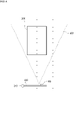
- FIG. 8A is a diagram for explaining the detection range of infrasensor 100 when arm 220 is not rotated with respect to pole 210
- FIGS. FIG. 4 is a diagram for explaining the detection range of the infrasensor 100 in this case;
- the infrasensor 100 can radiate radio waves to a certain detection range 400 and receive reflected waves from an object within the detection range 400 to detect the position of the object.
- a target area 300 which is the guaranteed detection range of the infrastructure sensor 100, is set on the road.
- area of interest 300 is contained within detection range 400 . Therefore, the infrastructure sensor 100 can detect the position of the vehicle V in the target area 300 .
- the detection range 400 moves.
- the detection range 400 after movement includes the target area 300 . Therefore, in this case as well, the infrastructure sensor 100 can detect the position of the vehicle V in the target area 300 .
- the correction unit 123 corrects the position of the vehicle V detected by the detection unit 122 according to the rotation angle ⁇ .
- the correction unit 123 does not correct the position of the vehicle V detected by the detection unit 122 and outputs abnormality information.
- the infrastructure sensor 100 can be set in advance with a first range for determining whether correction by the correction unit 123 can be executed.
- the first range can be set as a range in which the target area 300 can be included within the detection range 400 . That is, in the example shown in FIG. 8B, the rotation angle ⁇ is included in the first range, and in the example shown in FIG. 8C, the rotation angle ⁇ is out of the first range.
- the correction unit 123 does not correct the position of the vehicle V and outputs abnormality information.
- the second range can be set as a small range.
- the second range can be set based on the elastic limit of the pole 210 . That is, when the inclination angle ⁇ of the pole 210 is out of the second range, the deformation of the pole 210 exceeds the elastic limit and is plastically deformed.
- the second range is defined by a first limit (eg, upper limit) and a second limit (eg, lower limit).
- a first limit eg, upper limit
- a second limit eg, lower limit
- the tilt angle detected by the tilt sensor 160 is out of the second range, it means that the tilt angle exceeds either the first limit value or the second limit value. That is, in other words, the correction unit 123 outputs abnormality information without correcting the position of the vehicle V when the tilt angle exceeds the threshold value (first limit value or second limit value).
- the first limit value and the second limit value of the second range are examples of the "second threshold".
- the anomaly information is output to an external terminal connected to the infrastructure sensor 100, for example. If the external terminal is not connected to the infrastructure sensor 100, the abnormality information output from the correction unit 123 is stored in the nonvolatile memory 112, for example. When an external terminal is connected to the infrastructure sensor 100, the abnormality information stored in the nonvolatile memory 112 is transmitted to the external terminal.
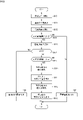
- FIG. 9 is a flow chart showing an example of the operation procedure of the infrastructure sensor 100 according to the embodiment.
- the processor 111 activates the correction program 117
- the infrasensor 100 executes processing as described below.
- the transmission circuit 114 generates a modulated wave, and transmits the generated modulated wave from the transmission antenna 114a.
- the transmitted modulated waves hit the vehicle V, and the reflected waves from the vehicle V are received by the receiving antennas 115a and 115b.
- the receiving circuit 115 processes the reflected wave signal and generates reflected wave data.
- Processor 111 receives reflected wave data (step S101).
- the processor 111 analyzes the reflected wave data and detects reflection points.
- the processor 111 groups reflection points on the same vehicle V and detects the position of the vehicle V (step S102).
- the tilt sensor 160 outputs tilt data indicating the tilt angle ⁇ of the pole 210 .
- Processor 111 receives the tilt data (step S103).
- the processor 111 compares the tilt angle ⁇ with the second range, and determines whether ⁇ falls within the second range (step S104). If ⁇ falls within the second range (YES in step S104), processor 111 proceeds to step S106. If ⁇ is out of the second range (NO in step S104), processor 111 outputs abnormality information (step S105).
- the angle sensor 150 outputs angle data indicating the rotation angle ⁇ of the arm 220 with respect to the pole 210.
- Processor 111 receives the angle data (step S106).
- the processor 111 determines whether or not the rotation angle ⁇ is 0 (step S107). In this case, it is sufficient to determine that the arm 220 is not rotating with respect to the pole 210, so it is sufficient to determine that the rotation angle ⁇ is substantially zero.
- the range including the detection error of the angle sensor 150 can be used as the zero range.
- step S107 the processor 111 outputs the position of the vehicle V detected in step S102 (step S108). In other words, the processor 111 does not correct the detected position of the vehicle V in this case.
- processor 111 determines whether ⁇ falls within the first range (step S109). If ⁇ falls within the first range (YES in step S109), processor 111 proceeds to step S110. is out of the first range (NO in step S109), processor 111 outputs abnormality information (step S105).
- step S110 the processor 111 coordinate-transforms the detected position of the vehicle V from the XYZ coordinate system to the xyz coordinate system.
- the processor 111 applies Equation (1) to the position of the vehicle V after the coordinate transformation, and corrects the position of the vehicle V by ⁇ (step S111). Further, the processor 111 inversely transforms the corrected position of the vehicle V from the xyz coordinate system to the XYZ coordinate system (step S112).
- the processor 111 outputs the corrected position of the vehicle V in the XYZ coordinate system (step S113).
- the infrastructure sensor 100 repeats the above operations. Note that the order of each step does not have to be the order described above. For example, the order of steps S101 and S102 may be between steps S109 and S110. By doing so, when outputting the abnormality information, it is not necessary to execute the process of receiving the reflected wave data, analyzing the reflected wave data, and detecting the position of the vehicle V. FIG.
- Angle sensor 150 may be a non-contact sensor such as a rotary encoder instead of a potentiometer.
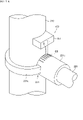
- FIG. 10 is a diagram showing a modification using a rotary encoder as the angle sensor according to the embodiment.
- the angle sensor 150 may include a light emitting element 153a such as an LED, a light receiving element 153b, and slit plates 153c and 153d having a plurality of slits. The slit plates 153c and 153d are arranged between the light emitting element and the light receiving element.
- the first member 151 may include a light emitting element 153a, a light receiving element 153b, and a slit plate 153d
- the second member 152 may include a slit plate 153c. Accordingly, when the second member 152 rotates with respect to the first member 151, the positional relationship between the light emitting element 153a and the light receiving element 153b and the slit plate 153c changes.
- the slit plate 153d is fixedly arranged with respect to the light emitting element 153a and the light receiving element 153b. As a result, the light emitted from the light emitting element 153a is received or not received by the light receiving element 153b depending on the position of the slit plate 153c.
- the rotation angle ⁇ is detected by counting pulses output from the light receiving element 153b.
- the light emitting element 153a, the light receiving element 153b, and the slit plate 153d may be arranged on the second member 152, and the slit plate 153c may be arranged on the first member 151.
- the angle sensor 150 having such a configuration can also detect the rotation angle ⁇ of the arm 220 with respect to the pole 210 .
- the angle sensor 150 can be configured using a reflective optical sensor.
- 11A and 11B are diagrams showing a modification using a reflective optical sensor as the angle sensor according to the embodiment.
- a reflective optical sensor is arranged on the first member 151 .
- the second member 152 is omitted, and a plurality of slits 155 are provided in the arm fixing portion 231b.
- a reflective photosensor is arranged on the second member 152 .
- the first member 151 is omitted and the pole 210 is provided with a plurality of slits 155 .
- the positional relationship between the slit 155 and the reflective optical sensor changes.
- the reflection point of the light emitted from the reflective optical sensor is between two adjacent slits 155, the light reflected on the surface of the arm fixing portion 231b or the pole 210 is received by the reflective optical sensor, and the reflective optical sensor is formed.
- the received light level of the optical sensor increases.
- the reflection point of the light emitted from the reflective photosensor is the slit 155, the light emitted from the reflective photosensor is not reflected, and the light reception level of the reflective photosensor is low.
- the rotation angle ⁇ is detected by counting the pulses output from the reflective photosensor.
- the angle sensor 150 may be a gyro sensor. That is, in this modified example, angle sensor 150 detects the angular velocity of arm 220 . Rotation angle ⁇ of arm 220 with respect to pole 210 is calculated based on the angular velocity detected by angle sensor 150 . That is, by integrating the detected angular velocities, the rotation angle ⁇ of arm 220 with respect to pole 210 can be calculated. The calculation of the rotation angle ⁇ may be performed by the angle sensor 150 or by the processor 111 . The correction unit 123 corrects the position of the vehicle V detected by the detection unit 122 based on the calculated rotation angle.
- angle sensor 150 is a gyro sensor, it is not necessary to place the angle sensor 150 at the joint between the pole 210 and the arm 220.
- Angle sensor 150 may be placed at any position on arm 220 .
- angle sensor 150 may be located within the housing of infrasensor 100 .
- the infrastructure sensor 100 is a radio wave radar in the above embodiment, it is not limited to this. LiDAR (Light Detection and Ranging) or a camera that detects the position of an object using a laser may be used as the infrastructure sensor 100 .
- LiDAR Light Detection and Ranging
- a camera that detects the position of an object using a laser may be used as the infrastructure sensor 100 .
- a traffic monitoring system 10 includes an infrastructure sensor 100 and an angle sensor 150 .
- Infrasensor 100 is attached to arm 200 .
- Arm 200 extends from pole 210 , which is a stationary object fixed to the road surface or equipment, and is rotatable in the circumferential direction of pole 210 .
- Angle sensor 150 is located at the point where arm 220 connects to pole 210 .
- Angle sensor 150 detects the rotation angle of arm 220 with respect to pole 210 .
- Infrasensor 100 includes a detector 122 and a corrector 123 .
- the detection unit 122 detects the position of the vehicle V (object) existing in the target area 300 which is the detection target area of the infrastructure sensor 100 .
- the correction unit 123 corrects the position of the vehicle V detected by the detection unit 122 based on the rotation angle detected by the angle sensor 150 . This makes it possible to correct the detection result of the infrasensor 100 when the installation position of the infrasensor 100 is displaced. Therefore, the vehicle V can be accurately detected by the infrastructure sensor 100 .
- the angle sensor 150 may include a first member 151 and a second member 152.
- the first member 151 is fixed to the pole 210 .
- a second member 152 is fixed to the arm 220 .
- the second member 152 rotates in the circumferential direction of the first member 151 as the arm 220 rotates.
- Angle sensor 150 detects the rotation angle of arm 220 with respect to pole 210 by detecting the rotation angle of second member 152 with respect to first member 151 . Thereby, the angle sensor 150 that detects the rotation angle of the arm 220 with respect to the pole 210 can be realized.
- the arm 220 may be rotatably supported with respect to the pole 210 by a support member 231.
- the support member 231 rotates in the circumferential direction of the pole 210 as the arm 220 rotates.
- Angle sensor 150 may include a first member 151 and a second member 152 .
- the first member 151 is fixed to the pole 210 .
- the second member 152 is fixed to the support member 231 and rotates in the circumferential direction of the first member 151 as the support member 231 rotates.
- Angle sensor 150 detects the angle of arm 220 with respect to pole 210 by detecting the rotation angle of second member 152 with respect to first member 151 . Thereby, the angle sensor 150 can be attached to the connection point between the pole 210 and the arm 220 so as to detect the rotation angle of the arm 220 with respect to the pole 210 .
- the correction unit 123 may output abnormality information without correcting the position of the vehicle V.
- the amount of positional deviation of the infra-sensor 100 is unacceptably large, the detection result of the infra-sensor 100 is not corrected, and the abnormality information can be output.
- the traffic monitoring system 10 may further include a tilt sensor 160.
- the tilt sensor 160 detects the tilt angle of the pole 210 with respect to the vertical axis (reference direction).
- the correction unit 123 may output abnormality information without correcting the position of the vehicle V.
- the abnormality information can be output without correcting the detection result of the infrastructure sensor 100 .
- the traffic monitoring system 10 includes an infrastructure sensor 100 and an angle sensor 150 that is a gyro sensor.
- Infrasensor 100 is attached to arm 200 .
- Arm 200 extends from pole 210 , which is a stationary object fixed to the road surface or equipment, and is rotatable in the circumferential direction of pole 210 .
- Angle sensor 150 detects the angular velocity of arm 220 .
- Infrasensor 100 includes a detector 122 and a corrector 123 .
- the detection unit 122 detects the position of the vehicle V existing in the target area 300 which is the detection target area of the infrastructure sensor 100 .
- the correction unit 123 corrects the position of the vehicle V detected by the detection unit 122 based on the rotation angle of the arm 220 with respect to the pole 210 obtained based on the angular velocity detected by the angle sensor 150 . This makes it possible to correct the detection result of the infrasensor 100 when the installation position of the infrasensor 100 is displaced. Therefore, the vehicle V can be accurately detected by the infrastructure sensor 100 .
- Traffic monitoring system (object detection system) 100 infrastructure sensor 111 processor 112 nonvolatile memory 113 volatile memory 114 transmission circuit 114a transmission antenna 115 reception circuit 115a, 115b reception antenna 116 input/output interface (I/O) 117 correction program 121 input unit 122 detection unit 123 correction unit 150 angle sensor 151 first member 151a brush 151C first circuit 152 second member 152C second circuit 152R resistor 153a light emitting element 153b light receiving element 153c, 153d slit plate 155 slit 160 inclination Sensor 210 pole 220 arm 221 arm body 222 lower support arm 223 upper support arm 231, 232, 233 support member 231a annular portion 231b arm fixing portion 300 target area 400 detection range 400A detection range V vehicle
Landscapes
- Engineering & Computer Science (AREA)
- Radar, Positioning & Navigation (AREA)
- Remote Sensing (AREA)
- Physics & Mathematics (AREA)
- Computer Networks & Wireless Communication (AREA)
- General Physics & Mathematics (AREA)
- Electromagnetism (AREA)
- Traffic Control Systems (AREA)
Priority Applications (3)
| Application Number | Priority Date | Filing Date | Title |
|---|---|---|---|
| US18/576,372 US20240329237A1 (en) | 2021-07-07 | 2022-04-28 | Object detection system and infrastructure sensor |
| CN202280041983.6A CN117480401A (zh) | 2021-07-07 | 2022-04-28 | 物体检测系统和基础设施传感器 |
| JP2023533449A JP7800547B2 (ja) | 2021-07-07 | 2022-04-28 | 物体検出システム及びインフラセンサ |
Applications Claiming Priority (2)
| Application Number | Priority Date | Filing Date | Title |
|---|---|---|---|
| JP2021-112775 | 2021-07-07 | ||
| JP2021112775 | 2021-07-07 |
Publications (1)
| Publication Number | Publication Date |
|---|---|
| WO2023281907A1 true WO2023281907A1 (ja) | 2023-01-12 |
Family
ID=84800206
Family Applications (1)
| Application Number | Title | Priority Date | Filing Date |
|---|---|---|---|
| PCT/JP2022/019373 Ceased WO2023281907A1 (ja) | 2021-07-07 | 2022-04-28 | 物体検出システム及びインフラセンサ |
Country Status (4)
| Country | Link |
|---|---|
| US (1) | US20240329237A1 (https=) |
| JP (1) | JP7800547B2 (https=) |
| CN (1) | CN117480401A (https=) |
| WO (1) | WO2023281907A1 (https=) |
Families Citing this family (2)
| Publication number | Priority date | Publication date | Assignee | Title |
|---|---|---|---|---|
| US12313725B2 (en) * | 2022-09-30 | 2025-05-27 | Zadar Labs, Inc. | System and method for radar static-dynamic segmentation |
| US12313770B2 (en) * | 2022-09-30 | 2025-05-27 | Zadar Labs, Inc. | System and method for radar calibration |
Citations (6)
| Publication number | Priority date | Publication date | Assignee | Title |
|---|---|---|---|---|
| JP2008179269A (ja) * | 2007-01-25 | 2008-08-07 | Mitsubishi Electric Corp | 踏切障害物検知装置 |
| JP2012127906A (ja) * | 2010-12-17 | 2012-07-05 | Fujitsu Ltd | 制御装置、レーダ検知システム、レーダ検知方法 |
| DE102011100628A1 (de) * | 2011-05-05 | 2012-11-08 | Deutsches Zentrum für Luft- und Raumfahrt e.V. | Verfahren und Vorrichtung zur Bestimmung mindestens eines Kameraparameters |
| JP2017009574A (ja) * | 2015-06-24 | 2017-01-12 | パナソニック株式会社 | レーダ軸ずれ量算出装置およびレーダ軸ずれ量算出方法 |
| JP2017508951A (ja) * | 2014-01-31 | 2017-03-30 | エス・エム・エス・スマート・マイクロウェーブ・センサーズ・ゲーエムベーハー | センサ装置 |
| JP2017194385A (ja) * | 2016-04-21 | 2017-10-26 | 住友電気工業株式会社 | 電波センサおよび検知方法 |
Family Cites Families (5)
| Publication number | Priority date | Publication date | Assignee | Title |
|---|---|---|---|---|
| DE3206875C2 (de) * | 1982-02-26 | 1993-05-27 | Dr. Johannes Heidenhain Gmbh, 8225 Traunreut | Winkelmeßeinrichtung |
| JP2003090872A (ja) * | 2001-09-18 | 2003-03-28 | Fujitsu Ltd | 位置測定装置、それを備えた端末及び位置測定方法 |
| JP7255095B2 (ja) * | 2018-05-30 | 2023-04-11 | 株式会社デンソー | 回転検出装置、および、これを用いた電動パワーステアリング装置 |
| JP2020167877A (ja) * | 2019-03-29 | 2020-10-08 | 日本電産エレシス株式会社 | コネクタモジュール及び電力変換装置 |
| US20210190968A1 (en) * | 2019-12-23 | 2021-06-24 | Continental Automotive Systems, Inc. | Self-calibrating infrastructure sensor |
-
2022
- 2022-04-28 WO PCT/JP2022/019373 patent/WO2023281907A1/ja not_active Ceased
- 2022-04-28 JP JP2023533449A patent/JP7800547B2/ja active Active
- 2022-04-28 CN CN202280041983.6A patent/CN117480401A/zh active Pending
- 2022-04-28 US US18/576,372 patent/US20240329237A1/en active Pending
Patent Citations (6)
| Publication number | Priority date | Publication date | Assignee | Title |
|---|---|---|---|---|
| JP2008179269A (ja) * | 2007-01-25 | 2008-08-07 | Mitsubishi Electric Corp | 踏切障害物検知装置 |
| JP2012127906A (ja) * | 2010-12-17 | 2012-07-05 | Fujitsu Ltd | 制御装置、レーダ検知システム、レーダ検知方法 |
| DE102011100628A1 (de) * | 2011-05-05 | 2012-11-08 | Deutsches Zentrum für Luft- und Raumfahrt e.V. | Verfahren und Vorrichtung zur Bestimmung mindestens eines Kameraparameters |
| JP2017508951A (ja) * | 2014-01-31 | 2017-03-30 | エス・エム・エス・スマート・マイクロウェーブ・センサーズ・ゲーエムベーハー | センサ装置 |
| JP2017009574A (ja) * | 2015-06-24 | 2017-01-12 | パナソニック株式会社 | レーダ軸ずれ量算出装置およびレーダ軸ずれ量算出方法 |
| JP2017194385A (ja) * | 2016-04-21 | 2017-10-26 | 住友電気工業株式会社 | 電波センサおよび検知方法 |
Also Published As
| Publication number | Publication date |
|---|---|
| JP7800547B2 (ja) | 2026-01-16 |
| JPWO2023281907A1 (https=) | 2023-01-12 |
| CN117480401A (zh) | 2024-01-30 |
| US20240329237A1 (en) | 2024-10-03 |
Similar Documents
| Publication | Publication Date | Title |
|---|---|---|
| JP5571929B2 (ja) | 障害物検出および警告のためのシステムおよび方法 | |
| JP7800547B2 (ja) | 物体検出システム及びインフラセンサ | |
| KR101962398B1 (ko) | 레이더의 표적 정보 오차 보상 방법 및 장치 | |
| CN102232196A (zh) | 用于光学地扫描和测量周围环境的方法 | |
| US20180052230A1 (en) | Road information detection apparatus and road information detection method | |
| CN111801592B (zh) | 使用微波和毫米波视差对空间的三维和四维测绘 | |
| KR101903960B1 (ko) | 라이다 장치 | |
| JP2018162977A (ja) | 電波センサ、調整方法および調整プログラム | |
| CN114442073B (zh) | 激光雷达的标定方法、装置、车辆及存储介质 | |
| CN111837086A (zh) | 用于检测雷达波偏移的方法和设备 | |
| JP6494694B2 (ja) | 検出装置 | |
| KR20200028648A (ko) | 센서들에 대한 정렬 모델 조정 방법 및 그 방법을 수행하는 전자 장치 | |
| CN110736998A (zh) | 激光雷达系统及其操作方法 | |
| JP6984448B2 (ja) | 照準器、電波センサおよび調整方法 | |
| CN115902845A (zh) | 激光雷达的外参标定方法及相关装置 | |
| EP3667368B1 (en) | Sensor control device | |
| JPWO2023281907A5 (https=) | ||
| KR101565481B1 (ko) | 다지점 적설량 측정 장치 | |
| US11480666B2 (en) | Method and device for determining an operational geographical zone observed by a sensor | |
| JP7452350B2 (ja) | 交通用検知装置および交通用検知方法 | |
| CN113589258A (zh) | 一种可监控电机转速的雷达系统及其实现方法和雷达设备 | |
| Yan et al. | CurveLight: An accurate and practical indoor positioning system | |
| JP7452349B2 (ja) | 交通用検知装置および交通用検知方法 | |
| JP2024164643A (ja) | レーダ装置 | |
| US20210149052A1 (en) | Planimetric Feature Data Structure |
Legal Events
| Date | Code | Title | Description |
|---|---|---|---|
| 121 | Ep: the epo has been informed by wipo that ep was designated in this application |
Ref document number: 22837328 Country of ref document: EP Kind code of ref document: A1 |
|
| WWE | Wipo information: entry into national phase |
Ref document number: 202280041983.6 Country of ref document: CN |
|
| WWE | Wipo information: entry into national phase |
Ref document number: 2023533449 Country of ref document: JP |
|
| WWE | Wipo information: entry into national phase |
Ref document number: 18576372 Country of ref document: US |
|
| NENP | Non-entry into the national phase |
Ref country code: DE |
|
| 122 | Ep: pct application non-entry in european phase |
Ref document number: 22837328 Country of ref document: EP Kind code of ref document: A1 |