WO2023276705A1 - 光学積層体および照明装置 - Google Patents
光学積層体および照明装置 Download PDFInfo
- Publication number
- WO2023276705A1 WO2023276705A1 PCT/JP2022/024180 JP2022024180W WO2023276705A1 WO 2023276705 A1 WO2023276705 A1 WO 2023276705A1 JP 2022024180 W JP2022024180 W JP 2022024180W WO 2023276705 A1 WO2023276705 A1 WO 2023276705A1
- Authority
- WO
- WIPO (PCT)
- Prior art keywords
- light
- layer
- main surface
- light guide
- distribution control
- Prior art date
- Legal status (The legal status is an assumption and is not a legal conclusion. Google has not performed a legal analysis and makes no representation as to the accuracy of the status listed.)
- Ceased
Links
Images







Classifications
-
- B—PERFORMING OPERATIONS; TRANSPORTING
- B32—LAYERED PRODUCTS
- B32B—LAYERED PRODUCTS, i.e. PRODUCTS BUILT-UP OF STRATA OF FLAT OR NON-FLAT, e.g. CELLULAR OR HONEYCOMB, FORM
- B32B7/00—Layered products characterised by the relation between layers; Layered products characterised by the relative orientation of features between layers, or by the relative values of a measurable parameter between layers, i.e. products comprising layers having different physical, chemical or physicochemical properties; Layered products characterised by the interconnection of layers
- B32B7/02—Physical, chemical or physicochemical properties
- B32B7/023—Optical properties
-
- F—MECHANICAL ENGINEERING; LIGHTING; HEATING; WEAPONS; BLASTING
- F21—LIGHTING
- F21S—NON-PORTABLE LIGHTING DEVICES; SYSTEMS THEREOF; VEHICLE LIGHTING DEVICES SPECIALLY ADAPTED FOR VEHICLE EXTERIORS
- F21S2/00—Systems of lighting devices, not provided for in main groups F21S4/00 - F21S10/00 or F21S19/00, e.g. of modular construction
-
- F—MECHANICAL ENGINEERING; LIGHTING; HEATING; WEAPONS; BLASTING
- F21—LIGHTING
- F21V—FUNCTIONAL FEATURES OR DETAILS OF LIGHTING DEVICES OR SYSTEMS THEREOF; STRUCTURAL COMBINATIONS OF LIGHTING DEVICES WITH OTHER ARTICLES, NOT OTHERWISE PROVIDED FOR
- F21V33/00—Structural combinations of lighting devices with other articles, not otherwise provided for
-
- G—PHYSICS
- G02—OPTICS
- G02B—OPTICAL ELEMENTS, SYSTEMS OR APPARATUS
- G02B5/00—Optical elements other than lenses
- G02B5/08—Mirrors
-
- G—PHYSICS
- G02—OPTICS
- G02B—OPTICAL ELEMENTS, SYSTEMS OR APPARATUS
- G02B6/00—Light guides; Structural details of arrangements comprising light guides and other optical elements, e.g. couplings
-
- F—MECHANICAL ENGINEERING; LIGHTING; HEATING; WEAPONS; BLASTING
- F21—LIGHTING
- F21Y—INDEXING SCHEME ASSOCIATED WITH SUBCLASSES F21K, F21L, F21S and F21V, RELATING TO THE FORM OR THE KIND OF THE LIGHT SOURCES OR OF THE COLOUR OF THE LIGHT EMITTED
- F21Y2115/00—Light-generating elements of semiconductor light sources
- F21Y2115/10—Light-emitting diodes [LED]
Definitions
- the present invention relates to an optical laminate and a lighting device.
- An object of the embodiments of the present invention is to provide a lighting device that is rich in design or entertainment and an optical laminate that is preferably used for such a lighting device.
- An optical laminate having a first main surface and a second main surface opposite to the first main surface, a light guide layer having a light receiving portion for receiving light emitted from a light source, a third main surface on the side of the first main surface, and a fourth main surface on the side of the second main surface; a mirror layer having light reflectivity disposed on the fourth main surface side of the light guide layer; A light distribution control structure having a plurality of internal spaces, wherein the plurality of internal spaces direct part of the light propagating in the light guide layer to the first main surface side or the second main surface by total internal reflection. a light distribution control structure forming a side facing interface; An optical laminate having
- the light distribution control structure is a second light distribution control structure in which the plurality of internal spaces are formed in a direction conversion layer provided on the third principal surface side or the fourth principal surface side of the light guide layer. 6.
- a first region in which the optical coupling layer exists and a second region in which the optical coupling layer does not exist are arranged so as to define a predetermined pattern when viewed from the direction normal to the first main surface.
- FIG. 11 an optical laminate according to any one of items 1 to 10; a light source that emits light toward the light receiving unit; A lighting device.
- FIG. 4 is a cross-sectional view schematically showing an internal space IS of the light distribution control structure of lighting device 100A_L. 4 is a plan view schematically showing an internal space IS; FIG. It is a sectional view showing lighting installation 100A_L typically.
- FIG. 10 is a cross-sectional view schematically showing another lighting device 100B_L according to an embodiment of the present invention; FIG. 10 is a cross-sectional view schematically showing still another lighting device 100C_L according to an embodiment of the present invention; FIG.
- FIG. 10 is a cross-sectional view schematically showing still another illumination device 100D_L according to an embodiment of the present invention; It is a sectional view showing lighting installation 100D_L typically.
- FIG. 10 is a cross-sectional view schematically showing still another lighting device 100E_L according to an embodiment of the present invention; It is a sectional view showing lighting installation 100E_L typically. It is a sectional view showing lighting installation 100E_L typically.
- FIG. 10 is a cross-sectional view schematically showing still another lighting device 100F_L according to an embodiment of the present invention; It is a sectional view showing lighting installation 100F_L typically. It is a sectional view showing lighting installation 100A_L typically. It is a sectional view showing lighting installation 100E_L typically.
- FIG. 10 is a cross-sectional view schematically showing still another illumination device 100D_L according to an embodiment of the present invention; It is a sectional view showing lighting installation 100D_L typically.
- FIG. 10 is a cross-sectional
- FIG. 10 is a cross-sectional view schematically showing still another lighting device 100G_L according to an embodiment of the present invention; It is a sectional view showing lighting installation 100G_L typically.
- FIG. 10 is a cross-sectional view schematically showing still another lighting device 100H_L according to an embodiment of the present invention;
- FIG. 10 is a plan view showing an arrangement example of a first region R1 and a second region R2 of the lighting device 100H_L;
- FIG. 10 is a cross-sectional view schematically showing still another illumination device 100I_L according to an embodiment of the present invention;
- optical laminates and lighting devices according to embodiments of the present invention will be described with reference to the drawings. It should be noted that the optical layered body and lighting device according to the embodiments of the present invention are not limited to those exemplified in the following description.
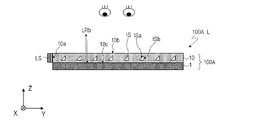
- FIG. 1 is a cross-sectional view schematically showing lighting device 100A_L.
- the illumination device 100A_L includes a light source LS and an optical laminate 100A. As will be described later, the lighting device 100A_L has a function of illuminating the front when the light source LS is on, and functions as a mirror when the light source LS is off.
- the light source LS is, for example, an LED device.
- a plurality of LED devices may be used as the light source LS.
- a plurality of LED devices are arranged, for example, in the X direction.
- the optical laminate 100A has a first principal surface and a second principal surface opposite to the first principal surface.
- the main surface on the upper side is the first main surface
- the main surface on the lower side is the second main surface.
- the lighting device 100A_L functions as a mirror, the first main surface is positioned on the viewer side (front side), and the second main surface is positioned on the side opposite to the viewer side (back side). .
- the optical laminate 100A receives light emitted from the light source LS, propagates the light in the Y direction, and emits the light in the Z direction. Therefore, the first main surface of the optical layered body 100A functions as a light exit surface.
- the light propagation direction has variations (distribution) from the Y direction
- the light emission direction also has variations (distribution) from the Z direction.
- a coupling optical system may be provided between the optical layered body 100A and the light source LS to efficiently guide the light emitted from the light source LS to the optical layered body 100A.
- the optical laminate 100A has a light guide layer 10 and a mirror layer 1.
- the light guide layer 10 includes a light receiving portion that receives light emitted from the light source LS, a third main surface 10b located on the first main surface side (that is, the light emission surface side), and a second main surface side (that is, the light emission surface side). and a fourth main surface 10c located on the opposite side to the surface side.
- the light receiving portion of the light guide layer 10 is a side surface (light receiving side surface) 10a of the light guide layer 10 on the light source LS side.
- the third main surface 10b of the light guide layer 10 is the optical layered body 100A. It is a 1st main surface.
- the mirror layer 1 is arranged on the fourth main surface 10 c side of the light guide layer 10 .
- the mirror layer 1 has light reflectivity.
- the mirror layer 1 includes a layer made of a material that specularly reflects light, as will be described later.
- the optical laminate 100A further has a light distribution control structure having a plurality of internal spaces IS.
- a plurality of internal spaces IS of the light distribution control structure form an interface that directs part of the light propagating in the light guide layer 10 toward the first principal surface by total internal reflection (TIR).
- Each internal space IS has a first inclined surface ISa that directs part of the light propagating in the light guide layer 10 toward the first principal surface by total internal reflection, and a second inclined surface ISa opposite to the first inclined surface ISa. and a surface ISb.
- a light distribution control structure having a plurality of internal spaces IS is formed within the light guide layer 10 .
- the light distribution control structure formed in the light guide layer 10 may be referred to as a "first light distribution control structure".
- the internal space IS is typically a gap (air cavity) filled with air.
- the visible light transmittance and haze value of the light guide layer 10 can be controlled.
- the visible light transmittance of the light guide layer 10 is, for example, 60% or more, preferably 80% or more.
- the haze value of the light guide layer 10 is, for example, less than 30%, preferably less than 10%.
- light with a wavelength of 380 nm or more and 780 nm or less is defined as visible light.
- Visible light transmittance and haze value can be measured using, for example, a haze meter (manufactured by Murakami Color Research Laboratory: trade name HM-150).
- the ratio of the area of the plurality of internal spaces IS to the area of the light guide layer 10 is 1% or more and 80% or less. and more preferably 1% or more and 50% or less. From the viewpoint of obtaining a low haze value, the occupied area ratio of the internal space IS is preferably 30% or less, more preferably 10% or less.
- FIG. 2 is a plan view schematically showing the illumination device 100A_L.
- FIG. 3 is a cross-sectional view schematically showing the internal space IS, and
- FIG. 4 is a plan view schematically showing the internal space IS.
- the plurality of internal spaces IS can be arranged discretely, for example, in the light guide direction (Y direction) of the light guide layer 10 and in a direction intersecting the light guide direction.
- the discrete arrangement may or may not have periodicity (regularity) in at least one direction.
- a plurality of internal spaces IS having substantially the same shape and curved surfaces convex in the same direction are arranged in the light guide direction (Y direction) of the light guide plate 10 and perpendicular to the light guide direction. are arranged discretely and periodically in the direction (X direction).
- the pitch Px of the internal spaces IS in the X direction is preferably 10 ⁇ m or more and 500 ⁇ m or less
- the pitch Py of the internal spaces IS in the Y direction is preferably 10 ⁇ m or more and 500 ⁇ m or less.
- an internal space IS is further provided that is arranged with a 1/2 pitch shift in each of the Y and X directions.
- the first inclined surface ISa forms a convex curved surface toward the light source LS when viewed from above in the direction normal to the first principal surface of the optical layered body 100A.
- the light source LS When a plurality of LED devices arranged in the X direction are used as the light source LS, the light emitted from each LED device spreads in the Y direction.
- the first inclined surface ISa having a curved surface acts more uniformly on light. Note that when a coupling optical system is provided between the light source LS and the light receiving side surface 10a of the light guide layer 10 so that highly parallel light (light with a small spread in the Y direction) is incident, the first inclined surface ISa may be parallel to the X direction.
- the discrete internal spaces IS for example, internal spaces such as grooves (for example, triangular prisms) extending in the X direction may be used.
- the cross-sectional shape of the internal space IS (the cross-sectional shape perpendicular to the X direction in FIG. 1 and parallel to the YZ plane) is, for example, the first main surface side of the optical layered body 100A (Z direction).
- the inclination angle ⁇ a of the first inclined surface ISa on the light source LS side is, for example, 10° or more and 70° or less. If the angle of inclination ⁇ a is less than 10°, the controllability of the light distribution may deteriorate, and the light extraction efficiency may also deteriorate. On the other hand, if the inclination angle ⁇ a exceeds 70°, it may become difficult to process the film that constitutes the light guide layer 10, for example.
- the inclination angle ⁇ b of the second inclined surface ISb is, for example, 50° or more and 100° or less. If the tilt angle ⁇ b is less than 50°, stray light may occur in an unintended direction. On the other hand, if the inclination angle ⁇ b exceeds 100°, it may become difficult to process the film forming the light guide layer 10, for example.
- the cross-sectional shape of the internal space IS is not limited to the triangular shape illustrated here, and may be trapezoidal or the like.
- the two-dimensional size of the internal space IS is defined by the length L and width W of the internal space IS.
- the length L of the internal space IS is preferably 10 ⁇ m or more and 500 ⁇ m or less, for example.
- the width W of the internal space IS is preferably 1 ⁇ m or more and 100 ⁇ m or less, for example.
- the length L of the internal space IS is, for example, twice or more the width W of the internal space IS.
- the height H (see FIG. 3) of the internal space IS is preferably, for example, 1 ⁇ m or more and 100 ⁇ m or less.
- the lighting device 100A_L when the light source LS is turned on, the light emitted from the light source LS and propagating through the light guide layer 10 is controlled by the light distribution control structure. Illumination can be performed by directing the light toward one main surface (light LRa in FIG. 1).
- the illumination device 100A_L When the light source LS is turned off, the illumination device 100A_L functions as a mirror by reflecting (specularly reflecting) the external light incident on the optical laminate 100A on the mirror layer 1, as shown in FIG. It works (light LRb in FIG. 5).
- the lighting device 100A_L can be used as a lighting device when the light source LS is on, and can be used as a mirror when the light source LS is off. That is, the lighting device 100A_L can switch between a mode (illumination mode) functioning as a lighting device and a mode (mirror mode) functioning as a mirror. Therefore, it can be said that the lighting device 100A_L is a design lighting device for a completely new application.
- the lighting device 100A_L has a light distribution control structure having a plurality of internal spaces IS (that is, using total internal reflection), the efficiency of light utilization is high, and the light guide layer 10 (optical laminate It is possible to realize high transparency (visible light transmittance) and low haze value of the body 100A except for the mirror layer 1).
- the visible light transmittance of the light guide layer 10 is preferably 60% or more, and the haze value of the light guide layer 10 is is preferably less than 30%.
- the illumination device 100A_L As a device that functions as both a lighting device and a mirror, it is conceivable to adopt a configuration in which a light source is arranged on the back of a half mirror. In this configuration, when the light source is on, illumination is performed by the light transmitted through the half mirror among the light emitted from the light source. Moreover, in this configuration, the half mirror functions as a mirror by reflecting external light when the light source is turned off. However, in this configuration, since the light reflectance of the half mirror is low, the mirror image in the mirror mode becomes dark. Also, in the lighting mode, part of the light emitted from the light source is reflected by the half mirror, so the light utilization efficiency is low. On the other hand, the illumination device 100A_L according to the embodiment of the present invention has the above-described configuration, thereby suppressing darkening of the mirror image in the mirror mode and increasing the light utilization efficiency in the illumination mode. can be done.
- the illumination device 100A_L can avoid such problems.
- the light guide layer 10 can be made of a known material with high visible light transmittance.
- the light guide layer 10 is made of, for example, an acrylic resin such as polymethyl methacrylate (PMMA), a polycarbonate (PC) resin, a cycloolefin resin, or glass (for example, quartz glass, alkali-free glass, or borosilicate glass). be.
- the refractive index n GP of the light guide layer 10 is, for example, 1.40 or more and 1.80 or less. Unless otherwise specified, the refractive index refers to the refractive index measured with an ellipsometer at a wavelength of 550 nm.
- the thickness of the light guide layer 10 can be appropriately set according to the application.
- the thickness of the light guide layer 10 is, for example, 0.05 mm or more and 50 mm or less.
- the light guide layer 10 formed with a light distribution control structure having a plurality of internal spaces IS is formed by laminating a first film having no pattern and a second film having a desired fine pattern formed thereon, for example. or by bonding with an adhesive (including a pressure sensitive adhesive).
- Laser patterning, direct laser imaging, laser drilling, masked or maskless laser or electron beam irradiation are used to form the micropattern on the second film. Further, individual characteristics may be imparted by printing, inkjet printing, screen printing, or the like, and the material and refractive index value may be changed. Micro/nanodispensing, dosing, direct "writing”, discrete laser sintering, micro electrical discharge machining (micro EDM) or micromachining, micromolding, imprinting, embossing and the like can also be used.
- micro EDM micro electrical discharge machining
- a glass plate whose surface is plated with metal eg, aluminum plating or silver plating
- a metal plate eg, aluminum plate
- a reflective film having a multilayer structure made of resin can also be used.
- the light guide layer 10 and the mirror layer 1 can be bonded together via an adhesive layer, for example.
- adhesive is meant to include pressure-sensitive adhesives (also called adhesives).
- FIG. 6 is a cross-sectional view schematically showing lighting device 100B_L. The following description will focus on the differences between the lighting device 100B_L and the lighting device 100A_L shown in FIG.
- the optical layered body 100B included in the lighting device 100B_L differs from the optical layered body 100A of the lighting device 100A_L in that an antireflection layer 20 is further provided.
- the antireflection layer 20 is arranged on the third main surface 10b side of the light guide layer 10, that is, on the first main surface (light emission surface) side with respect to the light distribution control structure.
- the antireflection layer 20 is provided, so that surface reflection on the first main surface of the optical layered body 100B can be suppressed.
- the antireflection layer 20 for example, a multi-layer laminate composed of a plurality of thin films having different refractive indices can be used.
- Materials for the thin films forming the multilayer laminate include metal oxides, nitrides, fluorides, and the like.
- the antireflection layer 20 is preferably an alternate laminate of high refractive index layers and low refractive index layers.
- the refractive index of the high refractive index layer is, for example, 1.9 or more, preferably 2.0 or more.
- Materials for the high refractive index layer include titanium oxide, niobium oxide, zirconium oxide, tantalum oxide, zinc oxide, indium oxide, indium tin oxide (ITO), and antimony-doped tin oxide (ATO). Among them, titanium oxide or niobium oxide is preferable.
- the refractive index of the low refractive index layer is, for example, 1.6 or less, preferably 1.5 or less.
- Materials for the low refractive index layer include silicon oxide, titanium nitride, magnesium fluoride, barium fluoride, calcium fluoride, hafnium fluoride, and lanthanum fluoride. Among them, silicon oxide is preferred. In particular, it is preferable to alternately stack a niobium oxide (Nb 2 O 5 ) thin film as a high refractive index layer and a silicon oxide (SiO 2 ) thin film as a low refractive index layer.
- a medium refractive index layer having a refractive index of about 1.6 to 1.9 may be provided in addition to the low refractive index layer and the high refractive index layer.
- the film thicknesses of the high refractive index layer and the low refractive index layer are each about 5 nm or more and 200 nm or less, preferably about 15 nm or more and 150 nm or less.
- the film thickness of each layer may be designed so that the reflectance of visible light is reduced according to the refractive index, lamination structure, and the like.
- the method of forming the thin film that constitutes the antireflection layer 20 is not particularly limited, and either a wet coating method or a dry coating method may be used.
- a dry coating method such as vacuum deposition, CVD, sputtering, or electron beam deposition is preferable because a thin film having a uniform thickness can be formed.
- the sputtering method is preferable because it is excellent in uniformity of film thickness and easy to form a dense film.
- the antireflection layer described in JP-A-2020-52221 can be preferably used.
- the entire disclosure of Japanese Patent Application Laid-Open No. 2020-52221 is incorporated herein by reference.
- FIG. 7 is a cross-sectional view schematically showing the lighting device 100C_L. The following description will focus on the differences between the lighting device 100C_L and the lighting device 100A_L shown in FIG.
- the optical layered body 100C included in the lighting device 100C_L differs from the optical layered body 100A of the lighting device 100A_L in that an antifouling layer 30 is further provided.
- the antifouling layer 30 has water repellency and/or oil repellency (hydrophilicity).
- the antifouling layer 30 is arranged on the third main surface 10b side of the light guide layer 10, and is provided as the outermost layer on the first main surface (light exit surface) side of the optical layered body 100C.
- the illuminating device 100C_L is provided with the antifouling layer 30, so that the optical layered body 100C can be prevented from being soiled.
- the configuration of the antifouling layer 30 is appropriately selected according to the application.
- Antifouling layer 30 can be formed using a known material.
- a silicone-based compound or a fluorine-containing compound is preferable.
- fluorine-containing compounds are excellent in water repellency and can exhibit high antifouling properties, and fluorine-based polymers containing a perfluoropolyether skeleton are particularly preferable.
- perfluoropolyethers having a rigidly parallel main chain structure are particularly preferred.
- the structural unit of the main chain skeleton of the perfluoropolyether is preferably an optionally branched perfluoroalkylene oxide having 1 to 4 carbon atoms, such as perfluoromethylene oxide (--CF 2 O--). , perfluoroethylene oxide (--CF 2 CF 2 O--), perfluoropropylene oxide (--CF 2 CF 2 CF 2 O--), perfluoroisopropylene oxide (--CF(CF 3 )CF 2 O--), etc. be done.
- the thickness of the antifouling layer 30 is preferably 3 nm or more and 15 nm or less, more preferably 3 nm or more and 10 nm or less.
- the method for forming the antifouling layer 30 may be a physical vapor deposition method such as vapor deposition or sputtering, a chemical vapor deposition method, a reverse coating method, a die coating method, a wet coating method such as a gravure coating method, or the like, depending on the material. can be used.
- the antifouling layer described in JP-A-2020-067582 can be preferably used.
- the entire disclosure of Japanese Patent Application Laid-Open No. 2020-067582 is incorporated herein by reference.
- An antireflection layer may be arranged on the antifouling layer 30 on the light guide layer 10 side (between the antifouling layer 30 and the light guide layer 10).
- FIG. 8 is a cross-sectional view schematically showing the illumination device 100D_L. The following description will focus on the differences between the lighting device 100D_L and the lighting device 100A_L shown in FIG.
- the optical layered body 100D included in the lighting device 100D_L differs from the optical layered body 100A of the lighting device 100A_L in that the polarization selective reflection layer 40 is further provided.
- the polarization selective reflection layer 40 is arranged on the third main surface 10b side of the light guide layer 10, that is, on the first main surface (light emission surface) side with respect to the light distribution control structure.
- the polarization selective reflection layer 40 selectively reflects light in a specific polarization state (polarization direction) and transmits light in other polarization states.
- the polarization selective reflection layer 40 selectively reflects one of two mutually orthogonal polarized components contained in light and transmits the other polarized component.
- the illuminating device 100D_L is provided with the polarization selective reflection layer 40, it is possible to selectively emit light in a certain polarization state (polarization direction) from the first main surface of the optical laminate 100D in the illumination mode. Therefore, it functions as a polarized illumination device.
- the lighting device 100D_L that can function as a polarized lighting device in this way can be suitably used for, for example, the following uses.
- the applicant of the present application has proposed a peeping prevention system capable of preventing peeping from the outside in International Publication No. 2021/200722.
- the peep prevention system includes a display device and a partition that separates a space in which display is provided by the display device from the surroundings.
- the display device has a first polarizing layer in front of the display surface with a first absorption axis parallel to a first direction (eg one of the horizontal and vertical directions).
- the partition has a translucent portion through which the inside of the space described above can be seen.
- the transparent portion of the partition has a second polarizing layer disposed on the space side of the transparent substrate and having a second absorption axis parallel to a second direction (eg, the other of the horizontal direction and the vertical direction). With such a configuration, it is possible to prevent the display by the display device from being peeped from the outside.
- the lighting device 100D_L By arranging the lighting device 100D_L in a room (for example, a conference room) in which this peep prevention system is used, the visibility of the lighting from the outside in the lighting mode can be reduced.
- the lighting device 100D_L is used as a backlight for a liquid crystal display device, the light extraction efficiency can be further improved.
- the polarization selective reflection layer 40 for example, a multilayer optical film such as DBEF manufactured by 3M can be used.
- the degree of polarization of the polarization selective reflection layer 40 is, for example, 90% or more, preferably 99% or more.
- an antireflection layer 20 may be provided on the polarization selective reflection layer 40 (on the first main surface side of the polarization selective reflection layer 40).
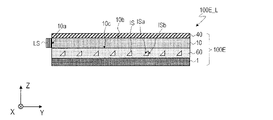
- FIG. 10 is a cross-sectional view schematically showing the illumination device 100E_L. The following description will focus on the differences between the illumination device 100E_L and the illumination device 100D_L shown in FIG.
- the optical layered body 100E included in the lighting device 100E_L differs from the optical layered body 100D of the lighting device 100D_L in that a direction changing layer 60 is further provided.
- the direction changing layer 60 is provided on the third main surface 10b side of the light guide layer 10 .
- the light distribution control structure having a plurality of internal spaces IS is formed in the direction conversion layer 60, not in the light guide layer 10.
- the light distribution control structure formed in the direction changing layer 60 may be referred to as a "second light distribution control structure".
- the light distribution control structure (second light distribution control structure) of the illumination device 100E_L also directs part of the light propagating in the light guide layer 10 toward the first main surface.
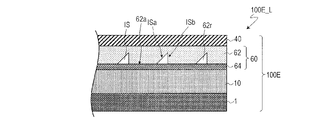
- FIG. 11 shows an example of a specific configuration of the direction changing layer 60 on which the light distribution control structure is formed.
- the direction changing layer 60 includes a shaping film 62 having a fifth main surface 62a having a plurality of recesses 62r, and an adhesive layer disposed on the fifth main surface 62a side of the shaping film 62. 64.
- the adhesive layer 64 is located between the shaping film 62 and the light guide layer 10 , and the light guide layer 10 and the shaping film 62 are adhered by the adhesive layer 64 .
- a plurality of internal spaces IS are defined by a plurality of recesses 62 r of the shaping film 62 and the adhesive layer 64 .
- the shaping film 62 for forming the internal space IS can be produced, for example, by the method described in JP-T-2013-524288. Specifically, for example, the surface of a polymethyl methacrylate (PMMA) film is coated with a lacquer (for example, Fine Cure RM-64 manufactured by Sanyo Chemical Industries, Ltd.), and an optical pattern is embossed on the film surface containing the lacquer. , and then curing the lacquer to form the shaped film 62A.
- PMMA polymethyl methacrylate
- a lacquer for example, Fine Cure RM-64 manufactured by Sanyo Chemical Industries, Ltd.
- the thickness of the adhesive layer 64 is, for example, 0.1 ⁇ m or more and 100 ⁇ m or less, preferably 0.3 ⁇ m or more and 100 ⁇ m or less, and more preferably 0.5 ⁇ m or more and 50 ⁇ m or less.
- the refractive index of the adhesive layer 64 is preferably 1.42 or more and 1.60 or less, more preferably 1.47 or more and 1.58 or less.
- the refractive index of the adhesive layer 64 is preferably close to the refractive index of the light guide layer 10 or the shaping film 62, and the absolute value of the difference in refractive index is preferably 0.2 or less.
- adhesives include rubber-based adhesives, acrylic-based adhesives, silicone-based adhesives, epoxy-based adhesives, cellulose-based adhesives, and polyester-based adhesives. These adhesives may be used alone or in combination of two or more.
- the adhesive layer 64 can adhere without filling the concave portions 62r on the surface of the shaping film 62 .
- the adhesive described in International Publication No. 2021/167090, International Publication No. 2021/167091, or International Application PCT/JP2022/004554 by the present applicant is preferably used. be able to. The entire disclosure of these applications is incorporated herein by reference.
- the polyester-based adhesive described in International Application PCT/JP2022/004554 is preferred.
- the shaping film 62 and the polarization selective reflection layer 40 can be bonded together by an adhesive layer.
- FIG. 10 illustrates a configuration in which the direction changing layer 60 is provided on the third main surface 10b side of the light guide layer 10, but the arrangement of the direction changing layer 60 is not limited to this.
- FIG. 12 shows another example of the arrangement of the redirecting layer 60. As shown in FIG. In the example shown in FIG. 12, the direction changing layer 60 is provided on the fourth main surface 10c side of the light guide layer 10 (that is, between the light guide layer 10 and the mirror layer 1).
- FIG. 13 is a cross-sectional view schematically showing the lighting device 100F_L. The following description will focus on the differences between the lighting device 100F_L and the lighting device 100E_L shown in FIG.
- the optical layered body 100F included in the lighting device 100F_L differs from the optical layered body 100E of the lighting device 100E_L in that a quarter-wave plate 70 is further provided.
- the quarter-wave plate 70 is arranged between the polarization selective reflection layer 40 and the mirror layer 1, and more specifically, on the side of the fourth main surface 10c of the light guide layer 10 (that is, between the light guide layer 10 and the light guide layer 10). mirror layer 1).
- the quarter-wave plate 70 as described above is provided.
- Light that is, light that cannot be transmitted through the polarization selective reflection layer 40
- FIG. 13 shows an example in which the quarter-wave plate 70 is arranged on the fourth main surface 10c side of the light guide layer 10, the arrangement of the quarter-wave plate 70 is not limited to this.
- FIG. 14 shows another example of the arrangement of the quarter wave plate 70. As shown in FIG. In the example shown in FIG. 14, the quarter-wave plate 70 is arranged between the direction changing layer 60 and the polarization selective reflection layer 40 . In the arrangement illustrated in FIG. 13 and the arrangement illustrated in FIG. 14, quarter-wave plate 70 is optically equivalent and functions similarly.
- the light distribution control structure in which part of the light propagating in the light guide layer 10 is directed toward the first main surface side was exemplified. may be configured to face the second main surface side.
- the luminous intensity distribution control structure (first luminous intensity distribution control structure) formed in the light guide layer 10 can internally transmit part of the light propagating in the light guide layer 10 like the illumination device 100A_L shown in FIG. It may have a plurality of internal spaces IS that form an interface directed toward the second principal surface by total reflection.
- the cross-sectional shape of these internal spaces IS is, for example, a triangle having an apex angle on the second main surface side ( ⁇ Z direction in FIG. 15) of the optical layered body 100A.
- the light distribution control structure (second light distribution control structure) formed in the direction changing layer 60 controls part of the light propagating in the light guide layer 10 as in the lighting device 100E_L shown in FIG. It may have a plurality of internal spaces IS forming an interface directed toward the second principal surface by reflection.
- the cross-sectional shape of these internal spaces IS is, for example, a triangle having an apex angle on the second main surface side ( ⁇ Z direction in FIG. 16) of the optical layered body 100A.
- the light directed toward the second main surface is reflected by the mirror layer 1 to be directed toward the first main surface and emitted from the first main surface. Therefore, even when the light distribution control structure is configured to direct part of the light propagating in the light guide layer 10 toward the second main surface, illumination can be performed favorably.
- FIG. 17 is a cross-sectional view schematically showing the lighting device 100G_L. The following description will focus on the differences between the lighting device 100G_L and the lighting device 100E_L shown in FIG.
- the optical laminate 100G included in the illumination device 100G_L further includes an optical coupling layer 80 provided between the light guide layer 10 and the direction changing layer 60.
- the optical coupling layer 80 has a plurality of low refractive index regions 80 a having a refractive index n C smaller than the refractive index n GP of the light guide layer 10 .
- Each low refractive index region 80a is formed in a dot shape with a size of 1 ⁇ m or more and 1000 ⁇ m or less, for example.
- the illumination device 100G_L is provided with the light coupling layer 80 having the plurality of low refractive index regions 80a, so that the light propagating through the light guide layer 10 can be more selectively and efficiently guided to the direction conversion layer 60. can. Further, by adjusting the arrangement density of the plurality of low refractive index regions 80a, the uniformity of emitted light can be controlled. For example, the uniformity of light can be improved by arranging the low refractive index regions 80a densely on the light source LS side and sparsely spaced away from the light source LS.
- the polarization selective reflection layer 40 of the illumination device 100G_L may be omitted as shown in FIG.
- the effect of providing the optical coupling layer 80 can be obtained even in the configuration in which the polarization selective reflection layer 40 is omitted as shown in FIG.
- the direction changing layer 60 may be provided on the fourth main surface 10c side of the light guide layer 10 (that is, between the light guide layer 10 and the mirror layer 1). Even in the configuration in which the direction changing layer 60 is provided on the fourth main surface 10c side of the light guide layer 10, the light coupling layer 80 is provided between the light guide layer 10 and the direction changing layer 60, A similar effect can be obtained.
- the refractive index n C of the low refractive index region 80a is preferably from 1.05 to 1.30, more preferably from 1.05 to 1.25.
- the difference between the refractive index nGP of the light guide layer 10 and the refractive index nC of the low refractive index region 80a is preferably 0.20 or more, more preferably 0.23 or more, and still more preferably 0.25. That's it.
- the low refractive index region 80a having a refractive index n C of 1.30 or less can be, for example, a porous region having a void structure inside.
- the thickness of the low refractive index region 80a is, for example, 0.3 ⁇ m or more and 5 ⁇ m or less.
- the low refractive index region 80a When the low refractive index region 80a is a porous region, its porosity is preferably 35% by volume or more, more preferably 38% by volume or more, and particularly preferably 40% by volume or more. Within such a range, the low refractive index region 80a having a particularly low refractive index can be formed.
- the upper limit of the porosity is, for example, 90% by volume or less, preferably 75% by volume or less. Within such a range, the low refractive index region 80a having excellent strength can be obtained.
- the porosity is calculated by Lorentz-Lorenz's formula from refractive index values measured by an ellipsometer.
- the low refractive index region 80a for example, a low refractive index layer having a void structure disclosed in WO2019/146628 can be used.
- the entire disclosure of WO2019/146628 is incorporated herein by reference.
- the low refractive index regions 80a having a void structure are composed of substantially spherical particles such as silica particles, silica particles having micropores, hollow silica nanoparticles, fibrous particles such as cellulose nanofibers, alumina nanofibers, silica nanofibers, and the like. It may include particles, tabular particles such as nanoclays composed of bentonite, and the like.
- the low refractive index region 80a having a void structure can be a porous body configured by directly chemically bonding particles (for example, microporous particles) to each other. At least a part of the particles forming the low refractive index region 80a having a void structure may be bonded together via a small amount (for example, the mass of the particles or less) of one component of the binder.
- the porosity and refractive index n C of the low refractive index region 80a can be adjusted by the particle size, particle size distribution, etc. of the particles forming the low refractive index region 80a.
- Methods for obtaining the low refractive index region 80a having a void structure include, for example, JP-A-2010-189212, JP-A-2008-040171, JP-A-2006-011175, International Publication No. 2004/113966, and Methods described in those references are included. All of the disclosures of JP-A-2010-189212, JP-A-2008-040171, JP-A-2006-011175, and International Publication No. 2004/113966 are incorporated herein by reference.
- a silica porous body can be suitably used as the low refractive index region 80a having a void structure.
- a silica porous body is produced, for example, by the following method. a silicon compound; hydrolyzable silanes and/or silsesquioxane, and a method of hydrolyzing and polycondensing at least one of its partial hydrolyzate and dehydration condensate; porous particles and/or hollow fine particles; method, method of generating an airgel layer using the springback phenomenon, pulverizing the gel-like silicon compound obtained by the sol-gel method, and chemically pulverizing the resulting pulverized microporous particles with a catalyst or the like. and a method using a combined pulverized gel.
- the low refractive index region 80a is not limited to the silica porous body, nor is the manufacturing method limited to the exemplified manufacturing method, and may be manufactured by any manufacturing method.
- Silsesquioxane is a silicon compound having (RSiO 1.5 , R is a hydrocarbon group) as a basic structural unit, and is strictly different from silica having SiO 2 as a basic structural unit.
- a porous material containing silsesquioxane as a basic structural unit is also referred to herein as a silica porous material or a silica-based porous material, since it has a network structure crosslinked with silica in common.
- the silica porous body can be composed of microporous particles of a gel-like silicon compound bonded together.
- pulverized bodies of the gelled silicon compound can be mentioned.
- the silica porous body can be formed, for example, by coating a base material with a coating liquid containing a pulverized gel-like silicon compound.
- the pulverized gel-like silicon compound can be chemically bonded (for example, siloxane bond) by the action of a catalyst, light irradiation, heating, or the like.
- FIG. 19 is a cross-sectional view schematically showing the lighting device 100H_L. The following description will focus on the differences between the lighting device 100H_L and the lighting device 100G_L shown in FIG.
- the optical laminate 100H included in the illumination device 100H_L includes a first region R1 in which the light distribution control structure exists (that is, the internal space IS is formed) and a first region R1 in which the light distribution control structure does not exist ( That is, it has a second region R2 in which the internal space IS is not formed.
- the first region R1 and the second region R2 are arranged so as to define a predetermined pattern when viewed from above in the direction normal to the first main surface.
- the "design” includes characters, numbers, symbols, pictures, patterns, combinations thereof, and the like.
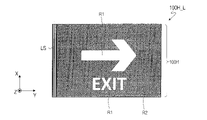
- FIG. 20 shows an example of arrangement of the first region R1 and the second region R2.
- FIG. 20 shows a state in which the lighting device 100H_L is lit.
- the first region R1 in which the light distribution control structure exists is a region (light emitting region) that emits light in the lighting state
- the second region R2 in which the light distribution control structure does not exist substantially It is a region (non-light-emitting region) that does not emit light at all.
- the pattern defined by the first area R1 and the second area R2 is not limited to the one illustrated in FIG.
- the first region R1 in which the light distribution control structure exists and the second region R2 in which the light distribution control structure does not exist are arranged so as to define a predetermined pattern. , can emit light in a predetermined pattern in the lighting mode. Therefore, illumination (light emission) rich in design and entertainment can be realized.
- the first region R1 and the second region R2 are arranged so as to define the characters "EXIT" and the arrow. Therefore, the illumination device 100H_L can be used as a mirror in the mirror mode during normal times, and can be used as a guide light indicating the evacuation direction in the illumination mode in an emergency. Always putting up emergency guidance signs (guide lights) may impair the appearance of facilities and buildings. obtain. In this way, the lighting device 100H_L can be used for more practical purposes depending on the design, and can normally function as a mirror. can.
- FIG. 21 is a cross-sectional view schematically showing the illumination device 100I_L. The following description will focus on the differences between the lighting device 100I_L and the lighting device 100G_L shown in FIG.
- the optical laminate 100I included in the illumination device 100I_L has a first region R1' where the optical coupling layer 80 exists and a second region R2' where the optical coupling layer 80 does not exist.
- the first region R1' and the second region R2' are arranged so as to define a predetermined pattern when viewed from above in the direction normal to the first main surface.
- the first region R1′ where the light coupling layer 80 exists (that is, the low refractive index region 80a is formed)
- the light propagating in the light guide layer 10 is totally reflected by the light coupling layer 80, resulting in a light distribution control structure. (internal space IS) becomes difficult to reach. Therefore, the first region R1' in which the optical coupling layer 80 exists is a region (low-luminance light-emitting region) that emits light (or substantially does not emit light) with relatively low luminance in the lighting state.
- the second region R2' where the optical coupling layer 80 does not exist is a region that emits light with relatively high luminance in the lighting state (high luminance light emitting region).
- the first region R1′ in which the optical coupling layer 80 exists and the second region R2′ in which the optical coupling layer 80 does not exist are arranged so as to define a predetermined pattern.
- light can be emitted so that a predetermined pattern can be visually recognized in the illumination mode. Therefore, illumination (light emission) rich in design and entertainment can be realized.
- a coating method or a printing method can be suitably used.
- a coating method a mask having a predetermined pattern may be used for coating.
- a printing method a plate-type printing method such as gravure printing may be used, or a plateless printing method such as inkjet printing may be used.
- the illumination device according to the embodiment of the present invention is a device for a completely new application that is used by switching between illumination mode and mirror mode, and can be used as a building member, for example.
- Reference Signs List 1 mirror layer 10 light guide layer 10a light receiving side surface of light guide layer 10b third main surface of light guide layer 10c fourth main surface of light guide layer 20 antireflection layer 30 antifouling layer 40 polarization selective reflection layer 60 direction changing layer 62 Shaping film 62r Concave portion of shaping film 64 Adhesive layer 70 Quarter wave plate 80 Optical coupling layer 80a Low refractive index regions 100A, 100B, 100C, 100D, 100E, 100F Optical laminate 100G, 100H, 100I Optical laminate 100A_L, 100B_L, 100C_L Lighting device 100D_L, 100E_L, 100F_L Lighting device 100G_L, 100H_L, 100I_L Lighting device IS Internal space ISa First inclined surface ISb Second inclined surface LS Light source R1, R1' First region R2, R2' Second region
Landscapes
- Physics & Mathematics (AREA)
- Engineering & Computer Science (AREA)
- General Engineering & Computer Science (AREA)
- General Physics & Mathematics (AREA)
- Optics & Photonics (AREA)
- Planar Illumination Modules (AREA)
Priority Applications (1)
| Application Number | Priority Date | Filing Date | Title |
|---|---|---|---|
| JP2023531792A JPWO2023276705A1 (https=) | 2021-06-29 | 2022-06-16 |
Applications Claiming Priority (2)
| Application Number | Priority Date | Filing Date | Title |
|---|---|---|---|
| JP2021107333 | 2021-06-29 | ||
| JP2021-107333 | 2021-06-29 |
Publications (1)
| Publication Number | Publication Date |
|---|---|
| WO2023276705A1 true WO2023276705A1 (ja) | 2023-01-05 |
Family
ID=84692346
Family Applications (1)
| Application Number | Title | Priority Date | Filing Date |
|---|---|---|---|
| PCT/JP2022/024180 Ceased WO2023276705A1 (ja) | 2021-06-29 | 2022-06-16 | 光学積層体および照明装置 |
Country Status (2)
| Country | Link |
|---|---|
| JP (1) | JPWO2023276705A1 (https=) |
| WO (1) | WO2023276705A1 (https=) |
Citations (6)
| Publication number | Priority date | Publication date | Assignee | Title |
|---|---|---|---|---|
| JP2015035252A (ja) * | 2011-11-30 | 2015-02-19 | シャープ株式会社 | 光源装置、面光源装置、表示装置および照明装置 |
| JP2015173066A (ja) * | 2014-03-12 | 2015-10-01 | 大日本印刷株式会社 | バックライト装置、液晶表示装置及び積層体 |
| JP2019061787A (ja) * | 2017-09-25 | 2019-04-18 | オムロン株式会社 | 表示装置及び液晶表示装置 |
| WO2019180676A1 (en) * | 2018-03-22 | 2019-09-26 | Nitto Denko Corporation | Optical device |
| WO2020230783A1 (ja) * | 2019-05-13 | 2020-11-19 | 大日本印刷株式会社 | バリアフィルム、それを用いた波長変換シート、及びそれを用いた表示装置 |
| JP2021093369A (ja) * | 2019-12-10 | 2021-06-17 | 三菱電機株式会社 | 照明装置および拡散体 |
-
2022
- 2022-06-16 JP JP2023531792A patent/JPWO2023276705A1/ja active Pending
- 2022-06-16 WO PCT/JP2022/024180 patent/WO2023276705A1/ja not_active Ceased
Patent Citations (6)
| Publication number | Priority date | Publication date | Assignee | Title |
|---|---|---|---|---|
| JP2015035252A (ja) * | 2011-11-30 | 2015-02-19 | シャープ株式会社 | 光源装置、面光源装置、表示装置および照明装置 |
| JP2015173066A (ja) * | 2014-03-12 | 2015-10-01 | 大日本印刷株式会社 | バックライト装置、液晶表示装置及び積層体 |
| JP2019061787A (ja) * | 2017-09-25 | 2019-04-18 | オムロン株式会社 | 表示装置及び液晶表示装置 |
| WO2019180676A1 (en) * | 2018-03-22 | 2019-09-26 | Nitto Denko Corporation | Optical device |
| WO2020230783A1 (ja) * | 2019-05-13 | 2020-11-19 | 大日本印刷株式会社 | バリアフィルム、それを用いた波長変換シート、及びそれを用いた表示装置 |
| JP2021093369A (ja) * | 2019-12-10 | 2021-06-17 | 三菱電機株式会社 | 照明装置および拡散体 |
Also Published As
| Publication number | Publication date |
|---|---|
| JPWO2023276705A1 (https=) | 2023-01-05 |
Similar Documents
| Publication | Publication Date | Title |
|---|---|---|
| JP7317800B2 (ja) | 光学デバイス | |
| CN111295606B (zh) | 光分布结构和元件,相关方法和用途 | |
| JP7560557B2 (ja) | 照明装置用導光部材、照明装置および建築部材 | |
| KR20030085590A (ko) | 전면발광 터치 패널 | |
| TW202012834A (zh) | 改良式光分佈元件 | |
| KR20020032374A (ko) | 도광판, 면광원 장치 및 반사형 액정 표시장치 | |
| WO2006093087A1 (ja) | 光拡散フィルムおよびこれを用いた面光源素子並びに液晶表示装置 | |
| US12210181B2 (en) | Light guide member for lighting device and lighting device | |
| TW201505847A (zh) | 積層體、積層體的製造方法、光源裝置用導光體及光源裝置 | |
| US20240230978A1 (en) | Light guide member for light emission device and light emission device | |
| WO2023276705A1 (ja) | 光学積層体および照明装置 | |
| JP2009258666A (ja) | 機能性部材、光学部品、バックライトユニット及び表示装置 | |
| JP2004227913A (ja) | 光学素子、その製造方法及び液晶表示装置 | |
| WO2023276836A1 (ja) | 照明装置用導光部材および照明装置 | |
| CN223155344U (zh) | 显示系统以及背光 | |
| KR20250078925A (ko) | 조명 장치 | |
| JP2005005062A (ja) | 面光源装置及びそれを用いた表示装置 | |
| WO2022244474A1 (ja) | 光学装置 | |
| JP2009294672A (ja) | 光学調整部材、並びに、それを備える照明装置及び液晶表示装置 | |
| KR20260021595A (ko) | 적층 필름 및 롤 | |
| WO2024252895A1 (ja) | 積層フィルム | |
| JP2023550917A (ja) | 自己整合バックライト反射板 | |
| JP2003131226A (ja) | 反射型液晶表示装置 | |
| JP2013045762A (ja) | 光学複合シート |
Legal Events
| Date | Code | Title | Description |
|---|---|---|---|
| 121 | Ep: the epo has been informed by wipo that ep was designated in this application |
Ref document number: 22832855 Country of ref document: EP Kind code of ref document: A1 |
|
| WWE | Wipo information: entry into national phase |
Ref document number: 2023531792 Country of ref document: JP |
|
| NENP | Non-entry into the national phase |
Ref country code: DE |
|
| 122 | Ep: pct application non-entry in european phase |
Ref document number: 22832855 Country of ref document: EP Kind code of ref document: A1 |