WO2023214535A1 - 左右の目で独立した表示画像を目視することによる脳疾患又は自立神経失調症の診断装置及びプログラム - Google Patents
左右の目で独立した表示画像を目視することによる脳疾患又は自立神経失調症の診断装置及びプログラム Download PDFInfo
- Publication number
- WO2023214535A1 WO2023214535A1 PCT/JP2023/016668 JP2023016668W WO2023214535A1 WO 2023214535 A1 WO2023214535 A1 WO 2023214535A1 JP 2023016668 W JP2023016668 W JP 2023016668W WO 2023214535 A1 WO2023214535 A1 WO 2023214535A1
- Authority
- WO
- WIPO (PCT)
- Prior art keywords
- user
- image
- autonomic nervous
- display
- brain
- Prior art date
- Legal status (The legal status is an assumption and is not a legal conclusion. Google has not performed a legal analysis and makes no representation as to the accuracy of the status listed.)
- Ceased
Links
Images



Classifications
-
- A—HUMAN NECESSITIES
- A61—MEDICAL OR VETERINARY SCIENCE; HYGIENE
- A61B—DIAGNOSIS; SURGERY; IDENTIFICATION
- A61B10/00—Instruments for taking body samples for diagnostic purposes; Other methods or instruments for diagnosis, e.g. for vaccination diagnosis, sex determination or ovulation-period determination; Throat striking implements
-
- A—HUMAN NECESSITIES
- A61—MEDICAL OR VETERINARY SCIENCE; HYGIENE
- A61B—DIAGNOSIS; SURGERY; IDENTIFICATION
- A61B3/00—Apparatus for testing the eyes; Instruments for examining the eyes
- A61B3/10—Objective types, i.e. instruments for examining the eyes independent of the patients' perceptions or reactions
- A61B3/11—Objective types, i.e. instruments for examining the eyes independent of the patients' perceptions or reactions for measuring interpupillary distance or diameter of pupils
-
- A—HUMAN NECESSITIES
- A61—MEDICAL OR VETERINARY SCIENCE; HYGIENE
- A61B—DIAGNOSIS; SURGERY; IDENTIFICATION
- A61B3/00—Apparatus for testing the eyes; Instruments for examining the eyes
- A61B3/10—Objective types, i.e. instruments for examining the eyes independent of the patients' perceptions or reactions
- A61B3/113—Objective types, i.e. instruments for examining the eyes independent of the patients' perceptions or reactions for determining or recording eye movement
Definitions
- This invention relates to a device for diagnosing a brain disease, autonomic imbalance, by analyzing eyeball movements using the principle that brain activity and autonomic nerve movements are reflected in changes in the eyeballs (pupil and viewpoint).
- this invention uses changes in the user's left and right pupils and the viewpoint within the displayed image when the same or different displayed images are shown to the user's left and right eyes, and the user is diagnosed with a brain disease.
- a diagnostic device for diagnosing whether or not someone is suffering from autonomic nervous system imbalance.
- the pamphlet of International Publication WO2017-057631 describes a user emotion determination device.
- This invention is a device that can simultaneously capture left and right eyeball images with separate cameras, and measures changes in the diameter of a user's pupils or movement of the viewpoint in the displayed images when viewing the same or different left and right displayed images at the same time. By doing so, we aim to provide a new method for diagnosing a user's brain disease, autonomic nervous disorder.
- the present invention basically focuses on changes in the pupils of a user who has a brain disease or poor physical condition due to autonomic nervous disorder and changes in the viewpoint within the displayed image when the left and right independent display images are changed. This is based on the knowledge that the appearance is different from that of healthy people.
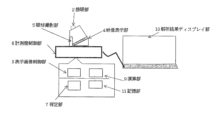
- This brain disease and autonomic nerve imbalance diagnostic device 1 includes a display image control section 3, an eyeball imaging section 5, and a determination section 7.
- the display image control section 3 is an element for changing the display image displayed on the display section.
- the eyeball photographing unit 5 is an element for photographing an eyeball image of a user viewing a displayed image.
- the determining unit 7 uses the size of the user's pupils photographed by the eyeball photographing unit 5 or the pattern of changes over time in the movement of the viewpoint in the displayed image to determine whether the user is suffering from a brain disease or not. This is an element for determining poor physical condition due to ataxia.
- the display image control section 3 changes the display image displayed on the display section based on a pre-stored pattern. Then, the eyeball photographing unit 5 simultaneously photographs left and right eyeball images of the user viewing the displayed image using separate cameras.
- the determining unit 7 receives an image including the user's eyeball image photographed by the eyeball photographing unit 5. Then, the determination unit 7 determines the pattern of changes over time in the size of the user's pupils photographed by the eyeball imaging unit and the movement of the viewpoint, and uses the patterns of changes over time to determine whether the user is suffering from brain disease or autonomic nervous disorder. Determine whether or not you are infected.
- the user is a healthy person.
- the perspective change in the 3D image or the movement of the viewpoint in the maze image is accurate and the time required to reach the destination is close to the average for a healthy person, it can be determined that the patient is not suffering from a brain disease or poor physical condition due to autonomic nervous disorder. .
- the display pattern is one in which, for example, one or more of the brightness, color, and brightness of the display for the left and right eyes, the perspective movement of the stereoscopic display image, and the maze image vary.
- One typical example of a display pattern is a periodically changing white screen and black screen.
- brain diseases are epilepsy, neurodegenerative diseases, neural stem cell diseases, neural progenitor cell diseases, ischemic diseases, neurological trauma, affective disorders, neuropsychiatric diseases, retinal degenerative diseases, retinal damage/trauma, and cognition, learning, and memory. disability, Alzheimer's disease, mild cognitive impairment (MCI), Parkinson's disease, Parkinson's syndrome, Huntington's disease, amyotrophic lateral sclerosis, ischemic stroke, traumatic brain injury, depression, bipolar depression/disorder, chronic fatigue syndrome, Anxiety syndrome/disorder, autism, or Asperger syndrome.
- An example of autonomic imbalance is poor physical condition.
- the user's brain can be improved by simply using a relatively simple device (for example, a device that can simultaneously capture left and right eyeball images with separate cameras, and a device that simultaneously displays the same or different left and right images). It is possible to provide a device that can diagnose whether a person is suffering from a disease, whether the brain disease is severe, whether there is a high risk of suffering from the disease, and the severity of autonomic nervous disorder.
- a relatively simple device for example, a device that can simultaneously capture left and right eyeball images with separate cameras, and a device that simultaneously displays the same or different left and right images.
- Measuring instrument image diagram Example of display screen
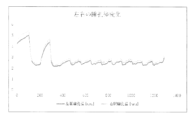
- Example of measuring left and right pupil diameters of a healthy person Representation of changes in left and right pupil diameters of healthy subjects
- Example of viewpoint trajectory in maze image (example of healthy person)
- Example of the trajectory of the viewpoint in a maze image (an example assuming a person with autonomic nervous disorder)
- Viewpoint trajectory diagram of the difference finding image spot the difference image Distribution of left and right attention (measurement example of healthy subjects)
- a brain disease diagnostic device is a device that uses a computer to determine one or more of whether a user is suffering from a brain disease, whether the degree of the brain disease is severe, or whether the user is at a high risk of developing the disease.
- brain diseases are epilepsy, neurodegenerative diseases, neural stem cell diseases, neural progenitor cell diseases, ischemic diseases, neurological trauma, affective disorders, neuropsychiatric diseases, retinal degenerative diseases, retinal damage/trauma, and cognition, learning, and memory. disability, Alzheimer's disease, mild cognitive impairment (MCI), Parkinson's disease, Parkinson's syndrome, Huntington's disease, amyotrophic lateral sclerosis, ischemic stroke, traumatic brain injury, depression, bipolar depression/disorder, chronic fatigue syndrome, Anxiety syndrome/disorder, autism, or Asperger syndrome.
- MCI mild cognitive impairment
- Parkinson's disease Parkinson's syndrome
- Huntington's disease amyotrophic lateral sclerosis
- ischemic stroke traumatic brain injury, depression, bipolar depression/disorder, chronic fatigue syndrome, Anxiety syndrome/disorder, autism, or Asperger syndrome.
- dysautonomia diagnosis examples include transportation operators such as bus drivers, taxi drivers, large and long-distance truck drivers, train drivers, and aircraft pilots, as well as construction site managers and field workers. This is a diagnosis of poor physical condition for people working in jobs such as machine workers in factories where incorrect behavior is always unacceptable due to occupational safety and health concerns.
- This brain disease/autonomic imbalance diagnosis device 1 includes a display image control section 3, an eyeball imaging section 5, and a determination section 7.
- the display image control section 3 is an element for changing the display image displayed on the display section based on the display pattern.
- An example of a display section is a monitor screen.
- This device can be implemented using a computer that is capable of exchanging information with a photographing device such as a camera.
- Information taken by a camera or the like may be input to the computer through a cable or the like. Further, the photographing information may be input to the computer wirelessly.
- a computer includes an input/output section, a control section, an arithmetic section, and a storage section, and each element is configured to be able to exchange information via a bus or the like. Then, the computer stores the input information in the storage section.
- the control section of the computer reads out the control program stored in the storage section, and causes the calculation section to perform various calculations using the input information and the information stored in the storage section. Then, the calculation results are stored in the storage section as appropriate, and are output as appropriate via the input/output section. The calculation results may be displayed on the 10 analysis result display section.
- the display pattern is one in which one or more of, for example, brightness, color, brightness, perspective change of a stereoscopic image, a maze image, and a spot-the-difference image vary based on a predetermined time pattern.
- the frequency of switching may be from 1 second to 10 seconds, or from 2 seconds to 6 seconds, or from 2 seconds to 5 seconds. Switching may be done at regular intervals. Further, the first screen (for example, a white screen) and the second screen (for example, a black screen) may be switched every different number of seconds.
- This pattern may be one in which three or more types of screens can be switched, for example.
- examples of other patterns include a perspective change image using a stereoscopic image that utilizes the feature of independent viewing by the left and right eyes, a maze image, and a difference finding image.
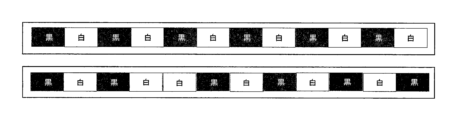
- FIG. 2 is a conceptual diagram showing an example of a display pattern.
- a white screen and a black screen are displayed alternately for the left and right eyes at regular intervals.
- the eyeball photographing unit 5 is an element for simultaneously photographing left and right eyeball images of the user viewing the displayed image using separate cameras.
- the pupil is the area in the center of the eye that allows light to pass through.
- the size of the pupil changes under the influence of light and other factors.
- the pupil has a different color from the surrounding area.
- multiple eyeball images of a certain user are taken, the area where the size changes is analyzed, and the color (color width) of that area is stored.
- the user's pupil color can be memorized.
- a display image including the user's pupils is photographed and the color tone is analyzed.
- the viewpoint calculation method is based on a known technique.
- the eyeball photographing unit 5 has a near-infrared LED light source, and the direction of the line of sight is calculated by a corneal reflection method, etc., which calculates the line of sight angle from the positional relationship between the reflection point of this LED on the cornea and the pupil, and the viewpoint in the displayed image is determined. There is a way to calculate it.
- the determination unit 7 determines whether or not the user is suffering from a brain disease or autonomic nervous disorder, using the pattern of changes over time in the size of the user's pupils photographed by the eyeball imaging unit and the display pattern.
- the position of the viewpoints of both eyes due to changes in perspective of stereoscopic images, changes in pupil diameter, the speed and accuracy of viewpoint movement in maze images, and the degree to which the attention distribution of spot-the-difference images differs from those of healthy people. This is an element for determining whether or not the user is suffering from a brain disease or autonomic nervous disorder.
- the determination unit 7 determines the sizes of the left and right pupils of the user and the movement of the viewpoint over time, for example, based on the above-mentioned algorithm. Then, the determination unit 7 analyzes changes in the size of the user's left and right pupils and movement of the viewpoint over a certain period of time. For example, it is determined whether the sizes of the user's left and right pupils over a certain period of time are increasing or decreasing, or whether the amount of change can be said to be within a constant range. In addition, by determining whether the speed and accuracy of viewpoint movement deviate from those of a healthy person, the determination unit can analyze changes in the user's pupil size and the speed and accuracy of viewpoint movement. .
- the determining unit 7 determines the maximum value and minimum value of the relative value of the user's pupil size for a certain period of time, and further determines the difference ⁇ . Then, the part (upper part) that is within a certain range from the maximum value (for example, the range of 0.2 ⁇ or more and 0.5 ⁇ ), and the part that is within a certain range (for example, the range of 0.2 ⁇ or more and 0.5 ⁇ ) from the minimum value (the lower part). It is also possible to determine whether there is a correlation between the appearance frequency of either or both of the upper part and the lower part and the display pattern. For example, if the lower portion appears at the same frequency as the display pattern change frequency (or within a certain time interval), the user may be determined to be healthy.
- the user can be determined to be healthy if the position of the viewpoints of both eyes due to changes in perspective of the stereoscopic image, the change in pupil diameter, and the speed and accuracy of the movement of the viewpoints in the maze image are within the average range for a healthy person.
- the degree of brain disease is high, or if the index such as the correlation coefficient is within a certain range. If so, it may be determined that there is a risk of developing a brain disease or autonomic nervous system disorder.
- changes in the viewpoint of both eyes due to changes in perspective of stereoscopic images, changes in pupil diameter, speed and accuracy of viewpoint movement in maze images, and viewpoint movement and attention distribution in spot-the-difference images were compared to the average of healthy people. If there is a deviation, it may be determined that the user is at risk of suffering from a brain disease or autonomic nervous disorder.
- Calculation of the degree of attention to a visual object uses the principle that the diameter of the pupil expands when attention is paid to it.
- the pupil diameter also changes depending on the brightness (luminance) of the object to be viewed, it is necessary to understand in advance the relationship between the user-specific reference luminance and the basic pupil diameter. Therefore, using a luminance meter 8 that measures the luminance of the display image on the video display section 4, the user can display a plain black display image with the lowest luminance, a plain white display image with the highest luminance, and an intermediate display image between them.
- the user visually observes a gray plain display image with stepwise brightness, and creates a relationship table between the standard brightness gs and the user's basic pupil diameter Ps.
- Q the total attention level of a specific part of an image is the integral value of Q when the viewpoint is on the specific part.
- the computer may store various diseases and corresponding changes in pupils and viewpoints in the storage unit.
- the computer takes pictures of the pupils and changes in viewpoint of multiple patients for multiple diseases, performs machine learning on each disease, changes in pupils, and changes in viewpoint over time, and creates a database on various diseases and changes in pupils over time. You may also build the .
- the determining unit 7 uses the user's eyeball image photographed by the eyeball photographing unit 5 to obtain and pattern changes in the user's pupils and viewpoint over time, thereby determining whether the user is suffering from a brain disease.
- the display image control section 3 changes the display image displayed on the display section based on a display pattern stored in advance. Then, the eyeball imaging unit 5 obtains an eyeball image of the user viewing the displayed image.
- the determining unit 7 receives an eyeball image including the user's pupil and line of sight, which has been photographed by the eyeball photographing unit 5. Then, the determination unit 7 determines the pattern of change over time in the size of the user's pupils photographed by the eyeball imaging unit and the change in viewpoint in the displayed image, and uses the pattern of change over time and the display pattern to It is determined whether the user is suffering from a brain disease or autonomic nervous system imbalance. Preferably, the determining unit 7 is also capable of diagnosing whether the brain disease and autonomic nervous disorder are severe and whether the risk of contracting the disease is high.
- This specification describes a computer as means for changing the display image displayed on the display unit based on the display pattern; means for receiving a photographed image of the eyeball of a user who visually views the display image photographed by the eyeball photographing section; Using the received captured images, the eyeball imaging unit determines the pattern of changes over time in the size of the user's pupils photographed and the changes in the movement of the viewpoint in the displayed image.
- the present invention also provides a program that functions as a means for determining whether a user is suffering from a brain disease or autonomic nervous disorder using a pattern of changes over time and a display pattern. This program may further enable the computer to implement each function of the above-mentioned brain disease and autonomic nervous disorder diagnostic apparatus.
- This specification describes a computer as a step of changing a display image displayed on the display unit based on the display pattern; a step of receiving a photographed image of an eyeball image of a user viewing a display image, taken by an eyeball photographing unit; Using the received photographic image, the eyeball imaging department determines the pattern of change in pupil size over time and movement of the viewpoint of the user photographed, and displays the determined pattern of change in pupil size over time and movement of the viewpoint.
- a step of determining whether the user is suffering from a brain disease using The present invention also provides a program that causes the user to perform the step of determining autonomic nervous disorder in a user. This program may further enable the computer to realize each function of the above-mentioned brain disease and autonomic nervous disorder diagnostic apparatus.
- this program by installing this program on a mobile device such as a smartphone or a game console, it can provide a simple brain diagnosis and autonomic nervous system diagnosis tool using a smartphone or other device.
- This specification may be a computer-readable information recording medium that stores the above program.
- Examples of information recording media are CD-ROM, DVD, and memory stick.
- the computer's video display section was configured to display an image for the right eye in the upper row and for the left eye in the lower row every 3 seconds, as shown in Figure 2.
- a camera that can take images of the target's eyeballs.
- FIG. 3 is a measurement diagram showing changes in pupil diameter and pattern display of a healthy person. It can be seen that for healthy subjects, there is a correlation between changes in the display pattern and changes in pupil diameter over time (pupil diameter fluctuates approximately every 3 seconds).
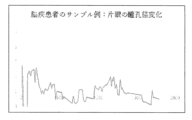
- FIG. 4 is a measurement diagram showing pupil changes and pattern display in the right eye of a patient suffering from Parkinson's disease. It can be seen that there is no correlation between changes in the display pattern and changes in pupil diameter over time, and that the pattern of change in pupil diameter is different from that of healthy individuals.
- Figure 5-1 is an example of the trajectory of the viewpoint in a maze image (an example of a healthy person) Even though his perspective is swaying considerably, he reaches the final goal by following an almost exact route.
- Figure 5-2 is an example of the trajectory of the viewpoint of a person with autonomic nervous system disorder in a maze image. haven't reached the goal.
- Figure 6 is a viewpoint trajectory diagram of a difference finding image (an example of a healthy person) The viewpoint moves to almost the same area on the left and right
- Figure 7-1 is the difference finding image.
- Figure 7-2 is the distribution of left and right attention of users who visually viewed Figure 7-1 (an example of a healthy person). In healthy subjects, the distribution of attention on the left and right sides is even.
- This invention can be used not only as a medical device but also as an application for a mobile terminal.
Landscapes
- Health & Medical Sciences (AREA)
- Life Sciences & Earth Sciences (AREA)
- Engineering & Computer Science (AREA)
- Surgery (AREA)
- General Health & Medical Sciences (AREA)
- Heart & Thoracic Surgery (AREA)
- Medical Informatics (AREA)
- Molecular Biology (AREA)
- Veterinary Medicine (AREA)
- Animal Behavior & Ethology (AREA)
- Biomedical Technology (AREA)
- Public Health (AREA)
- Physics & Mathematics (AREA)
- Biophysics (AREA)
- Ophthalmology & Optometry (AREA)
- Pathology (AREA)
- Human Computer Interaction (AREA)
- Eye Examination Apparatus (AREA)
Priority Applications (1)
| Application Number | Priority Date | Filing Date | Title |
|---|---|---|---|
| JP2024519205A JPWO2023214535A1 (https=) | 2022-05-02 | 2023-04-27 |
Applications Claiming Priority (2)
| Application Number | Priority Date | Filing Date | Title |
|---|---|---|---|
| JP2022-083400 | 2022-05-02 | ||
| JP2022083400 | 2022-05-02 |
Publications (1)
| Publication Number | Publication Date |
|---|---|
| WO2023214535A1 true WO2023214535A1 (ja) | 2023-11-09 |
Family
ID=88646453
Family Applications (1)
| Application Number | Title | Priority Date | Filing Date |
|---|---|---|---|
| PCT/JP2023/016668 Ceased WO2023214535A1 (ja) | 2022-05-02 | 2023-04-27 | 左右の目で独立した表示画像を目視することによる脳疾患又は自立神経失調症の診断装置及びプログラム |
Country Status (2)
| Country | Link |
|---|---|
| JP (1) | JPWO2023214535A1 (https=) |
| WO (1) | WO2023214535A1 (https=) |
Citations (5)
| Publication number | Priority date | Publication date | Assignee | Title |
|---|---|---|---|---|
| JP2002253509A (ja) * | 2000-12-28 | 2002-09-10 | Matsushita Electric Works Ltd | 脳機能検査方法とその装置、脳機能検査システム、脳機能検査サービス方法及びそのプログラムと装置 |
| JP2019521379A (ja) * | 2016-06-20 | 2019-07-25 | マジック リープ, インコーポレイテッドMagic Leap,Inc. | 視覚的処理および知覚の疾患を含む神経学的疾患の評価および修正のための拡張現実ディスプレイシステム |
| WO2020129834A1 (ja) * | 2018-12-17 | 2020-06-25 | 株式会社夏目綜合研究所 | 脳疾患の診断装置 |
| JP2020524530A (ja) * | 2017-05-15 | 2020-08-20 | エムユーエスシー ファウンデーション フォー リサーチ ディベロップメントMusc Foundation For Research Development | 神経機能状態を監視するためのデバイス、システム、および方法 |
| JP2021504093A (ja) * | 2017-11-30 | 2021-02-15 | ビューマインド・エセ・ア | 神経障害の検出および一般的認知能力の測定のためのシステムおよび方法 |
-
2023
- 2023-04-27 JP JP2024519205A patent/JPWO2023214535A1/ja active Pending
- 2023-04-27 WO PCT/JP2023/016668 patent/WO2023214535A1/ja not_active Ceased
Patent Citations (5)
| Publication number | Priority date | Publication date | Assignee | Title |
|---|---|---|---|---|
| JP2002253509A (ja) * | 2000-12-28 | 2002-09-10 | Matsushita Electric Works Ltd | 脳機能検査方法とその装置、脳機能検査システム、脳機能検査サービス方法及びそのプログラムと装置 |
| JP2019521379A (ja) * | 2016-06-20 | 2019-07-25 | マジック リープ, インコーポレイテッドMagic Leap,Inc. | 視覚的処理および知覚の疾患を含む神経学的疾患の評価および修正のための拡張現実ディスプレイシステム |
| JP2020524530A (ja) * | 2017-05-15 | 2020-08-20 | エムユーエスシー ファウンデーション フォー リサーチ ディベロップメントMusc Foundation For Research Development | 神経機能状態を監視するためのデバイス、システム、および方法 |
| JP2021504093A (ja) * | 2017-11-30 | 2021-02-15 | ビューマインド・エセ・ア | 神経障害の検出および一般的認知能力の測定のためのシステムおよび方法 |
| WO2020129834A1 (ja) * | 2018-12-17 | 2020-06-25 | 株式会社夏目綜合研究所 | 脳疾患の診断装置 |
Also Published As
| Publication number | Publication date |
|---|---|
| JPWO2023214535A1 (https=) | 2023-11-09 |
Similar Documents
| Publication | Publication Date | Title |
|---|---|---|
| EP4076139B1 (en) | System and method for determining refraction features of both first and second eyes of a subject | |
| KR101966164B1 (ko) | 가상현실을 이용한 안과 검사 시스템 및 방법 | |
| US10231614B2 (en) | Systems and methods for using virtual reality, augmented reality, and/or a synthetic 3-dimensional information for the measurement of human ocular performance | |
| US20200085298A1 (en) | Systems, methods, and devices for measuring eye movement and pupil response | |
| US10463248B2 (en) | Systems, methods, and devices for measuring eye movement and pupil response | |
| JP2023022142A (ja) | スクリーニング装置及び方法 | |
| JP7396681B2 (ja) | 脳疾患の診断装置 | |
| CN113288044B (zh) | 动态视力检测系统和方法 | |
| US9572486B2 (en) | Device and method for checking human vision | |
| JPWO2020129834A5 (https=) | ||
| JP2022038942A (ja) | 検眼装置及び検眼装置の制御プログラム | |
| CN114340472B (zh) | 调节和聚散度的联合确定 | |
| WO2023214535A1 (ja) | 左右の目で独立した表示画像を目視することによる脳疾患又は自立神経失調症の診断装置及びプログラム | |
| EP3727128B1 (en) | A method of analyzing a visual field of an individual | |
| DE102021202451A1 (de) | Verfahren, System und Computerprogrammprodukt zur Bestimmung optometrischer Parameter | |
| CN113508331A (zh) | 测量被测试者的眼球的旋转特性的测量方法及渐进屈光力镜片的设计方法 | |
| US20240108213A1 (en) | Ophthalmologic apparatus | |
| HK40048473A (en) | Device for diagnosing brain disease | |
| JP2025034650A (ja) | 眼科検査装置及び眼科検査方法 | |
| JP2025009585A (ja) | 光刺激による瞳孔径の変化を測定し、被験者の体調を判定する装置及びプログラム | |
| JPH09276226A (ja) | 眼光学装置及び視線入力装置 | |
| Horiuchi et al. | Development of a tool that increases/reverses the user's binocular parallax with optical elements to change the feeling of depth of a physical object | |
| JP2013202291A (ja) | 変位測定装置、変位測定方法、及びプログラム | |
| Frisch | Determination of stereoacuity thresholds and their inherent test retest reliabilities at various eccentricities with a monitor-based two-rod-test | |
| Broschart | Peripheral Dynamic Stereovision–A Novel Stereoscopic Test |
Legal Events
| Date | Code | Title | Description |
|---|---|---|---|
| 121 | Ep: the epo has been informed by wipo that ep was designated in this application |
Ref document number: 23799465 Country of ref document: EP Kind code of ref document: A1 |
|
| NENP | Non-entry into the national phase |
Ref country code: DE |
|
| WWE | Wipo information: entry into national phase |
Ref document number: 2024519205 Country of ref document: JP |
|
| 122 | Ep: pct application non-entry in european phase |
Ref document number: 23799465 Country of ref document: EP Kind code of ref document: A1 |