WO2023210295A1 - 測定システム - Google Patents
測定システム Download PDFInfo
- Publication number
- WO2023210295A1 WO2023210295A1 PCT/JP2023/014266 JP2023014266W WO2023210295A1 WO 2023210295 A1 WO2023210295 A1 WO 2023210295A1 JP 2023014266 W JP2023014266 W JP 2023014266W WO 2023210295 A1 WO2023210295 A1 WO 2023210295A1
- Authority
- WO
- WIPO (PCT)
- Prior art keywords
- measurement
- circuit
- path
- measurement path
- reference signal
- Prior art date
- Legal status (The legal status is an assumption and is not a legal conclusion. Google has not performed a legal analysis and makes no representation as to the accuracy of the status listed.)
- Ceased
Links
Images











Classifications
-
- G—PHYSICS
- G01—MEASURING; TESTING
- G01R—MEASURING ELECTRIC VARIABLES; MEASURING MAGNETIC VARIABLES
- G01R31/00—Arrangements for testing electric properties; Arrangements for locating electric faults; Arrangements for electrical testing characterised by what is being tested not provided for elsewhere
- G01R31/28—Testing of electronic circuits, e.g. by signal tracer
-
- G—PHYSICS
- G01—MEASURING; TESTING
- G01R—MEASURING ELECTRIC VARIABLES; MEASURING MAGNETIC VARIABLES
- G01R1/00—Details of instruments or arrangements of the types included in groups G01R5/00 - G01R13/00 and G01R31/00
- G01R1/20—Modifications of basic electric elements for use in electric measuring instruments; Structural combinations of such elements with such instruments
- G01R1/203—Resistors used for electric measuring, e.g. decade resistors standards, resistors for comparators, series resistors, shunts
-
- G—PHYSICS
- G01—MEASURING; TESTING
- G01R—MEASURING ELECTRIC VARIABLES; MEASURING MAGNETIC VARIABLES
- G01R1/00—Details of instruments or arrangements of the types included in groups G01R5/00 - G01R13/00 and G01R31/00
- G01R1/30—Structural combination of electric measuring instruments with basic electronic circuits, e.g. with amplifier
-
- G—PHYSICS
- G01—MEASURING; TESTING
- G01R—MEASURING ELECTRIC VARIABLES; MEASURING MAGNETIC VARIABLES
- G01R31/00—Arrangements for testing electric properties; Arrangements for locating electric faults; Arrangements for electrical testing characterised by what is being tested not provided for elsewhere
- G01R31/36—Arrangements for testing, measuring or monitoring the electrical condition of accumulators or electric batteries, e.g. capacity or state of charge [SoC]
- G01R31/396—Acquisition or processing of data for testing or for monitoring individual cells or groups of cells within a battery
-
- G—PHYSICS
- G01—MEASURING; TESTING
- G01R—MEASURING ELECTRIC VARIABLES; MEASURING MAGNETIC VARIABLES
- G01R35/00—Testing or calibrating of apparatus covered by the other groups of this subclass
- G01R35/005—Calibrating; Standards or reference devices, e.g. voltage or resistance standards, "golden" references
- G01R35/007—Standards or reference devices, e.g. voltage or resistance standards, "golden references"
Definitions
- the present disclosure relates to a measurement system.
- the voltage detection device disclosed in Patent Document 1 includes two voltage detection means for selectively detecting the voltage of each battery cell of an assembled battery, a first mode for detecting the voltage of different battery cells, and a first mode for detecting the voltage of different battery cells. , and a second mode for detecting the cell voltage of the same battery cell. In the second mode, if a difference occurs in the measurement results, it is determined that some kind of failure has occurred in one of the voltage detection means.
- Patent Document 1 has a problem in that measurement data of the object to be measured cannot be obtained if a power supply or the like commonly used for the two measurement paths has a failure.
- the present disclosure provides a measurement system that can acquire measurement data of an object to be measured more reliably than before.
- a measurement system includes n (n is an integer of 4 or more) measurement paths that output measurement data obtained by measuring one or more objects to be measured, and a measurement path that is referenced by the n measurement paths.
- n is an integer of 4 or more
- m is an integer of 2 or more
- reference signal generation circuits that output reference signals, each of which outputs the reference signal to two or more measurement paths among the n measurement paths
- a signal generation circuit and k (k is an integer of 2 or more) path abnormality determinations, each of which compares the measurement data output from two of the n measurement paths to determine the presence or absence of an abnormality.
- k is an integer of 2 or more path abnormality determinations, each of which compares the measurement data output from two of the n measurement paths to determine the presence or absence of an abnormality.
- processing circuit into which the measurement data output from each of the n measurement routes and the determination results output from each of the k route abnormality determination circuits are input.
- measurement data of the object to be measured can be acquired more reliably than in the past.
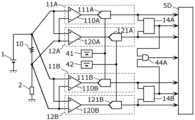
- FIG. 1A is a block diagram showing a first example of the circuit configuration of the measurement system according to the first embodiment.
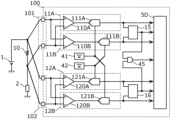
- FIG. 1B is a block diagram showing a second example of the circuit configuration of the measurement system according to the first embodiment.
- FIG. 1C is a block diagram showing a third example of the circuit configuration of the measurement system according to the first embodiment.
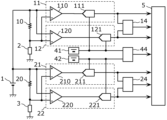
- FIG. 2A is a block diagram showing a first example of the circuit configuration of the measurement system according to the second embodiment.
- FIG. 2B is a block diagram showing a second example of the circuit configuration of the measurement system according to the second embodiment.
- FIG. 2C is a block diagram showing a third example of the circuit configuration of the measurement system according to the second embodiment.
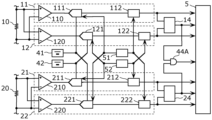
- FIG. 3 is a block diagram showing the circuit configuration of the measurement system according to the third embodiment.
- FIG. 1A is a block diagram showing a first example of the circuit configuration of the measurement system according to the second embodiment.
- FIG. 2B is a block diagram showing a second example of the circuit configuration of the
- FIG. 4 is a block diagram showing a generalized circuit configuration of the measurement system according to the third embodiment.
- FIG. 5A is a block diagram showing a circuit configuration of a measurement system according to Embodiment 4.
- FIG. 5B is a diagram showing a logic value table in the measurement system of FIG. 5A.
- FIG. 6A is a block diagram showing a circuit configuration of a measurement system according to Embodiment 5.
- FIG. 6B is a diagram showing a logic value table in the measurement system of FIG. 6A.
- FIG. 7A is a block diagram showing a first example of another circuit configuration of the measurement system according to the fifth embodiment.
- FIG. 7B is a logical value table in the measurement system of FIG.
- FIG. 7A is a diagram showing the relationship between the output (“H” or “L” signal) of each determination circuit and a failure location.
- FIG. 8A is a block diagram showing a second example of another circuit configuration of the measurement system according to the fifth embodiment.
- FIG. 8B is a logical value table in the measurement system of FIG. 8A, and is a diagram showing the relationship between the output (“H” or “L” signal) of each determination circuit and a failure location.
- FIG. 9A is a block diagram showing a first example of a circuit configuration of a measurement system according to a comparative example.
- FIG. 9B is a block diagram showing a second example of the circuit configuration of the measurement system according to the comparative example.
- FIG. 9C is a block diagram showing a third example of the circuit configuration of the measurement system according to the comparative example.
- FIG. 9A is a block diagram showing a first example of a circuit configuration of a measurement system according to a comparative example.
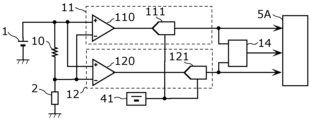
- FIG. 9A shows measurement paths 11 and 12 for a circuit that supplies power from the battery 1 to the load circuit 2, through which the supplied current is detected/measured by the resistor 10 and transmitted to the processing circuit 5A.
- the measurement system includes measurement paths 11 and 12, a determination circuit 14, a band gap reference (hereinafter abbreviated as BGR) circuit 41, and a processing circuit 5A.
- the measurement path 11 includes an amplifier 110 and an analog-to-digital converter (hereinafter abbreviated as an AD converter) 111
- the measurement path 12 includes an amplifier 120 and an AD converter 121.
- the voltage across the resistor 10 is amplified by the amplifier 110, and the output of the amplifier 110 is converted to digital data by the AD converter 111 and output.
- the voltage across the resistor 10 is amplified by an amplifier 120, and the output of the amplifier 120 is converted into digital data by an AD converter 121 and output.
- the outputs of the measurement paths 11 and 12 are compared in the determination circuit 14, and if the difference is within a predetermined value, it is determined that there is no abnormality, and the determination circuit 14 outputs "L" to the processing circuit 5A. If the difference exceeds a predetermined value, it is determined that one of the measurement paths 11 and 12 is abnormal, and "H” is output from the determination circuit 14 to the processing circuit 5A. Therefore, if there is a failure in either of the measurement paths 11 and 12, the determination circuit 14 determines the failure, and the processing circuit 5A can issue a warning as the input measurement data is unreliable.
- “L” indicates a low level signal (for example, 0V)
- "H” indicates a high level signal (for example, 5V), but the present invention is not limited thereto.
- the reference voltage necessary for determining the level of measurement data in each AD converter 111 and 121 is generated by the BGR circuit 41.
- the BGR circuit 41 fails, the outputs of the measurement paths 11 and 12 also become abnormal values, but there is no difference between them, and the determination circuit 14 cannot determine the failure.
- the reference voltage is an example of a reference signal.
- FIG. 9B is a block diagram showing a second example of the circuit configuration of the measurement system according to the comparative example.
- the measurement system according to the second example includes a BGR circuit 42 that generates the same reference voltage as the BGR circuit 41, and each reference voltage outputted by the BGR circuits 41 and 42.
- the configuration includes an additional determination circuit 44 that compares the values and outputs the presence or absence of an abnormality.
- the processing circuit 5B further receives the output from the determination circuit 44.
- the processing circuit 5B has a processing function according to the output from the determination circuit 44 in addition to the processing circuit 5A.
- the determination circuit 14 determines the failure, and if there is a failure in either of the BGR circuits 41 and 42, the determination circuit 44 determines the failure, and the processing circuit 5B A warning can be issued as the input measurement data is unreliable.
- each BGR circuit 41 and 42 outputs a signal corresponding to a reference voltage generated and output internally to the determination circuit 44, and the determination circuit 44 determines whether there is an abnormality by comparing the corresponding signals. I don't mind. This also applies to subsequent embodiments and drawings.
- FIG. 9C is a block diagram showing a third example of the circuit configuration of the measurement system according to the comparative example.
- the measurement system according to the third example has a configuration in which a BGR circuit 42 is added to the measurement system shown in FIG. 9A, and the reference voltage of the BGR circuit 41 is referred to by the AD converter 111.
- the reference voltage of the BGR circuit 42 is configured to be referred to by the AD converter 121. That is, this is a solution by including the BGR circuit 41 in the measurement path 11 and the BGR circuit 42 in the measurement path 12, thereby eliminating the reference signal commonly used in each measurement path 11 and 12.
- the processing circuit 5C has the same function as the processing circuit 5A. Note that being referred to means being used when processing (for example, AD conversion processing) is performed in a processing unit (for example, AD converter 111, etc.).
- this method has a problem in that the circuit scale increases when there are multiple objects to be measured, measurement paths, or reference signals or multiple types of reference signals.
- the measurement paths 11 and 12 may have the same measurement purpose or may have different measurement purposes. For example, when the measurement paths 11 and 12 have the same measurement purpose, the measurement accuracy can be improved by averaging them in the processing circuits 5A to 5C.
- the measurement path 11 is used to calculate and store the power consumption of the load circuit 2 from the supplied current
- the measurement path 12 is used to protect the battery 1 from an abnormal state of the load circuit 2. used for overcurrent detection.
- the measurement paths 11 and 12 detect/measure the current supplied to the same load circuit 2, but since the measurement purposes are different, the required accuracy, processing speed, etc. may be different.
- the purpose of measurement is not limited to current detection, overcurrent detection, etc., and may be generalized and referred to as measurement purpose A, measurement purpose B, etc. in the following description.
- each figure is not necessarily strictly illustrated.
- substantially the same configurations are denoted by the same reference numerals, and overlapping explanations may be omitted or simplified.
- connection of each component means an electrical connection, not only when two components are directly connected, but also when another component is inserted between two components. This also includes cases where two components are indirectly connected in a state.
- FIG. 1A is a block diagram showing a first example of a circuit configuration of a measurement system according to this embodiment.
- FIG. 1A shows measurement paths 11A, 12A, 11B and a measurement path 12B through which the current supplied from the battery 1 to the load circuit 2 is detected/measured by a resistor 10 and transmitted to the processing circuit 5D.
- the resistor 10 is an example of a first object to be measured, and has a function of converting the current supplied to the load circuit 2 into voltage.
- the measurement system includes measurement paths 11A, 12A, 11B, and 12B, BGR circuits 41 and 42, determination circuits 14A, 14B, and 44, and a processing circuit. 5D.
- a plurality of measurement paths including the measurement paths 11A, 12A, 11B, and 12B are also referred to as measurement paths 11A, etc.
- a plurality of AD converters including the AD converters 111A, 121A, 111B, and 121B are referred to as an AD converter. Also written as 111A etc.
- the measurement system includes four measurement paths 11, etc. (an example of n measurement paths), two BGR circuits 41 and 42 (an example of m reference signal generation circuits), and determination circuits 14A and 14B (an example of k measurement paths). It can also be said to include a route abnormality determination circuit (an example) and a processing circuit 5D.
- the number of measurement paths included in the measurement system is not particularly limited as long as it is 4 or more (n is an integer of 4 or more), and the number of BGR circuits is not particularly limited as long as it is 2 or more (m is an integer of 2 or more).
- the number of determination circuits is not particularly limited as long as it is 2 or more (k is an integer of 2 or more).
- measurement paths 11A and 12A will be described as being used for measurement purpose A, and the measurement paths 11B and 12B will be used for measurement purpose B, but the relationship between the measurement paths and measurement purposes is not limited to this.
- Each of the measurement paths 11A, etc. detects/measures current with a resistor 10 and transmits the current to the processing circuit 5D.
- the measurement path 11A includes an amplifier 110A and an AD converter 111A.
- the voltage across the resistor 10 is amplified by the amplifier 110A, and the output of the amplifier 110A is converted into digital data by the AD converter 111A and output to the processing circuit 5D.
- the measurement path 11A is an example of a first measurement path.
- the measurement path 12A includes an amplifier 120A and an AD converter 121A.
- the voltage across the resistor 10 is amplified by the amplifier 120A, and the output of the amplifier 120A is converted into digital data by the AD converter 121A and output to the processing circuit 5D.
- the measurement path 12A is an example of a second measurement path.
- the measurement path 11B includes an amplifier 110B and an AD converter 111B.
- the voltage across the resistor 10 is amplified by the amplifier 110B, and the output of the amplifier 110B is converted into digital data by the AD converter 111B and output to the processing circuit 5D.
- the measurement path 11B is an example of a third measurement path.
- the measurement path 12B includes an amplifier 120B and an AD converter 121B.
- the voltage across the resistor 10 is amplified by the amplifier 120B, and the output of the amplifier 120B is converted into digital data by the AD converter 121B and output to the processing circuit 5D.
- the measurement path 12B is an example of a fourth measurement path.
- the AD converter 111A and the like may be, for example, an AD converter using a delta-sigma method, an AD converter using a SAR (Successive Approximation Register) method, or an AD converter using another method. It may be a vessel.
- Each of the AD converters 111A and the like converts an input voltage into digital data of the same number of bits, for example, but the invention is not limited to this. Furthermore, the time periods during which the AD converters 111A and the like perform AD conversion may be the same or different. Generally, when an AD converter takes a long time to perform AD conversion, a more accurate value can be obtained. Therefore, the time to perform AD conversion is appropriately determined depending on the measurement purpose of the measurement path.
- the determination circuit 14A is connected between the measurement paths 11A and 12A and the processing circuit 5D, and is based on the output of the measurement path 11A (digital value of measurement data) and the output of the measurement path 12A. Determine whether there is any abnormality. For example, the determination circuit 14A compares the measurement data output from the measurement paths 11A and 12A, and determines whether or not there is an abnormality in the measurement paths 11A and 12A.
- the determination circuit 14A is an example of a route abnormality determination circuit (first route abnormality determination circuit).
- the determination circuit 14B is connected between the measurement paths 11B and 12B and the processing circuit 5D, and is based on the output of the measurement path 11B (digital value of measurement data) and the output of the measurement path 12B. Determine whether there is any abnormality. For example, the determination circuit 14B compares the measurement data output from the measurement paths 11B and 12B, and determines whether or not there is an abnormality in the measurement paths 11B and 12B.
- the determination circuit 14B is an example of a route abnormality determination circuit (second route abnormality determination circuit).
- the determination circuits 14A and 14B determine that there is no abnormality if the difference in the measured data is within a predetermined value, and determine that there is an abnormality if the difference in the measured data is greater than the predetermined value.
- L'' is output to the processing circuit 5D.
- the determination circuits 14A and 14B determine whether the difference in the measurement data is within a predetermined value based on, for example, whether or not the upper predetermined bits (for example, the upper 8 bits) match. Alternatively, it may be determined whether the difference between the numerical values indicated by the 10 bits is within a predetermined value.
- the determination circuit 14A uses calculated data obtained by calculating a plurality of digital data output from the AD converter with the shorter time and the AD conversion with the longer time.
- the data may be compared with one piece of digital data output from the device.
- the calculated data is an average value of a plurality of digital data, but may also be a median value, a mode value, etc. The same applies to the determination circuit 14B.
- the BGR circuit 41 is connected to the AD converters 111A and 121A and the determination circuit 44, and outputs reference signals used in the measurement paths 11A and 12A, respectively.
- the BGR circuit 41 is an example of a first reference signal generation circuit.
- the BGR circuit 42 is connected to the AD converters 111B and 121B and the determination circuit 44, and outputs reference signals used in the measurement paths 11B and 12B, respectively.
- the BGR circuit 42 is an example of a second reference signal generation circuit.
- the reference voltage necessary for determining the level of measurement data in the AD converter 111A etc. is generated by the BGR circuits 41 and 42
- the reference voltage output from the BGR circuit 41 is referred to by the AD converter 111A and 121A
- the BGR The reference voltage output by the circuit 42 is referred to by AD converters 111B and 121B. Note that the reference voltage supplied by the BGR circuit 42 and the reference voltage supplied by the BGR circuit 41 are the same voltage.
- the determination circuit 44 is connected between the BGR circuits 41 and 42 and the processing circuit 5D, and based on the output (reference signal) of the BGR circuit 41 and the output (reference signal) of the BGR circuit 42, It is determined whether any of the circuits 42 has a failure.
- the determination circuit 44 determines that there is no abnormality if the difference in reference voltage is within a predetermined value, determines that there is an abnormality if the difference in measured data is greater than the predetermined value, and outputs the determination result (“H” or “ L'') is output to the processing circuit 5D.
- the determination circuit 44 is an example of a circuit abnormality determination section (circuit abnormality determination circuit).
- the determination circuit 14A compares the outputs of the measurement paths 11A and 12A, and if the difference is within a predetermined value, it is determined that there is no abnormality. "L" is output from the determination circuit 14A to the processing circuit 5D, but if the difference exceeds a predetermined value and it is determined that one of the measurement paths 11A and 12A is abnormal, an "H” is output from the determination circuit 14A to the processing circuit 5D. Output.
- the respective outputs of the measurement paths 11B and 12B are compared by the determination circuit 14B, and the determination circuit 14B outputs the presence or absence of an abnormality to the processing circuit 5D.
- each reference voltage outputted by the BGR circuits 41 and 42 is compared in a determination circuit 44, and the determination circuit 44 outputs the presence or absence of an abnormality to the processing circuit 5D.
- the determination circuit 14A determines the failure
- the determination circuit 14B determines the failure
- the determination circuit 44 can determine the failure.
- the processing circuit 5D issues a warning that the current measurement data of the measurement paths 11A and 12A are unreliable when the determination circuit 14A determines a failure
- the processing circuit 5D warns that the reference voltage supplied to each circuit or measurement system is abnormal even if the other determination circuits 14A and 14B do not determine a failure. , it is possible to take measures such as stopping the operation of the load circuit 2.
- measurement of measurement data can be continued through the measurement paths 11B and 12B, and even if the determination circuit 14B determines a failure, the measurement Measurement data can be continued through the paths 11A and 12A.
- FIG. 1B is a block diagram showing a second example of the circuit configuration of the measurement system according to the present embodiment.
- the measurement system shown in FIG. 1B is a simplified version of the determination circuit 44 of the measurement system shown in FIG. 1A.
- the difference between the measurement system shown in FIG. 1B and the measurement system shown in FIG. 1A is that the reference voltage output by the BGR circuit 41 is referenced by the AD converter 111A of the measurement path 11A and the AD converter 111B of the measurement path 11B, and the BGR circuit 42 is referenced by the AD converter 121A of the measurement path 12A and the AD converter 121B of the measurement path 12B.
- the determination circuit 44A can be simplified.
- the determination circuit 44A can be realized by, for example, an AND circuit.
- the output of the determination circuit 14A and the output of the determination circuit 14B are input to the determination circuit 44A.
- the determination circuit 44A is connected to the determination circuits 14A and 14B and the processing circuit 5D, and is connected to the output (“H” or “L”) of the determination circuit 14A and the output (“H” or “L”) of the determination circuit 14B. Based on this, it is determined whether either of the BGR circuits 41 and 42 is abnormal. When the outputs of the determination circuits 14A and 14B are both "H”, the determination circuit 44A outputs "H” indicating that one of the BGR circuits 41 and 42 is abnormal to the processing circuit 5D, and the determination circuit 14A When at least one of the outputs of 14B and 14B is "L", "L” is output to the processing circuit 5D.
- the determination circuit 44A is an example of a circuit abnormality determination section.
- the measurement paths 11A and 12A are measurement paths for the same measurement purpose, but the measurement path 11A refers to the reference voltage from the BGR circuit 41, and the measurement path 12A refers to the reference voltage from the BGR circuit 42.
- the determination circuits 14A and 14B determine the failure, and the determination circuits 44A and 14B determine the failure.
- "H" is output to each of the processing circuits 5D. Therefore, the determination circuit 44A outputs "H" to the processing circuit 5D.
- the determination circuits 14A and 14B simultaneously determine failure only when an abnormality occurs in one of the BGR circuits 41 and 42. That is, the determination circuit 44A has a simpler configuration than the determination circuit 44 shown in FIG. 1A, and has the same function as the determination circuit 44.
- AD converter 111A etc. refers to the reference voltage of which BGR circuit 41 and 42 is not limited to the connection shown in FIG. 1B.
- AD converters on different measurement paths that handle measurement data for the same measurement purpose may be connected so as to refer to reference voltages of different BGR circuits.
- FIG. 1C is a block diagram showing a third example of the circuit configuration of the measurement system according to the present embodiment.
- FIG. 1C shows other connections between the AD converter and the BGR circuit, and is an example of a circuit configuration of a measurement system in which the integrated circuit 100 includes the measurement path 11A, etc. excluding the resistor 10, and the processing circuit 5D.
- the integrated circuit 100 is formed by integrating the terminal pair 101, the terminal pair 102, the measurement path 11A, etc., the determination circuits 15, 16, and 45, and the processing circuit 5D.
- the measurement system shown in FIG. 1C includes a terminal pair 101 (an example of a first terminal pair) connected to measurement paths 11A and 11B, and a terminal pair 102 (an example of a second terminal pair) connected to measurement paths 12A and 12B. (an example of a terminal pair).
- This connection assumes that a separate object to be measured is connected to each of the two terminal pairs 101 and 102, and is a connection for each terminal pair 101 and 102 to support both measurement purposes A and B. .
- the reference voltage output by the BGR circuit 41 is referenced by the AD converter 111A of the measurement path 11A and the AD converter 121B of the measurement path 12B, and the reference voltage output by the BGR circuit 42 is referred to by the AD converter 111A of the measurement path 11B. 111B and the AD converter 121A of the measurement path 12A. Further, each output of the measurement paths 11A and 11B is compared in the determination circuit 15, and if the difference is within a predetermined value, it is determined that there is no abnormality, and the determination circuit 15 outputs "L" to the processing circuit 5D.
- the difference exceeds a predetermined value, it is determined that one of the measurement paths 11A and 11B is abnormal, and "H" is output from the determination circuit 15 to the processing circuit 5D.
- the outputs of the measurement paths 12A and 12B are compared by the determination circuit 16, and the determination circuit 16 outputs the presence or absence of an abnormality to the processing circuit 5D.
- the output of the determination circuit 15 and the output of the determination circuit 16 are input to the determination circuit 45 .
- the AD converters of two measurement paths for the same measurement purpose are connected so as to refer to the reference voltages of different BGR circuits, so that the determination circuit 45 can be simplified as in FIG. 1B.
- the determination circuit 45 can be simplified as in FIG. 1B.
- the measurement data output from the measurement paths 11A and 12A may be used for measurement purpose A
- the measurement data output from measurement paths 11B and 12B may be used for measurement purpose B
- the terminal pairs 101 and 102 may be connected to different devices under test. That is, the measurement paths 11A and 11B and the measurement paths 12A and 12B may measure different objects to be measured.
- each of the measurement paths 11A and 11B and each of the measurement paths 12A and 12B are used for different measurement purposes, and the measurement paths for the same measurement purpose (for example, the measurement paths 11A and 12A and the measurement paths 11B and 12B), a reference signal is supplied from a mutually different BGR circuit (BGR circuit 41 or 42).
- FIG. 2A is a block diagram showing a first example of the circuit configuration of the measurement system according to the present embodiment.
- resistors 10 and 20 are included as one or more objects to be measured.
- the measurement paths 11 and 12 shown in FIG. 2A may have the same configuration as the measurement paths 11A and 12A shown in FIG. 1A, and the measurement paths 21 and 22 may have the same configuration as the measurement paths 11B and 12B shown in FIG. 1A. It may be.
- the determination circuits 14 and 24 may have the same configuration as the determination circuits 14A and 14B shown in FIG. 1A. Therefore, a detailed explanation of the measurement path 11 and the like and the determination circuits 14 and 24 will be omitted.
- FIG. 2A shows a path for supplying power from the battery 1 to two load circuits 2 and 3, and a path for detecting/measuring each supplied current and transmitting it to the processing circuit 5.
- a resistor 10 is connected to detect the current supplied to the load circuit 2, and the voltage across the resistor 10 is transmitted to measurement paths 11 and 12.
- the voltage across the resistor 10 is amplified by the amplifier 110, and the output of the amplifier 110 is converted to digital data by the AD converter 111 and output.
- the voltage across the resistor 10 is amplified by an amplifier 120, and the output of the amplifier 120 is converted into digital data by an AD converter 121 and output.
- the resistor 20 is an example of a second object to be measured, and converts the current supplied to the load circuit 3 into a voltage, and the voltage across the resistor 20 is transmitted to the measurement paths 21 and 22.
- the voltage across the resistor 20 is amplified by an amplifier 210, and the output of the amplifier 210 is converted into digital data by an AD converter 211 and output.
- the voltage across the resistor 20 is amplified by an amplifier 220, and the output of the amplifier 220 is converted into digital data by an AD converter 221 and output.
- the measurement path 11 and the measurement path 12 may be the same type of measurement or may be different types of measurement.
- the processing circuit 5 takes the average of both, thereby improving the measurement accuracy.
- the measurement path 11 is used to calculate and store the power consumption of the load circuit 2 from the supplied current
- the measurement path 12 is used to protect the battery 1 from an abnormal state of the load circuit 2.
- the measurement paths 11 and 12 detect/measure the current supplied to the same load circuit 2, but because they are used for different purposes, the required accuracy, processing speed, etc. are different. This also applies to the measurement paths 21 and 22, or the subsequent embodiments and drawings. Note that the same type of measurement means that the measurement purpose is the same, and the different type of measurement means that the measurement purpose is different.
- Reference voltages necessary for determining the level of measurement data in each AD converter 111 etc. are generated by BGR circuits 41 and 42, the reference voltage output from BGR circuit 41 is referred to by AD converters 111 and 121, and BGR circuit 42 is generated by BGR circuits 41 and 42.
- the output reference voltage is referred to by AD converters 211 and 221.
- the BGR circuits 41 and 42 output reference signals used in measurement paths for different objects under test.
- the outputs of the measurement paths 11 and 12 are compared in the determination circuit 14, and if the difference is within a predetermined value, it is determined that there is no abnormality, and the determination circuit 14 outputs "L" to the processing circuit 5. If the difference exceeds a predetermined value, it is determined that one or both of the measurement paths 11 and 12 is abnormal, and the determination circuit 14 outputs "H" to the processing circuit 5. Similarly, the outputs of the measurement paths 21 and 22 are compared by the determination circuit 24, and the determination circuit 24 outputs the presence or absence of an abnormality to the processing circuit 5. Further, the reference voltages output by the BGR circuits 41 and 42 are compared by a determination circuit 44, and the determination circuit 44 outputs the presence or absence of an abnormality to the processing circuit 5.
- the determination circuit 14 determines the failure, and if there is an abnormality in the measurement path 21 or the measurement path 22, the determination circuit 24 determines the failure. be able to. In addition, if there is an abnormality in the BGR circuit 41 or 42, the determination circuit 14 and the determination circuit 24 cannot detect it, but the determination circuit 44 can determine the failure.
- the processing circuit 5 can issue a warning that the current supplied to the load circuit 2 cannot be detected/measured correctly, and can take measures such as stopping the operation of the load circuit 2, for example.
- the processing circuit 5 can take measures such as warning that the current supplied to the load circuit 3 cannot be detected/measured correctly and stopping the operation of the load circuit 3.
- the processing circuit 5 warns that the reference voltage supplied to each circuit or measurement system is abnormal even if the other determination circuits 14 and 24 do not determine a failure. , measures can be taken such as stopping the operation of all loaded circuits.
- FIG. 2B is a block diagram showing a second example of the circuit configuration of the measurement system according to this embodiment.
- the measurement system shown in FIG. 2B is a simplified version of the determination circuit 44 of the measurement system shown in FIG. 2A.
- the measurement system shown in FIG. 2B is different from the measurement system shown in FIG. 2A because the reference voltage output by the BGR circuit 41 is referenced by the AD converter 111 of the measurement path 11 and the AD converter 211 of the measurement path 21, and the BGR circuit 42 is referenced by the AD converter 121 of the measurement path 12 and the AD converter 221 of the measurement path 22.
- the determination circuit 44A is an AND circuit similar to the measurement system shown in FIG. 1B, and the output of the determination circuit 14 and the output of the determination circuit 24 are inputted thereto.
- the BGR circuit 41 supplies a reference voltage to the AD converters 111 and 211.
- the BGR circuit 41 supplies a common reference voltage to the measurement paths 11 and 21, which are different objects to be measured but have the same measurement purpose.
- BGR circuit 42 supplies reference voltage to AD converters 121 and 221.
- the BGR circuit 42 supplies a common reference voltage to the measurement paths 12 and 22, which are different objects to be measured but have the same measurement purpose.
- measurement paths 11 and 12 are measurement paths for measuring the same object under test, but measurement path 11 refers to the reference voltage from BGR circuit 41, and measurement path 12 refers to the reference voltage from BGR circuit 42. refer.
- measurement path 11 refers to the reference voltage from BGR circuit 41
- measurement path 12 refers to the reference voltage from BGR circuit 42. refer.
- the judgment circuits 14 and 24 will judge the failure at the same time when an abnormality occurs in one of the BGR circuits 41 and 42. That is, the determination circuit 44A has a simpler configuration than the determination circuit 44 shown in FIG. 2A, and can function similarly to the determination circuit 44.
- AD converter 111 etc. refers to which reference voltage of which BGR circuit 41 and 42 is not limited to the connection shown in FIG. 2B.
- AD converters on different measurement paths that handle measurement data of the same DUT may be connected so as to refer to reference voltages of different BGR circuits.
- FIG. 2C is a block diagram showing a third example of the circuit configuration of the measurement system according to this embodiment.
- FIG. 2C shows another example of the connection of the AD converter and the BGR circuit.
- the measurement system shown in FIG. 2C is different from the measurement system shown in FIG. 2B because the reference voltage output by the BGR circuit 41 is referenced by the AD converter 111 of the measurement path 11 and the AD converter 221 of the measurement path 22, and the BGR circuit 42 is referenced by the AD converter 121 of the measurement path 12 and the AD converter 211 of the measurement path 21.
- the BGR circuit 41 supplies a reference voltage to the AD converters 111 and 221.
- the BGR circuit 41 supplies a common reference voltage to the measurement paths 11 and 22, which have different objects under test and different measurement purposes.
- BGR circuit 42 supplies reference voltage to AD converters 121 and 211.
- the BGR circuit 42 supplies a common reference voltage to the measurement paths 12 and 21, which have different objects under test and different measurement purposes.
- FIG. 2C the AD converters of the two measurement paths of the same object under test are connected so as to refer to the reference voltages of different BGR circuits, so the determination circuit 44A can be simplified as in FIG. 2B. Further, the configuration shown in FIG. 2C corresponds to the configuration in FIG. 1C in which AD converters of two measurement paths for the same measurement purpose are connected to refer to reference voltages of different BGR circuits.
- the digital data output from the AD converter in the measurement path is often subjected to processing such as arithmetic processing in a post-signal processing circuit and latching processing to a register that can be accessed from the outside.
- a sequencer circuit may be used in the measurement system to adjust AD conversion output timing, various processing timings, and the like.
- the sequencer circuit generates various trigger signals in accordance with the counter value of a counter synchronized with an internal system clock.
- the AD converter, post-signal processing circuit, etc. refer to these various trigger signals and perform appropriate output, processing, etc.
- the post-signal processing circuit is a processing circuit different from the processing circuit 5 connected between the AD converter and the processing circuit (for example, the processing circuit 5 shown in FIG. 3).
- Various trigger signals are examples of reference signals.
- the post-signal processing circuit will also be referred to as a post-signal processing section.
- FIG. 3 is a block diagram showing the circuit configuration of the measurement system according to this embodiment.
- the measurement system shown in FIG. 3 is different from the measurement system shown in FIG. 2C in that each AD converter 111, etc. and each post-signal processing unit 112, etc. generate various necessary trigger signals (hereinafter also referred to as reference signals).
- the difference is that sequencer circuits 51 and 52 are provided. Note that in FIG. 3, illustration of the battery 1 and load circuits 2 and 3 is omitted for convenience.
- the measurement path 11 includes an amplifier 110, an AD converter 111, and a post-signal processing section 112.
- Post-signal processing section 112 is connected between AD converter 111 and processing circuit 5.
- the voltage across the resistor 10 is amplified by the amplifier 110
- the output of the amplifier 110 is converted to digital data by the AD converter 111 and output
- the output of the AD converter 111 is output by the post-signal processing section 112 . It is subjected to predetermined processing and output to the processing circuit 5.
- the measurement path 12 includes an amplifier 120, an AD converter 121, and a post-signal processing section 122.
- Post-signal processing section 122 is connected between AD converter 121 and processing circuit 5.
- the voltage across the resistor 10 is amplified by the amplifier 120
- the output of the amplifier 120 is converted to digital data by the AD converter 121 and output
- the output of the AD converter 121 is output by the post-signal processing section 122 . It is subjected to predetermined processing and output to the processing circuit 5.
- the measurement path 21 includes an amplifier 210, an AD converter 211, and a post-signal processing section 212.
- Post-signal processing section 212 is connected between AD converter 211 and processing circuit 5.
- the voltage across the resistor 20 is amplified by the amplifier 210
- the output of the amplifier 210 is converted to digital data by the AD converter 211 and output
- the output of the AD converter 211 is output by the post-signal processing section 212 . It is subjected to predetermined processing and output to the processing circuit 5.
- the measurement path 22 includes an amplifier 220, an AD converter 221, and a post-signal processing section 222.
- Post-signal processing section 222 is connected between AD converter 221 and processing circuit 5.
- the voltage across the resistor 20 is amplified by the amplifier 220
- the output of the amplifier 220 is converted to digital data by the AD converter 221 and output
- the output of the AD converter 221 is output by the post-signal processing section 222 . It is subjected to predetermined processing and output to the processing circuit 5.
- predetermined processes in the post-signal processing unit 112 and the like may be the same process or may be different processes.
- the reference signal output by the sequencer circuit 51 is referenced by at least one of the AD converters 111 and 221 and the post-signal processing units 112 and 222, and in the example of FIG. 3, both of them.
- the reference signal output by the sequencer circuit 51 is a reference signal different from the reference signal output by the BGR circuit 41.
- the reference signal output by the sequencer circuit 52 is referenced by at least one of the AD converters 121 and 211 and the post-signal processing units 122 and 212, and in the example of FIG. 3, both of them.
- the reference signal output by the sequencer circuit 52 is a reference signal different from the reference signal output by the BGR circuit 42.
- the measurement system may include determination circuits for the sequencer circuits 51 and 52, which correspond to determination circuits for the BGR circuits 41 and 42.
- the determination circuits of the sequencer circuits 51 and 52 directly check that the timings of the various trigger signals described above match, and indirectly that the counter values of the counters inside the sequencer circuits 51 and 52 match. good.
- the sequencer circuits 51 and 52 are an example of m reference signal generation circuits.
- the sequencer circuit 51 is an example of a third reference signal generation circuit
- the sequencer circuit 52 is an example of a fourth reference signal generation circuit.
- the configuration of FIG. 3 refers to reference voltages from different BGR circuits 41 and 42 and reference signals from different sequencer circuits 51 and 52 (for example, See also trigger signal).
- measurement paths 11 and 12 are measurement paths for measuring the same object to be measured.
- the measurement path 11 receives reference signals from the BGR circuit 41 and the sequencer circuit 51
- the measurement path 12 receives reference signals from the BGR circuit 42 and the sequencer circuit 52.
- the determination circuit 44A outputs “H” to the processing circuit 5. Unless it is assumed that two failures occur at the same time, the determination circuits 14 and 24 will determine failure at the same time when an abnormality occurs in the BGR circuits 41 and 42 or the sequencer circuits 51 and 52.
- the determination circuit 44A is connected between the determination circuits 14 and 24 and the processing circuit 5, and determines whether the BGR circuits 41 and 42 or the sequencer circuits 51 and 52 are connected based on the output of the determination circuit 14 and the output of the determination circuit 24. It functions as a determination circuit that determines abnormality.
- FIG. 4 is a block diagram showing the circuit configuration when the measurement system according to this embodiment is generalized. Note that, in order to avoid complication of the drawings, the determination circuits 14, 24, and 44A are incorporated in the processing circuit 5E, and are not shown.
- Two reference signal generation circuits (41 and 42, 51 and 52, . . . n1 and n2) that generate signals are provided. By referring to the reference signals from different reference signal generation circuits in each measurement path, it is possible to determine the failure of the reference signal generation circuit from the output of the determination circuit of each measurement path.
- the object to be measured will be generalized and expressed as a block as shown in FIG.
- a block called a BGR circuit and an output called a reference signal are collectively expressed.
- Embodiment 4 and the like described above describe a measurement system that performs failure determination by providing two reference signal generation circuits (for example, BGR circuits 41 and 42) and two measurement paths connected to each object under test.
- the number of reference signal generation circuits may be three, and the number of measurement paths connected to the object under test may be three. Thereby, it is possible to realize a measurement system that can identify a failure location including the reference signal generation circuit.
- FIG. 5A is a block diagram showing the circuit configuration of the measurement system according to this embodiment.
- the measurement system includes measurement paths 11, 12, and 13 for measuring/processing the resistance 10, measurement paths 21, 22, and 23 for measuring/processing the resistance 20, and a BGR. It includes circuits 41, 42, and 43, determination circuits 14, 15, 24, 25, 45, and 46, and a processing circuit 6. Reference signals necessary for measurement/processing in each measurement path 11 etc. are generated by BGR circuits 41 and 42, and the reference signal outputted by BGR circuit 41 is referred to by measurement paths 11, 12 and 13, and output by BGR circuit 42. Reference signals are referenced in the measurement paths 21, 22 and 23. Further, the reference signal output by the BGR circuit 43 is not referenced by any measurement path such as the measurement path 11.
- the BGR circuit 43 is configured to be able to output the reference signal output from the BGR circuit 41 and the reference signal output from the BGR circuit 42, and outputs the reference signal used for failure determination of the BGR circuits 41 and 42.
- the BGR circuit 43 is an example of a fifth reference signal generation circuit.
- the measurement path 13 is an example of the fifth measurement path, and the measurement path 23 is an example of the sixth measurement path.
- the determination circuit 14 is an example of a first route abnormality determination circuit
- the determination circuit 15 is an example of a third route abnormality determination circuit
- the determination circuit 24 is an example of a second route abnormality determination circuit
- the determination circuit 25 is an example of a fourth route abnormality determination circuit.
- the measurement paths 11, 12, and 13 are connected between the resistor 10 and the processing circuit 6, and the measurement paths 21, 22, and 23 are connected between the resistor 20 and the processing circuit 6.
- the judgment circuit 14 is connected between the measurement paths 11 and 12 and the processing circuit 6, and receives the outputs of the measurement paths 11 and 12, and the judgment circuit 15 is connected between the measurement paths 12 and 13 and the processing circuit 6. The outputs of measurement paths 12 and 13 are inputted.
- the judgment circuit 24 is connected between the measurement paths 21 and 22 and the processing circuit 6, and receives the outputs of the measurement paths 21 and 22, and the judgment circuit 25 is connected between the measurement paths 22 and 23 and the processing circuit 6. The outputs of the measurement paths 22 and 23 are inputted.
- the determination circuit 45 is connected between the BGR circuits 41 and 43 and the processing circuit 6, and receives the outputs of the BGR circuits 41 and 43, and the determination circuit 46 is connected between the BGR circuits 42 and 43 and the processing circuit 6. , and the outputs of the BGR circuits 42 and 43 are inputted thereto.
- the BGR circuit 41 outputs a reference signal used in the measurement paths 11, 12, and 13, and the BGR circuit 42 outputs a reference signal used in the measurement paths 21, 22, and 23.
- the determination circuit 14 compares the respective outputs of the measurement paths 11 and 12, and if the difference is within a predetermined value, it is determined that there is no abnormality, and the determination circuit 14 outputs "L" to the processing circuit 6 (V14 shown in FIG. 5A). ) is output, but if the difference exceeds a predetermined value, it is determined that one of the measurement paths 11 and 12 is abnormal, and the determination circuit 14 outputs "H" (V14 shown in FIG. 5A) to the processing circuit 6. Output. Similarly, each output of the measurement path 12 and the measurement path 13 is compared in the determination circuit 15, and the determination circuit 15 outputs the presence or absence of an abnormality to the processing circuit 6 (V15 shown in FIG. 5A).
- the respective outputs of the measurement paths 21 and 22 are compared in the determination circuit 24, and the determination circuit 24 outputs the presence or absence of an abnormality (V24 shown in FIG. 5A) to the processing circuit 6.
- the respective outputs of the measurement paths 22 and 23 are compared by the determination circuit 25, and the determination circuit 25 outputs the presence or absence of an abnormality (V25 shown in FIG. 5A) to the processing circuit 6.
- the determination circuit 14 determines whether or not there is an abnormality in the measurement paths 11 and 12 based on the outputs of the measurement paths 11 and 12, and the determination circuit 15 determines whether or not there is an abnormality in the measurement paths 11 and 12 based on the outputs of the measurement paths 12 and 13. The presence or absence of an abnormality in the measurement paths 12 and 13 is determined. Further, the determination circuit 24 determines whether or not there is an abnormality in the measurement paths 21 and 22 based on the outputs of the measurement paths 21 and 22, and the determination circuit 25 determines whether or not there is an abnormality in the measurement paths 21 and 22 based on the outputs of the measurement paths 22 and 23. It is determined whether there is an abnormality in the routes 22 and 23. The output of the measurement path 12 is input to each of the determination circuits 14 and 15, and the output of the measurement path 22 is input to each of the determination circuits 24 and 25.
- each reference voltage outputted by the BGR circuits 41 and 43 is compared in a determination circuit 45, and the presence or absence of an abnormality in the BGR circuit 41 is output.
- the determination circuit 45 determines whether the BGR circuit 41 is abnormal based on the output of the BGR circuit 41 and the output of the BGR circuit 43.
- each reference voltage outputted by the BGR circuits 42 and 43 is compared by a determination circuit 46, and the presence or absence of an abnormality in the BGR circuit 42 is outputted.
- the determination circuit 46 determines whether the BGR circuit 42 is abnormal based on the output of the BGR circuit 42 and the output of the BGR circuit 43.
- the reference voltage output by the BGR circuit 43 is compared by each of determination circuits 45 and 46, and the presence or absence of an abnormality is output.
- the processing circuit 6 determines whether the BGR circuit 43 is abnormal based on the output of the determination circuit 45 and the output of the determination circuit 46 .
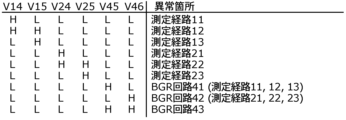
- each determination circuit 14 From the output of each determination circuit 14, etc., it is possible to identify the presence or absence of a failure and the location of the failure as described below. If all the circuits are normal, all the determination circuits 14 and the like output "L". If the measurement path 11 is out of order, only the determination circuit 14 outputs "H", and if the measurement path 12 is out of order, the determination circuits 14 and 15 output "H", and the measurement path 13 If there is a failure, only the determination circuit 15 outputs "H”. Similarly, when the measurement path 21 is out of order, only the judgment circuit 24 outputs “H”, and when the measurement path 22 is out of order, the judgment circuits 24 and 25 output “H”, and the measurement If the path 23 is out of order, only the determination circuit 25 outputs "H".
- FIG. 5B is a diagram showing a logic value table in the measurement system of FIG. 5A.
- the logical value table shows the relationship between the output (“H” or “L” signal) of each determination circuit 14 etc. and the failure location. Note that V14, V15, V24, V25, V45, and V46 shown in FIG. show.
- the failure location in the logical value table is written as "BGR circuit 41 (measurement paths 11, 12, 13)".
- the BGR circuit 42 is out of order, the measurement data output by the measurement paths 21, 22, and 23 is unreliable.
- the processing circuit 6 determines the failure of the measurement path and identifies the failed measurement path based on the logical value table, it issues a warning that detection/measurement cannot be performed correctly on the specified measurement path, and notifies the higher-level system. Take action.
- the processing circuit 6 determines the failure of the BGR circuit and identifies the failed BGR circuit, the processing circuit 6 supplies the signal to the failed BGR circuit and the measurement system to which it is connected, even if other determination circuits do not determine the failure. Takes measures such as warning that the reference signal received is abnormal and notifying the higher-level system.
- measurement paths 11 and 21 have the same measurement purpose (measurement purpose A)
- measurement paths 12 and 22 have the same measurement purpose (measurement purpose B)
- measurement paths 13 and 23 have the same measurement purpose (measurement purpose B).
- the same measurement purpose (measurement purpose C) if the BGR circuit 41 fails, the measurement of the resistor 10 cannot be performed, but the measurement of the resistor 20 can be continued, and if the BGR circuit 42 fails, the measurement of the resistor 20 cannot be performed. However, measurements on the resistance 10 can be continued. In other words, the measurement system shown in FIG. 5A can continue measurement even if one of the BGR circuits 41 and 42 fails.
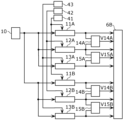
- FIG. 6A is a block diagram showing the circuit configuration of the measurement system according to this embodiment.
- the measurement system shown in FIG. 6A is a simplified version of the determination circuit of the measurement system shown in FIG. 5A.
- the measurement system shown in FIG. 6A is different from the measurement system shown in FIG.
- the reference signal output from the BGR circuit 43 is referenced by the measurement paths 13 and 23, and the determination circuits 45 and 46 are simplified.
- the measurement system according to this embodiment does not include the determination circuits 45 and 46 shown in FIG. 5A.
- the BGR circuit 43 is an example of a third or fifth reference signal generation circuit.
- the determination circuits 14 and 24 output "H"
- the BGR circuit 41 When the BGR circuit 43 is out of order, the judgment circuits 14, 15, 24 and the judgment circuit 25 output "H", and when the BGR circuit 43 is out of order, the judgment circuits 15 and 25 output "H”. .
- FIG. 6B is a diagram showing a logic value table in the measurement system of FIG. 6A.
- the logical value table shows the relationship between the output (“H” or “L” signal) of each determination circuit and the failure location.
- the processing circuit 6A determines the failure of the measurement path and identifies the failed measurement path based on the logical value table, it issues a warning that the specified measurement path cannot be correctly detected/measured, and notifies the higher-level system. Take action.
- the processing circuit 6A determines the failure of the BGR circuit and identifies the failed BGR circuit, the processing circuit 6A supplies power to the failed BGR circuit and the measurement system to which it is connected, even if other determination circuits do not determine the failure. Takes measures such as warning that the reference signal received is abnormal and notifying the higher-level system.
- each measurement path 11 etc. refers to a reference signal from a different BGR circuit, and it is possible to determine the failure of the BGR circuit from the output of the determination circuit 14 etc. of each measurement path 11 etc.
- the measurement system shown in FIG. 6A not only has fewer determination circuits than the fourth embodiment, but also prevents the measurement path for the same object from being wiped out even if the BGR circuit fails. can.
- FIG. 7A is a block diagram showing a first example of another circuit configuration of the measurement system according to the present embodiment.
- the measurement system shown in FIG. 7A is a modification of the measurement system shown in FIG. 6A into a system corresponding to one object to be measured (resistance 10). Accordingly, the symbols were changed, and the measurement paths 11, 12, 13, 21, 22, and 23 shown in FIG. 6A were changed to measurement paths 11A, 12A, 13A, 11B, 12B, and 13B. Note that the measurement path 11 and the like and the measurement path 11A and the like have the same configuration and function, for example.
- the reference signal output by the BGR circuit 41 is referenced by the measurement paths 11A and 11B
- the reference signal output by the BGR circuit 42 is referenced by the measurement paths 12A and 12B
- the reference signal output by the BGR circuit 43 is referenced by the measurement paths 13A and 13B.
- BGR circuit 41 is connected to measurement paths 11A and 11B
- BGR circuit 42 is connected to measurement paths 12A and 12B
- BGR circuit 43 is connected to measurement paths 13A and 13B.
- the determination circuit 14A compares the outputs of the measurement paths 11A and 12A, and if the difference exceeds a predetermined value, it is determined that one of the measurement paths 11A and 12A is abnormal, and the determination circuit 14A sends an "H" signal to the processing circuit 6B. ” is output. Similarly, the outputs of the measurement paths 12A and 13A are compared by a determination circuit 15A, and the determination circuit 15A outputs the presence or absence of an abnormality to the processing circuit 6B. The respective outputs of the measurement paths 11B and 12B are compared by a determination circuit 14B, and the determination circuit 14B outputs the presence or absence of an abnormality to the processing circuit 6B.
- the respective outputs of the measurement paths 12B and 13B are compared by a determination circuit 15B, and the determination circuit 15B outputs the presence or absence of an abnormality to the processing circuit 6B.
- the outputs of each measurement path and each determination circuit are input to the processing circuit 6B.
- measurement path 11A, measurement path 12A, and measurement path 13A are used for measurement purpose A
- measurement path 11B, measurement path 12B, and measurement path 13B are used for measurement purpose B.
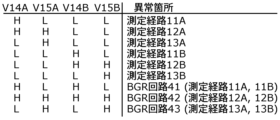
- FIG. 7B is a logical value table in the measurement system of FIG. 7A, and shows the relationship between the output (“H” or “L” signal) of each determination circuit and the failure location.
- the operation of the measurement system having such a configuration is the same as that shown in FIG. 6A except that the symbols of each part are different, and the processing circuit 6B performs failure determination and the location where the failure has been identified in the upper system based on the logical value table of FIG. 7B. and the measurement can be continued with the normal BGR circuit and measurement path for both measurement purposes A and B.
- the measurement system has fewer determination circuits, can identify a failure location, and furthermore can prevent the measurement path from being wiped out.
- the measurement system imposes two types of measurement purposes on one object to be measured, and provides three measurement paths for each measurement purpose, but if there is a failure in one place, the same method as normal Measurement is possible.
- FIG. 8A is a block diagram showing a second example of another circuit configuration of the measurement system according to the present embodiment.
- FIG. 8A is a circuit block diagram of a measurement system according to yet another example in which there is one object to be measured.
- the measurement purpose corresponds to three types, and the measurement system has measurement paths 11A and 12A for measurement purpose A, measurement paths 11B and 12B for measurement purpose B, and measurement purpose C. measurement paths 11C and 12C.
- the reference signal output by the BGR circuit 41 is referenced by the measurement paths 11A and 12B
- the reference signal output by the BGR circuit 42 is referenced by the measurement paths 11B and 12C
- the reference signal output by the BGR circuit 43 is referenced by the measurement paths 11C and 12A.
- BGR circuit 41 is connected to measurement paths 11A and 12B
- BGR circuit 42 is connected to measurement paths 11B and 12C
- BGR circuit 43 is connected to measurement paths 11C and 12A.
- the measurement path 11A is an example of the first measurement path
- the measurement path 11B is an example of the second measurement path
- the measurement path 11C is an example of the third measurement path
- the measurement path 12A is an example of the second measurement path.
- the measurement path 12B is an example of the fifth measurement path
- the measurement path 12C is an example of the sixth measurement path.
- the determination circuit 16A is an example of a first route abnormality determination circuit, and has the same function as the determination circuit 14A shown in FIG. 7A.
- the determination circuit 17A is an example of a second route abnormality determination circuit, and has the same function as the determination circuit 15A shown in FIG. 7A.
- the determination circuit 16B is an example of a third route abnormality determination circuit, and has the same function as the determination circuit 14B shown in FIG. 7A.
- the determination circuit 17B is an example of a fourth route abnormality determination circuit, and has the same function as the determination circuit 15B shown in FIG. 7A.
- the respective outputs of the measurement paths 11A and 11B are compared in the judgment circuit 16A, and if the difference exceeds a predetermined value, it is judged that one of the measurement paths 11A and 11B is abnormal, and the judgment circuit 16A sends "H" to the processing circuit 6C. ” is output.
- the outputs of the measurement paths 11B and 11C are compared by a determination circuit 17A, and the determination circuit 17A outputs the presence or absence of an abnormality to the processing circuit 6C.
- the respective outputs of the measurement paths 12A and 12B are compared by a determination circuit 16B, and the determination circuit 16B outputs the presence or absence of an abnormality to the processing circuit 6C.
- the respective outputs of the measurement paths 12B and 12C are compared by a determination circuit 17B, and the determination circuit 17B outputs the presence or absence of an abnormality to the processing circuit 6C.
- the outputs of each measurement path and each determination circuit are input to the processing circuit 6C.
- FIG. 8B is a logical value table in the measurement system of FIG. 8A, and is a diagram showing the relationship between the output (“H” or “L” signal) of each determination circuit and a failure location.
- the processing circuit 6C Based on the logical value table in FIG. 8B, the processing circuit 6C notifies the host system of the failure determination and the location where the failure has been identified, and also determines whether the measurement purpose A, measurement purpose B, and measurement purpose C are all normal. Measurements can be continued with the BGR circuit and measurement path.
- the measurement system has fewer determination circuits, can identify a failure location, and can further prevent the measurement path from being wiped out.
- three types of measurement purposes are assigned to one object to be measured, and two measurement paths are provided for each measurement purpose, but if there is a failure in one location, the same measurement as normal is possible. .
- the measurement system provides three measurement paths for each object to be measured, distributes the reference signals of the three BGR circuits to each measurement path, and references the three measurement paths.
- the configuration includes a determination circuit that selects and compares two sets. This makes it possible to identify the presence or absence of a failure and the location of the failure from the output of each determination circuit 16A and the like. Once the fault location has been identified, the measurement system can continue measurement using a normal circuit other than the fault location in the event of a fault. Furthermore, the measurement system can continue the failure determination function as in Embodiment 1 or 2, since measurement is performed using 2 paths or 2 circuits instead of 3 paths or 3 circuits.
- a plurality of reference signal generation circuits are provided to generate a reference signal commonly used for each measurement path, and the reference signal is input to the failure determination circuit.
- the measurement systems shown in FIGS. 6A, 7A, and 8A may be integrated circuits.
- the measurement system includes a first terminal group including a terminal connected to measurement path 11, a terminal connected to measurement path 12, and a terminal connected to measurement path 13; It further comprises a second terminal group including a terminal to be connected, a terminal to be connected to the measurement path 22, and a terminal to be connected to the measurement path 23, and the first terminal group, the second terminal group, and the measurement path 11 to 13 and 21 to 23, determination circuits 14, 15, 24 and 25, and processing circuit 6A may be integrated circuits.
- the measurement system includes a first terminal group including a terminal connected to the measurement path 11A, a terminal connected to the measurement path 12A, and a terminal connected to the measurement path 13A; 11B, a second terminal group including a terminal connected to measurement path 12B, and a terminal connected to measurement path 13B, the first terminal group, the second terminal group, and the measurement path 11A to 13A and 11B to 13B, determination circuits 14A, 15A, 14B and 15B, and processing circuit 6B may be integrated circuits.
- the measurement system includes a first terminal group including a terminal connected to the measurement path 11A, a terminal connected to the measurement path 11B, and a terminal connected to the measurement path 11C; 12A, a second terminal group including a terminal connected to measurement path 12B, and a terminal connected to measurement path 12C, the first terminal group, the second terminal group, and the measurement path 11A to 11C and 12A to 12C, determination circuits 16A, 17A, 16B and 17B, and processing circuit 6C may be integrated circuits.
- FIG. 1C shown in Embodiment 1 above shows a drawing in which the configuration of the measurement system is integrated circuit, and the structure of the measurement system in FIGS. 6A, 7A, and 8A shown in Embodiment 5 above is integrated circuit.
- FIGS. 6A, 7A, and 8A shown in Embodiment 5 above is integrated circuit.
- the object to be measured is a resistance that converts current to voltage, but the object to be measured is not limited to being a resistance.
- the object to be measured may be any other electronic component as long as the object to be measured can be converted into an electrical quantity such as a voltage that can be processed as data.
- the determination circuit outputs "H” when there is a failure and "L” when it is normal; however, it outputs "L” when there is a failure and Sometimes "H” may be output.
- the measurement systems according to each of the above embodiments may be realized as a single device (or a single electronic component), or may be realized by a plurality of devices (or a plurality of electronic components).
- each component included in the measurement system may be distributed to the plurality of devices (or a plurality of electronic components) in any manner.
- the communication method between the multiple devices is not particularly limited, and may be wireless communication or wired communication. . Additionally, wireless communication and wired communication may be combined between devices.
- each component described in each of the above embodiments may be realized as software, or typically, as an LSI that is an integrated circuit. These may be individually integrated into one chip, or may be integrated into one chip including some or all of them. Although it is referred to as an LSI here, it may also be called an IC, system LSI, super LSI, or ultra LSI depending on the degree of integration. Furthermore, if an integrated circuit technology that replaces LSI emerges due to advances in semiconductor technology or other derivative technologies, that technology may of course be used to integrate the components.
- a system LSI is a super-multifunctional LSI manufactured by integrating multiple processing units on a single chip, and specifically includes microprocessors, ROM (Read Only Memory), RAM (Random Access Memory), etc.
- a computer system that includes: A computer program is stored in the ROM. The system LSI achieves its functions by the microprocessor operating according to a computer program.
- the present disclosure is useful for a measurement system for determining/diagnosing a failure of a circuit for measuring electrical quantities such as current and voltage mounted on a semiconductor device.
Landscapes
- Physics & Mathematics (AREA)
- General Physics & Mathematics (AREA)
- Engineering & Computer Science (AREA)
- General Engineering & Computer Science (AREA)
- Measurement Of Current Or Voltage (AREA)
- Arrangements For Transmission Of Measured Signals (AREA)
Priority Applications (4)
| Application Number | Priority Date | Filing Date | Title |
|---|---|---|---|
| CN202380036140.1A CN119072634A (zh) | 2022-04-28 | 2023-04-06 | 测定系统 |
| JP2024517943A JPWO2023210295A1 (https=) | 2022-04-28 | 2023-04-06 | |
| EP23796041.4A EP4517339A4 (en) | 2022-04-28 | 2023-04-06 | MEASURING SYSTEM |
| US18/926,008 US20250052847A1 (en) | 2022-04-28 | 2024-10-24 | Measurement system |
Applications Claiming Priority (2)
| Application Number | Priority Date | Filing Date | Title |
|---|---|---|---|
| JP2022074512 | 2022-04-28 | ||
| JP2022-074512 | 2022-04-28 |
Related Child Applications (1)
| Application Number | Title | Priority Date | Filing Date |
|---|---|---|---|
| US18/926,008 Continuation US20250052847A1 (en) | 2022-04-28 | 2024-10-24 | Measurement system |
Publications (1)
| Publication Number | Publication Date |
|---|---|
| WO2023210295A1 true WO2023210295A1 (ja) | 2023-11-02 |
Family
ID=88518775
Family Applications (1)
| Application Number | Title | Priority Date | Filing Date |
|---|---|---|---|
| PCT/JP2023/014266 Ceased WO2023210295A1 (ja) | 2022-04-28 | 2023-04-06 | 測定システム |
Country Status (5)
| Country | Link |
|---|---|
| US (1) | US20250052847A1 (https=) |
| EP (1) | EP4517339A4 (https=) |
| JP (1) | JPWO2023210295A1 (https=) |
| CN (1) | CN119072634A (https=) |
| WO (1) | WO2023210295A1 (https=) |
Citations (9)
| Publication number | Priority date | Publication date | Assignee | Title |
|---|---|---|---|---|
| JPS5915865A (ja) * | 1982-07-16 | 1984-01-26 | Mitsubishi Electric Corp | 電圧検知器 |
| JP2013009514A (ja) * | 2011-06-24 | 2013-01-10 | Sony Corp | 監視装置、監視制御装置、電源装置、監視方法、監視制御方法、蓄電システム、電子機器、電動車両および電力システム |
| JP2013024800A (ja) | 2011-07-25 | 2013-02-04 | Denso Corp | 電圧検出装置 |
| CN103311976A (zh) * | 2012-03-14 | 2013-09-18 | 张兴发 | 电池管理装置、方法及系统 |
| JP2015050870A (ja) * | 2013-09-03 | 2015-03-16 | 株式会社マキタ | バッテリパック |
| JP2016080364A (ja) * | 2014-10-09 | 2016-05-16 | 株式会社日立超エル・エス・アイ・システムズ | 半導体装置 |
| JP2018013415A (ja) * | 2016-07-21 | 2018-01-25 | 矢崎総業株式会社 | 電池監視システム |
| US20180149526A1 (en) * | 2016-11-28 | 2018-05-31 | Nxp Usa, Inc. | Temperature sensor circuitry and method therefor |
| JP2022001987A (ja) * | 2020-06-19 | 2022-01-06 | 株式会社日立製作所 | 保安装置、及び故障検知方法 |
Family Cites Families (5)
| Publication number | Priority date | Publication date | Assignee | Title |
|---|---|---|---|---|
| JP5860942B2 (ja) * | 2014-10-03 | 2016-02-16 | マイクロ モーション インコーポレイテッド | アナログからデジタルへの変換ステージおよび2つ以上のアナログ信号をデジタル化するための位相同期方法 |
| JP7049115B2 (ja) * | 2015-09-17 | 2022-04-06 | ヌヴォトンテクノロジージャパン株式会社 | 異常検出装置、及び電池システム |
| JP6630151B2 (ja) * | 2015-12-28 | 2020-01-15 | ラピスセミコンダクタ株式会社 | 半導体装置、電池監視システム、及び半導体装置の診断方法 |
| US20200028219A1 (en) * | 2018-07-19 | 2020-01-23 | Navitas Solutions, Inc. | Fault-tolerant electronic battery sensing |
| JP2020123795A (ja) * | 2019-01-30 | 2020-08-13 | ソニーセミコンダクタソリューションズ株式会社 | 固体撮像装置および電子機器 |
-
2023
- 2023-04-06 JP JP2024517943A patent/JPWO2023210295A1/ja active Pending
- 2023-04-06 EP EP23796041.4A patent/EP4517339A4/en active Pending
- 2023-04-06 WO PCT/JP2023/014266 patent/WO2023210295A1/ja not_active Ceased
- 2023-04-06 CN CN202380036140.1A patent/CN119072634A/zh active Pending
-
2024
- 2024-10-24 US US18/926,008 patent/US20250052847A1/en active Pending
Patent Citations (9)
| Publication number | Priority date | Publication date | Assignee | Title |
|---|---|---|---|---|
| JPS5915865A (ja) * | 1982-07-16 | 1984-01-26 | Mitsubishi Electric Corp | 電圧検知器 |
| JP2013009514A (ja) * | 2011-06-24 | 2013-01-10 | Sony Corp | 監視装置、監視制御装置、電源装置、監視方法、監視制御方法、蓄電システム、電子機器、電動車両および電力システム |
| JP2013024800A (ja) | 2011-07-25 | 2013-02-04 | Denso Corp | 電圧検出装置 |
| CN103311976A (zh) * | 2012-03-14 | 2013-09-18 | 张兴发 | 电池管理装置、方法及系统 |
| JP2015050870A (ja) * | 2013-09-03 | 2015-03-16 | 株式会社マキタ | バッテリパック |
| JP2016080364A (ja) * | 2014-10-09 | 2016-05-16 | 株式会社日立超エル・エス・アイ・システムズ | 半導体装置 |
| JP2018013415A (ja) * | 2016-07-21 | 2018-01-25 | 矢崎総業株式会社 | 電池監視システム |
| US20180149526A1 (en) * | 2016-11-28 | 2018-05-31 | Nxp Usa, Inc. | Temperature sensor circuitry and method therefor |
| JP2022001987A (ja) * | 2020-06-19 | 2022-01-06 | 株式会社日立製作所 | 保安装置、及び故障検知方法 |
Non-Patent Citations (1)
| Title |
|---|
| See also references of EP4517339A4 |
Also Published As
| Publication number | Publication date |
|---|---|
| EP4517339A4 (en) | 2025-09-17 |
| EP4517339A1 (en) | 2025-03-05 |
| CN119072634A (zh) | 2024-12-03 |
| JPWO2023210295A1 (https=) | 2023-11-02 |
| US20250052847A1 (en) | 2025-02-13 |
Similar Documents
| Publication | Publication Date | Title |
|---|---|---|
| US20200028219A1 (en) | Fault-tolerant electronic battery sensing | |
| US10330736B2 (en) | Semiconductor device, battery monitoring system, and diagnostic method for semiconductor device | |
| US7317324B2 (en) | Semiconductor integrated circuit testing device and method | |
| US10745023B2 (en) | Functional safety power supply framework for real-time automotive systems | |
| US11573134B2 (en) | Semiconductor device and test method of semiconductor device | |
| KR102830363B1 (ko) | 상태 진단을 수행하는 전압 레벨 검출기 | |
| JP2010139442A (ja) | 試験装置および診断方法 | |
| US11422201B1 (en) | Devices and methods for voltage supply monitoring | |
| US6346822B2 (en) | Semiconductor integrated circuit having diagnosis function | |
| EP2759936A1 (en) | System and method for three input voting | |
| JP6088642B2 (ja) | 複数のアナログ信号検出チャネルを有するアナログ信号入力回路 | |
| US20040249612A1 (en) | Apparatus and method for monitoring high impedance failures in chip interconnects | |
| US9651630B2 (en) | Circuitry and method for monitoring a power supply of an electronic device | |
| WO2023210295A1 (ja) | 測定システム | |
| US11156672B2 (en) | Semiconductor device | |
| US20120286792A1 (en) | Channel Verification of Multiple Channels on One Chip | |
| JP2021052122A (ja) | 半導体集積回路装置 | |
| US20070041425A1 (en) | Temperature detector, temperature detecting method, and semiconductor device having the temperature detector | |
| US10928434B2 (en) | Averaged reference with fault monitoring | |
| JP7469535B2 (ja) | 基準電圧回路および半導体装置 | |
| US11762034B2 (en) | Abnormal power supply voltage detection device and method for detecting abnormal power supply voltage | |
| TW202346880A (zh) | 汽車設備的缺陷偵測系統 | |
| US11243587B2 (en) | Data processing device | |
| JP6989404B2 (ja) | 半導体集積回路 | |
| US12174253B2 (en) | Bias generator testing using grouped bias currents |
Legal Events
| Date | Code | Title | Description |
|---|---|---|---|
| 121 | Ep: the epo has been informed by wipo that ep was designated in this application |
Ref document number: 23796041 Country of ref document: EP Kind code of ref document: A1 |
|
| WWE | Wipo information: entry into national phase |
Ref document number: 202380036140.1 Country of ref document: CN Ref document number: 2024517943 Country of ref document: JP |
|
| WWE | Wipo information: entry into national phase |
Ref document number: 2023796041 Country of ref document: EP |
|
| NENP | Non-entry into the national phase |
Ref country code: DE |
|
| ENP | Entry into the national phase |
Ref document number: 2023796041 Country of ref document: EP Effective date: 20241128 |