WO2023199635A1 - ホットスタンプ成形体 - Google Patents
ホットスタンプ成形体 Download PDFInfo
- Publication number
- WO2023199635A1 WO2023199635A1 PCT/JP2023/007780 JP2023007780W WO2023199635A1 WO 2023199635 A1 WO2023199635 A1 WO 2023199635A1 JP 2023007780 W JP2023007780 W JP 2023007780W WO 2023199635 A1 WO2023199635 A1 WO 2023199635A1
- Authority
- WO
- WIPO (PCT)
- Prior art keywords
- hot
- less
- content
- region
- stamped
- Prior art date
- Legal status (The legal status is an assumption and is not a legal conclusion. Google has not performed a legal analysis and makes no representation as to the accuracy of the status listed.)
- Ceased
Links
Images
Classifications
-
- C—CHEMISTRY; METALLURGY
- C22—METALLURGY; FERROUS OR NON-FERROUS ALLOYS; TREATMENT OF ALLOYS OR NON-FERROUS METALS
- C22C—ALLOYS
- C22C38/00—Ferrous alloys, e.g. steel alloys
- C22C38/18—Ferrous alloys, e.g. steel alloys containing chromium
- C22C38/38—Ferrous alloys, e.g. steel alloys containing chromium with more than 1.5% by weight of manganese
-
- B—PERFORMING OPERATIONS; TRANSPORTING
- B21—MECHANICAL METAL-WORKING WITHOUT ESSENTIALLY REMOVING MATERIAL; PUNCHING METAL
- B21D—WORKING OR PROCESSING OF SHEET METAL OR METAL TUBES, RODS OR PROFILES WITHOUT ESSENTIALLY REMOVING MATERIAL; PUNCHING METAL
- B21D22/00—Shaping without cutting, by stamping, spinning, or deep-drawing
- B21D22/02—Stamping using rigid devices or tools
- B21D22/022—Stamping using rigid devices or tools by heating the blank or stamping associated with heat treatment
-
- B—PERFORMING OPERATIONS; TRANSPORTING
- B21—MECHANICAL METAL-WORKING WITHOUT ESSENTIALLY REMOVING MATERIAL; PUNCHING METAL
- B21D—WORKING OR PROCESSING OF SHEET METAL OR METAL TUBES, RODS OR PROFILES WITHOUT ESSENTIALLY REMOVING MATERIAL; PUNCHING METAL
- B21D22/00—Shaping without cutting, by stamping, spinning, or deep-drawing
- B21D22/20—Deep-drawing
-
- C—CHEMISTRY; METALLURGY
- C21—METALLURGY OF IRON
- C21D—MODIFYING THE PHYSICAL STRUCTURE OF FERROUS METALS; GENERAL DEVICES FOR HEAT TREATMENT OF FERROUS OR NON-FERROUS METALS OR ALLOYS; MAKING METAL MALLEABLE, e.g. BY DECARBURISATION OR TEMPERING
- C21D1/00—General methods or devices for heat treatment, e.g. annealing, hardening, quenching or tempering
- C21D1/18—Hardening; Quenching with or without subsequent tempering
-
- C—CHEMISTRY; METALLURGY
- C21—METALLURGY OF IRON
- C21D—MODIFYING THE PHYSICAL STRUCTURE OF FERROUS METALS; GENERAL DEVICES FOR HEAT TREATMENT OF FERROUS OR NON-FERROUS METALS OR ALLOYS; MAKING METAL MALLEABLE, e.g. BY DECARBURISATION OR TEMPERING
- C21D1/00—General methods or devices for heat treatment, e.g. annealing, hardening, quenching or tempering
- C21D1/62—Quenching devices
- C21D1/673—Quenching devices for die quenching
-
- C—CHEMISTRY; METALLURGY
- C21—METALLURGY OF IRON
- C21D—MODIFYING THE PHYSICAL STRUCTURE OF FERROUS METALS; GENERAL DEVICES FOR HEAT TREATMENT OF FERROUS OR NON-FERROUS METALS OR ALLOYS; MAKING METAL MALLEABLE, e.g. BY DECARBURISATION OR TEMPERING
- C21D6/00—Heat treatment of ferrous alloys
- C21D6/005—Heat treatment of ferrous alloys containing Mn
-
- C—CHEMISTRY; METALLURGY
- C21—METALLURGY OF IRON
- C21D—MODIFYING THE PHYSICAL STRUCTURE OF FERROUS METALS; GENERAL DEVICES FOR HEAT TREATMENT OF FERROUS OR NON-FERROUS METALS OR ALLOYS; MAKING METAL MALLEABLE, e.g. BY DECARBURISATION OR TEMPERING
- C21D6/00—Heat treatment of ferrous alloys
- C21D6/008—Heat treatment of ferrous alloys containing Si
-
- C—CHEMISTRY; METALLURGY
- C21—METALLURGY OF IRON
- C21D—MODIFYING THE PHYSICAL STRUCTURE OF FERROUS METALS; GENERAL DEVICES FOR HEAT TREATMENT OF FERROUS OR NON-FERROUS METALS OR ALLOYS; MAKING METAL MALLEABLE, e.g. BY DECARBURISATION OR TEMPERING
- C21D7/00—Modifying the physical properties of iron or steel by deformation
- C21D7/13—Modifying the physical properties of iron or steel by deformation by hot working
-
- C—CHEMISTRY; METALLURGY
- C21—METALLURGY OF IRON
- C21D—MODIFYING THE PHYSICAL STRUCTURE OF FERROUS METALS; GENERAL DEVICES FOR HEAT TREATMENT OF FERROUS OR NON-FERROUS METALS OR ALLOYS; MAKING METAL MALLEABLE, e.g. BY DECARBURISATION OR TEMPERING
- C21D8/00—Modifying the physical properties of ferrous metals or ferrous alloys by deformation combined with, or followed by, heat treatment
-
- C—CHEMISTRY; METALLURGY
- C21—METALLURGY OF IRON
- C21D—MODIFYING THE PHYSICAL STRUCTURE OF FERROUS METALS; GENERAL DEVICES FOR HEAT TREATMENT OF FERROUS OR NON-FERROUS METALS OR ALLOYS; MAKING METAL MALLEABLE, e.g. BY DECARBURISATION OR TEMPERING
- C21D8/00—Modifying the physical properties of ferrous metals or ferrous alloys by deformation combined with, or followed by, heat treatment
- C21D8/02—Modifying the physical properties of ferrous metals or ferrous alloys by deformation combined with, or followed by, heat treatment during manufacturing of plates or strips
-
- C—CHEMISTRY; METALLURGY
- C21—METALLURGY OF IRON
- C21D—MODIFYING THE PHYSICAL STRUCTURE OF FERROUS METALS; GENERAL DEVICES FOR HEAT TREATMENT OF FERROUS OR NON-FERROUS METALS OR ALLOYS; MAKING METAL MALLEABLE, e.g. BY DECARBURISATION OR TEMPERING
- C21D9/00—Heat treatment, e.g. annealing, hardening, quenching or tempering, adapted for particular articles; Furnaces therefor
-
- C—CHEMISTRY; METALLURGY
- C21—METALLURGY OF IRON
- C21D—MODIFYING THE PHYSICAL STRUCTURE OF FERROUS METALS; GENERAL DEVICES FOR HEAT TREATMENT OF FERROUS OR NON-FERROUS METALS OR ALLOYS; MAKING METAL MALLEABLE, e.g. BY DECARBURISATION OR TEMPERING
- C21D9/00—Heat treatment, e.g. annealing, hardening, quenching or tempering, adapted for particular articles; Furnaces therefor
- C21D9/0068—Heat treatment, e.g. annealing, hardening, quenching or tempering, adapted for particular articles; Furnaces therefor for particular articles not mentioned below
-
- C—CHEMISTRY; METALLURGY
- C21—METALLURGY OF IRON
- C21D—MODIFYING THE PHYSICAL STRUCTURE OF FERROUS METALS; GENERAL DEVICES FOR HEAT TREATMENT OF FERROUS OR NON-FERROUS METALS OR ALLOYS; MAKING METAL MALLEABLE, e.g. BY DECARBURISATION OR TEMPERING
- C21D9/00—Heat treatment, e.g. annealing, hardening, quenching or tempering, adapted for particular articles; Furnaces therefor
- C21D9/46—Heat treatment, e.g. annealing, hardening, quenching or tempering, adapted for particular articles; Furnaces therefor for sheet metals
-
- C—CHEMISTRY; METALLURGY
- C22—METALLURGY; FERROUS OR NON-FERROUS ALLOYS; TREATMENT OF ALLOYS OR NON-FERROUS METALS
- C22C—ALLOYS
- C22C38/00—Ferrous alloys, e.g. steel alloys
- C22C38/001—Ferrous alloys, e.g. steel alloys containing N
-
- C—CHEMISTRY; METALLURGY
- C22—METALLURGY; FERROUS OR NON-FERROUS ALLOYS; TREATMENT OF ALLOYS OR NON-FERROUS METALS
- C22C—ALLOYS
- C22C38/00—Ferrous alloys, e.g. steel alloys
- C22C38/002—Ferrous alloys, e.g. steel alloys containing In, Mg, or other elements not provided for in one single group C22C38/001 - C22C38/60
-
- C—CHEMISTRY; METALLURGY
- C22—METALLURGY; FERROUS OR NON-FERROUS ALLOYS; TREATMENT OF ALLOYS OR NON-FERROUS METALS
- C22C—ALLOYS
- C22C38/00—Ferrous alloys, e.g. steel alloys
- C22C38/005—Ferrous alloys, e.g. steel alloys containing rare earths, i.e. Sc, Y, Lanthanides
-
- C—CHEMISTRY; METALLURGY
- C22—METALLURGY; FERROUS OR NON-FERROUS ALLOYS; TREATMENT OF ALLOYS OR NON-FERROUS METALS
- C22C—ALLOYS
- C22C38/00—Ferrous alloys, e.g. steel alloys
- C22C38/008—Ferrous alloys, e.g. steel alloys containing tin
-
- C—CHEMISTRY; METALLURGY
- C22—METALLURGY; FERROUS OR NON-FERROUS ALLOYS; TREATMENT OF ALLOYS OR NON-FERROUS METALS
- C22C—ALLOYS
- C22C38/00—Ferrous alloys, e.g. steel alloys
- C22C38/02—Ferrous alloys, e.g. steel alloys containing silicon
-
- C—CHEMISTRY; METALLURGY
- C22—METALLURGY; FERROUS OR NON-FERROUS ALLOYS; TREATMENT OF ALLOYS OR NON-FERROUS METALS
- C22C—ALLOYS
- C22C38/00—Ferrous alloys, e.g. steel alloys
- C22C38/04—Ferrous alloys, e.g. steel alloys containing manganese
-
- C—CHEMISTRY; METALLURGY
- C22—METALLURGY; FERROUS OR NON-FERROUS ALLOYS; TREATMENT OF ALLOYS OR NON-FERROUS METALS
- C22C—ALLOYS
- C22C38/00—Ferrous alloys, e.g. steel alloys
- C22C38/06—Ferrous alloys, e.g. steel alloys containing aluminium
-
- C—CHEMISTRY; METALLURGY
- C22—METALLURGY; FERROUS OR NON-FERROUS ALLOYS; TREATMENT OF ALLOYS OR NON-FERROUS METALS
- C22C—ALLOYS
- C22C38/00—Ferrous alloys, e.g. steel alloys
- C22C38/18—Ferrous alloys, e.g. steel alloys containing chromium
- C22C38/20—Ferrous alloys, e.g. steel alloys containing chromium with copper
-
- C—CHEMISTRY; METALLURGY
- C22—METALLURGY; FERROUS OR NON-FERROUS ALLOYS; TREATMENT OF ALLOYS OR NON-FERROUS METALS
- C22C—ALLOYS
- C22C38/00—Ferrous alloys, e.g. steel alloys
- C22C38/18—Ferrous alloys, e.g. steel alloys containing chromium
- C22C38/22—Ferrous alloys, e.g. steel alloys containing chromium with molybdenum or tungsten
-
- C—CHEMISTRY; METALLURGY
- C22—METALLURGY; FERROUS OR NON-FERROUS ALLOYS; TREATMENT OF ALLOYS OR NON-FERROUS METALS
- C22C—ALLOYS
- C22C38/00—Ferrous alloys, e.g. steel alloys
- C22C38/18—Ferrous alloys, e.g. steel alloys containing chromium
- C22C38/26—Ferrous alloys, e.g. steel alloys containing chromium with niobium or tantalum
-
- C—CHEMISTRY; METALLURGY
- C22—METALLURGY; FERROUS OR NON-FERROUS ALLOYS; TREATMENT OF ALLOYS OR NON-FERROUS METALS
- C22C—ALLOYS
- C22C38/00—Ferrous alloys, e.g. steel alloys
- C22C38/18—Ferrous alloys, e.g. steel alloys containing chromium
- C22C38/28—Ferrous alloys, e.g. steel alloys containing chromium with titanium or zirconium
-
- C—CHEMISTRY; METALLURGY
- C22—METALLURGY; FERROUS OR NON-FERROUS ALLOYS; TREATMENT OF ALLOYS OR NON-FERROUS METALS
- C22C—ALLOYS
- C22C38/00—Ferrous alloys, e.g. steel alloys
- C22C38/18—Ferrous alloys, e.g. steel alloys containing chromium
- C22C38/30—Ferrous alloys, e.g. steel alloys containing chromium with cobalt
-
- C—CHEMISTRY; METALLURGY
- C22—METALLURGY; FERROUS OR NON-FERROUS ALLOYS; TREATMENT OF ALLOYS OR NON-FERROUS METALS
- C22C—ALLOYS
- C22C38/00—Ferrous alloys, e.g. steel alloys
- C22C38/18—Ferrous alloys, e.g. steel alloys containing chromium
- C22C38/32—Ferrous alloys, e.g. steel alloys containing chromium with boron
-
- C—CHEMISTRY; METALLURGY
- C22—METALLURGY; FERROUS OR NON-FERROUS ALLOYS; TREATMENT OF ALLOYS OR NON-FERROUS METALS
- C22C—ALLOYS
- C22C38/00—Ferrous alloys, e.g. steel alloys
- C22C38/18—Ferrous alloys, e.g. steel alloys containing chromium
- C22C38/34—Ferrous alloys, e.g. steel alloys containing chromium with more than 1.5% by weight of silicon
-
- C—CHEMISTRY; METALLURGY
- C22—METALLURGY; FERROUS OR NON-FERROUS ALLOYS; TREATMENT OF ALLOYS OR NON-FERROUS METALS
- C22C—ALLOYS
- C22C38/00—Ferrous alloys, e.g. steel alloys
- C22C38/18—Ferrous alloys, e.g. steel alloys containing chromium
- C22C38/40—Ferrous alloys, e.g. steel alloys containing chromium with nickel
- C22C38/44—Ferrous alloys, e.g. steel alloys containing chromium with nickel with molybdenum or tungsten
-
- C—CHEMISTRY; METALLURGY
- C22—METALLURGY; FERROUS OR NON-FERROUS ALLOYS; TREATMENT OF ALLOYS OR NON-FERROUS METALS
- C22C—ALLOYS
- C22C38/00—Ferrous alloys, e.g. steel alloys
- C22C38/18—Ferrous alloys, e.g. steel alloys containing chromium
- C22C38/40—Ferrous alloys, e.g. steel alloys containing chromium with nickel
- C22C38/48—Ferrous alloys, e.g. steel alloys containing chromium with nickel with niobium or tantalum
-
- C—CHEMISTRY; METALLURGY
- C22—METALLURGY; FERROUS OR NON-FERROUS ALLOYS; TREATMENT OF ALLOYS OR NON-FERROUS METALS
- C22C—ALLOYS
- C22C38/00—Ferrous alloys, e.g. steel alloys
- C22C38/18—Ferrous alloys, e.g. steel alloys containing chromium
- C22C38/40—Ferrous alloys, e.g. steel alloys containing chromium with nickel
- C22C38/50—Ferrous alloys, e.g. steel alloys containing chromium with nickel with titanium or zirconium
-
- C—CHEMISTRY; METALLURGY
- C22—METALLURGY; FERROUS OR NON-FERROUS ALLOYS; TREATMENT OF ALLOYS OR NON-FERROUS METALS
- C22C—ALLOYS
- C22C38/00—Ferrous alloys, e.g. steel alloys
- C22C38/18—Ferrous alloys, e.g. steel alloys containing chromium
- C22C38/40—Ferrous alloys, e.g. steel alloys containing chromium with nickel
- C22C38/54—Ferrous alloys, e.g. steel alloys containing chromium with nickel with boron
-
- C—CHEMISTRY; METALLURGY
- C22—METALLURGY; FERROUS OR NON-FERROUS ALLOYS; TREATMENT OF ALLOYS OR NON-FERROUS METALS
- C22C—ALLOYS
- C22C38/00—Ferrous alloys, e.g. steel alloys
- C22C38/60—Ferrous alloys, e.g. steel alloys containing lead, selenium, tellurium, or antimony, or more than 0.04% by weight of sulfur
-
- C—CHEMISTRY; METALLURGY
- C21—METALLURGY OF IRON
- C21D—MODIFYING THE PHYSICAL STRUCTURE OF FERROUS METALS; GENERAL DEVICES FOR HEAT TREATMENT OF FERROUS OR NON-FERROUS METALS OR ALLOYS; MAKING METAL MALLEABLE, e.g. BY DECARBURISATION OR TEMPERING
- C21D2211/00—Microstructure comprising significant phases
- C21D2211/002—Bainite
-
- C—CHEMISTRY; METALLURGY
- C21—METALLURGY OF IRON
- C21D—MODIFYING THE PHYSICAL STRUCTURE OF FERROUS METALS; GENERAL DEVICES FOR HEAT TREATMENT OF FERROUS OR NON-FERROUS METALS OR ALLOYS; MAKING METAL MALLEABLE, e.g. BY DECARBURISATION OR TEMPERING
- C21D2211/00—Microstructure comprising significant phases
- C21D2211/008—Martensite
Definitions
- Hot stamping technology is progressing, in which press forming is performed after heating the steel plate to a high temperature in the austenite region where the steel plate becomes soft.
- Hot stamping is attracting attention as a technology that achieves both moldability into automobile parts and strength of automobile parts by performing quenching treatment in a mold at the same time as press working.
- Patent Document 1 discloses a high-yield ratio, high-strength electrogalvanized steel sheet in which the amount of diffusible hydrogen in the steel is 0.20 mass ppm or less and excellent bendability.
- Hydrogen embrittlement cracking is a phenomenon in which a steel member under high stress during use breaks down due to hydrogen penetrating into the steel from the external environment. This phenomenon is also called delayed fracture because of the manner in which the fracture occurs. It is generally known that hydrogen embrittlement cracking of a steel plate occurs more easily as the tensile strength of the steel plate increases. This is thought to be because the higher the tensile strength of the steel plate, the greater the stress remaining in the steel plate after forming the part. This susceptibility to hydrogen embrittlement cracking (delayed fracture) is called hydrogen embrittlement resistance.
- Patent Document 1 bendability is considered, but hydrogen embrittlement resistance is not considered.
- An object of the present invention is to provide a hot-stamped molded article that has high strength and excellent hydrogen embrittlement resistance.
- the hot stamp molded article according to one embodiment of the present invention has a chemical composition in mass %, C: more than 0.40%, less than 0.70%, Si: 0.010-3.000%, Mn: 0.10% or more, less than 0.60%, P: 0.100% or less, S: 0.0100% or less, N: 0.0200% or less, O: 0.0200% or less, Al: 0.0010-0.5000%, Nb: 0.0010-0.1000%, Ti: 0.010-0.200%, Cr: 0.010-0.800%, Mo: 0.0010-1.0000%, B: 0.0005-0.0200%, Co: 0-4.00%, Ni: 0-3.00%, Cu: 0-3.00%, V: 0 to 3.00%, W: 0-3.00%, Ca: 0-1.0000%, Mg: 0 to 1.0000%, REM: 0-1.0000%, Sb: 0 to 1.000%, Sn: 0-1.000%, Zr: 0
- the hot-stamped molded article according to (1) above has the chemical composition in mass %, Co: 0.01-4.00%, Ni: 0.01 to 3.00%, Cu: 0.01-3.00%, V: 0.01 to 3.00%, W: 0.01-3.00%, Ca: 0.0001-1.0000%, Mg: 0.0001 to 1.0000%, REM: 0.0001-1.0000%, Sb: 0.001 to 1.000%, Sn: 0.001 to 1.000%, Zr: 0.001 to 1.000%, and As: 0.001 to 0.100% It may contain one or more selected from the group consisting of:
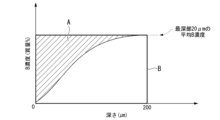
- FIG. 3 is a diagram for explaining how to obtain a B-free index.
- the present inventors have succeeded in improving the hydrogen embrittlement resistance of hot-stamped bodies by generating a desired amount of bainite in the surface layer region, creating a texture with a desired crystal orientation, and achieving a desired B removal index. It was found that the chemical properties can be improved.
- the hot-stamped molded article according to this embodiment has a chemical composition in mass %: C: more than 0.40% and 0.70% or less, Si: 0.010 to 3.000%, and Mn: 0.10%. or more, less than 0.60%, P: 0.100% or less, S: 0.0100% or less, N: 0.0200% or less, O: 0.0200% or less, Al: 0.0010 to 0.5000% , Nb: 0.0010-0.1000%, Ti: 0.010-0.200%, Cr: 0.010-0.800%, Mo: 0.0010-1.0000%, B: 0.0005 ⁇ 0.0200%, and the balance: Contains Fe and impurities. Each element will be explained below.
- C More than 0.40% and 0.70% or less C is an element that improves the strength of the hot stamp molded product. If the C content is less than 0.40%, the desired strength cannot be obtained in the hot-stamped molded product. Therefore, the C content is set to exceed 0.40%. The C content is preferably 0.42% or more or 0.44% or more. On the other hand, if the C content exceeds 0.70%, the amount of hydrogen trapped in martensite increases, making it impossible to obtain excellent hydrogen embrittlement resistance. Therefore, the C content is set to 0.70% or less. Preferably, the C content is 0.65% or less or 0.60% or less.
- Si 0.010-3.000% Si is an element that improves the strength of the hot stamp molded product through solid solution strengthening. If the Si content is less than 0.010%, desired strength cannot be obtained. Therefore, the Si content is set to 0.010% or more. The Si content is preferably 0.050% or more, 0.100% or more, or 0.150% or more. On the other hand, if the Si content exceeds 3.000%, the amount of ferrite increases and a desired metal structure cannot be obtained. Therefore, the Si content is set to 3.000% or less. The Si content is preferably 2.000% or less, 1.000% or less, or 0.600% or less.
- Mn 0.10% or more, less than 0.60%
- Mn is an element that improves the hardenability of steel and increases the strength of hot stamped compacts.
- the Mn content is set to 0.10% or more.
- the Mn content is preferably 0.20% or more or 0.25% or more.
- the Mn content is made less than 0.60%.
- the Mn content is 0.55% or less, 0.50% or less or 0.45% or less.
- P 0.100% or less
- P is an impurity element and reduces grain boundary strength by segregating at grain boundaries. This deteriorates the hydrogen embrittlement resistance of the hot stamped body.
- the P content is set to 0.100% or less.
- the P content is preferably 0.050% or less or 0.010% or less.
- the lower limit of the P content is not particularly limited, but may be 0%. However, reducing the P content to less than 0.0001% significantly increases the cost of removing P, which is economically unfavorable. Therefore, the P content may be 0.0001% or more, 0.001% or more, or 0.005% or more.
- S 0.0100% or less
- S is an impurity element and forms inclusions in steel. These inclusions trap a large amount of hydrogen and form regions where the hydrogen concentration locally increases, thereby degrading the hydrogen embrittlement resistance of the hot-stamped compact.
- the S content is set to 0.0100% or less.
- the S content is preferably 0.0080% or less, 0.0050% or less, or 0.0030% or less.
- the lower limit of the S content is not particularly limited, but may be 0%. However, if the S content is reduced to less than 0.0001%, the cost for removing S will increase significantly, which is economically unfavorable. Therefore, the S content may be 0.0001% or more, 0.0002% or more, 0.0003% or more, or 0.0010% or more.
- N is an impurity element and forms nitrides in steel. This nitride traps a large amount of hydrogen and forms regions where the hydrogen concentration locally increases, thereby degrading the hydrogen embrittlement resistance of the hot stamped body.
- the N content is set to 0.0200% or less.
- the N content is preferably 0.0150% or less, 0.0100% or less, 0.0060% or less, or 0.0040% or less.
- the lower limit of the N content is not particularly limited, but may be 0%. However, reducing the N content to less than 0.0001% significantly increases the cost of removing N, which is economically unfavorable. Therefore, the N content may be 0.0001% or more or 0.0010% or more.
- O 0.0200% or less
- O When O is contained in large amounts in steel, it forms coarse oxides. This oxide traps a large amount of hydrogen and forms regions where the hydrogen concentration locally increases, thereby deteriorating the hydrogen embrittlement resistance of the hot stamped product.
- the O content exceeds 0.0200%, the above effects become significant. Therefore, the O content is set to 0.0200% or less.
- the O content is preferably 0.0100% or less, 0.0070% or less, or 0.0040% or less.
- the O content may be 0%, but in order to disperse a large number of fine oxides during deoxidation of molten steel, the O content may be 0.0005% or more or 0.0010% or more.
- Al 0.0010-0.5000%
- Al is an element that has the effect of deoxidizing molten steel and making the steel sound.
- the Al content is set to 0.0010% or more.
- the Al content is preferably 0.0050% or more, 0.0100% or more, or 0.0300% or more.
- the Al content exceeds 0.5000%, coarse oxides will be generated in the steel.
- the Al content is set to 0.5000% or less.
- the Al content is preferably 0.4000% or less, 0.3000% or less, 0.2000% or less, or 0.1000% or less.
- Ti 0.010-0.200%
- Ti is an element that forms carbonitrides in steel and improves the strength of hot stamped products through precipitation strengthening. If the Ti content is less than 0.010%, desired strength cannot be obtained. Therefore, the Ti content is set to 0.010% or more.
- the Ti content is preferably 0.020% or more or 0.025% or more.
- the Ti content exceeds 0.200%, a large amount of coarse carbonitrides will be generated in the steel, resulting in sites where the hydrogen concentration locally increases, resulting in the durability of the hot-stamped compact. Hydrogen embrittlement properties deteriorate. Therefore, the Ti content is set to 0.200% or less.
- the Ti content is preferably 0.150% or less, 0.090% or less, 0.080% or less, 0.070% or less, 0.060% or less, or 0.050% or less.
- Cr:0.010 ⁇ 0.800% Cr is an element that increases the strength of the hot-stamped molded product by forming a solid solution in the prior austenite grains during heating before hot-stamping. If the Cr content is less than 0.010%, desired strength cannot be obtained. Therefore, the Cr content is set to 0.010% or more. The Cr content is preferably 0.100% or more, 0.150% or more, or 0.200% or more. On the other hand, if the Cr content exceeds 0.800%, a desired texture cannot be obtained in the hot-stamped molded product, and the hydrogen embrittlement resistance deteriorates. Therefore, the Cr content is set to 0.800% or less. The Cr content is preferably 0.700% or less, 0.500% or less, or 0.400% or less.
- Mo 0.0010-1.0000%
- Mo is an element that increases the strength of the hot-stamped molded product by forming a solid solution in the prior austenite grains during heating before hot-stamping. If the Mo content is less than 0.0010%, desired strength cannot be obtained. Therefore, the Mo content is set to 0.0010% or more.
- the Mo content is preferably 0.0100% or more, 0.0500% or more, or 0.1000% or more.
- the Mo content exceeds 1.0000%, a desired texture cannot be obtained in the hot-stamped molded product, and the hydrogen embrittlement resistance deteriorates. Therefore, the Mo content is set to 1.0000% or less. Mo content is preferably 0.8000% or less, 0.6000% or less, or 0.4000% or less.
- B 0.0005-0.0200%
- B is an element that improves the hardenability of steel. If the B content is less than 0.0005%, desired strength cannot be obtained. Therefore, the B content is set to 0.0005% or more.
- the B content is preferably 0.0010% or more or 0.0015% or more.
- the B content exceeds 0.0200%, coarse intermetallic compounds will be formed in the hot stamped product. This intermetallic compound becomes a site where the hydrogen concentration locally increases, degrading the hydrogen embrittlement resistance of the hot stamped product. Therefore, the B content is set to 0.0200% or less.
- the B content is preferably 0.0150% or less, 0.0100% or less, 0.0080% or less, 0.0040% or less, or 0.0030% or less.
- the hot stamp molded product may contain the following elements as optional elements. When the following arbitrary elements are not included, the content is 0%.
- Ni 0-3.00%
- Ni has the effect of increasing the strength of the hot-stamped molded product by solidly dissolving in the prior austenite grains during heating before hot-stamping.
- the Ni content is preferably 0.01% or more.
- the Ni content is 3.00% or less. If necessary, the upper limit of the Ni content may be set to 1.50%, 1.00%, 0.50%, 0.10%, 0.05% or 0.02%.
- V 0-3.00%
- V has the effect of forming carbonitrides in the steel and improving the strength of the hot stamped product through precipitation strengthening.
- the V content is preferably 0.01% or more.
- the V content is more preferably 0.05% or more.
- the V content is set to 3.00% or less. If necessary, the upper limit of the V content may be set to 1.50%, 1.00%, 0.50%, 0.10%, 0.05% or 0.02%.
- W 0-3.00% W has the effect of improving the strength of the hot stamp molded product.
- the W content is preferably 0.01% or more.
- the W content is preferably 0.05% or more.
- the W content is set to 3.00% or less. If necessary, the upper limit of the W content may be set to 1.50%, 1.00%, 0.50%, 0.10%, 0.05% or 0.02%.
- Ca 0 ⁇ 1.0000%
- Ca is an element that suppresses the formation of oxides that become the starting point of fracture, and contributes to improving the hydrogen embrittlement resistance of the hot stamped compact.
- the Ca content is preferably 0.0001% or more.
- the Ca content is set to 1.0000% or less. If necessary, the upper limit of the Ca content may be set to 0.1000%, 0.0100%, 0.0050%, 0.0010%, 0.0005% or 0.0002%.
- Mg 0-1.0000% Mg forms oxides and sulfides in molten steel, suppresses the formation of coarse MnS, and disperses many fine oxides, thereby refining the metal structure. This contributes to improving the hydrogen embrittlement resistance of the hot-stamped molded body.
- the Mg content is 0.0001% or more.
- the Mg content is set to 1.0000% or less. If necessary, the upper limit of the Mg content may be set to 0.1000%, 0.0100%, 0.0050%, 0.0010%, 0.0005% or 0.0002%.
- Sb 0-1.000% Sb suppresses the formation of coarse oxides that become sites that are accompanied by a local increase in hydrogen concentration. This contributes to improving the hydrogen embrittlement resistance of the hot-stamped molded body.
- the Sb content is preferably 0.001% or more.
- the Sb content is set to 1.000% or less. If necessary, the upper limit of the Sb content may be set to 0.100%, 0.050%, 0.020%, 0.010%, 0.005% or 0.002%.
- Sn 0-1.000% Sn suppresses the formation of coarse oxides that become sites that cause a local increase in hydrogen concentration. This contributes to improving the hydrogen embrittlement resistance of the hot-stamped molded body.
- the Sn content is preferably 0.001% or more.
- the Sn content is set to 1.000% or less. If necessary, the upper limit of the Sn content may be set to 0.100%, 0.050%, 0.020%, 0.010%, 0.005% or 0.002%.
- Zr 0-1.000% Zr suppresses the formation of coarse oxides that become sites associated with local increases in hydrogen concentration. This contributes to improving the hydrogen embrittlement resistance of the hot-stamped molded body.
- the Zr content is preferably 0.001% or more.
- the Zr content is set to 1.000% or less. If necessary, the upper limit of the Zr content may be set to 0.100%, 0.050%, 0.020%, 0.010%, 0.005% or 0.002%.
- the As content is preferably 0.001% or more.
- the As content is set to 0.100% or less. If necessary, the upper limit of the As content may be set to 0.100%, 0.050%, 0.020%, 0.010%, 0.005% or 0.002%.
- the surface of the hot-stamped molded product has a plating layer, a paint film, etc., as described below, for convenience, the area where the iron concentration is less than 90% by mass in GD-OES measurement, that is, the plating layers, paint films, etc. are excluded from the hot-stamped molded body, and the measurement point where the iron concentration is 90% by mass (that is, the interface between the base steel material and the plating layer, etc.) is regarded as the surface of the hot-stamped molded body.
- the plating layer, paint film, etc. were excluded from the hot-stamped product, but the thickness of the plating layer, paint film, etc.
- the thickness section of the sampled test piece by mirror polishing After finishing the thickness section of the sampled test piece by mirror polishing, it is observed using an optical microscope at 100x, 200x, 500x, and 1000x magnification. Depending on the size of the inclusion, select an observation result with an appropriate magnification that allows the size of the inclusion to be measured.
- the observation range is a width of 500 ⁇ m or more and the full thickness of the plate, and areas with low brightness are determined to be inclusions. When observing, you may observe from multiple fields of view.
- the same method as above is applied to the plane parallel to the plane rotated in 5° increments in the range of 0° to 180° with the thickness direction as the axis, using the thickness cross section initially observed by the above method as a reference. Observe the cross section according to the method.
- the hot stamping steel plate has the above-mentioned chemical composition.
- the metal structure of the steel sheet for hot stamping is not particularly limited as long as the desired strength and hydrogen embrittlement resistance can be obtained after hot stamping, but for example, in terms of area ratio, ferrite: 5 to 90%, bainite and martensite: 0 ⁇ 100%, pearlite: 10 ⁇ 95%, and retained austenite: 0 ⁇ 5%.
- iron carbides, alloy carbides, intermetallic compounds, and inclusions may be included.
- the oxidizing atmosphere may be any heating atmosphere that generates oxide scale on the surface layer of the steel sheet, and may be a general condition.
- a gas combustion atmosphere it is preferable to create an atmosphere in which the mixture ratio of air and fuel (air-fuel ratio) is controlled to 1.00 or more, and more preferably to be controlled to 1.10 or more.
- air-fuel ratio air-fuel ratio
- the oxidized scale on the surface of the steel sheet remain in subsequent steps. That is, it is preferable to perform hot stamping, which will be described later, with the oxide scale remaining. Oxide scale is removed by shot blasting after hot stamping.
- the conditions in the example are examples of conditions adopted to confirm the feasibility and effects of the present invention, and the present invention is based on this example of conditions. It is not limited.
- the present invention can adopt various conditions as long as the purpose of the present invention is achieved without departing from the gist of the present invention.
- the underline in the table indicates that it is outside the scope of the present invention, that it falls outside of the preferred manufacturing conditions, or that the characteristic value is unfavorable.
- the metal structure of the surface layer region of the hot-stamped molded article according to the example of the present invention contains martensite of 90% or more in terms of area %, and ferrite and retained austenite of 65% or less in total. was.
- the metal structure of the hot-stamped molded article according to the example of the present invention in a region other than the surface region consists of a total of 90% or more of martensite and bainite, and 10% or less of ferrite and retained austenite, in terms of area %. Ta.
- the measurement of the metallographic structure, B removal index, and extreme density of the texture of the hot-stamped compact was performed by the method described above.
- the mechanical properties of the hot-stamped molded product were evaluated by the following method.
- the tensile (maximum) strength TS of the hot-stamped molded product can be determined by preparing a No. 5 test piece from any position of the hot-stamped molded product in accordance with JIS Z 2241:2011 and performing a tensile test. Obtained. Note that the crosshead speed was 1 mm/min. A case where the tensile strength TS was 2200 MPa or more was judged to have high strength and was determined to pass, and a case where the tensile strength TS was less than 2200 MPa was judged to be failed as not to have high strength.
Landscapes
- Chemical & Material Sciences (AREA)
- Engineering & Computer Science (AREA)
- Mechanical Engineering (AREA)
- Materials Engineering (AREA)
- Metallurgy (AREA)
- Organic Chemistry (AREA)
- Thermal Sciences (AREA)
- Physics & Mathematics (AREA)
- Crystallography & Structural Chemistry (AREA)
- Heat Treatment Of Sheet Steel (AREA)
- Heat Treatment Of Steel (AREA)
- Road Signs Or Road Markings (AREA)
- Heat Treatment Of Articles (AREA)
Priority Applications (6)
| Application Number | Priority Date | Filing Date | Title |
|---|---|---|---|
| JP2024514838A JP7828012B2 (ja) | 2022-04-14 | 2023-03-02 | ホットスタンプ成形体 |
| US18/834,189 US20250108424A1 (en) | 2022-04-14 | 2023-03-02 | Hot-stamping formed body |
| MX2024009297A MX2024009297A (es) | 2022-04-14 | 2023-03-02 | Cuerpo formado por estampado en caliente. |
| EP23788057.0A EP4509240A4 (en) | 2022-04-14 | 2023-03-02 | HOT-STAMPED SHAPED ITEM |
| KR1020247025947A KR102928025B1 (ko) | 2022-04-14 | 2023-03-02 | 핫 스탬프 성형체 |
| CN202380019834.4A CN118647743A (zh) | 2022-04-14 | 2023-03-02 | 热冲压成形体 |
Applications Claiming Priority (2)
| Application Number | Priority Date | Filing Date | Title |
|---|---|---|---|
| JP2022067023 | 2022-04-14 | ||
| JP2022-067023 | 2022-04-14 |
Publications (1)
| Publication Number | Publication Date |
|---|---|
| WO2023199635A1 true WO2023199635A1 (ja) | 2023-10-19 |
Family
ID=88329336
Family Applications (1)
| Application Number | Title | Priority Date | Filing Date |
|---|---|---|---|
| PCT/JP2023/007780 Ceased WO2023199635A1 (ja) | 2022-04-14 | 2023-03-02 | ホットスタンプ成形体 |
Country Status (7)
| Country | Link |
|---|---|
| US (1) | US20250108424A1 (https=) |
| EP (1) | EP4509240A4 (https=) |
| JP (1) | JP7828012B2 (https=) |
| KR (1) | KR102928025B1 (https=) |
| CN (1) | CN118647743A (https=) |
| MX (1) | MX2024009297A (https=) |
| WO (1) | WO2023199635A1 (https=) |
Citations (5)
| Publication number | Priority date | Publication date | Assignee | Title |
|---|---|---|---|---|
| WO2020079925A1 (ja) | 2018-10-18 | 2020-04-23 | Jfeスチール株式会社 | 高降伏比高強度電気亜鉛系めっき鋼板及びその製造方法 |
| WO2020213179A1 (ja) * | 2019-04-17 | 2020-10-22 | 日本製鉄株式会社 | 鋼板及びその製造方法、並びに成形体 |
| WO2021230150A1 (ja) * | 2020-05-13 | 2021-11-18 | 日本製鉄株式会社 | ホットスタンプ用鋼板およびホットスタンプ成形体 |
| WO2021230149A1 (ja) * | 2020-05-13 | 2021-11-18 | 日本製鉄株式会社 | ホットスタンプ成形体 |
| JP2022067023A (ja) | 2020-10-19 | 2022-05-02 | 株式会社カレントダイナミックス | 推進装置 |
Family Cites Families (2)
| Publication number | Priority date | Publication date | Assignee | Title |
|---|---|---|---|---|
| US11180837B2 (en) * | 2018-03-29 | 2021-11-23 | Nippos Steel Corporation | Hot stamped article |
| CN113597474B (zh) * | 2019-03-20 | 2023-04-28 | 日本制铁株式会社 | 热冲压成形体 |
-
2023
- 2023-03-02 WO PCT/JP2023/007780 patent/WO2023199635A1/ja not_active Ceased
- 2023-03-02 JP JP2024514838A patent/JP7828012B2/ja active Active
- 2023-03-02 CN CN202380019834.4A patent/CN118647743A/zh active Pending
- 2023-03-02 KR KR1020247025947A patent/KR102928025B1/ko active Active
- 2023-03-02 US US18/834,189 patent/US20250108424A1/en active Pending
- 2023-03-02 MX MX2024009297A patent/MX2024009297A/es unknown
- 2023-03-02 EP EP23788057.0A patent/EP4509240A4/en active Pending
Patent Citations (5)
| Publication number | Priority date | Publication date | Assignee | Title |
|---|---|---|---|---|
| WO2020079925A1 (ja) | 2018-10-18 | 2020-04-23 | Jfeスチール株式会社 | 高降伏比高強度電気亜鉛系めっき鋼板及びその製造方法 |
| WO2020213179A1 (ja) * | 2019-04-17 | 2020-10-22 | 日本製鉄株式会社 | 鋼板及びその製造方法、並びに成形体 |
| WO2021230150A1 (ja) * | 2020-05-13 | 2021-11-18 | 日本製鉄株式会社 | ホットスタンプ用鋼板およびホットスタンプ成形体 |
| WO2021230149A1 (ja) * | 2020-05-13 | 2021-11-18 | 日本製鉄株式会社 | ホットスタンプ成形体 |
| JP2022067023A (ja) | 2020-10-19 | 2022-05-02 | 株式会社カレントダイナミックス | 推進装置 |
Non-Patent Citations (1)
| Title |
|---|
| See also references of EP4509240A4 |
Also Published As
| Publication number | Publication date |
|---|---|
| JPWO2023199635A1 (https=) | 2023-10-19 |
| EP4509240A1 (en) | 2025-02-19 |
| KR20240132338A (ko) | 2024-09-03 |
| JP7828012B2 (ja) | 2026-03-11 |
| CN118647743A (zh) | 2024-09-13 |
| EP4509240A4 (en) | 2025-10-15 |
| US20250108424A1 (en) | 2025-04-03 |
| KR102928025B1 (ko) | 2026-02-19 |
| MX2024009297A (es) | 2024-08-06 |
Similar Documents
| Publication | Publication Date | Title |
|---|---|---|
| EP2392683A1 (en) | High-strength hot-dip galvanized steel sheet and manufacturing method therefor | |
| JP2017048412A (ja) | 溶融亜鉛めっき鋼板、合金化溶融亜鉛めっき鋼板、およびそれらの製造方法 | |
| CN115003841A (zh) | 钢板、部件及它们的制造方法 | |
| WO2020203979A1 (ja) | 被覆鋼部材、被覆鋼板およびそれらの製造方法 | |
| JP7549277B2 (ja) | ホットスタンプ用鋼板およびホットスタンプ成形体 | |
| CN114829652A (zh) | 热压成形体 | |
| KR20180019213A (ko) | 냉연 강판, 도금 강판 및 이것들의 제조 방법 | |
| CN113906152B (zh) | 热压成型体 | |
| JP7319569B2 (ja) | ホットスタンプ成形体 | |
| CN113874536B (zh) | 热冲压成型体 | |
| JP7828012B2 (ja) | ホットスタンプ成形体 | |
| WO2023132344A1 (ja) | 鋼板およびその製造方法 | |
| KR102928024B1 (ko) | 핫 스탬프 성형체 | |
| WO2023189175A1 (ja) | ホットスタンプ用鋼板及びホットスタンプ成形体 | |
| WO2023032225A1 (ja) | 熱延鋼板 | |
| JP7708344B1 (ja) | 亜鉛めっき鋼板および部材、ならびに、それらの製造方法 | |
| JP7741468B2 (ja) | めっき鋼板 | |
| JP7741469B2 (ja) | 鋼板及びめっき鋼板 | |
| JP7780113B2 (ja) | ホットスタンプ成形体 | |
| JP7063414B2 (ja) | 鋼板 | |
| WO2023189183A1 (ja) | ホットスタンプ成形体 | |
| WO2023189174A1 (ja) | ホットスタンプ成形体 | |
| WO2024195680A1 (ja) | 鋼板 | |
| KR20220092945A (ko) | 핫 스탬프 성형체 | |
| WO2024122121A1 (ja) | めっき鋼板 |
Legal Events
| Date | Code | Title | Description |
|---|---|---|---|
| 121 | Ep: the epo has been informed by wipo that ep was designated in this application |
Ref document number: 23788057 Country of ref document: EP Kind code of ref document: A1 |
|
| ENP | Entry into the national phase |
Ref document number: 2024514838 Country of ref document: JP Kind code of ref document: A |
|
| WWE | Wipo information: entry into national phase |
Ref document number: 202417054938 Country of ref document: IN |
|
| WWE | Wipo information: entry into national phase |
Ref document number: MX/A/2024/009297 Country of ref document: MX |
|
| WWE | Wipo information: entry into national phase |
Ref document number: 18834189 Country of ref document: US |
|
| ENP | Entry into the national phase |
Ref document number: 20247025947 Country of ref document: KR Kind code of ref document: A |
|
| WWE | Wipo information: entry into national phase |
Ref document number: 202380019834.4 Country of ref document: CN |
|
| WWE | Wipo information: entry into national phase |
Ref document number: 2401005016 Country of ref document: TH |
|
| WWE | Wipo information: entry into national phase |
Ref document number: 2023788057 Country of ref document: EP |
|
| NENP | Non-entry into the national phase |
Ref country code: DE |
|
| ENP | Entry into the national phase |
Ref document number: 2023788057 Country of ref document: EP Effective date: 20241114 |
|
| WWP | Wipo information: published in national office |
Ref document number: 18834189 Country of ref document: US |