WO2023199592A1 - 面発光装置、表示装置、及び照明装置 - Google Patents
面発光装置、表示装置、及び照明装置 Download PDFInfo
- Publication number
- WO2023199592A1 WO2023199592A1 PCT/JP2023/005267 JP2023005267W WO2023199592A1 WO 2023199592 A1 WO2023199592 A1 WO 2023199592A1 JP 2023005267 W JP2023005267 W JP 2023005267W WO 2023199592 A1 WO2023199592 A1 WO 2023199592A1
- Authority
- WO
- WIPO (PCT)
- Prior art keywords
- light
- light source
- emitting device
- surface emitting
- light sources
- Prior art date
- Legal status (The legal status is an assumption and is not a legal conclusion. Google has not performed a legal analysis and makes no representation as to the accuracy of the status listed.)
- Ceased
Links
Images






Classifications
-
- G—PHYSICS
- G02—OPTICS
- G02B—OPTICAL ELEMENTS, SYSTEMS OR APPARATUS
- G02B6/00—Light guides; Structural details of arrangements comprising light guides and other optical elements, e.g. couplings
- G02B6/0001—Light guides; Structural details of arrangements comprising light guides and other optical elements, e.g. couplings specially adapted for lighting devices or systems
- G02B6/0011—Light guides; Structural details of arrangements comprising light guides and other optical elements, e.g. couplings specially adapted for lighting devices or systems the light guides being planar or of plate-like form
- G02B6/0033—Means for improving the coupling-out of light from the light guide
- G02B6/0035—Means for improving the coupling-out of light from the light guide provided on the surface of the light guide or in the bulk of it
- G02B6/0045—Means for improving the coupling-out of light from the light guide provided on the surface of the light guide or in the bulk of it by shaping at least a portion of the light guide
-
- G—PHYSICS
- G02—OPTICS
- G02B—OPTICAL ELEMENTS, SYSTEMS OR APPARATUS
- G02B6/00—Light guides; Structural details of arrangements comprising light guides and other optical elements, e.g. couplings
- G02B6/0001—Light guides; Structural details of arrangements comprising light guides and other optical elements, e.g. couplings specially adapted for lighting devices or systems
- G02B6/0011—Light guides; Structural details of arrangements comprising light guides and other optical elements, e.g. couplings specially adapted for lighting devices or systems the light guides being planar or of plate-like form
- G02B6/0013—Means for improving the coupling-in of light from the light source into the light guide
- G02B6/0015—Means for improving the coupling-in of light from the light source into the light guide provided on the surface of the light guide or in the bulk of it
- G02B6/002—Means for improving the coupling-in of light from the light source into the light guide provided on the surface of the light guide or in the bulk of it by shaping at least a portion of the light guide, e.g. with collimating, focussing or diverging surfaces
-
- F—MECHANICAL ENGINEERING; LIGHTING; HEATING; WEAPONS; BLASTING
- F21—LIGHTING
- F21S—NON-PORTABLE LIGHTING DEVICES; SYSTEMS THEREOF; VEHICLE LIGHTING DEVICES SPECIALLY ADAPTED FOR VEHICLE EXTERIORS
- F21S2/00—Systems of lighting devices, not provided for in main groups F21S4/00 - F21S10/00 or F21S19/00, e.g. of modular construction
-
- G—PHYSICS
- G02—OPTICS
- G02B—OPTICAL ELEMENTS, SYSTEMS OR APPARATUS
- G02B6/00—Light guides; Structural details of arrangements comprising light guides and other optical elements, e.g. couplings
- G02B6/0001—Light guides; Structural details of arrangements comprising light guides and other optical elements, e.g. couplings specially adapted for lighting devices or systems
- G02B6/0011—Light guides; Structural details of arrangements comprising light guides and other optical elements, e.g. couplings specially adapted for lighting devices or systems the light guides being planar or of plate-like form
- G02B6/0033—Means for improving the coupling-out of light from the light guide
- G02B6/0035—Means for improving the coupling-out of light from the light guide provided on the surface of the light guide or in the bulk of it
- G02B6/0038—Linear indentations or grooves, e.g. arc-shaped grooves or meandering grooves, extending over the full length or width of the light guide
-
- G—PHYSICS
- G02—OPTICS
- G02B—OPTICAL ELEMENTS, SYSTEMS OR APPARATUS
- G02B6/00—Light guides; Structural details of arrangements comprising light guides and other optical elements, e.g. couplings
- G02B6/0001—Light guides; Structural details of arrangements comprising light guides and other optical elements, e.g. couplings specially adapted for lighting devices or systems
- G02B6/0011—Light guides; Structural details of arrangements comprising light guides and other optical elements, e.g. couplings specially adapted for lighting devices or systems the light guides being planar or of plate-like form
- G02B6/0066—Light guides; Structural details of arrangements comprising light guides and other optical elements, e.g. couplings specially adapted for lighting devices or systems the light guides being planar or of plate-like form characterised by the light source being coupled to the light guide
- G02B6/0068—Arrangements of plural sources, e.g. multi-colour light sources
-
- G—PHYSICS
- G02—OPTICS
- G02F—OPTICAL DEVICES OR ARRANGEMENTS FOR THE CONTROL OF LIGHT BY MODIFICATION OF THE OPTICAL PROPERTIES OF THE MEDIA OF THE ELEMENTS INVOLVED THEREIN; NON-LINEAR OPTICS; FREQUENCY-CHANGING OF LIGHT; OPTICAL LOGIC ELEMENTS; OPTICAL ANALOGUE/DIGITAL CONVERTERS
- G02F1/00—Devices or arrangements for the control of the intensity, colour, phase, polarisation or direction of light arriving from an independent light source, e.g. switching, gating or modulating; Non-linear optics
- G02F1/01—Devices or arrangements for the control of the intensity, colour, phase, polarisation or direction of light arriving from an independent light source, e.g. switching, gating or modulating; Non-linear optics for the control of the intensity, phase, polarisation or colour
- G02F1/13—Devices or arrangements for the control of the intensity, colour, phase, polarisation or direction of light arriving from an independent light source, e.g. switching, gating or modulating; Non-linear optics for the control of the intensity, phase, polarisation or colour based on liquid crystals, e.g. single liquid crystal display cells
- G02F1/133—Constructional arrangements; Operation of liquid crystal cells; Circuit arrangements
- G02F1/1333—Constructional arrangements; Manufacturing methods
- G02F1/1335—Structural association of cells with optical devices, e.g. polarisers or reflectors
- G02F1/1336—Illuminating devices
-
- F—MECHANICAL ENGINEERING; LIGHTING; HEATING; WEAPONS; BLASTING
- F21—LIGHTING
- F21Y—INDEXING SCHEME ASSOCIATED WITH SUBCLASSES F21K, F21L, F21S and F21V, RELATING TO THE FORM OR THE KIND OF THE LIGHT SOURCES OR OF THE COLOUR OF THE LIGHT EMITTED
- F21Y2115/00—Light-generating elements of semiconductor light sources
- F21Y2115/10—Light-emitting diodes [LED]
Definitions
- the present invention relates to a surface emitting device, a display device, and a lighting device.
- Patent Document 1 discloses a liquid crystal display device including a liquid crystal panel, a viewing angle control means, a prism sheet, and a light guide plate.
- the viewing angle control means includes an upper transparent electrode layer, a lower transparent electrode layer, and a transmission state variable layer, and by adjusting the voltage applied between the upper transparent electrode layer and the lower transparent electrode layer, The orientation state of the liquid crystal in the variable transmission state layer is changed to control the viewing angle.
- Patent Document 1 it is necessary to dispose a viewing angle control means for switching the light distribution by electrical control between the light guide plate and the liquid crystal panel, which reduces the light transmittance and costs the entire device. There is a problem in that the amount increases.
- the present invention has been made in view of this point, and its purpose is to provide a surface emitting device that can switch between narrow-angle light distribution and wide-angle light distribution with a relatively simple configuration.
- a surface emitting device includes a plurality of light sources, a light guide that guides light emitted from the plurality of light sources, and a control section that controls lighting operations of the plurality of light sources.
- the light guide includes a plurality of light control sections into which light from the plurality of light sources is incident, a prism that reflects the light that has passed through the plurality of light control sections, and a light guide surface on which the prisms are provided. , an output surface that is arranged to face the light guide surface and outputs the light reflected by the prism.
- the plurality of light control units are arranged in a line in a first direction intersecting optical axes of the plurality of light control units, and the plurality of light sources include a first light source and a second light source, and the plurality of light sources include a first light source and a second light source, and The first light source is disposed on one of the optical axes of the plurality of light control units, and the second light source is disposed at a position away from the optical axis of the plurality of light control units, and the second light source is disposed on one of the optical axes of the plurality of light control units.
- the unit turns on at least one of the first light source and the second light source.
- the angle of incidence of the light entering the light control unit can be changed, and the narrow-angle light distribution and the wide-angle light distribution can be switched.
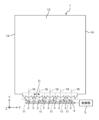
- FIG. 2 is a plan view showing the configuration of a surface emitting device.
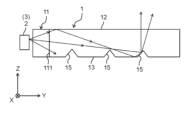
- FIG. 2 is a side view showing the configuration of a surface emitting device.
- FIG. 1 is a plan view showing the configuration of a display device including a surface emitting device.
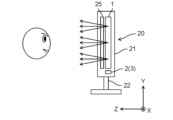
- FIG. 1 is a side view showing the configuration of a display device including a surface emitting device.
- FIG. 2 is a schematic diagram illustrating light forming a narrow-angle light distribution. It is a schematic diagram explaining the light which forms wide-angle light distribution. It is a figure which shows the luminous intensity angle distribution when only the 1st light source for narrow-angle light distribution is turned on.
- FIG. 7 is a diagram showing a luminous intensity angular distribution when the light amount of the second light source for wide-angle light distribution is made smaller than the light amount of the first light source for narrow-angle light distribution in Modified Example 1;
- FIG. 7 is a perspective view showing the configuration of a surface emitting device according to Modification 2.
- FIG. 2 is a side view showing the configuration of a surface emitting device.
- FIG. 7 is a side view showing the configuration of a surface emitting device according to Modification 3.
- FIG. 7 is a perspective view showing the configuration of a surface emitting device according to Modification Example 4;
- FIG. 2 is a side view showing the configuration of a surface emitting device. It is a side view which shows the structure of the illuminating device provided with the surface emitting device based on other embodiment.
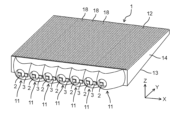
- the surface emitting device 10 includes a light guide 1, a first light source 2, a second light source 3, and a control unit 5.
- the first light source 2 and the second light source 3 are mounted on the control board 4.
- Control board 4 is connected to control section 5 .
- the light guide 1 guides light emitted from at least one of the first light source 2 and the second light source 3.
- the light guide 1 is made of a material that is transparent to visible light.
- the light guide 1 is made of, for example, PMMA (polymethyl methacrylate), polycarbonate, or the like.
- the light guide 1 has a plurality of light control units 11 , an output surface 12 , a light guide surface 13 , and a side surface 14 .
- the normal direction of the exit surface 12 is assumed to be the Z-axis plus direction
- the normal direction of the side surface 14 is assumed to be the X-axis plus direction. It is assumed that a right-handed XYZ orthogonal coordinate system is used.
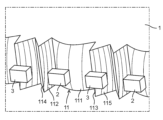
- the plurality of light control units 11 are arranged in a line in a first direction intersecting the optical axis 16 of the light control unit 11.
- the first direction is the X-axis direction.
- the first light source 2 and the second light source 3 are arranged alternately along the X-axis direction. Light emitted from at least one of the first light source 2 and the second light source 3 is incident on the light control unit 11 . Note that the specific configuration of the light control section 11 will be described later.
- a prism 15 is provided on the light guide surface 13.
- the prism 15 reflects the light that has passed through the light control section 11 and inside the light guide 1 toward the output surface 12 .
- the output surface 12 is arranged facing the light guide surface 13.
- the output surface 12 outputs the light reflected by the prism 15.
- the first light source 2 is arranged on one of the optical axes 16 of the plurality of light control units 11.
- the second light source 3 is arranged at a position away from the optical axis 16 of the light control section 11. That is, the second light source 3 is not arranged on the optical axis 16 of the light control section 11.
- the second light source 3 is arranged within a range of ⁇ 20% from the intermediate position with reference to the intermediate position between the two adjacent first light sources 2. More specifically, the second light source 3 is arranged within a range of 20% of the distance D between the first light source 2 and the second light source 3 with respect to the intermediate position between two adjacent first light sources 2. ing.
- the second light source 3 is composed of the same type of light source as the first light source 2.
- the first light source 2 and the second light source 3 are composed of white LEDs.
- the second light source 3 may be configured with a light source different from the first light source 2.
- the second light source 3 may be configured with an LED having a different color from the first light source 2 or an LED having a different spread angle.
- the surface emitting device 10 As shown in FIG. 3, in the surface emitting device 10, light is emitted toward the light control unit 11 from at least one of the first light source 2 and the second light source 3. The light that has passed through the light control section 11 is totally reflected by the output surface 12 and the light guide surface 13 and propagates within the light guide 1 .
- the surface emitting device 10 is used as a backlight of a display device 20.
- the display device 20 includes a surface emitting device 10, a housing 21, and a liquid crystal panel 25.
- the casing 21 accommodates the surface emitting device 10 and the liquid crystal panel 25.
- the housing 21 is supported by a support stand 22.
- the display device 20 may have a configuration that does not include the support stand 22.
- the liquid crystal panel 25 is arranged on the exit surface 12 side of the light guide 1 in the surface emitting device 10. The liquid crystal panel 25 is placed facing the user.
- control unit 5 is connected to the control board 4 on which the first light source 2 and the second light source 3 are mounted.
- the control unit 5 controls the lighting operations of the first light source 2 and the second light source 3.
- the control unit 5 switches between narrow-angle light distribution and wide-angle light distribution by turning on at least one of the first light source 2 and the second light source 3.
- An example of the control unit 5 is a processor that controls lighting operations of the first light source 2 and the second light source 3.
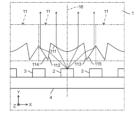
- the light control section 11 constitutes an entrance lens.
- the light control unit 11 has a main entrance surface 111, a sub-incident surface 112, and a sub-incident surface 113.
- the first light source 2 is arranged on the optical axis 16 of the light control section 11.
- the second light source 3 is not arranged on the optical axis 16 of the light control section 11.
- the main entrance surface 111 is arranged to face the first light source 2.
- the sub-incidence surface 112 and the sub-incidence surface 113 are oriented normal to the main entrance surface 111 .
- the sub-incidence surface 112 and the sub-incidence surface 113 are located at least in part around the main entrance surface 111 .
- the normal to the main entrance surface 111 is, for example, if the main entrance surface 111 is dome-shaped, the normal to the main entrance surface 111 at its tip (the apex of the dome). In the example shown in FIG. 6 , the normal to the main entrance surface 111 coincides with the optical axis 16 of the light control section 11 .
- the main entrance surface 111 converts the light emitted from above the optical axis 16 of the first light source 2 into approximately parallel to the Y axis in the XY plane.
- the light control unit 11 further includes an outer circumferential surface 114 and an outer circumferential surface 115.
- the outer peripheral surface 114 is located on the opposite side of the normal to the main entrance surface 111 when viewed from the sub-incidence surface 112.
- the outer circumferential surface 114 is configured to convert the light that is emitted from the optical axis 16 of the first light source 2 and enters the light control unit 11 from the sub-incidence surface 112 into substantially parallel to the Y axis in the XY plane. reflect.
- the outer peripheral surface 115 is located on the opposite side of the normal to the main entrance surface 111 when viewed from the sub-incidence surface 113.
- the outer circumferential surface 115 is configured to convert the light that is emitted from the optical axis 16 of the first light source 2 and enters the light control unit 11 from the sub-incidence surface 113 into substantially parallel to the Y axis in the XY plane. reflect.
- substantially parallel in this embodiment refers to a relationship where the angle is within a range of several degrees (for example, less than 10 degrees).
- the light emitted from the first light source 2 is converted into light substantially parallel to the Y axis in the XY plane by the light control unit 11, and enters the inside of the light guide 1. Therefore, the light reflected from the prism 15 toward the exit surface 12 also becomes substantially parallel to the Z axis in the XZ plane.
- the light emitted from the light guide 1 can form a narrow-angle light distribution substantially parallel to the Z axis in the XZ plane.
- the light emitted from the second light source 3 which is not arranged on the optical axis 16 of the light control unit 11 is transmitted through the main entrance surface 111, the sub-incidence surface 112, the sub-incidence surface 113, and the outer circumferential surface 114.
- Light enters the inside of the light guide 1 from the outer circumferential surface 115.
- the main entrance surface 111, the sub-incidence surface 112, the sub-incidence surface 113, the outer circumferential surface 114, and the outer circumferential surface 115 have shapes that convert light on the optical axis 16 of the light control unit 11 into approximately parallel light. . Therefore, most of the light from the second light source 3 arranged outside the optical axis 16 of the light control unit 11 is not converted into substantially parallel light, but spreads inside the light guide 1 in the XY plane. . As a result, the light reflected from the prism 15 toward the exit surface 12 also becomes light that spreads with respect to the Z axis in the XZ plane.
- the light emitted from the light guide 1 is aligned with respect to the Z axis in the XZ plane. It is possible to form a wide-angle light distribution that spreads over a certain range.
- FIG. 8 is a diagram showing the luminous intensity angular distribution when only the first light source 2 for narrow-angle light distribution is turned on.
- the horizontal axis represents the spread of light emitted from the light guide 1 in the XZ plane, and the vertical axis represents the spread of light emitted from the light guide 1 in the YZ plane.
- the narrow-angle light distribution has a spread of ⁇ 15 degrees.
- the light control unit 11 is designed to convert light emitted from the optical axis 16 into approximately parallel light, but since the actual first light source 2 has a light emitting surface of a certain size, Light emitted from a direction other than the optical axis 16 cannot be converted into substantially parallel light, and the spread of the emitted light increases depending on the size of the light emitting surface of the light source.
- FIG. 9 is a diagram showing the luminous intensity angular distribution when only the second light source 3 for wide-angle light distribution is turned on.
- the horizontal axis represents the spread of light emitted from the light guide 1 in the XZ plane, and the vertical axis represents the spread of light emitted from the light guide 1 in the YZ plane.
- the narrow-angle light distribution has a spread of ⁇ 60 degrees.
- FIG. 10 is a diagram showing the luminous intensity angular distribution when the first light source 2 and the second light source 3 are turned on at the same time.
- the horizontal axis represents the spread of light emitted from the light guide 1 in the XZ plane, and the vertical axis represents the spread of light emitted from the light guide 1 in the YZ plane.
- the narrow-angle light distribution has a spread of ⁇ 45 degrees.
- the narrow-angle light distribution and the wide-angle light distribution of the light guide 1 can be changed. You can switch the light.
- the spread of the light distribution may be changed by adjusting the light amount of the first light source 2 for narrow-angle light distribution and the second light source 3 for wide-angle light distribution.
- FIG. 11 is a diagram showing the luminous intensity angular distribution when the light amount of the second light source 3 for wide-angle light distribution is made smaller than the light amount of the first light source 2 for narrow-angle light distribution.
- the light intensity of the second light source 3 is not adjusted relative to the light intensity of the first light source 2, if the luminous intensity at 0 degrees in the horizontal direction is 100%, then 30 degrees in the horizontal direction The luminous intensity will be about 50%.
- the horizontal The luminous intensity at 30 degrees can be made approximately 30%.
- the shape of the light control section 11 may be changed.
- the light control unit 11 has a main entrance surface 111 , a sub-incident surface 112 , a sub-incident surface 113 , an outer circumferential surface 114 , and an outer circumferential surface 115 .
- the main entrance surface 111 is formed to have a curvature in the Z-axis direction. Specifically, the main entrance surface 111 is formed into a convex lens shape that is curved so as to protrude toward the first light source 2 .
- the sub-incidence surface 112 and the sub-incidence surface 113 are formed to have curvature in the Z-axis direction. Specifically, the sub-incidence surface 112 and the sub-incidence surface 113 are formed in a curved shape so as to protrude toward the first light source 2 .
- the outer circumferential surface 114 and the outer circumferential surface 115 are formed to have curvature in the Z-axis direction. Specifically, the outer circumferential surface 114 and the outer circumferential surface 115 are formed in a curved shape so as to protrude toward the second light source 3.
- the light emitted from the first light source 2 and the second light source 3 will be condensed by the light control unit 11, and the spread of light on the YZ plane in the light guide 1 will be controlled. It becomes possible to do so.
- the shape of the light control section 11 may be changed.
- the light control unit 11 has a main entrance surface 111 , a sub-incident surface 112 , a sub-incident surface 113 , an outer circumferential surface 114 , and an outer circumferential surface 115 . Note that in the example shown in FIG. 14, only the main entrance surface 111 will be described.
- the main entrance surface 111 is formed to have a curvature in the Z-axis direction. Specifically, the main entrance surface 111 is formed in the shape of a concave lens that is curved and depressed relative to the first light source 2 .
- the light emitted from the first light source 2 and the second light source 3 is diverged in the light control unit 11, and the spread of light on the YZ plane in the light guide 1 is controlled. becomes possible.
- sub-incidence surface 112 the sub-incidence surface 113, the outer circumferential surface 114, and the outer circumferential surface 115 may be similarly formed into concave lens shapes.
- the light guide 1 may include a direct optical path L that directly reflects the light incident from the light control unit 11 on the prism 15 and outputs it from the output surface 12. .
- a multi-lens consisting of a group of a plurality of small lenses 18 is provided on the exit surface 12 of the light guide 1.
- each of the plurality of small lenses 18 is formed in a semi-cylindrical shape.
- the plurality of small lenses 18 are arranged side by side in the X-axis direction.
- the small lens 18 controls the light distribution by refracting the emitted light taken out from the emitting surface 12 and making it diverge or converge. Note that a configuration may be adopted in which the small lens 18 is not provided on the exit surface 12.
- the light that spreads radially from the first light source 2 becomes parallel light by passing through the light control unit 11.
- the light control unit 11 causes the light emitted from the first light source 2 to enter the entrance surface 17 of the light guide 1 .
- the output surface 12 is a plane parallel to the XY plane.
- the XY plane is a plane that includes the X axis and the Y axis, and is perpendicular to the Z axis.
- the entrance plane 17 is a plane parallel to the XZ plane.
- the XZ plane is a plane that includes the X axis and the Z axis, and is orthogonal to the Y axis.
- the light guiding surface 13 is not parallel to the XY plane, but is a plane inclined to the XY plane. Specifically, the light guiding surface 13 is inclined with respect to the XY plane so that it approaches the exit surface 12 as it moves away from the entrance surface 17. That is, the output surface 12 and the light guide surface 13 are inclined to each other.
- a plurality of prisms 15 are provided on the light guide surface 13.
- the prism 15 reflects the light passing through the inside of the light guide 1 toward the exit surface 12 .
- most of the light that passes through the incident surface 17 is reflected by the prism 15 without being reflected by the light guide surface 13 or the portion of the output surface 12 other than the prism 15. , are emitted from the emission surface 12.
- the light guide 1 includes a direct optical path L that directly reflects the light incident from the light control unit 11 on the prism 15 and outputs the light from the output surface 12 as output light. Thereby, it is possible to improve the light intake efficiency.
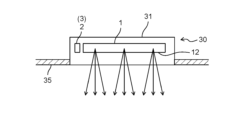
- a surface emitting device 10 may be used as a lighting device 30.
- the lighting device 30 includes a surface emitting device 10 and a housing 31.
- the surface emitting device 10 is housed inside the casing 31 .
- the lighting device 30 is embedded in the ceiling 35, for example.
- the output surface 12 of the light guide 1 in the surface emitting device 10 is arranged on the indoor space side.
- the lighting device 30 including the surface emitting device 10 can be used as a downlight.
- the lighting device 30 is not limited to being placed in an indoor space, but may be placed in an outdoor space.
- the present disclosure is useful for surface emitting devices that can switch between narrow-angle light distribution and wide-angle light distribution.
Landscapes
- Physics & Mathematics (AREA)
- General Physics & Mathematics (AREA)
- Optics & Photonics (AREA)
- Nonlinear Science (AREA)
- Mathematical Physics (AREA)
- Chemical & Material Sciences (AREA)
- Crystallography & Structural Chemistry (AREA)
- Engineering & Computer Science (AREA)
- General Engineering & Computer Science (AREA)
- Planar Illumination Modules (AREA)
Priority Applications (4)
| Application Number | Priority Date | Filing Date | Title |
|---|---|---|---|
| EP23788015.8A EP4509753A4 (en) | 2022-04-13 | 2023-02-15 | SURFACE ELECTROLUMINESCENT DEVICE, DISPLAY DEVICE AND LIGHTING DEVICE |
| JP2024514819A JPWO2023199592A1 (https=) | 2022-04-13 | 2023-02-15 | |
| CN202380031514.0A CN118984968A (zh) | 2022-04-13 | 2023-02-15 | 面发光装置、显示装置以及照明装置 |
| US18/905,145 US12416756B2 (en) | 2022-04-13 | 2024-10-03 | Surface light-emitting device, display device, and illumination device |
Applications Claiming Priority (2)
| Application Number | Priority Date | Filing Date | Title |
|---|---|---|---|
| JP2022-066127 | 2022-04-13 | ||
| JP2022066127 | 2022-04-13 |
Related Child Applications (1)
| Application Number | Title | Priority Date | Filing Date |
|---|---|---|---|
| US18/905,145 Continuation US12416756B2 (en) | 2022-04-13 | 2024-10-03 | Surface light-emitting device, display device, and illumination device |
Publications (1)
| Publication Number | Publication Date |
|---|---|
| WO2023199592A1 true WO2023199592A1 (ja) | 2023-10-19 |
Family
ID=88329258
Family Applications (1)
| Application Number | Title | Priority Date | Filing Date |
|---|---|---|---|
| PCT/JP2023/005267 Ceased WO2023199592A1 (ja) | 2022-04-13 | 2023-02-15 | 面発光装置、表示装置、及び照明装置 |
Country Status (5)
| Country | Link |
|---|---|
| US (1) | US12416756B2 (https=) |
| EP (1) | EP4509753A4 (https=) |
| JP (1) | JPWO2023199592A1 (https=) |
| CN (1) | CN118984968A (https=) |
| WO (1) | WO2023199592A1 (https=) |
Citations (5)
| Publication number | Priority date | Publication date | Assignee | Title |
|---|---|---|---|---|
| WO2011024960A1 (ja) * | 2009-08-27 | 2011-03-03 | シャープ株式会社 | 導光板ユニット、面光源装置及び表示装置 |
| JP2019164386A (ja) | 2019-06-26 | 2019-09-26 | 日東電工株式会社 | 液晶表示装置 |
| JP2019200928A (ja) * | 2018-05-17 | 2019-11-21 | スタンレー電気株式会社 | 車両用灯具 |
| JP2020021640A (ja) * | 2018-08-01 | 2020-02-06 | ミネベアミツミ株式会社 | 面状照明装置 |
| JP2021027005A (ja) * | 2019-08-08 | 2021-02-22 | パナソニックIpマネジメント株式会社 | 光学システム、照明システム、表示システム及び移動体 |
Family Cites Families (11)
| Publication number | Priority date | Publication date | Assignee | Title |
|---|---|---|---|---|
| JP4757577B2 (ja) | 2005-09-14 | 2011-08-24 | 日本電気株式会社 | 光源装置、表示装置、端末装置、光源ユニット及び光源装置の駆動方法 |
| KR20120088121A (ko) * | 2011-01-31 | 2012-08-08 | 삼성전자주식회사 | 백라이트 어셈블리 및 이를 갖는 표시장치 |
| TWI499815B (zh) * | 2013-10-22 | 2015-09-11 | Univ Nat Chiao Tung | 背光模組 |
| JP6397789B2 (ja) | 2014-07-04 | 2018-09-26 | 株式会社ジャパンディスプレイ | 面光源装置及び液晶表示装置 |
| JP2018045778A (ja) * | 2016-09-12 | 2018-03-22 | 株式会社ジャパンディスプレイ | 照明装置 |
| EP3961292A4 (en) | 2019-04-26 | 2022-06-22 | Panasonic Intellectual Property Management Co., Ltd. | Optical system, illumination system, display system, and mobile body |
| JP7493149B2 (ja) * | 2020-10-28 | 2024-05-31 | パナソニックIpマネジメント株式会社 | 光屈折部材、光学システム、照明システム、表示システム、移動体及び金型 |
| WO2022138211A1 (ja) * | 2020-12-24 | 2022-06-30 | 日亜化学工業株式会社 | 発光モジュール及びレンズ |
| WO2022230370A1 (ja) * | 2021-04-28 | 2022-11-03 | パナソニックIpマネジメント株式会社 | 光学システム、照明システム、表示システム及び移動体 |
| CN113359349A (zh) * | 2021-06-02 | 2021-09-07 | 深圳市华星光电半导体显示技术有限公司 | 一种背光模组及显示装置 |
| JP2024069025A (ja) * | 2022-11-09 | 2024-05-21 | オムロン株式会社 | 表示装置及び遊技機 |
-
2023
- 2023-02-15 JP JP2024514819A patent/JPWO2023199592A1/ja active Pending
- 2023-02-15 WO PCT/JP2023/005267 patent/WO2023199592A1/ja not_active Ceased
- 2023-02-15 EP EP23788015.8A patent/EP4509753A4/en active Pending
- 2023-02-15 CN CN202380031514.0A patent/CN118984968A/zh active Pending
-
2024
- 2024-10-03 US US18/905,145 patent/US12416756B2/en active Active
Patent Citations (5)
| Publication number | Priority date | Publication date | Assignee | Title |
|---|---|---|---|---|
| WO2011024960A1 (ja) * | 2009-08-27 | 2011-03-03 | シャープ株式会社 | 導光板ユニット、面光源装置及び表示装置 |
| JP2019200928A (ja) * | 2018-05-17 | 2019-11-21 | スタンレー電気株式会社 | 車両用灯具 |
| JP2020021640A (ja) * | 2018-08-01 | 2020-02-06 | ミネベアミツミ株式会社 | 面状照明装置 |
| JP2019164386A (ja) | 2019-06-26 | 2019-09-26 | 日東電工株式会社 | 液晶表示装置 |
| JP2021027005A (ja) * | 2019-08-08 | 2021-02-22 | パナソニックIpマネジメント株式会社 | 光学システム、照明システム、表示システム及び移動体 |
Also Published As
| Publication number | Publication date |
|---|---|
| CN118984968A (zh) | 2024-11-19 |
| US12416756B2 (en) | 2025-09-16 |
| US20250028108A1 (en) | 2025-01-23 |
| EP4509753A4 (en) | 2025-08-06 |
| EP4509753A1 (en) | 2025-02-19 |
| JPWO2023199592A1 (https=) | 2023-10-19 |
Similar Documents
| Publication | Publication Date | Title |
|---|---|---|
| US20040093779A1 (en) | Illuminated background display apparatus | |
| EP2279374B1 (en) | Optical element for asymmetric light distribution | |
| JP4437675B2 (ja) | 照明装置 | |
| JP2010262818A (ja) | トンネル用照明装置 | |
| CN106164581B (zh) | 照明灯具 | |
| WO2016059465A1 (en) | An asymmetric linear led luminaire design for uniform illuminance and color | |
| US8579489B2 (en) | Illuminator allowing a wide luminous intensity distribution | |
| EP3497365B1 (en) | Indirect luminaire | |
| KR20010021390A (ko) | 비발광형 표시 장치를 구비하는 전자 기기, 도광판 및조명 장치 | |
| TW200912195A (en) | Light-spreading and energy-saving shade | |
| JP5416808B2 (ja) | コーブ照明モジュール | |
| WO2023199592A1 (ja) | 面発光装置、表示装置、及び照明装置 | |
| US11982438B2 (en) | Uniform illumination lens and lamp thereof | |
| US7470054B2 (en) | Light-guide board | |
| TW201315941A (zh) | 照明裝置及透鏡 | |
| JP7165938B2 (ja) | 導光板、導光板アッセンブリ、及び照明装置 | |
| US7703970B2 (en) | Illuminated background display apparatus | |
| JP4349741B2 (ja) | 導光板を有する照明装置 | |
| CN212157016U (zh) | 照明装置及光学模块 | |
| TWI720874B (zh) | 照明裝置及光學模組 | |
| JP2000222906A (ja) | 照明装置 | |
| CN221570353U (zh) | 一种偏光的透镜及灯具 | |
| TWI795896B (zh) | 發光裝置 | |
| TW201020638A (en) | Display apparatus and light emitting module thereof | |
| TW202611571A (zh) | 導光元件、導光結構及調控曝光角度的調光模組 |
Legal Events
| Date | Code | Title | Description |
|---|---|---|---|
| 121 | Ep: the epo has been informed by wipo that ep was designated in this application |
Ref document number: 23788015 Country of ref document: EP Kind code of ref document: A1 |
|
| ENP | Entry into the national phase |
Ref document number: 2024514819 Country of ref document: JP Kind code of ref document: A |
|
| WWE | Wipo information: entry into national phase |
Ref document number: 202380031514.0 Country of ref document: CN |
|
| WWE | Wipo information: entry into national phase |
Ref document number: 2023788015 Country of ref document: EP |
|
| NENP | Non-entry into the national phase |
Ref country code: DE |
|
| ENP | Entry into the national phase |
Ref document number: 2023788015 Country of ref document: EP Effective date: 20241113 |