WO2023195376A1 - プラスチックフィルムを回収する方法 - Google Patents
プラスチックフィルムを回収する方法 Download PDFInfo
- Publication number
- WO2023195376A1 WO2023195376A1 PCT/JP2023/012308 JP2023012308W WO2023195376A1 WO 2023195376 A1 WO2023195376 A1 WO 2023195376A1 JP 2023012308 W JP2023012308 W JP 2023012308W WO 2023195376 A1 WO2023195376 A1 WO 2023195376A1
- Authority
- WO
- WIPO (PCT)
- Prior art keywords
- layer
- laminate
- epoxy resin
- plastic film
- curing agent
- Prior art date
- Legal status (The legal status is an assumption and is not a legal conclusion. Google has not performed a legal analysis and makes no representation as to the accuracy of the status listed.)
- Ceased
Links
Images
Classifications
-
- C—CHEMISTRY; METALLURGY
- C08—ORGANIC MACROMOLECULAR COMPOUNDS; THEIR PREPARATION OR CHEMICAL WORKING-UP; COMPOSITIONS BASED THEREON
- C08J—WORKING-UP; GENERAL PROCESSES OF COMPOUNDING; AFTER-TREATMENT NOT COVERED BY SUBCLASSES C08B, C08C, C08F, C08G or C08H
- C08J11/00—Recovery or working-up of waste materials
- C08J11/04—Recovery or working-up of waste materials of polymers
-
- B—PERFORMING OPERATIONS; TRANSPORTING
- B29—WORKING OF PLASTICS; WORKING OF SUBSTANCES IN A PLASTIC STATE IN GENERAL
- B29B—PREPARATION OR PRETREATMENT OF THE MATERIAL TO BE SHAPED; MAKING GRANULES OR PREFORMS; RECOVERY OF PLASTICS OR OTHER CONSTITUENTS OF WASTE MATERIAL CONTAINING PLASTICS
- B29B17/00—Recovery of plastics or other constituents of waste material containing plastics
- B29B17/04—Disintegrating plastics, e.g. by milling
- B29B17/0412—Disintegrating plastics, e.g. by milling to large particles, e.g. beads, granules, flakes, slices
-
- B—PERFORMING OPERATIONS; TRANSPORTING
- B29—WORKING OF PLASTICS; WORKING OF SUBSTANCES IN A PLASTIC STATE IN GENERAL
- B29B—PREPARATION OR PRETREATMENT OF THE MATERIAL TO BE SHAPED; MAKING GRANULES OR PREFORMS; RECOVERY OF PLASTICS OR OTHER CONSTITUENTS OF WASTE MATERIAL CONTAINING PLASTICS
- B29B17/00—Recovery of plastics or other constituents of waste material containing plastics
- B29B17/02—Separating plastics from other materials
-
- B—PERFORMING OPERATIONS; TRANSPORTING
- B29—WORKING OF PLASTICS; WORKING OF SUBSTANCES IN A PLASTIC STATE IN GENERAL
- B29B—PREPARATION OR PRETREATMENT OF THE MATERIAL TO BE SHAPED; MAKING GRANULES OR PREFORMS; RECOVERY OF PLASTICS OR OTHER CONSTITUENTS OF WASTE MATERIAL CONTAINING PLASTICS
- B29B17/00—Recovery of plastics or other constituents of waste material containing plastics
- B29B17/02—Separating plastics from other materials
- B29B2017/0203—Separating plastics from plastics
-
- B—PERFORMING OPERATIONS; TRANSPORTING
- B29—WORKING OF PLASTICS; WORKING OF SUBSTANCES IN A PLASTIC STATE IN GENERAL
- B29B—PREPARATION OR PRETREATMENT OF THE MATERIAL TO BE SHAPED; MAKING GRANULES OR PREFORMS; RECOVERY OF PLASTICS OR OTHER CONSTITUENTS OF WASTE MATERIAL CONTAINING PLASTICS
- B29B17/00—Recovery of plastics or other constituents of waste material containing plastics
- B29B17/02—Separating plastics from other materials
- B29B2017/0213—Specific separating techniques
- B29B2017/0293—Dissolving the materials in gases or liquids
-
- B—PERFORMING OPERATIONS; TRANSPORTING
- B29—WORKING OF PLASTICS; WORKING OF SUBSTANCES IN A PLASTIC STATE IN GENERAL
- B29B—PREPARATION OR PRETREATMENT OF THE MATERIAL TO BE SHAPED; MAKING GRANULES OR PREFORMS; RECOVERY OF PLASTICS OR OTHER CONSTITUENTS OF WASTE MATERIAL CONTAINING PLASTICS
- B29B17/00—Recovery of plastics or other constituents of waste material containing plastics
- B29B17/02—Separating plastics from other materials
- B29B2017/0213—Specific separating techniques
- B29B2017/0293—Dissolving the materials in gases or liquids
- B29B2017/0296—Dissolving the materials in aqueous alkaline solutions, e.g. NaOH or KOH
-
- B—PERFORMING OPERATIONS; TRANSPORTING
- B29—WORKING OF PLASTICS; WORKING OF SUBSTANCES IN A PLASTIC STATE IN GENERAL
- B29K—INDEXING SCHEME ASSOCIATED WITH SUBCLASSES B29B, B29C OR B29D, RELATING TO MOULDING MATERIALS OR TO MATERIALS FOR MOULDS, REINFORCEMENTS, FILLERS OR PREFORMED PARTS, e.g. INSERTS
- B29K2063/00—Use of EP, i.e. epoxy resins or derivatives thereof, as moulding material
-
- B—PERFORMING OPERATIONS; TRANSPORTING
- B29—WORKING OF PLASTICS; WORKING OF SUBSTANCES IN A PLASTIC STATE IN GENERAL
- B29K—INDEXING SCHEME ASSOCIATED WITH SUBCLASSES B29B, B29C OR B29D, RELATING TO MOULDING MATERIALS OR TO MATERIALS FOR MOULDS, REINFORCEMENTS, FILLERS OR PREFORMED PARTS, e.g. INSERTS
- B29K2067/00—Use of polyesters or derivatives thereof, as moulding material
- B29K2067/003—PET, i.e. poylethylene terephthalate
-
- B—PERFORMING OPERATIONS; TRANSPORTING
- B29—WORKING OF PLASTICS; WORKING OF SUBSTANCES IN A PLASTIC STATE IN GENERAL
- B29L—INDEXING SCHEME ASSOCIATED WITH SUBCLASS B29C, RELATING TO PARTICULAR ARTICLES
- B29L2009/00—Layered products
-
- C—CHEMISTRY; METALLURGY
- C08—ORGANIC MACROMOLECULAR COMPOUNDS; THEIR PREPARATION OR CHEMICAL WORKING-UP; COMPOSITIONS BASED THEREON
- C08J—WORKING-UP; GENERAL PROCESSES OF COMPOUNDING; AFTER-TREATMENT NOT COVERED BY SUBCLASSES C08B, C08C, C08F, C08G or C08H
- C08J2323/00—Characterised by the use of homopolymers or copolymers of unsaturated aliphatic hydrocarbons having only one carbon-to-carbon double bond; Derivatives of such polymers
- C08J2323/02—Characterised by the use of homopolymers or copolymers of unsaturated aliphatic hydrocarbons having only one carbon-to-carbon double bond; Derivatives of such polymers not modified by chemical after treatment
- C08J2323/10—Homopolymers or copolymers of propene
- C08J2323/12—Polypropene
-
- C—CHEMISTRY; METALLURGY
- C08—ORGANIC MACROMOLECULAR COMPOUNDS; THEIR PREPARATION OR CHEMICAL WORKING-UP; COMPOSITIONS BASED THEREON
- C08J—WORKING-UP; GENERAL PROCESSES OF COMPOUNDING; AFTER-TREATMENT NOT COVERED BY SUBCLASSES C08B, C08C, C08F, C08G or C08H
- C08J2363/00—Characterised by the use of epoxy resins; Derivatives of epoxy resins
-
- Y—GENERAL TAGGING OF NEW TECHNOLOGICAL DEVELOPMENTS; GENERAL TAGGING OF CROSS-SECTIONAL TECHNOLOGIES SPANNING OVER SEVERAL SECTIONS OF THE IPC; TECHNICAL SUBJECTS COVERED BY FORMER USPC CROSS-REFERENCE ART COLLECTIONS [XRACs] AND DIGESTS
- Y02—TECHNOLOGIES OR APPLICATIONS FOR MITIGATION OR ADAPTATION AGAINST CLIMATE CHANGE
- Y02W—CLIMATE CHANGE MITIGATION TECHNOLOGIES RELATED TO WASTEWATER TREATMENT OR WASTE MANAGEMENT
- Y02W30/00—Technologies for solid waste management
- Y02W30/20—Waste processing or separation
-
- Y—GENERAL TAGGING OF NEW TECHNOLOGICAL DEVELOPMENTS; GENERAL TAGGING OF CROSS-SECTIONAL TECHNOLOGIES SPANNING OVER SEVERAL SECTIONS OF THE IPC; TECHNICAL SUBJECTS COVERED BY FORMER USPC CROSS-REFERENCE ART COLLECTIONS [XRACs] AND DIGESTS
- Y02—TECHNOLOGIES OR APPLICATIONS FOR MITIGATION OR ADAPTATION AGAINST CLIMATE CHANGE
- Y02W—CLIMATE CHANGE MITIGATION TECHNOLOGIES RELATED TO WASTEWATER TREATMENT OR WASTE MANAGEMENT
- Y02W30/00—Technologies for solid waste management
- Y02W30/50—Reuse, recycling or recovery technologies
- Y02W30/62—Plastics recycling; Rubber recycling
Definitions
- the present invention relates to a method for recovering plastic film from a laminate.
- Inorganic vapor-deposited films in which inorganic materials such as alumina and silica are vapor-deposited on thermoplastic films, have high gas barrier properties and are therefore used as gas barrier packaging materials.
- some gas barrier packaging materials have a printed layer.
- a packaging material in the form of a laminate film in which an inorganic vapor-deposited film and a plastic film are laminated with an adhesive layer interposed therebetween.
- Patent Document 1 discloses a method for producing a recycled base material including a step of immersing a laminate in a basic aqueous solution, wherein the laminate includes a plastic base material and at least one selected from the group consisting of aluminum, aluminum oxide, and silica.
- the manufacturing method includes a release layer containing one kind of compound and a printing layer in this order, and the basic aqueous solution has a basic compound concentration and water temperature within a predetermined range. It is disclosed that a plastic base material forming a laminate can be obtained efficiently and simply as a recycled base material.
- Patent Document 2 describes a first base material, a first release layer for desorbing the first base material and recycling the first base material, and a second base material,
- a packaging material comprising: a second release layer for removing a second base material and recycling the second base material, the first release layer forming composition comprising aluminum , an adhesive composition containing at least one kind and a predetermined amount of an inorganic substance selected from the group consisting of aluminum oxide and silica, and wherein the second release layer forming composition contains a predetermined polyol component and a polyisocyanate component.
- a packaging material is disclosed.
- This packaging material has excellent base adhesion, which is necessary as a packaging material, and it is possible to remove not only the outer printed layer of the package but also the inner printed layer, making it possible to remove both of the two base materials that make up the packaging material. It is described that the packaging material has excellent releasability and is suitable for plastic recycling.
- the binder resin contained in the release layer a resin selected from polyurethane resin, acrylic resin, polyester resin, and polyvinyl alcohol is exemplified, and as the adhesive layer, the anchor layer is formed from a molten polyolefin resin. Examples include a resin layer, a urethane adhesive layer, an acrylic adhesive, etc.
- the second release layer forming composition disclosed in Patent Document 2 is an adhesive composition containing a polyol component and a polyisocyanate component.
- laminates containing layers made of these resins do not have sufficient gas barrier properties, and furthermore, there is a problem in that the degree of freedom in recovery conditions for plastic films is low. In particular, there has been a desire for a technique for easily recovering plastic films even from laminate-type laminates having two or more plastic films.
- An object of the present invention is to provide a method for efficiently recovering plastic film from a laminate containing plastic film.
- the present inventors have discovered that the above problem can be solved by a method that includes a step of bringing a laminate having a plastic film and a predetermined layer into contact with an acid aqueous solution or an alkaline aqueous solution. That is, the present invention is a method for recovering plastic film from a laminate, the laminate comprising: plastic film (I), At least one inorganic layer (II) selected from the group consisting of silicon oxide, aluminum, and aluminum oxide, and a resin hardening layer (III),
- the resin cured layer (III) is a cured product of an epoxy resin composition containing an epoxy resin and an epoxy resin curing agent including an amine-based curing agent,
- the method relates to a method including the step of bringing the laminate into contact with an acid aqueous solution or an alkaline aqueous solution.
- a plastic film can be efficiently recovered from a laminate containing a plastic film.
- the method of the present invention has a high degree of freedom in the recovery conditions for plastic films, and in particular, plastic films can be easily recovered even from a laminate having two or more plastic films.
- the present invention is a method for recovering plastic film from a laminate (hereinafter also referred to as "the method of the present invention"), the laminate comprising: plastic film (I), At least one inorganic layer (II) selected from the group consisting of silicon oxide, aluminum, and aluminum oxide, and a resin cured layer (III), the resin cured layer (III) comprising an epoxy resin, It is a cured product of an epoxy resin composition containing an epoxy resin curing agent including an amine-based curing agent, and the method includes a step of bringing the laminate into contact with an acid aqueous solution or an alkaline aqueous solution.
- the method includes a step of bringing the laminate into contact with an acid aqueous solution or an alkaline aqueous solution.
- the method of the present invention can efficiently recover a plastic film from a laminate containing a plastic film. Although the reason for this is not certain, it is thought to be as follows.
- At least one inorganic layer (II) selected from the group consisting of silicon oxide, aluminum, and aluminum oxide dissolves when contacted with an acid aqueous solution or an alkali aqueous solution. do. Therefore, the plastic film can be easily recovered from the laminate having the inorganic layer (II).
- a laminated body having two or more plastic films has a problem in that it is difficult for an acid or alkaline aqueous solution to penetrate between the layers, making it difficult to recover the plastic films.
- the films are generally laminated via a cured resin layer such as an adhesive layer.
- the laminate is a packaging material
- a primer layer an anchor coat layer, a colored layer formed from colored ink, a medium layer formed from ink containing no colorant, and an overcoat layer for surface protection.
- a primer layer an anchor coat layer
- a colored layer formed from colored ink a medium layer formed from ink containing no colorant
- an overcoat layer for surface protection.
- the laminate defined in the present invention has a cured resin layer (III) that is a cured product of an epoxy resin composition containing an epoxy resin and an epoxy resin curing agent including an amine-based curing agent. Since the resin cured layer (III) is a cured product of an epoxy resin composition, it is different from a resin layer that can be dissolved in an acid or alkaline aqueous solution, a solvent, or the like. However, when an epoxy resin curing agent containing an amine-based curing agent is used in an epoxy resin composition, an acid aqueous solution and an alkali aqueous solution easily penetrate between the formed resin cured layers (III), and the inorganic layer (II) dissolves.
- the present invention is advantageous in that the plastic film can be recovered even when the laminate is brought into contact with not only an alkaline aqueous solution but also an acid aqueous solution.
- the inorganic layer (II) and the cured resin layer (III) are adjacent or close to each other, the presence of the cured resin layer (III) makes it easier for the acid or alkaline aqueous solution to penetrate between the layers of the laminate, resulting in It is inferred that this will make it easier to collect the plastic film.
- the inorganic layer (II) and the cured resin layer (III) are close to each other means that the inorganic layer (II) and the cured resin layer (III) exist with one or two layers separated. It means there is.
- the laminate defined in the present invention includes a plastic film (I), at least one inorganic layer (II) selected from the group consisting of silicon oxide, aluminum, and aluminum oxide, and a resin cured layer (III).
- the cured resin layer (III) is a cured product of an epoxy resin composition containing an epoxy resin and an epoxy resin curing agent including an amine curing agent.
- the plastic film (I) may be any plastic film commonly used for packaging materials, etc., such as polyolefin films such as low-density polyethylene, high-density polyethylene, linear low-density polyethylene, and polypropylene; polyethylene terephthalate, polyethylene, etc.
- Polyester films such as naphthalate and polybutylene terephthalate; polyamide films such as nylon 6, nylon 6,6, and polymethaxylylene adipamide (N-MXD6); polyimide films; biodegradable films such as polylactic acid; Examples include polyacrylonitrile films; poly(meth)acrylic films; polystyrene films; polycarbonate films; saponified ethylene-vinyl acetate copolymer (EVOH) films, and polyvinyl alcohol films.
- plastic films from the group consisting of polyolefin films, polyester films, polyamide films, and polyimide films are preferred from the viewpoint of the transparency, strength, heat resistance, and resistance to acid or alkaline aqueous solutions of the laminate.
- At least one selected from the group consisting of polyolefin films and polyester films is more preferable, and at least one selected from the group consisting of polypropylene films and polyethylene terephthalate (PET) films is even more preferable.
- the above film may be unstretched or may be uniaxially or biaxially stretched.
- the thickness of the plastic film (I) is not particularly limited, but from the viewpoint of transparency, strength, heat resistance, and resistance to the acid or alkaline aqueous solution used for recovering the plastic film (I), it is preferably 5 to 300 ⁇ m, or more.
- the thickness is preferably 5 to 100 ⁇ m, more preferably 5 to 50 ⁇ m.
- the above thickness is the thickness per sheet of plastic film (I).
- the inorganic layer (II) is a layer made of at least one member selected from the group consisting of silicon oxide, aluminum, and aluminum oxide. Since the laminate has the inorganic layer (II), the plastic film (I) can be easily recovered by contacting it with an acid aqueous solution or an alkaline aqueous solution.
- silicon oxide include silica (SiO x )
- aluminum oxide include alumina (Al 2 O x ).
- the inorganic layer (II) is preferably a layer made of at least one member selected from the group consisting of aluminum and aluminum oxide (alumina), and more preferably is a layer made of aluminum. Furthermore, from the viewpoint of ease of recovery of the plastic film (I) using an aqueous alkaline solution, the inorganic layer (II) is preferably a layer containing silica. Examples of the layer containing silica include a layer made of silica and a layer made of silica-alumina.
- the inorganic layer (II) examples include those made of metal foil and those formed by a vapor deposition method, but from the viewpoint of imparting gas barrier properties to the laminate, an inorganic vapor deposited layer formed by a vapor deposition method is used. It is preferable that there be. That is, the inorganic layer (II) is more preferably at least one selected from the group consisting of a silica vapor-deposited layer, an aluminum vapor-deposited layer, and an alumina vapor-deposited layer, from the viewpoint of ease of recovery of the plastic film (I) with an acidic aqueous solution.
- the inorganic layer (II) is more preferably at least one selected from the group consisting of an aluminum vapor deposited layer and an alumina vapor deposited layer, and even more preferably an aluminum vapor deposited layer.
- the inorganic layer (II) is preferably a vapor deposited layer containing silica, more preferably a silica vapor deposited layer and a silica-alumina binary vapor deposited layer.
- the thickness of the inorganic layer (II) is not particularly limited, but is preferably 5 nm or more from the viewpoint of ease of recovery of the plastic film (I) and from the viewpoint of imparting gas barrier properties.
- the thickness is preferably 100 nm or less, more preferably 50 nm or less, from the viewpoint of improving the transparency and bending resistance of the laminate, and from the economic viewpoint.
- the above thickness is the thickness per layer of the inorganic layer (II).
- the method for forming the inorganic layer (II) is not particularly limited, and examples of the vapor deposition method include physical vapor deposition methods such as vacuum evaporation method, sputtering method, and ion plating method, plasma chemical vapor deposition method, and thermochemical vapor deposition method. Known vapor deposition methods such as phase epitaxy and chemical vapor deposition such as photochemical vapor deposition may be used. Moreover, the inorganic layer (II) can also be formed by laminating a metal foil such as an aluminum foil with another layer.
- the cured resin layer (III) is a cured product of an epoxy resin composition containing an epoxy resin and an epoxy resin curing agent including an amine-based curing agent.
- the components contained in the epoxy resin composition will be explained below.
- the epoxy resin used in the epoxy resin composition may be any of saturated or unsaturated aliphatic compounds, alicyclic compounds, aromatic compounds, or heterocyclic compounds. When considering imparting gas barrier properties, epoxy resins containing an aromatic ring or alicyclic structure in the molecule are preferred. Specific examples of the epoxy resin include epoxy resins having a glycidylamino group derived from metaxylylene diamine, epoxy resins having a glycidylamino group derived from paraxylylene diamine, and 1,3-bis(aminomethyl).
- At least one resin selected from epoxy resins having glycidyloxy groups derived from resorcinol and epoxy resins having glycidyloxy groups derived from resorcinol is mentioned.
- two or more of the above-mentioned epoxy resins may be used in a mixture at an appropriate ratio.
- epoxy resins include epoxy resins having a glycidylamino group derived from meta-xylylene diamine, epoxy resins having a glycidylamino group derived from para-xylylene diamine, and bisphenol.
- the main component is at least one selected from the group consisting of epoxy resins having a glycidyloxy group derived from F, and the main component is an epoxy resin having a glycidylamino group derived from metaxylylene diamine. is more preferable.
- the "main component” here means that other components may be included without departing from the spirit of the present invention, and is preferably 50 to 100% by mass, more preferably 70 to 100% by mass of the whole. , more preferably 90 to 100% by mass.
- Epoxy resin curing agent containing amine curing agent The epoxy resin curing agent used in the epoxy resin composition contains an amine curing agent from the viewpoint of easily recovering the plastic film (I) from the laminate and from the viewpoint of imparting gas barrier properties.
- the amine curing agent polyamines conventionally used as epoxy resin curing agents or modified products thereof can be used.
- the amine curing agent is preferably a modified polyamine.
- the curing agent is at least one selected from the group consisting of the curing agent (i) and the curing agent (ii), and it is even more preferable to include the curing agent (i) below.
- reaction product of X and Y refers to a reaction product (adduct) of X and Y, as well as by-products other than the reaction product, unreacted raw materials such as X, Y, etc. It includes.
- B At least one selected from the group consisting of unsaturated carboxylic acids represented by the following general formula (1) and derivatives thereof (In formula (1), R 1 and R 2 each independently represent a hydrogen atom, an alkyl group having 1 to 8 carbon atoms, an aryl group having 6 to 12 carbon atoms, or an aralkyl group having 7 to 13 carbon atoms.
- the component (A) is used from the viewpoint of easily recovering the plastic film (I) from the laminate, improving adhesion with other layers, and improving gas barrier properties.
- Metaxylylene diamine is used from the viewpoint of gas barrier properties. is preferred.
- Component (A) may be used alone or in a mixture of two types.
- the component (B) is at least one selected from the group consisting of unsaturated carboxylic acids represented by the general formula (1) and derivatives thereof, from the viewpoint of easily recovering the plastic film (I) from the laminate;
- R 1 in the general formula (1) is preferably a hydrogen atom or an alkyl group having 1 to 8 carbon atoms; -3 alkyl group is more preferred, a hydrogen atom or a methyl group is even more preferred, and a hydrogen atom is even more preferred.
- R 2 in the general formula (1) is preferably a hydrogen atom or an alkyl group having 1 to 8 carbon atoms, and preferably a hydrogen atom or an alkyl group having 1 to 3 carbon atoms. is more preferred, a hydrogen atom or a methyl group is even more preferred, and a hydrogen atom is even more preferred.
- Examples of the derivative of the unsaturated carboxylic acid represented by the general formula (1) include esters, amides, acid anhydrides, and acid chlorides of the unsaturated carboxylic acid.
- the ester of unsaturated carboxylic acid is preferably an alkyl ester, and from the viewpoint of obtaining good reactivity, the alkyl carbon number is preferably 1 to 6, more preferably 1 to 3, and still more preferably 1 to 2.
- Examples of the unsaturated carboxylic acid represented by the general formula (1) and its derivatives include acrylic acid, methacrylic acid, ⁇ -ethyl acrylic acid, ⁇ -propylacrylic acid, ⁇ -isopropylacrylic acid, and ⁇ -n-butylacrylic acid.
- Acid ⁇ -t-butylacrylic acid, ⁇ -pentylacrylic acid, ⁇ -phenylacrylic acid, ⁇ -benzylacrylic acid, crotonic acid, 2-pentenoic acid, 2-hexenoic acid, 4-methyl-2-pentenoic acid, 2-heptenoic acid, 4-methyl-2-hexenoic acid, 5-methyl-2-hexenoic acid, 4,4-dimethyl-2-pentenoic acid, 4-phenyl-2-butenoic acid, cinnamic acid, o-methyl cinnamon Examples thereof include acids, unsaturated carboxylic acids such as m-methylcinnamic acid, p-methylcinnamic acid, and 2-octenoic acid, and esters, amides, acid anhydrides, and acid chlorides thereof.
- the component (B) is acrylic acid, methacrylic acid, and crotonic acid. At least one selected from the group consisting of acrylic acid, methacrylic acid, crotonic acid and their alkyl esters is preferred, and at least one selected from the group consisting of acrylic acid, methacrylic acid, crotonic acid and their alkyl esters is more preferred; At least one selected from the group consisting of alkyl esters of acrylic acid is more preferred, alkyl esters of acrylic acid are even more preferred, and methyl acrylate is even more preferred.
- Component (B) may be used alone or in combination of two or more.
- the reaction between the component (A) and the component (B) is carried out at a temperature of 0 to 100°C, more preferably 0 to 70°C.
- Components (A) and (B) are mixed together under conditions of 100 to 300°C, preferably 130 to 250°C to carry out a Michael addition reaction and an amide group forming reaction by dehydration, dealcoholization, and deamination.
- the inside of the reaction apparatus may be subjected to reduced pressure treatment at the final stage of the reaction, if necessary.
- it can also be diluted using a non-reactive solvent if necessary.
- catalysts such as phosphorous esters may be added as dehydrating agents and dealcoholizing agents.
- an acid anhydride or acid chloride of an unsaturated carboxylic acid is used as the component (B)
- Michael addition reaction and amide It is carried out by carrying out a group forming reaction.
- the inside of the reaction apparatus may be subjected to reduced pressure treatment at the final stage of the reaction, if necessary.
- it can also be diluted using a non-reactive solvent if necessary.
- tertiary amines such as pyridine, picoline, lutidine, and trialkylamine can also be added.
- the epoxy which is the reaction product of component (A) and component (B) The resin cured layer (III) formed using the epoxy resin composition containing a resin curing agent has high gas barrier properties and good adhesiveness.
- the reaction molar ratio of the component (B) to the component (A) [(B)/(A)] is preferably in the range of 0.3 to 1.0. If the reaction molar ratio is 0.3 or more, a sufficient amount of amide groups will be produced in the epoxy resin curing agent, and a high level of gas barrier properties will be exhibited. On the other hand, if the above reaction molar ratio is within the range of 1.0 or less, the amount of amino groups necessary for reaction with the epoxy groups in the epoxy resin is sufficient, and the epoxy resin has excellent heat resistance and solubility in organic solvents and water. It is also excellent. When particularly considering the improvement of gas barrier properties, it is preferable that the reaction molar ratio of the component (B) to the component (A) [(B)/(A)] is in the range of 0.6 to 1.0. preferable.
- the above-mentioned amine curing agent is a reaction product of the above-mentioned (A) component and (B) component, and at least one compound selected from the group consisting of the following (C) component, (D) component, and (E) component. It may be a thing.
- C At least one member selected from the group consisting of monovalent carboxylic acids and derivatives thereof represented by R 3 -COOH (R 3 is a hydrogen atom, an alkyl having 1 to 7 carbon atoms which may have a hydroxyl group) group or an aryl group having 6 to 12 carbon atoms.)
- R 3 is a hydrogen atom, an alkyl having 1 to 7 carbon atoms which may have a hydroxyl group) group or an aryl group having 6 to 12 carbon atoms.
- D Cyclic carbonate
- E Monoepoxy compound having 2 to 20 carbon atoms
- R 3 represents a hydrogen atom, an alkyl group having 1 to 7 carbon atoms which may have a hydroxyl group, or an aryl group having 6 to 12 carbon atoms, and R 3 preferably represents an alkyl group having 1 to 3 carbon atoms or phenyl. It is the basis.
- Examples of the monovalent carboxylic acid derivative represented by R 3 -COOH include esters, amides, acid anhydrides, and acid chlorides of the carboxylic acid.
- the ester of the carboxylic acid is preferably an alkyl ester, and the alkyl carbon number is preferably 1 to 6, more preferably 1 to 3, and still more preferably 1 to 2.
- the component (C) include monovalent carboxylic acids such as formic acid, acetic acid, propionic acid, butyric acid, lactic acid, glycolic acid, and benzoic acid, and derivatives thereof.
- the component (C) may be used alone or in combination of two or more.
- the cyclic carbonate which is the component (D) is used as necessary from the viewpoint of reducing the reactivity between the epoxy resin curing agent and the epoxy resin and improving workability. From the viewpoint of reactivity, a cyclic carbonate having a six-membered ring or less is preferable.
- at least one selected from the group consisting of ethylene carbonate, propylene carbonate, and glycerin carbonate is preferred.
- the component (D) may be used alone or in combination of two or more.
- the monoepoxy compound which is the component (E) is a monoepoxy compound having 2 to 20 carbon atoms, and from the viewpoint of reducing the reactivity between the epoxy resin curing agent and the epoxy resin and improving workability, it may be added as necessary. used. From the viewpoint of gas barrier properties, a monoepoxy compound having 2 to 10 carbon atoms is preferable, and a compound represented by the following formula (2) is more preferable.
- R 4 represents a hydrogen atom, an alkyl group having 1 to 8 carbon atoms, an aryl group, or R 5 -O-CH 2 -, and R 5 represents a phenyl group or a benzyl group.
- Examples of the monoepoxy compound represented by the formula (2) include ethylene oxide, propylene oxide, 1,2-butylene oxide, styrene oxide, phenyl glycidyl ether, and benzyl glycidyl ether.
- the component (E) may be used alone or in combination of two or more.
- any one selected from the group consisting of the above-mentioned (C) component, (D) component, and (E) component may be used alone, or two or more types may be used in combination.
- the amine curing agent may be a reaction product obtained by reacting with other components as long as the effects of the present invention are not impaired.
- the other components include aromatic dicarboxylic acids or derivatives thereof.
- the amount of the "other components" used is preferably 30% by mass or less, more preferably 10% by mass or less, and 5% by mass or less of the total amount of the reaction components constituting the amine curing agent. % or less is more preferable.
- the reaction product of the (A) component and (B) component and at least one compound selected from the group consisting of the (C) component, (D) component, and (E) component is the (C) component. It is obtained by using at least one compound selected from the group consisting of component (D) and component (E) in combination with component (B) and reacting with component (A), which is a polyamine compound.
- component (A) which is a polyamine compound.
- the components (B) to (E) may be added in any order and reacted with the component (A), or the components (B) to (E) may be mixed to react with the component (A). It may also be reacted with other components.
- the reaction between the component (A) and the component (C) can be carried out under the same conditions as the reaction between the component (A) and the component (B).
- the above component (C) the above (B) component and (C) component may be mixed and reacted with the above (A) component, or the above (A) component and (B) component are first mixed. You may react the said (C) component after reacting.
- the (D) component and/or (E) component the (A) component and (B) component are first reacted, and then the (D) component and/or (E) component is reacted. It is preferable to react with the component.
- the reaction between the component (A) and the component (D) and/or the component (E) is carried out by mixing the component (A) with the component (D) and/or the component (E) at a temperature of 25 to 200°C.
- the addition reaction is carried out under conditions of 30 to 180°C, preferably 40 to 170°C.
- a catalyst such as sodium methoxide, sodium ethoxide, potassium t-butoxide, etc. can be used if necessary.
- the component (D) and/or the component (E) may be melted or diluted with a non-reactive solvent as necessary.
- the amine curing agent is a reaction product of the (A) component and (B) component, and at least one compound selected from the group consisting of the (C) component, (D) component, and (E) component. Even when is preferably in the range of 0.6 to 1.0.
- the reaction molar ratio of the component (C), component (D), and component (E) to the component (A) [ ⁇ (C)+(D)+(E) ⁇ /(A)] is 0 It is preferably in the range of .05 to 3.1, more preferably in the range of 0.07 to 2.5, and even more preferably in the range of 0.1 to 2.0.
- reaction molar ratio of the components (B) to (E) to the component (A) [ ⁇ (B)+(C)+(D)+(E) ⁇ /(A )] is preferably in the range of 0.35 to 2.5, more preferably in the range of 0.35 to 2.0.
- the amine curing agent (i) is obtained by reacting only the components (A) and (B) from the viewpoint of easily recovering the plastic film (I) from the laminate and from the viewpoint of imparting gas barrier properties. More preferably, it is a reaction product.
- the amine curing agent (ii) is a reaction product of epichlorohydrin and at least one member selected from the group consisting of meta-xylylene diamine and para-xylylene diamine.
- the amine curing agent (ii) preferably contains a compound represented by the following general formula (3) as a main component.
- the term "main component” as used herein refers to a component whose content is 50% by mass or more, when the total constituent components in the amine curing agent (ii) are 100% by mass.
- A is a 1,3-phenylene group or a 1,4-phenylene group.
- n is a number from 1 to 12.
- A is a 1,3-phenylene group.
- the content of the compound represented by the above general formula (3) in the amine curing agent (ii) and the composition of the compound represented by the above general formula (3) are determined by GC analysis and gel filtration chromatography (GPC) analysis. It can be found by
- the amine curing agent (ii) can be obtained by subjecting epichlorohydrin to at least one member selected from the group consisting of metaxylylene diamine and paraxylylene diamine in a conventional manner.
- the total content of the amine curing agent (i) and the amine curing agent (ii) in the amine curing agent is determined from the viewpoint of easily recovering the plastic film (I) from the laminate and providing gas barrier properties. From this point of view, the content is preferably 50% by mass or more, more preferably 70% by mass or more, still more preferably 80% by mass or more, even more preferably 90% by mass or more, and 100% by mass or less.
- the epoxy resin curing agent may contain curing agent components other than the amine-based curing agent, but from the viewpoint of easily recovering the plastic film (I) from the laminate, improving adhesion with other layers, and gas barrier. From the viewpoint of improving properties, it is preferable that the content of the amine curing agent is high. From the above viewpoint, the content of the amine curing agent in the epoxy resin curing agent is preferably 50% by mass or more, more preferably 70% by mass or more, still more preferably 80% by mass or more, even more preferably 90% by mass or more. and is 100% by mass or less.
- the content ratio of the epoxy resin and the epoxy resin curing agent is determined from the viewpoints of easily recovering the plastic film (I) from the laminate, improving adhesiveness with other layers, and improving gas barrier properties.
- the ratio of the number of active hydrogens in the epoxy resin curing agent to the number of epoxy groups in the epoxy resin is preferably 0.2 to 12.0. , more preferably in the range of 0.2 to 10.0, so that the resin cured layer (III) is easily peeled off from the laminate when it comes into contact with an acid or alkaline aqueous solution, and the plastic film (I) can be more easily recovered. From this point of view, it is more preferably from 0.2 to 8.0, even more preferably from 0.2 to 5.0, even more preferably from 0.5 to 5.0, even more preferably from 0.8 to 5.0. is within the range of
- the epoxy resin composition may further contain a coupling agent from the viewpoint of improving the adhesiveness between the resulting cured resin layer (III) and other layers.
- the coupling agent include a silane coupling agent, a titanate coupling agent, an aluminate coupling agent, and the like, and a silane coupling agent is preferable from the viewpoint of improving adhesiveness with other layers.
- the silane coupling agent include a silane coupling agent having a vinyl group, a silane coupling agent having an amino group, a silane coupling agent having an epoxy group, a silane coupling agent having a (meth)acrylic group, and a mercapto group. Examples include silane coupling agents having the following.
- the content of the coupling agent in the epoxy resin composition is preferably 0.1 to 10 parts by mass, more preferably 1 to 8 parts by mass, based on 100 parts by mass of the epoxy resin curing agent. be.
- the epoxy resin composition may contain an organic solvent, and the organic solvent is preferably a non-reactive solvent.
- the organic solvent is preferably a non-reactive solvent.
- the organic solvent is preferably a non-reactive solvent.
- the organic solvent is preferably a non-reactive solvent.
- Specific examples thereof include preferably methanol, ethanol, 1-propanol, 2-propanol, 1-butanol, 2-butanol, 2-methoxyethanol, 2-ethoxyethanol, 2-propoxyethanol, 2-butoxyethanol, 1-
- protic polar solvents such as methoxy-2-propanol, 1-ethoxy-2-propanol, and 1-propoxy-2-propanol, one or more of ethyl acetate, butyl acetate, methyl isobutyl ketone, toluene, etc.
- at least one selected from the group consisting of methanol, ethanol, and ethyl acetate is preferred.
- the solid content concentration of the epoxy resin composition is not particularly limited, but from the viewpoint of coating properties, it is preferably 10% by mass or more, more preferably 20% by mass or more, and Preferably it is 30% by mass or more.
- the viewpoint of coatability and the viewpoint of adjusting the resulting cured resin layer (III) to a desired thickness it is preferably 60% by mass or less, more preferably 50% by mass or less, and even more preferably 40% by mass. It is as follows.
- the epoxy resin composition may optionally include a thermosetting resin, a wetting agent, a tackifier, an antifoaming agent, a curing accelerator, an antirust additive, a pigment, and an oxygen scavenger to the extent that the effects of the present invention are not impaired.
- Additives such as agents may be added.
- the total content of the above-mentioned additives in the epoxy resin composition is preferably 20.0 parts by mass or less with respect to 100 parts by mass of the total amount of the epoxy resin and the epoxy resin curing agent, from the viewpoint of developing higher adhesiveness. More preferably, it is 0.001 to 15.0 parts by mass.
- the total content of the epoxy resin and the epoxy resin curing agent in the solid content of the epoxy resin composition is preferably 60% by mass or more, more preferably 70% by mass or more, and even more preferably The content is 80% by mass or more, more preferably 85% by mass or more, and the upper limit is 100% by mass.
- Solid content of the epoxy resin composition means the components in the epoxy resin composition excluding water and organic solvent.
- the epoxy resin composition preferably has a low content of lubricant, from the viewpoint that the resulting cured resin layer (III) exhibits higher adhesiveness.
- the content of the lubricant in the epoxy resin composition is preferably less than 10 parts by mass, more preferably 5 parts by mass, based on 100 parts by mass of the total amount of epoxy resin and epoxy resin curing agent in the epoxy resin composition. less than 2 parts by weight, even more preferably less than 1 part by weight, even more preferably less than 0.1 parts by weight, even more preferably less than 0.01 parts by weight, even more preferably 0. Part by mass.
- the above-mentioned lubricant includes, in addition to components conventionally known as lubricants, unsaturated fatty acid amides having 14 to 24 carbon atoms, such as erucic acid amide and oleic acid amide.
- the epoxy resin composition preferably has a low content of fillers such as organic or inorganic powder, organic or inorganic fibers, etc., from the viewpoint that the resulting cured resin layer (III) exhibits higher adhesiveness.
- the content of the filler in the epoxy resin composition is preferably less than 10 parts by mass, more preferably less than 100 parts by mass of the total amount of epoxy resin and epoxy resin curing agent in the epoxy resin composition. Less than 5 parts by weight, more preferably less than 2 parts by weight, even more preferably less than 1 part by weight, even more preferably less than 0.1 parts by weight, even more preferably less than 0.01 parts by weight, even more preferably It is 0 parts by mass.
- the epoxy resin composition is prepared by mixing predetermined amounts of an epoxy resin, an epoxy resin curing agent including an amine curing agent, additives and organic solvents used as necessary, and then stirring using known methods and equipment. , can be prepared by mixing. Note that the epoxy resin and the epoxy resin curing agent may be mixed immediately before use.
- the cured resin layer (III) is formed using the epoxy resin composition.
- the epoxy resin composition is a thermosetting resin composition containing the epoxy resin and the epoxy resin curing agent.
- the epoxy resin composition is coated on the plastic film (I) or other layers. After processing and removing the organic solvent if necessary, another plastic film or layer is laminated and then cured to form a cured resin layer (III).
- the method for curing the epoxy resin composition is not particularly limited, and the curing can be carried out by a known method at a concentration of the epoxy resin composition and at a temperature sufficient to obtain the cured product. Details of the method for forming the cured resin layer (III) will be described later in "Method for manufacturing laminate".
- the thickness of the cured resin layer (III) is preferably 0.05 to 20 ⁇ m, more preferably 0.1 to 20 ⁇ m, from the viewpoint of improving adhesiveness and easily recovering the plastic film (I) from the laminate. 15 ⁇ m, more preferably 0.2 to 10 ⁇ m, even more preferably 0.5 to 7 ⁇ m, even more preferably 1 to 5 ⁇ m, even more preferably 2 to 5 ⁇ m.
- the above thickness is the thickness per layer of the resin cured layer (III).
- the laminate used in the present invention only needs to have one or more of each of the plastic film (I), the inorganic layer (II), and the cured resin layer (III), and may have two or more.
- the types and thicknesses of the plurality of plastic films (I) may all be the same or different. The same applies to the types and thicknesses of the inorganic layer (II) and the cured resin layer (III).
- the resins constituting all the plastic films (I) are the same type of resin.
- the lamination order of the plastic film (I), the inorganic layer (II), and the cured resin layer (III) is not particularly limited, but it is preferable that the laminate contains two or more plastic films (I).
- the inorganic layer (II) and the cured resin layer (III) are laminated between any two plastic films (I). It is preferable.
- the laminate may have layers other than the plastic film (I), the inorganic layer (II), and the cured resin layer (III).
- the layers include a primer layer, an anchor coat layer, an overcoat layer, an ink layer, a thermoplastic resin layer other than the plastic film (I), a resin cured layer that is a cured product of a photocurable or thermosetting resin composition, Examples include adhesive layers other than the resin cured layer (III), and one or more of these may be included.
- the laminate may further include an ink layer.
- the ink layer include a colored layer formed by an ink containing a colorant, and a medium layer formed by an ink not containing a colorant.
- the colored layer can be formed using a printing ink containing a coloring agent such as a pigment and a binder resin, for example.
- the medium layer can be formed using a printing ink (medium) that does not contain a colorant.
- the ink layer may be formed on the entire surface of the laminate, or may be formed partially. Furthermore, it may be decorated with characters, logos, patterns, etc.
- the thickness of the ink layer is usually 0.05 to 20 ⁇ m, preferably 0.1 to 15 ⁇ m, more preferably 0.2 to 5 ⁇ m, and even more preferably 0.4 to 2 ⁇ m.
- the above thickness is the thickness of one ink layer.
- the ink layer is preferably formed by a known printing method using printing ink, examples of which include gravure printing, flexographic printing, screen printing, etc. From the viewpoint of productivity, gravure Printing methods are preferred.
- Examples of the laminate containing two or more plastic films (I) include a laminate containing the plastic film (I), the inorganic layer (II), the cured resin layer (III), and the plastic film (I) in this order.
- Preferred layer structures of the laminate containing two or more plastic films (I) are exemplified below. In the following description, when it is described as I/II/III, it means that each layer is laminated in the order of I, II, and III from the top.
- the layer structure of the laminate is not limited to the above, and may have a primer layer, anchor coat layer, overcoat layer, etc. between any of the above layers.
- the structure is not limited to the configurations (8) to (10), and may include two or more inorganic layers (II), or may include two or more cured resin layers (III).
- the laminate has an inorganic layer (II) and a cured resin layer (III) adjacent to each other or separated by one or two layers. It is preferable that the inorganic layer (II) and the cured resin layer (III) are adjacent to each other, or that the inorganic layer (II) and the cured resin layer (III) are adjacent to each other, or that they are separated by only one layer. It is more preferable that the cured resin layer (III) is adjacent to the resin cured layer (III).
- the laminate may be in the form of a film.
- a laminated structure including a plastic film (I), an inorganic layer (II), and a cured resin layer (III), bags, bottles, their lid materials, sealing materials, and cylindrical plastic labels can be used. It may be in a shape other than a film, such as.
- the method for manufacturing the laminate is not particularly limited, and any known method can be used.
- any one of the plastic films (I) may be used.
- Form an inorganic layer (II) on one side by the method described above apply the epoxy resin composition to the desired thickness on the inorganic layer (II) side, and immediately apply another layer on the coated side.
- Examples include a method in which the plastic films (I) are bonded together using nip rolls or the like, and then the epoxy resin composition is cured by the method described above to form the cured resin layer (III).
- a resin cured layer (III) may be formed on the surface of the inorganic layer (II) using a film in which the inorganic layer (II) is previously formed on the plastic film (I).
- Application methods for applying the epoxy resin composition include, for example, bar coating, Meyer bar coating, air knife coating, gravure coating, reverse gravure coating, micro gravure coating, micro reverse gravure coating, die coating, slot die coating, vacuum die coating, Examples include dip coating, spin coating, roll coating, spray coating, and brush coating.
- bar coating, roll coating, and spray coating are preferred, and industrially, gravure coating, reverse gravure coating, microgravure coating, and microreverse gravure coating are preferred.
- a step of volatilizing the solvent is performed as necessary.
- the conditions for the drying step can be selected as appropriate, and for example, the drying temperature can be 40 to 180° C. and the drying time can be 5 to 180 seconds.
- the epoxy resin composition is cured to form a cured resin layer (III).
- the curing temperature can be selected, for example, from 10 to 140°C, preferably from 10 to 80°C. Further, the curing time can be selected, for example, from 1 minute to 7 days, preferably from 2 to 100 hours.
- the method of the present invention includes the step of bringing the laminate into contact with an aqueous acid solution or an aqueous alkaline solution.
- the acid used in the acid aqueous solution may be either an inorganic acid or an organic acid.
- inorganic acids include hydrochloric acid, sulfuric acid, nitric acid, and phosphoric acid.
- organic acid include carboxylic acid compounds, sulfonic acid compounds, and organic phosphoric acid compounds.
- organic acids may be selected from the group consisting of carboxylic acid compounds and sulfonic acid compounds. At least one kind is preferred.
- Examples of the carboxylic acid compound include formic acid, acetic acid, citric acid, malic acid, lactic acid, adipic acid, sebacic acid, stearic acid, maleic acid, succinic acid, tartaric acid, fumaric acid, gluconic acid, and the like.
- Examples of the sulfonic acid compound include methanesulfonic acid, ethanesulfonic acid, p-toluenesulfonic acid, and the like.
- At least one acid selected from the group consisting of hydrochloric acid and carboxylic acid compounds is preferable as the acid used in the acid aqueous solution.
- at least one selected from the group consisting of hydrochloric acid, acetic acid, citric acid, and lactic acid is more preferable
- at least one selected from the group consisting of hydrochloric acid, acetic acid, and lactic acid is even more preferable
- at least one selected from the group consisting of acetic acid and lactic acid is more preferable.
- at least one of the following is preferred.
- the concentration of the acid in the acid aqueous solution is preferably 0.1 to 4 N, more preferably 0.1 to 4 N, from the viewpoint of easily recovering the plastic film (I) from the laminate and suppressing the deterioration of the plastic film (I). It is 0.2 to 3N, more preferably 0.5 to 2N.
- the pH of the acid aqueous solution at 25° C. is preferably 6.0 or less, more preferably 5.0 or less, even more preferably 4.0 or less, and even more It is preferably 3.0 or less, and from the viewpoint of easily recovering the plastic film (I) from the laminate and suppressing deterioration of the plastic film (I), it is preferably 0.2 or more, more preferably 0. .5 or more, more preferably 1.0 or more, even more preferably 1.8 or more.
- the alkali compound used in the alkaline aqueous solution may be either an inorganic alkali compound or an organic alkali compound.
- inorganic alkali compounds include alkali metal hydroxides such as lithium hydroxide, sodium hydroxide, and potassium hydroxide; alkali metal carbonates such as lithium carbonate, lithium hydrogen carbonate, potassium carbonate, potassium hydrogen carbonate, sodium carbonate, and sodium hydrogen carbonate; Mention may be made of salts or bicarbonates, as well as ammonia.
- Examples of the organic alkali compound include amine compounds, tetraalkylammonium hydroxide, and the like.
- Examples of the amine compound include alkanolamine, alkylamine, aralkylamine, etc., and the number of carbon atoms in these compounds is preferably 10 or less, more preferably 8 or less, from the viewpoint of water solubility.
- Alkanolamines include mono-, di- or trimethanolamine, mono-, di- or triethanolamine, and alkylamines include methylamine, dimethylamine, ethylamine, diethylamine, N-methylethylamine, propylamine. , butylamine, and the like.
- Examples of the aralkylamine include benzylamine.
- Examples of the tetraalkylammonium hydroxide include tetramethylammonium hydroxide, tetraethylammonium hydroxide, and the like.
- the alkali compound used in the alkaline aqueous solution is preferably an inorganic alkali compound, more preferably an alkali metal hydroxide, At least one selected from the group consisting of sodium hydroxide and potassium hydroxide is more preferred.
- the concentration of the alkali compound in the alkaline aqueous solution varies depending on the type of alkali compound, it is preferable from the viewpoint of easily recovering the plastic film (I) from the laminate and from the viewpoint of suppressing deterioration of the plastic film (I). is 0.1 to 20% by weight, more preferably 1 to 15% by weight, even more preferably 2 to 10% by weight.
- the pH of the alkaline aqueous solution at 25° C. is preferably 8.0 or higher, more preferably 9.0 or higher, and even more preferably 10.0 or higher, from the viewpoint of easily recovering the plastic film (I) from the laminate. From the viewpoint of suppressing deterioration of the plastic film (I), it is preferably 15.0 or less.
- the method of the present invention preferably includes a step of bringing the laminate into contact with an aqueous acid solution, and more preferably a step of immersing the laminate in an aqueous acid solution.
- Methods for bringing the laminate into contact with an acid aqueous solution or an alkaline aqueous solution include dipping, spraying, casting, etc., but immersion is preferred from the viewpoint of easily recovering the plastic film (I) from the laminate.
- the temperature of the aqueous solution when the laminate is brought into contact with the acid aqueous solution or alkaline aqueous solution is not particularly limited, but from the viewpoint of easily recovering the plastic film (I) from the laminate and from the viewpoint of suppressing deterioration of the plastic film (I).
- the temperature is preferably 5 to 90°C, more preferably 5 to 70°C, even more preferably 10 to 60°C, even more preferably 15 to 45°C.
- the time period for which the laminate is brought into contact with the acid aqueous solution or alkaline aqueous solution is also not particularly limited, but from the viewpoint of recovery efficiency of the plastic film (I), it is preferably 30 minutes to 7 days, more preferably 1 hour to 5 days.
- the amount of the acid aqueous solution or alkaline aqueous solution to be used when the laminate is brought into contact with the acid aqueous solution or the alkali aqueous solution is preferably determined from the viewpoint of easily recovering the plastic film (I) from the laminate and from the viewpoint of economic efficiency.
- the amount is 2 to 2,000 times the body mass, more preferably 2 to 500 times, and even more preferably 2 to 100 times.
- the laminate after contact with the acid aqueous solution or alkaline aqueous solution and the plastic film (I) peeled from the laminate can be washed with water, dried, and recovered.
- the plastic film in a laminate containing only one plastic film (I), if the film is separable from one or more other layers (preferably inorganic layer (II)), the plastic film In a laminate containing two or more of (I), it is determined that the plastic film is easy to collect if the films can be separated from each other. Other layers may remain on the separated plastic film (I), and in this case, the method of the present invention may further include the step of removing the other layers. For example, if the ink layer remains on the plastic film (I), the ink layer can be easily removed by a known deinking process.
- Production Example 1 (Preparation of epoxy resin hardener solution A containing amine hardener) A reaction vessel was charged with 1 mol of metaxylylene diamine (MXDA). The temperature was raised to 60° C. under a nitrogen stream, and 0.93 mol of methyl acrylate was added dropwise over 1 hour. The temperature was raised to 165° C. while distilling off the generated methanol, and the temperature was maintained at 165° C. for 2.5 hours to obtain an amine curing agent.
- MXDA metaxylylene diamine
- Production Example 2 (Preparation of epoxy resin curing agent solution B containing amine curing agent) A reaction vessel was charged with 1 mol of metaxylylene diamine (MXDA). The temperature was raised to 60° C. under a nitrogen stream, and 0.93 mol of methyl acrylate was added dropwise over 1 hour. The temperature was raised to 165° C. while distilling off the generated methanol, and the temperature was maintained at 165° C. for 2.5 hours to obtain an amine curing agent.
- MXDA metaxylylene diamine
- Production example 3 preparation of epoxy resin composition A
- 1.98 g of methanol and 3.25 g of ethyl acetate as diluting solvents, and 3.64 g of epoxy resin curing agent solution A obtained in Production Example 1 were added and stirred.
- Production example 4 (preparation of epoxy resin composition B) 1.56 g of methanol and 3.25 g of ethyl acetate as diluting solvents, and 4.83 g of epoxy resin curing agent solution A obtained in Production Example 1 were added and stirred.
- Production Example 5 (Preparation of epoxy resin composition C) 2.15 g of methanol and 3.25 g of ethyl acetate as diluent solvents, and 3.13 g of epoxy resin curing agent solution A obtained in Production Example 1 were added and stirred.
- Example 1 (Preparation of laminate and recovery of plastic film) (Preparation of laminate) (Preparation of laminate) A laminate having the layer structure shown in Table 1 was produced according to the following procedure. On one side of a biaxially oriented polypropylene film (OPP) ("FOR” manufactured by Futamura Chemical Co., Ltd., thickness: 25 ⁇ m), white ink (“Bell Color R115" manufactured by Sakata Inx Co., Ltd.) was coated with a diluting solvent (Sakata Inx Co., Ltd.). 2 times diluted with "L Solvent” manufactured by )) was coated with Bar Coater No. 8 and dried by heating at 80° C. for 10 seconds (thickness after drying: about 0.5 ⁇ m) to form a colored layer.
- OPP biaxially oriented polypropylene film
- Example 1 evaluation was performed in the same manner as in Example 1, except that the aqueous solution in which the laminate was immersed was changed to one listed in Table 1. The results are shown in Table 1.
- Example 5 In Example 1, Table 1 was prepared in the same manner as in Example 1, except that epoxy resin composition B obtained in Production Example 4 was used in place of epoxy resin composition A obtained in Production Example 3. A laminate having the layer structure shown in was prepared and evaluated. The results are shown in Table 1.
- Example 5 evaluation was performed in the same manner as in Example 5, except that the aqueous solution in which the laminate was immersed was changed to one listed in Table 1. The results are shown in Table 1.
- Comparative examples 2-3 In Comparative Example 1, evaluation was performed in the same manner as in Comparative Example 1, except that the aqueous solution in which the laminate was immersed was changed to one listed in Table 1. The results are shown in Table 1.
- Example 9 (Preparation of laminate and recovery of plastic film) (Preparation of laminate)
- a laminate having the layer structure shown in Table 2 was produced according to the following procedure.
- White ink ( "Bellcolor R115" manufactured by Sakata Inx Co., Ltd. was diluted 2 times with a diluting solvent ("L Solvent” manufactured by Sakata Inx Co., Ltd.)) using Bar Coater No. 8 and dried by heating at 80° C. for 10 seconds (thickness after drying: about 0.5 ⁇ m) to form a colored layer.
- gravure ink for back printing ("Bell Flora R Medium” manufactured by Sakata Inx Co., Ltd.
- the coated surface of the epoxy resin composition and an unstretched polypropylene film (CPP) ("Pylene Film-CT P1146" manufactured by Toyobo Co., Ltd., thickness: 50 ⁇ m) were bonded together using nip rolls, and then heated at 40°C for 2 hours.
- a cured resin layer (III)-3 was formed by heating for several days to obtain a laminate having the layer structure shown in Table 2.
- the produced laminate was cut into strips of 1.5 cm x 5 cm, and one strip of the laminate was immersed in a 1N acetic acid aqueous solution (about 10 g) at 40° C. for 16 hours. After immersion, the laminate was collected and evaluated as follows.
- Example 9 evaluation was performed in the same manner as in Example 9, except that the aqueous solution in which the laminate was immersed was changed to one listed in Table 2. The results are shown in Table 2.
- Comparative examples 5-6 evaluation was performed in the same manner as in Comparative Example 4, except that the aqueous solution in which the laminate was immersed was changed to one listed in Table 2. The results are shown in Table 2.
- Example 12 (Preparation of laminate and recovery of plastic film) (Preparation of laminate)
- a laminate having the layer structure shown in Table 3 was produced according to the following procedure.
- silica was deposited on the silica-deposited side of a silica-deposited PET ("Tech Barrier L” manufactured by Mitsubishi Chemical Corporation, thickness: 12 ⁇ m), in which silica was deposited on one side of a biaxially stretched polyethylene terephthalate film (PET).
- PET biaxially stretched polyethylene terephthalate film
- the obtained epoxy resin composition A was coated with bar coater No. 8 and dried by heating at 80° C. for 10 seconds (thickness after drying: about 3 ⁇ m).
- the produced laminate was cut into strips of 1.5 cm x 5 cm, and one strip of the laminate was immersed in a 1N acetic acid aqueous solution (about 10 g) at 40° C. for 16 hours. After immersion, the laminate was collected and evaluated as follows.
- Example 12 evaluation was performed in the same manner as in Example 12, except that the aqueous solution in which the laminate was immersed was changed to one listed in Table 3. The results are shown in Table 3.
- Comparative examples 8-9 In Comparative Example 7, evaluation was performed in the same manner as in Comparative Example 7, except that the aqueous solution in which the laminate was immersed was changed to one listed in Table 3. The results are shown in Table 3.
- Example 15 (Preparation of laminate and recovery of plastic film) (Preparation of laminate)
- a laminate having the layer structure shown in Table 4 was produced according to the following procedure.
- Epoxy resin composition A obtained in Production Example 3 was applied to one side of a biaxially oriented polypropylene film (OPP) ("FOR” manufactured by Futamura Chemical Co., Ltd., thickness: 25 ⁇ m) using bar coater No. 8 and dried by heating at 80° C. for 10 seconds (thickness after drying: about 3 ⁇ m).
- OPP biaxially oriented polypropylene film
- Aluminum vapor-deposited CPP (“SF-1" manufactured by Nakai Kogyo Co., Ltd., thickness: 25 ⁇ m) in which aluminum was vapor-deposited on the coated surface of the epoxy resin composition and one surface of an unstretched polypropylene film (CPP). They were bonded together using nip rolls with their aluminum vapor-deposited surfaces facing each other, and heated at 40° C. for 2 days to form a resin cured layer (III)-1, thereby obtaining a laminate having the layer structure shown in Table 4.
- CPP unstretched polypropylene film
- the produced laminate was cut into strips of 1.5 cm x 5 cm, and one strip of the laminate was immersed in 1N-hydrochloric acid (about 10 g) at 23° C. for 96 hours. After immersion, the laminate was collected and evaluated as follows.
- Example 16 Evaluation was performed in the same manner as in Example 15, except that the aqueous solution in which the laminate was immersed was changed to a 5%-KOH aqueous solution (pH at 25° C.: 14.7). The results are shown in Table 4.
- Example 17 (Preparation of laminate and recovery of plastic film) (Preparation of laminate) A laminate having the layer structure shown in Table 4 was produced according to the following procedure.
- aluminum was deposited on the aluminum-deposited surface of an aluminum-deposited CPP ("SF-1" manufactured by Nakai Kogyo Co., Ltd., thickness: 25 ⁇ m), in which aluminum was deposited on one surface of an unstretched polypropylene film (CPP).
- the obtained epoxy resin composition D was coated with bar coater No. 3 and dried by heating at 80° C. for 30 seconds (thickness after drying: approximately 0.1 ⁇ m).
- a urethane adhesive (TM-569/CAT- manufactured by Toyo Morton Co., Ltd. RT37'') with bar coater No.
- Example 18 In Example 17, evaluation was performed in the same manner as in Example 17, except that the aqueous solution in which the laminate was immersed was changed to a 5%-KOH aqueous solution (pH at 25° C.: 14.7). The results are shown in Table 4.
- plastic films can be separated using an acid aqueous solution or an alkaline aqueous solution.
- Example 19 (Preparation of laminate and recovery of plastic film) (Preparation of laminate)
- a laminate having the layer structure shown in Table 5 was produced according to the following procedure. Silica was deposited on one side of a polyethylene terephthalate film (PET) on the silica-deposited surface of silica-deposited PET ("Tech Barrier L” manufactured by Mitsubishi Chemical Corporation, thickness: 12 ⁇ m), obtained in Production Example 3.
- Epoxy resin composition A was coated with bar coater No. 8 and dried by heating at 80° C. for 10 seconds (thickness after drying: about 3 ⁇ m).
- a binary vapor-deposited PET sealant film (“VE034” manufactured by Toyobo Co., Ltd., thickness: 30 ⁇ m) in which a binary vapor-deposited layer of silica-alumina was formed on the coated surface of the epoxy resin composition and one surface of the PET sealant. They were bonded together using nip rolls with their vapor deposited layer surfaces facing each other, and heated at 40° C. for 2 days to form a cured resin layer (III)-1, to obtain a laminate having the layer structure shown in Table 5.
- VE034 manufactured by Toyobo Co., Ltd., thickness: 30 ⁇ m
- the produced laminate was cut into strips of 1.5 cm x 5 cm, and one strip of the laminate was immersed in a 5%-KOH aqueous solution (about 10 g) at 40° C. for 16 hours. After immersion, the laminate was collected and evaluated as follows.
- Example 19 evaluation was performed in the same manner as in Example 19, except that the aqueous solution in which the laminate was immersed was changed to one listed in Table 5. The results are shown in Table 5.
- Comparative examples 11 to 13 In Comparative Example 10, evaluation was performed in the same manner as in Comparative Example 10, except that the aqueous solution in which the laminate was immersed was changed to one listed in Table 5. The results are shown in Table 5.
- Example 23 (Preparation of laminate and recovery of plastic film) (Preparation of laminate)
- a PET sealant film (“HS-PET (C)” manufactured by Nissei Chemical Co., Ltd.) was used instead of the binary vapor-deposited PET sealant film.
- a laminate having the layer structure shown in Table 6 was produced.
- the produced laminate was cut into strips of 1.5 cm x 5 cm, and one strip of the laminate was immersed in a 5%-KOH aqueous solution (about 10 g) at 40° C. for 96 hours. After immersion, the laminate was collected and evaluated as follows.
- Example 23 evaluation was performed in the same manner as in Example 19, except that the aqueous solution in which the laminate was immersed was changed to one listed in Table 6. The results are shown in Table 6.
- Comparative examples 15-16 In Comparative Example 14, evaluation was performed in the same manner as in Comparative Example 14, except that the aqueous solution in which the laminate was immersed was changed to one listed in Table 6. The results are shown in Table 6.
- Example 27 (Preparation of laminate and recovery of plastic film) (Preparation of laminate) (Preparation of laminate) A laminate having the layer structure shown in Table 7 was produced according to the following procedure. On one side of a biaxially oriented polyethylene terephthalate film (PET) ("E5100” manufactured by Toyobo Co., Ltd., thickness: 12 ⁇ m), white ink (“Bellcolor R115" manufactured by Sakata Inx Co., Ltd.) was coated with a diluting solvent (Sakata Inx Co., Ltd.). 2 times diluted with "L Solvent” manufactured by )) was coated with Bar Coater No. 8 and dried by heating at 80° C. for 10 seconds (thickness after drying: about 0.5 ⁇ m) to form a colored layer.
- PET biaxially oriented polyethylene terephthalate film
- white ink (Bellcolor R115” manufactured by Sakata Inx Co., Ltd.) was coated with a diluting solvent (Sakata Inx
- gravure ink for back printing ("Bell Flora R Medium” manufactured by Sakata Inx Co., Ltd. diluted 2 times with a diluting solvent ("K Solvent” manufactured by Sakata Inx Co., Ltd.)) was applied using bar coater No. 8 and dried by heating at 80° C. for 10 seconds (thickness after drying: about 0.5 ⁇ m) to form a medium layer.
- the epoxy resin composition A obtained in Production Example 3 was applied onto the medium layer using bar coater No. 8 and dried by heating at 80° C. for 10 seconds (thickness after drying: about 3 ⁇ m).
- a binary vapor-deposited PET sealant film (“VE034” manufactured by Toyobo Co., Ltd., thickness: 30 ⁇ m) in which a binary vapor-deposited layer of silica-alumina was formed on the coated surface of the epoxy resin composition and one surface of the PET sealant. They were bonded together using nip rolls with their vapor-deposited layer surfaces facing each other, and heated at 40° C. for 2 days to form a cured resin layer (III)-1, to obtain a laminate having the layer structure shown in Table 7.
- the produced laminate was cut into strips of 1.5 cm x 5 cm, and one strip of the laminate was immersed in a 5%-KOH aqueous solution (about 10 g) at 40° C. for 16 hours. After immersion, the laminate was collected and evaluated as follows.
- Example 28-31 evaluation was performed in the same manner as in Example 27, except that the aqueous solution in which the laminate was immersed was changed to one listed in Table 7. The results are shown in Table 7.
- Comparative Examples 18-21 evaluation was performed in the same manner as in Comparative Example 17, except that the aqueous solution in which the laminate was immersed was changed to one listed in Table 7. The results are shown in Table 7.
- Example 32 (Recovery of plastic film using actual machine) Using the laminate having the layer structure of Example 1 (OPP/ink layer/cured resin layer (III)/Al vapor deposited layer/CPP), a plastic film was recovered by the following method.
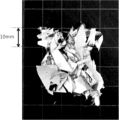
- a laminate having the layer structure of Example 1 (a roll film having a width of 300 mm) was put into a dry pulverizer having a fixed blade and a rotating blade and equipped with a screen having a mesh size of 12 mm, and the laminate was pulverized.
- the shape of the laminate after pulverization is as shown in FIG. 300 mL of 1N-lactic acid aqueous solution was placed in a 500 mL separable flask and heated to 75° C. using an oil bath.
- the collected film was poured into 500 mL of water and washed by stirring at room temperature and stirring speed of 300 rpm for 1 hour.
- the OPP/ink layer and CPP film were subjected to SEM-EDX analysis after cleaning, no residual aluminum deposited layer was confirmed.
- the plastic film recovery test was conducted again in the same manner as above using the lactic acid aqueous solution after recovering the cured resin layer and film, the same results as above were obtained. From this, it can be said that the lactic acid aqueous solution can be used repeatedly.
- a plastic film can be efficiently recovered from a laminate containing a plastic film.
- the method of the present invention has a high degree of freedom in the recovery conditions for plastic films, and in particular, plastic films can be easily recovered even from a laminate having two or more plastic films.
Landscapes
- Engineering & Computer Science (AREA)
- Mechanical Engineering (AREA)
- Environmental & Geological Engineering (AREA)
- Chemical & Material Sciences (AREA)
- Chemical Kinetics & Catalysis (AREA)
- Medicinal Chemistry (AREA)
- Polymers & Plastics (AREA)
- Organic Chemistry (AREA)
- Life Sciences & Earth Sciences (AREA)
- Health & Medical Sciences (AREA)
- Sustainable Development (AREA)
- Laminated Bodies (AREA)
- Separation, Recovery Or Treatment Of Waste Materials Containing Plastics (AREA)
Priority Applications (5)
| Application Number | Priority Date | Filing Date | Title |
|---|---|---|---|
| KR1020247033104A KR20250002192A (ko) | 2022-04-08 | 2023-03-27 | 플라스틱 필름을 회수하는 방법 |
| CN202380031107.XA CN118973782A (zh) | 2022-04-08 | 2023-03-27 | 回收塑料薄膜的方法 |
| US18/853,166 US20250223415A1 (en) | 2022-04-08 | 2023-03-27 | Method for recovering plastic film |
| JP2024514232A JPWO2023195376A1 (cg-RX-API-DMAC7.html) | 2022-04-08 | 2023-03-27 | |
| EP23784666.2A EP4506133A4 (en) | 2022-04-08 | 2023-03-27 | METHOD OF RECOVERING PLASTIC FILM |
Applications Claiming Priority (2)
| Application Number | Priority Date | Filing Date | Title |
|---|---|---|---|
| JP2022-064642 | 2022-04-08 | ||
| JP2022064642 | 2022-04-08 |
Publications (1)
| Publication Number | Publication Date |
|---|---|
| WO2023195376A1 true WO2023195376A1 (ja) | 2023-10-12 |
Family
ID=88242862
Family Applications (1)
| Application Number | Title | Priority Date | Filing Date |
|---|---|---|---|
| PCT/JP2023/012308 Ceased WO2023195376A1 (ja) | 2022-04-08 | 2023-03-27 | プラスチックフィルムを回収する方法 |
Country Status (7)
| Country | Link |
|---|---|
| US (1) | US20250223415A1 (cg-RX-API-DMAC7.html) |
| EP (1) | EP4506133A4 (cg-RX-API-DMAC7.html) |
| JP (1) | JPWO2023195376A1 (cg-RX-API-DMAC7.html) |
| KR (1) | KR20250002192A (cg-RX-API-DMAC7.html) |
| CN (1) | CN118973782A (cg-RX-API-DMAC7.html) |
| TW (1) | TW202348388A (cg-RX-API-DMAC7.html) |
| WO (1) | WO2023195376A1 (cg-RX-API-DMAC7.html) |
Citations (7)
| Publication number | Priority date | Publication date | Assignee | Title |
|---|---|---|---|---|
| JPS5720320A (en) * | 1980-07-11 | 1982-02-02 | Taku Yamada | Reuse of synthetic resin |
| JP2009101684A (ja) * | 2007-10-05 | 2009-05-14 | Mitsubishi Gas Chem Co Inc | ガスバリア性積層体 |
| WO2013161480A1 (ja) * | 2012-04-27 | 2013-10-31 | 三菱瓦斯化学株式会社 | エポキシ樹脂硬化剤、エポキシ樹脂組成物、及びガスバリア性接着剤、並びにガスバリア性積層体 |
| JP2014019003A (ja) * | 2012-07-13 | 2014-02-03 | Fujimori Kogyo Co Ltd | 複合材料の分別回収方法 |
| WO2018105282A1 (ja) * | 2016-12-09 | 2018-06-14 | 三菱瓦斯化学株式会社 | ガスバリア性フィルム |
| JP2020175620A (ja) | 2019-04-22 | 2020-10-29 | 東洋インキScホールディングス株式会社 | リサイクル基材製造方法 |
| JP2021107159A (ja) | 2019-12-20 | 2021-07-29 | 東洋インキScホールディングス株式会社 | 包装材、及びリサイクル基材製造方法 |
Family Cites Families (1)
| Publication number | Priority date | Publication date | Assignee | Title |
|---|---|---|---|---|
| TW533096B (en) * | 2002-09-12 | 2003-05-21 | Fgd Recycling Ind Co Ltd | Method for separating and recycling aluminum plastic (paper) composite packaging material |
-
2023
- 2023-03-27 WO PCT/JP2023/012308 patent/WO2023195376A1/ja not_active Ceased
- 2023-03-27 CN CN202380031107.XA patent/CN118973782A/zh active Pending
- 2023-03-27 KR KR1020247033104A patent/KR20250002192A/ko active Pending
- 2023-03-27 US US18/853,166 patent/US20250223415A1/en active Pending
- 2023-03-27 JP JP2024514232A patent/JPWO2023195376A1/ja active Pending
- 2023-03-27 EP EP23784666.2A patent/EP4506133A4/en active Pending
- 2023-03-31 TW TW112112394A patent/TW202348388A/zh unknown
Patent Citations (7)
| Publication number | Priority date | Publication date | Assignee | Title |
|---|---|---|---|---|
| JPS5720320A (en) * | 1980-07-11 | 1982-02-02 | Taku Yamada | Reuse of synthetic resin |
| JP2009101684A (ja) * | 2007-10-05 | 2009-05-14 | Mitsubishi Gas Chem Co Inc | ガスバリア性積層体 |
| WO2013161480A1 (ja) * | 2012-04-27 | 2013-10-31 | 三菱瓦斯化学株式会社 | エポキシ樹脂硬化剤、エポキシ樹脂組成物、及びガスバリア性接着剤、並びにガスバリア性積層体 |
| JP2014019003A (ja) * | 2012-07-13 | 2014-02-03 | Fujimori Kogyo Co Ltd | 複合材料の分別回収方法 |
| WO2018105282A1 (ja) * | 2016-12-09 | 2018-06-14 | 三菱瓦斯化学株式会社 | ガスバリア性フィルム |
| JP2020175620A (ja) | 2019-04-22 | 2020-10-29 | 東洋インキScホールディングス株式会社 | リサイクル基材製造方法 |
| JP2021107159A (ja) | 2019-12-20 | 2021-07-29 | 東洋インキScホールディングス株式会社 | 包装材、及びリサイクル基材製造方法 |
Non-Patent Citations (1)
| Title |
|---|
| See also references of EP4506133A4 |
Also Published As
| Publication number | Publication date |
|---|---|
| KR20250002192A (ko) | 2025-01-07 |
| US20250223415A1 (en) | 2025-07-10 |
| TW202348388A (zh) | 2023-12-16 |
| EP4506133A4 (en) | 2025-08-13 |
| JPWO2023195376A1 (cg-RX-API-DMAC7.html) | 2023-10-12 |
| EP4506133A1 (en) | 2025-02-12 |
| CN118973782A (zh) | 2024-11-15 |
Similar Documents
| Publication | Publication Date | Title |
|---|---|---|
| EP1219656B1 (en) | Composition for coating having a gas barrier property, coating and coated film having a gas barrier property used the same | |
| JPWO2018105282A1 (ja) | ガスバリア性フィルム | |
| US20030190480A1 (en) | Gas barrier film having excellent flexibility | |
| KR20100110318A (ko) | 구조용 접착제에 접합되는 조립체 및 이를 제조하기 위한 방법 및 어플리케이터 | |
| JP5257148B2 (ja) | ガスバリア性樹脂組成物、塗料および接着剤 | |
| JP4314916B2 (ja) | ガスバリア性コートフィルム | |
| JP2005111983A (ja) | ガスバリア性積層フィルム | |
| JP4929769B2 (ja) | ガスバリア性樹脂組成物、塗料および接着剤 | |
| US20250223415A1 (en) | Method for recovering plastic film | |
| JP2003251752A (ja) | 高湿度下でのガスバリア性に優れたラミネートフィルム | |
| JP4117451B2 (ja) | 耐屈曲性に優れたガスバリア性積層フィルム | |
| JP4280892B2 (ja) | ガスバリア性積層体 | |
| JP2012184294A (ja) | ガスバリア性エポキシ樹脂組成物 | |
| JP5195122B2 (ja) | ガスバリア性容器 | |
| JP2011068835A (ja) | ガスバリア性コートフィルム | |
| JP2008222761A (ja) | アミン系揮発物質の透過防止方法 | |
| JP4069357B2 (ja) | 耐屈曲性に優れたアルミニウム箔積層フィルム | |
| JP5051030B2 (ja) | ガスバリア性積層体 | |
| JP2004082708A (ja) | ガスバリア性容器 | |
| JP4143811B2 (ja) | ガスバリア性延伸ポリエステル積層フィルム | |
| JP4117459B2 (ja) | ガスバリア性積層フィルム | |
| JP4940683B2 (ja) | ガスバリア性容器 | |
| JP4117458B2 (ja) | ガスバリア性積層体 | |
| JP2004025616A (ja) | ガスバリア性ポリオレフィン積層フィルム | |
| JP2010270272A (ja) | ガスバリア性樹脂組成物、塗料および接着剤 |
Legal Events
| Date | Code | Title | Description |
|---|---|---|---|
| 121 | Ep: the epo has been informed by wipo that ep was designated in this application |
Ref document number: 23784666 Country of ref document: EP Kind code of ref document: A1 |
|
| ENP | Entry into the national phase |
Ref document number: 2024514232 Country of ref document: JP Kind code of ref document: A |
|
| WWE | Wipo information: entry into national phase |
Ref document number: 202380031107.X Country of ref document: CN |
|
| WWE | Wipo information: entry into national phase |
Ref document number: 18853166 Country of ref document: US |
|
| WWE | Wipo information: entry into national phase |
Ref document number: 2023784666 Country of ref document: EP |
|
| NENP | Non-entry into the national phase |
Ref country code: DE |
|
| ENP | Entry into the national phase |
Ref document number: 2023784666 Country of ref document: EP Effective date: 20241108 |
|
| WWP | Wipo information: published in national office |
Ref document number: 18853166 Country of ref document: US |