WO2023195216A1 - データ処理方法、プログラム、画像処理装置、および、走査型プローブ顕微鏡 - Google Patents
データ処理方法、プログラム、画像処理装置、および、走査型プローブ顕微鏡 Download PDFInfo
- Publication number
- WO2023195216A1 WO2023195216A1 PCT/JP2023/003162 JP2023003162W WO2023195216A1 WO 2023195216 A1 WO2023195216 A1 WO 2023195216A1 JP 2023003162 W JP2023003162 W JP 2023003162W WO 2023195216 A1 WO2023195216 A1 WO 2023195216A1
- Authority
- WO
- WIPO (PCT)
- Prior art keywords
- data
- image
- processing
- processing method
- sample
- Prior art date
- Legal status (The legal status is an assumption and is not a legal conclusion. Google has not performed a legal analysis and makes no representation as to the accuracy of the status listed.)
- Ceased
Links
Images




Classifications
-
- G—PHYSICS
- G06—COMPUTING OR CALCULATING; COUNTING
- G06T—IMAGE DATA PROCESSING OR GENERATION, IN GENERAL
- G06T11/00—Two-dimensional [2D] image generation
- G06T11/40—Filling planar surfaces by adding surface attributes, e.g. adding colours or textures
-
- G—PHYSICS
- G01—MEASURING; TESTING
- G01Q—SCANNING-PROBE TECHNIQUES OR APPARATUS; APPLICATIONS OF SCANNING-PROBE TECHNIQUES, e.g. SCANNING PROBE MICROSCOPY [SPM]
- G01Q30/00—Auxiliary means serving to assist or improve the scanning probe techniques or apparatus, e.g. display or data processing devices
- G01Q30/04—Display or data processing devices
-
- G—PHYSICS
- G06—COMPUTING OR CALCULATING; COUNTING
- G06T—IMAGE DATA PROCESSING OR GENERATION, IN GENERAL
- G06T5/00—Image enhancement or restoration
- G06T5/73—Deblurring; Sharpening
-
- G—PHYSICS
- G06—COMPUTING OR CALCULATING; COUNTING
- G06T—IMAGE DATA PROCESSING OR GENERATION, IN GENERAL
- G06T7/00—Image analysis
- G06T7/10—Segmentation; Edge detection
- G06T7/12—Edge-based segmentation
-
- G—PHYSICS
- G06—COMPUTING OR CALCULATING; COUNTING
- G06T—IMAGE DATA PROCESSING OR GENERATION, IN GENERAL
- G06T7/00—Image analysis
- G06T7/10—Segmentation; Edge detection
- G06T7/136—Segmentation; Edge detection involving thresholding
-
- G—PHYSICS
- G06—COMPUTING OR CALCULATING; COUNTING
- G06T—IMAGE DATA PROCESSING OR GENERATION, IN GENERAL
- G06T7/00—Image analysis
- G06T7/10—Segmentation; Edge detection
- G06T7/194—Segmentation; Edge detection involving foreground-background segmentation
-
- G—PHYSICS
- G06—COMPUTING OR CALCULATING; COUNTING
- G06T—IMAGE DATA PROCESSING OR GENERATION, IN GENERAL
- G06T2207/00—Indexing scheme for image analysis or image enhancement
- G06T2207/10—Image acquisition modality
- G06T2207/10056—Microscopic image
-
- G—PHYSICS
- G06—COMPUTING OR CALCULATING; COUNTING
- G06T—IMAGE DATA PROCESSING OR GENERATION, IN GENERAL
- G06T2207/00—Indexing scheme for image analysis or image enhancement
- G06T2207/20—Special algorithmic details
- G06T2207/20172—Image enhancement details
- G06T2207/20192—Edge enhancement; Edge preservation
Definitions
- the present invention relates to the processing of images obtained by a scanning probe microscope.
- a scanning probe microscope uses a sufficiently sharpened probe brought close enough to the sample to be observed, and the height of the probe is adjusted so that the physical quantity acting on the tip of the probe and the surface of the sample remains constant. By scanning the sample surface in the horizontal direction with a probe while moving the probe up and down, the unevenness of the sample surface can be observed with high resolution.
- SPM is a general term for microscopes that observe the unevenness of a sample surface using the above operating principle.
- a typical SPM is a scanning tunneling microscope (STM) that detects the current flowing between the probe and the sample as an interaction.
- Scanning Tunneling Microscope Scanning Tunneling Microscope
- AFM Atomic Force Microscope
- a scanning probe microscope has high resolution in the surface height direction, and it is difficult to set the sample surface horizontally at that level of resolution. Therefore, it is common to perform height correction on a height image (hereinafter referred to as an SPM image) acquired with a scanning probe microscope so that the inclined surface becomes horizontal.
- an SPM image a height image acquired with a scanning probe microscope so that the inclined surface becomes horizontal.
- Patent Document 1 As an example of processing images obtained by such a scanning probe microscope, Japanese Patent Laid-Open No. 2019-164090 (Patent Document 1) describes correction of the height of measurement data. More specifically, Patent Document 1 extracts at least a part of a region other than edges in image data as a reference plane region, and calculates measurement data based on height information of three points belonging to the reference plane region. Discloses a technique for correcting height. According to such technology, when a sample is composed of a substrate containing a structure, if the edge of the structure is accurately detected, the three points used for image processing belong to the area corresponding to the substrate. . That is, three points selected from the area corresponding to the substrate are used for image processing.
- the edges of the structure may not be detected accurately. In such a case, it is not possible to accurately correct the SPM image, and as a result, it is not possible to provide the user with an accurate surface state of the sample.
- the present invention was devised in view of the above circumstances, and its purpose is to provide a technique for providing the user with an accurate surface state of a sample.
- a data processing method is a method of processing image data of a sample including a substrate and a structure on the substrate generated based on measurement with a scanning probe microscope, the method comprising: a step of extracting a pixel from the image data that satisfies the condition that the comparison result with an adjacent pixel is an edge as an edge pixel; and a dilation step of dilating the edge formed by the edge pixels with respect to the image data.
- the method includes the steps of generating first data by performing a process, and using the first data to generate second data that specifies a region of the sample corresponding to the substrate.
- a program according to an aspect of the present disclosure causes a computer to perform the above-described data processing method.
- An image processing device implements the above-described data processing method.
- a scanning probe microscope according to an aspect of the present disclosure includes the above-described image processing device.
- a technique for providing an accurate sample surface state to a user is provided.
- FIG. 1 is a schematic configuration diagram of a scanning probe microscope according to Embodiment 1.
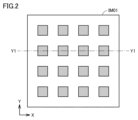
- FIG. FIG. 2 is a diagram showing an example of the shape of a sample observed with a scanning probe microscope.
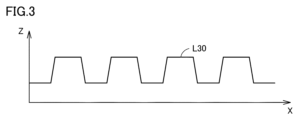
- 3 is a graph showing the height along the Y1-Y1 line in FIG. 2.
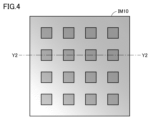
- FIG. 7 is a diagram showing another example of the shape of a sample observed with a scanning probe microscope.
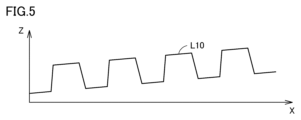
- 5 is a graph showing the height along the Y2-Y2 line in FIG. 4.
- FIG. 3 is a diagram schematically showing the result of edge extraction for an image obtained as an observation result using a scanning probe microscope.
- FIG. 3 is a diagram schematically showing the result of processing to expand extracted edges.
- FIG. 3 is a diagram schematically showing the results of binarization processing.
- FIG. 3 is a diagram schematically showing the result of hole-filling processing.
- FIG. 3 is a diagram schematically illustrating a data structure of a substrate region.
- 3 is a diagram schematically showing a part of a tilt correction process in the scanning probe microscope 1.
- FIG. 3 is a diagram schematically showing a part of a tilt correction process in the scanning probe microscope 1.
- FIG. 3 is a flowchart of an example of processing performed for image processing in the scanning probe microscope 1.
- FIG. 12 is a flowchart of an example of processing performed in the scanning probe microscope 1 according to the second embodiment. 12 is a flowchart of an example of processing performed in the scanning probe microscope 1 according to the third embodiment.
- FIG. 1 is a schematic configuration diagram of a scanning probe microscope according to Embodiment 1.
- An example of a scanning probe microscope is an atomic force microscope. Note that the scanning probe microscope may be another type of scanning probe microscope (for example, a scanning tunneling microscope).
- a scanning probe microscope 1 includes a sample stage 112 on which a sample 110 is placed, a piezo scanner 111 that displaces the sample stage, a cantilever 113 having a probe 114 formed at its tip, and a cantilever. 113, a feedback signal generating section 131, a computer 132, a scanning signal generating section 133, a storage device 134, and a display section 135.
- computer 132 includes at least one processor, and storage 134 non-volatilely stores programs executed by the processor.
- the piezo scanner 111 includes a Z scanner 111z that generates displacement in the Z direction based on the voltage value Vz, and an XY scanner 111xy that generates displacement in the XY direction based on the voltage values Vx and Vy.
- the displacement detection mechanism 120 includes a laser diode 115 and a photodetector 119.
- the laser light emitted from the laser diode 115 is reflected by the back surface of the cantilever 113, and the reflected light is received by the photodetector 119. be done.
- the cantilever 113 bends like a leaf spring, and the amount of bending is observed at the light receiving position of the photodetector 119.
- the feedback signal generator 131 receives a detection signal from the photodetector 119. Feedback signal generator 131 calculates the amount of deflection of cantilever 113 based on the detection signal. The feedback signal generator 131 controls the position of the sample in the Z direction so that the atomic force between the probe 114 and the surface of the sample 110 is always constant. The feedback signal generation unit 131 calculates a voltage value Vz for displacing the piezo scanner 111 in the Z-axis direction based on the amount of deflection of the cantilever 113, and outputs it to the Z scanner 111z.
- the scanning signal generator 133 calculates voltage values Vx and Vy in the X-axis and Y-axis directions so that the sample 110 moves relative to the probe 114 in the XY plane according to a predetermined scanning pattern. , and output to the XY scanner 111xy.
- a signal reflecting the amount of feedback in the Z-axis direction (voltage Vz applied to the scanner and deviation signal Sd) is also sent to the computer 132 and stored in the storage device 134.
- the computer 132 calculates the surface displacement due to the unevenness of the sample 110 from the voltage Vz based on the correlation information indicating the relationship between the voltage Vz and the corresponding amount of surface displacement due to the unevenness of the sample 110, which is stored in the storage device 134 in advance. Calculate the amount.
- the computer 132 reproduces a three-dimensional image of the sample surface by calculating the amount of displacement at each position in the X-axis and Y-axis directions, and depicts this on the screen of the display unit 135.
- This three-dimensional image data is also stored in the storage device 134.
- the data includes coordinates indicating the position on the XY plane and the sample height at the coordinates.
- the computer 132 can read the three-dimensional image data stored in the storage device 134 and display it on the display unit 135 at any time
- the computer 132 can perform height correction on the three-dimensional image data as necessary and display the data on the display unit 135.
- FIG. 2 is a diagram showing an example of the shape of a sample observed with a scanning probe microscope.
- 16 structures are arranged on the substrate.
- the 16 structures are arranged in four rows in the X-axis direction and four rows in the Y-axis direction, that is, in a 4x4 configuration.
- An example of the substrate is a mica board.
- An example of a structure is a nanoparticle or nanofiber of a biological sample. Note that these are just examples, and the sample (substrate, structure) targeted by the scanning probe microscope 1 is not limited to these.
- the shading of pixels in image IM01 represents the height in the Z-axis direction. Darker pixels represent higher positions in the sample in the Z-axis direction. Thin pixels represent positions lower in the sample in the Z-axis direction.
- FIG. 3 is a graph showing the height along the Y1-Y1 line in FIG. 2.
- the line L30 represents the height generated based on ideal observation by the scanning probe microscope 1. More specifically, line L30 represents one line of image data observed in an ideal case where there is no tilt of the substrate in the sample.
- the plane boundary (the boundary between the substrate and the structure) is shown as a line, but in FIG. A taper is provided at the plane boundary to make it closer.
- the horizontal axis indicates the position in the X direction, and the Z axis indicates the height at each X position. Note that when the probe scans along the X direction, the X axis also corresponds to the time axis.
- FIG. 4 is a diagram showing another example of the shape of a sample observed with a scanning probe microscope.
- Image IM10 shown in FIG. 4 corresponds to the same sample as sample 110 that corresponds to image IM01 shown in FIG.
- shading occurs on the same plane.
- large shading occurs in areas other than the areas corresponding to the 16 structures (areas corresponding to the substrate).
- One of the reasons why such shading occurs is that the sample 110 is installed at an angle on the sample stage 112.
- FIG. 5 is a graph showing the height along the Y2-Y2 line in FIG. 4.
- a line L10 represents the height of the sample 110 assumed from the Y2-Y2 line of the image IM10.
- the line L10 indicates that the surface of the sample 110 is inclined such that the larger the X coordinate is, the higher the surface of the sample 110 is.
- the scanning probe microscope 1 applies correction to an image generated based on observation results, such as the image IM10, and provides the corrected image. Thereby, the surface state of the sample 110 can be more accurately recognized from the corrected image. The details of the correction added to the image will be explained below.
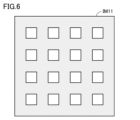
- FIG. 6 is a diagram schematically showing the result of edge extraction for an image obtained as an observation result using a scanning probe microscope.
- the image IM11 shown in FIG. 6 is subjected to a known process for edge extraction (Process/ Find Edges, etc.).
- the process of extracting edges to obtain the image IM11 typically includes differential processing of the height image. Furthermore, the processing for extracting edges may use a general outline extraction method used in photo processing techniques and the like. In one example, a portion where the absolute value of the difference between adjacent pixel data exceeds a certain threshold value may be extracted.
- pixels forming the boundaries between each of the 16 structures and the substrate are detected as edges and are shown as black pixels.
- each pixel detected as an edge is an example of an edge pixel.
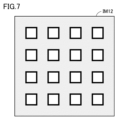
- FIG. 7 is a diagram schematically showing the result of processing to expand the extracted edges.
- the image IM12 shown in FIG. 7 is obtained by subjecting the image IM11 of FIG. 6 to maximum value processing.
- edge pixels are shown as black pixels (pixels with relatively high pixel values). Therefore, by performing the maximum value processing on the image IM11, in the image IM12 shown in FIG. 7, the edges formed by the edge pixels are expanded.
- the data for displaying the image IM12 is an example of "first data.”
- processing for edge expansion is not limited to maximum value processing.
- the type of processing for edge expansion can be changed as appropriate depending on the expression mode of edge pixels. For example, when an edge pixel is expressed as a white pixel (pixel having a relatively low pixel value), minimum value processing may be employed as the processing for edge expansion.
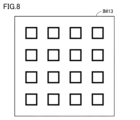
- FIG. 8 is a diagram schematically showing the results of the binarization process.
- the image IM13 shown in FIG. 8 is obtained by performing a known binarization process (open source ImageJ (https://imagej.nih.gov/ij/)) on the image IM12 of FIG. Process/Binary/Make Binary etc.).
- the threshold value for binarization may be adjusted by the user and/or computer 132 as appropriate.
- the computer 132 may perform line connection processing on the binarized image IM13. This allows the edge pixels detected in image IM10 to more accurately represent the outer edge of the structure.
- the line connection process can be realized, for example, by a known technique (Process/Binary/Close in open source ImageJ (https://imagej.nih.gov/ij/), etc.).
- the computer 132 may perform hole filling processing on the binarized image IM13 (or the image obtained by performing line connection processing on the image IM13).
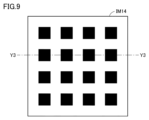
- FIG. 9 is a diagram schematically showing the results of the hole filling process.
- the hole filling process can be realized, for example, by a known technique (Process/Binary/Fill Holes in open source ImageJ (https://imagej.nih.gov/ij/), etc.).
- regions of the sample 110 corresponding to each of the 16 structures are represented filled with black pixels, and other regions are represented filled with white pixels. ing.
- the computer 132 can extract a white pixel region from the image IM14 shown in FIG. 9 as a region of the sample corresponding to the substrate (a region where no structure is placed).
- the data specifying the area corresponding to the substrate (substrate area) is also referred to as "second data.”
- FIG. 10 is a diagram for schematically explaining the data structure of the substrate area. 10 includes lines L11, L12, L13, L14, and L15 that indicate the height along the Y3-Y3 line in FIG. 9 in the substrate area.
- each end of the lines L11 to L15 is located inside by a length D1.
- FIG. 11 is a diagram schematically showing a part of the tilt correction process in the scanning probe microscope 1.
- data filled (interpolated) to make the lines L11 to L15 shown in FIG. 10 into one line is shown by a broken line.
- the line formed by data interpolation is shown as line A10.
- computer 132 generates a straight line (line A10) inferred from the points making up lines L11-L15 during data interpolation.
- Generation of a straight line is an example of generation of data for filling. Then, the computer 132 realizes data interpolation by filling the portions other than the five lines L11 to L15 with the data of the corresponding portions of the generated straight lines.
- the computer 132 performs data interpolation similar to that shown in FIG. 11 (generation of filling data and filling). This generates data corresponding to the entire area of the sample, that is, data representing the surface of the substrate corresponding to the entire area of the sample.
- the data generated here virtually represents the substrate from which the structure has been removed from the sample, and is an example of "third data.”
- the inclination of the surface generated here is expected to represent the inclination of the sample 110 on the sample stage 112.
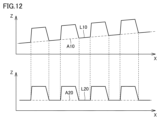
- FIG. 12 is a diagram schematically showing a part of the tilt correction process in the scanning probe microscope 1.
- the computer 132 calculates the inclination of the plane of the data generated in the process described with reference to FIG. 11 with respect to the ideal plane, and corrects the image IM10 so as to correct the calculated inclination.
- FIG. 12 the direction of the surface of the data generated in the process described with reference to FIG. 11 is shown as line A10.
- the ideal surface orientation is shown as line A20.
- Computer 132 calculates the slope of line A10 with respect to line A20. This slope corresponds to the slope of the sample 110. Then, the computer 132 corrects the image IM10 (FIG. 4) so as to offset the calculated tilt. Through this correction, a line L20 is generated from the line L10, as shown in FIG. 12. Similarly, by correcting the entire area of image IM10, a corrected image is generated. This correction is expected to bring image IM10 closer to image IM01 (FIG. 2). In this specification, the corrected image is also referred to as "fourth data.”
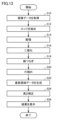
- FIG. 13 is a flowchart of an example of processing performed for image processing in the scanning probe microscope 1.
- the process of FIG. 13 is performed by the processor of computer 132 executing a given program.
- computer 132 is an example of an image processing device.
- step S10 the scanning probe microscope 1 acquires image data that is the observation result.
- An example of the image data acquired here corresponds to image IM10 in FIG. 4.
- step S12 the scanning probe microscope 1 extracts edges from the image acquired in step S10. Edge extraction is achieved, for example, by the method described with reference to FIG.
- step S14 the scanning probe microscope 1 expands the edge extracted in step S12. Edge dilation is achieved, for example, by the technique described with reference to FIG.
- step S16 the scanning probe microscope 1 binarizes the image whose edges have been expanded in step S14. Binarization is realized, for example, by the method described with reference to FIG.
- step S18 the scanning probe microscope 1 performs line connection processing on the image binarized in step S16.
- the line connection process is realized, for example, by the method described with reference to FIG.
- step S20 the scanning probe microscope 1 performs hole-filling processing on the image subjected to the line connection processing in step S18.
- the hole filling process is realized, for example, by the method described with reference to FIG.
- step S22 the scanning probe microscope 1 generates substrate area data using the image subjected to the hole-filling process in step S20.
- the substrate area data is data that specifies the substrate area, and is the above-mentioned "second data.”
- step S24 the scanning probe microscope 1 uses the second data to correct the image data acquired in step S10 (height correction). Correction of image data is realized, for example, by the method described with reference to FIGS. 11 and 12.
- data specifying a substrate region is filled with data in a region corresponding to a structure, as shown by a broken line (line A10) in FIG. It was done. Note that in the correction of image data, such data filling may be omitted.
- the scanning probe microscope 1 may calculate the inclination of the sample 110 (with respect to an ideal plane) only from the substrate area.
- step S26 the scanning probe microscope 1 displays the processing results on the display unit 135.
- the displayed results may include the image generated by the correction in step S24. Thereafter, the scanning probe microscope 1 ends the process of FIG. 13.
- the first data is generated by performing the expansion process on the edge of the structure, and the first data is used to generate the area (substrate) corresponding to the substrate in the sample.
- Second data is generated that specifies a region (a region on which no structure exists). This reliably prevents the image of the structure from being included in the region corresponding to the substrate specified by the second data. Furthermore, areas other than the area are reliably identified as areas including the entire structure.
- the region specified by the second data is used to correct the tilt in the original image data caused by the tilt of the sample, more points (or lines or regions) can be used for the correction. . Thereby, the tilt can be corrected more accurately during correction. Therefore, the surface state of the sample can be accurately provided to the user.
- the scanning probe microscope 1 corrects the original image data using the substrate area data, and again specifies the area corresponding to the structure from the corrected image data.
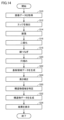
- FIG. 14 is a flowchart of an example of processing performed in the scanning probe microscope 1 of the second embodiment.
- the process in FIG. 14 includes control in steps S10 to S24, similar to the process in FIG. In the process of FIG. 14, control proceeds to step S30 after step S24.
- step S30 the scanning probe microscope 1 identifies a region corresponding to the structure in the corrected image data generated in step S24.
- the corrected image data generated in step S24 is an example of "fourth data.”
- the identification of the region corresponding to the structure in step S30 may include, for example, the same control as steps S12 to S22. That is, the scanning probe microscope 1 extracts edges from the corrected image data, dilates the extracted edges, binarizes the edge-dilated image, and converts the binarized image to line connection processing is performed, hole filling processing is performed on the image subjected to the line connection processing, and board area data of the image subjected to the hole filling processing is generated. Then, the scanning probe microscope 1 identifies an area other than the substrate area specified by the substrate area data as an area corresponding to the structure.
- step S32 the scanning probe microscope 1 generates "structure data" by extracting a region corresponding to the structure identified in step S30 from the image data corrected in step S24.
- the structure data includes images corresponding to structures.
- step S34 the scanning probe microscope 1 displays the processing results on the display unit 135.
- the displayed results may include an image of the structure data generated in step S30, that is, an image corresponding to the structure. After that, the scanning probe microscope 1 ends the process of FIG. 14.
- an area other than the area specified by the second data is extracted from the original image data and displayed as structure data.
- the second data is generated using the first data, and the first data is generated through expansion processing. This ensures that the entire area of the structure is included in the area other than the area specified by the second data. Therefore, the state of the structure can be accurately provided to the user, and thereby the surface state of the sample can be accurately provided.
- the scanning probe microscope 1 generates a pseudo image of the entire sample by combining the structure data of the second embodiment and background data that fills the area of the substrate.
- FIG. 15 is a flowchart of an example of processing performed in the scanning probe microscope 1 of the third embodiment.
- the process in FIG. 15 includes control in steps S10 to S22, similar to the process in FIG. 13. In the process of FIG. 15, control proceeds to step S40 after step S22.
- step S40 the scanning probe microscope 1 generates structure data using the image data acquired in step S10 and the substrate area data generated in step S22.
- the structure data generated in step S40 is generated by extracting an area other than the area of the substrate specified by the substrate area data generated in step S22 from the image data acquired in step S10.
- step S42 the scanning probe microscope 1 generates viewing data by filling an area other than the area specified by the structure data generated in step S40 with background data.
- the data for viewing represents a pseudo image of the entire sample. In this image, the structure in the image data acquired in step S10 and the background image are combined.
- step S44 the scanning probe microscope 1 displays the processing results on the display unit 135.
- the displayed results may include an image of the viewing data generated in step S42, that is, a pseudo image of the entire sample. After that, the scanning probe microscope 1 ends the process of FIG. 14.
- the viewing data in Embodiment 3 (the image of the entire pseudo sample), the area corresponding to the substrate area has appropriate brightness. No adjustment required. Therefore, the user can visually check the processing results without having to perform complicated operations such as contrast adjustment. Furthermore, in the conventional technique, a wave in pixel density may occur in the background during contrast adjustment. In the third embodiment, since the contrast adjustment can be omitted, it is possible to avoid the above-mentioned wave of pixel density from occurring in the image displayed to the user.
- the viewing data may be generated by combining the structure data (S30) and the background data (S42) generated in the second embodiment.
- the image of the entire pseudo sample includes an image of an area other than the area specified by the second data from the original image data.
- the second data is generated using the first data, and the first data is generated through expansion processing. This ensures that the entire area of the structure is included in the area other than the area specified by the second data. Therefore, by providing a pseudo image of the entire sample, the user can be provided with an accurate state of the structure, and thereby an accurate surface state of the sample.
- a data processing method is a method for processing image data of a sample including a substrate and a structure on the substrate, which is generated based on measurement with a scanning probe microscope, and includes: a step of acquiring the image data; a step of extracting from the image data a pixel that satisfies a condition that a comparison result with an adjacent pixel is an edge as an edge pixel; generating first data by performing an expansion process to expand the edge of the sample; and using the first data, generating second data for specifying a region corresponding to the substrate in the sample. It may also have the following.
- the expansion process may include maximum value processing.
- the configuration is reliably expanded by edge pixels in the expansion process.
- filling data from the image data into an area other than the area specified by the second data may be used to fill the substrate.
- the method may further include the step of generating third data representing only the image.
- the height of the original image data can be corrected more accurately.
- the step of generating the third data uses the pixel values of the area specified by the second data in the image data to It may include generating data for.
- data for filling can be generated as data that more closely matches the original image data.
- the step of generating the third data includes performing tilt correction on the image data using the third data. 4 data may be generated.
- image data whose tilt has been corrected more reliably can be generated as the fourth data.
- the data processing method includes the step of specifying, in the fourth data, an area corresponding to the structure in the image data;
- the method may further include a step of generating structure data from which a region corresponding to the region is extracted.
- data that includes the entire structure can be generated more reliably as the structure data.
- the data processing method according to Item 1 or 2 further includes the step of generating structure data by extracting a region specified by the second data from the image data. You can leave it there.
- data that includes the entire structure can be generated more reliably as structure data.
- Paragraph 8 The data processing method according to Paragraph 6 or 7 is characterized by combining the structure data and background data having background pixels in the area specified by the second data. , the method may further include the step of generating data for viewing.
- contrast adjustment is not required when displaying data for viewing.
- the method may further include a step of performing binarization processing.
- edges can be expressed more clearly in the data.
- the data processing method according to Item 9 may further include the step of performing line connection processing on the image subjected to the binarization processing in order to generate the second data. good.
- the region corresponding to the substrate in the data is specified more reliably.
- the program may cause a computer to execute the data processing method described in Sections 1 to 10.
- a technique for providing a user with an accurate surface state of a sample is provided.
- a scanning probe microscope may include the image processing device described in Section 12.
- 1 scanning probe microscope 110 sample, 111 piezo scanner, 111xy XY scanner, 111z Z scanner, 112 sample stage, 113 cantilever, 114 needle, 115 laser diode, 119 photodetector, 120 displacement detection mechanism, 131 Feedback signal generator, 132 Computer, 133 Scanning signal generation section, 134 Storage device, 135 Display section.
Landscapes
- Engineering & Computer Science (AREA)
- Physics & Mathematics (AREA)
- General Physics & Mathematics (AREA)
- Theoretical Computer Science (AREA)
- Computer Vision & Pattern Recognition (AREA)
- Health & Medical Sciences (AREA)
- General Health & Medical Sciences (AREA)
- Nuclear Medicine, Radiotherapy & Molecular Imaging (AREA)
- Radiology & Medical Imaging (AREA)
- Length Measuring Devices With Unspecified Measuring Means (AREA)
Priority Applications (3)
| Application Number | Priority Date | Filing Date | Title |
|---|---|---|---|
| US18/854,468 US20250252541A1 (en) | 2022-04-07 | 2023-02-01 | Data Processing Method, Program, Image Processing Device, and Scanning Probe Microscope |
| CN202380031696.1A CN118974567A (zh) | 2022-04-07 | 2023-02-01 | 数据处理方法、程序、图像处理装置以及扫描型探针显微镜 |
| JP2024514159A JP7740527B2 (ja) | 2022-04-07 | 2023-02-01 | データ処理方法、プログラム、画像処理装置、および、走査型プローブ顕微鏡 |
Applications Claiming Priority (2)
| Application Number | Priority Date | Filing Date | Title |
|---|---|---|---|
| JP2022063826 | 2022-04-07 | ||
| JP2022-063826 | 2022-04-07 |
Publications (1)
| Publication Number | Publication Date |
|---|---|
| WO2023195216A1 true WO2023195216A1 (ja) | 2023-10-12 |
Family
ID=88242771
Family Applications (1)
| Application Number | Title | Priority Date | Filing Date |
|---|---|---|---|
| PCT/JP2023/003162 Ceased WO2023195216A1 (ja) | 2022-04-07 | 2023-02-01 | データ処理方法、プログラム、画像処理装置、および、走査型プローブ顕微鏡 |
Country Status (4)
| Country | Link |
|---|---|
| US (1) | US20250252541A1 (https=) |
| JP (1) | JP7740527B2 (https=) |
| CN (1) | CN118974567A (https=) |
| WO (1) | WO2023195216A1 (https=) |
Cited By (1)
| Publication number | Priority date | Publication date | Assignee | Title |
|---|---|---|---|---|
| WO2025022875A1 (ja) * | 2023-07-25 | 2025-01-30 | 株式会社島津製作所 | 画像処理方法、プログラム、画像処理装置、および走査型プローブ顕微鏡 |
Citations (6)
| Publication number | Priority date | Publication date | Assignee | Title |
|---|---|---|---|---|
| JPH1137719A (ja) * | 1997-07-15 | 1999-02-12 | Fujitsu Ltd | 検査装置 |
| JPH1185965A (ja) * | 1997-07-16 | 1999-03-30 | Seiko Instr Inc | 走査型プローブ顕微鏡 |
| JP2007295210A (ja) * | 2006-04-25 | 2007-11-08 | Sharp Corp | 画像処理装置、画像処理方法、画像処理プログラム、およびこれを記録した記録媒体 |
| CN203163784U (zh) * | 2013-02-06 | 2013-08-28 | 中国计量学院 | 显微流量检测仪 |
| JP2018007016A (ja) * | 2016-07-01 | 2018-01-11 | オリンパス株式会社 | 撮像装置、撮像方法、およびプログラム |
| JP2019164090A (ja) * | 2018-03-20 | 2019-09-26 | 株式会社島津製作所 | データ補正方法、データ補正方法をコンピュータに実行させるプログラム、画像処理装置、走査型プローブ顕微鏡 |
-
2023
- 2023-02-01 CN CN202380031696.1A patent/CN118974567A/zh active Pending
- 2023-02-01 JP JP2024514159A patent/JP7740527B2/ja active Active
- 2023-02-01 WO PCT/JP2023/003162 patent/WO2023195216A1/ja not_active Ceased
- 2023-02-01 US US18/854,468 patent/US20250252541A1/en active Pending
Patent Citations (6)
| Publication number | Priority date | Publication date | Assignee | Title |
|---|---|---|---|---|
| JPH1137719A (ja) * | 1997-07-15 | 1999-02-12 | Fujitsu Ltd | 検査装置 |
| JPH1185965A (ja) * | 1997-07-16 | 1999-03-30 | Seiko Instr Inc | 走査型プローブ顕微鏡 |
| JP2007295210A (ja) * | 2006-04-25 | 2007-11-08 | Sharp Corp | 画像処理装置、画像処理方法、画像処理プログラム、およびこれを記録した記録媒体 |
| CN203163784U (zh) * | 2013-02-06 | 2013-08-28 | 中国计量学院 | 显微流量检测仪 |
| JP2018007016A (ja) * | 2016-07-01 | 2018-01-11 | オリンパス株式会社 | 撮像装置、撮像方法、およびプログラム |
| JP2019164090A (ja) * | 2018-03-20 | 2019-09-26 | 株式会社島津製作所 | データ補正方法、データ補正方法をコンピュータに実行させるプログラム、画像処理装置、走査型プローブ顕微鏡 |
Cited By (1)
| Publication number | Priority date | Publication date | Assignee | Title |
|---|---|---|---|---|
| WO2025022875A1 (ja) * | 2023-07-25 | 2025-01-30 | 株式会社島津製作所 | 画像処理方法、プログラム、画像処理装置、および走査型プローブ顕微鏡 |
Also Published As
| Publication number | Publication date |
|---|---|
| JPWO2023195216A1 (https=) | 2023-10-12 |
| JP7740527B2 (ja) | 2025-09-17 |
| CN118974567A (zh) | 2024-11-15 |
| US20250252541A1 (en) | 2025-08-07 |
Similar Documents
| Publication | Publication Date | Title |
|---|---|---|
| CN110308310B (zh) | 数据校正方法、记录介质、图像处理装置、扫描型探针显微镜 | |
| JP3485052B2 (ja) | 参照画像作成方法、パターン検査装置及び参照画像作成プログラムを記録した記録媒体 | |
| US6489611B1 (en) | Atomic force microscope for profiling high aspect ratio samples | |
| CN117296075B (zh) | 具有保留度量的实时去噪的afm成像 | |
| Kocur et al. | Correction of AFM data artifacts using a convolutional neural network trained with synthetically generated data | |
| JP7740527B2 (ja) | データ処理方法、プログラム、画像処理装置、および、走査型プローブ顕微鏡 | |
| JP2006093251A (ja) | 寸法計測方法及びその装置 | |
| KR20210069690A (ko) | 입자 현미경을 사용하여 영상을 기록하는 방법 | |
| CN106104278B (zh) | 扫描探针显微镜 | |
| JPWO2010095392A1 (ja) | 試料観察方法および走査電子顕微鏡 | |
| JP7810264B2 (ja) | 画像処理方法、画像処理装置、走査型プローブ顕微鏡、およびプログラム | |
| JP2000266706A (ja) | 検査装置および検査方法 | |
| US20160163501A1 (en) | Charged Particle Beam Device and Image Acquisition Method | |
| JP2010085376A (ja) | 走査型電子顕微鏡を用いたパターン計測方法 | |
| US12352779B2 (en) | Scanning probe microscope and method for measuring physical quantity using scanning probe microscope | |
| WO2014143727A1 (en) | Method and apparatus for adaptive tracking using a scanning probe microscope | |
| Schmuck et al. | Automatic and time-resolved determination of fracture characteristics from in situ experiments | |
| JP4262649B2 (ja) | 走査型電子顕微鏡装置およびこれを用いた三次元画像表示方法 | |
| CN121844213A (zh) | 图像处理方法、程序、图像处理装置、以及扫描探针显微镜 | |
| WO2024150494A1 (ja) | 探針劣化判定方法、探針劣化判定装置、および、探針劣化判定用プログラム | |
| JP2022134649A (ja) | 走査型プローブ顕微鏡、情報処理装置、およびプログラム | |
| JP7833722B2 (ja) | 学習装置、三次元測定システム、学習方法、及びプログラム | |
| JP3360792B2 (ja) | 走査型プローブ顕微鏡 | |
| TWI921248B (zh) | 圖像處理系統,圖像處理方法,及顯示裝置 | |
| JP3121619B2 (ja) | 走査型トンネル顕微鏡の画像処理方法 |
Legal Events
| Date | Code | Title | Description |
|---|---|---|---|
| 121 | Ep: the epo has been informed by wipo that ep was designated in this application |
Ref document number: 23784511 Country of ref document: EP Kind code of ref document: A1 |
|
| ENP | Entry into the national phase |
Ref document number: 2024514159 Country of ref document: JP Kind code of ref document: A |
|
| WWE | Wipo information: entry into national phase |
Ref document number: 202380031696.1 Country of ref document: CN |
|
| NENP | Non-entry into the national phase |
Ref country code: DE |
|
| WWE | Wipo information: entry into national phase |
Ref document number: 18854468 Country of ref document: US |
|
| 122 | Ep: pct application non-entry in european phase |
Ref document number: 23784511 Country of ref document: EP Kind code of ref document: A1 |
|
| WWP | Wipo information: published in national office |
Ref document number: 18854468 Country of ref document: US |