WO2023195212A1 - オキシハロゲン化物材料、電池、および電池システム - Google Patents
オキシハロゲン化物材料、電池、および電池システム Download PDFInfo
- Publication number
- WO2023195212A1 WO2023195212A1 PCT/JP2023/002792 JP2023002792W WO2023195212A1 WO 2023195212 A1 WO2023195212 A1 WO 2023195212A1 JP 2023002792 W JP2023002792 W JP 2023002792W WO 2023195212 A1 WO2023195212 A1 WO 2023195212A1
- Authority
- WO
- WIPO (PCT)
- Prior art keywords
- oxyhalide
- battery
- range
- oxyhalide material
- less
- Prior art date
- Legal status (The legal status is an assumption and is not a legal conclusion. Google has not performed a legal analysis and makes no representation as to the accuracy of the status listed.)
- Ceased
Links
Images




Classifications
-
- H—ELECTRICITY
- H01—ELECTRIC ELEMENTS
- H01M—PROCESSES OR MEANS, e.g. BATTERIES, FOR THE DIRECT CONVERSION OF CHEMICAL ENERGY INTO ELECTRICAL ENERGY
- H01M4/00—Electrodes
- H01M4/02—Electrodes composed of, or comprising, active material
- H01M4/36—Selection of substances as active materials, active masses, active liquids
- H01M4/58—Selection of substances as active materials, active masses, active liquids of inorganic compounds other than oxides or hydroxides, e.g. sulfides, selenides, tellurides, halogenides or LiCoFy; of polyanionic structures, e.g. phosphates, silicates or borates
- H01M4/582—Halogenides
-
- C—CHEMISTRY; METALLURGY
- C01—INORGANIC CHEMISTRY
- C01G—COMPOUNDS CONTAINING METALS NOT COVERED BY SUBCLASSES C01D OR C01F
- C01G35/00—Compounds of tantalum
-
- H—ELECTRICITY
- H01—ELECTRIC ELEMENTS
- H01M—PROCESSES OR MEANS, e.g. BATTERIES, FOR THE DIRECT CONVERSION OF CHEMICAL ENERGY INTO ELECTRICAL ENERGY
- H01M10/00—Secondary cells; Manufacture thereof
- H01M10/05—Accumulators with non-aqueous electrolyte
- H01M10/052—Li-accumulators
-
- H—ELECTRICITY
- H01—ELECTRIC ELEMENTS
- H01M—PROCESSES OR MEANS, e.g. BATTERIES, FOR THE DIRECT CONVERSION OF CHEMICAL ENERGY INTO ELECTRICAL ENERGY
- H01M10/00—Secondary cells; Manufacture thereof
- H01M10/05—Accumulators with non-aqueous electrolyte
- H01M10/056—Accumulators with non-aqueous electrolyte characterised by the materials used as electrolytes, e.g. mixed inorganic/organic electrolytes
- H01M10/0561—Accumulators with non-aqueous electrolyte characterised by the materials used as electrolytes, e.g. mixed inorganic/organic electrolytes the electrolyte being constituted of inorganic materials only
- H01M10/0562—Solid materials
-
- H—ELECTRICITY
- H01—ELECTRIC ELEMENTS
- H01M—PROCESSES OR MEANS, e.g. BATTERIES, FOR THE DIRECT CONVERSION OF CHEMICAL ENERGY INTO ELECTRICAL ENERGY
- H01M4/00—Electrodes
- H01M4/02—Electrodes composed of, or comprising, active material
- H01M4/36—Selection of substances as active materials, active masses, active liquids
- H01M4/58—Selection of substances as active materials, active masses, active liquids of inorganic compounds other than oxides or hydroxides, e.g. sulfides, selenides, tellurides, halogenides or LiCoFy; of polyanionic structures, e.g. phosphates, silicates or borates
-
- H—ELECTRICITY
- H01—ELECTRIC ELEMENTS
- H01M—PROCESSES OR MEANS, e.g. BATTERIES, FOR THE DIRECT CONVERSION OF CHEMICAL ENERGY INTO ELECTRICAL ENERGY
- H01M4/00—Electrodes
- H01M4/02—Electrodes composed of, or comprising, active material
- H01M2004/026—Electrodes composed of, or comprising, active material characterised by the polarity
- H01M2004/028—Positive electrodes
-
- Y—GENERAL TAGGING OF NEW TECHNOLOGICAL DEVELOPMENTS; GENERAL TAGGING OF CROSS-SECTIONAL TECHNOLOGIES SPANNING OVER SEVERAL SECTIONS OF THE IPC; TECHNICAL SUBJECTS COVERED BY FORMER USPC CROSS-REFERENCE ART COLLECTIONS [XRACs] AND DIGESTS
- Y02—TECHNOLOGIES OR APPLICATIONS FOR MITIGATION OR ADAPTATION AGAINST CLIMATE CHANGE
- Y02E—REDUCTION OF GREENHOUSE GAS [GHG] EMISSIONS, RELATED TO ENERGY GENERATION, TRANSMISSION OR DISTRIBUTION
- Y02E60/00—Enabling technologies; Technologies with a potential or indirect contribution to GHG emissions mitigation
- Y02E60/10—Energy storage using batteries
Definitions
- the present disclosure relates to oxyhalide materials, batteries, and battery systems.
- Patent Document 1 discloses a solid electrolyte material containing Li, M, O, and X, and a battery using the same.
- M is at least one element selected from the group consisting of Nb and Ta
- X is at least one element selected from the group consisting of Cl, Br, and I.
- Patent Document 2 discloses a solid electrolyte material containing Li, M, O, X, and F, and a battery using the same.
- M is at least one element selected from the group consisting of Ta and Nb
- X is at least one element selected from the group consisting of Cl, Br, and I.
- An object of the present disclosure is to provide an oxyhalide material with practical lithium ion conductivity and practical electrochemical stability.
- the oxyhalide materials of the present disclosure include: Contains Li, M, O, and X, M is at least two selected from Group 5 elements, X is at least one selected from the group consisting of F, Cl, Br, and I, Shows a reversible redox reaction, In the X-ray diffraction pattern obtained by X-ray diffraction measurement of the oxyhalide material using Cu-K ⁇ radiation, the range of diffraction angle 2 ⁇ of 13.0° or more and 14.5° or less was defined as the first range.
- the present disclosure provides oxyhalide materials with practical lithium ion conductivity and practical electrochemical stability.
- FIG. 1 is a sectional view showing a schematic configuration of a battery according to a second embodiment.
- FIG. 2 is a schematic diagram of a pressure molding die used to evaluate the ionic conductivity of oxyhalide materials.
- FIG. 3 is a graph showing a Cole-Cole plot obtained by electrochemical impedance measurement of the oxyhalide material of Example 1-1.
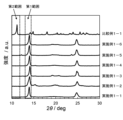
- FIG. 4A is a graph showing X-ray diffraction patterns of oxyhalide materials of Examples and Comparative Examples.
- FIG. 4B is an enlarged view of the first range of FIG. 4A.
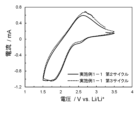
- FIG. 5 is a graph showing the cyclic voltammograms of the second and third cycles obtained by cyclic voltammetry (CV) measurement of the oxyhalide material of Example 1-1.
- FIG. 6 is a graph showing the X-ray diffraction patterns of the oxyhalide material of Example 1-1 before and after carrying out 11 cycles of CV measurement.
- FIG. 7A is a graph showing the first cycle discharge characteristics of the batteries of Example 2-1 and Comparative Example 2-1.
- FIG. 7B is a graph showing the second cycle discharge characteristics of the batteries of Example 2-1 and Comparative Example 2-1.
- FIG. 8 is a graph showing the discharge characteristics of the battery of Example 3-1 in the first cycle and the 50th cycle.
- Patent Document 1 discloses Li, M, O, and X (M is at least one element selected from the group consisting of Nb and Ta, and X is selected from the group consisting of Cl, Br, and I). discloses a solid electrolyte material containing at least one element).
- Patent Document 2 discloses that Li, M, O, X, and F (M is at least one element selected from the group consisting of Ta and Nb, and X is selected from the group consisting of Cl, Br, and I).
- the solid electrolyte materials disclosed in Patent Documents 1 and 2 contain Ta or Nb, which are transition metal elements.
- the transition metal ions are reduced, which may cause the material to decompose or change its structure. Therefore, when the solid electrolyte material is exposed to a potential lower than the reduction initiation potential, the lithium ion conductivity may decrease significantly.
- Patent Document 2 discloses that when the molar ratio of F to the total of X and F is 10% or more and 50% or less, the reduction start potential of the solid electrolyte material decreases. Specifically, Patent Document 2 discloses that in a material consisting of Li, Ta, O, Cl, and F, when the molar ratio of F to the total of X and F is 10%, the reduction initiation potential at 25°C is (metal It discloses that the reduction initiation potential at 25° C. is 2.0 V when the molar ratio of F to the sum of X and F is 50%. Thus, the reduction initiation potential of the solid electrolyte material decreases as the molar ratio of F to the sum of X and F increases.
- electrolyte materials used in batteries are required to have high electrochemical stability in addition to high lithium ion conductivity.
- High lithium ion conductivity is necessary to reduce the internal resistance of the battery.
- the electrolyte material has a lithium ion conductivity of 1.0 ⁇ 10 ⁇ 3 S/cm or more near room temperature, for example, it can be said to have a lithium ion conductivity sufficient to reduce the internal resistance of the battery.
- the reduction initiation potential of the electrolyte material changes due to the operating potential of the battery, the potential distribution within the battery, and changes in the temperature of the battery. Therefore, when used as an electrolyte material in a positive electrode, the reduction start potential of the electrolyte material is preferably 2.2 V or less, for example. When used in a low-potential negative electrode or as a separator layer of a battery, the reduction start potential of the electrolyte material is preferably 1.5 V or less, for example.
- the solid electrolyte materials disclosed in Patent Documents 1 and 2 cannot achieve both sufficiently high lithium ion conductivity and sufficiently high electrochemical stability. That is, the solid electrolyte materials disclosed in Patent Documents 1 and 2 have a lithium ion conductivity of 1.0 ⁇ 10 -3 S/cm or more near room temperature, and a reduction initiation potential of 2.2 V or less or less. It is not possible to maintain a voltage of 1.5V or less.
- the present inventors have conducted extensive studies in order to realize an oxyhalide material that has practical lithium ion conductivity and practical electrochemical stability. As a result, we came up with the oxyhalide material of the present disclosure.
- the oxyhalide material according to the first aspect of the present disclosure includes: Contains Li, M, O, and X, M is at least two selected from Group 5 elements, X is at least one selected from the group consisting of F, Cl, Br, and I, Shows a reversible redox reaction, In the X-ray diffraction pattern obtained by X-ray diffraction measurement of the oxyhalide material using Cu-K ⁇ radiation, the range of diffraction angle 2 ⁇ of 13.0° or more and 14.5° or less was defined as the first range.
- the oxyhalide materials of the present disclosure have practical lithium ion conductivity and practical electrochemical stability.
- M may include Nb. According to the above configuration, the electrochemical stability of the oxyhalide material is further improved.
- M may include Nb and Ta. According to the above configuration, the lithium ion conductivity of the oxyhalide material is further improved.
- X is at least two selected from the group consisting of F, Cl, Br, and I. It may be. According to the above configuration, the electrochemical stability of the oxyhalide material is further improved.
- X may include F and Cl. According to the above configuration, the electrochemical stability of the oxyhalide material is further improved.
- the metal In a range of 1.5 V or more and 4.5 V or less with respect to the standard electrode potential of Li, the total amount of current in the third cycle with respect to the total amount of current in the second cycle may be more than 90% and less than 110%.
- the oxyhalide material has high electrochemical stability.
- the total amount of current in the third cycle with respect to the total amount of current in the second cycle may be more than 90% and less than 110%.
- the oxyhalide material easily achieves high electrochemical stability in addition to high lithium ion conductivity.
- M includes Nb
- X includes F
- the molar ratio of Nb to M is 0. It may be .50 or more and 0.70 or less, and the molar ratio of F to X may be 0.02 or more and 0.08 or less. According to the above configuration, the lithium ion conductivity of the oxyhalide material is improved.
- the molar ratio of Nb to M may be 0.55 or more and 0.60 or less. According to the above configuration, the reversibility of the redox reaction of the oxyhalide material is further improved.
- the battery according to the tenth aspect of the present disclosure includes: positive electrode, a negative electrode; and an electrolyte layer provided between the positive electrode and the negative electrode; Equipped with At least one selected from the group consisting of the positive electrode, the negative electrode, and the electrolyte layer includes the oxyhalide material of any one of the first to ninth aspects.
- the battery of the present disclosure has excellent charge and discharge characteristics.
- At least one selected from the group consisting of the positive electrode and the negative electrode may include the oxyhalide material. According to the above configuration, excellent charge/discharge characteristics can be achieved.
- At least one selected from the group consisting of the positive electrode and the negative electrode includes the oxyhalide material as an active material, and It is not necessary to contain active materials other than halide materials. According to the above configuration, the energy density of the battery can be improved.
- the battery system according to the thirteenth aspect of the present disclosure includes: comprising a battery according to any one of the tenth to twelfth aspects,
- the lower limit of operation potential of the battery is 3.0 V or less with respect to the standard electrode potential of metal Li.
- the charge/discharge capacity and energy density of the battery can be improved.
- the oxyhalide material according to the first embodiment includes Li, M, O, and X.
- M is at least two selected from Group 5 elements.
- X is at least one selected from the group consisting of F, Cl, Br, and I.
- the oxyhalide material according to the first embodiment exhibits a reversible redox reaction. Note that the Group 5 elements are V, Nb, Ta, and Db.
- the oxyhalide material according to the first embodiment has practical lithium ion conductivity and practical electrochemical stability.
- the oxyhalide material according to the first embodiment has high lithium ion conductivity.
- high lithium ion conductivity is, for example, 1.0 ⁇ 10 ⁇ 3 S/cm or more near room temperature. That is, the solid electrolyte material according to the first embodiment may have a lithium ion conductivity of 1.0 ⁇ 10 ⁇ 3 S/cm or more.
- the oxyhalide material according to the first embodiment exhibits a reversible redox reaction, and therefore may have high electrochemical stability.
- the oxyhalide material according to the first embodiment can be used not only as an electrolyte but also as an active material in a battery.
- An active material is a material that has the property of occluding and releasing metal ions.
- the expression that the oxyhalide material "exhibits a reversible redox reaction” means that it can reversibly occlude and release Li.
- the oxyhalide material receives electrons (e - ) and is electrochemically reduced, even if the composition changes. , it is possible to electrochemically oxidize and return to the original composition by a reverse reaction. In this example, the order of reduction and oxidation may be reversed.
- M +V represents a +5-valent transition metal ion
- M +IV represents a +4-valent transition metal ion produced by reduction of M +V
- X represents a halide ion.
- the double-headed arrow “ ⁇ ” means that the redox reaction proceeds reversibly.
- Reaction formula (1) shows that the composition represented by LiM +V OX 4 changes to the composition represented by Li 2 M +IV OX 4 , or vice versa, by a redox reaction via absorption and release of Li. It represents that.
- LiM +V OX 4 may have the same crystal structure as Li 2 M +IV OX 4 or may have a different crystal structure. To increase electrochemical stability, LiM +V OX 4 may have the same crystal structure as Li 2 M +IV OX 4 .
- the oxyhalide material according to the first embodiment exhibits a reversible redox reaction. Therefore, even if decomposition or structural changes occur due to exposure to a potential below the reduction initiation potential, exposure to a potential above the reduction initiation potential can return to the form before the decomposition or structural change. . That is, even if the lithium ion conductivity decreases due to reduction, the lithium ion conductivity can be restored through oxidation. Therefore, the oxyhalide material according to the first embodiment has high stability against external electrochemical influences.
- the means for observing the reversibility of the redox reaction of the oxyhalide material is not particularly limited.
- the reversibility of redox reactions can be evaluated by performing cyclic voltammetry measurements (hereinafter referred to as "CV measurements") using an oxyhalide material as a working electrode and a material that can absorb and release lithium as a counter electrode. .
- CV measurements cyclic voltammetry measurements
- the reversibility of the redox reaction can be observed by performing multiple cycles of CV measurement and measuring the change in the amount of current when the oxyhalide material is electrochemically oxidized and reduced.
- the reversibility of the redox reaction can be observed from the similarity of the diffraction patterns obtained by performing X-ray diffraction measurements before and after oxidizing and reducing the oxyhalide material.
- the oxyhalide material according to the first embodiment may or may not be a single compound.
- the oxyhalide material according to the first embodiment can be used to obtain a battery with excellent charge and discharge characteristics.
- An example of such a battery is an all-solid-state battery.
- the battery may be a primary battery or a secondary battery.
- the oxyhalide material according to the first embodiment desirably does not contain sulfur. Materials that do not contain sulfur are safer because they do not generate hydrogen sulfide even when exposed to the atmosphere.
- the oxyhalide material according to the first embodiment may consist essentially of Li, M, O, and X.
- the expression that the oxyhalide material "substantially consists of Li, M, O, and X" means that Li, M, O, and It means that the total molar ratio (i.e., molar fraction) of the amount of substances of X is 90% or more. As an example, the molar ratio may be 95% or more.
- the oxyhalide material according to the first embodiment may consist only of Li, M, O, and X.
- the oxyhalide material according to the first embodiment may contain elements that are inevitably mixed. Examples of such elements are hydrogen or nitrogen. Such elements may be present in the raw material powder of the solid electrolyte material or in the atmosphere for manufacturing or storing the solid electrolyte material.
- M may contain Nb.
- M may contain Nb and Ta.
- X may be at least two selected from the group consisting of F, Cl, Br, and I.
- X may contain F and Cl.
- the oxyhalide material according to the first embodiment may be crystalline.
- the X-ray diffraction pattern of the oxyhalide material according to the first embodiment is determined by the ⁇ -2 ⁇ method using Cu-K ⁇ radiation (wavelengths of 1.5405 ⁇ and 1.5444 ⁇ , that is, wavelengths of 0.15405 nm and 0.15444 nm). It can be obtained by X-ray diffraction measurement.
- the range of diffraction angle 2 ⁇ of 13.0° or more and 14.5° or less is defined as the first range, at least one peak exists in the first range.
- the crystal phase having a peak in the first range has a one-dimensional chain structure.
- the cation of the Group 5 element ie, M
- Li can be reversibly inserted and removed between the one-dimensional chain structures. Therefore, the reversibility of the redox reaction of the oxyhalide material increases, and higher electrochemical stability can be achieved.
- the ratio I p1 /I p2 of the intensity I p1 of the peak with the highest intensity existing in the first range to the intensity I p2 of the peak with the highest intensity existing in the second range may be larger than 5.
- the oxyhalide material according to the first embodiment may be amorphous.
- the oxyhalide material according to the first embodiment may have both crystalline and amorphous properties.
- crystalline refers to the presence of a peak in the X-ray diffraction pattern.
- Amorphous refers to the presence of a broad peak (ie, halo) in the X-ray diffraction pattern. When amorphous and crystalline materials coexist, peaks and halos are present in the X-ray diffraction pattern.
- the cyclic voltammogram of the oxyhalide material according to the first embodiment can be obtained by CV measurement using the oxyhalide material as a working electrode and a material that absorbs and releases lithium ions (for example, metal Li) as a counter electrode. .
- the total current amount in the third cycle relative to the total current amount in the second cycle is , more than 90% and less than 110%. According to the above configuration, the oxyhalide material has high electrochemical stability.
- the total amount of current in the first cycle may include current due to reactions other than redox reactions of the oxyhalide material. Therefore, in this embodiment, since the focus is on the redox reaction of the oxyhalide material, the total amount of current in the first cycle is not taken into consideration.
- the total current amount in the third cycle relative to the total current amount in the second cycle is , more than 90% and less than 110%. According to the above configuration, the oxyhalide material easily achieves high electrochemical stability in addition to high lithium ion conductivity.
- the molar ratio of Nb to M is 0.50 or more and 0.70 or less, and the molar ratio of F to X is 0.02 or more and 0.70 or less. It may be 08 or less. According to the above configuration, the lithium ion conduction path in the oxyhalide material is optimized. Therefore, the lithium ion conductivity of the oxyhalide material is improved.
- the upper and lower limits of the molar ratio of F to X may be defined by any combination selected from the values of 0.02, 0.04, and 0.08.
- the upper and lower limits of the molar ratio of Nb to M may be defined by any combination selected from the values of 0.50, 0.55, 0.60, and 0.70.
- the molar ratio of Nb to M may be 0.55 or more and 0.60 or less. According to the above configuration, the one-dimensional chain structure of the oxyhalide material of the first embodiment becomes significantly stronger. Therefore, the reversibility of the redox reaction of the oxyhalide material is further improved.
- the shape of the oxyhalide material according to the first embodiment is not particularly limited. Examples of such shapes are needle-like, spherical, or ellipsoidal.
- the oxyhalide material according to the first embodiment may be particles.
- the oxyhalide material according to the first embodiment may be formed to have the shape of a pellet or plate.
- the oxyhalide material may have a median diameter of 0.1 ⁇ m or more and 100 ⁇ m or less. .
- the median diameter means the particle diameter when the cumulative volume in the volume-based particle size distribution is equal to 50%.
- the volume-based particle size distribution is measured, for example, by a laser diffraction measurement device or an image analysis device.
- the oxyhalide material according to the first embodiment may have a median diameter of 0.5 ⁇ m or more and 10 ⁇ m or less. Thereby, the oxyhalide material according to the first embodiment has higher lithium ion conductivity. Furthermore, when the oxyhalide material according to the first embodiment is mixed with other materials, the oxyhalide material according to the first embodiment and other materials can be well dispersed.
- the oxyhalide material according to the first embodiment can be produced, for example, by the method described below.
- raw material powders are mixed to have the desired composition.
- raw material powders are oxides, hydroxides, halides, or acid halides.
- the molar ratios of Li/M, O/X, Nb/M, and F/X at the time of mixing raw materials are respectively , 1.2, 0.24, 0.50 , and 0.04, then Li2O2 , TaCl5 , TaF5 , and NbCl5 are 0.60:0.46:0.04:0 They are mixed in a molar ratio of .50.
- the element types of M and X are determined.
- the mixing ratio of the raw material powder the molar ratio of each element is determined.
- the raw material powders may be mixed at a pre-adjusted molar ratio to offset compositional changes that may occur during the synthesis process.
- the raw material powders are mechanochemically reacted with each other in a mixing device such as a planetary ball mill to obtain a reactant. That is, the raw material powders are mixed and reacted using a mechanochemical milling method.
- the reaction product thus obtained may be further calcined in an inert gas atmosphere or in vacuum.
- a mixture of raw material powders may be fired in an inert gas atmosphere to react with each other to obtain a reactant.
- inert gases are helium, nitrogen or argon. Firing may be performed in vacuum.
- a mixture of raw material powders may be placed in a container (for example, a crucible, a sealed container, and a vacuum sealed tube) and fired in a heating furnace.
- the oxyhalide material according to the first embodiment can be obtained.
- composition of the oxyhalide material is determined, for example, by ICP emission spectrometry, ion chromatography, inert gas melting-infrared absorption, or electron probe microanalyzer.
- the battery according to the second embodiment includes a positive electrode, a negative electrode, and an electrolyte layer.
- An electrolyte layer is provided between the positive electrode and the negative electrode.
- At least one selected from the group consisting of the positive electrode, the negative electrode, and the electrolyte layer includes the oxyhalide material according to the first embodiment.
- At least one selected from the group consisting of a positive electrode and a negative electrode may contain the oxyhalide material according to the first embodiment.
- the battery according to the second embodiment includes the oxyhalide material according to the first embodiment, it has excellent charge and discharge characteristics.
- the battery may be an all-solid battery.
- FIG. 1 is a cross-sectional view showing a schematic configuration of a battery 1000 according to the second embodiment.
- the battery 1000 according to the second embodiment includes a positive electrode 201, an electrolyte layer 202, and a negative electrode 203. Electrolyte layer 202 is provided between positive electrode 201 and negative electrode 203.
- the positive electrode 201 contains positive electrode active material particles 204 and solid electrolyte particles 100.
- the electrolyte layer 202 contains an electrolyte material.
- the electrolyte material is, for example, a solid electrolyte material.
- the negative electrode 203 contains negative electrode active material particles 205 and solid electrolyte particles 100.
- the solid electrolyte particles 100 may be particles made of the oxyhalide material according to the first embodiment, or particles containing the oxyhalide material according to the first embodiment as a main component.
- particles containing the oxyhalide material according to the first embodiment as a main component means particles in which the component contained in the largest molar ratio is the oxyhalide material according to the first embodiment.
- the solid electrolyte particles 100 When having the above configuration, the solid electrolyte particles 100 have higher lithium ion conductivity.
- the solid electrolyte particles 100 are particles made of a material other than the oxyhalide material according to the first embodiment, or solid electrolyte particles containing a material other than the oxyhalide material according to the first embodiment as a main component. Good too.
- the solid electrolyte is called a second solid electrolyte. That is, the solid electrolyte particles 100 may include the second solid electrolyte.
- the second solid electrolyte may be a sulfide solid electrolyte, an oxide solid electrolyte, a halide solid electrolyte, a polymer solid electrolyte, or a complex hydride solid electrolyte.
- sulfide solid electrolyte means a solid electrolyte containing sulfur.
- Oxide solid electrolyte means a solid electrolyte that contains oxygen and does not contain sulfur or halogen elements.
- Halide solid electrolyte means a solid electrolyte that contains a halogen element and does not contain sulfur. The halide solid electrolyte may contain oxygen.
- Examples of sulfide solid electrolytes are Li 2 SP 2 S 5 , Li 2 S-SiS 2 , Li 2 SB 2 S 3 , Li 2 S-GeS 2 , Li 3.25 Ge 0.25 P 0.75 S 4 , or It is Li 10 GeP 2 S 12 .
- LiX, Li 2 O, MO q , Lip MO q or the like may be added to the sulfide solid electrolyte.
- X in “LiX” is at least one element selected from the group consisting of F, Cl, Br, and I.
- M in "MO q " and " Lip MO q " is at least one element selected from the group consisting of P, Si, Ge, B, Al, Ga, In, Fe, and Zn.
- p and q in "MO q " and " Lip MO q " are each independent natural numbers.
- oxide solid electrolytes examples include NASICON type solid electrolytes such as LiTi 2 (PO 4 ) 3 and its elemental substitution products, perovskite type solid electrolytes such as (La, Li)TiO 3 , Li 14 ZnGe 4 O 16 , LISICON type solid electrolytes such as Li 4 SiO 4 , LiGeO 4 and their elemental substitution products, garnet type solid electrolytes such as Li 7 La 3 Zr 2 O 12 and its element substitution products, Li 3 PO 4 and its N substitution products Alternatively, it is a glass or glass ceramic made of a base material of Li-BO compounds such as LiBO 2 and Li 3 BO 3 to which materials such as Li 2 SO 4 and Li 2 CO 3 are added.
- Li-BO compounds such as LiBO 2 and Li 3 BO 3 to which materials such as Li 2 SO 4 and Li 2 CO 3 are added.
- halide solid electrolyte is a compound represented by Li a Me b Y c X 6 .
- Me is at least one selected from the group consisting of metal elements and metalloid elements other than Li and Y
- m represents the valence of Me. represent.
- the "metalloid elements” are B, Si, Ge, As, Sb, and Te.
- metallic elements include all elements contained in Groups 1 to 12 of the periodic table (excluding hydrogen), and all elements contained in groups 13 to 16 of the periodic table (excluding B , Si, Ge, As, Sb, Te, C, N, P, O, S, and Se).
- a "metal element” is a group of elements that can become a cation when an inorganic compound is formed with a halogen compound.
- Me may be at least one element selected from the group consisting of Mg, Ca, Sr, Ba, Zn, Sc, Al, Ga, Bi, Zr, Hf, Ti, Sn, Ta, and Nb.
- Li 3 YCl 6 and Li 3 YBr 6 and the like can be used.
- An example of a solid polymer electrolyte is a compound of a polymer compound and a lithium salt.
- the polymer compound may have an ethylene oxide structure. Since the polymer compound having an ethylene oxide structure can contain a large amount of lithium salt, the lithium ion conductivity can be further increased.
- lithium salts are LiPF6 , LiBF4 , LiSbF6, LiAsF6 , LiSO3CF3 , LiN ( SO2CF3 ) 2 , LiN( SO2C2F5 ) 2 , LiN( SO2CF3 ) . (SO 2 C 4 F 9 ), or LiC(SO 2 CF 3 ) 3 .
- the lithium salt one type of lithium salt selected from these may be used alone, or a mixture of two or more types of lithium salts selected from these may be used.
- complex hydride solid electrolytes are LiBH 4 --LiI or LiBH 4 --P 2 S 5 .
- the solid electrolyte particles 100 may have a median diameter of 0.1 ⁇ m or more and 100 ⁇ m or less. When the solid electrolyte particles 100 have a median diameter of 0.5 ⁇ m or more and 10 ⁇ m or less, the solid electrolyte particles 100 have higher ionic conductivity.
- the positive electrode 201 contains a material that can insert and release metal ions (for example, lithium ions).
- the material is, for example, a positive electrode active material (for example, the positive electrode active material particles 204), which is a material that can occlude and release metal ions.
- the positive electrode active material particles 204 may be particles made of the oxyhalide material according to the first embodiment, or particles containing the oxyhalide material according to the first embodiment as a main component.
- the battery 1000 has a high energy density.
- the positive electrode active material particles 204 are particles made of a material other than the oxyhalide material according to the first embodiment, or positive electrode active material particles containing a material other than the oxyhalide material according to the first embodiment as a main component. There may be.
- the positive electrode active material is called a second positive electrode active material. That is, the positive electrode active material particles 204 may include the second positive electrode active material.
- Examples of the second positive electrode active material include a lithium-containing transition metal oxide, a transition metal fluoride, a polyanionic material, a fluorinated polyanionic material, a transition metal sulfide, a transition metal oxyfluoride, a transition metal oxysulfide, or a transition metal oxynitride. It is a thing.
- Examples of lithium-containing transition metal oxides are Li(Ni, Co, Al)O 2 or LiCoO 2 .
- the notation "(A, B, C)" in the chemical formula means "at least one selected from the group consisting of A, B, and C.”
- “(Ni, Co, Al)” is synonymous with “at least one selected from the group consisting of Ni, Co, and Al.”
- the positive electrode active material particles 204 a mixture of particles made of the oxyhalide material according to the first embodiment and particles made of the second positive electrode active material may be used.
- the positive electrode active material particles 204 may have a median diameter of 0.1 ⁇ m or more and 100 ⁇ m or less. When the positive electrode active material particles 204 have a median diameter of 0.1 ⁇ m or more, the positive electrode active material particles 204 and the solid electrolyte particles 100 can be well dispersed in the positive electrode 201. This improves the charging and discharging characteristics of the battery 1000. When the positive electrode active material particles 204 have a median diameter of 100 ⁇ m or less, the lithium diffusion rate within the positive electrode active material particles 204 is improved. This allows battery 1000 to operate at high output.
- the positive electrode active material particles 204 may have a larger median diameter than the solid electrolyte particles 100. Thereby, in the positive electrode 201, the positive electrode active material particles 204 and the solid electrolyte particles 100 can be well dispersed.
- the ratio of the volume of the positive electrode active material particles 204 to the total volume of the positive electrode active material particles 204 and the volume of the solid electrolyte particles 100 is 0.30 or more and 0. It may be .95 or less.
- the positive electrode 201 may have a thickness of 10 ⁇ m or more and 500 ⁇ m or less.
- the electrolyte layer 202 contains an electrolyte material.
- the electrolyte material is, for example, an oxyhalide material according to the first embodiment.
- Electrolyte layer 202 may be a solid electrolyte layer.
- the electrolyte layer 202 may be composed only of the oxyhalide material according to the first embodiment. Alternatively, the electrolyte layer 202 may be composed only of a second solid electrolyte different from the oxyhalide material according to the first embodiment.
- the electrolyte layer 202 may contain not only the oxyhalide material according to the first embodiment but also the second solid electrolyte material.
- the oxyhalide material according to the first embodiment and the second solid electrolyte material may be uniformly dispersed.
- the layer made of the oxyhalide material according to the first embodiment and the layer made of the second solid electrolyte material may be stacked along the stacking direction of the battery 1000.
- the electrolyte layer 202 may have a thickness of 1 ⁇ m or more and 1000 ⁇ m or less. When the electrolyte layer 202 has a thickness of 1 ⁇ m or more, the positive electrode 201 and the negative electrode 203 are less likely to be short-circuited. When electrolyte layer 202 has a thickness of 1000 ⁇ m or less, battery 1000 can operate at high output.
- the negative electrode 203 contains a material that can insert and release metal ions (for example, lithium ions).
- the material is, for example, a negative electrode active material (for example, negative electrode active material particles 205), which is a material that can occlude and release metal ions.
- the negative electrode active material particles 205 may be particles made of the oxyhalide material according to the first embodiment, or particles containing the oxyhalide material according to the first embodiment as a main component.
- the battery 1000 has a high energy density.
- the negative electrode active material particles 205 are particles made of a material other than the oxyhalide material according to the first embodiment, or negative electrode active material particles containing a material other than the oxyhalide material according to the first embodiment as a main component. There may be.
- the negative electrode active material is called a second negative electrode active material. That is, the negative electrode active material particles 205 may include the second negative electrode active material.
- Examples of the second negative electrode active material are metal materials, carbon materials, oxides, nitrides, tin compounds, or silicon compounds.
- the metal material may be a single metal or an alloy.
- Examples of metallic materials are lithium metal or lithium alloys.
- Examples of carbon materials are natural graphite, coke, semi-graphitized carbon, carbon fiber, spherical carbon, artificial graphite, or amorphous carbon. From the viewpoint of capacity density, suitable examples of the negative electrode active material are silicon (ie, Si), tin (ie, Sn), a silicon compound, or a tin compound.
- the negative electrode active material particles 205 a mixture of particles made of the oxyhalide material according to the first embodiment and particles made of the second negative electrode active material may be used.
- the negative electrode active material particles 205 may have a median diameter of 0.1 ⁇ m or more and 100 ⁇ m or less. When the negative electrode active material particles 205 have a median diameter of 0.1 ⁇ m or more, the negative electrode active material particles 205 and the solid electrolyte particles 100 can be well dispersed in the negative electrode 203. This improves the charging and discharging characteristics of the battery. When the negative electrode active material particles 205 have a median diameter of 100 ⁇ m or less, the lithium diffusion rate within the negative electrode active material particles 205 is improved. This allows battery 1000 to operate at high output.
- the negative electrode active material particles 205 may have a larger median diameter than the solid electrolyte particles 100. Thereby, in the negative electrode 203, the negative electrode active material particles 205 and the solid electrolyte particles 100 can be well dispersed.
- the ratio of the volume of the negative electrode active material particles 205 to the total volume of the negative electrode active material particles 205 and the volume of the solid electrolyte particles 100 is 0.30 or more and 0.30 or more. It may be 95 or less.
- the negative electrode 203 may have a thickness of 10 ⁇ m or more and 500 ⁇ m or less.
- At least one selected from the group consisting of the positive electrode 201 and the negative electrode 203 contains the oxyhalide material according to the first embodiment as an active material, and does not contain any active material other than the oxyhalide material according to the first embodiment. It's okay.
- the oxyhalide material plays a role not only as an electrolyte but also as an active material, so that the energy density of the battery 1000 can be improved.
- At least one selected from the group consisting of the positive electrode 201, the electrolyte layer 202, and the negative electrode 203 contains a second solid electrolyte material for the purpose of increasing ionic conductivity, chemical stability, and electrochemical stability. You can leave it there.
- At least one selected from the group consisting of the positive electrode 201, the electrolyte layer 202, and the negative electrode 203 is made of a nonaqueous electrolyte, a gel electrolyte, or It may contain an ionic liquid.
- the non-aqueous electrolyte includes a non-aqueous solvent and a lithium salt dissolved in the non-aqueous solvent.
- nonaqueous solvent examples include a cyclic carbonate solvent, a chain carbonate solvent, a cyclic ether solvent, a chain ether solvent, a cyclic ester solvent, a chain ester solvent, or a fluorine solvent.
- cyclic carbonate solvents are ethylene carbonate, propylene carbonate, or butylene carbonate.
- linear carbonate solvents are dimethyl carbonate, ethylmethyl carbonate, or diethyl carbonate.
- cyclic ether solvents are tetrahydrofuran, 1,4-dioxane, or 1,3-dioxolane.
- linear ether solvents are 1,2-dimethoxyethane or 1,2-diethoxyethane.
- An example of a cyclic ester solvent is ⁇ -butyrolactone.
- An example of a linear ester solvent is methyl acetate.
- fluorine solvents are fluoroethylene carbonate, methyl fluoropropionate, fluorobenzene, fluoroethylmethyl carbonate, or fluorodimethylene carbonate.
- One type of non-aqueous solvent selected from these may be used alone. Alternatively, a mixture of two or more non-aqueous solvents selected from these may be used.
- lithium salts are LiPF6 , LiBF4 , LiSbF6, LiAsF6 , LiSO3CF3 , LiN ( SO2CF3 ) 2 , LiN( SO2C2F5 ) 2 , LiN( SO2CF3 ) . (SO 2 C 4 F 9 ), or LiC(SO 2 CF 3 ) 3 .
- One type of lithium salt selected from these may be used alone. Alternatively, a mixture of two or more lithium salts selected from these may be used. The concentration of the lithium salt is, for example, 0.5 mol/liter or more and 2 mol/liter or less.
- a polymer material impregnated with a non-aqueous electrolyte may be used as the gel electrolyte.
- examples of polymeric materials are polyethylene oxide, polyacrylonitrile, polyvinylidene fluoride, polymethyl methacrylate, or polymers with ethylene oxide linkages.
- ionic liquids examples include: (i) aliphatic chain quaternary salts such as tetraalkylammonium or tetraalkylphosphonium; (ii) aliphatic cyclic ammoniums such as pyrrolidiniums, morpholiniums, imidazoliniums, tetrahydropyrimidiniums, piperaziniums, or piperidiniums, or (iii) nitrogen-containing heteros such as pyridiniums or imidazoliums. It is a ring aromatic cation.
- Examples of anions contained in ionic liquids are PF 6 - , BF 4 - , SbF 6 - , AsF 6 - , SO 3 CF 3 - , N(SO 2 CF 3 ) 2 - , N(SO 2 C 2 F 5 ) 2- , N( SO2CF3 ) ( SO2C4F9 )- , or C ( SO2CF3 ) 3- .
- the ionic liquid may contain a lithium salt.
- At least one selected from the group consisting of the positive electrode 201, the electrolyte layer 202, and the negative electrode 203 may contain a binder for the purpose of improving adhesion between particles.
- binders include polyvinylidene fluoride, polytetrafluoroethylene, polyethylene, polypropylene, aramid resin, polyamide, polyimide, polyamideimide, polyacrylonitrile, polyacrylic acid, polyacrylic acid methyl ester, polyacrylic acid ethyl ester, Polyacrylic acid hexyl ester, polymethacrylic acid, polymethacrylic acid methyl ester, polymethacrylic acid ethyl ester, polymethacrylic acid hexyl ester, polyvinyl acetate, polyvinylpyrrolidone, polyether, polyether sulfone, hexafluoropolypropylene, styrene butadiene rubber , or carboxymethylcellulose.
- Copolymers may also be used as binders.
- binders are tetrafluoroethylene, hexafluoroethylene, hexafluoropropylene, perfluoroalkyl vinyl ether, vinylidene fluoride, chlorotrifluoroethylene, ethylene, propylene, pentafluoropropylene, fluoromethyl vinyl ether, acrylic acid , and hexadiene.
- a mixture of two or more selected from the above-mentioned materials may be used as a binder.
- At least one selected from the positive electrode 201 and the negative electrode 203 may contain a conductive additive in order to improve electronic conductivity.
- Examples of conductive aids are: (i) graphites such as natural graphite or artificial graphite; (ii) carbon blacks such as acetylene black or Ketjen black; (iii) conductive fibers such as carbon fibers or metal fibers; (iv) fluorinated carbon; (v) metal powders such as aluminum; (vi) conductive whiskers such as zinc oxide or potassium titanate; (vii) a conductive metal oxide such as titanium oxide, or (viii) a conductive polymer compound such as polyaniline, polypyrrole, or polythiophene; It is. In order to reduce costs, the above-mentioned conductive aid (i) or (ii) may be used.
- Examples of the shape of the battery 1000 according to the second embodiment are a coin shape, a cylindrical shape, a square shape, a sheet shape, a button shape, a flat shape, or a stacked shape.
- a material for forming a positive electrode, a material for forming an electrolyte layer, and a material for forming a negative electrode are prepared, and the positive electrode, the electrolyte layer, and the negative electrode are formed in this order by a known method. It may be manufactured by creating an arranged laminate.
- the battery 1000 according to the second embodiment may be used, for example, when the lower limit of operation potential is 3.0 V or less with respect to the standard electrode potential of metal Li. That is, in the battery system including the battery 1000 according to the second embodiment, the lower limit of operation potential may be 3.0 V or less with respect to the standard electrode potential of metal Li. According to the above configuration, the redox reaction of the oxyhalide material according to the first embodiment can contribute to the charge/discharge reaction of the battery 1000 according to the second embodiment. Therefore, the charge/discharge capacity and energy density of the battery 1000 can be improved.
- Example 1-1> Preparation of oxyhalide material
- dry argon atmosphere an argon atmosphere having a dew point of -60°C or lower
- raw material powders such as Li 2 O 2 , TaCl 5 , TaF 5 , and NbCl 5 are prepared as Li 2 O 2 :TaCl 5 :
- a mixture was obtained by mixing TaF 5 :NbCl 5 in a molar ratio of 0.60:0.46:0.04:0.50. Thereafter, the mixture was milled using a planetary ball mill (manufactured by Fritsch, Model P-7) at 600 rpm for 12 hours.
- Example 1-1 the oxyhalide material powder of Example 1-1 was produced.
- Example 1-1 The constituent elements of the oxyhalide material of Example 1-1, the molar ratio of Nb to M (i.e., Nb/M molar ratio), and the molar ratio of F to X (i.e., F/X molar ratio) are shown in Table 1. is shown.
- M represents a Group 5 element.
- M is the sum of Ta and Nb.
- X represents a halogen element.
- X is the sum of Cl and F.
- the Nb/M molar ratio calculated from the molar ratio of the mixed raw material powder was 0.50
- the F/X molar ratio was 0.04
- the Li/M molar ratio was 1. .2
- the O/X molar ratio was 0.24.
- FIG. 2 is a schematic diagram of a pressure molding die 300 used to evaluate the lithium ion conductivity of the oxyhalide material of Example 1-1.
- the pressure molding die 300 included a punch upper part 301, a frame mold 302, and a punch lower part 303. Both the punch upper part 301 and the punch lower part 303 were made of electronically conductive stainless steel.
- the frame mold 302 was made of insulating polycarbonate.
- the lithium ion conductivity of the oxyhalide material of Example 1-1 was evaluated by the following method.
- the oxyhalide material powder 101 of Example 1-1 was filled into the pressure molding die 300. Inside the pressure molding die 300, a pressure of 360 MPa was applied to the powder 101 of the oxyhalide material of Example 1-1 using the punch upper part 301 and the punch lower part 303.
- the punch upper part 301 and punch lower part 303 were connected to a potentiostat equipped with a frequency response analyzer (Princeton Applied Research, VersaSTAT4).
- the punch upper part 301 was connected to a working electrode and a terminal for potential measurement.
- the punch lower part 303 was connected to the counter electrode and the reference electrode.
- the impedance of the oxyhalide material was measured by electrochemical impedance measurement at room temperature (25°C).
- FIG. 3 is a graph showing a Cole-Cole plot obtained by impedance measurement of the oxyhalide material of Example 1-1.
- the vertical axis shows the imaginary part of the complex impedance, and the horizontal axis shows the real part of the complex impedance.
- the real value of the impedance at the measurement point where the absolute value of the phase of the complex impedance was the smallest was regarded as the resistance value of the oxyhalide material to ionic conduction.
- the resistance value of the oxyhalide material to ionic conduction For the real value, refer to the arrow R SE shown in FIG. 3.
- lithium ion conductivity was calculated based on the following formula (2).
- ⁇ lithium ion conductivity
- S represents the contact area of the oxyhalide material with the punch upper part 301 (equal to the cross-sectional area of the hollow part of the frame mold 302 in FIG. 2).
- R SE represents the resistance value of the oxyhalide material in impedance measurements.
- t represents the thickness of the oxyhalide material (ie, in FIG. 2, the thickness of the layer formed from the powder 101 of the oxyhalide material).
- the lithium ion conductivity of the oxyhalide material of Example 1-1 measured at 25° C. was 7.4 ⁇ 10 ⁇ 3 S/cm.
- the measurement results are shown in Table 1.
- FIG. 4A is a graph showing the X-ray diffraction pattern of the oxyhalide material of Example 1-1.
- FIG. 4B is an enlarged view of the first range of FIG. 4A.
- the vertical axis shows the diffraction X-ray intensity
- the horizontal axis shows the diffraction angle (2 ⁇ ).
- the X-ray diffraction pattern was measured using the following procedure.
- the X-ray diffraction pattern of the oxyhalide material of Example 1-1 was measured by the ⁇ -2 ⁇ method using an X-ray diffraction device (Rigaku, MiniFlex 600) in a dry environment with a dew point of ⁇ 50° C. or lower. .
- Cu-K ⁇ radiation (wavelengths of 1.5405 ⁇ and 1.5444 ⁇ ) was used as an X-ray source.
- Example 1-1 In the diffraction pattern of the oxyhalide material of Example 1-1, there was at least one peak in the first range of diffraction angle 2 ⁇ of 13.0° or more and 14.5° or less. There was no peak in the second range of diffraction angle 2 ⁇ of 10.0° or more and 11.9° or less.
- FIG. 5 is a graph showing the cyclic voltammograms of the second and third cycles obtained by CV measurement of the oxyhalide material according to Example 1-1.
- the vertical axis shows the response current value, and the horizontal axis shows the applied potential.
- Example 1-1 In a dry argon atmosphere, the oxyhalide material of Example 1-1 and SUS powder were prepared in a volume ratio of 50:50. These materials were mixed in an agate mortar to obtain a mixed powder of Example 1-1.
- metal Li having a thickness of 200 ⁇ m was laminated on the solid electrolyte layer of the laminate.
- a pressure of 80 MPa was applied to this laminate to form a counter electrode and a reference electrode.
- a current collector made of stainless steel was attached to the counter electrode and the reference electrode, and a current collection lead was attached to the current collector.
- Example 1-1 was produced.
- the obtained CV measurement cell was placed in a constant temperature bath at 25°C.
- the CV measurement was performed using the following procedure.
- the potential was swept from an open circuit voltage (approximately 3.26 V relative to the standard electrode potential of metal Li) to 1.5 V relative to the standard electrode potential of metal Li at a scanning voltage rate of -2 mV/sec.
- the potential was swept at a scanning voltage rate of 2 mV/sec up to 3.5 V with respect to the standard electrode potential of metal Li.
- the potential was swept at a scanning voltage rate of ⁇ 2 mV/sec to the initial open circuit voltage (approximately 3.2 V relative to the standard electrode potential of metallic Li).
- the total amount of current in the cyclic voltammogram of each cycle was determined by integrating the absolute value of the amount of current in the cyclic voltammogram obtained in each cycle.
- the total current amount A 3 in the third cycle relative to the total current amount A 2 in the second cycle that is, the value calculated by 100 ⁇ (A 3 /A 2 ) is 102 %Met.
- the smaller the rate of change of the total current amount A 3 in the third cycle with respect to the total current amount A 2 in the second cycle the higher the reversibility of the redox reaction can be said to be exhibited by the oxyhalide material.
- FIG. 6 is a graph showing the X-ray diffraction patterns of the oxyhalide material of Example 1-1 before and after carrying out 11 cycles of CV measurement.
- the vertical axis shows the diffraction X-ray intensity, and the horizontal axis shows the diffraction angle (2 ⁇ ).
- the X-ray diffraction pattern was performed using the procedure described in the section (X-ray diffraction measurements) above.
- the calculated Nb/M molar ratio is 0.50, F/X molar ratio is 0.02, Li/M molar ratio is 1.2, and O/X molar ratio. was 0.24.
- the calculated Nb/M molar ratio is 0.50
- F/X molar ratio is 0.08
- Li/M molar ratio is 1.2
- O/X molar ratio. was 0.24.
- the calculated Nb/M molar ratio is 0.55
- F/X molar ratio is 0.04
- Li/M molar ratio is 1.2
- O/X molar ratio was 0.24.
- the calculated Nb/M molar ratio is 0.60
- F/X molar ratio is 0.04
- Li/M molar ratio is 1.2
- O/X molar ratio was 0.24.
- the calculated Nb/M molar ratio is 0.70
- F/X molar ratio is 0.04
- Li/M molar ratio is 1.2
- O/X molar ratio was 0.24.
- Oxyhalide materials of Examples 1-2 to 1-6 were produced in the same manner as in Example 1-1 except for the above matters.
- the constituent elements, Nb/M molar ratio, and F/X molar ratio of the oxyhalide materials of Examples 1-2 to 1-6 are shown in Table 1.
- the diffraction patterns of the oxyhalide materials of Examples 1-2 to 1-6 had at least one peak in the first range of diffraction angle 2 ⁇ of 13.0° or more and 14.5° or less. There was no peak in the second range of diffraction angle 2 ⁇ of 10.0° or more and 11.9° or less.
- Example 1-1 Cyclic voltammetry measurement
- cyclic voltammograms from the first cycle to the third cycle were obtained for the oxyhalide materials of Examples 1-2 to 1-6, respectively.
- the total current amount A 3 (100 ⁇ (A 3 /A 2 )) of the third cycle with respect to the total current amount A 2 of the second cycle was determined.
- the values of 100 ⁇ (A 3 /A 2 ) are shown in Table 1.
- Comparative example 1-1 (Preparation of oxyhalide material)
- FIGS. 4A and 4B The X-ray diffraction pattern of the oxyhalide material of Comparative Example 1-1 was measured by the same method as in Example 1-1. The measurement results are shown in FIGS. 4A and 4B.
- FIG. 4B is an enlarged view of the first range of FIG. 4A.
- the ⁇ shown in the diffraction pattern of the oxyhalide material of Comparative Example 1-1 represents the position of the peak.
- the diffraction pattern of the oxyhalide material of Comparative Example 1-1 has two peaks in the first range of diffraction angle 2 ⁇ of 13.0° or more and 14.5° or less. One existed. Two peaks were present in the second range of diffraction angle 2 ⁇ of 10.0° or more and 11.9° or less.
- calculate the ratio I p1 /I p2 of the diffraction intensity I p1 of the peak with the highest intensity in the second range to the diffraction intensity I p2 of the peak with the highest intensity in the second range did. The value of the ratio I p1 /I p2 was 0.24.
- Cyclic voltammograms from the first cycle to the third cycle were obtained for the oxyhalide material of Comparative Example 1-1 by the same method as in Example 1-1. Based on the obtained cyclic voltammogram, the total current amount A 3 (100 ⁇ (A 3 /A 2 )) of the third cycle with respect to the total current amount A 2 of the second cycle was determined. The values of 100 ⁇ (A 3 /A 2 ) are shown in Table 1.
- Examples 2-1 to 2-6 and Comparative Example 2-1 below batteries were produced using the oxyhalide materials of Examples 1-1 to 1-6 and Comparative Example 1-1 as solid electrolytes.
- Example 2-1> (Preparation of battery) In a dry argon atmosphere, the oxyhalide material of Example 1-1 and Li(Ni,Co,Al)O 2 (hereinafter referred to as "NCA") were prepared at a volume ratio of 30:70. These materials were mixed in a mortar to obtain a positive electrode material.
- NCA Li(Ni,Co,Al)O 2
- a glass ceramic sulfide solid electrolyte Li 2 SP 2 S 5 80 mg
- a halide solid electrolyte Li 3 YBr 2 Cl 4 15 mg
- the above positive electrode materials were laminated in this order.
- the mass of the positive electrode material was adjusted so that the amount of NCA contained in the positive electrode material was 7 mg.
- a pressure of 720 MPa was applied to the obtained laminate to form a solid electrolyte layer and a positive electrode made of the positive electrode material.
- metal Li (thickness: 200 ⁇ m) was laminated on the solid electrolyte layer. A pressure of 80 MPa was applied to the obtained laminate to form a negative electrode.
- current collectors made of stainless steel were attached to the positive and negative electrodes, and current collector leads were attached to the current collectors.
- Example 2-1 The battery of Example 2-1 was placed in a constant temperature bath at 25°C.
- the battery of Example 2-1 was charged at a constant current of 70 ⁇ A until a voltage of 4.3 V was reached.
- the current value corresponds to a 0.05C rate.
- Example 2-1 was discharged at a constant current of 70 ⁇ A until a voltage of 2.5 V was reached.
- the current value corresponds to a 0.05C rate.
- the battery of Example 2-1 was charged at a constant current of 140 ⁇ A until a voltage of 4.3 V was reached.
- the current value corresponds to a 0.1C rate.
- Example 2-1 was discharged at a constant current of 140 ⁇ A until a voltage of 2.5 V was reached.
- the current value corresponds to a 0.1C rate.
- FIGS. 7A and 7B are graphs showing the first cycle discharge characteristics and the second cycle discharge characteristics of the battery of Example 2-1, respectively.
- the vertical axis shows voltage
- the horizontal axis shows discharge capacity.
- the battery of Example 2-1 had a discharge capacity of 1.39 mAh in the first cycle and 1.34 mAh in the second cycle.
- Examples 2-2 to 2-6 Batteries of Examples 2-2 to 2-6 were obtained using the oxyhalide materials of Examples 1-2 to 1-6 in the same manner as in Example 2-1. A charge/discharge test was conducted using the batteries of Examples 2-2 to 2-6 in the same manner as in Example 2-1. As a result, the batteries of Examples 2-2 to 2-6 were charged and discharged well, similar to the battery of Example 2-1.
- ⁇ Comparative example 2-1> A battery of Comparative Example 2-1 was obtained using the oxyhalide material of Comparative Example 1-1 in the same manner as in Example 2-1. A charge/discharge test was conducted using the battery of Comparative Example 2-1 in the same manner as in Example 2-1.
- FIG. 7A shows the first cycle discharge characteristics of the battery of Example 2-1 as well as the first cycle discharge characteristics of the battery of Comparative Example 2-1.
- FIG. 7B shows the discharge characteristics of the battery of Example 2-1 in the second cycle as well as the discharge characteristics of the battery of Comparative Example 2-1 in the second cycle.
- the battery of Comparative Example 2-1 had a discharge capacity of 1.27 mAh in the first cycle and a discharge capacity of 1.23 mAh in the second cycle.
- Example 3-1 a battery was produced using the oxyhalide material of Example 1-1 as an active material.
- Example 3-1 (Preparation of battery)
- the oxyhalide material of Example 1-1 and the halide solid electrolyte Li 3 YBr 2 Cl 4 were prepared in a volume ratio of 70:30.
- carbon fiber manufactured by Showa Denko K.K., VGCF-H
- VGCF-H carbon fiber
- VGCF is a registered trademark of Showa Denko K.K.
- a glass-ceramic sulfide solid electrolyte Li 2 SP 2 S 5 (80 mg), Li 3 YBr 2 Cl 4 (15 mg), and the above cathode material were placed. They were laminated in this order.
- the mass of the positive electrode material was adjusted so that the amount of oxyhalide material contained in the positive electrode material was 7 mg.
- a pressure of 720 MPa was applied to the obtained laminate to form a solid electrolyte layer and a positive electrode made of the positive electrode material.
- metal Li (thickness: 200 ⁇ m) was laminated on the solid electrolyte layer. A pressure of 80 MPa was applied to the obtained laminate to form a negative electrode.
- current collectors made of stainless steel were attached to the positive and negative electrodes, and current collector leads were attached to the current collectors.
- Example 3-1 a battery of Example 3-1 was obtained.
- Example 3-1 The battery of Example 3-1 was placed in a constant temperature bath at 25°C.
- the battery of Example 3-1 was subjected to constant current discharge at a current value of 63 ⁇ A until a voltage of 2.45 V was reached.
- the current value corresponds to a 0.2C rate.
- Example 3-1 was charged at a constant current of 63 ⁇ A until a voltage of 3.00 V was reached.
- the current value corresponds to a 0.2C rate.
- FIG. 8 is a graph showing the discharge characteristics of the first cycle and the 50th cycle of the battery of Example 3-1.
- the battery of Example 3-1 had a discharge capacity of 0.24 mAh in the first cycle and 0.18 mAh in the 50th cycle.
- the oxyhalide materials of Examples 1-1 to 1-6 have a diffraction angle of 2 ⁇ of 13.0° or more and 14.5° or less in the X-ray diffraction pattern. Although it had at least one peak in one range, it did not have a peak in the second range of diffraction angle 2 ⁇ of 10.0° or more and 11.9° or less. In contrast, the oxyhalide material of Comparative Example 1-1 had two peaks in the first range and two peaks in the second range in the X-ray diffraction pattern. More specifically, in the oxyhalide material of Comparative Example 1-1, the ratio I p1 /I p2 was 0.24.
- the crystal phase having a peak in the first range has a one-dimensional chain structure, and therefore has high reversibility of redox reaction.
- a crystalline phase having a peak in the second range has lower reversibility of redox reaction than a crystalline phase having a peak in the first range. Therefore, in the oxyhalide materials of Examples 1-1 to 1-6, the oxidation-reduction reversibility of the oxyhalide materials was improved and high electrochemical stability was achieved compared to Comparative Example 1-1. It is thought that
- Example 2-1 which includes a positive electrode material containing an oxyhalide material with high electrochemical stability as a solid electrolyte, is different from the battery of Comparative Example 2-1. It had a higher discharge capacity than the previous one.
- Example 3-1 equipped with a positive electrode material containing an oxyhalide with high electrochemical stability as an active material was charged and discharged at room temperature and exhibited high cycle characteristics. had.
- the oxyhalide material according to the present disclosure has high electrochemical stability in addition to high lithium ion conductivity, and is therefore suitable for providing a battery that can be charged and discharged well.
- the oxyhalide material of the present disclosure is used, for example, in batteries (eg, all-solid lithium ion secondary batteries).
Landscapes
- Chemical & Material Sciences (AREA)
- Inorganic Chemistry (AREA)
- Chemical Kinetics & Catalysis (AREA)
- Electrochemistry (AREA)
- General Chemical & Material Sciences (AREA)
- Manufacturing & Machinery (AREA)
- Engineering & Computer Science (AREA)
- Organic Chemistry (AREA)
- Physics & Mathematics (AREA)
- Condensed Matter Physics & Semiconductors (AREA)
- General Physics & Mathematics (AREA)
- Secondary Cells (AREA)
- Battery Electrode And Active Subsutance (AREA)
Priority Applications (2)
| Application Number | Priority Date | Filing Date | Title |
|---|---|---|---|
| JP2024514156A JPWO2023195212A1 (https=) | 2022-04-06 | 2023-01-30 | |
| US18/890,830 US20250015286A1 (en) | 2022-04-06 | 2024-09-20 | Oxyhalide material, battery, and battery system |
Applications Claiming Priority (2)
| Application Number | Priority Date | Filing Date | Title |
|---|---|---|---|
| JP2022063643 | 2022-04-06 | ||
| JP2022-063643 | 2022-04-06 |
Related Child Applications (1)
| Application Number | Title | Priority Date | Filing Date |
|---|---|---|---|
| US18/890,830 Continuation US20250015286A1 (en) | 2022-04-06 | 2024-09-20 | Oxyhalide material, battery, and battery system |
Publications (1)
| Publication Number | Publication Date |
|---|---|
| WO2023195212A1 true WO2023195212A1 (ja) | 2023-10-12 |
Family
ID=88242656
Family Applications (1)
| Application Number | Title | Priority Date | Filing Date |
|---|---|---|---|
| PCT/JP2023/002792 Ceased WO2023195212A1 (ja) | 2022-04-06 | 2023-01-30 | オキシハロゲン化物材料、電池、および電池システム |
Country Status (3)
| Country | Link |
|---|---|
| US (1) | US20250015286A1 (https=) |
| JP (1) | JPWO2023195212A1 (https=) |
| WO (1) | WO2023195212A1 (https=) |
Cited By (1)
| Publication number | Priority date | Publication date | Assignee | Title |
|---|---|---|---|---|
| CN118763268A (zh) * | 2024-04-29 | 2024-10-11 | 国联汽车动力电池研究院有限责任公司 | 一种新型对锂金属稳定的卤氧化物固态电解质及其制备方法和全固态锂金属电池 |
Citations (9)
| Publication number | Priority date | Publication date | Assignee | Title |
|---|---|---|---|---|
| CN107452950A (zh) * | 2017-08-08 | 2017-12-08 | 西安交通大学 | 一种循环稳定的锂离子电池正极材料及方法 |
| CN110129046A (zh) * | 2019-05-30 | 2019-08-16 | 江苏师范大学 | 一种Tb3+掺杂的氟铌钽酸盐荧光粉及其合成与应用 |
| CN110129047A (zh) * | 2019-06-19 | 2019-08-16 | 江苏师范大学 | 一种Tb3+激活的铌钽酸盐绿发光荧光粉及其制备与应用 |
| WO2020137155A1 (ja) * | 2018-12-28 | 2020-07-02 | パナソニックIpマネジメント株式会社 | 固体電解質材料およびそれを用いた電池 |
| WO2020137153A1 (ja) * | 2018-12-28 | 2020-07-02 | パナソニックIpマネジメント株式会社 | 固体電解質材料およびそれを用いた電池 |
| WO2021075243A1 (ja) * | 2019-10-17 | 2021-04-22 | パナソニックIpマネジメント株式会社 | 固体電解質材料およびそれを用いた電池 |
| WO2021117778A1 (ja) * | 2019-12-12 | 2021-06-17 | パナソニックIpマネジメント株式会社 | 固体電解質組成物、および、固体電解質部材の製造方法 |
| WO2021220923A1 (ja) * | 2020-04-30 | 2021-11-04 | パナソニックIpマネジメント株式会社 | オキシハロゲン化物の製造方法 |
| WO2021220924A1 (ja) * | 2020-04-28 | 2021-11-04 | パナソニックIpマネジメント株式会社 | 正極材料、および、電池 |
-
2023
- 2023-01-30 JP JP2024514156A patent/JPWO2023195212A1/ja active Pending
- 2023-01-30 WO PCT/JP2023/002792 patent/WO2023195212A1/ja not_active Ceased
-
2024
- 2024-09-20 US US18/890,830 patent/US20250015286A1/en active Pending
Patent Citations (9)
| Publication number | Priority date | Publication date | Assignee | Title |
|---|---|---|---|---|
| CN107452950A (zh) * | 2017-08-08 | 2017-12-08 | 西安交通大学 | 一种循环稳定的锂离子电池正极材料及方法 |
| WO2020137155A1 (ja) * | 2018-12-28 | 2020-07-02 | パナソニックIpマネジメント株式会社 | 固体電解質材料およびそれを用いた電池 |
| WO2020137153A1 (ja) * | 2018-12-28 | 2020-07-02 | パナソニックIpマネジメント株式会社 | 固体電解質材料およびそれを用いた電池 |
| CN110129046A (zh) * | 2019-05-30 | 2019-08-16 | 江苏师范大学 | 一种Tb3+掺杂的氟铌钽酸盐荧光粉及其合成与应用 |
| CN110129047A (zh) * | 2019-06-19 | 2019-08-16 | 江苏师范大学 | 一种Tb3+激活的铌钽酸盐绿发光荧光粉及其制备与应用 |
| WO2021075243A1 (ja) * | 2019-10-17 | 2021-04-22 | パナソニックIpマネジメント株式会社 | 固体電解質材料およびそれを用いた電池 |
| WO2021117778A1 (ja) * | 2019-12-12 | 2021-06-17 | パナソニックIpマネジメント株式会社 | 固体電解質組成物、および、固体電解質部材の製造方法 |
| WO2021220924A1 (ja) * | 2020-04-28 | 2021-11-04 | パナソニックIpマネジメント株式会社 | 正極材料、および、電池 |
| WO2021220923A1 (ja) * | 2020-04-30 | 2021-11-04 | パナソニックIpマネジメント株式会社 | オキシハロゲン化物の製造方法 |
Non-Patent Citations (2)
| Title |
|---|
| XUE XU, XU YOULONG, MA XIAONING: "Elevated Energy Density and Cyclic Stability of LiVPO 4 F Cathode Material for High-rate Lithium Ion Batteries", ACS APPLIED ENERGY MATERIALS, vol. 3, no. 4, 27 April 2020 (2020-04-27), pages 3553 - 3561, XP093097676, ISSN: 2574-0962, DOI: 10.1021/acsaem.0c00081 * |
| XUE XU, XU YOULONG: "Double Donors Tuning Conductivity of LiVPO 4 F for Advanced Lithium-Ion Batteries", APPLIED MATERIALS & INTERFACES, AMERICAN CHEMICAL SOCIETY, US, vol. 11, no. 42, 23 October 2019 (2019-10-23), US , pages 38849 - 38858, XP093097678, ISSN: 1944-8244, DOI: 10.1021/acsami.9b14647 * |
Cited By (1)
| Publication number | Priority date | Publication date | Assignee | Title |
|---|---|---|---|---|
| CN118763268A (zh) * | 2024-04-29 | 2024-10-11 | 国联汽车动力电池研究院有限责任公司 | 一种新型对锂金属稳定的卤氧化物固态电解质及其制备方法和全固态锂金属电池 |
Also Published As
| Publication number | Publication date |
|---|---|
| JPWO2023195212A1 (https=) | 2023-10-12 |
| US20250015286A1 (en) | 2025-01-09 |
Similar Documents
| Publication | Publication Date | Title |
|---|---|---|
| JP7542196B2 (ja) | ハロゲン化物固体電解質材料およびこれを用いた電池 | |
| JP7432897B2 (ja) | 固体電解質材料およびそれを用いた電池 | |
| JP7535703B2 (ja) | 電池 | |
| JP7664530B2 (ja) | 固体電解質材料およびそれを用いた電池 | |
| JP7731056B2 (ja) | 固体電解質材料およびそれを用いた電池 | |
| JP7535700B2 (ja) | 固体電解質材料およびそれを用いた電池 | |
| US12272786B2 (en) | Solid electrolyte material and battery using same | |
| WO2019135321A1 (ja) | 固体電解質材料、および、電池 | |
| JP7653606B2 (ja) | 固体電解質材料およびそれを用いた電池 | |
| JP7668498B2 (ja) | 固体電解質材料およびそれを用いた電池 | |
| JP7756340B2 (ja) | 固体電解質材料およびそれを用いた電池 | |
| JP7769981B2 (ja) | 固体電解質材料およびそれを用いた電池 | |
| JP7825179B2 (ja) | 固体電解質材料およびそれを用いた電池 | |
| US20230103996A1 (en) | Solid electrolyte material, and battery in which same is used | |
| JP7417951B2 (ja) | リチウムイオン伝導性固体電解質材料、およびこれを用いた電池 | |
| US20230018258A1 (en) | Solid electrolyte material and battery using same | |
| WO2023013390A1 (ja) | 固体電解質材料およびそれを用いた電池 | |
| WO2022215337A1 (ja) | 固体電解質材料およびそれを用いた電池 | |
| US20250015286A1 (en) | Oxyhalide material, battery, and battery system | |
| JP7769986B2 (ja) | 固体電解質材料およびそれを用いた電池 | |
| JP7656876B2 (ja) | 固体電解質材料およびそれを用いた電池 | |
| JP7624636B2 (ja) | 固体電解質材料およびそれを用いた電池 | |
| JP7664537B2 (ja) | 固体電解質材料およびそれを用いた電池 | |
| WO2023195272A1 (ja) | 固体電解質材料およびそれを用いた電池 | |
| WO2023171044A1 (ja) | 固体電解質材料およびそれを用いた電池 |
Legal Events
| Date | Code | Title | Description |
|---|---|---|---|
| 121 | Ep: the epo has been informed by wipo that ep was designated in this application |
Ref document number: 23784507 Country of ref document: EP Kind code of ref document: A1 |
|
| ENP | Entry into the national phase |
Ref document number: 2024514156 Country of ref document: JP Kind code of ref document: A |
|
| NENP | Non-entry into the national phase |
Ref country code: DE |
|
| 122 | Ep: pct application non-entry in european phase |
Ref document number: 23784507 Country of ref document: EP Kind code of ref document: A1 |