WO2023191060A1 - 医療用デバイス - Google Patents
医療用デバイス Download PDFInfo
- Publication number
- WO2023191060A1 WO2023191060A1 PCT/JP2023/013570 JP2023013570W WO2023191060A1 WO 2023191060 A1 WO2023191060 A1 WO 2023191060A1 JP 2023013570 W JP2023013570 W JP 2023013570W WO 2023191060 A1 WO2023191060 A1 WO 2023191060A1
- Authority
- WO
- WIPO (PCT)
- Prior art keywords
- operating
- rotation
- section
- end side
- distal end
- Prior art date
- Legal status (The legal status is an assumption and is not a legal conclusion. Google has not performed a legal analysis and makes no representation as to the accuracy of the status listed.)
- Ceased
Links
Images









Classifications
-
- A—HUMAN NECESSITIES
- A61—MEDICAL OR VETERINARY SCIENCE; HYGIENE
- A61B—DIAGNOSIS; SURGERY; IDENTIFICATION
- A61B1/00—Instruments for performing medical examinations of the interior of cavities or tubes of the body by visual or photographical inspection, e.g. endoscopes; Illuminating arrangements therefor
- A61B1/005—Flexible endoscopes
- A61B1/008—Articulations
-
- A—HUMAN NECESSITIES
- A61—MEDICAL OR VETERINARY SCIENCE; HYGIENE
- A61M—DEVICES FOR INTRODUCING MEDIA INTO, OR ONTO, THE BODY; DEVICES FOR TRANSDUCING BODY MEDIA OR FOR TAKING MEDIA FROM THE BODY; DEVICES FOR PRODUCING OR ENDING SLEEP OR STUPOR
- A61M25/00—Catheters; Hollow probes
- A61M25/01—Introducing, guiding, advancing, emplacing or holding catheters
- A61M25/0105—Steering means as part of the catheter or advancing means; Markers for positioning
- A61M25/0133—Tip steering devices
Definitions
- the present invention relates to a medical device that includes an elongated member that is inserted into the body and is capable of deflecting an operated portion provided at its distal end, and particularly relates to a elongated member that is inserted into the body.
- This invention relates to medical devices such as endoscopes and catheters equipped with
- medical devices such as endoscopes and catheters are used, which are equipped with elongated members suitable for insertion into the body and passing through body lumens.
- the elongated member is generally made of a flexible member with a small diameter, and is used for various treatments and examinations by inserting the elongated member into a body lumen from outside the body and allowing its distal end to reach a desired site within the body. It is configured so that it can do the following.
- a bendable operated part is provided at the distal end of a long member, and a technique is known in which the operated part inserted into the body can be deflected by a practitioner's operation outside the body. ing.
- a technique for deflecting the operated part for example, an operating wire is interposed between the operated part located at the distal end of the elongated member and an operating device arranged outside the body, and the operated part is operated by the operating device.
- a configuration is known in which a deflection operation of an operated section is performed by operating a wire.
- Patent Document 1 listed below describes a technique for providing a high-quality catheter without damaging the operating wire or the tubular body under the heating or swelling environment that the catheter is subjected to after assembly.
- the present invention has been made in view of the above problems, and aims to provide a medical device with a simple and compact configuration and excellent operability and convenience.
- a medical device in which a bendable operated portion is disposed on the distal end side, and a medical device connected to the proximal end side of the elongated member.
- an operating mechanism having a grippable case connected to the elongated member and an operating section housed in the case;
- a medical device comprising: The operation section is A first position on the distal end side which is movable in the axial direction of the operating wire within the case, and where the operating wire is loosened and does not generate tension, and a proximal end where the operating wire is caused to generate tension.
- a housing portion configured to be able to be placed in a second position; a rotation operation member rotatably arranged with respect to the housing part;
- the operating wire is movable in the axial direction of the operating wire within the case together with the housing portion, and the operating wire is moved in the axial direction in response to rotation of the rotating operating member to generate tension in the operating wire.
- a transmission member has The present invention is characterized in that a movement restriction portion is provided that restricts movement of the housing portion disposed at the second position toward the distal end.
- the housing part that accommodates the operation transmission member that generates tension in the operation wire according to the rotation of the rotation operation member is placed between the first position and the second position in the grippable case. By making it movable, the tension generated in the operating wire can be adjusted by moving the housing part.
- the housing part before use during sterilization or transportation, the housing part is placed in the first position to loosen the operating wire, and during use, the housing part is moved to the second position to generate tension in the operating wire. Therefore, it is possible to avoid applying force to the elongated member and the operating wire before use, and prevent breakage and deformation of the elongated member and the operating wire.
- the housing section moves to the second position, it is fixed at the second position by the movement restriction section, so that the medical device can be maintained in a state where it can be used appropriately and the operated section can be deflected. You will be able to perform operations properly.
- an elastic claw part constituting the movement restriction part is provided on a member relatively fixed to the case,
- the housing portion has a pawl locking portion that locks with a tip end of the elastic pawl portion in the first position, and the distal end side end surface of the housing portion engages with the tip portion of the resilient pawl portion in the second position.
- the movement of the housing portion toward the distal end may be restricted by coming into contact with the tip end surface of the nail.
- the housing portion can be fixed at both the first position and the second position.
- the distal end side end surface of the housing portion disposed at the second position and the claw tip surface of the elastic claw portion are brought into contact with each other. It may be configured such that it can be released to release the restriction on movement of the housing portion toward the distal end side.
- the state in which the housing part is fixed in the second position by the claw tips of the elastic claw parts cannot be easily released without using a tool, so that the housing part can be moved to the second position during use.
- the housing portion can be securely fixed to prevent it from accidentally moving toward the distal end, thereby improving the operability and safety of the medical device.
- a rotation restriction portion is provided that restricts rotation of the rotation operation member when the housing portion is disposed at a position other than the second position. You can leave it there.
- the rotating operating member cannot deflect the operated part. Therefore, the operability and safety of the medical device can be improved.
- the housing portion is arranged at the second position, and the rotation restriction of the rotation operation member by the rotation restriction portion is released.
- a display section may be provided to indicate that the vehicle is present.
- the operator can confirm that the housing part is placed in the second position and can be rotated by the indication part, thereby improving the operability and safety of the medical device. can be improved.
- the rotation operation member is provided on a rotation operation plate rotatably arranged with respect to the housing part, and on a plate surface of the rotation operation plate. It is composed of a rotating rib-shaped or groove-shaped rotating cam part, A member constituting the operation transmission member, which is connected to each of the proximal end portions of the first and second operation wires that are the operation wires, and is configured to transmit the first and second operations to the housing portion.
- the first and second follower members are movable in the axial direction of the wire rod, are spaced apart from each other on both sides of the rotation center of the rotation operation plate, and engage with the rotation cam part. is, In response to the rotation of the rotation operation plate, the first and second follower members that engage with the rotation cam portion move in opposite directions to each other, thereby axially moving the first and second operation wires toward each other. It may also be moved in the opposite direction.
- an operating section that is movable in the axial direction of the operating wire within the case and movable between the first position and the second position within the case is realized, and the operation section can be moved.
- the tension generated in the operating wire can be adjusted by
- the operating section is capable of converting the rotation operation of the rotation operation member into a reciprocating displacement movement of the first and second follower members and the first and second operation wires.
- This operating section has a simple and compact structure that does not require large bending or folding of the first and second operating wires in order to operate them in the axial direction.
- a highly convenient medical device can be provided.
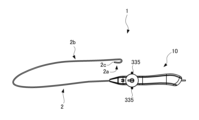
- FIG. 1 is a schematic configuration diagram showing an endoscope that is an example of a medical device in this embodiment.
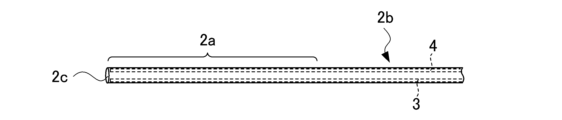
- FIG. 2 is a partial enlarged view of the distal end side of the tubular member in the endoscope shown in FIG. 1, and is a diagram showing a state in which the operated portion is straightly extended without being bent.
- FIG. 2 is a partially enlarged view of the distal end side of the tubular member in the endoscope shown in FIG. 1, and is a diagram showing a state in which the operated portion is bent in one direction within the plane.
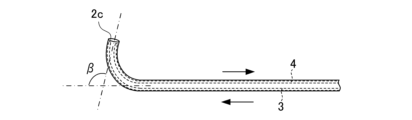
- FIG. 2 is a partially enlarged view of the distal end side of the tubular member in the endoscope shown in FIG. 1, showing a state in which the operated section is most bent in one direction within the plane.
- FIG. 1 is a schematic configuration diagram showing an endoscope that is an example of a medical device in this embodiment.
- FIG. 2 is a partial enlarged view of the distal end side of the tubular member in the endoscope shown in FIG. 1, and is
- FIG. 2 is a partially enlarged view of the distal end side of the tubular member in the endoscope shown in FIG. 1, and is a diagram showing a state in which the operated portion is bent in the other direction within the plane.
- FIG. 2 is a partially enlarged view of the distal end side of the tubular member in the endoscope shown in FIG. 1, and is a diagram showing a state in which the operated portion is most bent in the other direction within the plane.
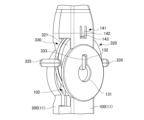
- FIG. 1 is a plan view showing a state before use of a medical device according to an embodiment of the present invention.
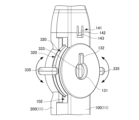
- FIG. 1 is a plan view showing a state in which a medical device according to an embodiment of the present invention is used.
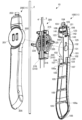
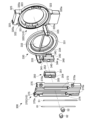
- FIG. 2 is an exploded perspective view of the operating mechanism according to the embodiment of the present invention, viewed from one direction.
- FIG. 3 is an exploded perspective view of the operating mechanism in the embodiment of the present invention viewed from another direction.
- FIG. 2 is an exploded perspective view of the operating section included in the operating mechanism according to the embodiment of the present invention, viewed from one direction.
- FIG. 3 is an exploded perspective view of the operating section included in the operating mechanism according to the embodiment of the present invention, viewed from another direction.
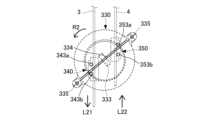
- FIG. 7 is a diagram for explaining the arrangement position when the rotating cam part of the operating part and the pin of one follower member are engaged in the embodiment of the present invention, and is a diagram showing the arrangement position according to the embodiment.
- FIG. 6 is a diagram for explaining the arrangement position when the rotating cam part of the operating part and the pin of one follower member are engaged in the embodiment of the present invention, and is a diagram showing the arrangement position according to a derivative example.
- it is a partially transparent view schematically showing a state in which the operating unit arranged at the second position is viewed from above, and schematically showing a state in which the rotating handle part is in a symmetrical position.
- FIG. 4 is a partially transparent view schematically showing a state in which the operation unit disposed at the second position is viewed from above in an embodiment of the present invention, and schematically shows a state in which the rotating handle portion is rotated in one direction.
- FIG. 4 is a partially transparent view schematically showing a state in which the operation unit disposed at the second position is viewed from above in an embodiment of the present invention, and schematically shows a state in which the rotating handle portion is rotated in one direction.
- FIG. 1 is a partially transparent view schematically showing a state in which the operating unit arranged at the second position is viewed from above, and schematically showing a state in which the rotating handle part is rotated in the other direction.
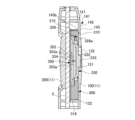
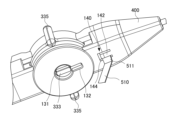
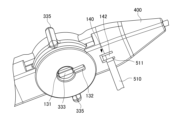
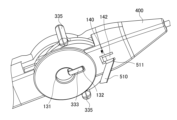
- FIG. FIG. 2 is an enlarged view of the vicinity of the operating section of the medical device according to the embodiment of the present invention, showing the state before use.
- FIG. 12 is a cross-sectional view taken along the longitudinal centerline in FIG. 11;
- FIG. 2 is an enlarged view of the vicinity of the operating section showing a state in which the medical device according to the embodiment of the present invention is in use.
- FIG. 14 is a cross-sectional view taken along the longitudinal centerline in FIG. 13; FIG.
- FIG. 6 is a diagram illustrating an example of a tool used to return the operating section from the second position to the first position in the embodiment of the present invention.
- FIG. 7 is a diagram for explaining a first step of returning the operating section from the second position to the first position in the embodiment of the present invention.
- FIG. 6 is a diagram for explaining a second step of returning the operating section from the second position to the first position in the embodiment of the present invention.
- FIG. 7 is a diagram for explaining a third step of returning the operating section from the second position to the first position in the embodiment of the present invention.
- FIG. 7 is a diagram for explaining a fourth step of returning the operating section from the second position to the first position in the embodiment of the present invention.
- a medical device is an endoscope, a catheter, or the like that includes an elongated member, and is configured so that a user can deflect the operated portion disposed on the distal end side of the elongated member. It is constructed.
- a configuration in which the present invention is applied to an endoscope equipped with a tubular member having a lumen as an elongated member will be described as an example.
- the present invention is not limited to the configuration, and can be applied to any medical device that deflectably operates the operated portion disposed on the distal end side of the elongated member.
- FIG. 1 is a schematic configuration diagram showing an endoscope 1, which is an example of a medical device in this embodiment.
- FIG. 1 shows a schematic configuration of an endoscope 1.
- the endoscope 1 shown in FIG. 1 includes a long tubular member (long member) 2 that constitutes a shaft of the endoscope 1, and an operating mechanism 10 for a user to operate.
- a controller equipped with an imaging system that receives a video signal from an image sensor disposed at the distal end 2c of the tubular member 2 and outputs an image on a monitor, and a suction system that aspirates body fluids, etc.
- the operating mechanism 10 Although it is possible to connect various devices to the operating mechanism 10, such as a pump and an irrigation water control pump for supplying and suctioning irrigation water such as physiological saline or a medical solution, they are not shown in FIG.
- the present invention does not particularly limit the manner of connection between these various devices and the operating mechanism 10.
- the tubular member 2 is a long, thin, flexible tube that constitutes the shaft of the endoscope 1 that is inserted into the body lumen from outside the body.
- the tubular member 2 can be inserted into the body lumen from outside the body, and the distal end 2c of the tubular member 2 can reach a desired site inside the body. It looks like this.
- the tubular member 2 has a tubular structure in which one or more internal cavities (lumens or channels) are formed along its extending direction.
- an image sensor, a light output section, etc. are disposed at the distal end 2c of the tubular member 2, and the inner cavity of the tubular member 2 includes wiring for transmitting a video signal from the image sensor and light to the light output section.
- a transmission optical fiber or the like is inserted through it, and the operation can be controlled by various devices connected to the operating mechanism 10. Furthermore, even if it is possible to insert endoscopic treatment instruments such as forceps and snares into the inner cavity of the tubular member 2, and to allow fluids such as irrigation water, body fluids, and contrast media to flow therethrough. good.
- an operated section 2a which is a movable section that can be bent and operated by the user using the operating mechanism 10.
- bending in this specification includes a curvature such as an arch.
- An operating wire rod (operating wire rods 3 and 4 to be described later) is inserted into the inside of the tubular member 2.
- the operating wire is a member interposed between the operated portion 2a and the operating mechanism 10 so as to be able to transmit an operation.
- a wire made of a metal such as stainless steel
- the operating wire rod can bend the operated portion 2a by moving toward the proximal end in the axial direction by operating the operating mechanism 10.
- the tubular member 2 is preferably set to a size suitable for internal treatment, examination, etc., and is not particularly limited, but for example, the cross-sectional radial dimension is about 2 to 20 mm, and the axial dimension is about 20 to 300 cm. can do. Further, the range of the operated part 2a can be set as appropriate depending on the target area of treatment or examination in the body, and is not particularly limited, but may be, for example, a range of about 2 to 10 cm from the distal end 2c of the tubular member 2. be able to.
- the material of the tubular member 2 is preferably a material that gives flexibility to the tubular member 2 and is not harmful to the human body, and is not particularly limited, such as polyurethane, polyethylene, polypropylene, or polytetrafluoroethylene. It may also be a biocompatible polymeric material such as a fluororesin such as. Further, the operated portion 2a and the intermediate portion 2b (the tubular member 2 on the proximal end side of the operated portion 2a) may be made of the same material.
- the operated portion 2a disposed on the distal end side of the tubular member 2 has higher flexibility than the intermediate portion 2b of the tubular member 2. It is preferable that the intermediate portion 2b of the tubular member 2 can be flexibly deformed to fit the body lumen, while the operated portion 2a is preferably able to be flexibly deflected by operation by the user. In particular, when the user performs an operation using the operation mechanism 10, the intermediate portion 2b of the tubular member 2 does not bend in conjunction with the operation mechanism 10, and the Preferably, only the portion 2a can be deflected in conjunction with each other.
- An operating mechanism 10 is connected to the proximal end side of the tubular member 2.
- the operating mechanism 10 includes a case (housing) 11 that is placed outside the body when the user performs internal treatment or examination, and can be held by the user's hand.
- the user can operate the rotating handle portion 335 provided on the operating mechanism 10 while holding the case 11 with one hand.
- the operating mechanism 10 is capable of moving the operating wire in the axial direction in accordance with the rotation of the rotating handle portion 335, thereby deflecting the operated portion 2a in a predetermined direction. .
- the case 11 has a shape and size that can be held by a user.
- the material of the case 11 is not particularly limited, it is preferably a lightweight and durable material, and may be a polymeric material such as polyethylene, polycarbonate, polyacetal, ABS, or PET.
- the operating mechanism 10 is not particularly limited, it may be capable of being connected to various devices not shown.
- the operating mechanism 10 includes, for example, a forceps channel port, various ports such as a Y-shaped adapter for simultaneously supplying and suctioning irrigation water (forceps channel port, suction port, water supply port, etc.), and a controller equipped with an imaging system. It may also be equipped with a cable connector etc. that can be connected to.
- Various ports, connectors, etc. of the operating mechanism 10 communicate with the inner cavity of the tubular member 2 connected to the operating mechanism 10, and the distal end 2c of the tubular member 2 is placed inside the body to perform appropriate treatment as appropriate. It is now possible to do so.
- FIGS. 2A, 2B, 2C, 2D, and 2E are partially enlarged views of the distal end side of the tubular member 2 in the endoscope 1 shown in FIG. 1.
- 2A is a diagram showing a state in which the operated part 2a is straight without bending
- FIG. 2B is a diagram showing a state in which the operated part 2a is bent in one direction within the plane
- FIG. 2C is a diagram showing the operated part 2a in a straight direction.
- FIG. 2D is a diagram showing a state in which the operated part 2a is bent most in one direction within the plane
- FIG. 2D is a diagram showing a state in which the operated part 2a is bent in the other direction in the plane
- FIG. 2E is a diagram showing a state in which the operated part 2a is bent most in the other direction in the plane.
- two operating wires 3 and 4 are inserted into the tubular member 2, and one of the two operating wires 3 and 4 is inserted into the tubular member 2.
- a portion or the entirety thereof is fixed to the operated portion 2a of the tubular member 2.
- the two operating wires 3 and 4 are fixed at positions facing each other in the cross-sectional radial direction across the central axis of the tubular member 2, and the two operating wires 3 and 4 facing each other are
- the plane including the axial direction of the operating wires 3 and 4 of the book is illustrated so as to match the plane of the paper.
- the operated portion 2a When one operating wire 4 is pushed out toward the distal end and the other operating wire 3 is pulled toward the proximal end, the operated portion 2a is located on the side where the operating wire 3 is arranged (lower side in FIG. 2B). ) so that the direction (angle ⁇ shown in FIG. 2B) of the distal end 2c of the tubular member 2 changes.
- the direction of the distal end 2c of the tubular member 2 is such that it can be bent until the angle ⁇ reaches a maximum of 275°, as shown in FIG. 2C, for example.
- the two operating wires 3 and 4 are placed around the circumference of the tubular member 2 away from the central axis of the tubular member 2. It is preferable to arrange it near the surface.
- the two operating wires 3 and 4 are attached to the tubular member 2 by being inserted into the interior (lumen) of the tubular member 2, but the method for attaching the operating wires 3 and 4 to the tubular member 2 is It is not limited to this.
- the operating wires 3 and 4 may be placed along the outer side of the tubular member 2 and attached by fixing the operating wires 3 and 4 to the distal end side of the tubular member 2.
- the two operating wire rods 3 and 4 may be composed of one wire rod connected in the vicinity of the operated portion 2a.
- the middle part of one wire is folded back at the operated part 2a and fixed to the operated part 2a, and extends along the tubular member 2 as two operating wires 3 and 4,
- the mechanism 10 may be configured to move both ends of the one wire in the axial direction.
- a configuration may be adopted in which one operating wire is inserted into the inside of the tubular member 2, and the distal end portion of the one operating wire is fixed to the operated portion 2a.
- the operated portion 2a can be deflected in a predetermined direction.
- the operating mechanism 10 in the embodiment of the present invention will be explained.
- FIG. 3 is a plan view showing the state of the medical device according to the embodiment of the present invention before use
- FIG. 4 is a plan view showing the state of the medical device according to the embodiment of the present invention during use
- FIG. 5 is an exploded perspective view of the operating mechanism 10 according to the embodiment of the present invention viewed from one direction
- FIG. 6 is an exploded perspective view of the operating mechanism 10 according to the embodiment of the present invention viewed from the other direction
- FIG. 7 is an exploded perspective view of the operating section 300 included in the operating mechanism 10 according to the embodiment of the present invention, viewed from one direction
- FIG. 8 is an exploded perspective view of the operating section 300 included in the operating mechanism 10 according to the embodiment of the present invention. It is an exploded perspective view seen from the direction. Note that the tip cover portion 400 is not shown in FIGS. 5 and 6.
- the operating mechanism 10 generally includes a case 11 constituted by an upper case member 100 and a lower case member 200, an operating section 300, and a tip cover section 400.
- Each member constituting the operating mechanism 10 can be manufactured by molding resin, for example, and the operating mechanism 10 can be assembled by combining these members.
- the operating mechanism 10 has a shape that is elongated from the distal end side to the proximal end side.
- the longitudinal direction hereinafter refers to the longitudinal direction of the operating mechanism 10.
- the term “lateral” hereinafter refers to a direction toward the outside of the operating mechanism 10 from the longitudinal center line of the operating mechanism 10 when the operating mechanism 10 is viewed in plan as shown in FIG.
- the surface side where the elastic claw portion 141 is provided is referred to as the upper side
- the surface side where the elastic claw portion 141 is not provided is referred to as the lower side, but the user should refer to the upper side and the lower side. You can perform operations without being aware of it.
- the operating unit 300 can be placed at a first position moved to the distal end side with respect to the case 11 as shown in FIG. 3, and at the most proximal end side with respect to the case 11 as shown in FIG. It is configured to be movable in the longitudinal direction with respect to the case 11 between the first position and the second position.
- the operator moves the operating section 300 from the first position to the second position by, for example, pulling the pair of rotating handle sections 335 disposed on both sides of the case 11 toward the proximal end (in the direction of arrow D1 shown in FIG. 3). It is now possible to move it into position.
- the first position is a position where the operating section 300 is placed before using the medical device according to the present invention.
- the operating wires 3 and 4 interposed between the operated section 2a and the operating section 300 are all adjusted to be in a relaxed state.
- the term "before a medical device is used" refers to a state before it is actually used by a user, and includes the time of sterilization, the time of factory shipment, the time of transportation, the time of storage, and the like.
- the second position is a position where the operating section 300 is placed when the medical device according to the present invention is used.
- tension is generated in at least one or all of the operating wires 3 and 4 interposed between the operated section 2a and the operating section 300. It has been adjusted.
- the operating section 300 is placed in the second position, by moving the operating wires 3 and 4 in the axial direction, the operated section 2a to which the operating wires 3 and 4 are attached can be deflected. ing.
- the user can move the operating section 300 located at the first position to the second position so that the user can appropriately deflect the operated section 2a. It has become.
- the upper case member 100 is a member having an elongated shape along the longitudinal direction.
- the upper case member 100 and the lower case member 200 are formed so as to overlap each other to form the case 11. Further, the proximal end of the case 11 is shaped so that it can be grasped by hand by an operator who performs a deflection operation on the operated section 2a.
- the upper case member 100 and the lower case member 200 overlap each other, an accommodation space is formed between the upper case member 100 and the lower case member 200 (inside the case 11).
- the operating section 300 to which the operating wires 3 and 4 are connected, the proximal end of the tubular member 2, and the like are accommodated in the accommodation space.
- the upper case member 100 in this embodiment has two screw holes 100a for screwing and fixing to the lower case member 200.
- the upper case member 100 is provided with a disc member 101 formed into a thin, substantially circular plate shape.
- the disk member 101 is provided so as to be located on the upper surface side of the operation section 300, and its radial dimension is approximately the same as the dimension of the approximately circular rotation operation plate 331 provided in the rotation operation member 330. It is set so that Further, the disc member 101 is provided so as to overlap the rotation operation plate 331 of the rotation operation member 330 when the operation section 300 is arranged at the second position, and the approximately circular disk member 101 The center of is located on the rotation axis of the operating section 300 located at the second position.
- Openings 102 are formed in both side walls of the upper case member 100 near the disc member 101.
- the rotation handle portion 335 of the rotation operation member 330 included in the operation section 300 can protrude to both sides through the opening 102 .
- An upper cover attachment part 103 for attaching a tapered tip cover part 400 is provided at the distal end of the upper case member 100.
- the tip cover portion 400 has a role of protecting the tip portion of the operating mechanism 10.
- the upper cover attachment part 103 overlaps with the lower cover attachment part 203 to form a truncated conical cover attachment part that tapers toward the distal end, and the tip cover part 400 is fitted and fixed from the distal end. It is now possible to do so.
- a substantially semicircular upper insertion groove 104 is formed inside the upper cover mounting portion 103.
- the upper insertion groove 104 overlaps the lower insertion groove 204 of the lower cover attachment portion 203 to form a substantially circular insertion hole.
- a substantially semicircular tubular member insertion groove 105 is formed in the longitudinal center portion and the proximal end of the upper case member 100.
- the upper insertion groove 104 and the tubular member insertion groove 105 are formed in the lower case member
- a substantially circular insertion hole is formed by overlapping with a lower insertion groove 204 and a tubular member insertion groove 205 that are similarly formed in 200, and the tubular member 2 is disposed in the insertion hole and is connected to the distal end of the operating mechanism 10. The proximal end is in a state of being penetrated.
- two operating wires 3 and 4 are inserted into the insertion hole formed by the upper insertion groove 104 and the lower insertion groove 204, and extend along the tubular member 2 to the operated part 2a.
- the method for attaching the two operating wires to the operated section 2a of the tubular member 2 is not particularly limited as long as the deflection direction of the operated section 2a can be changed using the two operating wires.
- the two operating wires may extend along the outer circumferential surface of the tubular member 2, or the tubular member 2 may be configured as a multilayer tube including an inner tube and an outer tube, and the two operating wires may extend along the outer peripheral surface of the tubular member 2. Two operating wires may extend between the inner tube and the outer tube.
- a pair of wire insertion grooves 106 are formed in the upper case member 100 near the proximal end side of the upper insertion groove 104.
- the pair of wire insertion grooves 106 are arranged at symmetrical positions in the width direction so that the operating wires 3 and 4 can be guided to the operating section 300 and connected to the pair of follower members 340 and 350, respectively.
- a substantially cylindrical columnar member that guides the pair of operating wires 3 and 4 is arranged so that the extending direction of the operating wires 3 and 4 is along the side circumferential surface of the columnar member. It is also possible to change the values smoothly.
- a pair of wire rods is provided on the proximal end side of the disk member 101 so that the operation wire rods 3 and 4 that have passed through the operation section 300 can further extend toward the proximal end side.
- An insertion groove 107 is formed.
- the operating section 300 is arranged on the lower surface side of the upper case member 100 so that the housing section 310 of the operating section 300 can slide in the longitudinal direction.
- a slide regulating wall portion 122 is provided on the proximal end side of the disc member 101 for regulating the sliding of the operating portion 300 toward the proximal end side of the housing portion 310 .
- the slide regulating wall portion 121 and the slide regulating wall portion 122 have slide regulating surfaces perpendicular to the longitudinal direction.
- the housing section 310 of the operating section 300 that has slid toward the distal end cannot slide any further toward the distal end because the distal end surface 315 of the housing section 310 comes into contact with the slide regulating wall section 121. ing. Further, the housing portion 310 of the operating portion 300 that has slid toward the proximal end side is prevented from sliding further toward the proximal end side because the proximal end side end surface of the housing portion 310 comes into contact with the slide regulating wall portion 122. It has become.
- a pair of guide walls 123 are provided on the distal end side of the disc member 101.
- the pair of guide wall parts 123 have a pair of slide guide surfaces facing each other in the width direction, and the distance between the pair of slide guide surfaces in the width direction is the width direction of the housing part 310 of the operation part 300.
- the dimensions are set to be approximately the same.
- a pair of guide walls 124 are similarly provided on the proximal end side of the disc member 101.
- the pair of guide wall portions 124 have a pair of slide guide surfaces facing each other in the width direction, and the distance between the pair of slide guide surfaces in the width direction is the width direction of the housing portion 310 of the operation portion 300 The dimensions are set to be approximately the same.
- the housing part 310 of the operating part 300 is able to slide while being sandwiched between a pair of guide walls 123 and 124.
- the sliding direction of the housing section 310 of the operating section 300 is defined by the pair of guide walls 123 and 124, and the housing section 310 of the operating section 300 can slide smoothly along the sliding direction.
- a pair of substantially linear protrusions 125 extending in the longitudinal direction are provided on the lower surface of the disc member 101.
- the housing section 310 of the operating section 300 slides while its upper surface is in line contact with the pair of projections 125, so that it can slide smoothly along the sliding direction.
- the lower case member 200 also includes a slide regulating wall portion 221 on the distal end side, a slide regulating wall portion 222 on the proximal end side, and a pair of guide walls 223 and 224 facing each other in the width direction. They are provided at positions corresponding to each of the upper case members 100.
- the slide regulating wall portions 121 and 221 on the distal end side, the slide regulating wall portions 122 and 222 on the proximal end side, and the width direction The pair of guide walls 123, 124, 223, and 224 that face each other define a range in which the housing section 310 of the operation section 300 can slide within the case.
- the position where the distal end side end surface 315 of the housing section 310 contacts the slide regulating wall sections 121, 221 is the first position of the operation section 300, and the position where the proximal end side end surface of the housing section 310 contacts the slide regulating wall sections 122, 222.
- the abutting position is set to be the second position of the operating unit 300.
- a circular hole 131 is provided approximately at the center of the disc member 101.
- the circular hole portion 131 is a through hole passing through the upper and lower surfaces of the disc member 101, and is provided so that the rotation protrusion 333 provided on the upper surface of the rotation operation member 330 of the operation section 300 can be inserted therein. It is being The center of the substantially circular hole 131 is located on the rotation axis of the operating section 300 located at the second position. Further, the diameter of the circular hole portion 131 is set to be approximately the same as the longitudinal dimension of the rotating protrusion 333 provided on the operating portion 300, or slightly larger than that. When the operating portion 300 is placed in the second position, the rotating protrusion 333 is rotatable within the circular hole 131.
- a slot hole 132 is provided on the distal end side of the circular hole 131.
- the slot hole portion 132 is a through hole that penetrates the upper and lower surfaces of the disc member 101, and extends in the longitudinal direction so as to be continuous from the distal end side (widthwise central portion) of the circular hole portion 131. It is extending.
- the slot hole 132 has an elongated shape that matches the shape of the rotating protrusion 333 provided on the upper surface of the rotating operation plate 331 of the operating unit 300, and is configured such that the rotating protrusion 333 can be inserted therein. It is provided.
- the widthwise dimension of the slot hole 132 is set to be approximately the same as or slightly larger than the widthwise dimension of the rotary protrusion 333 provided on the upper surface of the rotary operation plate of the operation section 300. Therefore, when the rotating protrusion 333 of the operating section 300 is arranged so as to be oriented along the longitudinal direction, the rotating protrusion 333 can move forward and backward within the slot hole 132 in the longitudinal direction.
- the circular hole portion 131 and the slot hole portion 132 integrally form a through hole into which the rotating protrusion 333 of the operating portion 300 can fit into the disc member 101.
- the circular hole portion 131 allows the rotation protrusion 333 of the operating section 300 disposed at the second position to rotate, and has a role as a rotation permitting hole that allows the operating section 300 to perform a rotational operation. are doing.
- the slot hole portion 132 restricts the rotation of the rotating protrusion 333 of the operating portion 300 disposed at a position other than the second position (for example, the first position), and prevents rotation operation by the operating portion 300. It has the role of a rotation regulating hole.
- An elastic claw portion 141 is provided on the distal end side of the circular hole portion 131 and the slot hole portion 132.
- the elastic claw portion 141 includes a claw shaft portion 142 and a claw tip portion 143.
- the claw shaft portion 142 is an elongated member extending in the longitudinal direction, and is elastically deformable in the vertical direction.
- the distal end side of the claw shaft portion 142 is integrally connected to the upper case member 100.
- the proximal end side of the claw shaft portion 142 is free from the upper case member 100 and serves as a free end that is movable in the vertical direction. Since the elastic claw part 141 is formed into such a shape, a substantially U-shaped gap part 144 having both ends on the distal end side is formed around the claw shaft part 142 of the elastic claw part 141.
- the claw tip portion 143 is formed on the proximal end side of the claw shaft portion 142 so as to be integrated with the claw shaft portion 142.
- the nail tip 143 is configured to gradually become thicker downward as it goes from the connecting part with the nail shaft 142 toward the proximal end.
- a claw slope surface 143a (see FIGS. 12 and 14 described later) that slopes downward toward the side is formed.
- a nail tip surface 143b (see FIGS. 12 and 14 described later), which is an end surface on the proximal end side of the nail tip portion 143, is a surface substantially perpendicular to the longitudinal direction.
- the lower case member 200 is a member having an elongated shape along the longitudinal direction.
- the upper case member 100 and the lower case member 200 are formed so as to overlap each other to form the case 11.
- an accommodation space is formed between the upper case member 100 and the lower case member 200 (inside the case 11).
- the lower case member 200 in this embodiment has two screw holes 200a for screwing and fixing to the upper case member 100.
- the lower case member 200 is provided with a disk member 201 formed into a thin, substantially circular plate shape.
- the disc member 201 is provided so as to be located on the upper surface side of the operation section 300, and its radial dimension is approximately the same as the dimension of the approximately circular rotation operation plate 331 included in the rotation operation member 330. It is set so that Further, the disk member 201 is provided so as to overlap the rotation operation plate 331 of the rotation operation member 330 when the operation section 300 is placed at the second position, and the approximately circular disk member 201 The center of is located on the rotation axis of the operating section 300 located at the second position.
- a pair of arc-shaped side wall portions 202 are provided on the side peripheral edges of the disc member 201, respectively.
- the arc-shaped side wall portions 202 are arranged at symmetrical positions in the width direction, and have the role of protecting the operation section 300 inside the case 11 and when the operator performs a rotation operation of the rotation handle section 335. It has the role of improving operability by making contact with fingers.
- the vertical dimension (height) of the arcuate side wall portion 202 is preferably set to such a size that it does not come into contact with the rotation operation member 330 so as not to impede the rotation of the rotation operation member 330.
- a lower cover attachment part 203 for attaching a tapered tip cover part 400 is provided at the distal end of the lower case member 200.
- the lower cover attachment part 203 overlaps with the upper cover attachment part 103 to form a truncated conical cover attachment part that tapers toward the distal end, and the tip cover part 400 is fitted and fixed from the distal end. It is now possible to do so.
- a substantially semicircular lower insertion groove 204 is formed inside the lower cover mounting portion 203.
- the lower insertion groove 204 overlaps the upper insertion groove 104 of the upper cover mounting portion 103 to form a substantially circular insertion hole.
- a substantially semicircular tubular member insertion groove 205 is formed in the longitudinal center and proximal end of the lower case member 200.
- the lower insertion groove 204 and the tubular member insertion groove 205 are The upper insertion groove 104 and the tubular member insertion groove 105, which are similarly formed in the member 100, overlap to form a substantially circular insertion hole, and the tubular member 2 is disposed in the insertion hole and is connected to the distal end of the operating mechanism 10. The proximal end is in a state of being penetrated.
- the operating section 300 is arranged on the upper surface side of the lower case member 200 so that the housing section 310 of the operating section 300 can slide in the longitudinal direction.
- a slide regulating wall portion 221 is provided for regulating the sliding of the operating section 300 toward the distal end side of the housing section 310.
- a slide restricting wall portion 222 is provided on the proximal end side of the disc member 201 to restrict the sliding of the operating portion 300 toward the proximal end side of the housing portion 310 .
- the slide regulating wall portion 221 and the slide regulating wall portion 222 have slide regulating surfaces perpendicular to the longitudinal direction.
- the housing section 310 of the operating section 300 that has slid toward the distal end cannot slide any further toward the distal end because the distal end surface 315 of the housing section 310 comes into contact with the slide regulating wall section 221. ing. Further, the housing portion 310 of the operating portion 300 that has slid toward the proximal end side is prevented from sliding further toward the proximal end side by the proximal end side end surface of the housing portion 310 coming into contact with the slide regulating wall portion 222. It has become.
- a pair of guide walls 223 are provided on the distal end side of the disc member 201.
- the pair of guide wall parts 223 have a pair of slide guide surfaces facing each other in the width direction, and the distance between the pair of slide guide surfaces in the width direction is the width direction of the housing part 310 of the operation part 300.
- the dimensions are set to be approximately the same.
- a pair of guide walls 224 are provided on the proximal end side of the disc member 201.
- the pair of guide wall parts 224 have a pair of slide guide surfaces facing each other in the width direction, and the distance between the pair of slide guide surfaces in the width direction is the width direction of the housing part 310 of the operation part 300.
- the dimensions are set to be approximately the same.
- the housing part 310 of the operating part 300 is able to slide while being sandwiched between a pair of guide walls 223 and 224.
- the sliding direction of the housing section 310 of the operating section 300 is defined by the pair of guide walls 223 and 224, and the housing section 310 of the operating section 300 can slide smoothly along the sliding direction.
- a pair of substantially linear protrusions 225 extending in the longitudinal direction are provided on the lower surface side of the disc member 201.
- the housing part 310 of the operating part 300 slides while its lower surface is in line contact with the pair of protrusions 225, so that it can slide smoothly along the sliding direction.
- a range in which the housing section 310 of the operation section 300 can slide is defined by a pair of guide wall sections 123, 124, 223, and 224 facing each other in the width direction.
- the position where the distal end side end surface 315 of the housing section 310 contacts the slide regulating wall sections 121, 221 is the first position of the operation section 300, and the position where the proximal end side end surface 316 of the housing section 310 contacts the slide regulating wall section 122, 222.
- the second position of the operation unit 300 is set so that the position where the operation unit 300 comes into contact with the operation unit 300 is a second position.
- a pair of substantially linear grooves 226 extending in the longitudinal direction are provided on the upper surface of the disc member 201.
- a pair of follower members 340 and 350 included in the operating section 300 slightly protrude downward from the lower surface of the operating section 300.
- the pair of grooves 226 are formed in a range in which the follower members 340 and 350 move, and define a space in which the follower members 340 and 350 do not come into contact with the lower case member 200.
- the operating section 300 that can be used in the present invention has a configuration that allows deflection of the operated section 2a by moving the operating wires 3 and 4 in the axial direction in response to an operation by an operator, and the case 11 It is not particularly limited as long as it is modularized so that it can be moved relative to the object.
- the operating section 300 in this embodiment is generally configured to include a housing section 310 composed of an upper housing member 320 and a lower housing member 370, a rotation operating member 330, and a pair of follower members 340 and 350.
- Each member constituting the operating section 300 can be manufactured by molding resin, for example, and the operating section 300 can be assembled by combining these members.
- This operating section 300 has a simple and compact configuration and is modularized so as to be movable relative to the case 11, and is suitable for use in the present invention.
- the housing portion 310 is a casing that accommodates the rotation operation member 330 and the pair of follower members 340 and 350.
- the operating section 300 is configured as an operating module housed in a housing section 310, and each component of the operating section 300 including the housing section 310 is movable relative to the case 11.
- the housing part 310 includes an upper housing member 320 and a lower housing member 370, and the upper housing member 320 and the lower housing member 370 are formed to overlap each other to constitute the housing part 310. .
- the upper housing member 320 is a member having a substantially rectangular parallelepiped shape with a substantially circular center portion in the longitudinal direction.
- a housing space is formed between the side housing member 370 (inside the housing part 310).
- the upper housing member 320 in this embodiment has four screw holes 320a for screwing and fixing to the lower housing member 370.
- the upper housing member 320 is provided with a disk member 321 formed into a thin, substantially circular plate shape.
- the disc member 321 is provided so as to be located on the upper surface side of a substantially circular rotation operation plate 331 provided in the rotation operation member 330, and its radial dimension is determined by the rotation of the rotation operation member 330.
- the dimensions are set to be approximately the same as the dimensions of the operation panel 331.
- the disc member 321 is provided so as to overlap the disc member 101 of the upper case member 100.
- the center of the substantially circular disk member 321 is located on the rotation axis of the operating section 300.
- Openings 322 are formed in both side walls of the upper housing member 320 near the disc member 321.
- the opening 322 is such that the rotation handle portion 335 of the rotation operation member 330 included in the operation section 300 is disposed outside the case 11 through the opening 322 .
- a circular hole 323 is provided approximately at the center of the disc member 321.
- the circular hole portion 323 is a through hole that passes through the upper and lower surfaces of the disc member 321, and is provided so that a disc protrusion 332 provided on the upper surface of the rotational operation member of the operation unit 300 can be inserted into the circular hole portion 323. ing.
- the center of the substantially circular hole 323 is located on the rotation axis of the operating section 300. Further, the diameter of the circular hole 323 is set to be approximately the same as or slightly larger than the dimension of the disc protrusion 332 of the rotation operation member, and the disc protrusion 332 is It is rotatable while being fitted into the portion 323.
- the upper housing member 320 is shaped to have a substantially rectangular parallelepiped shape.
- a protruding corner portion 325 that slightly protrudes toward the distal end side is formed at a corner portion on the distal end side of the upper housing member 320.
- a similar protruding corner 375 is also formed at a corner on the distal end side of the lower housing member 370.
- the protruding corner 325 of the upper housing member 320 and the protruding corner 375 of the lower housing member 370 form a distal corner of the housing portion 310 .
- the distal end surfaces of the protruding corner portions 325 and the protruding corner portions 375 are the distalmost end surfaces of the housing portion 310 (the distal end surface 315 of the housing portion 310).
- proximal end side end surface of the approximately rectangular parallelepiped proximal end of the upper housing member 320 and the proximal end side end surface of the approximately rectangular parallelepiped proximal end of the lower housing member 370 are the most This becomes the end surface on the proximal end side (the end surface 316 on the proximal end side of the housing portion 310).
- a claw locking portion 326 is provided on the distal end side of the disc member 321.
- the pawl locking portion 326 has a recessed hole formed in the upper surface of the upper housing member 320, and when the operating portion 300 is placed in the first position, the pawl locking portion 326 engages the elastic pawl portion provided on the upper case member 100.
- the tip end portion 143 of the claw 141 is fitted into the hole.
- the shape of the hole formed in the claw locking part 326 is adapted to the shape of the claw tip 143 of the elastic claw part 141, and the hole in the claw locking part 326 has a depth that increases toward the proximal end.
- An inclined surface 326a that is a downward slope is formed so that the depth increases.
- the slope of the inclined surface 326a is set to substantially match the slope of the claw inclined surface 143a formed on the claw tip portion 143 of the elastic claw portion 141.
- the rotation operation member 330 is a member for the operator to perform rotation operation.
- the rotation operation member 330 is arranged below the upper housing member 320 and above the pair of follower members 340 and 350.
- the rotation operation member 330 is provided with a rotation operation plate 331 formed into a substantially circular thin flat plate shape.
- the center of the substantially circular rotation operation plate 331 is located on the rotation axis of the operation section 300.
- a disc protrusion 332 is provided integrally with the rotation operation plate 331 at the center of the upper surface of the rotation operation plate 331.
- the disc protrusion 332 is a disc member that slightly protrudes from the upper surface of the rotation operation plate 331.
- the disc protrusion 332 can be fitted into the circular hole 323 of the upper case member.
- the disc protrusion 332 is fitted into the circular hole 323 and is supported by the circular hole 323 so that it can rotate integrally with the rotation operation plate 331 .
- the center of the approximately circular disk protrusion 332 serves as a rotation axis of the operating section 300.
- a rotating protrusion 333 is provided integrally with the rotating operation plate 331 approximately at the center of the disc protruding portion 332 .
- the rotation protrusion 333 is an elongated member that protrudes from the upper surface of the rotation operation plate 331, and can be fitted into the circular hole 323 of the upper case member 100 together with the disk protrusion 332. Further, the rotating protrusion 333 can rotate integrally with the rotating operation plate 331, and the direction of the elongated rotating protrusion 333 can be changed by rotation.
- the center of the rotation protrusion 333 is located on the rotation axis of the operating section 300.
- the rotating protrusion 333 can be fitted into the slot hole 132 provided on the upper surface of the upper case member 100.
- the slot hole 132 is elongated in the longitudinal direction, and when the rotating protrusion 333 is arranged so that its orientation is along the longitudinal direction, the rotating protrusion 333 extends longitudinally within the slot hole 132. It is now possible to move forward and backward in any direction.
- the operating section 300 can be slid in the longitudinal direction with respect to the case 11 when the rotating protrusion 333 is arranged so that the direction thereof coincides with the longitudinal direction.
- the rotating protrusion 333 is configured so that when the pair of rotating handles 335 are arranged symmetrically with respect to the case 11, the elongated direction of the rotating protrusion 333 coincides with the longitudinal direction. ing.
- the rotating protrusion 333 can rotate within the circular hole 131 of the upper case member 100 when the operating section 300 is placed in the second position.
- a part or the entire rotating protrusion 333 fits into the slot hole 132 and cannot be rotated. It has become.
- the rotating protrusion 333 is exposed from the circular hole 131 of the upper case member 100 and is visible from the outside.
- the rotating protrusion 333 has a position indicating function for determining the position where the housing section 310 of the operating section 300 is placed. Particularly, when the rotating protrusion 333 is disposed in the circular hole 131 after being fitted into the slot hole 132, the housing portion 310 of the operating portion 300 is disposed in the second position.
- it has a function as a display section that indicates that rotation restriction of the rotation operation member 300 is released. The operator can confirm that the rotation operation member 330 can be rotated by the display provided by the display section, and can safely operate the medical device after understanding that the rotation operation member 330 is in a usable state. I can do it.
- a rotating cam portion 334 is provided integrally with the rotating operating plate 331 on the lower surface side of the rotating operating plate 331.
- the rotating cam portion 334 is an elongated member extending on the diameter of the substantially circular rotating operation plate 331, and is provided in the shape of a rib protruding from the lower surface side of the rotating operation plate 331.
- the rotation cam portion 334 is arranged to fit between the pair of pins 343a, 343b of the follower member 340 and between the pair of pins 353a, 353b of the follower member 350, and is configured to rotate the rotation operation member 330. It has a role as an operation transmission member that converts an operation into a reciprocating displacement movement of the follower members 340, 350.
- a pair of rotation handle portions 335 are formed integrally with the rotation operation plate 331 on the side periphery of the rotation operation plate 331.
- the pair of rotating handle portions 335 are provided at positions facing each other (positions rotated by 180°). Further, the pair of rotating handle portions 335 are provided at positions intersecting the extending direction of the rotating cam portion 334 provided on the rotating operation plate 331.
- the pair of rotating handle portions 335 are each formed by a cylindrical member extending parallel to the rotating shaft, and the rotating handle portion 335 of the rotating operation knob of the operating unit 300 is connected to the opening of the case 11. It is placed outside the case 11 through openings formed on both sides. The operator can perform a rotation operation of the rotation operation member 330 by operating the rotation handle portion 335 with a finger or the like.
- the pair of follower members 340 and 350 are arranged below the rotation operating member 330 and above the lower housing member 370.
- the pair of follower members 340 and 350 are arranged so as to be spaced apart from each other on both sides of the rotation center of the rotation operation member 330.
- one operating wire 3 is connected and fixed to one follower member 340, and the other operating wire 4 is connected and fixed to the other follower member 350.
- the follower member 340 has a slide main body portion 341 formed into a substantially rectangular parallelepiped shape.
- the slide main body portion 341 is slidably inserted into a slide guide hole 371 provided in the lower housing member 370.
- the longitudinal direction of the slide body portion 341 is arranged to match the longitudinal direction (slide direction) of the slide guide hole 371.
- a wide top plate portion 342 that extends on both sides of the slide body portion 341 is integrally provided on the upper surface side of the slide body portion 341.
- the top plate portion 342 slides into the stepped portion 371a provided on the side edge of the slide guide hole 371. possible to be placed.
- the follower member 340 can slide along the slide guide hole 371 while being stably supported by the stepped portion 371a.
- a lateral protrusion 343 that protrudes laterally is provided integrally with the slide body 341 on the upper surface side thereof.
- the lateral protrusion 343 protrudes in a direction away from the longitudinal center line of the lower housing member 370 (in a direction away from the rotation axis) when the slide main body 341 is inserted into the slide guide hole 371. .
- a pair of pins 343a and 343b are provided on the upper surface of the side protrusion 343, and are integrally provided with the side protrusion 343.
- the pair of pins 343a and 343b are formed into, for example, a cylindrical shape, and are spaced apart from each other along the longitudinal direction (sliding direction) of the slide body portion 341.
- a rotating cam portion 334 provided on the lower surface side of the rotating operation plate 331 is arranged between the pair of pins 343a and 343b.
- the pair of pins 343a and 343b serve as an operation transmission member that converts the rotation operation of the rotation operation member 330 into a reciprocating displacement operation of the follower member 340.
- a groove 344 for passing the operating wire 3 is provided on the lower surface side of the slide main body 341 over the entire lengthwise direction. Furthermore, a recess 345 is provided within the groove 344 for locating the female screw 52. The lower surface side of the slide body portion 341 is exposed below the lower housing member 370 when the slide body portion 341 is inserted into the slide guide hole 371.
- the connection between the operating wire 3 and the follower member 340 is performed with the lower surface side of the slide main body portion 341 exposed below the lower housing member 370.
- the proximal ends of the operating wires 3 are guided by the grooves 344 formed in the slide body 341 and inserted into the metal tubes 51 arranged in the grooves 344, respectively.
- a bolt (not shown) is screwed into the female screw 52, and the metal tube
- the operating wire 3 is crimped and fixed within the metal tube 51.
- the operating wire 3 can be connected to the follower member 340.
- the connection between the operating wire 3 and the follower member 340 is not limited to this method, and as long as the operating wire 3 also moves in its axial direction as the follower member 340 reciprocates in the longitudinal direction, Any linking method can be used.
- the pair of follower members 340 and 350 have a laterally symmetrical shape, and the follower member 350 also has the same configuration as the follower member 340 described above.
- the follower member 350 has a slide main body portion 351 formed into a substantially rectangular parallelepiped shape.
- the slide main body portion 351 is slidably inserted into a slide guide hole 372 provided in the lower housing member 370.
- the longitudinal direction of the slide main body portion 351 is arranged to match the longitudinal direction (slide direction) of the slide guide hole 372.
- a wide top plate portion 352 that extends to both sides of the slide body portion 351 is integrally provided on the upper surface side of the slide body portion 351.
- the top plate portion 352 slides into the step portion 372a provided on the side edge of the slide guide hole 372. possible to be placed.
- the follower member 350 can slide along the slide guide hole 372 while being stably supported by the stepped portion 372a.
- a lateral protrusion 353 that protrudes laterally is provided integrally with the slide body 351.
- the lateral protrusion 353 protrudes in a direction away from the longitudinal center line of the lower housing member 370 (in a direction away from the rotation axis) when the slide main body 351 is inserted into the slide guide hole 372.
- a pair of pins 353a and 353b are provided on the upper surface of the lateral protrusion 353 and are integrally provided with the lateral protrusion 353.
- the pair of pins 353a and 353b are formed into, for example, a cylindrical shape, and are spaced apart from each other along the longitudinal direction (sliding direction) of the slide body portion 351.
- a rotating cam portion 334 provided on the lower surface side of the rotating operation plate 331 is arranged between the pair of pins 353a and 353b.
- the pair of pins 353a and 353b serve as an operation transmission member that converts the rotation operation of the rotation operation member 330 into a reciprocating displacement operation of the follower member 350.
- a groove 354 for passing the operating wire 4 is provided on the lower surface side of the slide main body 351 over the entire lengthwise direction. Furthermore, a recess 355 is provided within the groove 354 for locating the female screw 62. The lower surface side of the slide body portion 351 is exposed below the lower housing member 370 when the slide body portion 351 is inserted into the slide guide hole 372.
- the connection between the operating wire 4 and the follower member 350 is performed with the lower surface side of the slide main body portion 351 exposed below the lower housing member 370.
- the proximal ends of the operating wires 4 are guided by the grooves 354 formed in the slide body 351 and inserted into the metal tubes 61 arranged in the grooves 354, respectively.
- the metal tube 61 passed through the female screw 62 so as to pass through the inner cavity from the side surface of the female screw 62 disposed in the sinkhole portion 355, a bolt (not shown) is screwed into the female screw 62, and the metal tube By caulking 61, the operating wire 3 is crimped and fixed within the metal tube 61.
- the operating wire 4 can be connected to the follower member 350.
- the connection between the operating wire 4 and the follower member 350 is not limited to this method, and as long as the operating wire 4 also moves in its axial direction as the follower member 350 reciprocates in the longitudinal direction, Any linking method can be used.
- the lower housing member 370 is a member having a substantially rectangular parallelepiped shape.
- the upper housing member 320 and the lower housing member 370 are formed so as to overlap each other to form the housing portion 310.
- an accommodation space is formed between the upper housing member 320 and the lower housing member 370 (inside the housing part 310).
- the lower housing member 370 in this embodiment has four screw holes 370a for screwing and fixing to the upper housing member 320.
- a pair of slide guide holes 371 and 372 are formed in the lower housing member 370, passing through the upper surface and the lower surface.
- the pair of slide guide holes 371 and 372 are provided at symmetrical positions with respect to the longitudinal center line of the lower housing member 370 (the longitudinal direction passing through the rotation axis). That is, the pair of slide guide holes 371 and 372 are through holes that extend in the longitudinal direction and are formed at symmetrical positions with the rotation axis in between.
- step portions 371a and 372a are provided at the longitudinal side edges of the pair of slide guide holes 371 and 372, respectively.
- a pair of follower members 340, 350 can be slidably disposed in the pair of slide guide holes 371, 372 and the step portions 371a, 372a, respectively.
- the follower member 340 slides along the slide guide hole 371 and can be reciprocated in the longitudinal direction with the slide body portion 341 inserted into the slide guide hole 371 and the top plate portion 342 supported by the stepped portion 371a. It has become.
- the follower member 350 slides along the slide guide hole 372 with the slide main body portion 351 inserted into the slide guide hole 372 and the top plate portion 352 supported by the stepped portion 372a, and is reciprocated in the longitudinal direction. It is now possible to do so.
- a pair of grooves 373 and 374 are formed on the lower surface side of the lower housing member 370 over the entire longitudinal direction.
- the pair of grooves 373 and 374 are provided so as to extend toward the distal and proximal ends of the pair of slide guide holes 371 and 372.
- the operating wires 3 and 4 are connected to the follower members 340 and 350, respectively.
- the metal tubes 51 and 61 into which the operating wires 3 and 4 are inserted are inserted into the grooves 373 and 374, respectively. Fixed in position.
- the operating wires 3 and 4 are inserted into the pair of grooves 373 and 374, respectively, and connected to the slide body parts 341 and 351 exposed on the lower surface side of the lower housing member 370, and the follower member 340, When 350 reciprocates, the operating wires 3 and 4 can also move in the axial direction.
- a protruding corner portion 375 that slightly protrudes toward the distal end side is formed at a corner portion on the distal end side of the lower housing member 370.
- a similar protruding corner 325 is also formed at the corner on the distal end side of the upper housing member 320.
- the protruding corner 325 of the upper housing member 320 and the protruding corner 375 of the lower housing member 370 form a distal corner of the housing portion 310 .
- the end surface on the distal end side of the corner of the housing section 310 becomes the end surface on the most distal end side of the housing section 310 (the end surface on the distal end side 315 of the housing section 310).
- proximal end side end surface of the approximately rectangular parallelepiped proximal end of the upper housing member 320 and the proximal end side end surface of the approximately rectangular parallelepiped proximal end of the lower housing member 370 are the most This becomes the end surface on the proximal end side (the end surface 316 on the proximal end side of the housing portion 310).
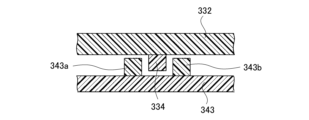
- FIG. 9A is a diagram for explaining the arrangement position when the rotating cam part 334 of the operating part 300 and the pins 343a, 343b of one follower member 340 are engaged in the embodiment of the present invention. It is a figure showing the arrangement position according to. FIG.
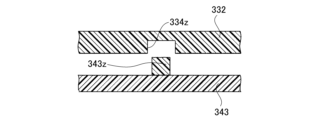
- FIGS. 9A and 9B are diagrams for explaining the arrangement position when the rotating cam part 334 of the operating part 300 and the pins 343a, 343b of one follower member 340 are engaged in the embodiment of the present invention, It is a figure showing such an arrangement position. Note that although only one follower member 340 is illustrated in FIGS. 9A and 9B, the other follower member 350 is also arranged in the same manner.
- the follower members 340 and 350 are arranged to be spaced apart on both sides of the rotation center of the rotation operation member 330, and engage with the rotation cam portion 334.
- the follower members 340 and 350 are spaced apart from each other in a direction perpendicular to the direction in which the rib-shaped rotating cam portion 334 extends.
- the rotating cam portion 334 is arranged so as to be sandwiched between the two pins 343a and 343b of the follower member 340 (the same is true between the two pins 353a and 353b of the follower member 350). has been done.
- the rotation cam portion 334 when the rotation operation member 330 rotates, the side surface of the rotation cam portion 334 comes into contact with the side surface of one of the two pins 343a, 343b in the follower member 340, In the follower member 350, the side surface of the rotating cam portion 334 comes into contact with the side surface of one of the two pins 353a, 353b.
- the rotation cam portion 334 can drive the abutted pin to move the follower members 340 and 350 in the sliding direction.
- the rotating cam portion 334 is formed in a rib shape here, the rotating cam portion 334z may be formed in a groove shape as shown in FIG. 9B. In this case, it is preferable that only one pin is provided in each of the follower members 340, 350 at a position facing the groove-shaped rotating cam portion 334z. Although only the pin 343z provided on the follower member 340 is shown in FIG. 9B, a similar pin is provided on the follower member 350 as well.
- the pins (pins 343z shown in FIG. 9B) provided on each of the follower members 340 and 350 are arranged within the groove-shaped rotating cam section 334z.
- the rotation operation member 330 rotates, the groove surface of the rotation cam portion 334z comes into contact with the side surface of a pin (pin 343z shown in FIG. 9B) provided on the follower members 340, 350.
- the rotation cam portion 334z can drive the abutted pin to move the follower members 340, 350 in the sliding direction.
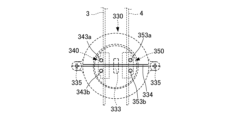
- FIGS. 10A, 10B, and 10C are partially transparent views schematically showing the operation unit 300 disposed at the second position viewed from above in the embodiment of the present invention
- FIG. 10A is a rotating handle.
- 10B schematically shows a state in which the rotating handle portion 335 is in a symmetrical position
- FIG. 10B schematically shows a state in which the rotating handle portion 335 is rotated in one direction
- FIG. 10C schematically shows a state in which the rotating handle portion 335 is rotated in the other direction.
- FIGS. 10A, FIG. 10B, and FIG. 10C are partially transparent views schematically showing the operation unit 300 disposed at the second position viewed from above in the embodiment of the present invention
- FIG. 10A is a rotating handle.
- 10B schematically shows a state in which the rotating handle portion 335 is in a symmetrical position
- FIG. 10B schematically shows a state in which the rotating handle portion 335 is rotated in one direction
- FIG. 10C schematically shows a state
- the rotation cam portion 334 provided on the lower surface of the rotation operation member 330 also rotates. and rotate in the same direction (for example, in the direction of arrow R1 in FIG. 10B).
- the rib-shaped rotating cam portion 334 comes into contact with the side surface of the pin 343a of the follower member 340 and the side surface of the pin 353b of the follower member 350.
- the pin 343a is pushed and moved by the rotation cam portion 334, and the follower member 340 moves in one direction (for example, in the direction of arrow L11 in FIG.
- the follower member 350 is pushed and moved by the rotating cam portion 334 in the opposite direction (for example, in the direction of arrow L12 in FIG. 10B).
- the operating wire rods 3 and 4 connected to the follower members 340 and 350, respectively, also move in the axial direction, and the operated portion 2a disposed on the distal end side of the tubular member 2 is moved as shown in FIG. 2D. It is bent in the direction shown.
- the follower member 350 is pushed and moved by the rotating cam portion 334 in the opposite direction (for example, in the direction of arrow L22 in FIG. 10C).
- the operating wire rods 3 and 4 connected to the follower members 340 and 350 also move in the axial direction, and the operated portion 2a disposed on the distal end side of the tubular member 2 is moved as shown in FIG. 2B. It is bent in the direction.
- the rotation of the rotation operation member 330 is converted into movement of the follower members 340, 350 in the sliding direction via the rotation cam portion 334 and the pins 343a, 343b, 353a, 353b.
- follower members 340, 350 are adapted to move in opposite directions.
- the operating wires 3, 4 connected to the follower members 340, 350 also move in the axial direction, and as a result, are disposed on the distal end side of the tubular member 2.
- the operated portion 2a is deflected as shown in FIG.
- FIG. 11 is an enlarged view of the vicinity of the operating section 300 showing a state before use of the medical device according to the embodiment of the present invention
- FIG. 12 is a sectional view taken along the longitudinal center line in FIG. 11.
- FIG. 13 is an enlarged view of the vicinity of the operating section 300 showing a state in which the medical device according to the embodiment of the present invention is used
- FIG. 14 is a sectional view taken along the longitudinal center line in FIG. 13.
- the rotating handle portion 335 When the operation unit 300 is placed in the first position, the rotating handle portion 335 is placed symmetrically with respect to the case 11, and the rotating protrusion 333 is fitted into the slot hole portion 132. It is in a state. In this state, the rotating protrusion 333 cannot change its direction due to the slot hole 132, thereby restricting the rotation of the rotating operating member 330.
- the distal end surface 315 of the housing section 310 is set to be in a position where it comes into contact with the slide regulating walls 121 and 221. As a result, the operating section 300 cannot be slid from the first position toward the distal end.
- the claw tip part 143 of the elastic claw part 141 is fitted into the claw locking part 326 formed on the upper surface of the upper housing member 320.
- the shape of the claw tip part 143 of the elastic claw part 141 is set to match the shape of the claw locking part 326, and the slope of the claw slope surface 143a formed on the claw tip part 143 and the nail locking
- the slopes of the inclined surfaces 326a formed in the portion 326 are set to be substantially the same.
- the operation section 300 will be difficult to move toward the proximal end, and the operation section 300 will be less likely to unintentionally move toward the second position before use. 300 may be difficult to move to the second position.
- the slope is gentle, the operating section 300 will easily move toward the proximal end, making it easier for the user to move the operating section 300 to the second position. There is a possibility that it will move to the 2nd position side.
- the angle of the slope (the angle of inclination with respect to the upper surface of the upper housing member 320) is preferably set to an appropriate angle while taking into consideration the elastic force of the claw shaft portion 142, but it is preferable to prevent unintentional movement of the operating portion 300, and In order to make it easier for the user to pull in the operating unit 300, it is preferable that the angle is in the range of 30° to 60°, for example. In the configuration shown, the slope angle is set to approximately 45°.
- the claw inclined surface 143a and the inclined surface 326a are sloped downward toward the proximal end side. Therefore, when a force is applied to the operating portion 300 to move it toward the proximal end, the force acts on the claw shaft portion 142 of the elastic claw portion 141 to move the claw tip portion 143 upward.
- the claw shaft portion 142 has elasticity, and an elastic force acting on the claw shaft portion 142 that tends to return downward against the upward force acts on the claw shaft portion 142, so that the operating portion 300 is held at the first position. become.
- the claw shaft portion 142 of the elastic claw portion 141 deforms upward, and engages with the claw tip portion 143.
- the engagement with the portion 326 is disengaged, and the upper housing member 320 is placed on the upper surface of the upper housing member 320 located on the distal end side of the claw locking portion 326 .
- the operating section 300 can be slid to the second position on the proximal end side.
- the rotation protrusion 333 is fitted into the slot hole 132, so the rotation of the rotation operation member 330 is restricted. It looks like this. Therefore, the operator cannot perform a rotation operation of the rotation operation member 330 when the operation section 300 is arranged at the first position and the operation wires 3 and 4 are loosened.
- the rotation protrusion 333 and the slot hole 132 function as a rotation restriction section that restricts the rotation of the rotation operation member 330 when the operation section 300 is placed at a position other than the second position. There is.
- the operating section 300 placed at the first position cannot move toward the distal end due to the slide regulating walls 121 and 221, and furthermore, due to the engagement between the elastic claw section 141 and the claw locking section 326, the operating section 300 moves toward the proximal end. It is now held so that it cannot be moved. As a result, before the medical device is used (during sterilization, transportation, etc.), the operating section 300 is held in the first position, so that the operating wires 3 and 4 are loosened without tension.
- the tubular member 2 is made of a material with a relatively large coefficient of linear expansion (such as a polymer material), and the operating wires 3 and 4 are made of a material with a relatively small coefficient of linear expansion (such as a metal). Even if the tubular member 2 undergoes large thermal expansion in the length direction due to being placed in a high-temperature environment, the tension of the operating wires 3 and 4 is avoided from being applied to the tubular member 2, and the operating wire 3 and 4 and deformation of the tubular member 2 can be prevented.
- a material with a relatively large coefficient of linear expansion such as a polymer material
- the operating wires 3 and 4 are made of a material with a relatively small coefficient of linear expansion (such as a metal).
- the operating section 300 can be moved toward the proximal end, and the operating section 300 can be moved from the first position to the second position. It is now possible to move it to As a result, the operation section 300 can be kept in the first position before the medical device is used (during sterilization, transportation, etc.), and the user can keep the operation section 300 close when using the medical device.
- the operating section 300 By moving the operating section 300 to the second position by performing an operation such as pulling it toward the distal side, the operating section 300 can be brought into a usable state.
- the rotating protrusion 333 When the operating section 300 is placed in the second position, the rotating protrusion 333 is released from being fitted into the slot hole 132 and is placed inside the circular hole 131. In this state, the rotation protrusion 333 can rotate within the circular hole 131 without being restricted by the slot hole 132, thereby allowing the rotation operation member 330 to rotate. Movement restrictions will be lifted.
- the proximal end surface 316 of the housing section 310 is set to be in a position where it comes into contact with the slide regulating walls 122, 222. As a result, the operating section 300 cannot be slid toward the proximal end from the second position.
- the claw tip surface 143b of the claw tip section 143 of the elastic claw section 141 is set to be in contact with the distal end side end surface 315 of the housing section 310. There is. As a result, the operating section 300 cannot be slid from the second position toward the distal end.
- the user when using a medical device, the user performs an operation such as pulling the operating section 300 toward the proximal end side, thereby applying a force exceeding a predetermined value to the operating section 300 disposed at the first position.
- the operation unit 300 can be moved from the first position to the second position.
- the operating section 300 which was in the first position where no tension was applied to the operating wires 3 and 4 before using the medical device (during sterilization, transportation, etc.), is moved to the second position. It is possible to move so that tension is generated in at least one of the operating wires 3 and 4, and it is possible to appropriately perform a deflection operation of the operated section 2a using the operating section 300 disposed at the second position. It becomes like this.
- the rotation protrusion 333 is released from the fitted state in the slot hole 132, and the rotation operation member 330 can be rotated. Therefore, by placing the operating section 300, which has been disposed at a position other than the second position (for example, the first position) and cannot be rotated, in the second position, the operator can control the rotational operation member 330. You will be able to perform rotational operations.
- the operating section 300 placed in the second position is prevented from moving toward the proximal end by the slide regulating walls 122 and 222, and further fixed so that it cannot move toward the distal end by the claw tip surface 143b of the elastic claw section 141. It is now possible to do so. In this way, by fixing the operating section 300 at the second position, the operating section 300 will not move erroneously toward the distal end when the operator rotates the rotating operating member 330. This allows the person to safely rotate the rotation operation member 330.
- the arrangement position of the rotating protrusion 333 is visible from the outside, and the user can see that the rotating protrusion 333 has passed through the slot hole 132 and is disposed within the circular hole 131. can be visually recognized. By visually checking the position of the rotation protrusion 333, the user can understand that the operation section 300 is placed in the second position and that the rotation restriction of the rotation operation member 300 is released. can.
- the elastic claw portion 141 has a function of fixing the operating portion 300 at both the first position and the second position.
- the claw tip portion 143 is formed to have a claw inclined surface 143a that slopes downward toward the proximal end, the user can push the operating portion 300 toward the proximal end with a predetermined force or more. When pulled in, the operating section 300 can be moved from the first position to the second position.
- the nail tip surface 143b which is the proximal end surface of the nail tip section 143, is formed to be a vertical surface, the operation section 300 is fixed at the second position by the nail tip surface 143b, and the operation section 300 is fixed at the second position. movement toward the distal end can be restricted.
- FIG. 15 is a diagram showing an example of a tool used to return the operating section 300 from the second position to the first position in the embodiment of the present invention.
- 16 to 19 are diagrams for explaining the first to fourth steps of returning the operating section 300 from the second position to the first position, respectively, in the embodiment of the present invention.
- a tool 500 shown in FIG. 15 When returning the operating unit 300 from the second position to the first position, a tool 500 shown in FIG. 15, for example, is used.
- a tool 500 shown in FIG. 15 includes a rod 510 and a grip portion 520.
- the rod 510 is composed of a thin and elongated plate-like member with a rectangular cross section.
- the tip 511 of the rod 510 is bent into an L shape (approximately 90°).
- the tip 511 of the rod 510 is inserted into the gap 144 of the elastic claw 141 and is used to lift the claw shaft 142 upward. Therefore, the tip of the rod 510 has a size that can be inserted into the gap 144 of the elastic claw part 141, and the material of the rod 510 is a material (for example, metal) that is harder than the material (for example, resin) of the elastic claw part 141.
- the grip portion 520 is a portion that is gripped by the user when using the tool.
- the operating section 300 is slid to the first position on the distal end side while maintaining the state in which the claw shaft section 142 is lifted upward by the tip section 511.
- the tip 143 of the elastic claw 141 is engaged with the claw locking part 326.
- the operation unit 300 can be returned to the state before use.
- the medical device includes the tubular member 2 (long member) in which the bendable operated portion 2a is disposed on the distal end side, and the tubular member 2 on the proximal end side.
- the operating mechanism 10 includes a grippable case 11 connected to the tubular member 2, an operating section 300 housed in the case 11, and an operating mechanism 10 that is attached to the tubular member 2 and is operated with the operated section 2a. Operation wires 3 and 4 are provided between the mechanism 10 so that operation can be transmitted.
- the operating section 300 is movable in the axial direction of the operating wires 3 and 4 within the case 11, and is located at a first position on the distal end side where the operating wires 3 and 4 are loosened and no tension is generated.
- the operating member 330 and the housing part 310 are movable in the axial direction of the operating wires 3 and 4 within the case 11, and the operating wires 3 and 4 are moved in the axial direction in accordance with the rotation of the rotating operating member 330. It has a rotating cam section and follower members 340, 350 (operation transmission members) that generate tension in the operating wires 3, 4, and prevents the housing section 310 disposed at the second position from moving toward the distal end side.
- An elastic claw part 141 (movement regulating part) is provided to regulate the movement.
- the housing portion 310 that accommodates the operation transmission member that generates tension in the operation wires 3 and 4 in accordance with the rotation of the rotation operation member 330 can be moved to the first position and the second position in the grippable case 11.
- the tension generated in the operating wires 3 and 4 can be adjusted by moving the housing portion 310.
- the housing part 310 is placed in the first position to loosen the operating wires 3 and 4, and when used, the housing part 310 is moved to the second position and the operating wires 3 and 4 are loosened.
- the housing section 310 moves to the second position, it is fixed at the second position by the elastic claw section 141, so that the medical device can be appropriately used and the operated part can be moved to the second position. Be able to properly perform deflection operations.
Landscapes
- Health & Medical Sciences (AREA)
- Life Sciences & Earth Sciences (AREA)
- Veterinary Medicine (AREA)
- Heart & Thoracic Surgery (AREA)
- Biophysics (AREA)
- Public Health (AREA)
- General Health & Medical Sciences (AREA)
- Animal Behavior & Ethology (AREA)
- Biomedical Technology (AREA)
- Surgery (AREA)
- Engineering & Computer Science (AREA)
- Medical Informatics (AREA)
- Physics & Mathematics (AREA)
- Molecular Biology (AREA)
- Radiology & Medical Imaging (AREA)
- Pathology (AREA)
- Optics & Photonics (AREA)
- Nuclear Medicine, Radiotherapy & Molecular Imaging (AREA)
- Rehabilitation Therapy (AREA)
- Pulmonology (AREA)
- Anesthesiology (AREA)
- Hematology (AREA)
- Instruments For Viewing The Inside Of Hollow Bodies (AREA)
- Endoscopes (AREA)
Priority Applications (2)
| Application Number | Priority Date | Filing Date | Title |
|---|---|---|---|
| CN202380018615.4A CN118591335A (zh) | 2022-03-31 | 2023-03-31 | 医疗用设备 |
| JP2024512911A JPWO2023191060A1 (https=) | 2022-03-31 | 2023-03-31 |
Applications Claiming Priority (2)
| Application Number | Priority Date | Filing Date | Title |
|---|---|---|---|
| JP2022058749 | 2022-03-31 | ||
| JP2022-058749 | 2022-03-31 |
Publications (1)
| Publication Number | Publication Date |
|---|---|
| WO2023191060A1 true WO2023191060A1 (ja) | 2023-10-05 |
Family
ID=88202427
Family Applications (1)
| Application Number | Title | Priority Date | Filing Date |
|---|---|---|---|
| PCT/JP2023/013570 Ceased WO2023191060A1 (ja) | 2022-03-31 | 2023-03-31 | 医療用デバイス |
Country Status (3)
| Country | Link |
|---|---|
| JP (1) | JPWO2023191060A1 (https=) |
| CN (1) | CN118591335A (https=) |
| WO (1) | WO2023191060A1 (https=) |
Citations (4)
| Publication number | Priority date | Publication date | Assignee | Title |
|---|---|---|---|---|
| JP2014188335A (ja) * | 2013-03-28 | 2014-10-06 | Sumitomo Bakelite Co Ltd | カテーテル、カテーテル操作部およびカテーテルの製造方法 |
| JP2015523892A (ja) * | 2012-06-19 | 2015-08-20 | ベイリス メディカル カンパニー インコーポレイテッドBaylis Medical Company Inc. | 操縦可能な医療デバイスハンドル |
| JP2016518203A (ja) * | 2013-04-30 | 2016-06-23 | セント・ジュード・メディカル・ルクセンブルク・ホールディング・エスエーアールエル | カテーテル用の制御ハンドル |
| JP2018083006A (ja) * | 2016-11-25 | 2018-05-31 | 住友ベークライト株式会社 | 医療機器 |
-
2023
- 2023-03-31 JP JP2024512911A patent/JPWO2023191060A1/ja active Pending
- 2023-03-31 CN CN202380018615.4A patent/CN118591335A/zh active Pending
- 2023-03-31 WO PCT/JP2023/013570 patent/WO2023191060A1/ja not_active Ceased
Patent Citations (4)
| Publication number | Priority date | Publication date | Assignee | Title |
|---|---|---|---|---|
| JP2015523892A (ja) * | 2012-06-19 | 2015-08-20 | ベイリス メディカル カンパニー インコーポレイテッドBaylis Medical Company Inc. | 操縦可能な医療デバイスハンドル |
| JP2014188335A (ja) * | 2013-03-28 | 2014-10-06 | Sumitomo Bakelite Co Ltd | カテーテル、カテーテル操作部およびカテーテルの製造方法 |
| JP2016518203A (ja) * | 2013-04-30 | 2016-06-23 | セント・ジュード・メディカル・ルクセンブルク・ホールディング・エスエーアールエル | カテーテル用の制御ハンドル |
| JP2018083006A (ja) * | 2016-11-25 | 2018-05-31 | 住友ベークライト株式会社 | 医療機器 |
Also Published As
| Publication number | Publication date |
|---|---|
| JPWO2023191060A1 (https=) | 2023-10-05 |
| CN118591335A (zh) | 2024-09-03 |
Similar Documents
| Publication | Publication Date | Title |
|---|---|---|
| JP7175604B2 (ja) | ラック・アンド・ピニオン偏向機構を備えた方向転換可能なガイドシース | |
| CN108601604B (zh) | 用于外科手术器械的控制装置 | |
| US5275151A (en) | Handle for deflectable catheter | |
| US8676290B2 (en) | Multi-directional catheter control handle | |
| US20190008497A1 (en) | Self-articulating joint for a minimally invasive surgical apparatus | |
| US11925321B2 (en) | Anti-twist tip for steerable catheter | |
| EP2030557A1 (en) | Endoscopie guiding tube device | |
| US20040260274A1 (en) | Handle for medical devices, and medical device assemblies including a handle | |
| US12369782B2 (en) | Endoscope having operation portion with surface for restricting movement of tube and seal | |
| JP7564258B2 (ja) | ロボット内視鏡カメラのねじれ防止機構 | |
| EP1949924A1 (en) | Treatment device for endoscope and double tube for the treatment device | |
| US20230389780A1 (en) | Endoscope | |
| JP7751646B2 (ja) | 操作可能な医療装置のための制御装置及び回転ノブ・アセンブリ | |
| CN114711893B (zh) | 内窥镜工具 | |
| US20230372672A1 (en) | Medical device | |
| WO2023191060A1 (ja) | 医療用デバイス | |
| US20210161371A1 (en) | Endoscope | |
| JP3283115B2 (ja) | 内視鏡 | |
| US20220265126A1 (en) | Overtube and medical device using this overtube | |
| JP7782235B2 (ja) | 医療用デバイス | |
| JP7779113B2 (ja) | 医療用デバイス | |
| WO2023032145A1 (ja) | 処置装置、処置具操作デバイス、処置システムおよび処置具操作方法 | |
| KR102229513B1 (ko) | 조향 가능 카테터 핸들 | |
| WO2023191068A1 (ja) | 医療用デバイス | |
| CN221242820U (zh) | 转向锁止装置及探查镜 |
Legal Events
| Date | Code | Title | Description |
|---|---|---|---|
| 121 | Ep: the epo has been informed by wipo that ep was designated in this application |
Ref document number: 23781068 Country of ref document: EP Kind code of ref document: A1 |
|
| WWE | Wipo information: entry into national phase |
Ref document number: 202380018615.4 Country of ref document: CN |
|
| ENP | Entry into the national phase |
Ref document number: 2024512911 Country of ref document: JP Kind code of ref document: A |
|
| NENP | Non-entry into the national phase |
Ref country code: DE |
|
| 122 | Ep: pct application non-entry in european phase |
Ref document number: 23781068 Country of ref document: EP Kind code of ref document: A1 |