WO2023189806A1 - 吸着フィルター - Google Patents
吸着フィルター Download PDFInfo
- Publication number
- WO2023189806A1 WO2023189806A1 PCT/JP2023/010837 JP2023010837W WO2023189806A1 WO 2023189806 A1 WO2023189806 A1 WO 2023189806A1 JP 2023010837 W JP2023010837 W JP 2023010837W WO 2023189806 A1 WO2023189806 A1 WO 2023189806A1
- Authority
- WO
- WIPO (PCT)
- Prior art keywords
- activated carbon
- adsorption filter
- less
- volume
- water
- Prior art date
- Legal status (The legal status is an assumption and is not a legal conclusion. Google has not performed a legal analysis and makes no representation as to the accuracy of the status listed.)
- Ceased
Links
Images




Classifications
-
- B—PERFORMING OPERATIONS; TRANSPORTING
- B01—PHYSICAL OR CHEMICAL PROCESSES OR APPARATUS IN GENERAL
- B01D—SEPARATION
- B01D39/00—Filtering material for liquid or gaseous fluids
- B01D39/14—Other self-supporting filtering material ; Other filtering material
- B01D39/20—Other self-supporting filtering material ; Other filtering material of inorganic material, e.g. asbestos paper, metallic filtering material of non-woven wires
- B01D39/2055—Carbonaceous material
- B01D39/2058—Carbonaceous material the material being particulate
- B01D39/2062—Bonded, e.g. activated carbon blocks
-
- B—PERFORMING OPERATIONS; TRANSPORTING
- B01—PHYSICAL OR CHEMICAL PROCESSES OR APPARATUS IN GENERAL
- B01J—CHEMICAL OR PHYSICAL PROCESSES, e.g. CATALYSIS OR COLLOID CHEMISTRY; THEIR RELEVANT APPARATUS
- B01J20/00—Solid sorbent compositions or filter aid compositions; Sorbents for chromatography; Processes for preparing, regenerating or reactivating thereof
- B01J20/02—Solid sorbent compositions or filter aid compositions; Sorbents for chromatography; Processes for preparing, regenerating or reactivating thereof comprising inorganic material
- B01J20/20—Solid sorbent compositions or filter aid compositions; Sorbents for chromatography; Processes for preparing, regenerating or reactivating thereof comprising inorganic material comprising free carbon; comprising carbon obtained by carbonising processes
-
- B—PERFORMING OPERATIONS; TRANSPORTING
- B01—PHYSICAL OR CHEMICAL PROCESSES OR APPARATUS IN GENERAL
- B01D—SEPARATION
- B01D39/00—Filtering material for liquid or gaseous fluids
- B01D39/14—Other self-supporting filtering material ; Other filtering material
- B01D39/20—Other self-supporting filtering material ; Other filtering material of inorganic material, e.g. asbestos paper, metallic filtering material of non-woven wires
-
- B—PERFORMING OPERATIONS; TRANSPORTING
- B01—PHYSICAL OR CHEMICAL PROCESSES OR APPARATUS IN GENERAL
- B01J—CHEMICAL OR PHYSICAL PROCESSES, e.g. CATALYSIS OR COLLOID CHEMISTRY; THEIR RELEVANT APPARATUS
- B01J20/00—Solid sorbent compositions or filter aid compositions; Sorbents for chromatography; Processes for preparing, regenerating or reactivating thereof
- B01J20/28—Solid sorbent compositions or filter aid compositions; Sorbents for chromatography; Processes for preparing, regenerating or reactivating thereof characterised by their form or physical properties
-
- B—PERFORMING OPERATIONS; TRANSPORTING
- B01—PHYSICAL OR CHEMICAL PROCESSES OR APPARATUS IN GENERAL
- B01J—CHEMICAL OR PHYSICAL PROCESSES, e.g. CATALYSIS OR COLLOID CHEMISTRY; THEIR RELEVANT APPARATUS
- B01J20/00—Solid sorbent compositions or filter aid compositions; Sorbents for chromatography; Processes for preparing, regenerating or reactivating thereof
- B01J20/28—Solid sorbent compositions or filter aid compositions; Sorbents for chromatography; Processes for preparing, regenerating or reactivating thereof characterised by their form or physical properties
- B01J20/28002—Solid sorbent compositions or filter aid compositions; Sorbents for chromatography; Processes for preparing, regenerating or reactivating thereof characterised by their form or physical properties characterised by their physical properties
- B01J20/28004—Sorbent size or size distribution, e.g. particle size
-
- B—PERFORMING OPERATIONS; TRANSPORTING
- B01—PHYSICAL OR CHEMICAL PROCESSES OR APPARATUS IN GENERAL
- B01J—CHEMICAL OR PHYSICAL PROCESSES, e.g. CATALYSIS OR COLLOID CHEMISTRY; THEIR RELEVANT APPARATUS
- B01J20/00—Solid sorbent compositions or filter aid compositions; Sorbents for chromatography; Processes for preparing, regenerating or reactivating thereof
- B01J20/28—Solid sorbent compositions or filter aid compositions; Sorbents for chromatography; Processes for preparing, regenerating or reactivating thereof characterised by their form or physical properties
- B01J20/28002—Solid sorbent compositions or filter aid compositions; Sorbents for chromatography; Processes for preparing, regenerating or reactivating thereof characterised by their form or physical properties characterised by their physical properties
- B01J20/28011—Other properties, e.g. density, crush strength
-
- B—PERFORMING OPERATIONS; TRANSPORTING
- B01—PHYSICAL OR CHEMICAL PROCESSES OR APPARATUS IN GENERAL
- B01J—CHEMICAL OR PHYSICAL PROCESSES, e.g. CATALYSIS OR COLLOID CHEMISTRY; THEIR RELEVANT APPARATUS
- B01J20/00—Solid sorbent compositions or filter aid compositions; Sorbents for chromatography; Processes for preparing, regenerating or reactivating thereof
- B01J20/28—Solid sorbent compositions or filter aid compositions; Sorbents for chromatography; Processes for preparing, regenerating or reactivating thereof characterised by their form or physical properties
- B01J20/28014—Solid sorbent compositions or filter aid compositions; Sorbents for chromatography; Processes for preparing, regenerating or reactivating thereof characterised by their form or physical properties characterised by their form
- B01J20/2803—Sorbents comprising a binder, e.g. for forming aggregated, agglomerated or granulated products
-
- B—PERFORMING OPERATIONS; TRANSPORTING
- B01—PHYSICAL OR CHEMICAL PROCESSES OR APPARATUS IN GENERAL
- B01J—CHEMICAL OR PHYSICAL PROCESSES, e.g. CATALYSIS OR COLLOID CHEMISTRY; THEIR RELEVANT APPARATUS
- B01J20/00—Solid sorbent compositions or filter aid compositions; Sorbents for chromatography; Processes for preparing, regenerating or reactivating thereof
- B01J20/28—Solid sorbent compositions or filter aid compositions; Sorbents for chromatography; Processes for preparing, regenerating or reactivating thereof characterised by their form or physical properties
- B01J20/28014—Solid sorbent compositions or filter aid compositions; Sorbents for chromatography; Processes for preparing, regenerating or reactivating thereof characterised by their form or physical properties characterised by their form
- B01J20/28042—Shaped bodies; Monolithic structures
-
- B—PERFORMING OPERATIONS; TRANSPORTING
- B01—PHYSICAL OR CHEMICAL PROCESSES OR APPARATUS IN GENERAL
- B01J—CHEMICAL OR PHYSICAL PROCESSES, e.g. CATALYSIS OR COLLOID CHEMISTRY; THEIR RELEVANT APPARATUS
- B01J20/00—Solid sorbent compositions or filter aid compositions; Sorbents for chromatography; Processes for preparing, regenerating or reactivating thereof
- B01J20/28—Solid sorbent compositions or filter aid compositions; Sorbents for chromatography; Processes for preparing, regenerating or reactivating thereof characterised by their form or physical properties
- B01J20/28054—Solid sorbent compositions or filter aid compositions; Sorbents for chromatography; Processes for preparing, regenerating or reactivating thereof characterised by their form or physical properties characterised by their surface properties or porosity
- B01J20/28069—Pore volume, e.g. total pore volume, mesopore volume, micropore volume
- B01J20/28071—Pore volume, e.g. total pore volume, mesopore volume, micropore volume being less than 0.5 ml/g
-
- B—PERFORMING OPERATIONS; TRANSPORTING
- B01—PHYSICAL OR CHEMICAL PROCESSES OR APPARATUS IN GENERAL
- B01J—CHEMICAL OR PHYSICAL PROCESSES, e.g. CATALYSIS OR COLLOID CHEMISTRY; THEIR RELEVANT APPARATUS
- B01J20/00—Solid sorbent compositions or filter aid compositions; Sorbents for chromatography; Processes for preparing, regenerating or reactivating thereof
- B01J20/28—Solid sorbent compositions or filter aid compositions; Sorbents for chromatography; Processes for preparing, regenerating or reactivating thereof characterised by their form or physical properties
- B01J20/28054—Solid sorbent compositions or filter aid compositions; Sorbents for chromatography; Processes for preparing, regenerating or reactivating thereof characterised by their form or physical properties characterised by their surface properties or porosity
- B01J20/28069—Pore volume, e.g. total pore volume, mesopore volume, micropore volume
- B01J20/28076—Pore volume, e.g. total pore volume, mesopore volume, micropore volume being more than 1.0 ml/g
-
- B—PERFORMING OPERATIONS; TRANSPORTING
- B01—PHYSICAL OR CHEMICAL PROCESSES OR APPARATUS IN GENERAL
- B01J—CHEMICAL OR PHYSICAL PROCESSES, e.g. CATALYSIS OR COLLOID CHEMISTRY; THEIR RELEVANT APPARATUS
- B01J20/00—Solid sorbent compositions or filter aid compositions; Sorbents for chromatography; Processes for preparing, regenerating or reactivating thereof
- B01J20/28—Solid sorbent compositions or filter aid compositions; Sorbents for chromatography; Processes for preparing, regenerating or reactivating thereof characterised by their form or physical properties
- B01J20/28054—Solid sorbent compositions or filter aid compositions; Sorbents for chromatography; Processes for preparing, regenerating or reactivating thereof characterised by their form or physical properties characterised by their surface properties or porosity
- B01J20/28078—Pore diameter
- B01J20/28085—Pore diameter being more than 50 nm, i.e. macropores
-
- B—PERFORMING OPERATIONS; TRANSPORTING
- B01—PHYSICAL OR CHEMICAL PROCESSES OR APPARATUS IN GENERAL
- B01J—CHEMICAL OR PHYSICAL PROCESSES, e.g. CATALYSIS OR COLLOID CHEMISTRY; THEIR RELEVANT APPARATUS
- B01J20/00—Solid sorbent compositions or filter aid compositions; Sorbents for chromatography; Processes for preparing, regenerating or reactivating thereof
- B01J20/30—Processes for preparing, regenerating, or reactivating
-
- B—PERFORMING OPERATIONS; TRANSPORTING
- B01—PHYSICAL OR CHEMICAL PROCESSES OR APPARATUS IN GENERAL
- B01J—CHEMICAL OR PHYSICAL PROCESSES, e.g. CATALYSIS OR COLLOID CHEMISTRY; THEIR RELEVANT APPARATUS
- B01J20/00—Solid sorbent compositions or filter aid compositions; Sorbents for chromatography; Processes for preparing, regenerating or reactivating thereof
- B01J20/30—Processes for preparing, regenerating, or reactivating
- B01J20/3007—Moulding, shaping or extruding
-
- B—PERFORMING OPERATIONS; TRANSPORTING
- B01—PHYSICAL OR CHEMICAL PROCESSES OR APPARATUS IN GENERAL
- B01J—CHEMICAL OR PHYSICAL PROCESSES, e.g. CATALYSIS OR COLLOID CHEMISTRY; THEIR RELEVANT APPARATUS
- B01J20/00—Solid sorbent compositions or filter aid compositions; Sorbents for chromatography; Processes for preparing, regenerating or reactivating thereof
- B01J20/30—Processes for preparing, regenerating, or reactivating
- B01J20/3021—Milling, crushing or grinding
-
- B—PERFORMING OPERATIONS; TRANSPORTING
- B01—PHYSICAL OR CHEMICAL PROCESSES OR APPARATUS IN GENERAL
- B01J—CHEMICAL OR PHYSICAL PROCESSES, e.g. CATALYSIS OR COLLOID CHEMISTRY; THEIR RELEVANT APPARATUS
- B01J20/00—Solid sorbent compositions or filter aid compositions; Sorbents for chromatography; Processes for preparing, regenerating or reactivating thereof
- B01J20/30—Processes for preparing, regenerating, or reactivating
- B01J20/3042—Use of binding agents; addition of materials ameliorating the mechanical properties of the produced sorbent
-
- C—CHEMISTRY; METALLURGY
- C02—TREATMENT OF WATER, WASTE WATER, SEWAGE, OR SLUDGE
- C02F—TREATMENT OF WATER, WASTE WATER, SEWAGE, OR SLUDGE
- C02F1/00—Treatment of water, waste water, or sewage
- C02F1/28—Treatment of water, waste water, or sewage by sorption
-
- C—CHEMISTRY; METALLURGY
- C02—TREATMENT OF WATER, WASTE WATER, SEWAGE, OR SLUDGE
- C02F—TREATMENT OF WATER, WASTE WATER, SEWAGE, OR SLUDGE
- C02F1/00—Treatment of water, waste water, or sewage
- C02F1/28—Treatment of water, waste water, or sewage by sorption
- C02F1/283—Treatment of water, waste water, or sewage by sorption using coal, charred products, or inorganic mixtures containing them
-
- C—CHEMISTRY; METALLURGY
- C02—TREATMENT OF WATER, WASTE WATER, SEWAGE, OR SLUDGE
- C02F—TREATMENT OF WATER, WASTE WATER, SEWAGE, OR SLUDGE
- C02F2101/00—Nature of the contaminant
- C02F2101/10—Inorganic compounds
- C02F2101/20—Heavy metals or heavy metal compounds
-
- C—CHEMISTRY; METALLURGY
- C02—TREATMENT OF WATER, WASTE WATER, SEWAGE, OR SLUDGE
- C02F—TREATMENT OF WATER, WASTE WATER, SEWAGE, OR SLUDGE
- C02F2101/00—Nature of the contaminant
- C02F2101/30—Organic compounds
- C02F2101/32—Hydrocarbons, e.g. oil
- C02F2101/322—Volatile compounds, e.g. benzene
Definitions
- the present invention relates to an adsorption filter made of a molded body containing activated carbon and a binder.
- adsorption filters made of activated carbon molded bodies are generally used.
- Patent Document 1 discloses a method for manufacturing a turbidity-reducing filter body that can be used for a longer period of time by adjusting the hardness difference between an inflow filter medium portion and an outflow filter medium portion of an activated carbon molded body.
- Patent Document 2 discloses a water purification cartridge that includes an activated carbon molded body and a nonwoven fabric and is capable of achieving both high turbidity removal performance and a sufficiently long clogging life.
- Patent Document 3 describes powdery activated carbon (a) and fibrous binder (b) having a central particle diameter of 80 ⁇ m to 120 ⁇ m and a standard deviation ⁇ g of 1.3 to 1.9 in the particle size distribution.
- An activated carbon molded body formed by molding a mixture containing the following is disclosed. According to the activated carbon molded article of Patent Document 3, it is described that it has excellent ability to remove free residual chlorine, volatile organic compounds, CAT and 2-MIB, and also has excellent turbidity filtration ability.
- the turbidity removal performance test performed on filters made of activated carbon molded bodies is specified by, for example, JIS S 3201:2019.
- kaolin with a size of about 1 ⁇ m to 20 ⁇ m is used as a turbidity component (particulate matter), and its removal performance is evaluated.
- the turbidity removal performance is also evaluated based on the test.
- Patent Document 4 discloses that fine particles can be removed by specifying the central particle diameter D50 of particulate matter and the content rate of particulate matter with a particle diameter of 10 ⁇ m or less within a predetermined range. Molded adsorbents with improved performance are described.
- JP2015-033680A Japanese Patent Application Publication No. 2016-140788 International Publication No. 2011/016548 JP 2021-122778 Publication
- An object of the present invention is to provide an adsorption filter that can achieve both excellent water permeability due to low water flow resistance and ultrafine particle removal performance, and can be used for a long period of time.
- the present inventors conducted intensive studies to solve the above problems, and as a result, they arrived at the present invention.
- the adsorption filter according to the first aspect of the present invention is an adsorption filter made of a molded body containing activated carbon and a binder,
- the adsorption filter has a pore volume of 0.06 cm 3 /cc to 0.30 cm 3 /cc with a pore diameter of 15 ⁇ m or more and 30 ⁇ m or less, measured by mercury porosimetry.
- the adsorption filter according to the second aspect of the present invention is an adsorption filter made of a molded body containing activated carbon and a binder,
- D50 is 30 ⁇ m or more and 110 ⁇ m or less
- D90 is 110 ⁇ m or more
- the content of particles having a particle size of 10 ⁇ m or less in the activated carbon is 1.2% by volume or more and 8.9% by volume or less.
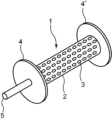
- FIG. 1 shows a perspective view showing an example of a mold for preparing an adsorption filter in this embodiment.
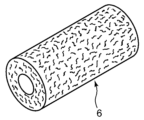
- FIG. 2 is a perspective view showing an example of the adsorption filter in this embodiment obtained using the formwork shown in FIG.
- FIG. 3 is a diagram illustrating how to cut out a sample when measuring the pore volume of an adsorption filter.
- FIG. 4 is a perspective view showing an example of an automatic grinder for manufacturing an adsorption filter.
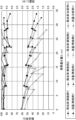
- FIG. 5 is a graph showing the results of water flow tests using test water containing turbid substances in Examples 1 to 3 and Comparative Example 1.
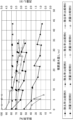
- FIG. 6 is a graph showing the results of a water flow test using test water containing turbid substances in Examples 1 to 3 and Comparative Example 1 when backwashing is performed.
- FIG. 1 shows a perspective view showing an example of a mold for preparing an adsorption filter in this embodiment.
- FIG. 2 is a perspective view showing an example of the adsorption filter in this embodiment obtained using the form
- FIG. 7 is a graph showing the results of water flow tests using test water containing turbid substances in Examples 4 to 6.
- FIG. 8 is a graph showing the results of a water flow test using test water containing turbid substances when backwashing is performed in Examples 4 to 6.
- FIG. 9 is a graph showing the results of water flow tests using test water containing turbid substances in Comparative Examples 2 to 5.
- FIG. 10 is a graph showing the results of water flow tests using test water containing turbid substances when backwashing work is performed in Comparative Examples 2 to 5.
- the shaped adsorbent described in Patent Document 4 has a structure in which the central particle diameter D50 of the particulate matter and the content of particulate matter with a particle diameter of 10 ⁇ m or less are defined within a predetermined range. Improves removal performance.
- it is generally necessary to reduce the pores of the adsorption filter by making the particle size of activated carbon as a raw material finer. Therefore, the water flow resistance of the adsorption filter becomes high. Therefore, there is a need for an adsorption filter that can achieve both excellent water permeability due to low water flow resistance and ultrafine particle removal performance.
- adsorption filters in which the particle size of activated carbon as a raw material is fine such as the molded adsorbent described in Patent Document 4, may become clogged early due to turbid substances of about 1 ⁇ m to 20 ⁇ m. Conceivable. As a result, the removal performance of the adsorption filter is reduced, and the life of the adsorption filter is expected to be shortened.
- an adsorption filter that can achieve both excellent water permeability due to low water flow resistance and ultrafine particle removal performance, and can be used for a long period of time.
- backwashing the adsorption filter according to the present invention the flow rate can be efficiently regenerated and the life of the filter can be extended.
- the adsorption filter in this embodiment is an adsorption filter made of a molded body containing activated carbon and a binder, and has a pore volume of 15 ⁇ m or more and 30 ⁇ m or less in pore diameter based on the volume of the adsorption filter measured by mercury porosimetry. is 0.06 cm 3 /cc to 0.30 cm 3 /cc.
- the adsorption filter in this embodiment is an adsorption filter made of a molded body containing activated carbon and a binder, and in the volume-based cumulative particle size distribution of the activated carbon, D50 is 30 ⁇ m or more and 110 ⁇ m or less, and D90 is 110 ⁇ m or more. And the particle content of the activated carbon having a particle diameter of 10 ⁇ m or less is 1.2% by volume or more and 8.9% by volume or less.
- D50 means a 50% particle diameter in a volume-based cumulative particle size distribution.
- D90 means a 90% particle diameter in a volume-based cumulative particle size distribution.
- D10 measured in the later examples means the 10% particle diameter in the volume-based cumulative particle size distribution.
- the adsorption filter in this embodiment can achieve both excellent water permeability due to low water flow resistance and ultrafine particle removal performance, and can be used for a long period of time. can.
- pores within a predetermined pore diameter range are formed. Adjust the pore volume to be within a specific range.
- the raw material activated carbon activated carbon whose D50 and D90 in the volume-based cumulative particle size distribution are within a predetermined range, and whose content rate of particle diameters below a specific value is within a predetermined range is used. do.
- the adsorption filter in this embodiment has a pore volume with a pore diameter of 15 ⁇ m or more and 30 ⁇ m or less based on the volume of the adsorption filter measured by mercury intrusion method (hereinafter simply referred to as "pore volume with a pore diameter of 15 ⁇ m or more and 30 ⁇ m or less"). ) is 0.06 cm 3 /cc to 0.30 cm 3 /cc.
- the pore volume of pores By setting the pore volume of pores with a diameter of 15 ⁇ m or more and 30 ⁇ m or less to 0.06 cm 3 /cc or more, it suppresses clogging due to turbid substances, has excellent water permeability, and can be used satisfactorily for a long period of time. You can get filters. Furthermore, by performing the backwashing operation, the flow rate of the adsorption filter can be efficiently regenerated, and the life of the adsorption filter can be further extended. Furthermore, by setting the volume of pores with a pore diameter of 15 ⁇ m or more and 30 ⁇ m or less to 0.30 cm 3 /cc or less, the ultrafine particle removal performance of the adsorption filter can be improved.
- the pore volume with a pore diameter of 15 ⁇ m or more and 30 ⁇ m or less is preferably 0.08 cm 3 /cc or more, more preferably 0.10 cm 3 /cc or more, even more preferably 0.12 cm 3 /cc or more, particularly preferably 0. It is 13 cm 3 /cc or more. Further, the pore volume with a pore diameter of 15 ⁇ m or more and 30 ⁇ m or less is preferably 0.27 cm 3 /cc or less, more preferably 0.25 cm 3 /cc or less, even more preferably 0.23 cm 3 /cc or less, particularly preferably It is 0.21 cm 3 /cc or less.
- the adsorption filter in this embodiment has a pore volume with a pore diameter of 7 ⁇ m or less based on the volume of the adsorption filter measured by mercury intrusion method (hereinafter also simply referred to as "pore volume with a pore diameter of 7 ⁇ m or less"). ) is preferably 0.10 cm 3 /cc or more. By setting the pore volume with a pore diameter of 7 ⁇ m or less to 0.10 cm 3 /cc or more, the adsorption filter can obtain significantly superior ultrafine particle removal performance.
- the pore volume with a pore diameter of 7 ⁇ m or less is more preferably 0.12 cm 3 /cc or more, and still more preferably 0.14 cm 3 /cc or more.
- the upper limit of the pore volume with a pore diameter of 7 ⁇ m or less is not particularly limited, but for example, the pore volume with a pore diameter of 7 ⁇ m or less is preferably 0.50 cm 3 /cc or less, more preferably 0.45 cm 3 /cc or less, more preferably 0.40 cm 3 /cc or less.
- the adsorption filter in this embodiment preferably has a total pore volume (hereinafter also simply referred to as "total pore volume”) on a volume basis of the adsorption filter measured by mercury porosimetry of 0.50 cm 3 / It is preferably cc to 0.73 cm 3 /cc.
- total pore volume By setting the total pore volume to 0.50 cm 3 /cc or more, the adsorption filter can obtain better water permeability and can be suitably used, for example, as a water purification filter.
- the total pore volume By setting the total pore volume to 0.73 cm 3 /cc or less, a sufficient amount of activated carbon can be retained and the adsorption performance as a general filter can be improved.
- the total pore volume is more preferably 0.53 cm 3 /cc or more, and still more preferably 0.56 cm 3 /cc or more. Further, the total pore volume is more preferably 0.70 cm 3 /cc or less, and even more preferably 0.67 cm 3 /cc or less.
- the pore volume with a pore diameter of 15 ⁇ m or more and 30 ⁇ m or less, the pore volume with a pore diameter of 7 ⁇ m or less, and the total pore volume measured by mercury porosimetry are as described in the examples below. It can be measured using a mercury porosimetry pore volume measuring device ("MicroActive AutoPore V 9620" manufactured by Micromeritics).
- the molded layer of the filter is used as a measurement sample having a size of about 1 cm square, but it is preferable that the size of this measurement sample is changed as appropriate depending on the filter size. For example, in the case of a spout-in type filter, it is desirable to measure with a measurement sample of approximately 5 mm square.
- the pore volume with a pore diameter of 15 ⁇ m or more and 30 ⁇ m or less, the pore volume with a pore diameter of 7 ⁇ m or less, and the total pore volume are controlled by various methods. be able to.
- the physical properties of activated carbon as a raw material and its blending amount if two or more types of activated carbon with different physical properties are used, their blending ratio; the type and amount of binder in the raw material; the blending amount of optional components in the raw material; adsorption filters.
- the value can be controlled by appropriately selecting and/or adjusting the processing conditions (suction pressure, drying time, etc.) during production.
- the pore volume with a pore diameter of 15 ⁇ m or more and 30 ⁇ m or less is calculated based on the D50 and D90 of the raw activated carbon, and the particle content (volume %) of the raw activated carbon with a particle diameter of 10 ⁇ m or less. It can be controlled by adjusting within a range.
- the density of the adsorption filter in this embodiment (hereinafter also simply referred to as "filter density”) is preferably 0.59 g/cm 3 or less.
- filter density is preferably 0.35 g/cm 3 or more.
- the filter density is 0.35 g/cm 3 or more, the total amount of activated carbon becomes a suitable amount, and the removal performance of ultrafine particles and other ordinary harmful substances can be maintained well.
- the filter density is more preferably 0.38 g/cm 3 or more, still more preferably 0.40 g/cm 3 or more, particularly preferably 0.42 g/cm 3 or more. Further, the filter density is more preferably 0.57 g/cm 3 or less, still more preferably 0.55 g/cm 3 or less, particularly preferably 0.53 g/cm 3 or less.
- filter density can be measured by the method detailed in the Examples below.
- the value of filter density can be controlled by various methods. For example, the physical properties of activated carbon as a raw material and its blending amount; if two or more types of activated carbon with different physical properties are used, their blending ratio; the type and amount of binder in the raw material; the blending amount of optional components in the raw material; adsorption filters.
- the value can be controlled by appropriately selecting and/or adjusting the processing conditions (suction pressure, drying time, etc.) during production.
- the adsorption filter in this embodiment preferably has a benzene saturated adsorption amount of 18% to 35%.
- the benzene saturated adsorption amount of the adsorption filter is determined based on the activated carbon test method of JIS K 1474:2014. It can be determined from the increase in sample volume (%) when it becomes constant.
- benzene saturated adsorption amount By having a benzene saturated adsorption amount of 18% or more, sufficient removal performance can be obtained especially for organic substances. By setting the benzene saturated adsorption amount to 35% or less, it is possible to prevent the pore diameter from increasing in an overactivated state, and it is possible to suppress the possibility that the ability to adsorb and retain harmful substances will decrease.
- the benzene saturated adsorption amount is more preferably 20% or more, and still more preferably 22% or more. Moreover, the benzene saturated adsorption amount is more preferably 33% or less, still more preferably 30% or less.
- the saturated benzene adsorption amount of the adsorption filter in this embodiment can be determined, for example, by appropriately selecting and/or selecting the physical properties of activated carbon as a raw material, its blending amount, and when using two or more types of activated carbon with different physical properties, their blending ratio, etc. Or its value can be controlled by adjusting.
- the adsorption filter in this embodiment consists of a molded body containing activated carbon and a binder.
- the activated carbon used as a raw material for the adsorption filter in this embodiment has a D50 of 30 ⁇ m or more and 110 ⁇ m or less, and a D90 of 110 ⁇ m or more in the volume-based cumulative particle size distribution of the activated carbon. Furthermore, the content of particles having a particle size of 10 ⁇ m or less in the activated carbon is 1.2% by volume or more and 8.9% by volume or less.
- an adsorption filter with a pore diameter of 15 ⁇ m or more and 30 ⁇ m or less and a pore volume in the range of 0.06 cm 3 /cc to 0.30 cm 3 /cc. .
- the pore volume of the adsorption filter with a pore diameter of 15 ⁇ m or more and 30 ⁇ m or less is increased. be able to.
- an adsorption filter that suppresses clogging caused by turbid substances, has excellent water permeability, and can be used satisfactorily for a long period of time is increased.
- the flow rate can be efficiently regenerated and the life of the adsorption filter can be extended.
- D50 is preferably 33 ⁇ m or more, more preferably 40 ⁇ m or more, even more preferably 44 ⁇ m or more, and particularly preferably 50 ⁇ m or more. Further, in the raw material activated carbon, D50 is preferably 108 ⁇ m or less, more preferably 100 ⁇ m or less, even more preferably 92 ⁇ m or less, and particularly preferably 85 ⁇ m or less.
- D90 is preferably 120 ⁇ m or more, more preferably 130 ⁇ m or more, even more preferably 140 ⁇ m or more, and particularly preferably 150 ⁇ m or more. Note that the upper limit of D90 is not particularly limited, but may be, for example, 300 ⁇ m or less.
- an adsorption filter having excellent ultrafine particle removal performance can be obtained.
- an adsorption filter having excellent water permeability due to low water flow resistance can be obtained.
- the content of particles with a particle size of 10 ⁇ m or less is preferably 2.7% by volume or more, more preferably 2.9% by volume or more, even more preferably 3.1% by volume or more, and particularly preferably 3.2% by volume. % by volume or more.
- the content of particles with a particle size of 10 ⁇ m or less is preferably 8.0 volume% or less, more preferably 7.4 volume% or less, still more preferably 6.8 volume% or less, particularly preferably 6. .3% by volume or less.
- the type of activated carbon used as a raw material is not particularly limited as long as it satisfies the conditions of D50, D90 and particle content with a particle size of 10 ⁇ m or less, and it can be used alone or in combination of two or more types of activated carbon with different physical properties. .
- the content of particles having a particle size of 10 ⁇ m or less varies depending on the physical properties of each activated carbon, the blending ratio of each activated carbon, and the like. Therefore, by selecting and/or adjusting them appropriately, their values can be controlled.
- the D50, D90 and particle content with a particle size of 10 ⁇ m or less of the raw material activated carbon are, for example, the type of carbonaceous material that is the raw material of the activated carbon and the activation treatment of the carbonaceous material during the production of activated carbon, which will be described later.
- the value can be controlled by appropriately selecting and/or adjusting the method and its processing conditions (heating temperature and time, etc.), pulverization conditions, classification conditions, and the like.
- the D50, D90 and particle content with a particle size of 10 ⁇ m or less in the raw material activated carbon can be determined using a wet particle size distribution analyzer ("Microtrac MT3300EX-II" manufactured by Microtrac Bell Co., Ltd.), as described in the later examples. ) can be analyzed and measured by laser diffraction/scattering methods.
- a wet particle size distribution analyzer (“Microtrac MT3300EX-II" manufactured by Microtrac Bell Co., Ltd.), as described in the later examples. ) can be analyzed and measured by laser diffraction/scattering methods.
- activated carbon obtained by carbonizing a carbonaceous material, which is a raw material for activated carbon, as necessary, and then performing an activation treatment, and, as necessary, a washing treatment, a drying treatment, and a pulverization treatment. You can also use
- Carbonaceous materials to be used as raw materials include, but are not particularly limited to, plant-based carbonaceous materials (e.g., wood, planer shavings, charcoal, fruit shells such as coconut shells and walnut shells, fruit seeds, pulp production by-products, lignin, plant-derived materials such as blackstrap molasses), mineral-based carbonaceous materials (e.g., mineral-derived materials such as peat, lignite, lignite, bituminous coal, anthracite, coke, coal tar, coal pitch, petroleum distillation residue, petroleum pitch), Synthetic resin-based carbonaceous materials (e.g., materials derived from synthetic resins such as phenol resin, polyvinylidene chloride, acrylic resin, etc.), natural fiber-based carbonaceous materials (e.g., natural fibers such as natural fibers such as cellulose, and recycled fibers such as rayon) fiber-derived materials), etc. These carbonaceous materials may be used alone or in combination of two or more.
- plant-based carbonaceous materials
- coconut shells or phenolic resins are preferred from the viewpoint of easy development of micropores that are involved in the volatile organic compound removal performance specified in JIS S 3201:2019.
- these carbonaceous materials are usually treated at 400°C to 800°C, preferably 500°C to 800°C, more preferably 550°C to 550°C, in an environment where oxygen or air is excluded. Carbonization treatment can be performed at about 750°C. Thereafter, the particle size may be adjusted if necessary.
- Activation treatment is a treatment that forms pores on the surface of a carbonaceous material and turns it into activated carbon, which is a porous material.
- the activation treatment can be performed by a method commonly used in the technical field, and is not particularly limited, and can mainly include two types of treatment methods: gas activation treatment and drug activation treatment. Among these, when used for water purification treatment, gas activation treatment is preferred from the viewpoint of less residual impurities.
- the gas activation treatment is, for example, a treatment in which a carbonaceous material is heated in the presence of water vapor, carbon dioxide, air, oxygen, combustion gas, or a mixed gas thereof.
- the heating temperature is not particularly limited, but is carried out, for example, at a temperature of about 700°C to 1100°C, preferably 800°C to 980°C, more preferably 850°C to 950°C.
- the activation time and temperature increase rate are not particularly limited, and may be adjusted as appropriate depending on the type, shape, and size of the selected carbonaceous material. In consideration of safety and reactivity, it is preferable to use a water vapor-containing gas containing 10% to 40% by volume of water vapor.
- an activator such as zinc chloride, calcium chloride, phosphoric acid, sulfuric acid, sodium hydroxide, potassium hydroxide, magnesium hydroxide, calcium hydroxide, etc. is mixed with a carbonaceous material, and the mixture is heated in an inert gas atmosphere.
- a known method of heating at a lower temperature may be used.
- the activated carbon after activation treatment is washed and dried as necessary.
- activated carbon is made from plant-based carbonaceous materials such as coconut shells or mineral-based carbonaceous materials that contain impurities such as alkali metals, alkaline earth metals, and transition metals, ash and chemicals are removed. Clean as necessary. Mineral acids and water are used for cleaning, and hydrochloric acid with high cleaning efficiency is preferred as the mineral acid.
- the activated carbon after the activation treatment is pulverized and/or classified as necessary.
- the pulverization process can be carried out using a pulverizer that is generally used for pulverizing activated carbon, such as a high-speed rotating mill such as an Erofor mill, rod mill, roller mill, hammer mill, blade mill, or pin mill, a ball mill, or a jet mill. I can do it.
- the classification treatment include methods generally used for classifying activated carbon, such as classification using a sieve, wet classification, and dry classification.
- wet classifiers include classifiers that utilize the principles of gravity classification, inertial classification, hydraulic classification, centrifugal classification, and the like.
- Examples of the dry classifier include classifiers that utilize principles such as sedimentation classification, mechanical classification, and centrifugal classification.
- the activated carbon obtained through such treatment or commercially available activated carbon may be in any form such as powder, particulate, or fibrous (thread, cloth, felt), and may be modified as appropriate depending on the application. You can choose. Among these shapes, a powdery one having high adsorption performance per volume is preferable.
- the binder used in the adsorption filter in this embodiment is not particularly limited, and powdery or fibrous binders can be used alone or in combination of two or more. Among these, it is preferable to include a fibrous binder from the viewpoint of excellent water permeability when molded into an adsorption filter.
- the fibrous binder is not particularly limited as long as it can be formed by entangling activated carbon, and a wide variety of binders, synthetic or natural, can be used.
- binders include acrylic fibers, polyethylene fibers, polypropylene fibers, polyacrylonitrile fibers, cellulose fibers, nylon fibers, aramid fibers, and pulp.
- the fiber length of the fibrous binder is preferably 4 mm or less.
- the fibrous binder includes an acrylic fibrous binder. Furthermore, it is more preferable that the fibrous binder includes a cellulose-based fibrous binder. Moreover, you may use these fibrous binders in combination of 2 or more types. For example, it is more preferable to use both an acrylic fibrous binder and a cellulose fibrous binder in combination. By using the cellulose-based fibrous binder in combination, it is possible to reduce the outflow of fine powder from the adsorption filter in this embodiment.
- the blending ratio of the acrylic fibrous binder and the cellulose fibrous binder is preferably 30 parts by mass to 70 parts by mass, more preferably 40 parts by mass, per 100 parts by mass of the acrylic fibrous binder. Parts by mass to 60 parts by mass.
- the water permeability of the fibrous binder is preferably about 1 mL to 200 mL in terms of CSF value. Further, it is more preferable that the CSF value is 10 mL to 150 mL.
- the CSF value is a value measured with reference to the Canadian Standard Freeness Method, "Pulp Freeness Test Method" specified in JIS P 8121:2012. Specifically, in the measurement, the value is evaluated using tap water with a conductivity of about 100 ⁇ s/cm. Note that the CSF value can be adjusted, for example, by fibrillating the binder.
- the fibrous binder has a CSF value of 1 mL or more, sufficient water permeability can be maintained, a decrease in the strength of the molded product can be suppressed, and the risk of pressure loss can be prevented. Furthermore, when the CSF value is 200 mL or less, the powdered activated carbon can be sufficiently retained, the strength of the molded body can be suppressed from decreasing, and the possibility that the adsorption performance will decrease can be prevented. In addition, when two or more types of fibrous binders are used in combination, it is preferable that the CSF value in a state where the two or more types of fibrous binders are mixed satisfies the above range.
- the CSF value of the acrylic fibrous binder is preferably 20 mL or more, more preferably 50 mL or more. Further, the CSF value of the acrylic fibrous binder is preferably 200 mL or less, more preferably 150 mL or less. By setting this range, even if the fibrous binder contains other fibrous binders other than the acrylic fibrous binder, the CSF value of the fibrous binder as a whole including the acrylic fibrous binder can be reduced. becomes an appropriate value, making it possible to improve the strength of the molded body, reduce pressure loss, retain powdered activated carbon, and maintain adsorption performance.
- the cellulose fibrous binder when the fibrous binder includes an acrylic fibrous binder and a cellulose fibrous binder, the cellulose fibrous binder is The CSF value in a state where 50 parts by mass of is blended is preferably 1 mL or more, more preferably 10 mL or more. Further, the cellulose-based fibrous binder preferably has a CSF value of 50 mL or less, and preferably 40 mL or less when 50 parts by mass of the cellulose-based fibrous binder is blended with 100 parts by mass of the acrylic fibrous binder. It is more preferable.
- the blending ratio of activated carbon and binder is not particularly limited, and when the adsorption filter is molded, the pore volume with a pore diameter of 15 ⁇ m or more and 30 ⁇ m or less (and preferably the pore volume with a pore diameter of 7 ⁇ m or less) is the main amount. What is necessary is just to set it suitably so that it may fall within the specific range prescribed
- the binder is preferably used in an amount of about 2 to 8 parts by weight per 100 parts by weight of the activated carbon. By setting the amount of the binder to 2 parts by mass or more, a molded adsorption filter having sufficient strength can be obtained. By setting the amount of the binder to 8 parts by mass or less, it is possible to suppress a decrease in the adsorption performance of the activated carbon in the adsorption filter.
- the mixing ratio of the binder to 100 parts by mass of activated carbon is more preferably 3 parts by mass or more, and still more preferably 4 parts by mass or more. Further, the mixing ratio of the binder to 100 parts by mass of activated carbon is more preferably 7 parts by mass or less, still more preferably 6 parts by mass or less. In addition, when the binder contains a lead adsorbent, etc., which will be described later, it is preferable that the mixing ratio of the binder is the above-mentioned mixing ratio with respect to the total of activated carbon and lead adsorbent.
- the adsorption filter in this embodiment may contain any other functional component as long as the effects of the present invention are not impaired.
- examples include zeolite powder (lead adsorbent), ion exchange resin, or chelate resin that can adsorb and remove soluble lead.
- various adsorbents containing silver ions or silver compounds may be contained alone or in combination of two or more.
- An example of such an adsorbent is silver-impregnated activated carbon, which is added in an amount that does not affect the physical properties of the adsorption filter in this embodiment.
- the amount of these other optional components is not particularly limited, but when the adsorption filter is molded, the pore volume with a pore diameter of 15 ⁇ m or more and 30 ⁇ m or less (and preferably the pore volume with a pore diameter of 7 ⁇ m or less) may be set appropriately so that it falls within a specific range defined in this embodiment. For example, 1 part by mass to 30 parts by mass can be added to 100 parts by mass of the entire adsorption filter.
- the adsorption filter made of a molded body containing activated carbon and a binder in this embodiment further includes a core, and may be a cylindrical adsorption filter. By making it cylindrical, water flow resistance can be reduced. Furthermore, when used as a cartridge by filling a housing as described later, there is an advantage that loading and replacing the cartridge into the water purifier can be done easily.
- the core is not particularly limited as long as it can be inserted into the hollow part of the cylindrical adsorption filter and can reinforce the cylindrical adsorption filter.
- Examples include trical pipes, netron pipes, ceramic filters, and the like.
- a nonwoven fabric or the like may be wrapped around the outer periphery of the core.
- the method for manufacturing the adsorption filter in this embodiment is not particularly limited and may be performed by any method known to those skilled in the art.
- a slurry suction method is preferred from the viewpoint of efficient production.
- the cylindrical adsorption filter (molded body) in this embodiment includes a slurry preparation process, a suction filtration process, a rolling process as necessary, a drying process, and a grinding process as necessary. It can be manufactured by a method including.
- a slurry preparation step powdered activated carbon and a fibrous binder are dispersed in water to prepare a slurry.
- the suction filtration step the prepared slurry is filtered while being suctioned to obtain a preform.
- the preform after suction filtration is compressed on a shaping table to shape the outer surface as necessary.
- the drying step the shaped preform is dried to obtain a dry mold.
- the outer surface of the dried molded body is ground as necessary.
- the powdered activated carbon and the fibrous binder are mixed so that, for example, the amount of the fibrous binder is 2 to 8 parts by mass per 100 parts by mass of the powdered activated carbon, and the solid content concentration is 0.1.
- a slurry is prepared by dispersing it in a solvent to a concentration of 10% by weight to 10% by weight, preferably 1% to 5% by weight.
- the solvent is not particularly limited, it is preferable to use water or the like.
- symbol represents the formwork 1, the core body 2, the suction hole 3, the flanges 4 and 4', and the filtrate discharge port 5.
- the core body 2 has a large number of suction holes 3 on its surface, flanges 4 and 4' are attached to both ends, and a filtrate outlet 5 is provided.
- a formwork 1 for a cylindrical molded body is used.
- a core as described above is attached to the formwork 1, placed in the prepared slurry, and filtered while suctioning from the inside of the formwork 1 through the filtrate outlet 5, thereby adhering the slurry to the formwork 1.
- a suction method a conventional method such as a suction method using a suction pump or the like can be used. In this way, the preform is attached to the formwork 1.
- a rolling process may be performed to adjust the outer diameter of the preform to a predetermined size, increase roundness, and reduce irregularities on the outer peripheral surface. can.
- the mold 1 with the preformed body obtained in the suction filtration process still attached is placed on a table and moved back and forth while being pressed with a predetermined force.
- suction filtration step and the rolling step performed as necessary may be performed any number of times in order to obtain the desired pore volume, adsorption filter density, etc.
- drying process Next, the flanges 4 and 4' at both ends of the formwork 1 are removed, and the core body 2 is extracted. As a result, a hollow cylindrical preform can be obtained.
- the preformed body removed from the formwork 1 in this manner is dried in a dryer or the like, thereby obtaining a molded body 6 (an adsorption filter in this embodiment) shown in FIG. 2.
- the drying temperature is, for example, about 100°C to 150°C, particularly about 110°C to 130°C.
- the drying time is, for example, about 4 to 24 hours, particularly about 8 to 16 hours.
- a grinding process can be performed after the drying process in order to further adjust the outer diameter of the adsorption filter or to reduce irregularities on the outer peripheral surface.
- the grinding method is not particularly limited as long as it can grind (or polish) the outer surface of the dried molded body, and any grinding method known to those skilled in the art may be used. From the viewpoint of uniformity of grinding, a method using a grinding machine that rotates and grinds the molded body itself is preferred.
- the grinding process is not limited to a method using a grinder, and for example, a molded body fixed to a rotating shaft may be ground with a fixed flat grindstone.
- the generated grinding slag tends to accumulate on the grinding surface, so it is effective to grind while blowing air.
- the adsorption filter in this embodiment can be used, for example, as a water purification filter, an artificial dialysis filter, and the like.
- an adsorption filter can be manufactured by the above-mentioned manufacturing method, and after shaping and drying, the filter can be used by cutting into a desired size and shape.
- a cap may be attached to the tip portion or a nonwoven fabric may be attached to the surface.
- the adsorption filter in this embodiment can be filled into a housing and used as a water purification cartridge.
- the water purification cartridge is loaded into a water purifier and water is passed through the water purifier, and a total filtration method in which all of the raw water is filtered or a circulation filtration method can be adopted as the water flow method.
- the water purification cartridge loaded into the water purifier may be used, for example, by filling a housing with a water purification filter (an adsorption filter in this embodiment).
- the water purification filter can also be used in further combination with known nonwoven fabric filters, various adsorbents, mineral additives, ceramic filtration materials, and the like.
- the adsorption filter according to the first aspect of the present invention is an adsorption filter made of a molded body containing activated carbon and a binder,
- the adsorption filter has a pore volume of 0.06 cm 3 /cc to 0.30 cm 3 /cc with a pore diameter of 15 ⁇ m or more and 30 ⁇ m or less, measured by mercury porosimetry.
- the adsorption filter according to the second aspect of the present invention is an adsorption filter made of a molded body containing activated carbon and a binder,
- D50 is 30 ⁇ m or more and 110 ⁇ m or less
- D90 is 110 ⁇ m or more
- the content of particles having a particle size of 10 ⁇ m or less in the activated carbon is 1.2% by volume or more and 8.9% by volume or less.
- the pore volume of the adsorption filter with a pore diameter of 7 ⁇ m or less on a volume basis as measured by mercury porosimetry is 0.10 cm 3 /cc or more. It is preferable.
- D50 is 30 ⁇ m or more and 110 ⁇ m or less
- D90 is 110 ⁇ m or more
- the content of particles having a particle size of 10 ⁇ m or less in the activated carbon is 1.2% by volume or more and 8.9% by volume or less.
- ⁇ Powdered activated carbon A Coconut shell charcoal obtained by carbonizing coconut shells from the Philippines was activated with steam at 900°C, and the obtained coconut shell activated carbon was washed with dilute hydrochloric acid and desalted with ion-exchanged water to obtain granular activated carbon. The obtained granular activated carbon was pulverized with a ball mill to obtain powdered activated carbon A having D10 of 15 ⁇ m, D50 of 85 ⁇ m, and D90 of 159 ⁇ m.
- Granular activated carbon was obtained in the same manner as in the case of powdered activated carbon A, and the obtained granular activated carbon was ground in a ball mill to obtain powdered activated carbon B having D10 of 14 ⁇ m, D50 of 60 ⁇ m, and D90 of 152 ⁇ m.
- Granular activated carbon was obtained in the same manner as in the case of powdered activated carbon A, and the obtained granular activated carbon was ground in a ball mill to obtain powdered activated carbon C having D10 of 18 ⁇ m, D50 of 55 ⁇ m, and D90 of 152 ⁇ m.
- Granular activated carbon was obtained in the same manner as in the case of powdered activated carbon A, and the obtained granular activated carbon was ground in a ball mill to obtain powdered activated carbon D having D10 of 15 ⁇ m, D50 of 86 ⁇ m, and D90 of 164 ⁇ m.
- Granular activated carbon was obtained in the same manner as in the case of powdered activated carbon A, and the obtained granular activated carbon was ground in a ball mill to obtain powdered activated carbon E having D10 of 18 ⁇ m, D50 of 45 ⁇ m, and D90 of 130 ⁇ m.
- Granular activated carbon was obtained in the same manner as in the case of powdered activated carbon A, and the obtained granular activated carbon was ground in a ball mill to obtain powdered activated carbon F having D10 of 18 ⁇ m, D50 of 44 ⁇ m, and D90 of 120 ⁇ m.
- Granular activated carbon was obtained in the same manner as in the case of powdered activated carbon A, and the obtained granular activated carbon was ground in a ball mill to obtain powdered activated carbon G having D10 of 16 ⁇ m, D50 of 32 ⁇ m, and D90 of 58 ⁇ m.
- Granular activated carbon was obtained in the same manner as in the case of powdered activated carbon A, and the obtained granular activated carbon was ground in a ball mill to obtain powdered activated carbon H having D10 of 13 ⁇ m, D50 of 108 ⁇ m, and D90 of 194 ⁇ m.
- Granular activated carbon was obtained in the same manner as in the case of powdered activated carbon A, and the obtained granular activated carbon was pulverized with a roll mill to obtain powdered activated carbon I having D10 of 72 ⁇ m, D50 of 138 ⁇ m, and D90 of 215 ⁇ m.
- Granular activated carbon was obtained in the same manner as in the case of powdered activated carbon A, and after pulverizing the obtained granular activated carbon with a ball mill, dry classification was performed. Finally, powdered activated carbon J having D10 of 24 ⁇ m, D50 of 58 ⁇ m, and D90 of 149 ⁇ m was obtained.
- Granular activated carbon was obtained in the same manner as in the case of powdered activated carbon A, and the obtained granular activated carbon was ground in a ball mill to obtain powdered activated carbon K having D10 of 10 ⁇ m, D50 of 32 ⁇ m, and D90 of 66 ⁇ m.
- binder ⁇ Acrylic fibrous binder: "Acrylic fiber Bi-PUL/F" manufactured by Nihon Exlan Kogyo Co., Ltd., CSF value 83mL ⁇ Cellulose-based fibrous binder (CSF value is 28 mL when 50 parts by mass of the cellulose-based fibrous binder is blended with 100 parts by mass of the above acrylic fibrous binder (CSF value 83 mL))
- ⁇ Titanosilicate lead adsorbent “ATS” manufactured by Solenis, average particle size 20 ⁇ m ⁇ Central core: “PMF-30C-12-14” manufactured by Daiwabo Progress Co., Ltd. ⁇ Non-woven fabric: “9540-F” manufactured by Shinwa Co., Ltd.
- the turbidity filtering ability of the adsorption filter was evaluated by conducting a water flow test using test water containing turbidity and calculating the turbidity removal rate life (L/cc) and turbidity clogging life (L/cc). . These were measured and calculated by the methods described below.
- test water was passed from the outside to the inside of the obtained cylindrical adsorption filter so that the hydrodynamic pressure was maintained at 0.1 MPa, and the flow rate was measured over time. At that time, test water and treated water were simultaneously collected and used as samples.
- the turbidity of these samples at a wavelength of 660 nm was measured using a spectrophotometer (manufactured by SHIMADZU Co., Ltd., "UV-1900") and a cylindrical 50 mm quartz cell. From the results, the removal rate (%) of the turbidity contained in the test water was calculated. Furthermore, the cumulative water flow rate per volume of the adsorption filter at the time when the turbidity removal rate became less than 80% was calculated as the turbidity removal rate life (L/cc).
- the cumulative flow rate per adsorption filter volume at the time when the flow rate became less than 1/2 10 minutes after the start of water flow was calculated as the turbidity clogging life (L/cc).
- the acceptance criteria is when the turbidity clogging life (L/cc) is 10.5L/cc or more, and the adsorption filter maintains excellent water permeability for a long period of time without clogging with turbid substances. It was rated as possible.
- the backwashing work was performed once every 5 hours after the start of the water flow test. Specifically, the backwashing process was performed by reversing the direction of water flow for 1 minute, that is, by directing the test water from the inside to the outside of the cylindrical adsorption filter, and water flow so as to maintain a dynamic water pressure of 0.1 MPa. I went by doing. After 1 minute had passed, the water flow direction was returned to the original direction, that is, the test water was directed from the outside to the inside of the adsorption filter again, and water was flowed so as to maintain the dynamic water pressure at 0.1 MPa. Other procedures, measurement methods, and calculation methods are the same as those for the turbidity removal rate life (L/cc) and turbidity clogging life (L/cc) described above.
- the acceptance criteria is when the turbidity removal rate life (L/cc) is 15.1L/cc or more when backwashing is performed, and the adsorption filter removes turbid substances while backwashing. It was evaluated that it could be removed satisfactorily over a longer period of time.
- the acceptance criteria is when the turbidity and clogging life (L/cc) is 15.1L/cc or more when backwashing is performed, and the adsorption filter is designed to remove turbidity from clogging while backwashing. It was evaluated that superior water permeability could be maintained for a long period of time without causing water damage.
- the ultrafine particle removal performance of the adsorption filter was measured by the following method. First, use the fluoro -max (trademark) Green Fluorescent Polymer MicrosphERES G500 (particle diameter 0.5 ⁇ m) by THERMO FISHER SCIENTIFIC. The diluted water of / ML or more is prepared and the dilution water The temperature of the water was adjusted to 20 ⁇ 3°C and used as test water. This test water was flowed from the outside to the inside of the cylindrical adsorption filter at a flow rate of 1.9 L/min, and the test water and treated water were simultaneously collected over time and used as samples.
- fluoro -max trademark
- Green Fluorescent Polymer MicrosphERES G500 particle diameter 0.5 ⁇ m
- the cumulative amount of water passed per volume of the adsorption filter at the time when the particle removal rate became less than 85% was calculated as the ultrafine particle removal rate life (L/cc).
- L/cc ultrafine particle removal rate life
- the VOC removal performance of the adsorption filter was measured by the following method. First, dilution water with a chloroform concentration of 60 ⁇ 12 ppb was prepared, and the temperature of the diluted water was adjusted to 20 ⁇ 3° C. to be used as test water. This test water was flowed from the outside to the inside of the cylindrical adsorption filter at a flow rate of 1.9 L/min, and the test water and treated water were simultaneously collected over time and used as samples. The chloroform concentrations in these samples were measured using an ECD gas chromatograph ("GC-2014", manufactured by Shimadzu Corporation), and the removal rate (%) was calculated.
- ECD gas chromatograph ECD gas chromatograph
- the cumulative water flow rate per volume of the adsorption filter at the time when the chloroform removal rate became less than 80% was calculated as the VOC removal rate life (L/cc).
- VOC removal rate life (L/cc) was 10.5 L/cc or more was used as a passing criterion, and the adsorption filter was evaluated as being able to remove VOCs well over a long period of time.
- the lead removal performance of the adsorption filter was measured by the following method. First, diluted water with a lead concentration of 150 ⁇ 15 ppb was prepared, the pH of the diluted water was adjusted to 8.30 to 8.60 using an aqueous sodium hydroxide solution, the temperature was adjusted to 20 ⁇ 3°C, and the test was carried out. It was water. This test water was flowed from the outside to the inside of the cylindrical adsorption filter at a flow rate of 1.9 L/min, and the test water and treated water were simultaneously collected over time and used as samples.
- the lead concentration in these samples was measured using an ultrasonic nebulizer (“UAG-1”, manufactured by Shimadzu Corporation) and an ICP emission spectrometer (“ICPE9820”, manufactured by Shimadzu Corporation). Furthermore, the cumulative amount of water passed per volume of the adsorption filter at the time when the lead concentration of the treated water reached 10 ppb or more was calculated as the lead removal rate life (L/cc). In this test, a case where the lead removal rate life (L/cc) was 10.5 L/cc or more was used as a passing criterion, and the adsorption filter was evaluated to be capable of removing lead well over a long period of time.
- UAG-1 ultrasonic nebulizer
- ICPE9820 ICP emission spectrometer
- Example 1 Powdered activated carbon A, titanosilicate lead adsorbent, acrylic fibrous binder, and cellulose fibrous binder were prepared to a total of 8.36 kg at the blending ratio shown in Table 1 below, and tap water was added. did. The amount of slurry after addition was 83.6L.
- the core was attached to the mold for cylindrical molding shown in FIG. It was molded to a diameter of 43 mm, which is slightly larger than the outer diameter, by only suctioning at 400 mmHg, and then dried.
- the obtained molded body was mounted on an automatic grinding machine shown in FIG. 4, and the molded body rotation speed was 360 revolutions/min, the grindstone rotation speed was 2535 revolutions/min, and the grindstone movement speed was 250 mm/10 seconds (2.5 cm/min).
- the outer surface of the molded body was ground at 38.6 mm in outer diameter, 12 mm in inner diameter, and 108.0 mm in height to obtain a cylindrical adsorption filter.
- a single layer of nonwoven fabric was wrapped around the outer periphery of the obtained adsorption filter.
- a cylindrical packing made of ABS resin with a thickness of about 1 mm and having an outer diameter of 39 mm was adhered to one end of the adsorption filter using a hot melt adhesive.
- a packing with an outer diameter of 39 mm ⁇ , two holes of 2.2 mm ⁇ in the center, and a threaded part that can be connected to the housing for water flow testing was attached to the other end of the adsorption filter by hot melting. Attached with adhesive.
- Example 2 to Example 6 As shown in Table 1 below, Examples 2 to 6 were the same as Example 1 except that powdered activated carbon B to powdered activated carbon F were used instead of powdered activated carbon A as the raw material activated carbon. A cylindrical adsorption filter was obtained in a similar manner. The physical property measurement results and performance evaluation results of the adsorption filters in Examples 2 to 6 are summarized in Table 3 below.
- Comparative Example 1 to Comparative Example 5 were the same as Example 1 except that powdered activated carbon G to powdered activated carbon K were used instead of powdered activated carbon A as the raw material activated carbon.
- a cylindrical adsorption filter was obtained in a similar manner.
- the physical property measurement results and performance evaluation results of the adsorption filters in Comparative Examples 1 to 5 are summarized in Table 4 below.
- FIG. 5 shows a graph of the water flow test results using test water containing turbid substances in Examples 1 to 3 and Comparative Example 1.
- FIG. 6 shows a graph of the water flow test results using test water containing turbid substances in the case of backwashing in Examples 1 to 3 and Comparative Example 1.
- FIG. 7 shows a graph showing the results of water flow tests using test water containing turbid substances in Examples 4 to 6.
- FIG. 8 shows a graph showing the results of a water flow test using test water containing turbid substances when performing backwashing work in Examples 4 to 6.
- FIG. 9 shows a graph showing the results of water flow tests using test water containing turbid substances in Comparative Examples 2 to 5.
- FIG. 10 shows a graph showing the results of a water flow test using test water containing turbid substances when performing backwashing work in Comparative Examples 2 to 5.
- the adsorption filters of Examples 1 to 6 have pore diameters of 15 ⁇ m or more and 30 ⁇ m or less and pore volumes in the range of 0.06 cm 3 /cc to 0.30 cm 3 /cc.
- the activated carbon (powdered activated carbon A to F) used as the raw material for the adsorption filters of Examples 1 to 6 has a D50 of 30 ⁇ m or more and 110 ⁇ m or less, a D90 of 110 ⁇ m or more, and a particle content of 1.0 ⁇ m or less with a particle size of 10 ⁇ m or less. All conditions of 2 volume % or more and 8.9 volume % or less are satisfied.
- the pore volume with a pore diameter of 15 ⁇ m or more and 30 ⁇ m or less is outside the range of 0.06 cm 3 /cc to 0.30 cm 3 /cc, or the D50 of the raw material activated carbon is is 30 ⁇ m or more and 110 ⁇ m or less, D90 is 110 ⁇ m or more, and the content of particles with a particle diameter of 10 ⁇ m or less is 1.2 volume % or more and 8.9 volume % or less.
- the adsorption filters of Examples 1 to 6 have a better ability to remove not only ultrafine particles but also turbid substances over a long period of time than the adsorption filter of Comparative Example 1. was removed, and maintained excellent water permeability. Furthermore, as shown in Tables 3 and 4 above, the adsorption filters of Examples 1 to 6 also had lower initial water flow resistance values than the adsorption filter of Comparative Example 1. This is because the adsorption filter of Comparative Example 1, in which the particle size of the raw material activated carbon is small, can remove ultrafine particles as well as the filters of Examples 1 to 6, but it becomes clogged with larger turbid substances and has poor water permeability. It is thought that the life of the adsorption filter was eventually shortened.
- the adsorption filters of Examples 1 to 6 have a high flow rate regeneration effect through backwashing, and maintain good turbidity removal performance of the filter for a longer period of time. I was able to.
- the particle size of the raw material activated carbon was small, and even when backwashing was performed, it was difficult to release turbid substances, so the life of the adsorption filter could not be extended that long in the end. Conceivable.
- the adsorption filter of Comparative Example 2 had better water permeability than the adsorption filters of Examples 1 to 6, but had poor performance in removing both turbid substances (including the case with backwashing) and ultrafine particle removal.
- the life of the filter was shortened. This is considered to be because the pore diameters of the adsorption filter were distributed over a larger area compared to Examples 1 to 6.
- the adsorption filter of Comparative Example 3 also had better water permeability than the adsorption filters of Examples 1 to 6, but both the turbidity removal performance (including the case with backwashing) and ultrafine particle removal performance were poor.
- the life of the filter was shortened. This is considered to be because the particle size of the raw material activated carbon was significantly larger than that in Examples 1 to 6.
- the adsorption filter of Comparative Example 4 was inferior to the adsorption filters of Examples 1 to 6 in terms of turbidity removal performance (including the case with backwashing), and the life of the filter was shortened. This is considered to be because the content of particles with a particle size of 10 ⁇ m or less in the raw material activated carbon was too low compared to Examples 1 to 6.
- the adsorption filter of Comparative Example 5 was clogged with turbid substances, had poor water permeability, and had a short filter life. This is considered to be because, similar to Comparative Example 1, the particle size of the raw material activated carbon was smaller than in Examples 1 to 6.
- the adsorption filters of Examples 1 to 6 were able to successfully remove VOCs and lead, which is a harmful substance, over a long period of time.
- the adsorption filter of the present invention is used for water purification by filling a housing to remove harmful substances such as free residual chlorine, VOC (volatile organic compounds) such as trihalomethanes, agricultural chemicals, and mold odors contained in tap water. Suitable for use as a cartridge.
Landscapes
- Chemical & Material Sciences (AREA)
- Organic Chemistry (AREA)
- Chemical Kinetics & Catalysis (AREA)
- Analytical Chemistry (AREA)
- Engineering & Computer Science (AREA)
- Life Sciences & Earth Sciences (AREA)
- Inorganic Chemistry (AREA)
- Environmental & Geological Engineering (AREA)
- Hydrology & Water Resources (AREA)
- Water Supply & Treatment (AREA)
- Nanotechnology (AREA)
- Geology (AREA)
- Materials Engineering (AREA)
- Solid-Sorbent Or Filter-Aiding Compositions (AREA)
- Water Treatment By Sorption (AREA)
- Treating Waste Gases (AREA)
Priority Applications (7)
| Application Number | Priority Date | Filing Date | Title |
|---|---|---|---|
| JP2024511872A JP7555521B2 (ja) | 2022-03-29 | 2023-03-20 | 吸着フィルター |
| MYPI2024005555A MY207181A (en) | 2022-03-29 | 2023-03-20 | Adsorption filter |
| US18/850,146 US12409438B2 (en) | 2022-03-29 | 2023-03-20 | Adsorption filter |
| AU2023244247A AU2023244247B2 (en) | 2022-03-29 | 2023-03-20 | Adsorption filter |
| KR1020247033359A KR102849068B1 (ko) | 2022-03-29 | 2023-03-20 | 흡착 필터 |
| CN202380030495.XA CN118946403A (zh) | 2022-03-29 | 2023-03-20 | 吸附过滤器 |
| JP2024154962A JP2024170592A (ja) | 2022-03-29 | 2024-09-09 | 吸着フィルター |
Applications Claiming Priority (2)
| Application Number | Priority Date | Filing Date | Title |
|---|---|---|---|
| JP2022053499 | 2022-03-29 | ||
| JP2022-053499 | 2022-03-29 |
Publications (1)
| Publication Number | Publication Date |
|---|---|
| WO2023189806A1 true WO2023189806A1 (ja) | 2023-10-05 |
Family
ID=88201025
Family Applications (1)
| Application Number | Title | Priority Date | Filing Date |
|---|---|---|---|
| PCT/JP2023/010837 Ceased WO2023189806A1 (ja) | 2022-03-29 | 2023-03-20 | 吸着フィルター |
Country Status (8)
| Country | Link |
|---|---|
| US (1) | US12409438B2 (https=) |
| JP (2) | JP7555521B2 (https=) |
| KR (1) | KR102849068B1 (https=) |
| CN (1) | CN118946403A (https=) |
| AU (1) | AU2023244247B2 (https=) |
| MY (1) | MY207181A (https=) |
| TW (1) | TW202346215A (https=) |
| WO (1) | WO2023189806A1 (https=) |
Cited By (1)
| Publication number | Priority date | Publication date | Assignee | Title |
|---|---|---|---|---|
| WO2025210769A1 (ja) * | 2024-04-03 | 2025-10-09 | 株式会社Lixil | 成形吸着体、及び浄水カートリッジ |
Citations (3)
| Publication number | Priority date | Publication date | Assignee | Title |
|---|---|---|---|---|
| WO2016121590A1 (ja) * | 2015-01-30 | 2016-08-04 | 株式会社Lixil | 浄水カートリッジ及び浄水器 |
| WO2019131305A1 (ja) * | 2017-12-28 | 2019-07-04 | 株式会社クラレ | 吸着フィルター |
| JP2020019016A (ja) * | 2014-11-19 | 2020-02-06 | 株式会社クラレ | 吸着フィルター |
Family Cites Families (6)
| Publication number | Priority date | Publication date | Assignee | Title |
|---|---|---|---|---|
| US9033158B2 (en) * | 2009-08-06 | 2015-05-19 | Kuraray Chemical Co., Ltd. | Molded activated charcoal and water purifier involving same |
| JP6489735B2 (ja) | 2013-08-09 | 2019-03-27 | フタムラ化学株式会社 | 濁度低減フィルター体の製造方法 |
| CN111511683A (zh) | 2017-12-27 | 2020-08-07 | 株式会社可乐丽 | 活性炭及其制造方法 |
| KR102469608B1 (ko) * | 2018-12-18 | 2022-11-21 | 쓰리엠 이노베이티브 프로퍼티즈 컴파니 | 미세입자 코팅된 연마 그레인을 갖는 연마 물품 |
| KR20210106480A (ko) * | 2018-12-28 | 2021-08-30 | 주식회사 쿠라레 | 정수용 필터 및 그것을 사용한 정수기 |
| JP7489198B2 (ja) | 2020-02-05 | 2024-05-23 | 株式会社Lixil | 成形吸着体、及び浄水カートリッジ |
-
2023
- 2023-03-20 KR KR1020247033359A patent/KR102849068B1/ko active Active
- 2023-03-20 JP JP2024511872A patent/JP7555521B2/ja active Active
- 2023-03-20 WO PCT/JP2023/010837 patent/WO2023189806A1/ja not_active Ceased
- 2023-03-20 CN CN202380030495.XA patent/CN118946403A/zh active Pending
- 2023-03-20 MY MYPI2024005555A patent/MY207181A/en unknown
- 2023-03-20 US US18/850,146 patent/US12409438B2/en active Active
- 2023-03-20 AU AU2023244247A patent/AU2023244247B2/en active Active
- 2023-03-28 TW TW112111681A patent/TW202346215A/zh unknown
-
2024
- 2024-09-09 JP JP2024154962A patent/JP2024170592A/ja active Pending
Patent Citations (3)
| Publication number | Priority date | Publication date | Assignee | Title |
|---|---|---|---|---|
| JP2020019016A (ja) * | 2014-11-19 | 2020-02-06 | 株式会社クラレ | 吸着フィルター |
| WO2016121590A1 (ja) * | 2015-01-30 | 2016-08-04 | 株式会社Lixil | 浄水カートリッジ及び浄水器 |
| WO2019131305A1 (ja) * | 2017-12-28 | 2019-07-04 | 株式会社クラレ | 吸着フィルター |
Cited By (1)
| Publication number | Priority date | Publication date | Assignee | Title |
|---|---|---|---|---|
| WO2025210769A1 (ja) * | 2024-04-03 | 2025-10-09 | 株式会社Lixil | 成形吸着体、及び浄水カートリッジ |
Also Published As
| Publication number | Publication date |
|---|---|
| US12409438B2 (en) | 2025-09-09 |
| JP2024170592A (ja) | 2024-12-10 |
| KR102849068B1 (ko) | 2025-08-21 |
| CN118946403A (zh) | 2024-11-12 |
| US20250108355A1 (en) | 2025-04-03 |
| KR20240154078A (ko) | 2024-10-24 |
| AU2023244247B2 (en) | 2025-02-20 |
| JPWO2023189806A1 (https=) | 2023-10-05 |
| TW202346215A (zh) | 2023-12-01 |
| AU2023244247A1 (en) | 2024-10-17 |
| JP7555521B2 (ja) | 2024-09-24 |
| MY207181A (en) | 2025-02-04 |
Similar Documents
| Publication | Publication Date | Title |
|---|---|---|
| JP6596015B2 (ja) | 吸着フィルター | |
| JP6902588B2 (ja) | 吸着フィルター | |
| JP7180036B2 (ja) | 吸着フィルター | |
| JP7303118B2 (ja) | 吸着フィルター | |
| JP7356458B2 (ja) | 浄水用フィルター及びそれを用いた浄水器 | |
| JP2024170592A (ja) | 吸着フィルター | |
| US20240299904A1 (en) | Water purification filter and water purifier | |
| WO2025173589A1 (ja) | 成型体ならびにパーフルオロアルキル化合物および/またはポリフルオロアルキル化合物の除去方法 |
Legal Events
| Date | Code | Title | Description |
|---|---|---|---|
| 121 | Ep: the epo has been informed by wipo that ep was designated in this application |
Ref document number: 23779822 Country of ref document: EP Kind code of ref document: A1 |
|
| ENP | Entry into the national phase |
Ref document number: 2024511872 Country of ref document: JP Kind code of ref document: A |
|
| WWE | Wipo information: entry into national phase |
Ref document number: 18850146 Country of ref document: US |
|
| WWE | Wipo information: entry into national phase |
Ref document number: 202380030495.X Country of ref document: CN |
|
| WWE | Wipo information: entry into national phase |
Ref document number: AU2023244247 Country of ref document: AU |
|
| ENP | Entry into the national phase |
Ref document number: 20247033359 Country of ref document: KR Kind code of ref document: A |
|
| WWE | Wipo information: entry into national phase |
Ref document number: 1020247033359 Country of ref document: KR |
|
| ENP | Entry into the national phase |
Ref document number: 2023244247 Country of ref document: AU Date of ref document: 20230320 Kind code of ref document: A |
|
| NENP | Non-entry into the national phase |
Ref country code: DE |
|
| 122 | Ep: pct application non-entry in european phase |
Ref document number: 23779822 Country of ref document: EP Kind code of ref document: A1 |
|
| WWP | Wipo information: published in national office |
Ref document number: 18850146 Country of ref document: US |
|
| WWG | Wipo information: grant in national office |
Ref document number: 18850146 Country of ref document: US |