WO2023188119A1 - 切削加工機 - Google Patents
切削加工機 Download PDFInfo
- Publication number
- WO2023188119A1 WO2023188119A1 PCT/JP2022/016033 JP2022016033W WO2023188119A1 WO 2023188119 A1 WO2023188119 A1 WO 2023188119A1 JP 2022016033 W JP2022016033 W JP 2022016033W WO 2023188119 A1 WO2023188119 A1 WO 2023188119A1
- Authority
- WO
- WIPO (PCT)
- Prior art keywords
- tool
- key
- insertion hole
- cutting machine
- respect
- Prior art date
- Legal status (The legal status is an assumption and is not a legal conclusion. Google has not performed a legal analysis and makes no representation as to the accuracy of the status listed.)
- Ceased
Links
Images




Classifications
-
- B—PERFORMING OPERATIONS; TRANSPORTING
- B23—MACHINE TOOLS; METAL-WORKING NOT OTHERWISE PROVIDED FOR
- B23B—TURNING; BORING
- B23B41/00—Boring or drilling machines or devices specially adapted for particular work; Accessories specially adapted therefor
- B23B41/12—Boring or drilling machines or devices specially adapted for particular work; Accessories specially adapted therefor for forming working surfaces of cylinders, of bearings, e.g. in heads of driving rods, or of other engine parts
-
- B—PERFORMING OPERATIONS; TRANSPORTING
- B23—MACHINE TOOLS; METAL-WORKING NOT OTHERWISE PROVIDED FOR
- B23B—TURNING; BORING
- B23B29/00—Holders for non-rotary cutting tools; Boring bars or boring heads; Accessories for tool holders
- B23B29/04—Tool holders for a single cutting tool
- B23B29/043—Tool holders for a single cutting tool with cutting-off, grooving or profile cutting tools, i.e. blade- or disc-like main cutting parts
-
- B—PERFORMING OPERATIONS; TRANSPORTING
- B23—MACHINE TOOLS; METAL-WORKING NOT OTHERWISE PROVIDED FOR
- B23B—TURNING; BORING
- B23B49/00—Measuring or gauging equipment on boring machines for positioning or guiding the drill; Devices for indicating failure of drills during boring; Centering devices for holes to be bored
-
- B—PERFORMING OPERATIONS; TRANSPORTING
- B23—MACHINE TOOLS; METAL-WORKING NOT OTHERWISE PROVIDED FOR
- B23B—TURNING; BORING
- B23B49/00—Measuring or gauging equipment on boring machines for positioning or guiding the drill; Devices for indicating failure of drills during boring; Centering devices for holes to be bored
- B23B49/02—Boring templates or bushings
Definitions
- the present invention relates to a cutting machine that processes a workpiece using a cutting tool.
- the present applicant has proposed a cutting machine used for boring or honing (see Japanese Patent Publication No. 5-2442).
- This cutting machine processes a bearing hole in a cylinder block, which is a workpiece.
- the cutting machine includes a support, a drive mechanism, a feed mechanism, four tool heads, a tool (boring bar), four support jigs, a workpiece support mechanism, and a transport mechanism.
- the pillars will be erected on the foundation.
- a processing station will be installed at the base.
- a drive mechanism is disposed at a position corresponding to the processing station so as to be movable up and down.
- the drive mechanism and tool head are moved up and down along the column by the feed mechanism.
- a tool is removably connected to each tool head.
- the tool extends downwardly from the tool head.
- the support jig is placed at a position corresponding to the processing station.
- the support jig is fixed to the lower part of the column.
- the workpiece is transported to a position corresponding to the processing station by the transport mechanism and held by a support jig.
- the motor of the feed mechanism is driven to lower the drive mechanism, tool head, and tool along the column.
- the lower end of the tool is inserted into the insertion hole provided in the bush (bearing) of the rotation support unit.
- the drive mechanism is driven, the tool is rotated and inserted into the bearing hole of the workpiece.
- the bearing hole of the workpiece is machined by the cutting tool.
- the feed mechanism is driven to raise the tool.
- the workpiece is transported out of the processing station by the transport mechanism.
- the movable key When the tool is lowered and engaged with the bushing, the movable key retreats, and then, when the tool is rotated and the phases of the movable key of the tool and the keyway of the bushing match, the movable key protrudes and the movable key and the keyway of the bushing are aligned.
- a method of engaging with a keyway is generally used. This makes it possible to match the rotational phases of the lower end of the tool and the bush.
- the present invention aims to solve the above-mentioned problems.
- aspects of the present invention include a main body frame; a shaft-shaped tool arranged so as to be linearly movable along the main body frame and rotationally driven; a rotating support unit having a rotating body provided with an insertion hole into which a tip end along a moving direction of the tool is inserted, and in which the rotating body is rotatable together with the tool inserted into the insertion hole;
- a cutting machine equipped with The tool is inserted into the insertion hole by moving in a first direction along the axial direction of the tool, The distal end of the tool is provided with an engagement convex portion that protrudes outward in the radial direction of the tool and extends along the axial direction of the tool,
- the insertion hole extends along the axial direction of the rotating body, and is recessed radially outward from the inner peripheral surface of the insertion hole to form an engagement groove into which the engagement convex portion is inserted.
- the engagement convex portion is a convex main body formed with a substantially constant width along the axial direction of the tool; a tapered portion that is disposed adjacent to the first direction of the convex main body and has first and second sloped surfaces whose distance from each other decreases toward the first direction; Equipped with When the tool is viewed in the first direction, the first inclined surface is disposed in a counterclockwise direction with respect to the center in the width direction of the tapered portion, and the second inclined surface is arranged in a direction counterclockwise with respect to the widthwise center of the tapered portion.
- the first inclined surface is a surface twisted clockwise with respect to the axial center of the tool toward the first direction
- the second inclined surface is twisted clockwise with respect to the axial center of the tool toward the first direction
- the rotating body has an end face facing in a second direction that is opposite to the first direction
- the engagement groove is a tapered groove portion extending from the end surface of the rotating body in the first direction, having first and second guide surfaces whose distance from each other becomes smaller toward the first direction, and having a width larger than the tapered portion; and, a groove body disposed adjacent to the tapered groove in the first direction and formed with a substantially constant width along the axial direction of the rotating body; Equipped with When looking at the insertion hole in the first direction, the first guide surface is disposed in a counterclockwise direction with respect to the widthwise center of the engagement groove, and the second guide surface is arranged in a clockwise direction with respect to the widthwise center of the engagement groove, The first guide surface is a surface twisted clockwise with respect to the axial center of the insertion hole toward the first direction, and the second guide surface is a surface twisted clockwise with respect to the axial center of the insertion hole toward the first direction. It is
- the tool is moved in the first direction along the main body frame, and the engagement protrusion provided at the tip of the tool is inserted into the engagement groove of the insertion hole in the rotating body.
- the first inclined surface is a surface twisted clockwise with respect to the axial center of the tool in the first direction
- the second inclined surface is twisted clockwise with respect to the axial center of the tool in the first direction. It is a surface twisted counterclockwise.
- the first guide surface is a surface twisted clockwise with respect to the axial center of the insertion hole toward the first direction
- the second guide surface is a surface twisted clockwise with respect to the axial center of the insertion hole toward the first direction. It is a surface that is twisted counterclockwise.
- the degree of phase shift in the rotational direction is Either the first inclined surface and the first guide surface or the second inclined surface and the second guide surface can be in surface contact with each other as torsionally curved surfaces.
- the engagement occurs.
- the rotating body rotates following the tool so that the widthwise center of the groove is directed toward the widthwise center of the engaging convex portion.
- the widthwise center of the engagement groove and the widthwise center of the engagement protrusion match, and the protrusion body of the engagement protrusion is inserted into the groove body of the engagement groove.
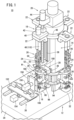
- FIG. 1 is an external perspective view of a cutting machine according to an embodiment of the present invention.
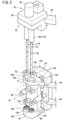
- FIG. 2 is an enlarged perspective view of the main parts of the cutting machine shown in FIG.
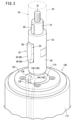
- FIG. 3 is an enlarged perspective view showing the vicinity of the tip of the tool and the first rotary support unit in the cutting machine of FIG.
- FIG. 4 is an enlarged front view showing the tip of the tool and the adapter.
- FIG. 5 is a sectional view taken along line VV in FIG. 4.
- 6A is a cross-sectional view taken along the VIA-VIA line in FIG. 4
- FIG. 6B is a cross-sectional view taken along the VIB-VIB line in FIG. 4
- FIG. 6C is a cross-sectional view taken along the VIC-VIC line in FIG. FIG.
- FIG. 1 is an external perspective view of a cutting machine according to an embodiment of the present invention.
- FIG. 2 is an enlarged perspective view of the main parts of the cutting machine shown in FIG.
- FIG. 3 is
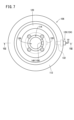
- FIG. 7 is a top view of the first rotation support unit shown in FIG. 2.
- FIG. 8 is a cross-sectional view taken along line VIII-VIII in FIG. 7.
- 9A is a cross-sectional view taken along line IXA-IXA in FIG. 8
- FIG. 9B is a cross-sectional view taken along line IXB-IXB in FIG. 8
- FIG. 9C is a cross-sectional view taken along line IXC-IXC in FIG.
- FIG. 10 is a conceptual diagram showing a state in which the tip of the tool is inserted into the keyway of the first rotation support unit.
- the cutting machine 10 is used to drill holes in the workpiece W.
- the workpiece W is a cylinder block and a cylinder head of an internal combustion engine mounted on a vehicle.
- the cutting machine 10 includes a base 12, a main body frame 14, a processing station 16, a drive mechanism 18, a feed mechanism 20, four tool heads 22, and a tool. 24, a jig 26, a support block 28, and a transport mechanism 30.
- the base 12 is placed at the bottom of the cutting machine 10.
- the base 12 extends horizontally.
- the base 12 is placed on a floor surface or the like.
- the base 12 includes a first base 32 and a second base 34.
- the main body frame 14 is connected to the upper part of the first base 32 .
- the second base 34 is adjacent to the first base 32.
- a transport mechanism 30, which will be described later, is arranged above the second base 34.
- the main body frame 14 is erected upward from the top of the first base 32 of the base 12.
- the main body frame 14 includes a housing space 36 and a guide rail 38.
- the accommodation space 36 opens on the outer peripheral surface of the main body frame 14.
- the accommodation space 36 faces a processing station 16 and a transport mechanism 30, which will be described later.
- the guide rail 38 is arranged on the outer peripheral surface of the main body frame 14.
- the guide rail 38 is arranged above the accommodation space 36.
- the guide rail 38 extends along the axial direction of the main body frame 14.
- the processing station 16 is a part where the workpiece W is processed.
- the processing station 16 is arranged on the side of the main body frame 14.
- the processing station 16 faces the lower part of the body frame 14.
- a workpiece W is carried into or out of the processing station 16 by a transport mechanism 30 .
- the drive mechanism 18 is arranged at the top of the main body frame 14. A portion of the drive mechanism 18 protrudes radially outward from the main body frame 14. The drive mechanism 18 is arranged above the processing station 16. The drive mechanism 18 and the processing station 16 face each other in the vertical direction.
- the drive mechanism 18 includes a lifting platform 40 and a drive motor 42.
- the lifting platform 40 is arranged horizontally orthogonally to the axis of the main body frame 14.
- the lifting platform 40 is movable along the guide rails 38 of the main body frame 14.
- the drive motor 42 is fixed to the upper part of the lifting platform 40.
- Drive motor 42 has a drive shaft (not shown).
- a rotating shaft 48 of the tool head 22 is connected to the lower end of the drive shaft. By energizing the drive motor 42 from a power source (not shown), the rotary shaft 48 rotates together with the drive shaft.
- the feeding mechanism 20 is capable of moving the drive mechanism 18 including the lifting platform 40 in the vertical direction.
- the feeding mechanism 20 is arranged at the top of the main body frame 14.
- the feeding mechanism 20 includes a lifting motor 44 . By driving the lift motor 44, the lift table 40 moves vertically along the guide rail 38.
- the four tool heads 22 are arranged around the outer periphery of the main body frame 14.
- the four tool heads 22 are held on a head carrier 46.
- the head carrier 46 has an annular shape.
- the head carrier 46 is arranged radially outward from the outer peripheral surface of the main body frame 14 .
- the head carrier 46 is rotatably arranged on the main body frame 14.
- the four tool heads 22 are arranged at equal intervals in the circumferential direction of the head carrier 46. When viewed in the axial direction of the head carrier 46, the four tool heads 22 are spaced apart from each other by 90°.
- the four tool heads 22 rotate around the main body frame 14 by rotating the head carrier 46 by the driving force of a drive source (not shown).
- the four tool heads 22 rotate along the outer peripheral surface of the main body frame 14 , and one tool head 22 of the four tool heads 22 is placed at a position facing the processing station 16 .
- Each tool head 22 includes a rotating shaft 48.
- Rotating shaft 48 is rotatably supported by tool head 22 .
- the rotating shaft 48 extends downward (in the first direction) from the tool head 22.
- the upper end of the rotating shaft 48 is connected to the lower end of the drive shaft of the drive motor 42 in the drive mechanism 18 .
- the lower end of the rotating shaft 48 is connected to the upper end of the tool 24 via a not-shown joint.
- the tool 24 is removably arranged on the tool head 22.
- the tool 24 has a shaft shape that is elongated along the axial direction.
- the tool 24 extends downward (in the second direction) from the tool head 22.
- the tool 24 includes a tool shaft 25, a plurality of cutting tools 50, and an adapter 52.
- the cutting tool 50 is a cutting tool that has a blade portion at the tip.
- the cutting tool 50 is arranged in a direction perpendicular to the axis of the tool shaft 25.
- the cutting tool 50 is inserted into a holding hole (not shown) provided in the tool shaft 25.
- the tip of the cutting tool 50 projects radially outward from the outer peripheral surface of the tool 24 (tool shaft 25).
- the plurality of cutting tools 50 are arranged at equal intervals along the axial direction of the tool 24.
- the inner peripheral surface of the prepared hole H for machining (see FIG. 2) in the workpiece W is cut by the tip of the cutting tool 50.
- the upper end of the tool 24 (tool shaft 25) can be connected to the lower end of the rotating shaft 48.
- the drive motor 42 rotates, the tool 24 rotates together with the rotating shaft 48.
- the lower end of the tool 24 can be inserted into a first rotation support unit 106 of a jig 26, which will be described later.
- the lower end (tip) of the tool shaft 25 has a mounting hole 54.
- the mounting hole 54 opens downward.
- the insertion portion 74 of the adapter 52 is inserted into the mounting hole 54 .
- the tool shaft 25 has a screw hole 56 at the upper end of the mounting hole 54.
- the screw hole 56 is located at the center of the mounting hole 54.
- the screw hole 56 extends upward (in the second direction) from the upper end of the mounting hole 54.
- the inner circumferential surface of the mounting hole 54 has a circular shape.
- the inner peripheral surface of the mounting hole 54 has a pair of slit grooves 58 .
- the slit groove 58 is recessed radially outward from the inner peripheral surface of the mounting hole 54 .
- the slit groove 58 extends along the axial direction of the mounting hole 54.
- the adapter 52 is connected to the lower end of the tool shaft 25.
- the adapter 52 is removably arranged on the tool shaft 25.
- the adapter 52 includes a body 60, a key member 62, a plug member 64, a nut member 66, a pair of rotation prevention members 68, and a connecting bolt 70. When the tool 24 is lowered, the adapter 52 can be inserted into the first rotary support unit 106 together with the tool 24.
- the body 60 is cylindrical.
- the outer circumferential diameter of the body 60 is approximately the same as the outer circumferential diameter of the tool 24.
- the body 60 includes a housing hole 72 and an insertion portion 74 .
- the accommodation hole 72 is arranged approximately at the center of the body 60 in the axial direction.
- the accommodation hole 72 penetrates the body 60 in a direction orthogonal to the axial direction.
- the accommodation hole 72 can accommodate the key member 62.
- the cross-sectional shape of the accommodation hole 72 is a rectangular shape that is elongated in the axial direction.
- the accommodation hole 72 opens on the outer peripheral surface of the body 60.
- the insertion part 74 is arranged at the upper end of the body 60.
- the insertion portion 74 has a smaller diameter than the body 60.
- the insertion portion 74 can be inserted into the mounting hole 54 of the tool 24 .
- a pair of detent members 68 are attached to the insertion portion 74 . When the rotation preventing member 68 is attached to the insertion portion 74, it protrudes radially outward from the outer circumferential surface of the insertion portion 74.
- the detent member 68 extends along the axial direction of the insertion portion 74.
- the pair of detent members 68 are inserted into the slit grooves 58, respectively. This prevents the tool 24 and the adapter 52 from rotating. The adapter 52 does not rotate relative to the tool 24.
- the inside of the body 60 has a bolt hole 76 and a set screw hole 78.
- the bolt hole 76 and the set screw hole 78 are arranged on the axis of the body 60, respectively.
- the connecting bolt 70 can be inserted into the bolt hole 76.
- the bolt hole 76 is located closer to the insertion portion 74 than the accommodation hole 72 .
- the bolt hole 76 opens and communicates with the accommodation hole 72.
- Bolt hole 76 extends from body 60 to insert portion 74 .
- the bolt hole 76 opens at the upper end of the insertion portion 74 .
- the set screw hole 78 penetrates from the lower end of the body 60 to the accommodation hole 72.
- the set screw hole 78 accommodates the plug member 64 and the nut member 66.
- the plug member 64 is disposed in the set screw hole 78 at a position close to the receiving hole 72 .
- the nut member 66 is disposed in the set screw hole 78 at a position close to the lower end of the body 60 spaced apart from the accommodation hole 72 .
- the nut member 66 With the plug member 64 inserted into the set screw hole 78, the nut member 66 is screwed into the set screw hole 78 from the lower end of the body 60. As a result, the set screw hole 78 is closed by the nut member 66. At the set screw hole 78 , the upper part of the plug member 64 projects into the accommodation hole 72 . The upper part of the plug member 64 can position the key member 62 in the radial direction by being engaged with a recess 84 of the key member 62, which will be described later.
- the key member 62 is a block body.
- the key member 62 includes a key body 80 and a key protrusion (engaging protrusion) 82.
- the cross-sectional shape of the key body 80 is approximately rectangular.
- the key body 80 has a shape corresponding to the accommodation hole 72 of the body 60.
- the lower end of the key body 80 is provided with a recess 84 .
- the cross-sectional shape of the recess 84 is a partially cut-out circular shape (see FIGS. 6A to 6C).
- the cross-sectional shape of the recess 84 corresponds to the plug member 64.
- the recess 84 faces the set screw hole 78.
- the upper part of the plug member 64 is inserted into the recess 84 .
- movement of the key member 62 along the accommodation hole 72 is restricted.
- the key member 62 is fixed to the receiving hole 72 by the plug member 64.
- the key body 80 has a side portion perpendicular to the lower end of the key body 80.
- a key protrusion 82 is arranged on the side of the key body 80. When the key member 62 is inserted into the housing hole 72, the key convex portion 82 projects radially outward from the outer peripheral surface of the body 60. The key protrusion 82 is exposed to the outside of the body 60.
- the key protrusion 82 extends along the axial direction of the key member 62.
- the key convex portion 82 is elongated along the axial direction of the key member 62.
- the extending direction of the key protrusion 82 is the same as the axial direction of the body 60.
- the key convex portion 82 includes a tapered portion 86 and a convex body 88.
- the tapered portion 86 extends from approximately the center of the key protrusion 82 along the extending direction of the key protrusion 82 to the lower end.
- the width dimension of the tapered portion 86 gradually decreases toward the lower end of the key convex portion 82.
- the width dimension is a dimension in the width direction perpendicular to the axial direction of the key convex portion 82.
- the tapered portion 86 has a pair of first and second inclined surfaces 90 and 92.
- the first and second inclined surfaces 90 and 92 are arranged on both sides of the key protrusion 82 in the width direction, which is perpendicular to the extending direction of the key protrusion 82 .
- the first inclined surface 90 is arranged on one side of the key protrusion 82 in the width direction.
- the second inclined surface 92 is arranged on the other side of the key protrusion 82 in the width direction.
- the first inclined surface 90 and the second inclined surface 92 are symmetrical with respect to a straight line AA passing through the widthwise center of the key convex portion 82 and the axial center P of the tool 24 (rotation center of the tool 24).
- the distance between the first inclined surface 90 and the second inclined surface 92 gradually decreases in the direction away from the protrusion main body 88 (downward, first direction).
- the first and second inclined surfaces 90 and 92 have a spiral shape twisted along the circumferential direction of the body 60.
- the first inclined surface 90 is in a counterclockwise direction (in the direction of arrow B) with respect to the straight line AA.
- the second inclined surface 92 is in the clockwise direction (arrow C direction) with respect to the straight line AA.
- the second inclined surface 92 is a curved surface twisted downward from the upper end of the tapered portion 86 counterclockwise with respect to the axial center of the tool 24 (adapter 52).
- the key member 62 shown in FIGS. 6A to 6C When the key member 62 shown in FIGS. 6A to 6C is viewed from above, assuming that the angle between the straight line AA and the first inclined surface 90 is the inclination angle ⁇ 1, the key member 62 shown in FIGS. 6A to 6C is gradually The inclination angle ⁇ 1 of the first inclined surface 90 becomes larger. As shown in FIG. 6A, at the upper end of the key protrusion 82, the first inclined surface 90 is parallel to the straight line AA.
- the second inclined surface 92 is twisted counterclockwise with respect to the axial center of the tool 24. It is a curved surface. Viewing the key member 62 from above, if the angle between the straight line AA and the second slope 92 is the slope angle ⁇ 2, then the slope angle ⁇ 2 of the second slope 92 gradually increases from the upper end to the lower end of the key protrusion 82. becomes larger. As shown in FIG. 6A, at the upper end of the key protrusion 82, the second inclined surface 92 is parallel to the straight line AA.
- the twisting direction of the first inclined surface 90 and the twisting direction of the second inclined surface 92 are opposite directions.
- the inclination angle ⁇ 1 and the inclination angle ⁇ 2 are the same in the extending direction of the key protrusion 82.
- the cross-sectional shape of the upper end of the key protrusion 82 is rectangular.
- the cross-sectional shape of the lower end of the key protrusion 82 is trapezoidal with a narrower width on the outer side in the radial direction.
- the cross-sectional shape of the key protrusion 82 gradually changes from a rectangular shape to a trapezoid shape from the upper end to the lower end of the key protrusion 82 .
- the protrusion main body 88 is placed above the tapered portion 86.
- the protrusion main body 88 extends from approximately the center of the key protrusion 82 along the extending direction of the key protrusion 82 to the upper end.
- the width dimension of the protrusion main body 88 is substantially constant along the extending direction of the key protrusion 82 .
- the convex body 88 has a symmetrical shape in the width direction of the convex body 88 . When viewed from above in the axial direction of the tool 24, the convex body 88 has a rectangular cross-sectional shape.
- the four jigs 26 can hold the work W.
- the jig 26 is held on a support carrier 94.
- the jig 26 is arranged at the same height as the support block 28 in the axial direction of the main body frame 14 by a pair of support carriers 94 .
- the support carrier 94 has an annular shape.
- the support carrier 94 is rotatably arranged around the outer periphery of the main body frame 14 .
- the four jigs 26 are held by the support carrier 94 at equal intervals in the circumferential direction of the support carrier 94 . When viewed in the axial direction of the support carrier 94, the four jigs 26 are spaced apart from each other by 90 degrees.
- the four jigs 26 can be rotated around the outer periphery of the main body frame 14 by the support carrier 94. When one of the four jigs 26 faces the processing station 16, said one jig 26 faces the support block 28.
- the jig 26 includes a jig main body 96 and first and second support parts 98 and 100, as shown in FIGS. 1 to 3.
- the cross-sectional shape of the jig 26 is a U-shape in which the first and second support parts 98, 100 and the jig main body 96 are substantially perpendicular to each other.
- the workpiece W is held so as to be surrounded by the jig main body 96 and the first and second supporting parts 98 and 100 (see FIGS. 1 and 2).
- the jig main body 96 has a flat plate shape.
- the jig body 96 faces the body frame 14 or the support block 28.
- the jig main body 96 has a substantially rectangular shape with a vertical dimension.
- the back side of the jig main body 96 faces the main body frame 14.
- a reference seat 102 is attached to the back surface of the jig main body 96.
- the first support part 98 is arranged at the lower end of the jig main body 96.
- the second support part 100 is arranged at the upper end of the jig main body 96.
- the first and second support portions 98 and 100 each protrude in a direction perpendicular to the extending direction of the jig main body 96.
- the first and second support parts 98 and 100 each extend in a direction opposite to the main body frame 14.
- the first support part 98 and the second support part 100 face each other in the vertical direction.
- the first support portion 98 has a first support hole 104.
- the first support hole 104 penetrates in the vertical direction.
- a first rotation support unit 106 is accommodated in the first support hole 104 .
- a second rotary support unit 110 that supports the tool 24 is inserted into the second support hole 108.
- the second rotation support unit 110 is held by the second support hole 108 of the second support portion 100 .
- the first rotation support unit 106 includes a housing 112, a bush (rotating body) 114, a pair of bearings 1161 and 1162, a holder 118, and first and second caps 120. , 122 and a detection mechanism 124.
- Housing 112 is cylindrical. The housing 112 is inserted into and held in the first support hole 104 of the first support part 98. The axis of the housing 112 extends in the vertical direction.
- a holder 118 is connected to the lower end of the housing 112.
- the bush 114 is a cylindrical body.
- Bushing 114 is housed within housing 112 and holder 118.
- Bushing 114 is arranged coaxially with housing 112.
- a pair of bearings 1161 and 1162 are arranged between bush 114 and housing 112.
- a pair of bearings 1161 and 1162 are spaced apart in the axial direction of bush 114 and housing 112.
- the bush 114 is rotatably supported by the housing 112 by a pair of bearings 1161 and 1162.
- a first cap 120 is attached to the upper ends of the housing 112 and the bush 114.
- the upper end of the bush 114 passes through the first cap 120.
- the upper end of the bush 114 is exposed to the outside.
- a second cap 122 is attached to the lower end of the housing 112 via a holder 118.
- the second cap 122 covers the lower end of the bush 114.
- the first and second caps 120, 122 are rotatable together with the bushing 114.
- the detection mechanism 124 includes a detected portion 126, an air supply member 128, and a detection sensor 130 (see FIG. 2).
- the detected portion 126 is arranged on the outer peripheral surface of the bush 114.
- the detected portion 126 is arranged near the lower end of the bush 114 .
- the detected portion 126 protrudes radially outward from the outer peripheral surface of the bush 114 .
- the detected portion 126 has a predetermined width in the rotational direction of the bush 114.
- the air supply member 128 is attached to the holder 118.
- the air supply member 128 is attached radially inward from the outer peripheral surface of the holder 118.
- Compressed air is supplied to the air supply member 128 from an air supply source (not shown).
- the tip of the air supply member 128 has a nozzle portion 132 that can inject air.
- Nozzle portion 132 is installed within space 134 of holder 118 .
- the nozzle portion 132 and the lower end of the bush 114 face each other with a space 134 in between. Compressed air is injected from the nozzle portion 132 of the air supply member 128 toward the outer peripheral surface of the bush 114 .
- the detection sensor 130 is arranged on a support block 28, which will be described later.
- Detection sensor 130 is an air gap sensor.
- the detection sensor 130 detects the pressure difference between the compressed air injected from the air supply member 128 toward the outer peripheral surface of the bush 114 . Based on the pressure difference detected by the detection sensor 130, a change in the distance between the outer peripheral surface of the bush 114 and the nozzle portion 132 of the air supply member 128 can be detected.
- the distance between the detected part 126 and the air supply member 128 becomes smaller and a pressure change occurs. Based on this pressure change, the position of the detected portion 126 facing the air supply member 128 along the rotational direction of the bush 114 is detected. By detecting the position of the bush 114 in the rotational direction, the position of the keyway 138 of the bush 114 can be confirmed. When the detected portion 126 and the air supply member 128 face each other, the key convex portion 82 of the tool 24 and the key groove 138 of the bush 114 are aligned in the rotational direction.
- Insertion hole 136 is provided inside the bush 114. Insertion hole 136 extends along the axial direction of bush 114. Insertion hole 136 passes through bush 114 in the axial direction. The tool 24 (adapter 52) is inserted into the insertion hole 136 from the upper end of the insertion hole 136.
- the insertion hole 136 has a constant diameter along the axial direction.
- the inner peripheral surface of the insertion hole 136 is circular when viewed from the axial direction of the bush 114.
- the inner peripheral diameter of the insertion hole 136 is large enough to allow the tool 24 to be inserted into the insertion hole 136.
- the insertion hole 136 includes a key groove (engaging groove) 138.
- the keyway 138 is recessed radially outward from the inner peripheral surface of the insertion hole 136.
- the keyway 138 extends along the axial direction of the insertion hole 136.
- the keyway 138 has a tapered groove portion 140 and a groove body 142, as shown in FIGS. 8 to 10.
- the tapered groove portion 140 is arranged above the keyway 138.
- the tapered groove portion 140 has a pair of first and second guide surfaces 144 and 146.
- the first and second guide surfaces 144 and 146 are arranged in the width direction of the keyway 138, which is perpendicular to the extending direction of the keyway 138.
- the first guide surface 144 and the second guide surface 146 are spaced apart from each other by a predetermined distance in the width direction of the keyway 138.
- the width dimension of the tapered groove portion 140 is larger than the width dimension of the tapered portion 86 of the key member 62.
- the straight line AB passes through the center axis S of the bush 114 (rotation center of the bush 114) and the center of the keyway 138 in the width direction.
- the first guide surface 144 is arranged in a counterclockwise direction (in the direction of arrow B, one of the width directions of the keyway 138) with respect to the straight line AB.
- the second guide surface 146 is arranged in a clockwise direction (direction of arrow C, the other widthwise direction of the keyway 138) with respect to the straight line AB.
- the first guide surface 144 and the second guide surface 146 face each other.
- the first guide surface 144 and the second guide surface 146 are symmetrical with respect to the straight line AB.
- the width dimension of the tapered groove portion 140 gradually decreases toward the lower end of the key convex portion 82. That is, in the width direction of the keyway 138, the distance between the first guide surface 144 and the second guide surface 146 gradually decreases from the upper end of the tapered groove portion 140 toward the groove body 142.
- the first guide surface 144 when viewed from above in the axial direction of the bush 114, the first guide surface 144 is threaded so as to rotate clockwise (in the direction of arrow C) with respect to the axial center of the insertion hole 136. It is a curved surface.
- the angle between the straight line AB and the first guide surface 144 is an inclination angle ⁇ 3
- the inclination angle ⁇ 3 of the first guide surface 144 gradually increases from the upper end of the tapered groove portion 140 toward the groove body 142. becomes smaller. That is, the inclination angle ⁇ 3 is largest at the upper end of the first guide surface 144.
- the first guide surface 144 is parallel to the straight line AB.
- the second guide surface 146 when viewed from above in the axial direction of the bush 114, the second guide surface 146 is a curved surface twisted so as to turn counterclockwise with respect to the axial center of the insertion hole 136. be.
- the angle between the straight line AB and the second guide surface 146 is an inclination angle ⁇ 4
- the inclination angle ⁇ 4 of the second guide surface 146 gradually increases from the upper end of the tapered groove portion 140 toward the groove body 142. becomes smaller. That is, the inclination angle ⁇ 4 is largest at the upper end of the second guide surface 146.
- the second guide surface 146 is parallel to the straight line AB.
- the twisting direction (tilting direction) of the first guide surface 144 and the twisting direction (tilting direction) of the second guide surface 146 are opposite directions.
- the inclination angle ⁇ 3 and the inclination angle ⁇ 4 are the same in the direction in which the bush 114 extends.
- the cross-sectional shape of the upper end of the tapered groove portion 140 is a trapezoidal shape that is wider on the outer side in the radial direction. That is, at the upper end of the tapered groove portion 140, the distance between the first guide surface 144 and the second guide surface 146 becomes narrower toward the inside in the radial direction of the bush 114.
- the cross-sectional shape of the lower end of the tapered groove portion 140 is approximately rectangular. That is, at the lower end of the tapered groove portion 140, the first guide surface 144 and the second guide surface 146 are parallel to each other.
- the cross-sectional shape of the tapered groove 140 gradually changes from a trapezoid to a substantially rectangular shape from the upper end to the lower end of the taper groove 140.
- the groove body 142 is arranged at the lower part of the tapered groove portion 140.
- the groove body 142 extends from the lower end of the tapered groove portion 140 to the lower end of the keyway 138 along the direction in which the keyway 138 extends.
- the width dimension of the groove body 142 is constant along the extending direction of the key protrusion 82.
- the groove body 142 has a pair of third guide surfaces 148.
- the width dimension of the groove body 142 is large enough to allow insertion of the tapered portion 86 of the key member 62.
- the width dimension of the groove body 142 is slightly larger than the width dimension of the key body 80.
- the cross-sectional shape of the groove body 142 is rectangular.
- the lower end of the tool 24 and the adapter 52 are inserted into the insertion hole 136 of the first rotation support unit 106.
- the key convex portion 82 of the key member 62 is inserted into the key groove 138.
- the first inclined surface 90 and the first guide surface 144 face each other.
- the second inclined surface 92 and the second guide surface 146 face each other. Either the first inclined surface 90 and the first guide surface 144 or the second inclined surface 92 and the second guide surface 146 are in surface contact with each other.
- the convex body 88 of the key member 62 is guided downward along the tapered groove 140 of the keyway 138.
- the key protrusion 82 of the key member 62 is guided into the groove body 142 of the keyway 138.
- the key member 62 and the keyway 138 are positioned relative to each other in the rotational direction of the first rotation support unit 106 by guiding the tapered portion 86 along the groove body 142.
- the bush 114 of the first rotation support unit 106 and the tool 24 are positioned relative to each other in the rotational direction of the tool 24.
- the lower end of the tool 24 is rotatably supported by a bush 114 of the first rotary support unit 106 .
- the support block 28 is accommodated in the accommodation space 36 of the main body frame 14 (see FIG. 1).
- the support block 28 is exposed to the outside of the main body frame 14 through the opening of the accommodation space 36 .
- the four jigs 26 rotate together with the support carrier 94, one of the four jigs 26 faces the support block 28.
- One jig 26 facing the support block 28 can be held by the support block 28.
- the support block 28 has a plurality of connection parts 150.
- the connecting portion 150 and the reference seat 102 of the jig 26 can be connected.
- the support block 28 and the jig 26 are positioned at predetermined positions and connected to each other.
- the transport mechanism 30 is arranged on the second base 34 of the base 12, as shown in FIG.
- the transport mechanism 30 faces the processing station 16 .
- the transport mechanism 30 includes a moving table 152, a cylinder 154, a workpiece holder 156, a pallet 158, and a pallet holder 160.
- the moving table 152 is arranged horizontally above the second base 34.
- the movable table 152 is movable along the second base 34 in a direction toward or away from the main body frame 14 .
- the cylinder 154 urges the moving table 152 in a direction toward or away from the main body frame 14 .
- the workpiece holder 156 is held on the movable table 152.
- the workpiece holder 156 extends along the moving direction of the moving table 152.
- a pallet holder 160 is attached to the end of the work holder 156.
- the pallet holder 160 faces the processing station 16 and the main body frame 14.
- the pallet holder 160 is a plate body perpendicular to the axial direction of the workpiece holder 156.
- the pallet holding section 160 is perpendicular to the moving direction of the moving table 152.
- the pallet holding section 160 can hold the workpiece W via the pallet 158.
- the workpiece W is held on the pallet 158 at a position where the moving table 152 of the transport mechanism 30 is spaced apart from the main body frame 14 .
- the cylinder 154 is driven to move the moving table 152 together with the work holder 156 toward the main body frame 14 .
- the workpiece W reaches the processing station 16 and is held by the jig 26.
- the support carrier 94 By rotating the support carrier 94, the work W is held by each of the four jigs 26.
- the jig 26 is placed at a position facing the support block 28, and the support block 28 is sent out toward the jig 26.
- the connecting portion 150 of the support block 28 and the reference seat 102 of the jig 26 come into contact.
- the jig 26 and the support block 28 are positioned relative to each other. Thereby, the jig 26 is held by the support block 28.
- the drive mechanism 18 and tool head 22 are lowered toward the work W by driving the lift motor 44 of the feed mechanism 20.
- This causes the tool 24 to descend together with the tool head 22.
- the second rotary support unit 110 is inserted into the second support hole 108 of the second support part 100, and then the tool 24 is inserted into the machining hole H (see FIG. 2) of the workpiece W. be done.
- the adapter 52 is inserted into the insertion hole 136 of the bush 114 in the first rotation support unit 106.
- the positions of the key protrusion 82 of the key member 62 and the key groove 138 of the insertion hole 136 basically match. That is, the positions of the key protrusion 82 and the key groove 138 in the rotational direction of the tool 24 are such that the key protrusion 82 can be inserted into the key groove 138.
- the positional relationship between the key convex part 82 of the key member 62 and the key groove 138 of the insertion hole 136 is maintained, and when processing the next workpiece W, the key convex part 82 of the key member 62 is It is inserted into the keyway 138 in the insertion hole 136.
- the axial length along the axial direction of the tapered groove 140 of the insertion hole 136 formed in the bush 114 is defined as L1
- the tool 24 is When the axial length along the axial direction to the lower end of is L2, the axial length L2 is longer than the axial length L1 of the tapered groove portion 140 (L2>L1). Therefore, when the tool 24 is inserted into the insertion hole 136, the axis of the insertion hole 136 and the axis of the tool 24 are aligned.
- the tapered portion 86 of the key convex portion 82 of the key member 62 is inserted into the tapered groove portion 140 of the keyway 138.
- the key convex portion 82 and the key groove 138 are slightly misaligned in the rotational direction of the tool 24, when the tip of the tapered portion 86 is inserted into the upper end of the tapered groove portion 140, , the first inclined surface 90 of the tapered portion 86 and the first guide surface 144 of the tapered groove portion 140 contact, or the second inclined surface 92 of the tapered portion 86 and the second guide surface 146 of the tapered groove portion 140 contact.
- the first guide surface 144 of the bush 114 moves along the first slope 90 as the first slope 90 and the first guide surface 144 come into contact. At this time, since the first guide surface 144 and the first inclined surface 90 are in surface contact with each other, the first guide surface 144 is stably guided along the first inclined surface 90.
- the bush 114 rotates counterclockwise (in the direction of arrow B) so as to follow the tool 24. As the bush 114 rotates inside the housing 112, the widthwise center of the keyway 138 approaches the widthwise center of the key protrusion 82.
- the bush 114 further rotates as the tapered portion 86 of the tool 24 descends along the tapered groove portion 140 of the keyway 138.
- the widthwise center of the key convex portion 82 and the widthwise center of the keyway 138 substantially coincide.
- the position of the tool 24 having the key convex portion 82 along the rotation direction and the position of the bush 114 (first rotation support unit 106) having the key groove 138 along the rotation direction substantially match. That is, the phases of the tool 24 and the bush 114 in the rotation direction substantially match.
- the key convex portion 82 is engaged with the key groove 138, so that the tool 24 and the bush 114 can rotate together.
- the lower end of the tool 24 is rotatably supported by the bush 114 of the first rotary support unit 106, and the vicinity of the upper end of the tool 24 is rotatably supported by the second rotary support unit 110.
- the workpiece W is slightly moved in the horizontal direction by the transport mechanism 30, so that the axis of the machining hole H of the workpiece W and the axis of the tool 24 are aligned.
- the drive motor 42 is driven to rotate the tool 24 and lower it further.
- the inner circumferential surface of the prepared hole H for machining is cut by the cutting tool 50 that rotates together with the tool 24.
- the inner circumferential surface of the prepared hole H for machining in the work W is machined to a desired inner circumferential diameter.
- the lower end and upper end of the tool 24 along the extending direction of the tool 24 are rotatably supported by the jig 26 via the first and second rotation support units 106 and 110. Therefore, when processing the workpiece W with the tool 24, the tool 24 is prevented from being pressed and deformed by the reaction force applied from the workpiece W to the tool 24.
- the drive mechanism 18 raises the tool 24 to separate it from the workpiece W, and then the workpiece W that has been machined is removed.
- the connection between the holding jig 26 and the support block 28 is released.
- the support carrier 94 is rotated, and the jig 26 holding the next workpiece W is faced to the support block 28.
- the support block 28 is sent out toward the jig 26, and after the jig 26 and the support block 28 are positioned at a predetermined position, the tool head 22 is lowered and the tool 24 is used to form a prepared hole H in the workpiece W. Perform processing.
- the first rotation support includes the tool 24 that can be rotationally driven to process the workpiece W, and the bush 114 provided with the insertion hole 136 into which the tip of the tool 24 is inserted. unit 106.
- the tip of the tool 24 includes a key member 62 having a key protrusion 82 .
- the insertion hole 136 of the bush 114 is provided with a keyway 138 that is recessed radially outward from the inner peripheral surface of the insertion hole 136.
- the key convex portion 82 of the key member 62 can be inserted into the key groove 138 .
- the key convex portion 82 includes a tapered portion 86 .
- the tapered portion 86 has first and second sloped surfaces 90 and 92 whose distance from each other decreases toward the bottom.
- the first inclined surface 90 When the tool 24 is viewed downward, the first inclined surface 90 is disposed in a counterclockwise direction with respect to the center of the tapered portion 86 in the width direction.
- the first inclined surface 90 is a curved surface twisted downward and clockwise with respect to the axial center of the tool 24 .
- the second inclined surface 92 When the tool 24 is viewed downward, the second inclined surface 92 is disposed in a clockwise direction with respect to the center of the tapered portion 86 in the width direction.
- the second inclined surface 92 is a curved surface twisted downward and counterclockwise with respect to the axial center of the tool 24 .
- the keyway 138 includes a tapered groove portion 140 having first and second guide surfaces 144 and 146 whose distance from each other becomes smaller toward the bottom.
- first guide surface 144 is arranged in a counterclockwise direction with respect to the widthwise center of the keyway 138
- the second guide surface 146 is arranged in a counterclockwise direction with respect to the widthwise center of the keyway 138. It is arranged in a clockwise direction with respect to the center in the width direction.
- the first guide surface 144 is a curved surface twisted downward and clockwise about the axial center of the insertion hole 136.
- the second guide surface 146 is a curved surface that is twisted downward and counterclockwise with respect to the axial center of the insertion hole 136.
- the tool 24 When processing the workpiece W using the tool 24 in the cutting machine 10, the tool 24 is lowered along the main body frame 14, and the tip of the tool 24 is inserted into the insertion hole 136 of the bush 114 in the first rotary support unit 106.
- the key convex portion 82 of the key member 62 When the key convex portion 82 of the key member 62 is inserted into the key groove 138 of the insertion hole 136, either the first inclined surface 90 and the first guide surface 144, or the second inclined surface 92 and the second guide surface 146 One side is in surface contact with the other.
- the tool 24 further descends while either the first inclined surface 90 and the first guide surface 144 or the second inclined surface 92 and the second guide surface 146 are in surface contact with each other.
- the bush 114 rotates following the tool 24 so that the center of the key groove 138 in the width direction is directed toward the center of the key protrusion 82 in the width direction. Since the widthwise center of the keyway 138 and the widthwise center of the key member 62 substantially match, the key body 80 of the key member 62 is inserted into the groove body 142 of the keyway 138, and the rotation of the tool 24 and the bush 114 It is possible to substantially match the phases in the directions.
- the tool 24 and The rotational phase with the bush 114 can be easily and reliably matched.
- the tool 24 when rotating the tool 24 to process the work W, the tool 24 can be rotatably supported by the bush 114.
- the tool 24 is rotated to match the phase with the bush 114.
- the phase can be matched simply by inserting it into the insertion hole 136. Therefore, the working time when processing the workpiece W with the cutting machine 10 can be shortened. Since the key member 62 is fixed to the tip of the tool shaft 25, there will be no malfunction due to chips generated by the cutting machine 10, and the key member 62 can be stably inserted into the keyway 138 at all times. . Thereby, the rotational phases of the tool 24 and the bush 114 can be matched.
- a detection mechanism 124 is provided that detects the position of the bush 114 of the first rotation support unit 106 in the rotation direction. By detecting the position of the bush 114 in the rotational direction by the detection mechanism 124, the position of the keyway 138 in the rotational direction can be detected. This confirms whether the position of the key protrusion 82 and the position of the key groove 138 match to such an extent that the key protrusion 82 can be inserted into the key groove 138 in the rotational direction of the tool 24 and the bush 114. becomes possible.
- the detection mechanism 124 includes a detected portion 126 disposed on the outer periphery of the bush 114 and protruding radially outward, and a detection sensor 130 capable of detecting the detected portion 126.
- a pressure difference between compressed air injected from the air supply member 128 toward the detected portion 126 is detected by the detection sensor 130. Based on the pressure difference, the position of the detected portion 126 directly facing the air supply member 128 along the rotational direction of the bush 114 is detected. By detecting the position of the bush 114 in the rotational direction, the position of the keyway 138 of the bush 114 can be confirmed.
- the adapter 52 including the key member 62 is removably disposed at the tip of the tool 24. Therefore, the key member 62 can be easily replaced with the tool 24 depending on the type or use of the tool 24.
- the upper end of the tool 24 is connected to a drive mechanism 18 that rotationally drives the tool 24, and the upper end is rotatably supported via a second rotation support unit 110 disposed on the main body frame 14. Thereby, both ends of the tool 24 are rotatably supported by the first and second rotation support units 106 and 110. Therefore, when processing the workpiece W with the tool 24, even if a reaction force from the workpiece W is applied to the tool 24, warpage (deformation) of the tool 24 is suppressed.
- the above embodiment includes a main body frame (14), a shaft-shaped tool (24) arranged to be linearly movable along the main body frame and rotatably driven; It has a rotating body (114) provided with an insertion hole (136) into which a tip end along the moving direction of the tool is inserted, and the rotating body is rotatable together with the tool inserted into the insertion hole.
- a cutting machine (10) comprising a rotation support unit (106),
- the tool is inserted into the insertion hole by moving in a first direction along the axial direction of the tool,
- the distal end portion of the tool is provided with an engagement convex portion (82) that protrudes outward in the radial direction of the tool and extends along the axial direction of the tool,
- the insertion hole extends along the axial direction of the rotating body, and is recessed from the inner peripheral surface of the insertion hole radially outward of the insertion hole, and has an engagement groove into which the engagement convex portion is inserted.
- the engagement convex portion is a convex main body (88) formed with a substantially constant width along the axial direction of the tool; a tapered portion (86) having first and second inclined surfaces (90, 92) that are arranged adjacent to each other in the first direction of the convex portion main body and whose distance from each other decreases toward the first direction; and, Equipped with When the tool is viewed in the first direction, the first inclined surface (90) is disposed in a counterclockwise direction with respect to the widthwise center of the tapered portion, and the second inclined surface ( 92) is arranged in a clockwise direction with respect to the widthwise center of the tapered portion, The first inclined surface is a surface twisted clockwise with respect to the axial center of the tool toward the first direction, and the second inclined surface is twisted clockwise with respect to the axial center of the tool toward the first direction.
- the rotating body has an end face facing in a second direction that is opposite to the first direction
- the engagement groove is It has first and second guide surfaces (144, 146) that extend from the end surface of the rotating body in the first direction and whose distance from each other decreases in the first direction, and a tapered groove portion (140) with a large width; a groove body (142) disposed adjacent to the tapered groove in the first direction and formed with a substantially constant width along the axial direction of the rotating body; Equipped with When looking at the insertion hole in the first direction, the first guide surface (144) is disposed in a counterclockwise direction with respect to the widthwise center of the engagement groove, and The surface (146) is arranged in a clockwise direction with respect to the widthwise center of the engagement groove, The first guide surface is a surface twisted clockwise with respect to the axial center of the insertion hole toward the first direction, and the second guide surface is a surface twisted clockwise with respect to the axial center of the
- a detection mechanism (124) is provided that detects the position of the rotating body in the rotational direction.
- the detection mechanism includes a detected portion (126) disposed on the outer periphery of the rotating body and protruding radially outward; a detection sensor (130) that detects the detected portion; Equipped with
- the engagement protrusion is removably disposed on the tip of the tool.
- the tool includes a proximal end that is disposed in a direction opposite to the distal end of the tool and is connected to a drive mechanism (18) that rotationally drives the tool, and the proximal end is disposed on the main body frame. It is rotatably supported by a second rotary support unit (110).
Landscapes
- Engineering & Computer Science (AREA)
- Mechanical Engineering (AREA)
- Constituent Portions Of Griding Lathes, Driving, Sensing And Control (AREA)
- Drilling And Boring (AREA)
- Machine Tool Units (AREA)
Priority Applications (4)
| Application Number | Priority Date | Filing Date | Title |
|---|---|---|---|
| JP2024510899A JP7675925B2 (ja) | 2022-03-30 | 2022-03-30 | 切削加工機 |
| PCT/JP2022/016033 WO2023188119A1 (ja) | 2022-03-30 | 2022-03-30 | 切削加工機 |
| US18/850,591 US20250214152A1 (en) | 2022-03-30 | 2022-03-30 | Cutting machine |
| CN202280094467.XA CN119053399A (zh) | 2022-03-30 | 2022-03-30 | 切削加工机 |
Applications Claiming Priority (1)
| Application Number | Priority Date | Filing Date | Title |
|---|---|---|---|
| PCT/JP2022/016033 WO2023188119A1 (ja) | 2022-03-30 | 2022-03-30 | 切削加工機 |
Publications (1)
| Publication Number | Publication Date |
|---|---|
| WO2023188119A1 true WO2023188119A1 (ja) | 2023-10-05 |
Family
ID=88200319
Family Applications (1)
| Application Number | Title | Priority Date | Filing Date |
|---|---|---|---|
| PCT/JP2022/016033 Ceased WO2023188119A1 (ja) | 2022-03-30 | 2022-03-30 | 切削加工機 |
Country Status (4)
| Country | Link |
|---|---|
| US (1) | US20250214152A1 (https=) |
| JP (1) | JP7675925B2 (https=) |
| CN (1) | CN119053399A (https=) |
| WO (1) | WO2023188119A1 (https=) |
Citations (3)
| Publication number | Priority date | Publication date | Assignee | Title |
|---|---|---|---|---|
| JPS5879131U (ja) * | 1981-11-24 | 1983-05-28 | トヨタ自動車株式会社 | 軸継手 |
| JPS62166909A (ja) * | 1986-01-17 | 1987-07-23 | Honda Motor Co Ltd | 中ぐり加工装置におけるボ−リングバ−の支持装置 |
| JP2016129938A (ja) * | 2015-01-13 | 2016-07-21 | 村田機械株式会社 | フィラメントワインディング装置 |
Family Cites Families (1)
| Publication number | Priority date | Publication date | Assignee | Title |
|---|---|---|---|---|
| JP2005313239A (ja) | 2004-04-26 | 2005-11-10 | Fanuc Ltd | 数値制御工作機械 |
-
2022
- 2022-03-30 JP JP2024510899A patent/JP7675925B2/ja active Active
- 2022-03-30 WO PCT/JP2022/016033 patent/WO2023188119A1/ja not_active Ceased
- 2022-03-30 US US18/850,591 patent/US20250214152A1/en active Pending
- 2022-03-30 CN CN202280094467.XA patent/CN119053399A/zh active Pending
Patent Citations (3)
| Publication number | Priority date | Publication date | Assignee | Title |
|---|---|---|---|---|
| JPS5879131U (ja) * | 1981-11-24 | 1983-05-28 | トヨタ自動車株式会社 | 軸継手 |
| JPS62166909A (ja) * | 1986-01-17 | 1987-07-23 | Honda Motor Co Ltd | 中ぐり加工装置におけるボ−リングバ−の支持装置 |
| JP2016129938A (ja) * | 2015-01-13 | 2016-07-21 | 村田機械株式会社 | フィラメントワインディング装置 |
Also Published As
| Publication number | Publication date |
|---|---|
| US20250214152A1 (en) | 2025-07-03 |
| JPWO2023188119A1 (https=) | 2023-10-05 |
| JP7675925B2 (ja) | 2025-05-13 |
| CN119053399A (zh) | 2024-11-29 |
Similar Documents
| Publication | Publication Date | Title |
|---|---|---|
| CA2290151C (en) | Machining centre, contouring process, and tool supporting mechanism, tool changer, curvic coupling device, and pallet changer in machine tool | |
| CN108687608B (zh) | 磨床 | |
| WO2023188119A1 (ja) | 切削加工機 | |
| JP3711370B2 (ja) | 研削盤 | |
| KR100768940B1 (ko) | 열교환기용 시트 플레이트 가공을 위한 드릴링 머신 | |
| CN115488659A (zh) | 型材钻铣加工装置 | |
| KR20090030938A (ko) | 키홈의 정밀 가공장치 | |
| KR100899091B1 (ko) | 수직선반을 이용한 편심 보링 장치 | |
| CN213379354U (zh) | 一种用于钻床的小型气动转台 | |
| CN213379355U (zh) | 一种用于钻床的小型电动转台 | |
| JP7459613B2 (ja) | 工作機械及び工作機械の位置調整方法 | |
| JP7518751B2 (ja) | 調芯機構および同機構を備えた自動締結機 | |
| EP0556226B1 (en) | Improvements in or relating to machine tools | |
| KR200497876Y1 (ko) | 소형 밀링머신의 포켓가공장치 | |
| KR20100071162A (ko) | 터닝센터에서의 공작물 척킹용 툴 홀더 | |
| JP3053339B2 (ja) | ロータリコンプレッサのベーン取付溝の加工装置及び当該装置を用いた加工方法 | |
| KR20240049961A (ko) | 공작기계 | |
| WO2023188120A1 (ja) | 切削用工具 | |
| JP7048334B2 (ja) | 歯車研削装置 | |
| KR100860360B1 (ko) | 라인보링머신의 가동형 공구 지지대 | |
| US20250319557A1 (en) | Rotation indexing device for machine tool | |
| JPH07108406A (ja) | ボーリング孔のフェーシング加工方法と、これに使用されるフェーシング機構付ボーリングバー装置 | |
| JP2012061548A (ja) | エアシリンダを用いた電動加工装置 | |
| US11648600B2 (en) | Manufacturing method of casing | |
| JP2708376B2 (ja) | 工作機械の割り出し位置決め装置 |
Legal Events
| Date | Code | Title | Description |
|---|---|---|---|
| 121 | Ep: the epo has been informed by wipo that ep was designated in this application |
Ref document number: 22935265 Country of ref document: EP Kind code of ref document: A1 |
|
| ENP | Entry into the national phase |
Ref document number: 2024510899 Country of ref document: JP Kind code of ref document: A |
|
| WWE | Wipo information: entry into national phase |
Ref document number: 18850591 Country of ref document: US |
|
| WWE | Wipo information: entry into national phase |
Ref document number: 202280094467.X Country of ref document: CN |
|
| NENP | Non-entry into the national phase |
Ref country code: DE |
|
| 122 | Ep: pct application non-entry in european phase |
Ref document number: 22935265 Country of ref document: EP Kind code of ref document: A1 |
|
| WWP | Wipo information: published in national office |
Ref document number: 18850591 Country of ref document: US |