WO2023176397A1 - ポリカーボネート樹脂組成物および成形品 - Google Patents
ポリカーボネート樹脂組成物および成形品 Download PDFInfo
- Publication number
- WO2023176397A1 WO2023176397A1 PCT/JP2023/007006 JP2023007006W WO2023176397A1 WO 2023176397 A1 WO2023176397 A1 WO 2023176397A1 JP 2023007006 W JP2023007006 W JP 2023007006W WO 2023176397 A1 WO2023176397 A1 WO 2023176397A1
- Authority
- WO
- WIPO (PCT)
- Prior art keywords
- polycarbonate resin
- component
- bis
- resin composition
- weight
- Prior art date
- Legal status (The legal status is an assumption and is not a legal conclusion. Google has not performed a legal analysis and makes no representation as to the accuracy of the status listed.)
- Ceased
Links
Classifications
-
- C—CHEMISTRY; METALLURGY
- C08—ORGANIC MACROMOLECULAR COMPOUNDS; THEIR PREPARATION OR CHEMICAL WORKING-UP; COMPOSITIONS BASED THEREON
- C08K—Use of inorganic or non-macromolecular organic substances as compounding ingredients
- C08K5/00—Use of organic ingredients
- C08K5/04—Oxygen-containing compounds
- C08K5/10—Esters; Ether-esters
- C08K5/101—Esters; Ether-esters of monocarboxylic acids
- C08K5/103—Esters; Ether-esters of monocarboxylic acids with polyalcohols
-
- C—CHEMISTRY; METALLURGY
- C08—ORGANIC MACROMOLECULAR COMPOUNDS; THEIR PREPARATION OR CHEMICAL WORKING-UP; COMPOSITIONS BASED THEREON
- C08L—COMPOSITIONS OF MACROMOLECULAR COMPOUNDS
- C08L63/00—Compositions of epoxy resins; Compositions of derivatives of epoxy resins
-
- C—CHEMISTRY; METALLURGY
- C08—ORGANIC MACROMOLECULAR COMPOUNDS; THEIR PREPARATION OR CHEMICAL WORKING-UP; COMPOSITIONS BASED THEREON
- C08L—COMPOSITIONS OF MACROMOLECULAR COMPOUNDS
- C08L69/00—Compositions of polycarbonates; Compositions of derivatives of polycarbonates
Definitions
- the present invention relates to a polycarbonate resin composition and a molded article in which the leakage of specific trace impurity ions is highly suppressed and has excellent moist heat resistance, molding heat resistance, and mold releasability. More specifically, the present invention relates to a polycarbonate resin composition that can be suitably used for containers for precision electronic materials such as semiconductor wafers, medical applications, and the like, and molded articles made from the same.
- Patent Document 1 and Patent Document 2 are known as polycarbonate resin compositions that take advantage of the mold release effect of fatty acid ester and the acid scavenging effect and moist heat resistance improvement effect of epoxy compounds.
- the range of addition amount of fatty acid ester specifically shown in these patent documents is 0.1% or more, and in this addition amount range, moist heat resistance at a high level is not sufficient.
- An object of the present invention is to provide a polycarbonate resin composition in which leakage of trace impurity ions is highly suppressed and excellent in heat and humidity resistance, molding heat resistance, and mold releasability, and a molded article made from the same.
- the present inventors found that in a polycarbonate resin composition that uses both an aliphatic ester compound and an epoxy group-containing compound, the amount of the aliphatic ester compound added and the epoxy group-containing compound By limiting the amount of both added to a small amount and limiting the aliphatic ester compound to a specific structure, the leakage of specific trace impurity ions is highly suppressed, resulting in high heat and humidity resistance, molding heat resistance, and mold release. It has been found that a polycarbonate resin composition that satisfies all properties can be obtained.
- the following configurations (1) to (8) are provided.
- a polycarbonate resin composition (2) The polycarbonate resin composition according to the above item (1), wherein component C is an aliphatic ester compound containing glycerin or pentaerythritol full ester as a main component.
- the polycarbonate resin composition of the present invention is a polycarbonate resin composition that highly suppresses the leakage of specific trace impurity ions and has excellent moist heat resistance, molding heat resistance, and mold releasability, and is useful in the OA equipment field, electrical and electronic equipment field, etc. It is useful in various industrial applications and in the medical field, and its industrial effects are exceptional. Specifically, we manufacture exterior molded products and peripheral molded parts that cover electronic parts, electronic boards, magnetic disks, semiconductor wafers such as wafers processed into integrated circuit chips, precision substrates such as mask glass, and other precision electronic materials.
- Molded products as containers for storing, transporting, transporting, and storing the various electronic materials mentioned above (thin plate storage and transportation containers, etc.), molded parts that make up containers, containers used for medical purposes, covers, piping, and equipment. It is useful as a molded product or a molded member that is a part thereof.
- the polycarbonate resin used as component A of the present invention is usually obtained by reacting a dihydroxy compound and a carbonate precursor by an interfacial polycondensation method or a melt transesterification method, or by reacting a carbonate prepolymer with a solid phase transesterification method. or by ring-opening polymerization of a cyclic carbonate compound.
- the dihydroxy component used here may be one that is normally used as a dihydroxy component of polycarbonate resins, and may be bisphenols or aliphatic diols.
- bisphenols include 4,4'-dihydroxybiphenyl, bis(4-hydroxyphenyl)methane, 1,1-bis(4-hydroxyphenyl)ethane, 1,1-bis(4-hydroxyphenyl)-1- Phenylethane, 2,2-bis(4-hydroxyphenyl)propane, 2,2-bis(4-hydroxy-3-methylphenyl)propane, 1,1-bis(4-hydroxyphenyl)-3,3,5 -trimethylcyclohexane, 2,2-bis(4-hydroxy-3,3'-biphenyl)propane, 2,2-bis(4-hydroxy-3-isopropylphenyl)propane, 2,2-bis(3-t- Butyl-4-hydroxyphenyl)propane, 2,2-bis(4-hydroxyphenyl)butane, 2,2-bis(4-hydroxyphenyl)octane, 2,2-bis(3-bromo-4-hydroxyphenyl) Propane, 2,2-bis(3,5-di
- Examples include bisphenol compounds having a siloxane structure represented by:
- R 3 and R 4 are each independently a hydrogen atom, a halogen atom, an alkyl group having 1 to 10 carbon atoms, or an alkoxy group having 1 to 10 carbon atoms
- R 5 , R 6 , R 7 , R 8 , R 9 and R 10 are each independently a hydrogen atom, an alkyl group having 1 to 12 carbon atoms, or a substituted or unsubstituted aryl group having 6 to 12 carbon atoms
- p and q are each 1 to 4 is an integer
- e is a natural number
- f is 0 or a natural number
- e+f is a natural number from 5 to 100.
- X is a divalent aliphatic group having 2 to 8 carbon atoms.
- aliphatic diols include 2,2-bis-(4-hydroxycyclohexyl)-propane, 1,14-tetradecanediol, octaethylene glycol, 1,16-hexadecanediol, 4,4'-bis(2- hydroxyethoxy)biphenyl, bis ⁇ (2-hydroxyethoxy)phenyl ⁇ methane, 1,1-bis ⁇ (2-hydroxyethoxy)phenyl ⁇ ethane, 1,1-bis ⁇ (2-hydroxyethoxy)phenyl ⁇ -1- Phenylethane, 2,2-bis ⁇ (2-hydroxyethoxy)phenyl ⁇ propane, 2,2-bis ⁇ (2-hydroxyethoxy)-3-methylphenyl ⁇ propane, 1,1-bis(2-hydroxyethoxy) phenyl ⁇ -3,3,5-trimethylcyclohexane, 2,2-bis ⁇ 4-(2-hydroxyethoxy)
- aromatic bisphenols are preferred, and among them, 1,1-bis(4-hydroxyphenyl)-1-phenylethane, 2,2-bis(4-hydroxyphenyl)propane, and 2,2-bis(4-hydroxyphenyl)propane.
- the polycarbonate resin used as component A of the present invention may be made into a branched polycarbonate resin by using a branching agent in combination with the above dihydroxy compound.
- a branching agent in combination with the above dihydroxy compound.
- trifunctional or higher polyfunctional aromatic compounds used in such branched polycarbonate resins include phloroglucin, phloroglucide, or 4,6-dimethyl-2,4,6-tris(4-hydroxydiphenyl)heptene-2,2.
- polycarbonate resins are produced by a reaction method known per se for producing ordinary polycarbonate resins, such as a method in which a dihydroxy component is reacted with a carbonate precursor such as phosgene or diester carbonate.
- a reaction method known per se for producing ordinary polycarbonate resins such as a method in which a dihydroxy component is reacted with a carbonate precursor such as phosgene or diester carbonate.
- a carbonate precursor such as phosgene or diester carbonate.
- the reaction is usually carried out in the presence of an acid binder and a solvent.
- an acid binder for example, an alkali metal hydroxide such as sodium hydroxide or potassium hydroxide or an amine compound such as pyridine is used.
- the solvent for example, halogenated hydrocarbons such as methylene chloride and chlorobenzene are used.
- catalysts such as tertiary amines or quaternary ammonium salts can also be used to promote the reaction.
- the reaction temperature is usually 0 to 40°C, and the reaction time is several minutes to 5 hours.
- the transesterification reaction using a carbonate diester as a carbonate precursor is carried out by stirring a predetermined proportion of a dihydroxy component with a carbonate diester under an inert gas atmosphere while heating, and distilling off the resulting alcohol or phenol.
- the reaction temperature varies depending on the boiling point of the alcohol or phenol produced, but is usually in the range of 120 to 300°C.
- the reaction is completed under reduced pressure from the initial stage to distill out the alcohol or phenol produced.
- a catalyst commonly used in transesterification reactions can also be used to promote the reaction.
- diester carbonate used in the transesterification reaction examples include diphenyl carbonate, dinaphthyl carbonate, bis(diphenyl) carbonate, dimethyl carbonate, diethyl carbonate, and dibutyl carbonate. Among these, diphenyl carbonate is particularly preferred.
- a terminal terminator can be used in the polymerization reaction.
- a terminal capping agent is used to control the molecular weight, and the resulting polycarbonate resin has superior thermal stability compared to a resin that is not terminal-capped.
- Such terminal capping agents include monofunctional phenols represented by the following formulas [2] to [4].
- A is a hydrogen atom, an alkyl group having 1 to 9 carbon atoms, an alkylphenyl group (the alkyl moiety has 1 to 9 carbon atoms), a phenyl group, or a phenylalkyl group (the alkyl moiety has 1 to 9 carbon atoms).
- Y is -R-O-, -R-CO-O- or -RO-CO-, where R is a single bond or has 1 to 10 carbon atoms, It preferably represents a divalent aliphatic hydrocarbon group of 1 to 5, and n represents an integer of 10 to 50.
- monofunctional phenols represented by the above general formula [2] include phenol, isopropylphenol, p-tert-butylphenol, p-cresol, p-cumylphenol, 2-phenylphenol, and 4-phenylphenol. Examples include phenol and isooctylphenol.
- the monofunctional phenols represented by the above formula [3] or [4] are phenols having long-chain alkyl groups or aliphatic ester groups as substituents, and these are used to terminate the terminals of polycarbonate resins. When capped, these not only function as end capping agents or molecular weight regulators, but also improve the melt flowability of the resin, making molding easier, and are also effective in lowering the water absorption rate of the resin, so they are preferably used. be done.
- the substituted phenols of formula [3] above are preferably those in which n is 10 to 30, particularly 10 to 26, and specific examples thereof include decylphenol, dodecylphenol, tetradecylphenol, hexadecylphenol, octadecylphenol, eiko Examples include silphenol, docosylphenol and triacontylphenol.
- substituted phenols of the above formula [4] compounds in which Y is -R-COO- and R is a single bond are suitable, and those in which n is 10 to 30, particularly 10 to 26 are suitable.
- Specific examples include decyl hydroxybenzoate, dodecyl hydroxybenzoate, tetradecyl hydroxybenzoate, hexadecyl hydroxybenzoate, eicosyl hydroxybenzoate, docosyl hydroxybenzoate, and triacontyl hydroxybenzoate.
- monofunctional phenols represented by the above formula [2] are preferred, alkyl-substituted or phenylalkyl-substituted phenols are more preferred, and p-tert-butylphenol and p-tert-butylphenol are particularly preferred. It is cumylphenol or 2-phenylphenol.
- these monofunctional phenolic end-stopping agents be introduced at least 5 mol%, preferably at least 10 mol%, at the ends of the obtained polycarbonate resin, and the end-stopping agent may be introduced alone. They may be used alone or in combination of two or more.
- the polycarbonate resin used as component A of the present invention may be a polyester carbonate copolymerized with an aromatic dicarboxylic acid, such as terephthalic acid, isophthalic acid, naphthalene dicarboxylic acid, or a derivative thereof, as long as it does not impair the spirit of the present invention. good.
- aromatic dicarboxylic acid such as terephthalic acid, isophthalic acid, naphthalene dicarboxylic acid, or a derivative thereof
- the viscosity average molecular weight of the polycarbonate resin used as component A of the present invention is preferably in the range of 15,000 to 23,000, more preferably in the range of 16,000 to 22,000, and more preferably in the range of 17,000 to 21,000. The range is more preferred, and the range of 18,000 to 20,000 is particularly preferred. When the molecular weight is within the above range, the melt viscosity is appropriate, the moldability is excellent, and the mechanical strength is excellent.
- the viscosity average molecular weight in the present invention was first determined by using an Ostwald viscometer to determine the specific viscosity calculated by the following formula from a solution of 0.7 g of polycarbonate resin dissolved in 100 ml of methylene chloride at 20°C. Insert the specific viscosity into the following equation to determine the viscosity average molecular weight Mv.
- the polycarbonate resin used as component A of the present invention preferably has a total Cl (chlorine) content of 0 to 500 ppm, more preferably 0 to 350 ppm, still more preferably 0 to 150 ppm, particularly preferably 0 to 500 ppm. 100 ppm, most preferably 0-20 ppm.
- the epoxy group-containing compound used as component B of the present invention can reduce leakage of specific impurity ions and the amount of leakage from polycarbonate resin compositions and molded articles.
- the above specific impurity ions can generally be measured using an ion chromatograph, such as chloride ion (Cl - , anion), fluoride ion (F - , anion), bromide ion (Br - , anion), etc. It refers to specific ions, the most important of which is the chloride ion.
- the above-mentioned leakage means volatilization from a molded product or dissolution into water from a molded product when immersed in water.
- a very small amount of volatile matter that volatilizes from the molded body during long-term use may contaminate the semiconductor wafer. It is important to estimate the possibility of evaporation and to select a material with a lower amount of volatilization. In order to estimate in a shorter time the trace amount of volatilization from a material that is detected over a long period of time, it is considered effective to measure the amount of trace impurity ions extracted by immersing it in water for a certain period of time. .
- the epoxy group-containing compound used as component B of the present invention can improve the heat and humidity resistance of polycarbonate resin compositions and molded products.
- Moist and heat resistance here not only means the degree to which it can withstand high-pressure steam treatment performed for sterilization, but also has the meaning of an accelerated test for long-term reliability testing.
- the epoxy group-containing compound used as component B of the present invention has at least one epoxy group in its molecule, and is not particularly limited as long as it can obtain the polycarbonate resin composition aimed at by the present invention.
- epoxy group-containing compounds used include epoxy group-containing acrylic/styrene polymers.
- an epoxy polymer containing glycidyl methacrylate as a copolymer may be mentioned, and polystyrene is preferably used as the other component of the copolymer.
- polystyrene is preferably used.
- Monomer components of the polymer containing glycidyl groups include allyl glycidyl ether, glycidyl methacrylate, glycidyl acrylate, 4-hydroxybutyl acrylate glycidyl ether, 1,2-epoxy-5-hexene, 1,2-epoxy-9-decene, Examples include epoxysuccinic acid.
- the epoxy group-containing compounds used include 3',4'-epoxycyclohexylmethyl-3,4-epoxycyclohexanecarboxylate, 1,2-epoxy of 2,2-bis(hydroxymethyl)-1-butanol, Examples thereof include alicyclic epoxy compounds (cycloaliphatic compounds having an epoxy group in which one oxygen atom is added to an ethylene bond within an aliphatic ring) such as -4-(2-oxiranyl)cyclohexane adducts.
- epoxidized vegetable oils such as epoxidized soybean oil and epoxy-valued linseed oil, terminal epoxy-modified polydimethylsiloxane, side-chain epoxy-modified polydimethylsiloxane, butanetetracarboxylic acid tetra(3,4-epoxycyclohexylmethyl) modified ⁇ -caprolactone , ⁇ -caprolactone-modified 3',4'-epoxycyclohexylmethyl 3,4-epoxycyclohexane carboxylate, 2,2-bis(4-hydroxycyclohexyl)propane-diglycidyl ether, bisphenol A glycidyl ether, and the like.
- epoxidized vegetable oils such as epoxidized soybean oil and epoxy-valued linseed oil, terminal epoxy-modified polydimethylsiloxane, side-chain epoxy-modified polydimethylsiloxane, butanetetracarboxylic
- the epoxy group-containing compounds in the present invention include epoxy group-containing compounds having a glycidyl group as an epoxy group.
- Epoxy group-containing compounds having a glycidyl group are classified into compound 1: a compound in which a glycidyl group is introduced as a glycidyl ester (a compound in which a glycidyl group is introduced via an ester bond), and compound 2: a glycidyl group.
- the epoxy group-containing compound of component B is preferably an epoxy
- the content of component B is 0.005 to 0.07 parts by weight, preferably 0.01 to 0.06 parts by weight, and more preferably 0.02 to 0.07 parts by weight, based on 100 parts by weight of component A. 05 parts by weight. If the content of component B is less than the lower limit, leakage ions cannot be suppressed and high moist heat resistance cannot be imparted, which is undesirable. If the content exceeds the upper limit, molding heat resistance deteriorates.
- the method for mixing the epoxy group-containing compound used as component B of the present invention is the method for mixing the epoxy group-containing compound used in preparing the raw material for extrusion when extrusion pelletizing a polycarbonate resin composition.
- common methods are used, including those shown in .
- component B can be mixed and diluted with component A to obtain a constant concentration, and this can be mixed with the remaining components to obtain an extrusion raw material powder for the desired polycarbonate resin composition. By extruding this, the desired polycarbonate resin composition can be obtained in the form of pellets.
- component B is preferably diluted with component A, dilution with other components is possible as long as the effect of the epoxy group-containing compound is not impaired.
- the polycarbonate resin composition of the present invention is an aliphatic ester compound composed of a polyhydric alcohol and a higher fatty acid based on 100 parts by weight of the polycarbonate resin, and all of the OH groups of the polyhydric alcohol are esterified. It is characterized by containing 0.01 to 0.08 parts by weight of an aliphatic ester compound (component C).
- the blending amount of the aliphatic ester compound composed of polyhydric alcohol and higher fatty acid is preferably 0.02 to 0.07 parts by weight, more preferably 0.03 to 0.07 parts by weight, based on 100 parts by weight of the polycarbonate resin. It is 0.06 part by weight. If the blending amount of the aliphatic ester compound is less than the above range, the mold releasability during molding will decrease and the molding processability will deteriorate, which is undesirable. If the blending amount of the aliphatic ester compound exceeds the above range, the molding However, as a result of our studies, surprisingly, the moisture and heat resistance at a high level deteriorates, which is not preferable.
- the polycarbonate resin will be more likely to decompose, albeit slightly, and the amount of phenol compounds as trace volatile components will increase, or the aliphatic ester compound itself will volatilize or decompose, causing the polycarbonate resin to deteriorate. This is not preferable because trace amounts of volatile components detected in the composition increase.
- aliphatic ester compounds in which a portion of the OH groups of polyhydric alcohols are esterified have insufficient molding heat resistance at a high level, so their use is not preferred.
- the "aliphatic ester compound in which a part of the OH group of a polyhydric alcohol is esterified” as a subcomponent that may be included when a commercially available product is blended as component C it is natural that the amount is less. is preferred.
- the polyhydric alcohol constituting the aliphatic ester compound preferably has 3 to 32 carbon atoms.
- Specific examples of such polyhydric alcohols include glycerin, diglycerin, polyglycerin (eg, decaglycerin, etc.), pentaerythritol, dipentaerythritol, diethylene glycol, propylene glycol, and the like.
- the higher fatty acid constituting the aliphatic ester compound is preferably an aliphatic carboxylic acid having 10 to 32 carbon atoms, and specific examples thereof include decanoic acid, undecanoic acid, dodecanoic acid, tridecanoic acid, tetradecanoic acid, and pentadecanoic acid.
- acids saturated aliphatic carboxylic acids such as hexadecanoic acid (palmitic acid), heptadecanoic acid, octadecanoic acid (stearic acid), nonadecanoic acid, icosanoic acid, docosanoic acid, hexacosanoic acid, as well as palmitoleic acid, oleic acid, linoleic acid, linolenic acid. acid, unsaturated aliphatic carboxylic acids such as eicosenoic acid, eicosapentaenoic acid, and cetoleic acid.
- aliphatic carboxylic acids those having 10 to 22 carbon atoms are more preferred, and those having 14 to 20 carbon atoms are even more preferred.
- saturated aliphatic carboxylic acids having 14 to 20 carbon atoms are preferred, with stearic acid and palmitic acid being particularly preferred.
- Aliphatic carboxylic acids such as stearic acid are often mixtures containing other carboxylic acid components having different numbers of carbon atoms.
- ester compounds obtained from stearic acid or palmitic acid which are produced from such natural oils and fats and are in the form of a mixture containing other carboxylic acid components, are preferably used.
- ester compounds aliphatic ester compounds containing glycerin or pentaerythritol full ester as main components are preferably used, and specific examples include those containing glycerin tristearate and pentaerythritol tetrastearate as main components. Preferably used.
- the chlorine atom content in the polycarbonate resin composition in the present invention is preferably 20 ppm or less, more preferably 10 ppm or less, even more preferably 5 ppm or less, particularly preferably 3 ppm or less.
- chlorine atoms are those left in the polycarbonate resin from the chlorine-based organic solvent used in the polymerization process.
- carbon tetrachloride contained as an impurity in the raw material phosgene and residues in the polymer chain. This is derived from trace amounts of unreacted chloroformate groups.
- the chlorine atom content in the polycarbonate resin composition in the present invention is measured by a combustion chlorine method.
- the trace volatile components that are targeted for reduction in the present invention include residual organic solvent components used in the polymerization process described above, decomposition components of residual organic solvents, and additives blended during extrusion, such as mold release components. These include volatile components and decomposition products from aliphatic ester compounds used as agents, volatile components and decomposition products from phosphorus compounds used as stabilizers, and phenol compounds derived from polycarbonate resins. Examples of the phenolic compound derived from polycarbonate resin include those that remain unreacted phenol compounds during polymerization of polycarbonate resin, or those that are generated by decomposition of polycarbonate resin during extrusion pelletization.
- phenolic compounds are phenolic compounds having 6 to 18 carbon atoms, and include monohydric phenol compounds for terminal blocking used in the production of polycarbonate resin, dihydric phenols as raw materials, and phenols constituting additives. There are compounds, etc. Note that a phenol compound having more than 18 carbon atoms has low volatility and therefore has little influence on achieving the present invention.
- the phenol compound having 6 to 18 carbon atoms specifically includes the above-mentioned dihydric phenol as a raw material, especially bisphenol A, and the above-mentioned monohydric phenol used as a terminal capping agent.
- Examples include p-tert-butylphenol, p-cumylphenol and isooctylphenol.
- the polycarbonate resin composition of the present invention it is important to suppress the amount of outgas generated. Although it is important to reduce the amount of solvents such as methylene chloride mentioned above, it is particularly important to reduce volatile components such as additives other than methylene chloride and phenolic compounds when used to store or transport various precision electronic materials. It is important because it is suitably used as a material for containers and covers.
- the amount of outgas generated in the polycarbonate resin composition is preferably 500 ppb or less, more preferably 300 ppb or less.
- the amount of volatile components other than methylene chloride is preferably 10 ppb or less, more preferably 7 ppb or less, and even more preferably 5 ppb or less.
- outgas analysis methylene chloride component amount and other component amounts
- HS/GC/MS headspace (HS) method and gas chromatography/mass spectrometry (GC/MS). It is obtained by measuring the amount of gas components (methylene chloride and other components) generated when a sample is heated at 150° C. for 1 hour using an MS system.
- the polycarbonate resin composition shown in the present invention has a trace amount of volatile gas suppressed, but as a method to further reduce trace amounts of volatile gas, it is possible to suppress the trace amount of volatile gas by using a chlorine-based organic solvent remaining in the polycarbonate resin composition or a carbon number of 6 to 18. It is effective to reduce the amount of phenolic compounds.
- methods to strengthen the drying of polycarbonate resin in the latter stages of the polymerization process, methods to dry polycarbonate resin with a large surface area, methods to dry polycarbonate resin powder using poor solvents, etc. Examples include a method of washing, and a method of strengthening devolatilization when melt-extruding polycarbonate resin powder.
- a specific method for enhancing devolatilization will be shown in the explanation of ⁇ Regarding production of polycarbonate resin composition> below.
- drying temperature is effective as a method for strengthening the drying of polycarbonate resin.
- the polycarbonate resin In order to increase the surface area of the polycarbonate resin, specifically, it is preferable to make the polycarbonate resin into a powder form with a smaller particle size, and for this purpose, methods such as strengthening the crushing of the polycarbonate resin are used. In particular, since the particles are too hard and inefficient to grind dry resin, it is preferable to grind a slurry containing an organic solvent and water after granulation. It is also effective to form a porous powder, for example, by dropping a polycarbonate resin solution dissolved in a good solvent into a poor solvent that is set at a temperature considerably higher than the boiling point of the good solvent while stirring and granulating it. There is a way to do it.
- the phenolic compound in the polycarbonate resin is extracted into the poor solvent. Furthermore, this method has the effect of reducing the amount of the chlorinated organic solvent in the polycarbonate resin by replacing the poor solvent with the chlorinated organic solvent in the polycarbonate resin.
- the poor solvent include acetone, methanol, heptane, etc. Among them, acetone is preferably used.
- a method for reducing carbon tetrachloride in a polycarbonate resin composition is to reduce the carbon tetrachloride concentration in the raw material phosgene, thereby reducing the amount of carbon tetrachloride carried in.
- carbon tetrachloride is adsorbed and removed using activated carbon. Examples include separation and removal of carbon tetrachloride from phosgene by distillation utilizing the boiling point difference between phosgene and carbon tetrachloride.
- the polycarbonate resin composition of the present invention may contain other additives, other resins, and fillers as long as they do not impair the effects of the epoxy group-containing compound as component B and the aliphatic ester compound as component C. However, since many other resins and fillers impede transparency, this point should be taken into consideration when selecting their type and amount.
- phosphorus-based heat stabilizers include phosphorous acid (phosphite), phosphonite, phosphinite, phosphine, phosphoric acid (phosphate), phosphonate, phosphinate, phosphine oxide, etc.
- phosphite, phosphonite, phosphine, etc. phosphonates and phosphates are preferably used.
- examples of phosphite compounds include trimethyl phosphite, triethyl phosphite, tripropyl phosphite, triisopropyl phosphite, tributyl phosphite, triphenyl phosphite, tris(nonylphenyl) phosphite, and tridecyl phosphite.
- trioctyl phosphite triotadecyl phosphite
- didecyl monophenyl phosphite dioctyl monophenyl phosphite, diisopropyl monophenyl phosphite, monobutyl diphenyl phosphite, monodecyl diphenyl phosphite, monooctyl diphenyl phosphite, 2 , 2-methylenebis(4,6-di-tert-butylphenyl)octyl phosphite, tris(diethylphenyl) phosphite, tris(di-iso-propylphenyl) phosphite, tris(di-n-butylphenyl) phosphite phyto, tris(2,4-di-tert-butylphenyl) phosphite, tri
- phosphite compounds those having a cyclic structure that react with dihydric phenols can also be used.
- 2,2'-methylenebis(4,6-di-tert-butylphenyl)(2,4-di-tert-butylphenyl)phosphite 2,2'-methylenebis(4,6-di-tert- butylphenyl) (2-tert-butyl-4-methylphenyl) phosphite
- 2,2'-ethylidenebis(4-methyl-6-tert-butylphenyl)(2-tert-butyl-4-methylphenyl)phosphite 2,2'-ethylidenebis(4-methyl-6-tert-butylphenyl)(2-tert-butyl-4-methyl
- Examples of phosphonite compounds include tetrakis(2,4-di-tert-butylphenyl)-4,4'-biphenylene diphosphonite, tetrakis(2,4-di-tert-butylphenyl)-4,3'-biphenylene diphosphonite, Phosphonite, Tetrakis(2,4-di-tert-butylphenyl)-3,3'-biphenylene diphosphonite, Tetrakis(2,6-di-tert-butylphenyl)-4,4'-biphenylene diphosphonite , Tetrakis(2,6-di-tert-butylphenyl)-4,3'-biphenylene diphosphonite, Tetrakis(2,6-di-tert-butylphenyl)-3,3'-biphenylene diphosphonite, Bis (2,4-di-tert-butylphenyl)-4-phenyl-phenyl
- phosphine compounds include triethylphosphine, tripropylphosphine, tributylphosphine, trioctylphosphine, triamylphosphine, dimethylphenylphosphine, dibutylphenylphosphine, diphenylmethylphosphine, diphenyloctylphosphine, triphenylphosphine, tri-p-tolylphosphine, Examples include trinaphthylphosphine and diphenylbenzylphosphine. A particularly preferred phosphine compound is triphenylphosphine.
- Examples of the phosphonate compound include dimethyl benzenephosphonate, diethyl benzenephosphonate, and dipropyl benzenephosphonate.
- Phosphate compounds include tributyl phosphate, trimethyl phosphate, tricresyl phosphate, triphenyl phosphate, trichlorophenyl phosphate, triethyl phosphate, diphenyl cresyl phosphate, diphenyl monoorthoxenyl phosphate, tributoxyethyl phosphate, dibutyl phosphate, dioctyl phosphate, Examples include diisopropyl phosphate, and triphenyl phosphate and trimethyl phosphate are preferred.
- tris(2,4-di-tert-butylphenyl) phosphite tris(2,4-di-tert-butylphenyl) phosphite, tetrakis(2,4-di-tert-butylphenyl)-4,4'-biphenylene diphosphonite, bis(2,6- di-tert-butyl-4-methylphenyl) pentaerythritol diphosphite, bis(2,4-di-cumylphenyl) pentaerythritol diphosphite is preferred; bis(2,6-di-tert-butyl-4-methyl More preferred are phenyl)pentaerythritol diphosphite and tris(2,4-di-tert-butylphenyl) phosphite; particularly preferred is tris(2,4-di-tert-butylphenyl) phosphite.
- the content of the phosphorus-based heat stabilizer is preferably 0.01 to 0.1 parts by weight based on 100 parts by weight of component A from the viewpoint of mold retention stability, mechanical properties such as impact resistance, heat resistance, etc.
- the amount is more preferably 0.01 to 0.05 parts by weight, and even more preferably 0.015 to 0.03 parts by weight.
- Hindered phenolic antioxidant A hindered phenolic antioxidant can be blended into the polycarbonate resin composition of the present invention.
- the polycarbonate resin composition of the present invention has dry heat resistance such that there is little deterioration in hue during molding processing or little discoloration due to long-term use of molded products at high temperatures, but it has more advanced properties. When imparting dry heat resistance performance, blending of such an antioxidant is effective.
- hindered phenol stabilizers include n-octadecyl- ⁇ -(4'-hydroxy-3',5'-di-tert-butylfer) propionate, 2,6-di-tert-butyl-4-( N,N-dimethylaminomethyl)phenol, 3,5-di-tert-butyl-4-hydroxybenzylphosphonate diethyl ester, 2,2'-methylenebis(4-methyl-6-tert-butylphenol), 2,2' -Methylenebis(4-ethyl-6-tert-butylphenol), 4,4'-methylenebis(2,6-di-tert-butylphenol), 2,2'-methylenebis(4-methyl-6-cyclohexylphenol), 1 , 6-hexanediol bis[3-(3,5-di-tert-butyl-4-hydroxyphenyl)propionate], bis[2-tert-butyl-4-methyl 6-(3-tert-
- the content of the hindered phenol antioxidant is preferably 0.01 to 0.30 parts by weight, more preferably 0.01 to 0.30 parts by weight, based on 100 parts by weight of component A, from the viewpoint of impact resistance, dry heat resistance, etc.
- the amount is preferably 0.02 to 0.25 parts by weight, more preferably 0.03 to 0.15 parts by weight.
- (III) Ultraviolet absorber The polycarbonate resin composition of the present invention may contain an ultraviolet absorber if necessary. Examples of such ultraviolet absorbers include 2,4-dihydroxybenzophenone, 2-hydroxy-4-methoxybenzophenone, 2-hydroxy-4-n-octoxybenzophenone, 2-hydroxy-4-n-dodecyloxybenzophenone, and 2-hydroxybenzophenone.
- Hydroxy-4-benzyloxybenzophenone 2,2'-dihydroxy-4-methoxybenzophenone, 2-hydroxy-4-methoxy-2'-carboxybenzophenone, 2-hydroxy-4-methoxy-5-sulfoxybenzophenone, 2, 2'-dihydroxy-4,4'-dimethoxybenzophenone, 2,2',4,4'-tetrahydroxybenzophenone, 2,2'-dihydroxy-4,4'-dimethoxy-5-sodium sulfoxybenzophenone, bis Examples include benzophenone ultraviolet absorbers typified by (5-benzoyl-4-hydroxy-2-methoxyphenyl)methane.
- ultraviolet absorbers examples include 2-(2'-hydroxy-5'-methylphenyl)benzotriazole, 2-(2'-hydroxy-5'-tert-butylphenyl)benzotriazole, 2-(2'-hydroxy -5'-tert-octylphenyl)benzotriazole, 2-(2'-hydroxy-3',5'-di-tert-butylphenyl)benzotriazole, 2-(2'-hydroxy-3',5'- di-tert-amylphenyl)benzotriazole, 2-(2'-hydroxy-3'-dodecyl-5'-methylphenyl)benzotriazole, 2-(2'-hydroxy-3',5'-bis( ⁇ , ⁇ '-dimethylbenzyl)phenylbenzotriazole, 2-[2'-hydroxy-3'-(3'',4'',5'',6''-tetraphthalimidomethyl)-5'-methylphenyl]benzotriazole, 2-
- ultraviolet absorbers examples include 2-(4,6-diphenyl-1,3,5-triazin-2-yl)-5-hexyloxy-phenol, 2-(4,6-bis-(2,4 - Clariant Japan Co., Ltd., which produces hydroxyphenyltriazine compounds such as dimethylphenyl-1,3,5-triazin-2-yl)-5-hexyloxy-phenol and 2-(1-arylalkylidene)malonic acid esters.
- malonic acid ester compounds such as Hostavin PR-25 manufactured by Clariant Japan Co., Ltd. and Hostavin B-CAP manufactured by Clariant Japan.
- the content of the ultraviolet absorber is preferably 0.01 to 5 parts by weight, more preferably 0.02 to 1 part by weight, and still more preferably 0.05 to 0.
- the amount is 5 parts by weight, particularly preferably 0.1 to 0.3 parts by weight.
- Examples of such light stabilizers include bis(2,2,6,6-tetramethyl-4-piperidyl) sebacate, bis(1,2,2,6,6-pentamethyl-4-piperidyl) sebacate, bis(1 , 2,2,6,6-pentamethyl-4-piperidyl)-2-(3,5-di-tert-butyl-4-hydroxybenzyl)-2n-butylmalonate, 1,2,3,4-butane Condensate of carboxylic acid, 2,2,6,6-tetramethyl-4-piperidinol and tridecyl alcohol, 1,2,3,4-butanedicarboxylic acid and 1,2,2,6,6-pentamethyl- Condensate of 4-piperidinol and tridecyl alcohol, Tetrakis(2,2,6,6-tetramethyl-4-piperidyl)-1,2,3,4-butanetetracarboxylate, Tetrakis(1,2,2 ,6,6-pentamethyl-4-piperidyl)
- the content of the light stabilizer is preferably 0.01 to 5 parts by weight, more preferably 0.02 to 1 part by weight per 100 parts by weight of component A.
- (V) Bluing agent The polycarbonate resin composition of the present invention may contain a bluing agent in order to cancel out the yellow tinge of the molded product caused by the polycarbonate resin and the ultraviolet absorber.
- the bluing agent is not particularly limited as long as it can be used for polycarbonate resins. Generally, anthraquinone dyes are preferred because they are easily available.
- Specific bluing agents include, for example, the generic name Solvent Violet 13 (CA. No. (Color Index No.) 60725; trade name: "Macrolex Violet B” manufactured by Bayer, "Diaresin Blue G” manufactured by Mitsubishi Chemical Corporation, “Sumiplast Violet B” manufactured by Sumitomo Chemical Co., Ltd.), generic name Solvent Violet31 (CA. No. 68210; trade name "Diaresin Violet D” manufactured by Mitsubishi Chemical Co., Ltd.), generic name Solvent Violet33 (CA. No. 60725; trademark) Common name: Solvent Blue94 (CA. No. 61500; Trade name: "Dia Resin Blue N” manufactured by Mitsubishi Chemical Corporation); Common name: Solvent Violet36 (CA. No.
- the bluing agent can be contained in the polycarbonate resin composition at a concentration of usually 0.3 to 1.2 ppm in consideration of luminous transmittance and the like.
- the optical brightener is not particularly limited as long as it is used to improve the color tone of the resin to white or bluish-white, such as stilbene-based
- examples include benzimidazole-based, benzoxazole-based, naphthalimide-based, rhodamine-based, coumarin-based, and oxazine-based compounds.
- Specific examples include CI Fluorescent Brightener 219:1, EASTOBRITE OB-1 manufactured by Eastman Chemical Company, and "Hakkor PSR" manufactured by Hakkol Chemical Company.
- the fluorescent whitening agent has the function of absorbing energy in the ultraviolet region of light and emitting this energy to the visible region.
- the content of the optical brightener is preferably 0.001 to 0.1 part by weight, more preferably 0.001 to 0.05 part by weight, based on 100 parts by weight of component A.
- Organometallic Salt The polycarbonate resin composition of the present invention may contain an organometallic salt compound. Such organic metal salts are blended for the purpose of imparting flame retardancy, and are preferably alkali (earth) metal salts of organic acids having 1 to 50 carbon atoms, preferably 1 to 40 carbon atoms. Preferably, organic sulfonic acid alkali (earth) metal salts are more preferable.
- the organic sulfonic acid alkali (earth) metal salts include fluorine-substituted alkyl sulfones such as metal salts of perfluoroalkyl sulfonic acids having 1 to 10 carbon atoms, preferably 2 to 8 carbon atoms, and alkali metals or alkaline earth metals. Included are metal salts of acids and metal salts of aromatic sulfonic acids having from 7 to 50 carbon atoms, preferably from 7 to 40 carbon atoms, with alkali metals or alkaline earth metals.
- Alkali metals constituting the metal salt include lithium, sodium, potassium, rubidium, and cesium, and alkaline earth metals include beryllium, magnesium, calcium, strontium, and barium. More preferred are alkali metals. Among such alkali metals, rubidium and cesium, which have larger ionic radii, are preferred when transparency is required, but they are not widely used and are difficult to purify, resulting in lower costs. It may be disadvantageous. On the other hand, metals with smaller ionic radii such as lithium and sodium may be disadvantageous in terms of flame retardancy.
- the alkali metal in the alkali metal sulfonate can be selected depending on these considerations, but potassium sulfonate is the most suitable because it has excellent balance of properties in all respects.
- Such a potassium salt and an alkali metal sulfonic acid salt consisting of another alkali metal can also be used in combination.
- alkali metal perfluoroalkylsulfonates include potassium trifluoromethanesulfonate, potassium perfluorobutanesulfonate, potassium perfluorohexanesulfonate, potassium perfluorooctanesulfonate, sodium pentafluoroethanesulfonate, and perfluorobutanesulfonate.
- the number of carbon atoms in the perfluoroalkyl group is preferably in the range of 1 to 18, more preferably in the range of 1 to 10, even more preferably in the range of 1 to 8.
- potassium perfluorobutanesulfonate is particularly preferred.
- a considerable amount of fluoride ions are usually mixed into the alkali (earth) metal salt of perfluoroalkylsulfonic acid made of an alkali metal. Since the presence of such fluoride ions can be a factor in reducing flame retardancy, it is preferable to reduce them as much as possible. The proportion of such fluoride ions can be measured by ion chromatography.
- the content of fluoride ions is preferably 100 ppm or less, more preferably 40 ppm or less, particularly preferably 10 ppm or less. Further, in terms of manufacturing efficiency, it is preferable that the content is 0.2 ppm or more.
- Such an alkali (earth) metal salt of perfluoroalkylsulfonic acid with a reduced amount of fluoride ions can be produced by using a known production method and contained in the raw materials for producing the fluorine-containing organic metal salt. Methods for reducing the amount of fluoride ions, methods for removing hydrogen fluoride etc. obtained by the reaction by using gas generated during the reaction or heating, and purification methods such as recrystallization and reprecipitation for producing fluorine-containing organometallic salts.
- organic metal salt flame retardants are relatively easily soluble in water, so use ion-exchanged water, especially water that satisfies an electrical resistance value of 18 M ⁇ cm or more, that is, an electrical conductivity of about 0.55 ⁇ S/cm or less. , and is preferably manufactured by a process of dissolving and washing at a temperature higher than room temperature, and then cooling and recrystallizing.
- aromatic sulfonic acid alkali (earth) metal salts include, for example, disodium diphenylsulfide-4,4'-disulfonate, dipotassium diphenylsulfide-4,4'-disulfonate, potassium 5-sulfoisophthalate, Sodium 5-sulfoisophthalate, polysodium polyethylene terephthalate polysulfonate, calcium 1-methoxynaphthalene-4-sulfonate, disodium 4-dodecyl phenyl ether disulfonate, polysodium poly(2,6-dimethylphenylene oxide) polysulfonate , polysodium poly(1,3-phenylene oxide) polysulfonate, polysodium poly(1,4-phenylene oxide) polysulfonate, polypotassium poly(2,6-diphenylphenylene oxide) polysulfonate, poly(2-fluoro- 6-Buty
- alkali (earth) metal salts of aromatic sulfonic acids potassium salts are particularly preferred.
- potassium diphenylsulfone-3-sulfonate and dipotassium diphenylsulfone-3,3'-disulfonate are preferred, and in particular mixtures thereof (the former and the latter) are preferred.
- the weight ratio of 15/85 to 30/70) is suitable.
- organic metal salts other than alkali (earth) metal sulfonates include alkali (earth) metal salts of sulfuric esters and alkali (earth) metal salts of aromatic sulfonamides.
- alkali (earth) metal salts of sulfuric esters mention may be made in particular of alkali (earth) metal salts of sulfuric esters of monohydric and/or polyhydric alcohols;
- sulfuric esters include methyl sulfate, ethyl sulfate, lauryl sulfate, hexadecyl sulfate, polyoxyethylene alkyl phenyl ether sulfate, pentaerythritol mono-, di-, tri-, and tetra-sulfate ester, and lauric acid monoglyceride sulfate.
- Examples include esters, sulfuric esters of palmitic acid monoglyceride, and sulfuric esters of stearic acid monoglyceride.
- Preferred examples of the alkali (earth) metal salts of these sulfuric esters include alkali (earth) metal salts of lauryl sulfate.
- Alkali (earth) metal salts of aromatic sulfonamides include, for example, saccharin, N-(p-tolylsulfonyl)-p-toluenesulfimide, N-(N'-benzylaminocarbonyl)sulfanylimide, and N-( Examples include alkali (earth) metal salts of phenylcarboxyl) sulfanylimide.
- the content of the organic metal salt is preferably 0.001 to 1 part by weight, more preferably 0.005 to 0.5 part by weight, and still more preferably 0.01 to 1 part by weight, based on 100 parts by weight of component A.
- the amount is 0.3 parts by weight, particularly preferably 0.03 to 0.15 parts by weight.
- Other thermal stabilizers include sulfur-based thermal stabilizers.
- sulfur-based heat stabilizer examples include pentaerythritol-tetrakis (3-laurylthiopropionate), pentaerythritol-tetrakis (3-myristylthiopropionate), and pentaerythritol-tetrakis (3-stearylthiopropionate). ), dilauryl-3,3'-thiodipropionate, dimyristyl-3,3'-thiodipropionate, distearyl-3,3'-thiodipropionate, and the like.
- pentaerythritol-tetrakis (3-laurylthiopropionate), pentaerythritol-tetrakis (3-myristylthiopropionate), dilauryl-3,3'-thiodipropionate, dimyristyl-3,3'-thiodipropionate.
- Pionates are preferred.
- Particularly preferred is pentaerythritol-tetrakis (3-laurylthiopropionate).
- the thioether compounds are commercially available from Sumitomo Chemical Co., Ltd. as Sumilizer TP-D (trade name) and Sumilizer TPM (trade name), and are easily available.
- the content of these sulfur-based heat stabilizers is preferably in the range of 0.005 to 0.2 parts by weight, more preferably in the range of 0.01 to 0.15 parts by weight, based on 100 parts by weight of component A. 0.02 to 0.1 part by weight is particularly preferred. Within the above range, an excellent stabilizing effect is obtained, a sufficient discoloration suppressing effect during molding, and excellent heat resistance.
- Other components in addition to the above, the polycarbonate resin composition of the present invention may contain additives known per se in order to impart various functions and improve properties of molded articles, as long as the purpose of the present invention is not impaired. Agents can be added. Such additives include reinforcing fillers, sliding agents (e.g.
- PTFE particles colorants
- fluorescent dyes inorganic phosphors (e.g. phosphors whose parent crystal is aluminate), antistatic agents, and crystal nucleating agents.
- inorganic and organic antibacterial agents e.g. particulate titanium oxide, particulate zinc oxide
- light diffusing agents e.g. particulate titanium oxide, particulate zinc oxide
- flow modifiers e.g. particulate titanium oxide, particulate zinc oxide
- radical generators e.g. particulate titanium oxide, particulate zinc oxide
- photochromic agents e.g. particulate titanium oxide, particulate zinc oxide
- Any method can be used to produce the polycarbonate resin composition of the present invention.
- components A, B, C, and optionally other components are sufficiently mixed using premixing means such as a V-type blender, Henschel mixer, mechanochemical device, or extrusion mixer, and then extruded as necessary.
- premixing means such as a V-type blender, Henschel mixer, mechanochemical device, or extrusion mixer, and then extruded as necessary.
- methods include granulation using a granulator or briquetting machine, followed by melt-kneading using a melt-kneading machine typified by a vented twin-screw ruder, and pelletizing using a device such as a pelletizer.
- component A, component B, component C, and optionally other components are each independently fed into a melt kneader represented by a vented twin-screw ruder, and a portion of component A and other components are prepared in advance.
- the components B and C are diluted and mixed with water or an organic solvent and then supplied to a melt kneader independently from the remaining components, or the diluted mixture is preliminarily mixed with other components.
- a method of supplying the mixture to a melt kneader after mixing may also be mentioned.
- a so-called liquid injection device or liquid addition device can be used to supply the components to the melt-kneading machine.
- two vents are provided during melt extrusion (usually one location), and an ion exchange water inlet is provided between the vents.
- an ion exchange water inlet is provided between the vents.
- the degree of vent vacuum of the extruder is preferably 2 kPa or less (more preferably 1 kPa or less), and the ion exchange water supplied as a devolatilization aid from the ion exchange water inlet is 0.2 kPa or less per 100 parts by weight of the polycarbonate resin composition. It is preferably around 5 parts by weight.
- the viscosity average molecular weight of the polycarbonate resin composition of the present invention is preferably in the range of 15,000 to 23,000, more preferably 16,000 to 22,000, even more preferably 17,000 to 21,000. , a range of 18,000 to 20,000 is most preferred. If the viscosity average molecular weight is within the above range, the mechanical strength will be sufficient when used in various industrial applications such as the OA equipment field and the electrical and electronic equipment field, and the moldability will be excellent.
- Manufacture of molded products The polycarbonate resin composition can be used as it is or once made into pellets using a melt extruder as described above, and then made into molded products by commonly known methods such as injection molding, extrusion molding, and compression molding. can.
- molded article made of the polycarbonate resin composition of the present invention is not limited to these forms.
- molded products include molded products used in various industrial applications such as the OA equipment field and the electrical and electronic equipment field, and the medical field. Specifically, as exterior molded products and surrounding molded parts that cover electronic parts, electronic boards, magnetic disks, semiconductor wafers such as wafers processed into integrated circuit chips, precision substrates such as mask glass, and other precision electronic materials.
- molded products molded products as containers for storing, transporting, transporting, and storing the various electronic materials mentioned above, molded products as molded parts that make up containers, containers used for medical purposes, covers, piping, Examples thereof include a molded product of an instrument or a molded member that is a part thereof.
- thin plate storage and transportation containers used for storing or transporting various precision electronic materials such as magnetic disks or wafers processed into integrated circuit chips are preferred, and storage and transportation containers for semiconductor wafers are particularly preferred.
- a component in the examples, details of evaluation, and implementation details of each example are as follows.
- a component A-1 A polycarbonate resin powder having a viscosity average molecular weight of 18,500 obtained by the method shown below was designated as A-1.
- ⁇ Production method of A-1> A reactor equipped with a thermometer, a stirrer, and a reflux condenser was charged with 2,194 parts of ion-exchanged water and 402 parts of a 48% aqueous sodium hydroxide solution, and 575 parts of 2,2-bis(4-hydroxyphenyl)propane and hydrosulfite were added to the reactor.
- the obtained polycarbonate resin organic solvent solution was poured into a kneader filled with 45°C warm water (an amount that accounts for about 10% of the internal space volume of the kneader) over an hour while being stirred, and while steam was being blown into the kneader.
- Methylene chloride was removed by evaporation at an internal temperature of 45°C to obtain a mixture of polycarbonate powder and water.
- the mixture of powder and water was passed through a pulverizer and pulverized, and then put into a hot water treatment tank with an agitator whose water temperature was controlled at 95°C, so that the mixture ratio was 25 parts of powder and 75 parts of water. Water was added to the mixture and mixed with a stirrer for 30 minutes.
- B-2 EHPE3150 manufactured by Daicel Chemical Industries, Ltd.
- B-3 Daicel Chemical Industries, Ltd.
- B-4 EPCLON850 manufactured by DIC [Liquid bisphenol A type epoxy resin (number of repeating units n 0.19) main component is diglycidyl ether of bisphenol A]
- B-5 NOF Corporation: Marproof G-0250SP (trade name) [copolymer of styrene and glycidyl methacrylate (compound in which a glycidyl group is introduced via an ester bond)] (C component)
- C-1 (mold release agent): Unistar H-476-S manufactured by NOF Corporation (main component: pentaerythritol fatty acid full ester)
- C-2 Manufactured by Riken Vitamin Co., Ltd.: Rikestar EW400 (trade name) (main ingredient: pentaerythritol tetraste
- the haze at a 2 mm thick portion of the three-tiered plate was measured according to JIS K7361 using NDH-2000 manufactured by Nippon Denshoku Industries Co., Ltd.
- ⁇ Haze is preferably 1.0% or less, more preferably 0.8% or less, even more preferably 0.6% or less.
- Measurement was performed using an ion chromatograph manufactured by ICS-1100).
- the extracted water sample for measurement was obtained by immersing 50 g of pellets in 50 ml of ultrapure water heated to 80° C. and leaving it for 24 hours.
- the amount of extracted Cl ions is preferably 3 ppb or less, more preferably 2 ppb or less, and even more preferably 1 ppb or less.
- Molding retention test (molding heat resistance) A molding retention test corresponding to a molding heat resistance test was conducted in the following manner. The pellets obtained in each example were dried in a hot air dryer at 120°C for 5 hours, and then molded using an injection molding machine J180ADS manufactured by Japan Steel Works, Ltd.
- a three-stage plate having a width of 50 mm, a length of 90 mm, and a thickness of 3 mm (length 20 mm), 2 mm (length 45 mm), and 1 mm (length 25 mm) from the gate side was formed using a cycle.
- the resin was allowed to stay in the cylinder of the injection molding machine at a cylinder temperature of 350°C for 10 minutes, and the 2 mm thick part of the test piece before and after the stay was tested according to JIS K-7105, JIS Z 8781- 4, the hue (L*, a*, b*) in the CIE color system was determined using Color-Eye 7000A manufactured by X-Rite (formerly known as Gretag Macbeth) under the conditions of light source D65, viewing angle of 10 degrees, and transmission method. ) and hue (L * ', a * ', b * ') were respectively measured, and the color difference ⁇ E* was determined using the following formula (a). The smaller ⁇ E* is, the better the molding retention stability is. ⁇ E* is preferably 0.03 or less, more preferably 0.02 or less, and even more preferably 0.01 or less.
- Injection molding was performed at a mold temperature of 90°C using a cup-shaped (opening outer diameter: 70 mm, bottom outer diameter: 63 mm, height: 20 mm, thickness: 4 mm) mold for mold release evaluation.
- the ejection load at the time of mold release was measured. The smaller this value is, the better the mold releasability is.
- the mold release load is preferably less than 180 kgf (x9.8 N).
- the polycarbonate resin composition of the present invention is a polycarbonate resin composition in which the leakage of specific trace impurity ions is highly suppressed and has excellent moist heat resistance, molding heat resistance, and mold releasability.
- Transparent molded products are useful in various industrial applications such as the OA equipment field, electrical and electronic equipment fields, and the medical field, and their industrial effects are exceptional.
- exterior molded products and peripheral molded parts that cover electronic parts, electronic boards, magnetic disks, semiconductor wafers such as wafers processed into integrated circuit chips, precision substrates such as mask glass, and other precision electronic materials.
- Molded products as containers for storing, transporting, transporting, and storing the various electronic materials mentioned above (thin plate storage and transportation containers, etc.), molded parts that make up containers, containers used for medical purposes, covers, piping, and equipment. It is extremely useful as a molded article or a molded member that is a part thereof.
Landscapes
- Chemical & Material Sciences (AREA)
- Health & Medical Sciences (AREA)
- Chemical Kinetics & Catalysis (AREA)
- Medicinal Chemistry (AREA)
- Polymers & Plastics (AREA)
- Organic Chemistry (AREA)
- Compositions Of Macromolecular Compounds (AREA)
Abstract
Description
(1)(A)ポリカーボネート樹脂(A成分)100重量部に対して、(B)エポキシ基含有化合物(B成分)0.005~0.07重量部および(C)多価アルコールと高級脂肪酸とから構成される脂肪族エステル化合物であって、多価アルコールのOH基の全てがエステル化された脂肪族エステル化合物(C成分)0.01~0.08重量部を配合してなることを特徴とするポリカーボネート樹脂組成物。
(2)C成分がグリセリンまたはペンタエリスリトールのフルエステルを主成分とする脂肪族エステル化合物である前項(1)記載のポリカーボネート樹脂組成物。
(3)B成分がグリシジルエステル基を有しないエポキシ基含有化合物である前項(1)または(2)に記載のポリカーボネート樹脂組成物。
(4)A成分の粘度平均分子量が15,000~23,000の範囲である前項(1)~(3)のいずれかに記載のポリカーボネート樹脂組成物。
(5)前項(1)~(4)のいずれかに記載のポリカーボネート樹脂組成物から成形された成形品。
(6)成形品が薄板収納搬送容器である前項(5)記載の成形品。
(7)薄板収納搬送容器が半導体ウエハ用収納搬送容器である前項(6)記載の成形品。
(8)成形品が医療用で使用される容器、カバー、配管、器具またはその一部である前項(5)記載の成形品。
<A成分:ポリカーボネート樹脂>
本発明のA成分として使用されるポリカーボネート樹脂は、通常ジヒドロキシ化合物とカーボネート前駆体とを界面重縮合法、溶融エステル交換法で反応させて得られたものの他、カーボネートプレポリマーを固相エステル交換法により重合させたもの、または環状カーボネート化合物の開環重合法により重合させて得られるものである。

脂肪族ジオール類としては、例えば2,2-ビス-(4-ヒドロキシシクロヘキシル)-プロパン、1,14-テトラデカンジオール、オクタエチレングリコール、1,16-ヘキサデカンジオール、4,4’-ビス(2-ヒドロキシエトキシ)ビフェニル、ビス{(2-ヒドロキシエトキシ)フェニル}メタン、1,1-ビス{(2-ヒドロキシエトキシ)フェニル}エタン、1,1-ビス{(2-ヒドロキシエトキシ)フェニル}-1-フェニルエタン、2,2-ビス{(2-ヒドロキシエトキシ)フェニル}プロパン、2,2-ビス{(2-ヒドロキシエトキシ)-3-メチルフェニル}プロパン、1,1-ビス(2-ヒドロキシエトキシ)フェニル}-3,3,5-トリメチルシクロヘキサン、2,2-ビス{4-(2-ヒドロキシエトキシ)-3,3’-ビフェニル}プロパン、2,2-ビス{(2-ヒドロキシエトキシ)-3-イソプロピルフェニル}プロパン、2,2-ビス{3-t-ブチル-4-(2-ヒドロキシエトキシ)フェニル}プロパン、2,2-ビス{(2-ヒドロキシエトキシ)フェニル}ブタン、2,2-ビス{(2-ヒドロキシエトキシ)フェニル}-4-メチルペンタン、2,2-ビス{(2-ヒドロキシエトキシ)フェニル}オクタン、1,1-ビス{(2-ヒドロキシエトキシ)フェニル}デカン、2,2-ビス{3-ブロモ-4-(2-ヒドロキシエトキシ)フェニル}プロパン、2,2-ビス{3,5-ジメチル-4-(2-ヒドロキシエトキシ)フェニル}プロパン、2,2-ビス{3-シクロヘキシル-4-(2-ヒドロキシエトキシ)フェニル}プロパン、1,1-ビス{3-シクロヘキシル-4-(2-ヒドロキシエトキシ)フェニル}シクロヘキサン、ビス{(2-ヒドロキシエトキシ)フェニル}ジフェニルメタン、9,9-ビス{(2-ヒドロキシエトキシ)フェニル}フルオレン、9,9-ビス{4-(2-ヒドロキシエトキシ)-3-メチルフェニル}フルオレン、1,1-ビス{(2-ヒドロキシエトキシ)フェニル}シクロヘキサン、1,1-ビス{(2-ヒドロキシエトキシ)フェニル}シクロペンタン、4,4’-ビス(2-ヒドロキシエトキシ)ジフェニルエ-テル、4,4’-ビス(2-ヒドロキシエトキシ)-3,3’-ジメチルジフェニルエ-テル、1,3-ビス[2-{(2-ヒドロキシエトキシ)フェニル}プロピル]ベンゼン、1,4-ビス[2-{(2-ヒドロキシエトキシ)フェニル}プロピル]ベンゼン、1,4-ビス{(2-ヒドロキシエトキシ)フェニル}シクロヘキサン、1,3-ビス{(2-ヒドロキシエトキシ)フェニル}シクロヘキサン、4,8-ビス{(2-ヒドロキシエトキシ)フェニル}トリシクロ[5.2.1.02,6]デカン、1,3-ビス{(2-ヒドロキシエトキシ)フェニル}-5,7-ジメチルアダマンタン、3,9-ビス(2-ヒドロキシー1,1-ジメチルエチル)-2,4,8,10-テトラオキサスピロ(5,5)ウンデカン、1,4:3,6-ジアンヒドロ-D-ソルビトール(イソソルビド)、1,4:3,6-ジアンヒドロ-D-マンニトール(イソマンニド)、1,4:3,6-ジアンヒドロ-L-イジトール(イソイディッド)等が挙げられる。



上記一般式〔2〕で表される単官能フェノール類の具体例としては、例えばフェノール、イソプロピルフェノール、p-tert-ブチルフェノール、p-クレゾール、p-クミルフェノール、2-フェニルフェノール、4-フェニルフェノール、およびイソオクチルフェノールなどが挙げられる。
[t0は塩化メチレンの落下秒数、tは試料溶液の落下秒数]
ηSP/c=[η]+0.45×[η]2c(但し[η]は極限粘度)
[η]=1.23×10⁻⁴Mv0.83
c=0.7
本発明のA成分として使用されるポリカーボネート樹脂は、樹脂中の全Cl(塩素)量が好ましくは0~500ppmであり、より好ましくは0~350ppm、さらに好ましくは0~150ppm、特に好ましくは0~100ppm、もっとも好ましくは0~20ppmである。ポリカーボネート樹脂中の全Cl量が上記範囲であると、色相および熱安定性に優れるので好ましく、また、漏出する塩化物イオン量が抑制され、使用するエポキシ基含有化合物量を抑制できる場合もあるので好ましい。
<B成分:エポキシ基含有化合物>
本発明のB成分として用いるエポキシ基含有化合物は、ポリカーボネート樹脂組成物や成形品から特定の不純物イオンの漏出およびその漏出量を低減させることができる。
<C成分:脂肪族エステル化合物>
本発明のポリカーボネート樹脂組成物は、ポリカーボネート樹脂100重量部に対して、多価アルコールと高級脂肪酸とから構成される脂肪族エステル化合物であって、多価アルコールのOH基の全てがエステル化された脂肪族エステル化合物(C成分)を0.01~0.08重量部を配合してなることを特徴とする。
<ポリカーボネート樹脂組成物中の特定成分の含有量>
本発明におけるポリカーボネート樹脂組成物中の塩素原子含有量は、ポリカーボネート樹脂組成物に対して20ppm以下が好ましく、10ppm以下がより好ましく、5ppm以下がさらに好ましく、3ppm以下が特に好ましい。塩素原子としては、ポリマー重合工程で使用した塩素系有機溶媒がポリカーボネート樹脂中に残留したものがほとんどであり、これに加えて、原料ホスゲン中に不純物として含まれる四塩化炭素や、ポリマー鎖に残った微量の未反応のクロロホーメート基に由来するものである。残存する塩素系有機溶媒が多くなると、塩素系有機溶媒自身の揮発や分解生成物により、樹脂から検出される微量揮発成分が増えることになる。なお、本発明におけるポリカーボネート樹脂組成物中の塩素原子含有量は、燃焼塩素法により測定される。
<ポリカーボネート樹脂組成物中の微量揮発成分の低減方法>
本発明で示したポリカーボネート樹脂組成物は、微量揮発ガスが抑制されているが、さらに微量揮発ガスを低減する方法として、ポリカーボネート樹脂組成物中に残存する塩素系有機溶媒や炭素数6~18のフェノール化合物を少なくすることが有効であり、例えば、ポリマー重合工程の後半の段階においてポリカーボネート樹脂の乾燥を強化する方法、表面積を大きくしたポリカーボネート樹脂を乾燥する方法、貧溶媒でポリカーボネート樹脂粉粒体の洗浄を行なう方法、そして、ポリカーボネート樹脂粉粒体を溶融押出する時に脱揮を強化する方法などが挙げられる。脱揮を強化する具体的な方法は、後述の<ポリカーボネート樹脂組成物の製造について>の説明に示す。
<その他の成分>
本発明のポリカーボネート樹脂組成物には、B成分であるエポキシ基含有化合物とC成分の脂肪族エステル化合物の効果を損なうことがない限り、他の添加剤や他の樹脂や充填剤を配合しても差し支えないが、他の樹脂や充填剤の多くは透明性に支障を来すので、その種類や量の選択は、その点を考慮すべきである。
(I)リン系熱安定剤
本発明のポリカーボネート樹脂組成物には、リン系熱安定剤を配合することができる。
これらの中でも、トリス(2,4-ジ-tert-ブチルフェニル)ホスファイト、テトラキス(2,4-ジ-tert-ブチルフェニル)-4,4’-ビフェニレンジホスホナイト、ビス(2,6-ジ-tert-ブチル-4-メチルフェニル)ペンタエリスリトールジホスファイト、ビス(2,4-ジ-クミルフェニル)ペンタエリスリトールジホスファイトが好ましく;ビス(2,6-ジ-tert-ブチル-4-メチルフェニル)ペンタエリスリトールジホスファイト、トリス(2,4-ジ-tert-ブチルフェニル)ホスファイトがより好ましく;トリス(2,4-ジ-tert-ブチルフェニル)ホスファイトが特に好ましい。
(II)ヒンダードフェノール系酸化防止剤
本発明のポリカーボネート樹脂組成物には、ヒンダードフェノール系酸化防止剤を配合することができる。本発明のポリカーボネート樹脂組成物は、成形加工時の色相の悪化が少ない、或いは成形品の高温下での長期間の使用に伴う変色が少ないといった耐乾熱性能を有しているが、さらに高度な耐乾熱性能を付与する場合には、かかる酸化防止剤の配合が有効である。
(III)紫外線吸収剤
本発明のポリカーボネート樹脂組成物には、必要に応じて紫外線吸収剤を配合することができる。かかる紫外線吸収剤としては、例えば2,4-ジヒドロキシベンゾフェノン、2-ヒドロキシ-4-メトキシベンゾフェノン、2-ヒドロキシ-4-n-オクトキシベンゾフェノン、2-ヒドロキシ-4-n-ドデシルオキシベンゾフェノン、2-ヒドロキシ-4-ベンジロキシベンゾフェノン、2,2’-ジヒドロキシ-4-メトキシベンゾフェノン、2-ヒドロキシ-4-メトキシ-2’-カルボキシベンゾフェノン、2-ヒドロキシ-4-メトキシ-5-スルホキシベンゾフェノン、2,2’-ジヒドロキシ-4,4’-ジメトキシベンゾフェノン、2,2’,4,4’-テトラヒドロキシベンゾフェノン、2,2’-ジヒドロキシ-4,4’-ジメトキシ-5-ソジウムスルホキシベンゾフェノン、ビス(5-ベンゾイル-4-ヒドロキシ-2-メトキシフェニル)メタンなどに代表されるベンゾフェノン系紫外線吸収剤を挙げることができる。
(IV)光安定剤
本発明のポリカーボネート樹脂組成物には、必要に応じて光安定剤を配合することができる。かかる光安定剤としては、例えばビス(2,2,6,6-テトラメチル-4-ピペリジル)セバケート、ビス(1,2,2,6,6-ペンタメチル-4-ピペリジル)セバケート、ビス(1,2,2,6,6-ペンタメチル-4-ピペリジル)-2-(3,5-ジ-tert-ブチル-4-ヒドロキシベンジル)-2n-ブチルマロネート、1,2,3,4-ブタンカルボン酸と2,2,6,6-テトラメチル-4-ピペリジノールとトリデシルアルコールとの縮合物、1,2,3,4-ブタンジカルボン酸と1,2,2,6,6-ペンタメチル-4-ピペリジノールとトリデシルアルコールとの縮合物、テトラキス(2,2,6,6-テトラメチル-4-ピペリジル)-1,2,3,4-ブタンテトラカルボキシレート、テトラキス(1,2,2,6,6-ペンタメチル-4-ピペリジル)-1,2,3,4-ブタンテトラカルボキシレート、ポリ{[6-(1,1,3,3-テトラメチルブチル)アミノ-1,3,5-トリアジン-2,4-ジイル][(2,2,6,6-テトラメチルピペリジル)イミノ]ヘキサメチレン[(2,2,6,6-テトラメチルピペリジル)イミノ]}、ポリ{[6-モルフォリノ-s-トリアジン-2,4-ジイル][(2,2,6,6-テトラメチルピペリジル)イミノ]ヘキサメチレン[(2,2,6,6-テトラメチルピペリジル)イミノ]}、1,2,3,4-ブタンテトラカルボン酸と2,2,6,6-テトラメチル-4-ピペリジノールとβ,β,β’,β’-テトラメチル-3,9-(2,4,8,10-テトラオキサスピロ[5,5]ウンデカン)ジエタノールとの縮合物、N,N’-ビス(3-アミノプロピル)エチレンジアミンと2,4-ビス[N-ブチル-N-(1,2,2,6,6-ペンタメチル-4-ピペリジル)アミノ]-クロロ-1,3,5-トリアジンとの縮合物、1,2,3,4-ブタンテトラカルボン酸と1,2,2,6,6-ペンタメチル-4-ピペリジノールとβ,β,β’,β’-テトラメチル-3,9-(2,4,8,10-テトラオキサスピロ[5,5]ウンデカン)ジエタノールとの縮合物、ポリメチルプロピル3-オキシ-[4-(2,2,6,6-テトラメチル)ピペリジニル]シロキサンに代表されるヒンダードアミンが挙げられる。光安定剤の含有量は、A成分100重量部に対して0.01~5重量部が好ましく、より好ましくは0.02~1重量部である。
(V)ブルーイング剤
本発明のポリカーボネート樹脂組成物には、ポリカーボネート樹脂や紫外線吸収剤に起因する成形品の黄色味を打ち消すために、ブルーイング剤を含有することができる。ブルーイング剤としてはポリカーボネート樹脂に使用されるものであれば特に制限はない。一般的にはアントラキノン系染料は入手が容易であるため好ましい。
(VI)蛍光増白剤
本発明のポリカーボネート樹脂組成物において蛍光増白剤は、樹脂等の色調を白色あるいは青白色に改善するために用いられるものであれば特に制限はなく、例えばスチルベン系、ベンズイミダゾール系、ベンズオキサゾール系、ナフタルイミド系、ローダミン系、クマリン系、オキサジン系化合物等が挙げられる。具体的には例えばCI Fluorescent Brightener 219:1や、イーストマンケミカル社製EASTOBRITE OB-1やハッコールケミカル社製「ハッコールPSR」、などを挙げることができる。ここで蛍光増白剤は、光線の紫外部のエネルギーを吸収し、このエネルギーを可視部に放射する作用を有するものである。蛍光増白剤の含有量はA成分100重量部に対して、0.001~0.1重量部が好ましく、より好ましくは0.001~0.05重量部である。
(VII)有機金属塩
本発明のポリカーボネート樹脂組成物には、有機金属塩化合物を配合することができる。かかる有機金属塩は、難燃性を付与するという目的で配合されているものであり、炭素原子数1~50、好ましくは1~40の有機酸のアルカリ(土類)金属塩であることが好ましく、有機スルホン酸アルカリ(土類)金属塩であることがより好ましい。この有機スルホン酸アルカリ(土類)金属塩には、炭素原子数1~10、好ましくは2~8のパーフルオロアルキルスルホン酸とアルカリ金属またはアルカリ土類金属との金属塩の如きフッ素置換アルキルスルホン酸の金属塩、並びに炭素原子数7~50、好ましくは7~40の芳香族スルホン酸とアルカリ金属またはアルカリ土類金属との金属塩が含まれる。金属塩を構成するアルカリ金属としてはリチウム、ナトリウム、カリウム、ルビジウムおよびセシウムが挙げられ、アルカリ土類金属としては、ベリリウム、マグネシウム、カルシウム、ストロンチウムおよびバリウムが挙げられる。より好適にはアルカリ金属である。かかるアルカリ金属の中でも、透明性の要求がより高い場合にはイオン半径のより大きいルビジウムおよびセシウムが好適である一方、これらは汎用的でなくまた精製もし難いことから、結果的にコストの点で不利となる場合がある。一方、リチウムおよびナトリウムなどのより小さいイオン半径の金属は逆に難燃性の点で不利な場合がある。これらを勘案してスルホン酸アルカリ金属塩中のアルカリ金属を使い分けることができるが、いずれの点においても特性のバランスに優れたスルホン酸カリウム塩が最も好適である。かかるカリウム塩と他のアルカリ金属からなるスルホン酸アルカリ金属塩とを併用することもできる。
(VIII)他の熱安定剤
他の熱安定剤としては、例えば、硫黄系熱安定剤を挙げることができる。硫黄系熱安定剤としては、例えば、ペンタエリスリトール-テトラキス(3-ラウリルチオプロピオネート)、ペンタエリスリトール-テトラキス(3-ミリスチルチオプロピオネート)、ペンタエリスリトール-テトラキス(3-ステアリルチオプロピオネート)、ジラウリル-3,3’-チオジプロピオネート、ジミリスチル-3,3’-チオジプロピオネート、ジステアリル-3,3’-チオジプロピオネート等が挙げられる。中でもペンタエリスリトール-テトラキス(3-ラウリルチオプロピオネート)、ペンタエリスリトール-テトラキス(3-ミリスチルチオプロピオネート)、ジラウリル-3,3’-チオジプロピオネート、ジミリスチル-3,3’-チオジプロピオネートが好ましい。特に好ましくはペンタエリスリトール-テトラキス(3-ラウリルチオプロピオネート)である。該チオエーテル系化合物は住友化学工業株式会社からスミライザーTP-D(商品名)及びスミライザーTPM(商品名)等として市販されており、容易に入手できる。
(IX)その他の成分
上記以外にも本発明のポリカーボネート樹脂組成物には、本発明の目的を損なわない限り、成形品の種々の機能の付与や特性改善のために、それ自体知られた添加剤を配合することができる。かかる添加剤としては、強化充填剤、摺動剤(例えばPTFE粒子)、着色剤、蛍光染料、無機系蛍光体(例えばアルミン酸塩を母結晶とする蛍光体)、帯電防止剤、結晶核剤、無機および有機の抗菌剤、光触媒系防汚剤(例えば微粒子酸化チタン、微粒子酸化亜鉛)、光拡散剤、流動改質剤、ラジカル発生剤、赤外線吸収剤(熱線吸収剤)、並びにフォトクロミック剤などが挙げられる。
<ポリカーボネート樹脂組成物の製造について>
本発明のポリカーボネート樹脂組成物を製造するには、任意の方法が採用される。例えばA成分、B成分、C成分および任意に他の成分をそれぞれV型ブレンダー、ヘンシェルミキサー、メカノケミカル装置、押出混合機などの予備混合手段を用いて充分に混合した後、必要に応じて押出造粒器やブリケッティングマシーンなどにより造粒を行い、その後ベント式二軸ルーダーに代表される溶融混練機で溶融混練、およびペレタイザー等の機器によりペレット化する方法が挙げられる。別法として、A成分、B成分、C成分および任意に他の成分をそれぞれ独立にベント式二軸ルーダーに代表される溶融混練機に供給する方法、A成分および他の成分の一部を予備混合した後、残りの成分と独立に溶融混練機に供給する方法、B成分およびC成分を水または有機溶剤で希釈混合した後、溶融混練機に供給、またはかかる希釈混合物を他の成分と予備混合した後、溶融混練機に供給する方法なども挙げられる。なお、配合する成分に液状のものがある場合には、溶融混練機への供給にいわゆる液注装置、または液添装置を使用することができる。
<成形品の製造>
ポリカーボネート樹脂組成物は、そのまま、または上述のように溶融押出機で一旦ペレット状にしてから、射出成形法、押出成形法、圧縮成形法等の通常知られている方法で成形品にすることができる。もちろん本発明のポリカーボネート樹脂組成物からなる成形品はこれらの形態に限定されるものではない。
<成形品>
成形品としては、OA機器分野、電気電子機器分野などの各種工業用途や医療分野に使用される成形品が挙げられる。具体的には、電子部品、電子基板、磁気ディスク、集積回路チップへと加工されるウエハなどの半導体ウエハ、マスクガラス等の精密基板、その他精密電子材料など覆う外装成形品や周辺の成形部材としての成形品、前述の各種電子材料を収納し、輸送、搬送、保管するための容器としての成形品や容器を構成する成形部材としての成形品、医療用で使用される容器、カバー、配管、器具の成形品またはその一部である成形部材としての成形品等が挙げられる。なかでも、磁気ディスクあるいは集積回路チップへと加工されるウエハなどの各種精密電子材料を収納あるいは運搬するために使用される薄板収納搬送容器が好ましく、特に半導体ウエハ用収納搬送容器が好ましい。
(A成分)
A-1:次に示す方法で得た粘度平均分子量18,500のポリカーボネート樹脂パウダーをA-1とした。
<A-1の製造方法>
温度計、撹拌機及び還流冷却器付き反応器にイオン交換水2194部、48%水酸化ナトリウム水溶液402部を仕込み、これに2,2-ビス(4-ヒドロキシフェニル)プロパン575部およびハイドロサルファイト1.2部を溶解した後、塩化メチレン1810部を加え、活性炭処理したホスゲン283部を撹拌下15~25℃で40分要して吹込んだ。ホスゲン吹き込み終了後、48%水酸化ナトリウム水溶液72部およびp-tert-ブチルフェノール18.5部を加え、撹拌して乳化せしめ、10分後にホモミキサーで処理した後、無撹拌状態で温度30~33℃の範囲で、3時間放置し反応を終了した。反応終了後塩化メチレン1810部を加え20分間撹拌混合した後静置して、ポリカーボネート樹脂の有機溶媒溶液相と水相を分離した。分離したポリカーボネート樹脂の有機溶媒溶液1部に対しイオン交換水1部を加えて洗浄および分液を水相の導電率がイオン交換水と殆ど同じになるまで3回繰り返した。洗浄した該ポリカーボネート樹脂有機溶媒溶液を公称ろ過精度1μmのSUS304製フィルターで濾過した。
(B成分)
B-1:(株)ダイセル化学工業製エポリードGT401[ブタンテトラカルボン酸 テトラ(3,4-エポキシシクロヘキシルメチル) 修飾ε-カプロラクトン]
B-2:(株)ダイセル化学工業製EHPE3150[2,2-ビス(ヒドロキシメチル)-1-ブタノールの1,2-エポキシ-4-(2-オキシラニル)シクロヘキサン付加物]
B-3:(株)ダイセル化学工業製 セロキサイド2021P(商品名)[3’,4’-エポキシシクロヘキシルメチル-3,4-エポキシシクロヘキシルカルボキシレート]
B-4:DIC製EPCLON850[液状のビスフェノールA型エポキシ樹脂(繰り返し単位n数0.19)主成分はビスフェノールAのジグリシジルエーテル]
B-5: 日油株式会社製:マープルーフG-0250SP(商品名)[スチレンとグリシジルメタクリレートの共重合体(グリシジル基がエステル結合を介して導入されている化合物)]
(C成分)
C-1(離型剤):日油株式会社製ユニスターH-476-S(主成分:ペンタエリスリトール系脂肪酸フルエステル)
C-2(離型剤):理研ビタミン(株)製:リケスターEW400(商品名)(主成分:ペンタエリスリトールテトラステアレート)
C-3(離型剤):理研ビタミン社製 リケマールSL-900(商品名)(ステアリン酸トリグリセリド(グリセリンのステアリン酸フルエステル)とステアリルステアレートの混合物)
C-4(離型剤;比較例):理研ビタミン株式会社製リケマールS-100A(主成分:グリセリンのステアリン酸モノエステル)
(評価方法)
(1)耐湿熱性
各実施例で得たペレットを120℃で5時間、熱風乾燥機にて乾燥し、株式会社日本製鋼所製のJ75EIII射出成形機を用いてシリンダー温度350℃、金型温度80℃、1分サイクルにて、幅50mm、長さ90mm、厚みがゲート側から3mm(長さ20mm)、2mm(長さ45mm)、1mm(長さ25mm)の3段型プレートを成形し、これを試験片とした。3段型プレートの厚み2mm部におけるヘーズをJIS K7361に従い、日本電色工業株式会社製のNDH-2000を用いて測定した。
(2)抽出イオン量
各実施例のポリカーボネート樹脂組成物ペレットに関して以下に示す抽出条件にて測定用抽出水サンプルを得て、このサンプルにおけるClイオンの濃度をクロマトグラフ(ThermoFisher SCIENTIFIC(旧DIONEX)社製イオンクロマトグラフ ICS-1100)にて測定した。なお、測定用抽出水サンプルは、80℃に加温した超純水50mlにペレット50gを浸漬して24時間放置して得たものである。抽出Clイオン量は3ppb以下が好ましく、2ppb以下がより好ましく、1ppb以下がさらに好ましい。
(3)成形滞留試験(成形耐熱性)
成形耐熱性試験に相当する成形滞留試験を下記の方法で実施した。各実施例で得たペレットを120℃で5時間、熱風乾燥機にて乾燥し、(株)日本製鋼所製の射出成形機J180ADSを用いてシリンダー温度350℃、金型温度80℃、1分サイクルにて幅50mm、長さ90mm、厚みがゲート側から3mm(長さ20mm)、2mm(長さ45mm)、1mm(長さ25mm)の3段型プレートを成形した。連続して20ショット成形した後、該射出成形機のシリンダー温度350℃のシリンダー中に樹脂を10分間滞留させ、滞留前後の試験片の厚さ2mm部について、JIS K-7105、JIS Z 8781-4に従い、X-Rite社(旧名Gretag Macbeth社)製のColor-Eye7000Aを用いて光源D65、視野角10度、透過法の条件でCIE表色系での色相(L*、a*、b*)と色相(L*’、a*’、b*’)とをそれぞれ測定し、以下の式(a)により色差ΔE*を求めた。ΔE*が小さいほど成形滞留安定性が優れることを示す。ΔE*は0.03以下が好ましく、0.02以下がより好ましく、0.01以下がさらに好ましい。
「滞留前の成形板」の色相:L*、a*、b*
「滞留後の成形板」の色相:L*’、a*’、b*’
ΔL*:L*-L*’
Δa*:a*-a*’
Δb*:b*-b*’
(4)離型荷重
ペレットを120℃で5時間乾燥した後、射出成型機((株)日本製鋼所製:J180ADS住友重機械工業(株)製:SS75)を用いてシリンダー温度320度℃、金型温度90℃度でコップ状(開口部外径:70mm、底面外径:63mm、高さ:20mm、厚さ:4mm)の離型性評価用金型を使用して射出成形し、ロードセルによって離型時の突き出し荷重を測定した。この値が小さいほど離型性に優れていることを示す。離型荷重は180kgf(×9.8N)未満が好ましい。
[実施例1]
前述の方法で得た粘度平均分子量18,500のポリカーボネート樹脂粉粒体(A-1)100部に、エポキシ基含有化合物(B-1)0.03部、離型剤として日油株式会社製ユニスターH-476-S(C-1)0.045部を各々添加し、タンブラーにて十分混合した後に、30mmφのベント式二軸押出成形機により温度280℃、真空度4.7kPaでペレット化した。このペレットに関する評価結果を表1に示した。
[実施例2~11、比較例1~8]
各種成分を表1記載の量で使用する以外は、実施例1と同様の操作を行った。その評価結果を表1および表2に示した。
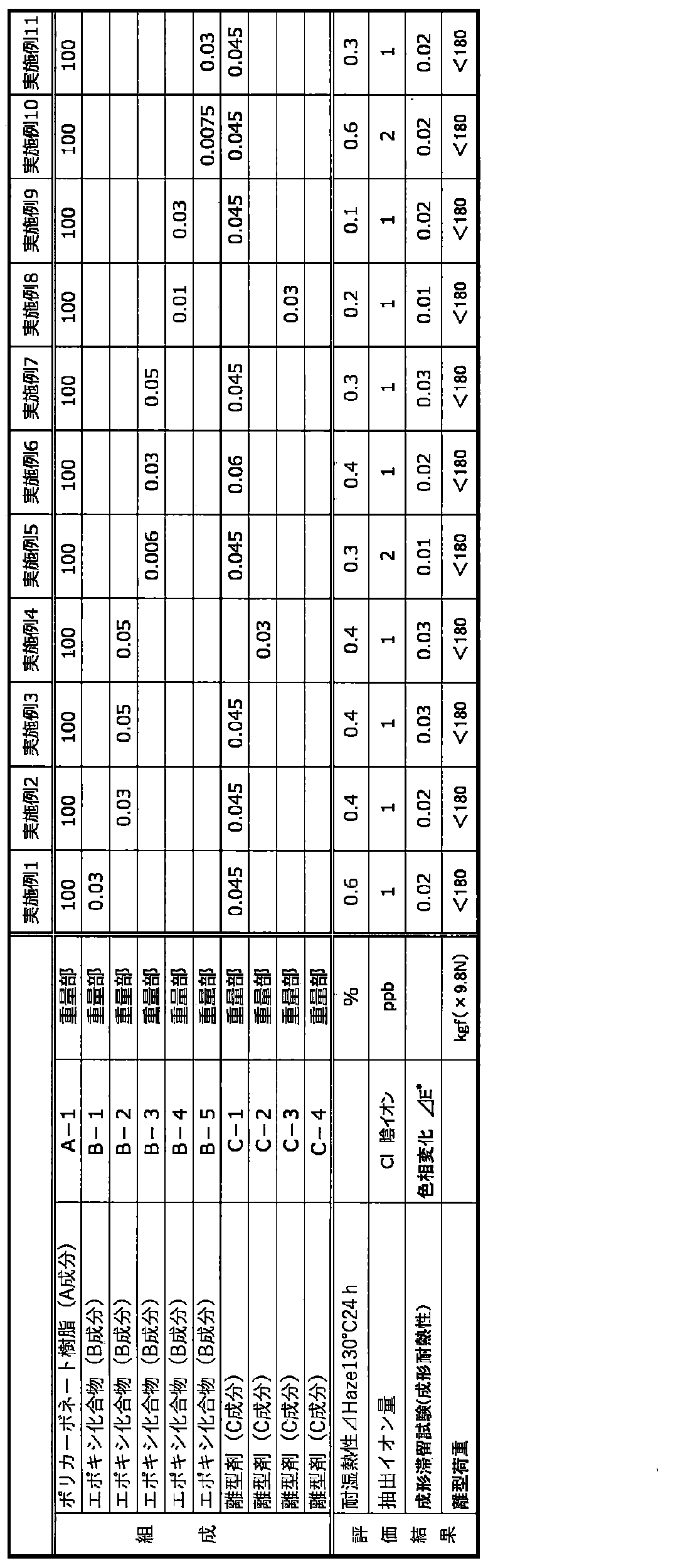

表1および表2の結果から分かるように、特定のエポキシ基含有化合物および特定の脂肪族エステル化合物を限られた少量添加範囲にて配合した実施例においては、抽出イオン量が抑制された上に、優れた耐湿熱性、優れた成形耐熱性、良好な離型性すべてを満たすことができる。これに対して、エポキシ基含有化合物や脂肪族エステル化合物が本発明から外れた比較例は、抽出イオン量の抑制、耐湿熱性、成形耐熱性、離型性の一つ以上が実施例よりも劣っていることが分かる。
Claims (8)
- (A)ポリカーボネート樹脂(A成分)100重量部に対して、(B)エポキシ基含有化合物(B成分)0.005~0.07重量部および(C)多価アルコールと高級脂肪酸とから構成される脂肪族エステル化合物であって、多価アルコールのOH基の全てがエステル化された脂肪族エステル化合物(C成分)0.01~0.08重量部を配合してなることを特徴とするポリカーボネート樹脂組成物。
- C成分がグリセリンまたはペンタエリスリトールのフルエステルを主成分とする脂肪族エステル化合物である請求項1に記載のポリカーボネート樹脂組成物。
- B成分がグリシジルエステル基を有しないエポキシ基含有化合物である請求項1または2に記載のポリカーボネート樹脂組成物。
- A成分の粘度平均分子量が15,000~23,000の範囲である請求項1~3のいずれかに記載のポリカーボネート樹脂組成物。
- 請求項1~4のいずれかに記載のポリカーボネート樹脂組成物から成形された成形品。
- 成形品が薄板収納搬送容器である請求項5記載の成形品。
- 薄板収納搬送容器が半導体ウエハ用収納搬送容器である請求項6記載の成形品。
- 成形品が医療用で使用される容器、カバー、配管、器具またはその一部である請求項5記載の成形品。
Priority Applications (2)
| Application Number | Priority Date | Filing Date | Title |
|---|---|---|---|
| CN202380027239.5A CN119013349A (zh) | 2022-03-15 | 2023-02-27 | 聚碳酸酯树脂组合物和成型品 |
| JP2024507672A JPWO2023176397A1 (ja) | 2022-03-15 | 2023-02-27 |
Applications Claiming Priority (2)
| Application Number | Priority Date | Filing Date | Title |
|---|---|---|---|
| JP2022-039987 | 2022-03-15 | ||
| JP2022039987 | 2022-03-15 |
Publications (1)
| Publication Number | Publication Date |
|---|---|
| WO2023176397A1 true WO2023176397A1 (ja) | 2023-09-21 |
Family
ID=88023439
Family Applications (1)
| Application Number | Title | Priority Date | Filing Date |
|---|---|---|---|
| PCT/JP2023/007006 Ceased WO2023176397A1 (ja) | 2022-03-15 | 2023-02-27 | ポリカーボネート樹脂組成物および成形品 |
Country Status (3)
| Country | Link |
|---|---|
| JP (1) | JPWO2023176397A1 (ja) |
| CN (1) | CN119013349A (ja) |
| WO (1) | WO2023176397A1 (ja) |
Citations (3)
| Publication number | Priority date | Publication date | Assignee | Title |
|---|---|---|---|---|
| JP2002155198A (ja) * | 2000-11-20 | 2002-05-28 | Teijin Ltd | ポリカーボネート樹脂組成物 |
| WO2010137729A1 (ja) * | 2009-05-28 | 2010-12-02 | 帝人化成株式会社 | ポリカーボネート樹脂組成物およびその成形品 |
| JP2020132840A (ja) * | 2019-02-26 | 2020-08-31 | 帝人株式会社 | ポリカーボネート樹脂組成物 |
Family Cites Families (1)
| Publication number | Priority date | Publication date | Assignee | Title |
|---|---|---|---|---|
| WO2022004475A1 (ja) * | 2020-06-30 | 2022-01-06 | 帝人株式会社 | ポリカーボネート樹脂組成物および成形品 |
-
2023
- 2023-02-27 CN CN202380027239.5A patent/CN119013349A/zh active Pending
- 2023-02-27 JP JP2024507672A patent/JPWO2023176397A1/ja active Pending
- 2023-02-27 WO PCT/JP2023/007006 patent/WO2023176397A1/ja not_active Ceased
Patent Citations (3)
| Publication number | Priority date | Publication date | Assignee | Title |
|---|---|---|---|---|
| JP2002155198A (ja) * | 2000-11-20 | 2002-05-28 | Teijin Ltd | ポリカーボネート樹脂組成物 |
| WO2010137729A1 (ja) * | 2009-05-28 | 2010-12-02 | 帝人化成株式会社 | ポリカーボネート樹脂組成物およびその成形品 |
| JP2020132840A (ja) * | 2019-02-26 | 2020-08-31 | 帝人株式会社 | ポリカーボネート樹脂組成物 |
Also Published As
| Publication number | Publication date |
|---|---|
| JPWO2023176397A1 (ja) | 2023-09-21 |
| CN119013349A (zh) | 2024-11-22 |
Similar Documents
| Publication | Publication Date | Title |
|---|---|---|
| JP6249139B2 (ja) | 芳香族ポリカーボネート樹脂、芳香族ポリカーボネート樹脂組成物及び芳香族ポリカーボネート樹脂成形体の製造方法 | |
| JP5663659B2 (ja) | 導光体用ポリカーボネート樹脂組成物、並びにそれからなる導光体および面光源体 | |
| JP5583947B2 (ja) | 帯電防止性ポリカーボネート樹脂組成物およびその成形品 | |
| KR102234098B1 (ko) | 이소소르비드 디에스테르를 함유하는 폴리카르보네이트 조성물 | |
| CN102597110B (zh) | 聚碳酸酯树脂组合物和成型品 | |
| EP2829574B1 (en) | Light-diffusible resin composition | |
| TWI553056B (zh) | A resin composition having a light-guiding property, and a light-conducting molded article comprising the same Surface light source body | |
| US8742057B2 (en) | Polycarbonate resin composition | |
| KR102366959B1 (ko) | 충전제, 카르복실산 및 그의 글리세롤 또는 디글리세롤 에스테르를 함유하는 폴리카르보네이트 조성물 | |
| JP6133644B2 (ja) | 難燃光拡散性ポリカーボネート樹脂組成物 | |
| JP5519092B2 (ja) | 帯電防止性ポリカーボネート樹脂組成物 | |
| JP6188272B2 (ja) | ポリカーボネート樹脂組成物及び成形品 | |
| JP2016156031A (ja) | ポリカーボネート樹脂組成物及び成形品 | |
| JP6895778B2 (ja) | ポリカーボネート樹脂組成物およびそれからなる成形品 | |
| JP7436667B2 (ja) | ポリカーボネート樹脂組成物および成形品 | |
| WO2023176397A1 (ja) | ポリカーボネート樹脂組成物および成形品 | |
| JP2013136659A (ja) | ポリカーボネート樹脂組成物及び成形品 | |
| WO2021230016A1 (ja) | ポリカーボネート樹脂組成物およびその成形品 | |
| JP6698273B2 (ja) | ポリカーボネート樹脂組成物および成形品 | |
| JP5664396B2 (ja) | ポリカーボネート樹脂組成物からなるシールド部材 | |
| JP2023149670A (ja) | ポリカーボネート樹脂組成物およびその成形品 | |
| JP2023139354A (ja) | ポリカーボネート樹脂組成物およびそれからなる成形品 | |
| CN120693372A (zh) | 聚碳酸酯树脂组合物及其成型品 | |
| WO2025192177A1 (ja) | ポリカーボネート樹脂組成物およびその成形品 | |
| JP2006137801A (ja) | 帯電防止性ポリカーボネート樹脂組成物 |
Legal Events
| Date | Code | Title | Description |
|---|---|---|---|
| 121 | Ep: the epo has been informed by wipo that ep was designated in this application |
Ref document number: 23770356 Country of ref document: EP Kind code of ref document: A1 |
|
| ENP | Entry into the national phase |
Ref document number: 2024507672 Country of ref document: JP Kind code of ref document: A |
|
| WWE | Wipo information: entry into national phase |
Ref document number: 202380027239.5 Country of ref document: CN |
|
| NENP | Non-entry into the national phase |
Ref country code: DE |
|
| 122 | Ep: pct application non-entry in european phase |
Ref document number: 23770356 Country of ref document: EP Kind code of ref document: A1 |