WO2023176337A1 - チョコレート用油脂組成物 - Google Patents
チョコレート用油脂組成物 Download PDFInfo
- Publication number
- WO2023176337A1 WO2023176337A1 PCT/JP2023/006352 JP2023006352W WO2023176337A1 WO 2023176337 A1 WO2023176337 A1 WO 2023176337A1 JP 2023006352 W JP2023006352 W JP 2023006352W WO 2023176337 A1 WO2023176337 A1 WO 2023176337A1
- Authority
- WO
- WIPO (PCT)
- Prior art keywords
- oil
- fat
- composition
- chocolate
- sfc
- Prior art date
- Legal status (The legal status is an assumption and is not a legal conclusion. Google has not performed a legal analysis and makes no representation as to the accuracy of the status listed.)
- Ceased
Links
Classifications
-
- A—HUMAN NECESSITIES
- A23—FOODS OR FOODSTUFFS; TREATMENT THEREOF, NOT COVERED BY OTHER CLASSES
- A23G—COCOA; COCOA PRODUCTS, e.g. CHOCOLATE; SUBSTITUTES FOR COCOA OR COCOA PRODUCTS; CONFECTIONERY; CHEWING GUM; ICE-CREAM; PREPARATION THEREOF
- A23G1/00—Cocoa; Cocoa products, e.g. chocolate; Substitutes therefor
- A23G1/30—Cocoa products, e.g. chocolate; Substitutes therefor
- A23G1/32—Cocoa products, e.g. chocolate; Substitutes therefor characterised by the composition containing organic or inorganic compounds
- A23G1/36—Cocoa products, e.g. chocolate; Substitutes therefor characterised by the composition containing organic or inorganic compounds characterised by the fats used
- A23G1/38—Cocoa butter substitutes
-
- A—HUMAN NECESSITIES
- A23—FOODS OR FOODSTUFFS; TREATMENT THEREOF, NOT COVERED BY OTHER CLASSES
- A23D—EDIBLE OILS OR FATS, e.g. MARGARINES, SHORTENINGS OR COOKING OILS
- A23D9/00—Other edible oils or fats, e.g. shortenings or cooking oils
-
- A—HUMAN NECESSITIES
- A23—FOODS OR FOODSTUFFS; TREATMENT THEREOF, NOT COVERED BY OTHER CLASSES
- A23D—EDIBLE OILS OR FATS, e.g. MARGARINES, SHORTENINGS OR COOKING OILS
- A23D9/00—Other edible oils or fats, e.g. shortenings or cooking oils
- A23D9/02—Other edible oils or fats, e.g. shortenings or cooking oils characterised by the production or working-up
-
- A—HUMAN NECESSITIES
- A23—FOODS OR FOODSTUFFS; TREATMENT THEREOF, NOT COVERED BY OTHER CLASSES
- A23G—COCOA; COCOA PRODUCTS, e.g. CHOCOLATE; SUBSTITUTES FOR COCOA OR COCOA PRODUCTS; CONFECTIONERY; CHEWING GUM; ICE-CREAM; PREPARATION THEREOF
- A23G1/00—Cocoa; Cocoa products, e.g. chocolate; Substitutes therefor
- A23G1/30—Cocoa products, e.g. chocolate; Substitutes therefor
- A23G1/32—Cocoa products, e.g. chocolate; Substitutes therefor characterised by the composition containing organic or inorganic compounds
- A23G1/36—Cocoa products, e.g. chocolate; Substitutes therefor characterised by the composition containing organic or inorganic compounds characterised by the fats used
-
- C—CHEMISTRY; METALLURGY
- C11—ANIMAL OR VEGETABLE OILS, FATS, FATTY SUBSTANCES OR WAXES; FATTY ACIDS THEREFROM; DETERGENTS; CANDLES
- C11B—PRODUCING, e.g. BY PRESSING RAW MATERIALS OR BY EXTRACTION FROM WASTE MATERIALS, REFINING OR PRESERVING FATS, FATTY SUBSTANCES, e.g. LANOLIN, FATTY OILS OR WAXES; ESSENTIAL OILS; PERFUMES
- C11B7/00—Separation of mixtures of fats or fatty oils into their constituents, e.g. saturated oils from unsaturated oils
- C11B7/0075—Separation of mixtures of fats or fatty oils into their constituents, e.g. saturated oils from unsaturated oils by differences of melting or solidifying points
-
- C—CHEMISTRY; METALLURGY
- C11—ANIMAL OR VEGETABLE OILS, FATS, FATTY SUBSTANCES OR WAXES; FATTY ACIDS THEREFROM; DETERGENTS; CANDLES
- C11C—FATTY ACIDS FROM FATS, OILS OR WAXES; CANDLES; FATS, OILS OR FATTY ACIDS BY CHEMICAL MODIFICATION OF FATS, OILS, OR FATTY ACIDS OBTAINED THEREFROM
- C11C3/00—Fats, oils, or fatty acids by chemical modification of fats, oils, or fatty acids obtained therefrom
- C11C3/04—Fats, oils, or fatty acids by chemical modification of fats, oils, or fatty acids obtained therefrom by esterification of fats or fatty oils
- C11C3/10—Ester interchange
-
- A—HUMAN NECESSITIES
- A23—FOODS OR FOODSTUFFS; TREATMENT THEREOF, NOT COVERED BY OTHER CLASSES
- A23G—COCOA; COCOA PRODUCTS, e.g. CHOCOLATE; SUBSTITUTES FOR COCOA OR COCOA PRODUCTS; CONFECTIONERY; CHEWING GUM; ICE-CREAM; PREPARATION THEREOF
- A23G2200/00—COCOA; COCOA PRODUCTS, e.g. CHOCOLATE; SUBSTITUTES FOR COCOA OR COCOA PRODUCTS; CONFECTIONERY; CHEWING GUM; ICE-CREAM; PREPARATION THEREOF containing organic compounds, e.g. synthetic flavouring agents
- A23G2200/08—COCOA; COCOA PRODUCTS, e.g. CHOCOLATE; SUBSTITUTES FOR COCOA OR COCOA PRODUCTS; CONFECTIONERY; CHEWING GUM; ICE-CREAM; PREPARATION THEREOF containing organic compounds, e.g. synthetic flavouring agents containing cocoa fat if specifically mentioned or containing products of cocoa fat or containing other fats, e.g. fatty acid, fatty alcohol, their esters, lecithin, paraffins
Definitions
- the present invention relates to an oil and fat composition for chocolate. More specifically, the present invention relates to an oil and fat composition for chocolate that is suitable for use in chocolate that does not undergo a tempering operation.
- Hard butter which is widely used as a cocoa butter substitute, is broadly divided into tempered hard butter, which is temperature-controlled during solidification and molding, and non-tempered hard butter, which is not temperature-controlled.
- Tempering type hard butter contains a lot of SUS type triglyceride (S: saturated fatty acid with 16 to 18 carbon atoms, U: monounsaturated fatty acid with 18 carbon atoms), which is contained in cocoa butter, and is similar to cocoa butter. Has physical properties. Therefore, it has high compatibility with cocoa butter and can provide a texture similar to that of cocoa butter, but since the tempering operation requires strict temperature control, it is desirable to omit it.
- non-tempered hard butter does not require complicated tempering operations, so it can be suitably used in various combination foods such as bread and Western confectionery combined with chocolate. It can be broadly classified into exchangeable/separated type hard butter and lauric acid type hard butter.
- trans-acid hard butters obtained by hydrogenating liquid oils such as soybean oil and rapeseed oil have been widely used because of their good meltability in the mouth and high compatibility with cocoa butter.
- liquid oils such as soybean oil and rapeseed oil
- the health risks of trans fatty acids should be reduced, and the market is demanding low-trans fatty acid hard butter that does not contain trans fatty acids.
- transesterified/fractionated hard butter is made by chemically or enzymatically transesterifying raw oils and fats with extremely low trans fatty acid content, such as extremely hardened oils such as soybean oil and rapeseed oil, and solid fats such as palm oil. It has a good melt-in-the-mouth quality by performing fractionation after the application.
- the cost is high due to the complexity of the manufacturing method, and a cheaper hard butter is desired.
- Lauric acid-type hard butter has been produced for a long time using fats and oils rich in triglycerides containing a large amount of lauric acid as raw materials, such as palm kernel oil fractionated hard oil and coconut oil. These have various advantages, such as having a texture and physical properties very similar to those of cocoa butter, and a good gloss. Cannot be combined.
- Patent Documents 5 to 9 disclose oil and fat compositions for chocolate that have a low trans acid content and contain lauric oils and fats.
- Patent Documents 1 to 4 which are fat and oil compositions for chocolate that have a low trans acid content and do not contain lauric fats and oils, tended to have poor melt-in-the-mouth texture.
- Patent Documents 5 to 9 which partially contain lauric oils and fats, have a relatively good melt-in-the-mouth feel, but cannot be said to be oils and fats that have hardness to chew, stickiness resistance, good flavor, and bloom resistance.
- the object of the present invention is to provide a fat and oil for chocolate that has good chewing hardness, stickiness resistance, good flavor, and bloom resistance while reducing the content of trans fatty acids in a simple manner.
- An object of the present invention is to provide a composition.
- An oil and fat composition for chocolate that includes a randomized triglyceride composition and satisfies all of (A) to (H).
- A) The content of saturated fatty acids with 6 to 18 carbon atoms is 80% by mass or more in the constituent fatty acid composition.
- B) The content of lauric acid is 30 to 45% by mass in the constituent fatty acid composition.
- Behenic acid content is 0.5 to 5.5% by mass in the constituent fatty acid composition
- D Unsaturated fatty acid content in the constituent fatty acid composition is 15% by mass or less
- E Trans fatty acid content in the constituent fatty acid composition is 5% by mass or less
- F Palmitic acid content / stearic acid in the constituent fatty acid composition Content ratio is 0.2 ⁇ 2
- G In the constituent fatty acid composition, the unsaturated fatty acid content/behenic acid content ratio is 4 or less
- SFC at 10°C is 90% or more
- the oil and fat composition for chocolate according to (1) which has an SFC of 15% or less at 35°C and an SFC of 5% or less at 40°C.
- the fat and oil composition for chocolate according to (2) which has an SFC of 15% or less at 35°C and an SFC of 5% or less at 40°C.
- the fat and oil composition for chocolate according to (3) which has an SFC of 15% or less at 35°C and an SFC of 5% or less at 40°C.
- the method for producing an oil or fat composition for chocolate according to (1) which includes the step of transesterifying a raw material oil containing the following oil or fat component X, oil or fat component Y, and oil or fat component Z as essential components.
- Fat component High Ercin Rapeseed Extremely Hardened Oil The method for producing an oil and fat composition for chocolate according to (2), which includes a step of transesterifying a raw material oil containing the following oil and fat components X, oil and fat component Y, and oil and fat component Z as essential components. Fat component High Ercin Rapeseed Extremely Hardened Oil (9) The method for producing an oil and fat composition for chocolate according to (3), which includes the step of transesterifying a raw material oil containing the following oil and fat components X, oil and fat component Y, and oil and fat component Z as essential components.
- Fat component High Ercin Rapeseed Extremely Hardened Oil (10) The method for producing an oil and fat composition for chocolate according to (4), which includes the step of transesterifying a raw material oil containing the following oil and fat components X, oil and fat component Y, and oil and fat component Z as essential components. Fat component High Ercin Rapeseed Extremely Hardened Oil (11) The method for producing an oil and fat composition for chocolate according to (1), which includes the step of transesterifying a raw material oil containing the following oil and fat components X, oil and fat component Y, and oil and fat component Z as essential components.
- Fat component Extremely Hardened Oil (12) The method for producing an oil or fat composition for chocolate according to (2), which includes the step of transesterifying a raw material oil containing the following oil or fat component X, oil or fat component Y, and oil or fat component Z as essential components. Fat component Extremely Hardened Oil (13) The method for producing an oil or fat composition for chocolate according to (3), which includes the step of transesterifying a raw material oil containing the following oil or fat component X, oil or fat component Y, and oil or fat component Z as essential components.
- Fat component Extremely Hardened Oil (4) The method for producing an oil or fat composition for chocolate according to (4), which includes a step of transesterifying a raw material oil containing the following oil or fat component X, oil or fat component Y, and oil or fat component Z as essential components.
- Fat component Extremely Hardened Oil (15) A chocolate containing the chocolate oil and fat composition of (1). (16) Chocolate containing the fat and oil composition for chocolate according to (2). (17) Chocolate containing the fat and oil composition for chocolate according to (3). (18) Chocolate containing the fat and oil composition for chocolate according to (4).
- the present invention includes the following inventions.
- (1) An oil and fat composition for chocolate that includes a randomized triglyceride composition and satisfies all of (A) to (H).
- (E) Trans fatty acid content in the constituent fatty acid composition is 5% by mass or less
- (H) SFC at 10°C is 90% or more
- the fat and oil composition for chocolate according to any one of (1) to (3) which has an SFC of 15% or less at 35°C and an SFC of 5% or less at 40°C.
- a method for producing an oil or fat composition for chocolate according to any one of (1) to (4) including a step of transesterifying a raw material oil containing the following oil and fat components X, oil and fat component Y, and oil and fat component Z as essential components.
- Fat component High Ercin rapeseed extremely hardened oil (6)
- an oil and fat composition for chocolate that has hardness in chewing, stickiness resistance, good flavor, and bloom resistance.
- the content of trans fatty acids can be reduced, no tempering operation is required, and the oil and fat composition for chocolate of the present invention has good chewing hardness, stickiness resistance, good flavor, Chocolate can be produced that is bloom resistant.
- the content of saturated fatty acids having 6 to 18 carbon atoms in the constituent fatty acid composition must be 80% by mass or more, preferably 81 to 96% by mass, more preferably 82 to 18% by mass. It becomes 94% by mass. If the content of saturated fatty acids having 6 to 18 carbon atoms is less than 80% by mass, the amount of low-melting point triglycerides increases, and the hardness of chewing may not be obtained.
- the content of lauric acid must be 30 to 45% by mass, preferably 31 to 44% by mass, more preferably 32 to 43% by mass, and It is preferably 33 to 42% by weight, most preferably 33 to 41% by weight.
- the content of lauric acid is less than 30% by mass, the content of palmitic acid and stearic acid in the saturated fatty acid becomes relatively large, and melting in the mouth may deteriorate and good flavor may not be obtained.
- the content of lauric acid exceeds 45% by mass, the content of palmitic acid and stearic acid in the saturated fatty acids will be relatively low, resulting in a decrease in SFC% at 10°C, and the hardness of chewing will not be obtained. There is.
- the content of behenic acid in the constituent fatty acid composition must be 0.5 to 5.5% by mass, preferably 1.5 to 5.5% by mass, and more preferably is 2.5 to 5.5% by weight, more preferably 3.5 to 5.5% by weight, and most preferably 4 to 5.5% by weight.
- the content of behenic acid is less than 0.5% by mass, the compatibility with cocoa butter may decrease and bloom resistance may become weak.
- the content of behenic acid exceeds 5.5% by mass, the amount of high-melting-point triglycerides may increase, resulting in poor melt-in-the-mouth texture.
- the fat and oil composition for chocolate of the present invention must have an unsaturated fatty acid content of 15% by mass or less in the constituent fatty acid composition, preferably 14% by mass or less, more preferably 13% by mass or less, still more preferably 12% by mass or less. .5% by mass or less, most preferably 12% by mass or less.
- unsaturated fatty acid content exceeds 15% by mass, low melting point triglycerides increase, which may lead to stickiness when the fat or oil is blended into chocolate.
- the reason for this is speculative, it is thought to be because some of the fats and oils exist in a molten state at room temperature, which increases the adhesion.
- the fat and oil composition for chocolate of the present invention must have a trans fatty acid content of 5% by mass or less in the constituent fatty acid composition, preferably 4% by mass or less, more preferably 3% by mass or less, and still more preferably 2% by mass. % or less, most preferably 1% by mass or less.
- the fat and oil composition for chocolate of the present invention must have a palmitic acid/stearic acid ratio of 0.2 to 2 in the constituent fatty acid composition, preferably 0.25 to 1.7, more preferably 0.3 to 2. 1.5, more preferably 0.35 to 1.2.
- a palmitic acid/stearic acid ratio is less than 0.2, the relative amount of stearic acid to palmitic acid increases, which is undesirable in that melting in the mouth deteriorates and good flavor cannot be obtained.
- the palmitic acid/stearic acid ratio exceeds 2, the relative amount of stearic acid to palmitic acid decreases, SFC% at 10° C. decreases, and chewing hardness may not be obtained.
- the unsaturated fatty acid content/behenic acid ratio in the constituent fatty acid composition must be 4 or less, preferably 3 or less.
- the unsaturated fatty acid content/behenic acid ratio is less than 4, the relative amount of unsaturated fatty acid to behenic acid increases, and good flavor may not be obtained.
- the fat and oil composition for chocolate of the present invention must have an SFC of 90% or more at 10°C, preferably 90 to 97%, more preferably 91 to 95%. If the SFC% at 10° C. is less than 90%, the hardness of chewing may not be obtained.
- the fat and oil composition for chocolate of the present invention preferably has a slope per temperature of -3.1 or less, more preferably -3.2 or less based on SFC% from 10°C to 40°C. If it exceeds -3.1, it may not be possible to achieve both hardness of bite and good flavor.
- the slope per temperature based on SFC% from 10°C to 40°C is the slope of 10°C SFC%, 20°C SFC, 25°C SFC%, 30°C SFC%, 35°C SFC% and 40°C SFC%. It can be obtained from the rate of change (slope) per temperature, which corresponds to the coefficient of X, assuming a linear function connecting six points (X axis is temperature and Y axis is SFC%). This slope can be calculated using general spreadsheet software. In addition, the validity of the obtained slope value shall be confirmed by confirming that the coefficient of determination value (R2) obtained at the same time exceeds at least 0.8.
- the fat and oil composition for chocolate of the present invention preferably has an SFC of 15% or less at 35°C and an SFC of 5% or less at 40°C, more preferably an SFC of 14% or less at 35°C and SFC is 3% or less. If the SFC at 35° C. exceeds 15% and the SFC at 40° C. exceeds 5%, it may not melt in the mouth and good flavor may not be obtained.
- the hardness of the bite as used herein refers to the hardness of the texture when eating chocolate, and can be exemplified by the breaking load in the oil and fat analysis values. The higher the value of the breaking load, the better the hardness of the oil and fat that can be chewed.
- stickiness as used herein refers to the degree of adhesion when chocolate is touched, and can be exemplified by adhesion in oil and fat analysis values. The lower the adhesion value, the less sticky the fat may be.
- Fats and oils that can be used in the fat and oil composition for chocolate of the present invention include high-quality rapeseed oil, rapeseed oil (canola oil), soybean oil, sunflower seed oil, cottonseed oil, peanut oil, rice bran oil, corn oil, safflower oil, olive oil, and kapok.
- Vegetable oils such as oil, sesame oil, evening primrose oil, palm oil, palm kernel oil, coconut oil, medium-chain triglycerides (MCT), shea butter, monkey fat, animal fats such as milk fat, beef tallow, lard, fish oil, whale oil, etc. Examples include oils and fats, their hydrogenated oils, fractionated oils, hardened fractionated oils, fractionated hydrogenated oils, processed oils and fats subjected to transesterification, and mixtures thereof.
- the fat and oil composition for chocolate of the present invention is not particularly limited in the fats and oils to be used as long as it satisfies the above configuration, but it is used as a raw material fat containing the following fats and oils X, Y and Z as essential components. It is preferable. Fat component Hierushin rapeseed extremely hardened oil
- the oil and fat composition for chocolate of the present invention is more preferably used as a raw material oil and fat containing the following oil and fat component X, oil and fat component Y, and oil and fat component Z as essential components.
- Oil component Extremely hardened oil is more preferably used as a raw material oil and fat containing the following oil and fat component X, oil and fat component Y, and oil and fat component Z as essential components.
- the oil/fat composition for chocolate of the present invention has a randomized triglyceride composition prepared to have the above-described oil/fat composition.
- Examples of the manufacturing method include random transesterified oil and a method in which random transesterification is performed and then extremely hardened.
- a randomized triglyceride composition is obtained by random transesterification in which fatty acids are once separated from triglycerides using a chemical catalyst or an enzyme catalyst and then recombined.
- the distribution of is completely random and uniquely determined stochastically. This is preferable because more triglyceride species can be obtained, resulting in excellent long-term quality stabilization in chocolate that is not tempered.
- the randomized triglyceride composition is preferably contained in an amount of 70% by mass or more, more preferably 90% by mass or more, still more preferably 98% by mass or more, and most preferably 70% by mass or more based on the entire fat and oil composition for chocolate of the present invention. Preferably it is 99% by mass or more. If the proportion of the randomized triglyceride composition contained in the entire fat and oil composition for chocolate of the present invention is less than 70% by mass, the types of triglycerides may not be sufficient and the bloom resistance may be insufficient.
- the fat and oil composition for chocolate of the present invention can also be obtained by extreme hardening after random transesterification.
- Fats and oils that undergo extreme hardening are obtained by converting double bonds contained in vegetable fats and oils into single bonds through hydrogenation accompanied by a chemical catalyst mainly composed of nickel.
- a chemical catalyst mainly composed of nickel mainly composed of nickel.
- fats and oils that have been hydrogenated to an iodine value of 4 or less, which is an indicator of the degree of unsaturation are defined as extremely hardened oils.
- the fat and oil composition for chocolate of the present invention can contain a small amount of highly erucic acid rapeseed extremely hardened oil.
- a small amount of highly hydrogenated rapeseed oil with high erucic acid bloom resistance can be improved while maintaining chewing hardness, stickiness resistance, and good flavor.
- the erucic acid content contained in the high erucin rapeseed oil used for preparing the high erucin acid rapeseed extremely hardened oil is preferably 30% by mass or more in the constituent fatty acid composition.
- the proportion of highly erucic acid rapeseed extremely hardened oil in the oil and fat composition for chocolate of the present invention is preferably 2% by mass or less, more preferably 1% by mass or less, and still more preferably 0.6% by mass or less. If the ratio of a small amount of high erucic acid rapeseed extremely hardened oil to the randomized triglyceride composition exceeds 2% by mass, a good flavor may not be obtained due to the large amount of high melting point components.
- the amount of the oil and fat composition for chocolate of the present invention used is preferably 10 to 65% by mass, more preferably 10 to 50% by mass, and even more preferably 15 to 45% by mass, based on the whole chocolate.
- the fat and oil composition for chocolate of the present invention is less than 10% by mass, the characteristics such as reduced hardness of chewing and reduced stickiness required for chocolate found in the present invention may not be obtained. If it exceeds 65% by mass, although the above-mentioned characteristics can be obtained, a good flavor may not be obtained, and the oil content in the chocolate may become relatively large, resulting in a strong oily feeling, which is not preferable.
- the chocolate of the present invention can be prepared by mixing other fats and oils.
- the chocolate mentioned here is not limited to chocolate, semi-chocolate, and chocolate-based foods as defined by the National Chocolate Industry Fair Trade Council and the Fair Trade Council for Chocolate-Based Foods, but includes oils and fats as essential ingredients. It also includes processed oil and fat foods that utilize cacao mass, cocoa, cacao butter, cacao butter substitutes, hard butter, and the like.
- the method for producing chocolate using the fat and oil composition for chocolate of the present invention can be carried out in the same manner as for producing general chocolate.
- the oil and fat composition for chocolate of the present invention is essential, and raw materials such as sugars, cacao mass, cacao butter, cocoa powder, various powdered foods such as powdered milk, emulsifiers, fragrances, and pigments are appropriately selected and mixed, It can be obtained by rolling and conching.
- An emulsifier that is normally used in the production of chocolate can be used in chocolate using the oil and fat composition for chocolate of the present invention.
- examples include glycerin fatty acid ester, sucrose fatty acid ester, organic acid monoglycerin fatty acid ester, polysorbate, polyglycerin condensed ricinoleate ester, and sorbitan fatty acid ester. These may be used in combination of two or more types.
- Example 1 Contains 35% by mass of palm kernel oil, 38% by mass of extremely hardened palm kernel oil, 15% by mass of palm fractionated high melting point part (iodine value 31), 2% by mass of extremely hardened palm oil, and 10% by mass of high erucic acid rapeseed extremely hardened oil. 0.2% by mass of sodium methylate was added as a catalyst to the raw fat and oil, and random transesterification was performed at 80° C. for 30 minutes, followed by washing with water, decolorization, and deodorization according to conventional methods.
- Example 2 Contains 15% by mass of palm kernel oil, 57% by mass of extremely hardened palm kernel oil, 15% by mass of palm fractionated high melting point part (iodine value 31), 3% by mass of extremely hardened palm oil, and 10% by mass of high erucic acid rapeseed extremely hardened oil. 0.2% by mass of sodium methylate was added as a catalyst to the raw fat and oil, and random transesterification was performed at 80° C. for 30 minutes, followed by washing with water, decolorization, and deodorization according to conventional methods.
- Example 3 0.2% by mass of sodium methylate was added as a catalyst to a raw material fat containing 69% by mass of palm kernel oil, 24% by mass of extremely hardened palm oil, and 7% by mass of highly erucic acid rapeseed extremely hardened oil, and the mixture was heated at 80°C. After performing random transesterification for 30 minutes, washing with water, decolorization, and deodorization were performed according to conventional methods.
- Example 4 0.2% by mass of sodium methylate was added as a catalyst to a raw material oil containing 85.5% by mass of palm kernel oil, 4.5% by mass of palm oil, and 10% by mass of highly erucic acid rapeseed extremely hardened oil, and the mixture was heated at 80°C. After performing random transesterification for 30 minutes, washing with water, adding 0.2% by mass of a nickel catalyst (SO-750 manufactured by Sakai Chemical), and increasing the iodine value at a hydrogenation pressure of 0.26 MPa and an upper limit temperature of 180°C. Curing was carried out until it became 1 or less, and decolorization/deodorization was carried out according to a conventional method.
- a nickel catalyst SO-750 manufactured by Sakai Chemical
- Comparative example 1 Added 0.2% by mass of sodium methylate as a catalyst to raw oil and fat blended with 55% by mass of palm kernel oil, 35% by mass of palm fractionated high melting point part (iodine value 31), and 10% by mass of high erucic acid rapeseed extremely hardened oil. After performing random transesterification at 80° C. for 30 minutes, washing with water, decolorization, and deodorization were performed according to conventional methods.
- Comparative example 4 0.2% by mass of sodium methylate was added as a catalyst to a raw fat and oil containing 50% by mass of coconut oil, 40% by mass of palm fractionated high melting point part (iodine value 31), and 10% by mass of high erucic acid rapeseed extremely hardened oil. After performing random transesterification at 80° C. for 30 minutes, washing with water, decolorization, and deodorization were performed according to conventional methods. To 99.6% by mass of the obtained deodorized oil, 0.4% by mass of high erucic acid rapeseed extremely hardened oil was added. The ratio of highly hardened rapeseed oil with high erucic acid to the deodorized oil having a randomized triglyceride composition is 0.4% by mass.
- an oil sample filled in an aluminum cup with a diameter of about 25 mm to a thickness of about 7 mm was cooled at 5°C for 30 minutes, stored at 15°C for 1 day, and then temperature-controlled at 10°C for 4 hours. Measurements were performed with a cylindrical plunger (diameter 3 mm) entering the center of the sample at a measurement speed of 1 mm/sec and a measurement strain rate of 90%. A 20 kgf load cell was used to apply the load. The number of measurement points was 6, and the average value of each was shown. The rupture point was the first point where a change in load due to rupture was clearly observed. (25°C adhesion measurement method) The analysis device used was a creep meter (RE2-33005C) manufactured by Yamaden Co., Ltd.
- an oil sample filled in an aluminum cup with a diameter of about 25 mm to a thickness of about 7 mm was cooled at 5°C for 30 minutes, stored at 15°C for 1 day, and then temperature-controlled at 25°C for 4 hours. Measurements were performed at a measurement speed of 5 mm/sec, a measurement strain rate of 50%, a return distance of 5 mm, and a cylindrical plunger (diameter 8 mm) entering the center of the sample twice. A 20 kgf load cell was used to apply the load. The number of measurement points was 6, and the average value of each was shown.
- Table 1 shows the results of measuring the fatty acid composition and SFC according to the fatty acid composition measurement method and SFC measurement method described above.
- the upper column of "Slope per temperature based on SFC% from 10°C to 40°C [-]" indicates the slope value
- the lower column in parentheses indicates the coefficient of determination value (R2).
- the palmitic acid/stearic acid ratio is 0.2 ⁇ 2
- G In the constituent fatty acid composition, the ratio of unsaturated fatty acid content/behenic acid content is 4 or less (H) SFC at 10°C is 90% or more
- Table 3 shows the results of measuring the breaking load at 10°C and the adhesion at 25°C according to the methods for measuring the breaking load at 10°C and the adhesion at 25°C.
- the breaking load is an example of the hardness of the food, and the larger the value, the better the hardness of the food.
- the 10°C breaking load was judged to be good if it was 3 kgf or more.
- Adhesiveness is an example of how easily food sticks, and the smaller the value, the less the food sticks to fingers.
- Adhesion at 25°C was judged to be good if it was 1.5 J/m3 or less.
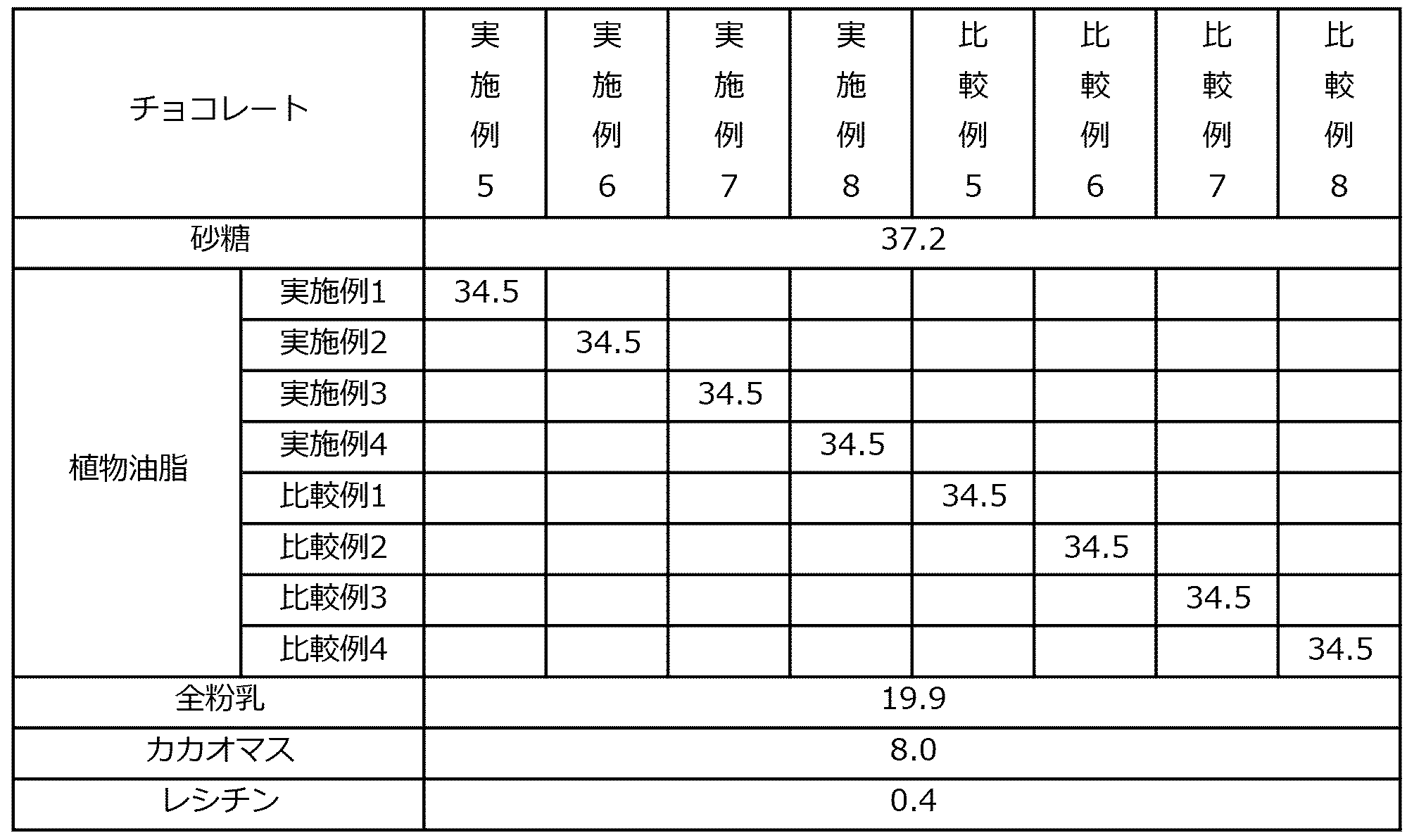
- Chocolate was produced using the oil and fat composition for chocolate in the vegetable oil part of Table 4 according to the formulation.
- the whole milk powder in the blended raw materials contains 26% milk fat, and the cacao mass contains 55% cocoa butter, so the oil content of this chocolate is 44.1%, and the oil content of cocoa butter, milk fat, and vegetable oil is 44.1%.
- the content rates are calculated as 10.0%, 11.8%, and 78.2%, respectively.
- After completely melting the prototype chocolate it was cooled to 45°C, poured into an aluminum cup, and cooled to 5°C for 30 minutes.
- the sensory evaluation was carried out by three panelists according to the evaluation criteria below, and the evaluation results are shown below. 5.
- the heat resistance of the produced chocolate was evaluated according to the following evaluation criteria. A score of 2 or more was considered a pass. 3 points: After being stored at 25°C for 2 hours, the dough does not stick even when touched with fingers. 2 points: After being stored at 25°C for 2 hours, fingerprints remain even when touched. 1 point: After being stored at 25°C for 2 hours, the dough will be soft and sticky when touched with your fingers.
- flavor evaluation criteria The flavor of the chocolate produced was evaluated according to the following evaluation criteria. A score of 2 or more was considered a pass. 3 points: Chocolate-like flavor can be felt well. 2 points: Chocolate-like flavor can be felt. 1 point: No chocolate flavor felt at all.
- Bloom's evaluation criteria Bloom evaluation of the chocolate produced according to the following evaluation criteria was carried out. A score of 2 was considered passing. 2 points: No bloom is observed after storage at 20°C for 2 months. 1 point: Bloom appears after storage at 20°C for 2 months.
- an oil and fat composition for chocolate that has hardness in chewing, stickiness resistance, good flavor, and bloom resistance, and is suitable for oil-based foods using these oils and fats, especially chocolate that does not undergo a tempering operation. It can be used for.
Landscapes
- Chemical & Material Sciences (AREA)
- Engineering & Computer Science (AREA)
- Life Sciences & Earth Sciences (AREA)
- Food Science & Technology (AREA)
- Polymers & Plastics (AREA)
- Oil, Petroleum & Natural Gas (AREA)
- Inorganic Chemistry (AREA)
- Chemical Kinetics & Catalysis (AREA)
- Wood Science & Technology (AREA)
- Organic Chemistry (AREA)
- General Chemical & Material Sciences (AREA)
- Confectionery (AREA)
- Edible Oils And Fats (AREA)
Abstract
Description
また、チョコレートに限ったことではないが、ライフスタイルの変化により食べ物を手に取った際に手につかないといった、べたつきが少なくなることも望まれている。これまでの検討ではシェラックがけなどチョコレートにコーティングを行うことでその一端が解決されてきているが、新たな工程が増えることは非常に煩雑となることから、更なる解決方法が求められている。
(1) ランダム化されたトリグリセリド組成を含み、かつ(A)~(H)を全て満たすチョコレート用油脂組成物。
(A)構成脂肪酸組成中、炭素数6~18の飽和脂肪酸の含有量が80質量%以上
(B)構成脂肪酸組成中、ラウリン酸の含有量が30~45質量%
(C)構成脂肪酸組成中、ベヘン酸の含有量が0.5~5.5質量%
(D)構成脂肪酸組成中、不飽和脂肪酸含有量が15質量%以下
(E)構成脂肪酸組成中、トランス脂肪酸含有量が5質量%以下
(F)構成脂肪酸組成中、パルミチン酸含有量/ステアリン酸含有量比が0.2~2
(G)構成脂肪酸組成中、不飽和脂肪酸含有量/ベヘン酸含有量比が4以下
(H)10℃におけるSFCが90%以上
(2) さらにハイエルシン酸菜種極度硬化油を含有する、(1)のチョコレート用油脂組成物。
(3) 10℃におけるSFCから40℃におけるSFCの傾きが-3.1以下である、(1)又は(2)のチョコレート用油脂組成物。
なお、10℃から40℃のSFC%を基準とした温度当たりの傾きは、10℃SFC%、20℃SFC、25℃SFC%、30℃SFC%、35℃SFC%および40℃SFC%の6点を結ぶ一次関数(X軸を温度、Y軸をSFC%)を想定した際の、Xの係数にあたる、温度当たりの変化率(傾き)により得る。
(4) 35℃におけるSFCが15%以下かつ、40℃におけるSFCが5%以下である、(1)のチョコレート用油脂組成物。
(5) 35℃におけるSFCが15%以下かつ、40℃におけるSFCが5%以下である、(2)のチョコレート用油脂組成物。
(6) 35℃におけるSFCが15%以下かつ、40℃におけるSFCが5%以下である、(3)のチョコレート用油脂組成物。
(7) 下記の油脂成分X、油脂成分Y、及び油脂成分Zを必須成分として含む原料油脂をエステル交換する工程を含む、(1)のチョコレート用油脂組成物の製造方法。
油脂成分Xは、パーム核油及びこれを加工した油脂より選ばれた1種以上の油脂
油脂成分Yは、パーム油及びこれを加工した油脂より選ばれた1種以上の油脂
油脂成分Zは、ハイエルシン菜種極度硬化油
(8) 下記の油脂成分X、油脂成分Y、及び油脂成分Zを必須成分として含む原料油脂をエステル交換する工程を含む、(2)のチョコレート用油脂組成物の製造方法。
油脂成分Xは、パーム核油及びこれを加工した油脂より選ばれた1種以上の油脂
油脂成分Yは、パーム油及びこれを加工した油脂より選ばれた1種以上の油脂
油脂成分Zは、ハイエルシン菜種極度硬化油
(9) 下記の油脂成分X、油脂成分Y、及び油脂成分Zを必須成分として含む原料油脂をエステル交換する工程を含む、(3)のチョコレート用油脂組成物の製造方法。
油脂成分Xは、パーム核油及びこれを加工した油脂より選ばれた1種以上の油脂
油脂成分Yは、パーム油及びこれを加工した油脂より選ばれた1種以上の油脂
油脂成分Zは、ハイエルシン菜種極度硬化油
(10) 下記の油脂成分X、油脂成分Y、及び油脂成分Zを必須成分として含む原料油脂をエステル交換する工程を含む、(4)のチョコレート用油脂組成物の製造方法。
油脂成分Xは、パーム核油及びこれを加工した油脂より選ばれた1種以上の油脂
油脂成分Yは、パーム油及びこれを加工した油脂より選ばれた1種以上の油脂
油脂成分Zは、ハイエルシン菜種極度硬化油
(11) 下記の油脂成分X、油脂成分Y、及び油脂成分Zを必須成分として含む原料油脂をエステル交換する工程を含む、(1)のチョコレート用油脂組成物の製造方法。
油脂成分Xは、パーム核油及び/又はパーム核極度硬化油
油脂成分Yは、パーム油、パーム分別高融点部、パーム極度硬化油より選ばれた1種以上の油脂
油脂成分Zは、ハイエルシン菜種極度硬化油
(12) 下記の油脂成分X、油脂成分Y、及び油脂成分Zを必須成分として含む原料油脂をエステル交換する工程を含む、(2)のチョコレート用油脂組成物の製造方法。
油脂成分Xは、パーム核油及び/又はパーム核極度硬化油
油脂成分Yは、パーム油、パーム分別高融点部、パーム極度硬化油より選ばれた1種以上の油脂
油脂成分Zは、ハイエルシン菜種極度硬化油
(13) 下記の油脂成分X、油脂成分Y、及び油脂成分Zを必須成分として含む原料油脂をエステル交換する工程を含む、(3)のチョコレート用油脂組成物の製造方法。
油脂成分Xは、パーム核油及び/又はパーム核極度硬化油
油脂成分Yは、パーム油、パーム分別高融点部、パーム極度硬化油より選ばれた1種以上の油脂
油脂成分Zは、ハイエルシン菜種極度硬化油
(14) 下記の油脂成分X、油脂成分Y、及び油脂成分Zを必須成分として含む原料油脂をエステル交換する工程を含む、(4)のチョコレート用油脂組成物の製造方法。
油脂成分Xは、パーム核油及び/又はパーム核極度硬化油
油脂成分Yは、パーム油、パーム分別高融点部、パーム極度硬化油より選ばれた1種以上の油脂
油脂成分Zは、ハイエルシン菜種極度硬化油
(15) (1)のチョコレート用油脂組成物を含有するチョコレート。
(16) (2)のチョコレート用油脂組成物を含有するチョコレート。
(17) (3)のチョコレート用油脂組成物を含有するチョコレート。
(18) (4)のチョコレート用油脂組成物を含有するチョコレート。
換言すれば、本発明は、下記の発明を含有するものである。
(1) ランダム化されたトリグリセリド組成を含み、かつ(A)~(H)を全て満たすチョコレート用油脂組成物。
(A)構成脂肪酸組成中、炭素数6~18の飽和脂肪酸の含有量が80質量%以上
(B)構成脂肪酸組成中、ラウリン酸の含有量が30~45質量%
(C)構成脂肪酸組成中、ベヘン酸の含有量が0.5~5.5質量%
(D)構成脂肪酸組成中、不飽和脂肪酸含有量が15質量%以下
(E)構成脂肪酸組成中、トランス脂肪酸含有量が5質量%以下
(F)構成脂肪酸組成中、パルミチン酸含有量/ステアリン酸含有量比が0.2~2
(G)構成脂肪酸組成中、不飽和脂肪酸含有量/ベヘン酸含有量比が4以下
(H)10℃におけるSFCが90%以上
(2) さらにハイエルシン酸菜種極度硬化油を含有する、(1)のチョコレート用油脂組成物。
(3) 10℃におけるSFCから40℃におけるSFCの傾きが-3.1以下である、(1)又は(2)のチョコレート用油脂組成物。
なお、10℃から40℃のSFC%を基準とした温度当たりの傾きは、10℃SFC%、20℃SFC、25℃SFC%、30℃SFC%、35℃SFC%および40℃SFC%の6点を結ぶ一次関数(X軸を温度、Y軸をSFC%)を想定した際の、Xの係数にあたる、温度当たりの変化率(傾き)により得ることができる。
(4) 35℃におけるSFCが15%以下かつ、40℃におけるSFCが5%以下である、(1)~(3)いずれかのチョコレート用油脂組成物。
(5) 下記の油脂成分X、油脂成分Y、及び油脂成分Zを必須成分として含む原料油脂をエステル交換する工程を含む、(1)~(4)いずれのチョコレート用油脂組成物の製造方法。
油脂成分Xは、パーム核油及びこれを加工した油脂より選ばれた1種以上の油脂
油脂成分Yは、パーム油及びこれを加工した油脂より選ばれた1種以上の油脂
油脂成分Zは、ハイエルシン菜種極度硬化油
(6) (1)~(4)いずれかのチョコレート用油脂組成物を含有するチョコレート。
好ましい態様として、本発明のチョコレート用油脂組成物をチョコレートに使用することで、トランス脂肪酸含有量の低減を実現しながら、テンパリング操作が不要で、噛み出しの硬さ、べたつき耐性、良好な風味、ブルーム耐性を有する、チョコレートを製造することができる。
尚、10℃から40℃のSFC%を基準とした温度当たりの傾きとは、10℃SFC%、20℃SFC、25℃SFC%、30℃SFC%、35℃SFC%および40℃SFC%の6点を結ぶ一次関数(X軸を温度、Y軸をSFC%)を想定した際の、Xの係数にあたる、温度当たりの変化率(傾き)により得ることができる。この傾きの計算は一般的な表計算ソフトを用いて行うことができる。併せて、得られた傾きの値の妥当性は同時に得られる決定係数値(R2)が最低でも0.8を超えることにより確認するものとする。
同様に、本明細書で言うべたつきとは、チョコレートに触った際の付着の程度のことを言い、油脂分析値では付着性により例示することができる。付着性の値が低いほど、べたつきの少ない油脂となり得る。
油脂成分Xは、パーム核油及びこれを加工した油脂より選ばれた1種以上の油脂
油脂成分Yは、パーム油及びこれを加工した油脂より選ばれた1種以上の油脂
油脂成分Zは、ハイエルシン菜種極度硬化油
油脂成分Xは、パーム核油及び/又はパーム核極度硬化油
油脂成分Yは、パーム油、パーム分別高融点部、パーム極度硬化油より選ばれた1種以上の油脂
油脂成分Zは、ハイエルシン菜種極度硬化油
ランダム化されたトリグリセリド組成は、本発明のチョコレート用油脂組成物全体に対し70質量%以上含まれることが好ましく、より好ましくは90質量%以上であり、さらに好ましくは98質量%以上であり、最も好ましくは99質量%以上である。ランダム化されたトリグリセリド組成が本発明のチョコレート用油脂組成物全体に対し含まれる割合が70質量%未満であると、トリグリセリドの種類が十分でなくブルーム耐性が不十分となる場合がある。
ハイエルシン酸菜種極度硬化油の調製に使用されるハイエルシン菜種油に含まれるエルシン酸含量は、構成脂肪酸組成中、30質量%以上であることが好ましい。
本発明のチョコレート用油脂組成物中のハイエルシン酸菜種極度硬化油の割合は、2質量%以下であることが好ましく、より好ましくは1質量%以下、さらに好ましくは0.6質量%以下である。ランダム化されたトリグリセリド組成に対する少量のハイエルシン酸菜種極度硬化油の割合が2質量%を超えると、高融点成分の量が多いことにより、良好な風味が得られない場合がある。
尚、本発明のチョコレート用油脂組成物を必須として使用する限り、他の油脂を混合して本発明のチョコレートを調製することができる。
パーム核油35質量%、パーム核極度硬化油38質量%、パーム分別高融点部(ヨウ素価31)15質量%、パーム極度硬化油2質量%、ハイエルシン酸菜種極度硬化油10質量%を配合した原料油脂に対し、ナトリウムメチラートを触媒として0.2質量%添加し、80℃にて30分間ランダムエステル交換を行った後、常法に従い水洗、脱色、脱臭を行った。
パーム核油15質量%、パーム核極度硬化油57質量%、パーム分別高融点部(ヨウ素価31)15質量%、パーム極度硬化油3質量%、ハイエルシン酸菜種極度硬化油10質量%を配合した原料油脂に対し、ナトリウムメチラートを触媒として0.2質量%添加し、80℃にて30分間ランダムエステル交換を行った後、常法に従い水洗、脱色、脱臭を行った。
パーム核油69質量%、パーム極度硬化油24質量%、ハイエルシン酸菜種極度硬化油7質量%を配合した原料油脂に対し、ナトリウムメチラートを触媒として0.2質量%添加し、80℃にて30分間ランダムエステル交換を行った後、常法に従い水洗、脱色、脱臭を行った。
パーム核油85.5質量%、パーム油4.5質量%、ハイエルシン酸菜種極度硬化油10質量%を配合した原料油脂に対し、ナトリウムメチラートを触媒として0.2質量%添加し、80℃にて30分間ランダムエステル交換を行った後、水洗し、さらにニッケル触媒(堺化学製SO-750)を0.2質量%添加し、水添圧0.26MPa、温度180℃上限にてヨウ素価1以下となるまで硬化を行い、常法に従い脱色/脱臭を行った。得られた脱臭油99.6質量%に対し、更にハイエルシン酸菜種極度硬化油を0.4質量%加えた。ランダム化されたトリグリセリド組成である該脱臭油に対する、ハイエルシン酸菜種極度硬化油の割合は0.4質量%である。
パーム核油55質量%、パーム分別高融点部(ヨウ素価31)35質量%、ハイエルシン酸菜種極度硬化油10質量%を配合した原料油脂に対し、ナトリウムメチラートを触媒として0.2質量%添加し、80℃にて30分間ランダムエステル交換を行った後、常法に従い水洗、脱色、脱臭を行った。
パーム核分別高融点部(ヨウ素価7)45質量%、パーム分別高融点部(ヨウ素価31)45質量%、パーム分別高融点部(ヨウ素価12)10質量%を配合した原料油脂に対し、ナトリウムメチラートを触媒として0.2質量%添加し、80℃にて30分間ランダムエステル交換を行った後、常法に従い水洗、脱色、脱臭を行った。
パーム分別高融点部(ヨウ素価31)61質量%、パーム油36質量%、ハイエルシン酸菜種極度硬化油3質量%を配合した原料油脂に対し、ナトリウムメチラートを触媒として0.2質量%添加し、80℃にて30分間ランダムエステル交換を行った後、常法に従い水洗、脱色、脱臭を行った。
ヤシ油50質量%、パーム分別高融点部(ヨウ素価31)40質量%、ハイエルシン酸菜種極度硬化油10質量%を配合した原料油脂に対し、ナトリウムメチラートを触媒として0.2質量%添加し、80℃にて30分間ランダムエステル交換を行った後、常法に従い水洗、脱色、脱臭を行った。得られた脱臭油99.6質量%に対し、更にハイエルシン酸菜種極度硬化油を0.4質量%加えた。ランダム化されたトリグリセリド組成である該脱臭油に対する、ハイエルシン酸菜種極度硬化油の割合は0.4質量%である。
油脂の構成脂肪酸組成は、基準油脂分析試験法2.4.2.1-2013により測定した。
(SFCの測定方法)
分析装置はBruker社製“minispecmq20”を使用した。SFC測定は、IUPAC2.150a (Solid Content Determination in Fats by NMR)に準じて行った。
(10℃破断荷重の測定方法)
分析装置は株式会社山電のクリープメーター(RE2-33005C)を使用した。測定前に予め、直径約25mmのアルミカップに厚さ約7mmに充填した油脂サンプルを5℃で30分冷却し、15℃で1日間保存した後、10℃で4時間温調した。測定速度1mm/sec、測定歪率90%でサンプルの中心に円柱型プランジャー(直径3mm)が進入するようにして測定を行った。荷重をかけるロードセルは20kgfを用いた。測定点数は6点とし、それぞれの平均値を示した。破断点は明らかに破断による荷重の変化がみられる最初の点を採用した。
(25℃付着性の測定方法)
分析装置は株式会社山電のクリープメーター(RE2-33005C)を使用した。測定前に予め、直径約25mmのアルミカップに厚さ約7mmに充填した油脂サンプルを5℃で30分冷却し、15℃で1日間保存した後、25℃で4時間温調した。測定速度5mm/sec、測定歪率50%、戻り距離5mm、2回繰り返しでサンプルの中心に円柱型プランジャー(直径8mm)が進入するようにして測定を行った。荷重をかけるロードセルは20kgfを用いた。測定点数は6点とし、それぞれの平均値を示した。
なお、「10℃から40℃のSFC%を基準とした温度当たりの傾き [-]」の上欄は傾きの値を、下欄(括弧内)は決定係数値(R2)を示す。

下記(A)~(H)の数値で評価した。評価結果を表2に示す。
(A)構成脂肪酸組成中、炭素数6~18の飽和脂肪酸の含有量が80質量%以上
(B)構成脂肪酸組成中、ラウリン酸の含有量が30~45質量%
(C)構成脂肪酸組成中、ベヘン酸の含有量が0.5~5.5質量%
(D)構成脂肪酸組成中、不飽和脂肪酸含有量が15質量%以下
(E)構成脂肪酸組成中、トランス脂肪酸含有量が5質量%以下
(F)構成脂肪酸組成中、パルミチン酸/ステアリン酸比が0.2~2
(G)構成脂肪酸組成中、不飽和脂肪酸含有量/ベヘン酸含有量比が4以下
(H)10℃におけるSFCが90%以上

・実施例1~実施例4は、(A)~(H)の数値範囲を全て満たした。
・比較例1は、(A)、(B)、(D)、(F)、(G)及び(H)を満たさないものであった。
・比較例2は、(B)、(C)、(D)、(G)及び(H)を満たさないものであった。
・比較例3は、(A)、(B)、(D)、(F)、(G)及び(H)を満たさないものであった。
・比較例4は、(A)、(B)、(D)、(F)及び(H)を満たさないものであった。
前記10℃破断荷重の測定方法、25℃付着性の測定方法に従い、10℃破断荷重、25℃付着性を測定した結果を表3に示す。
破断荷重は食品の硬さを例示するものであり、数値が大きいほど良好な噛み出しの硬さを得られる。10℃破断荷重は、3kgf以上となる場合を良好と判断した。
付着性は食品のくっつきやすさを例示するものであり、数値が小さいほど指への付着は少なくなる。25℃付着性は、1.5J/m3以下となる場合を良好と判断した。
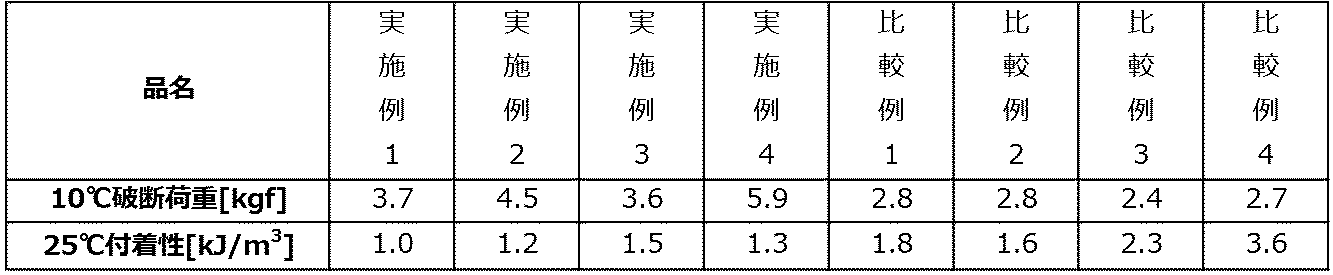
・実施例1~実施例4は、10℃破断荷重、25℃付着性の双方の評価基準を満たした。
・比較例1~比較例4は、10℃破断荷重、25℃付着性の双方の評価基準を満たさないものであった。
上記で作製したチョコレート用油脂組成物、実施例1~実施例4、比較例1~比較例4を使用してチョコレートテストにより評価した。
試作したチョコレートは完全溶解後、45℃まで冷却した後アルミカップに流し込み、5℃30分冷却し、官能評価についてはパネラー3名により下記の評価基準に従い、合議にて評価した、評価結果を表5に記載した。
下記評価基準に従い作製したチョコレートの噛み出しの硬さを評価した。2点以上を合格とした。
3点:チョコレートを噛んだ際に硬い食感を感じられる。
2点:チョコレートを噛んだ際に歯通りは良いが硬い食感を感じられる。
1点:チョコレートを噛んだ際に柔らかく感じられる。
下記評価基準に従い作製したチョコレートの耐熱性を評価した。2点以上を合格とした。
3点:25℃に2時間保存後、指で触っても生地がつかない。
2点:25℃に2時間保存後、指で触っても指紋がつく程度。
1点:25℃に2時間保存後、指で触ると柔らかく生地が付着する。
下記評価基準に従い作製したチョコレートの風味を評価した。2点以上を合格とした。
3点:チョコレートらしい風味が良く感じられる。
2点:チョコレートらしい風味が感じられる。
1点:チョコレートらしい風味が全く感じられない。
下記評価基準に従い作成したチョコレートのブルーム評価を実施した。2点を合格とした。
2点:20℃2か月保存することでブルーム発現がみられない。
1点:20℃2か月保存することでブルーム発現がみられる。

・実施例5~8は、噛み出しの硬さ、べたつき耐性、風味、ブルーム耐性いずれも基準以上であり、良好であった。
・比較例5~8は、噛み出しの硬さ、べたつき耐性、風味、ブルーム耐性のいずれか一つ以上の項目が基準以下であり、不良であった。
Claims (18)
- ランダム化されたトリグリセリド組成を含み、かつ(A)~(H)を全て満たすチョコレート用油脂組成物。
(A)構成脂肪酸組成中、炭素数6~18の飽和脂肪酸の含有量が80質量%以上
(B)構成脂肪酸組成中、ラウリン酸の含有量が30~45質量%
(C)構成脂肪酸組成中、ベヘン酸の含有量が0.5~5.5質量%
(D)構成脂肪酸組成中、不飽和脂肪酸含有量が15質量%以下
(E)構成脂肪酸組成中、トランス脂肪酸含有量が5質量%以下
(F)構成脂肪酸組成中、パルミチン酸含有量/ステアリン酸含有量比が0.2~2
(G)構成脂肪酸組成中、不飽和脂肪酸含有量/ベヘン酸含有量比が4以下
(H)10℃におけるSFCが90%以上 - さらにハイエルシン酸菜種極度硬化油を含有する、請求項1記載のチョコレート用油脂組成物。
- 10℃におけるSFCから40℃におけるSFCの傾きが-3.1以下である、請求項1又は2に記載のチョコレート用油脂組成物。
なお、10℃から40℃のSFC%を基準とした温度当たりの傾きは、10℃SFC%、20℃SFC、25℃SFC%、30℃SFC%、35℃SFC%および40℃SFC%の6点を結ぶ一次関数(X軸を温度、Y軸をSFC%)を想定した際の、Xの係数にあたる、温度当たりの変化率(傾き)により得る。 - 35℃におけるSFCが15%以下かつ、40℃におけるSFCが5%以下である、請求項1のチョコレート用油脂組成物。
- 35℃におけるSFCが15%以下かつ、40℃におけるSFCが5%以下である、請求項2のチョコレート用油脂組成物。
- 35℃におけるSFCが15%以下かつ、40℃におけるSFCが5%以下である、請求項3のチョコレート用油脂組成物。
- 下記の油脂成分X、油脂成分Y、及び油脂成分Zを必須成分として含む原料油脂をエステル交換する工程を含む、請求項1のチョコレート用油脂組成物の製造方法。
油脂成分Xは、パーム核油及びこれを加工した油脂より選ばれた1種以上の油脂
油脂成分Yは、パーム油及びこれを加工した油脂より選ばれた1種以上の油脂
油脂成分Zは、ハイエルシン菜種極度硬化油 - 下記の油脂成分X、油脂成分Y、及び油脂成分Zを必須成分として含む原料油脂をエステル交換する工程を含む、請求項2のチョコレート用油脂組成物の製造方法。
油脂成分Xは、パーム核油及びこれを加工した油脂より選ばれた1種以上の油脂
油脂成分Yは、パーム油及びこれを加工した油脂より選ばれた1種以上の油脂
油脂成分Zは、ハイエルシン菜種極度硬化油 - 下記の油脂成分X、油脂成分Y、及び油脂成分Zを必須成分として含む原料油脂をエステル交換する工程を含む、請求項3のチョコレート用油脂組成物の製造方法。
油脂成分Xは、パーム核油及びこれを加工した油脂より選ばれた1種以上の油脂
油脂成分Yは、パーム油及びこれを加工した油脂より選ばれた1種以上の油脂
油脂成分Zは、ハイエルシン菜種極度硬化油 - 下記の油脂成分X、油脂成分Y、及び油脂成分Zを必須成分として含む原料油脂をエステル交換する工程を含む、請求項4のチョコレート用油脂組成物の製造方法。
油脂成分Xは、パーム核油及びこれを加工した油脂より選ばれた1種以上の油脂
油脂成分Yは、パーム油及びこれを加工した油脂より選ばれた1種以上の油脂
油脂成分Zは、ハイエルシン菜種極度硬化油 - 下記の油脂成分X、油脂成分Y、及び油脂成分Zを必須成分として含む原料油脂をエステル交換する工程を含む、請求項1のチョコレート用油脂組成物の製造方法。
油脂成分Xは、パーム核油及び/又はパーム核極度硬化油
油脂成分Yは、パーム油、パーム分別高融点部、パーム極度硬化油より選ばれた1種以上の油脂
油脂成分Zは、ハイエルシン菜種極度硬化油 - 下記の油脂成分X、油脂成分Y、及び油脂成分Zを必須成分として含む原料油脂をエステル交換する工程を含む、請求項2のチョコレート用油脂組成物の製造方法。
油脂成分Xは、パーム核油及び/又はパーム核極度硬化油
油脂成分Yは、パーム油、パーム分別高融点部、パーム極度硬化油より選ばれた1種以上の油脂
油脂成分Zは、ハイエルシン菜種極度硬化油 - 下記の油脂成分X、油脂成分Y、及び油脂成分Zを必須成分として含む原料油脂をエステル交換する工程を含む、請求項3のチョコレート用油脂組成物の製造方法。
油脂成分Xは、パーム核油及び/又はパーム核極度硬化油
油脂成分Yは、パーム油、パーム分別高融点部、パーム極度硬化油より選ばれた1種以上の油脂
油脂成分Zは、ハイエルシン菜種極度硬化油 - 下記の油脂成分X、油脂成分Y、及び油脂成分Zを必須成分として含む原料油脂をエステル交換する工程を含む、請求項4のチョコレート用油脂組成物の製造方法。
油脂成分Xは、パーム核油及び/又はパーム核極度硬化油
油脂成分Yは、パーム油、パーム分別高融点部、パーム極度硬化油より選ばれた1種以上の油脂
油脂成分Zは、ハイエルシン菜種極度硬化油 - 請求項1のチョコレート用油脂組成物を含有するチョコレート。
- 請求項2のチョコレート用油脂組成物を含有するチョコレート。
- 請求項3のチョコレート用油脂組成物を含有するチョコレート。
- 請求項4のチョコレート用油脂組成物を含有するチョコレート。
Priority Applications (2)
| Application Number | Priority Date | Filing Date | Title |
|---|---|---|---|
| JP2024507647A JPWO2023176337A1 (ja) | 2022-03-16 | 2023-02-22 | |
| US18/843,698 US20250169518A1 (en) | 2022-03-16 | 2023-02-22 | Oil and/or fat composition for chocolate |
Applications Claiming Priority (2)
| Application Number | Priority Date | Filing Date | Title |
|---|---|---|---|
| JP2022-040959 | 2022-03-16 | ||
| JP2022040959 | 2022-03-16 |
Publications (1)
| Publication Number | Publication Date |
|---|---|
| WO2023176337A1 true WO2023176337A1 (ja) | 2023-09-21 |
Family
ID=88023357
Family Applications (1)
| Application Number | Title | Priority Date | Filing Date |
|---|---|---|---|
| PCT/JP2023/006352 Ceased WO2023176337A1 (ja) | 2022-03-16 | 2023-02-22 | チョコレート用油脂組成物 |
Country Status (3)
| Country | Link |
|---|---|
| US (1) | US20250169518A1 (ja) |
| JP (1) | JPWO2023176337A1 (ja) |
| WO (1) | WO2023176337A1 (ja) |
Cited By (1)
| Publication number | Priority date | Publication date | Assignee | Title |
|---|---|---|---|---|
| WO2026070942A1 (ja) * | 2024-09-30 | 2026-04-02 | 日清オイリオグループ株式会社 | チョコレート用油脂組成物及びチョコレート |
Citations (5)
| Publication number | Priority date | Publication date | Assignee | Title |
|---|---|---|---|---|
| WO2007129590A1 (ja) * | 2006-05-01 | 2007-11-15 | Fuji Oil Company, Limited | チョコレート用油脂組成物 |
| WO2017179455A1 (ja) * | 2016-04-13 | 2017-10-19 | 不二製油グループ本社株式会社 | ラウリン酸型チョコレート用油脂組成物及びこれを含有するチョコレート |
| WO2019026670A1 (ja) * | 2017-08-01 | 2019-02-07 | 日清オイリオグループ株式会社 | 油脂組成物及び該油脂組成物を含む油性食品 |
| JP2021052686A (ja) * | 2019-09-30 | 2021-04-08 | 株式会社明治 | 油脂組成物および油脂性食品 |
| WO2022209887A1 (ja) * | 2021-03-30 | 2022-10-06 | 不二製油グループ本社株式会社 | チョコレート用油脂組成物 |
-
2023
- 2023-02-22 WO PCT/JP2023/006352 patent/WO2023176337A1/ja not_active Ceased
- 2023-02-22 US US18/843,698 patent/US20250169518A1/en active Pending
- 2023-02-22 JP JP2024507647A patent/JPWO2023176337A1/ja active Pending
Patent Citations (5)
| Publication number | Priority date | Publication date | Assignee | Title |
|---|---|---|---|---|
| WO2007129590A1 (ja) * | 2006-05-01 | 2007-11-15 | Fuji Oil Company, Limited | チョコレート用油脂組成物 |
| WO2017179455A1 (ja) * | 2016-04-13 | 2017-10-19 | 不二製油グループ本社株式会社 | ラウリン酸型チョコレート用油脂組成物及びこれを含有するチョコレート |
| WO2019026670A1 (ja) * | 2017-08-01 | 2019-02-07 | 日清オイリオグループ株式会社 | 油脂組成物及び該油脂組成物を含む油性食品 |
| JP2021052686A (ja) * | 2019-09-30 | 2021-04-08 | 株式会社明治 | 油脂組成物および油脂性食品 |
| WO2022209887A1 (ja) * | 2021-03-30 | 2022-10-06 | 不二製油グループ本社株式会社 | チョコレート用油脂組成物 |
Non-Patent Citations (1)
| Title |
|---|
| K.K. SAIWAI SHOBO: "Yushi - Yuryo Handbook [Handbook fat oils]", 25 May 1988, SAIWAI SHOBO , Japan , ISBN: 4-7821-0085-X, article YOSHIRO ABE: "Passages; Handbook of Fats and Oils", pages: 238, 281, XP009549914 * |
Cited By (1)
| Publication number | Priority date | Publication date | Assignee | Title |
|---|---|---|---|---|
| WO2026070942A1 (ja) * | 2024-09-30 | 2026-04-02 | 日清オイリオグループ株式会社 | チョコレート用油脂組成物及びチョコレート |
Also Published As
| Publication number | Publication date |
|---|---|
| US20250169518A1 (en) | 2025-05-29 |
| JPWO2023176337A1 (ja) | 2023-09-21 |
Similar Documents
| Publication | Publication Date | Title |
|---|---|---|
| KR101258703B1 (ko) | 제과용 지방 조성물용의 저(低)트란스 지방 | |
| US8182857B2 (en) | Edible products with low content of saturated and trans unsaturated fats | |
| JP5613980B2 (ja) | チョコレート用油脂組成物 | |
| US4208445A (en) | Food fats | |
| EP1992231A1 (en) | Food products with low content of saturated and trans unsaturated fats | |
| JP7303242B2 (ja) | ハードバター | |
| JP7444061B2 (ja) | チョコレート様食品 | |
| JP7530937B2 (ja) | チョコレート用油脂組成物及びチョコレート | |
| JP7318840B1 (ja) | 低トランス、非テンパリング型チョコレート類用油脂 | |
| CN111836546A (zh) | 酯交换油脂 | |
| JP7477054B2 (ja) | チョコレート改良用油脂 | |
| WO2022209887A1 (ja) | チョコレート用油脂組成物 | |
| US20250169518A1 (en) | Oil and/or fat composition for chocolate | |
| EP1491097A1 (en) | Low-trans fats for confectionery fat compositions | |
| US20080085358A1 (en) | Oily Food And Method Of Producing The Same | |
| JP2024094418A (ja) | ランダムエステル交換油 | |
| JP6644430B2 (ja) | キャラメルの製造方法 | |
| EP2030508A1 (en) | Reduced fat content products, with low saturated and trans unsaturated fat content | |
| JPH0265744A (ja) | 油脂組成物 | |
| JP6676923B2 (ja) | チョコレート用油脂組成物、及びこれを含有するチョコレート | |
| JP2024053761A (ja) | チョコレート類 | |
| TW202112242A (zh) | 月桂系硬脂組成物、含有其的巧克力類食品及巧克力類食品的耐表面起白性的提高方法 | |
| JP7160234B1 (ja) | 非ラウリン、非トランス、非テンパリング型チョコレート類用油脂 | |
| JP2025132180A (ja) | 油脂組成物 | |
| CN116546889A (zh) | 油脂组合物 |
Legal Events
| Date | Code | Title | Description |
|---|---|---|---|
| 121 | Ep: the epo has been informed by wipo that ep was designated in this application |
Ref document number: 23770296 Country of ref document: EP Kind code of ref document: A1 |
|
| WWE | Wipo information: entry into national phase |
Ref document number: 2024507647 Country of ref document: JP |
|
| WWE | Wipo information: entry into national phase |
Ref document number: 18843698 Country of ref document: US |
|
| NENP | Non-entry into the national phase |
Ref country code: DE |
|
| WWE | Wipo information: entry into national phase |
Ref document number: 11202406078U Country of ref document: SG |
|
| 122 | Ep: pct application non-entry in european phase |
Ref document number: 23770296 Country of ref document: EP Kind code of ref document: A1 |
|
| WWP | Wipo information: published in national office |
Ref document number: 18843698 Country of ref document: US |