WO2023176055A1 - 光変調器 - Google Patents
光変調器 Download PDFInfo
- Publication number
- WO2023176055A1 WO2023176055A1 PCT/JP2022/043697 JP2022043697W WO2023176055A1 WO 2023176055 A1 WO2023176055 A1 WO 2023176055A1 JP 2022043697 W JP2022043697 W JP 2022043697W WO 2023176055 A1 WO2023176055 A1 WO 2023176055A1
- Authority
- WO
- WIPO (PCT)
- Prior art keywords
- optical waveguide
- electrode
- optical
- optical modulator
- main body
- Prior art date
- Legal status (The legal status is an assumption and is not a legal conclusion. Google has not performed a legal analysis and makes no representation as to the accuracy of the status listed.)
- Ceased
Links
Images







Classifications
-
- G—PHYSICS
- G02—OPTICS
- G02F—OPTICAL DEVICES OR ARRANGEMENTS FOR THE CONTROL OF LIGHT BY MODIFICATION OF THE OPTICAL PROPERTIES OF THE MEDIA OF THE ELEMENTS INVOLVED THEREIN; NON-LINEAR OPTICS; FREQUENCY-CHANGING OF LIGHT; OPTICAL LOGIC ELEMENTS; OPTICAL ANALOGUE/DIGITAL CONVERTERS
- G02F1/00—Devices or arrangements for the control of the intensity, colour, phase, polarisation or direction of light arriving from an independent light source, e.g. switching, gating or modulating; Non-linear optics
- G02F1/01—Devices or arrangements for the control of the intensity, colour, phase, polarisation or direction of light arriving from an independent light source, e.g. switching, gating or modulating; Non-linear optics for the control of the intensity, phase, polarisation or colour
- G02F1/03—Devices or arrangements for the control of the intensity, colour, phase, polarisation or direction of light arriving from an independent light source, e.g. switching, gating or modulating; Non-linear optics for the control of the intensity, phase, polarisation or colour based on ceramics or electro-optical crystals, e.g. exhibiting Pockels effect or Kerr effect
- G02F1/035—Devices or arrangements for the control of the intensity, colour, phase, polarisation or direction of light arriving from an independent light source, e.g. switching, gating or modulating; Non-linear optics for the control of the intensity, phase, polarisation or colour based on ceramics or electro-optical crystals, e.g. exhibiting Pockels effect or Kerr effect in an optical waveguide structure
Definitions
- the present disclosure relates to an optical modulator.
- An optical transceiver includes an optical modulator as a main component.
- An optical modulator is responsible for converting electrical signals into optical signals.
- a conventional optical modulator is disclosed in, for example, Japanese Patent Laid-Open No. 2020-20953 (Patent Document 1).
- the optical modulator of Patent Document 1 includes a ridge-type optical waveguide formed of a dielectric thin film having an electro-optic effect on a substrate, a buffer layer covering the optical waveguide, and a buffer layer disposed on the optical waveguide. and a signal electrode disposed.
- the width of the signal electrode is wider than the width of the ridge of the optical waveguide, and covers at least one side surface of the ridge via the buffer layer.
- the optical modulator of Patent Document 1 has a ground electrode placed on a thin film at a predetermined distance from a signal electrode. In other words, the optical modulator of Patent Document 1 has a coplanar electrode consisting of a signal electrode and a ground electrode.
- the ridge-shaped optical waveguide formed on the substrate is completely covered with a buffer layer.
- the signal electrode is not sufficiently close to the optical waveguide, the electric field applied to the optical waveguide may be reduced.
- the buffer layer were not formed, the difference between the effective refractive index perceived by electrical signals and the effective refractive index perceived by light waves would not become small, and the modulation frequency could not be increased. This is because there is no buffer layer that contributes to adjustment of the effective refractive index.
- An object of the present disclosure is to provide an optical modulator that can suppress a decrease in the electric field applied to an optical waveguide, increase the modulation frequency, and further improve the ratio of the electric field applied to the optical waveguide. That's true.
- An optical modulator includes a ridge-shaped optical waveguide made of a material having an electro-optic effect, a control electrode for controlling light passing through the optical waveguide, and a low dielectric constant lower than that of the optical waveguide. comprising a layer.
- the control electrode includes a first electrode and a second electrode that form a potential difference with each other.
- the first electrode is provided on one side in the thickness direction of the optical waveguide
- the second electrode is provided on the other side in the thickness direction of the optical waveguide
- the first electrode is , a main body portion facing the optical waveguide in the thickness direction of the optical waveguide, and a convex portion protruding toward the optical waveguide from an end portion of the main body portion in the width direction.
- a low dielectric constant layer is interposed between the main body of the first electrode and the optical waveguide.
- the optical modulator it is possible to suppress a decrease in the electric field applied to the optical waveguide, increase the modulation frequency, and further improve the ratio of the electric field applied to the optical waveguide.
- FIG. 1 is a schematic diagram showing a cross section of an optical modulator according to a first embodiment.
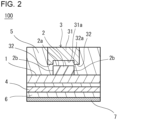
- FIG. 2 is a schematic diagram showing a cross section of an optical modulator according to a second embodiment.
- FIG. 3 is a schematic diagram showing a cross section of an optical modulator of Modification Example 1.
- FIG. 4 is a schematic diagram showing a cross section of an optical modulator of Modification 1.
- FIG. 5 is a schematic diagram showing a cross section of an optical modulator of Modification Example 1.
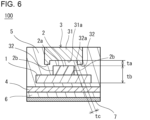
- FIG. 6 is a schematic diagram showing a cross section of an optical modulator of Modification Example 1.
- FIG. 7 is a schematic diagram showing a cross section of an optical modulator of Modification 2.
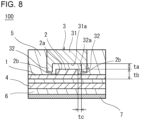
- FIG. 8 is a schematic diagram showing a cross section of an optical modulator of Modification 2.
- FIG. 1 is a schematic diagram showing a cross section of an optical modulator according to a first embodiment.
- FIG. 2 is a schematic diagram showing a cross section of an optical modulator according to a second embodiment.
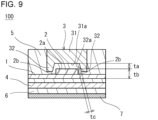
- FIG. 9 is a schematic diagram showing a cross section of an optical modulator according to modification 2.
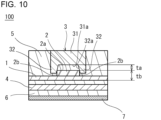
- FIG. 10 is a schematic diagram showing a cross section of an optical modulator of modification 2.
- FIG. 11 is a schematic diagram showing a cross section of an optical modulator according to modification 3.
- FIG. 12 is a schematic diagram showing a cross section of an optical modulator according to modification 3.
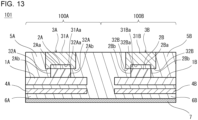
- FIG. 13 is a schematic diagram showing a cross section of an optical modulator according to a third embodiment.
- FIG. 14 is a schematic diagram showing a cross section of an optical modulator according to a fourth embodiment.
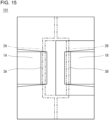
- FIG. 15 is a schematic plan view of the optical modulator according to the fourth embodiment.
- the optical modulator includes a ridge-shaped optical waveguide made of a material having an electro-optic effect, a control electrode for controlling light passing through the optical waveguide, and a low dielectric material having a lower dielectric constant than the optical waveguide. and a rate layer.
- the control electrode includes a first electrode and a second electrode that form a potential difference with each other.
- the first electrode is provided on one side in the thickness direction of the optical waveguide
- the second electrode is provided on the other side in the thickness direction of the optical waveguide
- the first electrode is , a main body portion facing the optical waveguide in the thickness direction of the optical waveguide, and a convex portion protruding toward the optical waveguide from an end portion of the main body portion in the width direction.
- a low dielectric constant layer is interposed between the main body of the first electrode and the optical waveguide (first configuration).
- the first electrode and the second electrode are arranged to sandwich the optical waveguide in the thickness direction. Further, the convex portion of the first electrode protrudes from the end portion in the width direction of the main body toward the optical waveguide, so that the convex portion of the first electrode is located closer to the ridge-shaped optical waveguide than the main body. From another perspective, in the first electrode, the distance between the bottom surface of the main body (the surface facing the optical waveguide in the main body) and the top surface of the optical waveguide (the surface facing the main body in the optical waveguide) is between the convex portion and the optical waveguide. It is much larger than the distance from the wave path. Therefore, a sufficiently thick low dielectric constant layer exists between the main body of the first electrode and the optical waveguide.
- the convex portion of the first electrode exists near the optical waveguide, the electric field applied to the optical waveguide does not decrease. Therefore, a decrease in the electric field applied to the optical waveguide can be suppressed.
- the electric field directed from the first electrode toward the ridge-shaped optical waveguide passes through a sufficiently thick low dielectric constant layer existing between the main body of the first electrode and the optical waveguide. This reduces the effective refractive index felt by the electrical signal.
- the effective refractive index felt by electrical signals is larger than the effective refractive index felt by light waves. Therefore, the difference between the effective refractive index felt by the electric signal and the effective refractive index felt by the light wave becomes small. Therefore, the modulation frequency can be increased.
- the optical waveguide is ridge-shaped, light can be further confined within the optical waveguide.
- the optical modulator described above preferably has the following configuration.
- the shortest distance between the inner side surface of the convex portion and the side surface of the optical waveguide is the same as the surface of the main body facing the optical waveguide and the surface of the optical waveguide facing the main body. (second configuration).
- the optical modulator of the first configuration preferably has the following configuration.
- the convex portion In a cross-sectional view perpendicular to the direction in which the optical waveguide extends, the convex portion is in contact with the optical waveguide (third configuration).
- the electric field is directly guided from the convex portion of the first electrode to the optical waveguide. Therefore, a decrease in the electric field applied to the optical waveguide can be further suppressed.
- the first electrode is in contact with the optical waveguide only through the convex portion.
- the refractive index of the first electrode is much smaller than the refractive index of the optical waveguide. Therefore, due to the refractive index relationship between the first electrode and the optical waveguide, absorption of light leaking from the optical waveguide into the first electrode is suppressed. Therefore, optical loss can be suppressed.
- the optical modulator with the above configuration preferably has the following configuration.
- the shortest distance between the surface of the main body facing the optical waveguide and the surface of the optical waveguide facing the main body is 6 times the thickness of the thickest part of the optical waveguide. It is as follows (fourth configuration).
- the optical modulator described above preferably has the following configuration.
- the material of the optical waveguide is LiNbO 3 (fifth configuration). LiNbO 3 (lithium niobate) has a particularly high electro-optic effect. In this specification, LiNbO 3 may be referred to as LN.
- the material of the optical waveguide is not particularly limited as long as it has an electro-optic effect.
- the material of the optical waveguide may be LiTaO 3 (lithium tantalate), PLZT (lead lanthanum zirconate titanate), KTN (potassium tantalate niobate), BaTiO 3 (barium titanate), etc. It may be.
- the above optical modulator may further include a substrate provided with an optical waveguide (sixth configuration).
- the optical modulator in any one of the first to fifth configurations may include two optical modulator units arranged in parallel.
- the two optical modulator units each include an optical waveguide, a control electrode, and a low dielectric constant layer (seventh configuration).
- the optical modulator of the seventh configuration constitutes a Mach-Zehnder type optical modulator.
- intensity modulation is also possible in addition to phase modulation. This allows multilevel modulation to be performed and increases transmission capacity.
- the optical modulator of the seventh configuration provides the same effects as the first to fifth configurations.
- the optical modulator with the seventh configuration may include the following configuration.
- Each of the optical modulator units further includes a substrate provided with an optical waveguide.
- the substrate of one of the two optical modulator units is arranged in parallel with the substrate of the other optical modulator unit (eighth configuration).
- the optical modulator with the eighth configuration may include the following configuration.
- the substrate of one optical modulator unit is integrated with the substrate of the other optical modulator unit, and the optical waveguide of one optical modulator unit and the optical waveguide of the other optical modulator unit are connected to each other.
- the direction of spontaneous polarization is opposite to that of the optical waveguide.
- the first electrode of one optical modulator unit is integrally formed with the first electrode of the other optical modulator unit.
- the second electrode of one optical modulator unit is integrally formed with the second electrode of the other optical modulator unit. Voltages having the same phase are applied to the first electrode of one optical modulator unit and the first electrode of the other optical modulator unit (ninth configuration).
- the substrate of one optical modulator unit can be shared with the substrate of the other optical modulator unit.
- the optical waveguide of one optical modulator unit and the optical waveguide of the other optical modulator unit are provided on a shared substrate. Therefore, the distance between the optical waveguide of one optical modulator unit and the optical waveguide of the other optical modulator unit can be reduced.
- the first electrode of one optical modulator unit can be shared with the first electrode of the other optical modulator unit.
- the second electrode of one optical modulator unit can be shared with the second electrode of the other optical modulator unit. Therefore, the distance between the optical waveguides can be further reduced. Therefore, the width of the entire optical modulator can be further reduced.
- FIG. 1 is a schematic diagram showing a cross section of an optical modulator 100 according to the first embodiment.
- FIG. 1 shows a cross section perpendicular to the direction in which the optical waveguide 2 extends.
- the direction in which the optical waveguide 2 extends can also be said to be a direction along the optical waveguide 2.
- a cross section means a cross section perpendicular to the direction in which the optical waveguide 2 or optical waveguides 2A and 2B described below extend.
- the support plate 7 that supports the whole is located at the bottom, the thickness direction of the optical modulator 100 corresponds to the up-down direction, and the width direction of the optical modulator 100 corresponds to the left-right direction.
- upper, lower, left, and right are defined for convenience of explanation, and do not limit the actual posture of the optical modulator 100.
- an optical modulator 100 includes a substrate 1, an optical waveguide 2, a first electrode 3, a second electrode 4, and a low dielectric constant layer 5.
- the first electrode 3 and the second electrode 4 are included in a control electrode for controlling light passing through the optical waveguide 2.
- the first electrode 3 is placed above the substrate 1 .
- the first electrode 3 and the second electrode 4 form a potential difference with each other.
- the first electrode 3 is, for example, a signal electrode.
- the second electrode 4 is not particularly limited as long as it forms a potential difference with the first electrode 3.
- the second electrode 4 is, for example, a ground electrode.
- the second electrode 4 may be a reverse signal electrode that applies a voltage having an opposite phase to the voltage of the first electrode 3.
- the second electrode 4 is placed below the substrate 1.
- the first electrode 3 and the second electrode 4 are arranged to sandwich the optical waveguide 2 in the vertical direction (thickness direction).
- the optical modulator 100 of this embodiment further includes an auxiliary low dielectric constant layer 6.
- the substrate 1 , the optical waveguide 2 , the low dielectric constant layer 5 , the first electrode 3 , the second electrode 4 and the auxiliary low dielectric constant layer 6 are supported by a support plate 7 .
- the support plate 7 is arranged at the bottom.
- the optical waveguide 2 is made of a material that has an electro-optic effect.
- the material of the optical waveguide 2 is, for example, LN.
- the optical waveguide 2 is formed on the substrate 1.
- the substrate 1 has a ridge-shaped optical waveguide 2. That is, the substrate 1 has a protrusion on its upper part, and this protrusion functions as the optical waveguide 2.
- a protruding strip that will become the optical waveguide 2 is formed on the substrate 1.
- the protrusions can confine light in the thickness direction and width direction.
- the substrate 1 may be made of the same material as the optical waveguide 2. However, the material of the substrate 1 may be different from the material of the optical waveguide 2. In this case, the material of the substrate 1 is, for example, Si.
- the optical waveguide 2 can have a cross-sectional shape in which the width (the horizontal dimension) is larger than the thickness (the vertical dimension).
- the cross-sectional shape of the ridge-type optical waveguide 2 is substantially wide and generally rectangular.
- the cross-sectional shape of the optical waveguide 2 includes a first side extending in the width direction and a second side arranged parallel to the first side and extending in the width direction.
- the cross-sectional shape of the optical waveguide 2 further includes a third side and a fourth side, each extending in the thickness direction.
- the first side and the second side are a pair of long sides
- the third side and the fourth side are a pair of short sides.
- the cross-sectional shape of the optical waveguide 2 is a wide rectangle
- one of the pair of long sides is parallel to the surface of the substrate 1
- the other long side is parallel to the surface of the substrate 1.
- the second side is located on the surface of the substrate 1.
- the first and second long sides are connected by the third and fourth short sides.
- the third side and the fourth side of the optical waveguide 2 are linear in a cross-sectional view of the optical modulator 100, and are parallel to the thickness direction of the optical waveguide 2.
- the third side and the fourth side may be inclined with respect to the thickness direction of the optical waveguide 2, and do not necessarily need to be linear.
- the third side and the fourth side of the optical waveguide 2 may have a curved shape, or may have a shape that is a combination of a straight line and a curved line.
- the length of the third side may be the same as the length of the fourth side, or may be different.
- the length of the first side may be the same as the length of the second side, or may be different.
- the cross-sectional shape of the ridge-type optical waveguide 2 is often trapezoidal.
- the cross-sectional shape of the optical waveguide 2 includes an upper base and a lower base, each extending in the width direction, and a pair of legs.
- the upper and lower bases are parallel to each other.
- the cross-sectional shape of the optical waveguide 2 is a wide trapezoid, the upper base (the upper short side) is parallel to the surface of the substrate 1, and the lower base (lower long side) is located on the surface of the substrate 1. .
- the ridge-type optical waveguide 2 has an upper surface 2a located on the opposite side from the substrate 1 and two side surfaces 2b. Each side surface 2b is connected to an end in the width direction of the upper surface 2a.
- a low dielectric constant layer 5 is laminated on the substrate 1 .
- a low dielectric constant layer 5 is laminated on the optical waveguide 2.
- the low dielectric constant layer 5 directly covers the top surface 2a and side surface 2b of the ridge-shaped optical waveguide 2, and also directly covers the top surface of the substrate 1 in the periphery thereof.
- the dielectric constant of the low dielectric constant layer 5 is lower than that of the optical waveguide 2.
- the material of the low dielectric constant layer 5 is not particularly limited as long as the dielectric constant is lower than the dielectric constant of the optical waveguide 2.
- the low dielectric constant layer 5 for example, an oxide (eg, Al 2 O 3 , SiO 2 , LaAlO 3 , LaYO 3 , ZnO, HfO 2 , MgO, Y 2 O 3 ) is used.
- a polymer eg, BCB (benzocyclobutene), PI (polyimide) may be used.
- the first electrode 3 and the second electrode 4 are made of metal material.
- the first electrode 3 is provided on one side of the optical waveguide 2 in the thickness direction.
- the second electrode 4 is provided on the other side of the optical waveguide 2 in the thickness direction.
- the first electrode 3 is arranged above the substrate 1, and the second electrode 4 is arranged below the substrate 1.
- the first electrode 3 includes a main body portion 31 and a convex portion 32.
- the main body portion 31 faces the optical waveguide 2 in the thickness direction of the optical waveguide 2. That is, the main body portion 31 is placed directly above the optical waveguide 2 .
- the main body portion 31 has a bottom surface 31a facing the top surface 2a of the optical waveguide 2.
- the convex portion 32 protrudes from the end portion of the main body portion 31 in the width direction toward the optical waveguide 2 side. In the example shown in FIG. 1, the convex portion 32 protrudes downward.
- the convex portion 32 has an inner side surface 32a located on the main body portion 31 side.
- the convex portions 32 are provided at both ends of the main body portion 31 in the width direction.
- the convex portion 32 may be provided only at one of both ends of the main body portion 31 in the width direction.
- the low dielectric constant layer 5 is interposed between the first electrode 3 and the optical waveguide 2. Specifically, the low dielectric constant layer 5 is interposed between the main body portion 31 of the first electrode 3 and the optical waveguide 2 .
- Each of the convex portions 32 of the first electrode 3 protrudes from the end of the main body 31 toward the optical waveguide 2, and thus exists closer to the ridge-shaped optical waveguide 2 than the main body 31.
- the distance between the bottom surface 31a of the main body portion 31 and the top surface 2a of the optical waveguide 2 is much larger than the distance between the convex portion 32 and the optical waveguide 2. Therefore, a sufficiently thick low dielectric constant layer 5 exists between the main body portion 31 of the first electrode 3 and the optical waveguide 2.
- each convex portion 32 of the first electrode 3 is in contact with the optical waveguide 2. Specifically, the inner corner of each of the convex portions 32 of the first electrode 3 is in contact with the corner at the end of the optical waveguide 2 in the width direction. In other words, the shortest distance between the inner side surface 32a of the convex portion 32 and the side surface 2b of the optical waveguide 2 is zero. The inner side surface 32a of the convex portion 32 does not cover the side surface 2b of the optical waveguide 2.
- an auxiliary low dielectric constant layer 6 is laminated under the substrate 1.
- the support plate 7 is laminated under the auxiliary low dielectric constant layer 6.
- the dielectric constant of the auxiliary low dielectric constant layer 6 is lower than that of the optical waveguide 2, similarly to the low dielectric constant layer 5.
- the material of the auxiliary low dielectric constant layer 6 is not particularly limited as long as the dielectric constant is lower than the dielectric constant of the optical waveguide 2.
- the material of the auxiliary low dielectric constant layer 6 may be the same as the material of the low dielectric constant layer 5, or may be different.
- the auxiliary low dielectric constant layer 6 covers the second electrode 4.
- the second electrode 4 is arranged inside the auxiliary low dielectric constant layer 6 so as to be parallel to the substrate 1 .
- the auxiliary low dielectric constant layer 6 directly covers the upper and lower surfaces of the second electrode 4.
- the second electrode 4 may be directly laminated under the substrate 1.
- the auxiliary low dielectric constant layer 6 directly covers the lower surface of the second electrode 4.
- the first electrode 3 and the second electrode 4 are arranged to sandwich the optical waveguide 2 in the thickness direction. Furthermore, a sufficiently thick low dielectric constant layer 5 is present between the main body portion 31 of the first electrode 3 and the optical waveguide 2 . Furthermore, since the convex portion 32 of the first electrode 3 protrudes from the end of the main body 31 toward the optical waveguide 2, it is located closer to the ridge-shaped optical waveguide 2 than the main body 31.
- an electric field is applied from the first electrode 3 to the ridge-shaped optical waveguide 2 when the optical modulator 100 is operated.
- the first electrode 3 and the second electrode 4 are arranged to sandwich the optical waveguide 2 in the thickness direction. That is, the optical waveguide 2 is arranged between the first electrode 3 and the second electrode 4. Therefore, an electric field acts from the first electrode 3 toward the second electrode 4. In other words, the electric field acts in the vertical direction. Therefore, an electric field is effectively guided from the first electrode 3 to the optical waveguide 2.
- the electrodes are arranged on the same side in the thickness direction with respect to the optical waveguide 2, and the ratio of the electric field applied to the optical waveguide 2 is improved compared to the case where the optical waveguide 2 is not sandwiched between these electrodes. I can do it.
- the convex portion 32 of the first electrode 3 is located closer to the optical waveguide 2 than the main body portion 31.
- the convex portion 32 of the first electrode 3 is arranged close to the optical waveguide 2 . Since the electric field is concentrated on the convex portion 32 of the first electrode 3, the intensity of the electric field directed from the first electrode 3 toward the optical waveguide 2 increases. Therefore, the electric field applied to the optical waveguide 2 does not decrease. Therefore, a decrease in the electric field applied to the optical waveguide 2 can be suppressed.
- a sufficiently thick low dielectric constant layer 5 exists between the main body portion 31 of the first electrode 3 and the optical waveguide 2.
- the electric field directed from the first electrode 3 toward the ridge-shaped optical waveguide 2 passes through the sufficiently thick low dielectric constant layer 5.
- the effective refractive index felt by the electrical signal in the optical waveguide 2 is reduced. Therefore, the difference between the effective refractive index felt by the electric signal and the effective refractive index felt by the light wave becomes small. Therefore, the modulation frequency can be increased.
- the optical waveguide 2 is ridge-shaped, light can be further confined within the optical waveguide 2.
- the convex portion 32 of the first electrode 3 that protrudes from the main body 31 is in contact with the optical waveguide 2, so that an electric field is generated from the convex portion 32 of the first electrode 3 to the optical waveguide 2. Directly guided. Therefore, a decrease in the electric field applied to the optical waveguide 2 can be further suppressed.
- the first electrode 3 is in contact with the optical waveguide 2 only through the convex portion 32.
- the refractive index of the first electrode 3 is smaller than the refractive index of the low dielectric constant layer 5 and much smaller than the refractive index of the optical waveguide 2. Therefore, due to the refractive index relationship between the first electrode 3 and the optical waveguide 2, light does not leak from the optical waveguide 2 to the first electrode 3. Therefore, the optical modulator 100 will not stop functioning due to the first electrode 3 coming into contact with the optical waveguide 2.
- the first electrode 3 and the optical waveguide The contact area with 2 is small.
- the corner at the end of the optical waveguide 2 in the width direction means the area from the end to 10% of the width of the optical waveguide 2 in the width direction of the optical waveguide 2, and in the thickness direction of the optical waveguide 2. This means the area from the end to 10% of the thickness of the optical waveguide 2.
- the inner corner of the convex part 32 of the first electrode 3 means an area corresponding to 10% of the width of the optical waveguide 2 from the end in the width direction of the convex part 32; In the thickness direction, it means a region corresponding to 10% of the thickness of the optical waveguide 2 from the end.
- FIG. 2 is a schematic diagram showing a cross section of the optical modulator 100 according to the second embodiment.
- the optical modulator 100 of this embodiment is a modification of the optical modulator 100 of the first embodiment.
- the first electrode 3 is not in contact with the optical waveguide 2. That is, the inner corner portions of each of the convex portions 32 of the first electrode 3 are slightly spaced apart upward from the optical waveguide 2 .
- the distance between the convex portion 32 of the first electrode 3 and the optical waveguide 2 is significantly smaller than the distance between the main body portion 31 and the optical waveguide 2, as in the first embodiment.
- a low dielectric constant layer 5 exists between the convex portion 32 and the optical waveguide 2, which are slightly spaced apart from each other in the thickness direction of the optical waveguide 2.
- the convex portion 32 of the first electrode 3 is still located closer to the optical waveguide 2 than the main body portion 31. Therefore, an electric field is effectively guided from the convex portion 32 of the first electrode 3 to the optical waveguide 2. Therefore, a decrease in the electric field applied to the optical waveguide 2 can be suppressed.
- the convex portion 32 of the first electrode 3 is not in contact with the optical waveguide 2, absorption of light leaking from the optical waveguide 2 into the first electrode 3 can be further suppressed. . Therefore, optical loss can be further suppressed.
- the inner corner of the convex part 32 of the first electrode 3 is It is preferable that the contact point be in contact with the corner of the section.
- [Modification 1] 3 to 6 are schematic diagrams showing modification example 1 of the optical modulator 100. A cross section of the optical modulator 100 is shown in FIGS. 3-6. In modification 1, the form of the first electrode 3 relative to the optical waveguide 2 in the optical modulator 100 shown in FIGS. 1 and 2 is changed.
- the cross-sectional shape of the optical waveguide 2 is rectangular.
- the inner side surface 32a of the convex portion 32 has a shape perpendicular to the width direction.
- the convex portion 32 of the first electrode 3 is slightly apart from the optical waveguide 2 in the width direction of the optical waveguide 2 .
- the shortest distance tc between the inner side surface 32a of the convex portion 32 and the side surface 2b of the optical waveguide 2 is smaller than the shortest distance ta between the bottom surface 31a of the main body portion 31 and the upper surface 2a of the optical waveguide 2.
- the cross-sectional shape of the optical waveguide 2 is trapezoidal.
- the inner side surface 32a of the convex portion 32 has a shape perpendicular to the width direction.
- the convex portion 32 of the first electrode 3 is slightly apart from the optical waveguide 2 in the width direction of the optical waveguide 2 .
- the shortest distance tc between the inner side surface 32a of the convex portion 32 and the side surface 2b of the optical waveguide 2 is smaller than the shortest distance ta between the bottom surface 31a of the main body portion 31 and the upper surface 2a of the optical waveguide 2.
- the cross-sectional shape of the optical waveguide 2 is rectangular.
- the inner side surface 32a of the convex portion 32 has a tapered shape. That is, the inner side surface 32a of the convex portion 32 is formed to form an obtuse angle with the bottom surface 31a of the main body portion 31.
- the convex portion 32 of the first electrode 3 is slightly apart from the optical waveguide 2 in the width direction of the optical waveguide 2 .
- the shortest distance tc between the inner side surface 32a of the convex portion 32 and the side surface 2b of the optical waveguide 2 is smaller than the shortest distance ta between the bottom surface 31a of the main body portion 31 and the upper surface 2a of the optical waveguide 2.
- the dimensions of the first electrode 3 with respect to the optical waveguide 2 are the same as in the example shown in FIG.
- the auxiliary low dielectric constant layer 6 exists so as to cover both ends of the substrate 1 in the width direction.
- the width of the substrate 1 is smaller than the width of the substrate 1 shown in FIGS. 3-5.
- the effective refractive index can be adjusted by adjusting the ratio of the auxiliary low dielectric constant layer 6 to the substrate 1 in the region where the electric field is applied.
- two etching steps are required to form the shape of the substrate 1 and the shape of the optical waveguide 2.
- Modification 2 7 to 10 are schematic diagrams showing a second modification of the optical modulator 100. 7 to 10, cross sections of the optical modulator 100 are shown. In modification 2, the form of the first electrode 3 relative to the optical waveguide 2 in the optical modulator 100 shown in FIGS. 1 and 2 is changed.
- the cross-sectional shape of the optical waveguide 2 is rectangular.
- the inner side surface 32a of the convex portion 32 has a shape perpendicular to the width direction.
- the convex portion 32 of the first electrode 3 is spaced apart from the optical waveguide 2 in the thickness direction and width direction of the optical waveguide 2 .
- the shortest distance tc between the inner side surface 32a of the convex portion 32 and the side surface 2b of the optical waveguide 2 is smaller than the shortest distance ta between the bottom surface 31a of the main body portion 31 and the upper surface 2a of the optical waveguide 2.
- the shortest distance ta between the bottom surface 31a of the main body 31 and the top surface 2a of the optical waveguide 2 is six times or less the thickness tb of the thickest part of the optical waveguide 2.
- this condition is met. The reason is shown below.
- the modulation speed of light can be improved. If the low dielectric constant layer 5 is installed between the first electrode 3 and the second electrode 4, the effective refractive index felt by the electric signal will be reduced, but the electric field applied to the optical waveguide 2 will be weakened.
- the low dielectric constant layer 5 When considering the voltage drop in the low dielectric constant layer 5 and the effective refractive index felt by electric signals, if the low dielectric constant layer 5 is designed to be about 6 times or less than the optical waveguide 2, a balance between the two can be achieved. , it is possible to both reduce optical loss and ensure voltage application efficiency.
- the cross-sectional shape of the optical waveguide 2 is rectangular.
- the inner side surface 32a of the convex portion 32 has a shape perpendicular to the width direction.
- the inner corner of the convex portion 32 of the first electrode 3 is located near the end of the optical waveguide 2 in the width direction.
- the convex portion 32 of the first electrode 3 extends to the immediate vicinity of the substrate 1.
- the convex portion 32 of the first electrode 3 does not cover the entire side surface 2b of the optical waveguide 2. That is, when viewed along the width direction of the optical waveguide 2, the convex portion 32 of the first electrode 3 partially overlaps with the optical waveguide 2.
- the shortest distance tc between the inner side surface 32a of the convex portion 32 and the side surface 2b of the optical waveguide 2 is smaller than the shortest distance ta between the bottom surface 31a of the main body portion 31 and the upper surface 2a of the optical waveguide 2. Further, the shortest distance ta between the bottom surface 31a of the main body 31 and the top surface 2a of the optical waveguide 2 is six times or less the thickness tb of the thickest portion of the optical waveguide 2.
- the inner corner of the convex portion 32 of the first electrode 3 is located near the end of the optical waveguide 2 in the width direction, so a strong electric field can be applied to the optical waveguide 2. Therefore, it becomes possible to suppress power consumption.
- the cross-sectional shape of the optical waveguide 2 is rectangular.
- the inner side surface 32a of the convex portion 32 has a tapered shape.
- the inner side surface 32a of the convex portion 32 of the first electrode 3 is located near the corner at the end of the optical waveguide 2 in the width direction.
- the shortest distance tc between the inner side surface 32a of the convex portion 32 and the side surface 2b of the optical waveguide 2 is smaller than the shortest distance ta between the bottom surface 31a of the main body portion 31 and the upper surface 2a of the optical waveguide 2.
- the shortest distance ta between the bottom surface 31a of the main body 31 and the top surface 2a of the optical waveguide 2 is six times or less the thickness tb of the thickest portion of the optical waveguide 2.
- the inner side surface 32a of the convex portion 32 of the first electrode 3 is in contact with the corner at the end of the optical waveguide 2 in the width direction.
- the first electrode 3 since the first electrode 3 contacts the optical waveguide 2 with a relatively small area through the convex portion 32, absorption of light from the optical waveguide 2 to the first electrode 3 is minimized, and the optical waveguide 2 is strengthened. An electric field can be applied.
- Modification 3 11 and 12 are schematic diagrams showing a third modification of the optical modulator 100. 11 and 12 show cross sections of the optical modulator 100. In modification 3, the form of the first electrode 3 relative to the optical waveguide 2 in the optical modulator 100 shown in FIG. 1 is changed.
- the tip surface of the convex portion 32 of the first electrode 3 is in contact with the upper surface 2a of the optical waveguide 2.
- the inner side surface 32a of the convex portion 32 of the first electrode 3 is in contact with the side surface 2b of the optical waveguide 2. In either case, since the convex portion 32 of the first electrode 3 is in contact with the optical waveguide 2 in a narrow range, a stronger electric field can be applied to the optical waveguide 2. Therefore, it becomes possible to suppress power consumption.
- the contact range between the convex part 32 of the first electrode 3 and the optical waveguide 2 is too large, light will leak from the optical waveguide 2 to the convex part 32 and be absorbed by the first electrode 3.
- they are in contact.
- FIG. 13 is a schematic diagram showing a cross section of the optical modulator 101 according to the third embodiment.
- the optical modulator 101 of this embodiment constitutes a Mach-Zehnder type optical modulator.
- the optical modulator 101 of this embodiment is a modification of the optical modulator 100 of the first embodiment, and each element of the optical modulator 100 of the first embodiment is arranged in parallel.
- the optical modulator 101 of this embodiment includes two optical modulator units 100A and 100B.
- One optical modulator unit 100A includes a substrate 1A, a ridge-shaped optical waveguide 2A, a first electrode 3A, a second electrode 4A, a low dielectric constant layer 5A, and an auxiliary low dielectric constant layer 6A.
- the other optical modulator unit 100B includes a substrate 1B, a ridge-shaped optical waveguide 2B, a first electrode 3B, a second electrode 4B, a low dielectric constant layer 5B, and an auxiliary low dielectric constant layer 6B.
- the optical modulator unit 100A and the optical modulator unit 100B are supported by a support plate 7.
- the substrates 1A and 1B correspond to the substrate 1 described above.
- the optical waveguides 2A and 2B correspond to the optical waveguide 2 described above.
- the low dielectric constant layers 5A and 5B correspond to the low dielectric constant layer 5 described above.
- the first electrodes 3A and 3B correspond to the first electrode 3 described above.
- the second electrodes 4A and 4B correspond to the second electrode 4 described above.
- the auxiliary low dielectric constant layers 6A and 6B correspond to the auxiliary low dielectric constant layer 6 described above.
- the substrate 1A provided with the optical waveguide 2A is arranged in parallel with the substrate 1B provided with the optical waveguide 2B. That is, the optical waveguide 2A and the optical waveguide 2B are arranged side by side. Upstream of the optical waveguide 2A and the optical waveguide 2B, one input optical waveguide branches into the optical waveguide 2A and the optical waveguide 2B. At the downstream of the optical waveguide 2A and the optical waveguide 2B, the optical waveguide 2A and the optical waveguide 2B merge into one output optical waveguide.
- optical modulator 101 of this embodiment Even with the optical modulator 101 of this embodiment, effects similar to those of the first embodiment described above can be obtained. Furthermore, since the optical modulator 101 of this embodiment constitutes a Mach-Zehnder type optical modulator, intensity modulation is also possible in addition to phase modulation. This allows multilevel modulation to be performed and increases transmission capacity.
- the first electrode 3A does not need to be in contact with the optical waveguide 2A as in the second embodiment, and the first electrode 3B does not need to be in contact with the optical waveguide 2B.
- FIG. 14 and 15 are schematic diagrams showing an optical modulator 101 according to the fourth embodiment.
- FIG. 14 shows a cross section of the optical modulator 101.
- FIG. 15 shows a plane when the optical modulator 101 is viewed from above.
- the optical modulator 101 of this embodiment is a modification of the optical modulator 101 of the third embodiment.
- the substrate 1A of the optical modulator unit 100A is integrated with the substrate 1B of the optical modulator unit 100B.
- the optical waveguide 2A and the optical waveguide 2B have opposite directions of spontaneous polarization.
- the material of the substrate 1A and the substrate 1B is a ferroelectric crystal such as LN or LiTaO3
- the direction of spontaneous polarization cannot be reversed by applying a high voltage to the ferroelectric crystal material. be.
- the location where the polarization is reversed can be recognized by observation using an atomic force microscope or an electron microscope. In this case, when the optical modulator 101 is operated, voltages having the same phase are applied to the first electrode 3A and the first electrode 3B.
- the substrate 1A and the substrate 1B can be used in common.
- the optical waveguide 2A and the optical waveguide 2B are provided on shared substrates 1A and 1B. Therefore, the distance between the optical waveguide 2A and the optical waveguide 2B can be reduced.
- the first electrode 3A of the optical modulator unit 100A is formed integrally with the first electrode 3B of the optical modulator unit 100B. That is, the first electrode 3B is electrically integrated with the first electrode 3A. In this case, the first electrode 3B can be shared with the first electrode 3A.
- the second electrode 4A of the optical modulator unit 100A is formed integrally with the second electrode 4B of the optical modulator unit 100B. That is, the second electrode 4B is electrically integrated with the second electrode 4A. In this case, the second electrode 4B can be used in common with the second electrode 4A. Therefore, the distance between the optical waveguide 2A and the optical waveguide 2B can be made smaller. Therefore, the width of the entire optical modulator 101 can be further reduced, and the size of the optical modulator 101 can be further reduced.
- Optical modulator 1 Substrate 2: Optical waveguide 3: First electrode 31: Main body portion 32: Convex portion 4: Second electrode 5: Low dielectric constant layer 6: Auxiliary low dielectric constant layer 7: Support plate
Landscapes
- Physics & Mathematics (AREA)
- Nonlinear Science (AREA)
- Chemical & Material Sciences (AREA)
- Engineering & Computer Science (AREA)
- Ceramic Engineering (AREA)
- Crystallography & Structural Chemistry (AREA)
- General Physics & Mathematics (AREA)
- Optics & Photonics (AREA)
- Optical Modulation, Optical Deflection, Nonlinear Optics, Optical Demodulation, Optical Logic Elements (AREA)
Priority Applications (1)
| Application Number | Priority Date | Filing Date | Title |
|---|---|---|---|
| JP2024507508A JPWO2023176055A1 (https=) | 2022-03-17 | 2022-11-28 |
Applications Claiming Priority (2)
| Application Number | Priority Date | Filing Date | Title |
|---|---|---|---|
| JP2022042071 | 2022-03-17 | ||
| JP2022-042071 | 2022-03-17 |
Publications (1)
| Publication Number | Publication Date |
|---|---|
| WO2023176055A1 true WO2023176055A1 (ja) | 2023-09-21 |
Family
ID=88023158
Family Applications (1)
| Application Number | Title | Priority Date | Filing Date |
|---|---|---|---|
| PCT/JP2022/043697 Ceased WO2023176055A1 (ja) | 2022-03-17 | 2022-11-28 | 光変調器 |
Country Status (2)
| Country | Link |
|---|---|
| JP (1) | JPWO2023176055A1 (https=) |
| WO (1) | WO2023176055A1 (https=) |
Citations (3)
| Publication number | Priority date | Publication date | Assignee | Title |
|---|---|---|---|---|
| US20050201686A1 (en) * | 2004-03-12 | 2005-09-15 | Cole James H. | Low loss electrodes for electro-optic modulators |
| JP2008250258A (ja) * | 2007-03-30 | 2008-10-16 | Sumitomo Osaka Cement Co Ltd | 光制御素子 |
| WO2015087988A1 (ja) * | 2013-12-11 | 2015-06-18 | 住友大阪セメント株式会社 | 電気光学素子 |
-
2022
- 2022-11-28 WO PCT/JP2022/043697 patent/WO2023176055A1/ja not_active Ceased
- 2022-11-28 JP JP2024507508A patent/JPWO2023176055A1/ja active Pending
Patent Citations (3)
| Publication number | Priority date | Publication date | Assignee | Title |
|---|---|---|---|---|
| US20050201686A1 (en) * | 2004-03-12 | 2005-09-15 | Cole James H. | Low loss electrodes for electro-optic modulators |
| JP2008250258A (ja) * | 2007-03-30 | 2008-10-16 | Sumitomo Osaka Cement Co Ltd | 光制御素子 |
| WO2015087988A1 (ja) * | 2013-12-11 | 2015-06-18 | 住友大阪セメント株式会社 | 電気光学素子 |
Also Published As
| Publication number | Publication date |
|---|---|
| JPWO2023176055A1 (https=) | 2023-09-21 |
Similar Documents
| Publication | Publication Date | Title |
|---|---|---|
| JP4589354B2 (ja) | 光変調素子 | |
| US7088875B2 (en) | Optical modulator | |
| CN101669061B (zh) | 光控制元件 | |
| JP4445977B2 (ja) | 光制御素子 | |
| US20080031564A1 (en) | Optical modulator | |
| US7099524B2 (en) | Optical modulator | |
| JP7259486B2 (ja) | 光変調器 | |
| US8031986B2 (en) | Optical control device | |
| JP3250712B2 (ja) | 偏波無依存光制御素子 | |
| JP2026010217A (ja) | 光変調器 | |
| WO2023176055A1 (ja) | 光変調器 | |
| JP7155848B2 (ja) | 光導波路素子および光変調器 | |
| JP7729468B2 (ja) | 光変調器 | |
| JP3924289B2 (ja) | 光変調素子及びその製造方法 | |
| JP7803355B2 (ja) | 光導波路素子及びそれを用いた光変調デバイス並びに光送信装置 | |
| JP3067760B1 (ja) | 導波路型光デバイス | |
| JP7538208B2 (ja) | 光変調素子 | |
| JPH05297332A (ja) | 光変調器 | |
| US20070081755A1 (en) | Optical modulator | |
| JPH06250131A (ja) | 光制御素子 | |
| WO2026013890A1 (ja) | 光変調器 | |
| JPH04254819A (ja) | 光導波路形デバイス | |
| JP2007025369A (ja) | 光変調器 | |
| JP4495326B2 (ja) | 光変調素子のチャープ制御方法 | |
| WO2022049770A1 (ja) | 光デバイス |
Legal Events
| Date | Code | Title | Description |
|---|---|---|---|
| 121 | Ep: the epo has been informed by wipo that ep was designated in this application |
Ref document number: 22932318 Country of ref document: EP Kind code of ref document: A1 |
|
| WWE | Wipo information: entry into national phase |
Ref document number: 2024507508 Country of ref document: JP |
|
| NENP | Non-entry into the national phase |
Ref country code: DE |
|
| 122 | Ep: pct application non-entry in european phase |
Ref document number: 22932318 Country of ref document: EP Kind code of ref document: A1 |