WO2023171254A1 - 発光装置 - Google Patents
発光装置 Download PDFInfo
- Publication number
- WO2023171254A1 WO2023171254A1 PCT/JP2023/004950 JP2023004950W WO2023171254A1 WO 2023171254 A1 WO2023171254 A1 WO 2023171254A1 JP 2023004950 W JP2023004950 W JP 2023004950W WO 2023171254 A1 WO2023171254 A1 WO 2023171254A1
- Authority
- WO
- WIPO (PCT)
- Prior art keywords
- less
- phosphor
- light emitting
- emitting device
- light
- Prior art date
- Legal status (The legal status is an assumption and is not a legal conclusion. Google has not performed a legal analysis and makes no representation as to the accuracy of the status listed.)
- Ceased
Links
Images

Classifications
-
- H—ELECTRICITY
- H10—SEMICONDUCTOR DEVICES; ELECTRIC SOLID-STATE DEVICES NOT OTHERWISE PROVIDED FOR
- H10H—INORGANIC LIGHT-EMITTING SEMICONDUCTOR DEVICES HAVING POTENTIAL BARRIERS
- H10H20/00—Individual inorganic light-emitting semiconductor devices having potential barriers, e.g. light-emitting diodes [LED]
- H10H20/80—Constructional details
- H10H20/85—Packages
- H10H20/851—Wavelength conversion means
- H10H20/8511—Wavelength conversion means characterised by their material, e.g. binder
- H10H20/8512—Wavelength conversion materials
- H10H20/8513—Wavelength conversion materials having two or more wavelength conversion materials
-
- H—ELECTRICITY
- H10—SEMICONDUCTOR DEVICES; ELECTRIC SOLID-STATE DEVICES NOT OTHERWISE PROVIDED FOR
- H10H—INORGANIC LIGHT-EMITTING SEMICONDUCTOR DEVICES HAVING POTENTIAL BARRIERS
- H10H20/00—Individual inorganic light-emitting semiconductor devices having potential barriers, e.g. light-emitting diodes [LED]
- H10H20/80—Constructional details
- H10H20/85—Packages
- H10H20/851—Wavelength conversion means
- H10H20/8511—Wavelength conversion means characterised by their material, e.g. binder
- H10H20/8512—Wavelength conversion materials
-
- C—CHEMISTRY; METALLURGY
- C09—DYES; PAINTS; POLISHES; NATURAL RESINS; ADHESIVES; COMPOSITIONS NOT OTHERWISE PROVIDED FOR; APPLICATIONS OF MATERIALS NOT OTHERWISE PROVIDED FOR
- C09K—MATERIALS FOR MISCELLANEOUS APPLICATIONS, NOT PROVIDED FOR ELSEWHERE
- C09K11/00—Luminescent materials, e.g. electroluminescent or chemiluminescent
- C09K11/08—Luminescent materials, e.g. electroluminescent or chemiluminescent containing inorganic luminescent materials
- C09K11/77—Luminescent materials, e.g. electroluminescent or chemiluminescent containing inorganic luminescent materials containing rare earth metals
- C09K11/7728—Luminescent materials, e.g. electroluminescent or chemiluminescent containing inorganic luminescent materials containing rare earth metals containing europium
- C09K11/77347—Silicon Nitrides or Silicon Oxynitrides
-
- C—CHEMISTRY; METALLURGY
- C09—DYES; PAINTS; POLISHES; NATURAL RESINS; ADHESIVES; COMPOSITIONS NOT OTHERWISE PROVIDED FOR; APPLICATIONS OF MATERIALS NOT OTHERWISE PROVIDED FOR
- C09K—MATERIALS FOR MISCELLANEOUS APPLICATIONS, NOT PROVIDED FOR ELSEWHERE
- C09K11/00—Luminescent materials, e.g. electroluminescent or chemiluminescent
- C09K11/08—Luminescent materials, e.g. electroluminescent or chemiluminescent containing inorganic luminescent materials
- C09K11/77—Luminescent materials, e.g. electroluminescent or chemiluminescent containing inorganic luminescent materials containing rare earth metals
- C09K11/7766—Luminescent materials, e.g. electroluminescent or chemiluminescent containing inorganic luminescent materials containing rare earth metals containing two or more rare earth metals
- C09K11/7774—Aluminates
-
- C—CHEMISTRY; METALLURGY
- C09—DYES; PAINTS; POLISHES; NATURAL RESINS; ADHESIVES; COMPOSITIONS NOT OTHERWISE PROVIDED FOR; APPLICATIONS OF MATERIALS NOT OTHERWISE PROVIDED FOR
- C09K—MATERIALS FOR MISCELLANEOUS APPLICATIONS, NOT PROVIDED FOR ELSEWHERE
- C09K11/00—Luminescent materials, e.g. electroluminescent or chemiluminescent
- C09K11/08—Luminescent materials, e.g. electroluminescent or chemiluminescent containing inorganic luminescent materials
- C09K11/77—Luminescent materials, e.g. electroluminescent or chemiluminescent containing inorganic luminescent materials containing rare earth metals
- C09K11/7766—Luminescent materials, e.g. electroluminescent or chemiluminescent containing inorganic luminescent materials containing rare earth metals containing two or more rare earth metals
- C09K11/77747—Silicon Nitrides or Silicon Oxynitrides
-
- H—ELECTRICITY
- H05—ELECTRIC TECHNIQUES NOT OTHERWISE PROVIDED FOR
- H05B—ELECTRIC HEATING; ELECTRIC LIGHT SOURCES NOT OTHERWISE PROVIDED FOR; CIRCUIT ARRANGEMENTS FOR ELECTRIC LIGHT SOURCES, IN GENERAL
- H05B33/00—Electroluminescent light sources
- H05B33/12—Light sources with substantially two-dimensional [2D] radiating surfaces
- H05B33/14—Light sources with substantially two-dimensional [2D] radiating surfaces characterised by the chemical or physical composition or the arrangement of the electroluminescent material, or by the simultaneous addition of the electroluminescent material in or onto the light source
-
- H—ELECTRICITY
- H10—SEMICONDUCTOR DEVICES; ELECTRIC SOLID-STATE DEVICES NOT OTHERWISE PROVIDED FOR
- H10H—INORGANIC LIGHT-EMITTING SEMICONDUCTOR DEVICES HAVING POTENTIAL BARRIERS
- H10H20/00—Individual inorganic light-emitting semiconductor devices having potential barriers, e.g. light-emitting diodes [LED]
- H10H20/80—Constructional details
- H10H20/85—Packages
- H10H20/851—Wavelength conversion means
- H10H20/8514—Wavelength conversion means characterised by their shape, e.g. plate or foil
Definitions
- the present disclosure relates to a light emitting device.
- Amber-colored light emitting devices are used as turn signals, which are vehicle marker lights.
- Japanese Patent Laid-Open No. 2007-213862 proposes a vehicle marker light having a light-emitting module composed of a semiconductor light-emitting element and a phosphor that emits amber light using the light from the semiconductor light-emitting element as excitation light. .
- Light-emitting devices used in vehicle marker lights are required to have improved temperature characteristics that suppress a decrease in luminous flux in high-temperature environments.
- An object of one embodiment of the present disclosure is to provide a light-emitting device that emits light in amber color and has good temperature characteristics.
- a first aspect includes a light emitting element having an emission peak wavelength within a wavelength range of 380 nm or more and 470 nm or less, and a wavelength conversion member that includes a phosphor that absorbs at least a part of light from the light emitting element and emits light. It is a light emitting device.
- the phosphor has an emission peak wavelength within a wavelength range of 535 nm or more and 560 nm or less, a half width in the emission spectrum of 100 nm or more and 120 nm or less, and a first phosphor containing a nitride having a composition containing La, Ce, and Si.
- the phosphor has an emission peak wavelength within a wavelength range of 605 nm or more and less than 620 nm, has a half-width in the emission spectrum of 70 nm or more and 80 nm or less, and has a composition containing at least one of Ca and Sr, Eu, Si, and Al. a second phosphor containing nitride.
- the light emitting device has a first point whose chromaticity coordinates (x, y) are (0.545, 0.425) and (0.560, 0.440) in the xy chromaticity coordinate system of the CIE 1931 chromaticity diagram.
- a first straight line that connects the first point and the second point For a certain second point, a third point that is (0.609, 0.390), and a fourth point that is (0.597, 0.390), a first straight line that connects the first point and the second point. , a second straight line connecting the second point and the third point, a third straight line connecting the third point and the fourth point, and a fourth straight line connecting the fourth point and the first point. emits light having chromaticity coordinates within the region.
- a light emitting device that emits light in amber color and has good temperature characteristics.
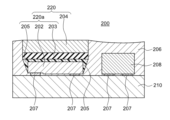
- FIG. 1 is a schematic cross-sectional view showing an example of a light emitting device according to the present embodiment. It is a schematic sectional view showing another example of the light emitting device concerning this embodiment.
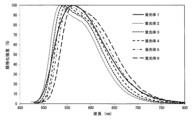
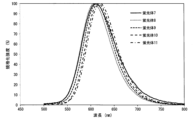
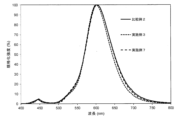
- FIG. 3 is a diagram showing an example of an emission spectrum of a first phosphor. It is a figure which shows the example of the emission spectrum of a 2nd fluorescent substance. It is a figure which shows the example of the emission spectrum of the light-emitting device based on an Example and a comparative example.
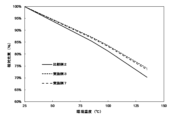
- FIG. 3 is a diagram showing the relationship between environmental temperature and luminous flux maintenance factor in light emitting devices according to Examples and Comparative Examples.
- the term "process” is used not only to refer to an independent process, but also to include a process in which the intended purpose of the process is achieved even if the process cannot be clearly distinguished from other processes.
- the content of each component in the composition means the total amount of the plurality of substances present in the composition, unless otherwise specified, when a plurality of substances corresponding to each component are present in the composition.
- the upper and lower limits of the numerical ranges described in this specification can be arbitrarily selected and combined from the numerical values exemplified as the numerical ranges.
- multiple elements separated by commas (,) indicate that at least one element among these multiple elements is included in the composition. It means to contain.
- the part before the colon (:) represents the host crystal
- the part after the colon (:) represents the activating element.
- the half-width of a phosphor or a light-emitting device means the wavelength width (full width at half-maximum; FWHM) of the emission spectrum where the emission intensity is 50% of the maximum emission intensity in the emission spectrum of the phosphor or the light-emitting device.
- the light-emitting device includes a light-emitting element having an emission peak wavelength within a wavelength range of 380 nm or more and 470 nm or less, and a wavelength conversion member that includes a phosphor that absorbs at least a portion of light from the light-emitting element and emits light.
- the phosphor has an emission peak wavelength within a wavelength range of 535 nm or more and 560 nm or less, has a half-width in the emission spectrum of 100 nm or more and 120 nm or less, and has a first fluorescent substance containing a nitride having a composition containing La, Ce, and Si.
- the light emitting device has a first point whose chromaticity coordinates (x, y) are (0.545, 0.425) and (0.560, 0.440) in the xy chromaticity coordinate system of the CIE 1931 chromaticity diagram.
- a first straight line connecting the first point and the second point Chromaticity coordinates within the area defined by the second straight line connecting the second and third points, the third straight line connecting the third and fourth points, and the fourth straight line connecting the fourth and first points emits light with a
- the wavelength conversion member included in the light emitting device includes a specific first phosphor and a specific second phosphor, thereby maintaining the luminous flux of the light emitting device.
- the decrease in luminous flux in high-temperature environments is effectively suppressed.
- this can be considered as follows. Since the first phosphor and the second phosphor each have their emission peak wavelengths within a specific wavelength range, they increase the components in the wavelength range with high visibility, and increase the components from light blue to red. This makes it possible to achieve desired amber-colored light emission. Further, since the first phosphor and the second phosphor each have a specific composition, the emission peak wavelength can be adjusted to a desired wavelength range while maintaining emission brightness and temperature characteristics.
- a light emitting device emits light having chromaticity coordinates within a specific region in the xy chromaticity coordinate system of the CIE 1931 chromaticity diagram.
- the light emitted by the light emitting device may be amber.
- the amber color of the light emitted by the light emitting device is, for example, the color specified in Agreement Regulation No. 48 (UN_R048) 2.29.3 of the ECE (Economic Commission for Europe) standard, which is a safety standard widely used in Europe. It is.
- the chromaticity coordinates (x, y) of the CIE 1931 chromaticity diagram are a first point whose chromaticity coordinates are (0.545, 0.425), a second point whose chromaticity coordinates are (0.560, 0.440), This is the color of light in a rectangular area whose vertices are the third point at (0.609, 0.390) and the fourth point at (0.597, 0.390).
- the emission spectrum of the light emitting device may have an emission peak wavelength within a wavelength range of 590 nm or more and 620 nm or less, and a half width of 90 nm or less.
- the emission peak wavelength in the emission spectrum of the light-emitting device may preferably be 595 nm or more, or 600 nm or more, and the emission peak wavelength may be 610 nm or less, or 605 nm or less.
- the half width in the emission spectrum of the light emitting device may be preferably 85 nm or less, or 80 nm or less, and may be 70 nm or more, or 75 nm or more.
- the emission spectrum of the light emitting device is measured at room temperature (for example, 25° C.) unless otherwise specified.
- a light emitting device emits light when, in its emission spectrum, the integral value of the luminescent intensity within the wavelength range of 600 nm or more and 800 nm or less is Z1 , and the integral value of the luminescent intensity within the wavelength range of 400 nm or more and less than 600 nm is Z2 .
- the intensity ratio Z 2 /Z 1 may be, for example, 0.600 or more, preferably 0.620 or more, 0.630 or more, 0.652 or more, or 0.660 or more.
- the emission intensity ratio Z 2 /Z 1 may be, for example, 0.750 or less, or 0.730 or less.
- the luminous flux maintenance rate which is the ratio of the luminous flux at an ambient temperature of 135° C. to the luminous flux at an ambient temperature of 25° C., may be greater than 70%, for example.
- the luminous flux maintenance factor may be preferably 71% or more, 72% or more, 73% or more, or 74% or more. Further, the luminous flux maintenance factor may be, for example, 90% or less, 85% or less, or 80% or less.
- the luminous flux maintenance rate is calculated, for example, by measuring the luminous flux when the driving current of the light emitting device is 150 mA.
- FIG. 1 is an example of a schematic cross-sectional view of a light emitting device.
- the light emitting device 100 includes a light emitting element 10 and a wavelength conversion member 50.
- the phosphors 70 included in the wavelength conversion member 50 include, for example, a first phosphor 71 having an emission peak wavelength within a range of 535 nm or more and 560 nm or less, and a second phosphor 72 having an emission peak wavelength within a range of 605 nm or more and less than 620 nm. Contains at least two types of.
- the light emitting device 100 includes a light emitting element 10 made of a gallium nitride compound semiconductor whose emission peak wavelength is within a range of 380 nm or more and 470 nm or less, and a molded body 40 on which the light emitting element 10 is placed.
- the molded body 40 is formed by integrally molding the first lead 20, the second lead 30, and a resin portion 42.
- the molded body 40 can also be formed using ceramics instead of the resin part 42 using a known method.
- the molded body 40 forms a recessed portion having a bottom surface and side surfaces, and the light emitting element 10 is placed on the bottom surface of the recessed portion.
- the light emitting element 10 has a pair of positive and negative electrodes, and the pair of positive and negative electrodes are electrically connected to the first lead 20 and the second lead 30 via wires 60, respectively.
- the light emitting element 10 is covered with a wavelength conversion member 50.
- the wavelength conversion member 50 includes, for example, a phosphor 70 that converts the wavelength of light from the light emitting element 10 and a resin. Contains phosphor.
- FIG. 2 is a schematic cross-sectional view showing another configuration example of the light emitting device.
- the light emitting device 200 includes a light emitting stack 220 having a light emitting surface of the light emitting device 200 and a covering member 206.
- the light emitting layered section 220 is provided on the substrate 210 and includes a light emitting section 220a including a light emitting element 202 and a wavelength conversion member 203.
- the light-emitting laminated portion 220 is covered with a covering member 206 except for the upper surface of the light-transmitting member 204, which is a light exit surface.
- the covering member 206 reflects both the light emitted by the light emitting element 202 and the light emitted by the phosphor included in the wavelength conversion member 203.
- the light emitting element 202 is provided on a substrate 210 via a conductive member 207, and a voltage is applied via wiring formed on the substrate 210 to emit light having an emission peak wavelength within a range of 380 nm or more and 470 nm or less. emanate.
- the wavelength conversion member 203 is provided on the light emitting surface of the light emitting element 202 and converts the wavelength of the light emitted from the light emitting element 202 using the phosphor contained in the wavelength conversion member 203.
- the wavelength conversion member 203 includes at least two types of phosphors, the first phosphor and the second phosphor described above.
- the wavelength conversion member 203 is bonded to the light emitting element via an adhesive layer 205.
- the light emitting device 200 may include a semiconductor element 208 such as a protection element to prevent the light emitting element 202 from being destroyed by application of excessive voltage.
- the semiconductor element 208 may be placed on the substrate 210 via the conductive member 207 and covered with the covering member 206. Note that the semiconductor element 208 herein does not include a light emitting element.
- the semiconductor element 208 is, for example, a Zener diode.
- the light-emitting element has a peak emission wavelength in the range of 380 nm or more and 470 nm or less, and preferably in the range of 420 nm or more and 460 nm or less from the viewpoint of luminous efficiency.
- a light emitting element having an emission peak wavelength in this range as an excitation light source, it is possible to construct a light emitting device that emits mixed color light of light from the light emitting element and fluorescence from the phosphor.
- the loss of light emitted from the light emitting device can be reduced, and a highly efficient light emitting device can be obtained.
- the emission peak wavelength is on the longer wavelength side than the near-ultraviolet region and there are few ultraviolet components, it is excellent in safety and luminous efficiency as a light source.
- the half width of the emission spectrum of the light emitting element can be, for example, 30 nm or less. It is preferable to use a semiconductor light emitting element such as an LED as the light emitting element. By using a semiconductor light emitting element as a light source, it is possible to obtain a stable light emitting device with high efficiency, high linearity of output with respect to input, and strong resistance to mechanical shock.
- a semiconductor light emitting device for example, a semiconductor light emitting device using a nitride semiconductor and emitting light in blue, green, etc. can be used.
- the wavelength conversion member may contain, for example, a phosphor and a resin, but may also contain only a phosphor, or may be made of a phosphor and an inorganic material.
- the wavelength conversion member includes, as phosphors, at least one first phosphor that absorbs light emitted from the light emitting element and emits yellow light, and at least one second phosphor that emits red light.
- the first phosphor and the second phosphor have different compositions. By appropriately selecting the composition ratio of the first phosphor and the second phosphor, characteristics such as luminous efficiency of the light emitting device and chromaticity coordinates of emitted light can be set within a desired range.
- the resin constituting the wavelength conversion member examples include silicone resin, epoxy resin, modified silicone resin, modified epoxy resin, and acrylic resin.
- the refractive index of the silicone resin may be in the range of 1.35 or more and 1.55 or less, more preferably 1.38 or more and 1.43 or less. If the refractive index of the silicone resin is within these ranges, it has excellent light transmittance and can efficiently extract light to the outside of the light emitting device, so it can be suitably used.
- the refractive index of the silicone resin here is the refractive index after curing, and is measured in accordance with JIS K7142:2008.
- the wavelength conversion member may further contain a light diffusing material.
- the directivity from the light emitting element can be relaxed and the viewing angle can be increased.
- the light diffusing material include inorganic materials such as silicon oxide, titanium oxide, zinc oxide, zirconium oxide, and aluminum oxide.
- the first phosphor may have an emission peak wavelength within a range of 535 nm or more and 560 nm or less.
- the emission peak wavelength of the first phosphor may be preferably 540 nm or more, 543 nm or more, or 545 nm or more, and preferably 555 nm or less, or 550 nm or less.
- the half width of the emission peak of the first phosphor may be, for example, 100 nm or more and 120 nm or less, preferably 105 nm or more, or 110 nm or more, and preferably 115 nm or less.
- the first phosphor may be, for example, a yellow phosphor that emits light in a yellow region.
- the first phosphor includes a nitride having a composition containing at least lanthanum (La), cerium (Ce), and silicon (Si), and includes at least one rare earth element selected from La and rare earth elements other than Ce.
- the nitride may further include the element M1 .
- rare earth elements other than La and Ce represented by M1 include scandium (Sc), yttrium (Y), praseodymium (Pr), neodymium (Nd), samarium (Sm), europium (Eu), and gadolinium (Gd).
- Element M1 may contain at least one selected from the group consisting of Y, Gd, and Lu, and may contain at least Y.
- the composition of the nitride contained in the first phosphor is, for example, when the number of moles of Si is 6, the total number of moles of La, Ce, and M1 is 2.7 to 3.3, and the mole of M1 is 2.7 to 3.3. number may be 0 or more and 1.2 or less, the number of moles of nitrogen atoms (N) may be 10 or more and 12 or less, and the number of moles of Ce may be greater than 0 and 1.2 or less.
- the composition of the nitride contained in the first phosphor may be such that when the number of moles of Si is 6, the total number of moles of La, Ce, and M1 is preferably 2.8 or more, or 2.9 or more.
- the composition of the nitride contained in the first phosphor is such that when the number of moles of Si is 6, the number of moles of M1 may preferably be 0.1 or more, or 0.3 or more, and 1.0 or less, or 0.8 or less. In the composition of the nitride contained in the first phosphor, when the number of moles of Si is 6, the number of moles of N may preferably be 10.3 or more, or 10.5 or more, and 11.5 or less. , or 11.3 or less.
- composition of the nitride contained in the first phosphor is such that when the number of moles of Si is 6, the number of moles of Ce may preferably be 0.15 or more, or 0.3 or more, and 1.0 or less. , or 0.9 or less.
- the nitride included in the first phosphor may have a theoretical composition expressed by the following formula (1a), for example.
- M 1 represents at least one element selected from rare earth elements other than La and Ce.
- the total molar content of Y, Gd and Lu in M 1 may be, for example, 90 mol% or more, 95 mol% or more, or 99 mol% or more.
- m may be greater than or equal to 0.1, or greater than or equal to 0.3, and may be less than or equal to 1.0, or less than or equal to 0.8.
- the nitride included in the first phosphor may have a theoretical composition substantially represented by the following formula (1b), for example.
- m may be 0.1 or more, or 0.3 or more, and may be 1.0 or less, or 0.8 or less
- the content of the first phosphor in the wavelength conversion member may be, for example, 20% by mass or more and 65% by mass or less with respect to the total mass of the phosphors included in the wavelength conversion member.
- the content of the first phosphor may be preferably 25% by mass or more, or 30% by mass or more, and preferably 60% by mass or less, or 55% by mass or less.
- the wavelength conversion member may contain only one type of first phosphor, or may contain a combination of two or more types.
- the second phosphor may have an emission peak wavelength within a range of 605 nm or more and less than 620 nm.
- the emission peak wavelength of the second phosphor may be preferably 607 nm or more, 608 nm or more, or 610 nm or more, and preferably 618 nm or less, 617 nm or less, or 615 nm or less.
- the half width of the emission peak of the second phosphor may be, for example, 70 nm or more and 80 nm or less, preferably 72 nm or more, and preferably 77 nm or less and 75 nm or less.
- the second phosphor may be, for example, a red phosphor that emits light in a red region.
- the difference in emission peak wavelength between the second phosphor and the first phosphor may be, for example, 85 nm or less, preferably 75 nm or less, or 70 nm or less.
- the difference in emission peak wavelength between the second phosphor and the first phosphor may be, for example, 45 nm or more, or 55 nm or more.
- the second phosphor is a nitride having a composition containing at least one of calcium (Ca) and strontium (Sr), europium (Eu), silicon (Si), aluminum (Al), and nitrogen (N).
- the nitride may further include at least one element M 2 selected from Group 2 elements other than Ca and Sr in its composition.
- Element M2 may include at least one selected from the group consisting of Ba and Mg.
- the composition of the nitride contained in the second phosphor is, for example, when the number of moles of Al is 1, the number of moles of Ca is greater than 0 and less than 1, the number of moles of Sr is greater than 0 and less than 1, and the number of moles of Sr is greater than 0 and less than 1, and Eu
- the number of moles of Ca, Sr and Eu is 0.8 or more and 1.1 or less, and the number of moles of Si is 0.8 or more and 1.2 or less.
- the number of moles of nitrogen atoms (N) may be 2.5 or more and 3.2 or less.
- the composition of the nitride contained in the second phosphor is such that when the number of moles of Al is 1, the number of moles of Ca is preferably 0.01 or more, or 0.02 or more, and 0.4 or less. Or it may be 0.2 or less.
- the composition of the nitride contained in the second phosphor is such that when the number of moles of Al is 1, the number of moles of Sr is preferably 0.6 or more, or 0.8 or more, and 0.99 or less. Or it may be 0.98 or less.
- the composition of the nitride contained in the second phosphor is preferably such that the number of moles of Eu is 0.0025 or more, or 0.003 or more, and 0.07 or less, when the number of moles of Al is 1.
- the composition of the nitride contained in the second phosphor may be such that, when the number of moles of Al is 1, the total number of moles of Ca, Sr, and Eu is preferably 0.85 or more, or 0.90 or more, and It may be 1.08 or less, or 1.06 or less.
- the composition of the nitride contained in the second phosphor is such that when the number of moles of Al is 1, the number of moles of Si is preferably 0.85 or more, or 0.9 or more, and 1.18 or less. Or it may be 1.15 or less.
- composition of the nitride contained in the second phosphor is such that when the number of moles of Al is 1, the number of moles of N may preferably be 2.55 or more, or 2.6 or more, and 3.15 or less. Or it may be 3.1 or less.
- the nitride included in the second phosphor may have a theoretical composition expressed by the following formula (2a), for example.
- M 2 represents at least one element selected from the group consisting of Ca, Ba, and Mg.
- the molar content of Ca in M2 may be, for example, 80 mol% or more, or 90 mol% or more.
- n may be greater than or equal to 0.6, or greater than or equal to 0.8, and may be less than or equal to 0.99, or less than or equal to 0.98.
- the nitride included in the second phosphor may have a theoretical composition substantially represented by the following formula (2b), for example, when M 2 is Ca in the above formula (1a).
- n may be 0.6 or more, or 0.8 or more, and may be 0.99 or less, or 0.98 or less.
- the content of the second phosphor in the wavelength conversion member may be, for example, 35% by mass or more and 80% by mass or less with respect to the total mass of the phosphors included in the wavelength conversion member.
- the content of the second phosphor may be preferably 40% by mass or more, or 45% by mass or more, and preferably 75% by mass or less, or 70% by mass or less.
- the wavelength conversion member may contain only one type of second phosphor, or may contain a combination of two or more types.
- the ratio of the content of the second phosphor to the total content of the first phosphor and the second phosphor may be, for example, 35% by mass or more and 80% by mass or less.
- the ratio of the content of the second phosphor to the total content of the first phosphor and the second phosphor in the wavelength conversion member may preferably be 40% by mass or more, 45% by mass or more, or 50% by mass or more. , and preferably 75% by mass or less, or 70% by mass or less.
- the wavelength conversion member may contain other fluorescent substances in addition to the first fluorescent substance and the second fluorescent substance.
- Other phosphors may have an emission peak wavelength in a wavelength range of 450 nm or more and 680 nm or less, for example.
- Examples of other phosphors include (Y, Gd, Lu) 3 (Al, Ga) 5 O 10 , (Ca, Sr, Ba) 2 Si 5 N 8 , (Ca, Sr, Ba) Si 2 O 2 It may contain at least one member selected from the group consisting of phosphors having compositions such as N 2 , (Ca, Sr, Ba) 2 SiO 4 , ⁇ -sialon, and ⁇ -sialon.
- the activator contained in these phosphors is preferably Ce or Eu, and more preferably Ce.
- the present invention provides the use of the first phosphor and the second phosphor in manufacturing the above-mentioned light-emitting device, the use of the first phosphor and the second phosphor in the above-mentioned light-emitting device, and the use of the first phosphor and the second phosphor in the above-mentioned light-emitting device. It also includes the first phosphor and second phosphor used.
- a phosphor 1 having a theoretical composition represented by Y 3 Al 5 O 12 :Ce (hereinafter sometimes abbreviated as YAG) and La 3 Si 6 N 11 :Ce (hereinafter sometimes abbreviated as YAG) were used.
- a phosphor 2 having a theoretical composition expressed as Phosphors 3 to 6 having a theoretical composition represented by (hereinafter sometimes abbreviated as LYSN) were prepared.
- LYSN a theoretical composition expressed as Ba k Sr (2-k) Si 5 N 8 :Eu (0.80 ⁇ k ⁇ 1.50; hereinafter sometimes abbreviated as BSESN).
- Fluorescent material 7 and a fluorescent material having different emission peak wavelengths and a theoretical composition represented by Sr n Ca (1-n) AlSiN 3 :Eu (0 ⁇ n ⁇ 1; hereinafter sometimes abbreviated as SCASN) Bodies 8 to 11 were prepared.
- the xy chromaticity coordinates, relative brightness (Y), relative emission energy (ENG), emission peak wavelength ( ⁇ p), and half-width of the CIE1931 chromaticity diagram were measured using a quantum efficiency measurement system (QE-2000; Otsuka Measurement was carried out at 25°C using an electronic device (manufactured by Denshi). The results are shown in Table 1. Note that relative brightness (Y) and relative emission energy (ENG) were relative values with phosphor 1 (YAG) as 100%. Furthermore, the ENG maintenance rate (%) was calculated by dividing the ENG at 150°C by the ENG at 25°C. The results are shown in Table 1. Furthermore, the emission spectra of each phosphor normalized by the maximum emission energy of each phosphor are shown in Figures 3 and 4.
- phosphors 2 to 5 have an emission peak wavelength in the wavelength range of 535 nm or more and 560 nm or less, a half width in the emission spectrum of 100 nm or more and 120 nm or less, and contain a nitride having the above composition (1a). Therefore, it can be seen that this corresponds to the first phosphor described above.
- the phosphors 8 to 10 have an emission peak wavelength in a wavelength range of 605 nm or more and less than 620 nm, a half width in the emission spectrum of 70 nm or more and 80 nm or less, and contain a nitride having the above composition (2a). It can be seen that this corresponds to the second phosphor described above.
- Example 1 An LED chip made of a nitride semiconductor and having an emission peak wavelength of 455 nm was prepared as a light emitting element. As shown in FIG. 1, the light emitting element 10 was placed on the bottom surface of the concave molded body 40, and the light emitting element 10 was connected to the first lead 20 and the second lead 30 with wires 60, respectively. Phosphor 2, which is a yellow phosphor, and phosphor 9, which is a red phosphor, are expressed so that the chromaticity coordinates (x, y) of the mixed color light emitted by the light emitting device are (0.563, 0.416).
- a composition for a wavelength conversion member was obtained by adding and mixing the mixtures in the silicone resin and dispersing the phosphor in the silicone resin. This composition for a wavelength conversion member was injected into the recessed portion of the molded body 40, and the silicone resin was cured to form a wavelength conversion member 50, thereby obtaining a light emitting device 100.
- Examples 2 to 11, Comparative Examples 1 to 5 Light-emitting devices were obtained in the same manner as in Example 1, except that the type and mixing ratio of the phosphors used were changed as shown in Table 2. Note that the mixing ratio (%) listed in Table 2 is the ratio (%) of the mass of each phosphor when the total mass of the yellow phosphor and red phosphor is 100%.
- Example 7 the emission spectra normalized by the maximum emission intensity in each emission spectrum are shown in FIG.
- Relative luminous flux The light emitting devices obtained in Examples 1 to 11 and Comparative Examples 1 to 4 were made to emit light at a driving current of 150 mA in a room temperature (25° C.) environment. The total luminous flux of each light emitting device was measured by a total luminous flux measuring device using an integrating sphere, and the relative luminous flux (Po; %) of each light emitting device was determined when the total luminous flux of the light emitting device of Comparative Example 2 was taken as 100%. was calculated.
- Luminous Flux Maintenance Rate Regarding the light emitting devices obtained in Examples 1 to 11 and Comparative Examples 1 to 4, the light emitting devices were placed in a constant temperature bath, and the ambient (atmosphere) temperature Ta and Tj (junction temperature) of the light emitting element were approximately
- the ratio of the total luminous flux at 135°C to the total luminous flux at 25°C was calculated as the luminous flux maintenance rate (%).
- the relative luminous flux (%) of each light emitting device at 135° C. was calculated by setting the total luminous flux of the light emitting device of Comparative Example 2 at 135° C. as 100%. The results are shown in Table 3.
- Luminous flux maintenance rate For each of the light emitting devices obtained in Example 3, Example 7, and Comparative Example 2, the total luminous flux when emitting light with a drive current of 150 mA in a room temperature (25°C) environment at 85°C and 100°C The ratio of the total luminous flux in each environment of 135° C. and 135° C. was calculated as the luminous flux maintenance rate (%).
- FIG. 6 shows changes in relative luminous flux (%) with respect to environmental temperature for the light emitting devices according to Example 3, Example 7, and Comparative Example 2.
- the light emitting devices of Examples 3, 4, and 7 have higher luminous fluxes at room temperature (25° C.) than the light emitting device of Comparative Example 2, which is the standard. Furthermore, the light emitting devices of Examples 1 to 11 in which LYSN and SCASN are combined have higher luminous flux maintenance rates than the light emitting device of Comparative Example 2. Furthermore, it can be seen that the relative luminous flux in a high temperature state is higher in the light emitting devices of any of the examples than in the light emitting device of Comparative Example 2.
- the optimal emission peak wavelength for each of LYSN and SCASN is preferably 535 nm or more and 555 nm, since the relative luminous flux of the example using phosphors 3, 4, and 5 is higher than that of the comparative example using phosphor 6. Since the relative luminous flux is higher in the examples using phosphors 3 and 4 than in the other examples, it can be seen that the range is more preferably 545 nm or more and 550 nm or less.
- the examples and comparative examples that use phosphors 8 and 9, respectively, have higher relative luminous fluxes than the examples and comparative examples that use phosphors 10 and 11.
- the optimal emission peak wavelength in SCASN is preferably 608 nm or more and 615 nm or less, and the example using phosphor 8 has a higher relative luminous flux than the example using phosphor 9. Therefore, it is more preferably 608 nm or more and 610 nm or less.
- the half width of the emission spectrum can be narrowed by combining LYSN and SCASN.
- the emission intensity of LYSN on the long wavelength side which is disadvantageous for improving the luminous flux of the light emitting device, is lower than that of BSESN. From this, it is considered that the combination of LYSN and SCASN is advantageous in improving the luminous flux of the light emitting device in terms of the shape of the spectrum in the light emitting device that emits amber color.
- the phosphors to be combined not only have high luminance as a phosphor, but also have a narrow half-width in the emission spectrum and have a small difference in peak emission wavelength between the first phosphor and the second phosphor.
- a spectrum with a narrow half-width in a light-emitting device that emits amber color can be formed.
- the light emitting device of the present disclosure can be used, for example, as a vehicle marker light, a display device, a lighting fixture, a display, a backlight light source for a liquid crystal display, and the like.
Landscapes
- Chemical & Material Sciences (AREA)
- Inorganic Chemistry (AREA)
- Engineering & Computer Science (AREA)
- Materials Engineering (AREA)
- Organic Chemistry (AREA)
- Luminescent Compositions (AREA)
- Led Device Packages (AREA)
Priority Applications (3)
| Application Number | Priority Date | Filing Date | Title |
|---|---|---|---|
| US18/845,146 US20250204104A1 (en) | 2022-03-11 | 2023-02-14 | Light-emitting device |
| DE112023001337.3T DE112023001337T5 (de) | 2022-03-11 | 2023-02-14 | Lichtemittierende Vorrichtung |
| JP2024505979A JPWO2023171254A1 (https=) | 2022-03-11 | 2023-02-14 |
Applications Claiming Priority (2)
| Application Number | Priority Date | Filing Date | Title |
|---|---|---|---|
| JP2022-038394 | 2022-03-11 | ||
| JP2022038394 | 2022-03-11 |
Publications (1)
| Publication Number | Publication Date |
|---|---|
| WO2023171254A1 true WO2023171254A1 (ja) | 2023-09-14 |
Family
ID=87936739
Family Applications (1)
| Application Number | Title | Priority Date | Filing Date |
|---|---|---|---|
| PCT/JP2023/004950 Ceased WO2023171254A1 (ja) | 2022-03-11 | 2023-02-14 | 発光装置 |
Country Status (4)
| Country | Link |
|---|---|
| US (1) | US20250204104A1 (https=) |
| JP (1) | JPWO2023171254A1 (https=) |
| DE (1) | DE112023001337T5 (https=) |
| WO (1) | WO2023171254A1 (https=) |
Cited By (1)
| Publication number | Priority date | Publication date | Assignee | Title |
|---|---|---|---|---|
| JP2023145094A (ja) * | 2022-03-28 | 2023-10-11 | サンケン電気株式会社 | 発光装置 |
Citations (4)
| Publication number | Priority date | Publication date | Assignee | Title |
|---|---|---|---|---|
| WO2009051137A1 (ja) * | 2007-10-17 | 2009-04-23 | Stanley Electric Co., Ltd. | 発光装置、それを用いた車両用灯具、およびヘッドランプ |
| JP2011044738A (ja) * | 2010-11-16 | 2011-03-03 | Nichia Corp | 発光装置 |
| JP2012142293A (ja) * | 2012-02-20 | 2012-07-26 | Koito Mfg Co Ltd | 車両用標識灯 |
| JP2021057480A (ja) * | 2019-09-30 | 2021-04-08 | 日亜化学工業株式会社 | 発光装置 |
Family Cites Families (2)
| Publication number | Priority date | Publication date | Assignee | Title |
|---|---|---|---|---|
| JP5006549B2 (ja) | 2006-02-07 | 2012-08-22 | 株式会社小糸製作所 | 車両用標識灯 |
| JP2022038394A (ja) | 2020-08-26 | 2022-03-10 | 株式会社クボタ | パン、パン生地、麺、麺生地、ピザ、ピザ生地、まんじゅう、まんじゅう生地、ケーキ、又は、ケーキ生地、及び、パン、パン生地、麺、麺生地、ピザ、ピザ生地、まんじゅう、まんじゅう生地、ケーキ、又は、ケーキ生地の製造方法 |
-
2023
- 2023-02-14 JP JP2024505979A patent/JPWO2023171254A1/ja active Pending
- 2023-02-14 DE DE112023001337.3T patent/DE112023001337T5/de active Pending
- 2023-02-14 US US18/845,146 patent/US20250204104A1/en active Pending
- 2023-02-14 WO PCT/JP2023/004950 patent/WO2023171254A1/ja not_active Ceased
Patent Citations (4)
| Publication number | Priority date | Publication date | Assignee | Title |
|---|---|---|---|---|
| WO2009051137A1 (ja) * | 2007-10-17 | 2009-04-23 | Stanley Electric Co., Ltd. | 発光装置、それを用いた車両用灯具、およびヘッドランプ |
| JP2011044738A (ja) * | 2010-11-16 | 2011-03-03 | Nichia Corp | 発光装置 |
| JP2012142293A (ja) * | 2012-02-20 | 2012-07-26 | Koito Mfg Co Ltd | 車両用標識灯 |
| JP2021057480A (ja) * | 2019-09-30 | 2021-04-08 | 日亜化学工業株式会社 | 発光装置 |
Cited By (2)
| Publication number | Priority date | Publication date | Assignee | Title |
|---|---|---|---|---|
| JP2023145094A (ja) * | 2022-03-28 | 2023-10-11 | サンケン電気株式会社 | 発光装置 |
| JP7838362B2 (ja) | 2022-03-28 | 2026-04-01 | サンケン電気株式会社 | 発光装置 |
Also Published As
| Publication number | Publication date |
|---|---|
| DE112023001337T5 (de) | 2024-12-19 |
| JPWO2023171254A1 (https=) | 2023-09-14 |
| US20250204104A1 (en) | 2025-06-19 |
Similar Documents
| Publication | Publication Date | Title |
|---|---|---|
| JP5080723B2 (ja) | 半導体発光装置 | |
| CN113725342B (zh) | 用于一般照明及显示器背光的磷光体转换白光发光装置和光致发光化合物 | |
| JP4559496B2 (ja) | 発光装置 | |
| TWI429731B (zh) | 由4價錳離子活化之發紅光錯合氟化磷光體 | |
| JP4911578B2 (ja) | 酸窒化物蛍光体および発光装置 | |
| JP5511820B2 (ja) | アルファ−サイアロン発光体 | |
| CN101184823B (zh) | 包括补偿彩色缺陷的发光材料的照明系统 | |
| US10199547B2 (en) | Red phosphor and light emitting device including the same | |
| CN102741376B (zh) | 磷光体转换led | |
| US20100283381A1 (en) | Phosphor and light emitting device | |
| CN101180381A (zh) | 用于基于led的照明的红色磷光体 | |
| CN102782887A (zh) | 卤磷酸盐荧光体及白色发光装置 | |
| JP2008533233A (ja) | 放射線源とルミネッセンス材料を含む照明システム | |
| TW201809221A (zh) | 發光裝置 | |
| JP5370047B2 (ja) | 白色発光装置のための演色性改善方法および白色発光装置 | |
| US20190181308A1 (en) | Light emitting device | |
| JP2010270196A (ja) | 蛍光体及び蛍光体の製造方法、並びに、蛍光体含有組成物、発光装置、照明装置、画像表示装置及び蛍光塗料 | |
| US9163176B2 (en) | Phosphor mixture, optoelectronic component comprising a phosphor mixture, and street lamp comprising a phosphor mixture | |
| JP6637449B2 (ja) | オキシフッ化物蛍光体組成物及びその照明装置 | |
| KR20150067711A (ko) | 형광체와 이를 포함하는 발광 소자 | |
| WO2023171254A1 (ja) | 発光装置 | |
| CN108352430A (zh) | 光电子器件和用于显示器的背景照明装置 | |
| KR101176212B1 (ko) | 알카리 토류 포스포러스 나이트라이드계 형광체와 그 제조방법 및 이를 이용한 발광장치 | |
| JP2013144794A (ja) | 酸窒化物系蛍光体およびこれを用いた発光装置 | |
| WO2012157998A2 (ko) | 형광체, 발광장치, 면광원 장치, 디스플레이 장치 및 조명장치 |
Legal Events
| Date | Code | Title | Description |
|---|---|---|---|
| 121 | Ep: the epo has been informed by wipo that ep was designated in this application |
Ref document number: 23766434 Country of ref document: EP Kind code of ref document: A1 |
|
| ENP | Entry into the national phase |
Ref document number: 2024505979 Country of ref document: JP Kind code of ref document: A |
|
| WWE | Wipo information: entry into national phase |
Ref document number: 112023001337 Country of ref document: DE |
|
| 122 | Ep: pct application non-entry in european phase |
Ref document number: 23766434 Country of ref document: EP Kind code of ref document: A1 |
|
| WWP | Wipo information: published in national office |
Ref document number: 18845146 Country of ref document: US |