WO2023171045A1 - 電解コンデンサ素子及び電解コンデンサ - Google Patents
電解コンデンサ素子及び電解コンデンサ Download PDFInfo
- Publication number
- WO2023171045A1 WO2023171045A1 PCT/JP2022/042651 JP2022042651W WO2023171045A1 WO 2023171045 A1 WO2023171045 A1 WO 2023171045A1 JP 2022042651 W JP2022042651 W JP 2022042651W WO 2023171045 A1 WO2023171045 A1 WO 2023171045A1
- Authority
- WO
- WIPO (PCT)
- Prior art keywords
- metal foil
- electrolytic capacitor
- layer
- carbon
- inorganic filler
- Prior art date
- Legal status (The legal status is an assumption and is not a legal conclusion. Google has not performed a legal analysis and makes no representation as to the accuracy of the status listed.)
- Ceased
Links
Images





Classifications
-
- H—ELECTRICITY
- H01—ELECTRIC ELEMENTS
- H01G—CAPACITORS; CAPACITORS, RECTIFIERS, DETECTORS, SWITCHING DEVICES, LIGHT-SENSITIVE OR TEMPERATURE-SENSITIVE DEVICES OF THE ELECTROLYTIC TYPE
- H01G9/00—Electrolytic capacitors, rectifiers, detectors, switching devices, light-sensitive or temperature-sensitive devices; Processes of their manufacture
- H01G9/004—Details
- H01G9/08—Housing; Encapsulation
- H01G9/10—Sealing, e.g. of lead-in wires
-
- H—ELECTRICITY
- H01—ELECTRIC ELEMENTS
- H01G—CAPACITORS; CAPACITORS, RECTIFIERS, DETECTORS, SWITCHING DEVICES, LIGHT-SENSITIVE OR TEMPERATURE-SENSITIVE DEVICES OF THE ELECTROLYTIC TYPE
- H01G9/00—Electrolytic capacitors, rectifiers, detectors, switching devices, light-sensitive or temperature-sensitive devices; Processes of their manufacture
- H01G9/004—Details
- H01G9/008—Terminals
- H01G9/012—Terminals specially adapted for solid capacitors
-
- H—ELECTRICITY
- H01—ELECTRIC ELEMENTS
- H01G—CAPACITORS; CAPACITORS, RECTIFIERS, DETECTORS, SWITCHING DEVICES, LIGHT-SENSITIVE OR TEMPERATURE-SENSITIVE DEVICES OF THE ELECTROLYTIC TYPE
- H01G9/00—Electrolytic capacitors, rectifiers, detectors, switching devices, light-sensitive or temperature-sensitive devices; Processes of their manufacture
- H01G9/004—Details
- H01G9/04—Electrodes or formation of dielectric layers thereon
- H01G9/042—Electrodes or formation of dielectric layers thereon characterised by the material
-
- H—ELECTRICITY
- H01—ELECTRIC ELEMENTS
- H01G—CAPACITORS; CAPACITORS, RECTIFIERS, DETECTORS, SWITCHING DEVICES, LIGHT-SENSITIVE OR TEMPERATURE-SENSITIVE DEVICES OF THE ELECTROLYTIC TYPE
- H01G9/00—Electrolytic capacitors, rectifiers, detectors, switching devices, light-sensitive or temperature-sensitive devices; Processes of their manufacture
- H01G9/004—Details
- H01G9/04—Electrodes or formation of dielectric layers thereon
- H01G9/042—Electrodes or formation of dielectric layers thereon characterised by the material
- H01G9/0425—Electrodes or formation of dielectric layers thereon characterised by the material specially adapted for cathode
-
- H—ELECTRICITY
- H01—ELECTRIC ELEMENTS
- H01G—CAPACITORS; CAPACITORS, RECTIFIERS, DETECTORS, SWITCHING DEVICES, LIGHT-SENSITIVE OR TEMPERATURE-SENSITIVE DEVICES OF THE ELECTROLYTIC TYPE
- H01G9/00—Electrolytic capacitors, rectifiers, detectors, switching devices, light-sensitive or temperature-sensitive devices; Processes of their manufacture
- H01G9/004—Details
- H01G9/04—Electrodes or formation of dielectric layers thereon
- H01G9/048—Electrodes or formation of dielectric layers thereon characterised by their structure
-
- H—ELECTRICITY
- H01—ELECTRIC ELEMENTS
- H01G—CAPACITORS; CAPACITORS, RECTIFIERS, DETECTORS, SWITCHING DEVICES, LIGHT-SENSITIVE OR TEMPERATURE-SENSITIVE DEVICES OF THE ELECTROLYTIC TYPE
- H01G9/00—Electrolytic capacitors, rectifiers, detectors, switching devices, light-sensitive or temperature-sensitive devices; Processes of their manufacture
- H01G9/004—Details
- H01G9/04—Electrodes or formation of dielectric layers thereon
- H01G9/048—Electrodes or formation of dielectric layers thereon characterised by their structure
- H01G9/055—Etched foil electrodes
-
- H—ELECTRICITY
- H01—ELECTRIC ELEMENTS
- H01G—CAPACITORS; CAPACITORS, RECTIFIERS, DETECTORS, SWITCHING DEVICES, LIGHT-SENSITIVE OR TEMPERATURE-SENSITIVE DEVICES OF THE ELECTROLYTIC TYPE
- H01G9/00—Electrolytic capacitors, rectifiers, detectors, switching devices, light-sensitive or temperature-sensitive devices; Processes of their manufacture
- H01G9/15—Solid electrolytic capacitors
Definitions
- the present invention relates to an electrolytic capacitor element and an electrolytic capacitor.
- Patent Document 1 discloses an anode body, a dielectric layer covering at least a portion of the anode body, a solid electrolyte layer covering at least a portion of the dielectric layer, and a cathode covering at least a portion of the solid electrolyte layer.
- an electrolytic capacitor is disclosed in which the carbon layer includes carbon particles and silver.
- a metal foil such as aluminum is used as the anode body.
- the metal foil When moisture enters an electrolytic capacitor provided with metal foil, the metal foil is corroded, causing a problem of LC failure (leakage current failure). In particular, moisture may reach the metal foil through the carbon layer, and it has been desired to prevent moisture from entering through this route.
- the present invention has been made to solve the above problems, and an object of the present invention is to provide an electrolytic capacitor element and an electrolytic capacitor that can prevent corrosion of metal foil due to moisture intrusion.
- the electrolytic capacitor element of the present invention includes a valve metal base having a core made of metal foil, a porous part formed along the surface of the metal foil, and a dielectric material formed on the porous part.
- an electrolytic capacitor element comprising: a solid electrolyte layer formed on the dielectric layer; and a conductive layer formed on the solid electrolyte layer, the conductive layer comprising a carbon layer;
- the carbon layer includes a carbon filler and a scale-like insulating inorganic filler, and in a cut surface of the electrolytic capacitor element cut in a direction perpendicular to the main surface of the metal foil, the carbon layer contains a carbon filler and a scale-like insulating inorganic filler.
- the average value of acute angles is 0° or more and 45° or less It is.
- the electrolytic capacitor of the present invention includes a laminate in which a plurality of electrolytic capacitor elements of the present invention are stacked, an anode external electrode, and a cathode external electrode.
- an electrolytic capacitor element and an electrolytic capacitor that can prevent corrosion of metal foil due to moisture intrusion.
- FIG. 1 is a perspective view schematically showing an example of a laminate in which a plurality of electrolytic capacitor elements are stacked.
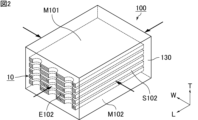
- FIG. 2 is a perspective view schematically showing an example of a laminate in which a plurality of electrolytic capacitor elements are stacked.
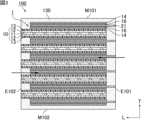
- FIG. 3 is a cross-sectional view schematically showing an example of a laminate in which a plurality of electrolytic capacitor elements are stacked.
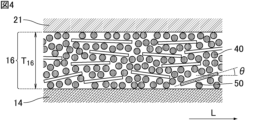
- FIG. 4 is an enlarged cross-sectional view schematically showing an example of a carbon layer.
- FIG. 5 is a schematic diagram showing how a maze effect is exerted by a scale-like insulating inorganic filler.
- FIG. 6 is a perspective view schematically showing the shape of a scale-like insulating inorganic filler.
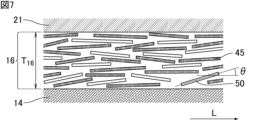
- FIG. 7 is an enlarged cross-sectional view schematically showing another example of the carbon layer.
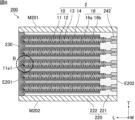
- FIG. 8 is a LT plane cross-sectional view schematically showing another example of a laminate in which a plurality of electrolytic capacitor elements are stacked.
- FIG. 9 is an enlarged cross-sectional view schematically showing a region surrounded by region B in FIG.
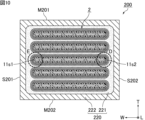
- FIG. 10 is a WT plane cross-sectional view schematically showing an example of a laminate in which a plurality of electrolytic capacitor elements are stacked.
- FIG. 11 is an enlarged cross-sectional view schematically showing a region surrounded by region D in FIG.
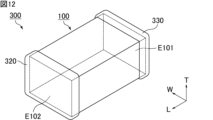
- FIG. 12 is a perspective view schematically showing an example of an electrolytic capacitor.
- the electrolytic capacitor element and electrolytic capacitor of the present invention will be explained below.
- the present invention is not limited to the following configuration, and can be modified and applied as appropriate without changing the gist of the present invention.
- the present invention also includes a combination of two or more of the individual desirable configurations of the present invention described below.
- the electrolytic capacitor element of the present invention includes a valve metal base having a core made of metal foil, a porous part formed along the surface of the metal foil, and a dielectric material formed on the porous part.
- an electrolytic capacitor element comprising: a solid electrolyte layer formed on the dielectric layer; and a conductive layer formed on the solid electrolyte layer, the conductive layer comprising a carbon layer;
- the carbon layer includes a carbon filler and a scale-like insulating inorganic filler, and in a cut surface of the electrolytic capacitor element cut in a direction perpendicular to the main surface of the metal foil, the carbon layer contains a carbon filler and a scale-like insulating inorganic filler.
- the average value of acute angles is 0° or more and 45° or less It is.
- FIG. 1 and 2 are perspective views schematically showing an example of a laminate in which a plurality of electrolytic capacitor elements are stacked.
- the first end surface E101 which is the end surface on the cathode side
- the second end surface E102 which is the end surface on the anode side
- the laminate 100 has a first main surface M101 and a second main surface M102 that face each other in the stacking direction (T direction), and a first end face E101 and a second main surface that face each other in the length direction (L direction) perpendicular to the stacking direction. 2, and a first side surface S101 and a second side surface S102 that face each other in the width direction (W direction) perpendicular to the stacking direction and the length direction.
- the direction of moisture intrusion that is of interest in this specification is the direction shown by the arrow in FIGS. 1 and 2.
- the present specification focuses on preventing corrosion of the metal foil due to moisture intrusion from the first end surface E101, the second end surface E102, the first side surface S101, or the second side surface S102 of the laminate. .
- Intrusion of moisture into the laminate 100 can occur at various times, such as during storage of the laminate and storage after forming external electrodes on the laminate to form an electrolytic capacitor.
- FIG. 3 is a cross-sectional view schematically showing an example of a laminate in which a plurality of electrolytic capacitor elements are laminated, and is cut along a plane along the length direction (L direction) and the lamination direction (T direction) of the laminate.
- FIG. FIG. 3 is also a cross-sectional view taken along line AA in FIG. Also in FIG. 3, arrows indicate directions in which moisture enters from the first end surface E101 and the second end surface E102 of the laminate 100.
- the electrolytic capacitor element 1 shown in FIG. 3 includes a valve metal base 10 having a core portion 11 made of metal foil, a porous portion 12 formed along the surface of the metal foil, and a valve metal base 10 formed on the porous portion 12.
- a solid electrolyte layer 14 is formed on the dielectric layer 13, and a conductive layer 16 is formed on the solid electrolyte layer 14.
- the core portion 11 of the valve metal base 10 is drawn out to the second end surface E102 of the laminate 100, and constitutes an anode side end surface.
- the core portion 11 is connected to the anode external electrode at the second end surface E102 of the laminate 100.
- valve metal base is made of a valve metal that exhibits so-called valve action.
- valve metals include simple metals such as aluminum, tantalum, niobium, titanium, and zirconium, and alloys containing these metals. Among these, aluminum or aluminum alloy is preferred.
- the core that constitutes the valve metal base is metal foil.
- the porous portion include an etching layer formed on the surface of the valve metal base, and a porous layer formed on the surface of the valve metal base by printing and sintering.
- an etched layer is preferred, and when the valve metal is titanium or a titanium alloy, a porous layer is preferred.
- the dielectric layer formed on the surface of the porous portion is porous reflecting the surface condition of the porous portion, and has a finely uneven surface shape.
- the dielectric layer is preferably made of an oxide film of the valve metal.
- a chemically formed foil that has been previously subjected to a chemical conversion treatment may be used as the valve metal base on which the dielectric layer is formed.
- Examples of the material constituting the solid electrolyte layer include conductive polymers having skeletons such as pyrroles, thiophenes, and anilines.
- Examples of conductive polymers with thiophene skeletons include PEDOT [poly(3,4-ethylenedioxythiophene)], and PEDOT:PSS complexed with polystyrene sulfonic acid (PSS) as a dopant. It may be.
- the solid electrolyte layer is formed by forming a polymer film of poly(3,4-ethylenedioxythiophene) or the like on the surface of the dielectric layer using a treatment liquid containing a monomer such as 3,4-ethylenedioxythiophene.
- the dielectric layer is formed by applying a dispersion of a polymer such as poly(3,4-ethylenedioxythiophene) to the surface of the dielectric layer and drying it. Note that after forming the solid electrolyte layer for the inner layer that fills the pores (recesses), it is preferable to form the solid electrolyte layer for the outer layer that covers the entire dielectric layer.
- the solid electrolyte layer can be formed in a predetermined area by applying the above treatment liquid or dispersion onto the dielectric layer by sponge transfer, screen printing, spray coating, dispenser coating, inkjet printing, etc.
- the thickness of the solid electrolyte layer is preferably 2 ⁇ m or more, and preferably 20 ⁇ m or less.
- the conductive layer includes a carbon layer.
- the conductive layer may be only a carbon layer, or may be a composite layer in which a silver layer is provided on a carbon layer.
- FIG. 3 shows a structure in which only the carbon layer 16 is used as the conductive layer 16.
- FIG. 3 shows a cathode foil 21 provided on the conductive layer 16.
- the cathode foil 21 is preferably a metal foil, and is preferably made of at least one metal selected from the group consisting of aluminum, copper, silver, and alloys containing these metals as main components.
- the cathode foil 21 is drawn out to the first end surface E101 and constitutes a cathode side end surface.
- the cathode foil 21 is connected to the cathode external electrode at the first end surface E101 of the laminate 100.
- the valve metal base 10 has porous portions 12 on both sides of the core portion 11, a dielectric layer 13 is formed on the surface of each porous portion 12, and a solid electrolyte layer 14 is formed on the dielectric layer 13. It is provided. A conductive layer 16 and a cathode foil 21 are provided on the solid electrolyte layer 14 .
- the carbon layer includes a carbon filler and a scale-like insulating inorganic filler.
- the longitudinal direction of the cross section of the insulating inorganic filler present in the carbon layer formed on the main surface of the metal foil and the metal foil Among the angles formed by the longitudinal direction of the cross section, the average value of acute angles is 0° or more and 45° or less.
- FIG. 4 is an enlarged cross-sectional view schematically showing an example of a carbon layer.
- FIG. 4 shows an enlarged sectional view of the carbon layer on a cut surface of the electrolytic capacitor element taken in a direction perpendicular to the main surface of the metal foil.
- the carbon layer 16 includes a spherical carbon filler 40 and a scale-like insulating inorganic filler 50.
- a direction parallel to the main surface of the metal foil is indicated by an arrow L in FIG.
- an acute angle is indicated by ⁇ in FIG.
- the angle shown by ⁇ in Figure 4 was determined for each of the scale-shaped insulating inorganic fillers shown in the electron microscope image taken on the cut surface perpendicular to the main surface of the metal foil, and the average value was taken. In some cases, the value is greater than or equal to 0° and less than or equal to 45°. If the angle between the longitudinal direction of the cross section of the scale-like insulating inorganic filler and the longitudinal direction of the cross section of the metal foil in the above-mentioned cut plane is within the range specified by this invention, then the flat surface of the insulating inorganic filler and the metal foil The three-dimensional angle formed between the main surface and the main surface also becomes smaller. That is, the scale-like insulating inorganic filler is oriented with respect to the main surface of the metal foil.
- FIG. 5 is a schematic diagram showing how a maze effect is exerted by a scale-like insulating inorganic filler. Since the carbon layer 16 exists between the cathode foil 21 and the core 11 of the valve metal base, FIG. 5 shows only the cathode foil 21, the core 11 of the valve metal base, and the carbon layer 16 between them. Shown schematically. Then, consider a case in which moisture enters the carbon layer 16, that is, from the first end surface E101 and the second end surface E102 of the laminate in the direction shown by the arrow.
- FIG. 5 schematically shows a carbon layer 16 in which the angle between the longitudinal direction of the cross section of the scale-shaped insulating inorganic filler 50 and the longitudinal direction of the cross section of the metal foil is 0°.
- the electrolytic capacitor element of the present invention includes a scale-like insulating inorganic filler whose cross-sectional longitudinal direction is oriented in a specific direction (0° or more and 45° or less) with respect to the longitudinal direction of the cross-section of the metal foil. This is effective, and corrosion of the metal foil due to moisture intrusion from the end or side surfaces of the laminate can be prevented.
- FIG. 6 is a perspective view schematically showing the shape of a scale-like insulating inorganic filler.
- the scale-like insulating inorganic filler 50 has a relatively wide plane with respect to its thickness.
- the scale-like insulating inorganic filler 50 has a thickness of t, a maximum length of l, and a maximum width of w, and the product of length and width (l x w) is preferably large. Specifically, it is preferable that (l ⁇ w)/t ⁇ 4. Further, it is preferable that (l ⁇ w)/t ⁇ 400.
- t a maximum length of l
- w maximum width of w
- the thickness t, length l, and width w of the scale-like insulating inorganic filler 50 are indicated by double arrows t, double arrows l, and double arrows w, respectively.
- the value of the product of length and width (l x w) is larger than the area of the plane of the insulating inorganic filler, but when considering the ratio between the area of the plane of the insulating inorganic filler and the thickness, it can be used as an approximate value of the area. do.
- the length l and the width w the longer dimension is defined as length l, and the shorter dimension is defined as width w.
- the ratio of length l to thickness t is preferably (l/t) ⁇ 2. Further, it is preferable that (l/t) ⁇ 20.
- the ratio of the width w to the thickness t is preferably (w/t) ⁇ 2. Further, it is preferable that (w/t) ⁇ 20.
- the length l of the scale-like insulating inorganic filler is preferably 1 ⁇ m or more. Moreover, it is preferable that it is 20 micrometers or less.
- the width w of the scale-like insulating inorganic filler is preferably 1 ⁇ m or more. Moreover, it is preferable that it is 20 micrometers or less.
- each dimension of the scale-like insulating inorganic filler observed in the electron microscope image taken on the cut surface perpendicular to the main surface of the metal foil is the scale-like insulating inorganic filler contained in the carbon layer. is determined as the average value of the dimensions of 10 or more fillers present in the image. The ratio of each dimension is also determined as the ratio between the average values of each dimension.
- the shape of the filler observed in an electron microscope image taken on a cut surface perpendicular to the main surface of the metal foil is such that the shape of the filler is oriented in one direction, like the scale-shaped insulating inorganic filler 50 shown in FIG.
- the length of the long side is defined as length l
- the dimension of the short side is defined as thickness t.
- a filler in which the ratio of length l to thickness t is (l/t) ⁇ 2 may be regarded as a scaly filler even if the width w is unknown.
- the ratio (l/T 16 ) of the length l of the scale-like insulating inorganic filler to the thickness of the carbon layer is (l/T 16 ) ⁇ 0. 05 is preferable.
- the scale-like insulating inorganic filler is made of an insulating material.
- the insulating material include those having a volume resistivity of 1 ⁇ 10 10 ⁇ cm or more.
- the filler may be entirely made of an insulating material, or may be made of an insulating material by forming an insulating film on the surface of a conductor such as metal.
- An example of the latter is a material in which a passive film (aluminum oxide film) is formed on the surface of aluminum.
- Specific examples include ceramic, which is an insulating material, and glass. Examples of the ceramic include silica, alumina, zirconia, aluminum nitride, silicon nitride, cordierite, mullite, and yttria. In particular, it is preferably at least one material selected from the group consisting of silica, alumina, and glass.
- FIG. 4 shows a spherical carbon filler 40 as an example of a carbon filler.
- the carbon filler may be a scaly carbon filler.
- FIG. 7 is an enlarged cross-sectional view schematically showing another example of the carbon layer.
- FIG. 7 shows how the carbon layer 16 includes a scale-like carbon filler 45 instead of the spherical carbon filler 40 shown in FIG.
- the angle between the longitudinal direction of the cross-section of the scale-like carbon filler and the longitudinal direction of the cross-section of the metal foil in a cut plane perpendicular to the main surface of the metal foil it is preferable that the acute angle is 0° or more and 45° or less.
- the scale-like carbon filler also exhibits a labyrinth effect, making it possible to further prevent corrosion of the metal foil due to moisture intrusion from the end or side surfaces of the laminate.
- Ratio of the weight of the scale-like insulating inorganic filler to the total weight of the carbon filler and the scale-like insulating inorganic filler in the carbon layer ((weight of the scale-like insulating inorganic filler)/(weight of the carbon filler + scales)
- the weight of the insulating inorganic filler) is preferably 0.01 or more and 0.5 or less. Corrosion of the metal foil can be sufficiently prevented by including the scale-like insulating inorganic filler in the carbon layer so that the above ratio is 0.01 or more. As a result, the long-term reliability of the electrolytic capacitor can be improved.
- the resistance value of the carbon layer can be lowered by containing carbon filler, which is a conductive filler, so that the above ratio is 0.5 or less. As a result, the ESR of the electrolytic capacitor can be lowered.
- the carbon layer may or may not contain a non-scaly insulating inorganic filler in addition to the scale-like insulating inorganic filler.
- a non-scaly insulating inorganic filler it is preferable that the weight ratio of the non-scaly insulating inorganic filler is 5% or less of the scale-like insulating inorganic filler.
- the carbon layer may further contain a metal filler, and examples of the material for the metal filler include silver, copper, and aluminum. Note that it is preferable that the metal filler is not included in the carbon layer since the metal filler itself may be galvanically corroded by moisture.
- FIG. 8 is a LT plane cross-sectional view schematically showing another example of a laminate in which a plurality of electrolytic capacitor elements are stacked.
- the electrolytic capacitor element 2 shown in FIG. 8 includes a valve metal base 10 having a core portion 11 made of metal foil, a porous portion 12 formed along the surface of the metal foil, and a valve metal base 10 formed on the porous portion 12.
- a solid electrolyte layer 14 is formed on the dielectric layer 13, and a conductive layer 16 is formed on the solid electrolyte layer 14.
- the conductive layer 16 consists of a carbon layer 16a and a silver layer 16b.
- the laminate 200 has a plurality of electrolytic capacitor elements 2 stacked one on top of the other, and the outer periphery of the laminate 200 is sealed with an exterior body 220.
- the exterior body 220 includes a first exterior body 221 and a second exterior body 222 that seal around the electrolytic capacitor element 2 .
- the second exterior body 222 is located at the outermost periphery of the laminate 200, and includes the first main surface M201, the second main surface M202, and the first side surface (S201: not shown in FIG. 7) of the laminate 200. and a second side (S202: not shown in FIG. 7).
- the core portion 11 of the valve metal base 10 is drawn out from the second end surface E202 of the laminate 200, and constitutes the anode side end surface of the laminate 200.
- the core portion 11 is connected to the anode external electrode at the second end surface E202 of the laminate 200.
- a mask layer 242, which is an insulating member, is provided near the anode side end surface of the valve metal base 10.
- a current collecting electrode 230 is provided on the first end surface E201 of the laminate 200, and is electrically connected to the plurality of cathodes of the plurality of electrolytic capacitor elements 2. As shown in FIG. 8, the current collecting electrode 230 is exposed on the first end surface E201 of the laminate 200, and constitutes the cathode side end surface of the laminate 200. The current collecting electrode 230 is connected to the cathode external electrode at the first end surface E201 of the stacked body 200.
- the dielectric layer 13, the solid electrolyte layer 14, and the conductive layer 16 are also provided on the side surface and one end surface of the valve metal base 10. Then, in a cut surface of the electrolytic capacitor element cut in a direction perpendicular to the main surface of the metal foil, a cross section of the scale-like insulating inorganic filler present in the carbon layer formed on the side surface and one end surface of the metal foil is obtained.
- the average value of acute angles is 45° or more and 90° or less.
- FIG. 9 is an enlarged cross-sectional view schematically showing a region surrounded by region B in FIG. 8.
- One end surface of the metal foil is the end surface of the core made of metal foil, and FIG. 9 shows the position of the first end surface 11e1 of the metal foil, which is the end surface of the core 11.
- a porous portion 12, a dielectric layer 13, a solid electrolyte layer 14, and a conductive layer 16 are formed along the surface of the first end surface 11e1 of the metal foil.
- the conductive layer 16 consists of a carbon layer 16a and a silver layer 16b.
- the "carbon layer formed on one end surface of the metal foil” is the area surrounded by area C in FIG.
- the carbon layer 16a includes a scale-like insulating inorganic filler 50 and a scale-like carbon filler 45.
- the longitudinal direction of the cross section of the metal foil (direction parallel to the main surface of the metal foil) is indicated by an arrow L in FIG.
- the acute angle is indicated by ⁇ in FIG.
- the angle shown by ⁇ in Figure 9 was determined for each of the scale-shaped insulating inorganic fillers shown in the electron microscope image taken on the cut surface perpendicular to the main surface of the metal foil, and the average value was taken. In some cases, the value is 45° or more and 90° or less.
- the scale-like insulating inorganic filler contained in the carbon layer is oriented in this way, moisture that has entered from the first end surface E201 of the laminate 200 will cause the carbon formed on one end surface of the metal foil to The layer 16a can be prevented from moving in the thickness direction of the carbon layer and reaching the core 11 by the labyrinth effect.
- angles formed by the longitudinal direction of the cross section of one scale-shaped insulating inorganic filler 50 existing in the carbon layer formed on the main surface of the metal foil and the longitudinal direction of the cross section of the metal foil it is an acute angle.
- the angle is indicated by ⁇ in FIG. Similar to the embodiment described with reference to FIG. 4, this angle is greater than or equal to 0° and less than or equal to 45°.
- FIG. 9 shows an embodiment in which the carbon layer 16a includes a scale-like carbon filler 45.
- the longitudinal direction of the cross-section of the scale-like carbon filler 45 and the longitudinal direction of the cross-section of the metal foil are also different. It is preferable that an acute angle among the angles formed by the angle is 45° or more and 90° or less. With this configuration, corrosion of the metal foil due to moisture entering from the first end surface of the laminate can be more effectively prevented.
- FIG. 10 is a WT plane cross-sectional view schematically showing an example of a laminate in which a plurality of electrolytic capacitor elements are stacked.
- the areas of interest are the area surrounded by area D and the area surrounded by area E in FIG.
- Area D and area E are areas near the side surfaces of the metal foil.
- Region D is a region near the second side surface 11s2 of the metal foil
- region E is a region near the first side surface 11s1 of the metal foil.
- FIG. 11 is an enlarged cross-sectional view schematically showing a region surrounded by region D in FIG.
- the “side surface of the metal foil” is the side surface of the core made of metal foil, and FIG. 11 shows the position of the second side surface 11s2 of the metal foil, which is the side surface of the core 11.
- a porous portion 12, a dielectric layer 13, a solid electrolyte layer 14, and a conductive layer 16 are formed along the surface of the second side surface 11s2 of the metal foil.
- the conductive layer 16 consists of a carbon layer 16a and a silver layer 16b.
- the "carbon layer formed on the side surface of the metal foil” is the area surrounded by area F in FIG.
- the carbon layer 16a includes a scale-like insulating inorganic filler 50 and a scale-like carbon filler 45.
- ⁇ in FIG. 1 The angle shown by ⁇ in Figure 11 was determined for each of the scale-shaped insulating inorganic fillers shown in the electron microscope image taken on the cut surface perpendicular to the main surface of the metal foil, and the average value was taken. In some cases, the value is 45° or more and 90° or less.
- the carbon layer formed on the first side surface 11s1 of the metal foil can also have the same structure as the carbon layer formed on the second side surface 11s2 of the metal foil. A similar effect is exerted against moisture entering from the side surface S201.
- the electrolytic capacitor of the present invention includes a laminate in which a plurality of electrolytic capacitor elements of the present invention are stacked, an anode external electrode, and a cathode external electrode.
- FIG. 12 is a perspective view schematically showing an example of an electrolytic capacitor.
- an anode external electrode 320 is provided on the second end surface E102 of the laminate 100 (see FIGS. 1, 2, and 3), and a cathode external electrode 330 is provided on the first end surface E101. I'm going to be beaten.
- the structures of the anode external electrode and the cathode external electrode are not particularly limited as long as they are structures conventionally used for external electrodes of electrolytic capacitors.
- anode external electrode and the cathode external electrode a structure formed by arbitrarily combining layers such as a sputtered film and/or a vapor deposited film, a resin electrode layer, a plating layer, etc. can be used.
- a carbon filler and a scale-like insulating inorganic filler are blended into carbon paste, which is a material for forming a carbon layer.
- the carbon paste may contain a resin component such as an epoxy resin or a phenol resin.
- a carbon layer can be formed by applying a carbon paste on the solid electrolyte layer by a method such as coating or dipping.
- a carbon paste can be applied by screen printing, sponge transfer, spray application, dispenser application, inkjet printing, or the like.
- screen printing it is preferable to apply carbon paste that applies shear stress to the carbon paste in one direction with a squeegee, and in this way, the scale-shaped insulating inorganic filler is oriented almost parallel to the printing surface. It becomes easier to do so.
- the scale-like insulating inorganic filler is more likely to be oriented in a direction close to parallel to the printing surface during drying.
- a carbon layer can be formed by immersing an element in which a dielectric layer and a solid electrolyte layer have been formed on a valve metal base in carbon paste. preferable.
- steps other than forming the carbon layer methods conventionally used in manufacturing electrolytic capacitor elements and electrolytic capacitors can be used.
- Electrolytic capacitor element 10 Valve metal base 11 Core (metal foil) 11e1 One end surface of metal foil (first end surface) 11s1 First side surface 11s2 of metal foil Second side surface 12 of metal foil Porous part 13 Dielectric layer 14 Solid electrolyte layer 16 Conductive layer (carbon layer) 16a Carbon layer 16b Silver layer 21 Cathode foil 40 Carbon filler (spherical) 45 Carbon filler (scaly) 50 Scale-shaped insulating inorganic filler 100 Laminated body M101 First principal surface M102 Second principal surface E101 First end surface E102 Second end surface S101 First side surface S102 Second side surface 130 Sealing material 200 Laminated body M201 First main surface M202 Second main surface E201 First end surface E202 Second end surface S201 First side surface S202 Second side surface 220 Exterior body 221 First exterior body 222 Second exterior body 230 Current collector Electrode 242 Mask layer 300 Electrolytic capacitor 320 Anode external electrode 330 Cathode external electrode
Landscapes
- Engineering & Computer Science (AREA)
- Power Engineering (AREA)
- Microelectronics & Electronic Packaging (AREA)
- Chemical & Material Sciences (AREA)
- Materials Engineering (AREA)
- Fixed Capacitors And Capacitor Manufacturing Machines (AREA)
- Laminated Bodies (AREA)
Priority Applications (3)
| Application Number | Priority Date | Filing Date | Title |
|---|---|---|---|
| JP2024505892A JP7708301B2 (ja) | 2022-03-07 | 2022-11-17 | 電解コンデンサ素子及び電解コンデンサ |
| CN202280093297.3A CN118742987A (zh) | 2022-03-07 | 2022-11-17 | 电解电容器元件以及电解电容器 |
| US18/826,699 US20240429000A1 (en) | 2022-03-07 | 2024-09-06 | Electrolytic capacitor element and electrolytic capacitor |
Applications Claiming Priority (2)
| Application Number | Priority Date | Filing Date | Title |
|---|---|---|---|
| JP2022034589 | 2022-03-07 | ||
| JP2022-034589 | 2022-03-07 |
Related Child Applications (1)
| Application Number | Title | Priority Date | Filing Date |
|---|---|---|---|
| US18/826,699 Continuation US20240429000A1 (en) | 2022-03-07 | 2024-09-06 | Electrolytic capacitor element and electrolytic capacitor |
Publications (1)
| Publication Number | Publication Date |
|---|---|
| WO2023171045A1 true WO2023171045A1 (ja) | 2023-09-14 |
Family
ID=87936535
Family Applications (1)
| Application Number | Title | Priority Date | Filing Date |
|---|---|---|---|
| PCT/JP2022/042651 Ceased WO2023171045A1 (ja) | 2022-03-07 | 2022-11-17 | 電解コンデンサ素子及び電解コンデンサ |
Country Status (4)
| Country | Link |
|---|---|
| US (1) | US20240429000A1 (https=) |
| JP (1) | JP7708301B2 (https=) |
| CN (1) | CN118742987A (https=) |
| WO (1) | WO2023171045A1 (https=) |
Citations (4)
| Publication number | Priority date | Publication date | Assignee | Title |
|---|---|---|---|---|
| JP2008028137A (ja) * | 2006-07-21 | 2008-02-07 | Nec Tokin Corp | 固体電解コンデンサ |
| JP2014022508A (ja) * | 2012-07-17 | 2014-02-03 | Konica Minolta Inc | Led装置及びその製造方法 |
| JP2019004100A (ja) * | 2017-06-19 | 2019-01-10 | 株式会社村田製作所 | 蓄電デバイス |
| WO2019167774A1 (ja) * | 2018-02-28 | 2019-09-06 | パナソニックIpマネジメント株式会社 | 電解コンデンサおよびその製造方法 |
-
2022
- 2022-11-17 WO PCT/JP2022/042651 patent/WO2023171045A1/ja not_active Ceased
- 2022-11-17 CN CN202280093297.3A patent/CN118742987A/zh active Pending
- 2022-11-17 JP JP2024505892A patent/JP7708301B2/ja active Active
-
2024
- 2024-09-06 US US18/826,699 patent/US20240429000A1/en active Pending
Patent Citations (4)
| Publication number | Priority date | Publication date | Assignee | Title |
|---|---|---|---|---|
| JP2008028137A (ja) * | 2006-07-21 | 2008-02-07 | Nec Tokin Corp | 固体電解コンデンサ |
| JP2014022508A (ja) * | 2012-07-17 | 2014-02-03 | Konica Minolta Inc | Led装置及びその製造方法 |
| JP2019004100A (ja) * | 2017-06-19 | 2019-01-10 | 株式会社村田製作所 | 蓄電デバイス |
| WO2019167774A1 (ja) * | 2018-02-28 | 2019-09-06 | パナソニックIpマネジメント株式会社 | 電解コンデンサおよびその製造方法 |
Also Published As
| Publication number | Publication date |
|---|---|
| JP7708301B2 (ja) | 2025-07-15 |
| CN118742987A (zh) | 2024-10-01 |
| JPWO2023171045A1 (https=) | 2023-09-14 |
| US20240429000A1 (en) | 2024-12-26 |
Similar Documents
| Publication | Publication Date | Title |
|---|---|---|
| KR102387047B1 (ko) | 고체 전해 콘덴서의 제조 방법 및 고체 전해 콘덴서 | |
| CN109791844B (zh) | 固体电解电容器 | |
| US11170941B2 (en) | Solid electrolytic capacitor | |
| US11232912B2 (en) | Solid electrolytic capacitor | |
| CN111755253B (zh) | 固体电解电容器的制造方法 | |
| CN115380345B (zh) | 电解电容器及电解电容器的制造方法 | |
| JP7427014B2 (ja) | 電解コンデンサ | |
| CN114946000B (zh) | 电解电容器以及电解电容器的制造方法 | |
| JP7708301B2 (ja) | 電解コンデンサ素子及び電解コンデンサ | |
| JP7439907B2 (ja) | 固体電解コンデンサ | |
| JP7747081B2 (ja) | 電解コンデンサ素子 | |
| US12087515B2 (en) | Electrolytic capacitor and method for manufacturing electrolytic capacitor | |
| US12424392B2 (en) | Electrolytic capacitor and method for manufacturing electrolytic capacitor | |
| JP7493162B2 (ja) | 電解コンデンサおよびその製造方法 | |
| JP7747080B2 (ja) | 電解コンデンサ素子 | |
| US12580134B2 (en) | Electrolytic capacitor element having a doped solid electrolyte layer | |
| WO2012066853A1 (ja) | 固体電解コンデンサの製造方法および固体電解コンデンサ | |
| JP2023165284A (ja) | 電解コンデンサ及び電解コンデンサの製造方法 |
Legal Events
| Date | Code | Title | Description |
|---|---|---|---|
| 121 | Ep: the epo has been informed by wipo that ep was designated in this application |
Ref document number: 22931017 Country of ref document: EP Kind code of ref document: A1 |
|
| ENP | Entry into the national phase |
Ref document number: 2024505892 Country of ref document: JP Kind code of ref document: A |
|
| WWE | Wipo information: entry into national phase |
Ref document number: 202280093297.3 Country of ref document: CN |
|
| NENP | Non-entry into the national phase |
Ref country code: DE |
|
| 122 | Ep: pct application non-entry in european phase |
Ref document number: 22931017 Country of ref document: EP Kind code of ref document: A1 |