WO2023162914A1 - 電解コンデンサ - Google Patents
電解コンデンサ Download PDFInfo
- Publication number
- WO2023162914A1 WO2023162914A1 PCT/JP2023/005923 JP2023005923W WO2023162914A1 WO 2023162914 A1 WO2023162914 A1 WO 2023162914A1 JP 2023005923 W JP2023005923 W JP 2023005923W WO 2023162914 A1 WO2023162914 A1 WO 2023162914A1
- Authority
- WO
- WIPO (PCT)
- Prior art keywords
- conductive polymer
- self
- component
- doping
- dielectric layer
- Prior art date
- Legal status (The legal status is an assumption and is not a legal conclusion. Google has not performed a legal analysis and makes no representation as to the accuracy of the status listed.)
- Ceased
Links
Images

Classifications
-
- H—ELECTRICITY
- H01—ELECTRIC ELEMENTS
- H01G—CAPACITORS; CAPACITORS, RECTIFIERS, DETECTORS, SWITCHING DEVICES, LIGHT-SENSITIVE OR TEMPERATURE-SENSITIVE DEVICES OF THE ELECTROLYTIC TYPE
- H01G9/00—Electrolytic capacitors, rectifiers, detectors, switching devices, light-sensitive or temperature-sensitive devices; Processes of their manufacture
- H01G9/004—Details
- H01G9/022—Electrolytes; Absorbents
- H01G9/035—Liquid electrolytes, e.g. impregnating materials
-
- H—ELECTRICITY
- H01—ELECTRIC ELEMENTS
- H01G—CAPACITORS; CAPACITORS, RECTIFIERS, DETECTORS, SWITCHING DEVICES, LIGHT-SENSITIVE OR TEMPERATURE-SENSITIVE DEVICES OF THE ELECTROLYTIC TYPE
- H01G11/00—Hybrid capacitors, i.e. capacitors having different positive and negative electrodes; Electric double-layer [EDL] capacitors; Processes for the manufacture thereof or of parts thereof
- H01G11/52—Separators
-
- H—ELECTRICITY
- H01—ELECTRIC ELEMENTS
- H01G—CAPACITORS; CAPACITORS, RECTIFIERS, DETECTORS, SWITCHING DEVICES, LIGHT-SENSITIVE OR TEMPERATURE-SENSITIVE DEVICES OF THE ELECTROLYTIC TYPE
- H01G9/00—Electrolytic capacitors, rectifiers, detectors, switching devices, light-sensitive or temperature-sensitive devices; Processes of their manufacture
- H01G9/004—Details
- H01G9/02—Diaphragms; Separators
-
- H—ELECTRICITY
- H01—ELECTRIC ELEMENTS
- H01G—CAPACITORS; CAPACITORS, RECTIFIERS, DETECTORS, SWITCHING DEVICES, LIGHT-SENSITIVE OR TEMPERATURE-SENSITIVE DEVICES OF THE ELECTROLYTIC TYPE
- H01G9/00—Electrolytic capacitors, rectifiers, detectors, switching devices, light-sensitive or temperature-sensitive devices; Processes of their manufacture
- H01G9/004—Details
- H01G9/022—Electrolytes; Absorbents
- H01G9/025—Solid electrolytes
-
- H—ELECTRICITY
- H01—ELECTRIC ELEMENTS
- H01G—CAPACITORS; CAPACITORS, RECTIFIERS, DETECTORS, SWITCHING DEVICES, LIGHT-SENSITIVE OR TEMPERATURE-SENSITIVE DEVICES OF THE ELECTROLYTIC TYPE
- H01G9/00—Electrolytic capacitors, rectifiers, detectors, switching devices, light-sensitive or temperature-sensitive devices; Processes of their manufacture
- H01G9/004—Details
- H01G9/022—Electrolytes; Absorbents
- H01G9/025—Solid electrolytes
- H01G9/028—Organic semiconducting electrolytes, e.g. TCNQ
-
- H—ELECTRICITY
- H01—ELECTRIC ELEMENTS
- H01G—CAPACITORS; CAPACITORS, RECTIFIERS, DETECTORS, SWITCHING DEVICES, LIGHT-SENSITIVE OR TEMPERATURE-SENSITIVE DEVICES OF THE ELECTROLYTIC TYPE
- H01G9/00—Electrolytic capacitors, rectifiers, detectors, switching devices, light-sensitive or temperature-sensitive devices; Processes of their manufacture
- H01G9/004—Details
- H01G9/04—Electrodes or formation of dielectric layers thereon
- H01G9/048—Electrodes or formation of dielectric layers thereon characterised by their structure
- H01G9/055—Etched foil electrodes
Definitions
- This disclosure relates to electrolytic capacitors.
- a capacitor element included in an electrolytic capacitor includes, for example, an anode body, a dielectric layer formed on the surface of the anode body, and a cathode portion covering at least part of the dielectric layer.
- the cathode portion includes a conductive polymer covering at least a portion of the dielectric layer.
- a conductive polymer is also referred to as a solid electrolyte.
- Patent Literature 1 describes a solid electrolyte layer of a solid electrolytic capacitor that contains a conductive polymer, a polysulfonic acid or its salt that functions as a dopant, a mixture of a polyacid and a carbon material, and a solvent. It is proposed to form using a polymer solution.
- Patent Document 2 includes a capacitor element, an electrolytic solution impregnated in the capacitor element, and an exterior body enclosing the capacitor element together with the electrolytic solution, wherein the electrolytic solution is at least polyalkylene glycol and a derivative of polyalkylene glycol.
- the electrolytic capacitor containing a non-volatile solvent.
- a self-doping conductive polymer is used for the solid electrolyte.
- U.S. Pat. No. 6,200,403 discloses an anode body at least partially coated with a solid electrolyte comprising a hetero-doped conductive polymer, counterions that do not covalently bond with the hetero-doped conductive polymer, and a self-doped conductive polymer. proposed a capacitor with
- Electrolytic capacitors are required to have a low initial ESR and a small ESR change over time ( ⁇ ESR).
- a first aspect of the present disclosure includes a capacitor element and a liquid component
- the capacitor element includes an anode foil having a dielectric layer on its surface, and a conductive polymer component in contact with at least a portion of the dielectric layer
- the conductive polymer component includes a self-doping conductive polymer
- the difference between the Hansen solubility parameter HSP p of the self-doping conductive polymer and the Hansen solubility parameter HSP e of the liquid component: ⁇ HSP1 is 9.0 MPa 0.5 or more and 11.4 MPa 0.5 or less. Concerning capacitors.
- the initial ESR and changes in ESR over time can be kept low.
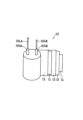
- FIG. 1 is a cross-sectional schematic diagram of an electrolytic capacitor according to an embodiment of the present disclosure
- FIG. 2 is a schematic diagram in which a part of a capacitor element of the electrolytic capacitor of FIG. 1 is developed;
- electrolytic capacitors for example, using a highly conductive conductive polymer component (conjugated polymer, dopant, etc.) is advantageous in terms of keeping the initial ESR low. Further, the combination of the conductive polymer component and the electrolytic solution reduces deterioration of the conductive polymer component, which is advantageous from the viewpoint of suppressing an increase in the ESR of the electrolytic capacitor.
- the conductive polymer component contains a conjugated polymer and a dopant, dedoping or decomposition of the dedoped conjugated polymer occurs during repeated use. Therefore, it is difficult to suppress deterioration of conductivity of the conductive polymer component over time. Therefore, it is difficult to suppress the increase in ESR over time.
- a self-doping conductive polymer has a conjugated polymer skeleton and a functional group (anionic group, etc.) that functions as a dopant directly or indirectly bound to this skeleton by a covalent bond. Therefore, when a self-doping type conductive polymer is used, high conductivity can be obtained, and dedoping is less likely to occur as in the case of using a conjugated polymer and a dopant, so that the conductivity decreases over time. hard. Therefore, it is expected that the initial ESR and the change in ESR over time can be kept low. By using a self-doping type conductive polymer in a solid electrolytic capacitor, initial ESR and changes in ESR over time can be suppressed to a low level.
- self-doping conductive polymers are materials with excellent performance.
- a liquid component such as an electrolytic solution
- the initial ESR cannot be kept low, and the ESR changes over time.
- a liquid component it has been difficult to obtain an electrolytic capacitor having performance at a practical level even if a self-doping type conductive polymer is used. It is believed that the initial increase in ESR and the increase over time when the self-doping conductive polymer and liquid component are combined are due to the dissolution of the self-doping conductive polymer in the liquid component.
- a conductive polymer component containing a conjugated polymer and a dopant the presence of the dopant molecule enhances the orientation of the conjugated polymer and provides high crystallinity, so the conductive polymer component becomes rigid. . Even if such a rigid conductive polymer component comes into contact with a liquid component, it is not easily eluted.
- self-doping conductive polymers the polymer chains are relatively flexible, and the positions of functional groups such as anionic groups are random. is low. Therefore, it is considered that the self-doping type conductive polymer has an affinity with the liquid component and easily dissolves into the liquid component.
- the capacitor not disclosed in the present disclosure includes a capacitor element and a liquid component.
- the capacitor element includes an anode foil having a dielectric layer thereon and a conductive polymer component in contact with at least a portion of the dielectric layer.
- the conductive polymer component includes a self-doping conductive polymer.
- the difference between the Hansen solubility parameter HSP p of the self-doping conductive polymer and the Hansen solubility parameter HSP e of the liquid component: ⁇ HSP1 is 9.0 MPa 0.5 or more and 11.4 MPa 0.5 or less.
- the difference between the Hansen solubility parameter HSP p of the self-doping conductive polymer contained in the conductive polymer component and the Hansen solubility parameter HSP e of the liquid component ⁇ HSP1 0 MPa 0.5 or more and 11.4 MPa 0.5 or less.
- ⁇ HSP1 11.4 MPa 0.5 or less
- the conductive polymer component can be sufficiently swollen with the liquid component, so high conductivity can be ensured.
- the initial ESR and the change in ESR over time (more specifically, the increase in ESR when the electrolytic capacitor is used repeatedly) can be kept low.
- ⁇ HSP1 is less than 0.5 at 9.0 MPa
- the liquid component tends to swell the conductive polymer component, but the affinity between the self-doping conductive polymer and the liquid component is high. Dissolution in the liquid component tends to be remarkable.
- ⁇ HSP1 exceeds 0.5 at 11.4 MPa, the dissolution of the self-doping conductive polymer in the liquid component is suppressed, but the swelling property of the self-doping conductive polymer due to the liquid component is low. It is difficult to ensure the effect of improving the conductivity or the effect of repairing the film of the dielectric layer by using it.
- HSP Hansen Solubility Parameter
- the London dispersion force is the attractive force caused by the bias of the charge in the molecule in a minute time, and is equal to the van der Waals force in nonpolar molecules.
- the solubility due to the London dispersion force is ⁇ d.
- a dipole-dipole force is an attractive force acting between dipoles of molecules having a dipole moment (polar molecules), and the solubility due to the dipole-dipole force is ⁇ p.
- Hydrogen bonding forces are strong intermolecular forces that result from a positively charged hydrogen atom covalently bonding to a highly electronegative atom, attracting another negatively charged atom to an equilibrium distance close to the radius of an anion. . ⁇ h is the solubility attributed to the hydrogen bonding force.
- the difference between the Hansen solubility parameter HSP p and the Hansen solubility parameter HSP f of the anode foil having the dielectric layer: ⁇ HSP2 is 10 MPa 0.5 or more and 16 MPa 0.5 or less. There may be.
- the anode foil may contain aluminum.
- the self-doping conductive polymer may contain at least a sulfo group.
- the capacitor element may include a cathode foil and a separator interposed between the anode foil and the cathode foil.
- the separator may be impregnated with the conductive polymer component.
- the electrolytic capacitor of the present disclosure including the above (1) to (5), will be described in more detail below. At least one of the above (1) to (5) may be combined with at least one of the elements described below within a technically consistent range.
- a capacitor element included in an electrolytic capacitor includes at least an anode foil having a dielectric layer on its surface and a conductive polymer component in contact with at least a portion of the dielectric layer.
- the anode foil can include valve action metals, alloys containing valve action metals, compounds containing valve action metals, and the like. These materials can be used singly or in combination of two or more. For example, aluminum, tantalum, niobium, and titanium are preferably used as valve metals.
- anode foil of the capacitor element aluminum is often used for the anode foil of the capacitor element because it is inexpensive, lightweight, and has high conductivity.
- the anode foil containing aluminum is easily corroded by the anionic group contained in the conductive polymer component or the acid component contained in the liquid component.
- the difference between the HSP p of the self-doping conductive polymer and the solubility parameter HSP f of the anode foil having a dielectric layer: ⁇ HSP2 is within the range described later. In this case, elution of the anode foil is suppressed, and corrosion can be suppressed.
- Anode foils containing aluminum may contain aluminum metal, aluminum alloys, or both.
- the anode foil may have a porous portion having pores on its surface.
- An anode foil having a porous portion can be obtained, for example, by roughening the surface of a base material (such as a foil-like or plate-like base material) containing a valve action metal by etching or the like. Roughening may be performed, for example, by electrolytic etching or chemical etching.
- the dielectric layer is formed by anodizing the valve action metal on the surface of the anode foil by chemical conversion treatment or the like.
- the dielectric layer may be formed so as to cover at least part of the anode foil.
- the dielectric layer contains an oxide of a valve metal.
- the dielectric layer contains Ta 2 O 5 when tantalum is used as the valve metal, and the dielectric layer contains Al 2 O 3 when aluminum is used as the valve metal.
- the dielectric layer is not limited to this, and may be any material as long as it functions as a dielectric.
- a dielectric layer is usually formed on the surface of the anode foil.
- the dielectric layer is formed on the surface of the porous portion of the anode foil, it is formed along the inner wall surfaces of the pores of the porous portion and the depressions (pits) on the surface of the anode foil.
- the volume-based pore diameter mode of the anode foil having the dielectric layer may be, for example, 0.1 ⁇ m or more and 0.5 ⁇ m or less.
- the mode of pore diameter may be 0.1 ⁇ m or more and 0.3 ⁇ m or less.
- the self-doping conductive polymer easily penetrates into the pores formed in the anode foil having the dielectric layer, resulting in high capacity.
- the self-doping type conductive polymer becomes more difficult to dissolve, the change in capacitance over time can be reduced.
- high conductivity is maintained, so that the change in ESR over time can be further reduced.
- the volume-based pore size mode of the anode foil having a dielectric layer is obtained by measuring the pore size of pores having a pore size of 10 ⁇ m or less in the volume-based pore size distribution measured using a mercury porosimeter. is the mode value (mode diameter) of In the measurement of the pore size distribution using a mercury porosimeter, the anode foil is removed from the capacitor element, and the attached conductive polymer component is removed using a solvent (ethanol). A sample cut into 5 mm length x 5 mm width) is used.
- the conductive polymer component includes a self-doping conductive polymer.
- a conductive polymer component is in contact with at least a portion of the dielectric layer.
- the conductive polymer component in contact with the surface of the dielectric layer may constitute a layer (sometimes referred to as a conductive polymer layer).
- the conductive polymer component constitutes at least part of the cathode body in the electrolytic capacitor.
- the conductive polymer component may contain at least one of other conjugated polymers (such as non-self-doping conjugated polymers) and dopants, if necessary.
- the conductive polymer component may contain additives as needed.
- the difference ⁇ HSP1 between the HSP p of the self-doping conductive polymer and the HSP e of the liquid component is 9.0 MPa 0.5 or more and 11.4 MPa 0.5 or less, and 9.0 MPa 0.5 or more and 10.5 MPa. It may be 0.5 or less (or 10 MPa 0.5 or less).
- ⁇ HSP1 is in such a range, dissolution of the self-doping conductive polymer into the liquid component can be suppressed and high conductivity can be achieved, despite the combination of the self-doping conductive polymer and the liquid component. High electrical conductivity of the molecular component can be ensured.
- ⁇ HSP1 is 10.5 MPa 0.5 or less (or 10 MPa 0.5 or less), the conductivity of the conductive polymer component is further increased, and the initial ESR can be further reduced.
- ⁇ HSP2 may be, for example, 10 MPa 0.5 or more and 16 MPa 0.5 or less.
- ⁇ HSP2 is 0.5 or more at 10 MPa, the affinity of the self-doping conductive polymer for the dielectric layer is increased, and the self-doping conductive polymer quickly adheres to the dielectric layer, so that the anode foil is formed. protected.
- elution of constituent components (such as aluminum) of the anode foil into the liquid component is suppressed, and corrosion can be suppressed.
- ⁇ HSP2 When .DELTA.HSP2 is 16 or less, the conductive polymer component easily penetrates into fine recesses formed in the anode foil having the dielectric layer, so that a high capacity can be easily obtained. From the viewpoint of further enhancing these effects, ⁇ HSP2 may be 12.5 MPa 0.5 or more and 14.5 MPa 0.5 or less.
- the HSP of the target material is measured using HSPiP (Hansen Solubility Parameters in Practice) software using the Hansen sphere method.
- HSPiP Haansen Solubility Parameters in Practice
- the solubility of the material of interest in multiple solvents with known HSPs is confirmed by dissolution experiments.
- the HSP of the solvent used in the dissolution experiment is plotted in the three-dimensional space of ( ⁇ d, ⁇ p, ⁇ h).
- the center coordinates of the smallest sphere be the HSP of the target material.
- the HSP e of the liquid component is calculated from the material property values of the HSPiP software.
- the solubility in multiple solvents e.g., 10 or more solvents
- HSP e of the liquid component is calculated using HSPiP software. be done.
- the HSP p of the self-doping conductive polymer is calculated using a predetermined amount (for example, 200 mg) of sample collected from the dried product obtained by removing volatile components from the self-doping conductive polymer by drying. More specifically, the solubility of the sample in multiple solvents with known HSPs (e.g., 10 or more solvents) is examined, and the HSP p of the self-doped conductive polymer is calculated using HSPiP software. .
- the HSP f of the anode foil with dielectric layer is taken as the literature value for the bulk of the constituents of the dielectric layer.
- HSP f is determined using a sample obtained by taking out the anode foil having the dielectric layer, washing with ethanol, drying at 125° C. for 2 hours, and collecting the surface layer portion. More specifically, the sample is tested for solubility in multiple solvents with known HSPs (e.g., 10 or more solvents), and the HSPiP software calculates the HSP f of the anode foil with the dielectric layer. .
- the anode foil having the dielectric layer after drying is used to examine the solubility in a plurality of solvents in the same manner as described above, and the HSPiP software is used. to calculate HSP f . In this case, whether or not the dielectric layer dissolves in the solvent is determined by whether or not the dielectric layer has been removed by reflection spectroscopic measurement.
- a self-doping conductive polymer usually contains an anionic group.
- anionic groups include a sulfo group, a carboxyl group, a phosphoric acid group, a phosphonic acid group, and the like.
- the anionic group of the self-doping conductive polymer may be contained in any form such as an anion, free, ester, or salt. It may be contained in a form in which it interacts with or is complexed with the components contained. In the present specification, all these forms are simply referred to as anionic groups.
- the self-doping conductive polymer may contain one type of anionic group, or two or more types.
- the self-doping type conductive polymer may contain at least a sulfo group from the viewpoint of easily ensuring higher conductivity of the self-doping type conductive polymer.
- the self-doping type conductive polymer containing sulfo groups is likely to dissolve in a liquid component due to the action of the sulfo groups, and tends to corrode anode foils (aluminum-containing anode foils, etc.).
- ⁇ HSP1 is within a specific range, so that the dissolution of the self-doping type conductive polymer in the liquid component can be suppressed. can be done. Also, when ⁇ HSP2 is within a specific range, corrosion of the anode foil can be suppressed.
- a self-doping conductive polymer includes a conjugated polymer skeleton and an anionic group introduced into this skeleton. It can be said that the skeleton of the self-doping type conductive polymer is composed of a conjugated polymer.
- the number of anionic groups contained in the self-doping conductive polymer is, for example, 1 or more and 3 or less per molecule of the conjugated polymer constituting the skeleton of the self-doping conductive polymer, It may be two or one.
- Examples of the conjugated polymer constituting the skeleton of the self-doping conductive polymer include polymers having a basic skeleton of polypyrrole, polythiophene, polyaniline, polyfuran, polyacetylene, polyphenylene, polyphenylenevinylene, polyacene, and polythiophenevinylene. be done.
- the above polymer may contain at least one type of monomer unit that constitutes the basic skeleton.
- the above polymers also include homopolymers, copolymers of two or more monomers, and derivatives thereof (substituents having substituents, etc.).
- polythiophenes include poly(3,4-ethylenedioxythiophene) and the like.
- Self-doping type conductive polymers have anionic groups in the skeleton of these conjugated polymers.
- the anionic group may be directly introduced into the skeleton of the conjugated polymer, or may be introduced via a linking group.
- the linking group is preferably a polyvalent group (divalent group) containing an alkylene group.
- Examples of the linking group include aliphatic polyvalent groups (such as divalent groups) such as alkylene groups, —R 1 —X—R 2 — groups (where X is an oxygen element or a sulfur element, R 1 and R are the same or different and are alkylene groups).
- the number of carbon atoms in each alkylene group contained in the linking group may be, for example, 1 or more and 10 or less, or may be 1 or more and 6 or less.
- the alkylene group may be linear or branched.
- the linking group preferably contains at least an alkylene group having 2 or more carbon atoms, from the viewpoint of easily balancing high swelling properties due to the liquid component and suppression of elution into the liquid component.
- the number of carbon atoms in such an alkylene group may be 2 or more (or 3 or more) and 10 or less, or 2 or more (or 3 or more) and 6 or less.
- R 1 may be an alkylene group having 1 to 6 carbon atoms
- R 2 may be an alkylene group having 2 to 10 (or 3 to 3) carbon atoms.
- the linking group is not limited to these.
- the conjugated polymer that constitutes the skeleton of the self-doping conductive polymer may be polypyrrole, polythiophene, or polyaniline.
- the self-doping type conductive polymer includes a conjugated polymer skeleton containing a monomer unit corresponding to a thiophene compound and an anionic group introduced into this skeleton. is preferred.
- thiophene compounds include compounds having a thiophene ring and capable of forming a repeating structure of corresponding monomer units.
- Thiophene compounds can be linked at the 2- and 5-positions of the thiophene ring to form a repeating structure of monomeric units.
- the thiophene compound may have a substituent at, for example, at least one of the 3- and 4-positions of the thiophene ring.
- the 3-position substituent and the 4-position substituent may be linked to form a ring condensed to the thiophene ring.
- the thiophene compounds include, for example, thiophenes optionally having a substituent at at least one of the 3- and 4-positions, alkylenedioxythiophene compounds (C 2-4 alkylenedioxythiophene compounds such as ethylenedioxythiophene compounds, etc. ).
- Alkylenedioxythiophene compounds also include compounds having substituents on the alkylene group portion.
- substituents include alkyl groups (C 1-4 alkyl groups such as methyl group and ethyl group), alkoxy groups (C 1-4 alkoxy groups such as methoxy group and ethoxy group), hydroxy groups, hydroxyalkyl groups ( hydroxy C 1-4 alkyl groups such as hydroxymethyl groups) and the like are preferred, but not limited thereto.
- each substituent may be the same or different.
- the thiophene ring (at least one of the thiophene ring and the alkylene group in the alkylenedioxythiophene ring) has the above anionic group or group containing an anionic group (e.g., sulfoalkyl group, etc.) as a substituent.
- an anionic group e.g., sulfoalkyl group, etc.
- the self-doping conductive polymer is a skeleton of a conjugated polymer (such as PEDOT) containing at least a monomer unit corresponding to a 3,4-ethylenedioxythiophene compound (such as 3,4-ethylenedioxythiophene (EDOT)).
- a conjugated polymer such as PEDOT
- EDOT 3,4-ethylenedioxythiophene
- the skeleton of the conjugated polymer containing at least the monomer unit corresponding to EDOT may contain only the monomer unit corresponding to EDOT, or may contain, in addition to the monomer unit, a monomer unit corresponding to a thiophene compound other than EDOT.
- the weight average molecular weight (Mw) of the self-doping conductive polymer is not particularly limited, but is, for example, 1,000 or more and 1,000,000 or less, and may be 1,000 or more and 100,000 or less. ,000 or more and 50,000 or less.
- Mw weight average molecular weight
- the weight average molecular weight (Mw) is a polystyrene-equivalent value measured by gel permeation chromatography (GPC). GPC is usually measured using a polystyrene gel column and water/methanol (volume ratio 8/2) as a mobile phase.
- the ratio of the self-doping conductive polymer contained in the conductive polymer component is, for example, 50% by mass or more, may be 75% by mass or more, or may be 90% by mass or more.
- the ratio of the self-doping type conductive polymer contained in the conductive polymer component is 100% by mass or less.
- the conductive polymer component may be composed only of the self-doping type conductive polymer.
- conductive polymers such as non-self-doping type conductive polymers contained in the conductive polymer component include, for example, conjugated polymers (non-self-doping type conjugated polymers (e.g., anionic conjugated polymers without groups) and dopants.
- conjugated polymers include the conjugated polymer exemplified as the conjugated polymer constituting the main skeleton of the self-doping conductive polymer.
- the conjugated polymer and the conjugated polymer constituting the main skeleton of the self-doping conductive polymer have similar skeletons, high affinity is likely to be obtained.
- a non-self-doping conjugated polymer containing thiophene compound monomer units and a self-doping conductive polymer having a main skeleton containing thiophene compound monomer units may be combined.
- Thiophene compounds corresponding to the monomer units of the non-self-doping conjugated polymer include the thiophene compounds described for the self-doping conductive polymer.
- the dopant includes at least one selected from the group consisting of anions and polyanions (such as polymer anions).
- anions include sulfate ions, nitrate ions, phosphate ions, borate ions, organic sulfonate ions, and carboxylate ions.
- Dopants that generate sulfonate ions include, for example, p-toluenesulfonic acid and naphthalenesulfonic acid.
- a polymer anion may be used from the viewpoint of easily obtaining higher stability.
- Polymeric anions having a sulfo group include, for example, polymeric type polysulfonic acids.
- polymer anions include polyvinylsulfonic acid, polystyrenesulfonic acid (PSS (including copolymers and substituents having substituents)), polyarylsulfonic acid, polyacrylsulfonic acid, polymethacrylsulfonic acid, poly (2-acrylamido-2-methylpropanesulfonic acid), polyisoprene sulfonic acid, polyester sulfonic acid (aromatic polyester sulfonic acid, etc.), and phenolsulfonic acid novolac resin.
- PSS polystyrenesulfonic acid
- dopants are not limited to these specific examples.
- the layered conductive polymer component may be a single layer or may be composed of a plurality of layers.
- the composition of the conductive polymer components contained in each layer may be the same or different.
- a conductive polymer component (or a conductive polymer layer) is formed, for example, using a treatment liquid (also referred to as a liquid composition) containing a self-doping conductive polymer.
- a treatment liquid also referred to as a liquid composition
- an anode foil having a dielectric layer, or a capacitor element precursor including an anode foil having a dielectric layer and a cathode body for example, an anode foil having a dielectric layer and a cathode foil are wound with a separator interposed therebetween.
- the wound body is immersed in the liquid composition and then dried to form a conductive polymer component (or a conductive polymer layer) in contact with the dielectric layer.
- the self-doping conductive polymer may be dissolved in the liquid composition or dispersed in the form of particles.
- the liquid composition may further contain other components (eg, other conjugated polymers, dopants, additives, etc.).
- a liquid composition can be obtained, for example, by polymerizing (eg, oxidative polymerization) a precursor of a self-doping conductive polymer in a liquid medium.
- the precursor include at least one selected from the group consisting of monomers constituting the self-doping conductive polymer, oligomers in which several monomers are linked together, and prepolymers. If necessary, at least one of other conjugated polymer and dopant may coexist when preparing the liquid composition.
- liquid media examples include water and organic liquid media.
- the liquid medium is, for example, a medium that is liquid at room temperature (temperature of 20° C. or higher and 35° C. or lower).
- organic liquid media include monohydric alcohols (methanol, ethanol, propanol, etc.), polyhydric alcohols (ethylene glycol, glycerin, etc.), or aprotic polar solvents (N,N-dimethylformamide, dimethylsulfoxide, acetonitrile, acetone, benzonitrile, etc.).
- the liquid composition may contain one liquid medium or two or more liquid mediums.
- the average particle size of the particles of the self-doping conductive polymer should be 100 nm or less from the viewpoint of easy filling into the pores of the porous portion. It may be 50 nm or less. Although the lower limit of the average particle size is not particularly limited, it is, for example, 0.5 nm or more or 5 nm or more.
- the average particle size here means the median size (D50) in the volume-based particle size distribution.
- the average particle size of the self-doping conductive polymer can be obtained from the particle size distribution by, for example, dynamic light scattering (DLS).
- DLS dynamic light scattering
- aqueous dispersion for example, a liquid dispersion
- LB-550 dynamic light scattering particle size distribution analyzer
- a metal foil (cathode foil) may be used for the cathode body.
- the type of metal is not particularly limited, and for example, valve action metals such as aluminum, tantalum, and niobium, or alloys containing valve action metals may be used. If necessary, the surface of the metal foil may be roughened.
- the surface of the metal foil may be provided with a chemical conversion coating, or may be provided with a coating of a metal (dissimilar metal) different from the metal constituting the metal foil (dissimilar metal) or a non-metal coating. Examples of dissimilar metals and non-metals include metals such as titanium and non-metals such as carbon.
- a separator may be arranged between the cathode foil and the anode foil.
- the separator is not particularly limited, and for example, a nonwoven fabric containing fibers of cellulose, polyethylene terephthalate, vinylon, polyamide (eg, aromatic polyamide such as aliphatic polyamide and aramid) may be used.
- the separator may be impregnated with the conductive polymer component.
- the conductive polymer component is interposed between the anode foil and the cathode foil and may be in contact with at least a portion of the dielectric layer and at least a portion of the cathode foil.
- the combination of the self-doping type conductive polymer and the liquid component provides high conductivity of the conductive polymer component, so even in these embodiments, the initial ESR and the change in ESR over time are kept low. be able to.
- the electrolytic capacitor may be of wound type, chip type or laminated type.
- An electrolytic capacitor may have at least one capacitor element, and may have a plurality of capacitor elements.
- an electrolytic capacitor may comprise a stack of two or more capacitor elements, or may comprise two or more wound capacitor elements. The configuration or number of capacitor elements may be selected according to the type or application of the electrolytic capacitor.
- Liquid components include, for example, non-aqueous solvents.
- the non-aqueous solvent is selected according to the HSP p of the self-doping conductive polymer such that ⁇ HSP1 is within the above range.
- Non-aqueous solvents include alcohol solvents, sulfone compounds, lactone compounds, carbonate compounds and the like.
- the liquid component may contain one type of non-aqueous solvent, or may contain two or more types in combination.
- Alcohol solvents include monohydric alcohols and polyhydric alcohols.
- the alcohol-based solvent may contain at least a polyhydric alcohol from the viewpoint of easily obtaining high repairability of the dielectric layer.
- Polyhydric alcohols include glycol compounds, glycerin compounds, sugar alcohol compounds, and the like.
- Glycol compounds include alkylene glycol, polyalkylene glycol, and alkylene oxide adducts of polyhydric alcohols.
- Alkylene glycols include ethylene glycol (EG), propylene glycol (PG), trimethylene glycol, butanediol, pentanediol, hexanediol, dihydroxyoctane, dihydroxynonane, dihydroxydecane, and the like.
- Alkylene glycol may be linear or branched. The number of carbon atoms in the alkylene glycol may be, for example, 2 or more and 10 or less.
- Polyalkylene glycols include poly C 2-4 alkylene glycols (eg, diethylene glycol, dipropylene glycol, triethylene glycol, polyethylene glycol (PEG), polypropylene glycol (PPG), polytrimethylene glycol, polytetramethylene glycol, etc.), etc. is mentioned.
- alkylene oxide adducts of polyhydric alcohols include C 2-4 alkylene oxide adducts of polyhydric alcohols ( ethylene oxide adducts, propylene oxide adducts, etc.).
- Alkylene oxide adducts polyethylene oxide adducts, propylene oxide adducts, etc. are also included.
- polyhydric alcohols to which alkylene oxide is added include alkylene glycols having different alkylene moiety structures from those of alkylene oxide (eg, alkylene glycols having 4 or more carbon atoms), trimethylolpropane, sugar alcohols (glycerin , erythritol, mannitol, pentaerythritol, etc.).
- the number of repeating oxyalkylene units in the polyalkylene glycol is, for example, 2 or more and 600 or less, may be 2 or more and 10 or less, or may be more than 10 and 600 or less (eg, 100 or more and 600 or less).
- the number of alkylene oxide units in the alkylene oxide adduct may be 1 or more, and the total number of alkylene oxide units may be 2 or more.
- the total number of repeating alkylene oxide units in the alkylene oxide adduct may be 2 or more and 50 or less, or may be 2 or more and 20 or less.
- Glycerin compounds include glycerin and polyglycerin (diglycerin, triglycerin, etc.). The number of repeating glycerin units in polyglycerin is, for example, 2 or more and 20 or less, and may be 2 or more and 10 or less.
- Sugar alcohol compounds include sugar alcohols (erythritol, mannitol, pentaerythritol, etc.).
- Sulfone compounds include sulfolane (SL), dimethylsulfoxide and diethylsulfoxide.
- Lactone compounds include ⁇ -butyrolactone (GBL), ⁇ -valerolactone and the like.
- Carbonate compounds include dimethyl carbonate, diethyl carbonate, ethylmethyl carbonate, ethylene carbonate, propylene carbonate and fluoroethylene carbonate.
- the non-aqueous solvent preferably contains at least a glycol compound.
- at least one solvent selected from the group consisting of alkylene glycols having 4 or more carbon atoms and polyalkylene glycols having 3 or more carbon atoms in the alkylene moiety (hereinafter sometimes referred to as first solvent) is preferred.
- Polyalkylene glycol includes a copolymer having two or more oxyalkylene units, an adduct obtained by adding an alkylene oxide having 3 or more carbon atoms to alkylene glycol (however, the alkylene moiety of alkylene glycol and the alkylene moiety of alkylene oxide are structure is different) etc. are also included.
- the alkylene moiety contained in these glycol compounds may be linear or branched.
- alkylene glycols having 4 or more carbon atoms examples include butanediol (1,2-butanediol, 1,3-butanediol, 2,3-butanediol, 1,4-butanediol, etc.), pentanediol (1, 2-pentanediol, 1,3-pentanediol, 1,4-pentanediol, 2,4-pentanediol, 1,5-pentanediol, etc.), hexanediol (3-methyl-2,4-pentanediol, 1 , 2-hexanediol, 1,3-hexanediol, 1,4-hexanediol, 1,6-hexanediol, etc.), dihydroxyoctane (2-ethyl-1,3-hexanediol, 1,2-dihydroxyoctane,
- the number of carbon atoms in the alkylene glycol may be 4 or more and 10 or less, or may be 4 or more and 8 or less.
- the number of carbon atoms in the alkylene glycol may be 4 or more and 6 or less from the viewpoint of facilitating adjustment of ⁇ HSP1, facilitating swelling of the conductive polymer component, and facilitating obtaining a higher capacity.
- Each of the two hydroxy groups of the alkylene glycol may be bonded to any of the primary, secondary and tertiary carbon atoms contained in the alkylene moiety.
- Alkylene glycol may have a structure in which at least one carbon atom is interposed between the carbon atoms to which each hydroxy group is attached. In this case, the force term ⁇ p between dipoles is increased, and the swelling effect of the conductive polymer component is further increased, thereby further improving the conductivity.
- Polyalkylene glycol having 3 or more carbon atoms in the alkylene moiety may contain a repeating structure of oxyalkylene having 3 or more carbon atoms (such as oxyC 3-4 alkylene), and oxyalkylene having 3 or more carbon atoms (oxyC 3-4 alkylene) and repeating structures of oxyethylene.
- the number of carbon atoms in the oxyalkylene may be 6 or less, or 4 or less.
- the ratio of oxyalkylene units having 3 or more carbon atoms (oxy C 3-4 alkylene units, etc.) to the total monomer units constituting the polyalkylene glycol may be 50 mol% or more, 70 mol% or more, or 90 mol%. or more.
- polyalkylene glycols examples include PPG, polytetramethylene glycol, polybutylene glycol (such as poly C 3-4 alkylene glycol), polyoxyethylene-polyoxypropylene copolymer (for example, 50 mol % of the total monomer units). or more oxypropylene units), propylene oxide adducts of ethylene glycol, propylene oxide adducts of alkylene glycol having 4 or more carbon atoms, butylene oxide adducts of C 2-3 alkylene glycol, butylene oxide adducts of alkylene glycol, and the like.
- the number of carbon atoms in the alkylene glycol to which the alkylene oxide is added is, for example, 10 or less, and may be 8 or less or 6 or less.
- the repeating number of oxyalkylene units in the polyalkylene glycol, the number of alkylene oxide units in the additional portion of the alkylene oxide adduct, or the total number of repeating alkylene oxide units in the additional portion can each be selected from the ranges described above.
- the Mw of the polyalkylene glycol is, for example, 1000 or less, may be 150 or more (or 200 or more) and 1000 or less, or may be 150 or more (or 200 or more) and 700 or less.
- Mw of the polyalkylene glycol is in such a range, it is easy to adjust ⁇ HSP1 within the above range, and the effect of suppressing the dissolution of the self-doping conductive polymer in the liquid component is enhanced.
- the liquid component may contain one type of the first solvent, or may contain two or more types in combination.
- the liquid component may contain a first solvent and a non-aqueous solvent other than the first solvent (hereinafter referred to as a second solvent).
- a second solvent the above non-aqueous solvent other than the first solvent, specifically, at least one selected from the group consisting of alcohol solvents other than the first solvent, sulfone compounds, lactone compounds, and carbonate compounds, etc. is mentioned.
- the ratio of the first solvent to the non-aqueous solvent contained in the liquid component is 50% by mass or more. is preferable, and 75% by mass or more or 90% by mass or more is more preferable.
- the ratio of the first solvent to the non-aqueous solvent is 100% by mass or less.
- the non-aqueous solvent may consist of only the first solvent.
- the content of the first solvent in the liquid component is, for example, 30% by mass or more, and may be 50% by mass or more or 55% by mass or more. When the content of the first solvent is within this range, ⁇ HSP1 can be easily adjusted within the above range, and the effect of suppressing the dissolution of the self-doping conductive polymer in the liquid component is further enhanced.
- the content of the first solvent in the liquid component may be 100% by mass or less, or may be, for example, 85% by mass or less or 75% by mass or less in consideration of the concentrations of solutes and additives. . These lower limit values and upper limit values can be combined arbitrarily.
- the content of the first solvent in the liquid component may be, for example, 30% by mass or more and 100% by mass or less, or 50% by mass or more (or 55% by mass or more) and 100% by mass or less. In these ranges, the upper limit may be changed to the above range.
- the liquid component contains a first solvent and a second solvent
- a second solvent containing at least one selected from the group consisting of sulfone compounds and lactone compounds when an alcohol-based second solvent is used. Compared to , it is advantageous in suppressing changes in ESR over time.
- GC-MS analysis may be performed under the following conditions.
- Apparatus GCMS-QP2010 (manufactured by Shimadzu Corporation) Sample volume: 1 ⁇ L
- Heating flow Hold 50°C for 1 minute ⁇
- the liquid component may contain a solute.
- solutes include acid components, base components, and the like.
- acid components include acids having a carbonyloxy bond (carboxylic acid, oxocarbonic acid, Meldrum's acid, etc.), acids having a carbonyloxy bond, coordination compounds of phenolic compounds, phenolic compounds (picric acid, p-nitrophenol , pyrogallol, catechol, etc.), sulfur-containing acids (sulfuric acid, sulfonic acid (aromatic sulfonic acid, etc.), oxyaromatic sulfonic acid (phenol-2-sulfonic acid, etc.), etc.), compounds having a sulfonylimide bond, boron-containing acids (such as boric acid, halogenated boric acid (such as tetrafluoroboric acid), or partial esters thereof), phosphorus-containing acids (such as phosphoric acid, halogenated phosphoric acid (such as hexafluorophosphoric acid), phosphonic acid, phosphinic acid, or These partial esters, etc.), nitrogen-
- carboxylic acid examples include aliphatic carboxylic acid, aromatic carboxylic acid (including sulfoaromatic carboxylic acid (p-sulfobenzoic acid, 3-sulfophthalic acid, 5-sulfosalicylic acid, etc.)) and the like.
- Aromatic carboxylic acids in particular, aromatic hydroxy acids (benzoic acid, salicylic acid, etc.), aromatic polycarboxylic acids (phthalic acid, pyromellitic acid, etc.) are preferred because of their high stability.
- Compounds having a sulfonylimide bond include saccharin, 1,2-benzenedisulfonimide, cyclohexafluoropropane-1,3-bis(sulfonyl)imide, 4-methyl-N-[(4-methylphenyl)sulfonyl] benzenesulfonamide, dibenzenesulfonimide, trifluoromethanesulfonanilide, N-[(4-methylphenyl)sulfonyl]acetamide, benzenesulfonanilide, N,N'-diphenylsulfamide and the like.
- the coordination compound examples include coordination compounds in which at least one central atom selected from the group consisting of boron, aluminum and silicon is bonded to the central atom with an acid having a carbonyloxy bond.
- Specific examples of coordination compounds include borodisalicylic acid, borodisoxalic acid, borodiglycolic acid, borodigallic acid, borodicatechol, and borodipyrogallol.
- the liquid component may contain one type of acid component, or may contain two or more types.
- aromatic carboxylic acids phthalic acid, salicylic acid, benzoic acid, etc.
- the above coordination compounds borodisalicylic acid, borodisoxalic acid, borodiglycolic acid, etc.
- Salicylic acid and the like are preferred.
- the acid component may be contained in the liquid component in a free form, an anion form, or a salt form. All these forms are sometimes referred to as an acid component.
- the liquid component may contain a base component together with the acid component.
- the base component neutralizes at least a portion of the acid component. Therefore, corrosion of the electrode due to the acid component can be suppressed while increasing the concentration of the acid component.
- the liquid component may contain one or more base components.
- Amines may be aliphatic, aromatic, or heterocyclic.
- Amines include, for example, trimethylamine, diethylamine, ethyldimethylamine, triethylamine, ethylenediamine, aniline, pyrrolidine, imidazole (such as 1,2,3,4-tetramethylimidazolinium), and 4-dimethylaminopyridine.
- imidazole such as 1,2,3,4-tetramethylimidazolinium
- 4-dimethylaminopyridine such as 1,2,3,4-tetramethylimidazolinium
- Examples of quaternary ammonium compounds include amidine compounds (including imidazole compounds).
- the liquid component may contain the base component in free form, cation form, or salt form. All these forms are sometimes referred to as base components.
- the molar ratio of the total amount of the acid component to the base component may be, for example, 0.5 or more (or 1 or more) and 50 or less, or 1.1 or more (or 1.5 or more). It may be 20 or less.
- the pH of the liquid component may be 1 or more and 4 or less, or may be 1 or more and 3.5 or less.
- the concentration of the solute in the liquid component is 0.1% by mass or more and 25% by mass or less from the viewpoint of ensuring high dissociation of the solute in the liquid component and easily obtaining high film repairability of the dielectric layer. 0.5% by mass or more and 25% by mass or less (or 15% by mass or less).
- concentration of the acid component is determined in terms of the free acid, not the anion or salt.
- concentrations of base components are determined in terms of free base, not cations or salts.
- each lead terminal may be joined to an electrode (metal foil or the like) by welding or the like, or may be joined to the electrode via a conductive adhesive.
- An electrolytic capacitor is made by housing a capacitor element and a liquid component in a case or an exterior body.
- an electrolytic capacitor may be formed by housing a capacitor element and a liquid component in a bottomed case and sealing the opening of the bottomed case with a sealing member. At this time, the other end portion of the anode lead terminal and the other end portion of the cathode lead terminal are respectively pulled out from the case or the exterior body. The other end of each terminal exposed from the case or the exterior body is used for solder connection with a board on which the electrolytic capacitor is to be mounted.
- the electrolytic capacitor of the present disclosure will be described more specifically based on the embodiments.
- the electrolytic capacitor of the present disclosure is not limited to the following embodiments.
- FIG. 1 is a schematic cross-sectional view of an electrolytic capacitor according to this embodiment
- FIG. 2 is a schematic diagram showing a part of a capacitor element of the same electrolytic capacitor.
- the electrolytic capacitor includes, for example, a capacitor element 10, a bottomed case 101 that accommodates the capacitor element 10 and a liquid component (not shown), a sealing member 102 that closes the opening of the bottomed case 101, and a seat plate that covers the sealing member 102. 103 , lead wires 104 A and 104 B extending from the sealing member 102 and penetrating the seat plate 103 , and lead tabs 105 A and 105 B connecting the lead wires and the electrodes of the capacitor element 10 .
- the vicinity of the open end of the bottomed case 101 is drawn inward, and the open end is curled so as to be crimped to the sealing member 102 .
- the capacitor element 10 is, for example, a wound body as shown in FIG.
- the wound body includes anode foil 11 connected to lead tab 105A, cathode foil 12 connected to lead tab 105B, and separator 13 .
- Anode foil 11 and cathode foil 12 are wound with separator 13 interposed therebetween.
- the outermost circumference of the wound body is fixed by a winding stop tape 14 .
- FIG. 2 shows a partially unfolded state before stopping the outermost circumference of the wound body.
- a dielectric layer (not shown) is formed on at least a part of the anode foil 11 in the capacitor element 10 .
- a separator 13 and a conductive polymer component (not shown) are interposed between the anode foil 11 and the cathode foil 12 .
- a conductive polymer component is in contact with at least a portion of the dielectric layer.
- the conductive polymer component is in contact with at least a portion of the cathode foil 12 .
- the conductive polymer component and the separator are impregnated with a liquid component.
- Electrolytic Capacitors E1 to E7 and C1 to C4>> A wound electrolytic capacitor (diameter 8 mm ⁇ L (length) 10 mm) having a rated voltage of 35 V and a rated capacitance of 150 ⁇ F was produced. A specific manufacturing method of the electrolytic capacitor will be described below.
- An aluminum foil having a thickness of 100 ⁇ m was subjected to an etching treatment to roughen the surface of the aluminum foil. After that, a dielectric layer was formed on the surface of the aluminum foil by chemical conversion treatment.
- the chemical conversion treatment was carried out by immersing an aluminum foil in an ammonium adipate solution and applying a voltage of 60 V thereto. After that, the aluminum foil was cut to prepare an anode foil.
- An anode lead tab and a cathode lead tab were connected to the anode foil and the cathode foil, and the anode foil and the cathode foil were wound via a separator while winding the lead tab.
- An anode lead wire and a cathode lead wire were connected to the ends of each lead tab protruding from the wound body.
- the produced wound body was subjected to chemical conversion treatment again to form a dielectric layer on the cut end of the anode foil. Next, the ends of the outer surface of the wound body were fixed with a winding stop tape to produce a wound body.
- aqueous dispersion (liquid composition) containing a self-doping polythiophene-based polymer was prepared.
- the concentration of the polythiophene-based polymer in the liquid composition was set to 4% by mass.
- the polythiophene-based polymer particles were very small particles with a particle size of less than 1 nm.
- As the self-doping polythiophene-based polymer PEDOT (Mw: about 10,000) having a sulfo group bonded to the PEDOT skeleton via a linking group containing a butylene group was used.
- an aqueous dispersion containing PEDOT doped with PSS concentration: 4% by mass
- an accelerated test was performed by placing the electrolytic capacitor in a constant temperature bath with a 145°C atmosphere and keeping the rated voltage applied for 500 hours.
- the ESR and Cap were measured in a 20° C. environment in the same manner as the initial ESR and Cap, and the average values (ESR and Cap after the accelerated test) of 20 solid electrolytic capacitors were obtained.
- the ratio of the Cap after the accelerated test to the initial Cap was obtained as the Cap change rate.
- the Cap change rate is an index of Cap change over time.
- the initial ESR, the ESR after the accelerated test, and the Cap rate of change are each shown as a ratio when the value of Comparative Example 1 is 100.
- Table 1 shows the evaluation results.
- E1 to E7 are examples, and C1 to C4 are comparative examples.
- C4 has a large ⁇ ESR and a low capacity change rate compared to E1 to E7 is that dedoping occurs in the accelerated test, causing deterioration of the conductive polymer and lowering the conductivity of the solid electrolyte layer. it is conceivable that.
- ⁇ HSP2 is 10 MPa 0.5 or more and 16 MPa 0.5 or less, a high capacity is obtained even after the accelerated test. It is considered that this is because the conductive polymer component easily penetrates into fine recesses on the surface of the dielectric layer, and the elution of the conductive polymer component during the accelerated test is suppressed.
- the electrolytic capacitor of the present disclosure can be used as a hybrid electrolytic capacitor. Electrolytic capacitors have small changes in ESR over time and are excellent in reliability. Therefore, it is particularly suitable for applications that require high reliability. However, the uses of electrolytic capacitors are not limited to these.
- Electrolytic capacitor 101 Bottomed case 102: Sealing body 103: Seat plate 104A, 104B: Lead wire 105A, 105B: Lead tab 10: Capacitor element 11: Anode foil 12: Cathode foil 13: Separator 14: Winding tape
Landscapes
- Engineering & Computer Science (AREA)
- Power Engineering (AREA)
- Chemical & Material Sciences (AREA)
- Chemical Kinetics & Catalysis (AREA)
- Electrochemistry (AREA)
- Microelectronics & Electronic Packaging (AREA)
- Compositions Of Macromolecular Compounds (AREA)
Priority Applications (3)
| Application Number | Priority Date | Filing Date | Title |
|---|---|---|---|
| US18/841,220 US20250191849A1 (en) | 2022-02-28 | 2023-02-20 | Electrolytic capacitor |
| CN202380023905.8A CN118765427A (zh) | 2022-02-28 | 2023-02-20 | 电解电容器 |
| JP2024503128A JPWO2023162914A1 (https=) | 2022-02-28 | 2023-02-20 |
Applications Claiming Priority (2)
| Application Number | Priority Date | Filing Date | Title |
|---|---|---|---|
| JP2022030095 | 2022-02-28 | ||
| JP2022-030095 | 2022-02-28 |
Publications (1)
| Publication Number | Publication Date |
|---|---|
| WO2023162914A1 true WO2023162914A1 (ja) | 2023-08-31 |
Family
ID=87765765
Family Applications (1)
| Application Number | Title | Priority Date | Filing Date |
|---|---|---|---|
| PCT/JP2023/005923 Ceased WO2023162914A1 (ja) | 2022-02-28 | 2023-02-20 | 電解コンデンサ |
Country Status (4)
| Country | Link |
|---|---|
| US (1) | US20250191849A1 (https=) |
| JP (1) | JPWO2023162914A1 (https=) |
| CN (1) | CN118765427A (https=) |
| WO (1) | WO2023162914A1 (https=) |
Cited By (1)
| Publication number | Priority date | Publication date | Assignee | Title |
|---|---|---|---|---|
| KR20240131455A (ko) | 2022-12-21 | 2024-08-30 | 가부시끼가이샤 레조낙 | 도전성 중합체 함유 분산액, 고체 전해 콘덴서 및 그 제조방법 |
Families Citing this family (1)
| Publication number | Priority date | Publication date | Assignee | Title |
|---|---|---|---|---|
| CN117678042A (zh) * | 2021-07-26 | 2024-03-08 | 松下知识产权经营株式会社 | 电解电容器 |
Citations (3)
| Publication number | Priority date | Publication date | Assignee | Title |
|---|---|---|---|---|
| WO2013024886A1 (ja) * | 2011-08-17 | 2013-02-21 | 旭硝子株式会社 | 含フッ素共重合体組成物、コーティング用組成物、塗膜を有する物品、及び成形品 |
| WO2021153752A1 (ja) * | 2020-01-31 | 2021-08-05 | パナソニックIpマネジメント株式会社 | 電解コンデンサおよびその製造方法 |
| JP2021195437A (ja) * | 2020-06-12 | 2021-12-27 | 東ソー株式会社 | 導電性高分子水溶液及びその用途 |
Family Cites Families (3)
| Publication number | Priority date | Publication date | Assignee | Title |
|---|---|---|---|---|
| US11482382B2 (en) * | 2012-02-27 | 2022-10-25 | Kemet Electronics Corporation | Electrolytic capacitor and process for forming an electrolytic capacitor |
| WO2015171727A1 (en) * | 2014-05-07 | 2015-11-12 | E. I. Du Pont De Nemours And Company | Polyimide web separator for use in an electrochemical cell |
| JP7083225B2 (ja) * | 2016-05-12 | 2022-06-10 | 株式会社村田製作所 | 電子部品の製造方法 |
-
2023
- 2023-02-20 US US18/841,220 patent/US20250191849A1/en active Pending
- 2023-02-20 JP JP2024503128A patent/JPWO2023162914A1/ja active Pending
- 2023-02-20 WO PCT/JP2023/005923 patent/WO2023162914A1/ja not_active Ceased
- 2023-02-20 CN CN202380023905.8A patent/CN118765427A/zh active Pending
Patent Citations (3)
| Publication number | Priority date | Publication date | Assignee | Title |
|---|---|---|---|---|
| WO2013024886A1 (ja) * | 2011-08-17 | 2013-02-21 | 旭硝子株式会社 | 含フッ素共重合体組成物、コーティング用組成物、塗膜を有する物品、及び成形品 |
| WO2021153752A1 (ja) * | 2020-01-31 | 2021-08-05 | パナソニックIpマネジメント株式会社 | 電解コンデンサおよびその製造方法 |
| JP2021195437A (ja) * | 2020-06-12 | 2021-12-27 | 東ソー株式会社 | 導電性高分子水溶液及びその用途 |
Cited By (2)
| Publication number | Priority date | Publication date | Assignee | Title |
|---|---|---|---|---|
| KR20240131455A (ko) | 2022-12-21 | 2024-08-30 | 가부시끼가이샤 레조낙 | 도전성 중합체 함유 분산액, 고체 전해 콘덴서 및 그 제조방법 |
| US12278061B1 (en) | 2022-12-21 | 2025-04-15 | Resonac Corporation | Conductive polymer-containing dispersion liquid, solid electrolytic capacitor and method for producing same |
Also Published As
| Publication number | Publication date |
|---|---|
| JPWO2023162914A1 (https=) | 2023-08-31 |
| US20250191849A1 (en) | 2025-06-12 |
| CN118765427A (zh) | 2024-10-11 |
Similar Documents
| Publication | Publication Date | Title |
|---|---|---|
| CN103429796B (zh) | 借助聚甘油提高包含pedot/pss作为固体电解质的电容器的电参数的方法 | |
| US9589734B2 (en) | Solid electrolytic capacitor and manufacturing method thereof | |
| JP5397531B2 (ja) | 電解コンデンサの製造方法 | |
| JP7836953B2 (ja) | 電解コンデンサ | |
| WO2023162914A1 (ja) | 電解コンデンサ | |
| JP7731057B2 (ja) | 電解コンデンサおよびその製造方法 | |
| WO2015119047A1 (ja) | 固体電解コンデンサ及びその製造方法 | |
| WO2020022471A1 (ja) | 電解コンデンサ | |
| JP6868848B2 (ja) | 電解コンデンサ | |
| JP7400123B2 (ja) | 高信頼性用途のためのポリマーコンデンサの製造プロセス | |
| WO2023162915A1 (ja) | 電解コンデンサ | |
| CN102592847B (zh) | 固体电解电容器及其制造方法 | |
| JP7702641B2 (ja) | 電解コンデンサおよびその製造方法 | |
| WO2023189924A1 (ja) | 固体電解コンデンサ素子および固体電解コンデンサ、ならびに固体電解コンデンサ素子の製造方法 | |
| JP2023123115A (ja) | 固体電解コンデンサ素子およびその製造方法、ならびに固体電解コンデンサおよびその製造方法 | |
| WO2026004777A1 (ja) | 電解コンデンサ | |
| JP7850938B2 (ja) | 電解コンデンサおよびその製造方法 | |
| JP7660305B2 (ja) | 電解コンデンサおよび電解コンデンサの製造方法 | |
| WO2025047357A1 (ja) | 電解コンデンサおよび電解コンデンサの液状成分用添加剤 | |
| WO2026004778A1 (ja) | 電解コンデンサ | |
| JP2024078273A (ja) | 電解コンデンサおよび電解コンデンサ用液状成分 | |
| WO2025070507A1 (ja) | 電解コンデンサ | |
| WO2024162157A1 (ja) | 電解コンデンサおよびその製造方法 | |
| WO2026094937A1 (ja) | 電解コンデンサおよびそれに用いられる電解液 | |
| WO2026094938A1 (ja) | 電解コンデンサおよびそれに用いられる電解液 |
Legal Events
| Date | Code | Title | Description |
|---|---|---|---|
| 121 | Ep: the epo has been informed by wipo that ep was designated in this application |
Ref document number: 23759915 Country of ref document: EP Kind code of ref document: A1 |
|
| ENP | Entry into the national phase |
Ref document number: 2024503128 Country of ref document: JP Kind code of ref document: A |
|
| WWE | Wipo information: entry into national phase |
Ref document number: 18841220 Country of ref document: US |
|
| WWE | Wipo information: entry into national phase |
Ref document number: 202380023905.8 Country of ref document: CN |
|
| NENP | Non-entry into the national phase |
Ref country code: DE |
|
| 122 | Ep: pct application non-entry in european phase |
Ref document number: 23759915 Country of ref document: EP Kind code of ref document: A1 |
|
| WWP | Wipo information: published in national office |
Ref document number: 18841220 Country of ref document: US |