WO2023162455A1 - ペン入力装置用シート - Google Patents
ペン入力装置用シート Download PDFInfo
- Publication number
- WO2023162455A1 WO2023162455A1 PCT/JP2022/047965 JP2022047965W WO2023162455A1 WO 2023162455 A1 WO2023162455 A1 WO 2023162455A1 JP 2022047965 W JP2022047965 W JP 2022047965W WO 2023162455 A1 WO2023162455 A1 WO 2023162455A1
- Authority
- WO
- WIPO (PCT)
- Prior art keywords
- input device
- sheet
- pen
- writing
- pen input
- Prior art date
- Legal status (The legal status is an assumption and is not a legal conclusion. Google has not performed a legal analysis and makes no representation as to the accuracy of the status listed.)
- Ceased
Links
Images










Classifications
-
- G—PHYSICS
- G06—COMPUTING OR CALCULATING; COUNTING
- G06F—ELECTRIC DIGITAL DATA PROCESSING
- G06F3/00—Input arrangements for transferring data to be processed into a form capable of being handled by the computer; Output arrangements for transferring data from processing unit to output unit, e.g. interface arrangements
- G06F3/01—Input arrangements or combined input and output arrangements for interaction between user and computer
- G06F3/03—Arrangements for converting the position or the displacement of a member into a coded form
- G06F3/033—Pointing devices displaced or positioned by the user, e.g. mice, trackballs, pens or joysticks; Accessories therefor
- G06F3/0354—Pointing devices displaced or positioned by the user, e.g. mice, trackballs, pens or joysticks; Accessories therefor with detection of two-dimensional [2D] relative movements between the device, or an operating part thereof, and a plane or surface, e.g. 2D mice, trackballs, pens or pucks
- G06F3/03545—Pens or stylus
-
- G—PHYSICS
- G06—COMPUTING OR CALCULATING; COUNTING
- G06F—ELECTRIC DIGITAL DATA PROCESSING
- G06F3/00—Input arrangements for transferring data to be processed into a form capable of being handled by the computer; Output arrangements for transferring data from processing unit to output unit, e.g. interface arrangements
- G06F3/01—Input arrangements or combined input and output arrangements for interaction between user and computer
- G06F3/03—Arrangements for converting the position or the displacement of a member into a coded form
- G06F3/041—Digitisers, e.g. for touch screens or touch pads, characterised by the transducing means
-
- G—PHYSICS
- G06—COMPUTING OR CALCULATING; COUNTING
- G06F—ELECTRIC DIGITAL DATA PROCESSING
- G06F2203/00—Indexing scheme relating to G06F3/00 - G06F3/048
- G06F2203/041—Indexing scheme relating to G06F3/041 - G06F3/045
- G06F2203/04101—2.5D-digitiser, i.e. digitiser detecting the X/Y position of the input means, finger or stylus, also when it does not touch, but is proximate to the digitiser's interaction surface and also measures the distance of the input means within a short range in the Z direction, possibly with a separate measurement setup
Definitions
- the present invention relates to a pen input device sheet that is used in a pen input device and contacts the pen tip of an electronic pen.
- a pen input device is composed of an electronic pen and a position detection device that detects a position indicated by the electronic pen.
- Electronic pens used in pen input devices for such small-sized electronic devices are becoming slimmer, and many of the pen tips have the same diameter as the pen tips of commercially available ballpoint pens.
- Patent Document 1 Japanese Patent Application Laid-Open No. 2014-137640
- Patent Document 2 Japanese Patent Application Laid-Open No. 2014-149817
- Patent Document 3 Japanese Patent Application Laid-Open No. 2006-119772 proposes a sheet (film) for a pen input device in which the surface of the sheet is coated with a soft resin so as to make writing comfortable.
- Patent Document 4 Japanese Patent Laid-Open No. 2018-173905
- Patent Document 4 Japanese Patent Laid-Open No. 2018-173905
- a writing comfort improving sheet has been proposed in which the writing comfort improving layer has spherical fine particles, and the writing comfort improving layer satisfies the following predetermined limited conditions.
- the pen tip of the touch pen with a hard felt core with a pen tip diameter of 0.5 mm is pressed against the surface of the writing quality improvement layer with which the touch pen comes into contact under a load of 3.92 N.
- Contact in the vertical direction move in any direction parallel to the surface of the writing comfort improving layer at a speed of 100 mm / min, measure the pen tip resistance, and chart Fourier transform of the obtained movement distance - pen tip resistance.
- the amplitude in the frequency range of 1 to 2 Hz obtained from the frequency-amplitude chart obtained by conversion is said to be 1.2 or more and 10 or less.
- the writing feeling improvement sheet described in Patent Document 4 sets a standard for the feeling of resistance and smoothness as a writing feeling when writing with a touch pen with a hard felt core with a pen tip diameter of 0.5 mm, and follows the standard.
- the idea of obtaining a writing feel similar to or similar to that obtained when writing is input on a predetermined writing medium with a predetermined writing instrument is also proposed in Patent Document 4.
- the present invention provides a pen input that is capable of obtaining a writing feel equivalent to or similar to the writing feel of a combination of a writing instrument and a writing medium selected as a target when performing writing input with an electronic pen.
- An object of the present invention is to provide a device sheet.
- a sheet for a pen input device having a writing input surface side with a pen, When the electronic pen is moved at a predetermined speed on the writing input surface of the sheet for pen input device, the vibration frequency characteristic of the dynamic friction coefficient is such that a predetermined writing instrument can be used on a predetermined writing medium.
- a sheet for a pen input device characterized by being adapted to vibration frequency characteristics of a dynamic friction coefficient when moved at a speed of .
- the sheet for a pen input device having the above-described structure, when performing writing input with an electronic pen, it is possible to obtain a writing feeling equivalent to or similar to the writing feeling of a combination of a writing utensil and a writing medium desired by the user. can be done.
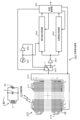
- FIG. 1 is a diagram for explaining a circuit configuration example of a position detection device of a pen input device using the pen input device sheet according to the present invention
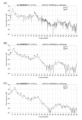
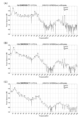
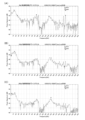
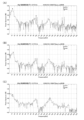
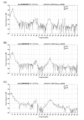
- FIG. 2 is a diagram showing an example of vibration frequency characteristics of a dynamic friction coefficient in an example of a writing instrument and a writing medium targeted by an embodiment of a sheet for a pen input device according to the present invention
- FIG. 1 is a diagram for explaining a circuit configuration example of a position detection device of a pen input device using the pen input device sheet according to the present invention
- FIG. 2 is a diagram showing an example of vibration frequency characteristics of a dynamic friction coefficient in an example of a writing instrument and a writing medium targeted by an embodiment of a sheet for a pen input device according to the present invention
- FIG. 2 is a diagram showing an example of vibration frequency characteristics of a dynamic friction coefficient in an example of a writing instrument and a writing medium targeted by an embodiment of a sheet for a pen input device according to the present invention
- FIG. 2 is a diagram showing an example of vibration frequency characteristics of a dynamic friction coefficient in an example of a writing instrument and a writing medium targeted by an embodiment of a sheet for a pen input device according to the present invention
- FIG. 2 is a diagram showing an example of vibration frequency characteristics of a dynamic friction coefficient in an example of a writing instrument and a writing medium targeted by an embodiment of a sheet for a pen input device according to the present invention
- FIG. 1 is a diagram for explaining a main part of a configuration example of an embodiment of a sheet for a pen input device according to the present invention
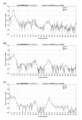
- FIG. 4 is a diagram showing an example of vibration frequency characteristics of the dynamic friction coefficient in the embodiment of the pen input device sheet according to the present invention
- FIG. 4 is a diagram showing an example of vibration frequency characteristics of the dynamic friction coefficient in the embodiment of the pen input device sheet according to the present invention
- FIG. 5 is a diagram showing an example of vibration frequency characteristics of a dynamic friction coefficient in another example of a writing instrument and a writing medium targeted by an embodiment of the sheet for a pen input device according to the present invention
- FIG. 5 is a diagram showing an example of vibration frequency characteristics of a dynamic friction coefficient in another example of a writing instrument and a writing medium targeted by an embodiment of the sheet for a pen input device according to the present invention
- FIG. 2 is a diagram showing an example of vibration frequency characteristics of a dynamic friction coefficient in an example of a writing instrument and a writing medium targeted by an embodiment of a sheet for a pen input device according to the present invention
- FIG. 2 is a diagram showing an example of vibration frequency characteristics of a dynamic friction coefficient in an example of a writing instrument and a writing medium targeted by an embodiment of a sheet for a pen input device according to the present invention
- FIG. 2 is a diagram showing an example of vibration frequency characteristics of a dynamic friction coefficient in an example of a writing instrument and a writing medium targeted by an embodiment of a sheet for a pen input device according to the present invention
- FIG. 2 is a diagram showing an example of vibration frequency characteristics of a dynamic friction coefficient in an example of a writing instrument and a writing medium targeted by an embodiment of a sheet for a pen input device according to the present invention
- FIG. 1 is a diagram showing an example of vibration frequency characteristics of a dynamic friction coefficient in an example of a writing instrument and a writing medium targeted by an embodiment of a sheet for a pen input device according to the present invention
- FIG. 2 is a diagram showing an example of vibration frequency characteristics of a dynamic friction coefficient in an example of a writing instrument and a writing medium targeted by an embodiment of a sheet for a pen input device according to the present invention
- FIG. 2 is a diagram showing an example of vibration frequency characteristics of a dynamic friction coefficient in an example of a writing instrument and a writing medium targeted by an embodiment of a sheet for a pen input device according to the present invention
- FIG. 10 is a cross-sectional view for explaining a first modification of the configuration example of the embodiment of the sheet for pen input device according to the present invention
- FIG. 11 is a cross-sectional view for explaining a second modification of the configuration example of the embodiment of the sheet for pen input device according to the present invention
- FIG. 11 is a cross-sectional view for explaining a third modification of the configuration example of the embodiment of the sheet for pen input device according to the present invention
- FIG. 11 is a cross-sectional view for explaining a fourth modification of the configuration example of the embodiment of the sheet for pen input device according to the present invention
- FIG. 11 is a cross-sectional view for explaining a fifth modification of the configuration example of the embodiment of the sheet for pen input device according to the present invention
- FIG. 11 is a cross-sectional view for explaining a sixth modification of the configuration example of the embodiment of the sheet for pen input device according to the present invention
- FIG. 12 is a cross-sectional view for explaining a seventh modification of the configuration example of the embodiment of the sheet for pen input device according to the present invention
- FIG. 12 is a cross-sectional view for explaining an eighth modification of the configuration example of the embodiment of the sheet for a pen input device according to the present invention
- FIG. 1 shows an example of a tablet information terminal 200 as an example of a pen input device.
- the tablet information terminal 200 includes a display device 202, in this example a LCD (Liquid Crystal Display), in the terminal housing, and at the bottom (back side) of the display screen 202D of the display device 202, An electromagnetic induction type position detection device 300 is provided.
- the display device 202 When the display device 202 is not provided, the terminal becomes a pen tablet type terminal, and the position detection device 300 is provided under the top plate of the terminal housing (upper surface plate constituting the input surface of the pen tablet type terminal).
- the position detection device 300 is an electromagnetic induction type position detection device having a position detection area of a size corresponding to the display area of the display screen 202D of the display device 202, although not shown in FIG. A sensor is provided, and the position detection sensor is arranged such that the display area of the display screen 202D and the position detection area overlap each other. Therefore, the tablet information terminal 200 of this example is configured so that almost the entire display area of the display screen 202D serves as the position detection area of the position detection sensor.
- the position detection sensor may be provided so that the position detection area corresponds to a part of the display area of the display screen 202D instead of substantially the entire area of the display area.
- the tablet-type information terminal 200 of this example includes the electronic pen 1 that indicates a position to the position detection sensor of the position detection device 300 by electromagnetic induction. Then, on the display screen 202D of the tablet information terminal 200, the pen input device sheet 100 of the present invention is attached and provided. In this example, almost the entire display area of the display screen 202D is used as the position detection area of the position detection sensor. are arranged. The exposed surface of the sheet 100 for pen input device becomes the input surface for position indication by the electronic pen 1, that is, the writing input surface.
- the pen input device sheet of the present invention may be used even in the pen tablet type terminal that does not include the display device 202 .
- the user touches the tip of the core body (pen tip) of the electronic pen 1 to the pen input device sheet 100 and applies a predetermined pen pressure to the pen input device sheet 100 .
- Perform input operations such as drawing lines with .
- the position detection device 300 detects a drawing input by the electronic pen 1 on the pen input device sheet 100 and also detects the writing pressure of the electronic pen 1 at the time of the drawing input.
- FIG. 2 shows an outline of the electronic pen 1 used in the tablet information terminal 200 of this example.
- the electronic pen 1 of this example is a case of an electromagnetic induction type electronic pen.
- a printed circuit board 6 on which electronic components such as a capacitor 5 constituting a resonance circuit are mounted is arranged in order in the axial direction and stored.
- the coil 3 is wound around a ferrite core 7, which is an example of a magnetic core having a through hole 7a in the axial direction, and is housed in the housing 2 near the opening 2a on the pen point side.
- the writing pressure detection unit 4 includes a fitting portion 9 into which the axial center portion 82 of the core 8 is fitted.
- the core body 8 has a configuration in which a tip portion 81 that serves as a pen tip and a shaft portion 82 are integrally connected.
- the core body 8 is inserted into the housing 2 through the opening 2 a from the axial center portion 82 side and passes through the through hole 7 a of the ferrite core 7 .
- the end portion of the axial center portion 82 of the core body 8 is fitted and held in the fitting portion 9 provided in the writing pressure detecting portion 4 .
- the tip portion 81 of the core body 8 protrudes outside from the opening 2a of the housing 2, as shown in FIG. .
- the pen pressure detection unit 4 is configured with a variable capacitance capacitor that detects the pen pressure applied to the tip 81 of the core 8 as a change in capacitance. An electrical connection is made to form a resonant circuit together with the coil 3 and the capacitor 5 .
- the electromagnetic induction type electronic pen 1 of this example performs signal interaction with the position detection sensor of the position detection device 300 in a resonance circuit. Detect the coordinates of the position
- the writing pressure detection unit 4 receives the pressure in the axial direction of the core 8 through the fitting portion 9 and detects the pressure in the axial direction as a change in capacitance.
- the resonance frequency of the resonance circuit changes due to this change in capacitance.
- the position detection device detects the writing pressure applied to the tip 81 of the core 8 of the electronic pen 1 based on the detection of this change in resonance frequency.
- circuit configuration for position detection and writing pressure detection in position detection device used with electronic pen 1 [Circuit configuration for position detection and writing pressure detection in position detection device used with electronic pen 1]
- one end and the other end of the coil 3 are connected to a capacitor 5, and a variable capacitor 4C composed of the writing pressure detection unit 4 is connected. are connected in parallel to the coil 3 and the capacitor 5 to form a resonance circuit 1R.
- the electromagnetic induction type position detection device 300 of this embodiment transmits a signal to the electronic pen 1 by electromagnetic induction coupling, and the electronic pen 1 feeds back the signal received from the position detection device 300 via the resonance circuit 1R. do.
- the feedback signal from the resonance circuit 1R of the electronic pen 1 is received by electromagnetic induction coupling, and the position on the sensor indicated by the electronic pen 1 is shifted from the position on the sensor where the received signal is detected.
- the change in the resonance frequency is detected.
- an X-axis direction loop coil group 311 and a Y-axis direction loop coil group 312 are laminated to form a position detection sensor 310 composed of position detection coils. Further, the position detection device 300 is provided with a selection circuit 313 to which the X-axis direction loop coil group 311 and the Y-axis direction loop coil group 312 are connected. This selection circuit 313 sequentially selects one loop coil from the two loop coil groups 311 and 312 .
- the position detection device 300 includes an oscillator 301, a current driver 302, a switching connection circuit 303, a reception amplifier 304, a position detection circuit 305, a writing pressure detection circuit 306, and a processing control unit 307. is provided.
- the processing control unit 307 is composed of a microcomputer. The processing control unit 307 controls selection of loop coils in the selection circuit 313 and switching of the switching connection circuit 303 , and controls processing timings in the position detection circuit 305 and the writing pressure detection circuit 306 .
- the oscillator 301 generates an AC signal of frequency f0.
- the oscillator 301 then supplies the generated AC signal to the current driver 302 and the writing pressure detection circuit 306 .
- the current driver 302 converts the AC signal supplied from the oscillator 301 into a current and sends it to the switching connection circuit 303 .
- the switching connection circuit 303 switches connection destinations (transmitting terminal T, receiving terminal R) to which the loop coil selected by the selection circuit 313 is connected under the control of the processing control unit 307 .
- a current driver 302 is connected to the terminal T on the transmission side
- a reception amplifier 304 is connected to the terminal R on the reception side.
- the induced voltage generated in the loop coil selected by the selection circuit 313 is sent to the reception amplifier 304 via the selection circuit 313 and the switching connection circuit 303 .
- the reception amplifier 304 amplifies the induced voltage supplied from the loop coil and sends it to the position detection circuit 305 and the pen pressure detection circuit 306 .
- an induced voltage is generated by the radio wave transmitted from the electronic pen 1.
- the position detection circuit 305 detects the induced voltage generated in the loop coil, that is, the received signal, converts the detected output signal into a digital signal, and outputs the digital signal to the processing control unit 307 .
- the processing control unit 307 determines the coordinates of the indicated position of the electronic pen 1 in the X-axis direction and the Y-axis direction based on the digital signal from the position detection circuit 305, that is, the level of the voltage value of the induced voltage generated in each loop coil. Calculate the value.
- the writing pressure detection circuit 306 synchronously detects the output signal of the reception amplifier 304 with the AC signal from the oscillator 301, obtains a signal with a level corresponding to the phase difference (frequency shift) therebetween, and A signal corresponding to the phase difference (frequency shift) is converted into a digital signal and output to the processing control unit 307 .
- the processing control unit 307 applies to the electronic pen 1 based on the level of the digital signal from the writing pressure detection circuit 306, that is, the signal level corresponding to the phase difference (frequency shift) between the transmitted radio wave and the received radio wave. Detects the pressure applied.
- the creator of the sheet for a pen input device selects a combination of target writing utensils and writing media for which he/she wishes to obtain a feeling of writing with an electronic pen.
- the selected writing instrument is moved linearly, for example, at a predetermined speed in a predetermined direction while applying a predetermined writing pressure, and the dynamic friction coefficient at that time is measured. do.
- the coefficient of dynamic friction is measured as a time-series change (vibration change) when the passage of time during linear movement is plotted on the horizontal axis.
- the time-series change in the dynamic friction coefficient obtained as the measurement result is Fourier transformed to obtain the power spectrum of the change (vibration) over time in the dynamic friction coefficient, that is, the vibration frequency characteristic of the dynamic friction coefficient.
- the frequency distribution of the vibration magnitude of the dynamic friction coefficient in the obtained vibration frequency characteristics of the dynamic friction coefficient and the frequencies protruding from the adjacent frequency range are detected, and the frequency distribution of the vibration magnitude is detected. Detect the frequency at which the peak of the amplitude of vibration that protrudes from the broad waveform is detected.
- the peak of the magnitude of vibration is the maximum value at the top of the crest constituting the frequency distribution of the magnitude of vibration.
- the dynamic friction coefficient when moving the selected writing instrument at a predetermined speed on the selected writing medium is produced by configuring the sheet so as to have the vibration frequency characteristic of the dynamic friction coefficient that matches the vibration frequency characteristic.
- the vibration frequency of the dynamic friction coefficient when moving the electronic pen on the writing input surface of the created pen input device sheet at the same speed as when the dynamic friction coefficient was measured in the combination of the selected writing instrument and writing medium A sheet for a pen input device is constructed so that the characteristics match the vibration frequency characteristics of the coefficient of dynamic friction obtained in the selected writing instrument and writing medium combination.
- the peak of the vibration magnitude of the dynamic friction coefficient in the vibration frequency characteristics of the dynamic friction coefficient obtained for the pen input device sheet is The frequency to be presented is within the range of frequency fp ⁇ Hz where the peak of the vibration magnitude of the dynamic friction coefficient in the vibration frequency characteristics of the dynamic friction coefficient obtained in the combination of the selected writing instrument and writing medium exists.
- the value of ⁇ at the frequency fp ⁇ Hz is determined according to the range of writing pressure applied to the tip of the electronic pen 1 by the user during writing.
- the value of ⁇ is determined in view of the fact that the tip of the writing instrument that contacts the writing medium may have various degrees of hardness, that is, in this embodiment, the pencil lead may have several types of hardness. It is determined in consideration of the difference in peak frequency corresponding to the difference in hardness of these several types.
- not only pencils but also fountain pens, for example have differences in the hardness of the nib, and ballpoint pens also have differences in the size of the ball at the tip (thinness of the nib). is determined.
- the dynamic friction coefficient of the pen input device sheet of the embodiment is By configuring the pen input device sheet so that the vibration frequency characteristics match the vibration frequency characteristics of the dynamic friction coefficient obtained in the selected target combination of writing instrument and writing medium, the combination of the selected writing instrument and writing medium It is possible to obtain a writing feeling equivalent to or similar to the writing feeling in .
- the frequency having the peak of the vibration magnitude of the dynamic friction coefficient in the vibration frequency characteristics of the dynamic friction coefficient of the pen input device sheet 100 corresponds to the selected writing instrument and writing medium.
- the pen input device sheet is configured so that the peak of the vibration magnitude of the dynamic friction coefficient in the vibration frequency characteristics of the dynamic friction coefficient obtained under various writing pressures is within the frequency range. Even if the writing pressure applied to the electronic pen changes, it is possible to obtain a writing feeling equivalent to or similar to the writing feeling in the combination of the selected writing instrument and writing medium.
- the frequency having the peak of the vibration magnitude of the dynamic friction coefficient in the vibration frequency characteristics of the dynamic friction coefficient of the pen input device sheet 100 corresponds to the selected writing instrument and writing medium.
- the frequency range where the peak of the vibration magnitude of the dynamic friction coefficient exists in the vibration frequency characteristics of the dynamic friction coefficient obtained according to the difference in hardness of the tip portion that is the contact portion with the writing medium of the selected writing instrument Since the sheet for a pen input device is configured so as to obtain a writing feel equivalent to or similar to that of a combination of a selected writing instrument and writing medium, regardless of the difference in hardness of the core body of the electronic pen. can be done.
- the sheet for a pen input device is for a case where the combination of a target writing instrument and writing medium for which a user desires to obtain writing comfort with an electronic pen is a combination of a pencil and paper.
- the pencil as an example of the writing utensil was a Hi-Uni pencil manufactured by Mitsubishi Pencil Co., Ltd., and the example of the writing medium was copy paper.
- the pencil was subjected to three writing pressures of 50 gf, 100 gf and 200 gf, and the pencil was linearly moved on the copy paper at a speed of 10 mm/sec, for example, for measurement.
- the pencil was moved while being inclined at an angle of about 45 to 60 degrees with respect to the surface of the copy paper.
- the time series change of the dynamic friction coefficient obtained as the measurement result was Fourier transformed to obtain the power spectrum of the change (vibration) of the dynamic friction coefficient over time, that is, the vibration frequency characteristic of the dynamic friction coefficient.
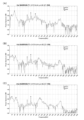
- FIG. 4 shows the case of writing with a pencil with a core hardness of 4B
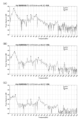
- FIG. 5 shows the case of writing with a pencil with a core hardness of 2B
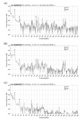
- FIG. 6 shows the case of writing with a pencil with a core hardness of HB
- FIG. 7 respectively show the vibration frequency characteristics of the dynamic friction coefficient when writing with a pencil having a lead hardness of 2H.
- FIGS. 4(A), 5(A), 6(A) and 7(A) show that when a writing pressure of 50 gf is applied to the pencil
- FIGS. 6(B) and 7(B) are when 100 gf is applied to the pencil as writing pressure
- FIGS. 4(C), 5(C), 6(C) and 7(C) are as writing pressure It shows the vibration frequency characteristics of the dynamic friction coefficient in each case when 200 gf is applied to a pencil.
- the vibration frequency characteristics of the dynamic friction coefficient when writing on copy paper with a pencil with a writing pressure of 50 gf The frequency at which the magnitude of the vibration of the dynamic friction coefficient peaks is 18 Hz for a 4B pencil, 20 Hz for a 2B pencil, 17 Hz for a HB pencil, and 15 Hz for a 2H pencil. It can be confirmed that the characteristic exhibits a peak with a magnitude of .
- the writing pressure when a user holds a pencil and writes on a writing medium is about 50 gf.
- a frequency that protrudes from the adjacent frequency range exists after 60 Hz, but as a broad waveform over several tens of Hz of the frequency distribution of vibration magnitude Figure 2 shows the trend of the power spectrum distribution with maxima at frequencies below 35 Hz.
- the tip of the lead tends to wear out during the writing process.
- the frictional vibration of writing is influenced by the vibration caused by the breakage of the lead that occurs when the lead is worn out, and the frequency of the measured frictional vibration is dispersed.
- the peak of the magnitude of vibration is 22 Hz for a pencil with a core hardness of 4B and 12 Hz for a pencil with a core hardness of 2B at a frequency of 12 Hz. It can be confirmed that the characteristic exhibits a peak of the magnitude of vibration of .
- the peak of the vibration magnitude of the dynamic friction coefficient in the vibration frequency characteristics of the dynamic friction coefficient when writing on copy paper with a pencil with a writing pressure of 200 gf is It can be confirmed that a pencil with a lead hardness of 4B has a frequency of 8 Hz, and a pencil with a core hardness of 2B has a peak of the magnitude of vibration of the dynamic friction coefficient at a frequency of 10 Hz.
- the peak of the vibration magnitude of the dynamic friction coefficient in the vibration frequency characteristics of the dynamic friction coefficient when writing on copy paper with a pencil with a writing pressure of 200 gf is It can be confirmed that the frequency exhibits a peak of the magnitude of vibration of the dynamic friction coefficient at a frequency of 22 Hz for a pencil with a core hardness of HB and at a frequency of 21 Hz for a pencil with a core hardness of 2H.
- the pen input device sheet of this embodiment can provide a writing feel similar to that of a combination of a pencil and copy paper. Further, even without considering the hardness of the core of the electronic pen 1, considering that the writing pressure when writing on the pen input device sheet 100 with the electronic pen 1 is normally about 50 gf, this Even with such a frequency range, the pen input device sheet of this embodiment can provide a writing feel similar to that of a combination of a pencil and copy paper.
- the vibration frequency characteristic of the dynamic friction coefficient when writing with the electronic pen 1 on the pen input device sheet 100 is The pen input device sheet 100 is configured so as to conform to the vibration frequency characteristics of the coefficient of dynamic friction when writing on copy paper.
- the electronic pen 1 is applied with a predetermined writing pressure, for example, 50 gf, and at a predetermined speed.
- the vibration frequency characteristics of the dynamic friction coefficient of the pen input device sheet 100 when moved at a speed of 10 mm/sec are compared with the vibration frequency characteristics of the dynamic friction coefficient when a pencil is moved on copy paper under the same conditions (Fig. 4(A), FIG. 5(A), FIG. 6(A) and FIG. 7(A)) over a predetermined frequency range, in this example a frequency range of 17 Hz ⁇ 5 Hz. is configured to have a vibration amplitude peak of
- the writing pressure applied to the electronic pen 1 when obtaining the vibration frequency characteristics of the dynamic friction coefficient of the pen input device sheet 100 is not limited to 50 gf, and may be smaller or larger than 50 gf.
- FIG. 8 is a diagram for explaining a configuration example of the pen-input device sheet 100 of the first embodiment.
- the pen input device sheet 100 is shown here in cross-section.
- the pen input device sheet 100 of this embodiment is fixed with a sheet-like adhesive layer 101 on a smooth glass plate 400 that serves as a support for a pen tablet terminal housing or a display device.
- the position detection device 300 is omitted in FIG.
- the same writing effect as when the pen input device sheet is pasted on the pen tablet terminal housing or display device is obtained.
- the pen input device sheet 100 of this embodiment is composed of an adhesive layer 101 and an elastic material layer 102 disposed on the adhesive layer 101, as shown in FIG.
- the elastic material layer 102 a material having elasticity, in this example, a PVC (polyvinyl chloride) sheet having a film thickness of 0.1 mm is used.
- the elastic material layer 102A is disposed on one surface of the sheet-like adhesive layer 101, and the exposed surface 102S of the elastic material layer 102 on the side opposite to the adhesive layer 101 side is the writing input surface of the electronic pen 1. It is said that
- the elastic material layer 102 includes a plurality of layer portions having different configurations (structures) in the thickness direction. 101 side and a second layer portion 1022 on the opposite side.
- examples of different configurations (structures) between the first layer portion 1021 and the second layer portion 1022 include different densities per unit volume from each other and/or The hardness is made different.
- the second layer portion 1022 of the elastic material layer 102 is only a single PVC layer portion.
- the first layer portion 1021 has a concavo-convex pattern 1021P in which concave portions 1021Pa and convex portions 1021Pb are alternately repeated along the plane parallel to the sheet surface of the second layer portion 1022.
- the uneven pattern 1021P is a lattice pattern as shown in FIG. 9 in this example. Therefore, in this example, the first layer portion 1021 and the second layer portion 1022 have different density and hardness per unit volume.
- the tip of the convex portion 1021Pb forming the uneven pattern 1021P of the first layer portion 1021 on the adhesive layer 101 side is brought into contact with one surface of the adhesive layer 101.
- the convex portion 1021Pb of the concave-convex pattern 1021P of the first layer portion 1021 on the adhesive layer 101 side is composed of the hard member 103 made of a harder material than the second layer portion 1022.
- This hard member 103 is made of an ultraviolet (UV (Ultra Violet)) curable material in this example.
- UV Ultra Violet
- the concave portion 1021Pa of the concave/convex pattern 1021P of the first layer portion 1021 on the adhesive layer 101 side is a space that is not filled with material and is filled with air.
- An example of the manufacturing method of the pen input device sheet 100 of this example is as follows. On one surface of the PVC sheet-like second layer portion 1022, a lattice pattern corresponding to the lattice pattern of the concave-convex pattern 1021P is formed with UV curable ink (UV curable ink) as shown in FIG. Then, the hard member 103 is UV-printed and formed by UV curing. In this case, in this example, in the grid pattern formed by the hard member 103, the lines of the UV curable ink forming the grid are tilted 45 degrees with respect to the horizontal and vertical directions of the rectangular position detection area. formed in the state.
- UV curable ink UV curable ink
- FIG. 8 is a cross-sectional view taken along the line AA of FIG. 9, and is a cross-sectional view when the pen input device sheet 100 of this embodiment is cut at the diagonal position of the lattice pattern of the uneven pattern 1021P. It's becoming
- the portion corresponding to the position where the UV curable ink of the hard member 103 UV-printed on the second layer portion 1022 does not exist is the concave portion of the uneven pattern 1021P of the first layer portion 1021 of the elastic material layer 102. 1021 Pa, and the portion corresponding to the position where the UV curable ink exists becomes the convex portion 1021Pb of the uneven pattern 1021P of the first layer portion 1021 of the elastic material layer 102 .
- the sheet-like adhesive layer 101 is attached to the surface of the first layer portion 1021 opposite to the second layer portion 1022 side, thereby forming the pen input device sheet 100 of the embodiment. .
- the vibration frequency characteristic of the dynamic friction coefficient is the vibration frequency characteristic of the dynamic friction coefficient when the pencil is moved on the copy paper (Fig. 4 (A ), see FIGS. 5(A), 6(A) and 7(A)) to exhibit the maximum value of the peak waveform of the dynamic friction coefficient oscillation in the frequency range of 17 Hz ⁇ 5 Hz.
- the line width w (see FIG. 9) of the UV curable ink of the grid pattern for forming the uneven pattern 1021P and the pitch Pt (see FIG. 9) for forming the grid of the grid pattern are selected.
- a grid-like pattern is formed by the cured ink.
- 10 and 11 show the vibration frequency characteristics of the dynamic friction coefficient of the pen-input device sheet 100 according to the first embodiment, in which the uneven pattern 1021P is formed on the layer portion 1021.
- FIG. The vibration frequency characteristics of the coefficient of dynamic friction shown in FIGS. This is a case where writing input is performed with the electronic pen 1 at a speed of 10 mm/sec while the electronic pen 1 is being applied. In this case as well, writing input is performed with the electronic pen 1 tilted at an angle of 45 to 60 degrees with respect to the writing input surface.
- FIG. 10 shows the vibration frequency characteristics of the dynamic friction coefficient of the pen input device sheet 100 when the core of the electronic pen 1 is made of POM (Polyoxymethylene), which is a hard material.
- 10(B) shows the case of applying a writing pressure of 100 gf
- FIG. 10(C) shows the case of applying a writing pressure of 200 gf.
- FIG. 11 shows the vibration frequency characteristics of the dynamic friction coefficient of the pen input device sheet 100 when the core of the electronic pen 1 is made of elastomer, which is a soft material.
- FIG. 11B shows the case of applying 100 gf as writing pressure
- FIG. 11C shows the case of applying 200 gf as writing pressure.
- the pen input device sheet of the first embodiment described above when a handwriting input is made on the pen input device sheet 100 with the electronic pen, the user can write on the copy paper with a pencil. It is possible to obtain the same feel (writing feeling or writing feeling) as in the case of writing input with , and also obtain a rough feeling during writing in the relationship between a pencil and paper.
- the vibration frequency characteristic of the dynamic friction coefficient of the pen input device sheet 100 when the electronic pen 1 is moved at a predetermined speed while a predetermined writing pressure is applied is not within the predetermined frequency range.
- the frequency exhibiting the maximum value of the peak waveform of the vibration of the coefficient of dynamic friction is the maximum value of the peak waveform of the vibration of the coefficient of dynamic friction in the vibration frequency characteristics of the coefficient of dynamic friction when a pencil is moved on copy paper under the same conditions. It may be configured to correspond to, ie, equal or approximate, the frequencies.
- the frequency at which the peak waveform of the vibration of the coefficient of dynamic friction exhibits the maximum value is 17 Hz in the case of a pencil with a lead hardness of HB. Therefore, when writing with the electronic pen 1, if it is desired to obtain the same writing feeling as when writing on a copy paper with a pencil having a core hardness of HB, the vibration frequency characteristic of the dynamic friction coefficient at a writing pressure of 50 gf is
- the pen input device sheet 100 is configured such that the frequency at which the peak waveform of the vibration of the coefficient of dynamic friction at 100 is the maximum value is 17 Hz. That is, the line width and formation pitch of the lattice pattern of the concave-convex pattern of the first layer portion of the elastic material layer 102 in the above-described embodiment are selected so as to achieve such a configuration.
- the writing pressure applied to the pencil and the hardness of the lead of the pencil are changed as targets to be obtained as a feeling of writing when writing with the electronic pen 1, the value of the writing pressure and the hardness of the lead of the pencil are changed.
- the frequency corresponding to the frequency that exhibits the maximum value of the peak waveform of the vibration of the dynamic friction coefficient in the vibration frequency characteristics of the dynamic friction coefficient at the time of hardness exhibits the maximum value of the vibration peak waveform of the dynamic friction coefficient.
- a sheet 100 is constructed.
- the sheet for a pen input device of the second embodiment is for a combination of a ballpoint pen and paper as a target combination of a writing instrument and a writing medium for which a user desires to obtain writing comfort with an electronic pen.
- the ballpoint pen as an example of the writing instrument is "Uni 0.5mm Lakubo" manufactured by Mitsubishi Pencil Co., Ltd.
- the writing medium "Campus loose-leaf notebook No-837WEN” manufactured by Kokuyo Co., Ltd. is used as paper. Using.
- the above-described ballpoint pen was moved on two sheets of paper and three sheets of paper, and the dynamic friction coefficient was measured at that time.
- the ball-point pen was applied with three writing pressures of 50 gf, 100 gf, and 200 gf, and the ball-point pen was linearly moved on the paper at a speed of 10 mm/sec, for example, for the measurement.
- the ballpoint pen was moved while being inclined at an angle of about 45 to 60 degrees with respect to the surface of the paper.
- the time series change of the dynamic friction coefficient obtained as the measurement result was Fourier transformed to obtain the power spectrum of the change (vibration) of the dynamic friction coefficient over time, that is, the vibration frequency characteristic of the dynamic friction coefficient.
- FIGS. 12 and 13 show the vibration frequency characteristics of the dynamic friction coefficient in the case of two sheets
- FIG. 13 shows the vibration frequency characteristics in the case of three sheets.
- FIGS. (C) and FIG. 13(C) show the vibration frequency characteristics of the dynamic friction coefficient when a writing pressure of 200 gf is applied to the ballpoint pen.
- the vibration frequency characteristics of the dynamic friction coefficient when writing on paper with a ballpoint pen with a writing pressure of 50 gf is the peak waveform of the vibration of the dynamic friction coefficient at a frequency of 11 Hz. It was confirmed that the characteristics exhibited the maximum value.
- the writing pressure when a user writes on a writing medium with a ballpoint pen is about 50 gf.
- the frequency at which the peak waveform of the vibration of the dynamic friction coefficient in the vibration frequency characteristics of the dynamic friction coefficient exhibits the maximum value is applied to the ballpoint pen. It was confirmed that as the writing pressure increased, the frequency shifted toward higher frequencies, and the maximum value of the peak waveform of the vibration of the dynamic friction coefficient was slightly suppressed, but hardly changed.
- the pen input device sheet of the second embodiment is configured.
- an elastic material layer 102 is formed on an adhesive layer 101 .
- the hard member 103 formed by UV printing on the first layer portion 1021 is configured based on the vibration frequency characteristics of the dynamic friction coefficient shown in FIGS. 12 and 13 described above.
- the hard member 103 is formed by UV printing on the PVC sheet of the second layer portion 1022 having a thickness of 0.1 mm. , are determined based on the vibration frequency characteristics of the dynamic friction coefficients shown in FIGS.
- the electronic pen The frequency at which the peak waveform of the vibration of the dynamic friction coefficient in the vibration frequency characteristics of the dynamic friction coefficient when writing by 1 is present in the frequency range of 11 Hz to 19 Hz. configure the sheet; That is, when forming the hard member 103 formed by UV printing on the first layer portion 1021, the line width of the UV curable ink and the formation pitch of the grid pattern are selected to values that provide such frequency characteristics. .
- the electronic pen 1 is used on the pen input device sheet of the second embodiment.
- the pen input device sheet of the second embodiment is used so that the frequency at which the peak waveform of the vibration of the dynamic friction coefficient in the vibration frequency characteristics of the dynamic friction coefficient when writing is at its maximum value is in the frequency range of 11 Hz to 16 Hz.
- the hard member 103 is formed on the first layer portion 1021 by UV printing. to be selected.
- the electronic pen 1 can be used to write on the sheet for pen input device of the second embodiment.
- the pen input device sheet of the second embodiment is configured such that the frequency at which the peak waveform of the vibration of the dynamic friction coefficient in the vibration frequency characteristics of the dynamic friction coefficient exhibits the maximum value is 11 Hz. That is, when forming the hard member 103 formed by UV printing on the first layer portion 1021, the line width of the UV curable ink and the formation pitch of the grid pattern are selected to values that provide such frequency characteristics. .
- the frequency at which the peak waveform of the vibration of the dynamic friction coefficient in the vibration frequency characteristics of the dynamic friction coefficient exhibits the maximum value is In the case of 50 gf, it does not change even if the number of sheets of paper is changed, but as the writing pressure increases from 100 gf to 200 gf, the frequency tends to change to a lower frequency as the number of sheets of paper increases. is confirmed. It should be noted that the number of sheets may be considered to correspond to the thickness of one sheet.
- the thickness of paper as a writing medium is considered as an object to obtain as a writing feeling when writing with the electronic pen 1, when writing with the electronic pen 1 on the pen input device sheet of the embodiment, It is effective that the frequency or frequency range exhibiting the maximum value of the peak waveform of the vibration of the dynamic friction coefficient in the vibration frequency characteristic of the dynamic friction coefficient is varied according to the thickness of the paper.
- the vibration frequency characteristics of the dynamic friction coefficient when the thickness of the paper was changed changed to a lower frequency when the thickness of the paper was thicker, as in the case of a ballpoint pen.
- the vibration frequency characteristics of the dynamic friction coefficient of the pen input device sheet the frequency that indicates the maximum value of the peak waveform of the vibration of the dynamic friction coefficient is lower when the thickness of the paper is thicker. tend to change.
- FIGS. 14 to 19 show examples of the vibration frequency characteristics of the dynamic friction coefficient when the thickness of the paper is changed with a combination of pencil and paper.
- Figures 14 to 16 show the coefficient of dynamic friction when writing with a mechanical pencil core of 0.5 mm, Hi-Uni, HB manufactured by Mitsubishi Pencil Co., Ltd., and "Campus Loose Leaf Notebook No-836AT" manufactured by Kokuyo Co., Ltd. as paper.
- FIG. 14 shows the case of one sheet
- FIG. 15 shows the case of two sheets
- FIG. 16 shows the case of three sheets. 17 to 19, as an example of a pencil, a mechanical pencil core of 0.5 mm, Hi-Uni, HB manufactured by Mitsubishi Pencil Co., Ltd.
- FIGS. 17 is for one sheet
- Fig. 18 is for two sheets
- Fig. 19 is for three sheets, are shown respectively.
- the pen input device sheet of the second embodiment described above when writing input is performed with an electronic pen on the pen input device sheet, it is the same as when writing is input on paper with a ballpoint pen. feeling (writing feeling or feeling of writing) can be obtained.
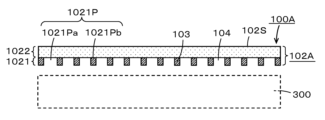
- FIG. 20 is a diagram for explaining a specific configuration example (structural example) of the pen input device sheet 100A of the first modified example.
- the same reference numerals are given to the same components as those of the pen-input device sheet 100 of the first embodiment described above, and the detailed description thereof is as follows. omitted.
- the pen-input device sheet 100A of this first modified example has a configuration obtained by removing the adhesive layer 101 from the pen-input device sheet 100 of the first embodiment.
- the elastic material layer 102A has the first layer portion 1021 on the side facing the direction of the position detection device 300 and the side opposite to the position detection device 300 side. and a second layer portion 1022 on the side.
- the tip of the convex portion 1021Pb of the uneven pattern 1021P of the first layer portion 1021 on the position detection device 300 side is exposed from the surface of the elastic material layer 102A.
- the elastic material layer 102A alone constitutes the pen-input device sheet 100A.
- the pen input device sheet 100A moves in the same manner as paper.
- the pen-input device sheet 100A By pressing the pen-input device sheet 100A with a hand or a tape so as not to cause the pen-input device sheet 100A to be in contact with the pen-input device sheet 100A, it is possible to obtain the same feeling (writing feeling or writing feeling) as that of the pen-input device sheet 100 of the first embodiment described above.
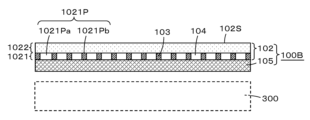
- FIG. 21 is a diagram for explaining a specific configuration example (structural example) of the pen-input device sheet 100B of the second modification.
- the same reference numerals are given to the same components as those of the pen-input device sheet 100 of the first embodiment described above, and detailed description thereof is as follows. omitted.
- the pen-input device sheet 100B of the second modification is an example in which the adhesive layer 101 of the pen-input device sheet 100 of the first embodiment is changed to a base material 105.
- the pen input device sheet 100B of this second modification is composed of a base material 105 and an elastic material layer 102 disposed on the base material 105, as shown in FIG.
- the base material 105 is made of a material harder than the elastic material of the elastic material layer 102, in this example, PET (Polyethylene terephthalate) resin.
- the base material 105 is a sheet-like member that is disposed on the position detection device 300 and covers the entire position detection area of the position detection sensor 310 of the position detection device 300. .
- the elastic material layer 102 has a first layer portion as a layer portion of a plurality of layers having different configurations (structures) in the thickness direction. 1021 and a second layer portion 1022.
- the first layer portion 1021 is on the substrate 105 side
- the second layer portion 1022 is on the side opposite to the substrate 105 side. It is configured to have
- the tips of the projections 1021Pb forming the uneven pattern 1021P of the first layer portion 1021 on the base material 105 side are brought into contact with one surface of the base material 105 .
- the pen input device sheet 100B of the second modified example does not move like paper.
- the pen input device sheet 100B by pressing the pen input device sheet 100B with a hand or tape, it is possible to obtain the same feeling (writing feeling or writing feeling) as that of the pen input device sheet 100 of the first embodiment described above.
- FIG. 22 is a diagram for explaining a specific configuration example (structural example) of the pen-input device sheet 100C of the third modification.
- the same reference numerals are given to the same constituent parts as those of the pen-input device sheet 100 of the first embodiment described above, and detailed description thereof is as follows. omitted.
- the pen-input device sheet 100C of the third modification has the adhesive layer 101 on the surface of the base material 105 opposite to the elastic material layer 102 side of the pen-input device sheet 100B of the second modification. This is an added example.
- the sheet 100C for a pen input device of the third modification includes an adhesive layer 101, a base material 105 provided on the adhesive layer 101, and a base material 105 provided on the base material 105. and an elastic material layer 102 that is The pen input device sheet 100C is attached to the upper surface of the top plate 500 of the pen tablet terminal housing.
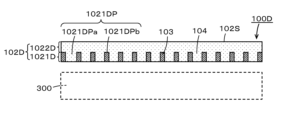
- FIG. 23 is a diagram for explaining a specific configuration example (structural example) of the pen-input device sheet 100D of the fourth modification.
- the same reference numerals are given to the same constituent parts as those of the pen-input device sheet 100 of the first embodiment described above, and the detailed description thereof is as follows. omitted.
- the elastic material of the pen input device sheet 100 of the first embodiment is changed to polyurethane resin, and the recesses of the uneven pattern of the first layer portion 1021 are replaced with This corresponds to an example in which an elastic material is filled and the adhesive layer 101 is removed.
- the elastic material layer 102D has a plurality of layer portions having different configurations (structures) in the thickness direction. As such, it is composed of a first layer portion 1021D and a second layer portion 1022D.
- the elastic material layer 102D has a first layer portion 1021D on the side facing the position detection device 300, and a second layer portion 1021D on the side opposite to the position detection device 300. 1022D.
- the elastic material layer 102D alone constitutes the pen-input device sheet 100D.
- examples of different configurations (structures) between the first layer portion 1021D and the second layer portion 1022D include different densities per unit volume from each other and/or The hardness is made different.
- the second layer portion 1022D of the elastic material layer 102D is made only of a single polyurethane resin.
- the first layer portion 1021D has a concavo-convex pattern 1021DP in which concave portions 1021DPa and convex portions 1021DPb are alternately repeated along the direction of the plane parallel to the exposed surface 102S of the second layer portion 1022D.
- the uneven pattern 1021DP is a lattice pattern as shown in FIG. Therefore, in this example, the first layer portion 1021D and the second layer portion 1022D have different density and hardness per unit volume.
- the concave portions 1021DPa of the uneven pattern 1021DP of the first layer portion 1021D on the position detection device 300 side are filled with the same elastic material as the second layer portion 1022D.
- This elastic material uses an optical material in the case of a terminal having a display device 202 .
- the tip of the projection 1021DPb is exposed from the surface of the elastic material layer 102D.
- the convex portion 1021DPb of the concave-convex pattern 1021DP of the first layer portion 1021D on the position detection device 300 side is more It is configured to be buried with a hard member 103 made of a sufficiently hard material.
- This hard member 103 is made of an ultraviolet (UV (Ultra Violet)) curable material in this example.
- UV Ultra Violet
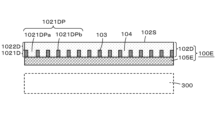
- FIG. 24 is a diagram for explaining a specific configuration example (structural example) of the pen-input device sheet 100E of the fifth modification.
- the same reference numerals are given to the same components as those of the pen-input device sheet 100D of the fourth modification described above in FIG. Description is omitted.
- the sheet for pen input device 100E of the fifth modification is a modification in which a base material 101E is disposed on the position detection device 300 side of the elastic material layer 102D that constitutes the sheet for pen input device 100D of the fourth modification. For example.
- the base material 105E is made of a material harder than the elastic material of the elastic material layer 102D, in this example, PET (Polyethylene terephthalate) resin.
- the base material 105E is a sheet-like member that is disposed on the position detection device 300 and covers the entire position detection area of the position detection sensor 310 of the position detection device 300. .
- the sheet 100E for a pen input device of this fifth modification is composed of a base material 101E and an elastic material layer 102D arranged on this base material 105E.
- a base material 101E an optical material is used in the case of a terminal having the display device 202.
- the tips of the projections 1021Pb forming the uneven pattern 1021P of the first layer portion 1021 on the side of the substrate 105E abut one surface of the substrate 105E.
- the pen input device sheet 100E of the fifth modification when writing is input with an electronic pen on the pen input device sheet 100E of the fifth modification, the pen input device sheet does not move in the same manner as paper. Thus, by pressing the pen input device sheet 100E with a hand or a tape, the same feeling (writing feeling or writing feeling) as that of the pen input device sheet 100 can be obtained.
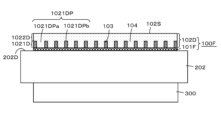
- FIG. 25 is a diagram for explaining a specific configuration example (structural example) of the pen-input device sheet 100F of the sixth modification.
- the same constituent parts as those of the pen-input device sheet 100D of the fourth modification described above are denoted by the same reference numerals, and the detailed description thereof is as follows. omitted.
- the sheet for pen input device 100F of the sixth modification is a modification in which an adhesive layer 101F is arranged on the position detection device 300 side of the elastic material layer 102D that constitutes the sheet for pen input device 100D of the fourth modification. For example.
- the sheet 100F for a pen input device of the sixth modification is composed of an adhesive layer 101F and an elastic material layer 102D disposed on the adhesive layer 101F.
- an optical material is used for the adhesive layer 101F.
- the tip of the convex portion 1021DPb forming the uneven pattern 1021DP of the first layer portion 1021D on the adhesive layer 101F side is brought into contact with one surface of the adhesive layer 101F.
- the pen input device sheet 100 ⁇ /b>F is attached to the display screen 202 ⁇ /b>D of the display unit 202 of the tablet information terminal 200 .
- the entire display area of the display screen 202D is used as the position detection area of the position detection sensor. are arranged.
- the exposed surface of the pen-input device sheet 100F serves as the input surface for position indication with the electronic pen 1, that is, the writing input surface.
- FIG. 26 is a diagram for explaining a specific configuration example (structural example) of the pen-input device sheet 100G of the seventh modification.
- the pen input device sheet 100G of the seventh modification has an adhesive layer 101G on the surface of the pen input device sheet 100E of the fifth modification opposite to the elastic material layer 102D side of the base material 105E. This is an added modified example.
- the sheet 100G for a pen input device of the seventh modification includes an adhesive layer 101G, a base material 105E provided on the adhesive layer 101G, and a base material 105E provided on the base material 105E. and an elastic material layer 102D.
- an optical material is used for the adhesive layer 101G and the base material 105E.
- the pen input device sheet 100 ⁇ /b>G is attached on the display screen 202 ⁇ /b>D of the display section 202 of the tablet information terminal 200 .
- the entire display area of the display screen 202D is used as the position detection area of the position detection sensor. are arranged.
- the exposed surface of the pen-input device sheet 100G becomes an input surface for position indication by the electronic pen 1, that is, a writing input surface.
- FIG. 27 is a diagram for explaining a specific configuration example (structural example) of a pen-input device sheet 100H of an eighth modification obtained by further modifying the pen-input device sheet 100G of the seventh modification. is.
- the same reference numerals are used for the same components as in the pen-input device seat 100G of the seventh modification shown in FIG. , and detailed description thereof will be omitted.
- the combination of the target writing instrument and the writing medium for which one desires to obtain a feeling of writing with the electronic pen 1 is a pencil. This is the case of writing on paper.
- the pen-input device sheet 100H of the eighth modified example is a modified example of the pen-input device sheet 100 of the first embodiment, and is also an improved example.
- a sheet-like adhesive layer 101G is arranged on the surface of the sheet-like base material 105E on the side of the display screen 202D of the display device 202. and an elastic material layer 102H is provided on the opposite surface.
- the elastic material layer 102H includes first layer portions 1021D and 1022D formed in the same manner as the elastic material layer 102D of the pen input device sheet 100G of the seventh modified example of FIG.
- a third layer portion 1023 is provided on top of the second layer portion 1022D.
- the third layer portion 1023 has a concavo-convex pattern 1023P having convex portions 1023Pa and concave portions 1023Pb along the plane parallel to the sheet surface of the sheet-like base material 105E.
- the uneven pattern 1023P of the third layer portion 1023 is a pattern that repeats at specific regular intervals or forms irregularly arranged uneven shapes.
- the concavo-convex pattern 1023P of the third layer portion 1023 is formed at a formation pitch PtH, which is a smaller average distance between concavo-convex patterns than the lattice formation pitch Pt of the lattice pattern of the concavo-convex pattern 1021DP of the first layer portion 1021D.
- the line width of the UV curable ink may be the same or may be changed.
- the formation pitch Pt of the lattice pattern of the uneven pattern 1021DP of the first layer portion 1021D is the same as that of the first and second embodiments described above.
- the vibration frequency characteristic of the dynamic friction coefficient it is selected so as to match the frequency of the maximum value of the peak waveform of the vibration of the dynamic friction coefficient.
- the uneven pattern 1023P of the third layer portion 1023 disperses the sharp peak waveform of the vibration frequency characteristic of the dynamic friction coefficient generated by the above-described method, and forms a broadened peak waveform of the vibration frequency distribution. selected for
- the first layer portion 1021D, the second layer portion 1022D, and the third layer portion 1023 have different densities and hardnesses per unit volume. Both are configured differently.
- “appropriate to the frequency exhibiting the peak” may mean that the frequency exhibiting the peak exists within a predetermined frequency range, or that the frequency exhibiting the peak is , a frequency that matches or approximates a predetermined frequency.
- a method of forming the uneven pattern 1023P of the third layer portion 1023 is as follows. That is, in this example, as shown in FIG. 27, a transfer film member 600 is used. In this transfer film member 600, a concave-convex pattern corresponding to the concave-convex pattern 1023P of the third layer portion 1023 is formed on a sheet-like base film 601 by UV curing ink, and the hard member 602 is UV-printed by UV curing. It was formed by Furthermore, in this transfer film member 600, a release agent is applied to the surface side where the hard member 602 is formed.
- the side of the transfer film member 600 on which the hard member 602 of the base film 601 is formed is pressed against the side of the elastic material layer 102D opposite to the side of the base 105E.
- a third layer portion 1023 is formed on the elastic material layer 102D by peeling.
- An adhesive layer 101G is provided on the surface of the base material 105E opposite to the elastic material layer 102D.
- the elastic material layer 102D of the adhesive layer 101G is formed in the same manner as the pen-input device sheet 100 of the above-described first embodiment.
- the third layer portion 1023 side having the concave-convex pattern 1023P is arranged and used on the display screen 202D so that the side opposite to the side on which the electronic pen 1 is provided is, for example, the display screen side. face.
- the pen input device has vibration frequency characteristics of the dynamic friction coefficient that are more similar to the vibration frequency characteristics of the dynamic friction coefficient in the target combination of the writing instrument and the writing medium. You can get a sheet for
- the maximum value of the peak waveform does not spike from the frequency range before and after, but about 20 Hz including the maximum value of the peak waveform.
- the vibration frequency range with a width of there is a tendency to become a peak portion of a broad waveform over several tens of Hz of the frequency distribution of the magnitude of vibration.
- the pen input device sheet of the third embodiment is provided with:
- the frequency exhibiting the maximum value of the peak waveform of the vibration of the dynamic friction coefficient in the vibration frequency characteristics of the dynamic friction coefficient when writing with the electronic pen 1 is in the frequency range of 17 Hz ⁇ 5 Hz, as in the first embodiment.
- the line width of the UV curable ink and the formation pitch of the lattice pattern when forming the hard member 103 formed by UV printing on the base material 105E are set to the vibration frequency characteristics of the dynamic friction coefficient as in the first embodiment.
- a hard member 602 formed on the base film 601 of the transfer film member 600 is selected so that the frequency exhibiting the maximum value of the peak waveform of the vibration of the coefficient of dynamic friction is in the frequency range of 17 Hz ⁇ 5 Hz.
- the formation pitch of the concavo-convex pattern of the UV curable ink is made smaller than the formation pitch of the hard member 103, and the constant vibration frequency due to the lattice pattern of the hard member 103 is dispersed back and forth, and this eighth modification constitute the pen input device sheet 100H.
- the vibration frequency characteristics of the dynamic friction coefficient can be reproduced for core hardnesses of 4B, 2B and HB.
- the hard member 103 formed by UV printing on the base material 105E is formed in the same manner as in the first embodiment.
- the hard material formed on the base material 601 of the transfer film member 600 is such that the frequency exhibiting the second peak of the vibration of the dynamic friction coefficient in the vibration frequency characteristics of the dynamic friction coefficient exists in the frequency range of 100 Hz ⁇ 10 Hz.
- the pen input device sheet 100H of the eighth modification configured in this way, only the maximum value of the peak waveform of the vibration of the dynamic friction coefficient of the vibration frequency characteristics of the dynamic friction coefficient in the case of the target writing instrument and the writing medium.
- it is configured to adapt to a broad waveform of the frequency distribution of the magnitude of vibration, including the vibration frequency before and after the maximum value of the peak waveform, it is possible to achieve a better writing feel between the target writing instrument and the writing medium. It is possible to approach the writing feeling of the combination.
- hard members for forming the uneven patterns 1021P, 1021DP and 1023P formed on the first layer portions 1021 and 1021D and the third layer portions 1023 of the elastic material layers 102 and 102D 103 and the hard member 602 are formed by UV printing with UV curable ink, but the method of forming the hard member is not limited to UV printing, and any method that can form the hard member can be used. Any method may be used. Alternatively, the uneven shape may be formed by a method of deforming the base material 105 or 105E.
- the hard member 103 and the hard member 602 are formed in a lattice pattern in the above embodiment, they are not limited to a lattice pattern.
- a short line of UV curable resin may be placed on the substrate 101 or 401 .
- the dot-like UV curable resin may be provided in the first layer portions 1021 and 1021D or on the base film 601.
- the pen input device sheet is used for the display Since this example assumes a pen tablet type terminal that is not arranged on the screen, the adhesive layers 101, 101F, 101G and the elastic material layers 102, 102D are made of non-optical materials, but the display When arranged on the screen, it is made of a material having optical properties.
- the electronic pen and the position detection device are of the electromagnetic induction type.
- any method such as an electrostatic coupling method or another method may be used.
- Reference Signs List 1 Electronic pen 1R Resonance circuit 100 100A, 100B, 100C, 101D, 101E, 101F, 101G, 101H Sheet for pen input device 101, 101F, 101G Adhesive layer 102, 102D, 102H Elastic material layer 102S Exposed surface 1021, 1021D First layer portion 1022, 1022D Second layer portion 1023 Third layer portion 1021P, 1021DP Concavo-convex pattern of first layer portion 1021Pa, 1021DPa Concavo-convex pattern 1021P, 1021DP Concave portions 1021Pb, 1021DPb... Convex portions of the concavo-convex patterns 1021P and 1021DP 1023P...
Landscapes
- Engineering & Computer Science (AREA)
- General Engineering & Computer Science (AREA)
- Theoretical Computer Science (AREA)
- Human Computer Interaction (AREA)
- Physics & Mathematics (AREA)
- General Physics & Mathematics (AREA)
- Position Input By Displaying (AREA)
Priority Applications (3)
| Application Number | Priority Date | Filing Date | Title |
|---|---|---|---|
| CN202280090184.8A CN118661148A (zh) | 2022-02-28 | 2022-12-26 | 笔输入装置用片材 |
| JP2024502873A JPWO2023162455A1 (https=) | 2022-02-28 | 2022-12-26 | |
| US18/809,143 US12591318B2 (en) | 2022-02-28 | 2024-08-19 | Pen input device sheet with elastic layer having recessed protruding pattern facing a position detecting device |
Applications Claiming Priority (2)
| Application Number | Priority Date | Filing Date | Title |
|---|---|---|---|
| JP2022029543 | 2022-02-28 | ||
| JP2022-029543 | 2022-02-28 |
Related Child Applications (1)
| Application Number | Title | Priority Date | Filing Date |
|---|---|---|---|
| US18/809,143 Continuation US12591318B2 (en) | 2022-02-28 | 2024-08-19 | Pen input device sheet with elastic layer having recessed protruding pattern facing a position detecting device |
Publications (1)
| Publication Number | Publication Date |
|---|---|
| WO2023162455A1 true WO2023162455A1 (ja) | 2023-08-31 |
Family
ID=87765369
Family Applications (1)
| Application Number | Title | Priority Date | Filing Date |
|---|---|---|---|
| PCT/JP2022/047965 Ceased WO2023162455A1 (ja) | 2022-02-28 | 2022-12-26 | ペン入力装置用シート |
Country Status (4)
| Country | Link |
|---|---|
| US (1) | US12591318B2 (https=) |
| JP (1) | JPWO2023162455A1 (https=) |
| CN (1) | CN118661148A (https=) |
| WO (1) | WO2023162455A1 (https=) |
Families Citing this family (4)
| Publication number | Priority date | Publication date | Assignee | Title |
|---|---|---|---|---|
| US12299218B2 (en) | 2023-06-11 | 2025-05-13 | Remarkable As | Active pen-stylus precise eraser |
| CN121300639A (zh) | 2024-07-08 | 2026-01-09 | 瑞马科宝股份有限公司 | 可更换导电标记笔尖端 |
| CN121300641A (zh) | 2024-07-08 | 2026-01-09 | 瑞马科宝股份有限公司 | 标记笔保护系统 |
| CN121300642A (zh) | 2024-07-08 | 2026-01-09 | 瑞马科宝股份有限公司 | 标记笔书写系统 |
Citations (3)
| Publication number | Priority date | Publication date | Assignee | Title |
|---|---|---|---|---|
| JP2015054417A (ja) * | 2013-09-10 | 2015-03-23 | 株式会社ダイセル | 透明触感フィルム及びその製造方法 |
| JP2018081482A (ja) * | 2016-11-16 | 2018-05-24 | リンテック株式会社 | 書き味向上フィルム |
| JP2018128827A (ja) * | 2017-02-08 | 2018-08-16 | 株式会社ダイセル | ペン入力デバイス用フィルムの評価方法、ペン入力デバイスフィルム評価装置、及びペン入力デバイス用フィルム |
Family Cites Families (6)
| Publication number | Priority date | Publication date | Assignee | Title |
|---|---|---|---|---|
| JP2006119772A (ja) | 2004-10-19 | 2006-05-11 | Nof Corp | ペン入力装置用表面材 |
| JP6196164B2 (ja) | 2013-01-09 | 2017-09-13 | 株式会社ダイセル | ペン入力デバイス |
| JP6013202B2 (ja) | 2013-01-15 | 2016-10-25 | 株式会社ダイセル | 触感改良フィルム及びその製造方法 |
| KR102426427B1 (ko) * | 2017-02-03 | 2022-07-29 | 다이니폰 인사츠 가부시키가이샤 | 터치 패널 펜용 필기성 부재의 선별 방법, 터치 패널 시스템, 터치 패널 펜용 필기성 부재, 터치 패널 및 표시 장치 |
| JP6805053B2 (ja) | 2017-03-31 | 2020-12-23 | リンテック株式会社 | 書き味向上シート |
| JP6801147B2 (ja) * | 2018-12-14 | 2020-12-16 | リンテック株式会社 | 書き味向上シート |
-
2022
- 2022-12-26 JP JP2024502873A patent/JPWO2023162455A1/ja active Pending
- 2022-12-26 WO PCT/JP2022/047965 patent/WO2023162455A1/ja not_active Ceased
- 2022-12-26 CN CN202280090184.8A patent/CN118661148A/zh active Pending
-
2024
- 2024-08-19 US US18/809,143 patent/US12591318B2/en active Active
Patent Citations (3)
| Publication number | Priority date | Publication date | Assignee | Title |
|---|---|---|---|---|
| JP2015054417A (ja) * | 2013-09-10 | 2015-03-23 | 株式会社ダイセル | 透明触感フィルム及びその製造方法 |
| JP2018081482A (ja) * | 2016-11-16 | 2018-05-24 | リンテック株式会社 | 書き味向上フィルム |
| JP2018128827A (ja) * | 2017-02-08 | 2018-08-16 | 株式会社ダイセル | ペン入力デバイス用フィルムの評価方法、ペン入力デバイスフィルム評価装置、及びペン入力デバイス用フィルム |
Also Published As
| Publication number | Publication date |
|---|---|
| US12591318B2 (en) | 2026-03-31 |
| US20240411387A1 (en) | 2024-12-12 |
| CN118661148A (zh) | 2024-09-17 |
| JPWO2023162455A1 (https=) | 2023-08-31 |
Similar Documents
| Publication | Publication Date | Title |
|---|---|---|
| WO2023162455A1 (ja) | ペン入力装置用シート | |
| CN108700962B (zh) | 笔输入装置用板以及笔输入装置用板的制造方法 | |
| JP4872111B2 (ja) | 位置指示器 | |
| JP5308531B2 (ja) | 追加機能性を有する可動トラックパッド | |
| EP0716391B1 (en) | Electrostatic pen apparatus and method | |
| US9158394B2 (en) | Stylus for use with capacitive touch panel | |
| US8633916B2 (en) | Touch pad with force sensors and actuator feedback | |
| US8525530B2 (en) | Variable capacitor and position indicator | |
| JP5854223B2 (ja) | 入力ペン | |
| TWI587182B (zh) | 筆型座標指示器 | |
| US8350813B2 (en) | Digitizer and input device | |
| US20150084935A1 (en) | Electromagnetic and capacitive pointer | |
| EP2263138A2 (en) | A pointer device for capacitive sensitive touch screens | |
| WO2020054163A1 (ja) | 電子ペンおよび電子ペン用の芯体 | |
| JP2016021134A (ja) | タッチペン及びそのペン先 | |
| JPWO2023162455A5 (https=) | ||
| JP2016154054A (ja) | 入力用タッチペン | |
| JP2013065147A (ja) | タッチペン用ペン先、タッチペン、筆記具付きタッチペン、ペン先出没式筆記具および入力ペン用リフィル | |
| AU2013203623B2 (en) | Touch pad with force sensors and actuator feedback | |
| WO2024116826A1 (ja) | ペン入力装置用シート | |
| KR20170018658A (ko) | 다양한 필기감을 가지는 햅틱 스타일러스 펜 | |
| KR102550768B1 (ko) | 자기 유변 탄성체 기반 정전용량 센서 및 진동 액츄에이터 통합 시스템 | |
| KR101229988B1 (ko) | 터치 펜 | |
| JP6634130B2 (ja) | ペン入力装置 | |
| KR20130000411U (ko) | 터치팁 교체형 터치펜 |
Legal Events
| Date | Code | Title | Description |
|---|---|---|---|
| 121 | Ep: the epo has been informed by wipo that ep was designated in this application |
Ref document number: 22928970 Country of ref document: EP Kind code of ref document: A1 |
|
| ENP | Entry into the national phase |
Ref document number: 2024502873 Country of ref document: JP Kind code of ref document: A |
|
| WWE | Wipo information: entry into national phase |
Ref document number: 202280090184.8 Country of ref document: CN |
|
| NENP | Non-entry into the national phase |
Ref country code: DE |
|
| 122 | Ep: pct application non-entry in european phase |
Ref document number: 22928970 Country of ref document: EP Kind code of ref document: A1 |